





Introduction
Peanut harvest for the United States in 2023 totaled 637,247 ha (USDA-NASS 2024). Georgia, the nation’s top peanut-producing state, produced 1.43 million kg (∼53% of the U.S. total). Despite the high value of peanut in Georgia and the United States, agrichemicals for weed control are primarily developed for the major agronomic crops (field corn [Zea mays L.], rice [Oryza sativa L.], soybean [Glycine max L. Merr.], and wheat [Triticum aestivum L.]) that are produced around the world and not specifically for peanut.
Trifludimoxazin is a new herbicide belonging to the N-phenyl-imide family that inhibits protoporphyrinogen oxidase (PPO). Trifludimoxazin is being developed for potential use as a preplant burndown herbicide for use on soybean, field corn, and cotton (Gossypium hirsutum L.), and for vegetation management in chemical fallow areas (Armel et al. Reference Armel, Hanzlik, Witschel, Hennigh, Bowe, Simon, Liebl and Mankin2017; Asher et al. Reference Asher, Dotray, Liebl, Keeling, Ritchie, Udeigwe, Reed, Keller, Bowe, Aldridge and Simon2021; [PMRA] Pest Management Regulatory Agency, 2020; Steppig Reference Steppig2022).
Previously, trifludimoxazin has been reported to be active against Amaranthus biotypes that exhibit target-site resistance to PPO-inhibiting herbicides (Armel et al. Reference Armel, Hanzlik, Witschel, Hennigh, Bowe, Simon, Liebl and Mankin2017; Porri et al. Reference Porri, Betz, Seebruck, Knapp, Johnen, Witschel, Aponte, Liebl, Tranel and Lerchl2023). However, it was recently discovered that a PPO-resistant Palmer amaranth population in Georgia has a relative resistance factor (RRF) of 8 to 49 for trifludimoxazin applied preemergence or postemergence (Randell et al. Reference Randell, Hand, Vance, Wright and Culpepper2024).
Asher et al. (Reference Asher, Dotray, Liebl, Keeling, Ritchie, Udeigwe, Reed, Keller, Bowe, Aldridge and Simon2021) evaluated trifludimoxazin applied 14 d preplant or preemergence on cotton across three Texas soils and discovered that the downward movement of trifludimoxazin from 2.5 cm of irrigation caused unacceptable injury to cotton and reduced biomass when compared with the nontreated control. Trifludimoxazin had the greatest downward movement in the Amarillo soil series, which is classified as a loamy sand, with less than 1% organic matter when it was irrigated with 2.5 cm of water (Asher et al. Reference Asher, Dotray, Liebl, Keeling, Ritchie, Udeigwe, Reed, Keller, Bowe, Aldridge and Simon2021). These data are important since peanut grown in Georgia on deep sands or sandy loams could be subjected to unacceptable levels of injury when trifludimoxazin is applied preemergence.
Prior research has reported differential peanut cultivar response to herbicides (Richburg et al. Reference Richburg, Wilcut, Culbreath and Kvien1995; Wilcut et al. Reference Wilcut, Askew, Bailey, Spears and Isleib2001). However, very little is known regarding peanut cultivar tolerance to trifludimoxazin. Additionally, little is understood about how trifludimoxazin would perform as part of a peanut weed management system.
Therefore, the objectives of this research were 1) to determine the effects of preemergence-applied trifludimoxazin on the growth and development of seven commercially available peanut cultivars, and 2) to determine the effectiveness of trifludimoxazin in controlling common weeds in comparison to current recommended weed control practices.
Materials and Methods
Peanut Cultivar Experiment 1
A field experiment was conducted each year from 2019 through 2021 at the University of Georgia Ponder Research Farm in Ty Ty, Georgia (31.507654°N, 83.658395°W) to determine the effects of trifludimoxazin on three peanut cultivars. Soil type was a Tifton sand (fine-loamy, kaolinitic, thermic Plinthic Kandiudults) with 92% to 94% sand, 4% to 6% silt, 2% clay, 0.6% to 0.93% organic matter, and a pH of 6.0. Treatments were arranged in a split-plot design with main plots consisting of three peanut cultivars (‘Georgia-06G’ [Branch Reference Branch2007], ‘Georgia-16HO’ [Branch Reference Branch2017], and ‘Georgia-18RU’ [Branch Reference Branch2019]) and subplots with four rates of trifludimoxazin applied preemergence (0, 25, 38, and 75 g ai ha−1), with all 12 treatments replicated four times. Peanut cultivars were planted into conventionally tilled seedbeds using a vacuum planter calibrated to deliver 18 peanut seed/m at a depth of 5 cm (Monosem Precision Planters, Edwardsville, KS). Peanuts were planted in twin rows spaced 23 cm apart on a 91-cm centers. Plots were 1.8 m (two sets of twin rows) wide and 7.6 m in length.
Preemergence herbicide treatments were applied 1 d after planting (DAP) using a CO2-pressurized backpack sprayer calibrated to deliver 140 L/ha at 248 kPa and at 5.3 km/h with AIXR11002 nozzles (TeeJet Technologies Inc., Glendale Heights, IL). Immediately following herbicide applications, treatments were activated with 1.3 cm of overhead irrigation. Plots were maintained weed-free throughout the season by applying pendimethalin (1,066 g ha−1) plus diclosulam (26 g ha−1) over the experimental area preemergence followed by hand-weeding when necessary. Production, irrigation, and pest management practices other than specific herbicide treatments were constant throughout the experiment to optimize peanut growth and development (Monfort Reference Monfort2022).
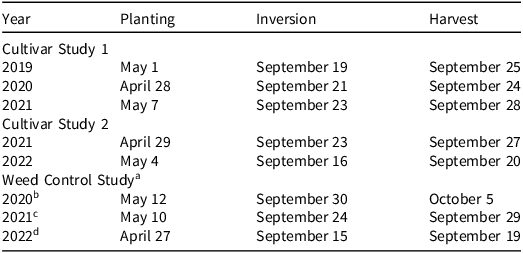
Data collected included peanut density (stand) at 27 to 34 DAP, visible estimates of peanut injury (necrosis and stunting), and yield. Peanut plant density was obtained by counting the number of emerged plants per 1-row m. Visible estimates of crop injury were obtained at 1, 2, 3, 4, 5, 6, 8, and 10 wk after preemergence application (WAA) using a subjective scale of 0 to 100 (0 = no injury, 100 = plant death). Peanut yield was determined using commercial harvesting equipment. Yields were adjusted to 10% moisture. A complete summary of planting, vine inversion, and harvesting dates can be found in Table 1. Rainfall and supplemental irrigation totals for the first 30 DAP are presented in Table 2.
Planting, inversion, and harvest dates of trifludimoxazin peanut trials.
a Peanut cultivar ‘GA-16HO’ was planted in all years.
b Preemergence were applied May 13, 2020; postemergence –herbicides were applied June 4, 2020.
c Preemergence herbicides were applied May 11, 2021; postemergence herbicides were applied June 4, 2021.
d Preemergence herbicides were applied April 28, 2022; postemergence herbicides were applied May 24, 2022.
Weather comparison for trifludimoxazin cultivar experiment one during the first 30 d after planting.

a Measured in degrees C.
b Measured in centimeters.
c Measured 14 d after planting.
Data for all parameters were analyzed as a split-plot design and subjected to ANOVA using the GLIMMIX procedure with SAS (v. 9.4; SAS Institute, Cary, NC). Peanut cultivar and trifludimoxazin rate were set as fixed effects. Replications within years and cultivars by replications within years were set as random effects. Peanut density, necrosis, stunting, and yield were set as the response variables. Trifludimoxazin rate-by-year interactions for 2019 prevented the pooling of data across all years. All data for 2019 were separated from 2020 and 2021 data. There was no cultivar-by-trifludimoxazin rate-by-year, cultivar-by-year, or trifludimoxazin rate-by-year interaction for 2020 and 2021, thus data is pooled across those years. All P-values for tests of differences between least-square means were compared and separated using the Tukey-Kramer method at P < 0.10. The value of P < 0.10 was chosen prior to trial initiation because it has been our experience that biologically or practically significant differences in data are often overlooked when P < 0.05.
Peanut Cultivar Experiment 2
A second field experiment was conducted to determine the effects of trifludimoxazin applied preemergence on four additional cultivars. Production practices, location, soil type, and pest management were identical to those noted in the first experiment. The split-plot design with main plots consisted of four different peanut cultivars (‘AUNPL-17’ [Chen et al. Reference Chen, Balkcom, Hagan, Dang, Lamb and Mingli2017], ‘FloRun331’ [Tillman Reference Tillman2021], ‘Georgia-20VHO’ [Branch Reference Branch2021], and ‘TifNV High O/L’ [Holbrook et al. Reference Holbrook, Ozias-Akins, Chu, Culbreath, Kvien and Brenneman2017]) and subplots with three trifludimoxazin rates applied preemergence (0, 38, or 75 g ha−1), with all 12 treatments replicated three times. A complete summary of peanut planting, vine inversion, and harvesting dates are listed in Table 1. The statistical analysis was identical to that described for Cultivar Experiment 1 with the exception that no year interactions were observed, which allowed data to be pooled across years.
Weed Control Experiment
Cultural production practices, location, and soil characteristics for the weed control experiment were identical to those in the cultivar experiments except only the cultivar GA-16HO was planted (Branch Reference Branch2017). Planting, herbicide application, vine inversion, and harvest dates are presented in Table 1.
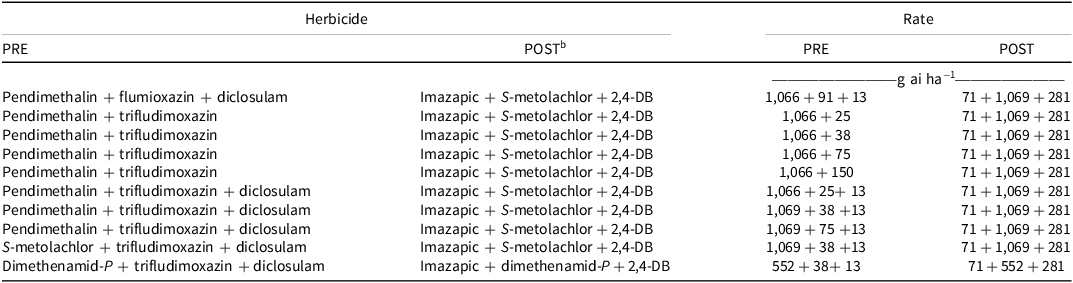
Ten herbicide treatments were arranged in a randomized complete block design with three to four replications. Trifludimoxazin at 25, 38, 75, and 150 g ha−1 was tank-mixed with pendimethalin at 1,066 g ha−1 and applied preemergence. Additionally, trifludimoxazin at 38 g ha−1 was applied with tank-mixtures of diclosulam, S-metolachlor, and/or dimethenamid-P. Results of trifludimoxazin treatments were directly compared against standard recommended peanut preemergence tank-mixes of flumioxazin + pendimethalin + diclosulam (1,066 + 91 + 13 g ha−1). All preemergence herbicide treatments were applied 1 DAP using a CO2-pressurized backpack sprayer calibrated to deliver 140 L/ha at 248 kPa and at 5.3 kph. Immediately following herbicide applications, treatments were activated with 1.3 cm of overhead irrigation. The entire study received a postemergence application of imazapic + 2,4-DB, and S-metolachlor or dimethenamid-P (application dates are listed in Table 1). All postemergence herbicide treatments were applied approximately 4 wk after planting using application techniques that were identical to the preemergence application. Two nontreated checks were also included for comparison. A complete list of treatment rates, combinations, and rates are presented in Table 3.
Weed control programs, rates, and application timings for weed control study with trifludimoxazin.a
a Abbbreviations: POST, postemergence; PRE, preemergence.
b POST treatments were applied approximately 4 wk after planting.
Data collection included visible estimates of peanut stunting and necrosis, visible estimations of weed control, and yield. Visible estimates of crop injury were obtained at 2, 3, 5, 6, and 7 WAA using a subjective scale of 0 to 100 (0 = no injury; 100 = plant death). Weed control ratings were collected using a scale of 0 to 100 (0 = no weed control; 100 = weed free). Weed control ratings were collected during injury ratings along with additional ratings from 11 and 13 WAA. Peanut yield data were obtained using commercial harvesting equipment. Yields were adjusted to 10% moisture.
Data were subjected to ANOVA using the GLIMMIX procedure SAS (v. 9.4). Peanut injury, weed control, and yield were set as the response variables with replication within year included in the model as random factors. There was not a year-by-treatment interaction, thus data were pooled over years. All P-values for tests of differences between least-square means were compared and separated using the Tukey-Kramer method (P < 0.10).
Results and Discussion
Peanut Density
Cultivar Experiment 1
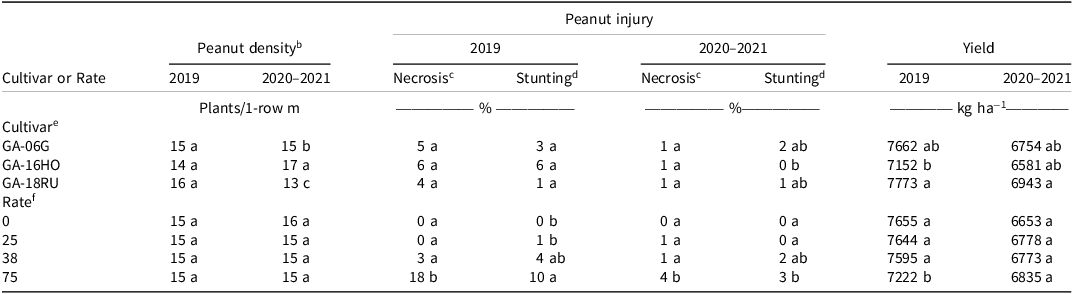
In 2019, peanut density was not influenced by either cultivar or trifludimoxazin rate (P > 0.24) (Table 4). However, peanut density for 2020–2021 was influenced by cultivar (P < 0.0001) but not trifludimoxazin rate (P = 0.4119) (Table 4). Relative peanut density for cultivars in 2020–2021 was GA-16HO>GA-06G>GA-18RU. Peanut cultivar emergence is often dependent upon the management, harvest, and storage of each cultivars seed lot, thus giving reasons why cultivars can vary widely in final plant density (Morton et al. Reference Morton, Tillman, Gorbet and Boote2008).
Influence of peanut cultivar and trifludimoxazin rate on peanut density, leaf necrosis, stunting, and yield, cultivar experiment 1.a
a Means in the same column of either cultivar or rate with the same letter are not significantly different according to the Tukey-Kramer method (P < 0.10).
b Peanut density data were collected 27–34 d after planting.
c Visible estimates of peanut necrosis were performed 2 wk after application. Foliar necrosis was based on a scale of 0 = no necrosis and 100 = complete necrotic tissue.
d Visible estimates of peanut stunting were performed 8 wk after application. Peanut stunting was based on scale of 0 = no stunting and 100 = complete crop death.
e Averaged over trifludimoxazin rate.
f Rate = g ai ha−1 trifludimoxazin averaged over cultivar.
Cultivar Experiment 2
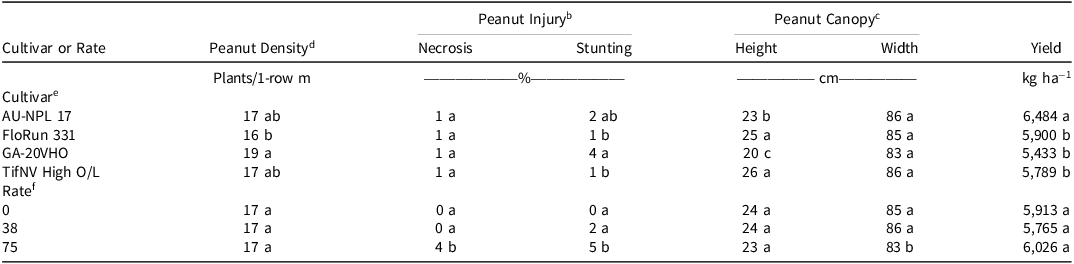
Peanut density was not influenced by the interaction of cultivar and trifludimoxazin rate (P = 0.8879). Cultivar effects were significant (P = 0.003), but trifludimoxazin rates were not (P = 0.9727). FloRun 331 density was lower than GA-20VHO with no other cultivar differences observed (Table 5).
The influence of peanut cultivar and trifludimoxazin rate on peanut density, injury (leaf necrosis, stunting), canopy height/width, and yield, cultivar experiment 2.a
a Means in the same column of either cultivar or rate with the same letter are not significantly different according to the Tukey-Kramer method (P < 0.10).
b Visible estimates of peanut injury were based on scale of 0 = no injury and 100 = complete crop death combined over 2 site-years. Necrosis = 3 wk after application and stunting = 8 wk after application.
c Peanut canopy data were collected 9 wk after application, 5 plants plot−1.
d Peanut density data were collected 21 d after planting.
e Averaged over trifludimoxazin rate.
f Rate = g ai ha−1 trifludimoxazin averaged over cultivar.
Peanut Injury
Cultivar Experiment 1
Necrosis was not influenced by the interaction of cultivar and trifludimoxazin rate (P = 0.126) in 2019 (Table 4). The main effect of cultivar did not influence necrosis when averaged across all rates of trifludimoxazin (P = 0.6153). Foliar necrosis was 18% across all cultivars with trifludimoxazin at 75 g ha−1, but no other rate differences were observed. When averaged over rate, there was no difference in peanut injury between cultivars. The trifludimoxazin rate of 75 g ha−1 resulted in 10% visible stunting when averaged across all cultivars.
Foliar necrosis and stunting ratings for 2020–2021 are presented in Table 4. Necrosis ratings were recorded at 2 WAA, and stunting injury at 8 WAA. Cultivar (P = 0.5814) did not influence foliar necrosis, but trifludimoxazin at 75 g ha−1 resulted in 4% leaf necrosis. Peanut stunting was influenced by trifludimoxazin rate (P = 0.0006), but 75 g ha−1 resulted in only 3% stunting. Cultivar (P = 0.1088) differences were not observed.
Cultivar Experiment 2
There was no interaction between cultivar and rate for leaf necrosis or stunting ratings in 2021–2022 (Table 5). Rate was significant, with 75 g ha−1 resulting in 4% leaf necrosis and 5% stunting. Cultivar (P = 0.0857) was significant for stunting at 8 WAA, and when averaged over rate, the GA-20 VHO cultivar exhibited more stunting than the FloRun 331 and TifNV High O/L cultivars.
Weed Control Experiment
Peanut stunting with flumioxazin at 2 WAA was 20% in 2020–2022 (Table 6). Trifludimoxazin rates ≥75 g ha−1 resulted in 13% to 24% peanut stunting. Trifludimoxazin rates of 75 and 150 g ha−1 represent a 2× and 4× rate, respectively. Trifludimoxazin rates ≤38 g ha−1 resulted in significantly less peanut stunting than flumioxazin. Leaf necrosis at 3 WAA was 27% when treated with the 150 g ha−1 rate of trifludimoxazin. Stunting and necrosis symptoms were transient and dissipated as the season progressed.

a Abbreviations: AGRASS, annual grasses (non-uniform mixture of Texas millet, crabgrass spp., goosegrass, crowfootgrass); AMAPA, Palmer amaranth; POST, postemergence; PRE, preemergence; RAPRA, wild radish; WAA, weeks after PRE application.
b Means in the same column with the same letters are not significantly different according to the Tukey-Kramer method (P < 0.10). The untreated control was not included in the statistical analysis.
c Ratings are visible estimates of peanut injury based on a percent of the nontreated control (0 = no crop injury, 100 = complete crop death) and averaged over 3 site-years.
d Ratings are visible estimates of weed control based on the percent of the nontreated control (0 = no weed control, 100 = complete weed control) and averaged over 3 site-years.
e Applied approximately 4 wk after planting.
Peanut Plant Height/Width
Cultivar Experiment 2
Peanut canopy height was significantly influenced by cultivar but not rate in 2021–2022 (Table 5). Peanut canopy heights as influenced by cultivar when averaged across herbicide rates are reported as TifNV High O/L = FloRun 331 > AU-NPL 17 > GA-20 VHO. Peanut canopy width was significantly influenced by rate but not cultivar. Canopy width averaged across cultivars was reduced by 2% to 3% by the 75 g ha−1 rate. No width differences were observed between cultivars.
Weed Control
Weed control evaluations were pooled over years and were recorded at 3, 5, and 13 WAA (Table 6). The standard preemergence herbicide program for which all other preemergence and postemergence herbicide combinations were compared included the pendimethalin + flumioxazin + diclosulam (preemergence) followed by imazapic + S-metolachlor + 2,4-DB (postemergence).
Palmer Amaranth Control
Palmer amaranth control was 99% up to 13 WAA (∼9 wk after postemergence) when treated with pendimethalin + flumioxazin + diclosulam preemergence followed by a postemergence application of imazapic + S-metolachlor + 2,4-DB. Palmer amaranth control at 2 WAA was ≥93% with all herbicide treatment combinations. However, the pendimethalin + trifludimoxazin (1,066 + 38 g ha−1) treatment was significantly different (6%) from the pendimethalin + flumioxazin + diclosulam treatment. The pendimethalin + trifludimoxazin treatment with the two lowest rates of trifludimoxazin resulted in a reduction of 8% Palmer amaranth control at 13 WAA when compared to the standard preemergence program. Palmer amaranth control was ≥91% with any herbicide treatment at 13 WAA. Control of Palmer amaranth with trifludimoxazin was improved with either increased rates or the addition of diclosulam. However, increasing rates of trifludimoxazin in peanut could potentially increase the risk of peanut injury.
Wild Radish Control
Wild radish control is reported for only the 3 and 5 WAA observations as it was either senesced or unobservable at the 13 WAA rating. The standard preemergence treatment resulted in 99% control of wild radish up to 3 WAA. The pendimethalin + trifludimoxazin treatments (1,066 + [25 or 38] g ha−1) provided, respectively, only 79% and 87% control of wild radish at 3 WAA. Pendimethalin is effective at controlling small-seeded broadleaf weeds and annual grasses, thus, without the addition of diclosulam radish control was dependent upon trifludimoxazin. The dimethenamid-P + trifludimoxazin + diclosulam treatment provided only 88% control at 3 WAA. No other wild radish control observations were different from the standard at that time. Wild radish control is important to maximizing crop yield potential, and research conducted by Roncatto et al. (Reference Roncatto, Barroso, Novello, Goncalves, Jarek and Young2022) reported the efficacy of diclosulam in reducing radish density and biomass. Diclosulam was able to reduce the density of wild radish by 68% compared with the untreated control, and that resulted in a biomass reduction of 89% (Roncatto et al. Reference Roncatto, Barroso, Novello, Goncalves, Jarek and Young2022). Control of wild radish early in the season is important because this weed can be highly troublesome, competitive, and widespread (Eslami et al. Reference Eslami, Gill, Bellotti and McDonald2006; Hashem et al. Reference Hashem, Bowran, Piper and Dhammu2001). Wild radish control at 5 WAA was ≥96% with all herbicide treatment combinations. Herbicides that inhibit acetolactate synthase are effective at controlling wild radish from postemergence applications; for example, imazethapyr was able to reduce biomass of wild radish by 82% per square meter. Improved control from the postemergence application can be attributed to imazapic.
Annual Grass Control
Annual grass control consisting of a nonuniform mixture of Texas millet [Urochloa texana (Buckley) R. Webster], crabgrass (Digitaria spp.), goosegrass [Eleusine indica (L.) Gaertn.], and crowfootgrass [Dactyloctenium aegyptium (L.) Willd.] was ≥96% for the standard preemergence herbicide program up to 3 WAA. Pendimethalin + trifludimoxazin (1,066 + 25 g ha−1) provided 8% less control of annual grasses at 3 WAA. The dimethenamid-P + trifludimoxazin treatment resulted in 6% less control at 3 WAA. All herbicide treatment combinations resulted in similar control to that of the standard preemergence + postemergence program of applications at 5 and 13 WAA. The pendimethalin + trifludimoxazin (1,066 + 150 g ha−1) combination resulted in 5% better grass control than the dimethenamid-P + trifludimoxazin treatment when evaluated at 5 WAA. However, by 13 WAA, no differences in control were observed.
Peanut Yield
Cultivar Experiment 1
Peanut yield in 2019 was influenced by cultivar (P = 0.0601) and trifludimoxazin rate (P = 0.0013), but there was not a cultivar-by-herbicide interaction (P = 0.3643) (Table 4). Georgia-18RU yields were 8% greater than Georgia-16HO yields when averaged across trifludimoxazin rates. Yields were reduced by 6% when trifludimoxazin at 75 g ha−1 was applied, when averaged across peanut cultivars. Increased leaf necrosis and prolonged plant stunting from the 75 g ha−1 rate of trifludimoxazin as shown in Table 4, could be attributed to the environmental conditions noted in Table 2. Greater rainfall/irrigation in the first 14 DAP likely increased the uptake of trifludimoxazin, which resulted in greater peanut injury and yield reductions (Table 2). Other research has also documented the potential negative effects of residual herbicides associated with excessive moisture (Askew et al. Reference Askew, Wilcut and Cranmer1999; Burke et al. 2002). Peanut yield in 2020–2021 was not influenced by either cultivar (P = 0.1025) or trifludimoxazin rate (P = 0.5095) (Table 5). These results indicated adequate cultivar tolerance to trifludimoxazin when applied at rates ≤75 g ha−1.
Cultivar Experiment 2
Peanut yield in 2021–2022 was influenced by cultivar but not by trifludimoxazin rate (Table 6). Yields of the AU-NPL 17 cultivar were 9% to 16% greater than the three other cultivars. In previous studies with older peanut cultivars and conditions, preemergence applications of flumioxazin did not influence yield (Basinger et al. Reference Basinger, Randell and Prostko2021; Grichar et al. Reference Grichar, Besler and Brewer2004; Main et al. Reference Main, Ducar, Whitty and Macdonald2003; Wilcut et al. Reference Wilcut, Askew, Bailey, Spears and Isleib2001).
Weed Control Experiment
Peanut yield for 2020–2022 was influenced by herbicide treatment (P = 0.0155). The nontreated controls are not included in the pairwise means comparison because those plots could not be harvested. The pendimethalin + trifludimoxazin (1,066 + 75 g ha−1) and pendimethalin + trifludimoxazin + diclosulam (1,066 + 75 + 13 g ha−1) treatments resulted in 11% to 12% greater yields than the pendimethalin + trifludimoxazin (1,066 + 150 g ha−1) treatment. The 150 g ha−1 rate of trifludimoxazin is four times greater than the proposed use rate. No other yield differences were observed.
Practical Implications
Historically, herbicide discovery, specifically for U.S. peanut production, has been limited due to lower planted hectarage in comparison to other major agronomic crops such as field corn, soybean, and wheat. Peanut producers will need additional herbicides in the future as herbicide resistance continues to evolve. This research confirms that numerous peanut cultivars are sufficiently tolerant of preemergence applications of trifludimoxazin. Additionally, trifludimoxazin can be applied at lower rates, is less injurious, and provides similar weed control to comparable flumioxazin-based systems in peanut.
Acknowledgments
This research could not have been conducted without the technical support of Charlie Hilton, Tim Richards, and Dewayne Dales. The contributions of A.S. Culpepper, W.S. Monfort, M.A. Abney, W.C. Johnson III, and C.J. Bryant are also greatly appreciated.
Funding
Partial funding for this research was provided by BASF.
Competing Interests
The authors declare that they have no competing interests.


 Open access

