


Introduction
Voter turnout has been on the decline across advanced democracies for many decades (Blais et al., Reference Blais, Gidengil, Nevitte and Nadeau2004; Blais and Rubenson, Reference Blais and Rubenson2013; Kostelka and Blais, Reference Kostelka and Blais2021). Canada has been among the leaders in this trend, with recent elections seeing a roughly 14 percentage point turnout drop since its 1960s average of 77.2 per cent (Heard, Reference Heard2022). Canada’s turnout decline is particularly pronounced among the young (Blais and Loewen, Reference Blais and Loewen2011; Gidengil et al., Reference Gidengil, Nevitte, Blais and Nadeau2003; Stockemer and Rocher, Reference Stockemer and Rocher2017), a trend that is not unique to Canada, as youth also increasingly vote at lower rates in many countries (Angelucci et al., Reference Angelucci, Carrieri and Improta2024; Holbein and Hillygus, Reference Holbein and Hillygus2020; Schäfer et al., Reference Schäfer, Roßteutscher and Abendschön2020; Smets, Reference Smets2012, Reference Smets2016).
Relatedly, cross-national research shows that lower socio-economic status (SES) individuals vote at much lower rates than higher SES individuals, which is becoming more acute over time (Dalton, Reference Dalton2017; Elsässer et al., Reference Elsässer, Schäfer and Wenker2022; Gallego, Reference Gallego2015; Goldberg, Reference Goldberg2020; Rennwald, Reference Rennwald2020; Tuorto, Reference Tuorto2022). Although declining youth turnout has received widespread attention among Canadian scholars, the relationship between social status and turnout has received scant attention. This sizable gap in the literature is surprising for two key reasons.
First, although class politics has largely been neglected in Canada, recent research has documented that social class has been a discernible cleavage in voting in Canada (Andersen, Reference Andersen, Dirk de Graaf and Evans2013), which appears to be gaining strength in recent years (Kiss et al., Reference Kiss, Polacko and Graefe2023; Polacko et al., Reference Polacko, Kiss and Graefe2022, Reference Polacko, Kiss, Graefe, Robbins-Kanter, Koop and Troup2025). Second, as democracy is based on equality of participation in decision making, high and/or increasing turnout inequality raises key concerns regarding how truly democratic and representative our democracies are. Since politicians are more likely to cater to the preferences of voters than nonvoters, this can result in certain segments of the population becoming alienated from the political decision-making process (Griffin and Newman, Reference Griffin and Newman2005). This can lead to unequal influence and has important consequences for political outcomes, as a burgeoning literature finds evidence that legislators produce biased outcomes in favour of higher social status individuals over lower ones in the United States (Bartels, Reference Bartels2008; Gilens, Reference Gilens2012), Europe (Elsässer et al., Reference Elsässer, Hense and Schäfer2021; Mathisen, Reference Mathisen2023; Schakel, Reference Schakel2021) and cross-nationally (Lupu and Warner, Reference Lupu and Warner2022; Schakel et al., Reference Schakel, Persson and Sundell2024).
This article builds upon previous research in this area in several ways. First, it advances a novel test into the relationship between social status and turnout by introducing supply-side logic via the saliency of the political party system. It tests whether a stronger focus on economic issues in campaign discourse by political parties is likely to result in higher political participation among lower social status individuals. Second, by restricting focus to a single country, it can better take into account temporal developments and socio-political idiosyncrasies of an under-explored country-case, which has experienced a comparatively high level of turnout decline. Third, exploring three potential sources of turnout inequality (class, education and income) at the same time allows for a much more detailed examination and test of the strength of the relationships, as standard analyses in this area tend to focus on only one of these key demographics, using some, but not always the others, as controls. Last, this study is of relevance to a wide range of scholars across the political inequality, and electoral and political behaviour sub-fields, as well as policymakers and researchers attempting to identify potential reforms that may be linked with increased engagement among marginalized groups.
In this article, I address the important temporal, theoretical and descriptive gaps in the literature by using the entire series of the Canadian Election Study (CES) (1965–2021), as well as party manifesto data, to examine social-status inequalities in turnout in Canada, by class, education and income. I develop four main conclusions: I find that: (1) major class-based participatory inequalities exist in Canada; (2) these inequalities have worsened significantly over time; (3) the magnitude of the turnout gap has mainly been driven by the demobilization of lower-SES individuals; (4) greater saliency of economic issues in the party system reduces these turnout inequalities via the increased mobilization of lower-SES individuals.
To illustrate these points, the article is organized as follows: I first provide an overview of the existing literature on social-status inequalities in turnout, providing the basis for the research questions. I then outline the data and methodology utilized in the analysis, followed by a presentation of the main results stemming from analysis of the entire series of the CES. Lastly, I conclude with a discussion of the results and key implications.
Literature Review
Socio-demographic characteristics of turnout inequality
Electoral participation is not always unequal (Gallego, Reference Gallego2015: 31–33). For example, in countries such as Belgium or Australia that reach 90 per cent turnout rates through compulsory voting, differences in electoral participation become insignificant. However, if turnout falls below 80 per cent, participation tends to become imbalanced among certain social groups. Emphasizing this connection between low turnout and social inequality, Tingsten’s (Reference Tingsten1937) “law of dispersion,” first posited that lower overall turnout leads to larger variations in turnout across groups. This is pronounced in social status, as voters tend to be better educated, and wealthier, than nonvoters (Leighley and Nagler, Reference Leighley and Nagler2014; Wolfinger and Rosenstone, Reference Wolfinger and Rosenstone1980). Hence, according to Lijphart (Reference Lijphart1997: 2), low turnout “means unequal and socio-economically biased participation.”
The SES gap in electoral participation is among the most robust patterns of modern political behaviour. The majority of existing research categorizes socio-economic groups by income. Although income is important, education and occupation are also essential for identifying politically significant socio-economic groups (Kitschelt and Rehm, Reference Kitschelt and Rehm2014). For each dimension, the key theory linking social status to turnout inequality is the resource-model of political participation (Brady et al., Reference Brady, Verba and Schlozman1995: 273; Verba et al., Reference Verba, Nie and Kim1978). It posits that individuals with jobs, a high income and education are more likely to have access to a wider range of resources (particularly money, networks, time and skills), which better facilitates their participation in politics.
The first dimension of SES is income. The relationship between income and turnout has been extensively studied. Beginning with Wolfinger and Rosenstone’s study (Reference Wolfinger and Rosenstone1980) of voters and abstainers, many scholars have since found a mainly positive correlation between the two (Franko et al., Reference Franko, Kelly and Witko2016; Leighley and Nagler, Reference Leighley and Nagler2014; Nevitte et al., Reference Nevitte, Blais, Gidengil, Nadeau and Klingemann2009; Persson et al., Reference Persson, Solevid and Öhrvall2013; Schlozman et al., Reference Schlozman, Brady and Verba2018; Tuorto, Reference Tuorto2022). Wolfinger and Rosenstone (Reference Wolfinger and Rosenstone1980) posit that voters who are economically insecure are less interested in politics because they have more pressing day-to-day concerns. Indeed, higher income individuals have better living standards, which provide greater access to political information and the resources to follow politics more easily. Lower income individuals also tend to disproportionately face institutional restrictions (Rosenstone and Hansen, Reference Rosenstone and Hansen1993). Furthermore, the income gap in turnout tends to be widest in countries with the most income inequality, such as the United States and United Kingdom (Polacko, Reference Polacko2022; Schäfer and Schwander, Reference Schäfer and Schwander2019).
Another key component of SES is education, which is one of the principal predictors of individual political behaviour and has received the most attention in the relationship between SES and turnout. Many studies confirm the existence of a positive correlation that has increased over time (Dalton, Reference Dalton2017; Dassonneville and Hooghe, Reference Dassonneville and Hooghe2017; Gallego, Reference Gallego2015; Northmore-Ball, Reference Northmore-Ball2016; Persson et al., Reference Persson, Solevid and Öhrvall2013). Education reduces the costs of voting because the cognitive skills such as communication and critical thinking acquired through education, lowers barriers to participation (Verba et al., Reference Verba, Nie and Kim1978). Higher levels of education also help reduce the effort needed to become informed on political issues and can reinforce positive orientations towards civic society, which place a higher value on participation (Brady et al., Reference Brady, Verba and Schlozman1995; Wolfinger and Rosenstone, Reference Wolfinger and Rosenstone1980).
The third dimension of SES is social class, which comprises an individual’s occupation via their position in the labour market. Class voting was traditionally a key cleavage in Western democracies but has become de-aligned and weakened over time. Accompanying this trend is a striking development, whereby a large portion of the working class has stopped voting altogether. Documented by Evans and Tilley (Reference Evans and Tilley2017) in Britain, prior to the 1990s, there was no discernible class turnout gap (the proportion of voters and nonvoters between manual and nonmanual workers). In regard to these dynamics, Heath (Reference Heath2018: 1061) has pointed out that now “class is more important as a participatory cleavage than it is as an electoral cleavage.” Similar patterns have been found elsewhere in Western Europe (Rennwald, Reference Rennwald2020). Recent research has found this trend to be mainly attributed to changes in political parties’ programmes towards convergence and a reduction in appeals to the working class (Evans and Tilley, Reference Evans and Tilley2017; Heath, Reference Heath2015, Reference Heath2018; Rennwald, Reference Rennwald2014, Reference Rennwald2020; Vivyan et al., Reference Vivyan, Wagner, Glinitzer and Eberl2020).
Political parties and turnout
Socio-demographic factors such as class, education and income are positively correlated with voting, but each of these groups also rely on being successfully mobilized to turn out. This mobilization model of turnout posits that individuals are mobilized to participate in politics by candidates, interest groups, parties and social movements (Rosenstone and Hansen, Reference Rosenstone and Hansen1993). When political parties provide variation in their policy offerings or greater salience to an issue, distinct preferences between social groups can be manifested through voting (Evans & Dirk de Graaf, Reference Evans and Dirk de Graaf2013). However, if parties do not offer genuine alternatives or salience to socio-economic issues, then class differences are not reflected in party choice.
Some findings point to the failure of parties in representing lower-SES interests as a key cause of unequal participation (Elff, Reference Elff2009; Evans and Tilley, Reference Evans and Tilley2017). Economic saliency, in particular via parties on the left, has clear resonance for lower-status individuals dating back to Lipset et al.’s (Reference Lipset, Lazarsfeld, Barton, Linz and Lindzey1954) early assertions that they tend to prefer redistributive policies. Przeworski and Sprague (Reference Przeworski and Sprague1986) state that when leftist parties pursue “supraclass strategies,” some lower-status individuals will respond by abstaining. Weakliem and Heath (Reference Weakliem, Heath and Evans1999) suggest that in the United States, as the Democratic Party became more centrist, class differences in turnout increased. More recent analyses find that as social democratic parties moved significantly towards the centre of the political spectrum in the 1980s and 1990s, they reduced their appeals to the lower classes, (Evans and Tilley, Reference Evans and Tilley2012, Reference Evans and Tilley2017; Evans and de Graaf, Reference Evans and Dirk de Graaf2013; Leighley and Nagler, Reference Leighley and Nagler2014), and increasingly do not derive their members from the working class (Carnes, Reference Carnes2013; Carnes and Lupu, Reference Carnes, Lupu, Lupu and Pontussson2024).
Reduced appeals to the lower classes have also coincided with a weakening of key agents that traditionally mobilized lower classes, such as unions and the welfare state (Bartolini, Reference Bartolini2000; Gallego, Reference Gallego2015). Labour unions stimulate political interest and boost turnout through mobilization of their members around election time (Kerrissey and Schofer, Reference Kerrissey and Schofer2018). While a more generous welfare state increases opportunities for political engagement and participation by providing material support from unemployment and income shocks, higher quality education and/or support for families with children (Schneider and Makszin, Reference Schneider and Makszin2014).
The theoretical framework that supports the proposition that issue salience influences a citizen’s decision to vote, is rooted in Downsian rational choice theory (1957). Downs posited that voting is a rational act whereby an individual’s probability to vote is based on the issues presented to them, which should have some match with their preferences. For example, Gunderson (Reference Gunderson2024) finds cross-nationally that perceptions of party differences in issue saliency are associated with a significant increase in voting probability of between 5 and 7.5 percentage points. The emergence of post-materialism in the 1970s (Inglehart, Reference Inglehart1977, Reference Inglehart1990), and therefore, a rising salience of socio-cultural issues, has meant that political conflict has become increasingly two-dimensional, with a reduced saliency placed on economic issues. Hence, a reduced focus on economic issues in campaign discourse at the aggregate level, is likely to result in lower turnout among citizens who are more supportive of redistribution, which lower-SES individuals have significantly been shown to be (Gelepithis and Giani, Reference Gelepithis and Giani2022; Rueda, Reference Rueda2018).
Indeed, Jungkunz et al. (Reference Jungkunz, Fastenrath and Marx2023) draw on party manifesto data since the 1990s, election surveys between 2005 and 2021, and focus group discussions after the 2021 federal election campaign to find that greater saliency of economic issues in Germany increases the political participation of low-income citizens. This is most pronounced in the 2021 election, where proposals on raising taxes on high incomes and markedly increasing the minimum wage were the most salient topics of the campaign, which produced a very large 8 to 12 percentage point increase in voting likelihood for the bottom quintile, compared to the previous four elections, and the gap between the bottom and top quintile was dramatically reduced. Recent studies in both Europe (Ares, Reference Ares2022) and the United States (Bonomi et al., Reference Bonomi, Gennaioli and Tabellini2020) also show that greater saliency and politicization of redistribution by political parties significantly activates class over socio-cultural preferences in voters, thereby strengthening the class cleavage. Therefore, given evidence from these recent studies, it is likely that saliency in the entire party system is most relevant for mobilizing lower-status individuals, as opposed to solely social democratic parties, especially in a case such as Canada, where the social democratic party has always been comparatively weak.
Canadian contribution
Canada has been among the leaders in declining turnout. Postwar turnout at national elections averaged around 75 per cent until 1988. Since then, it has declined markedly, falling below 70 per cent in every election to an average of roughly 63 per cent this century (Heard, Reference Heard2022). Declining turnout in Canada has principally been attributed to culture, occurring primarily via generational differences (Blais et al., Reference Blais, Gidengil, Nevitte and Nadeau2004). This has stemmed from scholars focusing heavily on explaining the causes for Canada’s acute youth turnout problem (Blais and Loewen, Reference Blais and Loewen2011; Gidengil et al., Reference Gidengil, Nevitte, Blais and Nadeau2003; Stockemer and Rocher, Reference Stockemer and Rocher2017). The other principal source of turnout decline in Canada is electoral competitiveness, as elections have become less competitive (Cutler et al., Reference Cutler, Rivard and Hodgson2022; Johnston et al., Reference Richard, Matthews and Bittner2007; Johnston, Reference Johnston2017), which became pronounced in the 1990s.
Economic factors have largely been overlooked as a source of turnout decline, beyond a recent study finding aggregate-level economic inequality as a culprit (Polacko, Reference Polacko2020), and the class aspect of turnout at the individual level has been particularly neglected. This was largely owing to the belief that class voting was essentially absent in Canada, dominated instead by linguistic, regional and religious divisions (Alford, Reference Alford1963; Porter, Reference Porter1965). Since early studies on class emerged, structural changes in the economy have transformed the electorate. Deindustrialization of the workforce and educational expansion has led to a decline of employment in lower skilled industries and widespread occupational upgrading towards a higher skilled service sector, with a growing professional and managerial class. This has been particularly pronounced in Canada since the 1960s, as the country has shifted from a resource-based economy to a service-based one, with a manufacturing sector that has declined markedly. The shift in this postindustrial structure has led to greater attention focused on noneconomic issues that the higher educated professional and managerial classes afford greater salience to. However, recent research has shown that class has been a discernible cleavage in voting in Canada (Andersen, Reference Andersen, Dirk de Graaf and Evans2013), which seems to be on the rise in recent years (Kiss et al., Reference Kiss, Polacko and Graefe2023; Polacko et al., Reference Polacko, Kiss and Graefe2022, Reference Polacko, Kiss, Graefe, Robbins-Kanter, Koop and Troup2025), despite a party system that has comparatively been at the forefront of the turn away from materialist values (Houtman et al., Reference Houtman, Achterberg and Derks2009: 59–60).
Canada differs from most countries since it does not have a standard left-right party system. Instead, it has a unique “two-and-a-half” party system, whereby the Liberal Party has dominated electoral politics as an amorphous big tent party at the centre of the political spectrum, despite it often being characterized as leftist (Johnston, Reference Johnston2017). The country also has a strong regional party (Bloc Québécois) that eschews fitting into a standard left-right classification. Although the Liberals and the New Democratic Party (NDP) have historically traded votes, recent findings show that the NDP brings a distinct class profile to a potential left bloc because the party increasingly is attracting lower income voters, with redistribution a key driver (Kiss et al., Reference Kiss, Polacko and Graefe2023). Contrastingly, the Liberal Party has placed an explicit focus on the middle class, and it has increasingly shed working-class and lower income voters, which has resulted in the party now being dominated by higher-status individuals that are more concerned with socio-cultural issues (Kiss et al., Reference Kiss, Polacko and Graefe2023; Polacko et al., Reference Polacko, Kiss and Graefe2022), while the Conservative Party has consolidated support on the right by drawing on socio-culturally right-leaning voters (Wilkins-Laflamme Reference Wilkins-Laflamme2016). With the two largest parties in the country less focused on the economy and redistributive issues, this has likely led to a decline in economic, relative to cultural saliency in the party system, which could be turning off lower-status individuals from voting altogether.
This article’s focus on the Canadian case offers the chance to test existing and new theories in a country that has experienced a considerable decline in turnout, and where the underpinnings of this trend have not been sufficiently investigated. Based on rational choice theory’s account of issues’ influence on citizens’ probability of voting, this article argues that by raising the perceived issue salience of economic over cultural issues, lower SES-individuals will be more likely to vote. Following on from this, the key questions this article seeks to answer are: What is the extent of turnout inequalities between social groups based on social status in Canada? Have they increased over time? If so, how can this best be explained? Does the politicization of socio-economic conflicts by political parties impact these relationships?
Hypotheses
Informed by the literature and key questions above, the following hypotheses are tested in this article:
H1: The decrease in voter turnout in Canada has led to greater turnout inequality by social status (H1a), and occurred significantly more among lower social status individuals, rather than higher social status individuals (H1b).
H2: Lower social status individuals are more likely to vote if the party system places greater emphasis on economic saliency, relative to socio-cultural saliency.
Data and Methods
To examine turnout inequality in social status in Canada, this study relies on merged data from the entire series of the CES, which are the most extensive surveys on public opinion and voting in Canada. The dataset comprises 17 federal elections from 1965 to 2021.Footnote 1 I utilize both the telephone and face-to face mode of interviews that lasted until 2019, as well as the web mode for the 2019 and 2021 elections.Footnote 2
I operationalize the dependent variable turnout by relying on self-reported voting data. In the post-election wave of the CES, citizens are asked whether they voted in the most recent federal election. Thus, turnout is coded 1, if a respondent provides an affirmative answer and 0 otherwise. Since the dependent variable is binary, I undertake logistic regressions for estimating turnout. It should be noted that self-reported turnout is affected by problems such as recall and social desirability bias (Karp and Brockington, Reference Karp and Brockington2005), therefore, reported turnout usually has a substantial upward bias when compared to data on actual turnout. Indeed, the CES reflects this with very high reported levels of turnout, often 15–30 percentage points greater than actual turnout. This is especially important when analyzing turnout by SES, as Lahtinen et al. (Reference Lahtinen, Pekka Martikainen, Wass and Rapeli2019) show that the combined effect of social desirability bias and the overrepresentation of voters in surveys, leads to substantial underestimating of SES turnout gaps. To remedy this underrepresentation of nonvoters in the CES, I weight turnout based on official figures for each election.Footnote 3 Previous work has utilized this method in analyzing individual turnout by age both descriptively and via logistic models (Fieldhouse et al., Reference Fieldhouse, Tranmer and Russell2007; Franklin, Reference Franklin2004; Smets, Reference Smets2012, Reference Smets2016).
The key explanatory variables measure SES via education, income and occupation.Footnote 4 For education, the level of schooling is consistently available in the CES since the 1980s, which allows for ordinal education categories. However, many studies involving the CES utilize a simple dummy variable for education, usually distinguishing between degree holders and nondegree holders (Anderson and Goodyear-Grant, Reference Anderson and Goodyear-Grant2009; Breton et al., Reference Breton, Cutler, Lachance and Mierke-Zatwarnicki2017; Fournier et al., Reference Fournier, Fred Cutler, Stolle and Bélanger2013; Kiss et al., Reference Kiss, Polacko and Graefe2023). Given that this study spans the entire series of the CES since the 1960s, which pre-dates the introduction of consistent levels of schooling, I follow this convention and code 0 for nondegree holders and 1 for degree holders.Footnote 5
Throughout the CES, respondents were typically given the option of providing total household income or identifying their placement within categories.Footnote 6 The coding of income is complicated for this reason, due to the lack of consistency in the inclusion of either option for each wave, the real value of the dollar changing substantially from 1965 to 2021, and the difficulty of assigning category responses to terciles. As a remedy, respondents are divided into terciles (low to high) that come closest to matching the boundaries provided by the values for total household income found in the nearest five-year census or national labour market survey.
Following Andersen (Reference Andersen, Dirk de Graaf and Evans2013) and Polacko et al.’s (Reference Polacko, Kiss and Graefe2022) Canadian class voting works, I code class according to a simplified version of Erikson and Goldthorpe’s (Reference Erikson and Goldthorpe1992) influential class schema that categorizes occupations along two dimensions: a hierarchy of authority and a logic of task structures (Kitschelt and Rehm, Reference Kitschelt and Rehm2014). Hence, working-class occupations are clustered in skill types that deal with things, while the routine nonmanual class is clustered in occupations that deal with people and information.Footnote 7 Due to concerns over sample size and concerns over how well the skilled and semiskilled categories are actually distinguished, the higher two professional categories are collapsed. Therefore, respondents are classified into three categories (professionals and managers, routine nonmanual and working-class).Footnote 8 To construct these class categories, I relied primarily on pre-existing categories provided in the early CES files.Footnote 9 This ended in 2006, so for subsequent elections, I used Statistics Canada’s National Occupation Classification (NOC) system. This matrix of occupations distinguishes two dimensions for occupations: skill level and skill type. Managers and professionals were distinguished by all those in the managerial and the professional skill levels (skill levels A and B, respectively).Footnote 10 The routine nonmanual class was defined as being in skill levels B, C and D, but in occupational categories 1 through 6 (Statistics Canada 2021).Footnote 11 The working class was defined as workers in skill levels B, C and D, and occupational categories 7, 8 and 9, which effectively combines skilled and unskilled working-class occupations.Footnote 12
Related to class is union membership. Labour unions were one of the instruments used by working-class social movements to advance the interests of workers (Alford, Reference Alford1963). A key method they have used is by mobilizing working-class voters around elections. Therefore, union membership has been positively linked to turnout, which I operationalize as a dummy variable (Kerrissey and Schofer, Reference Kerrissey and Schofer2018).Footnote 13 In addition, I rely on further demographic controls such as age, since young adults are notorious abstainers, particularly in Canada (Blais and Loewen, Reference Blais and Loewen2011; Gidengil et al., Reference Gidengil, Nevitte, Blais and Nadeau2003; Stockemer and Rocher, Reference Stockemer and Rocher2017). Previous research has shown that men typically vote more than women due to a greater availability of resources, however, the gender gap has receded in recent years and in many cases, women vote more than men now (Kostelka et al., Reference Kostelka, Blais and Gidengil2019). Citizenship impacts turnout, due to the notion that ethnic minorities often have fewer resources and skills to participate in elections. Therefore, I include male and foreign-born dummy variables. I also control for Canada’s pronounced regionalism via a four-category region variable (Atlantic, Ontario, Quebec and West). Religion has also been found to be an effective mobilizer (Verba et al., Reference Verba, Nie and Kim1978). Hence, based on Canada’s religious cleavage, religion is included as a four-category variable (no religion, Catholic, Protestant and other).
In a second step of the analysis, I test whether the political salience of an issue moderates the relationship between the independent variables and turning out to vote. To this end, I employ party manifesto data drawn from the Comparative Manifesto Project (MARPOR) (Lehmann et al., Reference Lehmann, Simon Franzmann, Al-Gaddooa, Christoph Ivanusch, Felicia Riethmüller, Weßels and Zehnter2024). MARPOR is a popular dataset for the study of political parties and offers reliable estimates that correlate highly with national experts and mass surveys, including 104 Canadian party experts surveyed by Benoit and Laver (Reference Benoit and Laver2006). The policy statements are classified into 56 policy categories over multiple issue domains. Hence, the data captures the issue emphases of political parties and can be utilized to measure the party system salience of issue dimensions, which is the original and primary purpose of the dataset. This study focuses on the items that relate to the two primary dimensions of politics (economic and socio-cultural). The economic dimension comprises 21 categories ranging from “free market economy” to “nationalization,” and the socio-cultural dimension comprises 14 categories that includes education, the environment, law and order, minorities, multiculturalism, nationalism and traditional morality.Footnote 14 Following previous research (Hillen, Reference Hillen2023; Kraft, Reference Kraft2017; Lindqvist, Reference Lindqvist2024; Ward et al., Reference Ward, Hyun Kim, Graham and Tavits2015), party system saliency is estimated by summing the economic dimension score minus the socio-cultural dimension score of each party. Scores are then weighted by a party’s vote share in the corresponding federal election to arrive at a party system economic salience score, as larger parties usually receive more attention and should exert greater influence on saliency (Kraft, Reference Kraft2017). This method is chosen because it better captures saliency, as opposed to positioning on a left-right scale, which also allows this analysis to sidestep most of the concerns that have been levied towards MARPOR, since they predominantly focus on positioning.
In the party system salience analysis, I also control for political factors that may influence turnout. Uncompetitive elections tend to reduce incentives to vote, which has been particularly acute in Canada, and has been partially attributed with the sudden decline in turnout in the 1990s (Johnston et al., Reference Richard, Matthews and Bittner2007). Thus, margin of victory for each federal election is measured, which is the difference in total votes between the first- and second-place parties. Incumbency at the federal level is also controlled for, which can influence who turns out to vote (Johnston, Reference Johnston2017; Polacko, Reference Polacko2020). As only two parties (Liberals and Conservatives) have formed the federal government in Canada, incumbent party is measured via a dummy variable (0 = “Conservative”; 1 = “Liberal”).
To determine receptivity to economic salience, I measure respondent support for redistribution, which is based on variations of the question: “how much do you think should be done to reduce the gap between the rich and the poor in Canada.”Footnote 15 The variable is available since 1988 in the CES and is re-scaled 0–1, with higher levels indicating greater support for redistribution.
Results
Turnout descriptives
First, turnout trends are examined. As mentioned, I use weighting procedures in all analyses to correct for overreporting. Figure 1 displays the mean turnout percentage by class, education and income in the CES from 1965–2021.Footnote 16 We can see that turnout has declined among all three social groups. Importantly, there is a very clear consistent gradient for all three social groups, which increases substantially over time. Therefore, we find preliminary descriptive evidence in support of (H1a). However, what groups are driving the turnout gap? In each case, we can see that the top SES category did not decline nearly as much as the lower category, and that it is primarily a decline in voting of low SES individuals, which accounts for Canada’s considerable turnout decline.
Mean turnout per cent by class, education and income, 1965–2021.

Aside from the roughly 15 percentage point difference in turnout between the top and bottom income terciles in 1968, there was not much of a turnout gap in income between these groups until 1984. From then onwards the turnout gap tends to increase slightly over time and typically reaches 15 to 20 percentage points. We can also see that the middle income tercile tends to vote at rates closest to the top tercile, rather than the bottom tercile. Overall, the top tercile only declines in turnout from roughly 80 to 78 per cent, the middle tercile increases very slightly from 75 to 76 per cent, while the lowest tercile declines from 73 to 55 per cent.
Class follows a very similar pattern to income, except that the turnout gap between the upper class and working class is a bit steeper and does not begin until the twentieth century. It peaks at around 27 percentage points from 2000 to 2019, where it suddenly returns to 1980s and 1990s levels of roughly half this amount in 2021. However, the shrinking gap in 2021 is likely a figment of the survey mode change to online, because in 2019 the gap was 21 per cent larger in the phone mode. Furthermore, we also can see that the middle-class was closer to the working-class during much of the peak turnout decline, and that working-class turnout averaged around 45 per cent during this period.
Turning to education, it does not display as large a turnout gap, or decline, as class and income as both degree holders and nondegree holders tend to decline together, albeit at a larger rate for nondegree holders beginning in the 1980s. Over the entire period, the turnout rate of degree holders declines roughly 11 percentage points, while it declines roughly 17 percentage points for nondegree holders.
The descriptive evidence from Figure 1 outlining that lower SES groups are driving the turnout gap, lends support to H1b. This appears to be a similar pattern for many other Western democracies, however, the extent of the increase, as well as the low level of turnout for the lowest SES groups, appears to be more pronounced in Canada than most other Western comparators. The descriptive statistics here show that the disparities in turnout in Canada tend to be greater than in Western Europe (Dalton, Reference Dalton2017; Elsässer et al,. Reference Elsässer, Schäfer and Wenker2022; Gallego, Reference Gallego2015; Tuorto, Reference Tuorto2022), roughly on par with the United Kingdom (Patel, Reference Patel2023), but not quite at American levels (Leighley and Nagler, Reference Leighley and Nagler2014). For example, European turnout income gaps tend to average roughly 10 to 15 percentage points (Tuorto, Reference Tuorto2022), while American gaps are typically over 30 percentage points (Franko et al., Reference Franko, Kelly and Witko2016; Leighley and Nagler, Reference Leighley and Nagler2014; Schlozman et al., Reference Schlozman, Brady and Verba2018: 210).
Turnout estimations
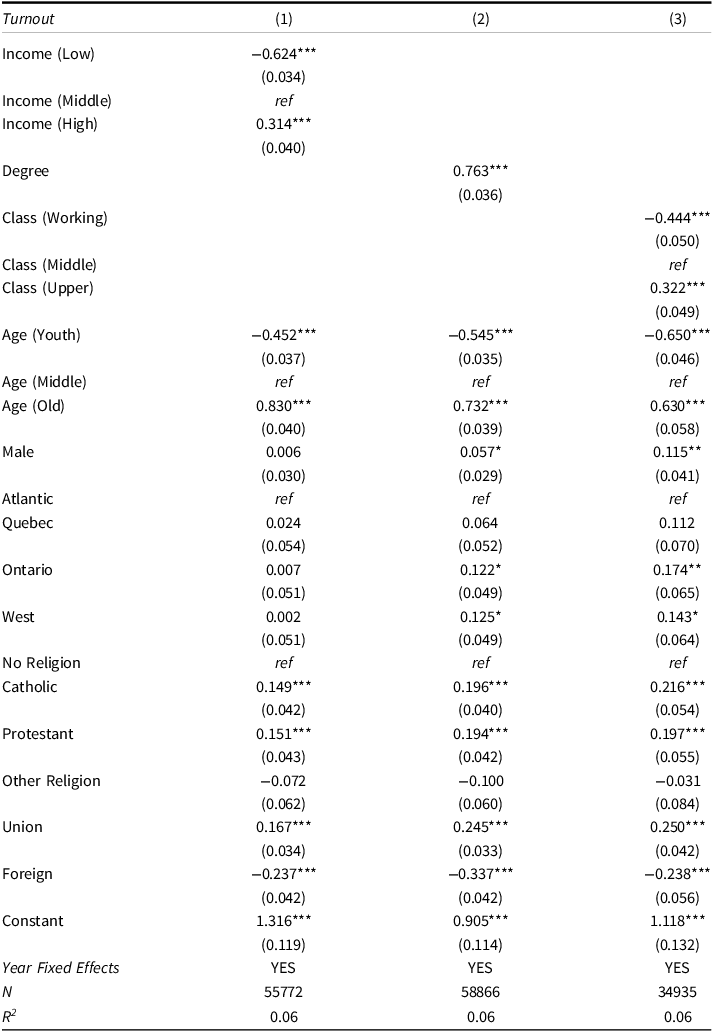
Next, we turn to estimating turnout by social group. First, I estimate a pooled logistic regression model that includes each of the available elections from 1965–2021 as fixed effects. All three SES measures (education, income and class) were combined with each of the individual level controls into a multivariate analysis to examine the independent and cumulative impact of social-status influences on turnout. The variables are standardized in all models to facilitate comparison. First each SES measure is estimated individually with each of the controls to facilitate ascertaining the independent influence of each SES measure, separately from the other SES measures. Table 1 displays the results of the three models.
Pooled Logistic Regression Predicting Propensity to Vote

Note: Beta coefficients from a pooled logistic regression predicting turnout, with standard errors in parentheses. *p < 0.05, **p < 0.01, ***p < 0.001.
Each SES variable is statistically significant at (p < 0.001) and has large substantive effects compared to the controls, save for age. Model 1 shows that lower income respondents are significantly less likely to vote than higher income respondents. The coefficient is also roughly twice as strong as the high-income group when each are compared to middle income respondents. This shows that it is low-income earners that are driving the income effects. Model 2 shows that degree holders are significantly more likely to vote with a coefficient effect size that is equal to class in Model 3. Model 3 reveals that lower class respondents are significantly less likely to vote than higher class groups. The coefficient effect size for the lower class is not as strong as for low-income earners in Model 1, but it is a quarter larger than for the upper class, when both are compared to the middle class.
I also estimate a comprehensive model containing each SES variable, to ascertain overall effect. Figure 2 summarizes the independent influence of each variable by displaying the point estimates of logit coefficients with their 95 per cent confidence intervals (CIs). Region and gender are the only variables that do not reach statistical significance. Union members and native-born Canadians are significantly more likely to vote, and Catholics and Protestants are significantly more likely to vote than the nonreligious. Importantly, each of our three independent variables are significant, positively related to turnout, and display by far the largest effects in the model, save for age, which displays the greatest effect. A clear gradient again emerges with lower-SES individuals less likely to vote than higher-SES individuals. Education displays a large statistically significant effect at the highest level (b = 0.53, p < 0.001)). Both low income (b = 0.44) and working class (b = 0.35) individuals are negatively related to middle earners and the middle class respectively, and are both statistically significant at the highest level (p < 0.001). High earners (p < 0.001) are also significantly more likely to vote compared to the middle reference category, while upper-class individuals have a greater likelihood to vote than the middle class, but not significantly so.
Logit coefficients with 95 per cent CIs from a multivariate pooled (1965–2021) regression of turnout, including age, class, degree, income, region, gender, religion, nativity and union status. See Appendix A5 for full table.

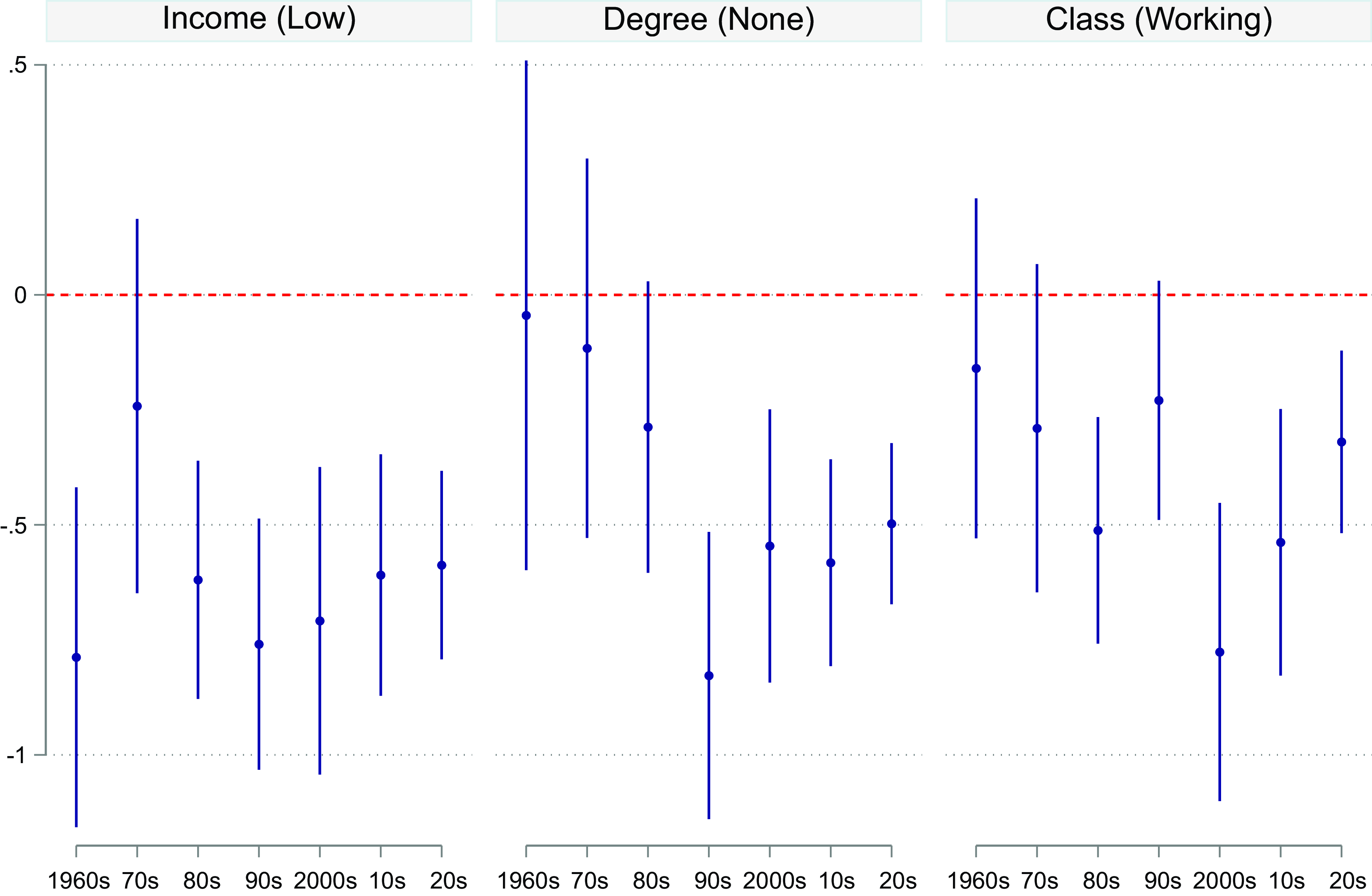
Social status is clearly significantly related to turnout in Canada. But has its influence changed over time? To ascertain the time trends, I undertake a series of multivariate logistic regressions with the same variables and election fixed effects, but this time pooled by decade. Figure 3 displays the point estimates of logit coefficients for low status (relative to high status) for each of our three independent variables, with their 95 per cent confidence intervals (CIs), in each decade since the 1960s.
Logit coefficients (lower status) with 95 per cent CIs from multivariate pooled regressions of turnout, including age, class, degree, income, region, gender, religion, nativity and union status, by decade. Reference is higher-status categories. See Appendix A6 for full table.

The estimations by decade show a fairly consistent pattern of increasing effects for each of the SES variables. The negative relation of not holding a degree to turnout peaks in the 1990s, but of note is that the variable displays a null effect until the 1980s, and does not attain significance until the 1990s. This suggests that education did not really become an important predictor of turnout until turnout began to precipitously decline in Canada. Class also decreases in effect over time, except for the 1990s, and it peaks in the 2000s. In the most recent election, we see a decreased effect, which is likely owing to the modal change to web that we also see in Figure 1. The one outlier is income when the entire period is taken into consideration, as the significantly negative relation of low income to turnout has held consistently over time, except for a blip in the 1970s. So, in comparison to a 1970s starting point, the effect of low income has substantially increased, however, this is not the case relative to the 1960s.
In addition, the total explanatory power of the three independent variables accounts for much of the explanatory power of the models throughout, dwarfing the controls, save for age, as well as substantially increasing over time, by roughly doubling in size.Footnote 17 Overall, the decade estimations do lend some support to the notion of increasing effects for the independent variables and therefore support for H1a and H1b, even though they are not quite as conclusive as the descriptive evidence from Figure 1.
Economic salience and turnout
Given these findings, I now turn to whether party system salience impacts the relationship between social status and turnout. Specifically, I investigate H2 whether lower social status individuals are more likely to vote if the party system places greater emphasis on economic saliency relative to socio-cultural saliency. Figure 4 presents the relative party system salience of these two dimensions in Canada from 1965–2021. A decline in the party system variable implies fading salience of the economic dimension relative to the socio-cultural dimension. In-line with cross-national research (Hillen, Reference Hillen2023), there is a distinct pattern of decreasing economic salience and increasing cultural salience over time. Although economic saliency has always been larger, socio-cultural saliency has more than doubled since the 1960s, gradually increasing. Economic saliency peaked in the 1974 and 1980 elections and has declined since the 1980s. Until the 1980s, the gap between economic and cultural saliency was vast, and since 1997, it has largely been very small. Therefore, the decline in relative economic saliency in Canada has tended to track the decline in turnout (r = 0.48).
Relative party system salience of the economic vs the cultural dimension, 1965–2021.

As clarified above, the party system saliency empirical test rests on the theoretically grounded assumption that lower-SES individuals care about economic over socio-cultural values more than higher-SES individuals do. Consequently, increased attention to the economy by the party system could mobilize lower-SES individuals to go to the polls in greater numbers. I verified this assumption using a measure of support for redistribution that is available since 1988 in the CES.
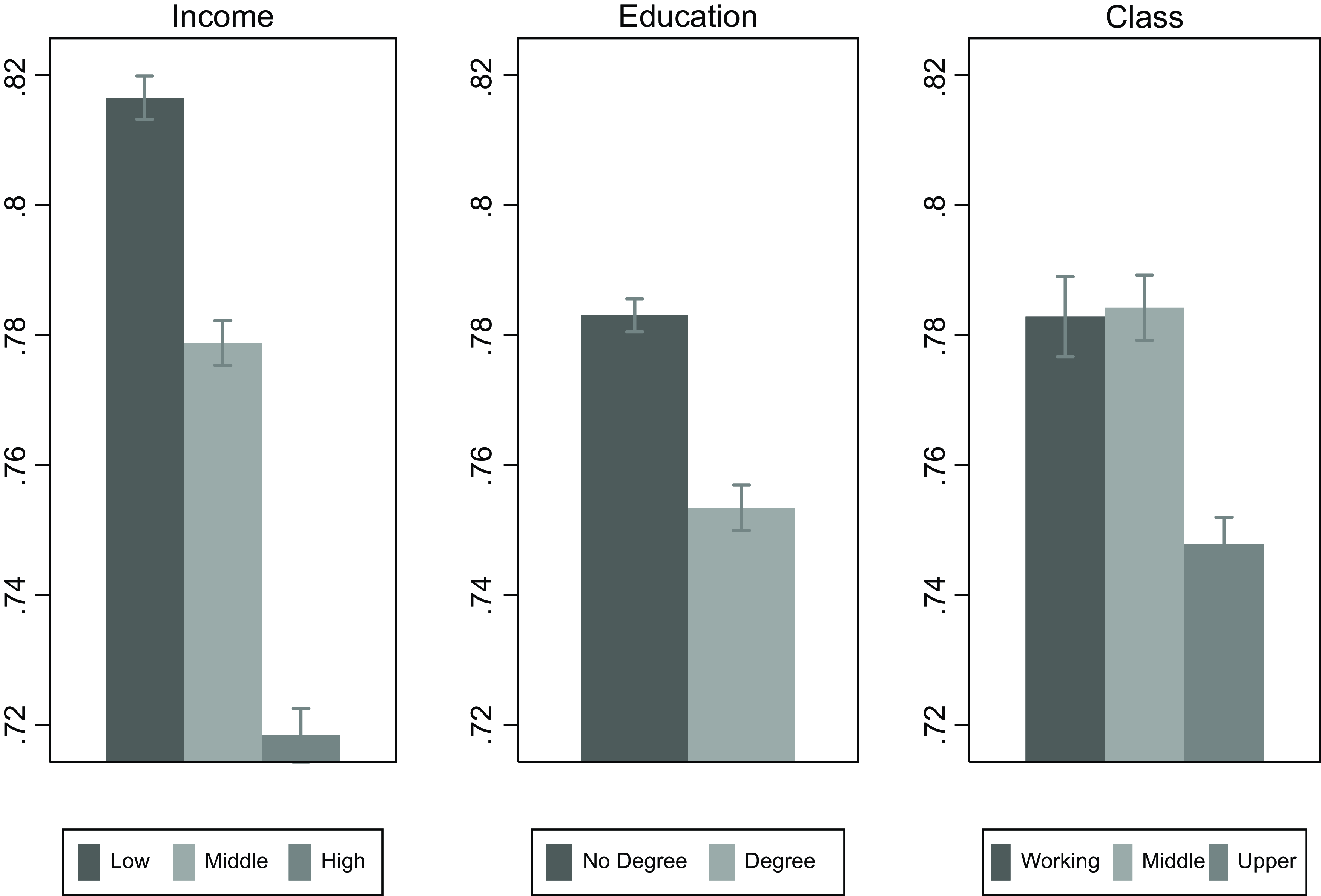
Figure 5 reports the pooled mean support for redistribution by class, education and income in Canada. The variable is re-scaled 0–1 based on five-point answers. All three independent variables confirm that lower-status individuals are significantly more supportive of redistribution than higher-status individuals. Within class, both the working class and middle class have the highest support for redistribution at roughly the same level (0.785), which is roughly 0.04 points higher than the upper class. Nondegree holders are roughly 0.04 points more supportive than degree holders. However, income provides the greatest confirmation of lower-status openness to economic saliency, as low-income individual mean support for redistribution is roughly 0.82. There is a clear gradient with the middle income tercile support at roughly 0.78, and the richest tercile only supportive at roughly 0.72, a very large 0.1 point gap between the lowest and highest terciles.
Mean support for redistribution by class, education, and income, with 95% CIs, 1988–2021.

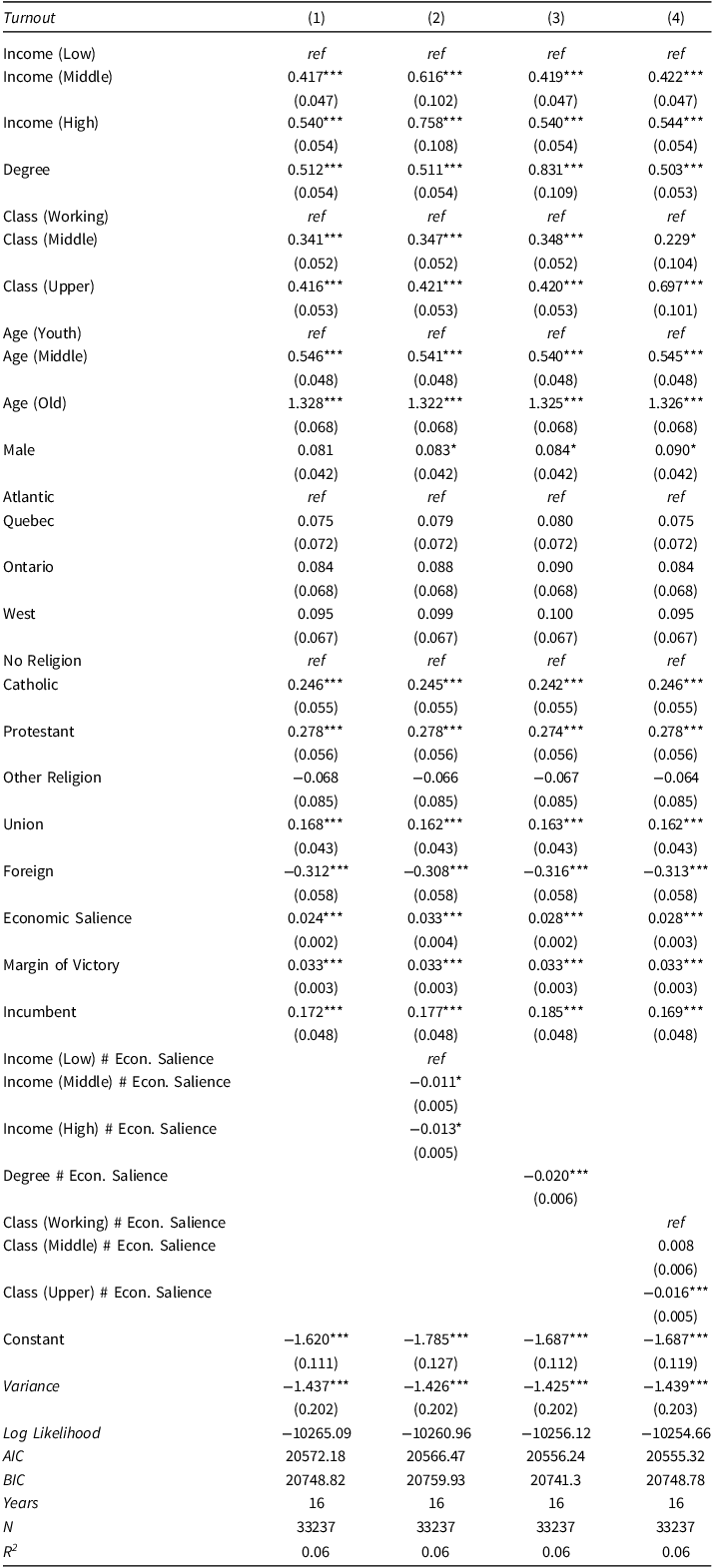
Last, to test whether lower social status individuals are more likely to vote if the party system places more emphasis on economic saliency relative to socio-cultural saliency, I estimate a series of multilevel logistic models, containing each of the individual-level variables, as well as economic saliency, and controls at the election level. Given the structure of the data, I pool elections together with individuals nested in elections. In this way, I take into account the clustering of respondents across different elections, which allows for testing the effect of variables measured at the aggregate level on individual turnout. Table 2 displays the results. Model 1 contains each of the variables. Models 2–4 then also each contain an interaction with one of the three independent variables, which best measures the individual effects of each interaction.
Multilevel Pooled Logistic Regression Predicting Propensity to Vote

Note: Beta coefficients from a multilevel pooled logistic regression predicting turnout, with clustered standard errors in parentheses.
*p < 0.05, **p < 0.01, ***p < 0.001.
Model 1 results show that class, degree and income are again all statistically significant at (p < 0.001). Both aggregate level controls are positive and significantly related to turnout, as people are more likely to vote when elections are more competitive and when the Liberal Party is in power. Importantly, the key aggregate level variable is significant and positively related to turnout (p < 0.001), as people are more likely to vote when the party system contains greater economic saliency relative to socio-cultural saliency.
The results from Models 2–4 show that each of the interactions are negative and statistically significant to varying degrees for the highest status groups. The education and class interactions are significant at the highest level (p < 0.001), and the income interaction at (p < 0.01). The negative interactions, when each variable was positively related to turnout in Model 1, implies that either higher-status individuals are less likely to vote with greater economic saliency, or that lower-status individuals are more likely to vote with greater economic saliency. To investigate further, Figure 6 presents the marginal effects of each interaction.
Marginal effects of interactions between economic saliency and income, degree and class, on predicting turnout, with 95 per cent CIs. From Models 2–4 (Table 2) of pooled logistic regressions.

In each case, lower-status individuals are significantly more likely to vote with greater party system economic saliency. At the lowest level of economic salience, low-income earner likelihood to vote is roughly 51 per cent, while it is roughly 68 per cent for high earners. Both groups are more likely to vote with greater economic saliency, however the increased rate is much higher for low earners. At the highest level of economic salience, the gap in voting between the two groups closes substantially, with high-income groups predicted to vote only two percentage points more than low earners, at roughly 83 per cent. We also see that the slope for middle earners is very similar to high earners, and the gap only closes a couple percentage points from the lowest to highest levels of saliency.
The income effects from Model 2 are very similar for education (Model 3) and class (Model 4). However, for education we see a reduced slope for degree holders, which is roughly twice as less steep than for income and class. This implies that increased economic saliency has a much lower effect on voting likelihood for degree holders than for high-status individuals by income and class. The other key difference is that for class, the middle-class slope roughly is even slightly steeper than the working-class slope, and we see at the highest levels of economic saliency that middle class vote likelihood even surpasses the upper class. This would seem to match the results from Figure 5, which shows that both working-class and middle-class respondents are more supportive of redistribution than upper-class respondents, and that the middle class is even slightly more supportive than the working class.
The magnitude of each of the effects is very strong, which should be taken with some caution. First, only 16 elections could be included in the salience models, which is a small amount of higher order units. Second, over two-thirds of the economic salience variance (11 elections) occurs at the lowest levels of salience, between 2 and 20 points on a scale that ranges upwards to roughly 50 points. Therefore, the magnitude of the interaction effect is much lower where the majority of cases cluster. For example, this smaller variance range would mean that low-income earners are predicted to vote roughly 10 more percentage points moving between 2 and 20 on the economic salience variable, which would only reduce the income turnout gap by roughly 5 percentage points. Still a substantive amount, but a much smaller overall effect. Nevertheless, the interactions provide telling evidence in support of H2, that the decline of turnout among lower-status groups is significantly moderated by economic saliency.
Conclusion
Voter turnout has been on the decline in many advanced democracies, with Canada at the forefront of the trend (Blais et al., Reference Blais, Gidengil, Nevitte and Nadeau2004; Blais and Rubenson, Reference Blais and Rubenson2013; Kostelka and Blais, Reference Kostelka and Blais2021). Cross-national research shows that lower-status individuals (Dalton, Reference Dalton2017; Elsässer et al., Reference Elsässer, Schäfer and Wenker2022; Gallego, Reference Gallego2015; Goldberg, Reference Goldberg2020; Rennwald, Reference Rennwald2020; Tuorto, Reference Tuorto2022) vote at much lower rates than higher-status individuals. These inequalities in political voice stem from the fact that those with more resources at their disposal turn out to vote in higher numbers. However, social groups also need to be mobilized by party systems via policy supply, in order to participate electorally.
Relying on data from the entire series of the CES, the empirical analyses in this article show that the decline of turnout in Canada is driven by a disproportionate decline of turnout among individuals with lower social status, which began in the 1980s. The turnout gap has also increased considerably over time for all three social groups (class, education and income) investigated. In attempting to understand the factors that might explain this increasing turnout gap, I focused particular attention on supply-side logic and the role played by political parties in mobilizing voters. I did so by drawing on parties’ issue emphases from election manifestos to derive a measure of the salience of the economic dimension vis-a-vis the cultural dimension in party competition. I found that lower-SES individuals care about economic values, and I provide evidence that they are more supportive of redistribution than higher-SES individuals. I also show that until the 1980s, the gap between economic and cultural saliency was very large, and since 1997, it has narrowed considerably. Therefore, the decline in relative economic saliency in Canada has tended to track the decline in turnout. Although the decline in relative saliency precedes the increase in turnout inequality by class, it can take multiple elections for changes in party supply to incur class effects in turnout, as Evans and Tilley (Reference Evans and Tilley2017) and Heath (Reference Heath2018) show in the United Kingdom. However, the results here reveal that greater saliency of economic issues in the party system significantly reduces these turnout inequalities via the increased mobilization of lower-SES individuals to vote.
Class politics has largely been neglected in Canada, although recent research documents a discernible voting cleavage (Andersen, Reference Andersen, Dirk de Graaf and Evans2013; Kiss et al., Reference Kiss, Polacko and Graefe2023; Polacko et al., Reference Polacko, Kiss and Graefe2022, Reference Polacko, Kiss, Graefe, Robbins-Kanter, Koop and Troup2025). However, by focusing on voter turnout by class, this article provides a coherent and more complete narrative of class voting in Canada over time. One key implication is that similar to the United States, class exerts a small effect on party vote in Canada, but a particularly strong influence on electoral participation. It also outlines the importance of class-related political representation for political participation.
The findings suggest that recent concerns regarding voter alienation and indifference appear to be warranted and have serious implications for lower-status individuals in Canada. The results here confirm that lower-SES individuals have different economic preferences than higher-SES individuals, which is consequential and only likely to increase with a growing cost-of-living crisis and rising inequality. We see economic anxiety accompanied by growing distrust and dissatisfaction with politicians and political institutions. Hence, political institutions are increasingly being deemed to be unresponsive to meeting the needs of many ordinary citizens. For example, a recent Angus Reid survey found that 30 per cent of English-speaking Canadians have no trust in democracy, and nearly 50 per cent do not feel represented by government, with lower-status individuals and individuals dissatisfied with the economy significantly more likely to hold both views (Stockemer and Gaspard, Reference Stockemer and Gaspard2025). Importantly, the results in this article show that Canada’s party system is not providing the requisite saliency to economic issues in order to keep lower-status individuals engaged in electoral participation. If political parties do not focus on issues that are of key concern for large social groups, then it is unsurprising that class non-voting has been on the rise. Therefore, low turnout should largely “be blamed on the character of the election, not on the characters of those who failed to vote” (Franklin, Reference Franklin2004: 2).
A further key implication is that the political disengagement of large social groups in the population is a fundamental problem that deeply undermines the very notions of democracy and representative government. Since social status influences party preference formation, both for voters (Kitschelt and Rehm, Reference Kitschelt and Rehm2014) and legislators (Carnes, Reference Carnes2013), these results show that a growing class gap in electoral participation in Canada means that the privileged position in society of the few can magnify political and social inequalities in a never-ending loop, whereby socio-economic inequality fosters political inequality, which fosters socio-economic inequality, and so on (Bartels, Reference Bartels2008). This pervasive self-reinforcing cycle serves to increasingly distance lower–social status individuals from political life (Dalton, Reference Dalton2017; Dassonneville and Hooghe, Reference Dassonneville and Hooghe2017).
One avenue for further research is to test for the generalizability of these findings in the Canadian case, by examining the moderating effect of party system saliency on turnout inequality in other democracies. Perhaps it is a feature in some contexts over others, such as welfare regime, electoral system or region? More research is also needed to examine how lower-status individuals perceive campaign rhetoric and changes in electoral saliency. Hopefully the results here will stimulate further research into saliency perceptions and turnout inequalities in the Canadian context and focus efforts on identifying mechanisms that can curb detachment from civic life. The results should also inspire research and policy makers that tackle the issues of inequality, poverty, social immobility and unequal voice, in a way that promotes political equality and representation for all.
Supplementary material
The supplementary material for this article can be found at https://doi.org/10.1017/S0008423925100462
Funding statement
Social Sciences and Humanities Research Council of Canada (SSHRC): #756-2023-0239. Fonds de recherche du Québec – Société et culture (FRQSC): #336672.





 Open access

