


The Nubian ibex Capra nubiana is an arid-land montane ungulate. In 2020, the species was categorized as Vulnerable on the IUCN Red List under criteria C1+2a(i); i.e. with < 4,500 mature individuals (C) estimated to remain in the wild, and with the population continuing to decline (1) and no subpopulation estimated to contain > 250 mature individuals (a(1); Ross et al., Reference Ross, Elalqamy, Al Said and Saltz2020; IUCN, 2023). Historically, the distribution of the Nubian ibex extended from north-east Africa to the mountains of southern Oman (Al-Ghafri et al., Reference Al-Ghafri, White, Briers, Dicks, Ball and Ghazali2021) but its current distribution is uncertain, particularly in Saudi Arabia (Barichievy et al., Reference Barichievy, Sheldon, Wacher, Llewellyn, Al-Mutairy and Alagaili2018). The historical distribution in Saudi Arabia covered central regions and the western mountains (Harrison & Bates, Reference Harrison and Bates1991). Aerial and ground surveys during 1987–1989 found ibex concentrated in the mountains of the Arabian shield in the west of the country, with isolated groups located in the northern, north-central and central regions in a wide range of habitat types (Habibi & Grainger, Reference Habibi and Grainger1990). However, in their IUCN Red List assessment, Ross et al. (Reference Ross, Elalqamy, Al Said and Saltz2020) reported that the species was now restricted to the Hawtat bani Tamim Ibex Reserve in central Saudi Arabia, having previously occurred in mountainous areas across the country. This suggests that it may have been extirpated from 11 other sites, although there is a dearth of empirical data to support this conclusion (Ross et al., Reference Ross, Elalqamy, Al Said and Saltz2020; Fig. 1a).
(a) Geographical range of the Nubian ibex Capra nubiana in Saudi Arabia according to the latest IUCN Red List assessment (Ross et al., Reference Ross, Elalqamy, Al Said and Saltz2020). (b) Camera-trap locations in 16 areas in Saudi Arabia during 2020–2022 (Dunford et al., Reference Dunford, Faure, Ross, Spalton, Drouilly and Pryce-Fitchen2023). (c) Location of camera-trap areas where Nubian ibex were detected, and release sites of captive-bred animals.

Fig. 1 Long description
Panel A: A map of Saudi Arabia showing the historical and current distribution of the Nubian ibex. The map uses color coding to indicate areas where the ibex is extant (resident), possibly extant (resident), and possibly extinct. Key cities such as Tabuk, Medina, Mecca, Riyadh, and Ad Damman are labeled. Panel B: A map of Saudi Arabia highlighting camera-trap areas in 16 locations during 2020-2022. The camera-trap areas are marked in orange. Key cities such as Tabuk, Medina, Mecca, and Jeddah are labeled. Panel C: A map of Saudi Arabia showing the locations where Nubian ibex were detected by camera traps and the release sites of captive-bred animals. Camera-trap detections are marked in green, and release sites are marked with black triangles. Key cities such as Tabuk, Medina, Mecca, and Jeddah are labeled.
We took advantage of extensive camera-trapping bycatch data from 2020–2022 to update the distribution map of the Nubian ibex in Saudi Arabia and supplement the Red List data using additional information that was not available when the 2020 assessment was made. As part of a wider study, we undertook camera-trap monitoring (726 camera stations) in 16 areas thought to contain the Arabian leopard Panthera pardus nimr but also known to be suitable habitat for Nubian ibex (for details see Dunford et al., Reference Dunford, Faure, Ross, Spalton, Drouilly and Pryce-Fitchen2023; Fig. 1b). The study area (c. 5,324 km2) covered arid to semi-arid mountainous terrain at elevations ranging from 286 to 2,762 m.
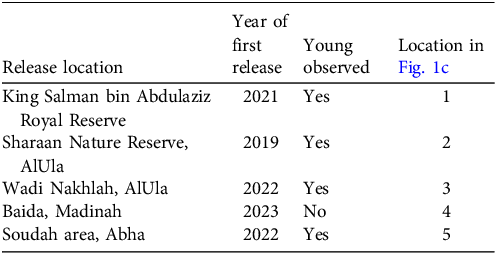
Our camera-trap locations partially overlapped with one of the 11 sites where the ibex is listed as possibly extinct on the Red List database (Fig. 1a) but we did not detect the species in that area. To our knowledge, captive-bred Nubian ibex have been released in at least five locations within their historical range since 2019 (Table 1, Fig. 1c) as part of a wider reintroduction/rewilding initiative in Saudi Arabia, and we collated records from these sites.
Nubian ibex Capra nubiana release locations in Saudi Arabia, year of first release, confirmation of sightings of young ibex following release and approximate location of release sites shown in Fig. 1c.

Table 1 Long description
A table with five rows and four columns detailing Nubian ibex release locations, years of first release, young ibex observations, and approximate locations in Fig. 1c. Column headers are Release location, Year of first release, Young observed, and Location in Fig. 1c. Row 1: King Salman bin Abdulaziz Royal Reserve, 2021, Yes, 1. Row 2: Sharaan Nature Reserve, AlUla, 2019, Yes, 2. Row 3: Wadi Nakhlah, AlUla, 2022, Yes, 3. Row 4: Baida, Madinah, 2023, No, 4. Row 5: Soudah area, Abha, 2022, Yes, 5.
Across 94,369 trap-nights, we recorded 426 Nubian ibex events from 42 camera-trap stations, comprising 113 independent detections (i.e. images taken > 30 minutes apart at the same station; Fig. 1b). The majority of camera-trap detections (71 of 113 independent detections, 62.8%) were during diurnal hours (06:00–17:59) and individuals were detected at elevations of 606–2,672 m. We found wild Nubian ibex in 50% of the areas surveyed (eight out of 16 sites), indicating persistence in multiple refugia along the western escarpments of Saudi Arabia. In addition, the species is known to occur in the Ibex Reserve in central Saudi Arabia where it is monitored as part of an ongoing management plan.
Our study extends our knowledge of the current distribution of the Nubian ibex. Our camera-trap data demonstrate that the ibex still exists in multiple sites along the western coastal mountain escarpments. An understanding of where wild populations remain, and where reintroduced Nubian ibex now occur in Saudi Arabia, is vital for developing effective conservation and management programmes to encourage the establishment of healthy, viable populations. Our findings indicate the key areas that function as important refuges for the ibex and should be targeted for additional protection (Fig. 1). This information is being incorporated into management planning and conservation actions within Saudi Arabia. Even within these generally rugged and remote areas, ibex were mostly recorded on, or very close to, steep slopes that limit human access. Further targeted surveys are needed at sites where ibex occurred in the past (Fig. 1a) to accurately map their current distribution in Saudi Arabia and to facilitate the creation and protection of wildlife corridors.
The low number of detections relative to the camera-trapping survey effort suggests that only small remnant Nubian ibex populations survive in the wild, distributed over a wide area, and persisting in montane refuges that are difficult to access (Habibi, Reference Habibi1994, Reference Habibi1997). Extensive grazing of both domestic livestock (camels, goats, sheep) and feral animals (donkeys) is a key threat, restricting the amount of food available for the ibex (P. Faure, pers. comm., 2024). Management should target key threats in locations where wild ibex are present, including reduction of grazing by domestic livestock and feral animals, and prevention of illegal hunting. Additional research is needed to quantify the effect of competition from other herbivores and to understand the severity of the threat they pose to the ibex.
Reintroduction has become a key conservation strategy to reinforce threatened populations and increase the range of the Nubian ibex in Saudi Arabia, with further reintroductions planned in new areas in addition to the existing release sites (Table 1, Fig. 1c). Reintroductions are a commonly used and potentially powerful tool in biodiversity conservation (Fischer & Lindenmayer, Reference Fischer and Lindenmayer2000). However, the success of reintroductions depends on addressing the original drivers of decline, particularly illegal hunting and habitat degradation, before releases occur (Fisher & Lindenmayer, Reference Fischer and Lindenmayer2000). Nubian ibex were historically widespread in Saudi Arabia but were hunted extensively and are still targeted. Overgrazing by livestock leading to habitat degradation is another threat to their survival. These issues must be addressed in national management plans if ibex populations are to survive in the wild and if reintroductions are to succeed. Population connectivity, genetic relatedness and the proximity of release sites to wild populations are also important considerations. Reintroductions from genetically divergent populations may not be appropriate, as highlighted by genetic research on Nubian ibex in Oman (Al-Ghafri et al., Reference Al-Ghafri, White, Briers, Dicks, Ball and Ghazali2021). We recommend genetic profiling of both wild and reintroduced populations to inform management plans and decision-making. Research into the genetics and population connectivity of the Nubian ibex in Saudi Arabia would reveal the degree of fragmentation and isolation and the areas where reintroductions are needed to minimize inbreeding depression.
Although our findings indicate that the Nubian ibex is more widespread in Saudi Arabia than suggested in the 2020 Red List assessment (Ross et al., Reference Ross, Elalqamy, Al Said and Saltz2020), a coordinated management strategy is needed to protect remaining populations from ongoing threats and to secure the species’ survival into the future.
Author contributions
Study design: IS, AS, JPBF, SB, GKHM; data collection: JPBF, GKHM, EG, MSS; data analysis: JPBF, IS, AS; writing: IS, JPBF, AS, MSS, SB.
Acknowledgements
We thank the Saudi Arabian National Centre for Wildlife, The Royal Commission for AlUla and Panthera for their support; and Marine Drouilly, Andrew Spalton, Hadi Al Hikmani, Mari-Su de Villiers, Michael Lambrecht, Joe Jacobs, Michael Ross, Kai Pryce-Fitchen, Lucy Smyth, Josh van der Ploeg, Matt Smith, Clement Brunet, Charles Spalton, Jacques Proust, Nic Proust, Mesfer Al Hlafi, Saleh Al Aamri, Abdullah Al Sheri and everyone who assisted with the Panthera fieldwork. This research received no specific grant from any funding agency, or commercial or not-for-profit sectors.
Conflicts of interest
None.
Ethical standards
The regional governing bodies, The Royal Commission for AlUla (RCU) and the Kingdom of Saudi Arabia Ministry of Interior, provided formal permission for field surveys within the study area (permit number 149137). Wherever local people were encountered during camera deployment, they were informed of the purpose of the study, and stickers on all cameras identified them as the property of RCU in Arabic. Our research abided by the Oryx guidelines on ethical standards.
Data availability
The data supporting the findings of this study are available from The Royal Commission for AlUla. Restrictions apply to the availability of these data, which were used under licence for this study. Data are available from the corresponding author, IS, with the permission of The Royal Commission for AlUla.


 Open access

