

Introduction
‘Green jobs’ occupy a central role in platforms for a Green New Deal, anchored in the belief that they can simultaneously limit emissions and contribute to a revitalised labour movement (see Brecher Reference Brecher2024; Calhoun and Fong Reference Calhoun and Fong2022; Klein Reference Klein2019; Ordower and Zafir Reference Ordower and Zafir2024). Related to this, many studies have tended to focus on social upgrading and upskilling strategies or technocratic aspects of the transition in discussing work and workers (Bazilian et al Reference Bazilian, Carley, Konisky, Zerriffi, Pai and Handler2021; García-García et al Reference García-García, Carpintero and Buendía2020; Huber Reference Huber, Ordower and Zafir2024; Knuth et al Reference Knuth, Behrsin, Levenda and McCarthy2022).Footnote 1 Indeed, the prevailing view channels a ‘promethean view’ of social change consistent with ecological modernisation in which technological change resolves environmental maladies through innovation, with attendant boosts in employment as a ‘natural’ by-product (Roos and Hornborg Reference Roos and Hornborg2024). While alternatives to the fossil fuel regime are needed, it is also true that the expansion of newer sectors like wind, solar, and battery storage should make the lives of workers and communities more, not less secure. Evidence suggests, however, that expanding sectors of the ‘new energy economy’ may further perpetuate and lock-in conditions of precarity and flexibilisation (Davidson Reference Davidson2023; Krommyda et al Reference Krommyda, Gialis and Stratigea2025; Pearse and Bryant Reference Pearse and Bryant2021).
To both understand and shift work arrangements towards more ecologically and socially sensitive ends, we need to ground our understanding of expanding sectors and related work processes in empirical investigations into existing conditions of work in the ‘energy transition’. Such analyses can help to better discern the mutual constitution of both labour exploitation and ecological appropriation understood as conjoined processes (Selwyn Reference Selwyn2025), including how existing social arrangements of work in the energy sector either constrain or unlock the potential for eco-social transformation.
To make progress on this goal, I construct a description of the onshore wind energy labour regime in the US and how its varied aspects mediate the labour process across phases of wind production. To do so, I use the framework of labour regime analysis to map how the imbricated spheres of production, circulation, ecology, and social reproduction explain the relative intensity of labour exploitation in onshore wind. Related to this contribution and anchored to a political project aimed at improving conditions of work in renewable energy, I ask what conditions unique to wind energy can suppress or contribute to unionisation.Footnote 2
Secondly, I contribute to theoretical debates on how the socioecological indeterminacy of production (see Baglioni and Campling Reference Baglioni and Campling2017; Campling and Kim Reference Campling and Kim2025) influences the constitution of local workplace labour regimes. I emphasise how the relative mobility and remoteness of work activities shape the labour regime and intensity of exploitation, in line with recent analyses by Felipe Irarrazaval and Miguel Atienza (Reference Irarrazaval and Atienza2025). I extend my analysis, however, arguing that different facets of the labour regime, including ecological aspects, mediate how workers perceive their jobs according to the particularities and settings of work, which comingles with the wind industry’s historical formation and the broader political economic conditions of the ‘social workfare’ regime (see Peck Reference Peck2016) in the US. Expounding this ideational element can help better explain the relative durability of labour regimes. While the role of ideas and perceptions has been registered by labour regime scholarship in shaping the range of possibility workers feel is available to them, it is often sidelined for material dimensions, a common practice in geographical political economy more generally (Peck et al Reference Peck, Meulbroek and Phillips2025). While it is critical to acknowledge that ideas do not appear spontaneously as exogenous factors but are instead mutually constituted by sociohistorical relations and material realities, the ideational space nevertheless plays an important role in governing the everyday rhythms and practices of people’s lives – what Antonio Gramsci would refer to as a ‘hegemonic common sense’.
Thirdly, and in relation to other recent renewable energy labour regime studies (see Krommyda et al Reference Krommyda, Gialis and Stratigea2025; Neal Reference Nealforthcoming), I argue that the labour processes associated with wind energy in the ‘main’ spheres of production (manufacture, project development, and operations and maintenance) are internally related and conditioned by capitals-in-competition. This competition is driven by the profit incentives of investor-owned utilities, which suggests an axis along which labour unions and environmentalists may seek to contend the power of capital in the transition; that is, democratic control and ownership in the energy sector.
I base my findings on data generated through desk-based research, prior knowledge of the industry as a member of it, and qualitative assessments of 40 semi-structured interviews with an array of individuals familiar with the energy sector, and wind energy, in particular. This includes 5 interviews with state representatives; 11 interviews with industry insiders, such as managers, executives, and consultants; and 24 interviews with workers, trade unionists, or groups that represent the interests of wind energy workers, and includes 5 interviews with subject matter experts of wind production processes. Interviewees were selected through purposeful sampling, which subsequently gave way to chain sampling. In some instances, interviewees occupy multiple identities according to the above categorisation. For example, someone interviewed may have once been a worker but now represents the role of an industry manager. Interviews were transcribed and subsequently analysed through content analysis and associated codification of themes. When information I offer references an interview with an interlocuter, I provide the citation with the corresponding number. For instance, interview 1 is denoted by (I1). The Annex should be consulted for more details about interviews referenced in this paper.
I begin the article with a recap on labour regimes in global production network (GPN) research. Next, I map the wind energy industry in the US, doing so first with a history of its origins, which are interlinked to associated regulatory changes in electricity markets. I then move into empirical subsections that examine how labour regimes for onshore wind energy condition outcomes in three phases of production: manufacturing, project development, and operations and maintenance (O&M). Throughout, I provide commentary on how different facets of wind production and the societal milieux in which it operates, contribute to or hinder future organising efforts. Based on my analysis, I conclude with a series of observations about the onshore wind energy labour regime and future areas of research.
Labour regimes in global production networks (GPNs)
Informed by labour process theory, labour regime scholarship stretches back to Michael Burawoy’s (Reference Burawoy1983) work on factory regimes. More recently, it has been leveraged by Global Value Chain (GVC) and GPN scholars to help theorise how private governance, commercial pressures, and the state shape working conditions and corresponding forms of worker contestation (Anner Reference Anner2015; Coe and Yeung Reference Coe and Yeung2019; Pattenden Reference Pattenden2016; Selwyn Reference Selwyn2012).Footnote 3
Labour regimes refer to historical, multi-scalar phenomena that result from struggles over labour control that exist both at and between sites of work across production networks. They exist as a ‘mediating category’, meaning that they seek to connect broader political economic structures, sociocultural currents, and institutions with the actual practices of labour control in the workplace (Pattenden Reference Pattenden2016). In this respect, they offer a way to theorise and explain the labour process at sites of production but do so not on the basis of unilinear causality, but through mutually constitutive and multi-scalar processes within GPNs and internal relations among actors (Baglioni Reference Baglioni2018; Smith et al Reference Smith, Barbu, Campling, Harrison and Richardson2018).
Its adoption by GVC and GPN researchers represents an attempt to recentre and foreground workers in their analyses (Baglioni et al Reference Baglioni, Campling, Mezzadri, Miyamura, Pattenden, Selwyn, Baglioni, Campling, Coe and Smith2022a, 4; Taylor et al Reference Taylor, Newsome, Bair, Rainnie, Newsome, Taylor, Bair and Rainnie2015). GPN and some GVC scholars recognised that existing research tended to privilege firm and business-focused narratives of global production outcomes, pushing labour to the side even though it is the source from which value derives (Baglioni et al Reference Baglioni, Campling, Mezzadri, Miyamura, Pattenden, Selwyn, Baglioni, Campling, Coe and Smith2022a, 1; Selwyn Reference Selwyn2016). Nevertheless, firms remain central to analysis because, just like labour, they face conditions not of their own making.
As an abstraction, labour regimes comprise four interrelated analytical spheres: production, circulation, (social) reproduction, and ecology (refer to Baglioni et al Reference Baglioni, Campling, Mezzadri, Miyamura, Pattenden, Selwyn, Baglioni, Campling, Coe and Smith2022(b)). Capital seeks to produce surplus value through exploitation across these categories, each of which is mediated by historical, spatial, and institutional contexts (Baglioni et al Reference Baglioni, Campling, Coe, Smith, Baglioni, Campling, Coe and Smith2022)c, 82). As Liam Campling and Hyunjung Kim (Reference Campling and Kim2025) discuss, it is impossible for a single researcher to do justice to every sphere simultaneously, but it is nevertheless useful to recognise their mutual existence to adequately theorise the processes that condition workplace outcomes. Ecological dimensions have been somewhat underdeveloped and theorised, however (Baglioni et al Reference Baglioni, Campling, Mezzadri, Miyamura, Pattenden, Selwyn, Baglioni, Campling, Coe and Smith2022b; Campling and Havice Reference Campling, Havice, Ponte, Gereffi and Raj-Reichert2019). This is problematic as the ‘natural gifts’ of the environment and embodied labour power are the ultimate source from which capital derives surplus value. Energy (and nature) as aspects of the environment are often treated as strictly physical and apolitical phenomena, which reinforces how production and its interaction with ecology is understood. A key draw of renewables, however, is how certain material attributes set it apart from the ‘subterranean energy regime’ (see Huber and McCarthy Reference Huber and McCarthy2017) of fossil fuels and, perhaps there exists the possibility of implicit, if unrealised, radical eco-social change in the energy sector. In this respect, considering the ecological sphere is essential – arguably inescapable – when considering work in the energy sector. Related to this, ecology brings attention to the relative fixity of resources and other materialities of production that pose distinct challenges and opportunities for companies and worker agency, shaping labour regimes in important ways (Baglioni and Campling Reference Baglioni and Campling2017; Irarrazaval and Atienza Reference Irarrazaval and Atienza2025). As Irarrazaval and Atienza (Reference Irarrazaval and Atienza2025) note, studies that more explicitly integrate ecology offer a solid foundation to assess socioecological relations, but these often assume a fixed space of production and reproduction, which may not adequately reflect the reality of many workers.
Despite the significant advances of labour regime analysis in recent years, certain elements could be further elaborated. In addition to developments in the ecological sphere, the ways in which ideational aspects of work emerge from, and condition labour regimes appear somewhat overlooked. While Baglioni et al (Reference Baglioni, Campling, Mezzadri, Miyamura, Pattenden, Selwyn, Baglioni, Campling, Coe and Smith2022b) note how culture plays a role in maintaining labour regime outcomes, it often takes a background role or is otherwise dealt with perfunctorily, when considering the relative intensity or manner of labour exploitation. While it may be true that cultural dynamics are not strictly derivative of capital’s logic,Footnote 4 there is value in elaborating how different spheres of the labour regime, including ecology, inform expectations of work that explain the relative durability of the labour process, that is something that may be especially important if the experience of work is precarious and contestation is relatively quiescent. Highlighting how ideas about work connect to material attributes of the labour regime can help us better consider how subtle and diffuse mechanisms of power shape expectations of work and related outcomes. For the purposes of this paper, I have adopted a Gramscian perspective of a ‘hegemonic common sense’ that governs social relations in the day-to-day rhythms of life (Brand Reference Brand2022; Gill Reference Gill2008). As political theorist Alyssa Battisoni (Reference Battistoni2024) argues, the value in probing these ideational elements (in her case considering the expectations of social reproduction) lies in its ability to help us reveal the contradictory and uneven ways in which capitalist accumulation shapes and remakes social life, including how people think about their lives. If we accept the proposition that labour regimes and corresponding forms of exploitation are manufactured (Baglioni et al Reference Baglioni, Campling, Mezzadri, Miyamura, Pattenden, Selwyn, Baglioni, Campling, Coe and Smith2022b), and that they are mediated by workers’ struggles against exploitation, it therefore suggests a need not only to attend to the material aspects of labour control and resistance but also to consider the origins and maintenance function that ideas play, including how these both enable and restrict changes to the labour process.
Critical perspectives on renewable energy work
Several critical perspectives with a focus on labour have been advanced on the topic of renewables. For instance, Dustin Mulvaney’s (Reference Mulvaney2024; Reference Mulvaney2013; Reference Mulvaney2018) investigations into commodity chains of solar energy production highlight the embodied injustices across the solar lifecycle. The approach establishes connections across multi-sited commodity chains that can help reveal the spatial and production dynamics that shape corresponding socioenvironmental relations. While there is much to appreciate about such an approach, supply chain analyses like this do not treat labour as the central process necessary for the valorisation of energy or other natural resources. Furthermore, while the supply chain approach may reveal embodied injustices, it does not necessarily explain why the spatial restructuring of energy flows produces differentiated social relations.
Rebecca Pearse and Gareth Bryant (Reference Pearse and Bryant2021) instead use a value theoretical model from Marxist and feminist political economy that shares a greater affinity with the mode of analysis employed in this paper. Like Matt Huber (Reference Huber2009) and Gavin Bridge et al (Reference Bridge, Özkaynak and Turhan2018), they emphasise that the flow of energy, and associated value relations are, ‘co-constituted with society in and through space’ (Pearse and Bryant Reference Pearse and Bryant2021). They ultimately argue that a value theoretical approach better explains the distributive outcomes of changes to energy systems, and that labour occupies a central role in this spatial reorganisation. Along these lines, others have recently hit upon the emergence of an emerging precariat of subaltern workers in a new energy economy as a function of these processes of spatial reorganisation of the global division of labour (Stock Reference Stock2021; While and Eadson Reference While and Eadson2022). Within countries, such divisions are co-constituted by the liberalisation of electricity markets, which Pearse (Reference Pearse2017) and Bryant (Reference Bryant2019) emphasise have important implications for labour and renewable energy capitals, at least within Australia. States often oversee or regulate these capitals, which makes them central points of contestation over renewable energy capital (Newell Reference Newell2019; Pearse and Bryant Reference Pearse and Bryant2021). In advancing this idea, the value theoretical perspective and review provided by Pearse and Bryant (Reference Pearse and Bryant2021) is exceptionally helpful. My analysis extends their earlier theorisation by grounding it into a particular context, that of onshore wind energy in the U.S., the par excellence of liberal capitalism. In so doing, where their analysis discusses in general terms how liberalised electricity markets and associated policies contribute to conditions of competition, my description shows how these function in concrete terms within an exemplary setting. Moreover, the labour regime approach allows me to synthesise data generated throughout and to provide an explanation as to both why and how the labour process appears as it does.
Concerning wind energy specifically, William Westgard-Cruice (Reference Westgard-Cruice2025a) has carried out a Marxist analysis of offshore wind development in the Northeastern US and Europe to articulate the evolving spatial division of labour resulting from the centralisation of capital processes in offshore wind manufacturing. While Westgard-Cruice (Reference Westgard-Cruice2025a) does not use the expression ‘labour regime’ within their article, it is unmistakably influenced by labour process theory in its discussion of how the circulatory processes and reorganisation of wind capitals create a distinct landscape of differentiated labour. Similarly, Luke Neal ( Reference Nealforthcoming ) has been developing a labour regime analysis of offshore wind energy development in the Humber estuary of the UK, where he emphasises the socioecological indeterminacy of offshore wind energy production. He argues, among other things, that the increasing size of offshore wind turbines has moved sites of extraction further from shore, intensifying the rate of labour exploitation. More recent work (Westgard-Cruice Reference Westgard-Cruice2025b) in a comparative assessment of offshore wind in the Northeastern US and Europe, also argues that workers may leverage structural power afforded to them in the maritime labour regime to formulate alternative class relations (Westgard-Cruice Reference Westgard-Cruice2025b). Each enhances our understanding of the offshore wind industry and latent political possibilities, but leaves onshore wind – offshore wind’s older, smaller sibling – less attended to.
Waking the wind: An abbreviated history
To properly understand the formation of wind energy labour regimes, I first provide a historical look at the development of the wind industry in the US. I discuss the important role the state has played in helping the industry establish itself, and how this coincides with greater competition in the energy sector, which will become important when I turn my attention to the role of capitals-in-competition across the spheres of production and circulation later in the paper.
Renewable energies as we understand them today began in the 1970s following the 1973 Oil Embargo (IRENA 2013). In the US, the embargo led to the creation of the US Department of Energy (DOE) in 1977 and subsequent passage of the Energy Security Act in 1980. In both instances, Congress sought better coordination between federal energy programmes, and this included investments into alternative energy systems such as wind to secure the country from the volatility of global energy markets.
Around the same time, Congress passed the Public Utility Regulatory Policies Act (PURPA) in 1978, which required utilities to buy power from qualified third parties at a utility’s avoided cost, the cost the utility would have incurred for a power project. Before PURPA, utilities had no obligation to consider independent power producers (IPPs) for electricity procurement, and IPPs were not guaranteed access to corresponding transmission. The implementation of PURPA in 1981 increased the salience of IPPs as utilities increasingly sold off their generating assets, while maintaining control of distribution infrastructure like transmission lines and substations (Cleary and Palmer Reference Cleary and Palmer2022; Federal Energy Regulatory Commission 2025). These changes ultimately led to the passage of the Energy Policy Act of 1992, which established the foundation for wholesale electricity market competition by removing barriers to things like transmission access. Today, about one-third of utilities are vertically integrated and regulated (i.e. the utility owns the generators and transmission lines) and most others are serviced by wholesale electricity markets in the form of independent system operators or regional transmission organisations (Cleary and Palmer Reference Cleary and Palmer2022). As a result of these changes, IPPs could compete with regulated utilities at favourable rates, which trailblazed later electricity deregulation and created a more favourable environment for renewables to take hold (Knuth Reference Knuth2023).Footnote 5
Wind energy experienced its first boom in the 1980s because of these changes. During this period, more durable Danish wind turbines dotted the California landscape alongside lighter American-made turbines, reflecting a combination of federal policy built on top of California tax credits (I7). However, the industry floundered in the late 1980s and early 1990s beset by several challenges. Early projects often functioned as tax shelters for investors, which contributed to ‘fly-by-night’ developments plagued by poor design and construction (Garud and Karnøe Reference Garud and Karnøe2003; Knuth Reference Knuth2023; Van Est Reference Van Est1999; Righter Reference Righter1996). Consequently, American original equipment manufacturers (OEMs) largely shuttered their doors.Footnote 6
When Congress passed the Energy Policy Act of 1992, it introduced a production tax credit of 1.5 cents kw/hr. Congress sought to avoid the repeat of earlier projects that reaped capital gains simply through the installation of wind power equipment. Not surprisingly, the industry went through a dry spell through the mid to late 1990s, with those companies that survived being those able to maintain sufficient revenue to keep operations and maintenance on existing plants underway, as early years were heavily dependent on tax incentives (I7).Footnote 7
Eventually, the wind industry recovered and took off in the mid-2000s through a combination of technological improvements, industry standardisation, maturing supply chains, and state support through tax incentives and research activities in centres in the US and Europe that helped improve technological standards (Knuth Reference Knuth2023; I7). The wind industry experienced another major bump in 2015 when the Obama Administration signed a five-year production tax credit (I25), which encouraged further investments and rapid expansion (see White House 2015).
More recently, the Inflation Reduction Act (IRA) and Infrastructure Investment and Jobs Act (IIJA) boosted the pipeline of new wind projects. The Congressional Budget Office pegged federal spending associated with the IRA around $391 billion, with several programmes earmarked for low-carbon energy and climate projects. Goldman Sachs put the number closer to $1.2 trillion (Saul Reference Saul2023). These investments have been rolled back by the Trump Administration with the cessation of tax credits for projects placed in service after December 31, 2027 (David Reference David2025). The Trump Administration has similarly made permitting of new projects more difficult, further limiting the expansion of wind projects, especially on federal land (DOI 2025a; DOI 2025b). Because capital requirements of wind power are relatively fixed, these policies that slow renewable energy development will likely result in the continued use of business practices to reduce labour costs as a malleable sphere for companies to secure themselves in the face of volatility.
Onshore wind energy labour regimes in the US
The following section offers a description of the onshore wind energy labour regime, acknowledging that mutiple overlapping and multiscalar regimes exist that modify the more general principles I elaborate. In it, I emphasise how the spheres of production, circulation, and ecology condition particular outcomes. That is not to say social reproduction does not matter, indeed, in the US, it matters a great deal. Nevertheless, to limit the scope of my analysis I largely bracket this dimension, incorporating it as appropriate. I pivot between phases of production – manufacturing, project development, O&M work – organically as the different production phases, especially for project and development and O&M work, often overlap. Moreover, because production phases depend on one another, I discuss them as internally related elements of the production process. As onshore wind energy aims at the valorisation and transformation of a natural phenomenon, I begin my analysis by considering the role of ecology in shaping the labour process and corresponding forms of exploitation.
The ecology and materialities of wind production
Wind results from the uneven heating of Earth’s surface by solar radiation and consequent movement of air from areas of high to low pressure. It undergoes a process of valorisation as kinetic wind energy undergoes transformation by spinning a turbine rotor that converts it into electricity for distribution on the electric grid. Despite the ubiquity of wind resources as one of nature’s ‘free gifts’, the means of conversion into electricity are controlled by a project owner. In this fashion, we can say power producers who profit from wind, in some sense, quite literally extract rents from thin air (Wade and Ellis Reference Wade and Ellis2022). Project owners create enclosures through the lease or purchase of land with high wind potential. Wind power sold on the grid therefore represents the commodification of nature via legal mechanisms that sanction accumulation through the conversion of an ‘unproductive space’ into a productive one. Ecology is therefore embedded within the broader political economy and associated expectations of value. In the US, this process often occurs on privately owned land, where a landowner earns a share of the value produced by a wind project (ACP 2025). The preference for private land stems from reductions in permitting timelines (Tegen Reference Tegen2015; Tegen et al Reference Tegen, Lantz, Mai, Heimiller, Hand and Ibanez2016), which reduce associated costs of regulatory hurdles.
One of the distinctive material attributes of wind energy is the commodity itself: electricity. Wind is not the commodity for sale. Instead, from the standpoint of wind OEMs, the turbines and their potential to convert wind into electricity represent the commodity. For the project developer or utility (sometimes the same entity), the electricity produced by the power plant constitutes the commodity. In both cases, the capitals depend on the relative ubiquity of wind resources in some areas and a common sense notion that legally sanctioned enclosures and those who own the turbine assets should profit from the enterprise.Footnote 8 As discussed by Pearse and Bryant (Reference Pearse and Bryant2021), those employed in campaigns for renewables or those employed by renewables in ‘white-collar’ positions of research and engineering infrequently consider how changes to ownership could change energy production and, consequently, the labour process.
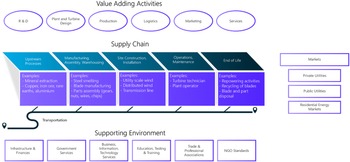
Wind capitals require workers across several phases of production as outlined in Figure 1 (BLS 2024). The bulk of employment activities occur within manufacturing, project development, and O&M phases (NASEO 2021). Each production phase is necessary to bring a project to completion. In both project development and manufacture work, while the commodities offered defer, the source of value derives from the associated labour. Wind capitals leverage R&D activities and ‘white-collar’ workers to demonstrate the viability of turbine technology and to develop innovations that enhance relative surplus value. For instance, companies increasingly use direct drive turbines that are more reliable and suffer less down time than their gearbox counterparts, thereby reducing the need for gearbox repairs in their accumulation strategies. As Lachapelle et al (Reference Lachapelle, MacNeil and Paterson2017) argue, technological innovation has been a primary accumulation strategy in the US. While this may be true to some extent, the ecological dimensions of the wind energy labour regime shape labour exploitation in some important ways, especially as it relates to their remote and rural locations.
Wind energy production involves a diverse set of activities, including an enabling support environment from both state and private interests. The graphic was created using information adapted from the from Liu et al (Reference Liu, Wei, Dai and Liang2018).

Although manufacturing work takes place in urban settings with access to workers and necessary infrastructure for rail transport (I6; I32; I37), project development and O&M work take place in remote settings, which creates several effects. First, this creates variance on the level of local labour used (Manzo et al Reference Manzo, Frank and Kashian2022; Stefek et al Reference Stefek, Kaelin, Tegen, Roberts and Keyser2019). Construction activities often require a sizeable base of workers, often too many for rural communities to supply. As a result, temporary hiring firms and short-term contracts for construction are common, especially as it allows the project developer or asset owner to save costs by limiting the number of direct hires across the country (I6).
In the case of O&M work, groups of usually three wind technicians visit remote sites to maintain various turbine parts (I28). Wind techs often travel extensively throughout the year. In some instances, they maintain turbines under the warranty contract of an OEM, in which case they are usually direct employees (I28; I38). In other instances, they take employment as part of a subcontract network in which project owners hire technicians to maintain or repair turbines (I4; I12; I28). In both cases, a combination of the remote nature of the work itself and the affiliated social relations shape the form of exploitation and disciplining, but especially with respect to the intensity of hours worked as capital seeks to enhance surplus value extraction.
In concrete terms, wind project owners cannot generate revenue when the blades of the turbines do not spin. Therefore, any downtime for a wind turbine or repairs constitutes potential revenue loss for the project owner. Because of the level of competition in the energy sector for access to electricity market – a point I expand on below – such downtime results in the asset owner either pressuring their employees, the OEM with a warranty, or a subcontractor to complete repairs or construction as soon as possible. Intense work schedules are the result.
Schedules vary, but a six weeks on, one week off schedule is common among technicians (NREL 2024; I20; I28). For comparison, oil and gas workers often work a schedule of three or four weeks on the job, and one week off (NREL 2024). Although a six-day work week schedule is common, technicians and installers may be called on to work seven days a week and holidays because downtime corresponds to a loss in profits. The remote nature of work further intensifies this pressure as some workers reason that if they are in a rural setting with little else to do, they might as well work to make more money (I28).Footnote 9 Although overtime pay represents a potential benefit to work, it also creates dangerous work conditions as the rigours of an extended work schedule in a physically demanding job can create lapses in judgment. Put more simply, when people get tired, they make mistakes that can put them and others at risk (I4; I28). According to one interviewee (I28), the recent death of two experienced turbine technicians was the result of these pressures (Saegert Reference Saegert2025). In this regard, the intensity of work can be attributed to capital’s pursuit of absolute surplus value, which they achieve by lengthening the duration of both the working week and number of hours worked.
These pressures are further heightened by the remote nature of wind projects, which increases the risk of serious injury or death given the vast distances first responders need to travel. Despite this, no OSHA guidelines specific to wind energy exist (Mayers Reference Mayers, Ordower and Zafir2024). Instead, the closest thing to an industry wide safety standard is promulgated by the Global Wind Organisation led by turbine manufacturers and owners (I7; I12). Because of the remote nature of work, everyone on a wind project is ostensibly granted stop work authority if they feel something is potentially dangerous (I25; I28; I38). However, workers have differential levels of comfort in their willingness to invoke such authority, often in accordance with their respective position in a project’s pecking order with those who occupy lower rungs on the ladder less likely to speak up for fear of reprisal (I4; I28; I38).
The remote location of wind projects creates both opportunities and challenges for organised labour, or conversely, challenges to capital for how to maintain labour control. Remote project locations means that wind techs or those involved in construction are often away from management supervision. Indeed, an appealing attribute of wind work is the opportunity to occupy what can often be beautiful landscapes away from the prying eyes of upper-level management. As one interviewee put it, it was an ideal situation for someone ‘who has problems with authority’ (I28). However, these same qualities also isolate workers from their peers, which can make raising class-consciousness and broader solidarity more difficult.
The ability for unions to make inroads into the sector also faces challenges linked to the locations of wind projects. Several interlocuters noted a mismatch between shop-model unionism whereby project developers recruit workers from union shops, which does not correspond with what is often itinerant and remote work (I6; I12; I25). That has not prevented the Utility Workers of America (UWUA) from making inroads with Vestas wind technicians in Michigan, the first wind techs to be unionised in North America (UWUA 2025). All of that said, the remote setting of wind turbine developments does not explain why manufacturing facilities, which are anchored to a particular location, have similarly struggled with unionisation. Indeed, several interlocuters noted renewable energy companies are vehemently opposed to unions (I4; I15; I17; I22; I27; I28) and actively work to keep them out of their business (I15). In this respect, across phases of production there exists a concerted effort to cultivate a particular type of wind worker in the industry to aid its accumulation strategy.
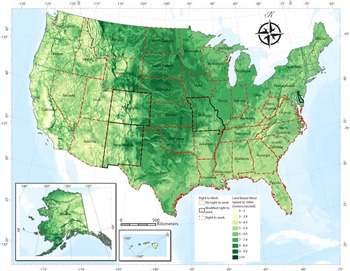
Ecological dimensions do not determine outcomes on their own, even if they play an important role that influences production. Indeed, while it is true that renewables like wind give distinct political and geographical attributes that reconfigure spatial patterns of energy production (Pearse and Bryant Reference Pearse and Bryant2021), these are ultimately mediated by the state and associated institutions (Coe and Jordhus-Lier Reference Coe and Jordhus-Lier2011). Considering the U.S., the best wind resources for wind project developers and utilities exist in the middle of the country in states such as Texas, Iowa, Oklahoma, Kansas, and Illinois (EIA 2023). As Figure 2 shows, these wind resources coincide with states with labour-governing institutions that actively suppress unions through the existence of so-called ‘right to work’ laws that constrain union security agreements.Footnote 10 In this respect, the geographic dispersion of wind energy and its intersection with the surrounding institutional environment plays an important role in establishing the ground rules for worker contestation in many settings of wind energy, including the unevenness of the labour process in differentiated settings. Two interviewees noted the interaction between energy geographies in concert with the surrounding legal environment was the main reason for the lack of unionisation in the industry (I2; I6).
Many of the states with the best wind resources exist in the middle of the country, within the boundaries of ‘right to work’ states. Map credit to the author.

The production of ‘green’ wind workers
Who is, or is not, a direct employee of a wind company depends on their relative credentialling, and a wind project may bring together a variety of workers with varying levels of precarity. It is well known that across industries, precarious workforce practices are more common where the use of labour brokers and other intermediaries is commonplace (Barrientos Reference Barrientos2013). Within wind, this is most common within project development and entry-level positions for wind turbine maintenance (I4; I20; I28; I38). The fragmentation of the labour process makes building worker solidarity more challenging, and like other settings where labour contracting is common, markers of precarity such as safety short cuts, wage theft, and few benefits are present (I4; I12; I28). Several interlocuters noted that many workers enter the industry simply because they ‘have a pulse’ and provide the bodies necessary for a subcontractor to complete their contract (I4; I28). However, these individuals do not necessarily have the training or experience necessary to keep themselves or others safe, conditions exacerbated with a general lack of training or apprenticeship opportunities (I2; I5; I6; I12). Considering again the stratification of the wind workforce, those who work directly for an OEM receive a great deal more training and often have prior experience before joining the OEM (I25).
As a function of this division between workers, a distinctive hierarchy exists in the industry, and on construction projects, in particular. For example, wind techs or equipment and crane operators with prior on-the-job-training, certification, and supervisory experience specific to wind energy, are more likely to be employees or have positions that oversee operations on wind projects (Hamilton and Liming Reference Hamilton and Liming2024). Meanwhile, the bulk of workers needed for project construction are often hired through labour brokers and temporary hire firms (I4), although this fluctuates in degree depending on industry stability (I15). Individuals recruited by temporary hiring firms who receive less investment compared to those directly employed by the OEM, perform ‘lower-skilled’ or menial functions on wind projects; creating post holes for a fence, for instance. Such stratification reproduces a permanent underclass to perform some of these ‘lower-skilled tasks’. It is difficult to break out of these roles unless the individual who occupies them knows someone in management or some other connections to break out of this cycle (I4).Footnote 11 These hierarchies are crucial to capital’s accumulation strategy, which leverages these structural inequalities to ensure the availability of workers on remote projects through subcontracted networks, while simultaneously avoiding the provision of additional benefits to these workers and simultaneously ensuring that their embodied labour value remains accessible in the future. As others have theorised, the stratification of the workforce may occur along gendered and racial lines (Pearse and Bryant Reference Pearse and Bryant2021), which this study affirms in the context of project development. Critically, while ecological dimensions may condition the use of these business practices, it is abetted by the state and associated institutions, which allows for temporary hiring and subcontracting in the name of individual freedom.
The use of subcontracting and temporary hiring bears the hallmarks of a ‘fissured workplace’, in which companies use these practices to reduce costs and offload responsibilities from the lead firm (Weil Reference Weil2014). Such a strategy is also used by firms or major brands to distance themselves from negative aspects of production (environmental degradation, violations of labour rights and standards) through the structuring of their activities (LeBaron et al Reference LeBaron, Lister and Dauvergne2017). Biden era incentives in the IRA and IIJA sought to allay these issues with concessions in the form of prevailing wage standard and PLA incentives for companies, but these do not resolve the overarching coercive laws of competition that emanate from competition in the energy sector that drive these outcomes.
There is also a distinct gendered element to wind work, which partially reflects the ecological sphere of the labour regime in terms of the setting of work for wind projects and associated maintenance. As alluded to earlier, the life of a wind tech can be quite nomadic because of the locations of wind projects. As a result, many travelling wind techs are often younger individuals, with those who are older and with more experience moving into positions that require less travel (e.g. servicing a single location) or moving into managerial positions. One interlocuter noted that young males were a ‘better match’ for the industry’s needs (I25). The itinerant nature of the work makes dating and maintaining a relationship challenging (I4), but companies benefit from this in not having to provide family healthcare coverage, which can help them maintain more profit. In this respect, the so-called ‘workforce gap’ (McDowell et al Reference McDowell, Stefek, Smith, Pons and Ahmad2024; Stefek et al Reference Stefek, Christol, Smith, Kotarbinski and McDowell2022) to fill wind tech and development positions is not only attributable to a lack of education or awareness of the industry, but also a by-product of the labour process itself. The work requires individuals who are willing to work in remote areas in a physically demanding job, at heights, with weather conditions that range from enervating heat to bone-chilling cold. There simply is not a large pool of individuals who have both the willingness and physical ability to work the job (I25).
In this respect, the specialised skills and attributes of wind turbine technicians grant them a measure of structural leverage in the capital-labour relationship not afforded to workers in other phases of production. That the labour market is constrained, conceivably also aids in their ability to advocate for different work conditions and collective bargaining rights. Although none of my interlocuters made this connection explicitly, one interviewee had some notion of this, remarking in reference to the historical experience of coal workers that,
…I see our work as being also incredibly dangerous and that we just really need our own union. And then I am always telling coworkers, especially when I was a contractor, like, hey, all of these people that work in the office, we’re the ones paying their bills and we’re paying their salaries. We’re doing this dangerous work that’s paying all of us. Yeah, they work for us like, you know, these project managers, these human resources people, we are doing the thing and risking our lives to do the actual thing that gets them paid as well as us (I28).
In the same interview, they would go on to discuss some of the challenges they have faced creating solidarity among their peers. Several interlocuters chalked this up to a pervasive ideology of individualism in the political economy of the US (I17; I28; I38) or even the significant presence of MAGA inclined individuals in their work settings (I20; I22; I28) – a contradiction given the Trump Administration’s hostility to renewables.
This brings us into the discussion of some of the ideational components of wind work born out of the socioecological aspects of the labour regime, which are similarly conditioned by historical contingencies in US wind development. Beginning with the historical formation of wind workers in the growth period of the 2000s and 2010s, many were former veterans (I7; I15; I25; I27). Combined with the material realities of wind work – often isolated and remote – the idea of a wind ‘brotherhood’ emerged as a salient concept regularly invoked by my interlocuters (I12; I15; I25; I27; I28; I38). The pervasive sense of ‘brotherhood’ as opposed to ‘family’ reflects the male-dominated nature of the industry, despite efforts to change this (I25). The notion of brotherhood also reflects several values that govern expectations of work in the sector. First, that it is incumbent on workers to look out for one another as the primary line of security, which is linked to the remote and dangerous nature of the work (I15; I25; I27; I28).
Belief in a wind brotherhood also represents a diffuse form of productive power (see Barnett and Duvall Reference Barnett and Duvall2005) that governs the labour regime. It reflects a ‘common sense’ belief, in a Gramscian sense, that worker safety is incumbent on individual workers to secure themselves and one another. In this fashion, it deflects attention away from some of the systems and structures that can sometimes make work dangerous; things like extended work hours and tight deadlines stemming from the needs of project owners. It does so by shifting the burden for safety away from the company and onto the shoulders of workers and their peers.
The notion of a brotherhood also plays a contradictory role in which an appeal to familial values could conceivably lend itself to future organising efforts. However, it may also be wielded as a shield to keep unions out of the workplace, as they are ‘outside’ the family of wind work. Indeed, one interlocuter noted that potential access to a more loyal workforce influenced their locational decision when siting new manufacturing facilities (I32). Two former workers also felt unions would jeopardise wind company success, which had enough challenges in maintain profitability as is (I15; I27).
At this point, I would be remiss not to remark on how the state mediates the capital-labour relationship through the sphere of social reproduction. It does so by ensuring that the successful social reproduction of the worker depends on their use and availability to capital. The US is a ‘social workfare’ state, meaning the receipt of essential benefits like healthcare and wages depends on employment (MacLeavy and Peoples Reference MacLeavy and Peoples2009; Peck Reference Peck2016). As a tool of control, binding healthcare coverage to employment stacks the capital-labour relationship in favour of capital, as job loss and consequent losses not only in wages, but also in healthcare coverage, act as a more overt form of control. Several interviewees remarked that when unionisation at a wind manufacturing facility was entertained, the individuals involved backed off for fear of reprisal and attendant losses in wages and healthcare (I16; I17; I21).
The US context provides a concrete articulation of Søren Mau’s (Reference Mau2023) description of capitalist society in which workers are dispossessed of their ability to meet their basic needs, which necessitates the sale of their labour power for their social reproduction (Mau Reference Mau2023; 134). The combination of this dynamic reinforced by the ideology of individualism pervasive throughout the US, present in wind, creates conditions that make one-to-one organising conversations difficult. The material and ecological spheres of wind energy production help to reinforce the idea of a ‘wind brotherhood’ as the first line of safety and security. The resulting consequence of a social setting with healthcare attached to employment and regular work in isolated settings is that many workers, understandably, choose strategies for their social reproduction and that may include union avoidance. In labour environmentalism scholarship, the same is true for coal workers who question the benefits and rationale of a ‘just transition’, if there is no social safety net to speak of (Cha et al Reference Cha, Price, Dimitris, Vachon, Brescia-Weiler and Brecher2021; Sicotte Reference Sicotte2024). In other words, the day-to-day experience of both survival and work reinforces the belief that it is better to remain in a job, however marginal, than risk unemployment and consequent loss in healthcare coverage and, ultimately, death.
Capitals-in-competition in energy
As I have alluded to several times, it is impossible to fully comprehend the onshore wind energy labour regime without considering the pressures of competition emanating from the energy sector. In this section, I argue that the dynamics of production and circulation within a triad of cooperation and competition between OEMs, project owners, and utility corporations plays an important role in conditioning the labour process. It helps to explain the intensity of working hours, reliance on business practices associated with workplace fissuring, and union avoidance as companies seek to secure themselves in a highly competitive electricity markets to ensure access to the power grid.
Within wind energy production networks, the project owner will purchase the turbines for a power plant from an OEM and usually subcontract with a construction firm like Mortensen to complete the project. In this fashion, the project owner acts in a manner like that of a lead firm in more traditional commodity GPNs, as they coordinate activities among actors and establish the parameters and goals of a particular project. In the US, companies like NextEra Energy, Invenergy, and Enel Green Power represent some of the major production firms that coordinate industry activities, and they have an outsized influence on the goals, information, and messaging of industry association groups like American Clean Power (ACP) (I18).
Meanwhile, OEMs and project developers tend to avoid cooperation outside of ACP convenings or during political lobbying (I18). In the US, three OEMs dominate the market: Vestas, Siemens-Gamesa, and GE Vernova. They rarely share technology or expertise to enhance their competitive viability (I7). As a result, more specialised OEM work will sometimes use imported workers with whom a developer is familiar (Sweeney Reference Sweeney2021). However, OEMs do subcontract to suppliers for specialised parts and smaller components like wind blade epoxies, inverters, and controllers that major firms later assemble into major turbine components. Subcontracting by OEMs and project development is common, and includes some measure of spatial differentiation on where manufacturing activities take place or from where (and from whom) workers are recruited. Wind OEMs choose their locations according to where existing and future markets reside, in addition to other cost-factors that include local governmental tax breaks and subsidies, the availability and relative cost of labour, and suitability of transportation infrastructure.
Towers manufactured in the US receive pressure from low-cost steel imports from Asian markets such as Indonesia, South Korea, Vietnam, and India (Baranowski et al Reference Baranowski, Cooperman, Gilman and Lantz2022). Beyond the spatial movement of manufacturing locations, companies may also choose to offload associated costs of production by subcontracting production of parts to other companies, which results in rounds of layoffs, as recently occurred at tower manufacturing facility in Pueblo, Colorado (Vestas Wind Systems 2021). Alternatively, OEMs attempt to exert their power in their relationship with project owners by extending control of turbine assets through extended warranties, which allows them to extract more value by limiting the amount of aftermarket investments facility owners can make on a project (I24).
The power of utilities
The intervening role of electric utilities differentiates energy industries from other GPNs. As discussed above in the section, Waking the wind, many wind projects are often built through financing mechanisms such as power purchase agreements (PPAs) in which the power off-taker (i.e. entity purchasing electricity, often a utility) negotiates certain terms and conditions for the project rates paid for electricity, installed capacity of the project, and predicted electric production over the project’s lifetime (Energy I-Spark; Jacobs et al Reference Jacobs, Huang, MacGillvary and Lopezlira2022). In the US, private investor-owned utilities (IOUs) exist as natural monopolies, servicing 72% of US electricity customers (EIA 2019). Because of their frequent role as both project owner and purchaser, they hold a great deal of relative structural power that influences which energy projects are built, how they are built, and the way they are built. Let us pause and again turn to history to understand why this is the case.
The Federal Power Act of 1935 divides authority of electric power distribution between state and federal governments. Federal regulators oversee ‘wholesale’ electricity (sale for large-scale purchases between power generators and utilities) and interstate transmission lines (16 U.S.C. § 824a.). Both federal and state governments granted a virtual monopoly over power generation to utilities so long as their decisions are ‘just and reasonable’ (Welton Reference Welton2018, 594). What constitutes the public interest is not always specified beyond cost and stability, however (I3). When the Federal Energy Regulatory Commission allowed markets to determine wholesale electricity rates across much of the country in the 1990s, this shifted the dynamic between utilities and their respective public utility commissions (PUCs) (Welton Reference Welton2018, 595).
Today, PUCs ostensibly determine what is just and reasonable by overseeing the rates charged to customers and reviewing proposed projects. The increasingly diverse array of power producing assets makes resource planning, forecasting, and power distribution much more complex. Many PUCs do not have the expertise or staffing to properly oversee utilities, so they end up relying on the information given to them (I3). For example, while a PUC oversees the ratemaking decisions of utilities or the different projects they develop, they depend on the utility’s models for which project bids are most competitive. As they are often under-resourced and understaffed, they generally defer to the utility (I11). The asymmetry of information and expertise means utilities have cover to make decisions that result in greater shareholder profit than what is in the public interest (I3; I11). Labyrinthian grid operations and dense legalese mean that very few people truly understand the landscape of energy production and consumption (Burke and Stephens Reference Burke and Stephens2018; Welton Reference Welton2018). As a result, those with a vested interest in maintaining existing structures of power (literally and metaphorically) are also more likely to serve as commissioners on boards that oversee utilities (I3).
When selecting projects, those deemed most viable are those most likely to reap the greatest profit. Of the capital expenditures on a powerplant, turbine assets occupy the largest share of relatively fixed project costs (Mone et al Reference Mone, Hand, Bollinger, Rand, Heimiller and Ho2015). Consequently, the workforce is often the easiest place for a project developer or owner to shave costs (I26), which helps explain the prevalence of subcontract and temporary work. Conceivably, however, utilities could elect to choose projects or sign PPAs that include preferences for things like unionisation. Indeed, some states like Colorado have sought to bring greater clarity to the bidding process and associated labour costs through Best Value Employment Metrics that considers local labour and apprenticeship training requirements (CRS § 40-2-129). However, the information asymmetry remains, and such measures do not guarantee the use of union labour even though they may have more robust apprenticeship training. This is especially true as project developers have grown reliant on the services of specific groups, like Mortensen in the case of construction, that have a preference to use non-unionised labour for their wind projects (I6). In this respect, investor-owned utilities, especially those within wholesale energy markets, produce value-squeeze on project developers as they are required to purchase power at low costs while maintaining grid reliability. Therefore, the dynamics of capitals-in-competition across the spheres of production and circulation produce the conditions that help explain the consequent hiring practices of companies, as well as conditioning the intensity of work in remote settings. In essence, competition in the energy sector for access to the power grid conditions how companies pursue their accumulation strategies, and this parlays into practices consistent with workplace fissuring and an increasing rate of labour exploitation, especially in terms of hours worked.
Final thoughts
I have offered a systematic mapping of the onshore wind energy labour regime in the US. Aside from demonstrating the utility of the labour regime framework, I showed empirically how some of the same structures and social relations that have made work precarious in other settings similarly exist in the expanding wind energy sector, risking further ‘lock-in’ and perpetuation of relations of exploitation. As other authors have argued, a shift to low-carbon electric power prioritises the reproduction of capital over the security of communities in the face of climate crisis (Andreucci et al Reference Andreucci, García López, Radhuber, Conde, Voskoboynik, Farrugia and Zografos2023; Krommyda et al Reference Krommyda, Gialis and Stratigea2025). Like Pearse and Bryant (Reference Pearse and Bryant2021) I argue this is partially a function of neoliberalised electricity markets. However, I take this further by emphasising the role played by IOUs, project owners, and the mediating role of the state, including the sociohistorical contingency of these relations. In revealing this, I suggest utilities and the PUCs that govern them are critical points of conjuncture and a potential site of contestation that can bring labour and environmental coalitions together, a point similarly made by the group Trade Unions for Energy Democracy, more thoroughly explored by Christina Paul (Reference Paul2024). In essence, any progress in improving outcomes in the transition – either in bringing new renewable projects online or improving conditions of work and the environment – requires addressing the coercive laws of competition in the energy sector. It also requires challenging the institutionalised common sense notion that energy exists as a resource, rather than a social relation embedded within networks of power that seek to govern socioecological change (Huber Reference Huber2009).
I have also highlighted obstacles and opportunities for unionisation, especially as it concerns the socioecological indeterminacy of wind work. Like the recent analyses by Felipe Irarrazaval and Miguel Atienza (Reference Irarrazaval and Atienza2025) that assessed critically the assumed fixity of the workplace, I show that mobility and remoteness shape the form and experience of labour exploitation in important ways. Given the expansion of more contingent and highly mobile work, this has important ramifications for future labour regime analyses in other industries. I extend my analysis, however, arguing how these ecological dimensions mutually constitute distinct ideational elements for the ways in which workers perceive their jobs according to the particularities and settings of work, some of which can be traced to a combination of the industry’s history and distinct materialities. More specifically, ecological dimensions of onshore wind energy at once heighten the intensity of labour exploitation but also create spaces away from management that could conceivably lend themselves to future organising. This includes the notion of a ‘wind brotherhood’ that generates consent and helps explain the relative durability of existing labour processes in the sector. However, I have also argued this same attribute could conceivably lend itself to future organising for sector transformation. In this fashion, we can see the contradictory function that expectations and a ‘common sense’ notion of work play in both shaping and maintaining the labour regime.
While I have focused on a particular sector in this paper, my findings suggest that future labour regime analyses, including those associated with sectors implicated by the ‘energy transition’, more thoroughly probe the ideational elements that condition labour regimes. In this fashion, this article offers an empirical example of how ideology is rooted in the labour process and systems of capitalist accumulation as described by Alyssa Battistoni (Reference Battistoni2025). This has important implications for labour regime scholars to not only consider how structural and institutional elements govern labour regimes, but also more subtle and diffuse forms of power connected with material realities of the labour process. These represent ‘productive’ forms of power (see Barnett and Duvall Reference Barnett and Duvall2005), in which meaning and associated identities are manufactured, embodied, and transformed to produce social identities that govern ‘common sense’ expectations of work in the labour regime. Critically, these do not exist as exogenous influences on the labour regime but are internally related to its imbricated spheres that shape the workplace.
Funding statement
This research was made possible, in part, through funding obtained as part of Rutgers Global Future of Workers Initiative.
Annex

Brendan Davidson is a PhD Candidate of Political Science at Colorado State University. His work covers environmental labour studies, political ecology, global and comparative political economy, science and technology studies, and political geography.

 Open access

