


“In front of us, the task is to build and complete the peoples’ government inexile.”
Mate Barbić, 27.11.44.Footnote 130°02'10.2”N, 32°36'47.9”E. A star marks the spot. In the desert east of the Suez Canal, some ten kilometers northeast of the Egyptian city of Suez, a five-pointed star is visible from space. The cemetery in the shape of a Partisan five-pointed star (petokraka) is the only visible reminder in Egypt of 30,000 Yugoslavs who found refuge here during the two years at the cusp of World War Two and the early post-war period, between 1944 and 1946.Footnote 2 The refugees, mostly from Dalmatia, had fled Nazi occupation of the Dalmatian coast following the Italian surrender in September 1943 with the help of the British navy and the Yugoslav partisans.Footnote 3 They first made their way to southern Italy and later to Egypt. Most found temporary shelter in El Shatt, a former British Army camp prepared to defend Egypt from the Axis campaign in north Africa. Once German and Italian forces were routed at El Alamein in November 1942, the threat receded, and the camps became available for refugees as British troops relocated to Europe. El Shatt, in sight of the Suez Canal, was a desolate place in the desert. The high temperatures during the day and the cold at night, together with harsh winds, made it an unlikely home.
These refugees are among many Europeans who found shelter in the Middle East during the war: Greeks, who fled the Dodecanese and Aegean islands via Turkey to Allied-controlled Syria, Lebanon and Palestine, and Poles, mostly part of the army formed of prisoners of war released in the Soviet Union after the German invasion of 1941.Footnote 4 They all were just a small part of the millions who moved, either voluntarily or by force, during the war and in its immediate aftermath. Of those millions, many, if not most, experienced camps, the ubiquitous symbol of the war. Camps varied in terms of the goals of those who built them, and the experiences of those who found themselves in them. From the horrors of Nazi death camps to concentration and forced labor camps, these included prisoner of war camps and camps for the displaced.
The experience of the Yugoslav refugees highlights an important and neglected episode in the creation of the socialist Yugoslav state. Camps are a site were individuals encounter state authority in a more structured and intense manner than in other contexts. In this case, it is between refugees and the newly-emerging Socialist Yugoslav state that offers insight into the post war order. In addition, this experience also demonstrates that refugees were not just passive subjects of host countries’ policies and the aid organizations that supported them, but actively pursued their post-war goals, either to return in conjunction with the emerging Partisan authorities or alternatively by rejecting the Partisans. Returning agency is particularly significant at a time when debates about refugees are shaped by fear, with refugees often reduced to objects of debates and policies.Footnote 5
The history of the Yugoslavs in Egypt belongs to one of the more benign camp experiences of the twentieth century. While conditions were harsh, the Allies’ aim was to care for the refugees rather than incarcerate them, or worse. Unlike millions of others, the Yugoslavs could, and mostly did, return home. As this aspect of Europe's history of displacement was episodic, it has largely been forgotten in Yugoslav, Croatian, and European historiography. The reasons for the neglect in Yugoslav historiography were twofold: first, the plight of the refugees paled in comparison with the repression of those who stayed at home by German occupying troops and the Partisan struggle, which attracted the bulk of the attention from socialist Yugoslav World War Two historiography. Second, the predominance of women and children among the refugees did not fit the male-dominated historiography of the heroic resistance struggle.Footnote 6 In post-1991 Croatia, the experience fits even less into the national historiography. The refugees were overwhelmingly supporters of the Partisans, and the Yugoslav project stood at the center of camp life. Thus, this episode was ignored and forgotten, just as the graveyard of the refugees who perished in the camps was neglected. Renewed interest emerged only after the peak of Croatian nation-building, with greater space for critical historiography in the mid-2000s.Footnote 7
Research on the broader European experience of displacement and the plight of refugees at the end of the war and the immediate post-war period has experienced renewed interest recently, not least because of the public attention devoted to refugees from the Middle East in Europe.Footnote 8 Yet the displacement of Europeans to Africa received little attention, mostly because the refugees came from the European periphery and fled outside Europe.
The two years in the Egyptian desert were not only significant for the refugees’ experiences but also became a crucial site for experimenting with Yugoslav ideas and building institutions.Footnote 9 In addition, their experience was ultimately transnational, as they interacted with the British authorities, numerous American volunteers from different aid organizations, Egyptians, and other refugees (mostly Greek), as well as Jews who fled with the Dalmatians from Nazi occupation but then quickly sought to leave for Palestine. They wrote to their relatives back home in Yugoslavia, but also sought help, invitations, and consolation from their kin in New Zealand, Australia, Latin America, and the United States. As a result, their story is part of the wider transnational refugee experience.Footnote 10
What set the Yugoslav refugees apart from the millions of other refugees was the extent to which their country of origin organized their lives and integrated refugee life into the state-building experience. As such, the future state became the main interlocutor for the refugees and the allied authorities at the camps. Most refugees fell into three patterns. Some had fled from their country of origin due to the repressive policies of their government, such as the Jews who fled Nazi Germany. Of these, some fled to countries that would welcome them, at least at first. Others countries, such as Italy, would protect refugees from Nazi concentration camps, but they would remain potentially vulnerable due to the German-Italian alliance.
Other refugees fled with their governments that were displaced by the occupying forces, mostly Germany and its allies. This group included Greek and Polish refugees in the Middle East and Africa who were supported by the Greek and Polish governments in exile in Cairo and London, respectively. These governments in exile were weak and were themselves displaced, possessing limited resources and infrastructure. While west European governments in exile would return victorious after the war, most central and eastern European governments did not resume authority at the end of the war.
The Yugoslav experience falls within a distinct pattern, where the emerging government organized the evacuation, maintained strong organizational ties with the refugees, and engaged in state-building among the refugee community in preparation for their return home. There are few comparable cases, as governments were unable or unwilling to exert a similar degree of authority over their citizens in exile.
For the Partisans, it was also a crucial moment to consolidate their ties with their western allies. This included the British Army, which guarded the camp and provided supplies; British and American volunteers—mostly from religious organizationsFootnote 11—and the Allied administration of the United Nations Relief and Rehabilitation Administration (UNRRA), which had taken over from the British Army in May 1944.Footnote 12 Thus, the Partisans had to negotiate their relationship with their western allies, and the episode in Egypt highlights the great lengths to which the Partisan camp administration went to convince its allies of the socialist Yugoslav project. Until 1943, the British government primarily supported King Petar II and the Yugoslav government in exile, as well as the monarchist Četnik forces in Yugoslavia. Part of the government in exile, including ministers and officers of the royal army, were based in Cairo.Footnote 13 While the Dalmatians were being displaced, British support began to shift. They offered more support to the Partisans, whom they judged to be more effective and reliable. The evacuation of the Dalmatian refugees, with British assistance, to Egypt would be a test case for the emerging alliance. For the communist-led partisans, a good relationship with Britain, the most important source of Allied military support and recognition, was essential. Thus, in addition to maintaining control and molding the refugees into Yugoslav citizens, the Partisans sought to demonstrate their ability to manage the displacement. The Refugee Central Committee (Centralni odbor Zbjega, COZ) had to negotiate with the UNRRA and their British and American allies, who ran and supplied the camps. Tensions were inevitable, as the Partisan movement and the British viewed each other with some skepticism in light of their ideological differences. Their relations were marked by both mutual admiration and suspicion that foreshadowed the Cold War. This mirrored the cooperation between the British and the Partisans elsewhere, including in maintaining control over the island of Vis to serve as headquarters for Tito and to supply the Partisan army. It also showed that the Yugoslavs were able to work and cooperate with western partners, which would become the norm after the Tito-Stalin split in 1948, just two years after the closure of the camps.
The defining feature of the Partisan camp administration was their degree of control and influence. This gave the refugees a sense of purpose and motivation for their return and injected an element of self-management, control, and ideological indoctrination. Camp life in El Shatt was one of the first experiments in state-building by the Partisan movement. It had controlled liberated territories in Yugoslavia, starting with the “Užička Republika” in southwestern Serbia in the fall of 1941 and spreading to large swathes of land in Bosnia and Croatia in the subsequent years, but these were short-lived and in flux. It established Peoples’ Councils in liberated areas, and these gradually evolved into the seeds of future Communist Party-led government.Footnote 14 In the Egyptian desert, the Partisans could build institutions and convince a captive audience of the merits of its cause. These included schools, newspapers, and establishing a new social contract, from gender relations to labor.
In the two years between early 1944 and 1946, the Yugoslav camps in Egypt became a microcosm of early Yugoslav state-building, the negotiation of relations between the Partisans and the western Allies, and calibrating the tools of control, consent, and repression among their people. This story of the camps and their inhabitants thus constitutes a bridge between the war and the post-war period, helping to understand the rise of Socialist Yugoslavia. It also seeks to draw attention to European refugees whose experience differed significantly from most of the millions scattered across Europe.
Arrival and Camp Life
The refugees arrived in Egypt after a long, arduous journey. Following the armistice of Fascist Italy with the Allies on September 3, 1943, Partisan forces were able to take control of large swathes of the Yugoslav coast previously held by Italian forces. These included the city of Spilt and most islands in central Dalmatia. The Partisan victory turned out to be short-lived, however. German units quickly began taking over, motivated by the fear of an Allied invasion of the Balkans. Over the fall and winter of 1943–1944, German army units occupied the Dalmatian coast, forcing a growing group of refugees to move towards Vis, one of the islands furthest out into the Adriatic. The refugees included communist sympathizers and partisans, with their families, but also others who feared German reprisals.
In November 1943, the Partisans created the COZ in the small fishing village of Vrboska on the island of Hvar among those being displaced by the German advance. It also included other opponents of the Ustaša regime and incorporated key mass organizations, such as the Antifascist Women's Front (Antifašistički front žena, AFŽ) and the youth movement (Ujedinjeni savez antifašističke omladine Jugoslavije, USAO). Being responsible for governing the refugees while they were displaced, it was organized into administrative sections dealing with issues such as education, health care, and culture.
The last stop in Yugoslavia for refugees was Vis: the island was held by the Partisans, with British military assistance, throughout the war. As the island was transformed from a sleepy fishing community in the middle of the Adriatic to a military outpost to defend against German dominance, the refugees, as well as the civilian population of Vis, had to find a new temporary home. The first destination was southern Italy, already under Allied control. However, there were no facilities to house the tens of thousands of refugees, and the frontline was too close. Thus, the British proposed evacuation to Egypt, where military camps were available.
Altogether just over 40,000 Dalmatians fled for Italy and most of them were later transferred to Egypt (39,647), while several thousand remained in Italy. These refugees amount to just below 10 percent of the entire population of Dalmatia (466,000), and considerably more in the case of the islands and the central Dalmatian coast.Footnote 15
At first, the camps in the Middle East were run by the British Middle East Relief and Refugee Administration (MERRA). On May 1, 1944, the UNRRA took over. In effect, the British Army guarded the camps, while welfare and food supplies were administered by Americans working for UNRRA. In addition, humanitarian workers, British and American for the most part, worked with the hospitals and schools. Amidst the UNRRA, the British Army, and US relief, the Partisan-led COZ had to carve out their role in the camps, which initially led to tensions with the British. Once in the camps, the COZ established de-facto self-government of the refugees. COZ members had traveled with the refugees, were themselves from the same towns and the villages as they were and thus had an authority hard for the allies to ignore. In a November 1944 report, secretary Mate Barbić notes how this work of the COZ constituted a crucial experiment of state building: “The organization structure that will lift the COZ on a higher level and enable it to fulfill its task—enables it to increasingly approximate a new form of state power… .Comrades are afraid of mistakes and taking responsibility, but this is not correct. We have never had people's democratic government and thus we cannot have experience.”Footnote 16
The main camp, El Shatt, was to become a “city with streets, house numbers, schools, hospitals, clinics, post offices, theaters, choirs, football teams, sports clubs, a cemetery, and churches.”Footnote 17 It grew steadily in the first months to include a total of five sub-camps, often several kilometers of desert apart and each constituting a little town of its own. At its peak in January 1945, some 24,771 refugees lived in El Shatt. This made it the second largest Dalmatian city after Split, and just slightly smaller than the city of Suez, which was just some ten kilometers away on the other side of the Suez Canal.Footnote 18 Others found shelter in Tolumbat, twenty kilometers east of Alexandria, and Khatatba in the Nile Delta. El Arish, on the Mediterranean coast, hosted those Yugoslavs who rejected Partisan dominance, as well as other “misfits.” This article will focus on El Shatt, unless noted in the text, as it became home to the majority of Yugoslav refugees, and with its five sub-camps became the center of refugee life in Egypt.Footnote 19
The arrival in El Shatt was often a shock for the refugees, as Rusko Matulić recalls in his memoirs: “When the freight car doors opened in the morning we came face to face with the torrid desert reality…we were assigned to a tent with a wet concrete slab, went to fetch straw mattresses…” Camp life was harsh, with high temperatures during the day and freezing desert nights. Neven Bogdanić recalls, how despite becoming “quickly used to the new environment, to the cold nights and the unbearable heat…in the desert in the middle of nowhere…[we] were caught by the nostalgia for the Adriatic Sea, the peace and quiet of its bay, the scent of sage, lavender, rosemary, pines and the gentle Dalmatian landscape.”Footnote 20 The desert wind the refugees called Gibli covered everything in sand, leaving a lasting impression on the refugees.Footnote 21 From rural coastal and island communities shaped by agriculture and the sea, the Dalmatians found themselves in the desert without vegetation in an improvised urban setting few had earlier experienced.Footnote 22
Upon arrival, refugees were grouped by their villages of origin and assigned to tents that kept villages largely together. Families shared tents, but often also had to share them with strangers or at least non-family members.Footnote 23 A. Tegla Davies, who worked for the Friends Ambulance Unit, described the modest life in the tents: “Each tent has…items of home-made furniture improvised out of wooden boxes and pieces of timber… For the most part they are kept spotlessly clean, although the same care is not always extended to anything outside their living quarters.”Footnote 24 (Figure 1)
Washing tables in El Shatt (Credit: UNRRA, UN Archives, S-0800-0008-0010).

The defining feature of camp life was the extensive organization that permeated all social life. While a sense of idleness often marked other camps, El Shatt was busy. Cultural life began as soon as the refugees arrived. The refugees include some prominent artists who were evacuated together with farmers and fishermen.Footnote 25 Within weeks of their arrival in March 1944, schools were already beginning to operate, newspapers were published, and theater and choir groups were set up. In addition to singing Yugoslav songs, the choir immediately catered to the circumstances and learned to perform Yankee Doodle and Pack up your Troubles next to communist and traditional Dalmatian songs such as Partizanka and Marijana, giving concerts to American and British soldiers.Footnote 26 Soon afterwards, the repertoire included the national anthems of the allies and an ever increasing number of British, American, and Russian songs.Footnote 27
The camp administration also built up libraries, but books were scarce, and few were available in Croatian/Serbian, increasing the importance of the various publications produced in the camp.Footnote 28 Pupils went to school while adults worked and learned everything from shoemaking to sculpting. In other camps, refugees were paid for their labor by the British, who charged the governments in exile for repayment after the war. The COZ rejected this, however, and only allowed for pocket money to be paid out on the grounds that the Partisans fighting back home also received no pay. The only payment for labor was thus extra bread and cigarettes, the latter a valuable resource. Besides, refugees also received substantial financial support through remittances from relatives overseas, particularly in the United States.Footnote 29
In the eyes of the COZ, working was a central aspect of building the new society and demonstrating the motivation of the refugees. As Henry G. Russel notes in his report, there were more mundane motivations: boredom, interest in the job, being part of a group, or getting away from the women and children. “It gives the men a chance to be with their pals, to be away from the ‘old woman,’ to talk about politics, and women, and the weather, and they may not work very hard at it, but at least it's ‘man's work’; and it gives them a certain amount of self-respect.”Footnote 30 Of course, women worked no less than the men in the camp, as aid worker Viola G. Pfrommer noted in a letter in November 1944: “One woman does the work of three men and that willingly, even if most were not formally employed.”Footnote 31
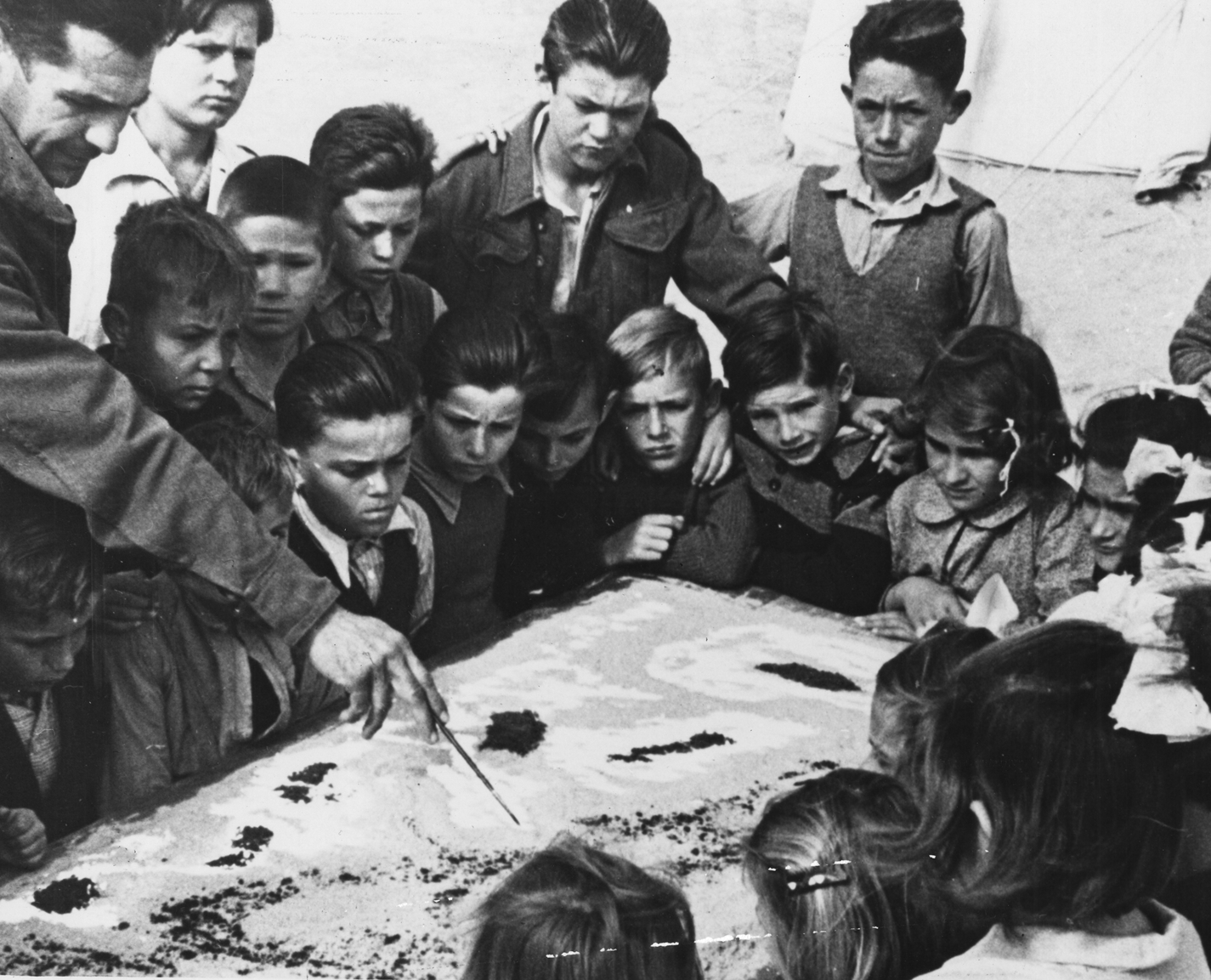
The educational system included kindergartens and daycare, primary and secondary schools, and adult education, including learning reading and writing for a largely illiterate community.Footnote 32 The schools were basic, but the COZ experimented with some innovations, such as weekly parent-teacher meetings, described by UNRRA as a “very progressive educational technique…not used in Yugoslavia, but…developed out of a felt need at El Shatt.”Footnote 33 Reflecting efforts to maintain a good relationship with the Catholic and Orthodox Church, the education included weekly religious instruction.Footnote 34 (Figure 2).
Teaching in school, with relief map of Dalmatia made of sand in class in Tolumbat (Credit: UNRRA, UN Archives, S-0800-0008-0008).
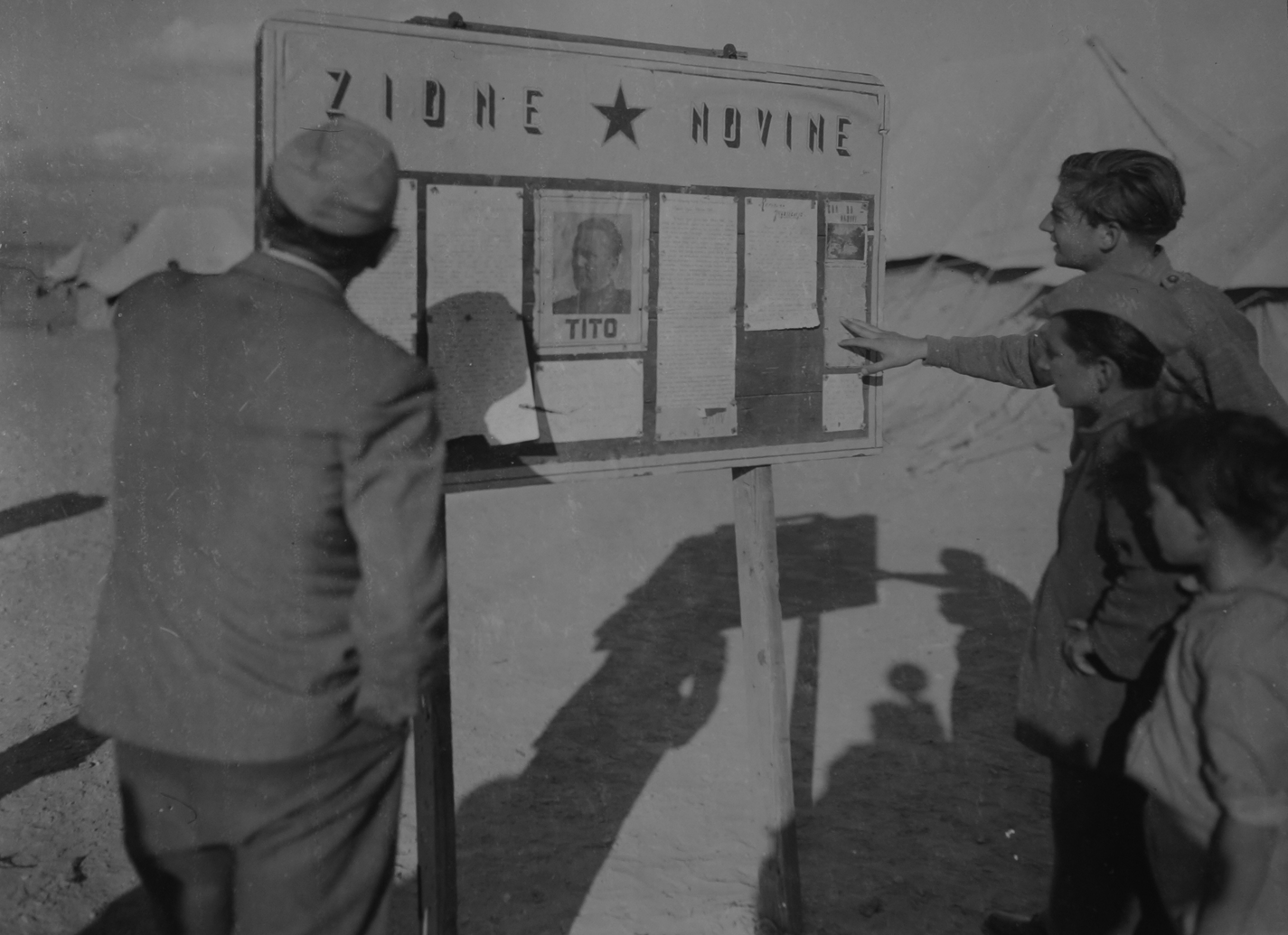
One important aspect of camp life was information about the rest of the world, the war, and the post-war period in Yugoslavia. Information was sparse, as the reception of radio stations, including Radio London, not to mention Radio Free Yugoslavia, was close to impossible and few outside newspapers from Yugoslavia reached the camp.Footnote 35
Considering the distance from Dalmatia and the obstacles to communication, the COZ had to build up its own media outlets, drawing on reports it received from the Allies and the Yugoslav liaison office in Cairo, as well as newspapers from Dalmatia. These included the daily Naš list, which was published throughout the period.Footnote 36 Besides, the COZ printed a range of other periodicals, as well as other publications, including partisan songs and textbooks for schools.Footnote 37 Considering that the COZ held a monopoly over printed information, it could control the news flow. Naš list and all the other publications supported the Partisan movement and followed the line of the leadership.Footnote 38 (Figure 3).
Refugees reading camp newspaper in El Shatt, April 1946 (Credit: UNRRA, UN Archives S-0800-0008-0010).
In addition to media, there was an impressive range of events organized throughout the camps. Cultural evenings included lectures, readings and recitals, singing of partisan and patriotic songs, theater performances, and traditional kolo dances. There were typically three to four cultural evenings in all the camps’ districts each month, some attended by up to 1,000 people.Footnote 39
An important part of entertainment was soccer and sports in general: there were some eight sports clubs, with 1,241 members, in June 1944.Footnote 40 The most legendary game was a visit by the Split soccer club Hajduk on May11, 1945, less than a week after the end of the war. In front of 8,000 spectators, Hajduk played against the camp club Jedinstvo. Even though Hajduk won 4–0, the internal the COZ report noted large celebrations and a cheerful evening.Footnote 41
The British and American aid workers and UNRRA staff repeatedly noted their admiration for the resilience of the refugees in the camps. For example, William B. Edgerton, writing to his wife from the camp via the American Friends Services Committee, noted that “I must not give the impression that these people have managed to create a little paradise here on the desert with their resourcefulness…their extreme lack of everything…only makes what they do accomplish more impressive, standing as it does against such a background.”Footnote 42 An UNRRA report from 1944 came to a similar conclusion, noting the “high pitch of enthusiasm that the refugees maintain.” While far removed from Yugoslavia, the connection remained strong, as they “are a piece of Yugoslavia transplanted to the Egyptian desert until such a time as they can go back to Yugoslavia.”Footnote 43
Beyond the emotional connection to Yugoslavia, reinforced by the desolate conditions in the desert and the temporary nature of their stay, the institutional structures of camp life ensured the connection to Yugoslavia—the Yugoslavia slowly established by the Partisans.
Building a Yugoslav State
The well-organized camp life was the result of meticulous planning. The COZ worked like a mini-government in the camps, including five departments (Economic, Education, Culture and Information, Technical Matters, and Health), each directed by two officials as well as a president and secretary, and supported by an administration.Footnote 44
Reflecting on the camp committee in Tolumbat, UNRRA official G. Chesters noted that “in practice the committee in its present stage holds the position of a ministry of domestic affairs, and its growth and effort tend towards turning itself into a completely responsible government.”Footnote 45 This structure was replicated in all the camps and districts, resulting in a total of 195 committee members in all camps.Footnote 46
The KPJ (Communist Party of Yugoslavia) controlled the camp administration through the COZ. In all of the Egyptian camps, however, there were only 371 party members and 132 candidates, of which only fifty-six were accepted during the period.Footnote 47 The party was represented in the COZ; but it included others as well, such as Andro Štambuk. As a priest, he was responsible for education in the camps for most of the period, making him one of the most influential non-communist officials. His relations with the Partisans were overall sound, and as a priest, he helped dispel concerns among the Allies over religious repression by the Partisans.Footnote 48 In addition to Štambuk, who was the most senior clergy and maintained contact with the Catholic church in Yugoslavia, there were a further five priests, which is a relatively small number. Asked why he joined the Partisans, one replied: “Because I am a priest and I think like the people.”Footnote 49 (Figure 4).
COZ leadership, including Ivan Jurlina, Milovoj Visković, Ivo Markić, Mate Barbić, Mate Plosnić (left to right) (Credit: UNRRA, UN Archives, S-0800-0008-0010).

All of the committees had members representing other political orientations. For example, the committee of camp 1 had four sections (administrative, economic, educational, and technical) with ten members, including five Partisan sympathizers, four supporters of the Croatian Peasant Party, and one Yugoslav nationalist. Similarly, the COZ detailed the different party sympathies in the camp committees of the camps and their sub-districts, highlighting that the leadership was quite pluralist.Footnote 50 Non-communists were less central to the running of the camps and would become more marginal upon their return to Yugoslavia. Communist dominance was possible through mass organizations, such as the League of Communist Youth of Yugoslavia (Savez komunističke omladine Jugoslavije, SKOJ) and AFŽ.
While the idea of elections to the camp committees was raised by both the Allies and some critics of the COZ, the leadership rejected this. It argued that considering the large number of women and children, whose husbands were fighting in the homeland, it would be “unfair to raise the question of elections in exile,” also arguing that the population was “incomplete” and in exile, making elections less necessary or possible.Footnote 51 These reasons are only partly convincing, especially considering the overall reluctance of the Partisans to hold free elections. In the end, elections were held in December 1944 for the United Peoples’ Liberation Front (Jedinstvena narodnooslobodilačka fronta, JNOF). With high turnout, the elections confirmed the dominance of candidates sympathetic to the National Liberation Movement. In the commission for the front, parties other than the Communist Party were also represented. In fact, ten were members of the Croatian Peasant Party, one each from the Radical Party, the Yugoslav National Party, and the Democrat Party, two Communist Party members and two non-party members.Footnote 52
Beyond the committees, schools, and other services, the COZ also organized courts and unarmed Partisan guards, who acted as an internal police force and also protected the camp together with the British Army guards.Footnote 53 Each camp had a designated official responsible for the partisan guard. There was a commander for each camp, a deputy commander, a political commissar, and his deputy. Each camp had between nineteen (Tolumbat) and 115 guards (El Shatt camp 3) on duty day and night.Footnote 54 In June 1944, for example, Partisan guards noted sixty-three violations, both disciplinary and criminal. It also monitored contacts with the outside world, noting contacts with the government in exile or black-market activities, as will be discussed next. The courts also took on criminal and civil cases: in June 1944, some 177 were pending, with 148 having been resolved.Footnote 55 UNRRA accepted the authority of the courts. UNRRA and the British were overall grateful for this internal policing and court system, as the “presence of such a refugee administration set-up removes from the shoulders of the camp staff a thousand and one petty problems that crop up daily.”Footnote 56
Throughout the camps, the COZ and the Partisans were able to prove to the Allies their ability to administer the camps effectively, as the UNRRA acknowledged: “if the Yugoslavs have the tools and equipment to keep them busy both at work and at play the camp will function as smoothly and as quietly as a new electric refrigerator.”Footnote 57 UNRRA officials took this as evidence of the Partisans’ ability to manage reconstruction in Yugoslavia, as “[t]hese people have demonstrated that they are industrious and trustworthy and when the war ends the Yugoslavians should be able to meet their own problems with a minimum of administrative effort and supervision on our part.”Footnote 58 In effect, such assessments affirmed the goal of the COZ to project a sense of autonomous state building in the camps.
State-building in El Shatt was thus first and foremost reflected in the elaborate control and organization of the camp population. In addition, state-building also shaped self-perception. Thus in 1945, the COZ noted the importance of the experience of El Shatt as part of the larger post-war Yugoslav state-building:
“And as it is honorable…to be in Tito's army, it is also honorable to be part of the refugee community (zbijeg), which is itself a result of the struggle. But it is only honorable if through work, organization, discipline, and order we demonstrate our worthiness to those heroes who continue the fight for the liberation of our homeland…”Footnote 59
The importance of state-building was thus clearly set in relationship to the armed struggle back home. The goal of the refugees was to build institutions and work and to prove their worthiness in the eyes of the Partisan fighters in Yugoslavia, a recurring theme in the public and internal communication of the COZ. In addition to establishing legitimacy in exile, state-building also served to “tackle a new challenge, which will be the continuation of this work, and that is help in organizing life and work in liberated Yugoslavia, the renewal of the country.”Footnote 60 Finally, as shall be explored next, it also served to build the legitimacy of the Partisan movement in the eyes of its western allies.
Relations with the Allies
During the first weeks of the camps, the British did not recognize the COZ, but only individual camp committees, and wanted to work through these directly. The COZ was quickly able to assert its control, however, and eventually both the British Army and UNRRA looked favorably on the COZ.Footnote 61 UNRRA, once it took over, was particularly impressed by the Partisans. As S.K. Jacobs of UNRRA noted: “Yugoslavia has been the only occupied country to field an above ground, organized anti-fascist team, and the spirit that made an army out of peasants and fishermen is evident even to a stranger at El Shatt.”Footnote 62 Similarly, Henry Scattergood of the American Friends Service Committee saw the strong ideological orientation of the refugees positively, noting that “[t]hey are very politically-minded, for the most part strongly Partisan (pro-Tito) in their loyalties…unlike many European refugees they in all likelihood have something to go back to.”Footnote 63
Some observers took a more critical view of the efficiency and ideological control of the COZ. As Samuel Yoder, a doctor working for the Mennonite Central Committee, noted: “[i]t gave one an eerie feeling to see this totalitarian system gradually taking over and regimenting the lives of the people. They were good, sound, human stuff; simple, genuine, hard-working peasants…it was marvelous the way that they kept up their morale in the wasteland of heat and sand.”Footnote 64
The three principal sources of tension between the British and the COZ were the role of the COZ and the degree to which it would be able to run the camp autonomously; the question of how to deal with dissent and those who sought to leave the camp; and finally, the slow pace of repatriations, which seriously undermined morale and thus also the reputation of the COZ. Initially, the British and the Partisans encountered each other with a certain degree of suspicion. Thus, Tito's close associate Vladimir Dedijer wrote about the camps and how a British officer promised to “break this arrogant communist spirit,” a claim that might be plausible for some officers, but certainly not the entire British Army managing the camps. It is certain that the English officers, who expected to find a group of helpless refugees, were greatly surprised at how quickly they set up their infrastructure in the camps.Footnote 65 UNRRA would have preferred a more democratic system in El Shatt, “as an international organization which could not be suspected of a desire to gain control over Yugoslavia's internal affairs, it [UNRRA] might, had it organized the refugee camps from the start, have been able to insist on greater personal freedom for all the camp inmates.” However, the system was firmly in place and could not easily be changed.Footnote 66
In the first months, tensions were greatest between El Shatt Camp Commander John Langman and the COZ. An attempt by some Yugoslavs to leave the camp was the catalyst for the crisis. For the British, the discovery that Partisans had forcibly evacuated people to the camp violated the initial agreement, according to which only those voluntarily evacuated should be in the camps. On the other hand, the COZ considered Langman's intervention as interference. The conflict was resolved following a meeting with the Yugoslav liaison office, UNRRA, and British officials in Cairo on March 4, 1944.Footnote 67 The agreement between the British government and the Partisans meant that the latter retained autonomy over the internal affairs of the camps and the British ensured that the camps would not be infiltrated by supporters of the Royalists, associated with the Yugoslav government in exile located in part in Cairo.
The de-escalation was also linked to the appointment of Mate Jakšić as a liaison between the Partisans, the COZ, the British, and UNRRA in Cairo, who took a pragmatic line and later noted in an interview that “many…wanted to implement a rigorous and inflexible policy and were not aware that they had to cooperate with the Allies, since they were no longer the Partisan Army.”Footnote 68 Relations improved, but tensions with anti-communist British officers persisted. Royalist and other opponents sought to be employed by the British to maintain contact with the outside world.Footnote 69
Once the British Army replaced Langman in the summer of 1944 and a division of labor emerged between UNRRA, the British Army and the COZ, relations grew cordial. In addition to the regular concerts and performances, the COZ also organized an exhibition about the camp for the Allies in June 1944, with the aim of showing how the refugees “in new and challenging circumstances, without necessary materials, get to work.”Footnote 70 “To exhibit what we know and can do, we want to show how we have dealt with and how we live in exile.”Footnote 71
For the COZ and the Partisans, establishing good relations was important, also in terms of proving their worthiness as allies, as COZ Secretary Mate Barbić noted in a report in April 1944:
“Our relationship towards the Allies, the English authorities in this case, in general is correct and normal, and the autonomy of our committees is fully recognized by the English, who consider them able to resolve all problems. Today our authority can no longer be avoided, not even in the smallest and unimportant matters. There is no doubt that the English and Americans, through the exiled, and through our ability in exile, value and appreciate the ability of the people of Yugoslavia to build a new state after liberation.”Footnote 72
Relations further improved as allied support shifted decisively to the Partisans, whereas the credibility of the Yugoslav government-in-exile declined and the Četnik movement increasingly collaborated with the Axis forces. Weekly meetings between the camp committees and the camp commander took place to deal with all sorts of complaints, such as the quality of the bread.Footnote 73 At the same time, the Partisans also kept a close eye on the Allied officers at the camp to ascertain their support or hostility, noting the Allies were resentful when their assistance was not acknowledged.Footnote 74
Repartition and the Long Return Home
When the war ended, and the refugees began to return, there was great excitement in the air: “Our peoples’ government, music, as well as the entire people of the refugee community accompanied the first groups, who impatiently awaited the hour of their journey…we will build with song and music a new happy free democratic federal Yugoslavia…”Footnote 75 There were some tensions among the refugees about who would return when, but the repatriation ran smoothly at first.Footnote 76 This excitement quickly gave way to frustration, however: the repatriation came to a standstill after the first ten transports between April 11 and July 18 brought 18,985 back, more than half of all refugees.Footnote 77 The British Army justified the delay due to a shortage of ships in the Mediterranean, as ships were needed in the Asian theater of the war.Footnote 78 As time went by, however, the Yugoslav authorities, as well as the COZ, grew impatient.Footnote 79 Not only did they want their citizens’ return, but the inhabitants of the camps grew understandably restless. As the COZ noted in mid-1945, “the people [in the camps] always understood and correctly interpreted everything that was explained to them, but there were individuals who wanted to convince the people that the peoples’ government as well as the commission [for repatriation] does not take sufficient account of the people and that delays are caused by this.”Footnote 80
The slow return was embarrassing for authorities, “especially in view of the fact that the same military authorities who have declared that there is no shipping available to transport Yugoslav refugees have provided shipping for the return of Greek refugees.”Footnote 81 This was particularly surprising, as the Greek government had requested a delay in the returns, while the new Yugoslav authorities urged for quick repatriation.Footnote 82 Considering the relative proximity of the Greek islands, repatriation of Greek refugees was logistically easier. The returns to Yugoslavia only resumed in October 1945, followed by smaller transports in November. Only in January 1946 did the repatriation pick up again.Footnote 83 The delays contributed to rising tensions between the new Communist Yugoslav government and its earlier western Allies, while simultaneously giving rise to a last wave of dissent among some refugees against the leadership.
Overall, the COZ was able to establish itself unchallenged in the camps and make itself an indispensable partner for the Allies. While some had misgivings about their ideological control, the Partisans’ anti-fascist orientation, and moreover their efficiency, which aided the British Army and UNRRA in administering the camp, trumped other concerns.
Opposition
The most sensitive topic, both for internal and external state-building, was dissent. The refugees were ostensibly evacuated for their fear of reprisals by Axis forces and were assumed to be supportive of the Partisan cause. Besides, the Committee sought to build a new Yugoslav society in the camps, and dissent was not welcome. However, not all refugees shared the enthusiasm for the new Yugoslavia. Throughout the two years in Egypt, hundreds sought to leave the camp, and others were dissatisfied or in outright opposition to the prevailing communist ideology that became more visible and prevalent as time went on.
Unlike in Yugoslavia, where opponents were often executed, this option was not available to the Partisans under the watchful eye of the western Allies. For those rejecting the new communist message, there were two options: either exit, leaving the camp, knowing that a return to Yugoslavia was no longer possible, or keep their opposition to themselves or confined to small circles. Even then, however, opposition could not be kept a secret from the Partisans. Through informers, the camp leadership kept a close watch on political opponents and sought to minimize their influence.
While the vast majority had been supportive of the Partisans, some opposition emerged early on in the camp. During the first weeks in the camp, a self-identified Royalist, followed by a priest and another refugee asked to be transferred to another camp; the British camp administrators acknowledged this request. The question of loyalty and opposition to the Committee was the biggest test for relations between the Allies and the Partisans in El Shatt, as noted in the previous section. After the first transfers as the camps were first set up in March 1944, the British sought to allow for the transfer of all those who wanted to leave. While the COZ agreed, they insisted that only identification as Royalists would be acceptable grounds for transfer and that known Royalists would also be required to leave, thus allowing the Committee to weed out potential opposition. Some eighty refugees signed on and had stones thrown at them, mostly by teenagers. The Committee insisted on interviewing all the “Royalist” refugees individually, which the British commander Langman conceded under the condition that a British officer would be present and their transfer would go ahead. From these interviews, it emerged that the so-called “Royalists” included several disparate groups: some were former Yugoslav soldiers who had been interned in Italy and were not part of the initial group of refugees; others were former civil servants who felt duty bound to the state; and “most were surprised at the idea that Royalists were automatically the enemies of the Partisans and vice versa.”Footnote 84 Finally, some claimed to have been evacuated from Dalmatia against their will by the Partisans. Subsequently, all refugees who did not support the Partisan leadership were transferred to Tolumbat and later to El Arish. These were camps for the “difficult” cases among the refugees. Besides Yugoslavs who were deemed “Royalists” or “neutral,” there were Greek “troublemakers”: ironically mostly communists who had been evacuated against their will from Greek islands and Italians who were settlers on the Dodecanese islands.Footnote 85
During the first months in exile, the COZ noted opposition, which it attributed to Ustaša and Četnik elements, the lack of full Allied support, and the difficult conditions in the camps.Footnote 86 From his perspective, the US ambassador to the Yugoslav and the Greek governments-in-exile, Lincoln MacVeagh, noted after a visit to the refugee camps that “Greeks have politics in their heads but the Yugoslavs have hatred in their hearts.” The “hatred” MacVeagh mentions refers to the polarization that had occurred during the previous three years of war in Yugoslavia and the paradox that Četniks in Dalmatia, often collaborating closely with the Italian occupiers, had frequently fought with Partisans, yet in Egypt both were still supported by the Allies. Thus, the matrix of Axis vs. Allies did not fit the Yugoslav pattern. Some Yugoslavs, whom he called “Četnik sympathizers,” had been taken to a different camp: “they were pitiful creatures, mostly old women and children, but nevertheless the British authorities assured me that their danger had been real and acute.”Footnote 87 In the Tolumbat camp in May 1944, 528 non-Partisan Yugoslavs were housed: a mixture of former soldiers from different parts of Yugoslavia, as well as Dalmatians who did not want to remain under Partisan control.Footnote 88 Their number was less than three percent of the entire Dalmatian refugee population in El Shatt. After the first wave of refugees left, there was still some dissent, as Yoder recalls, but no longer any open opposition:
“Sometimes there was complaining, subdued and careful, of course. There was the day of the election, for example. It was done in the open by a show of hands; there was one candidate for each office. Intelligent dissenters seemed to know that it was a farce. There were a few avowed Royalists, but most of them had long since been banished to another camp. Some others styled themselves democrats; they were not popular with the governing committee.”Footnote 89
The COZ categorized its opponents into five categories: a) long time opponents who had already rejected the national liberation movement in Yugoslavia; b) former officials with “unfulfilled ambitions”; c) former Partisan officials who became estranged in exile; d) undisciplined people, and e) people who were not enemies of the National Liberation Movement but “lack consciousness and do not have the strength to endure.”Footnote 90
Finally, there were different reasons for ending up in the Egyptian camps, unsurprisingly not without relevance for their support for the emerging order. While most had fled the advancing German troops, not all did so voluntarily. Among those who ended up in El Shatt against their will, one can distinguish between two groups: there were those who had been forcibly evacuated from Vis, and those who had been forced to leave from other places because the Partisans considered that they would have been a security threat if they had remained.
Most civilians of Vis were evacuated against their will, as the island was transformed into a military outpost of the Partisans, with British support. While the other refugees knew their towns and villages were under German rule and the risks of returning were great, many islanders from Vis resented being forced from their island and not all were partisan sympathizers.Footnote 91
Another group who unsurprisingly resented the Partisans was comprised of those who had been forcibly taken to El Shatt. These were relatively few and included people accused of being Ustaša supporters, HSS supporters, and Yugoslav nationalists. It was often feared that they would divulge important information to the German occupying forces. However, they appeared to not be sufficiently associated with the enemy to have been executed back in Dalmatia. Many of those forcibly taken claimed that they did not know the reason for their abduction, such as the 64-year old Franka Carković from Brač, who sought to leave for El Arish, noting that:
“I don't know why, I, a peasant woman (seljakinja) who doesn't know to read and write [was abducted]. Italians killed my husband a year ago. I don't want to stay in the camp as everyone from my home has left. I like Tito, the Partisans, and King Petar. For me, all are brothers. I go where my fellow villagers take me. I am not happy because I am not in my home. The Partisans expelled me from my home and I curse them forever in heaven and earth.”Footnote 92
Overall, the COZ did not want political opponents from Yugoslavia in the camps. Noting difficulties with a refugee transport from Vis, the Committee note demanded that “…it is in general necessary not to send reactionaries here, but hold them in the homeland if this is possible.”Footnote 93 Nevertheless, the Partisans did send people to El Shatt against their will, and knew of their loyalties.Footnote 94
The political opponents of the Partisans belonged to all shades, and the COZ closely monitored them and attributed to them either an affiliation with their wartime opponents, mostly either Ustaša or Četniks, or associated them with one of the pre-war parties, such as the Croatian Peasant Party (Hrvatska seljačka stranka, HSS) or the Yugoslav Radical Community (Jugoslovenska radikalna zajednica, JRZ). Such labels are inherently problematic. As noted above, people associated with some of the same parties, in particular the HSS and the “Yugoslav nationalists,” were also among the accepted members of the camp committee. Furthermore, when exploring the biographies of those who were considered enemies, a more complex picture emerges. The label “Četnik” was used liberally to describe anybody identifying with the government-in-exile or those who expressed their loyalty to King Petar II, or even just for opposing the communists. This is exemplified by the statement of Frano Luger, from Split, who sought to move to El Arish:
“by my understanding, all who are fighting against communists in the peoples’ liberation struggle call themselves ‘Cetniks.’ During the celebration of the 26th anniversary of the [Russian] revolution on the place of honor, there was a communist flag and not the Allied English and American [flag]. Why do we carry the five-pointed star and not a national symbol? This means it is a party struggle.”Footnote 95
Some called themselves neutral, others Royalists, others nationalists, and Stevo Popović from near Benkovac declared that he was for “all the kings in the world.”Footnote 96
Their motivations were diverse, but few would have identified with the Četnik movement in Yugoslavia led by Draža Mihailović. As many of those whom the COZ considered Četniks were Catholic Croats from the islands, for whom the Serb nationalist project of the Četniks in Yugoslavia would have been attractive only in exceptional circumstances. Instead, some considered themselves loyal to the king and the government-in-exile, such as former state officials, including teachers and postal workers, who had sworn their loyalty to the Yugoslav authorities and wanted to preserve their jobs after the war.
In the second half of 1945, well over 100 refugees left for El Arish.Footnote 97 These departures were not without tensions. Thus, Nevena Dužević, for example, complained to the COZ that her son was attacked in the dining hall, that children pelted her tent with stones, and that her daughter was told that she was from a “Četnik tent,” as she and her family were about to transfer to El Arish.Footnote 98 Pragmatic reasons entered their considerations, however. When reviewing the personal biographies of those seeking to leave, recorded by the COZ, it is striking that many who had identified with the HSS before the war now described themselves as Yugoslav nationalists or pledged their support for the king. Considering that leaving the camp for El Arish was easier due to a political motivation rather than just hoping to seek a better future overseas, many might have invented or embellished their political motivations, considering that being a Royalist was a pedigree necessary to leave for El Arish. In other words, many might have chosen their loyalty to the young king out of pragmatism, rather than conviction, particularly since the return of the king might have still appeared plausible to many in Egypt.
Beyond the politically-organized opponents of the authorities in El Shatt, real or imagined, there was some broader level of anxiety about the emerging dominance of the Communist Party. This is best exemplified in this undated anonymous letter kept in the files of the COZ: “I joined NOP in Makarska. …I am not a communist, but I am an opponent of the Ustaša, Četniks, etc. …Some things in the camp make me wonder. The secret service, monitoring at every step, being called a fifth columnist. Those who are not members [of the party] have no rights.”Footnote 99
In April 1944, the COZ estimated that between 300 and 600 people could be counted among those dissatisfied.Footnote 100 Later that year, the COZ distinguished between a small group of those who publicly agitated against the Partisans, and those who had a receptive audience among an “undecided group of around 1,000–1,200 people.”Footnote 101 Later, the estimate was even lower, suggesting that in the “worst case, we are talking about 200 cases out of 27,000 refugees, it is no political problem.”Footnote 102 The British Ambassador to Yugoslavia considered the number to be considerably greater, numbering around 4,000 who opposed the communists.Footnote 103 Whatever the number, the camp authorities never had to face a serious challenge to their dominance.
The COZ attributed the opposition to the influence of the royal government in exile in Cairo and thus could easily gain influence. They apparently spread stories of the difficult situation in the camp, as well as the dangers of the transport there. Stories of a better life in the other camps circulated and were spread by critics of the camp leadership, as the COZ noted the attraction of “the prospect of moving to the Četnik camp of King Petar and the government in exile, where living conditions are considerably better, where there is no African desert sand, and where they might get paid. And supposedly the allied English would…even help in this.”Footnote 104
The camp administration kept a close eye on those whose loyalty they doubted, keeping reports of their meetings and activities, written by informants under code names such as “streljac” (shooter). These reports suggest that most merely voiced their opposition and dissatisfaction with the Partisans and the camp administration. A smaller group tried to recruit refugees to register for transfer to El Arish. The stories they told were like that of Jakov Griželj from Mostar, who sought to convince Jozo Vidis from Pelješac to leave. While the communists were killing their opponents en masse in Yugoslavia and he would be shot, he could instead move to America or South Africa with a good job and await the return of the king. While his claim that the king had 4,000 supports in El Shatt while Draža Mihailović had gathered 120,000 soldiers to take over Yugoslavia were fantastic in mid-1945, the survival and durability of Partisan rule in Yugoslavia was by no means settled and obvious to the refugees in Egypt.Footnote 105
In February 1945, some opponents managed to make flyers on cigarette paper with the slogans “Death to Fascism and Communism—Long Live Democracy, Justice and Honor,” for which informants suspected HSS supporters.Footnote 106 The reach of such actions was limited, however, and as opponents could be transferred to El Arish, the camp administration had an easy and readily- available safety valve.Footnote 107 Yet, the camps were not entirely self-contained. Opponents were sneaking out of the camp, sometimes swimming or taking a ferry across the nearby Suez Canal to travel to Cairo.Footnote 108 Not all the illicit travel was based on political opposition: black marketers and prostitutes also sought to leave and enter camps without the Partisan guards noticing.Footnote 109
Beyond those leaving for El Arish, many refugees sought not to return home. As the COZ gathered names, several hundred sought to leave for a third country. Some had American or other citizenship or were married to foreign citizens, mostly themselves Yugoslavs. The overwhelming majority of them came from the islands, in particular Vis.Footnote 110 Some had families overseas in New Zealand, Australia, or the Americas and sought to begin a new life there. In 1945, the COZ presumably received some 243 requests to leave for overseas, 153 or 63 percent of which were granted. The most popular destinations were the United States and Australia.Footnote 111
The COZ evaluated these requests not to return to Yugoslavia. As it had in 1944, it allowed people to leave if they gave political reasons, or had family connections overseas. However, the Committee also prohibited refugees from leaving when it thought that women had husbands or children had mothers back home in Yugoslavia. On this, the COZ noted that “[n]ot going into the reasons that force them to leave their husbands, we will consistently stand on the position that neither women nor children of our fighters can be allowed to be lost to our enemies. Not just politically, but on a human level, we are responsible for these children and their fathers and mothers will ask us tomorrow what we did.”Footnote 112
Over two years, the COZ and with it the Partisan movement created an experiment in Yugoslav state-building in El Shatt, complete with self-government, an educational and health systems, workshops, exhibitions, a cultural program, and media, combined with strong control over the lives of the refugees. The COZ was able to establish its authority due to a structure that was established prior to their arrival in Egypt and could not be easily challenged by the Allies. Once recognized, its efficiency won the—sometimes reluctant—admiration of the British and UNRRA authorities. It maintained support among the refugees through three strategies. First, it offered a comprehensive structure of camp life, from entertainment to education, which fully incorporated refugees and gave them an active stake in the new state-building project. The training, sports, and other activities sharply distinguished the camps managed by the COZ from other refugee camps. Second, it enforced tight ideological control that reduced the space for dissent. Finally, it provided controlled exit as an option for critics.
While the organization of the camp and the messages were carefully coordinated with the Partisan movement in Yugoslavia, the COZ operated largely autonomously in building this temporary extension of the Yugoslav state on the Sinai Peninsula.
Close to the end of the war, Mate Jakšić, the influential Yugoslav liaison officer, told the refugees who were to return home that
“the most solemn moment for the Yugoslav refugees in Egypt has now arrived. You were told you would go home when the Partisan army had liberated our country. That condition is now fulfilled. You left our country when the great fight was in progress but you are going back to a still greater fight—to struggle, rebuild, and reconstruct Yugoslavia… . Long live federated democratic Yugoslavia—long live Marshal Tito—long live our allies!”Footnote 113


 Open access

