

Whereas a long tradition of research tracks general attitudes toward protest rights, government censorship, and freedom of speech, less attention has been given to how Americans feel about citizen-initiated actions that disrupt public-speaking events. As speech-related conflicts become more prominent in national political debates, understanding the public’s views of these actions is increasingly urgent. Unfortunately, however, we lack empirical answers to important questions about speech-suppressing protests. Are disruptive acts intended to silence constitutionally protected speech viewed as legitimate forms of dissent or as impermissible violations of democratic norms? Who supports or opposes such protests? How do attitudes vary by age, education, and ideology?
To answer these questions, this article introduces new data from a nationally representative survey that randomly assigned respondents to answer the same basic questions about the acceptability of disruptive protest actions interfering with public speech in one of two ways: (1) a “non-group” question asking about abstract permissiveness for “shouting down” a speaker, “blocking others” from attending a speech, and “using violence” to stop a speech; or (2) a “most-offensive-idea” question, in which respondents first selected the statement that they found most offensive from a list of controversial viewpoints and then evaluated the three forms of disruptive protest against speakers advocating that specific idea.
Two conclusions emerge from this survey. First, whereas most Americans believe shoutdowns, blockades, and violence aimed at stopping speech are always unacceptable, support for these tactics is substantially higher among Gen Z than among older cohorts across both question formats. Second, ideological differences in support for speech-suppressing protest tactics are measurement dependent. When asked about shoutdowns, blockades, and violence in the abstract, young liberals were more likely than moderates, conservatives, and older liberals to state that such tactics are acceptable. When respondents were asked to evaluate these same actions targeting speakers that they found personally offensive, however, acceptance increased across the board and ideological differences disappeared. Taken together, these findings reveal a robust generational gap in permissiveness toward speech-suppressing protest and also show that ideological differences are conditional on whether respondents evaluate tactics abstractly or concretely.
When asked about shoutdowns, blockades, and violence in the abstract, young liberals were more likely than moderates, conservatives, and older liberals to state that such tactics are acceptable. When respondents were asked to evaluate these same actions targeting speakers that they found personally offensive, however, acceptance increased across the board and ideological differences disappeared.
LITERATURE REVIEW
The following three areas of research mention but do not directly address the American public’s attitudes toward speech-suppressing protest.
Political Tolerance
Political tolerance—“the willingness to extend civil liberties to groups or individuals one opposes” (Bos, Wichgers, and van Spanje Reference Bos, Wichgers and van Spanje2021)—is a foundational norm in liberal democracies (Hurwitz and Mondak Reference Hurwitz and Mondak2002). Ensuring that every member of the political community has the right to express even their most distasteful opinions is commonly viewed as an essential component of equal treatment under the law, individual autonomy, and the open exchange of ideas (Sullivan, Piereson, and Marcus Reference Sullivan, Piereson and Marcus1982).
Most empirical research on political tolerance focuses on identifying “who” is tolerant. Studies published before 2018 typically found higher levels of tolerance among college graduates, younger cohorts, and people on the political left (Jost et al. Reference Jost, Glaser, Sulloway, Kruglanski and Kruglanski2018; Sullivan, Piereson, and Marcus Reference Sullivan, Piereson and Marcus1982).Footnote 1 More recent research, however, suggests a realignment in political tolerance. Carlos, Sheagley, and Taylor (Reference Carlos, Sheagley and Taylor2023), for example, found that conservatives were more likely than liberals to oppose campus speech restrictions, suggesting a shift in tolerance across the ideological spectrum. Using the General Social Survey (GSS) long-running items on tolerance of racist, militarist, atheist, and communist speech, Chong, Citrin, and Levy (Reference Chong, Citrin and Levy2024) reported that younger, more liberal, and college-educated Americans are no longer more tolerant than older, more conservative, and less-educated Americans. They attributed this change to rising egalitarian concerns and the prioritization of equality over freedom in speech evaluations. Other recent surveys uncovered similar ideological and generational differences in speech attitudes (Cannon Reference Cannon2023; Ekins Reference Ekins2017; Freedom Forum Reference Forum2025).
That is, a growing literature suggests that tolerance has become conditional rather than principled during the past decade, particularly among younger and more progressive Americans. Free speech no longer is an inviolable principle, and many now view it as a secondary priority that is subservient to concerns about harm reduction, equality, and social justice. It is noteworthy that this more conditional view does not necessarily represent a rejection of democratic norms but instead a reweighting of them rooted in a moral framework that elevates values of inclusion and emotional well-being.
Although these studies provide valuable insight into the social and political foundations of support for civil liberties, they focus exclusively on abstract rights and government policies rather than disruptive protest actions taken by other members of the public to silence speech. As such, they shed little light on how Americans feel about the speech-suppressing protests that have become more frequent—particularly on college campuses—during the past 10 years.
Attitudes Toward Protest Actions
Surveys consistently find that a majority of Americans believe that nonviolent protests are a fundamental democratic right (Drakulich and Law Reference Drakulich and Law2025). This research also reveals, however, that support for protest declines sharply when tactics are coercive, violent, and disruptive. Considering only the most recent example, an August 2025 University of Massachusetts Amherst Poll found that whereas 64% of Americans support peaceful demonstrations against US Immigration and Customs Enforcement (ICE) efforts, less than 30% support obstructing ICE officers who are making arrests and less than 15% support the destruction of ICE property and physical assaults on ICE officers. More generally, empirical studies reveal that violent protests are so unpopular that they often “backfire” on the movements associated with them (Enos, Kaufman, and Sands Reference Enos, Kaufman and Sands2019; Wasow Reference Wasow2020).
At the same time, recent surveys show a nontrivial number of Americans endorse politically motivated violence (Kalmoe and Mason Reference Kalmoe and Mason2022). For example, Carey et al. (Reference Carey, Helmke, Nyhan and Stokes2020) found that 17% supported using violence to advance their own goals, 23% supported using violence if the other party wins an election, and 40% supported using violence if the other party uses it first. Similarly, in a March 2024 Marist poll, 20% agreed that “Americans may have to resort to violence in order to get the country back on track” (Marist Poll 2024). Surveys conducted after political activist Charlie Kirk was assassinated on September 10, 2025 (Franklin Reference Franklin2025; Montgomery Reference Montgomery2025) reported that more than 10% of Americans believe violence can be “justified” to achieve political ends. Gen Z and liberal respondents expressed the highest levels of support.
Yet, much of this research does not account for disruptive protests aimed at silencing speakers who are exercising their First Amendment rights. Most studies treat protest as a political response to policy injustice, not as a vehicle for silencing speech. Moreover, this research relies on abstractly worded questions that do not test support for protest actions targeting disliked groups.
Surveys of College Students
Surveys of college students provide the only direct measures of support for disruptive tactics that target speakers. Most notably, the Foundation for Individual Rights and Expression (FIRE) (2024) surveys thousands of students each year as part of its annual College Free Speech Rankings (CFSR). The CFSR survey asks respondents: “How acceptable [always/sometimes/rarely/never] would you say it is for students to engage in the following actions to protest a campus speaker?: (1) shouting down a speaker to prevent them from speaking on campus; (2) blocking other students from attending a campus speech; and (3) using violence to stop a campus speech.”
In 2024, only 32% of students answered “shouting down a speaker,” 48% answered “blocking other students from attending a campus speech,” and 68% answered “using violence to stop a campus speech” were “never” acceptable. Subsequent analyses of CFSR data revealed that this support is not distributed evenly across the student population. Progressives and members of racial, gender, and sexual minority groups are more likely than other students to accept speech-suppressing protest tactics (Wallsten Reference Wallsten2023). These findings parallel the results of Knight Foundation (Reference Foundation2018, Reference Foundation2019) college surveys that ask similar questions about protest tactics.
Growing student support for disruptive action also is apparent in data that track speech-suppressing protest events on college campuses. According to FIRE’s Campus Deplatforming Database, except during the COVID-19 pandemic, the number of speakers facing disruptive protests on campus has risen steadily since 2014. Particularly striking is the growth in speech-suppressing protests between 2021 and 2024 with “attempted” or “substantial disruptions” increasing from three to 79.Footnote 2
These data triggered a debate about higher education’s role in promoting free expression, political tolerance, and open discourse. Some scholars argue that colleges and universities are “teaching intolerance” by failing to uphold free-speech values (Tuccille Reference Tuccille2021). Others suggest that support for disruption reflects generational change rather than campus influence. Because FIRE and Knight Foundation surveys sample only college students, there is no good way to adjudicate between these explanations. It also is unclear whether Gen Z college students are even distinct from the rest of the public regarding their views on speech-suppressing protests.
A further limitation is that these college-focused surveys rely exclusively on abstractly worded questions that reveal little about how respondents feel when protest tactics target speakers that they find personally offensive. It is possible that acceptance of shoutdowns, blockades, and violence would be substantially higher if respondents were asked to consider speakers who were promoting views that they find objectionable. Testing this possibility, however, requires more than campus-specific samples and abstract scenarios to examine how moral provocation shapes acceptance of disruptive actions that target specific types of speech in more representative samples of the American public.
Limitations of Previous Research
Extant research has not distinguished conceptually or empirically between support for free expression and acceptance of disruptive protests that attempt to silence it. Most surveys ask whether members of broadly unpopular groups should be “allowed” to speak but not whether interrupting, blocking, and assaulting speakers can be acceptable under certain conditions. The best current data can be used only to generalize about the abstract permissiveness of college students. Despite their prominence in national discourse, therefore, we know very little about how average Americans feel about speech-suppressing tactics that target controversial speakers or about the individual-level factors that might lead people to accept shoutdowns, blockades, and violence.
DATA AND METHODS
Empirical research typically operationalizes tolerance in one of three ways (Gibson Reference Gibson2013): (1) a “non-group” approach that asks about support for civil liberties in the abstract; (2) a “fixed-group” approach that asks about tolerating speech and other activities from groups that researchers believe are broadly unpopular with the American public (e.g., atheists, communists, and racists); and (3) a “least-liked group” approach that asks about tolerating speech and other activities for a group that respondents previously selected from a list as being their least-liked group.
A persistent concern with the non-group and fixed-group methods is that they overestimate tolerance because they fail to measure whether respondents will extend civil liberties to groups that they find disagreeable. As Sullivan, Piereson, and Marcus (Reference Sullivan, Piereson and Marcus1982, 23) pointed out, “any attempt to measure tolerance must first determine the presence of opposition” to the speech in question. Because the least-liked approach directly assesses tolerance of views that respondents find threatening, offensive, or objectionable, it is used widely in studies of political tolerance (Gibson Reference Gibson2006). Yet, numerous scholars also have raised concerns about the comparability and interpretability of the least-liked approach across respondents and over time (van Doorn Reference van Doorn2014). Therefore, there is no universally preferred operationalization of tolerance, and prominent surveys (e.g., the GSS) continue to use fixed-group questions.
To fully capture the American public’s views on speech-suppressing disruptive protest tactics while accounting for the literature’s lack of consensus over how best to operationalize tolerance, I conducted a large (N=4,188) nationally representative survey in which respondents were randomly assigned to one of two conditions (Wallsten Reference Wallsten2026).Footnote 3 Adapting the CFSR survey’s questions, in the non-group condition, respondents were asked: “How acceptable [always/sometimes/rarely/never] would you say it is for people to engage in the following action to protest a public speaker?: (1) shouting down a speaker to prevent them from speaking; (2) blocking other people from attending a speech; and (3) using violence to stop a speech.”Footnote 4 In the “most-offensive-speaker” condition, respondents were first shown a list of politically divisive and potentially offensive statements (e.g., “All whites are racist oppressors” and “America got what it deserved on 9/11”).Footnote 5 They then were asked to select the statement that they found most offensive from the list. Following this selection, respondents were asked whether each of the protest tactics would be acceptable when used against a speaker who was advocating for the idea that they selected as most offensive.
The data from this survey enabled three types of analyses. First, because the data include responses to the same non-group questions used in FIRE’s CFSR surveys, the data allow for direct comparisons between the attitudes of college students and those of the American public more broadly. Second, because the data contain a sufficiently large sample of college-attending and non-college-attending members of Gen Z, the claim that support for disruptive protest is a consequence of socialization through higher education can be tested. Third, because the data incorporate a most-offensive-idea question, there is an opportunity to isolate the role of moral provocation in shaping support for disruptive, speech-suppressing protests.
FINDINGS
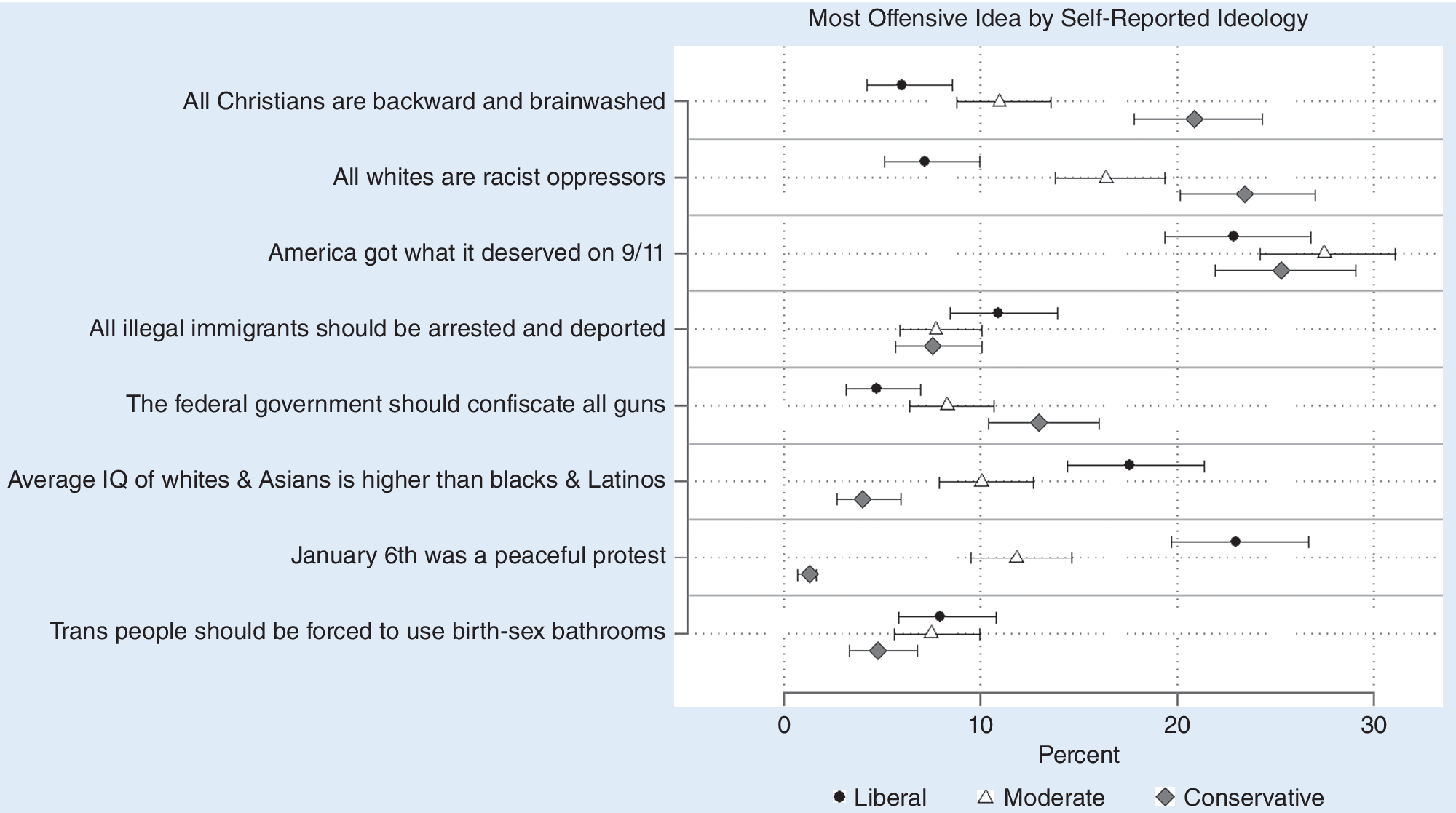
First, there was considerable ideological variation in the statement selected by respondents in the most-offensive-idea condition as being “most offensive” (figure 1). The “offensiveness gap” between liberals and conservatives was largest on the statement “January 6th was a peaceful protest,” with almost 25% of liberals but only 1% of conservatives choosing it as the most-offensive statement. The only statements equally offensive to respondents from across the political spectrum were “America got what it deserved on 9/11” and “All immigrants should be arrested and deported.”
Most-Offensive Idea by Political Ideology
Whiskers indicate 95% confidence intervals. Item-level pairwise differences are reported in online appendix table A1.

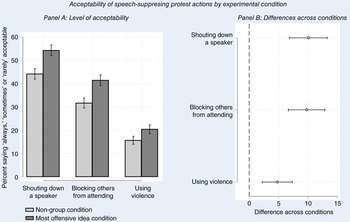
Second, Americans draw clear distinctions between different forms of speech-suppressing protest. In both the non-group and most-offensive-idea conditions, respondents were significantly more accepting of “shouting down a speaker” than they were of “blocking others” from attending an event and significantly more accepting of “blocking others” than they were of “using violence” to stop the speech (figure 2). Notably, the percentages of those accepting violence in at least certain circumstances (i.e., 15.6% in the non-group condition and 20.4% in the most-offensive-idea condition) closely parallel the results of previous surveys that measured support for political violence in general. This consistency suggests that a significant percentage of the American public is willing to condone violent tactics to achieve political objectives.
Acceptability of Speech-Suppressing Protest Actions by Experimental Condition
Panel A plots weighted percentages viewing each tactic as “always,” “sometimes,” or “rarely” acceptable in the non-group and most-offensive-idea conditions with 95% confidence intervals. Panel B reports the corresponding differences across conditions with 95% confidence intervals.

These results also reinforce the conclusions of previous studies about protest attitudes. Although most Americans regard nonviolent protests as a legitimate exercise of core democratic rights, support declines dramatically when tactics become disruptive, coercive, or violent. Because shoutdowns, blockades, and violence impede the ability of others to exercise their First Amendment rights, they draw less support than the more abstractly framed protest rights measured by previous research. Moreover, the greater acceptance of shoutdowns relative to violence confirms that the more confrontational the tactic, the less popular it is with the public.
Third, respondents were significantly more accepting of disruptive actions when asked about speakers whom they dislike. Whereas 44.2% stated that shouting down a speaker can be acceptable in the abstract, 54.2% stated that shouting down a speaker they find offensive can be acceptable. Similarly, the percentage of respondents who approved of blocking others from attending a speaking event and using violence to stop the event is significantly higher in the most-offensive-idea condition than in the non-group condition. This aligns with previous research finding that Americans are reluctant to extend free-speech protections to members of their least-liked group (Sullivan, Piereson, and Marcus Reference Sullivan, Piereson and Marcus1982). In summary, Americans appear more likely to accept efforts to suppress the speech of groups that they dislike regardless of whether the suppression is from government or other citizens.
Fourth, age is the strongest and most consistent predictor of permissiveness toward speech-suppressing protest tactics.Footnote 6 Figures 3–5 present the marginal effects of age and political ideology on the three dependent variables across the two experimental conditions.Footnote 7 In the non-group condition, acceptance of shoutdowns, blockades, and violence was highest among young people and declined steadily with age. As shown in the left-hand panels of figures 3–5, the impact of age on support for disruptive protest actions targeting speakers was especially strong among liberals. Although there are major ideological differences among younger cohorts, these differences vanish after age 60. In short, consistent with recent polling on politically motivated violence (Franklin Reference Franklin2025; Montgomery Reference Montgomery2025), young liberals stand out for their abstract willingness to endorse disruptive actions aimed at preventing public speech.
Acceptability of “Shouting Down the Speaker”
Marginal effects are derived from OLS regression models controlling for race, gender, education, income, religiosity, and marital status. Shaded areas indicate 84% confidence intervals.

Acceptability of “Blocking Other People”
Marginal effects are derived from OLS regression models controlling for race, gender, education, income, religiosity, and marital status. Shaded areas indicate 84% confidence intervals.

Acceptability of “Using Violence”
Marginal effects are derived from OLS regression models controlling for race, gender, education, income, religiosity, and marital status. Shaded areas indicate 84% confidence intervals.

As figures 3–5 also make clear, ideological differences disappear when respondents were asked about tactics that target speakers whom they find objectionable. This convergence is driven primarily by changes among young moderates and conservatives, who view speech-suppressing protest tactics in conditional rather than principled terms. For many Millennials and Zoomers who are not on the political left, disruptive actions interfering with speech are justifiable only when they target specifically offensive speech. In stark contrast, many young liberals appear to view speech-suppressing protest actions as broadly justifiable, regardless of whether the actions target speakers that they personally find objectionable.
These findings imply that ideological gaps are less about principled endorsement of disruptive protest actions and more about how respondents apply norms when speech is perceived as morally problematic. Analyses that rely solely on abstract questions (Franklin Reference Franklin2025; Montgomery Reference Montgomery2025), in other words, may overstate the distinctiveness of younger liberals and understate the situational flexibility of younger moderates and conservatives.
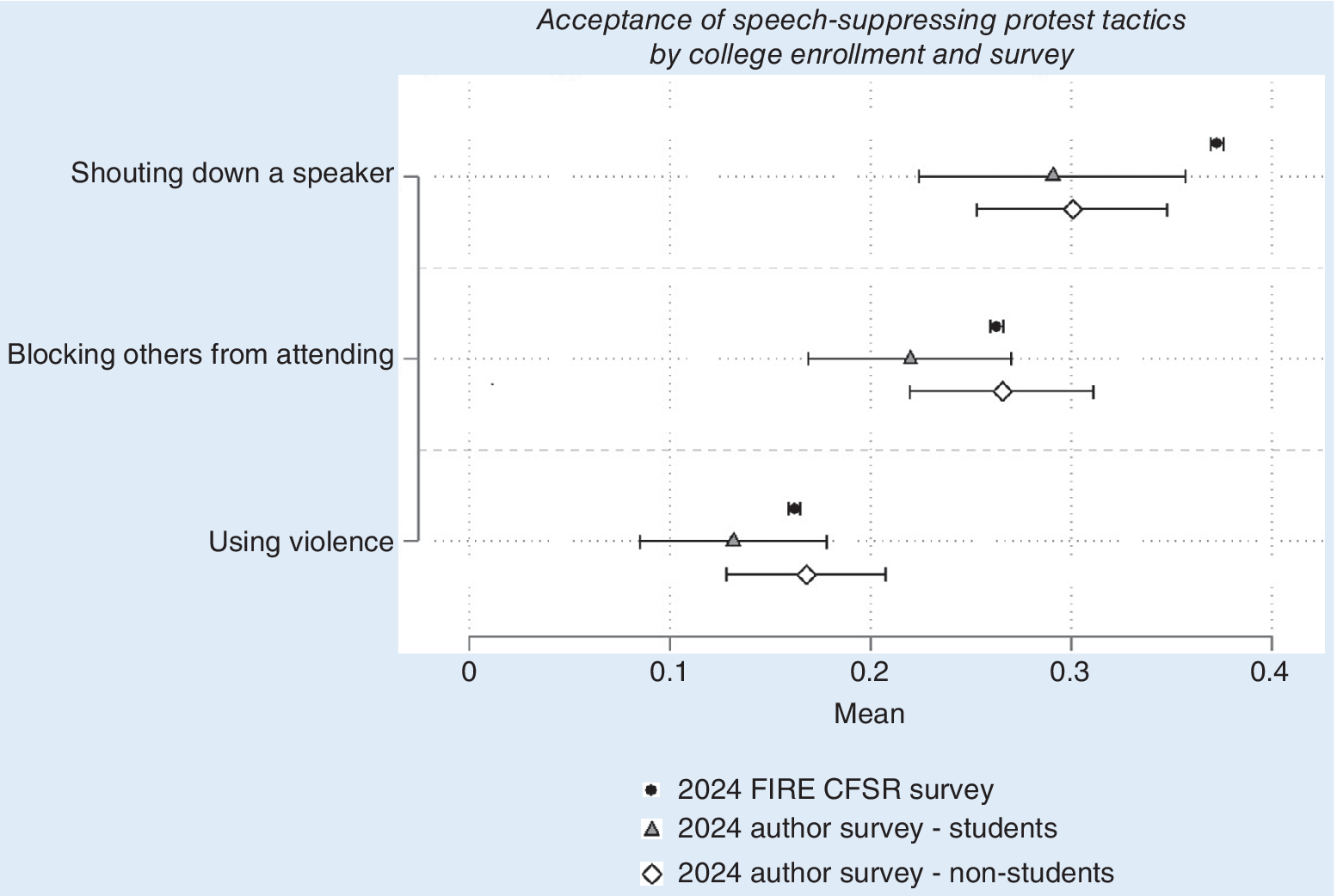
Fifth, I tested whether the reported age-based differences can plausibly be attributed to the socialization effects of higher education by comparing Gen Z respondents who are currently enrolled in college to those who are not.Footnote 8 As shown in figure 6, there were no statistically significant differences between 18- to 26-year-old students and nonstudents in the acceptability of blockades and violence. Whereas the college-attending young people in FIRE’s CFSR survey were modestly more accepting of shoutdowns than both the college-attending (mean difference=0.08, p=0.02) and noncollege-attending (mean difference=0.07, p<0.01) young respondents in my national survey, these differences were minor and may reflect the CFSR survey’s focus of nationally visible schools.Footnote 9
Acceptability of Speech-Suppressing Protest Actions Among Gen Z
Whiskers indicate 84% confidence intervals. Item-level pairwise differences are reported in online appendix table A6. Variables are coded 0 to 1, where 0=never acceptable and 1=always acceptable.

These results should not be interpreted as proof that colleges never foster intolerance. There may be campus contexts (e.g., particular schools, departments, and student subcultures) that explicitly encourage disruptive protest actions that target speech. For example, at least one study (Wallsten Reference Wallsten2023) shows higher levels of permissiveness for speech-suppressing protest among students who are majoring in ethnic and gender studies. The evidence presented in this study, however, suggests that acceptance of illiberal protest actions is not unique to college students and likely has its origins beyond higher education.
Recent scholarship reveals that Gen Z is a politically distinctive cohort, with a unique set of issue priorities, policy views, and normative commitments (McDonald and Deckman Reference McDonald and Deckman2023; Rice and Moffett Reference Rice and Moffett2021). National surveys also find significant generational differences in racial attitudes (Bonica and Grumbach Reference Bonica and Grumbach2025), national pride (Jones Reference Jones2025), and views about government censorship (Cannon Reference Cannon2023). The results presented in this article expand on this emerging profile by identifying speech-suppressing protest as yet another arena in which Gen Z stands apart from previous generations.
CONCLUSION
This study asks an important but understudied question about the American public’s views on constitutional liberties. Do the principles of political tolerance extend to judgments about disruptive protest actions intended to suppress speech? These analyses reveal important generational differences in how people think about speech-suppressing shoutdowns, blockades, and violence. Members of Gen Z consistently express more permissiveness about these tactics than older cohorts. Although previous research suggests that young liberals are particularly supportive of disruptive protest actions, this study demonstrates that ideological polarization is present only when survey respondents are asked abstractly worded questions. When asked to evaluate disruptive acts targeting speakers that they find personally offensive, ideological gaps between liberals and conservatives close.
…do the principles of political tolerance extend to judgments about disruptive protest actions intended to suppress speech? These analyses show important generational differences in how people think about speech-suppressing shoutdowns, blockades, and violence. Members of Gen Z consistently express more permissiveness about these tactics than older cohorts.
Although previous research suggests that young liberals are particularly supportive of disruptive protest actions, this study demonstrates that ideological polarization is present only when survey respondents are asked abstractly worded questions. When asked to evaluate disruptive acts targeting speakers that they find personally offensive, ideological gaps between liberals and conservatives close.
These findings highlight three areas that are deserving of further academic attention. First, the distinction between support for government restrictions on civil liberties and acceptance of disruptive protest that targets protected speech is an underexamined dimension of political tolerance. More empirical research is needed to assess the boundaries, causes, and consequences of the public’s views about speech-suppressing protest. Second, acceptance for the most extreme form of speech-suppressing protest (i.e., using violence) was similar to levels of support for politically motivated violence reported in other recent surveys. As Westwood et al. (Reference Westwood, Grimmer, Tyler and Nall2022) showed, however, vaguely worded questions that do not reference specific actions can inflate estimates of how many Americans endorse “violence.” Future research should expand on this insight and use more detailed questions that focus on the particular forms of violence that could be used to stop a speech. Third, more research is needed to identify the extent to which the generational gaps described in this article are a result of differential exposure to morally and emotionally salient social media content (Brady, Crockett, and Van Bavel Reference Brady, Crockett and van Bavel2020; Crockett Reference Crockett2017); broader cohort-based shifts in harm-related moral reasoning; or cultural transformations related to safety, resilience, and psychological vulnerability (Haidt and Lukianoff Reference Haidt and Lukianoff2018; Twenge Reference Twenge2017).
SUPPLEMENTARY MATERIAL
To view supplementary material for this article, please visit http://doi.org/10.1017/S1049096526102157.
ACKNOWLEDGMENTS
I thank Sean Stevens, Nathan Honeycutt, and Jack Citrin for their insightful comments and encouragement during the development of this research project.
DATA AVAILABILITY STATEMENT
Research documentation and data that support the findings of this study are openly available at the PS: Political Science & Politics Harvard Dataverse at https://doi.org/10.7910/DVN/P9D6YN.
CONFLICTS OF INTEREST
The author declares that there are no ethical issues or conflicts of interest in this research.




 Open access

