 Pol2(G)


1. Introduction
Let G be a finite group and let $k\ge1$
be an integer. For any matrix-valued function
$k\ge1$
be an integer. For any matrix-valued function $f\,:\, G\to M_n \mathbb C$
, define the difference operator
$f\,:\, G\to M_n \mathbb C$
, define the difference operator
 \begin{equation*}(\Delta_g f)(h) = f(gh)\,f(h)^*,\end{equation*}
and iterate to
 \begin{equation*}\Delta_{g_1,\ldots,g_k}=\;\Delta_{g_1}\circ\cdots\circ\Delta_{g_k}.\end{equation*}
The Gowers $U^k$
-norm of f is then given by
$U^k$
-norm of f is then given by
 \begin{equation*}\|\,f\|_{U^k}^{2^k} = \mathbb{E}_{g_0,\ldots,g_k\in G}\mathrm{tr}\bigl(\Delta_{g_1,\ldots,g_k}f(g_0)\bigr),\end{equation*}
where tr denotes the normalised trace on $M_n \mathbb C$
and
$M_n \mathbb C$
and $\mathbb{E}$
the expectation with respect to the uniform distribution on
$\mathbb{E}$
the expectation with respect to the uniform distribution on $G^{k+1}$
. Basic properties of these matrix-valued Gowers norms - including the fact that
$G^{k+1}$
. Basic properties of these matrix-valued Gowers norms - including the fact that $\|\cdot\|_{U^k}$
is indeed a norm - are collected in Appendix A.
$\|\cdot\|_{U^k}$
is indeed a norm - are collected in Appendix A.
Higher-order Fourier analysis is built around the study of these Gowers uniformity norms and, in particular, the inverse problem: given a function f withFootnote
1 $\|\,f\|_\infty\le1$
and a large
$\|\,f\|_\infty\le1$
and a large $U^k$
-norm, what algebraic or analytic structure must f exhibit? This inverse question depends both on the degree k of the norm and on the algebraic properties of the ambient group. The theory of Gowers norms - and their inverse theorems - originated in Gowers’s Fourier-analytic proof of Szemerédi’s theorem for scalar-valued functions on the cyclic groups
$U^k$
-norm, what algebraic or analytic structure must f exhibit? This inverse question depends both on the degree k of the norm and on the algebraic properties of the ambient group. The theory of Gowers norms - and their inverse theorems - originated in Gowers’s Fourier-analytic proof of Szemerédi’s theorem for scalar-valued functions on the cyclic groups $\mathbb{Z}/n\mathbb{Z}$
[
Reference Gowers4
], and has since been developed chiefly for scalar-valued functions on finite abelian groups [
Reference Green, Tao and Ziegler6
,
Reference Jamneshan and Tao10
,
Reference Leng, Sah and Sawhney14
,
Reference Milićević16
,
Reference Tao and Ziegler18
,
Reference Tao and Ziegler19
]. Moreover, even in the abelian scalar-valued setting, the inverse theory remains far from complete (cf. [
Reference Jamneshan and Tao10
, conjecture 1·11]).
$\mathbb{Z}/n\mathbb{Z}$
[
Reference Gowers4
], and has since been developed chiefly for scalar-valued functions on finite abelian groups [
Reference Green, Tao and Ziegler6
,
Reference Jamneshan and Tao10
,
Reference Leng, Sah and Sawhney14
,
Reference Milićević16
,
Reference Tao and Ziegler18
,
Reference Tao and Ziegler19
]. Moreover, even in the abelian scalar-valued setting, the inverse theory remains far from complete (cf. [
Reference Jamneshan and Tao10
, conjecture 1·11]).
Gowers and Hatami [
Reference Gowers and Hatami5
] initiated the study of noncommutative Gowers norms by proving a quantitative inverse theorem for matrix-valued Gowers $U^2$
-norms on nonabelian finite groups (see [
Reference Gowers and Hatami5
, theorem 5·6]). To illustrate, in the classical abelian scalar-valued setting, if G is a finite abelian group,
$U^2$
-norms on nonabelian finite groups (see [
Reference Gowers and Hatami5
, theorem 5·6]). To illustrate, in the classical abelian scalar-valued setting, if G is a finite abelian group, $f\,:\, G\to\mathbb{C}$
satisfies
$f\,:\, G\to\mathbb{C}$
satisfies $\lvert f\rvert\le1$
, and
$\lvert f\rvert\le1$
, and $\|\,f\|_{U^2}\ge\delta\gt0$
, then Plancherel’s identity guarantees a character
$\|\,f\|_{U^2}\ge\delta\gt0$
, then Plancherel’s identity guarantees a character $\chi\,:\, G\to S^1$
with
$\chi\,:\, G\to S^1$
with $|\langle f,\chi\rangle|\ge\delta^2$
. In the noncommutative, matrix-valued case, characters are replaced by unitary representations, and the quantitative bounds depend on the dimensions of those representations as well.
$|\langle f,\chi\rangle|\ge\delta^2$
. In the noncommutative, matrix-valued case, characters are replaced by unitary representations, and the quantitative bounds depend on the dimensions of those representations as well.
Gowers and Hatami further related their inverse theorem to stability questions for approximate representations in group theory. Using operator-theoretic methods, these $U^2$
-inverse and stability results were subsequently re-proved and extended to functions on countable amenable groups taking values in von Neumann algebras [
Reference Chiffre, Ozawa and Thom3
].
$U^2$
-inverse and stability results were subsequently re-proved and extended to functions on countable amenable groups taking values in von Neumann algebras [
Reference Chiffre, Ozawa and Thom3
].
This paper takes a step beyond the linear (first-order) inverse Gowers theory by investigating the quadratic (second-order) noncommutative Gowers inverse problem and its connection to higher-order stability phenomena. To initiate the study of the inverse theory for $\|\,f\|_{U^3}$
when
$\|\,f\|_{U^3}$
when $f\,:\, G\to M_n \mathbb C$
satisfies
$f\,:\, G\to M_n \mathbb C$
satisfies $\|\,f\|_\infty\le1$
, it is natural to begin with the extremal case, namely
$\|\,f\|_\infty\le1$
, it is natural to begin with the extremal case, namely $\|\,f\|_{U^3}=1$
(
$\|\,f\|_{U^3}=1$
( $100 \%$
regime). Indeed, by definition,
$100 \%$
regime). Indeed, by definition,
 \begin{equation*}\|\,f\|_{U^3}^{8} = \mathbb{E}_{g_0,g_1,g_2,g_3} \mathrm{tr}\bigl(\Delta_{g_1,g_2,g_3}f(g_0)\bigr),\end{equation*}
so $\Delta_{g_1,g_2,g_3}f(g_0)=I_n$
for all
$\Delta_{g_1,g_2,g_3}f(g_0)=I_n$
for all $g_0,g_1,g_2,g_3\in G$
is equivalent to
$g_0,g_1,g_2,g_3\in G$
is equivalent to $\|\,f\|_{U^3}=1$
. Consequently, understanding the
$\|\,f\|_{U^3}=1$
. Consequently, understanding the $100 \%$
regime amounts to classifying those functions
$100 \%$
regime amounts to classifying those functions $f\,:\, G\to M_n \mathbb C$
for which
$f\,:\, G\to M_n \mathbb C$
for which $\Delta_{g_1,g_2,g_3}f(g_0)=I_n$
for all
$\Delta_{g_1,g_2,g_3}f(g_0)=I_n$
for all $g_0,g_1,g_2,g_3\in G$
. If we assume that f takes unitary values, then such functions are precisely quadratic maps in the sense of Leibman, and, in the special case where G is abelian and f is scalar-valued, they coincide with the non-classical phase polynomials that play a central role in the inverse theory of scalar-valued Gowers norms on abelian groups [
Reference Jamneshan, Shalom and Tao9
,
Reference Tao and Ziegler18
,
Reference Tao and Ziegler19
].
$g_0,g_1,g_2,g_3\in G$
. If we assume that f takes unitary values, then such functions are precisely quadratic maps in the sense of Leibman, and, in the special case where G is abelian and f is scalar-valued, they coincide with the non-classical phase polynomials that play a central role in the inverse theory of scalar-valued Gowers norms on abelian groups [
Reference Jamneshan, Shalom and Tao9
,
Reference Tao and Ziegler18
,
Reference Tao and Ziegler19
].
Let G and H be groups. For a map $\varphi \,:\, G \to H$
and an element
$\varphi \,:\, G \to H$
and an element $k \in G$
, define the finite difference by
$k \in G$
, define the finite difference by
 \begin{equation*}(\Delta_k \varphi)(g) \,:\!=\, \varphi(kg)\, \varphi(g)^{-1}.\end{equation*}
Definition 1·1. A map $\varphi \,:\, G \to H$
is said to be polynomial of degree
$\varphi \,:\, G \to H$
is said to be polynomial of degree $-1$
if
$-1$
if $\varphi(g) = 1$
for all
$\varphi(g) = 1$
for all $g \in G$
. For
$g \in G$
. For $d \geq -1$
, the map
$d \geq -1$
, the map $\varphi$
is said to be polynomial of degree
$\varphi$
is said to be polynomial of degree $d+1$
if, for every
$d+1$
if, for every $k \in G$
, the finite difference
$k \in G$
, the finite difference $\Delta_k \varphi$
is polynomial of degree d.
$\Delta_k \varphi$
is polynomial of degree d.
The notion of polynomial maps has emerged as a fundamental concept in the field of higher-order Fourier analysis. For example, complex functions of polynomial maps between filtered groups are believed to constitute the general obstructions to uniformity in the inverse theory of the Gowers norms over finite abelian groups [
Reference Jamneshan and Tao10
]. This belief has been confirmed in the setting of cyclic groups of prime order [
Reference Green, Tao and Ziegler6
], finite vector spaces [
Reference Tao and Ziegler18
,
Reference Tao and Ziegler19
], and for the $U^3$
-norm on general finite abelian groups [
Reference Jamneshan and Tao10
].
$U^3$
-norm on general finite abelian groups [
Reference Jamneshan and Tao10
].
It is of interest to obtain algebraic descriptions and classifications of polynomial maps between groups. For classical polynomials over fields, a natural description is given by linear combinations of monomials, which can be derived from Definition 1·1 using a Taylor expansion. In a similar vein, for polynomial maps from $\mathbb{Z}^d$
into a not necessarily commutative filtered group G, a kind of Taylor expansion is available; see, for instance, [
Reference Green, Tao and Ziegler6
, lemma B·9].
$\mathbb{Z}^d$
into a not necessarily commutative filtered group G, a kind of Taylor expansion is available; see, for instance, [
Reference Green, Tao and Ziegler6
, lemma B·9].
In the setting of maps from $k^n$
, where k is a finite field, into the torus
$k^n$
, where k is a finite field, into the torus $S^1$
, a classification in terms of linear combinations of monomials divided by certain powers of the characteristic of k was established in [
Reference Tao and Ziegler19
, lemma 1·7]. Such maps, also known as non-classical polynomials, take values in the group of roots of unity of order equal to a power of the characteristic, where the power depends on the degree. This contrasts with classical polynomials, whose values lie in the group of roots of unity of order equal to the characteristic itself.
$S^1$
, a classification in terms of linear combinations of monomials divided by certain powers of the characteristic of k was established in [
Reference Tao and Ziegler19
, lemma 1·7]. Such maps, also known as non-classical polynomials, take values in the group of roots of unity of order equal to a power of the characteristic, where the power depends on the degree. This contrasts with classical polynomials, whose values lie in the group of roots of unity of order equal to the characteristic itself.
However, even for polynomial maps from an arbitrary finite abelian group into the torus, no algebraic description or classification is currently known. The main result of this paper presents a universal construction of polynomial maps between arbitrary groups and, in the case of quadratic maps, to compute this construction explicitly in group-theoretic terms.
We now describe our results in more detail. It is clear from Definition 1·1 that the composition of a polynomial of degree d with a homomorphism in either order is again a polynomial map of degree d. It also follows easily that polynomial maps of degree 0 are constant functions, and that polynomial maps of degree 1 are the product of a homomorphism and a constant function (see Lemma 2·1). The primary focus of this paper is to study the first non-trivial case: quadratic maps, i.e., polynomials of degree at most two. It also follows directly from the definition that if $\varphi \,:\, G \to H$
is a quadratic map, then the map
$\varphi \,:\, G \to H$
is a quadratic map, then the map $\varphi' \,:\, G \to H$
defined by
$\varphi' \,:\, G \to H$
defined by $\varphi'(g) = \varphi(g)h$
, for some fixed
$\varphi'(g) = \varphi(g)h$
, for some fixed $h \in H$
, is also quadratic. Consequently, without loss of generality, we may assume that
$h \in H$
, is also quadratic. Consequently, without loss of generality, we may assume that $\varphi(1) = 1$
. We call a map
$\varphi(1) = 1$
. We call a map $\varphi \,:\, G \to H$
unital if it satisfies
$\varphi \,:\, G \to H$
unital if it satisfies $\varphi(1) = 1$
, and denote by
$\varphi(1) = 1$
, and denote by $\mathrm{Quad}(G,H)$
the set of unital quadratic maps from G to H. For a fixed group G, we can then interpret
$\mathrm{Quad}(G,H)$
the set of unital quadratic maps from G to H. For a fixed group G, we can then interpret $\mathrm{Quad}(G,?)$
as a functor from the category of groups to the category of sets. Note that if H is abelian, then
$\mathrm{Quad}(G,?)$
as a functor from the category of groups to the category of sets. Note that if H is abelian, then $\mathrm{Quad}(G,H)$
is naturally an abelian group as well.
$\mathrm{Quad}(G,H)$
is naturally an abelian group as well.
Our main result provides a characterisation of quadratic maps in terms of group homomorphisms, as follows:
Theorem 1·2. Let G be a group. There exists a group $\mathrm{Pol}_2(G)$
and a natural bijection
$\mathrm{Pol}_2(G)$
and a natural bijection
 \begin{equation*}\hom(\mathrm{Pol}_2(G),?) \to \mathrm{Quad}(G,?),\end{equation*}
i.e., the functor $\mathrm{Quad}(G,?)$
is representable. More specifically, there exists a universal unital quadratic map
$\mathrm{Quad}(G,?)$
is representable. More specifically, there exists a universal unital quadratic map $\varphi \,:\, G \to \mathrm{Pol}_2(G)$
such that every unital quadratic map
$\varphi \,:\, G \to \mathrm{Pol}_2(G)$
such that every unital quadratic map $\varphi' \,:\, G \to H$
can be expressed as
$\varphi' \,:\, G \to H$
can be expressed as $\varphi' = \psi \circ \varphi$
for a unique homomorphism
$\varphi' = \psi \circ \varphi$
for a unique homomorphism $\psi \,:\, \mathrm{Pol}_2(G) \to H$
.
$\psi \,:\, \mathrm{Pol}_2(G) \to H$
.
We can describe the group $\mathrm{Pol}_2(G)$
in concrete terms as follows. Here,
$\mathrm{Pol}_2(G)$
in concrete terms as follows. Here, $\omega(G)$
denotes the augmentation ideal of the group ring
$\omega(G)$
denotes the augmentation ideal of the group ring $\mathbb{Z}[G]$
, and
$\mathbb{Z}[G]$
, and $G^{ab}$
denotes the abelianisation of G.
$G^{ab}$
denotes the abelianisation of G.
Theorem 1·3. The group $\mathrm{Pol}_2(G)$
is isomorphic to the twisted crossed product group
$\mathrm{Pol}_2(G)$
is isomorphic to the twisted crossed product group
 \begin{equation*}(\omega(G) \otimes_{\mathbb{Z}} G^{ab}) \rtimes_{\psi} G,\end{equation*}
where G acts on $\omega(G)$
by left multiplication and trivially on
$\omega(G)$
by left multiplication and trivially on $G^{ab}$
. The 2-cocycle
$G^{ab}$
. The 2-cocycle $\psi$
is given by
$\psi$
is given by $c \otimes \mathrm{ab}$
, the exterior product of the tautological 1-cocycle
$c \otimes \mathrm{ab}$
, the exterior product of the tautological 1-cocycle $c \,:\, G \to \omega(G)$
and the trivial 1-cocycle
$c \,:\, G \to \omega(G)$
and the trivial 1-cocycle $\mathrm{ab} \,:\, G \to G^{ab}$
.
$\mathrm{ab} \,:\, G \to G^{ab}$
.
One may naturally inquire about the classification of polynomial maps of higher degree. While the definition of $\mathrm{Pol}_k(G)$
is straightforward in terms of generators and relations, obtaining an explicit description such as in Theorem 1·3 seems to be more challenging.
$\mathrm{Pol}_k(G)$
is straightforward in terms of generators and relations, obtaining an explicit description such as in Theorem 1·3 seems to be more challenging.
Theorem 1·3 has several noteworthy consequences. In particular, it provides a concrete description of the abelianisation of $\mathrm{Pol}_2(G)$
, where
$\mathrm{Pol}_2(G)$
, where $\mathrm{Sym}^2(G)$
denotes the symmetric product of an abelian group G:
$\mathrm{Sym}^2(G)$
denotes the symmetric product of an abelian group G:
Corollary 1·4. Let G be an abelian group. The abelianisation of $\mathrm{Pol}_2(G)$
fits into an extension
$\mathrm{Pol}_2(G)$
fits into an extension
 \begin{equation*}1 \to \mathrm{Sym}^2(G) \to \mathrm{Pol}_2^{ab}(G) \to G \to 1,\end{equation*}
so that $\mathrm{Pol}_2^{ab}(G)$
is isomorphic to the twisted crossed product group
$\mathrm{Pol}_2^{ab}(G)$
is isomorphic to the twisted crossed product group
 \begin{equation*}\mathrm{Sym}^2(G) \rtimes_{\sigma} G\end{equation*}
for the 2-cocycle $\sigma\,:\, G \times G \to \mathrm{ Sym}^2(G)$
given by
$\sigma\,:\, G \times G \to \mathrm{ Sym}^2(G)$
given by $\sigma(g,h)=gh$
.
$\sigma(g,h)=gh$
.
We establish Theorem 1·3 and Corollary 1·4 in Section 3.
We begin our discussion of the consequences of our main results with the case of non-commutative groups. Recall that a group G is called perfect if it coincides with its commutator subgroup [G, G], or equivalently, if its abelianisation $G^{\mathrm{ab}}$
is trivial.
$G^{\mathrm{ab}}$
is trivial.
Corollary 1·5. If G is a perfect group, then the natural homomorphism $\pi \,:\, \mathrm{Pol}_2(G) \to G$
is an isomorphism. Consequently, every unital polynomial map defined on a perfect group is a group homomorphism.
$\pi \,:\, \mathrm{Pol}_2(G) \to G$
is an isomorphism. Consequently, every unital polynomial map defined on a perfect group is a group homomorphism.
Corollary 1·5 is proved in Section 4, where we also compute $\mathrm{ Pol}_2(\mathbb{F}_d)$
and its abelianisation for the free group
$\mathrm{ Pol}_2(\mathbb{F}_d)$
and its abelianisation for the free group $\mathbb{F}_d$
on d generators, and show that
$\mathbb{F}_d$
on d generators, and show that $\mathrm{Pol}_2(G)$
is finite for every finite group G.
$\mathrm{Pol}_2(G)$
is finite for every finite group G.
In Section 5, we turn our attention to the case of abelian groups. Of particular interest is the computation of the group of unital quadratic maps $\mathrm{Quad}(G, S^1)$
for an arbitrary finite abelian group G. In Proposition 5·3, we establish that
$\mathrm{Quad}(G, S^1)$
for an arbitrary finite abelian group G. In Proposition 5·3, we establish that
 \begin{equation*}\mathrm{Quad}(G, S^1) = \bigoplus_p \mathrm{Quad}(G_{(p)}, S^1),\end{equation*}
as abelian groups, where $\bigoplus_p G_{(p)}$
denotes the primary decomposition of G. Proposition 1·6 below then gives a complete classification of
$\bigoplus_p G_{(p)}$
denotes the primary decomposition of G. Proposition 1·6 below then gives a complete classification of $\mathrm{Quad}(G, S^1)$
for an arbitrary finite abelian group G.
$\mathrm{Quad}(G, S^1)$
for an arbitrary finite abelian group G.
Proposition 1·6. Let p be a prime number, and let $G = \bigoplus_{i=1}^d \mathbb{Z}/p^{n_i}\mathbb{Z}$
be a finite abelian p-primary group.
$G = \bigoplus_{i=1}^d \mathbb{Z}/p^{n_i}\mathbb{Z}$
be a finite abelian p-primary group.
-
(i) If $p = 2$
, then there is a group isomorphism
\begin{equation*}\mathrm{Quad}(G, S^1) \cong \bigoplus_{i=1}^d \mathbb{Z}/2^{n_i - 1}\mathbb{Z} \oplus \bigoplus_{1 \leq i \lt j \leq d} \mathbb{Z}/2^{\min(n_i, n_j)}\mathbb{Z} \oplus \bigoplus_{i=1}^d \mathbb{Z}/2^{n_i + 1}\mathbb{Z}.\end{equation*}
$p = 2$
, then there is a group isomorphism
\begin{equation*}\mathrm{Quad}(G, S^1) \cong \bigoplus_{i=1}^d \mathbb{Z}/2^{n_i - 1}\mathbb{Z} \oplus \bigoplus_{1 \leq i \lt j \leq d} \mathbb{Z}/2^{\min(n_i, n_j)}\mathbb{Z} \oplus \bigoplus_{i=1}^d \mathbb{Z}/2^{n_i + 1}\mathbb{Z}.\end{equation*}
-
(ii) If
$p \neq 2$
, then there is a group isomorphism
\begin{equation*}\mathrm{Quad}(G, S^1) \cong \bigoplus_{i=1}^d \mathbb{Z}/p^{n_i}\mathbb{Z} \oplus \bigoplus_{1 \leq i \lt j \leq d} \mathbb{Z}/p^{\min(n_i, n_j)}\mathbb{Z} \oplus \bigoplus_{i=1}^d \mathbb{Z}/p^{n_i}\mathbb{Z}.\end{equation*}


Our results for abelian groups recover the Tao–Ziegler classification for non-classical polynomials on finite vector spaces [
Reference Tao and Ziegler19
, lemma 1·7] in the quadratic case (see Remark 5·6), as well as the aforementioned Taylor expansion formula for quadratic maps on $\mathbb{Z}^d$
(see Example 5·2). Moreover, from the inverse theorem for the Gowers
$\mathbb{Z}^d$
(see Example 5·2). Moreover, from the inverse theorem for the Gowers $U^3$
-norm on arbitrary finite abelian groups [
Reference Jamneshan and Tao10
], one can deduce that, when restricting to families of finite abelian groups with uniformly bounded torsion, the obstructions to uniformity are precisely the quadratic maps with values in
$U^3$
-norm on arbitrary finite abelian groups [
Reference Jamneshan and Tao10
], one can deduce that, when restricting to families of finite abelian groups with uniformly bounded torsion, the obstructions to uniformity are precisely the quadratic maps with values in $S^1$
. In this setting, Proposition 1·6 provides an explicit description of the obstruction.
$S^1$
. In this setting, Proposition 1·6 provides an explicit description of the obstruction.
The final two sections are devoted to applications concerning the stability of approximate polynomial maps and a non-commutative inverse Gowers theory. Recall that a group G is said to have commutator width k if every element $g \in G$
can be expressed as a product of at most k commutators. The results in these sections focus on perfect groups with bounded commutator width. In both applications, Theorem 1·3 is used in the form of Corollary 1·5.
$g \in G$
can be expressed as a product of at most k commutators. The results in these sections focus on perfect groups with bounded commutator width. In both applications, Theorem 1·3 is used in the form of Corollary 1·5.
In Section 6, we study approximate polynomial maps with values in metric groups. Let $(H, \partial)$
be a group equipped with a bi-invariant metric. A unital map
$(H, \partial)$
be a group equipped with a bi-invariant metric. A unital map $\varphi \,:\, G \to H$
is called a uniform
$\varphi \,:\, G \to H$
is called a uniform $\varepsilon$
-polynomial of degree d if
$\varepsilon$
-polynomial of degree d if
 \begin{equation*}\partial((\Delta_{g_1, \ldots, g_{d+1}} \varphi)(1), 1) \leq \varepsilon\end{equation*}
for all $g_1, \ldots, g_{d+1} \in G$
, where
$g_1, \ldots, g_{d+1} \in G$
, where $\Delta_{g_1, \ldots, g_k} \,:\!=\, \Delta_{g_1} \circ \cdots \circ \Delta_{g_k}$
. A uniform
$\Delta_{g_1, \ldots, g_k} \,:\!=\, \Delta_{g_1} \circ \cdots \circ \Delta_{g_k}$
. A uniform $\varepsilon$
-polynomial of degree one is called uniform
$\varepsilon$
-polynomial of degree one is called uniform $\varepsilon$
-homomorphism – in agreement with the usual understanding of this term, since
$\varepsilon$
-homomorphism – in agreement with the usual understanding of this term, since
 \begin{equation*}d((\Delta_{g_1,g_2} \varphi)(1),1) = d(\varphi(g_2g_1)\varphi(g_1)^* \varphi(g_2)^*,1) = d(\varphi(g_2g_1),\varphi(g_2)\varphi(g_1)).\end{equation*}
We establish the following strong stability result for such approximate polynomial maps.
Theorem 1·7. Let $k \in \mathbb{N}$
. There exists a constant
$k \in \mathbb{N}$
. There exists a constant $c \,:\!=\, c(k) \gt 0$
such that the following holds: let
$c \,:\!=\, c(k) \gt 0$
such that the following holds: let $d \in \mathbb{N}$
, let
$d \in \mathbb{N}$
, let $(H, \partial)$
be a group equipped with a bi-invariant metric, and let G be a group of commutator width at most k. Then every unital uniform
$(H, \partial)$
be a group equipped with a bi-invariant metric, and let G be a group of commutator width at most k. Then every unital uniform $\varepsilon$
-polynomial map
$\varepsilon$
-polynomial map $\varphi \,:\, G{\to}H$
of degree d is a uniform
$\varphi \,:\, G{\to}H$
of degree d is a uniform $c(k)^{d-1} \varepsilon$
-homomorphism.
$c(k)^{d-1} \varepsilon$
-homomorphism.
In Section 7, inspired by the work of Gowers–Hatami [
Reference Gowers and Hatami5
], we define Gowers norms of arbitrary degree for functions on a finite group with values in $M_n \mathbb{C}$
as above. Any polynomial map
$M_n \mathbb{C}$
as above. Any polynomial map $\varphi \,:\, G \to \mathrm{U}(n)$
of degree
$\varphi \,:\, G \to \mathrm{U}(n)$
of degree $k-1$
satisfies
$k-1$
satisfies $\|\varphi\|_{U^k} = 1$
. It is thus natural to ask whether functions with values in the unitary group and
$\|\varphi\|_{U^k} = 1$
. It is thus natural to ask whether functions with values in the unitary group and $U^k$
-norm close to 1 must be close, in a suitable sense, to a polynomial map - where the estimates depend only on k and the commutator width, and are independent of the group G and the dimension n. This includes, for example, uniform estimates for the class of non-abelian finite simple groups, whose commutator width is known to be equal to one, see [
Reference Liebeck, O’Brien, Shalev and Huu Tiep15
] and Remark 6·2.
$U^k$
-norm close to 1 must be close, in a suitable sense, to a polynomial map - where the estimates depend only on k and the commutator width, and are independent of the group G and the dimension n. This includes, for example, uniform estimates for the class of non-abelian finite simple groups, whose commutator width is known to be equal to one, see [
Reference Liebeck, O’Brien, Shalev and Huu Tiep15
] and Remark 6·2.
Such a statement is often referred to as an inverse theorem in the 99% regime. Our main result is a strong form of such a theorem, which entails a collapse of the higher-order Fourier hierarchy:
Theorem 1·8. Let $k_0, k \in \mathbb{N}$
. For every
$k_0, k \in \mathbb{N}$
. For every $\delta \gt 0$
there exists
$\delta \gt 0$
there exists $\varepsilon = \varepsilon(\delta, k, k_0) \gt 0$
such that the following holds: let G be a finite perfect group of commutator width at most
$\varepsilon = \varepsilon(\delta, k, k_0) \gt 0$
such that the following holds: let G be a finite perfect group of commutator width at most $k_0$
, and let
$k_0$
, and let $\varphi \,:\, G \to M_n \mathbb{C}$
be a map satisfying
$\varphi \,:\, G \to M_n \mathbb{C}$
be a map satisfying $\|\varphi\|_{\infty} \leq 1$
and
$\|\varphi\|_{\infty} \leq 1$
and
 \begin{equation*}\|\varphi\|^{2^k}_{U^k} \geq 1 - \varepsilon.\end{equation*}
Then there exists a homomorphism $\beta \,:\, G \to \mathrm{U}(n')$
with
$\beta \,:\, G \to \mathrm{U}(n')$
with $n' \in [n, (1+\delta)n] \cap \mathbb{N}$
such that
$n' \in [n, (1+\delta)n] \cap \mathbb{N}$
such that
 \begin{equation*}\mathbb{E}_{g \in G} \left\| (\varphi(1)^* \varphi(g) \oplus 1_{n'-n}) - \beta(g) \right\|_2^2 \lt \delta.\end{equation*}
By Corollary 1·5, every unital polynomial map is necessarily a homomorphism. Hence Theorem 1·8 can be viewed as extending the Gowers–Hatami inverse theorem ([
Reference Gowers and Hatami5
, theorem 5·6]) from the case $k=2$
to all higher degrees - albeit only in the 99% regime (whereas Gowers–Hatami treat the more demanding 1% regime). Such inverse theorems require strong structural hypotheses on the group; our proof assumes that G is perfect. Whether a similar collapse of the higher-order Fourier hierarchy persists in the 1% regime for suitable classes of groups remains an intriguing open question, and at present no further evidence or results are known.
$k=2$
to all higher degrees - albeit only in the 99% regime (whereas Gowers–Hatami treat the more demanding 1% regime). Such inverse theorems require strong structural hypotheses on the group; our proof assumes that G is perfect. Whether a similar collapse of the higher-order Fourier hierarchy persists in the 1% regime for suitable classes of groups remains an intriguing open question, and at present no further evidence or results are known.
2. Basic results
Before we get to quadratic maps, we recall a basic result on polynomial maps of degree one.
Lemma 2·1. A map $\varphi \,:\, G \to H$
is polynomial of degree one if and only if there exists
$\varphi \,:\, G \to H$
is polynomial of degree one if and only if there exists $c \in H$
and a homomorphism
$c \in H$
and a homomorphism $\psi \,:\, G \to H$
, such that
$\psi \,:\, G \to H$
, such that
 \begin{equation*}\varphi(g) = \psi(g)c, \quad \forall g \in G.\end{equation*}
Proof. We set $\psi(g)\,:\!=\,\varphi(g)\varphi(1)^{-1}$
. Note that
$\psi(g)\,:\!=\,\varphi(g)\varphi(1)^{-1}$
. Note that $(\Delta_g \varphi)(h) = \varphi(gh)\varphi(h)^{-1}$
is of degree zero and therefore a constant equal to
$(\Delta_g \varphi)(h) = \varphi(gh)\varphi(h)^{-1}$
is of degree zero and therefore a constant equal to $\varphi(g)\varphi(1)^{-1}$
. Thus, we obtain
$\varphi(g)\varphi(1)^{-1}$
. Thus, we obtain
 \begin{equation*}\psi(gh) = \varphi(gh) \varphi(1)^{-1} = \varphi(g) \varphi(1)^{-1} \varphi(h) \varphi(1)^{-1} = \psi(g) \psi(h)\end{equation*}
and conclude that $\psi$
is a homomorphism, and set
$\psi$
is a homomorphism, and set $c\,:\!=\,\varphi(1)$
.
$c\,:\!=\,\varphi(1)$
.
We will freely use the terminology of group actions and cocycles, see [
Reference Brown2
] for details and background. Note that there is a natural right action of G on the set of functions f from G to H, given by $f^{k}(g)=f(kg)$
for all
$f^{k}(g)=f(kg)$
for all $k,g \in G$
. Indeed, we compute
$k,g \in G$
. Indeed, we compute
 \begin{equation*}f^{k_1k_2}(g)=f(k_1k_2g) = f^{k_1}(k_2g) = (\,f^{k_1})^{k_2}(g).\end{equation*}
In terms of this action, the finite differences satisfy the following cocycle relation.
Lemma 2·2. Let $\varphi \,:\, G \to H$
be a map and
$\varphi \,:\, G \to H$
be a map and $k_1,k_2 \in G$
, then the following 1-cocycle identity holds:
$k_1,k_2 \in G$
, then the following 1-cocycle identity holds:
 \begin{equation} \Delta_{k_1k_2} \varphi = (\Delta_{k_1} \varphi)^{k_2} \cdot \Delta_{k_2} \varphi\end{equation}
Proof. We compute
 \begin{eqnarray*}(\Delta_{k_1k_2} \varphi)(g)&=&\varphi(k_1k_2g)\varphi(g)^{-1} \\&=& \varphi(k_1k_2g)\varphi(k_2g)^{-1}\varphi(k_2g)\varphi(g)^{-1} \\&=& (\Delta_{k_1} \varphi)(k_2g) \cdot (\Delta_{k_2}\varphi)(g).\end{eqnarray*}
Let $\varphi \,:\, G \to H$
be a unital quadratic map. Using Lemma 2·1, for each
$\varphi \,:\, G \to H$
be a unital quadratic map. Using Lemma 2·1, for each $k \in G$
there exists a homomorphism
$k \in G$
there exists a homomorphism $\psi_k \,:\, G \to H$
and a constant
$\psi_k \,:\, G \to H$
and a constant $c_k \in H$
, such that
$c_k \in H$
, such that
 \begin{equation*}(\Delta_k \varphi)(g)=\varphi(kg)\varphi(g)^{-1} = \psi_k(g)c_k, \quad \forall g,k \in G.\end{equation*}
For $g=1$
, we obtain
$g=1$
, we obtain $c_k=\varphi(k).$
Setting
 \begin{equation*}\beta_k(g)\,:\!=\, \varphi(k)^{-1} \psi_k(g) \varphi(k) = \varphi(k)^{-1} (\Delta_k \varphi)(g)\end{equation*}
we obtain from Equation (2·1) the following identity:
 \begin{equation} \beta_{k_1k_2}(g) = \varphi(k_2)^{-1}\beta_{k_1}(g)\varphi(k_2) \cdot \beta_{k_2}(g).\end{equation}
Indeed, we compute as follows:
 \begin{eqnarray*}\beta_{k_1k_2}(g) &=& \varphi(k_1k_2)^{-1} (\Delta_{k_1k_2} \varphi)(g) \\&=& \varphi(k_1k_2)^{-1} (\Delta_{k_1} \varphi)^{k_2}(g) (\Delta_{k_2} \varphi)(g) \\&=& \varphi(k_1k_2)^{-1} (\Delta_{k_1} \varphi)(k_2g) (\Delta_{k_2} \varphi)(g) \\&=& \varphi(k_1k_2)^{-1} \varphi(k_1) \beta_{k_1}(k_2g) \varphi(k_2) \beta_{k_2}(g) \\&=& \varphi(k_1k_2)^{-1} \varphi(k_1) \beta_{k_1}(k_2) \beta_{k_1}(g) \varphi(k_2) \beta_{k_2}(g) \\&=& \varphi(k_2)^{-1} \beta_{k_1}(g) \varphi(k_2) \cdot \beta_{k_2}(g).\end{eqnarray*}
Note that $\beta_k \,:\, G \to H$
is also a homomorphism for
$\beta_k \,:\, G \to H$
is also a homomorphism for $k \in G$
and
$k \in G$
and $\beta_1$
is trivial. Moreover, we conclude from Equation (2·2) that the pointwise product of the homomorphism
$\beta_1$
is trivial. Moreover, we conclude from Equation (2·2) that the pointwise product of the homomorphism $g \mapsto \varphi(k_2)^{-1}\beta_{k_1}(g)\varphi(k_2)$
and the homomorphism
$g \mapsto \varphi(k_2)^{-1}\beta_{k_1}(g)\varphi(k_2)$
and the homomorphism $g \mapsto \beta_{k_2}(g)$
is again a homomorphism. The following folklore lemma shows that this is a rather special situation.
$g \mapsto \beta_{k_2}(g)$
is again a homomorphism. The following folklore lemma shows that this is a rather special situation.
Lemma 2·3. Let $\alpha,\beta \,:\, G \to H$
be homomorphisms.
$\alpha,\beta \,:\, G \to H$
be homomorphisms.
-
(i) If the pointwise product
$\alpha \beta$
is again a homomorphism, then the ranges of
$\alpha$
and
$\beta$
commute. -
(ii) If the pointwise inverse
$\alpha^{-1}$
is again a homomorphism, then the range of
$\alpha$
is abelian.


Proof. We first prove Claim (i) and compute:
 \begin{eqnarray*}\alpha(g)\alpha(h)\beta(g) \beta(h) &=& \alpha(gh)\beta(gh) = (\alpha\beta)(gh) \\&=& (\alpha \beta)(g)(\alpha \beta)(h) =\alpha(g)\beta(g)\alpha(h)\beta(h).\end{eqnarray*}
Hence, $\alpha(h)\beta(g)=\beta(g)\alpha(h)$
for all
$\alpha(h)\beta(g)=\beta(g)\alpha(h)$
for all $g,h \in G.$
Claim (ii) follows since the pointwise product of
$g,h \in G.$
Claim (ii) follows since the pointwise product of $\alpha$
and
$\alpha$
and $\alpha^{-1}$
is the trivial homomorphism and the ranges of
$\alpha^{-1}$
is the trivial homomorphism and the ranges of $\alpha$
and
$\alpha$
and $\alpha^{-1}$
agree.
$\alpha^{-1}$
agree.
Proposition 2·4. The range of $\beta_k$
is abelian for all
$\beta_k$
is abelian for all $k \in G$
and the ranges of the homomorphisms
$k \in G$
and the ranges of the homomorphisms $\beta_{k_1}$
and
$\beta_{k_1}$
and $\beta_{k_2}$
commute for all
$\beta_{k_2}$
commute for all $k_1,k_2 \in G.$
Proof. Indeed, Equation (2·2) shows for $k_1=k,k_2=k^{-1}$
that the map
$k_1=k,k_2=k^{-1}$
that the map $g \mapsto \beta_k(g)^{-1}$
is also a homomorphism. By Lemma 2·3(ii), this implies that the range of
$g \mapsto \beta_k(g)^{-1}$
is also a homomorphism. By Lemma 2·3(ii), this implies that the range of $\beta_k$
is abelian for all
$\beta_k$
is abelian for all $k \in G$
. Now, Lemma 2·3(i) implies that the ranges of
$k \in G$
. Now, Lemma 2·3(i) implies that the ranges of $g \mapsto \varphi(k_2)^{-1}\beta_{k_1}(g)\varphi(k_2)$
and
$g \mapsto \varphi(k_2)^{-1}\beta_{k_1}(g)\varphi(k_2)$
and $\beta_{k_2}$
commute. Hence, we conclude also that their product
$\beta_{k_2}$
commute. Hence, we conclude also that their product $\beta_{k_1k_2}$
commutes with
$\beta_{k_1k_2}$
commutes with $\beta_{k_2}$
. Since
$\beta_{k_2}$
. Since $k_1,k_2$
were arbitrary, this proves the claim.
$k_1,k_2$
were arbitrary, this proves the claim.
We can already prove our first result.
Proof of Theorem
1·2. Let G be a group. We define a group $\mathrm{Pol}_2(G)$
on formal generators
$\mathrm{Pol}_2(G)$
on formal generators $\varphi(g)$
for
$\varphi(g)$
for $g \in G$
, subject to relations
$g \in G$
, subject to relations
 \begin{equation} \varphi(g_1g_2g_3)= \varphi(g_1g_2)\varphi(g_2)^{-1}\varphi(g_1)^{-1} \varphi(g_1g_3)\varphi(g_3)^{-1}\varphi(g_2g_3)\end{equation}
for all $g_1,g_2,g_3 \in G.$
We claim that the tautological map
$g_1,g_2,g_3 \in G.$
We claim that the tautological map $\varphi \,:\, G \to \mathrm{Pol}_2(G)$
is the universal unital quadratic map. Applying the relation to
$\varphi \,:\, G \to \mathrm{Pol}_2(G)$
is the universal unital quadratic map. Applying the relation to $(g_1,g_2,g_3)=(1,1,1)$
, we see that
$(g_1,g_2,g_3)=(1,1,1)$
, we see that $\varphi(1)=1$
, so that
$\varphi(1)=1$
, so that $\varphi$
is unital.
$\varphi$
is unital.
The requirement for $\varphi$
to be quadratic is precisely that
$\varphi$
to be quadratic is precisely that $\Delta_{g_1} \varphi$
is linear for every
$\Delta_{g_1} \varphi$
is linear for every $g_1$
. Recall that
$g_1$
. Recall that
 \begin{equation*}(\Delta_{g_1} \varphi)(g) \,:\!=\, \varphi(g_1g)\varphi(g)^{-1},\end{equation*}
so that $(\Delta_{g_1} \varphi)(1)= \varphi(g_1).$
We set
$(\Delta_{g_1} \varphi)(1)= \varphi(g_1).$
We set
 \begin{equation*}\psi_{g_1}(g) \,:\!=\, \varphi(g_1g)\varphi(g)^{-1} \varphi(g_1)^{-1}.\end{equation*}
It remains to show that $\psi_{g_1}$
is a homomorphism for every
$\psi_{g_1}$
is a homomorphism for every $g_1.$
However,
$g_1.$
However,
 \begin{eqnarray*}\psi_{g_1}(g_2)\psi_{g_1}(g_3) &=& \varphi(g_1g_2)\varphi(g_2)^{-1} \varphi(g_1)^{-1}\varphi(g_1g_3)\varphi(g_3)^{-1} \varphi(g_1)^{-1} \\&\stackrel{(2{\cdot}3)}{=}& \varphi(g_1g_2g_3) \varphi(g_2g_3)^{-1} \varphi(g_1)^{-1} \\&=& \psi_{g_1}(g_2g_3).\end{eqnarray*}
This proves the claim and shows that $\varphi$
is indeed quadratic. At the same time, we see that all relations are necessary so that it follows that
$\varphi$
is indeed quadratic. At the same time, we see that all relations are necessary so that it follows that $\varphi$
is indeed the universal quadratic map.
$\varphi$
is indeed the universal quadratic map.
Remark 2·5. It is clear from the construction that a similar approach would define $\mathrm{ Pol}_k(G)$
, the relations to put are just
$\mathrm{ Pol}_k(G)$
, the relations to put are just $((\Delta_{g_1} \circ \cdots \circ \Delta_{g_{k+1}}) \varphi)(g_{k+2})$
for all
$((\Delta_{g_1} \circ \cdots \circ \Delta_{g_{k+1}}) \varphi)(g_{k+2})$
for all $g_1,\ldots,g_{k+2} \in G$
and
$g_1,\ldots,g_{k+2} \in G$
and $\varphi(1)=1.$
Proposition 2·6. The assignment $G \mapsto \mathrm{Pol}_2(G)$
is a functor on the category of groups.
$G \mapsto \mathrm{Pol}_2(G)$
is a functor on the category of groups.
The following corollary will allow us to compute $\mathrm{Pol}_2(G)$
in various special cases.
$\mathrm{Pol}_2(G)$
in various special cases.
Corollary 2·7. Let G be a group with symmetric generating set $S \subseteq G$
and let
$S \subseteq G$
and let $N \leq G$
be a normal subgroup generated by a symmetric set
$N \leq G$
be a normal subgroup generated by a symmetric set $\Sigma \subseteq N$
. Then
$\Sigma \subseteq N$
. Then $\mathrm{Pol}_2(G/N)$
is canonically isomorphic to the quotient of
$\mathrm{Pol}_2(G/N)$
is canonically isomorphic to the quotient of $\mathrm{Pol}_2(G)$
by the normal subgroup generated by the elements
$\mathrm{Pol}_2(G)$
by the normal subgroup generated by the elements $\varphi(\sigma)$
and
$\varphi(\sigma)$
and $\varphi(\sigma s) \varphi(s)^{-1}$
for
$\varphi(\sigma s) \varphi(s)^{-1}$
for $\sigma \in \Sigma, s \in S.$
Proof. We set $K_N \,:\!=\, \langle \! \langle \varphi(\sigma), \varphi(\sigma s) \varphi(s)^{-1}\,:\, \sigma \in \Sigma, s \in S \rangle \! \rangle$
and aim to show that
$K_N \,:\!=\, \langle \! \langle \varphi(\sigma), \varphi(\sigma s) \varphi(s)^{-1}\,:\, \sigma \in \Sigma, s \in S \rangle \! \rangle$
and aim to show that $\mathrm{Pol}_2(G)/K_N$
has the required universal property. Note that
$\mathrm{Pol}_2(G)/K_N$
has the required universal property. Note that $K_N$
lies in the kernel of the canonical map
$K_N$
lies in the kernel of the canonical map $\mathrm{Pol}_2(G) \to \mathrm{Pol}_2(G/N).$
It remains to provide an inverse to the induced homomorphism
$\mathrm{Pol}_2(G) \to \mathrm{Pol}_2(G/N).$
It remains to provide an inverse to the induced homomorphism $\mathrm{Pol}_2(G)/K_N \to \mathrm{Pol}_2(G/N).$
In order to do so we show that the canonical quadratic map
$\mathrm{Pol}_2(G)/K_N \to \mathrm{Pol}_2(G/N).$
In order to do so we show that the canonical quadratic map $\bar \varphi \,:\, G \to \mathrm{Pol}_2(G)/K_N$
is well-defined on
$\bar \varphi \,:\, G \to \mathrm{Pol}_2(G)/K_N$
is well-defined on $G/N.$
Now, it follows that $\beta_{\sigma}(s) = \varphi(\sigma)^{-1}\varphi(\sigma s) \varphi(s)^{-1} \in K_N$
for
$\beta_{\sigma}(s) = \varphi(\sigma)^{-1}\varphi(\sigma s) \varphi(s)^{-1} \in K_N$
for $\sigma \in \Sigma, s\in S$
and hence
$\sigma \in \Sigma, s\in S$
and hence $\beta_{\sigma}(g) \in K_N$
for all
$\beta_{\sigma}(g) \in K_N$
for all $g \in G$
. We conclude from Equation (2·2) and the fact that
$g \in G$
. We conclude from Equation (2·2) and the fact that $K_N$
is normal, that
$K_N$
is normal, that $\beta_h(g) \in K_N$
for all
$\beta_h(g) \in K_N$
for all $h \in N$
and
$h \in N$
and $g \in G.$
Since
$g \in G.$
Since $\beta_{h}(h')= \varphi(h)^{-1} \varphi(hh')\varphi(h')^{-1}$
it follows by induction on the word length that
$\beta_{h}(h')= \varphi(h)^{-1} \varphi(hh')\varphi(h')^{-1}$
it follows by induction on the word length that $\varphi(h) \in K_N$
for all
$\varphi(h) \in K_N$
for all $h \in N.$
Finally, this implies that
$h \in N.$
Finally, this implies that $\varphi(hg)\varphi(g)^{-1} \in K_N$
for all
$\varphi(hg)\varphi(g)^{-1} \in K_N$
for all $h \in N,g \in G$
. Thus,
$h \in N,g \in G$
. Thus, $\bar \varphi$
is indeed well-defined on
$\bar \varphi$
is indeed well-defined on $G/N.$
3. The computation of
$\mathrm{Pol}_2(G)$
and its abelianisation

This section is concerned with the proof of our main result about the structure of $\mathrm{Pol}_2(G).$
This is the basis for later sections, in which we exploit this structure result in order to derive explicit computations of
$\mathrm{Pol}_2(G).$
This is the basis for later sections, in which we exploit this structure result in order to derive explicit computations of $\mathrm{Pol}_2(G)$
in special cases and other consequences.
$\mathrm{Pol}_2(G)$
in special cases and other consequences.
Proof of Theorem 1·3. We have an extension
 \begin{equation*}1 \to \mathrm{N}(G) \to \mathrm{Pol}_2(G) \stackrel{\pi}{\to} G \to 1,\end{equation*}
where $\pi$
is the homomorphism that classifies the unital quadratic map
$\pi$
is the homomorphism that classifies the unital quadratic map $\mathrm{id}\,:\, G \to G$
, and the group
$\mathrm{id}\,:\, G \to G$
, and the group $\mathrm{N}(G)$
is defined to be
$\mathrm{N}(G)$
is defined to be $\ker(\pi)$
. Since
$\ker(\pi)$
. Since $\pi(\varphi(g))=g$
, we have that
$\pi(\varphi(g))=g$
, we have that $\varphi \,:\, G \to \mathrm{Pol}_2(G)$
is a canonical set-theoretic section of
$\varphi \,:\, G \to \mathrm{Pol}_2(G)$
is a canonical set-theoretic section of $\pi$
. Recall that
$\pi$
. Recall that $\beta_k(g) = \varphi(k)^{-1}\varphi(kg) \varphi(g)^{-1}$
for all
$\beta_k(g) = \varphi(k)^{-1}\varphi(kg) \varphi(g)^{-1}$
for all $k,g \in G$
.
$k,g \in G$
.
Proposition 3·1. The group $\mathrm{N}(G)$
is abelian and generated as a group by the set
$\mathrm{N}(G)$
is abelian and generated as a group by the set $\{\beta_k(g)\,:\, g,k \in G \setminus \{1\}\}.$
Proof. We obtain from Equation (2·2) that
 \begin{equation*}\varphi(k_2)^{-1} \beta_{k_1}(g) \varphi(k_2)= \beta_{k_1k_2}(g) \beta_{k_2}(g)^{-1}.\end{equation*}
Since $\mathrm{Pol}_2(G)$
is generated by
$\mathrm{Pol}_2(G)$
is generated by $\varphi(G)$
, we conclude that the group
$\varphi(G)$
, we conclude that the group $\langle \beta_k(g)\,:\, g,k \in G \setminus \{1\} \rangle$
is normal in G. Now, since the relations of the form
$\langle \beta_k(g)\,:\, g,k \in G \setminus \{1\} \rangle$
is normal in G. Now, since the relations of the form $\beta_k(g)$
define the quotient
$\beta_k(g)$
define the quotient $G=\mathrm{ Pol}_2(G)/\mathrm{N}(G)$
, we obtain
$G=\mathrm{ Pol}_2(G)/\mathrm{N}(G)$
, we obtain $\mathrm{N}(G)=\langle \beta_k(g)\,:\, g,k \in G \setminus \{1\} \rangle$
as claimed. By Proposition 2·4,
$\mathrm{N}(G)=\langle \beta_k(g)\,:\, g,k \in G \setminus \{1\} \rangle$
as claimed. By Proposition 2·4, $\mathrm{N}(G)$
is abelian.
$\mathrm{N}(G)$
is abelian.
Let’s try to analyse the extension
 \begin{equation*}1 \to \mathrm{N}(G) \to \mathrm{Pol}_2(G) \to G \to 1\end{equation*}
more closely. The study of extensions with abelian kernel is a classical topic, see, e.g., [ Reference Brown2 , p.90] for background.
First observe, that there is a homomorphism $\mu \,:\, G \to \mathrm{Aut}(\mathrm{N}(G)),$
given by the formula
$\mu \,:\, G \to \mathrm{Aut}(\mathrm{N}(G)),$
given by the formula $\mu_g(h) = \varphi(g)h\varphi(g)^{-1}$
for
$\mu_g(h) = \varphi(g)h\varphi(g)^{-1}$
for $h \in \mathrm{N}(G), g \in G$
. Indeed, this is a homomorphism since
$h \in \mathrm{N}(G), g \in G$
. Indeed, this is a homomorphism since $\varphi(g)^{-1}\varphi(gh)\varphi(h)^{-1} =\beta_g(h) \in \mathrm{N}(G)$
and
$\varphi(g)^{-1}\varphi(gh)\varphi(h)^{-1} =\beta_g(h) \in \mathrm{N}(G)$
and $\mathrm{N}(G)$
is abelian.
$\mathrm{N}(G)$
is abelian.
Now, if we write the cocycle relation in additive notation, we obtain:
 \begin{equation} \beta_{k_1k_2}(g) = \mu_{k_2^{-1}}(\beta_{k_1}(g)) + \beta_{k_2}(g),\end{equation}
or equivalently
 \begin{equation*}\mu_{k_2^{-1}}(\beta_{k_1}(g)) = \beta_{k_1k_2}(g) - \beta_{k_2}(g).\end{equation*}
There is also a 2-cocycle $\psi \,:\, G \times G \to \mathrm{N}(G)$
with respect to the action just defined. The formula for
$\psi \,:\, G \times G \to \mathrm{N}(G)$
with respect to the action just defined. The formula for $\psi$
is given by
$\psi$
is given by
 \begin{equation*}\psi(g,h) = - \mu_g(\beta_{g}(h)) = \varphi(g)\varphi(h)\varphi(gh)^{-1}.\end{equation*}
Recall, that in formulas being a 2-cocycle means:
 \begin{equation*}\mu_{g_1}(\psi(g_2,g_3)) - \psi(g_1g_2,g_3) + \psi(g_1,g_2g_3) - \psi(g_1,g_2)=0\end{equation*}
for all $g_1,g_2,g_3 \in G,$
which is easily checked. Indeed, for sake of completeness, we compute:
$g_1,g_2,g_3 \in G,$
which is easily checked. Indeed, for sake of completeness, we compute:
 \begin{eqnarray*}&& \mu_{g_1}(\psi(g_2,g_3)) - \psi(g_1g_2,g_3) + \psi(g_1,g_2g_3) - \psi(g_1,g_2) \\&&\quad = - \mu_{g_1}(\mu_{g_2}(\beta_{g_2}(g_3))) + \mu_{g_1g_2}(\beta_{g_1g_2}(g_3))- \mu_{g_1}(\beta_{g_1}(g_2g_3)) + \mu_{g_1}(\beta_{g_1}(g_2)) \\&&\quad = \mu_{g_1}({-} \mu_{g_2}(\beta_{g_2}(g_3)) + \mu_{g_2}(\beta_{g_1g_2}(g_3))- \beta_{g_1}(g_2g_3) + \beta_{g_1}(g_2)) \\&&\quad = \mu_{g_1}({-} \mu_{g_2}(\beta_{g_2}(g_3)) + \mu_{g_2}(\beta_{g_1g_2}(g_3))- \beta_{g_1}(g_3)) \\&&\quad = \mu_{g_1g_2}({-} \beta_{g_2}(g_3) + \beta_{g_1g_2}(g_3)- \mu_{g_2^{-1}}(\beta_{g_1}(g_3))) \stackrel{(3{\cdot}1)}{=} 0.\end{eqnarray*}
The extension would be described completely as
 \begin{equation*}\mathrm{Pol}_2(G)= \mathrm{N}(G) \rtimes_{\mu,\psi} G,\end{equation*}
after determining the $\mathbb Z[G]$
-module
$\mathbb Z[G]$
-module $\mathrm{N}(G)$
and understanding the cohomology class
$\mathrm{N}(G)$
and understanding the cohomology class $[\psi] \in H^2(G,\mathrm{N}(G))$
more explicitly. Recall that the multiplication in the twisted crossed product is given by
$[\psi] \in H^2(G,\mathrm{N}(G))$
more explicitly. Recall that the multiplication in the twisted crossed product is given by
 \begin{equation*}(\xi_1,g_1)(\xi_2,g_2) = (\xi_1 + \mu_{g_1}(\xi_2) + \psi(g_1,g_2),g_1g_2).\end{equation*}
We denote by $\omega(G)$
the augmentation ideal of
$\omega(G)$
the augmentation ideal of $\mathbb Z[G]$
, i.e.,
$\mathbb Z[G]$
, i.e., $\omega(G) \,:\!=\, \{ a \in \mathbb Z[G], \varepsilon(a)=0\}$
with
$\omega(G) \,:\!=\, \{ a \in \mathbb Z[G], \varepsilon(a)=0\}$
with $\varepsilon(\sum_g a_g g)\,:\!=\, \sum_g a_g.$
There is a natural free basis for
$\varepsilon(\sum_g a_g g)\,:\!=\, \sum_g a_g.$
There is a natural free basis for $\omega(G)$
consisting of the set
$\omega(G)$
consisting of the set $\{g-1 \mid g \in G, g \neq 1\}.$
We set
$\{g-1 \mid g \in G, g \neq 1\}.$
We set $c(g)\,:\!=\,g-1$
and note that
$c(g)\,:\!=\,g-1$
and note that $gc(h) = gh-g = c(gh) - c(g).$
This is the tautological 1-cocycle
$gc(h) = gh-g = c(gh) - c(g).$
This is the tautological 1-cocycle $c \,:\, G \to \omega(G).$
The key to understand $\mathrm{N}(G)$
is to note that there exists a G-equivariant surjection
$\mathrm{N}(G)$
is to note that there exists a G-equivariant surjection $\alpha \,:\, \omega(G) \otimes_{\mathbb Z }G^{ab} \to \mathrm{N}(G)$
given by the formula
$\alpha \,:\, \omega(G) \otimes_{\mathbb Z }G^{ab} \to \mathrm{N}(G)$
given by the formula $\alpha(c(h) \otimes \bar g ) = \beta_{h^{-1}}(g),$
where
$\alpha(c(h) \otimes \bar g ) = \beta_{h^{-1}}(g),$
where $\bar g$
denotes the image of
$\bar g$
denotes the image of $g \in G$
in
$g \in G$
in $G^{ab}$
. The G-equivariance is checked by the following computation:
$G^{ab}$
. The G-equivariance is checked by the following computation:
 \begin{eqnarray*}\alpha(g_1(c(h) \otimes \bar g))&=& \alpha(c(g_1h) \otimes \bar g)) - \alpha(c(g_1) \otimes \bar g) \\&=& \beta_{h^{-1}g_1^{-1}}(g) - \beta_{g_1^{-1}}(g)\\&=& \mu_{g_1}(\beta_{h^{-1}}(g))\\&=& \mu_{g_1}(\alpha(c(h) \otimes \bar g)).\end{eqnarray*}
We claim that $\alpha$
is an isomorphism. In order to show this, we would like to identify a 2-cocycle
$\alpha$
is an isomorphism. In order to show this, we would like to identify a 2-cocycle $\psi' \,:\, G\times G \to \omega(G) \otimes_{\mathbb Z} G^{ab}$
compatible with
$\psi' \,:\, G\times G \to \omega(G) \otimes_{\mathbb Z} G^{ab}$
compatible with $\alpha$
and
$\alpha$
and $\psi$
, so that the natural map
$\psi$
, so that the natural map
 \begin{equation*}(\omega(G) \otimes_{\mathbb Z} G^{ab}) \rtimes_{\psi'} G \to \mathrm{Pol}_2(G)\end{equation*}
is an isomorphism. This then also gives the desired computation of $\mathrm{Pol}_2(G).$
First of all, we need a good formula for the 2-cocycle $\psi' \,:\, G \times G \to \omega(G) \otimes_{\mathbb Z }G^{ab}.$
Since we have
$\psi' \,:\, G \times G \to \omega(G) \otimes_{\mathbb Z }G^{ab}.$
Since we have $\psi(g,h)=\varphi(g)\varphi(h)\varphi(gh)^{-1}= \mu_g(\beta_g(h))^{-1}$
a natural guess for a 2-cocycle
$\psi(g,h)=\varphi(g)\varphi(h)\varphi(gh)^{-1}= \mu_g(\beta_g(h))^{-1}$
a natural guess for a 2-cocycle $\psi' \,:\, G \times G \to \omega(G) \otimes G^{ab}$
would be
$\psi' \,:\, G \times G \to \omega(G) \otimes G^{ab}$
would be
 \begin{equation*}\psi'(g,h)=- g (c(g^{-1}) \otimes \bar h) = c(g) \otimes \bar h.\end{equation*}
This is indeed a 2-cocycle, namely the exterior product of the tautological 1-cocycle $c \,:\, G \to \omega(G)$
and the trivial 1-cocycle
$c \,:\, G \to \omega(G)$
and the trivial 1-cocycle $\mathrm{ab} \,:\, G \to G^{ab}$
, where G acts trivially on the abelian group
$\mathrm{ab} \,:\, G \to G^{ab}$
, where G acts trivially on the abelian group $G^{ab}.$
Moreover, if we compose the 2-cocycle
$G^{ab}.$
Moreover, if we compose the 2-cocycle $\psi' \,:\, G \times G \to \omega(G) \otimes_{\mathbb Z }G^{ab}$
with the surjective G-module homomorphism
$\psi' \,:\, G \times G \to \omega(G) \otimes_{\mathbb Z }G^{ab}$
with the surjective G-module homomorphism $\alpha \,:\, \omega(G) \otimes_{\mathbb Z }G^{ab} \to \mathrm{N}(G)$
, then we obtain
$\alpha \,:\, \omega(G) \otimes_{\mathbb Z }G^{ab} \to \mathrm{N}(G)$
, then we obtain $\psi$
by construction.
$\psi$
by construction.
Thus, we may consider the twisted crossed product group $(\omega(G) \otimes_{\mathbb Z} G^{ab}) \rtimes_{\psi'} G$
with its natural multiplication
$(\omega(G) \otimes_{\mathbb Z} G^{ab}) \rtimes_{\psi'} G$
with its natural multiplication
 \begin{equation*}(\xi_1,g_1)(\xi_2,g_2) \,:\!=\, (\xi_1 + g_1(\xi_2) + \psi'(g_1,g_2),g_1g_2).\end{equation*}
We obtain a natural surjection
 \begin{equation*}\alpha' \,:\, (\omega(G) \otimes_{\mathbb Z} G^{ab}) \rtimes_{\psi'} G \to \mathrm{Pol}_2(G)\end{equation*}
given by $\alpha'((c(h) \otimes \bar g_1),g_2) = \beta_{h^{-1}}(g_1) \varphi(g_2).$
In order to find the inverse of $\alpha'$
, we use the universal property of
$\alpha'$
, we use the universal property of $\mathrm{Pol}_2(G)$
and just construct a quadratic map
$\mathrm{Pol}_2(G)$
and just construct a quadratic map
 \begin{equation*}\varphi' \,:\, G \to (\omega(G) \otimes_{\mathbb Z} G^{ab}) \rtimes_{\psi'} G.\end{equation*}
Our philosophy suggests that it must be $\varphi'(g)\,:\!=\, (0,g)$
in the notation above. Indeed, if
$\varphi'(g)\,:\!=\, (0,g)$
in the notation above. Indeed, if $\varphi'$
is quadratic, it is easy to see that its classifying map is the inverse of
$\varphi'$
is quadratic, it is easy to see that its classifying map is the inverse of $\alpha$
. The inverse of
$\alpha$
. The inverse of $\varphi'(g)$
is naturally computed as
$\varphi'(g)$
is naturally computed as $\varphi'(g)^{-1} = ({-}\psi'(g^{-1},g),g^{-1}).$
Now, for any $g \in G$
, we obtain
$g \in G$
, we obtain
 \begin{eqnarray*}\beta'_g(h)&=& \varphi'(g)^{-1} \varphi'(gh) \varphi'(h)^{-1}\\&=& ({-}\psi'(g^{-1},g),g^{-1})(0,gh)({-}\psi'(h^{-1},h),h^{-1}) \\&=& ({-}\psi'(g^{-1},g) + \psi'(g^{-1},gh),h)({-}\psi'(h^{-1},h),h^{-1})\\&=& ({-}\psi'(g^{-1},g) + \psi'(g^{-1},gh) - h \psi'(h^{-1},h) + \psi(h,h^{-1}),1) \\&=& -c(g^{-1}) \otimes \bar g + c(g^{-1}) \otimes (\bar g +\bar h) - hc(h^{-1}) \otimes \bar h - c(h) \otimes h\\&=& c(g^{-1}) \otimes \bar h.\end{eqnarray*}
This is clearly a homomorphism in h. Thus, $\varphi'$
is quadratic and the proof of Theorem 1·3 is complete.
$\varphi'$
is quadratic and the proof of Theorem 1·3 is complete.
Having Theorem 1·3 at hand it is not difficult to describe its abelianisation in concrete terms.
Proof of Corollary
1·4. Let G be an abelian group. We need to compute the abelianisation of the group $(\omega(G) \otimes_{\mathbb Z} G) \rtimes_{\psi} G$
, where
$(\omega(G) \otimes_{\mathbb Z} G) \rtimes_{\psi} G$
, where $\psi \,:\, G \times G \to \omega(G) \otimes_{\mathbb Z} G^{ab}$
is given by
$\psi \,:\, G \times G \to \omega(G) \otimes_{\mathbb Z} G^{ab}$
is given by $\psi(g,h) =c(g) \otimes \bar h.$
We have
$\psi(g,h) =c(g) \otimes \bar h.$
We have
 \begin{equation*}(\xi_1,g_1)(\xi_2,g_2) \,:\!=\, (\xi_1 + g_1(\xi_2) + \psi'(g_1,g_2),g_1g_2)\end{equation*}
for all $\xi_1,\xi_2 \in \omega(G) \otimes_{\mathbb Z} G$
and
$\xi_1,\xi_2 \in \omega(G) \otimes_{\mathbb Z} G$
and $g_1,g_2 \in G.$
Now, clearly
$g_1,g_2 \in G.$
Now, clearly $[(0,g),(\xi,1)] = (g\xi - \xi,1)$
, so that
$[(0,g),(\xi,1)] = (g\xi - \xi,1)$
, so that $\omega(G)^2 \otimes_{\mathbb Z} G$
lies in the commutator subgroup. Here
$\omega(G)^2 \otimes_{\mathbb Z} G$
lies in the commutator subgroup. Here $\omega(G)^2$
denotes the square of the ideal
$\omega(G)^2$
denotes the square of the ideal $\omega(G) \subseteq \mathbb Z[G]$
. However,
$\omega(G) \subseteq \mathbb Z[G]$
. However, $\omega(G)/\omega(G)^2 = G$
, so that the map to the abelianisation factorises via
$\omega(G)/\omega(G)^2 = G$
, so that the map to the abelianisation factorises via $(G \otimes_{\mathbb Z} G) \rtimes_{\psi''} G$
with the two-cocycle
$(G \otimes_{\mathbb Z} G) \rtimes_{\psi''} G$
with the two-cocycle $\psi''(g,h)= g \otimes h.$
This group is not yet abelian, but
$\psi''(g,h)= g \otimes h.$
This group is not yet abelian, but
 \begin{eqnarray*}[(0,g),(0,h)] &=& (0,g)(0,h)(\psi''(g,g),-g)(\psi''(h,h),-h)\\&=& (\psi''(g,h),g+h)(\psi''(g,g)+\psi(h,h)+ \psi''(g,h),-g-h) \\&=& (\psi''(g,h) - \psi''(h,g),0).\end{eqnarray*}
Hence, the abelianisation factorises via $\mathrm{Sym}^2(G) \rtimes_{\sigma} G$
with
$\mathrm{Sym}^2(G) \rtimes_{\sigma} G$
with $\sigma \,:\, G \times G \to \mathrm{Sym}^2(G)$
given by
$\sigma \,:\, G \times G \to \mathrm{Sym}^2(G)$
given by $\sigma(g,h)=g \cdot h.$
This group is easily checked to be abelian and hence isomorphic to the abelianisation of
$\sigma(g,h)=g \cdot h.$
This group is easily checked to be abelian and hence isomorphic to the abelianisation of $\mathrm{Pol}_2(G)$
. This completes the proof.
$\mathrm{Pol}_2(G)$
. This completes the proof.
4. Computations and consequences for non-commutative groups
This section contains some concrete computations of $\mathrm{Pol}_2(G)$
and its abelianisation. The following corollary is already interesting for
$\mathrm{Pol}_2(G)$
and its abelianisation. The following corollary is already interesting for $d=1.$
Corollary 4·1. Let $\mathbb F_d$
be the free group on d generators. The group
$\mathbb F_d$
be the free group on d generators. The group $\mathrm{Pol}_2(\mathbb F_d)$
is isomorphic to
$\mathrm{Pol}_2(\mathbb F_d)$
is isomorphic to $(\mathbb Z[\mathbb F_d]^{\oplus d^2}) \rtimes \mathbb F_d$
. Moreover, the abelianisation is isomorphic to
$(\mathbb Z[\mathbb F_d]^{\oplus d^2}) \rtimes \mathbb F_d$
. Moreover, the abelianisation is isomorphic to $\mathbb Z^{d^2+d}.$
Proof. It is well known that $\omega(\mathbb F_d) = \mathbb Z[\mathbb F_d]^{\oplus d}$
and hence
$\omega(\mathbb F_d) = \mathbb Z[\mathbb F_d]^{\oplus d}$
and hence $\omega(\mathbb F_d) \otimes_{\mathbb Z} \mathbb Z^d = \mathbb Z[\mathbb F_d]^{\oplus d^2}$
as
$\omega(\mathbb F_d) \otimes_{\mathbb Z} \mathbb Z^d = \mathbb Z[\mathbb F_d]^{\oplus d^2}$
as $\mathbb F_d$
-modules. Moreover, the cohomological dimension of
$\mathbb F_d$
-modules. Moreover, the cohomological dimension of $\mathbb F_d$
is less than two, i.e., all cohomology in dimension 2 and above vanishes. Both of these facts are consequences of the existence of a free resolution
$\mathbb F_d$
is less than two, i.e., all cohomology in dimension 2 and above vanishes. Both of these facts are consequences of the existence of a free resolution
 \begin{equation*}0 \to \mathbb Z[\mathbb F_d]^{\oplus d} \to \mathbb Z[\mathbb F_d] \stackrel{\varepsilon}{\to} \mathbb Z \to 0,\end{equation*}
see, e.g., [ Reference Brown2 , p·16]. Consequently, the class of the cocycle
 \begin{equation*}[\psi] \in \mathrm{ H}^2(\mathbb F_d, \omega(\mathbb F_d) \otimes_{\mathbb Z} \mathbb F_d^{ab})\end{equation*}
is trivial and the extension from Theorem 1·3 is split. This implies the claim.
Remark 4·2. By Corollary 4·1, $\mathrm{Pol}_2(\mathbb Z)$
is isomorphic to the lamplighter group
$\mathrm{Pol}_2(\mathbb Z)$
is isomorphic to the lamplighter group $\mathbb Z \wr \mathbb Z$
. It is well known that this group is not nilpotent but residually nilpotent. As a consequence, for every
$\mathbb Z \wr \mathbb Z$
. It is well known that this group is not nilpotent but residually nilpotent. As a consequence, for every $n \in \mathbb N$
, there is a quadratic map
$n \in \mathbb N$
, there is a quadratic map $\varphi_n \,:\, \mathbb Z \to G_n$
with
$\varphi_n \,:\, \mathbb Z \to G_n$
with $G_n$
nilpotent of class n and such that the image of
$G_n$
nilpotent of class n and such that the image of $\varphi_n$
generates
$\varphi_n$
generates $G_n$
.
$G_n$
.
Example 4·3. The abelianisation of the group $\mathrm{Pol}_2(\mathbb F_d)$
is
$\mathrm{Pol}_2(\mathbb F_d)$
is $\mathbb Z^{d^2+d}$
by Corollary 4·1, whereas the abelianisation of
$\mathbb Z^{d^2+d}$
by Corollary 4·1, whereas the abelianisation of $\mathrm{Pol}_2(\mathbb Z^d)$
is
$\mathrm{Pol}_2(\mathbb Z^d)$
is $\mathbb Z^{(d^2+3d)/2}$
by Corollary 1·4. The numbers in the exponent differ for
$\mathbb Z^{(d^2+3d)/2}$
by Corollary 1·4. The numbers in the exponent differ for $d \geq 2.$
This implies that there are exotic unital quadratic
$d \geq 2.$
This implies that there are exotic unital quadratic $\mathbb Z$
-valued maps on
$\mathbb Z$
-valued maps on $\mathbb F_2$
that do not factor through the abelianisation
$\mathbb F_2$
that do not factor through the abelianisation $\mathbb F_2 \to \mathbb Z^2.$
One such map arises from the canonical homomorphism
$\mathbb F_2 \to \mathbb Z^2.$
One such map arises from the canonical homomorphism $\mathbb F_2$
to
$\mathbb F_2$
to $\mathrm{H}_3(\mathbb Z) = \mathbb F_2/[\mathbb F_2,[\mathbb F_2,\mathbb F_2]]$
composed with the map
$\mathrm{H}_3(\mathbb Z) = \mathbb F_2/[\mathbb F_2,[\mathbb F_2,\mathbb F_2]]$
composed with the map $\mathrm{H}_3(\mathbb Z) \to \mathbb Z$
that sends the
$\mathrm{H}_3(\mathbb Z) \to \mathbb Z$
that sends the $3\times 3$
-matrix to the entry in the upper right corner. More concretely, this map is given by the formula
$3\times 3$
-matrix to the entry in the upper right corner. More concretely, this map is given by the formula
 \begin{equation*}\varphi(a^{n_1}b^{m_1} \cdots a^{n_k}b^{m_k})\,:\!=\, \sum_{i\lt j} m_in_j,\end{equation*}
i.e., it counts the number of b’s on the left of a’s. To put this into perspective, Leibman [
Reference Leibman13
] showed that every unital quadratic map on any group with values in $\mathbb Z$
factors through a nilpotent quotient.
$\mathbb Z$
factors through a nilpotent quotient.
Proof of Corollary 1·5. By Theorem 1·3, we have
 \begin{equation*}\ker(\pi \,:\, \mathrm{Pol}_2(G) \to G)= \omega(G) \otimes_{\mathbb Z} G^{ab}.\end{equation*}
Hence, $\pi$
must be an isomorphism if G is perfect. Thus, every unital quadratic map is a homomorphism. The general claim follows then by the inductive nature of the definition of the degree of a polynomial.
$\pi$
must be an isomorphism if G is perfect. Thus, every unital quadratic map is a homomorphism. The general claim follows then by the inductive nature of the definition of the degree of a polynomial.
Let’s record another corollary of Theorem 1·3.
Corollary 4·4. If G is finite, then $\mathrm{Pol}_2(G)$
is finite.
$\mathrm{Pol}_2(G)$
is finite.
Proof. Indeed, $G^{ab}$
is finite, so that
$G^{ab}$
is finite, so that $\omega(G) \otimes_{\mathbb Z} G^{ab}$
is finite as well. It follows that
$\omega(G) \otimes_{\mathbb Z} G^{ab}$
is finite as well. It follows that $\mathrm{Pol}_2(G)$
is a finite group.
$\mathrm{Pol}_2(G)$
is a finite group.
Remark 4·5. While it is relatively easy to compute the abelianisation of $\mathrm{Pol}_2(\mathbb Z/n \mathbb Z)$
from Corollary 1·4, it is more challenging to pin down
$\mathrm{Pol}_2(\mathbb Z/n \mathbb Z)$
from Corollary 1·4, it is more challenging to pin down $\mathrm{Pol}_2(\mathbb Z/n\mathbb Z)$
. Clearly, Theorem 1·3 implies that
$\mathrm{Pol}_2(\mathbb Z/n\mathbb Z)$
. Clearly, Theorem 1·3 implies that $\mathrm{Pol}_2(\mathbb Z/n\mathbb Z)$
is a metabelian group of order
$\mathrm{Pol}_2(\mathbb Z/n\mathbb Z)$
is a metabelian group of order $n^n$
. We have
$n^n$
. We have $\mathrm{Pol}_2(\mathbb Z/2\mathbb Z) = \mathbb Z/4\mathbb Z$
. One can compute
$\mathrm{Pol}_2(\mathbb Z/2\mathbb Z) = \mathbb Z/4\mathbb Z$
. One can compute $\mathrm{Pol}_2(\mathbb Z/3\mathbb Z)$
to be the Heisenberg group over the ring
$\mathrm{Pol}_2(\mathbb Z/3\mathbb Z)$
to be the Heisenberg group over the ring $\mathbb Z/3\mathbb Z.$
5. Classification of quadratic maps on abelian groups
In this section, we derive consequences of our main results for quadratic maps from an abelian group G with target $H = S^1$
. As an immediate consequence of Corollary 1·4, Pontryagin duality, and Corollary 4·4, we obtain the following description.
$H = S^1$
. As an immediate consequence of Corollary 1·4, Pontryagin duality, and Corollary 4·4, we obtain the following description.
Proposition 5·1. Let G be an abelian group. The group $\mathrm{Quad}(G,S^1)$
is isomorphic to the Pontryagin dual of
$\mathrm{Quad}(G,S^1)$
is isomorphic to the Pontryagin dual of $\mathrm{Sym}^2(G)\rtimes_\sigma G$
. In particular, if G is finite, then there exists a non-canonical isomorphism of groups
$\mathrm{Sym}^2(G)\rtimes_\sigma G$
. In particular, if G is finite, then there exists a non-canonical isomorphism of groups
 \begin{equation*}\mathrm{Quad}(G,S^1) \cong \mathrm{Sym}^2(G)\rtimes_\sigma G.\end{equation*}
We consider the preceding proposition as a computation of a quadratic Pontryagin dual of G. A natural question is to compute the higher-order Pontryagin dual beyond the quadratic case in concrete terms. This remains an interesting direction for future research.
Example 5·2. Let $d \geq 1$
be an integer. For
$d \geq 1$
be an integer. For $n = (n_1, \ldots, n_d) \in \mathbb{Z}^d$
and
$n = (n_1, \ldots, n_d) \in \mathbb{Z}^d$
and $j = (j_1, \ldots, j_d) \in \mathbb{Z}^d_{\geq 0}$
, define the multi-binomial coefficient
$j = (j_1, \ldots, j_d) \in \mathbb{Z}^d_{\geq 0}$
, define the multi-binomial coefficient
 \begin{equation*} B_j(n) \,:\!=\, \binom{n_1}{j_1} \cdots \binom{n_d}{j_d}. \end{equation*}
Let J denote the collection of $j = (j_1, \ldots, j_d) \in \mathbb{Z}^d_{\geq 0}$
such that
$j = (j_1, \ldots, j_d) \in \mathbb{Z}^d_{\geq 0}$
such that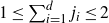 $1 \leq \sum_{i=1}^d j_i \leq 2$
. We use the notation
$1 \leq \sum_{i=1}^d j_i \leq 2$
. We use the notation $\exp(x) \,:\!=\, e^{2\pi i x}$
to represent the fundamental character from
$\exp(x) \,:\!=\, e^{2\pi i x}$
to represent the fundamental character from $\mathbb{R}/\mathbb{Z}$
to
$\mathbb{R}/\mathbb{Z}$
to $S^1$
.
$S^1$
.
By the Taylor expansion formula for polynomial maps between filtered groups (see, e.g., [
Reference Green, Tao and Ziegler6
, lemma B·9], and its Appendix B for background on such polynomial maps), every quadratic $\varphi \in \mathrm{Quad}(\mathbb{Z}^d, S^1)$
is of the form
$\varphi \in \mathrm{Quad}(\mathbb{Z}^d, S^1)$
is of the form
 \begin{equation*} \varphi(n) = \prod_{j \in J} \exp(c_j)^{B_j(n)} \end{equation*}
for some $c_j \in \mathbb{R}/\mathbb{Z}$
,
$c_j \in \mathbb{R}/\mathbb{Z}$
, $j \in J$
.
$j \in J$
.
The cardinality of J, which is the number of basis polynomials $n \mapsto \exp(c_j)^{B_j(n)}$
, is
$n \mapsto \exp(c_j)^{B_j(n)}$
, is $(d^2 + 3d)/2$
. The abelianisation of
$(d^2 + 3d)/2$
. The abelianisation of $\mathrm{Pol}_2(\mathbb{Z}^d)$
is
$\mathrm{Pol}_2(\mathbb{Z}^d)$
is $\mathbb{Z}^{(d^2+3d)/2}$
, which is the Pontryagin dual of
$\mathbb{Z}^{(d^2+3d)/2}$
, which is the Pontryagin dual of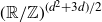 $(\mathbb{R}/\mathbb{Z})^{(d^2+3d)/2}$
.
$(\mathbb{R}/\mathbb{Z})^{(d^2+3d)/2}$
.
Proposition 5·3. If G is an abelian group of bounded exponent and $G=\oplus_p G_p$
is its primary decomposition, then
$G=\oplus_p G_p$
is its primary decomposition, then
 \begin{equation*}\mathrm{Pol}_2^{ab}(G) = \oplus_p \mathrm{Pol}_2^{ab}(G_p).\end{equation*}
Proof. This is a basic consequence of the isomorphism $\mathrm{Sym}^2(G) = \oplus_p \mathrm{Sym}^2(G_p)$
in this case.
$\mathrm{Sym}^2(G) = \oplus_p \mathrm{Sym}^2(G_p)$
in this case.
Proposition 5·4. If G is a 2-divisible finite abelian group, then the extension in Corollary 1·4 is split.
Proof. Note that if G is finite abelian and divisible by 2, then $\nu \,:\, G \to \mathrm{Sym}^2(G)$
given by
$\nu \,:\, G \to \mathrm{Sym}^2(G)$
given by $\nu(g)=g^2/2$
satisfies
$\nu(g)=g^2/2$
satisfies $\sigma(g,h)=\nu(g+h) - \nu(g) - \nu(h)$
. In particular, the 2-cocycle
$\sigma(g,h)=\nu(g+h) - \nu(g) - \nu(h)$
. In particular, the 2-cocycle $\sigma$
is a coboundary and the extension in Corollary 1·4 is split.
$\sigma$
is a coboundary and the extension in Corollary 1·4 is split.
Corollary 5·5. If G is a finite abelian and 2-divisible group, then $\mathrm{Pol}_2^{ab}(G)= \mathrm{Sym}^2(G) \oplus G$
. This applies to all finite abelian groups without 2-primary part.
$\mathrm{Pol}_2^{ab}(G)= \mathrm{Sym}^2(G) \oplus G$
. This applies to all finite abelian groups without 2-primary part.
In the remainder of this section, we prove Proposition 1·6.
Let G be a p-primary group for some fixed prime p. Then G is isomorphic to the direct sum $\bigoplus_{i=1}^d \mathbb{Z}/p^{n_i}\mathbb{Z}$
of cyclic groups of p-power order. By Proposition 5·1, we have the general description
$\bigoplus_{i=1}^d \mathbb{Z}/p^{n_i}\mathbb{Z}$
of cyclic groups of p-power order. By Proposition 5·1, we have the general description
 \begin{equation*}\mathrm{Quad}(G,S^1) \cong \mathrm{Sym}^2(G)\rtimes_\sigma G\end{equation*}
for the 2-cocycle $\sigma\,:\, G\times G\to \mathrm{Sym}^2(G)$
, given by
$\sigma\,:\, G\times G\to \mathrm{Sym}^2(G)$
, given by $\sigma(g,h)=gh$
.
$\sigma(g,h)=gh$
.
We can compute the symmetric second power of G to be
 \begin{equation*}\mathrm{Sym}^2(G) = \bigoplus_{i=1}^d \mathbb{Z}/p^{n_i}\mathbb{Z} \oplus \bigoplus_{1\leq i\lt j\leq d} \mathbb{Z}/p^{\min(n_i,n_j)}\mathbb{Z},\end{equation*}
where we call the first summand the diagonal part and the second summand the off-diagonal part of $\mathrm{Sym}^2(G)$
. If
$\mathrm{Sym}^2(G)$
. If $p\neq 2$
, by Corollary 5·5, we have directly:
$p\neq 2$
, by Corollary 5·5, we have directly:
 \begin{equation*}\mathrm{Sym}^2(G)\rtimes_\sigma G = \bigoplus_{i=1}^d \mathbb{Z}/p^{n_i}\mathbb{Z} \oplus \bigoplus_{1\leq i\lt j\leq d} \mathbb{Z}/p^{\min(n_i,n_j)}\mathbb{Z} \oplus \bigoplus_{i=1}^d \mathbb{Z}/p^{n_i}\mathbb{Z}\end{equation*}
and this completes the proof in this case.
Remark 5·6. Note that for odd primes and $G=(\mathbb{Z}/p\mathbb{Z})^d$
, we obtain
$G=(\mathbb{Z}/p\mathbb{Z})^d$
, we obtain
 \begin{equation*}\mathrm{Sym}^2(G)\rtimes_\sigma G = (\mathbb{Z}/p\mathbb{Z})^{\frac{d(d+3)}{2}}.\end{equation*}
This recovers, in the quadratic case, the description of Tao and Ziegler in [
Reference Tao and Ziegler19
, lemma 1·7]. Tao and Ziegler describe polynomial maps in terms of a closed-form formula for functions from G to $S^1$
. It is not difficult to read off from their functional description our above description in terms of a finite abelian group.
$S^1$
. It is not difficult to read off from their functional description our above description in terms of a finite abelian group.
Now, we focus on 2-primary groups G, in which case the computation is more subtle due to the existence of the twist. We start with the cyclic case.
Lemma 5·7. Suppose $G=\mathbb{Z}/2^n\mathbb{Z}$
. Then
$G=\mathbb{Z}/2^n\mathbb{Z}$
. Then $ \mathrm{Sym}^2(G)\rtimes_\sigma G $
is isomorphic to
$ \mathrm{Sym}^2(G)\rtimes_\sigma G $
is isomorphic to $ \mathbb{Z}/2^{n-1}\mathbb{Z} \oplus \mathbb{Z}/2^{n+1}\mathbb{Z}. $
Proof. Note that $\mathrm{Sym}^2(G)\rtimes_\sigma G=\mathbb{Z}/2^n\mathbb{Z}\rtimes_\sigma \mathbb{Z}/2^n\mathbb{Z}$
is a finite abelian group with
$\mathrm{Sym}^2(G)\rtimes_\sigma G=\mathbb{Z}/2^n\mathbb{Z}\rtimes_\sigma \mathbb{Z}/2^n\mathbb{Z}$
is a finite abelian group with $2^{2n}$
elements. We prove the isomorphism by constructing two cyclic subgroups of
$2^{2n}$
elements. We prove the isomorphism by constructing two cyclic subgroups of $\mathbb{Z}/2^n\mathbb{Z}\rtimes_\sigma \mathbb{Z}/2^n\mathbb{Z}$
with orders
$\mathbb{Z}/2^n\mathbb{Z}\rtimes_\sigma \mathbb{Z}/2^n\mathbb{Z}$
with orders $2^{n-1}$
and
$2^{n-1}$
and $2^{n+1}$
whose intersection is trivial.
$2^{n+1}$
whose intersection is trivial.
Let g denote the generator of $\mathbb{Z}/2^n\mathbb{Z}$
. We claim that
$\mathbb{Z}/2^n\mathbb{Z}$
. We claim that
 \begin{equation*}(0,g)^k=(\tbinom{k}{2} g^2, kg)\end{equation*}
for every $k\geq 1$
. Indeed, by induction, suppose that
$k\geq 1$
. Indeed, by induction, suppose that $(0,g)^{k-1}=(\binom{k-1}{2} g^2, (k-1)g)$
holds. Then
$(0,g)^{k-1}=(\binom{k-1}{2} g^2, (k-1)g)$
holds. Then
 \begin{equation*} (0,g)^{k-1}(0,g)= (\tbinom{k-1}{2} g^2 + (k-1)g^2, (k-1)g+g) = (\tbinom{k}{2} g^2, kg), \end{equation*}
proving the claim. Furthermore, we claim that
 \begin{equation*}(2g^2,2g)^k=(2k^2 g^2, 2k g)\end{equation*}
for every $k\geq 1$
. Again, by induction, suppose that
$k\geq 1$
. Again, by induction, suppose that $(2g^2,2g)^{k-1}=(2(k-1)^2 g^2,2(k-1)g)$
holds. Then
$(2g^2,2g)^{k-1}=(2(k-1)^2 g^2,2(k-1)g)$
holds. Then
 \begin{equation*} (2g^2,2g)^{k-1}(2g^2,2g)=(2(k-1)^2 g^2+ 2g^2+ 4(k-1)g^2,2kg) = (2k^2 g^2,(2k)g). \end{equation*}
Since the least k such that $2^n$
divides
$2^n$
divides $\binom{k}{2}$
is
$\binom{k}{2}$
is $2^{n+1}$
, the order of (0,g) is
$2^{n+1}$
, the order of (0,g) is $2^{n+1}$
. Since the least k such that
$2^{n+1}$
. Since the least k such that $2^n$
divides 2k is
$2^n$
divides 2k is $2^{n-1}$
, the order of
$2^{n-1}$
, the order of $(2g^2,2g)$
is
$(2g^2,2g)$
is $2^{n-1}$
. Since the only solution to
$2^{n-1}$
. Since the only solution to $\binom{2k}{2}=2k^2$
is
$\binom{2k}{2}=2k^2$
is $k=0$
, it follows that the cyclic subgroups generated by (0,g) and
$k=0$
, it follows that the cyclic subgroups generated by (0,g) and $(2g^2,2g)$
, respectively, have trivial intersection.
$(2g^2,2g)$
, respectively, have trivial intersection.
Having settled the cyclic case, we consider now the case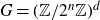 $G= (\mathbb{Z}/2^{n}\mathbb{Z})^d$
with
$G= (\mathbb{Z}/2^{n}\mathbb{Z})^d$
with $n,d\geq 1$
, Then, the group
$n,d\geq 1$
, Then, the group $\mathrm{Sym}^2(G)\rtimes_\sigma G$
has order
$\mathrm{Sym}^2(G)\rtimes_\sigma G$
has order $(2^n)^{\frac{d(d+3)}{2}}$
. If gh is a basis element in the off-diagonal part of
$(2^n)^{\frac{d(d+3)}{2}}$
. If gh is a basis element in the off-diagonal part of $\mathrm{Sym}^2(G)$
, then (gh,0) has order
$\mathrm{Sym}^2(G)$
, then (gh,0) has order $2^n$
in
$2^n$
in $\mathrm{Sym}^2(G)\rtimes_\sigma G$
. If g is a basis element of G, by Lemma 5·7, (0,g) has order
$\mathrm{Sym}^2(G)\rtimes_\sigma G$
. If g is a basis element of G, by Lemma 5·7, (0,g) has order $2^{n+1}$
in
$2^{n+1}$
in $\mathrm{ Sym}^2(G)\rtimes_\sigma G$
and
$\mathrm{ Sym}^2(G)\rtimes_\sigma G$
and $(2g^2,2g)$
has order
$(2g^2,2g)$
has order $2^{n-1}$
in
$2^{n-1}$
in $\mathrm{Sym}^2(G)\rtimes_\sigma G$
. We can conclude, similarly to the proof of Lemma 5·7, on noting that cyclic groups of different basis elements intersect trivially, that
$\mathrm{Sym}^2(G)\rtimes_\sigma G$
. We can conclude, similarly to the proof of Lemma 5·7, on noting that cyclic groups of different basis elements intersect trivially, that
 \begin{equation*} \mathrm{Sym}^2(G)\rtimes_\sigma G = (\mathbb{Z}/2^{n-1}\mathbb{Z})^d \oplus (\mathbb{Z}/2^{n}\mathbb{Z})^{\binom{d}{2}}\oplus (\mathbb{Z}/2^{n+1}\mathbb{Z})^d. \end{equation*}
This recovers, in the quadratic case, the classification of Tao and Ziegler in [
Reference Tao and Ziegler19
, lemma 1·7] for $G= (\mathbb{Z}/2\mathbb{Z})^d$
.
$G= (\mathbb{Z}/2\mathbb{Z})^d$
.
We can now prove the remaining part of Proposition 1·6. Indeed, for general G, we have
 \begin{equation*}\mathrm{Sym}^2(G)\rtimes_\sigma G = \left(\bigoplus_{i=1}^d \mathbb{Z}/2^{n_i}\mathbb{Z} \oplus \bigoplus_{1\leq i\lt j\leq d} \mathbb{Z}/2^{\min(n_i,n_j)}\mathbb{Z} \right)\rtimes_\sigma \bigoplus_{i=1}^d \mathbb{Z}/2^{n_i}\mathbb{Z}.\end{equation*}
Taking a basis element gh in the off-diagonal part of $\mathrm{Sym}^2(G)$
, say the generator of
$\mathrm{Sym}^2(G)$
, say the generator of $\mathbb{Z}/2^{\min(n_i,n_j)}\mathbb{Z}$
, then (gh,0) has order
$\mathbb{Z}/2^{\min(n_i,n_j)}\mathbb{Z}$
, then (gh,0) has order $2^{\min(n_i,n_j)}$
in
$2^{\min(n_i,n_j)}$
in $\mathrm{ Sym}^2(G)\rtimes_\sigma G$
. By Lemma 5·7, if g is a basis element of G, say the generator of
$\mathrm{ Sym}^2(G)\rtimes_\sigma G$
. By Lemma 5·7, if g is a basis element of G, say the generator of $\mathbb{Z}/2^{n_i}\mathbb{Z}$
, then (0,g) has order
$\mathbb{Z}/2^{n_i}\mathbb{Z}$
, then (0,g) has order $2^{n_i+1}$
in
$2^{n_i+1}$
in $\mathrm{ Sym}^2(G)\rtimes_\sigma G$
and
$\mathrm{ Sym}^2(G)\rtimes_\sigma G$
and $(2g^2,2g)$
has order
$(2g^2,2g)$
has order $2^{n_i-1}$
in
$2^{n_i-1}$
in $\mathrm{Sym}^2(G)\rtimes_\sigma G$
. Arguing similarly as in Lemma 5·7 and the previous case, we conclude that
$\mathrm{Sym}^2(G)\rtimes_\sigma G$
. Arguing similarly as in Lemma 5·7 and the previous case, we conclude that
 \begin{equation*}\mathrm{Sym}^2(G)\rtimes_\sigma G= \bigoplus_{i=1}^d \mathbb{Z}/2^{n_i-1}\mathbb{Z} \oplus \bigoplus_{1\leq i\lt j\leq d} \mathbb{Z}/2^{\min(n_i,n_j)}\mathbb{Z} \oplus \bigoplus_{i=1}^d \mathbb{Z}/2^{n_i+1}\mathbb{Z}.\end{equation*}
6. Approximate polynomial maps
This is the first of two sections where we study the case of perfect groups more closely. We start with an investigation of approximate polynomial maps with values in groups that carry a bi-invariant metric. Let us recall the following definition:
Definition 6·1. We say that a perfect group G is of commutator width k, if each element of G is a product of at most k commutators.
Remark 6·2. Note that a finite group is automatically of finite commutator width. For interesting classes of finite perfect groups there exist uniform bounds on the commutator width. For example, as mentioned already in the introduction, Wilson [ Reference Wilson20 ] showed that the commutator width is uniformly bounded for all finite simple groups. In fact, the commutator width is now known to be exactly 1, as established by the more recent solution to the Ore problem [ Reference Liebeck, O’Brien, Shalev and Huu Tiep15 ]. See also [ Reference Nikolov17 ] for even broader classes of finite perfect groups of bounded commutator width. It was shown by Holt–Plesken [ Reference Holt and Plesken8 , lemma 2·1·10], that the commutator width of a finite perfect group can become arbitrarily large. This also implies that an infinite perfect group does not need to have finite commutator width.
We will now derive a useful consequence of Corollary 1·5:
Corollary 6·3. Let $k \in \mathbb N.$
Let G be a perfect group of commutator width k. Consider the free group on the set
$k \in \mathbb N.$
Let G be a perfect group of commutator width k. Consider the free group on the set $\varphi(G)$
. There exists a constant
$\varphi(G)$
. There exists a constant $c\,:\!=\,c(k)\geq 0$
, such that for every
$c\,:\!=\,c(k)\geq 0$
, such that for every $g,h \in G$
, the element
$g,h \in G$
, the element $\varphi(g_1g_2)\varphi(g_2)^{-1} \varphi(g_1)^{-1}$
is a product of c conjugates of elements of the form
$\varphi(g_1g_2)\varphi(g_2)^{-1} \varphi(g_1)^{-1}$
is a product of c conjugates of elements of the form
 \begin{equation*}\varphi(g_1g_2g_3)^{-1} \varphi(g_1g_2)\varphi(g_2)^{-1}\varphi(g_1)^{-1} \varphi(g_1g_3)\varphi(g_3)^{-1}\varphi(g_2g_3)\end{equation*}
or their inverses for $g_1,g_2,g_3 \in G$
.
$g_1,g_2,g_3 \in G$
.
Proof. We consider subsets $\Sigma_1 \,:\!=\, \{\varphi(g_1g_2)\varphi(g_2)^{-1} \varphi(g_1)^{-1} \mid g_1,g_2 \in G \}$
and
$\Sigma_1 \,:\!=\, \{\varphi(g_1g_2)\varphi(g_2)^{-1} \varphi(g_1)^{-1} \mid g_1,g_2 \in G \}$
and $\Sigma_2 \,:\!=\, \{\varphi(g_1g_2g_3)^{-1} \varphi(g_1g_2)\varphi(g_2)^{-1}\varphi(g_1)^{-1} \varphi(g_1g_3)\varphi(g_3)^{-1}\varphi(g_2g_3) \mid g_1,g_2,g_3 \in G\}$
of the free group generated by
$\Sigma_2 \,:\!=\, \{\varphi(g_1g_2g_3)^{-1} \varphi(g_1g_2)\varphi(g_2)^{-1}\varphi(g_1)^{-1} \varphi(g_1g_3)\varphi(g_3)^{-1}\varphi(g_2g_3) \mid g_1,g_2,g_3 \in G\}$
of the free group generated by $\varphi(G)$
. Since G is assumed to be perfect, by Corollary 1·5, both sets of relations define the same normal subgroup, i.e.,
$\varphi(G)$
. Since G is assumed to be perfect, by Corollary 1·5, both sets of relations define the same normal subgroup, i.e., $\langle\! \langle \Sigma_1 \rangle\!\rangle = \langle\! \langle \Sigma_2 \rangle\!\rangle$
. Thus, each word of the form
$\langle\! \langle \Sigma_1 \rangle\!\rangle = \langle\! \langle \Sigma_2 \rangle\!\rangle$
. Thus, each word of the form $\varphi(g_1g_2)\varphi(g_2)^{-1} \varphi(g_1)^{-1}$
for
$\varphi(g_1g_2)\varphi(g_2)^{-1} \varphi(g_1)^{-1}$
for $g_1,g_2 \in G$
must be a product of conjugates of elements of the form
$g_1,g_2 \in G$
must be a product of conjugates of elements of the form $\varphi(g_1g_2g_3)^{-1} \varphi(g_1g_2)\varphi(g_2)^{-1}\varphi(g_1)^{-1} \varphi(g_1g_3)\varphi(g_3)^{-1}\varphi(g_2g_3)$
or their inverses. The uniform estimate c(k) on the number of factors follows from an easy ultra-product argument noting that the commutator width is preserved by the operation of taking an ultra-product of groups.
$\varphi(g_1g_2g_3)^{-1} \varphi(g_1g_2)\varphi(g_2)^{-1}\varphi(g_1)^{-1} \varphi(g_1g_3)\varphi(g_3)^{-1}\varphi(g_2g_3)$
or their inverses. The uniform estimate c(k) on the number of factors follows from an easy ultra-product argument noting that the commutator width is preserved by the operation of taking an ultra-product of groups.
Our focus is now on almost structure preserving maps to metric groups. Let $(H,\partial)$
be a metric group. It is of some interest in geometry as well as algebra to consider maps which are almost homomorphisms
$(H,\partial)$
be a metric group. It is of some interest in geometry as well as algebra to consider maps which are almost homomorphisms $\varphi \,:\, G \to H$
in the sense that
$\varphi \,:\, G \to H$
in the sense that
 \begin{equation*}\partial(\varphi(gh),\varphi(g)\varphi(h))\lt \varepsilon\end{equation*}
uniformly for all $g,h \in G$
. This has been studied in various situations, see for example [
Reference Becker and Chapman1
,
Reference Chiffre, Ozawa and Thom3
,
Reference Gowers and Hatami5
,
Reference Grove, Karcher and Ruh7
,
Reference Kazhdan11
) and the references therein. Note that
$g,h \in G$
. This has been studied in various situations, see for example [
Reference Becker and Chapman1
,
Reference Chiffre, Ozawa and Thom3
,
Reference Gowers and Hatami5
,
Reference Grove, Karcher and Ruh7
,
Reference Kazhdan11
) and the references therein. Note that
 \begin{equation*}(\Delta_{h}(\Delta_{g} \varphi))(1) = (\Delta_{g} \varphi)(h)(\Delta_{g} \varphi)(1)^{-1} = \varphi(gh) \varphi(h)^{-1} \varphi(g)^{-1}\end{equation*}
for unital maps, so that being an almost homomorphism as above can be easily expressed in terms of a condition on iterated finite differences of $\varphi$
. Theorem 1·7 generalises this idea and studies arbitrary iterated differences of
$\varphi$
. Theorem 1·7 generalises this idea and studies arbitrary iterated differences of $\varphi$
.
$\varphi$
.
Proof of Theorem
1·7. The proof proceeds by induction on d, where the case $d=1$
is trivial. The case
$d=1$
is trivial. The case $d=2$
requires special attention. Let us compute:
$d=2$
requires special attention. Let us compute:
 \begin{align*}(\Delta_{g_1,g_2,g_3} \varphi)(g_0) &= (\Delta_{g_1}(\Delta_{g_2,g_3} \varphi))(g_0) \\&= (\Delta_{g_2,g_3} \varphi)(g_1g_0) ((\Delta_{g_2,g_3} \varphi)(g_0))^{-1} \\&=\varphi(g_3g_2g_1g_0) \varphi(g_2g_1g_0)^{-1} \varphi(g_1g_0) \varphi(g_3g_1g_0)^{-1} \\& \quad \cdot (\varphi(g_3g_2g_0) \varphi(g_2g_0)^{-1} \varphi(g_0) \varphi(g_3g_0)^{-1})^{-1} \\&=\varphi(g_3g_2g_1g_0) \varphi(g_2g_1g_0)^{-1} \varphi(g_1g_0) \varphi(g_3g_1g_0)^{-1} \\& \quad \cdot \varphi(g_3g_0)\varphi(g_0)^{-1}\varphi(g_2g_0)\varphi(g_3g_2g_0)^{-1}.\end{align*}
Thus, for $\varphi$
unital, we obtain:
$\varphi$
unital, we obtain:
 \begin{equation*}(\Delta_{g_1,g_2,g_3} \varphi)(1)=\varphi(g_3g_2g_1) \varphi(g_2g_1)^{-1} \varphi(g_1) \varphi(g_3g_1)^{-1} \varphi(g_3)\varphi(g_2)\varphi(g_3g_2)^{-1}.\end{equation*}
By our assumption, we obtain
 \begin{equation*}\partial(\varphi(g_3g_2g_1) \varphi(g_2g_1)^{-1} \varphi(g_1) \varphi(g_3g_1)^{-1} \varphi(g_3)\varphi(g_2)\varphi(g_3g_2)^{-1},1) \leq \varepsilon\end{equation*}
for all $g_1,g_2,g_3 \in G$
. Note that the same estimate holds for conjugates and inverses by bi-invariance of the metric. Thus, Corollary 6·3 implies that
$g_1,g_2,g_3 \in G$
. Note that the same estimate holds for conjugates and inverses by bi-invariance of the metric. Thus, Corollary 6·3 implies that $\partial(\varphi(g_1g_2)\varphi(g_2)^{-1}\varphi(g_1)^{-1},1)\leq c(k) \varepsilon$
and equivalently
$\partial(\varphi(g_1g_2)\varphi(g_2)^{-1}\varphi(g_1)^{-1},1)\leq c(k) \varepsilon$
and equivalently
 \begin{equation*}\partial((\Delta_{g_1,g_2}\varphi)(1),1) \leq c(k) \varepsilon.\end{equation*}
As required, we conclude that $\varphi$
is a uniform
$\varphi$
is a uniform $c(k)\varepsilon$
-polynomial of degree 1. The general case follows by induction. Indeed, note that for
$c(k)\varepsilon$
-polynomial of degree 1. The general case follows by induction. Indeed, note that for $d \geq 2$
,
$d \geq 2$
, $\varphi$
is a uniform
$\varphi$
is a uniform $\varepsilon$
-polynomial of degree
$\varepsilon$
-polynomial of degree $d+1$
if and only if
$d+1$
if and only if $\Delta_g \varphi$
is a uniform
$\Delta_g \varphi$
is a uniform $\varepsilon$
-polynomial of degree d for all
$\varepsilon$
-polynomial of degree d for all $g \in G.$
Note that the previous result is particularly useful when a stability result is present for uniform $\varepsilon$
-homomorphisms, which is the case in various situations, see the references above. In those cases, every
$\varepsilon$
-homomorphisms, which is the case in various situations, see the references above. In those cases, every $\varepsilon$
-polynomial for
$\varepsilon$
-polynomial for $\varepsilon\gt0$
small enough is uniformly close to a homomorphism.
$\varepsilon\gt0$
small enough is uniformly close to a homomorphism.
A typical example where this happens is the group $\mathrm{U}(n)$
with the 2-norm and G amenable, see [
Reference Chiffre, Ozawa and Thom3
]. Here, for
$\mathrm{U}(n)$
with the 2-norm and G amenable, see [
Reference Chiffre, Ozawa and Thom3
]. Here, for $a \in M_n \mathbb C$
we denote by
$a \in M_n \mathbb C$
we denote by $\|a\|_2 = ((1/n)\sum_{ij} |a_{ij}|^2)^{1/2}$
the 2-norm or normalised Hilbert–Schmidt norm. Thus, we obtain:
$\|a\|_2 = ((1/n)\sum_{ij} |a_{ij}|^2)^{1/2}$
the 2-norm or normalised Hilbert–Schmidt norm. Thus, we obtain:
Theorem 6·4. Let $d,k \geq 0$
. For all
$d,k \geq 0$
. For all $\varepsilon\gt0$
, there exists
$\varepsilon\gt0$
, there exists $\delta\,:\!=\,\delta(d,k)\gt0$
, such that the following holds: Let G be an amenable group of commutator width k and let
$\delta\,:\!=\,\delta(d,k)\gt0$
, such that the following holds: Let G be an amenable group of commutator width k and let $\varphi \,:\, G \to \mathrm{U}(n)$
be a unital uniform
$\varphi \,:\, G \to \mathrm{U}(n)$
be a unital uniform $\delta$
-polynomial of degree d. Then there exists
$\delta$
-polynomial of degree d. Then there exists $n' \in [n,(1+\varepsilon)n] \cap \mathbb N$
and a homomorphism
$n' \in [n,(1+\varepsilon)n] \cap \mathbb N$
and a homomorphism $\beta \,:\, G \to \mathrm{U}(n')$
, such that
$\beta \,:\, G \to \mathrm{U}(n')$
, such that $\sup_g \|(\varphi(g) \oplus 1_{n'-n}) - \beta(g)\|_2 \lt \varepsilon.$
Remark 6·5. The previous corollary and theorem applies uniformly to all finite simple groups and fixed $d \in \mathbb N.$
An example of an infinite perfect amenable group with bounded commutator width is the group
$d \in \mathbb N.$
An example of an infinite perfect amenable group with bounded commutator width is the group ${\mathrm{Alt}}_{\mathrm{fin}}(\mathbb N)$
consisting of all alternating permutations of
${\mathrm{Alt}}_{\mathrm{fin}}(\mathbb N)$
consisting of all alternating permutations of $\mathbb N$
with finite support. In this case any homomorphism to
$\mathbb N$
with finite support. In this case any homomorphism to ${\mathrm{U}}(n)$
is trivial by Jordan’s theorem.
${\mathrm{U}}(n)$
is trivial by Jordan’s theorem.
Remark 6·6. We did not succeed to derive an explicit bound for c(k), even in the case $k=1$
.
$k=1$
.
7. An inverse theorem for matrix-valued Gowers norms
We recall the definition of the Gowers norms of arbitrary degree for functions on a finite group with values in $M_n \mathbb C$
. We set for a matrix valued function
$M_n \mathbb C$
. We set for a matrix valued function $\varphi \,:\, G \to M_n \mathbb C$
 \begin{equation*}(\Delta_g \varphi)(h) \,:\!=\, \varphi(gh)\varphi(h)^*.\end{equation*}
Note that if the function takes values in the group of unitaries, then this is just the old finite difference. We define
 \begin{equation*}\|\varphi\|^{2^k}_{U^k} \,:\!=\,\mathbb E_{g_0,g_1,\ldots,g_{k}} \mathrm{ tr}((\Delta_{g_1,\ldots,g_k}\varphi)(g_{0})),\end{equation*}
where $\Delta_{g_1,\ldots,g_k} \,:\!=\, \Delta_{g_1} \circ \cdots \circ \Delta_{g_k}$
,
$\Delta_{g_1,\ldots,g_k} \,:\!=\, \Delta_{g_1} \circ \cdots \circ \Delta_{g_k}$
, $\mathrm{tr} \,:\, M_n \mathbb C \to \mathbb C$
denotes the normalised trace, and
$\mathrm{tr} \,:\, M_n \mathbb C \to \mathbb C$
denotes the normalised trace, and $\mathbb E$
denotes the expectation with respect to the normalised counting measure on
$\mathbb E$
denotes the expectation with respect to the normalised counting measure on $G^{k+1}$
.
$G^{k+1}$
.
For $k=2$
, we compute
$k=2$
, we compute
 \begin{eqnarray*}(\Delta_{g_1,g_2} \varphi)(g_0) &=&(\Delta_{g_2} \varphi)(g_1g_0) (\Delta_{g_2} \varphi)(g_0)^{*} \\&=& \varphi(g_2g_1g_0) \varphi(g_1g_0)^{*} \varphi(g_0) \varphi(g_2g_0)^{*}\end{eqnarray*}
so that
 \begin{equation*}{\mathbb E}_{g_0,g_1,g_{2}} \mathrm{tr}((\Delta_{g_1,g_2} \varphi)(g_0)) = {\mathbb E}_{xy^{-1}zw^{-1}=1} \mathrm{tr}(\varphi(x)\varphi(y)^{*}\varphi(z)\varphi(w)^{*}).\end{equation*}
We see from this equality that our definition agrees with the $U^2$
-Gowers norm as defined in [
Reference Gowers and Hatami5
], modulo the normalisation of the trace. The assignment
$U^2$
-Gowers norm as defined in [
Reference Gowers and Hatami5
], modulo the normalisation of the trace. The assignment $\varphi \mapsto \|\varphi\|_{U^k}$
is called k-th Gowers norm, see Appendix A for more details on its properties.
$\varphi \mapsto \|\varphi\|_{U^k}$
is called k-th Gowers norm, see Appendix A for more details on its properties.
We start with the proof of Theorem 1·8. First of all, let us note that we may assume without loss of generality that the function $\varphi$
takes unitary values and
$\varphi$
takes unitary values and $\varphi(1)=1_n.$
Indeed, this is a consequence of the following two lemmas.
$\varphi(1)=1_n.$
Indeed, this is a consequence of the following two lemmas.
Lemma 7·1. Let $k \geq 1$
be a natural number. For all
$k \geq 1$
be a natural number. For all $\varepsilon\gt0$
there exists
$\varepsilon\gt0$
there exists $\delta\gt0$
such that if
$\delta\gt0$
such that if $v_1,\ldots,v_k \in M_n \mathbb C$
are contractions with
$v_1,\ldots,v_k \in M_n \mathbb C$
are contractions with
 \begin{equation*}\mathrm{tr}(v_1 \cdots v_k) \geq 1-\delta,\end{equation*}
then there exists unitaries $u_1,\ldots,u_k \in \mathrm{U}(n)$
such that
$u_1,\ldots,u_k \in \mathrm{U}(n)$
such that $\|v_i - u_i\|_2 \lt \varepsilon$
for all
$\|v_i - u_i\|_2 \lt \varepsilon$
for all $1 \leq i \leq k$
and
$1 \leq i \leq k$
and $u_1 \cdots u_k=1_n.$
Proof. Suppose by contradiction that for some $\varepsilon\gt0$
, there exists sequences of contractions
$\varepsilon\gt0$
, there exists sequences of contractions $(v_{i,m})_m$
for
$(v_{i,m})_m$
for $1 \leq i \leq k$
with
$1 \leq i \leq k$
with $v_{i,n} \in M_{n_m} \mathbb C$
such that
$v_{i,n} \in M_{n_m} \mathbb C$
such that
 \begin{equation*}\mathrm{tr}(v_{1,m} \cdots v_{k,m}) \geq 1 - \frac1m\end{equation*}
and at the same time, there do not exist unitaries $u_1,\ldots,u_k$
which are
$u_1,\ldots,u_k$
which are $\varepsilon$
-close to
$\varepsilon$
-close to $v_1,\ldots,v_k$
in the 2-norm.
$v_1,\ldots,v_k$
in the 2-norm.
Consider the tracial ultraproduct of von Neumann algebras.
 \begin{equation*}(M,\tau) \,:\!=\, \prod_{m \to \mathcal U} (M_{n_m} \mathbb C,\mathrm{tr}).\end{equation*}
It is well known that $(M,\tau)$
is a tracial von Neumann algebra, in fact it is a factor of type II
$(M,\tau)$
is a tracial von Neumann algebra, in fact it is a factor of type II $_1$
. Consider the contractions
$_1$
. Consider the contractions $v_i \in M$
represented by the sequences
$v_i \in M$
represented by the sequences $(v_{i,m})_m$
. From our assumption, we obtain
$(v_{i,m})_m$
. From our assumption, we obtain
 \begin{equation*}\tau(v_1 \cdots v_k)=1.\end{equation*}
Now, let $x \in M$
be an arbitrary contraction with
$x \in M$
be an arbitrary contraction with $\tau(x)=1.$
Since,
$\tau(x)=1.$
Since, $\|1-x\|^2_2 = 1 + \tau(x^*x) - \tau(x) - \tau(x^*) \leq 0$
we obtain
$\|1-x\|^2_2 = 1 + \tau(x^*x) - \tau(x) - \tau(x^*) \leq 0$
we obtain $x=1.$
In particular,
$x=1.$
In particular, $v_1$
is a contraction whose inverse is also a contraction, being equal to
$v_1$
is a contraction whose inverse is also a contraction, being equal to $v_2\cdots v_k$
. This implies that
$v_2\cdots v_k$
. This implies that $v_1$
is isometric and hence unitary. By induction, we conclude that
$v_1$
is isometric and hence unitary. By induction, we conclude that $v_1,\ldots,v_k$
are all unitaries. We conclude that
$v_1,\ldots,v_k$
are all unitaries. We conclude that $v_i$
can also be represented by a sequence of unitaries
$v_i$
can also be represented by a sequence of unitaries $(u_{i,m})_m$
with
$(u_{i,m})_m$
with
 \begin{equation*}\lim_{m \to \mathcal U} \|u_{i,m} - v_{i,m}\|_2 = 0 \quad \mbox{for} \quad 1 \leq i \leq k-1.\end{equation*}
We put $u_{i,k}\,:\!=\,(u_{i,1}\cdots u_{i,k-1})^{-1}$
. This is a contradiction and thus, proves the claim.
$u_{i,k}\,:\!=\,(u_{i,1}\cdots u_{i,k-1})^{-1}$
. This is a contradiction and thus, proves the claim.
Lemma 7·2. Let $k \in \mathbb N$
and
$k \in \mathbb N$
and $\varepsilon\gt0$
. There exists
$\varepsilon\gt0$
. There exists $\delta\,:\!=\,\delta(k,\varepsilon)\gt0$
, such that the following is true: Let G be a finite group and let
$\delta\,:\!=\,\delta(k,\varepsilon)\gt0$
, such that the following is true: Let G be a finite group and let $\varphi \,:\, G \to M_n \mathbb C$
with
$\varphi \,:\, G \to M_n \mathbb C$
with
 \begin{equation*}\|\varphi\|_{\infty} \leq 1 \quad \mbox{and} \quad \|\varphi\|^{2^k}_{U^k} \gt 1 -\delta.\end{equation*}
There exists a function $\varphi' \,:\, G \to \mathrm{U}(n)$
such that
$\varphi' \,:\, G \to \mathrm{U}(n)$
such that
 \begin{equation*}\mathbb E_g \|\varphi(g) - \varphi'(g)\|^2_2 \lt \varepsilon \quad \mbox{and} \quad \|\varphi'\|^{2^k}_{U^k} \gt 1 -\varepsilon.\end{equation*}
Proof. We have
 \begin{equation*}\|\varphi\|^{2^{k}}_{U^k} = \mathbb E_{g_0,g_2,g_3,\ldots,g_{k}} \mathrm{ tr}((\Delta_{g_1,\ldots,g_k}\varphi)(g_{0})) \gt 1 -\delta\end{equation*}
while $(\Delta_{g_1,\ldots,g_k}\varphi)(g_{0})$
is a product of
$(\Delta_{g_1,\ldots,g_k}\varphi)(g_{0})$
is a product of $2^k$
contractions from the set
$2^k$
contractions from the set $\varphi(G)$
. The lower bound implies that the set
$\varphi(G)$
. The lower bound implies that the set $\Sigma \subset G$
of those
$\Sigma \subset G$
of those $g \in G$
for which
$g \in G$
for which $\varphi(g)$
appears in such a product whose trace is at least
$\varphi(g)$
appears in such a product whose trace is at least $1 -\delta^{1/2}$
is of density at least
$1 -\delta^{1/2}$
is of density at least $1 -\delta^{1/2}$
. By Lemma 7·1, provided
$1 -\delta^{1/2}$
. By Lemma 7·1, provided $\delta\gt0$
is small enough, any such
$\delta\gt0$
is small enough, any such $\varphi(g)$
can be replaced by a unitary
$\varphi(g)$
can be replaced by a unitary $\varphi'(g)$
such that
$\varphi'(g)$
such that $\|\varphi(g)-\varphi(g')\|_2\lt \delta'.$
For all
$\|\varphi(g)-\varphi(g')\|_2\lt \delta'.$
For all $g \not \in \Sigma,$
we define
$g \not \in \Sigma,$
we define $\varphi'(g)=1_n.$
Now, note that the set of $(k+1)$
-tuples
$(k+1)$
-tuples $g_0,\ldots,g_k$
such that all contractions arising in factors of
$g_0,\ldots,g_k$
such that all contractions arising in factors of $(\Delta_{g_1,\ldots,g_k}\varphi)(g_{0})$
lie in
$(\Delta_{g_1,\ldots,g_k}\varphi)(g_{0})$
lie in $\Sigma$
is of density at least
$\Sigma$
is of density at least $1-2^k\delta^{1/2}$
. For those
$1-2^k\delta^{1/2}$
. For those $(k+1)$
-tuples, we obtain
$(k+1)$
-tuples, we obtain
 \begin{equation*}\|(\Delta_{g_1,\ldots,g_k}\varphi)(g_{0}) - (\Delta_{g_1,\ldots,g_k}\varphi')(g_{0})\|_2 \leq 2^k \delta'\end{equation*}
and hence
 \begin{equation*}|\mathrm{tr}((\Delta_{g_1,\ldots,g_k}\varphi)(g_{0}) - (\Delta_{g_1,\ldots,g_k}\varphi')(g_{0}))| \leq 2^{k+1} \delta'.\end{equation*}
Finally, we conclude
 \begin{equation*}\left| \|\varphi\|_{U^k}^{2^k} - \|\varphi'\|^{2^k}_{U^k} \right| \lt 2^{k+1} \delta' + 2^{k+1}\delta^{1/2}.\end{equation*}
Now, $\delta'\gt0$
is as small as we wish, when
$\delta'\gt0$
is as small as we wish, when $\delta$
is small. And
$\delta$
is small. And $\delta\gt0$
can be taken small enough so that also the second summand does not contribute. This proves the claim.
$\delta\gt0$
can be taken small enough so that also the second summand does not contribute. This proves the claim.
Before we start with the actual proof of Theorem 1·8, let us recall that the case $k=2$
is a consequence of [
Reference Gowers and Hatami5
, theorem 5·6]. Indeed, assuming that
$k=2$
is a consequence of [
Reference Gowers and Hatami5
, theorem 5·6]. Indeed, assuming that $\varphi$
takes values in
$\varphi$
takes values in $\mathrm{U}(n)$
, we compute
$\mathrm{U}(n)$
, we compute
 \begin{equation*}\|(\varphi(g) \oplus 1_{n'-n}) - \beta(g)\|^2_2 = 2 - 2 \Re \langle \varphi(g) \oplus 1_{n'-n}, \beta(g) \rangle,\end{equation*}
so that large correlation of unitary-valued maps is directly tied to a small 2-norm of the difference.
Proof of Theorem
1·8. We may assume that $\varphi$
takes values in unitaries and upon replacing
$\varphi$
takes values in unitaries and upon replacing $\varphi$
by
$\varphi$
by $g \mapsto \varphi(1)^{*} \varphi(g)$
, we may assume that
$g \mapsto \varphi(1)^{*} \varphi(g)$
, we may assume that $\varphi$
is unital.
$\varphi$
is unital.
We prove the claim by induction on k, where the case $k=2$
was proved in [
Reference Gowers and Hatami5
] as noted above. So let
$k=2$
was proved in [
Reference Gowers and Hatami5
] as noted above. So let $k \geq 3$
,
$k \geq 3$
, $\delta\gt0$
and
$\delta\gt0$
and $\varphi \,:\, G \to \mathrm{U}(n)$
be arbitrary and assume that
$\varphi \,:\, G \to \mathrm{U}(n)$
be arbitrary and assume that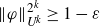 $\|\varphi\|^{2^k}_{U^k} \geq 1 - \varepsilon$
for some
$\|\varphi\|^{2^k}_{U^k} \geq 1 - \varepsilon$
for some $\varepsilon\gt0$
to be determined later. Now, the inequality just says that
$\varepsilon\gt0$
to be determined later. Now, the inequality just says that
 \begin{equation*}\mathbb E_{g_0,g_2,g_3,\ldots,g_{k}} \mathrm{tr}((\Delta_{g_1,\ldots,g_k}\varphi)(g_{0})) = \|\varphi\|^{2^k}_{U^k} \geq 1 - \varepsilon.\end{equation*}
Note that $\|\varphi\|_{\infty} \leq 1$
and we conclude by Markov’s inequality, that the set
$\|\varphi\|_{\infty} \leq 1$
and we conclude by Markov’s inequality, that the set $A \subseteq G$
of those
$A \subseteq G$
of those $g \in G$
, such that
$g \in G$
, such that
 \begin{equation*}\mathbb E_{g_0,g_2,g_3,\ldots,g_{k-1}} \mathrm{tr}((\Delta_{g_1,\ldots,g_{k-1},g}\varphi)(g_{0})) = \|\Delta_{g}\varphi\|^{2^{k-1}}_{U^{k-1}} \geq 1 - \varepsilon^{1/2}\end{equation*}
has cardinality at least $(1- \varepsilon^{1/2})|G|.$
Let $\eta\gt0$
to be determined later. For
$\eta\gt0$
to be determined later. For $\varepsilon\gt0$
such that
$\varepsilon\gt0$
such that $\varepsilon^{1/2} \leq \varepsilon(\eta,k-1,k_0)$
, by induction, we find
$\varepsilon^{1/2} \leq \varepsilon(\eta,k-1,k_0)$
, by induction, we find $n' \in [n,(1+ \eta)n] \cap \mathbb N$
, homomorphisms
$n' \in [n,(1+ \eta)n] \cap \mathbb N$
, homomorphisms $\beta_g \,:\, G \to \mathrm{U}(n')$
such that
$\beta_g \,:\, G \to \mathrm{U}(n')$
such that
 \begin{equation*}\mathbb E_h \|(\varphi(g)^*(\Delta_g\varphi)(h) \oplus 1_{n'-n}) - \beta_g(h)\|^2_2 \lt \eta,\end{equation*}
for all $g \in A.$
For $g \in A$
, again by Markov’s inequality, there exists a subset
$g \in A$
, again by Markov’s inequality, there exists a subset $B(g) \subseteq G$
of density at least
$B(g) \subseteq G$
of density at least $1-\eta^{1/2}$
such that
$1-\eta^{1/2}$
such that $\|(\varphi(g)^*(\Delta_g\varphi)(h) \oplus 1_{n'-n}) - \beta_g(h)\|_2\lt \eta^{1/4}$
for all
$\|(\varphi(g)^*(\Delta_g\varphi)(h) \oplus 1_{n'-n}) - \beta_g(h)\|_2\lt \eta^{1/4}$
for all $h \in B(g).$
Let us consider $g \in A \cap A^{-1}$
. For ease of notation, we will write
$g \in A \cap A^{-1}$
. For ease of notation, we will write $u\stackrel{\nu}{=} v$
if
$u\stackrel{\nu}{=} v$
if $\|u-v\|_2\lt \nu.$
Now, by the proof of Equation (2·2), we obtain
$\|u-v\|_2\lt \nu.$
Now, by the proof of Equation (2·2), we obtain
 \begin{equation*}1_{n'} \stackrel{2\eta^{1/4}}{=} \varphi(g)^{-1} \beta_{g^{-1}}(h) \varphi(g) \cdot \beta_g(h)\end{equation*}
for all $h \in g^{-1}B(g^{-1}) \cap B(g)$
. Thus, if
$h \in g^{-1}B(g^{-1}) \cap B(g)$
. Thus, if $h_1,h_2,h_2h_1 \in g^{-1}B(g^{-1}) \cap B(g)$
, we obtain
$h_1,h_2,h_2h_1 \in g^{-1}B(g^{-1}) \cap B(g)$
, we obtain
 \begin{eqnarray*}\beta_g(h_1h_2) &=& \beta_g(h_1)\beta_g(h_2) \\&\stackrel{4\eta^{1/4}}{=}& (\varphi(g)^{-1} \beta_{g^{-1}}(h_1) \varphi(g))^{-1}(\varphi(g)^{-1} \beta_{g^{-1}}(h_2) \varphi(g))^{-1} \\&=& (\varphi(g)^{-1} \beta_{g^{-1}}(h_2)\beta_{g^{-1}}(h_1) \varphi(g))^{-1}\\&=& (\varphi(g)^{-1} \beta_{g^{-1}}(h_2h_1) \varphi(g))^{-1} \\&\stackrel{2\eta^{1/4}}{=}& \beta_g(h_2h_1).\end{eqnarray*}
We conclude from this computation that the set C(g) of pairs $(h_1,h_2) \in G\times G$
with
$(h_1,h_2) \in G\times G$
with
 \begin{equation*}\beta_g([h_1,h_2]) \stackrel{6\eta^{1/4}}{=} 1_{n'}\end{equation*}
has density at least $1-6\eta^{1/2}.$
If
$1-6\eta^{1/2}.$
If $1-6\eta^{1/2}\gt1/2$
, then
$1-6\eta^{1/2}\gt1/2$
, then $C(g)^2=G \times G.$
Indeed, we have
$C(g)^2=G \times G.$
Indeed, we have $C(g)^{-1}= C(g)$
and under this condition on the intersection
$C(g)^{-1}= C(g)$
and under this condition on the intersection $(h_1,h_2)C(g)^{-1} \cap C(g)$
must be non-empty for each
$(h_1,h_2)C(g)^{-1} \cap C(g)$
must be non-empty for each $(h_1,h_2) \in G \times G$
. Note also that commutators satisfy the following universal identities:
$(h_1,h_2) \in G \times G$
. Note also that commutators satisfy the following universal identities:
 \begin{equation*}[ab,cd]=[ab,c]\cdot [ab,d]^{c} = [a,c]^b[b,c][a,d]^{bc}[b,d]^c\end{equation*}
for all $a,b,c,d \in G$
. Thus, we obtain from
$a,b,c,d \in G$
. Thus, we obtain from $C(g)^2 = G \times G$
that
$C(g)^2 = G \times G$
that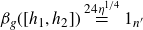 $\beta_g([h_1,h_2]) \stackrel{24\eta^{1/4}}{=} 1_{n'}$
for all
$\beta_g([h_1,h_2]) \stackrel{24\eta^{1/4}}{=} 1_{n'}$
for all $h_1,h_2 \in G.$
Since G has commutator width bounded by $k_0$
, this implies
$k_0$
, this implies $\|\beta_g(h) - 1_{n'}\| \lt 24k_0 \eta^{1/4}$
for all
$\|\beta_g(h) - 1_{n'}\| \lt 24k_0 \eta^{1/4}$
for all $h \in G.$
Thus,
$h \in G.$
Thus, $\Delta_g \varphi$
is almost constant for
$\Delta_g \varphi$
is almost constant for $g \in A \cap A^{-1}$
. Since
$g \in A \cap A^{-1}$
. Since $A \cap A^{-1}$
has density at least
$A \cap A^{-1}$
has density at least $1- 2\varepsilon^{1/2}$
and
$1- 2\varepsilon^{1/2}$
and $\|\varphi\|_{\infty}\leq 1$
, this implies that
$\|\varphi\|_{\infty}\leq 1$
, this implies that $\|\varphi\|_{U^2}$
is close to 1. Indeed, we obtain
$\|\varphi\|_{U^2}$
is close to 1. Indeed, we obtain
 \begin{equation*}\|\varphi\|^4_{U^2} = \mathbb E_{g_0,g_1,g_2} \mathrm{tr}( \Delta_{g_1,g_2} \varphi)(g_0))\geq 1 - 48k_0 \eta^{1/4} - 4\varepsilon^{1/2}.\end{equation*}
Thus, taking $\eta$
and
$\eta$
and $\varepsilon$
sufficiently small, so that
$\varepsilon$
sufficiently small, so that $48k_0 \eta^{1/4} + 4\varepsilon^{1/2} \leq \varepsilon(\delta,2,k_0)$
we are done by the results of Gowers–Hatami for the case
$48k_0 \eta^{1/4} + 4\varepsilon^{1/2} \leq \varepsilon(\delta,2,k_0)$
we are done by the results of Gowers–Hatami for the case $k=2$
.
$k=2$
.
Remark 7·3. The result of Gowers–Hatami [
Reference Gowers and Hatami5
, theorem 5·6] for $k=2$
is more general since it is also an inverse theorem in the 1% regime, i.e., a positive correlation with a linear map is derived only from
$k=2$
is more general since it is also an inverse theorem in the 1% regime, i.e., a positive correlation with a linear map is derived only from $\|\varphi\|_{U^2} \geq \varepsilon.$
We were not able to generalise this to hold for arbitrary
$\|\varphi\|_{U^2} \geq \varepsilon.$
We were not able to generalise this to hold for arbitrary $k \geq 3$
.
$k \geq 3$
.
Acknowledgments
Asgar Jamneshan acknowledges funding by the Deutsche Forschungsgemeinschaft (DFG, German Research Foundation) - 547294463. Andreas Thom acknowledges funding by the Deutsche Forschungsgemeinschaft (SPP 2026 “Geometry at infinity”). We are grateful to the anonymous referee for constructive feedback and many helpful remarks, which helped improve the exposition of the paper.
Appendix A. The Gowers norms on matrix valued functions
In this appendix, extending results from [Reference Gowers and Hatami5] for the case $k=2$
, we study basic properties for the Gowers norms on matrix-valued functions on a finite group. Motivated by the combinatorial structure of iterated finite differences, we define non-abelian cubes as follows:
$k=2$
, we study basic properties for the Gowers norms on matrix-valued functions on a finite group. Motivated by the combinatorial structure of iterated finite differences, we define non-abelian cubes as follows:
 \begin{align*}c_0 & = (1),\nonumber\\c_1(g_1)&= (g_1,1),\nonumber\\c_2(g_1,g_2)&= (g_1g_2,g_2,1,g_1),\nonumber\\c_3(g_1,g_2,g_3)&= (g_1g_2g_3,g_2g_3,g_3,g_1g_3,g_1,1,g_2,g_1g_2),\end{align*}
where each $c_k$
is a list of
$c_k$
is a list of $2^{k}$
words in the variables
$2^{k}$
words in the variables $g_1,\ldots,g_k$
. In general, we set:
$g_1,\ldots,g_k$
. In general, we set:
 \begin{equation*}c_{k+1}(g_1,\ldots,g_{k+1}) = (c_k(g_1,\ldots,g_k)g_{k+1},\bar c_k(g_1,\ldots,g_k)),\end{equation*}
where $\bar c$
denotes the reversed list. We write
$\bar c$
denotes the reversed list. We write
 \begin{equation*}c_k(g_1,\ldots,g_k)=(c_{1,k}(g_1,\ldots,g_k),\ldots,c_{2^k,k}(g_1,\ldots,g_k)).\end{equation*}
Definition A·1. Let G be a finite group $n,k \in \mathbb N$
. Let
$n,k \in \mathbb N$
. Let $f_i \,:\, G \to M_n \mathbb C$
for
$f_i \,:\, G \to M_n \mathbb C$
for $1 \leq i \leq 2^k$
. The Gowers inner product is defined as:
$1 \leq i \leq 2^k$
. The Gowers inner product is defined as:
 \begin{equation*}\left((\,f_i)_{i=1}^{2^k} \right)\,:\!=\, \mathbb E_{g_0,\ldots, g_k} \mathrm{tr} \left(\prod_{i=1}^{2^k} f_i\left((c_{i,k}(g_1,\ldots, g_k) g_0)\right)^{*^{i-1}} \right),\end{equation*}
where $\prod$
denotes the left-ordered product, tr denotes the normalised trace, and
$\prod$
denotes the left-ordered product, tr denotes the normalised trace, and $x^*$
is the adjoint of
$x^*$
is the adjoint of $x \in M_n \mathbb C$
.
$x \in M_n \mathbb C$
.
Let $\varphi \,:\, \{1,\ldots,2^k\} \to \{1,\ldots,2^k\}$
be a function. We define the functions
$\varphi \,:\, \{1,\ldots,2^k\} \to \{1,\ldots,2^k\}$
be a function. We define the functions
 \begin{equation*}L(i) =\begin{cases} i & 1 \leq i \leq 2^{k-1} \\ 2^k+1-i & 2^{k-1}+1 \leq i \leq 2^k\end{cases}\end{equation*}
and
 \begin{equation*}R(i) =\begin{cases} 2^k+1-i & 1 \leq i \leq 2^{k-1} \\ i & 2^{k-1}+1 \leq i \leq 2^k\end{cases}\end{equation*}
and set $\varphi'\,:\!=\, \varphi \circ L$
and
$\varphi'\,:\!=\, \varphi \circ L$
and $\varphi'' \,:\!=\, \varphi \circ R.$
Moreover, we define
$\varphi'' \,:\!=\, \varphi \circ R.$
Moreover, we define
 \begin{equation*}(S\varphi)(i) = \begin{cases}\varphi(2^k) & i=1 \\\varphi(i-1) & 2 \leq i \leq 2^{k} \end{cases}\end{equation*}
and $\bar \varphi(i) \,:\!=\, 2^k +1 -i.$
It is a basic fact that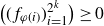 $\big((\,f_{\varphi(i)})_{i=1}^{2^k}\big) \geq 0$
if
$\big((\,f_{\varphi(i)})_{i=1}^{2^k}\big) \geq 0$
if $\varphi = \bar \varphi$
. The following lemma relates the Gowers inner product to the Gowers norms.
$\varphi = \bar \varphi$
. The following lemma relates the Gowers inner product to the Gowers norms.
Lemma A·2. Let G be a finite group, $n,k \in \mathbb N$
. Let
$n,k \in \mathbb N$
. Let $f \,:\, G \to M_n \mathbb C$
. Then, we have
$f \,:\, G \to M_n \mathbb C$
. Then, we have
 \begin{equation*}\|\,f\|_{U^k} = \left((\,f)_{i=1}^{2^k}\right)^{1/{2^k}}.\end{equation*}
Lemma A·3. Let G be a finite group, $n,k \in \mathbb N$
. Let
$n,k \in \mathbb N$
. Let $f \,:\, G \to M_n \mathbb C$
. If
$f \,:\, G \to M_n \mathbb C$
. If $k \geq 2$
, then
$k \geq 2$
, then $\|\,f\|_{U^k}=0$
implies
$\|\,f\|_{U^k}=0$
implies $f=0.$
Proof. We prove the claim by induction starting with $k=2$
. Note that
$k=2$
. Note that
 \begin{eqnarray*}\|\,f\|^4_{U^2} &=& \mathbb E_{g_0,g_1,g_2} \mathrm{tr}(\,f(g_1g_2g_0)f(g_2g_0)^* f(g_0)f(g_1g_0)^* )\\&=& \mathbb E_{g_0,g_1,g_2} \mathrm{tr}(\,f(g_1g_2)f(g_2)^* f(g_0)f(g_1g_0)^* )\\&=& \mathbb E_{g_1} \|\mathbb E_{g} f(g_1g)f(g)^*\|^2_{2}.\end{eqnarray*}
In particular, $\|\,f\|_{U^2}=0$
implies
$\|\,f\|_{U^2}=0$
implies $\mathbb E_{g} f(g_1g)f(g)^*=0$
for all
$\mathbb E_{g} f(g_1g)f(g)^*=0$
for all $g_1 \in G$
. Thus, considering
$g_1 \in G$
. Thus, considering $g_1=1$
, we conclude f is zero. Hence,
$g_1=1$
, we conclude f is zero. Hence, $\|.\|_{U^2}$
is faithful on the space of matrix-valued functions on G.
$\|.\|_{U^2}$
is faithful on the space of matrix-valued functions on G.
Let us now assume that the claim is already established for $k-1$
and consider the k-th Gowers norm. It follows from the definition of the Gowers norms that
$k-1$
and consider the k-th Gowers norm. It follows from the definition of the Gowers norms that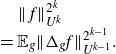 $\|\,f\|^{2^k}_{U^k} = \mathbb E_g \|\Delta_g f\|^{2^{k-1}}_{U^{k-1}}.$
In particular, if
$\|\,f\|^{2^k}_{U^k} = \mathbb E_g \|\Delta_g f\|^{2^{k-1}}_{U^{k-1}}.$
In particular, if $\|\,f\|_{U^k}=0$
, then
$\|\,f\|_{U^k}=0$
, then $\Delta_g f =0$
for all
$\Delta_g f =0$
for all $g \in G$
by induction. Since
$g \in G$
by induction. Since $(\Delta_1 f)(h) = f(h)f(h)^*$
, this implies that f is zero.
$(\Delta_1 f)(h) = f(h)f(h)^*$
, this implies that f is zero.
Lemma A·4. Let G be a finite group, $n,k \in \mathbb N$
. Let
$n,k \in \mathbb N$
. Let $f_i \,:\, G \to M_n \mathbb C$
for
$f_i \,:\, G \to M_n \mathbb C$
for $1 \leq i \leq 2^k$
and let
$1 \leq i \leq 2^k$
and let $\varphi \,:\, \{1,\ldots,n\} \to \{1,\ldots,n\}$
be some function. Then, we have
$\varphi \,:\, \{1,\ldots,n\} \to \{1,\ldots,n\}$
be some function. Then, we have
 \begin{eqnarray}|((\,f_{\varphi(i)})_{i=1}^{2^k})|&\leq & ((\,f_{\varphi'(i)})_{i=1}^{2^k})^{1/2} ((\,f_{\varphi''(i)})_{i=1}^{2^k})^{1/2} \end{eqnarray}
 \begin{eqnarray}((\,f_{(S\varphi)(i)})_{i=1}^{2^k}) &=& \overline{((\,f_{\varphi(i)})_{i=1}^{2^k})} \end{eqnarray}
Proof. First of all, note that it is enough to prove the inequality in (A·1) for $\varphi$
being the identity function.
$\varphi$
being the identity function.
In the following computation, we use the shorthand $\vec{g} = (g_1,\ldots,g_{k-1})$
and write for
$\vec{g} = (g_1,\ldots,g_{k-1})$
and write for $m\,:\!=\,2^{k-1}$
and functions
$m\,:\!=\,2^{k-1}$
and functions $f_i \,:\, G \to M_k \mathbb C$
for
$f_i \,:\, G \to M_k \mathbb C$
for $1 \leq i \leq m$
:
$1 \leq i \leq m$
:
 \begin{equation*}f_{i_1,\ldots,i_{m}}(h_1,\ldots,h_{m}) \,:\!=\, \prod_{i=1}^{m} f_{i_1}(h_i)^{*^{i}}.\end{equation*}
Note that in this notation, we have
 \begin{equation*}(\,f_{i_1,\ldots,i_{m}}(h_1,\ldots,h_m))^* = f_{i_{m},\ldots,i_1}(h_{m},\ldots,h_1).\end{equation*}
Claim (2·1) is a consequence of the usual Cauchy-Schwarz inequality carefully applied:
 \begin{align*} |(\,f_{i})_{i=1}^{2^k})| &= \mathbb |\mathbb E_{\vec{g},g_0,g_k} \mathrm{ tr}\big(\,f_{1,\ldots,2^{k-1}}(c_{k-1}(\vec{g}g_k g_0) f_{2^{k-1}+1,\ldots,2^{k}}(\bar c_{k-1}(\vec{g}g_0)\big)|\\&= |\mathbb E_{\vec{g},g_0,g_k} \mathrm{tr}(\,f_{1,\ldots,2^{k-1}}(c_{k-1}(\vec{g}g_k) f_{2^{k-1}+1,\ldots,2^{k}}(\bar c_{k-1}(\vec{g}g_0))|\\&= |\mathbb E_{\vec{g}} \mathrm{tr}\left( (\mathbb E_{g_k} f_{1,\ldots,2^{k-1}}(c_{k-1}(\vec{g}g_k)) \cdot (\mathbb E_{g_0} f_{2^{k},\ldots,2^{k-1}+1,}( c_{k-1}(\vec{g}g_0))^* \right) |\\&\leq \big( \mathbb E_{\vec{g}} \mathrm{tr}(|\mathbb E_{g_k}f_{1,\ldots,2^{k-1}}(c_{k-1}(\vec{g}g_k)|^2) \big)^{1/2} \cdot \\& \ \quad \big( \mathbb E_{\vec{g}} \mathrm{tr}(|\mathbb E_{g_0} f_{2^{k},\ldots,2^{k-1}+1,}(c_{k-1}(\vec{g}g_0)|^2) \big)^{1/2} \\&= \big( \mathbb E_{\vec{g}} \mathrm{tr}(\mathbb E_{g_k,g'_0}f_{1,\ldots,2^{k-1}}(c_{k-1}(\vec{g}g_k)f_{1,\ldots,2^{k-1}}(c_{k-1}(\vec{g}g'_0)^*) \big)^{1/2} \cdot \\& \ \quad\big( \mathbb E_{\vec{g}} \mathrm{tr}(\mathbb E_{g_0,g'_k} f_{2^{k},\ldots,2^{k-1}+1,}(c_{k-1}(\vec{g}g_0)f_{2^{k},\ldots,2^{k-1}+1,}( c_{k-1}(\vec{g}g'_k)^*) \big)^{1/2} \\&= \big( \mathbb E_{\vec{g},g_k,g'_0} \mathrm{ tr}(\,f_{1,\ldots,2^{k-1}}(c_{k-1}(\vec{g}g_k)f_{2^{k-1},\ldots,1}(\bar c_{k-1}(\vec{g}g'_0)) \big)^{1/2} \cdot \\& \ \quad\big( \mathbb E_{\vec{g},g_0,g'_k} \mathrm{tr}( f_{2^{k},\ldots,2^{k-1}+1,}( c_{k-1}(\vec{g}g_0)f_{2^{k-1}+1,\ldots,2^{k}}( \bar c_{k-1}(\vec{g})g'_k)) \big)^{1/2} \\&= \big((\,f_{L(i)})_{i=1}^{2^k}\big)^{1/2}\big((\,f_{R(i)})_{i=1}^{2^k}\big)^{1/2}.\end{align*}
Claim (A·2) is an immediate consequence of the trace property, i.e., $\mathrm{tr}(xy)=\mathrm{ tr}(yx)$
, and the fact that the trace of the hermitean conjugate of a matrix is just the complex conjugate of the trace of the matrix.
$\mathrm{tr}(xy)=\mathrm{ tr}(yx)$
, and the fact that the trace of the hermitean conjugate of a matrix is just the complex conjugate of the trace of the matrix.
Proposition A·5 (Gowers-Cauchy-Schwarz inequality). Let G be a finite group, $n,k \in \mathbb N$
. Let
$n,k \in \mathbb N$
. Let $f_i \,:\, G \to M_n \mathbb C$
for
$f_i \,:\, G \to M_n \mathbb C$
for $1 \leq i \leq 2^k$
. Then
$1 \leq i \leq 2^k$
. Then
 \begin{equation*}|((\,f_i)_{i=1}^{2^k})| \leq \prod_{i=1}^{2^k} \|\,f_i\|_{U^k}.\end{equation*}
Proof. Let’s first assume that $\|\,f_i\|_{U^k} = 1$
for all
$\|\,f_i\|_{U^k} = 1$
for all $1 \leq i \leq 2^k.$
We prove the stronger claim
$1 \leq i \leq 2^k.$
We prove the stronger claim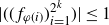 $|((\,f_{\varphi(i)})_{i=1}^{2^k})| \leq 1$
for all functions
$|((\,f_{\varphi(i)})_{i=1}^{2^k})| \leq 1$
for all functions $\varphi \,:\, \{1,\ldots,2^k\} \to \{1,\ldots 2^k\}.$
Clearly, the claim is true for all constant functions by definition of the Gowers norm.
$\varphi \,:\, \{1,\ldots,2^k\} \to \{1,\ldots 2^k\}.$
Clearly, the claim is true for all constant functions by definition of the Gowers norm.
Set $\alpha(\varphi)\,:\!=\,|((\,f_{\varphi(i)})_{i=1}^{2^k})|$
and
$\alpha(\varphi)\,:\!=\,|((\,f_{\varphi(i)})_{i=1}^{2^k})|$
and $\alpha \,:\!=\, \max_{\varphi} \alpha(\varphi).$
Let
$\alpha \,:\!=\, \max_{\varphi} \alpha(\varphi).$
Let $\Phi$
be the set of functions
$\Phi$
be the set of functions $\varphi$
that realize the maximum. If
$\varphi$
that realize the maximum. If $\varphi$
is a maximiser, it follows from the previous lemma that
$\varphi$
is a maximiser, it follows from the previous lemma that $\alpha(\varphi) \leq \alpha(\varphi')^{1/2} \alpha(\varphi'')^{1/2} \leq \alpha(\varphi')^{1/2} \alpha(\varphi)^{1/2}$
. Thus,
$\alpha(\varphi) \leq \alpha(\varphi')^{1/2} \alpha(\varphi'')^{1/2} \leq \alpha(\varphi')^{1/2} \alpha(\varphi)^{1/2}$
. Thus, $\alpha(\varphi) = \alpha(\varphi')$
and
$\alpha(\varphi) = \alpha(\varphi')$
and $\varphi'$
is another maximiser; hence
$\varphi'$
is another maximiser; hence $\Phi$
is closed under the operation
$\Phi$
is closed under the operation $\varphi \mapsto \varphi'$
. It is also clear that the set of maximisers is closed under S. Now, the chain
$\varphi \mapsto \varphi'$
. It is also clear that the set of maximisers is closed under S. Now, the chain $\varphi \mapsto S\varphi' \mapsto S^2(S \varphi')' \mapsto S^4(S^2(S \varphi')')' \mapsto \cdots$
has the effect that after i steps, the values of the first
$\varphi \mapsto S\varphi' \mapsto S^2(S \varphi')' \mapsto S^4(S^2(S \varphi')')' \mapsto \cdots$
has the effect that after i steps, the values of the first $2^{i}$
entries are equal to
$2^{i}$
entries are equal to $\varphi(1).$
Thus, after k steps, the resulting function is
$\varphi(1).$
Thus, after k steps, the resulting function is $c_{\varphi(1)}$
, i.e, the constant function with value equal to
$c_{\varphi(1)}$
, i.e, the constant function with value equal to $\varphi(1).$
This proves that
$\varphi(1).$
This proves that $\alpha = \alpha(\varphi) = \alpha(c_{\varphi(1)})=1$
and we are done. After scaling, this also covers the case when
$\alpha = \alpha(\varphi) = \alpha(c_{\varphi(1)})=1$
and we are done. After scaling, this also covers the case when $\|\,f_i\|_{U^k} \neq 0$
for all
$\|\,f_i\|_{U^k} \neq 0$
for all $1 \leq i \leq 2^k.$
If
$1 \leq i \leq 2^k.$
If $\|\,f_i\|_{U^k}=0$
for one of the
$\|\,f_i\|_{U^k}=0$
for one of the $f_i's$
, then we are done by Lemma A·3.
$f_i's$
, then we are done by Lemma A·3.
Corollary A·6. Let G be a finite group, $n,k \in \mathbb N$
. Let
$n,k \in \mathbb N$
. Let $f \,:\, G \to M_n \mathbb C$
. We have:
$f \,:\, G \to M_n \mathbb C$
. We have: $\|\,f\|_{U^{k+1}} \geq \|\,f\|_{U^k}$
Proof. This follows from the computation
 \begin{equation*}\|\,f\|^{2^k}_{U^k} = (\underbrace{f,\ldots,f}_{2^k},\underbrace{1,\ldots,1}_{2^k}) \leq \|\,f\|^{2^k}_{U^{k+1}} \cdot \|1\|^{2^k}_{U^{k+1}} = \|\,f\|^{2^k}_{U^{k+1}},\end{equation*}
where we used the Gowers-Cauchy-Schwarz inequality for the $(k+1)$
th Gowers inner product.
$(k+1)$
th Gowers inner product.
Finally, we are able to prove the triangle inequality.
Corollary A·7. Let G be a finite group, $n,k \in \mathbb N$
. Let
$n,k \in \mathbb N$
. Let $f_1,f_2 \,:\, G \to M_n \mathbb C$
. We have
$f_1,f_2 \,:\, G \to M_n \mathbb C$
. We have
 \begin{equation*}\|\,f_1 + f_2\|_{U^k} \leq \|\,f_1\|_{U^k} + \| f_2\|_{U^k}.\end{equation*}
In particular, for $k \geq 2$
,
$k \geq 2$
, $f \mapsto \|\,f\|_{U^k}$
defines a norm on the space of matrix-valued functions on G.
$f \mapsto \|\,f\|_{U^k}$
defines a norm on the space of matrix-valued functions on G.
Proof. This part of the argument is unchanged in comparison to the more classical instances of the triangle inequality for the Gowers norm. Indeed, we have
 \begin{align*}\|\,f_1+f_2\|^{2^k}_{U^k} &= ((\,f_1+f_2)_{i=1}^{2^k}) \\&= \sum_{\varphi \,:\, \{1,\ldots,2^k\} \to \{1,2\}} ((\,f_{\varphi(i)})_{i=1}^{2^k}) \\& \leq \sum_{\varphi \,:\, \{1,\ldots,2^k\} \to \{1,2\}} \|\,f_1\|^{|\varphi^{-1}(1)|}_{U^k} \|\,f_2\|^{|\varphi^{-1}(2)|}_{U^k} \\&= \sum_{m=0}^{2^k} \binom{2^k}{m} \|\,f_1\|_{U^k}^m \|\,f_2\|_{U^k}^{2^k-m} \\&= (\|\,f_1\|_{U^k} + \|\,f_2\|_{U^k})^{2^k}.\end{align*}
In order to obtain that $f \mapsto \|\,f\|_{U^k}$
is indeed a norm, we only need Lemma A·3 and observe that
$f \mapsto \|\,f\|_{U^k}$
is indeed a norm, we only need Lemma A·3 and observe that $\|\lambda f\|_{U^k} = |\lambda| \|\,f\|_{U^k}$
holds, which is obvious.
$\|\lambda f\|_{U^k} = |\lambda| \|\,f\|_{U^k}$
holds, which is obvious.




 Open access

