


Introduction
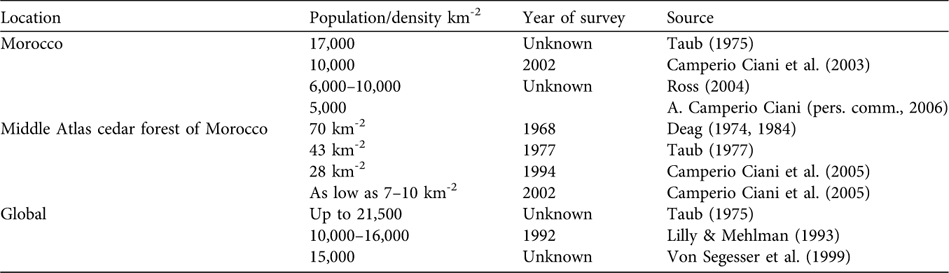
Once widespread throughout North Africa, the Barbary macaque Macaca sylvanus, the only macaque species found outside Asia, is now restricted to forest patches in northern Morocco and Algeria. Conservation concern for this macaque has arisen because of habitat loss from logging, overgrazing of the forest undergrowth and regenerating trees by livestock, cutting and collection of firewood and fodder, drought, and the illegal pet trade (Taub, Reference Taub1975, Reference Taub1977; Deag, Reference Deag1977; Fa, Reference Fa1984; Camperio Ciani, Reference Camperio Ciani1986; Menard & Vallet, Reference Menard and Vallet1993; Van Lavieren, Reference Van Lavieren2004, Reference Van Lavieren2008; Waters et al., Reference Waters, Aksissou, El Harrad, Hobbelink and Fa2007). Conservation measures such as restricting access of grazing animals, zonation with fencing, forest guarding and education on sustainable use of the forest have been proposed and partly implemented (Drucker, Reference Drucker and Fa1984; Taub, Reference Taub and Fa1984; Camperio Ciani et al., Reference Camperio Ciani, Palentini and Mouna2003, Reference Camperio Ciani, Palentini, Arahou, Martinoli, Capiluppi and Mouna2005; Van Lavieren, Reference Van Lavieren2004, Reference Van Lavieren2008). These measures have not yet mitigated threats to the Barbary macaque (Van Lavieren, Reference Van Lavieren2004; Camperio Ciani et al., Reference Camperio Ciani, Palentini, Arahou, Martinoli, Capiluppi and Mouna2005) and the species continues to decline (Camperio Ciani et al., Reference Camperio Ciani, Palentini, Arahou, Martinoli, Capiluppi and Mouna2005). The species is consequently now categorized as Endangered on the IUCN Red List (IUCN, 2008) and is listed on CITES Appendix II (CITES Trade Database Report, 2006). Estimates of Barbary macaque populations and densities since 1975, although obtained with different methodologies (Table 1), suggest an overall decline.
Population and density estimates for the Barbary macaque Macaca sylvanus since 1974.
Macaques are considered economic pests in the Middle Atlas because they strip and consume cedar bark. Bark-stripping behaviour is a survival strategy when water is scarce (Camperio Ciani et al., Reference Camperio Ciani, Martinoli, Capiluppi, Arahou and Mouna2001) or when the macaques are in search of minerals or nutrients that are otherwise unavailable (Menard & Quarro, Reference Menard and Quarro1999). Because bark stripping can kill young trees, increase the vulnerability of trees to disease, and decrease timber quality and volume the Moroccan department of Eaux et Forêts considers the stripping to be a serious threat to cedar forests (Jensen, Reference Jensen1995; M. Chouhani, pers. comm., 2006). Conversations in 2003 and 2004 between EvL and Eaux et Forêts officials indicated they believed the macaque population was increasing.
The aim of the study reported here was to determine the current status of the Barbary macaque in the central Middle Atlas region to assess the contradictory claim that the Barbary macaque population in the Middle Atlas is increasing versus the conclusions of a 2002 study (Camperio Ciani et al., Reference Camperio Ciani, Palentini, Arahou, Martinoli, Capiluppi and Mouna2005) that the population is decreasing.
Methods
The study took place in the Central Middle Atlas region of Morocco in the regions of Forêt d’Azrou, Sidi M’Guild and Michlifène (Fig. 1). The area consists of high cedar Cedrus atlantica forest, mixed cedar/oak (Quercus rotundifolia and Quercus faginea) forests and pure holm oak Quercus ilex forests. Surveys were carried out over a total of 6 months between June and December 2005, subdivided into three 2-month periods (referred to here as periods 1, 2 and 3). The first period covered the birth season of Barbary macaques and the last partly covered the breeding season.
The study area in the Atlas mountains of Morocco, indicating the locations of the six permanent transects (Table 2). The shaded rectangle on the inset indicates the location of the main map in Morocco.
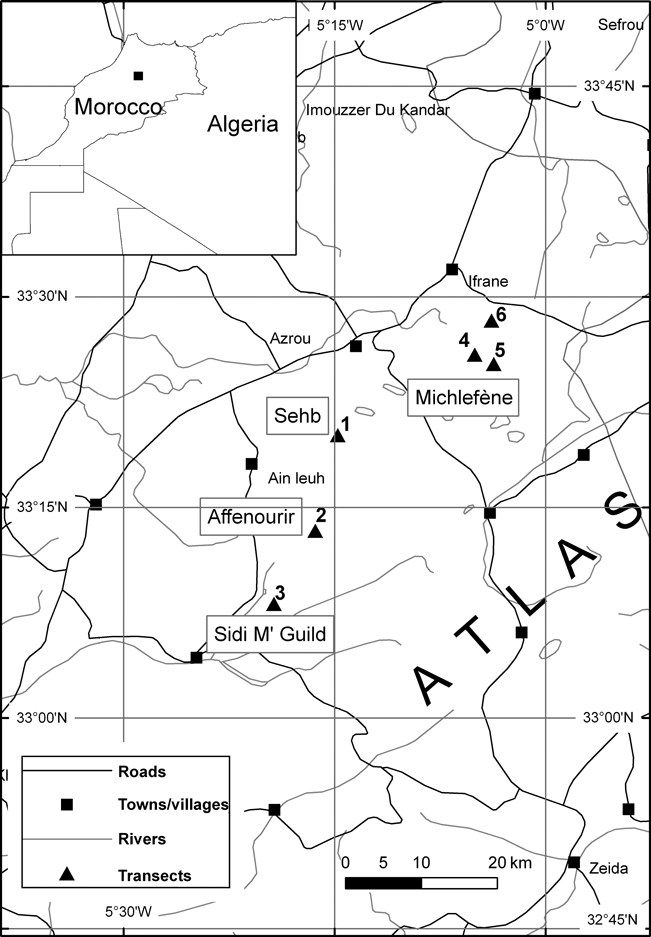
Line transects were used for the surveys because they are a systematic, objective and rapid method to compare population parameters between habitats (Buckland et al., Reference Buckland, Anderson, Burnham, Laake, Borchers and Thomas2001). Transects previously established by Camperio Ciani et al. (Reference Camperio Ciani, Martinoli, Capiluppi, Arahou and Mouna2001) were surveyed (Fig. 1): Sehb, Michlifène 1 and 2, Affenourir, and Sidi M’Guild. Michlifène 1 was surveyed only twice, in the first period, but not thereafter because we discovered that shepherds had not observed macaques there since 2004. These transects were walked at least four times per 2-month period, in the same direction. In addition we established the transect Michlifène road (Fig. 1) to extend the area sampled. In addition to these transects we chose 27 locations and surveyed them only once using transects with an average length of 1 km; these were added to extend the area sampled in periods 2 and 3. The sample effort by region, period and transect are given in Table 2.
Details of transects (Fig. 1) surveyed (both established transects surveyed more than once and short transects surveyed only once) and number of macaques observed, by region and by 2-month period.
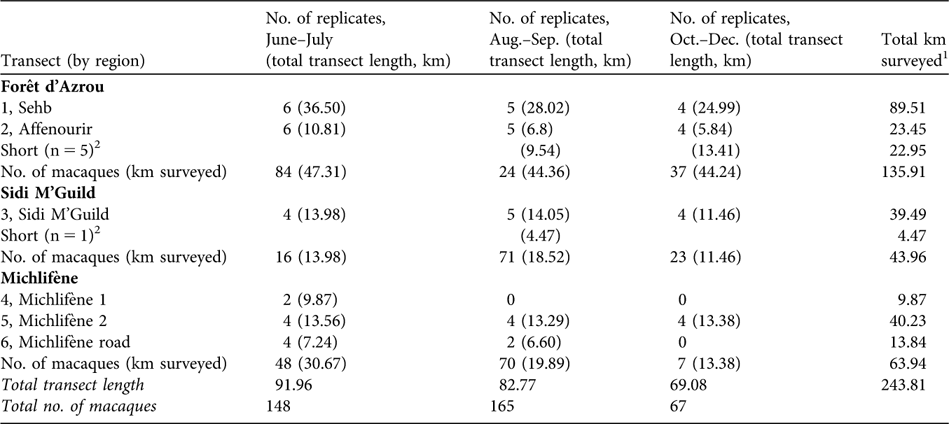
1 Length of individual transects varied because in cloudy weather or heavy foliage the GPS did not always work accurately. Slight deviations from the transect were corrected immediately but the extra distances walked because of this were added to the transect length.
2 Each of the short transects (of c. 1 km length) were walked only once
The total forested area of the three regions surveyed is 386.25 km2 (M. Chouhani, Eaux et Forêts, pers. comm., 2005) but A. Camperio Ciani (pers. comm., 2006) believes, after conducting several surveys in the region, that only c. 50% of this area is suitable macaque habitat. We therefore present our calculations of macaque densities based on this smaller area.
All transects were walked with a global positioning system (GPS) and a compass and, initially, some trees were sprayed with a small red mark to ensure that the same routes were followed in subsequent surveys. All transects were walked by EvL and one of two Moroccan assistants trained in spotting macaques.
For each macaque sighting we recorded the GPS coordinates, time of day, height above ground of the first individual observed, perpendicular distance to group centre, age and sex of all individuals, distance of first individual to observer, distance of group centre to observer, behaviour, habitat type and observation duration. Estimates of group size were possible because group sizes were relatively small and all individuals could usually be observed. All distances were either estimated by eye or with a measuring tape when undergrowth prevented accurate estimation. Prior to the surveys EvL, who estimated all distances, underwent a training phase to ensure that estimated distances corresponded to actual distances (to the nearest metre). Every individual of each group was recorded, allowing calculation of both group and individual densities.
Transects were not surveyed during heavy rain or snow, when observation quality would be compromised. Distance sampling analysis followed National Research Council (1981), Buckland et al. (Reference Buckland, Anderson, Burnham, Laake, Borchers and Thomas2001) and Marshall et al. (Reference Marshall, Lovett and White2008). Although repeat transects should in some cases be avoided (Buckland et al., Reference Buckland, Anderson, Burnham, Laake, Borchers and Thomas2001) we surveyed transects more than once because we wished to obtain repeated sightings of groups per transect and thus more than one measure of perpendicular distance per macaque group for each transect.
Macaque densities were calculated according to the formula (National Research Council, 1981): d = n/(2lμ), where d = density (km-2), n = total numbers of observations in the sample (individual group sightings), l = transect length (km) and μ = the effective strip width to the group centre (km), with μ calculated using Distance v. 4.1 (Thomas et al., Reference Thomas, Laake, Strindberg, Marques, Buckland and Borchers2004). Following the recommendations of Buckland et al. (Reference Buckland, Anderson, Burnham, Laake, Borchers and Thomas2001) data were truncated and grouped before analysis. Up to 10% of the most distant perpendicular values were considered for truncation to minimize the influence of outliers (Buckland et al., Reference Buckland, Anderson, Burnham, Laake, Borchers and Thomas2001). Detection intervals of perpendicular distances were varied to obtain the best fit of the detection curve models; histograms were analysed with cut-off points at 4-, 5-, 6-, 7-, 8- and 9-m intervals. Five recommended models were used (Buckland et al., Reference Buckland, Anderson, Burnham, Laake, Borchers and Thomas2001): uniform with cosine expansions, half-normal with cosine or hermite expansions and hazard rate with either cosine or simple polynomial expansions. Model selection was based on Akaike’s information criterion (AIC); the model that gave the lowest AIC value was used to estimate μ (Buckland et al., Reference Buckland, Anderson, Burnham, Laake, Borchers and Thomas2001). However, when a model with the lowest AIC value also gave significant goodness-of-fit values, the model with the second lowest AIC value was given priority because significant goodness-of-fit statistics may indicate that the wrong model is being fitted to the detection histogram (Buckland et al., Reference Buckland, Anderson, Burnham, Laake, Borchers and Thomas2001). Data from 47 observations were used for estimating μ. Perpendicular distance data from the various regions were lumped because there were insufficient estimates of μ per region. To calculate the total number of macaques in the area we calculated the average macaque density per forest region (Table 3) and multiplied these by 50% of the total area.
Mean group size and density and mean individual density of Barbary macaques, effective strip width (μ, with 95% confidence interval, CI) and total length of the transect surveys (l, from Table 2), and an estimation of the total number of macaques (with 95% confidence interval) based on the mean individual density extrapolated to 50% of the area potentially inhabitable by macaques (see discussion for further details).

Results
Table 2 shows the number of replicates per transect, the total transect lengths that were walked and the total numbers of individual macaques observed in each forest and region, by season.
Of the various models to estimate μ the uniform plus simple polynomial model with cut-off points at 8-m intervals provided the best fit to the data and yielded a μ of 40.7 (95% confidence interval = 35.4–47.0). The χ2 value of the goodness of fit was 4.75 (df = 6, P = 0.576).
The density of macaques, by region, is given in Table 3. Extrapolating these densities to 50% of the total surface area of the three regions indicates that most macaques occur in the Sidi M’Guild and Forêt d’Azrou areas, and gives an estimate of the total number of macaques in the surveyed region of 4,126 (Table 3).
Discussion
For many wildlife species line transect sampling results in accurate density estimates, although these methods can produce consistent over- or underestimates for some species (Whitesides et al., Reference Whitesides, Oates, Green and Kluberdanz1988). Because visual estimation of distances could lead to overestimates (Brugière & Fleury, Reference Brugière and Fleury2000) EvL trained in estimating distances until there was a strong correspondence between actual and estimated distance, and therefore there were no systematic errors in distance estimation. An additional concern is that, although measurements of distance to a group's centre are required, these may only be accurate when group sizes are small and groups are habituated (Marshall et al., Reference Marshall, Lovett and White2008). Macaque groups encountered in our study were small, which should mitigate problems with accuracy related to group size. Although variation in habituation might be an additional concern for accurate group size counts, habituation was such that groups remained where they were and locations of individuals did not change greatly as a result of our presence. This is probably the result of the considerable human activity in most areas where the macaques occur.
We are unable to compare our results directly with those of Camperio Ciani et al. (Reference Camperio Ciani, Palentini, Arahou, Martinoli, Capiluppi and Mouna2005) because the methods used to estimate effective strip width differed. We estimated distance to the group centre and used Distance to determine the best function to estimate μ. Camperio Ciani et al. (Reference Camperio Ciani, Palentini, Arahou, Martinoli, Capiluppi and Mouna2005) estimated μ as the average distance to the first sighting of an animal in each group, which varied for each habitat type. Nevertheless, the two studies produced a similar value: an average of 45 m (Camperio Ciani et al., Reference Camperio Ciani, Palentini, Arahou, Martinoli, Capiluppi and Mouna2005) and 40.7 m (this study).
Our calculated macaque densities of 12.1–28.2 km-2 (Table 3) are similar to those of Camperio Ciani et al. (Reference Camperio Ciani, Palentini, Arahou, Martinoli, Capiluppi and Mouna2005): 12 km-2 (Forêt d’Azrou) and 20 km-2 (Sidi M’Guild). We estimate that the total number of macaques in the area surveyed is c. 4,000 when the density estimates are extrapolated to the total area (taking into consideration that only c. 50% of the area contains habitat suitable for macaques; Camperio Ciani, pers. comm.). According to Camperio Ciani et al. (Reference Camperio Ciani, Palentini, Arahou, Martinoli, Capiluppi and Mouna2005) only 14% of the total surveyed area still contains intact forest, with the remaining forest degraded or highly degraded and the latter unsuitable habitat for macaques. The macaque densities in degraded forest were almost half that of densities in intact forest (Camperio Ciani & Mouna, Reference Camperio Ciani, Mouna, Hodges and Cortes2007). Our transects were all located in areas with relatively high macaque densities but densities differ substantially by region and there are areas where macaques do not occur (Camperio Ciani et al., Reference Camperio Ciani, Palentini, Arahou, Martinoli, Capiluppi and Mouna2005). Thus our extrapolation to the whole region may be an overestimate.
Although density estimates cannot be compared directly, both our study and that of Camperio Ciani et al. (Reference Camperio Ciani, Palentini, Arahou, Martinoli, Capiluppi and Mouna2005) indicate much lower densities than earlier studies (Deag, Reference Deag1977; Taub, Reference Taub1977; Fa, Reference Fa1984). Taken together, these results confirm that the macaque population of the Middle Atlas is decreasing and thus rules out the contradictory claim of an increasing population. Although our estimates of macaque density and forest area are now several years old, there are no more recent estimates of the area of forest, and disturbance continues, making it likely that our estimates of macaque numbers are conservative.
With respect to poaching for the illegal pet trade there is a role for both Morocco and the European Union. An estimated 300 infant macaques are smuggled into Europe annually (Van Lavieren, Reference Van Lavieren2008). The trade needs be tackled at the source of the problem: the relative ease with which macaques can be purchased, the lack of control of poaching in the forest, the open sale of macaques in markets, and the lack of control at the border between Morocco and Spain. The national wildlife laws and CITES regulations are insufficiently enforced in Morocco and we recommend that a sanctuary for confiscated macaques is created in the country. Any such macaques could form the basis for future restorations or reintroductions.
The outcome of this study was presented to Eaux et Forêts, and a 2-year project (initiated by WWF MedPO and AAP Sanctuary for exotic animals in The Netherlands) has commenced that focuses on the recommendations made here, by Van Lavieren (Reference Van Lavieren2008) and by Camperio Ciani & Mouna (Reference Camperio Ciani, Mouna, Hodges and Cortes2007). Various actions have been recently taken to tackle the illegal trade in the Barbary macaque.
Acknowledgements
We acknowledge the support of AAP Sanctuary for exotic animals, in particular David van Gennep, Rikkert Reijnen, Jack Drenthe, Dana Bezdickova and Ramon Braaf. For financial support we thank AAP, the Nationale Postcodeloterij, Holland, and the International Primate Protection League. For preparation of this research we thank Andrea Camperio Ciani and Aad van den Berg. For support and cooperation in Morocco we thank the Institut Scientifique in Rabat, Morocco, and in particular Prof. Mohamed Mouna. We also thank Mr Chouhani of Eaux et Forêts, Azrou, Morocco, and Karim Ahwash for his help with fieldwork. For help with analysis we thank Nelly Menard, Bart van Lavieren, Leoniek Wijngaards and Anna Nekaris.
Biographical sketches
Els van Lavieren is founder of the Moroccan Primate Conservation foundation and specializes in the care of wild animals in captivity, wildlife management and primatology. She spent 4 years working on Barbary macaque conservation projects with IUCN, AAP Sanctuary for exotic animals, and the WWF Mediterranean Programme in Morocco. Serge A. Wich has been studying Indonesian and African primates since 1993. He now focuses on orang-utan research and conservation, is co-manager of research at the Ketambe Orang-utan Research Station in Sumatra and a visiting scientist at the Great Ape Trust of Iowa.



