


Introduction
Wildlife tourism in nature reserves and protected areas is a growing enterprise, particularly in developing and emerging economies (Goodwin, Reference Goodwin1996; Gossling, Reference Gossling1999; Balmford et al., Reference Balmford, Beresford, Green, Naidoo, Walpole and Manica2009; Karanth & DeFries, Reference Karanth and DeFries2011). This growth in tourism is a result of increasing disposable incomes, improved accessibility for urban citizens and greater publicity for, and generation of public interest in, wild places and species such as tigers Panthera tigris, rhinoceroses Rhinoceros unicornis and elephants Elephas maximus (Scheyvens, Reference Scheyvens1999; Hutton & Leader-Williams, Reference Hutton and Leader-Williams2003; Hannam, Reference Hannam2005; Kruger, Reference Kruger2005). Governments and private commercial entities promote wildlife tourism as sustainable use of the environment that can benefit local people and protected areas whilst raising tourist interest in, awareness of, and general support for, conservation (Chin et al., Reference Chin, Moore, Wallington and Dowling2000; Kiss, Reference Kiss2004; Ballantyne et al., Reference Ballantyne, Packer and Hughes2009).
Wildlife and nature-based tourism results in a complex interplay between park managers, local communities, commercial tourist enterprises and tourists (Adams & Infield, Reference Adams and Infield2003; Naidoo & Ricketts, Reference Naidoo and Ricketts2006). Positive impacts from wildlife tourism include economic benefits (employment and entrepreneurship opportunities), infrastructure benefits (access to improved roads, transportation, health care and education) and social welfare benefits (political, psychological, economic and social empowerment; Ross & Wall, Reference Ross and Wall1999; Scheyvens, Reference Scheyvens1999; Archabald & Naughton-Treves, Reference Archabald and Naughton-Treves2001; Sandbrook, Reference Sandbrook2010). Negative impacts of wildlife tourism include commodification of people and places, particularly affecting pre-existing power structures among local people, and physical damage to habitats (King & Stewart, Reference King and Stewart1996; Stronza, Reference Stronza2001; He et al., Reference He, Chen, Liu, Bearer, Zhou and Cheng2008).
India is a rapidly growing emerging economy and domestic tourism is on the rise because of economic liberalization, resulting in a new middle class with greater disposable income (Bhardwaj, Reference Bhardwaj1998). Development of tourism, and wildlife tourism in particular, has only recently become a priority in India (Hannam, Reference Hannam2005). However, the institutional framework to develop wildlife tourism is weak (Sekhar, Reference Sekhar2003). Research on tourism trends in Indian parks suggests that wildlife tourism is growing (mean growth rate was 14.9% from 2002 to 2008) and is largely domestic (Karanth & DeFries, Reference Karanth and DeFries2011). This growth in wildlife tourism potentially generates public interest in conservation but presents new challenges in a landscape where conservation efforts are already challenged by growth of infrastructure, high densities and resource dependence of local people living around parks, and declining wildlife populations (Sekhar, Reference Sekhar2003; Hannam, Reference Hannam2005; TTF, 2005; DeFries et al., Reference DeFries, Karanth and Pareeth2010; Karanth & DeFries, 2010; Karanth & Nepal, 2012).
Perceptions and awareness among wildlife tourists have been less well examined than the perceptions of conservation and parks by local communities (Bookbinder et al., Reference Bookbinder, Dinerstein, Rijal, Cauley and Rajouria1998; Spiteri & Nepal, Reference Spiteri and Nepal2008). The willingness of tourists to return to a park has been examined by some studies (Luzar et al., Reference Luzar, Diagne, Gan and Henning1995; Wallace & Pierce, Reference Wallace and Pierce1996; Chase et al., Reference Chase, Lee, Schulze and Anderson1998; Oppermann, Reference Oppermann2000; Tisdell & Wilson, Reference Tisdell and Wilson2002). Other studies have established the importance of the presence of charismatic species such as gorillas Gorilla spp., panda Ailuropoda melanoleuca, polar bear Ursus maritimus or marine turtles for both conservation and wildlife tourism success (Wilkie & Carpenter, Reference Wilkie and Carpenter1999; Goodwin & Leader-Williams, Reference Goodwin, Leader-Williams, Entwistle and Dunston2000; Adams & Infield, Reference Adams and Infield2003; Tisdell & Wilson, Reference Tisdell and Wilson2002; Walpole & Leader-Williams, Reference Walpole and Leader-Williams2002; Lemelin & Weirsma, Reference Lemelin and Weirsma2007). In India the tiger is an iconic flagship species used to promote conservation (Goodwin, Reference Goodwin1996; Leader-Williams & Dublin, Reference Leader-Williams, Dublin, Entwistle and Dunstone2000; TTF, 2005) and there is public interest in tigers, with tiger reserves receiving >1 million visitors annually (TTF, 2005). Park managers have to balance and manage wider biodiversity conservation goals and growing tourist interest in these species and places (Karanth & DeFries, Reference Karanth and DeFries2011). The value and benefits of increased tourist interest, visitation, revenues and support for conservation relative to the costs and negative impacts that result from increased numbers of tourists is being debated (Gillingham & Lee, Reference Gillingham and Lee1999; Chin et al., Reference Chin, Moore, Wallington and Dowling2000; Wilson & Tisdell, Reference Wilson and Tisdell2001; Higginbottom, Reference Higginbottom2004; Marion & Reid, Reference Marion and Reid2007; Ballantyne et al., Reference Ballantyne, Packer and Hughes2009). Globally, studies have assessed tourists' awareness of gate fees and willingness to pay higher fees for visiting parks (Wells & Brandon, Reference Wells and Brandon1993; Wallace & Pierce, Reference Wallace and Pierce1996; Chase et al., Reference Chase, Lee, Schulze and Anderson1998; Goodwin, Reference Goodwin, Butler and Boyd2000; Hannam, Reference Hannam2005; Sandbrook, Reference Sandbrook2010). However, tourists' perceptions of park management and local communities have been examined by few studies (Mason, Reference Mason2002; Stem et al., Reference Stem, Lassoie, Lee, Deshler and Schelhas2003; Charnley, Reference Charnley2005). Understanding these perceptions is important for building support for conservation amongst tourists and the general public. People's perceptions of, and willingness to support, conservation are influenced by characteristics such as age, gender and income (Soto et al., Reference Soto, Munthali and Breen2001; Bandara & Tisdell, Reference Bandara and Tisdell2003; Brook et al., Reference Brook, Zint and de Young2003; Kleiven et al., Reference Kleiven, Bjerke and Kaltenborn2004). Here we examine tourists' interest in, awareness of, and support for, conservation in India, particularly their perceptions and attitudes that indicate potential to build broader public support for conservation and increase understanding of conservation challenges in India.
We focus on the following questions: (1) What are the demographic characteristics of tourists visiting parks in India/ What are the reasons tourists visit parks/ What are their experiences/ (2) Are tourists supportive of conservation, indicated by interest in wildlife other than tigers, interest in returning to the park and willingness to pay higher gate fees/ (3) Do tourists appreciate the conservation challenges in India, particularly conflicts with local residents around parks and the difficulties of park management/ We assess these questions through the lens of wildlife tourists, who are predisposed to appreciate wildlife relative to the general public.
Methods
Study sites
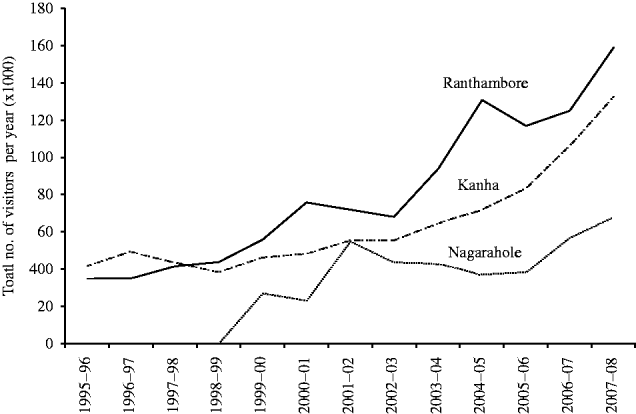
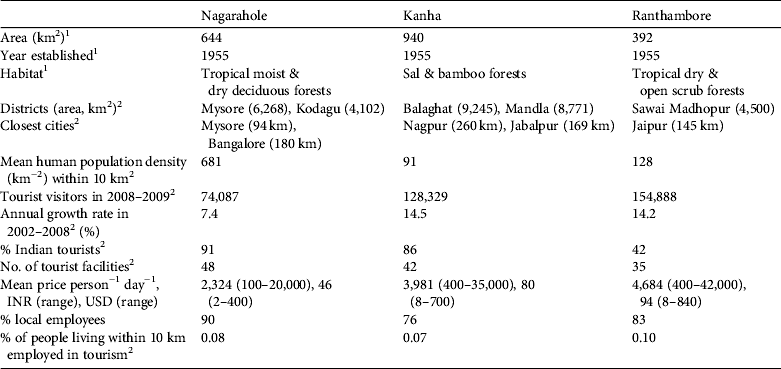
We selected three National Parks and Tiger Reserves in India: Nagarahole, Kanha and Ranthambore (Fig. 1). As our main focus is wildlife tourism we selected parks that are popular wildlife tourism destinations and have growing numbers of tourists (Karanth & DeFries, Reference Karanth and DeFries2011). In 2008–2009 the annual numbers of visitors to the three parks ranged from 74,087 in Nagarahole to 154,888 in Ranthambore (Fig. 2). All three parks are experiencing positive growth in the number of visitors. The majority of tourists visiting Nagarahole and Kanha were Indian citizens, in contrast to Ranthambore that receives more international visitors (Karanth & DeFries, Reference Karanth and DeFries2011). Additional reasons for selection of these parks included logistical feasibility to conduct surveys and co-operation from forest department in accessing government records. Table 1 provides further details about the three parks.
Location of Nagarahole, Kanha and Ranthambore National Parks (shown in black) in India; other protected areas are in grey.

Tourism trends in Nagarahole, Kanha and Ranthambore National Parks. Adapted from Karanth & DeFries (Reference Karanth and DeFries2011).
Characteristics of Nagarahole, Kanha and Ranthambore National Parks (Fig. 1).
1 DeFries et al. (Reference DeFries, Karanth and Pareeth2010)
2 Karanth & DeFries (Reference Karanth and DeFries2011)
Surveys, interviews and models
We conducted semi-structured interviews with tourists in Nagarahole, Kanha and Ranthambore during February–May 2010. We pre-tested the survey with tourists in Ranthambore in June 2009 to check for clarity, and revised the survey based on the feedback received. The Human Subjects IRB Committee at Columbia University approved our survey questions and protocols. Tourists were randomly selected by approaching them at the entrance to the parks, and in resorts and homestays (facilities that are located in pre-existing tea and coffee plantations). Survey questions covered demographic characteristics; participants provided details on age, gender, educational qualifications, citizenship, participation in wildlife tours, reasons for visiting, group size, length of visit and costs associated with their trip. Open-ended questions elicited responses to perceptions of the park, park officials, local people and conservation.
Questionnaire responses were compiled and analysed in R v. 2.11 (R Development Core Team, 2011). We examined the relationship between the characteristics and attitudes of tourists to conservation and parks using classification tree (CART) models. These tree-based models recursively partition data, thus allowing us to screen variables, capture non-additive behaviour and uncover data structure without pre-specifying interactions or assuming linear relationships (Cirincione & Gurrieri, Reference Cirincione and Gurrieri1997; Karanth et al., Reference Karanth, Kramer, Qian and Christensen2008). The tree identifies a series of best predictors (depicted as nodes and branches) for the dependent variable. In our study tree models can potentially identify the characteristics of tourists that drive their motivations for visiting parks. We examined whether tourists are tiger-centric by asking if they would visit these parks in the absence of tigers. We expected differential responses in the three parks, with southern tourists less tiger-centric because tiger sightings there are fewer compared to central and northern parks. We asked if tourists were interested in returning to the individual parks, grouping very likely and somewhat likely responses as ‘yes’. We assessed tourists' awareness of gate fees and willingness to pay higher gate fees in the parks. Additionally, we were interested in conservation awareness of tourists, particularly whether they perceive benefits to local people from the parks, and perceptions of park management by the forest department. We also asked tourists for their suggestions to improve the experience of tourists in these parks.
Results
Tourists' characteristics and experiences
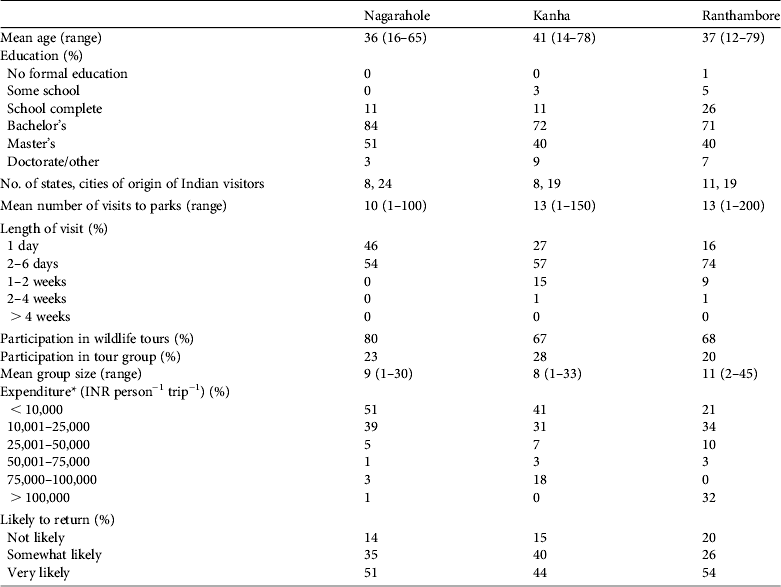
We surveyed 436 tourists in Ranthambore, Kanha and Nagarahole National Parks about their attitudes and perceptions of parks and conservation in India. Sixty-eight percent of participants were male, with a mean age of 38 years (range 12–79). Many tourists were well educated, with bachelor's (52%) and master's degrees (30%). Seventy-six percent of participants were Indian. For 71% of visitors it was their first visit to that particular park. Seventy-two percent of tourists had previously participated in wildlife tours. Length of tourist visits to these parks was usually from 1 day (30%) to < 1 week (58%). Many (72%) tourists spent <USD 600 on their trip (42% tourists spent <USD 250 and 30% spent USD 251–600). Characteristics of tourists visiting each of the three parks are summarized in Table 2.
Characteristics of tourists visiting Nagarahole, Kanha and Ranthambore National Parks.
* Exchange rate at the time of the study was 46 INR = 1 USD
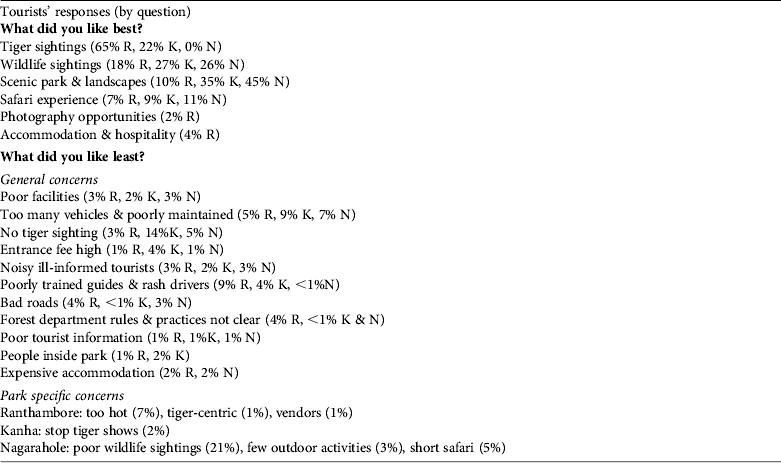
Indian park visitors ranked eight reasons for their visit. The three highest ranked reasons were opportunity to see nature (28% of participants ranked as first or second reason), opportunity to see tigers (27% of participants ranked as first or second reason) and scenic beauty of the landscape (21% of participants ranked as second or third reason). In responses to open-ended questions about what they liked best about their visit the most common observations were good tiger sightings and wildlife sightings in Ranthambore, and scenic beauty and good wildlife sightings in Kanha and Nagarahole. In responses to what they least liked about their visit common complaints were poorly trained guides and drivers, and too many vehicles in Ranthambore, absence of tiger sightings and too many vehicles in Kanha, and poor wildlife sightings and too many vehicles in Nagarahole. The responses to the two questions are summarized in Table 3.
Summary of responses of tourists to two questions about the National Parks (N, Nagarahole; K, Kanha; R, Ranthambore).
Interest in tigers, willingness to return and willingness to pay
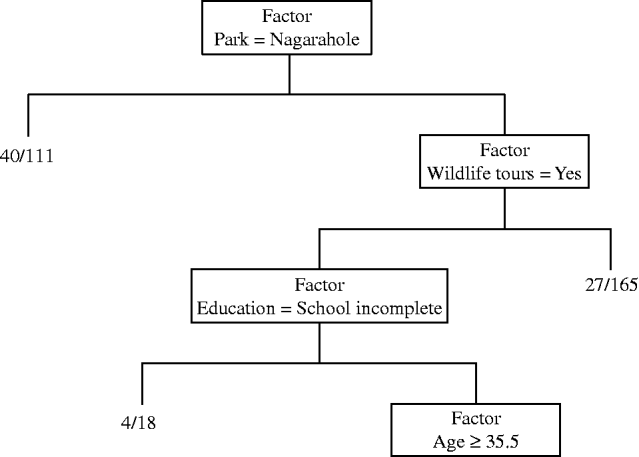
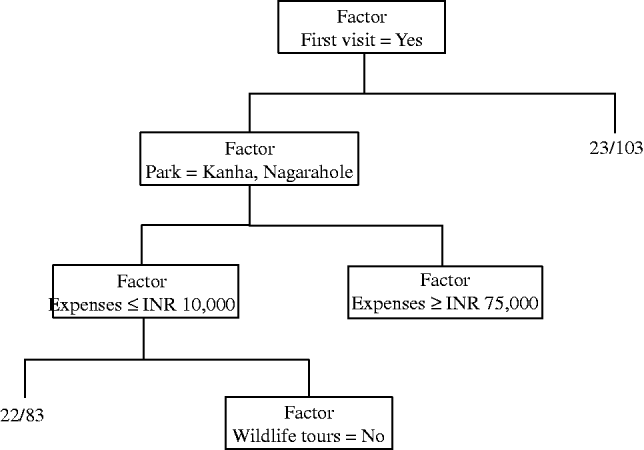
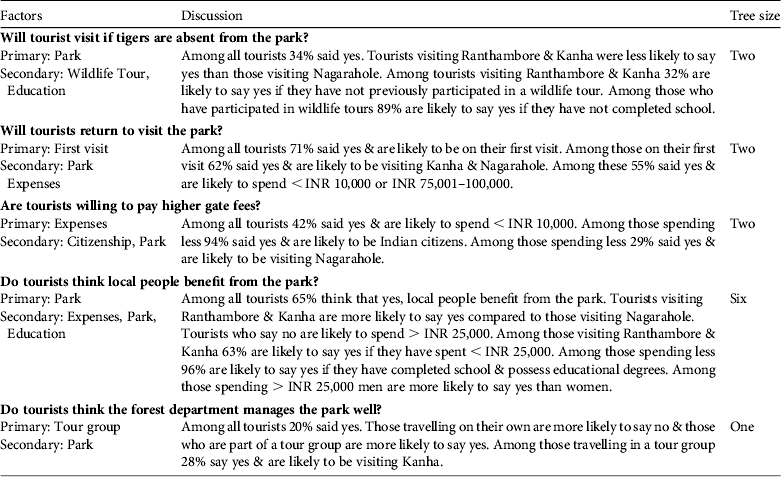
Among all tourists 34% stated that they would visit the park if there were no tigers (Fig. 3). There were differential responses, with tourists in Ranthambore and Kanha more likely to say no. Details on secondary factors such as participation in tour group and education are presented in Table 4. Among all tourists, many (71%) said ‘yes' they would return to the park (Fig. 4). The primary factor was first visit to a park (those on first visit were likely to say yes). Secondary factors included the park and expenses (Table 4). Among all tourists 80% knew the gate fees charged. Some (42%) were willing to pay more. The primary factor predicting their response was expenses (those spending <INR 10,000 (c. USD 200) were willing to pay more) and secondary factors were citizenship (more likely to be Indians) and the park (more likely to be visiting Nagarahole; Table 4).
Classification tree model for question concerning willingness of tourists to visit the park if tigers are absent. The text above each split shows the variable that is split and the condition for the left branch is stated. At the first node, the park was the primary factor and some (34%) said ‘yes' they would visit the park if tigers were absent. Tourists visiting Ranthambore and Kanha are more likely to say ‘no’ compared to tourists visiting Nagarahole. Among those tourists visiting Ranthambore and Kanha, 32% are likely to say ‘yes’ if they have not participated in a wildlife tour previously. Further detail provided in Table 4.
Classification tree model for question concerning the willingness of tourists to return to the park. The text above each split shows the variable that is split and the condition for the left branch is stated. At the first node, first visit was the primary factor and many tourists (71%) say ‘yes’. Among tourists on their first visit, many (62%) say ‘yes’ and are likely to be visiting Kanha and Nagarahole. Further detail provided in Table 4.
Summary of tree models predicting attitudes of tourists.
Tourists' conservation awareness and suggestions
Sixty-five percent of tourists thought that local people benefit from the parks and the primary factor predicting this response was the park. Tourists visiting Nagarahole responded less positively than those visiting Ranthambore and Kanha. Secondary factors included expenses and education (Table 4).
Overall, many (80%) tourists did not have a positive view of the forest departments' park management. The primary factor predicting this response was participation in a tour group, with those tourists travelling in a group more likely to hold a positive view. The secondary factor was the park; further details are given in Table 4.
Tourists in all parks suggested that the forest department improve the entry process into the parks, the facilities within and the roads in all parks. Tourists wanted park rules to be better enforced, limits on the number of vehicles and people allowed inside, and improved vehicle safety. Tourists also recommended that patrol efforts by managers inside the parks be increased to strengthen existing conservation efforts. Tourists stated that the information given to tourists prior to park entry was insufficient and they wanted monitoring of the behaviour of other tourists. In all parks it was suggested that guides require better training especially to drive slowly and carefully when viewing wildlife. Tourists suggested that more local people be employed in the park and tourists educated about local cultures. Other suggestions include introduction of night safaris, trekking opportunities, increasing wildlife numbers in the parks, lowering park entrance fees, availability of less expensive accommodation facilities, and educating people to be less tiger-centric. In Nagarahole tourists wanted more vehicles to view wildlife and an increase in safari length. In Kanha tourists suggested banning the playing of loud music in the tourist facilities, and stopping tiger shows, which stress both tigers and elephants. In these shows mahouts on elephants locate tigers in the park and then tourists are transported on elephant back to view the tigers in close proximity. These shows deploy multiple elephants that can ferry up to six tourists each. In Ranthambore tourists suggested improving the routes and zone management system, the online booking system and banning vendors inside the park. These suggestions were corroborated by observations of owners and managers of tourist facilities in these parks (Karanth & DeFries, Reference Karanth and DeFries2011).
Discussion
Wildlife tourism is growing in emerging economies such as India (Balmford et al., Reference Balmford, Beresford, Green, Naidoo, Walpole and Manica2009; Karanth & DeFries, Reference Karanth and DeFries2011). This growth presents an opportunity to engage tourists and the broader public in supporting conservation and to increase their awareness of conservation challenges. The use of tree models provides insights into characteristics of tourists that may influence their overall perceptions and attitudes and interest in wildlife and wild places. We found that tiger-centrism depends on the park, with tourists in Nagarahole less tiger-centric than tourists from Ranthambore and Kanha. In India tigers have captured the imagination of urban tourists as well as both the appreciation and hostility of local park residents. Park managers need to balance wider biodiversity conservation needs with the needs of flagship species such as the tiger, elephant and rhino and the interest of tourists in these species. However, over-reliance on tigers has potential pitfalls and can detract from wider conservation priorities such as reduced funding for parks that do not have tigers and unstable revenues from tourism (Entwistle, Reference Entwistle2000). In Sariska Tiger Reserve the local extinction of tigers resulted in a decrease in tourism and subsequent reintroduction of tigers resulted in increase in tourism (TTF, 2005; Karanth & DeFries, Reference Karanth and DeFries2011).
Tourists who participated in a tour group were more likely to have a positive perception of park management. Additionally, tourists who spent less on their trip were willing to pay higher gate fees and tourists on their first visit to a park are more likely to be interested in returning to the park. This is in conjunction with the continued growth in numbers of visitors to Indian parks (Karanth & DeFries, Reference Karanth and DeFries2011) and suggests that wildlife tourism will grow as more people become aware of wildlife and have the financial ability to travel to wild places. Sustaining growth in tourism numbers and facilities without overexploiting wild places, wildlife and communities living near parks is a top conservation priority.
The distribution of benefits to local people living in and around protected areas from wildlife tourism is a much debated conservation issue. The evidence for whether benefits are distributed equitably is mixed (King & Stewart, Reference King and Stewart1996; Bookbinder et al., Reference Bookbinder, Dinerstein, Rijal, Cauley and Rajouria1998; Stronza, Reference Stronza2001; Sekhar, Reference Sekhar2003; Spiteri & Nepal, Reference Spiteri and Nepal2008; Andam et al., Reference Andam, Ferraro, Sims, Healy and Holland2010). We found that tourists' perception of benefits for local people depended on the park (with Kanha and Ranthambore visitors being more positive compared to Nagarahole visitors). In a parallel study conducted in the same parks Karanth & DeFries (Reference Karanth and DeFries2011) found that benefits of parks to local people are minimal in these parks. As local support is critical for conservation, engaging local residents and ensuring benefits are shared with them remains a challenge in India. There is also a need to educate wildlife tourists about local conservation challenges in individual parks.
Growth in wildlife tourism presents both an opportunity and challenge to conservation in India and other emerging economies. This growth is fuelled by the Indian urban middle-class, a constituency that can potentially generate significant support for conservation among tourists and the general public. Tourists' expectations of sighting charismatic species will need to be managed, along with concerns about particular species and individual parks, to design more effective conservation strategies. Education is needed to communicate the major conservation challenges in India, most notably the difficult realities of conservation in human-dominated landscapes. Park managers in India have an important role to play in managing the growth in wildlife tourism and educating tourists.
Acknowledgements
We thank K.U. Karanth, L. Naughton Treves, N.S. Kumar, P.M. Muthanna, A. Singh, A. Behl, N.D. Tiwari, G.V. Reddy and E. Dcunha, the Centre for Wildlife Studies and Wildlife Conservation Society–India Program for their advice and logistical support in the field. We are grateful to the forest departments of the States of Rajasthan, Madhya Pradesh, Karnataka, and S. Sharma, H.S. Pabla, H.S. Negi, H.S. Mohanta, R. Shukla and A.C. Poovaih for their support. We appreciate the efforts of volunteers N. Ballal, A. Bangre, S. Katdare, A. Khanna, S. Kotian, R. Kumar, P. Matada, N. Manjunath, P. Matada, A. Nayak, K. Rangaswamy, R. Sarma, T.C. Siddarth and H. S. Wohra for help with data collection. We thank N. Cagle, C. Penaloza, N. Patil and A.M. Gopalaswamy for advice. NSF Grant Number 1029219 supported this research.
Biographical sketches
Krithi K. Karanth is a conservation ecologist with interests in species extinctions and distributions, people–park issues, human–wildlife conflicts, and the implications of conservation interventions. Ruth DeFries's research interests include land-use change in the tropics and its consequences for climate, biodiversity and ecosystem services. Arjun Srivathsa has interests in the behaviour, ecology and conservation of large mammals. Vishnupriya Sankaraman has interests in herpetology, evolutionary biology and the social aspects of wildlife conservation.



