




1. Introduction
Design education has emerged from a period of rapid change due to the impacts of the COVID-19 pandemic. Everyday established practices were disrupted, leading to irreversible changes. Key to these changes were social distancing restrictions that fuelled the accelerated use of emergent technologies across higher education, particularly those that supported distributed working to enable remote learning. Although much has been written about the potential for remote digital technologies to support learning (Tovey Reference Tovey2015; Deakin & Webb Reference Deakin and Webb2016; Orr & Shreeve Reference Orr and Shreeve2018), its adoption within UK Art & Design education has generally focussed on a blended approach via the use of established Virtual Learning Environments (VLE’s) such as Canvas, Blackboard, Moodle and so forth, rather than a completely digital approach as necessitated by the COVID-19 pandemic. The enforced move to remote teaching delivery through the COVID-19 period brought many challenges to studio-based courses and the traditional modes of teaching delivery that are often associated with Art Schools in the United Kingdom and around the world. Central to this was the overnight loss of the design studio as a focal point for engagement and learning. The removal of studio as the embodiment of our design pedagogy propelled alternative remote modes of engagement to be explored. The rapid shift to online delivery resulted in the adoption of new modes of teaching and revealed new ways for students to work, learn and collaborate.
Specifically, this position paper reports upon students learning within the context of a UK undergraduate Product Design programme. The study, conducted in three parts, provides a reflective analysis of experiences through the period of remote delivery in 2020–2021 and through the subsequent return to campus over 2022–2023 academic years. Employing a thematic analysis of student reflections on their learning experiences, the research focuses on the application of the online collaborative platform (Miro) used in the first instance to create an ad hoc digital studio environment in response to an inability to teach in person, and subsequently its continued application following the return to campus-based delivery from Autumn 2021 providing an augmentation to on campus studio delivery.
This position paper contributes to the research of design studio pedagogy in three ways. First, through evaluating the impacts of remote learning as experienced by design students, it identifies an emergence of new behaviours resulting from the shared experience. Second, it establishes clear benefits for the continued application of online platforms (such as Miro) to support learning within a return to campus-based delivery, identifying which aspects of the digital studio environment offer the most potential for ongoing use. Third, it identifies emergent characteristics in students’ navigation of the post-COVID design studio, highlighting new opportunities for critical pedagogies to be embedded through digital augmentation of studio-based teaching.
2. Studio pedagogy
The design studio, as described by Shreeve, Sims, & Trowler (Reference Shreeve, Sims and Trowler2010) is a space of shared, prolonged, communal activity where the process of making is visible and a focus for comment and debate. Jones, Lotz, & Holden (Reference Jones, Lotz and Holden2021) further describe the design studio as a place for collaboration among teachers and students in navigating the ambiguities of the design process, which can be viewed as a continual shifting between analysis and creativity (van Kampen et al. Reference van Kampen, Galperin, Jager, Noel, Strube, Lockton, Lenzi, Hekkert, Oak, Sádaba and Lloyd2022 from Lawson & Dorst Reference Lawson and Dorst2009). As such, “the studio is not just a space marked studio; it represents a way of thinking and learning” (Spruce Reference Spruce2007), which sets it apart from a classroom teaching environment. Although this is not to disregard potential negative cultures associated with some traditional studio practices that echo master-student apprentice transmission modes of teaching, and the studio’s potential to carry unequal power relationships as highlighted by Anthony (Reference Anthony1991), Dutton (Reference Dutton and Dutton1991), and Webster (Reference Webster2006) between students and staff. Nonetheless, the ethos of studio learning culture remains a strong ambition for many tutors and students, as a place where peers learn from and with each other and the teacher is more of a facilitator than a top-down instructor (van Kampen et al. Reference van Kampen, Galperin, Jager, Noel, Strube, Lockton, Lenzi, Hekkert, Oak, Sádaba and Lloyd2022). Despite the financial pressures on many UK institutions over recent years, communal learning environments have usually been maintained in some form, continuing to offer staff and students a studio-based ethos for teaching and learning (Tovey Reference Tovey2015).
The popularity of the design studio can be considered through four lenses. First, as a mediating artefact in the student learning experience that informs the content and delivery of teaching, influencing the approaches undertaken by students and supporting the development of design heuristics (Yilmaz et al. Reference Yilmaz, Daly, Seifert and Gonzalez2015). Second, as an essential part of creating the sticky curriculum (Orr & Shreeve Reference Orr and Shreeve2018) in providing a draw for students to return to and engage in activities together or to see something of collective interest and co-constructed with students. Third, as a social place of exchange for ideas, integration and synthesis (Tovey Reference Tovey2015) with opportunities for formal and informal peer learning that are dynamic, iterative and experimental (Marshalsey & Sclater Reference Marshalsey and Sclater2020). Fourth, as a signature pedagogy of creative arts education that affords “pervasive, routine and habitual” (Shulman Reference Shulman2005) engagement for students within their learning experience. Across these four perspectives, we can recognise that the studio creates the capacity for a structured, communal, habitual learning process that encourages and scaffolds students’ capacity to challenge, experiment and grow. As well as affording the unstructured serendipity of informal chance conversation.
The challenge presented by the COVID-19 pandemic was how to rapidly translate some of these aspects of the physical studio into a completely digital environment and manage the expectations of studio-based learning while in remote settings. Such a dramatic shift not only altered the context for learning but also the nature of the design activity itself with students’ lived experience becoming pivotal to project delivery. As recognised by Jones & Lotz (Reference Jones and Lotz2021), contexts change what we do as designers as well as how we do things.
3. Methods
As a practice-based discipline and programme of study, product design commonly adopts a project-based approach to learning. Using the project as a vehicle to understand issues or problems, develop responses and test new skills is familiar to product design students and aligns with one of the central characteristics of project-based learning that “students learn best by experiencing and solving real-world problems” (Vega Reference Vega2015). Within the period of the COVID-19 pandemic, projects oriented towards students responding to issues within their own context, becoming expert researchers of their own lived experience. Additional characteristics of project-based learning also became amplified, such as increased student control over their learning, teachers serving as coaches and facilitators of inquiry and reflection (Thomas Reference Thomas2000; Barron & Darling-Hammond Reference Barron and Darling-Hammond2008). Therefore, when orienting to remote teaching delivery, a continued project-based focus aimed to support students in familiar design methods while introducing the online Miro platform as an analogue to the physical design studio environment. Miro provided a platform to structure teaching delivery, share creative content and foster remote sharing of thoughts and ideas. Miro was chosen in preference to other online platforms such as Padlet or Mural due to its accessibility for large numbers of participants, compatibility with MS Teams and emergent widespread use within professional design practice over the period of the pandemic.
This study necessitated hybrid methods of qualitative thematic analysis, utilising inductive and deductive approaches as highlighted by previous researchers (Boyatzis Reference Boyatzis1998) and (Crabtree & Miller Reference Crabtree and Miller1999). Conducted over a 3-year period, the study synthesised tutor observations and student reflections of their learning experiences, from fully remote learning to a blended (on campus off campus) approach, to a fully on campus-based delivery. The aim of each phase of the study was to evaluate how the use of the online collaborative platform Miro supported learning, enabling a refinement of its application within each iteration of teaching delivery through the 3-year period.
Observations of how students responded to using Miro and how they behaved within the digital environments over the first year of remote delivery provided the method of analysis early in the study. While observations may be considered a subjective research method, real-time engagement and the digital legacy of synchronous and asynchronous activity provided a clear visual-indexed narrative to extract a rich thematic analysis from. An inductive approach was used to identify characteristic exchanges within the Miro environments and emergent behaviours that resulted from initiation into the different project spaces.
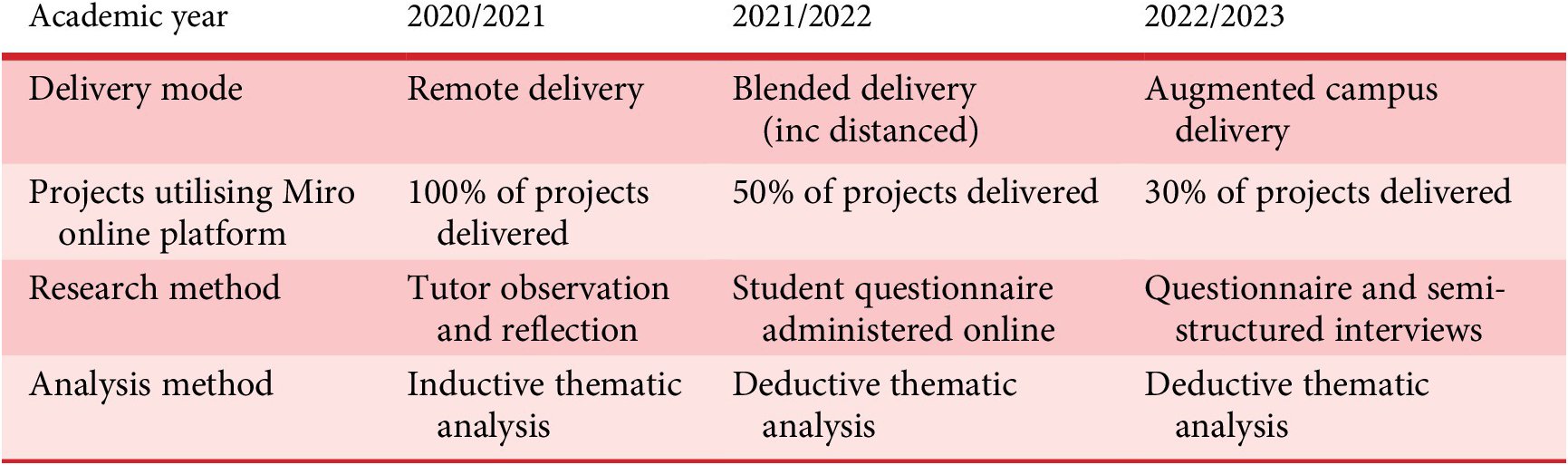
Questionnaires were selected as an established method to gather student feedback. Used in an open-ended format, questionnaires provide respondents with the opportunity to add depth and contextualise their answer or viewpoint. This format enabled the data to be first quantified and then thematically analysed to more clearly interpret responses and reveal any underlying commonalities. Braun & Clarke (Reference Braun and Clarke2006) refer to this as providing semantic and latent levels of theme to an analysis. We were interested in students’ own sense of their experiences and points of view; therefore, our analysis here was driven by the research questions and considered a deductive approach (Table 1).
Details the three phases of research, refined use of Miro and research methods
3.1. 2020/2021 academic year
Upon the rapid shift to online delivery, this phase of study considers the ways in which Miro had been utilised to mirror the concept of the studio. Reflecting on five projects that utilised Miro between November 2020 and April 2021. Miro was used as a platform to structure teaching delivery, share creative content and as an environment to generate dialogue among students. Projects followed a common delivery pattern, each comprising phases of research, ideation and presentation of final outcomes; however, the utilisation of Miro in each project was different, affording differing types of engagement.
3.2. 2021/2022 academic year
The identification of mirroring characteristics within the digital studio environment highlighted within the 2020/2021 study revealed a potential to be utilised either when campus-based teaching is required to be delivered remotely or as part of a blended delivery. Therefore, identifying symbiotic relationships between platforms such as Miro and the physical design studio environment in this phase of the study explored how a blended approach could usefully support on campus (often socially distanced) learning.
3.3. 2022/2023 academic year
Utilising the analysis of student reflections within the 2021/2022 study and following a full return to campus teaching with no distancing restrictions, a refined application of Miro was implemented to support specific learning activities identified as benefiting from digital augmentation.
4. The studies and results
4.1. 20/21 Remote studio year
Findings taken from an initial study of remote delivery experiences conducted by Spruce, Thomas, & Moriarty (Reference Spruce, Thomas and Moriarty2021).
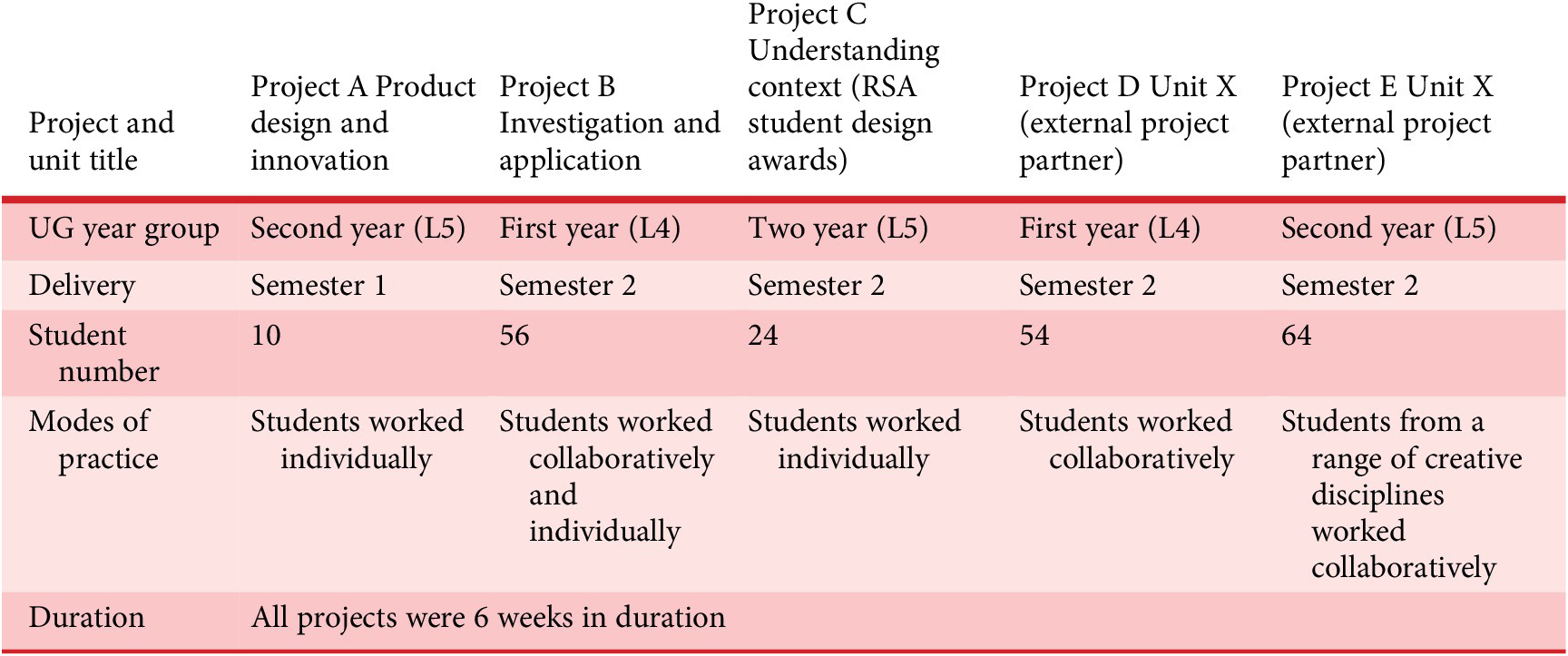
To consider the ways in which Miro might be utilised to both mirror and transform the concept of the studio, we reflect on five projects that utilised Miro between November 2020 and April 2021. In September 2020 (semester 1), we were thrown into the position of having to rapidly transition from teaching in person to teaching online. In the case of first year students, this was their introduction to both University life and the course. Our initial response to this was to use the collaborative tools provided and recommended by the University – MS Teams and our existing VLE Moodle. After completing the initial 6-week unit with students, it was evident that while MS Teams provided an adequate medium for communicating with students, it lacked the capacity to emulate the experience of design studio pedagogy. At this point, we sought to use Miro to complement MS Teams, seeking to make the shift from sharing a screen, to the experience of sharing a space by creating a more robust analogue of traditional studio practice. Miro was used as a platform to structure teaching delivery, share creative content and as an environment to generate dialogue among students. The projects delivered across our first and second year undergraduate units were broadly similar in terms of scope, following a design process comprising phases of research, ideation and the presentation of final outcomes, however the utilisation of Miro in each project was different. Table 2 lists the details for each project being delivered, while Table 3 summarises the characteristic exchanges on Miro across the different projects.
Detailing projects A, B, C, D and E utilising the Miro online platform
Characteristic exchanges

Analysis of all the unit activity in Miro established that the platform offers significant benefits in use, both in the absence of, and potentially in parallel with, co-located working. Across all the Miro spaces, we recognised that the use of these spaces quickly created rich, shared, visual repositories that reflected the different stages of the design process from research through to making. These spaces afforded opportunities for participants including staff, students and external guests, to engage with the projects and each other in new and often unexpected ways. These repositories demonstrated a permanence and accessibility that would be hard to recreate in a modern physical studio environment. A key aspect of this was the way in which the digital spaces overcame barriers that might be associated with the resources that can affect typical physical studio environments such as time, physical space and money. Participants could utilise the spaces both highly synchronously – working collaboratively at the same time, or highly asynchronous – accessing the space independently outside of structured lesson times, in effect creating a 24-hour studio space. The scale of these visual repositories was unprecedented and unachievable within a traditional physical studio environment, particularly in light of the pressures inherent in many modern art school studios wherein space is shared, and pin-up space is limited and time bound. The cost to realise this kind of visual repository in a physical environment would have been prohibitive both to the programmes and to students when considering the costs of printing imagery, post-it notes, paper, pens, markers and so forth. Furthermore, the quality of the work in the repository did not diminish over time (as perhaps a cluster of post-it notes on a wall might). Not only was it maintained in its original form without any signs of ageing, but it was also easy for it to be revisited, recategorised and remixed throughout the project with little or no impact on resources.
By observing the utilisation of these spaces, we observed the emergence of a series of new opportunities and new behaviours. In the product design domain, we identified insights in four significant areas: (1) Making the design process explicit, (2) Making the student journey visible, (3) Communities of practice and (4) Independence and Ownership.
4.1.1. Making the design process explicit
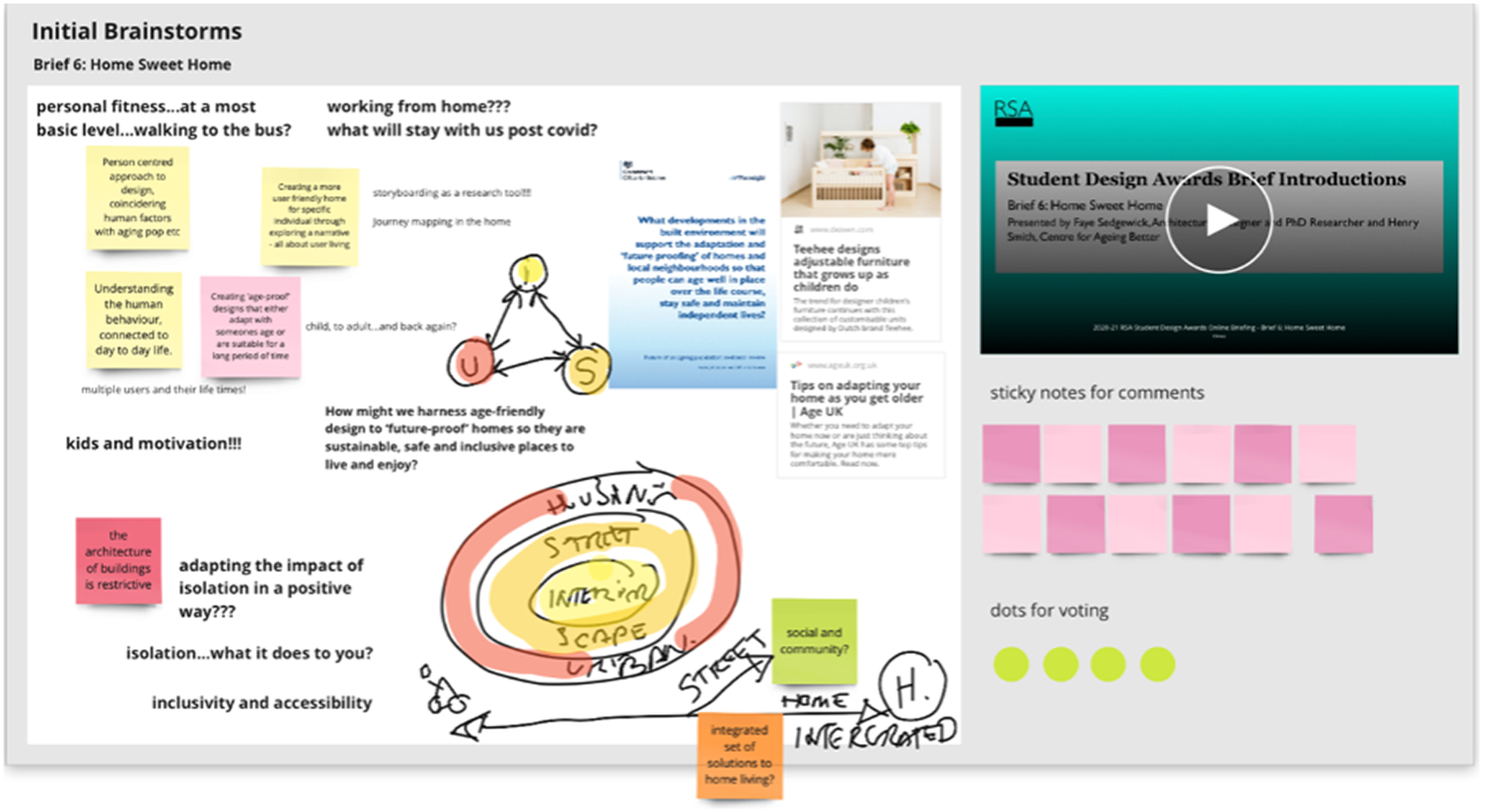
The use of Miro to locate both collaborative group activities and individual student’s projects has provided a rich visual canvas for tutors and students across all projects. In particular, the ability to visually formalise the design process emerged as a key characteristic of digital delivery. Projects C and D, shown in Figures 1 and 2 are examples of these. In such ways, these visualisations of the design process in Miro help students to make tacit design process knowledge to become codified and explicit, establishing a shared understanding and community of practice within the cohort. The visual representation of the design process in this dynamic (micro- and macro-scale) format also enabled clearer connections between methods and stages of the process to be recognised, highlighting the purpose and value of different design methods, enabling students to ‘join the dots’ of their own mental model of the design process.
Ideas generation tools utilised within the design process.

Collaboratively codifying the design process.
4.1.2. Making the student journey visible
Just as the design process was made explicit by the digital space, so too was the journey of each individual student. From initial observations and research through development to final presentation, the opportunity to chart each student’s personal journey and progress through the design process has proved highly valuable.
4.1.3. Communities of practice
Fostering a community of practice to support learning is a fundamental aim of the design studio environment and is at the heart of the social learning ethos. As we have highlighted, the capacity of the Miro space to make design processes and student learning journeys visible, shared and explicit helps to create communities with shared understandings, approaches and skills.
4.1.4. Independence and ownership
Alongside the emergence of communities of practice, we also observed students developing their own independence within, and taking ownership of, the (digital) studio space. As previously stated, the scaffold of peer learning, structured spaces and activities created a supportive environment that enabled individuality to emerge and be expressed. Individual workshop activities and peer feedback allowed the students to start to express their own identities and interpretations of the brief. These exercises were created in such a way as to provide students with their own personal workspaces analogous to those typically found in a design studio.
4.2. 21/22 Returning to campus (blended delivery)
Following the limited lifting of COVID-19 restrictions during summer 2021, many UK universities began planning a socially distanced return to campus-based delivery for the new academic year. Our emergence from remote teaching through Autumn 2021 once again reunited us with our physical studio environments, albeit with unfamiliar restrictions and a new sense of hybrid space usage. An in-person but at distance period of ‘slight return’ to campus necessitated the adoption of heavily blended approaches. The identification of mirroring characteristics within the digital studio environment revealed a potential to be utilised either when campus-based teaching is required to be delivered remotely or as part of a blended delivery. Therefore, the opportunity to utilise the beneficial experiences of remote delivery to create symbiotic relationships between platforms such as Miro and the physical design studio environment offered an exciting next step in reimagining the campus-based learning experiences. Reflecting the benefits revealed through the previous study a targeted use of digital spaces alongside campus-based delivery was planned. Continuing to offer a digital analogue to the physical design studio environment focused on providing the following things:
-
- Visualising the design process to support learning and navigation.
-
- Providing autonomy for students to develop their own working practices.
-
- Enhancing synchronous and asynchronous opportunities for peer and tutorial dialogue.
-
- Aiding self-reflection.
Table 4 details the blended campus-based projects delivered between September 2021 and March 2022, describing the targeted use of Miro boards within each project.
Blended campus-based projects
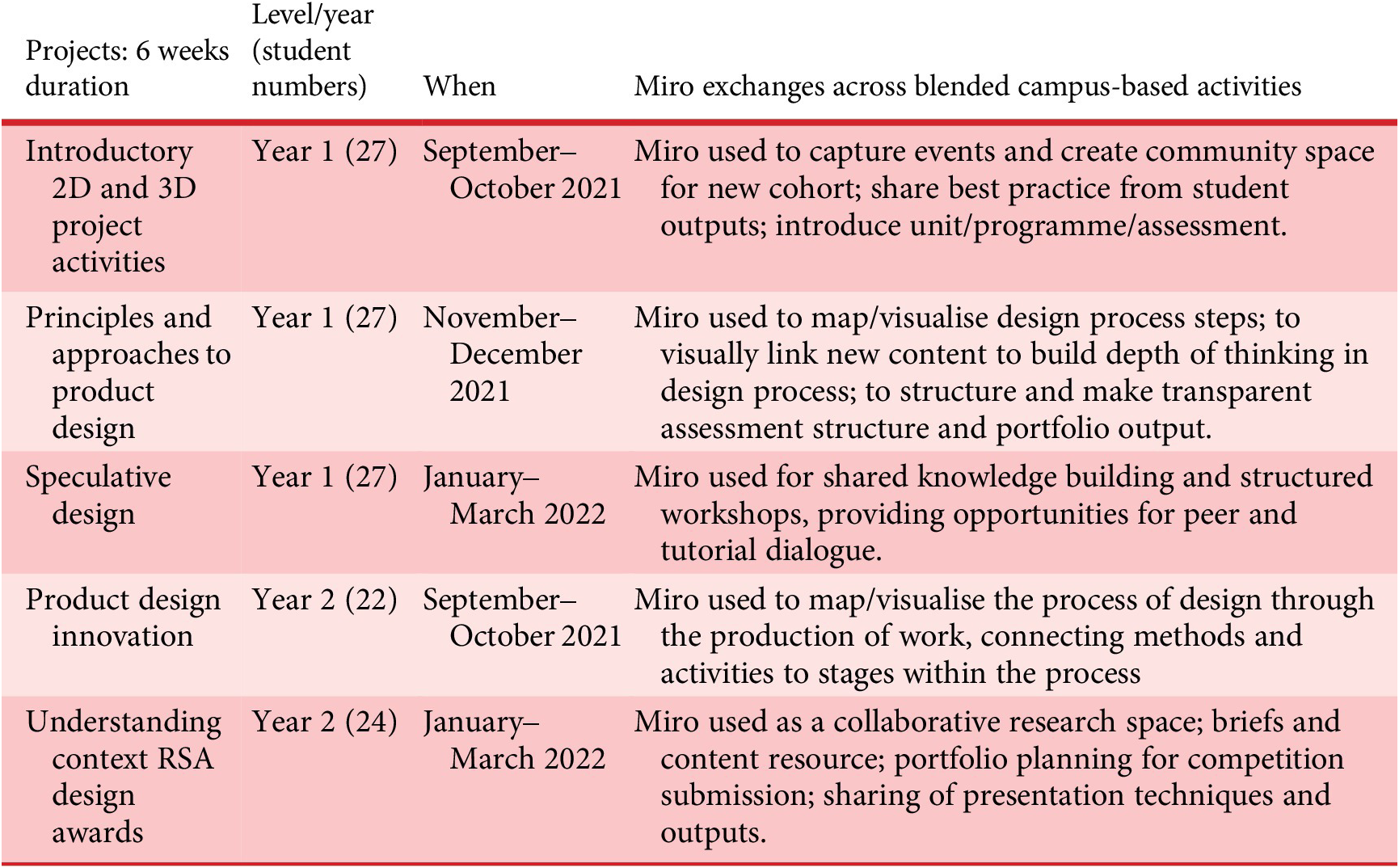
All projects followed a broadly common delivery format, consisting of lectures, taught studio activities, face-to-face tutorials, engagement with construction workshops and 3D printing.
4.3. Student feedback
Following delivery of all the projects, students were requested to participate in reflecting upon their experiences of using Miro online spaces alongside campus-based delivery. Questionnaires were administered via the Mentimeter online voting platform of which 27 anonymised responses were recorded. Specifically, students were asked to consider the relevance and usefulness (or not) of using Miro alongside campus delivery, if they enjoyed using Miro boards, if they preferred contributing to group boards or constructing their own, and to describe any benefits Miro added to their learning such as aiding self-reflection. The feedback questions were designed in correspondence with the 2021 study findings and were intended to help establish their ongoing relevance in the context of campus-based delivery. The student responses were reviewed and thematically analysed to identify common patterns in responses. A representative selection of direct quotations from respondents has been included in the question and feedback summaries below.
Question 1 asked if Miro project boards were still useful in supporting a better understanding of the design process, connecting design methods and navigation of the process visually?
Responses to this were overwhelmingly positive, comments included that “it helps to show the project broken down to better understand each part” and that “it helps show the steps of the project as we go along, and I like how it is accessible at any time.” Further comments added that “It allows us to maintain and develop a visual representation of our journey and it makes a nice temporary archive, convenient to go back for information we store on it.” The ability to use Miro boards as quick and easy reference points was highlighted frequently within the feedback comments, such as “I really enjoyed the blend physical/virtual learning that Miro provides. The online space allows me to instantly refer to or add to my work.” The comments here suggest that Miro continues to support the understanding of the design process and enables students to navigate through each stage of a project as an effective visual reference.
Question 2 asked if Miro continues to provide useful autonomy and ownership for students to construct project work and developing their own working practices?
Several comments to this question referred to personal approaches being adopted, such as “Miro for me helps in the ideation and development of projects for product design. Being able to lay out all your research in a digital format and collate everything really helps to explore ideas and progress them further.” and “I’ve created my own separate Miro space for many of the projects because it’s a space where I can organise and rationalise my thoughts and insights. I also add images of the Miro boards to my final submission boards because of this.” These comments describe an enhanced ownership and understanding of their processes and outputs, being able to communicate their individual practice through seeing their process holistically, as well as individual ‘portfolio’ boards.
Question 3 asked if Miro provides meaningful opportunities for peer and tutorial dialogue?
Many students commented on the value of “seeing what others are doing alongside your own for inspiration.” In addition, that “Miro was incredibly easy to use and very effective when sharing and communicating ideas with the rest of the class” so that “Multiple people can collaborate with each other on the same board by adding ‘post its’.” It was also recognised that “it is what other professionals said they use, when they have come in for talks” and that “Miro boards are a great way to share learning and they are also good for keeping track of work – for example, organisation.” Further comments highlighted that “it benefits our learning and also helps us visualise different key lessons or lectures.” This feedback highlights an appreciation of seeing peers’ work during a project. It also suggests that key points from lectures are being revisited asynchronously to help individuals embed their learning. Being able to relate to visiting professionals who also describe working on Miro suggests that using this ‘industry standard’ platform builds confidence in the students’ sense of career readiness and employability skills.
Question 4 asked if Miro is a useful aid for self-reflection?
Comments here highlighted a holistic view of Miro, such as how “It is best used when reflecting on projects” and that “When submitting final portfolios, the Miro boards are great to refer back to.” “Miro has significantly contributed to my learning by providing a space where I can organise and collate my thoughts. I like that it’s a virtual space, meaning that those insights are saved in the space, so I can also add notes or refer to previous ones.” Being able to revisit Miro project boards during projects suggests that students are reflecting upon their work and work of peers as a part of their practice.
Analysis of all the respondents’ feedback revealed three prominent themes: Understanding the design process, Organising and Saving work, Supporting creative thoughts and actions.
First, understanding the design process through its visual representation in the Miro spaces helps students to view their process as a whole ‘project picture’ and enables students to see clearer connections between phases of the process project content.
Second, the convenience of saving, collation and organisation of work were considered highly valuable. Familiarity and confidence with the platform enabled the building of project work as-you-go, creating habits of reviewing content and the ability to re-construct and review their own progress.
Third, support creative thoughts and actions by sharing work in progress, facilitating collaboration through and across projects as their practice is now much more visible, not just at presentation points, students can be seen ‘live’ (via cursors) reviewing their work and that of their peers throughout projects.
Although it is evident through the delivery of projects included in this study that not all students fully engaged in using the Miro platform alongside their campus-based activities, no negative feedback was received regarding its use. The feedback also reiterated the desire among students to align their practices to the professional world. Using Miro as a sharing platform and live linking with external industries throughout projects created a professional mode of practice in which the students can build identity and feel confident in a space where their outputs can be seen by industry partners at any time. Although it is evident that embedding Miro into large numbers of projects has created various editing, access and ownership issues as the number of boards has grown over time. The auditing and longer-term stewardship of boards will need to be addressed as part of its continued use.
While the return to campus-based delivery across many universities was welcomed by staff and students alike, the experiences of remote delivery and the accelerated use of distributed working technologies stimulated an examination of established norms across the sector. As highlighted by Gray (Reference Gray, Lockton, Lenzi, Hekkert, Oak, Sádaba and Lloyd2022), this allowed a once in a generation questioning of our established pedagogic practices. How should we learn from our experience and take advantage of the tools that are now available to reconsider what design studio education could be and how remote tools can continue to offer diversity in design approaches, as usefully highlighted by Moses et al. (Reference Moses, Wojciechowski, Daly and Sienko2023).
4.4. 22/23 Embedding augmented studio delivery and learning
Learning from the blended approach of 2021/2022 and committing to a full campus augmented approach with online digital tools within the product design programme, academic projects were designed and delivered using the collaborative whiteboard tool Miro within an on-campus design studio setting. This allowed further exploration and critique of the parameters of utilising online tools to enhance and enrich the programme’s teaching and learning pedagogy. Table 5 details the augmented campus-based projects delivered between September 2022 and March 2023, describing the targeted use of Miro boards within each project.
Augmented campus-based projects
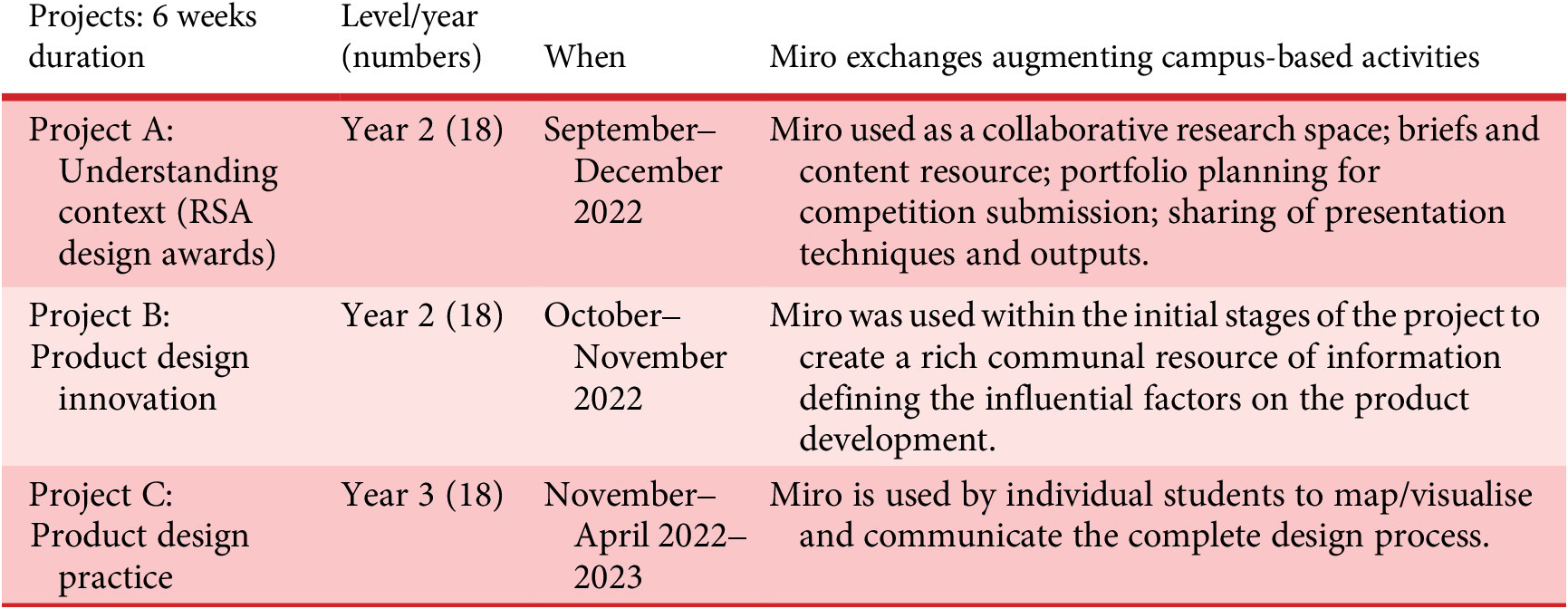
All projects followed a broadly common delivery format, consisting of lectures, taught studio activities, face-to-face tutorials, engagement with construction workshops and 3D printing.
Project A is a ‘live’, complex, multi-brief and multi-stakeholder competition project that is externally written and requires students to engage with external partners throughout. The class Miro board design had to accommodate a range of content required to tackle each brief, from primary stakeholder networks to timetabled tasks, and was designed in a series of ‘zones’ for the students to navigate and utilise during the project (see Figure 3). A key ‘zone’ was a social repository of primary and secondary research findings sourced by tutors, students and stakeholders to inform these complex, wicked briefs, none of which have a known pre-conceived product output. This research ‘zone’ enables students to ‘get smart quick’; it is collective and can be used asynchronously, remaining a mediated pristine archive. The project was delivered with weekly pre-recorded lectures accessed asynchronously by the students (via a link on Miro) that included tasks for the students to consider, engage with and then complete in the physical design studio. The tasks completed in the studio were uploaded at the end of each session for peer and tutor review and asynchronous reflection and action.
Asynchronous online workshop tasks, preparing for studio-based activity.

Project B is a design for manufacture project, requiring students to design a lighting product and specify the design for manufacture. Using Miro in the initial stages of the project enabled the students to bring together several influential factors on their product development. The students were able to share their awareness of product typologies/categories and document their analysis of the large number of lighting products made available to them in the studio. The Miro space provided group insights and discussion around the various situational needs and uses of light within the domestic environment, as well as the wide variety of the light sources available, as shown in Figure 4.
Collecting visual typologies.

They were also able to share information about various production and manufacturing processes available within the university workshops, and the Miro board rapidly became a rich communal resource and repository of information, which enabled them to accelerate the connections made between materials and functions and their personal visual influences, provided in the form of a mood board. As the students moved into the drawing (2D) and model-making (3D) phase of the project, the use of Miro declined and activity returned and focussed on the physical studio/workshop spaces.
Project C is a final, self-directed design project to initiate and deliver an extended design project that responds to personal design ambitions and visions. This project requires creative synthesis of critical, analytical and practical skills combined with an independent, resourceful and responsive approach to practice. Miro boards are owned and designed by the student to support and communicate their design process and demonstrate their design thinking and critical decision making throughout the project. An example of this is shown in Figure 5.
Student generated self-directed Miro board.

4.5. Student feedback
Following delivery, all 36 students who had been engaged with the projects described were asked to reflect upon their experiences of using online digital tools (Miro) alongside campus-based delivery. Specifically, students were asked how Miro continued to support student learning in their augmented, physical studio practice; what aspects of the online tool did they benefit from using in their journey of becoming a designer (from the least to the most) and did the students feel confident in sharing their work with others using an online tool. The questions were designed in correspondence with the authors’ 2022 paper findings and were intended to critically define where online learning tools can be most effectively used in the context of campus-based delivery. The student responses were reviewed and thematically analysed. To articulate the responses coherently, a representative selection of direct quotations have been included in the questions and feedback summary below.
Question 1: How do you think augmented digital tools support your on-campus physical studio practice?
In Level 5, 100% of students agreed that Miro supported their studio design practice. Students describe Miro as a “great tool for collaborative work.” Miro was used to share research, as “a collective area to display my work” and a space to “see other’s work and to give and get feedback”. In supporting asynchronous studio practice, Miro is seen as “extremely convenient to use in and outside of Uni, allowing communication with peers and lecturers” and is also regarded as a relevant industry standard tool “as guest speakers say they use it in practice.” The content and layout on Miro boards have supported student project management, enabling students to “refer back to” content, “to organise my work in a structured timeline” and “a good gateway into finding a workflow that suits me.”
In Level 6, where Miro has been selected by students as an online design tool in the self-directed project, 88% agreed that Miro supported their studio design practice. The students describe Miro as “great for laying out work and mind mapping stuff” and have used the tool as a way “to organise work in one space that was easily accessible on both pc and phone”. Students noted that Miro provided a platform to digitise work and in doing so could enable virtual collaboration throughout a project. Students’ design process practice has been supported as Miro “allows us to see the process visually” which has “made evaluating and finding gaps within my process a lot simpler”. Collaboration on Miro is described as “an easy to access platform to see notes and previous work that can be used between students” and when student work is posted onto a project Miro board, “it helps to see your work alongside your classmates, where everyone is at and what you need to achieve”. A small percentage of students have found Miro “one-dimensional and disconnected” and have not used it post lockdown, preferring the “organic and adaptive approach” of face-to-face tutorials in the physical studio.
Question 2: What benefits you the most/least when using Miro as a tool for supporting your process of becoming a designer? Why?
Students find Miro to be “easily accessible software” with tools that are “quick to learn” and templates that “support the design process”. The least beneficial aspects of the software are that it can “lag sometimes and crash” if there is a lot of uploaded content and it is “easy to accidentally move other people’s work around” resulting in Miro spaces that “can get overcrowded and untidy quite quickly”. There is limited access to boards because of university subscription constraints and this has resulted in students “losing access to work” or leaving them “unable to edit boards.”
Students see the benefit of Miro as a mediated archive, “it highlights the process of each project, an identifier to the workload achieved” and “incredibly useful to store information that I can later go through to create my portfolio”. Miro provides a space for whole projects to be viewed, which was seen as a benefit by most learners, “to have my work in a singular space allows my work to feel structured but not constrained” and “the infinite scale of the page has been the most useful as the board grows as you expand research or idea generation”. In comparison, other learners did not like the design of the space, “it should be linear, it can be overwhelming if you’re feeling unorganised. I don’t work very well with things spread out like Miro, it makes it hard for me to visualise things and move forward”.
Miro benefits students in accessing the work of peers “seeing others work lets me get better ideas for my own work and how to improve” and in getting feedback, “it’s good for tutors to remotely view and correct your work/progress”. However, some students prefer on-campus feedback, finding that Miro “can disconnect you from the physical project. During the design process, I would rather have feedback in person than use an interface”.
Miro has also revealed reflective benefits, “it allows me to lay out my research to then go through and choose which information to include or not,” and provides evidence of habitual choices “it is the obvious software I would use to collate and reflect on research”.
Question 3: Do you feel confident in sharing your work online with peers or external stakeholders?
Sharing work with peers or stakeholders is a fundamental aspect of the design process, with feedback from others used to challenge, clarify and build upon content the student has curated. Then, 45% of Level 5 students shared that they felt confident sharing work with peers, believing that “it is important for designers to feel confident sharing their work, and Miro helps to make work look more presentable”. Gibbons writes that “sharing unfinished work is naturally uncomfortable and often generates tension (Gibbons Reference Gibbons2016) which was reflected within 18% of the student feedback who experienced “fear of judgement”, and feelings of anxiety “it makes me feel anxious as I always feel my work is being judged by others”. There is also nervousness from Level 5 students about sharing work, one student commenting that he “had other students copy my work on their boards in the past”, whereas in Level 6 students found using peer content “effective at gaining inspiration”.
In Level 6, 60% of students have confidence that using Miro to communicate with external stakeholders enables students “to navigate my process and explain my work a lot easier” and is a “good tool to share work with peers or outsider parties if you can’t access them in person”. Students understand that online digital portfolio tools are used in the design industry, but there are a range of feelings around confidence in use, from “I can do it, I can’t say I’m confident” (20% of respondents stated they were not sure of their confidence) to “it can be tricky and hard to share your work online if you’re insecure or are less confident about your work” (20%of respondents stated they were not confident).
Students have shared that they “see it as a platform for thinking, not presentation” and that “I feel confident in sharing a personal board but less confident in using a shared board as it can feel comparative”. Feedback revealed that students have more confidence in presenting self-directed boards as “I can be selective about what I display. Knowing that I am displaying I will put more effort in as I want to present work that I feel is up to a certain standard”.
Analysis of the respondents’ feedback revealed four prominent themes of Miro use; Collective mediated archive; Habitual visualising and development of the design process; Defining technical requirements from online professional portfolio tool and Collaborative, social practice of feedback.
First, utilising Miro as a collective mediated archive enables students to access primary and secondary research from one platform. This visual research overview provides a ‘get smart quick’ gateway into their project plus opportunities for students to see links between data. In projects where students are required to add to the research content via tasks, feedback from students suggests that more mediated organisation needs to be developed to avoid boards becoming “overcrowded and untidy”.
Second, the habitual visualising and development of the design process enables Level 5 students to collaborate on tutor-designed boards that visualise the design process. Students experience how the design process evolves through a project, how their content impacts on the design process, and ultimately allows them to select the content they most value to inform their design ideas. In Level 6, students adapt their own design process within self-directed projects, and most have chosen to use Miro to structure and communicate their design processes.
Third, students have defined the technical requirements they require from Miro. They recognise that online tools are an industry requirement and appreciate that their work can be seen by external stakeholders, peers and tutors during projects. However, issues remain with editing, ownership, auditing and stewardship of boards (as highlighted in 2021/2022 study) which will need to be addressed as part of its continued use.
Fourth, students value the collaborative, social practice of feedback, where there are students who state that sharing work for feedback can feel like “being judged by others”, students understand that it is “important for designers to feel confident sharing their work.”
Gibbons (Reference Gibbons2016) advises that “critiques will only prove beneficial if there are unambiguous boundaries for what can and should be critiqued” and that facilitation can “foster an efficient, honest feedback loop”, so a clearer facilitated framework for the purpose of critiques could improve the student experience of sharing work for feedback.
5. Synthesis and discussion
This section aims to synthesis the results of student feedback and analysis from the three phases of research study, 2021–2023. Highlighting the most beneficial areas for online-tool application across a design curriculum, relative advantages and disadvantages and points for discussion identified within the broader context of post-COVID design studio-based teaching delivery.
5.1. Collaborative learning content to tackle complex, wicked design problems
Across the studies through lockdown, blended to augmented, Miro has provided space to foster a community of practice. With a return to campus, Miro has become a defined space where our student community can find and engage with project content in a single, communal space. As agenda-led projects, often complex and wicked, increasingly drive our curriculum, Miro is a communal, live space to support our students to get smart quick, with project content generated and curated by tutors then accessed, built upon and shared by students.
5.2. Visualisation of the design process
The capacity to visualise the design process, making the student journey visible and dynamically navigating through projects within the digital Miro space has been transformative to many students’ understandings of the processes and methods they use. Visualisation of the design process enables the creation of digital scaffolds within which to experiment with modes of thinking and index design methods. This visual process has generated a greater sense of awareness of their own learning journeys, which leads to the habitual use of Miro by students to support their independent projects and communication of their adapted design process as they complete their degree education and begin their design career.
5.3. Organisational and reflective tool
Throughout the studies, Miro has been regarded as a highly valuable tool for the organisation of student work, allowing a structured, scaffolded approach to project work, enabling students to take ownership of their digital portfolio space, although the mass of information and its layout can be overwhelming for some learners. Accessing Miro during timetabled studio time or asynchronously, students have demonstrated sticky behaviour, revisiting the communal archives of Miro to reflectively make the connections to express their own interpretations of the brief.
Across the studies, the software benefits remain (ease of use, collaborative industry tool) but the software limitations remain problematic (lagging, work loss, edit rights and subscription).
5.4. Feedback tool
Miro is a collective space providing the opportunity to compare student projects and progress and to gain feedback between students, tutors, peers and external stakeholders. Throughout the studies, feedback on Miro has been viewed as integral to student development; however, the anxiety of uploading work for critique and fear of judgement cannot be ignored. Moving forward, the removal of this hurdle within the student learning experience will need to be addressed for critiques on campus as well as online, developing unambiguous rules of engagement, with the “ultimate goal of improving a design, not simply judging a design” (Gibbons Reference Gibbons2016).
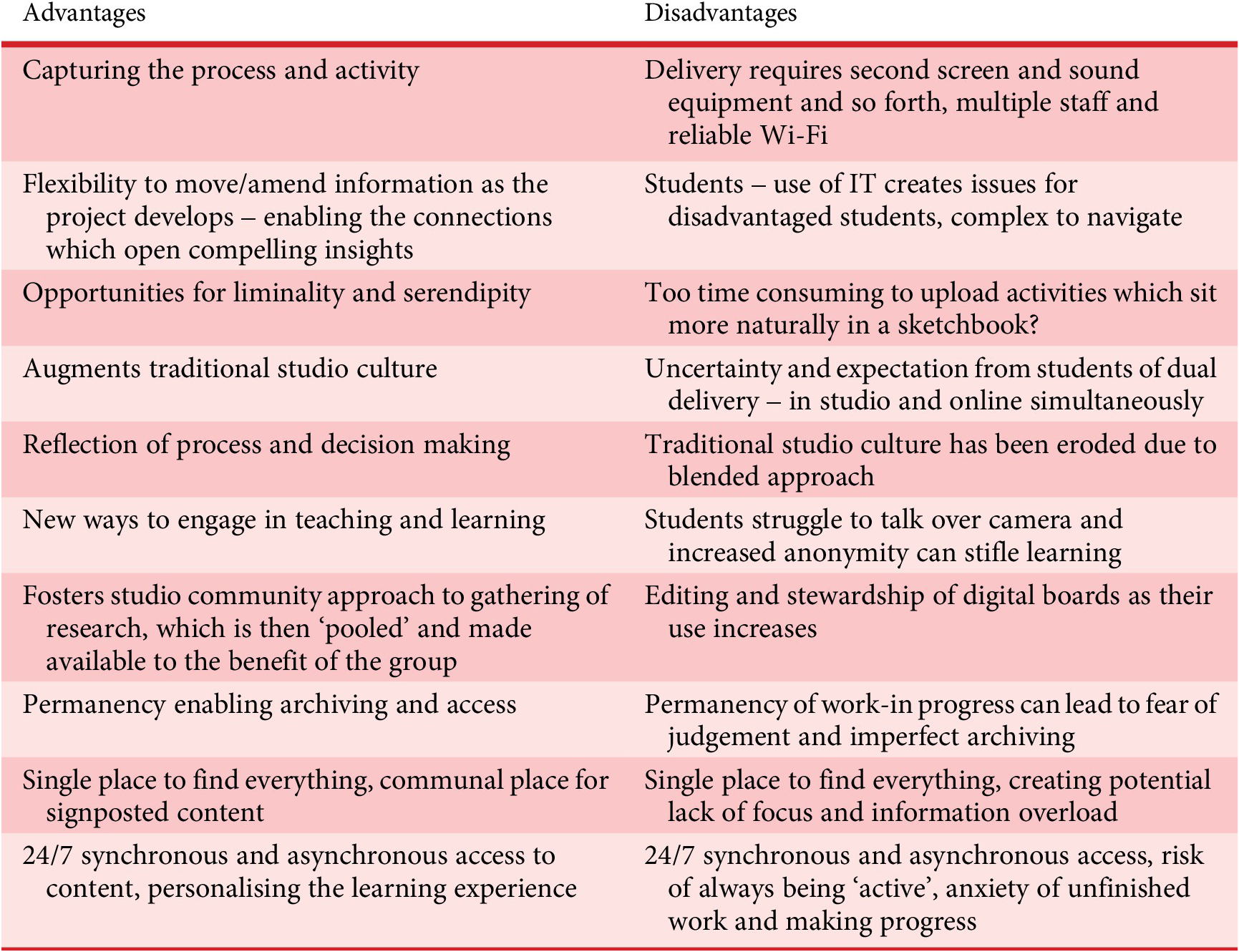
Key points from the synthesis of research findings can be visualised in Table 6 as an indexed comparison of advantages and disadvantages.
Indexed comparison of advantages and disadvantages
5.5. Discussion
Three years on since the emergence of the COVID-19 pandemic, its legacy may not yet be fully realised as its shock waves ripple through our world. Within the context of studio-based design education, this research study has identified how pragmatic responses to crisis modes of teaching can reveal unexpected benefits and offer ongoing value within the ‘post-COVID’ landscape. Our return to campus-based studio teaching has also revealed unexpected changes in behaviour that challenge many of the established habits and routines of the studio.
5.6. Tools
The integrated use of online platforms such as Miro, Figma and Freeform has expanded the application of teaching tools and methods of communication. These tools have enhanced how we deliver teaching and expanded the ways in which students can engage with content to support their learning. The greater diversity of access to content has also increased the criticality of our pedagogical approach, recognising student centred contexts for learning affords greater independence and flexibility for those who need it.
5.7. Choices
The post-COVID design studio has also revealed new dimensions of choice that challenge established notions of participation and modes of engagement. Choices of camera on or camera off in the early days of remote teaching due to bandwidth issues or just embarrassment has incubated a culture of ambiguity surrounding engagement and the constitution of participation. This raises fundamental challenges to the delivery of event-based activities such as studio critiques, either on campus or online, as such events yield their value from the active engagement of all participants in contributing feedback and shared dialogue.
5.8. Habits
As choice and participation have become more ambiguous in the post-COVID design studio, so many of the established habits and rituals of ‘pre-COVID’ studio culture has become fragmented and even lost. Through our experience and reflections of the past 2 years, we sense that we have left a set of established protocols behind and are still working out the new ones. In the meantime, the period of reconfiguring new habitual and routine relationships with studio practice, both on campus and online, will have an impact upon students’ learning. This echoes Shulman’s (Reference Shulman2005) identification that working out the rules of engagement reduces uncertainty and creates the time, and confidence to experiment, leading to successful learning.
This represents a period of evolution in studio-based teaching. We have yet to fully work out what the new terms of engagement are, or what they should be. However, it is clear (from our experience) that studio is not the same as it was, it has the potential to be enriched or the potential to slowly and painfully return back to its established ways, as the new practices we developed during COVID-19 recede from memory. To pursue change for the positive benefits of access, diversity and enhanced learning will require clarity of purpose to enable us to resolve definitions of choice in establishing equitable and navigable design studio cultures for the future.


 Open access

