


Background
Loneliness and social isolation are emerging public health concerns, particularly for older adults. Although currently there are no global estimates of its prevalence among older adults, the World Health Organization (2021) suggests that they are widespread. For instance, 25–29 per cent of older adults in the United States of America (USA) (Ong et al., Reference Ong, Uchino and Wethington2016), 31 per cent in England (Age UK, 2018) and 20–34 per cent in 25 European countries (Yang and Victor, Reference Yang and Victor2011) reported being lonely at least some of the time. Loneliness and social isolation have been associated with many negative health and wellbeing outcomes, including physical health problems such as elevated blood pressure, cardiovascular disease, diminished immune functioning (Holt-Lunstad, Reference Holt-Lunstad2017), poor mental health (Cacioppo et al., Reference Cacioppo, Hughes, Waite, Hawkley and Thisted2006), lower cognitive health (Barnes et al., Reference Barnes, De Leon, Wilson, Bienias and Evans2004; Ellwardt et al., Reference Ellwardt, Aartsen, Deeg and Steverink2013), increased morbidity and mortality (Holt-Lunstad et al., Reference Holt-Lunstad, Smith, Baker, Harris and Stephenson2015) and diminished quality of life (Jakobsson and Hallberg, Reference Jakobsson and Hallberg2005). The COVID-19 pandemic also highlighted loneliness and social isolation issues due to the restrictions in physical contacts required by public health mitigation measures such as physical distancing and lockdown.
The intersection of population ageing and immigration has made the older population ethnically and culturally diverse in many high-income countries (HICs), such as the United Kingdom (UK), USA, Canada and Australia (Torres, Reference Torres2015). Older adults from ethnic minority communities or with immigration backgrounds (hereafter referred to as ethnic minority/immigrant older adultsFootnote 1) are one subgroup of the ageing population that may be at higher risk of loneliness and social isolation. They may encounter double jeopardies based on their old age and minoritised group status as ethnic minorities/immigrants (Dowd and Bengtson, Reference Dowd and Bengtson1978; Carreon and Noymer, Reference Carreon and Noymer2011; Chatters et al., Reference Chatters, Taylor and Taylor2020). Apart from sharing common ageing-related risk factors with all older adults, such as limitations in mobility, the loss of loved ones, increased health problems and decreased cognitive functioning (Kemperman et al., Reference Kemperman, van den Berg, Weijs-Perrée and Uijtdewillegen2019), having migrated to a new country or being an ethnic minority may add an additional layer of complexity to ethnic minority/immigrant older adults’ experiences of loneliness and isolation. Some unique risk factors of loneliness and social isolation that ethnic minority/immigrant older adults may encounter include linguistic isolation (Jang et al., Reference Jang, Yoon, Park, Park, Chiriboga and Kim2021b), acculturation (Gierveld et al., Reference Gierveld, Van der Pas and Keating2015), a broken social convoy (Park et al., Reference Park, Jang, Lee, Ko, Haley and Chiriboga2015), lack of social trust towards the host communities (Djundeva and Ellwardt, Reference Djundeva and Ellwardt2020), racism and marginalisation.
A number of articles have reviewed literature on older adults’ experiences of loneliness and/or social isolation in general, for instance, about risk factors (Pinquart and Sörensen, Reference Pinquart and Sörensen2003; Ejiri et al., Reference Ejiri, Kawai, Ishii, Oka and Obuchi2021; Dahlberg et al., Reference Dahlberg, McKee, Frank and Naseer2022), consequences (Boss et al., Reference Boss, Kang and Branson2015; Holt-Lunstad et al., Reference Holt-Lunstad, Smith, Baker, Harris and Stephenson2015; Courtin and Knapp, Reference Courtin and Knapp2017) and interventions (Cattan et al., Reference Cattan, White, Bond and Learmouth2005; Dickens et al., Reference Dickens, Richards, Greaves and Campbell2011; Gardiner et al., Reference Gardiner, Geldenhuys and Gott2018; Fakoya et al., Reference Fakoya, McCorry and Donnelly2020). However, only a few review articles focus on experiences of individuals from ethnic minority/immigrant communities. Some of these focus on specific ethnicities, like the reviews by Zhao et al. (Reference Zhao, Holroyd, Garrett, Wright-St Clair and Neville2023) and Syed et al. (Reference Syed, McDonald, Smirle, Lau, Mirza and Hitzig2017) on Chinese older adults living in Western societies, or Shorey and Chan’s (Reference Shorey and Chan2021) review on Asian older adults living in Asian or Western countries. Others are confined to a single country context, as seen in the review by Johnson et al. (Reference Johnson, Bacsu, McIntosh, Jeffery and Novik2019) within the Canadian context. The review by Salway et al. (Reference Salway, Such, Preston, Booth, Zubair, Victor and Raghavan2020) extends beyond the ethnicity and geography limitations; it includes all age groups and focuses primarily on interventions for ethnic minority/immigrant people.
In distinction from prior reviews, this review amalgamates all the following components: (a) a focus on the older age group; (b) the focus on different ethnicities and varying immigration backgrounds; (c) coverage of multiple HIC contexts; and (d) an all-encompassing range of loneliness and social isolation aspects (including contributing factors, consequences and interventions). Thus, this scoping review comprehensively examines the extent and characteristics of empirical studies focused on loneliness and social isolation of ethnic minority/immigrant older adults. Through this review, we aim to offer readers a repository of available studies on this topic, aiding them in locating research that aligns with their interests and informational needs. Furthermore, we also aim to facilitate a more profound understanding of the topic’s landscape and contribute to advancement of scholarship by identifying gaps in the existing evidence base. Another noteworthy contribution is the creation of a multi-dimensional socio-ecological map illustrating the factors contributing to loneliness and social isolation of ethnic minority/immigrant older adults. The map draws inspiration from ecological systems theory (Bronfenbrenner, Reference Bronfenbrenner1992), multi-dimensional framework (Harms, Reference Harms2010) and ecological model for health promotion (McLeroy et al., Reference McLeroy, Bibeau, Steckler and Glanz1988). The factors gleaned from the existing empirical research were categorised into general and ethnicity/immigration-specific factors, then mapped across five dimensions (i.e. individual, relationship, community, structural and cultural dimensions) with an embodiment of place and time.
Method
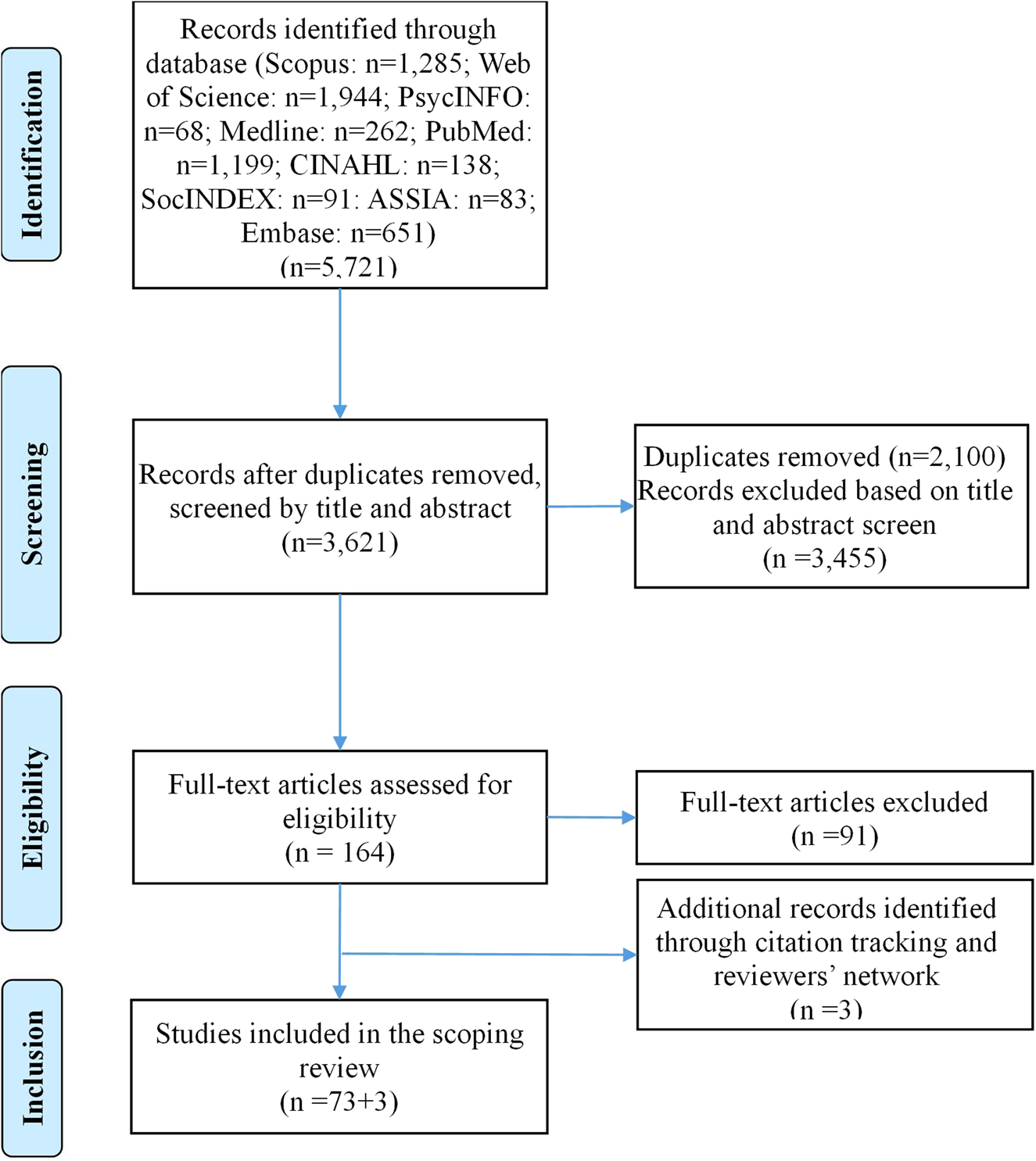
Both scoping reviews and systematic reviews share several procedural similarities, yet their purposes and applications diverge. Munn et al. (Reference Munn, Peters, Stern, Tufanaru, McArthur and Aromataris2018: 3) suggest that a systematic review is the most valid approach if the authors aim to address clinically meaningful questions and inform practice. This review’s purpose is to map the extent and characteristics (scope) of scholarship rather than synthesise the evidence, which is a scoping review’s strength. Furthermore, a systematic review is suited to synthesising evidence on a specific and well-defined research question while a scoping review is more appropriate for mapping a potentially large and diverse body of literature on a topic area that includes a greater range of study designs and methodologies (Arksey and O’Malley, Reference Arksey and O’Malley2005; Pham et al., Reference Pham, Rajić, Greig, Sargeant, Papadopoulos and McEwen2014). The subject of loneliness and social isolation among ethnic minority/immigrant older adults is a broad and complex realm because of the intricate relationship between the two concepts, their varied definitions and measurements, the multi-faceted nature of their contributing factors, and the heterogeneity of ethnic minority/immigrant communities. A scoping review emerges as the most fitting method, aligned with the purpose of the review and the diverse landscape of the topic. This review, guided by Arksey and O’Malley’s (Reference Arksey and O’Malley2005: 22) methodological framework, encompasses five key stages: (1) identify the research questions; (2) identify relevant studies; (3) study selection; (4) chart the data; and (5) collate, summarise and report the results. The reporting process follows the PRISMA extension for Scoping Reviews (Tricco et al., Reference Tricco, Lillie, Zarin, O’Brien, Colquhoun, Levac, Moher, Peters, Horsley and Weeks2018) (for the checklist, see S7 in the online supplementary material; for the study screen and selection process, see Figure 1).
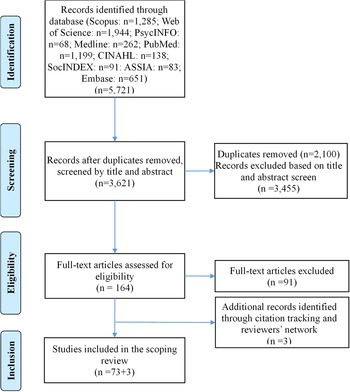
PRISMA flow diagram.
Stage 1: Identify the research questions
Although evidence shows that loneliness and social isolation are two distinct concepts (Valtorta and Hanratty, Reference Valtorta and Hanratty2012), they are correlated (Taylor, Reference Taylor2020), share some overlapping risk factors (Cattan et al., Reference Cattan, White, Bond and Learmouth2005) and are sometimes used interchangeably (Gardiner et al., Reference Gardiner, Geldenhuys and Gott2018). Therefore, we included both loneliness and social isolation in this review. We did not predefine the definitions of loneliness and social isolation, as establishing how scholars understand these concepts in their empirical research is one important part of this review. This review aims to address the following research questions:
(1) What is the extent, range and nature of the existing empirical studies on loneliness and social isolation among ethnic minority/immigrant older adults residing in HICs?
(2) What are the limitations and gaps in this evidence base?
(3) What is known from the existing empirical evidence regarding the contributing factors to loneliness and social isolation among older adults with ethnic minority/immigrant backgrounds?
Stage 2: Identify relevant studies
With the guidance of an expert librarian, we searched nine electronic databases: Scopus, Web of Science, PsycINFO, Medline, PubMed, CINAHL, SocINDEX, ASSIA and Embase. Boolean terms ‘OR’ and ‘AND’ were applied to combine our population group of interest and loneliness and social isolation. We conducted the literature search in December 2021. S1 in the online supplementary material shows the detailed search terms and final search strategy for each database. The search results were exported into Excel. The electronic database search was supplemented by scanning reference lists of included studies. This process is employed to minimise the possibility of missing potentially relevant studies.
Stage 3: Study selection
Studies were included if they meet all the following eligibility criteria:
(1) Empirical studies.
(2) Published in English.
(3) Peer-review journal articles.
(4) The participants of the study include older adults (identified as older by the researchers regardless of participants’ chronological age) either from ethnic minority communities and/or with immigration backgrounds.
(5) Focus on loneliness and/or social isolation as stated by the authors.
(6) Conducted in the following HICs: European countries (including the UK), the USA, Canada, Australia and New Zealand.
(7) Any publication dates.
(8) Any type of research design.
Peer-review journal articles undergo a rigorous process of assessment and critique which is particularly important when the quality appraisal of included studies is not taken. However, we acknowledge the exclusion of grey literature (e.g. reports, policy and government documents, news, etc.) as a potential limitation of this review. The HICs of focus were selected due to their status as destinations for immigrants and their culturally and ethnically diverse ageing populations. The conceptualisation of ‘older adults’ varies among researchers from different disciplines and within diverse societal and country contexts, which may also evolve over time. Therefore, we do not restrict participants based on a specific chronological age. Instead, participants are included in the review if they are identified as ‘older adults’ by the researchers conducting the respective studies. We acknowledge the complex and sometimes overlapping nature of the terms ‘ethnic minority’, ‘race’ and ‘immigrant’, which also vary in meaning and preference across different country contexts. In this review, these terms are broadly applied, allowing us to account for the nuanced and diverse experiences of individuals within different cultural, social and geographical contexts. We excluded studies that solely include participants from ethnic minority or immigration backgrounds in their samples but do not provide pertinent discussions on specific aspects related to immigration and/or ethnic minority status in relation to loneliness and social isolation. Regarding the study focus criteria, studies were considered eligible if the authors explicitly state that their studies centre on investigating loneliness and/or social isolation. Studies exploring related concepts, such as living alone, social networks, social support or social connectedness, without considering loneliness and/or social isolation, are not included under this criterion.
Stage 4: Chart the data
We used narrative review (Pawson, Reference Pawson2002: 171) to chart key information. The decision on what information should be recorded was made collectively among the authors. The items of information recorded are as follows:
(1) Author(s), year of publication, discipline of the first author, country of study.
(2) Aims/research questions.
(3) Study populations.
(4) Study focus: whether the study focuses on (a) loneliness and/or social isolation; (b) ethnicity/race and/or immigration; (c) predictors or outcomes or lived experiences of loneliness and/or social isolation.
(5) Research design: (a) quantitative or qualitative; (b) method; (c) primary or secondary data source.
(6) Sample size.
(7) Definition.
(8) Measurement.
MJ extracted the above-mentioned information of each included study into a data charting form (S2 and S5 in the online supplementary material).
Stage 5: Collate, summarise and report the results
We first conducted a basic numerical analysis of the extracted data and produced tables and charts to display study characteristics, including the number of studies published each year, distribution of countries where studies were conducted, study design and their distribution, population characteristics and study focus. Thereafter, we organised the literature thematically into the following structure: definition, measurements, factors and outcomes, comparative studies of different populations, and practice and policy implications suggested by the studies’ author(s). The next section reports results following this structure.
Results
The database search yielded 5,721 articles. A total of 2,100 duplicates were removed and 3,621 articles remained. MJ screened titles and abstracts of the 3,621 articles according to the inclusion criteria and NF randomly screened 10 per cent of the titles and abstracts to check the reliability. The two authors resolved disagreement through discussion and re-reading the studies. Title and abstract screening identified 3,455 articles that do not meet the inclusion criteria and were subsequently removed. MJ screened the full text of 164 articles. Of these articles, 91 were excluded because they do not meet the inclusion criteria, leaving 73 articles. In addition, two articles were identified through reference list tracing and one article was added through manual search to capture publications from December 2021 that were not yet catalogued. Consequently, this review includes 76 articles. Figure 1 summarises this process.
Characteristics of included studies
Study context
Research interest in loneliness and social isolation of ethnic minority/immigrant older adults has increased dramatically since the 1980s. The earliest two studies were published in 1983 (Creecy et al., Reference Creecy, Wright and Berg1983; Weeks and Cuellar, Reference Weeks and Cuellar1983). Since 2011, at least two studies on this topic were published each year. We observed a significant increase in publication number between 2019 and 2021 with 32 studies published, accounting for 42 per cent of the total. Notably, 17 studies were published in 2021 alone.
Table 1 presents the study characteristics, including country context, discipline, research focus, research design and sample size. Fifty-four per cent (N = 41) were conducted in the USA, followed by Europe (21%, N = 16) and Canada (11%, N = 8). This research topic attracted researchers from diverse disciplines. The top three disciplines are health sciences (N = 20), social work (N = 19) and psychology (N = 13).
Overview of included studies’ characteristics
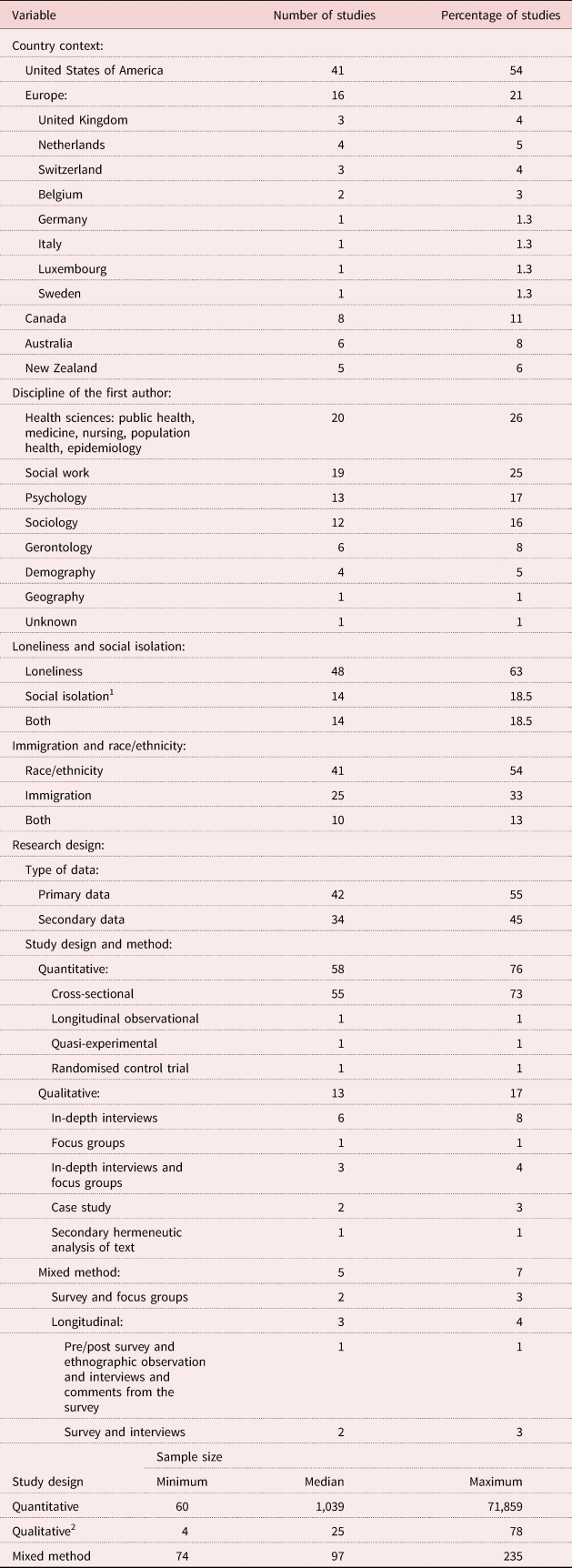
Notes: 1. One study (Jiang et al., Reference Jiang, Fung, Lay, Ashe, Graf and Hoppmann2019: 1096) examining solitude was categorised as social isolation as the study defined solitude as ‘the objective state of being alone’. 2. One study (Wright-St Clair and Nayar, Reference Wright-St Clair and Nayar2020) is excluded because its sample size is the number of quotes not participants.
Research design
The vast majority of publications in the sample (76%, N = 58) are quantitative, more specifically, cross-sectional designs (73%, N = 55) (Table 1). Only 13 studies are qualitative and five studies applied mixed methods. Four studies have a longitudinal design with one longitudinal observational study (Liu, Reference Liu2011) and three longitudinal mixed-methods studies (Hinojosa et al., Reference Hinojosa, Haun, Sberna Hinojosa and Rittman2011; Ehsan et al., Reference Ehsan, Bolano, Guillaume-Boeckle and Spini2021; Kotwal et al., Reference Kotwal, Fuller, Myers, Hill, Tha, Smith and Perissinotto2021). Forty-two studies collected primary data and 34 analysed secondary data. Regarding the source of secondary data, nearly half of the 34 studies used national databases (N = 16) (S3 in the online supplementary material).
Research focus
Sixty-three per cent (N = 48) researched loneliness, around 18 per cent (N = 14) studied social isolation and the rest researched both. Over half (54%, N = 41) focus on race/ethnicity, while 33 per cent (N = 25) concentrate on immigration, with the remainder addressing both aspects. Thirty-four focus on the predictors of loneliness and/or social isolation, 18 investigate outcomes and five are descriptions or comparisons of prevalence. In addition, 14 explore ethnic minority/immigrant older adults’ lived experiences of loneliness and/or social isolation, five examine the effectiveness of intervention programmes, and two are about the measurement validation of loneliness. S4 in the online supplementary material displays more detailed information about each study in this regard.
Population characteristics
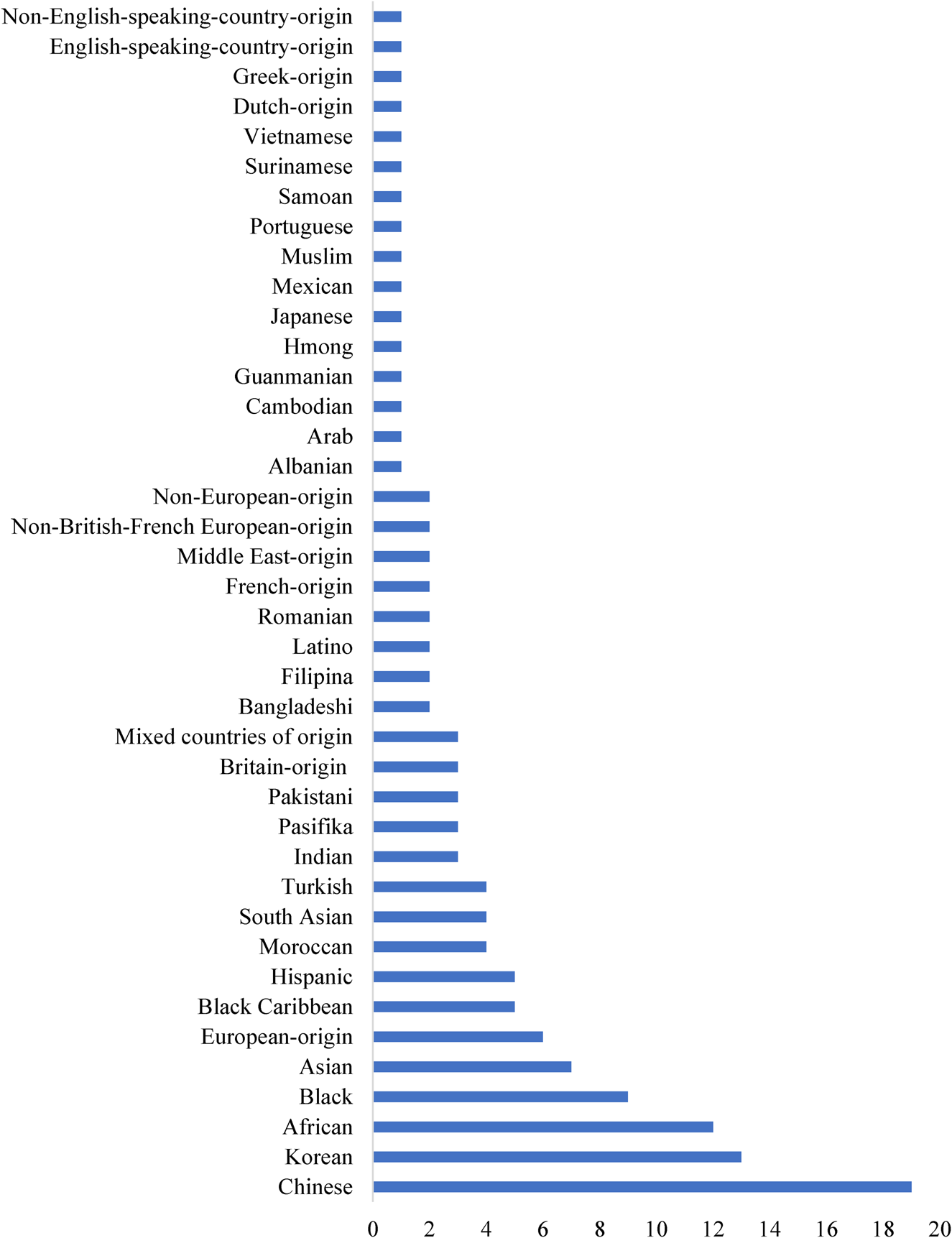
The majority (N = 47) focus on older adults from one specific racial/ethnic group (e.g. Chinese, Korean, South Asian, Black) and 28 studies have a mixed group of older adults from different racial/ethnic groups or countries/regions of origin as their samples. Overall, older adults from a total of 40 racial/ethnic groups or countries/regions of origin were studied. The most frequently researched populations are Black older adults (26 times), including both Black Africans and Black Caribbeans, followed by Chinese (19 times) and Korean (13 times) (Figure 2). To be noted that out of 12 studies that focus on Chinese older adults, seven used the same secondary data source (the Population-based Study of Chinese Elderly in Chicago) undertaken by one group of researchers. Similarly, studies that focus on Korean older adults also share some common researchers.
Ethnic minority/immigrant older populations researched in included studies.
Note: The labels of race/ethnicity in this figure were extracted as the names labelled by the author(s) in their empirical studies.
Some studies focus on specific subgroups of the ethnic minority/immigrant older population who may be more prone to loneliness or social isolation. Such specific subgroups include older Black Americans with human immunodeficiency virus (HIV) (Mannes et al., Reference Mannes, Burrell, Bryant, Dunne, Hearn and Whitehead2016; Han et al., Reference Han, Adeyemi, Wilson, Leurgans, Jimenez, Oullet, Shah, Landay, Bennett and Barnes2017), Hispanic veterans who are stroke survivors (Hinojosa et al., Reference Hinojosa, Haun, Sberna Hinojosa and Rittman2011), low-income older adults (Kotwal et al., Reference Kotwal, Fuller, Myers, Hill, Tha, Smith and Perissinotto2021; Wippold et al., Reference Wippold, Tucker, Roncoroni and Henry2021), very old Mexican Americans (aged 80 and over) (Gerst-Emerson et al., Reference Gerst-Emerson, Shovali and Markides2014), frail or at-risk-of-frail older adults (Jamieson et al., Reference Jamieson, Gibson, Abey-Nesbit, Ahuriri-Driscoll, Keeling and Schluter2018; Beere et al., Reference Beere, Keeling and Jamieson2019), late-life immigrants (Park et al., Reference Park, Morgan, Wiles and Gott2019: those immigrated at old age to join adult children; Wright-St Clair and Nayar, Reference Wright-St Clair and Nayar2020: those immigrated at 55 years and older) and older migrants with refugee backgrounds (Berthold et al., Reference Berthold, Kong, Ostrander and Fukuda2018; Ciobanu and Fokkema, Reference Ciobanu and Fokkema2021; Vang et al., Reference Vang, Thor and Sieng2021). In addition, three studies focus their research on older women: British-born and Greek-born immigrant widows (Panagiotopoulos et al., Reference Panagiotopoulos, Walker and Luszcz2013), Korean immigrants (Kim, Reference Kim1999b) and African Americans (LaVeist et al., Reference LaVeist, Sellers, Brown and Nickerson1997).
Definition of loneliness and social isolation
The majority of studies (68%) give explicit definitions of loneliness and/or social isolation. More specifically, 73 per cent of loneliness studies provide a definition. However, more than half (57%) of social isolation studies do not provide a clear definition. For studies that research both loneliness and social isolation, 79 per cent provide definitions. S5-1 in the online supplementary material lists these definitions.
The definitions of loneliness used in the included studies contain the following common key elements: subjective perception/evaluation (about), both the quality and quantity (of), social/personal/human relationships and unfavourable/unpleasant/distress/negative experiences/feelings. Five loneliness studies (Kim, Reference Kim1999b; Dong et al., Reference Dong, Chang, Wong and Simon2012; ten Kate et al., Reference ten Kate, Bilecen and Steverink2020; De Witte and Van Regenmortel, Reference De Witte and Van Regenmortel2022; Ehsan et al., Reference Ehsan, Bolano, Guillaume-Boeckle and Spini2021) acknowledge the distinction between emotional and social loneliness proposed by Weiss (Reference Weiss1973): the former is linked with emotional relationships (i.e. intimacy, meaningfulness, closeness) and the latter is connected with the number of social relationships and the frequency of social contacts. For the social isolation definition, some common key elements are: objective, measure/indicator/condition (of), lacking/no or few/absence/deprivation/minimal, both quantity and frequency, (of) social contacts/connections. However, three studies (Berthold et al., Reference Berthold, Kong, Ostrander and Fukuda2018; Morgan et al., Reference Morgan, Wiles, Moeke-Maxwell, Black, Park, Dewes, Williams and Gott2020; Koehn et al., Reference Koehn, Ferrer and Brotman2022) acknowledge the subjective components of social isolation.
Seven studies considered aspects of loneliness and social isolation definitions that are particularly pertinent to ethnic minority/immigrant older adults. Park et al. (Reference Park, Morgan, Wiles and Gott2019: 741) underscore the cultural aspect of definitions and hold the view that loneliness and social isolation ‘are based on cultural norms that do not have universal applicability’. van Tilburg and Fokkema (Reference van Tilburg and Fokkema2021) expand the definition of loneliness to include not only individual desires but also social expectations as the reference for evaluating actual social relationships. Two studies include the composition of social contacts in their social isolation definitions: Park et al. (Reference Park, Jang, Lee and Chiriboga2017) specify family and friends and Wright-St Clair and Nayar (Reference Wright-St Clair and Nayar2020) include community life involvement. This is of particular relevance when investigating the experiences of ethnic minority/immigrant older adults, as many within these communities strongly emphasise familial bonds and may also encounter unique barriers to community participation, such as language barriers and social exclusion. Furthermore, three studies include the sense of belonging in their definitions: Koehn et al. (Reference Koehn, Ferrer and Brotman2022: 1118) describe loneliness as ‘a lack of a sense of belonging or social embeddedness’; Ehsan et al. (Reference Ehsan, Bolano, Guillaume-Boeckle and Spini2021: 334) consider social loneliness as not having a sense of belonging ‘to their environment’; and Diaz et al. (Reference Diaz, Savundranayagam, Kloseck and Fitzsimmons2019: 114) see social isolation as a lack of a sense of belonging ‘socially’.
Measurement of loneliness and social isolation
S5-1 in the online supplementary material lists measurements used in each study. The most common loneliness measurements are the UCLA Loneliness Scale or its revised version (N = 23), the de Jong Gierveld Loneliness Scale (N = 15) and the single-item, self-report loneliness rating question (N = 14). Two studies measured the change of loneliness: Pan et al. (Reference Pan, Fokkema, Switsers, Dury, Hoens and De Donder2021) asked participants whether they felt more lonely because of the COVID-19 pandemic, and Victor et al. (Reference Victor, Burholt and Martin2012) asked about participants’ evaluation of loneliness in the previous 10 years and their expectations of loneliness in the next 10 years.
The measurements of social isolation are less consistent. Only four studies (Jang et al., Reference Jang, Park, Chiriboga, Yoon, Ko, Lee and Kim2016, Reference Jang, Choi, Park, Chiriboga, Duan and Kim2021a, Reference Jang, Yoon, Park, Park, Chiriboga and Kim2021b; Diaz et al., Reference Diaz, Savundranayagam, Kloseck and Fitzsimmons2019) use a standardised scale (i.e. Lubben Social Network Scale). The majority (N = 14) use an ad hoc index or a single ad hoc item. The items included in the ad hoc measurement are diverse, with social contact frequency (N = 9) as the most frequently included item, followed by living alone (N = 6) and social activity participation (N = 5) (for a full list, see S5-2 in the online supplementary material). Four studies include the subjective component of social isolation in their measurements: Tomaka et al. (Reference Tomaka, Thompson and Palacios2006) use the question ‘do you feel socially isolated’ to measure subjective/functional social isolation; Adams et al. (Reference Adams, Kaufman and Dressler1989) use the feelings of loneliness to measure affective isolation; Chatters et al. (Reference Chatters, Taylor, Nicklett and Taylor2018) use the feelings of closeness to social networks to measure subjective social isolation; and Miyawaki (Reference Miyawaki2015) use feelings of loneliness and perceived social support to measure perceived isolation.
Six studies address the suitability or limitations of measurements for ethnic minority/immigrant older groups. Two aim to assess the cross-cultural validity of loneliness measurement. Uysal-Bozkir et al. (Reference Uysal-Bozkir, Fokkema, MacNeil-Vroomen, van Tilburg and de Rooij2017) validate the de Jong Gierveld Loneliness Scale for Turkish, Moroccan and Surinamese older adults in the Netherlands. Victor et al. (Reference Victor, Dobbs, Gilhooly and Burholt2021) replicate their approach to validate the single-item question and de Jong Gierveld Loneliness Scale for Black Caribbean, Black African, Indian, Pakistani, Bangladeshi and Chinese groups in England and Wales. They question the appropriateness of measurements developed within individualism-oriented Western cultures for older adults from cultures with different values, such as familism-oriented cultures. Victor et al. (Reference Victor, Burholt and Martin2012: 70) acknowledge the challenge of loneliness measurement translation from English to other languages as ‘in some languages there is no single word that would differentiate between alone, and lonely’. Ali et al. (Reference Ali, Islam, Pillai, Kalasapudi, Mammen, Inala, Kalasapudi, Islam and Gunness2021) advocate for critical examination and comprehensive validation of loneliness or other mental health measurements in South Asian immigrant settings. Kong et al. (Reference Kong, Davitt and Dong2018) and ten Kate et al. (Reference ten Kate, Bilecen and Steverink2020) note the potential cultural desirability bias that leads to underreporting or don’t-know answers to loneliness as immigrants may consider some questions too personal and sensitive to discuss.
Factors and outcomes of loneliness and social isolation
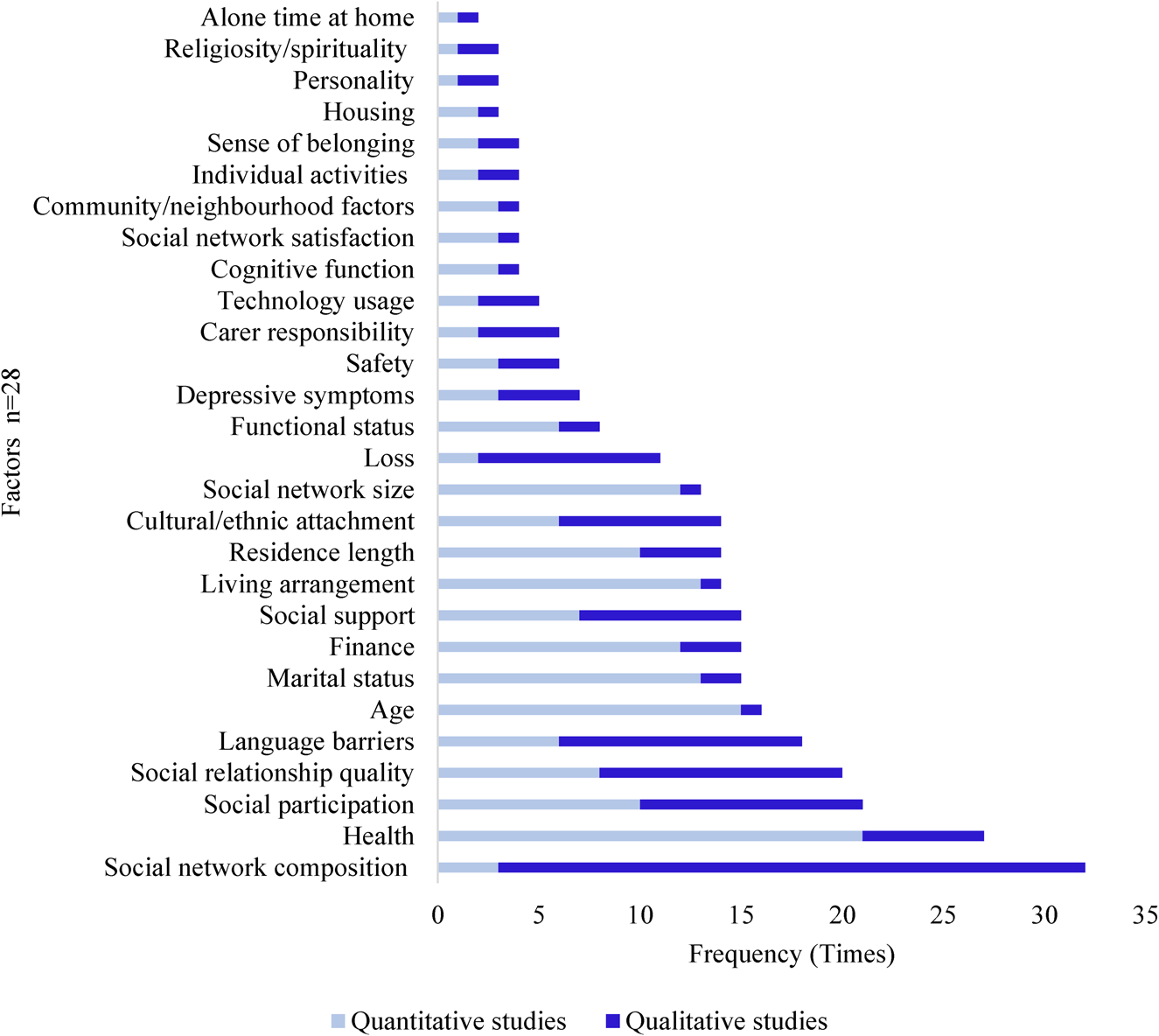
We record a total of 79 factors associated with loneliness and/or social isolation from 34 predictor-focused quantitative studies and 14 lived-experience-focused qualitative studies. Figure 3 displays the frequency distribution of 28 factors investigated in both quantitative and qualitative studies. Noteworthy variations emerge, like social network composition, receiving more attention in qualitative studies (29 occurrences) than in quantitative studies (three occurrences). Conversely, social network size is researched more frequently in quantitative studies (12 occurrences) compared to qualitative studies (one occurrence). S4-2 in the online supplementary material presents 16 predictors exclusively examined in quantitative studies and 35 factors exclusively explored in qualitative studies, providing a comprehensive overview of the research landscape. Among the quantitative studies, predictors such as gender (14 occurrences), education (13 occurrences) and social contact frequency (eight occurrences) emerge as the most frequently investigated. In qualitative studies, discrimination and transportation (seven occurrences) stand out as the most explored factors.
Frequency of factors investigated in both quantitative and qualitative studies.
In the 18 outcomes-focused quantitative studies, the top three most frequently investigated outcomes are cognitive function (Han et al., Reference Han, Adeyemi, Wilson, Leurgans, Jimenez, Oullet, Shah, Landay, Bennett and Barnes2017; Kong et al., Reference Kong, Davitt and Dong2018; Sol et al., Reference Sol, Sharifian, Manly, Brickman and Zahodne2021; Jang et al., Reference Jang, Choi, Park, Chiriboga, Duan and Kim2021a, Reference Jang, Yoon, Park, Park, Chiriboga and Kim2021b), depressive symptoms (Hinojosa et al., Reference Hinojosa, Haun, Sberna Hinojosa and Rittman2011; Park et al., Reference Park, Jang, Lee, Haley and Chiriboga2013, Reference Park, Jang, Lee and Chiriboga2017; Taylor and Nguyen, Reference Taylor and Nguyen2020) and self-rated health (Kim, Reference Kim1997; Miyawaki, Reference Miyawaki2015; Jang et al., Reference Jang, Yoon, Park, Park, Chiriboga and Kim2021b). Three qualitative studies include outcomes: use of emergency service for routine health problems (Berthold et al., Reference Berthold, Kong, Ostrander and Fukuda2018), feeling distressed and unsettled (Wright-St Clair and Nayar, Reference Wright-St Clair and Nayar2020), depressive symptoms, cognitive function and quality of life, poor health behaviour and moving to the nursing home (Dong et al., Reference Dong, Chang, Wong and Simon2012). S4 in the online supplementary material details factors and outcomes examined in each individual study.
Comparative studies of different populations
Thirty-five studies have a component of comparing loneliness and/or social isolation across different populations (Table 2). Twenty-four studies compare the differences between ethnic minority older adults and their White counterparts or between immigrant older adults and their native counterparts.Footnote 2 Two studies (i.e. Jamieson et al., Reference Jamieson, Gibson, Abey-Nesbit, Ahuriri-Driscoll, Keeling and Schluter2018; Beere et al., Reference Beere, Keeling and Jamieson2019) include loneliness prevalence differences among different ethnicities (i.e. Pasifika, Asian, European/other and Māori). Seventeen studies investigate the differences within ethnic minority/immigrant older groups, including comparisons within older immigrants but among different generations, length of settling, countries/regions of origin, ethnicities and old ages and comparisons within the same ethnicity, but among different countries/regions of origin, host and home countries, women and men, and immigrants and non-immigrants.
Studies that compare loneliness and/or social isolation between different populations
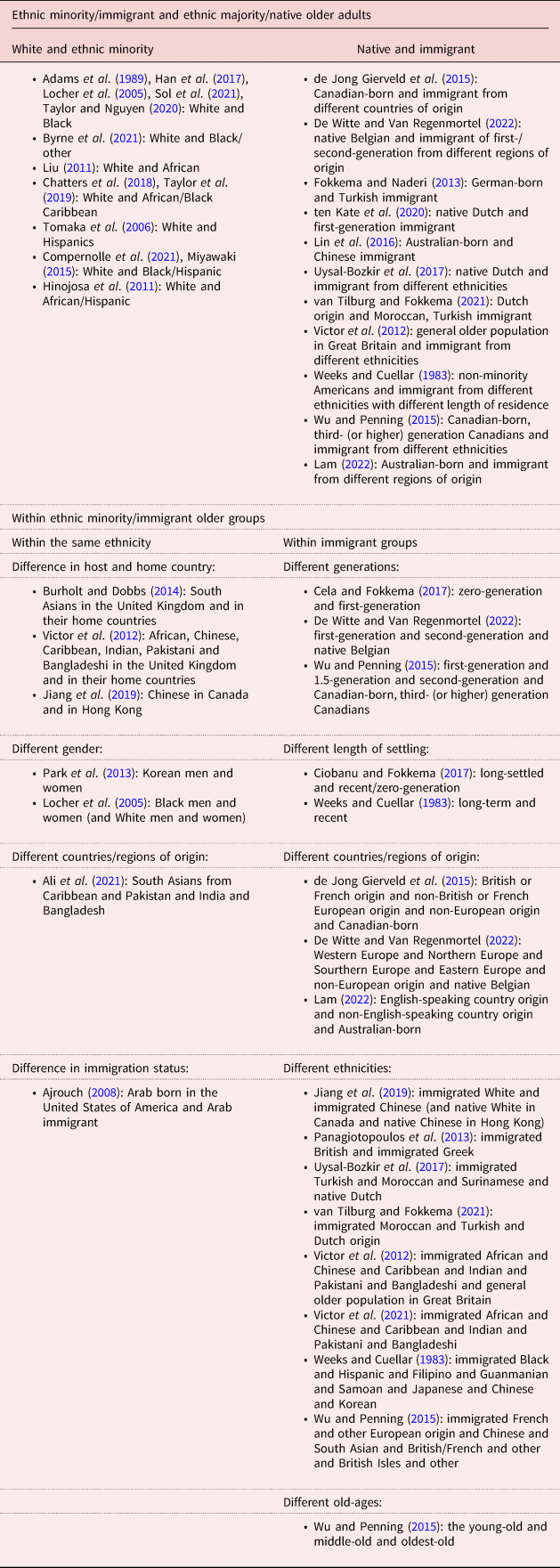
Note: Ethnicity and immigration are conceptualised and operated differently by researchers in various country contexts. Different countries also possess unique migration histories and demographic compositions. Some countries categorise immigrants based on their country or region of origin, while others use ethnic distinctions. Therefore, providing a single uniform language to describe these diverse categorisations is challenging. In this table, we have retained the language directly extracted from the included studies to reflect accurately the immigrant heterogeneity and complexity of each country’s specific context.
Theoretical frameworks employed in included studies
Fifteen studies employed theoretical frameworks to guide their analysis or hypothesis. Cela and Fokkema (Reference Cela and Fokkema2017), Gierveld et al. (Reference Gierveld, Van der Pas and Keating2015) and De Witte and Van Regenmortel (Reference De Witte and Van Regenmortel2022) applied the ecological model, which considers the contributors to loneliness and social isolation at intra-personal, inter-personal and societal levels. De Witte and Van Regenmortel (Reference De Witte and Van Regenmortel2022), Wu and Penning (Reference Wu and Penning2015), Ciobanu and Fokkema (Reference Ciobanu and Fokkema2021) and Vang et al. (Reference Vang, Thor and Sieng2021) utilised the lifecourse approach to examining the timing and duration of migration, and how early life experiences impact loneliness and social isolation in later life. Vang et al. (Reference Vang, Thor and Sieng2021) and Koehn et al. (Reference Koehn, Ferrer and Brotman2022) applied intersectionality theory to highlight the impacts of multiple forms of oppression, such as racism, sexism, classism and nativism. Other theories include Social Identity Model of Identity Change (Jetten et al., Reference Jetten, Dane, Williams, Liu, Haslam, Gallois and McDonald2018), Berry (Reference Berry and Padilla1980) acculturation strategies model (Klok et al., Reference Klok, van Tilburg, Suanet, Fokkema and Huisman2017), convoy model of social relations (Ajrouch, Reference Ajrouch2008), activity and social engagement theories (Park et al., Reference Park, Jang, Chiriboga and Chung2020), sociocultural stress and coping model (Diaz et al., Reference Diaz, Savundranayagam, Kloseck and Fitzsimmons2019), buffering hypothesis (Wippold et al., Reference Wippold, Tucker, Roncoroni and Henry2021), and discrepancy and social stratification theories of wellbeing (Burholt and Dobbs, Reference Burholt and Dobbs2014). Notably, several studies integrated multiple theories to enrich their analysis. For example, Koehn et al. (Reference Koehn, Ferrer and Brotman2022) applied an intersectional lifecourse perspective and De Witte and Van Regenmortel (Reference De Witte and Van Regenmortel2022) integrated the ecological model, psycho-social stress model and a lifecourse perspective.
Practice and policy implications proposed in included studies
Five studies examine the effectiveness of loneliness and/or social isolation interventions. Four investigated the intervention programmes that are specifically designed for ethnic minority/immigrant older adults, including peer-based interventions (Lai et al., Reference Lai, Li, Ou and Li2020; Kotwal et al., Reference Kotwal, Fuller, Myers, Hill, Tha, Smith and Perissinotto2021), intergenerational programmes (Weng, Reference Weng2019) and heritage culture group activity (Dane et al., Reference Dane, Haslam, Jetten, Liu, Gallois and Tran2020). One study (i.e. Ehsan et al., Reference Ehsan, Bolano, Guillaume-Boeckle and Spini2021) researched community-based interventions that were developed for older adults in general.
Forty-three studies, while not designed to evaluate interventions, discussed the practical or policy implications of their findings in the discussion sections. Some examples of recommended intervention are educational programmes (e.g. job, financial literacy and English training; third-age universities) (Ng and Northcott, Reference Ng and Northcott2015; Cela and Fokkema, Reference Cela and Fokkema2017; Ali et al., Reference Ali, Islam, Pillai, Kalasapudi, Mammen, Inala, Kalasapudi, Islam and Gunness2021; Koehn et al., Reference Koehn, Ferrer and Brotman2022), counselling interventions (Wang and Dong, Reference Wang and Dong2018; Liu et al., Reference Liu, Mao, Guo, Xu, Chi and Dong2021), group activities (Creecy et al., Reference Creecy, Wright and Berg1983; Park et al., Reference Park, Jang, Lee and Chiriboga2017; Pan et al., Reference Pan, Fokkema, Switsers, Dury, Hoens and De Donder2021), voluntary opportunities (Dong and Chen, Reference Dong and Chen2017), home visits programmes (Kim, Reference Kim1999b; Hinojosa et al., Reference Hinojosa, Haun, Sberna Hinojosa and Rittman2011; Ng and Northcott, Reference Ng and Northcott2015; Cela and Fokkema, Reference Cela and Fokkema2017; Park et al., Reference Park, Jang, Lee and Chiriboga2017; Berthold et al., Reference Berthold, Kong, Ostrander and Fukuda2018), peer support models (Ng and Northcott, Reference Ng and Northcott2015; Park et al., Reference Park, Jang, Lee and Chiriboga2017; Berthold et al., Reference Berthold, Kong, Ostrander and Fukuda2018; Liu et al., Reference Liu, Mao, Guo, Xu, Chi and Dong2021; Pan et al., Reference Pan, Fokkema, Switsers, Dury, Hoens and De Donder2021), internet-based social technology (Simon et al., Reference Simon, Chang, Zhang, Ruan and Dong2014; Ng and Northcott, Reference Ng and Northcott2015; Byrne et al., Reference Byrne, Anaraky, Dye, Ross, Chalil Madathil, Knijnenburg and Levkoff2021) and age-friendly communities (Weng, Reference Weng2019).
A range of recommendations for mitigating loneliness and/or social isolation, particularly relevant to ethnic minority/immigrant older adults, were proposed in the studies included in this review. Several studies suggest the importance of psychological-based strategies, such as adjusting expectations about social networks/relationships (Ng and Northcott, Reference Ng and Northcott2015; De Witte and Van Regenmortel, Reference De Witte and Van Regenmortel2022), particularly ‘dysfunctional’ expectations about family (Diaz et al., Reference Diaz, Savundranayagam, Kloseck and Fitzsimmons2019: 123). The involvement of families in interventions is highlighted as crucial. This includes facilitating families to better support older adults (Kim, Reference Kim1999a; Hinojosa et al., Reference Hinojosa, Haun, Sberna Hinojosa and Rittman2011; Dong et al., Reference Dong, Chang, Wong and Simon2012; Ng and Northcott, Reference Ng and Northcott2015; Jiang et al., Reference Jiang, Fung, Lay, Ashe, Graf and Hoppmann2019) and considering family expectations regarding older adults’ participation rate in programmes (Diaz et al., Reference Diaz, Savundranayagam, Kloseck and Fitzsimmons2019). Numerous studies stress the need for culturally competent/sensitive/appropriate programmes, services and professionals (Dong et al., Reference Dong, Chang, Wong and Simon2012, Reference Dong, Zhang and Chang2015; Simon et al., Reference Simon, Chang, Zhang, Ruan and Dong2014; Miyawaki, Reference Miyawaki2015; Dong and Chen, Reference Dong and Chen2017; Berthold et al., Reference Berthold, Kong, Ostrander and Fukuda2018; Kong et al., Reference Kong, Davitt and Dong2018; Diaz et al., Reference Diaz, Savundranayagam, Kloseck and Fitzsimmons2019; Olofsson et al., Reference Olofsson, Rämgård, Sjögren-Forss and Bramhagen2021; Vang et al., Reference Vang, Thor and Sieng2021). This includes the availability of bilingual and bicultural professionals, such as community workers, social workers and health-care professionals (Dong et al., Reference Dong, Chang, Wong and Simon2012; Miyawaki, Reference Miyawaki2015; Berthold et al., Reference Berthold, Kong, Ostrander and Fukuda2018; Vang et al., Reference Vang, Thor and Sieng2021).
Furthermore, recommendations extend to adapting general programmes to be inclusive, including inviting diverse groups in programme design (Morgan et al., Reference Morgan, Wiles, Moeke-Maxwell, Black, Park, Dewes, Williams and Gott2020), outreaching and engaging hard-to-reach and at-risk groups (LaVeist et al., Reference LaVeist, Sellers, Brown and Nickerson1997; Ip et al., Reference Ip, Lui and Chui2007; Park et al., Reference Park, Jang, Lee, Haley and Chiriboga2013, Reference Park, Morgan, Wiles and Gott2019, Reference Park, Jang, Chiriboga and Chung2020; Koehn et al., Reference Koehn, Ferrer and Brotman2022). Some studies advocate for additional support for ethnic minority/immigrant older adults to participate in programmes. Such support includes financial support (e.g. low/no-cost programmes, subsidised recreational programmes) (Diaz et al., Reference Diaz, Savundranayagam, Kloseck and Fitzsimmons2019; Koehn et al., Reference Koehn, Ferrer and Brotman2022), space (e.g. meeting places, a dedicated social centre) (Ip et al., Reference Ip, Lui and Chui2007; Ng and Northcott, Reference Ng and Northcott2015; Cela and Fokkema, Reference Cela and Fokkema2017) and transportation assistance (Creecy et al., Reference Creecy, Wright and Berg1983; Ng and Northcott, Reference Ng and Northcott2015; Cela and Fokkema, Reference Cela and Fokkema2017; Berthold et al., Reference Berthold, Kong, Ostrander and Fukuda2018; De Witte and Van Regenmortel, Reference De Witte and Van Regenmortel2022). Apart from general programmes, suggested programmes also include developing intergenerational activities (Simon et al., Reference Simon, Chang, Zhang, Ruan and Dong2014; Dong et al., Reference Dong, Zhang and Chang2015; Park et al., Reference Park, Jang, Lee and Chiriboga2017), as well as cultural programmes or co-ethnic group activities to enhance ethnic attachment (Kim, Reference Kim1999a) and maintain connectedness to ethnic roots (Jetten et al., Reference Jetten, Dane, Williams, Liu, Haslam, Gallois and McDonald2018).
Addressing structural barriers is another key recommendation. This involves allocating more resources to programmes serving ethnic minority/immigrant communities (Miyawaki, Reference Miyawaki2015; Berthold et al., Reference Berthold, Kong, Ostrander and Fukuda2018; Vang et al., Reference Vang, Thor and Sieng2021; Koehn et al., Reference Koehn, Ferrer and Brotman2022) and tackling structural issues such as health care, socio-economic inequality and community safety (Creecy et al., Reference Creecy, Wright and Berg1983; Fokkema and Naderi, Reference Fokkema and Naderi2013; De Witte and Van Regenmortel, Reference De Witte and Van Regenmortel2022; Pan et al., Reference Pan, Fokkema, Switsers, Dury, Hoens and De Donder2021; van Tilburg and Fokkema, Reference van Tilburg and Fokkema2021). Although addressed by only one study, recognising and addressing experiences of racism is also considered important, as Koehn et al. (Reference Koehn, Ferrer and Brotman2022) discuss the importance of creating discrimination-free spaces for older immigrants.
Discussion
This scoping review has mapped out the extent, range and nature of empirical research on loneliness and social isolation of ethnic minority/immigrant older adults in HIC (i.e. European countries, USA, Canada, Australia and New Zealand). We identified 76 empirical studies published between 1983 and 2021, covering prevalence, predictors, outcomes, lived experiences, intervention and measurement validation. In this section, we first map the various factors of loneliness and social isolation examined in the existing evidence into a multi-dimensional socio-ecological model and then highlight several critical gaps that should be at the forefront of future research.
A multi-dimensional socio-ecological map of loneliness and social isolation factors
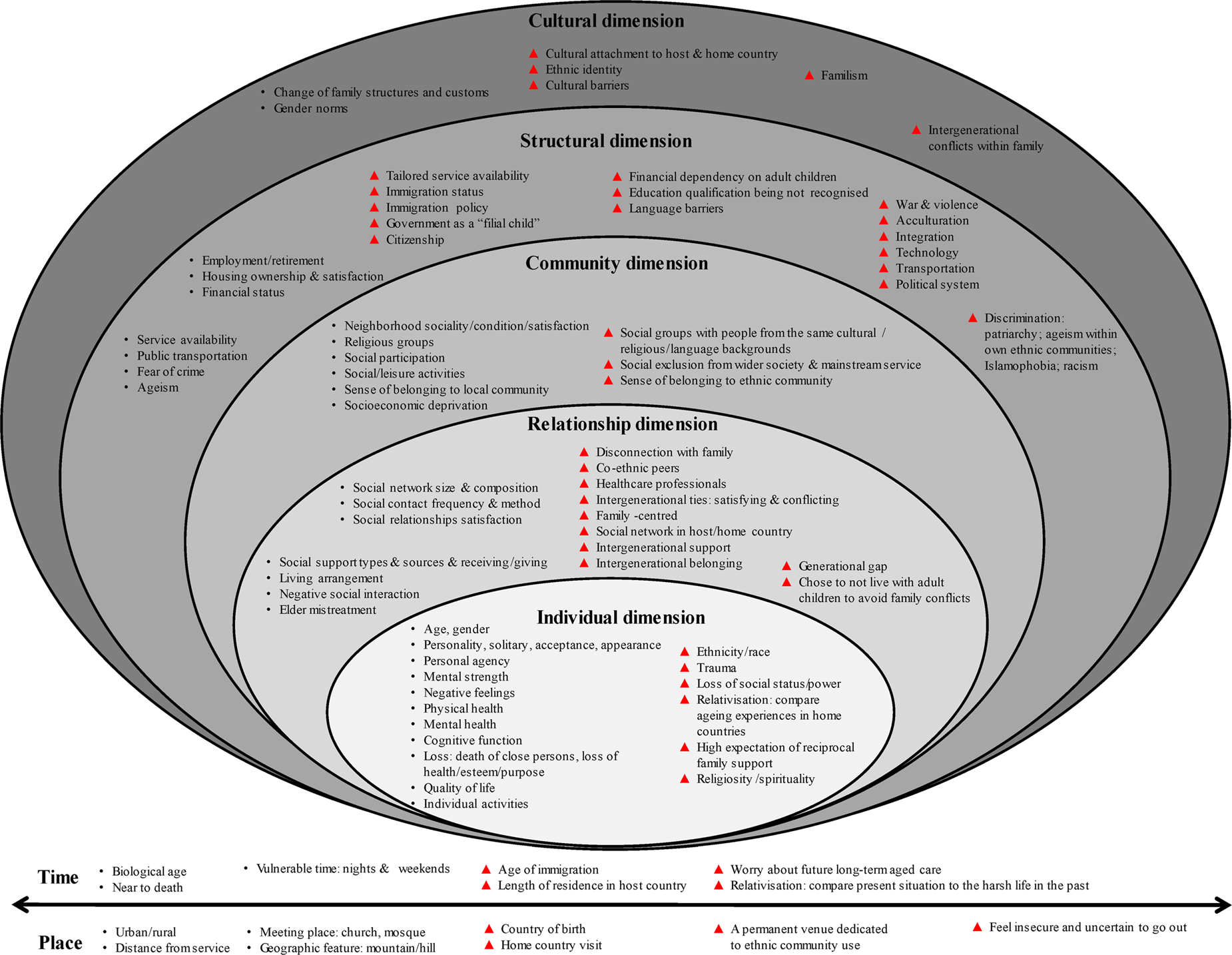
Extant research focusing on older adults in general has shown the complexity of loneliness and social isolation (Gerst-Emerson et al., Reference Gerst-Emerson, Shovali and Markides2014). The heterogeneity of ethnic minority/immigrant older populations adds another layer to this complexity. We summarised all the factorsFootnote 3 researched in the included studies and map them into an socio-ecological model involving five dimensions: individual, relationship, community, structural and cultural dimensions with an embodiment of place and time (Figure 4), informed by ecological systems theory (Bronfenbrenner, Reference Bronfenbrenner1992), multi-dimensional framework (Harms, Reference Harms2010) and ecological model for health promotion (McLeroy et al., Reference McLeroy, Bibeau, Steckler and Glanz1988). Apart from some general factors for the older population, such as poor health, loss of loved ones, social network and relationships, ethnic minority/immigrant older adults encounter specific factors that their ethnic majority/native peers are unlikely to face. General and ethnicity/immigration-specific factors intersect and impact loneliness and social isolation experiences. For instance, within the general factor of social support, older adults from some ethnic minority/immigrant communities may have a greater expectation of intergenerational social support (Dong et al., Reference Dong, Chang, Wong and Simon2012). When such an expectation is not met, intergenerational tensions and conflicts within the family, a critical risk factor of loneliness, may arise. With reference to Figure 4, we are able to address in what follows key areas of focus for future research on loneliness and social isolation of older ethnic minorities and immigrants.
Mapping factors of loneliness and social isolation into a multi-dimensional socio-economical mode.
Notes: ▴: Ethnicity/immigration-specific factors. ●: General factors. For a more detailed list of factors, see S6 in the online supplementary material.
Overlooked factors in structural and cultural dimensions
Some scholars (e.g. Johnson and Mullins, Reference Johnson and Mullins1987; Lam, Reference Lam2022) criticise loneliness literatures for often focusing on the micro level of analysis, such as the individual or relationship level, but paying less attention to the social structural factors that influence our opportunities for social contact and satisfying social bonding. Older adults’ needs and expectations for social interaction are inevitably influenced by the cultural context in which they are embedded and the cultural values they have internalised (de Jong Gierveld et al., Reference de Jong Gierveld, Dykstra and Schenk2012). Analysis of factors at structural and cultural levels might be particularly important to understand the loneliness and social isolation experiences of ethnic minority/immigrant older adults as they may face tremendous structural and cultural barriers across the lifecourse, such as racism/discrimination and cultural differences between their ethnic community/home country and the mainstream/host country. Furthermore, time and place are also closely related to older adults with immigration backgrounds. For instance, the age at migration (e.g. late-life immigrants and those who migrated when young and have aged in place), immigration generations and length of residence in the host country are all time-related factors, and country of birth, transnational networks and unfamiliarity with the environment in the host country are all place-related factors that influence their experiences of loneliness and social isolation. The multi-dimensional socio-ecological map, depicted in Figure 4, also illustrates that the structural, cultural, time and place dimensions have a higher proportion of ethnicity/immigration-specific factors. In contrast, the individual and relationship dimensions encompass predominantly general factors. This underscores the importance of paying specific attention to the factors in the structural and cultural dimensions when researching loneliness and social isolation experiences within ethnic minority/immigrant communities.
Discrimination and marginalisation, crucial factors in the structural dimension, remain significantly underrepresented in the existing evidence base. Only six qualitative studies have explored their profound impacts on the lived experience of loneliness and social isolation among ethnic minority/immigrant older adults. Their participants expressed feelings of exclusion from host or mainstream communities, hindering their ability to connect with the local community (Cela and Fokkema, Reference Cela and Fokkema2017; Morgan et al., Reference Morgan, Wiles, Moeke-Maxwell, Black, Park, Dewes, Williams and Gott2020; Wright-St Clair and Nayar, Reference Wright-St Clair and Nayar2020; Koehn et al., Reference Koehn, Ferrer and Brotman2022). Importantly, the adverse effects of racism experienced earlier in life persistently affect the social wellbeing of ethnic minority/immigrant people as they age (Cela and Fokkema, Reference Cela and Fokkema2017; Vang et al., Reference Vang, Thor and Sieng2021). Additionally, it is important to recognise that ethnic minority/immigrant older adults do not experience racism in isolation; rather, they often face an intersection of multiple forms of discrimination, such as racism, ageism, gender-based and language-based discrimination (Salma and Salami, Reference Salma and Salami2020; Vang et al., Reference Vang, Thor and Sieng2021). While several quantitative studies (Vancluysen and Van Craen, Reference Vancluysen, Van Craen, Motmans, Cuypers, Meier, Mortelmans and Zanoni2011; Lee and Turney, Reference Lee and Turney2012; Visser and El Fakiri, Reference Visser and El Fakiri2016), encompassing various age groups, have demonstrated a positive association between discrimination and loneliness, our review did not reveal any quantitative studies on this factor specifically focusing on the older ethnic minority/immigrant population. Considering the different eras in which older generations have navigated life, the experiences of racism and other forms of discrimination among older ethnic minority/immigrant adults are likely distinct from those of younger generations, suggesting this gap in the research should be rectified. It is crucial to capture the unique discrimination experiences of ethnic minority/immigrant older adults. This includes examining potential intersections of racism, ageism and other forms of oppression, as well as the multilevel manifestation of discrimination (e.g. internalised, interpersonal, institutional and structural), and delving into the mechanisms underlying the negative effects of such experiences on their social wellbeing in later life.
Need for more qualitative and longitudinal studies
The existing evidence base predominantly comprises quantitative cross-sectional studies that have provided valuable insight into loneliness and social isolation among ethnic minority/immigrant older adults. However, there is a need for more qualitative research to capture the depth, complexity and contextual richness of their experiences. Additionally, it lacks longitudinal studies to establish causal relationships and track changes over time. These approaches, together, can enable a comprehensive understanding that encompasses both depth and breadth, enhancing our ability to inform targeted interventions and policies.
The predominance of quantitative studies in this topic, while informative, presents certain limitations that warrant more qualitative investigations. We need them to delve into facets of ethnic minority/immigrant older adults’ experiences that can be challenging to capture through quantitative approaches. For instance, this review finds that factors such as social network composition, social relationship quality and discrimination experiences have primarily been explored through qualitative lenses. Furthermore, qualitative studies offer the opportunity for in-depth exploration and rich interpretations for why and how questions (Silverman, Reference Silverman2013). For instance, quantitative studies have identified language proficiency as an associated factor with loneliness and social isolation. However, it is through qualitative studies that we gain access to the intricate narrative surrounding language barriers: how it reduces older adults’ confidence to venture out on their own, which lowers their self-esteem (Ip et al., Reference Ip, Lui and Chui2007); how it stops older adults from participating in mainstream programmes, making them feel socially excluded from the wider society and causing a feeling of inferiority and lacking a sense of belonging (Berthold et al., Reference Berthold, Kong, Ostrander and Fukuda2018). More qualitative studies are needed to learn how ethnic minority/immigrant older adults make sense of and attach meaning to their loneliness and social isolation experiences.
Of the quantitative research, the vast majority of studies are cross-sectional. Although their contribution is important, especially considering the overall scarcity of empirical research on loneliness and social isolation that focuses on ethnic minority/immigrant older adults, we need a significant expansion of research efforts through the inclusion of longitudinal studies in this field. Longitudinal studies can unveil the temporal dynamics of loneliness and social isolation, allowing exploration of trajectories, transitions, and the causal relationships between these phenomena and various countributing factors (Dahlberg et al., Reference Dahlberg, McKee, Frank and Naseer2022). This temporal dimension is particularly relevant when examining the experiences of ethnic minority/immigrant older adults whose adjustment and acculturation process may evolve over time. It is noteworthy that many of the national datasets employed in the included studies, such as the General Society Survey, the Health and Retirement Study, and the Survey of Health, Ageing and Retirement in Europe, are longitudinal surveys. An increased emphasis on longitudinal studies, particularly harnessing existing national datasets, should be a research imperative to advance our comprehension of loneliness and social isolation among ethnic minority/immigrant older adults.
Exploring longitudinal qualitative research (LQR) is another promising avenue. LQR is well-suited to uncovering experiences of loneliness and social isolation through a lifecourse perspective, which includes identifying critical transitional time-points and identifying factors that support or undermine such transitions (Tuthill et al., Reference Tuthill, Maltby, DiClemente and Pellowski2020). It allows us to delve into the coping mechanisms and resilience of ethnic minority/immigrant older adults to combat loneliness and isolation. By combining quantitative and qualitative longitudinal data, we gain powerful insights into contextulised causation, processes and outcomes. This integrated longitudinal approach can inform policy and practice recommendations aimed at preventing or reducing loneliness and social isolation within ethnic minority/immigrant communities, which should be a crucial component of future social policy and intervention research agendas.
Defining and measuring loneliness and social isolation in ethnic minority/immigrant older populations
The appropriateness of loneliness and social isolation’s concepts and measurements for ethnic minority/immigrant older adults is rarely investigated. Feelings of loneliness and isolation are culturally constructed (Wang and Dong, Reference Wang and Dong2018) and the ageing process is also culturally embedded (King et al., Reference King, Lulle, Sampaio and Vullnetari2017). More research needs to explore whether definitions and measurements that developed based on individualism-oriented Western countries are able to capture adequately the experiences of older adults from other cultural backgrounds (e.g. familism-oriented culture).
The current definitions of loneliness and social isolation are contestable with recent research arguing for the investigation of their culturally specific aspects. As Park et al. (Reference Park, Morgan, Wiles and Gott2019: 741) argued, loneliness and social isolation are based on ‘cultural norms that do not have universal applicability’. For instance, older adults from family-oriented cultures may place more importance on intergenerational relationships whereas disconnection from contemporary society may be more unfavourable for older adults from Western societies (Fokkema et al., Reference Fokkema, De Jong Gierveld and Dykstra2012). The inclusion of belongingness in definitions (Diaz et al., Reference Diaz, Savundranayagam, Kloseck and Fitzsimmons2019; Ehsan et al., Reference Ehsan, Bolano, Guillaume-Boeckle and Spini2021; Koehn et al., Reference Koehn, Ferrer and Brotman2022) holds particular relevance for ethnic minority/immigrant individuals who may face unique challenges related to fitting into host communities or maintaining connections with their countries of origin. Further research, akin to the study of Park et al. (Reference Park, Morgan, Wiles and Gott2019), is crucial to empower ethnic minority/immigrant older adults to articulate their own interpretations of loneliness and social isolation, and to enable them to define what elements are most significant for their social wellbeing.
The measurement of loneliness in the included studies predominantly employed the UCLA Loneliness Scale, the de Jong Gierveld Loneliness Scale and a single-item self-report loneliness rating question. Investigations into the suitability or limitations of using these measurements for ethnic minority/immigrant older adults were notably scarce. Respondents may be reluctant to admit to feelings of loneliness, influenced by the negative connotations associated with loneliness, which might lead to an underestimation of loneliness prevalence (Pinquart and Sorensen, Reference Pinquart and Sorensen2001). While social desirability bias exists in the general population, it might be even stronger among ethnic minority/immigrant community members. This could be attributed to some cultural beliefs, such as shame linked to mental health issues and the perception of masculinity that may deter men from seeking help. The UCLA Loneliness Scale and the de Jong Gierveld Loneliness Scale have been cross-culturally translated and adapted to various countries and societies (e.g. Korea, Iran, Greece, China, Turkey, Spain and others). Systematic reviews by Alsubheen et al. (Reference Alsubheen, Oliveira, Habash, Goldstein and Brooks2023a, Reference Alsubheen, Oliveira, Habash, Goldstein and Brooks2023b) provide a thorough examination of these cross-cultural validations. However, these validation efforts typically involve participants residing in their home countries. People who migrated internationally residing in HICs occupy a unique cultural space, straddling both the culture of their home country and that of the host country in which they have settled. This dual cultural affiliation can result in distinct interpretations and understandings of loneliness, which may diverge from those of their peers who have not embarked on international migration. Our review revealed only two studies that validated the de Jong Gierveld Loneliness Scale in older immigrants (Uysal-Bozkir et al., Reference Uysal-Bozkir, Fokkema, MacNeil-Vroomen, van Tilburg and de Rooij2017) and ethnic minority older groups (Victor et al., Reference Victor, Dobbs, Gilhooly and Burholt2021) residing in HICs. Given the intricacies of ethnic minority/immigrant older adults’ experiences, the application of these scales to this unique demographic warrants specific consideration and further research.
Similar challenges confront the measurement of social isolation. The diversity of social isolation measurements introduces an additional layer of inquiry regarding their appropriateness for capturing the experiences of ethnic minority/immigrant populations. For instance, gauging the size of social networks, while a common approach, may not fully encapsulate the nuances of isolation experiences among these groups. Some may find themselves surrounded by their family members, yet concurrently experience a sense of isolation from their ethnic communities (Cela and Fokkema, Reference Cela and Fokkema2017) and the wider host community (Salma and Salami, Reference Salma and Salami2020). It might be contentious to pinpoint a specific social isolation conceptualisation and measurement. Nevertheless, we advocate for scholars to engage in thoughtful consideration of the unique cultural, familial and societal contexts that ethnic minority/immigrant older adults navigate when measuring their social isolation experiences.
Call for more between- and within-group studies and more attention on ‘super-minority’ groups
Ethnic minority/immigrant older adults are a heterogeneous group. The volume of between- and within-group studies (e.g. variations between older adults from different ethnicities or between older immigrants with different immigration backgrounds and within a specific ethnicity or within a particular immigration group) is low. We identify the lack of research on some subgroups which hold intersectional social positions and thus may be more prone to loneliness and social isolation, which deserves more attention from the research and practice communities.
The label ‘ethnic minority/immigrant’ covers a heterogeneous group of older adults. As observed in this review, 76 studies include older adults from 40 racial/ethnic groups or countries/regions of origin. Apart from the diversity of ethnic and cultural backgrounds, various immigration factors, such as immigration generation, motives for immigration, the age at immigration and length of residence in the host country, make their loneliness and social isolation experiences highly heterogeneous in later life. The need to acknowledge the heterogeneous ageing trajectories of the ethnic minority/immigrant older population has been raised in the literature (Phillipson, Reference Phillipson2015; Torres, Reference Torres2015; Hunter, Reference Hunter and Westwood2018; Ma and Joshi, Reference Ma and Joshi2022). We must go beyond a simple ethnic minority–White dualism or immigrant–native dichotomy when researching any ageing experiences. Findings from this review reflect such trends: these empirical studies look at not only the comparison between ethnic minority and White older populations or between immigrant and native older populations but contrast experiences between and within ethnic minority/immigrant older groups.
Some included studies focus on specific subgroups of the ethnic minority/immigrant older population, shedding light on the intersection of ethnic minority or immigration status with other factors, such as gender, health issues (e.g. HIV, stroke, frailty), socio-economic status (e.g. low-income) and age (e.g. very old age). However, the volume of such research is low. The multifaceted and multi-dimensional factors (as mapped in Figure 4) of loneliness and social isolation add another layer of complexity to the plurality of ethnic minority/immigrant older populations. Furthermore, some subgroups that hold intersectional social positions are largely missing in the existing empirical evidence base. For instance, older adults who are members of both ethnic minority and LGBTIQ+ communities, ethnic minority/immigrant older adults with disabilities, older adults with more disadvantaged immigration backgrounds (e.g. refugees, asylum seekers, irregular immigrants), older adults from White minority communities (e.g. Irish, Cypriots, Jews, Gypsies), to name a few. Such subgroups could be viewed as ‘super-minority’ (Salway et al., Reference Salway, Such, Preston, Booth, Zubair, Victor and Raghavan2020: 93) and more prone to loneliness and social isolation. They deserve more attention considering their intersectional vulnerabilities.
More practice-oriented research to inform intervention development
More practice-oriented research is needed to inform intervention development. We need more evaluation efforts to understand questions such as which already-proven loneliness and social isolation intervention programmes are also effective for ethnic minority/immigrant older adults, how the intervention programmes for older adults in general should be adjusted to meet the needs of ethnic minority/immigrant older adults, and what intervention programmes are explicitly designed for ethnic minority/immigrant older adults and how effective these programmes are.
As awareness of loneliness and social isolation grows, interventions to prevent or address these issues among older adults seem to be multiplying. Academic interest in the effectiveness of these interventions is also increasing (Fokkema and Ciobanu, Reference Fokkema and Ciobanu2021). However, investigation on loneliness and social isolation interventions for ethnic minority/immigrant older adults is lacking. Whether interventions that are designed for the older population in general are effective or sufficient for older adults from ethnic minority/immigrant communities remains questionable. One study (Ehsan et al., Reference Ehsan, Bolano, Guillaume-Boeckle and Spini2021) included in our review evaluates community-based interventions that were developed for older adults in general and, indeed, finds some institutional barriers, such as intentionally wanting to recruit participants who can speak French (i.e. the local language), that constrain immigrants from participating.
While the majority of included studies provided practical or policy implications for combating loneliness and social isolation, it is important to note that these recommendations, as summarised in the Results section, were suggested by the authors based on their empirical findings and have not undergone validation as interventions. Our review discovered only five studies that evaluated the effectiveness of intervention programmes. There is a critical need for more evaluation efforts jointly by researchers and practitioners to understand which types of intervention programmes are truly effective in addressing loneliness and social isolation among ethnic minority/immigrant older adults.
Conclusion
This scoping review provides, for the first time, application of a comprehensive search strategy and inclusion criteria to map out empirical research on ethnic minority/immigrant older adults’ loneliness and social isolation experiences. Our review identified 76 empirical studies on this topic from a variety of disciplines across multiple country contexts. This has revealed a multitude of factors of loneliness and social isolation – some specific to ethnic minority/immigrant older adults and some general – which we have mapped into a multi-dimensional socio-ecological model that can be used as a guide for future research. Given the complexity of loneliness and social isolation, coupled with the heterogeneity of the ethnic minority/immigrant older population, the existing evidence base is limited, and many gaps remain. There is an urgent need for further investigation into the structural and cultural dimensions that influence older adults’ opportunities for social contact and satisfying social bonding – an aspect frequently overlooked in the current literature. We need multiple methods, particularly more longitudinal and qualitative studies, to capture both the depth and breadth of such diverse experiences of loneliness and social isolation among ethnic minority/immigrant older adults. Another notable research gap identified is the necessity for culturally sensitive and appropriate definitions and measurements of loneliness and social isolation. Future studies could prioritise between- and within-group analyses, going beyond a simple ethnic minority–White dualism or immigrant–native dichotomy, and pay special attention to ‘super-minority’ groups that may be at heightened risk. Lastly, there is a distinct call for more practice-oriented research aimed at informing the development of targeted interventions, ensuring that the findings from scholarly inquiries translate into meaningful strategies for improving the social wellbeing of ethnic minority and immigrant older adults. Future scoping reviews to monitor the development of the evidence base will be essential given the increasing population of ethnic minority/immigrant older adults living in HICs and the growing awareness of social and health inequalities within ethnic minority/immigrant and older populations.
Supplementary material
The supplementary material for this article can be found at https://doi.org/10.1017/S0144686X24000205.
Acknowledgements
The authors would like to thank the University of St Andrews Library services for helping in developing the search string and identifying databases.
Author contributions
MJ led the conceptualisation, design and writing of this review. MJ conducted the literature search, short-listed the studies, analysed the literature and drafted substantive sections of the review. NF checked the reliability of title screening step. NF and JMH supervised each step of the review and provided substantial contributions to interpretation of data and critical revision of the intellectual content.
Financial support
This work was supported by the UK Economic and Social Research Council (PhD research grant reference number ES/P000681/1).
Competing interests
The authors declare no competing interests.
Ethical standards
This article did not collect empirical data so ethical approval was not required.


 Open access

