


INTRODUCTION
In their Reference Holman, Merolla and Zechmeister2022 American Political Science Review article and its Corrigendum (Reference Holman, Merolla and Zechmeister2024), Holman, Merolla, and Zechmeister (hereinafter, HMZ) show that terrorism in the United Kingdom did not produce the well-known “rally ’round the flag” effect (Mueller Reference Mueller1970; Reference Mueller1973) for U.K. Prime Minister Theresa May. Utilizing the British Election Study (BES), which happened to be in the field when the Manchester Bombing occurred in May 2017, they compare respondents interviewed just before and after the bombing and show that public support for May decreased. They supplement this unexpected event during survey design (UESD) (Muñoz, Falcó-Gimeno, and Hernández Reference Muñoz, Falcó-Gimeno and Hernández2020) with a difference-in-differences analysis that further indicates May’s approval fell. Based on their findings, they call for a gendered revision to the theory of the rally ’round the flag effect, arguing that international terrorist attacks may produce slumps for women leaders rather than bumps as they do for men because of gendered ideas about women’s (in)ability to lead in times of crisis.
In this article, we assess HMZ’s argument by reproducing and extending their analyses. We show that once a linear time trend is controlled, the effect of being surveyed after the Manchester attack becomes statistically insignificant at any conventional level. Notably, Table E4 of HMZ’s appendix reports a similar null result once the time trend is accounted for. Nevertheless, HMZ downplay this null finding by emphasizing the absence of an increase in support for the leader, which is the conventional rally hypothesis. In doing so, they give insufficient attention to the absence of a decrease in support, which is the central claim of their directionally specific hypothesis. This result should be interpreted as no effect, neither a slump nor a bump.
Methodologically, we argue that considering time trends is imperative in UESD studies and must shape the overall interpretation of an event’s impact. On this basis, we contend that the available evidence does not support the conclusion that the Manchester bombing caused a slump in May’s approval rating.
We also highlight shortcomings in HMZ’s difference-in-differences analysis, which does not sufficiently leverage respondent-level data across BES waves. We then replicate their UESD study using an alternative survey, the Gallup World Poll (GWP) survey, which coincidentally was also in the field in the United Kingdom during the Manchester Bombing. Again, we find no evidence that the attack caused a slump in May’s approval ratings.
Leveraging the UESD approach with the global GWP data, we further analyze the effects of major international terrorist attacks on leadership approval in countries where the GWP survey was in the field at the time of the attack. In a recent meta-analysis of terrorism-related rally effects, Godefroidt (Reference Godefroidt2023) identifies a strong Western bias in existing work, noting that studies “conducted in non-Western contexts remain virtually nonexistent” (23). Our analysis helps address this shortcoming. With the exception of the Manchester attack, all attacks conducted during the GWP survey sampling periods took place in African countries led by political leaders who are men. We find no evidence of a rally effect following these attacks.
Our findings challenge the broad applicability of the rally ’round the flag effect following terrorism. The absence of significant approval effects (either positive or negative) in the United Kingdom under May and in Africa suggests the need for greater attention to the context in which terrorist attacks occur. Our null findings for both men and women leaders imply that we need more than a gendered revision to the theory of the rally ’round the flag effect. Instead, we need a more global and comparative perspective on the theory and its limits.Footnote 1
Accordingly, it is essential to accumulate more empirical evidence from a range of countries and contexts before concluding how citizens assess (women) leaders’ performance in security crises. In particular, it is critical to examine terrorism’s effect in the places most impacted, like the African countries of the Sahel included in our study. Future research should also explore differences and similarities between international and domestic terrorism, especially given the latter’s higher frequency.Footnote 2 As Godefroidt (Reference Godefroidt2023) notes, scholars “know surprisingly little about how people in countries most affected by terrorism cope with such severe and sustained threats” (34).
GENDERED REACTIONS TO TERRORIST ATTACKS?
Mueller (Reference Mueller1970) coined the term “rally ’round the flag effect” to refer to short-term but substantial bumps in presidential approval in the United States following “specific, dramatic, and sharply focused” international events (21). Since then, the concept has been applied to countries worldwide and such diverse events as wars (Baker and Oneal Reference Baker and Oneal2001; Hurwitz and Peffley Reference Hurwitz and Peffley1987; James and Rioux Reference James and Rioux1998; Jentleson Reference Jentleson1992; Jentleson and Britton Reference Jentleson and Britton1998; Kernell Reference Kernell1978; Lee Reference Lee1977; MacKuen Reference MacKuen1983; Marra, Ostrom, and Simon Reference Marra, Ostrom and Simon1990; Mueller Reference Mueller1973; Nincic Reference Nincic1997; Ostrom and Job Reference Ostrom and Job1986; Ostrom and Simon Reference Ostrom and Simon1985; Russett Reference Russett1990; Seo and Horiuchi Reference Seo and Horiuchi2024; Sigelman and Conover Reference Sigelman and Conover1981), natural disasters (Ramos and Sanz Reference Ramos and Sanz2020; Yam et al. Reference Yam, Jackson, Barnes, Lau, Qin and Lee2020), and terrorist attacks (Chowanietz Reference Chowanietz2011; Falcó-Gimeno, Muñoz, and Pannico Reference Falcó-Gimeno, Muñoz and Pannico2023; Godefroidt Reference Godefroidt2023; Turkoglu and Chadefaux Reference Turkoglu and Chadefaux2023). Terrorist attacks, in particular, tend to fit Mueller’s criteria for specificity, drama, and focus, leading many observers and scholars to expect rally effects on leadership approval.
However, little work has been done on how terrorist attacks impact the evaluation of women leaders, although HMZ have elsewhere assessed how terrorist threats impact evaluations of women candidates and high-profile women politicians (Holman, Merolla, and Zechmeister Reference Holman, Merolla and Zechmeister2011; Reference Holman, Merolla and Zechmeister2016). To our knowledge, besides HMZ’s study, there is only one study by Carlin, Carreras, and Love (Reference Carlin, Carreras and Love2020) that focuses explicitly on terrorist attacks and the approval of women leaders, and it reaches the same conclusion. Looking at 20 presidential democracies in Latin America and East Asia for the past 35 years, they find that higher numbers of terrorist attacks in a quarter reduce approval ratings for women presidents but not for men. Their findings fit well with existing work on gender norms and stereotypes in times of insecurity or threat (Falk and Kenski Reference Falk and Kenski2006; Holman, Merolla, and Zechmeister Reference Holman, Merolla and Zechmeister2016; Kim and Kang Reference Kim and Kang2022; Lawless Reference Lawless2004). However, Carlin, Carreras, and Love’s (Reference Carlin, Carreras and Love2020) correlational approach, which uses quarterly data for multiple countries, is not sufficiently strong to allow causal interpretation.Footnote 3 HMZ improve their analysis by using identification strategies more suitable for causal inference, including the UESD analysis.
In theory, it is sensible to assume gendered responses to terrorism. Many scholars emphasize the problem of role incongruence facing women in politics. People tend to have social constructions of gender, which associate women with feminine traits, like compassion and compromise, and men with masculine traits, like assertiveness and decisiveness. Many issue areas are also gendered, with social or educational sectors perceived as more feminine and security sectors perceived as more masculine (Goddard Reference Goddard2019; Krook and O’Brien Reference Krook and O’Brien2012). Women may struggle to garner political support after terrorist attacks that fall into masculine issue areas because they are presumed not to possess the requisite masculine traits needed to deal with them (Kim and Kang Reference Kim and Kang2022). At the same time, if they display masculine characteristics in response to crises, they may be penalized for straying from expectations regarding the feminine traits women ought to display (Davidson-Schmich, Jalalzai, and Och Reference Davidson-Schmich, Jalalzai and Och2023). In both scenarios, role incongruence can undermine women’s political prospects (Barnes and O’Brien Reference Barnes and O’Brien2018; Davidson-Schmich, Jalalzai, and Och Reference Davidson-Schmich, Jalalzai and Och2023).
In empirics, several experimental and survey-based studies suggest that concerns about national security prompt respondents to prefer men as leaders, presumably because of the preference for the masculine traits they are thought to possess. For example, Falk and Kenski (Reference Falk and Kenski2006) find that U.S. respondents who identify terrorism, national security, or the war in Iraq as the most important problem facing the country are much more likely to prefer a man as president.
Holman, Merolla, and Zechmeister’s (Reference Holman, Merolla and Zechmeister2011) experiment using exposure to a news report highlighting the possibility of a terrorist attack produces similar results, as does their survey-based study (Holman, Merolla, and Zechmeister Reference Holman, Merolla and Zechmeister2016).Footnote 4 Looking beyond the United States, Kim and Kang (Reference Kim and Kang2022) use World Values Survey data from 1995 to 2014 and find that external military threats are positively and significantly associated with negative attitudes toward women leaders. They further identify a preference for men as leaders in countries experiencing civil war or terrorism.
Although there are reasons to expect security threats to disadvantage women leaders, whether terrorist attacks generate a rally effect for leaders of either gender is debated. Much of the existing literature on rallies suggests they occur only under specific circumstances (Feinstein Reference Feinstein2022; Groeling and Baum Reference Groeling and Baum2008). In a recent meta-analysis, Godefroidt (Reference Godefroidt2023) finds a statistically significant relationship between terrorist attacks and incumbent support. However, she emphasizes that the effect is modest and may be primarily driven by the U.S. experience following the September 11 attacks, when George W. Bush’s approval ratings jumped 35% in just four days. Elsewhere, Muñoz, Falcó-Gimeno, and Hernández (Reference Muñoz, Falcó-Gimeno and Hernández2020) find some evidence of a rally effect in France following the 2015 Charlie Hebdo attack, as do Falcó-Gimeno, Muñoz, and Pannico (Reference Falcó-Gimeno, Muñoz and Pannico2023) in Spain.Footnote 5 However, also in Spain, Montalvo (Reference Montalvo2011) argues that the Madrid terrorist attacks of March 2004 undermined support for the incumbent government. Other studies equally call into question terrorism’s ability to create a rally effect. Using county-level data from the United States, Baccini et al. (Reference Baccini, Brodeur, Nossek and Shor2021) find that terrorism has no effect on presidential elections and support for the incumbent. These findings are similar to those of Seo and Horiuchi (Reference Seo and Horiuchi2024), who find no rally ’round the flag effect for militarized disputes, and they raise the possibility that a null or even negative impact from terrorism on leaders’ approval may be more common than previously theorized.
REPRODUCTION AND EXTENSION
Our empirical analysis is divided into two parts, reproduction (and extension) and replication (see Nosek and Errington Reference Nosek and Errington2020, for definitions).Footnote 6 In this section, we reproduce HMZ’s study using their data and examine their findings’ robustness.Footnote 7 In the next section, we replicate HMZ’s study using GWP data to test their main hypothesis and present our comparative analysis, including African states.
We acknowledge that we are not the first to engage in a critical reproduction and extension of HMZ’s study. In a recently published article, Jetter and Stockley (Reference Jetter and Stockley2025) identify data coding errors in the original analysis, which have since been corrected in the 2024 corrigendum (Holman, Merolla, and Zechmeister Reference Holman, Merolla and Zechmeister2024).Footnote 8 Jetter and Stockley (Reference Jetter and Stockley2025) also criticize the generalizability of HMZ’s gendered theory in their global panel analysis. They find no evidence of a gendered slump after major terrorist attacks when applying conventional levels of statistical significance. We think that Jetter and Stockley’s (Reference Jetter and Stockley2025) focus on the global panel may be somewhat misplaced because HMZ acknowledge the global panel analysis as a preliminary test. They clearly prioritize the British case, with its UESD (Muñoz, Falcó-Gimeno, and Hernández Reference Muñoz, Falcó-Gimeno and Hernández2020), which is our primary focus.Footnote 9
Main Analysis
We begin by focusing explicitly on HMZ’s Manchester analysis and their use of the UESD. We use the original data in their replication package. We then turn to a critical examination of their difference-in-differences analysis using U.K. panel data.
Research Design
The primary data HMZ use for their core analyses is the BES. The BES Wave 12 includes 34 days from May 5 to June 7, 2017. Coincidentally, this period corresponds to days before and after the Manchester Bombing on May 22, 2017. To estimate the effect of the bombing on public opinion, HMZ split respondents into two groups: those interviewed before the incident and those interviewed after. This dichotomous variable constitutes their “treatment” variable in this quasi-experimental setting.
For the outcome variables, HMZ use two questions in the BES. The first question is: How much do you like or dislike the following party leaders? They focus on the evaluation of Theresa May. This variable (labeled as Favorability toward May) is an 11-point-scale measure, ranging from 0 (“Strongly dislike”) to 10 (“Strongly like”). The second question (labeled as May best prime minister) is: Who would make the best prime minister? The response is binary: 0 if “Jeremy Corbyn” was chosen and 1 if “Theresa May” was chosen. We run OLS regression models to estimate the treatment effects.Footnote 10 Following HMZ, we use sampling weights, include some control variables, and cluster observations by interview dates to calculate standard errors.
Results
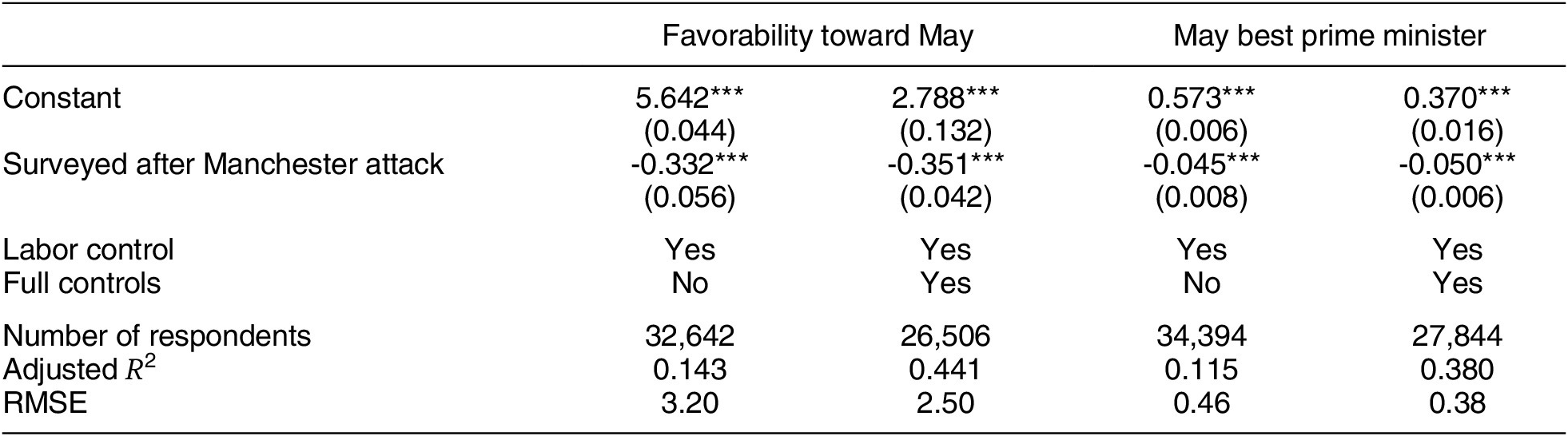
Table 1 shows our reproduction analysis. The effects of Surveyed after Manchester attack are all negative and significant at the 0.01 level (see Table B1 in the Supplementary Material for the full results). We also report that we can completely reproduce their estimates when we use their Stata data (BES_data.dta) and code (replication_files.v5.do). However, our re-analysis of their data with a linear trend line shows substantially different results.
Reproduction of HMZ, Manchester Attacks, and Evaluations of May

Note: The standard errors in parentheses are clustered by the interview dates. * $ p<0.05 $
; **
$ p<0.05 $
; ** $ p<0.01 $
; ***
$ p<0.01 $
; *** $ p<0.001 $
(two-sided). See Table B1 in the Supplementary Material for the full results.
$ p<0.001 $
(two-sided). See Table B1 in the Supplementary Material for the full results.
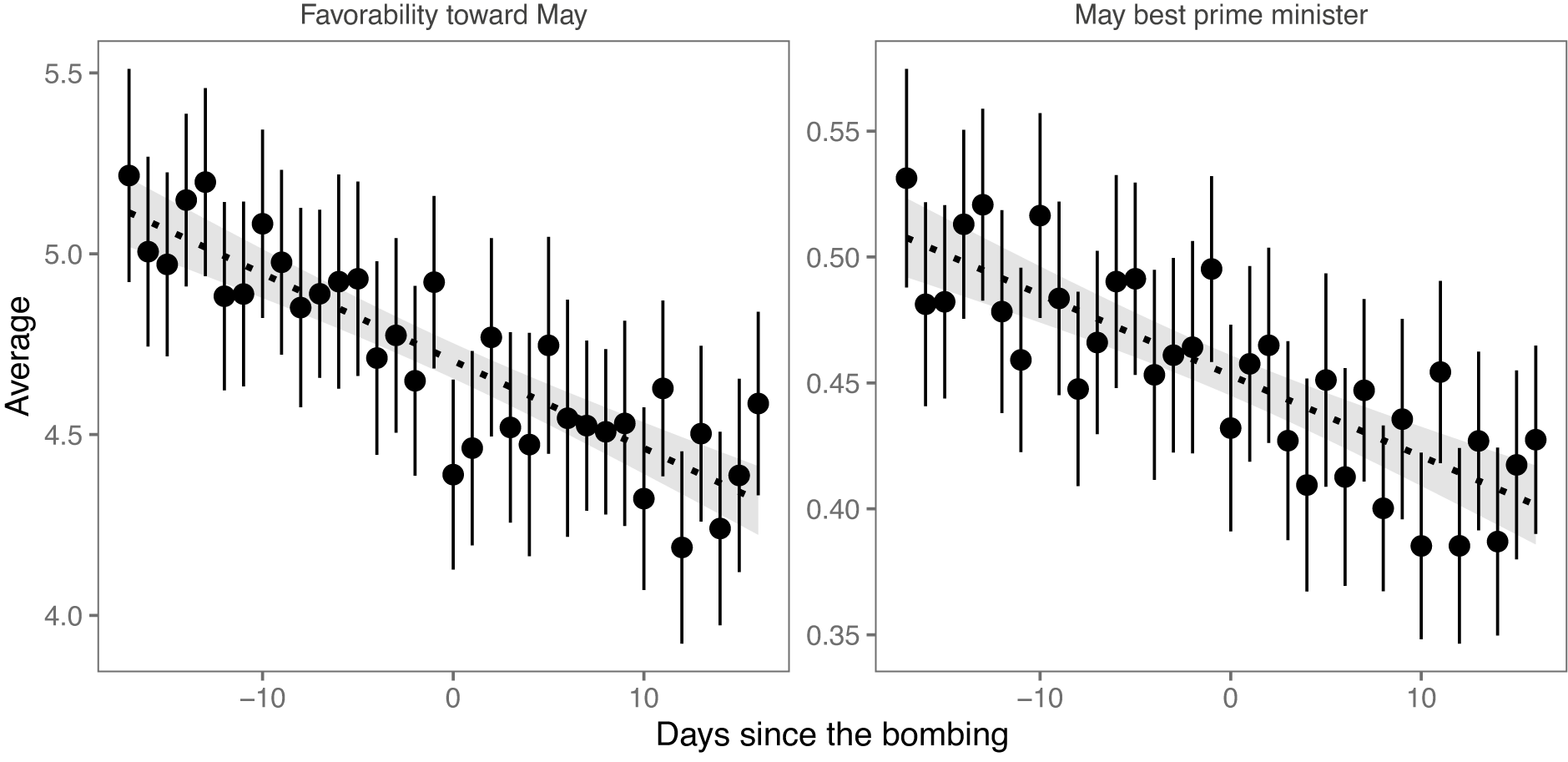
In Figure 1, the horizontal axis shows the number of days since the date of the Manchester Bombing. The vertical axes show the daily average response to each outcome question. The dots represent the averages, and the vertical lines represent the 95% confidence intervals of the averages. The OLS fitted lines and the 95% confidence intervals of prediction are overlayed to this figure.Footnote 11 The figure clearly shows that attitudes toward May became gradually and linearly more unfavorable during the period of investigation, about 15 days before and after the terrorist attack.
The Average Responses to the Outcome Questions by the Date of Starting an Interview
Note: The vertical lines represent the 95% confidence intervals. The dotted lines represent the OLS fitted values, and the gray areas correspond to the 95% confidence intervals of prediction. The sampling weights are used to calculate the averages. Source: Holman, Merolla, and Zechmeister (Reference Holman, Merolla and Zechmeister2022; Reference Holman, Merolla and Zechmeister2024).

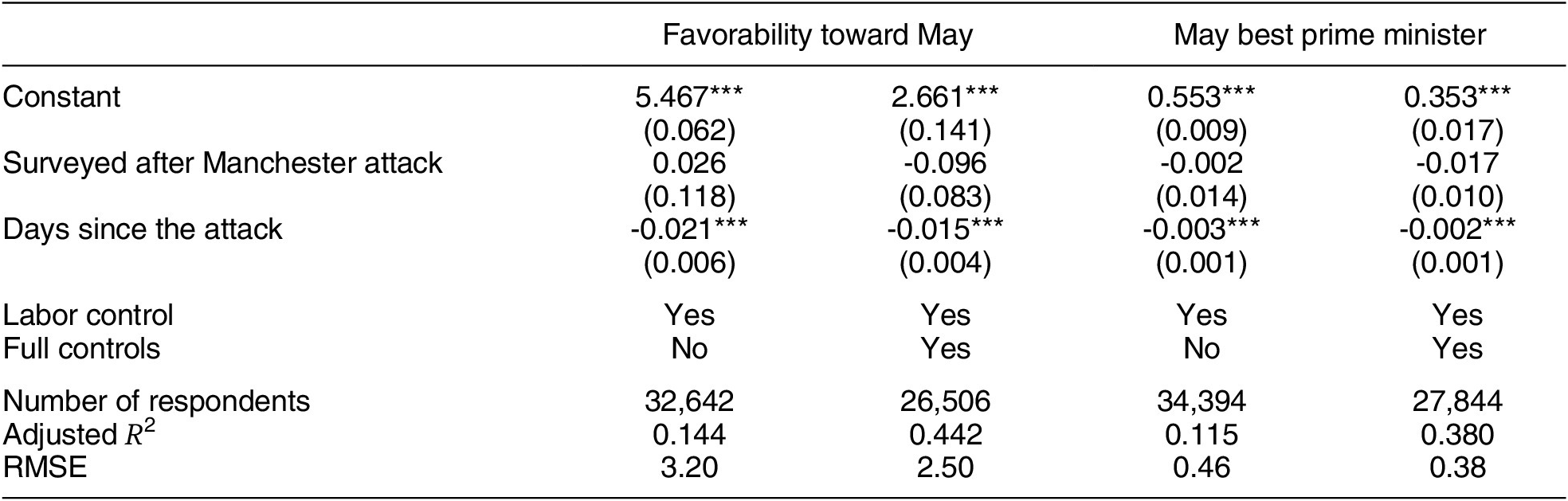
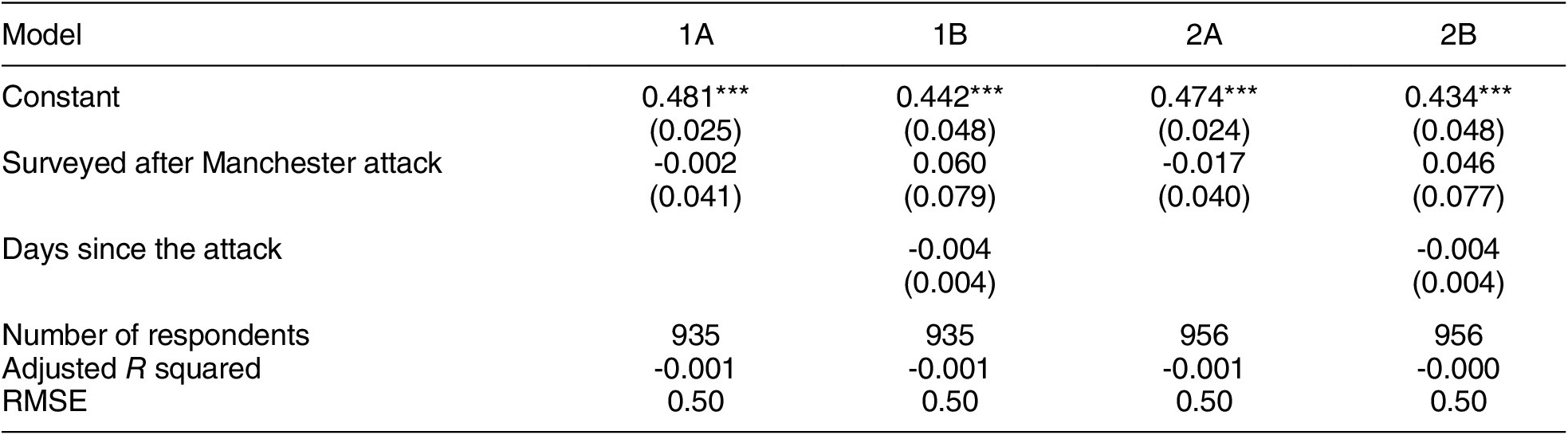
Table 2 shows the results of our extension analysis with Days since the attack linear trend added (see Table B2 in the Supplementary Material for the full results). Once this trend is controlled, regardless of whether or not all the control variables are included, the effects of Surveyed after Manchester attack are substantially attenuated (compared to the estimates shown in Table 1) and become statistically insignificant at any conventional level.Footnote 12 Table B3 in the Supplementary Material shows that even when we use HMZ’s narrower four-day bandwidth for a robustness test, the effect of Surveyed after Manchester attack is still insignificant. When we use the narrower bandwidths, the trend variable, Days since the attack, also becomes insignificant.Footnote 13
Extension of HMZ, Manchester Attacks, and Evaluations of May with Linear Trend

Note: The standard errors are in parentheses. * $ p<0.05 $
; **
$ p<0.05 $
; ** $ p<0.01 $
; ***
$ p<0.01 $
; *** $ p<0.001 $
(two-sided). See Table B2 in the Supplementary Material for the full results.
$ p<0.001 $
(two-sided). See Table B2 in the Supplementary Material for the full results.
We point out another problem in HMZ analysis. Figure 1 shows a substantial bump in both Favorability toward May and May best prime minister a day before the terrorist attack. Some unobserved factors increased the values of the outcome variables just before the Manchester bombing. Without controlling for the time trend, this idiosyncratic pattern—clearly unrelated to the bombing, which occurred unexpectedly afterward—exaggerates the naïve difference in means, especially when a narrow bandwidth is used.
HMZ acknowledge the possibility that their estimates may be “simply capturing a downward trend in evaluations of May and the Conservative Party $ \dots $
” (257) and undertake multiple tests. Specifically, to address the possibility of the impact of an economic decline, first, they include the exchange rate as a control in an alternative model. The second alternative model includes respondents’ evaluation of Brexit. The third way is to decrease the bandwidths to 10 days and 4 days. Fourth, they also split respondents in the control group (i.e., those interviewed before the bombing) into two groups based on the “median date” and show that the responses to the outcome variables are not significantly different between these two subgroups. Fifth, they run a multilevel model with the interview date random effects. Sixth, they also run ARIFMA (autoregressive fractionally integrated moving average) models. None of these models account for the gradual and systematic (i.e., nonrandom) trends observed in both the pre-treatment and post-treatment periods. While time itself may not be the causal factor behind the clear trend shown in Figure 1, modeling opinion changes over time provides a practical way to control for potential unobserved factors that vary systematically independent of the occurrence of terrorism.
$ \dots $
” (257) and undertake multiple tests. Specifically, to address the possibility of the impact of an economic decline, first, they include the exchange rate as a control in an alternative model. The second alternative model includes respondents’ evaluation of Brexit. The third way is to decrease the bandwidths to 10 days and 4 days. Fourth, they also split respondents in the control group (i.e., those interviewed before the bombing) into two groups based on the “median date” and show that the responses to the outcome variables are not significantly different between these two subgroups. Fifth, they run a multilevel model with the interview date random effects. Sixth, they also run ARIFMA (autoregressive fractionally integrated moving average) models. None of these models account for the gradual and systematic (i.e., nonrandom) trends observed in both the pre-treatment and post-treatment periods. While time itself may not be the causal factor behind the clear trend shown in Figure 1, modeling opinion changes over time provides a practical way to control for potential unobserved factors that vary systematically independent of the occurrence of terrorism.
We note that they run two additional models and present the findings in their Appendix (the second and third models in Tables E4 and E5). The first model adds the control for the interview date.Footnote 14 The second model adds an interaction between the interview-date-fixed effects and the treatment variable. The first model is essentially the same as the model we suggest.Footnote 15 The second model is puzzling because these two variables are perfectly correlated.Footnote 16 Importantly, these models show no significant effect for Surveyed after Manchester attack. Nevertheless, Holman, Merolla, and Zechmeister (Reference Holman, Merolla and Zechmeister2024, 2081) write in the updated Footnote 9 reported in the Corrigendum, “At no point does the terrorist attack result in a significant positive effect on May’s evaluation or rating.” We argue that this interpretation misses the point. What they intend to do in these additional tests is to examine the robustness of the negative and significant effects. Their models, when properly controlling the linear trend seen in Figure 1, show the lack of statistically significant negative effects. In line with their purposes in including these additional analyses, these results should be discussed as limiting the robustness of the slump findings.Footnote 17
A remaining concern is that some British respondents in the treatment (postattack) group may not have been aware of the incident at the time of their interview. To address this issue, we take advantage of the fact that the BES records the exact date and time each interview began and ended. Specifically, we conduct an additional robustness check by excluding respondents whose interviews began within 24 hours of the Manchester Bombing, which occurred at 4:31 p.m. on May 22, 2017. Since it is difficult to determine precisely when each respondent became aware of the attack, this test helps assess the sensitivity of our results to alternative design specifications. As shown in Table B6 in the Supplementary Material, the results are robust to this test. When the temporal trend is not controlled for, the estimated effects are highly significant; however, once the trend is included as a control, the effects become very small and statistically insignificant.
Finally, we conduct an “in-time” placebo test. For this test, we assign placebo treatments based on the actual bombing date, shifting it by $ -10,-9,...-1,1,...10 $
days. In other words, we estimate 20 treatment effects, assuming a significant event occurred 1 to 10 days before or after the actual bombing date. The results are presented in Figure B1 in the Supplementary Materials. It shows that when the model excludes linear trends, the estimated effects are consistently negative and significant. However, when the model includes linear trends, the effects are always insignificant. This result is expected, given the clear linear trend illustrated in Figure 1.
$ -10,-9,...-1,1,...10 $
days. In other words, we estimate 20 treatment effects, assuming a significant event occurred 1 to 10 days before or after the actual bombing date. The results are presented in Figure B1 in the Supplementary Materials. It shows that when the model excludes linear trends, the estimated effects are consistently negative and significant. However, when the model includes linear trends, the effects are always insignificant. This result is expected, given the clear linear trend illustrated in Figure 1.
Difference-in-Difference Analysis
HMZ also leverage the BES’s panel structure to test the gendered responses to the terrorist attacks. Employing Waves 9–12 of the BES,Footnote 18 they use the difference-in-differences to estimate how much the outcome variables change after the bombing by looking at within-wave variations. The independent variables are (1) whether a respondent was interviewed before or after the Manchester Bombing, (2) whether a wave was before or after the attack, and (3) an interaction of these two dichotomous variables. They also include wave-fixed effects.
Their model does not seem to be properly specified. Adding the wave-fixed effects means that they only use within-wave variations to estimate the effects of terrorism. All waves except Wave 12 are either entirely before or after the incident. In other words, Wave 12 should be the only relevant wave with a variation in its treatment variable. Consequently, their difference-in-differences analysis should be essentially similar to their primary analysis, which only uses Wave 12.Footnote 19
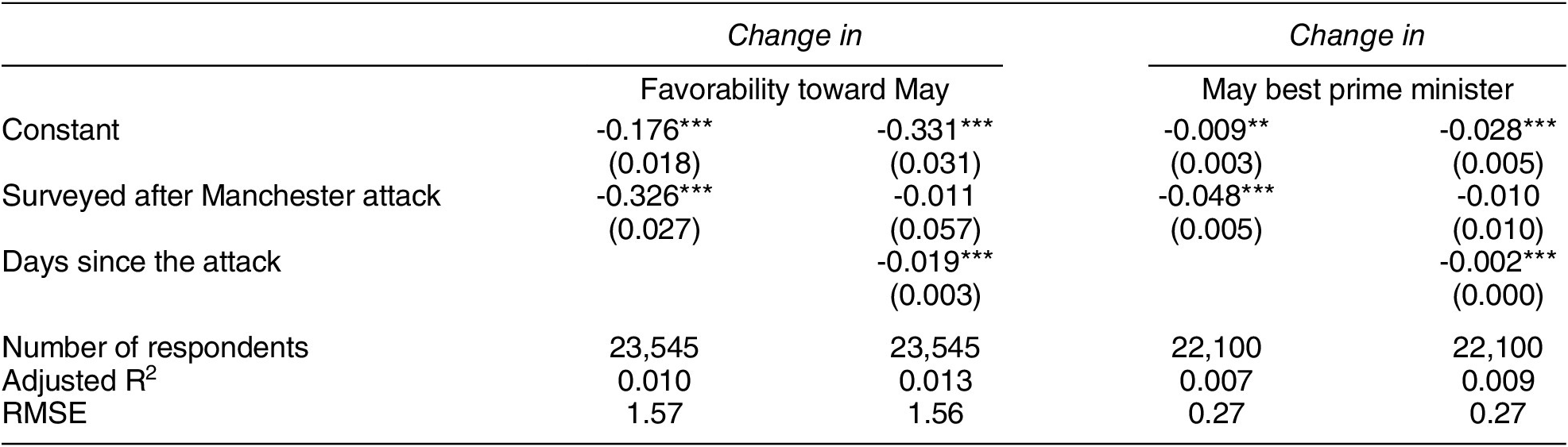
We take an alternative approach. Specifically, we use their original data to measure the change in the outcome variable between Wave 12 and the most recent wave each respondent participated in before Wave 12 (mainly, either Wave 10 or 11). We then estimate the effect of the Manchester attack on the change in the outcome variable. The main independent variable is the same as the original analysis—whether a respondent was interviewed before or after the Manchester Bombing. We estimate the models with and without the linear trend for each outcome variable.
The results using within-respondent variations between waves are presented in Table 3. The models without the linear trend (Days since the attack) show that being surveyed after the Manchester attack has negative and statistically significant effects on attitudes toward May. However, once the trend is added as a control, similar to the main results (Table 2), the effect of Surveyed after Manchester attack becomes statistically insignificant and very small.
Extension of HMZ, Difference-in-Differences with Linear Trend

Note: The standard errors are in parentheses. * $ p<0.05 $
; **
$ p<0.05 $
; ** $ p<0.01 $
; ***
$ p<0.01 $
; *** $ p<0.001 $
(two-sided).
$ p<0.001 $
(two-sided).
As an additional robustness check, following Bove et al. (Reference Bove, Di Leo, Efthyvoulou and Pickard2025), we estimate models that include a lagged dependent variable, specifically, the outcome variable from the prior wave for each individual. Including the lagged outcome helps control for individual baseline levels and addresses potential unobserved confounders. As shown in Table B7 in the Supplementary Material, the results remain substantively unchanged.
Overall, as evidenced in Figure 1, as long as we control the linear trend in all statistical models, regardless of whether they use the single survey data (Wave 12) or the panel survey data (Wave 12 and another pre-Wave-12 survey), the effect of the treatment variable (Surveyed after Manchester attack) is consistently small and statistically insignificant at any conventional level, indicating that May’s declining approval ratings cannot be attributed specifically to the Manchester attack.
REPLICATION AND COMPARATIVE ANALYSIS
We now replicate their main results based on a similar research design but using different data. Specifically, we use the GWP, a collection of annual surveys conducted across over 150 countries since 2005. HMZ leverage a rare opportunity that this major incident occurred during the BES’s sampling period, but it is even rarer that another survey was underway at almost the same period. As a result, we can replicate their analysis of the Manchester attack. In addition, GWP data allow us to conduct a comparative analysis of 10 other terrorist attacks and leader approval in five additional African countries using the same UESD approach. As noted in the introduction, the data allow us to examine the rally effect beyond the West, in countries where terrorism is more prevalent.
Research Design
HMZ’s global data analysis of the rally ’round the flag effect relies on quarterly data. However, testing this effect with quarterly data, as HMZ and others do (e.g., Carlin, Carreras, and Love Reference Carlin, Carreras and Love2020), is inherently challenging. As Seo and Horiuchi (Reference Seo and Horiuchi2024) rightly point out, coarse time-series data, such as quarterly data, are unsuitable for testing a theory that posits a relatively short-term effect. Moreover, using the quarterly data also introduces the common methodological issue of omitted variable bias. Any change in the approval rating from a specific quarter to the next quarter could be due to numerous other political, economic, and social changes, both domestically and internationally.
Our comparative analysis avoids this issue. Since the GWP records the interview date for each respondent, we can assess the impact of time-specific critical events on public opinion based on the same design that the HMZ adopt for their main analysis—the UESD, which is more powerful in testing the rally effect.
Data and Variables
We utilize individual-level data from the GWP (version February 15, 2024) to examine public responses to terrorist attacks primarily after the U.K. Manchester bombing but also in 10 other cases of large, international attacks in countries where the GWP was being carried out at the time of the attack.Footnote 20
We use the following question to measure outcome variables.
-
Outcome: “Do you approve or disapprove of the job performance of the leadership of this country?”
We then generate two dichotomous outcome variables to measure the percentage of approvals. The first assigns 1 for “Approve” and 0 otherwise. The second is similar to the first specification but excludes respondents who chose “Don’t know” or did not respond to this question. Because the percentage of those who neither chose “Approve” nor “Disapprove” is small (7.9%), we expect the results to be robust to variable specifications. That said, because these responses may indicate respondents’ substantively relevant ambivalent attitudes, it is worth investigating the treatment effects using these two outcome variables. Many existing studies use this question to measure the approval rating of the president or prime minister (see Aksoy, Guriev, and Treisman Reference Aksoy, Guriev and Treisman2024; Guriev and Treisman Reference Guriev and Treisman2020; James and Rioux Reference James and Rioux1998; Newport and Saad Reference Newport and Saad2021), which is the measure theoretically relevant to the rally ’round the flag effect.Footnote 21
We combine the GWP data with the Global Terrorism Database (National Consortium for the Study of Terrorism and Responses to Terrorism 2022), which HMZ also use, and measure our running and treatment variables in the following way:
-
Running: t, measuring the number of days between the date of a specific terrorist attack in a specific country j and the date a respondent i was interviewed.
-
Treatment: a respondent i is in the “treatment” group if $ k\ge t>0 $
and in the “control” group if
$ -k\le -t<0 $
,
$ k\ge t>0 $
and in the “control” group if
$ -k\le -t<0 $
,


where k is the “bandwidth” (i.e., the number of days before or after the attack) we set. Because the approval ratings of political leaders change over time, and these changes may not be directly relevant to terrorism, we need to minimize the effects of such changes and fluctuations by focusing on a short bandwidth. Since we do not know whether respondents interviewed on the day of a terrorist attack were exposed to news about the attack before answering questions, we exclude those interviewed on the day of the attack (i.e., $ t=0 $
).
$ t=0 $
).
In this replication study, we focus on the case of the Manchester Bombing in the United Kingdom and run two models for each outcome variable, one with and one without a linear trend. For our main analysis, we use all respondents in GWP Wave 12 fielded from May 4 to June 2, 2017. We also test robustness using different bandwidths, specifically, $ \pm $
{3, 5, 7} days. As in the original analysis by HMZ and our replication-and-extension analysis, we use sample weights in this reproduction analysis.
$ \pm $
{3, 5, 7} days. As in the original analysis by HMZ and our replication-and-extension analysis, we use sample weights in this reproduction analysis.
Comparative Analysis
HMZ write, “The types of incidents most likely to fuel [rally ’round the flag effects] are those that are international, involve the executive, and are ‘specific, dramatic, and sharply focused’ (Mueller Reference Mueller1970, 21)” (Holman, Merolla, and Zechmeister Reference Holman, Merolla and Zechmeister2022, 250). The Global Terrorism Database includes several codes to identify “international” incidents, and it is unclear which one HMZ use for their global data analysis. We focus on “logical” cases identified by a variable named INT_LOG, which is based on “a comparison between the nationality of the perpetrator group and the location of the attack” (page 57 of the codebook dated August 2021). HMZ also use a threshold of 14 fatalities for their data analysis.Footnote 22 The unit of observation in the Global Terrorism Database is each incident. Thus, we aggregate the number of fatalities on each date before selecting the cases with at least 14 total fatalities.
As long as we focus on “international” terrorist attacks in which at least 14 people were killed a day, there are 11 incidents that happened during the GWP sampling period. Table 4 shows all 11 terrorist attacks used for our comparative analysis. The second to fourth columns show the GWP wave, the sampling period, and the number of respondents. The fifth to seventh columns show the date of a terrorist attack, the number of people killed, and the number of people wounded, according to the Global Terrorism Database.
International Terrorist Attacks During GWP Sampling Periods

Note: The fourth column (N) shows the total number of respondents. The last two columns show the number of people killed and the number of people wounded, respectively.
With the exception of the Manchester bombing, all of the attacks occurred in African countries: Burkina Faso, Cameroon, Chad, Niger, and Tanzania. These countries offer fundamentally different political and security dynamics than the context in which terrorism’s rally effects have typically been studied.
Except for Tanzania, the attacks occurred in the Sahel region of West Africa. Beginning in 2010, the Sahel emerged as a global epicenter of Islamist terrorism. It now accounts for more deaths from terrorist attacks than the rest of the world combined (Orrell Reference Orrell2025). Nevertheless, little is known about how terrorism impacts approval ratings in the countries most frequently affected by such violence (Godefroidt Reference Godefroidt2023, 34). As Mueller (Reference Mueller1970) hypothesized, rally effects are most likely to follow “specific, dramatic, and sharply focused” events (21). The attacks included in this study certainly meet these criteria; however, in contexts of ongoing threat and repeated attacks, terrorism may provide less of a rallying point than in societies where attacks are rare. Indeed, studies from the West suggest leaders are unlikely to experience repeated rallies (Feinstein Reference Feinstein2022, 12).
In addition, in Western democracies, Islamist attacks are especially likely to provoke rallies due to heightened outgroup hostility. By contrast, populations most impacted by Islamist terrorist attacks in the Sahel often share the same religion, if not ideology, as their perpetrators. Scholars contend that rally effects in the West are driven more by identity-based mechanisms—namely, outgroup hostility and ingroup solidarity expressed through ethnonationalism—than by fear (Feinstein Reference Feinstein2022; Reference Feinstein2018; Godefroidt Reference Godefroidt2023). If identity-based dynamics are central to rally effects, then the relative religious or ethnic similarity between victims and attackers in many African states may decrease the likelihood of such effects. Moreover, the multiethnic nature of many African states may weaken the national unifying potential of a terrorist attack. Supporting this interpretation, a UESD study of two Boko Haram attacks in Nigeria on December 10 and 11, 2014—the only such study on Africa published to date—finds that the attacks decreased respondents’ sense of national identity relative to their attachment to ethnic identity. However, the same study also reports increased trust in the president following the attacks, suggesting that rally effects may still occur in African contexts, albeit through different mechanisms (Harding and Nwokolo Reference Harding and Nwokolo2024).
Finally, the African cases in our analysis span a range of political systems, from authoritarian to almost fully democratic. This diversity provides valuable test cases for a theory originally developed in democratic contexts. The applicability of the rally effect theory may be limited in more authoritarian settings. For instance, Park and Bali (Reference Park and Bali2017) find that frequent terrorist attacks are associated with a greater likelihood of leader removal in autocratic states than in democratic ones. Similarly, in a study of Putin’s approval ratings in Russia, Fedotenkov (Reference Fedotenkov2020) shows that major terrorist attacks tend to undermine rather than boost public support. In sum, there are strong theoretical reasons to reassess the broad applicability of the rally effect theory across different political and social contexts.
For these reasons, the GWP data offer a valuable opportunity to examine rally effects from a comparative perspective. We analyze all of the attacks listed in Table 4 using regression models. The dependent and independent variables are identical to those used in our analysis of the case of the Manchester Bombing. However, we add incident-specific fixed effects to control for unobservable heterogeneity across these cases. Aside from this addition, the model specifications remain the same as those used in the Manchester analysis. We estimate the effects using short bandwidths of 3, 5, or 7 days.
Using these cases and incorporating incident-specific fixed effects, we estimate whether terrorist attacks have any effect on public opinion, regardless of whether or not a political leader is a woman. If the effects are small or statistically insignificant, this calls into question the broader validity of the hypothesis on the terrorism-induced rally effect.Footnote 23
Results
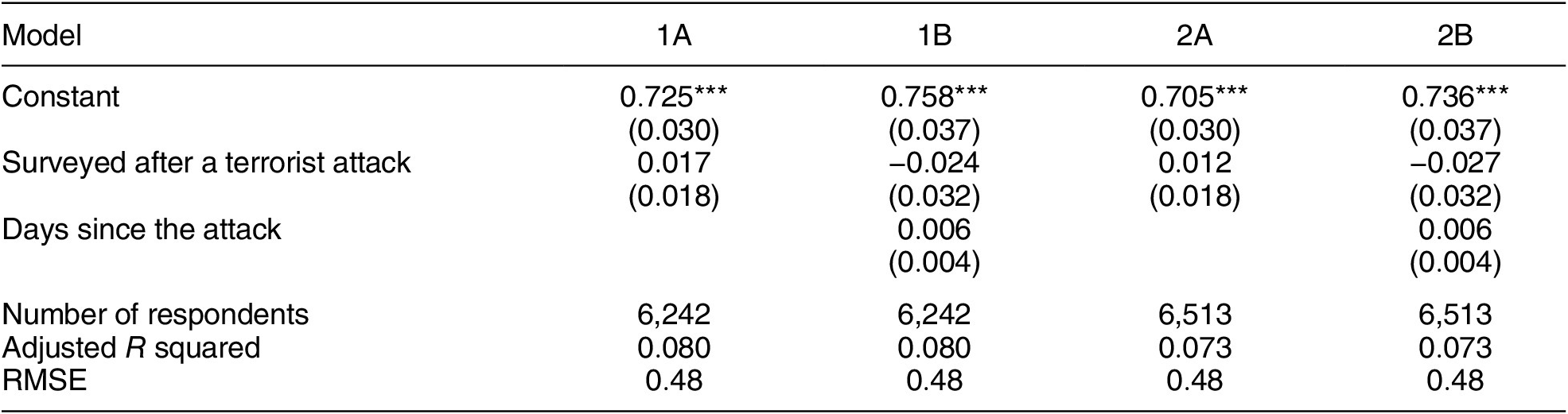
The results of our replication study using the GWP in the United Kingdom are presented in Table 5. Models 1A and 1B use the approval rating, excluding “Don’t know” responses and no responses (as zero), and Models 2A and 2B use the approval rating, including them. Models 1A and 2A exclude the linear trend (Days since the attack), and Models 1B and 2B include it. In all these models, the effects of our treatment variable (Surveyed after Manchester attack) are very small and statistically insignificant at any conventional level. We further undertake robustness tests by using short bandwidths of 3, 5, or 7 days and find substantially the same null results (see Tables B8–B10 in the Supplementary Material). Overall, we find no evidence that the Manchester terrorist attack changed the approval rating. There was neither bump nor slump. This finding is consistent with our reproduction-and-extension analysis shown in Table 2 and Table B3 in the Supplementary Material.
GWP Replication of HMZ, Manchester Attacks, and Approval of May with Linear Trend

Note: The standard errors are in parentheses. * $ p<0.05 $
; **
$ p<0.05 $
; ** $ p<0.01 $
; ***
$ p<0.01 $
; *** $ p<0.001 $
(two-sided). The outcome variable is whether or not a respondent approved of the job performance of the leadership of their country. Models 1A and 1B exclude “Don’t know” and no responses, while Models 2A and 2B include them. All observations are used.
$ p<0.001 $
(two-sided). The outcome variable is whether or not a respondent approved of the job performance of the leadership of their country. Models 1A and 1B exclude “Don’t know” and no responses, while Models 2A and 2B include them. All observations are used.
Table 6 shows our global results for the 10 attacks in African states and the Manchester attack, using the bandwidth of seven days. The results using other bandwidths are in Tables B11 and B12 in the Supplementary Material. All these tables show that as with the U.K. analysis, the estimates for Surveyed after a terrorist attack are statistically insignificant, regardless of model specifications.
Comparative Analysis of Terrorist Attacks and Leader Approval, Fixed-Effect Regression (Bandwidth: $ \pm $
7 Days)
$ \pm $
7 Days)

Note: The standard errors are in parentheses. * $ p<0.05 $
; **
$ p<0.05 $
; ** $ p<0.01 $
; ***
$ p<0.01 $
; *** $ p<0.001 $
(two-sided). The outcome variable is whether or not a respondent approved of the job performance of the leadership of their country. Models 1A and 1B exclude “Don’t know” and no responses, while Models 2A and 2B include them. Each model includes incident-country-specific fixed effects. The total number of incidents is 11. The bandwidth is
$ p<0.001 $
(two-sided). The outcome variable is whether or not a respondent approved of the job performance of the leadership of their country. Models 1A and 1B exclude “Don’t know” and no responses, while Models 2A and 2B include them. Each model includes incident-country-specific fixed effects. The total number of incidents is 11. The bandwidth is $ \pm $
7 days (inclusive).
$ \pm $
7 days (inclusive).
CONCLUSION
Contrary to HMZ, our reproduction, extension, and replication analyses find no statistically significant slump or bump in Theresa May’s approval ratings following the Manchester Bombing. Nor does our application of the UESD to GWP data demonstrate any significant short-term approval effects for male leaders in African countries surveyed during major international terrorist attacks. The absence of any bump (or slump) in approval across these markedly different contexts casts doubt on the broad applicability of the rally ’round the flag theory.
What explains our null findings? As Godefroidt (Reference Godefroidt2023) emphasizes, existing evidence of terrorism-induced rally effects is heavily biased, with most studies focusing on the United States, Israel, and European countries and predominantly on instances of Islamist terrorism. Her findings highlight the need for further comparative analysis to identify the requisite conditions for these rallies to occur.
Our findings suggest caution in concluding that having a male leader is one such condition. Prior research suggests that women leaders may pursue more aggressive foreign policy actions than men (Schramm and Stark Reference Schramm and Stark2020), particularly in response to being targeted (Powell and Mukazhanova-Powell Reference Powell and Mukazhanova-Powell2019; Post and Sen Reference Post and Sen2020). Such actions may shift public perceptions in ways that diminish the relevance of a leader’s gender in security-related assessments. Moreover, due to biased selection processes, women who attain high public office may be more qualified than men. As a result, the women who do reach a nation’s highest office may overperform relative to men (Ashworth, Berry, and Bueno de Mesquita Reference Ashworth, Berry and de Mesquita2021), making it unlikely that their gender alone would undermine public support in the aftermath of a terrorist attack.
In addition, gender may not straightforwardly shape the psychological mechanisms underlying rally effects. Some research suggests that, rather than fear, rallies are more often driven by other emotions, such as anger, intra-group solidarity, and the desire to reassert national status (Feinstein Reference Feinstein2022). While anger may be incongruent with traditional gender stereotypes about women, women may nevertheless be well-placed to advocate for national solidarity and, depending on their reputations, may be perceived as capable of enhancing national status.Footnote 24
For all these reasons, future research should look beyond leader gender to identify the conditions that give rise to rally effects. Several studies point to the critical role of media coverage in shaping emotional reactions and perceptions of executive leadership (Feinstein Reference Feinstein2022; Groeling and Baum Reference Groeling and Baum2008; Lambert et al. Reference Lambert, Scherer, Schott, Olson, Andrews, O’Brien and Zisser2010). Simply experiencing a terrorist attack, no matter how dramatic, may not be sufficient to rally the public around the chief executive. In a longitudinal study of terrorist attacks in the United States, for example, Feinstein (Reference Feinstein2022, 13) finds that rally effects only occur if politicians and the media frame government responses to terrorist attacks as “symbolic struggles for collective honor and respect.” Divisions between the executive and the opposition parties, as well as media critiques, can suppress rally effects (Baker and Oneal Reference Baker and Oneal2001). Similarly, Groeling and Baum (Reference Groeling and Baum2008) emphasize that rally effects depend on the perceived credibility of leaders’ messages, which is shaped by how the media presents potential rallying events.
Finally, as we expand the comparative analysis beyond the Euro-American context, we may discover under-explored factors that are more salient in countries where terrorist attacks are most common, such as the African cases considered in this study. As noted earlier, the higher frequency of terrorist attacks, the relative similarity between perpetrators and victims, and the prevalence of less democratic political systems may render rally effects less likely in these contexts. Yet, despite their relevance, these factors have received remarkably little scholarly attention. Without further research, it remains difficult to determine whether rally effects are a global phenomenon or a largely Western exception.
SUPPLEMENTARY MATERIAL
The supplementary material for this article can be found at https://doi.org/10.1017/S000305542610149X.
DATA AVAILABILITY STATEMENT
Research documentation and data that support the findings of this study are openly available at the American Political Science Review Dataverse: https://doi.org/10.7910/DVN/SCYAPL.
ACKNOWLEDGEMENTS
An earlier version of this article was presented at the 81st Annual Midwest Political Science Association Conference (Chicago, April 4–7, 2024). We thank Steven Moore, Gavin Ploger, and Melanie Phillips for their useful comments and T. J. Seo and Joseph Laroski for their research assistance.
CONFLICT OF INTEREST
The authors declare no ethical issues or conflicts of interest in this research.
ETHICAL STANDARDS
The authors affirm that this research did not involve human participants.




 Open access


Comments
No Comments have been published for this article.