


Rates of child obesity are increasing globally( 1 ), prompting governments to consider various strategies to improve children’s diets and reduce their risk of obesity and its sequela (for a comprehensive list of relevant initiatives, see the NOURISHING framework developed by the World Cancer Research Fund International( 2 )). An important component of these efforts is school food policies that specify the kinds of foods and beverages that can and cannot be sold and supplied on school premises( Reference Hawkes, Smith and Jewell 3 , Reference Mahesh, Vandevijvere and Dominick 4 ). The range of foods available for sale at school directly affects children’s on-site food purchases; for example, a recent study found a 1·67 % increase in the number of unhealthy foods purchased for every 1 % increase in availability( Reference Clinton-McHarg, Janssen and Delaney 5 ).
For new health policies and programmes to be effective, they need to be embraced by stakeholders and appropriately implemented on the ground( Reference Hawkes, Smith and Jewell 3 , Reference Snelling, Belson and Watts 6 ). Evidence of stakeholder support, along with support from the broader community, can be a key determinant of whether relevant policy decisions are made( Reference Baum and Fisher 7 – Reference Reisch, Sunstein and Gwozdz 10 ). There is a tendency for policies designed to improve health outcomes for children to achieve higher levels of community support than adult-focused policies( Reference Diepeveen, Ling and Suhrcke 8 , Reference Mazzocchi, Cagnone and Bech-Larsen 11 ). In addition, there is evidence that nutrition-related policies can be more effective in producing positive outcomes for disadvantaged groups if implemented in schools v. other settings( Reference Olstad, Ancilotto and Teychenne 12 ). However, efforts to formalise changes to school food provision to enforce the provision of healthier options and remove unhealthy options can still face opposition( Reference Pettigrew, Pescud and Donovan 13 ), making it important to anticipate potential reactions and the resulting implications for policy implementation. It has been noted that in the context of school food policies it is especially important to assess the reactions of those tasked with policy implementation within schools to (i) identify potential areas of acceptance and resistance and (ii) develop effective approaches and resources to enhance understanding of the benefits of the policy and facilitate implementation( Reference Levay, Chapman and Seed 14 – Reference Reilly, Reeves and Deeming 16 ).
Experiences in various health-related public policy domains have demonstrated that new policies generally become more acceptable post-implementation as people become accustomed to the new conditions( Reference Diepeveen, Ling and Suhrcke 8 ). Acceptance is heightened if it is apparent that the policies have been effective( Reference Drews and Van den Bergh 17 , Reference Jagers, Matti and Nilsson 18 ). Previous work has found considerable support for school food policies at the time of their introduction among key stakeholders( Reference Pettigrew, Pescud and Donovan 13 , Reference Asada, Ziemann and Zatz 19 – Reference Pettigrew, Pescud and Donovan 21 ). Much less is known about whether this support is maintained or changes over time.
While levels of child overweight/obesity in Australia are relatively stable at about 28 % of those aged 5–12 years( 22 ), this prevalence rate remains far too high and further efforts are needed to reduce the number of children affected. The implementation of more stringent healthy food and drink policies in schools is a potential strategy to assist in achieving this outcome. Such policies may positively influence both the types of foods consumed on school premises and children’s overall dietary intake( Reference Adamson, Spence and Reed 23 , Reference Micha, Karageorgou and Bakogianni 24 ). It is acknowledged that in-school food provision is just one aspect of children’s food environments and that other factors such as home and neighbourhood food characteristics will have a substantial influence on nutrition-related outcomes such as nutrient and energy intakes and adiposity levels, and are therefore also in need of attention( Reference Fitzpatrick, Datta and Henderson 25 , Reference Spence, Delve and Stamp 26 ). This is evident in the relatively small number of studies demonstrating significant reductions in child obesity resulting from school food policies that limit the presence of unhealthy ‘discretionary’ foods and beverages( Reference Datar and Nicosia 27 , Reference Dority, McGarvey and Kennedy 28 ). However, school food policies represent tools to create supporting healthy eating environments, and positive changes have been identified for other intermediary outcomes such as increased fruit and vegetable intake and reduced consumption of sugar-sweetened beverages( Reference Micha, Karageorgou and Bakogianni 24 , Reference Vézina-Im, Beaulieu and Bélanger-Gravel 29 ).
The aims of the present study were to: (i) assess key stakeholders’ attitudes to a healthy food and drink policy a decade after its introduction in Western Australia; (ii) investigate these stakeholders’ receptiveness to various potential policy extensions; and (iii) identify factors associated with higher levels of receptiveness to the introduction of a more stringent version of the policy, to provide insight into potential target areas for future interventions designed to increase support for policy extensions. In addition, given calls for schools to receive greater assistance to achieve high levels of food policy implementation( Reference Wu, Berg and Neeson 30 ), stakeholder interest in a range of potential resources was assessed.
The study builds on prior research investigating stakeholders’ perceptions of the Western Australian Department of Education’s Healthy Food and Drink Policy shortly after its introduction( Reference Pettigrew, Pescud and Donovan 13 , Reference Pettigrew, Pescud and Donovan 21 ) and an analysis of compliance levels 10 years later( Reference Pettigrew, Talati and Sauzier 31 ). By assessing stakeholders’ attitudes to the policy a decade after its implementation and gauging support for making the policy more stringent, the present study represents one of the few long-term evaluations of school food policies and provides novel insights into the extent to which such policies can be extended over time.
The Western Australian Healthy Food and Drink Policy
The mandatory Healthy Food and Drink Policy was officially introduced by the Western Australian Department of Education in late 2006 for implementation in the state’s 699 public schools in 2007. Reflective of the need for school food policies to be comprehensive in scope and consistent with a ‘whole of school’ approach( Reference Hawkes, Smith and Jewell 3 , Reference Hayes, Contento and Weekly 32 – Reference Welker, Lott and Story 34 ), there are five core areas of the Western Australian policy( 35 ): (i) the development of a school-level healthy food and drink policy; (ii) canteen menus must comprise a minimum of 60 % ‘green’ items, a maximum of 40 % ‘amber’ items and no ‘red’ items as determined by a traffic-light categorisation system; (iii) canteen staff must undertake training in the traffic-light food categorisation system and food safety/hygiene; (iv) foods and beverages classified as ‘red’ are not used as classroom rewards or provided as part of school-run events/activities; and (v) the school community is kept informed about the policy (e.g. through newsletters, school websites and/or colour-coded menus).
Subsequently, a national-level voluntary policy was introduced by the federal Health Department in 2010 that closely resembled the Western Australian policy( 36 ). The national policy has since been adopted by several Australian states, but Western Australia has retained its mandatory policy that is largely consistent with the national policy with some additional elements that make it more stringent. For example, Western Australia is the only jurisdiction to set specific targets for ‘green’ (≥60 %) and ‘amber’ (≤40 %) products and to require school principals to report annually on compliance to the Western Australian Department of Education( Reference Wu, Berg and Neeson 30 ).
In an evaluation of the Western Australian policy that was conducted about a year after its introduction( Reference Pettigrew, Pescud and Donovan 13 , Reference Pettigrew, Pescud and Donovan 21 ), high levels of support were found among key stakeholder groups including school principals, teachers, canteen managers and presidents of parents and citizens (P&C) associations (the latter are typically tasked with managing school canteens in Western Australian public schools). The results of a subsequent 10-year follow-up evaluation showed that about 80 % of schools reported being compliant with all aspects of the policy and that a large majority of respondents believed the policy has improved the healthiness of foods and drinks provided in schools (85 %) and constitutes a good opportunity to teach children about healthy eating (90 %)( Reference Pettigrew, Talati and Sauzier 31 ).
In the original evaluation, many respondents indicated endorsement of various policy extensions, with most support expressed for linking the canteen menu with the health curriculum, providing seating areas for children to eat their meals, ensuring foods offered are free of preservatives and additives and pricing foods according to their healthiness( Reference Pettigrew, Pescud and Donovan 21 ). To date, these additional components have not been incorporated into the policy and instead individual schools determine whether they will be implemented on their premises. Comparing these early results with the 10-year follow-up data, the present study examines the extent to which schools may have implemented these optional changes and/or continue to support their potential inclusion in the policy. The results provide policy makers with an indication of the types of additional policy components that are likely to be considered feasible and acceptable.
Methods
Participants
In both the 1-year and 10-year evaluations, a voluntary online survey was administered to the following key stakeholder groups in Western Australian public schools: school principals, teachers, canteen managers and presidents of P&C associations. Principals of Western Australian public schools have ultimate responsibility for policy implementation and, as noted above, are required to report on policy compliance annually. Teachers also have a role to play in policy implementation due to the requirement to avoid using ‘red’ foods and beverages to reward students. Canteen managers and P&C association presidents typically have joint operational responsibility for policy implementation via menu design and canteen management.
For the 1-year evaluation in 2008, the survey was disseminated via a single-purpose email directly to all public school principals that was accompanied by a request to forward the survey link to two teachers in their school, the canteen manager and the P&C president. Due to permission restrictions, the invitation to participate in the 2016 survey was incorporated into a group-distribution email containing numerous other news items sent by the Western Australian Department of Education to public school principals.
Instrumentation
To permit comparisons between the 2008 and 2016 results, the 2016 survey contained many of the same items from the initial policy evaluation survey that had been developed specifically for that study( Reference Pettigrew, Pescud and Donovan 21 ). These included descriptive items relating to role (principal, teacher, canteen manager, P&C president), school type (primary, secondary, other) and school location (metropolitan, regional), along with self-reported current level of school compliance with the policy (rated on a 5-point scale from ‘non-compliant’ to ‘fully compliant’). In addition, respondents were asked to report the extent to which they were committed to meeting and exceeding the minimum requirements (rated on a 5-point scale from ‘strongly disagree’ to ‘strongly agree’), their attitudes to a range of potential policy extensions and their preferences for various forms of support that would enable them to effectively implement an enhanced version of the policy. An example of exceeding the policy requirements provided to respondents was increasing the minimum proportion of ‘green’ items required on the menu (currently 60 %). Suggested policy extensions included those relating to the types of foods offered (e.g. organic foods), available infrastructure (e.g. seating areas of children) and the promotion and pricing of menu items. Listed forms of possible support included advertising materials to be displayed in the canteen and resources designed for key stakeholders including teachers, parents and children.
Data analysis
Data from the 2008 and 2016 data sets were analysed using the statistical software package IBM SPSS Statistics version 24. Descriptive statistics were calculated to show the proportion of respondents: (i) falling into different demographic categories; (ii) who were motivated to meet policy requirements; (iii) who were motivated to exceed policy requirements; (iv) who preferred different policy extensions; and (v) who preferred various forms of policy support. Z-scores and the associated P values were used to test for significant differences in demographics across the two data sets. The t test and one-way ANOVA (with Tukey’s honestly significant difference test for post hoc comparison) were used to test for significant differences between the two data sets for the remaining variables. Finally, a linear regression was used to examine predictors of respondents’ motivation to exceed policy requirements.
Results
In total, 607 stakeholders (from 699 schools) responded to the 2008 survey and 307 (from 798 schools) responded to the 2016 survey. While the latter sample was smaller in size, the stakeholder compositions of the samples were similar across the two surveys (see Table 1). It was not possible to determine the overall response rate due to the multiple potential respondents from each school and the likelihood that different schools were represented by different types of respondent (e.g. only the canteen manager may have responded from one school while all four categories of respondent may have participated from another). However, as a general indication of relative response rates across surveys, the number of principals responding as a proportion of the total number of schools in the state at each time point was 44 % (311 principals) for the initial survey and 14 % (116 principals) for the follow-up survey.
Sample profile of respondents to the online survey about the Healthy Food and Drink Policy in Western Australian public schools at the initial 1-year post-implementation evaluation (2008) and the 10-year follow-up evaluation (2016)
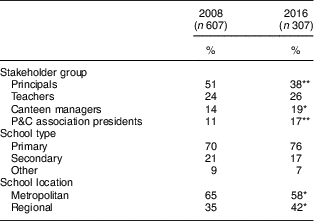
P&C, parents and citizens.
‘Other’ category includes schools that are combined primary/secondary schools or remote schools.
Significant difference between 2008 and 2016 (assessed via the t test): *P<0·05, **P<0·01.
Table 2 shows the reported motivation of respondents completing the 2016 survey to meet and/or exceed the policy’s requirements. More than three-quarters (84 %) of respondents indicated that they were motivated to comply with the current policy requirements and two-thirds (65 %) reported being motivated to exceed them. Of the various categories of respondent, canteen managers reported the highest level of motivation to exceed policy requirements (76 %).
Motivation to meet/exceed policy requirements expressed by respondents to the online survey about the Healthy Food and Drink Policy in Western Australian public schools at the 10-year follow-up evaluation (2016)

P&C, parents and citizens.
† Those selecting 4 or 5 on a 5-point scale, from 1=‘strongly disagree’ to 5=‘strongly agree’. No significant differences were found among the different stakeholder groups (assessed via ANOVA).
Very high levels of support were expressed for most of the proposed policy extensions listed in Table 3. As was found in the 2008 evaluation, the most popular extensions in 2016 were to explicitly link the school canteen menu with the health curriculum (83 % expressing support), to exclude foods containing preservatives and food additives (78 %) and to price products according to their healthiness (72 %). The only potential extension that did not receive majority support was for organic foods to be sold in the canteen (40 %). All potential extensions had larger levels of support in 2016 relative to 2008, with these increases statistically significant in all cases except for the provision of preservative/additive-free foods (P=0·07) and seating areas for children (P=0·07).
Stakeholders’ views on possible policy extensions to the Healthy Food and Drink Policy in Western Australian public schools at the initial 1-year post-implementation evaluation (2008) and the 10-year follow-up evaluation (2016)

P&C, parents and citizens.
a,b,cMean values within a row with unlike superscript letters were significantly different between stakeholder groups completing the survey in 2016 (assessed via ANOVA with Tukey’s honestly significant difference test for post hoc comparison): P<0·05.
Significant difference between 2008 and 2016 (assessed via the t test): **P<0·01.
† Excluding respondents who reported already implementing these policy extensions.
‡ Those selecting 4 or 5 on a 5-point scale, from 1=‘don’t want it at all’ to 5=‘want it very much’.
When asked about additional resources that could assist schools to comply with the policy, high levels of support were found for all suggested support options, ranging from 64 % endorsing actions to increase interaction between canteen managers and teachers to 80 % endorsing the provision of information for parents about the way the traffic-light food categorisation system is used in schools (Table 4). Significantly higher levels of interest were expressed in 2016 relative to 2008 for three areas of support: (i) developing student assignments on the topic of promoting healthy menu items; (ii) providing information for parents about the traffic-light system; and (iii) offering healthy lunchbox workshops for parents.
Stakeholders’ preferences for various types of additional policy support for the Healthy Food and Drink Policy in Western Australian public schools at the initial post-implementation evaluation (2008) and the 10-year follow-up evaluation (2016)

P&C, parents and citizens.
a,b,cMean values within a row with unlike superscript letters were significantly different between stakeholder groups completing the survey in 2016 (assessed via ANOVA with Tukey’s honestly significant difference test for post hoc comparison): P<0·05.
Significant difference between 2008 and 2016 (assessed via the t test): *P<0·05, **P<0·01.
† Those selecting 4 or 5 on a 5-point scale, from 1=‘strongly disagree’ to 5=‘strongly agree’.
A linear regression was conducted to identify factors associated with motivation to exceed minimum policy compliance. Factors included in the model were school type (primary, secondary), school location (metropolitan, regional), number of students enrolled at the school, days per week of canteen operation, current level of compliance (rated on a 5-point scale from ‘non-compliant’ to ‘fully compliant’), number of policy extensions endorsed (as listed in Table 3) and canteen profitability (profitable/breakeven, loss/unsure). Motivation to exceed current policy requirements was significantly associated with level of compliance with the current policy. Endorsement of a larger number of policy extensions, the number of days per week of canteen operations, school type, school size, school location and canteen profitability were not associated with motivation to exceed current requirements.
Discussion
The results of the present study provide support for the proposition that school food policies can experience stronger support after they have been in place for some time. This outcome is consistent with prior research in other domains indicating that public support for policies can increase post-implementation. In particular, support has been found to be stronger where policies are perceived to be effective, consistent with prevailing social norms and targeting vulnerable groups, especially children( Reference Diepeveen, Ling and Suhrcke 8 , Reference Drews and Van den Bergh 17 , Reference Jagers, Matti and Nilsson 18 ). However, while there is a growing evidence base on levels of public support for a wide range of existing and potential health-related policies, there appears to be a lack of research examining attitudes to the same potential policy extensions over time among those stakeholder groups tasked with policy implementation.
Extending previous research, the present results suggest that there may also be increasing support among key stakeholders for making school food policies more stringent over time. Two-thirds of respondents reported being motivated to exceed the requirements of the current policy and six of the seven potential policy extensions received majority support. Of note is that canteen managers reported the highest levels of motivation to exceed policy requirements (76 %), which is promising given that this group would be likely to be required to implement many of the changes.
Consistent with the earlier evaluation( Reference Pettigrew, Pescud and Donovan 13 , Reference Pettigrew, Pescud and Donovan 21 ), most of the proposed policy extensions received majority support across the four stakeholder groups. The most popular extensions related to enhancing the pedagogical potential of the policy, excluding foods with additives/preservatives and pricing items in accordance with their relative healthiness. The two extensions with the lowest levels of support were providing organic menu items (40 %) and providing seating areas for children (65 %). The relatively low support for organic menu items is likely to be primarily due to the substantially higher cost and more limited availability of organic produce in Australia( Reference O’Mahony and Lobo 37 ). In the case of seating areas, this variable had the highest ‘already implemented’ level (42 %), which may have resulted in some schools seeing this as a non-essential element of the policy.
For the more stringent school food policies of the future to meet their potential to improve children’s diets, various forms of implementation assistance are likely to be needed( 35 ). The stakeholders involved in the present study were very receptive to a range of possible resources that could assist them to meet and/or exceed current policy requirements. This is consistent with previous research highlighting the importance of such resources in determining schools’ ability to comply with healthy food policies( Reference Reilly, Nathan and Wiggers 15 ). The level of interest in the nominated resources was high in both the 2008 and 2016 surveys, with between about two-thirds and more than three-quarters of respondents in both time periods indicating that the suggested curriculum, parent and food promotion resources would be useful. There are therefore likely to be simple, concrete means by which governments can enhance compliance with existing school food policies and lay the ground for future policy extensions by suggesting strategies and providing schools with additional resources and strategies to facilitate closer integration of the policy into school practices and school–home interactions( Reference Kehm, Davey and Nanney 38 ). In addition, it may be possible to increase receptiveness to policy enhancements by framing any changes in terms of the additional support that would be provided to assist stakeholders with implementation of the scaled-up policy requirements.
The results show that those schools reporting the highest levels of compliance with the policy were most likely to be motivated to exceed the policy requirements. The lack of difference according to days of canteen operation, school type, location or size is encouraging, because this suggests that strategies employed to increase compliance levels and promote implementation beyond the scope of the policy do not need to be varied by these characteristics. This should simplify the process of developing resources designed to assist schools to optimise the positive outcomes that can be achieved through the introduction and enhancement of school food policies. It is important that any resulting resources are perceived to be appropriate and useful by the relevant stakeholders, and that efforts are made to ensure that those who could benefit from the resources are made aware of their availability( Reference Levay, Chapman and Seed 14 ).
In addition to policy-level implications, the study results highlight factors that schools can consider when developing their own health and well-being plans. The potential policy extensions listed in Table 3 constitute practices that schools may wish to implement at the local level and the strategies listed in Table 4 represent activities that could be undertaken to facilitate successful implementation of these local-level plans. Given the varying cost implications of different practices and strategies, those that require fewer resources could be initially prioritised. Examples include (i) encouraging interaction between canteen managers and teachers to facilitate curriculum activities about healthy eating and (ii) setting student assignments focused on developing strategies and materials to promote healthy menu items. Providing parents with information about how foods are selected for inclusion in the canteen menu is also likely to be a relatively inexpensive and straightforward initiative. Schools may wish to advocate for government policies to formalise and fund those additional policy elements they consider have the most potential to improve outcomes for their students.
Limitations
While a strength of the present study is the assessment of attitudes to potential school food policy extensions at two time points, primary limitations include the smaller sample in the 10-year follow-up survey and the anonymous nature of the data preventing direct comparisons between the two cohorts. The smaller sample in 2016 is likely to be a function of the somewhat different recruitment methods used in the two survey waves. Although both survey participation invitation emails were extended by the Western Australian Department of Education, the 2008 survey invitation was extended via a single-purpose email while the invitation for the 2016 survey was contained within an email featuring numerous information items with which the survey notice had to compete for attention. This may have resulted in a greater proportion of respondents with a specific interest in the policy responding to the second survey. In both waves, the dissemination process via email to principals prevented calculation of total response rates because information relating to the number of principals who opened the emails and the number of other stakeholders to whom they forwarded the link was unavailable.
A further limitation was the inability to include parents in the follow-up study due to funding constraints, despite their involvement in the original evaluation. Parents demonstrated even stronger support for policy extensions than the other stakeholders soon after policy introduction( Reference Pettigrew, Pescud and Donovan 21 ) and as such it would be of interest to determine whether their attitudes improved from this higher base. Future research could also consider the views of children and whether they similarly become more positive about school food policies over time.
Conclusions
This follow-up evaluation of a school food policy indicates that once a policy has become embedded into school practices, stakeholders may be receptive to modifications that strengthen the policy to increase its potential effects on children’s diets. This apparent increase in support for more stringent policies is a positive outcome because it provides policy makers with a degree of assurance that future policy enhancements would be readily accepted and implemented( Reference Reisch, Sunstein and Gwozdz 10 ). The ability to evolve school food policies and related support over time is important to ensure increasingly strong action can be taken to improve children’s diets and potentially address continuing high rates of child obesity.
Acknowledgements
Financial support: The implementation and evaluation of the Western Australian Healthy Food and Drink Policy is funded by the Western Australia Department of Health and the Western Australian Department of Education. Conflict of interest: M.S. and A.F. are employees of the Western Australian Department of Education and S.P. and Z.T. are employed in a university research unit contracted to evaluate the Healthy Food and Drink Policy. Authorship: S.P. conceptualised the study, managed data collection and took primary responsibility for preparing the manuscript. Z.T. performed the data analysis. M.S. and A.F. assisted with developing the instrument, preparing the instrument and providing technical advice on the policy. All authors contributed to the preparation of the manuscript and approved its publication. Ethics of human subject participation: This study was conducted according to the guidelines laid down in the Declaration of Helsinki and all procedures involving human subjects were approved by the Western Australian Department of Education and the Curtin University Human Research Ethics Committee. Informed consent was obtained from all study participants.



