

Non-life insurance is a common device to cover property risks and thereby enhance incentives for investing in property. Fire insurance, one of the major subcategories of non-life insurance, has its origins in late seventeenth-century Britain. More specifically, the first private fire insurance company, the Fire Office, was created after the Great Fire of London in 1666. A fire started in a bakery and destroyed over 13,000 buildings, leaving around 80 percent of the City of London homeless. In the seventeenth and nineteenth centuries, the British fire insurance industry further expanded, insuring newly developed industrial factories, including textiles, sugar refineries, and breweries, as well as dwellings, and resulting in faster growth than any other sector or the macroeconomy (Raynes Reference Raynes1964; Pearson Reference Pearson2004). This impressive rise in the fire insurance industry can be explained by both demand-side drivers, such as population growth and the development of industries with high fire risks, as well as supply-side factors, like expansion of agency networks, improvements in risk assessment techniques, international reinsurance, and the establishment of a cartel that stabilized fire insurance market (Raynes Reference Raynes1964; Cockerell and Green Reference Cockerell and Green1976; Pearson Reference Pearson2004; Gutiérrez Gonzalez and Andersson 2018). Nevertheless, while the Great Fire of London in 1666 has been widely accepted as the starting point of fire insurance, the role that large fires have played in creating the need for insuring against fire risk, and the possible implications of this, has, to the best of our knowledge, not yet been systematically examined. In this paper, we intend to address this issue by investigating early twentieth-century Japan. Japan is particularly interesting in the context of this paper in that it was not only the first country in Asia to industrialize, but it also introduced the modern fire insurance system under an environment substantially different from that in European countries, such as dense, flammable wooden buildings and frequent large fires.
One likely reason for the lack of research on the role of large fires in the growth of fire insurance is the lack of data on both large fires as well as fire insurance during the early stages of the development of fire insurance in most countries. Importantly for our analysis, data on large fires as well as on fire insurance became systematically available at the prefecture (regional) level when the fire insurance industry in Japan was arguably still in its infancy That is, while the fire insurance industry started in Japan with the creation of the Tokyo Fire Insurance Co. in 1888, it really only took off in the early part of the twentieth century, and our data covers the period 1910 to 1940. Moreover, since large fires at that time occurred not only because cities tended to be dense neighborhoods with many wooden houses, but also because of unpredictable weather conditions, such as strong winds and earthquakes, they can arguably be viewed as exogenous events. In addition to exploring whether large fires increased the uptake of fire insurance and thereby fostered the development of the fire insurance industry,Footnote 1 we further examine the socio-economic implications of the diffusion of fire insurance, focusing on policyholder behavior in terms of moral hazard and/or adverse selection. This potentially provides important insight into understanding how industry and consumers reacted to the provision of what was a relatively new product on the market. To investigate this, we examine the impact of fire insurance on the number of small fires caused by arson, using big fires as an arguably exogenous instrument.
While our paper aims at contributing to the understanding of the historical process of fire insurance development and its implications, it is also related to a wider literature. In particular, many recent studies have investigated how individual characteristics, such as time preference and risk attitude, are affected by the damage induced by large-scale natural disasters. Several studies observed that risk preference decreased after an event (Eckel et al. Reference Eckel, El-Gamal and Wilson2009), while some discovered an increase in the taste for risk (Cameron and Shah Reference Cameron and Shah2015; Hanaoka, Shigeoka, and Watanabe Reference Hanaoka, Shigeoka and Watanabe2018). In terms of time preference, Akesaka (Reference Akesaka2019) found that the Great East Japan Earthquake of 2011 increased present bias, although there is no significant change in the time discount factor, whereas Callen (Reference Callen2015) shows an increased time preference after the Indian Ocean Earthquake of 2004. Furthermore, there is evidence that people in damaged areas sometimes display time inconsistent behaviors such as procrastination (O’Donoghue and Rabin Reference O’Donoghue and Rabin1999). However, despite these significant impacts of large-scale natural disasters on people’s behavior, risk attitude, and time preference, the number of previous studies focusing on insurance and natural disasters is rather limited. In this regard, it has been shown that residents with high risk of natural disasters tend to be overoptimistic in their insurance choices (Royal and Walls Reference Royal and Walls2019) and have remarkably low willingness to pay (Wagner Reference Wagner2022) and the number of new insurance policies temporarily increased just after natural disasters (Trumbo et al. Reference Trumbo, Lueck, Marlatt and Peek2011; Aseervatham, Born, and Richter, Reference Aseervatham, Born and Richter2013; Atreya, Ferreira, and Michel-Kerjan Reference Atreya, Ferreira and Michel-Kerjan2015; Gallagher Reference Gallagher2014; Kamiya and Yanase Reference Kamiya and Yanase2019).Footnote 2 Gallagher (Reference Gallagher2014), using U.S. community-level insurance data, found that the area damaged by floods, as well as the areas within the same TV network covering these floods, sharply increased new policies, but steadily declined to its baseline after only a few years. Atreya, Ferreira, and Michel-Kerjan (Reference Atreya, Ferreira and Michel-Kerjan2015) found similar results on flood insurance in damaged areas in Georgia in the United States, as did Kamiya and Yanase (Reference Kamiya and Yanase2019), using new policies of earthquake insurance at the Japanese prefectural level in the 1990s to 2010s.
Exploiting the historical context of early twentieth-century Japan for the issues at hand has a number of advantages. First, people’s access to information was limited, whereas during our time period, the main sources in Japan were newspapers, with the radio, telephone, and telegram only emerging in the 1920s. In contrast, nowadays, mass media (e.g., TV, radio, newspapers, and magazines), social networking services, and personal information access (e.g., telecommunication and internet access) play an important role in affecting people’s risk attitude and time preferences in many ways, which might result in a possibly temporary increase in insurance demand. Therefore, our sample period allows us to reduce potential biases such as information bias by mass media and more directly measure the impact of natural disasters on insurance purchases. Second, the 1910s to 1940s period saw many large-scale disasters in Japan, including the Great Kanto Earthquake of 1923. At the same time, this period was also characterized by an underdevelopment of government aid policies and insufficient anti-disaster infrastructure spending. For example, the nationwide disaster-aid policies only started after the Ise Bay Typhoon of 1959 (Okubo and Strobl Reference Okubo and Strobl2021). As shown in Tesselaar et al. (Reference Tesselaar2022), adequte government aid policies can result in bias in risk attitudes and reduced insurance purchases in high-risk areas, due to what is commonly known as charity hazard.Footnote 3 In this sense, our historical data not only provides us with a set of arguably quasi-natural experiments, but also allows us to reduce the role of biases from interventionist government risk mitigation and management policies.
The results from our empirical analysis show that not only did large fires in Japan in the early part of the twentieth century increase insurance claims, as would be expected, but also induced a greater number of fire insurance policyholders, and even five years after these events, there was no reversal in this effect. One potentially important consequence of the rise in policy uptake may have been a change in risk behavior (moral hazard) or a change in the behavior type of policyholders (adverse selection), both of which remain important aspects of insurance even in modern settings (Zweifel et al. Reference Zweifel, Eisen, Eckles, Zweifel, Eisen and Eckles2021). To explore this, we also investigate whether the impact on policies through large fires may have affected the number of small fires in our setting of early insurance development. Our results show that this was indeed the case, as the number of small fires due to arson increased in response, possibly indicative of moral hazard.
The remainder of the paper is organized as follows. In the next section, we outline the historical context of our study period in terms of fire insurance and large fires in early twentieth-century Japan. We describe our data and provide summary statistics in the third section. The fourth section provides the econometric analysis of large fires on fire insurance, while we examine the impact of fire insurance takeup due to large fires on small fires in the penultimate section. Concluding remarks are given in the final section.
HISTORICAL BACKGROUND
Insurance System in Japan
The modern insurance system in Japan dates back to the late nineteenth century. When Tokugawa Shogunate abandoned the seclusion policy to open international trade under military pressure of the United States in 1859, foreign companies operated property insurance businesses at treaty ports. After the Meiji Restoration in 1868, Tokyo Marine Insurance Co. was founded as the first modern Japanese insurance company in 1879. While Tokyo Marine Insurance Co. specialized in the marine insurance business, Meiji Life Insurance Co. was established in 1881 to offer life insurance. Then, in 1888, Tokyo Fire Insurance Co. was created to start the fire insurance industry (Innnan Reference Innnan1966, pp. 227, 236, 266–267; Tokyo Marine and Fire Insurance Co. 1979, pp. 130–31; Kon and Kitazawa 1944, p. 1).
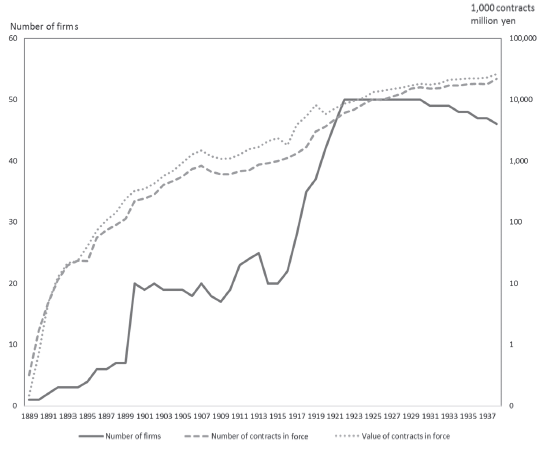
Figure 1 provides an overview of the development of the fire insurance industry in Japan. Following Tokyo Fire Insurance Co., many firms entered the fire insurance industry in the 1890s. Indeed, the number of fire insurance companies increased to 20 in 1900, and the number and the value of fire insurance contracts in force multiplied over 57.1 times from 1890 to 1895 and 7.9 times from 1895 to 1900. The institutional background of this sharp increase in fire insurance companies is that there was no entry regulation for the insurance business until the Insurance Business Law of 1900 introduced a licensing system and inspection by the government, while it prohibited a company from simultaneously offering life insurance and property insurance (Innnan Reference Innnan1966, pp. 274–75; Tokyo Marine and Fire Insurance Co. 1979, pp. 161–62). After the enactment of the Insurance Business Law of 1900, the number of fire insurance companies stabilized, although the fire insurance industry continued to grow, as indicated by the number and value of fire insurance contracts in force.
THE EVOLUTION OF THE NUMBER OF FIRE INSURANCE COMPANIES, THEIR CONTRACTS IN FORCE, AND THE VALUE OF THESE CONTRACTS
Sources: Toyo Keizai Shinpo-sha (1927); Statistics Bureau of the Cabinet, Nihon Teikoku Tokei Nenkan (Statistical Yearbook of Japan Empire, various issues).

Expansion of the fire insurance industry in the late nineteenth and early twentieth centuries reflected the progress of industrialization in Japan in that modern industries and large companies considerably increased the demand for fire insurance. For example, Tokyo Marine and Fire Insurance Co. (1979) noted that cotton spinning firms, leading Japan’s industrialization in its early stages, purchased fire insurance policies for their factories (p. 144). Additionally, Kon and Kitazawa (1944) stated that the rise of the silk weaving industry in Fukui Prefecture increased the demand for fire insurance (pp. 17–18). During WWI, Japan enjoyed a large economic boom because production capacity of major Western countries was mobilized for the war, and this boom boosted the development of its fire insurance industry. As shown in Figure 1, in the late 1910s, the number of fire insurance companies more than doubled, and the growth of the number and value of fire insurance contracts in force accelerated. That is, the value of fire insurance contracts in force was around five times larger in 1920 compared to 1915.
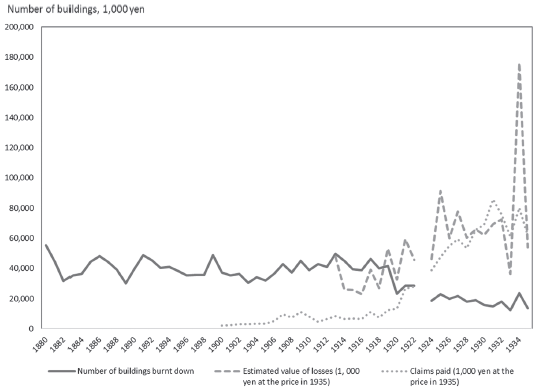
In the 1920s, the Japanese economy experienced a long stagnation because of the resumption of international competition with Western countries, large investment in equipment during WWI, and the appreciation of the Yen’s real exchange rate (Okazaki 1997). This affected the fire insurance industry by lowering its growth rate, although it still continued to grow, as reflected by the number and value of fire insurance contracts in force (Figure 1). Figure 2 depicts the number of buildings burned down, estimated losses by fires, and the fire insurance claims paid, excluding 1923, that is, the year of the Great Kanto Earthquake, the importance which will be described in greater detail. One should note that the loss values were estimated by the fire authorities, and that we deflated the nominal values to the real values at the prices in 1935 using the wholesale price index of the Bank of Japan (Bank of Japan 1966). While the number of buildings burned down tended to decrease from the late 1910s, the estimated total losses from fires increased substantially. At the same time, fire insurance claims paid increased as well, and became almost equal to the total estimated losses. This suggests that the fire insurance system developed enough to cover fire risks in Japan.
THE NUMBER OF BUILDINGS BURNED DOWN, THE ESTIMATED LOSS DUE TO FIRES, AND CLAIMS PAID
Note: The estimated value of losses and the claims paid are at the constant price in 1934–36, deflated by the wholesale price index of the Bank of Japan.
Sources: Toyo Keizai Shinpo-sha (1927, p. 671); Bank of Japan (1966, pp. 76–77); Statistics Bureau of the Cabinet, Nihon Teikoku Tokei Nenkan (Statistical Yearbook of Japan Empire, various issues).

In the process of developing the fire insurance system in Japan, the impact of large fires is notable. In our paper, a large fire is defined as a fire in which 300 or more buildings burned down. As we show, Japan experienced many large fires during this period. A basic reason for this is that cities in Japan were crowded with numerous small wooden houses that easily caught fire and, hence, under the right circumstances, could spread to become larger fires. When they did occur, large fires contributed to the expansion of the fire insurance system from both the demand and the supply sides. The impact from the demand side can be illustrated by the case of a large fire in Kanda Ward of Tokyo City in 1892, where 4,252 buildings burned down. Concerning the loss by this large fire, Meiji Fire Insurance Co. paid insurance claims according to the contracts, and “as a result, recognition of the need for fire insurance rose and the reputation of Meiji Fire Insurance Co. improved, which in turn increased fire insurance contracts of Meiji Fire Insurance Co. rapidly after the large fire” (Tokyo Marine and Fire Insurance Co. 1979, p. 143, the authors’ translation). Moreover, large fires took place in Toyama City in 1899 and Takaoka City in 1900, where more than 5,300 and 3,500 buildings burned down, respectively. Kon and Kitazawa (1944) note that “due to frequent large fires, recognition of insurance diffused and insurance demand increased” (pp. 17–18, the authors’ translation).Footnote 4
Many fire insurance companies also tended to utilize the occurrences of large fires for effective advertising purposes. For instance, after the large fire in Kanda Ward in Tokyo City in 1892, Meiji Fire Insurance Co. placed the following advertisement in a major newspaper (Yomiuri Shinbun, 16 November 1892):
A person would experience various unfortunes and disasters in his life. If he is not careful, he cannot avoid losing his assets and house. Above all the fire in Sarugaku-cho, Kanda Ward on April 10, has made clear that a fire is most terrible disaster. As fires are more frequent in winter, you should not hesitate to buy insurance even for one day (authors’ translation)
The impact of large fires on the fire insurance system from the supply side was substantial as well. In 1892, just after the launch of the modern fire insurance industry, a large fire occurred in Hyogo Prefecture. This large fire made Meiji Fire Insurance Co. recognize the fire risk in large cities, leading to the introduction of an upper limit on underwriting for each city with a high large fire risk (Tokyo Marine and Fire Insurance Co. 1979, pp. 142–43). Meanwhile, the huge payment of insurance claims due to large fires motivated fire insurance companies to sell more insurance policies and caused intense competition among them (Innnan Reference Innnan1966, p. 274). Tokyo Marine and Fire Insurance Co. (1979) stated that many large fires in the late 1900s and early 1910s caused serious losses to fire insurance companies, and “consequently competition to acquire insurance contracts became harsh and they aggressively lowered insurance rates” (p. 270, the authors’ translation). Harsh price competition, in turn, motivated fire insurance companies to form price cartels. Consequently the fire insurance price indeed substantially declined from the 1890s to the early 1910s (see Figure A1 in the Online Appendix).
The first attempt at a price cartel in the fire insurance industry was in 1898 for the Hokuriku District on the Japan Sea side, where large fires frequently occurred, and after that, many price cartels were formed and broken repeatedly (Takitani Reference Takitani1930, Reference Takitani1931; Kon and Kitazawa 1944; Innnan Reference Innnan1966, p. 294; Tokyo Marine and Fire Insurance Co. 1979, pp. 165, 252–253; Takeda Reference Takeda1997).
Finally, in the history of the fire insurance industry in Japan, the Great Kanto Earthquake in 1923 was an episode that cannot be overlooked. The Great Kanto Earthquake caused serious human and physical damage, especially in Tokyo and Yokohama, where the estimated physical damage amounted to around 35.5 percent of Japan’s GNP in 1922 (Imaizumi, Ito, and Okazaki Reference Imaizumi, Ito and Okazaki2016; Okazaki, Okubo, and Strobl Reference Okazaki, Okubo and Strobl2019, Reference Okazaki, Okubo and Strobl2024). Notably, most of the damage was because of the fires caused by the earthquake (Tokyo City Office 1925a, p. 1). More precisely, as a result of the earthquake, fires broke out almost simultaneously in at least 69 locations in Tokyo, due to flammable materials, ovens, braziers, and other factors, and these fires expanded rapidly into neighborhoods crowded with wooden houses. Furthermore, damage to the water supply infrastructure due to the earthquake weakened the capacity for fire extinction (ibid, pp. 1–9). Overall, the large fire caused by the Great Kanto Earthquake of 1923 was the largest in Japan’s history, with more than 381,000 buildings burned down (Tokyo City Office 1925b, p. 161).
The loss of physical assets of fire insurance policyholders of Japanese companies due to the Great Kanto Earthquake of 1923 has been valued at 2,230 million yen, which was around 10 times larger than their capital (Innnan Reference Innnan1966, pp. 313–14). Although the existing fire insurance contracts clearly granted exemption from paying claims for losses caused directly or indirectly by an earthquake, because of the pressure from the public and the government, fire insurance companies nevertheless agreed to pay 10 percent of the insurance amount in the name of “solatium,” financed by long-term, low-interest loans from the government (ibid, pp. 315–16).Footnote 5 Importantly, the extent of the fire after the Great Kanto Earthquake newly impressed the need for a fire insurance system to the Japanese public (ibid., p. 332).
As previously stated, large fires played a substantial role in the development of the fire insurance industry in Japan. The impacts of disasters like large fires on the fire insurance industry may have been different across the phases of the “underwriting cycle” (Sougiannis Reference Sougiannis1997). However, in Japan, the underwriting cycle is not clear, as indicated by the number of firms (Figure 1) and the insurance price (Figure 3). This may be because new entry, one of the main drivers of the underwriting cycle, has been regulated by the government since 1900.
CONTEMPORANEOUS AND LAGGED LARGE FIRE #’S ON FIRE INSURANCE
Notes: (a) t indicates time of impact; (b) Numerical values above dots are coefficient estimates; (c) Line bars indicate 95 percent confidence bands and constructed from standard errors clustered at the prefecture level; (d) Estimations are run for each insurance aspect (Claims, Active Policies, New Policies) separately.
Source: Authors’ dataset.

Large Fires: Case of Hakodate Large Fire of 1934
Many large fires, other than the Great Kanto Earthquake of 1923, during which hundreds of buildings burned down, occurred in prewar Japan. These large fires were generally caused by natural disasters and/or weather conditions within the context of neighborhoods dense with wooden, easily flammable houses. For example, the second largest fire before WWII, the Hakodate Large Fire of 1934, during which 23,000 buildings burned down, was caused by a storm. Hakodate City in Hokkaido is one of the early opening port cities in Japan and has a center for foreign trade, fisheries, and commerce. It has longer winters, more snow, and gusty winds than average in Japan. While Hakodate City experienced several large fires until the 1930s, among them, the large fire of 1934 was the most serious. More precisely, on 21 March of 1934, a spring storm hit Hakodate, where a low-pressure zone approached and air pressure in Hakodate drastically decreased by more than 20 hPa. Strong winds developed, reaching a maximum speed of 39m/s, resulting in the collapse of some wooden buildings. At 6:53 pm, a fireplace at a downtown wooden house collapsed due to the strong wind, causing fire. The fierce winds spread this fire almost immediately, resulting in more than 20 neighboring wooden buildings burning down and creating flying sparks to further spread the fire. In the end, 30 percent of the total city area was burned down (Hakodate City Reference City1997, pp. 728–30).
As illustrated by the cases of the Hakodate Large Fire in 1934 and the Great Kanto Earthquake of 1923, large fires in pre-war Japan tended to be originally small fires, but rapidly spread because of adverse weather conditions, for example, strong winds and dry air, as well as by the structure of cities with numerous crowded wooden buildings. The fact that exogenous natural conditions were a necessary condition for a large fire to occur is essential to the identification strategy of this paper, in which we examine whether fire insurance may have encouraged moral hazard and/or adverse selection behavior among policyholders.
Moral Hazard and Adverse Selection Behavior
Usually, moral hazard by fire insurance is a phenomenon where an insured person tends to take less care to prevent fires, leading to unintentional fires rather than arson. While there may have been cases of this usual moral hazard in early twentieth-century Japan, anecdotal evidence indicates a more aggressive type of moral hazard. That is, a major trade magazine of the insurance and banking industries, Hoken Ginko Jiho (Insurance and Banking News) reported a number of cases that insured persons set fire to their own houses intending to get insurance money (Hoken Ginko Jiho-sha 1905–1931, various issues). For example, an article in that magazine on 21 August 1905 reported:
Tokyo Metropolitan Police Department told that arson cases or suspected cases of arson have increased in Tokyo recently, and that these cases were supposed to be caused by fire insurance companies competing with each other to have larger amount of contracts and hence offering contracts that insured values larger than the real value of the objects (authors’ translation).
It is noted that this kind of aggressive moral hazard was observed even in the 1930s. The editorial article of Hoken Ginko Jiho on 27 November 1931 stated:
Arson cases in the territory in charge of the Tokyo Public Prosecutors’ Office have increased almost twice this year, and will be 300 cases by the end of the year. 80% of these arson cases aim at fire insurance imposture (authors’ translation).
These quotations suggest that moral hazard, as manifested through arson-induced fires, is more likely to have been characteristic of the early twentieth-century Japanese fire insurance industry. It is noted that the insurance price declined after large fires through competition between insurance companies (Figure 3). Not only high-risk high-return persons but also low-risk low-return persons were ready to join the insurance market due to lower insurance prices. Thus, adverse selection, in the sense that low-risk low-return persons are excluded from the insurance market because of the high insurance prices, is less likely to happen. This observation supports our hypothesis that what happened was a moral hazard rather than an adverse selection.
DATA AND SUMMARY STATISTICS
DataFootnote 6
Our insurance data are taken from Hoken Nenkan (Insurance Yearbook), which was published annually and provides information on fire insurance at the prefectural level from 1910 to 1940 (Ministry of Agriculture and Commerce 1912–1922, various issues; Ministry of Commerce and Industry 1925–1940, various issues; Ministry of Finance 1940). More specifically, for each prefecture, yearly information on the number of active policies, the number of claims, and the number of new and renewed policies is recorded. The active policies for each year refer to the stock of the fire insurance policies active at the end of the year, while the new and renewed policies for each year capture the flow of fire insurance policies newly contracted and renewed during the year. One should note that, unfortunately, the data does not allow us to distinguish between the types of policyholders, such as whether they are individuals or businesses. The data constitutes a balanced panel, except that information is missing for 1923 because of the Great Kanto Earthquake.
The information on large fires is taken from the database of Yomiuri Shinbun, one of the largest nation-wide newspapers in Japan during our sample period. To identify large fires, we searched articles for the keyword “Taika” (a large fire in English), and identified the year and location (prefecture) of large fires where 300 or more buildings burned down. The data on small fires are taken from Dai Nihon Teikoku Tokei Nenkan (Statistical Yearbook of the Japanese Empire, various issues) and Naimusho Tokei Houkoku (Statistical Report of the Ministry of Home Affairs, various issues), which provide information on the number of small fires (unintentional fires and arson) at the prefectural level for each year.
We also collected annual prefecture-level population data.Footnote 7 For the period from 1920, the Statistics Bureau of Japan provides the data on its webpage. The data were generated by interpolation using the census data for 1920, 1925, 1930, 1935, and 1940 as benchmarks. Before 1920, the Japanese government conducted population surveys in 1890, 1913, and 1918. We generated the annual prefecture-level population data from 1890 to 1919 by linear interpolation.Footnote 8 Finally, we used the annual data on bank deposits at the prefecture level from various issues of Ginko-kyoku Nenpo (Annual Report of the Bank Bureau of the Ministry of Finance). The deposit data here are the sum of the deposits of ordinary banks and savings banks at the end of the year. We have normalized the deposits to be in per capita terms with the population and deflated them by the wholesale price index of the Bank of Japan (1935=1.00).
Summary Statistics in Large Fires and Fire Insurance Policy Variables
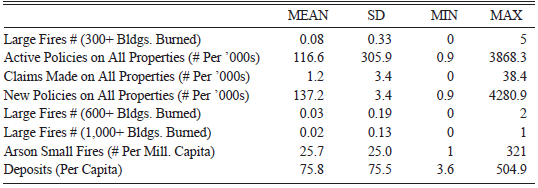
Summary statistics for all our variables are provided in Table 1. One should note that since we allow for lagged effects of large fires in our econometric analysis, the data on large fires are for the entire period from 1903 until 1938, while for all other variables these are defined for the common sample period of 1909 until 1938, excluding 1923 (when no data are available). In terms of the average number of large fires, the mean value is 0.08, suggesting an annual average of an 8 percent chance of a large fire occurring within a prefecture. However, the standard deviation is multiple times its mean, indicating that this probability varies widely over space and time. This is also apparent from Online Appendix Figure A2, where we depict the mean regional variation in the number of large fires. Accordingly, Hokkaido (1), Tokyo (13), Niigata (15), Shizuoka (22), Ishikawa (17), Aomori (2), Akita (5), and Miyagi (4) are the group of high probabilities; see Online Appendix Figure A3 for prefecture names and codes. One may want to note that a simple correlation between the number of big fires and population density suggest that these are positively associated.Footnote 9
SUMMARY STATISTICS (PREFECTURE LEVEL)

Source: Authors’ dataset.
In Hokkaido (1), Hakodate City of Hokkaido often suffered large fires in our sample period. For example, 8,977, 1,532, 1,763, 2,141, and 23,000 buildings burned down in the large fires of 1907, 1913, 1916, 1921, and 1934, respectively. In particular, as mentioned earlier, the large fire of 1934 in Hakodate city burned down 33 percent of the city, where 2,166 died. Shizuoka prefecture (22) also had some city-wide fires. For instance, in 1913, Numazu city had a large fire with 9 dead, 168 injured, and 1,468 burned buildings, while in 1940, Shizuoka city had a big fire where 5,229 buildings were burned down and there was one death and 788 injuries. Tokyo City (13), characterized by the largest population and the highest population density, had many large fires since the Edo period (seventeenth to nineteenth centuries). In our sample period, Asakusa Ward of Tokyo City had a big fire in 1921, resulting in 1,277 buildings burning down. Shortly after, when the Great Kanto Earthquake of 1923 hit Tokyo, 100 percent of Nihonbashi Ward and more than 90 percent of areas in Asakusa, Honjo, and Kanda Wards of Tokyo City were destroyed.
For our fire insurance variables, to account for potential differences in prefecture-level demand, we have normalized these by the prefecture-level population numbers to show their summary statistics in Table 1. In terms of the number of claims made by fire insurance policyholders, there are, on average 1.2 per every 1,000 inhabitants in a prefecture. Again, however, the number of claims varies widely as its standard deviation is more than double the mean. As suggested by Figure A4 in the appendix this is partly due to the large spatial variation in the number of policyholders across Japan. One possible reason for the spatial differences may be because the potential customer base is different, that is, there may be differences in the number of potential business customers. Since our insurance data does not allow us to distinguish between types of costumers, we as a rough check regressed the number of fire policies in force on the mean number of factories in the textiles and the mean number of machine factories as taken from Mohan, Okubo, and Strobl (Reference Mohan, Okubo and Strobl2023) for the common sample period (1919 to 1940). The results suggested that there is no significant association between fire insurance policies and textile factories, but in areas with more fire insurance policyholders, there are more machinery factories.Footnote 10 This indicates that machinery sector policyholders may be driving some of the spatial differences in fire insurance policy penetration observed (Figure A4 in the Online Appendix).
It is noteworthy that the number of new policies is large relative to the number of active policies, which indicates that policies tend to be short-lived (e.g., less than 1 year), but are likely renewed and/or that there is a lot of turnover among policyholders (Figure A5 in the Online Appendix).Footnote 11 More precisely, there are about 137 policy renewals and new policies per thousand population per year at the prefecture level. From 1918 onward, there was a continuous increase in the number of policies relative to the population size (green line of Panel (a)) of Online Appendix Figure A5 until about 1925, where a plateau persisted until the end of the 1935, after which the per capita policies taken up began to rise again. Claims (blue line of Panel (b)) started rising in a similar manner around 1918, but then experienced a stark increase a year after the Great Kanto Earthquake of 1923 for several years. While somewhat volatile, this increase continued until 1930, after which it was more or less flattened. The prefectural-level number of new and renewed policies (orange line of Panel (c) of Online Appendix Figure A5) displays a similar pattern to that of policies in force, except for a short period between 1930 and 1934, during which the former appears to be slightly more volatile.
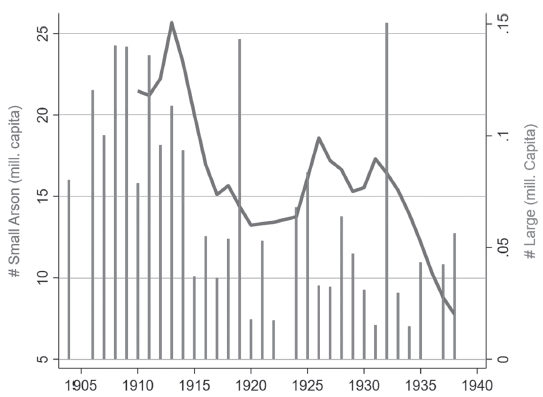
The average number of large fires per capita in each year, displayed as red bars in Figure A5 in the Online Appendix, shows that many large fires occurred in 1919 and 1932. Although this may give the impression that the frequency of large fires has no trend over time, in the period prior to 1915, many large fires occurred every year, and the frequency of large fires basically declined after that. This change is likely to improvements in firefighting technology and equipment. In the late 1910s, fire engines and pumps became widely spread, and after the Great Kanto Earthquake, firefighting equipment with advanced technology was introduced in many cities (Tokyo Fire Department 1980). In terms of seeking to identify any correlations between the large fire time series and the insurance variables, there appear to be some visually coinciding increases in the insurance series and peaks in large fire numbers, although only weakly so.
IMPACT OF LARGE FIRES ON INSURANCE
Econometric Specification
In order to estimate the impact of large fires on the fire insurance industry we specify the following:

where i and t indicate subscripts for prefecture and year, respectively. INS is a vector consisting of the number of claims, the number of active policies, and the number of new and renewal policies. FIRE is the number of incidences of large fires in a prefecture, where we allow for it to have both a contemporaneous impact (j=0) as well as lagged impacts up to 5 years after the events (j=1, …, 5). POP is population size of prefecture i at year t. Additionally, we control for year specific fixed effects (γ), prefecture fixed effects (µ), and prefecture-specific time trends (TREND). The prefecture-specific fixed effects control for all time invariant omitted variables, while the year specific dummies capture all common yearly shocks, such as changes to regulation of the insurance market and fire regulations, as well as technological changes in fire prevention. One should note that the inclusion of the population variable allows us to roughly control for all changes in population, as well as population density, through the inclusion of the prefecture-level fixed effects (µ), which are not already captured by the prefecture-specific time trends (TRENDS). The inclusion of prefecture-specific time trends TRENDS, apart from capturing general changes in population, also serves to control for general prefecture changes in factors that might affect fire insurance policies, such as greater awareness of the need for fire insurance or general changes in wealth and industrialization, as long as these are approximately linear. In all specifications, we cluster standard errors at the prefecture level.
Given the count nature of the dependent variables included in INS, we estimate Equation (1) using a Poisson fixed effects estimator with robust standard errors, which has the advantage of being suitable to a number of different common count data features, including under-dispersion, over-dispersion, and a large number of zeros (Wooldridge Reference Wooldridge1999).Footnote 12 Since spatial dependence, if time varying, is a possible threat to the estimation of the correct standard errors in a fixed effects Poisson estimation, we investigate the possible existence of such spatial correlation for each count model using the test developed by Bertanha and Moser (Reference Bertanha and Moser2016). One should finally note that the coefficients generated from a fixed effects Poisson estimator are interpreted as semi-elasticities.
Econometric Results
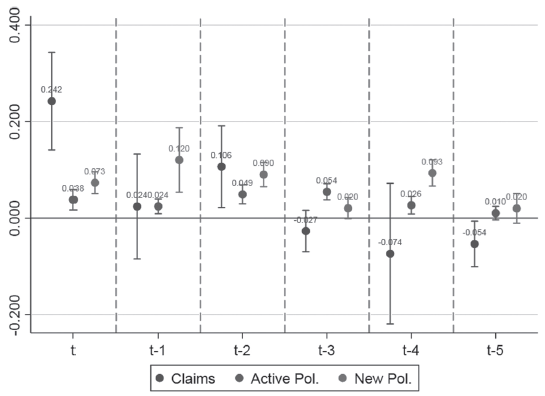
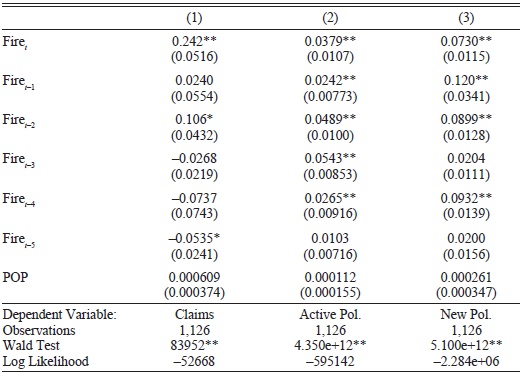
We first tested whether there was time varying spatial correlation present in estimating Equation (1) for our three fire insurance policy variables. However, the resultant test statistics did not indicate such and we thus proceeded using the fixed effects Poisson estimator with robust standard errors.Footnote 13 The results of estimating (1) for all properties for the numbers of claims, active policies, and new and renewed policies are shown in terms of the estimated coefficients and 95 percent confidence band on FIRE and its lags in Figure 3, as well as in Table 2. Accordingly, there is a relatively large and significant positive impact on the number of claims in the year of the fires, and then a much smaller one at t – 2. Taking these coefficients at face value suggests that in the year of its occurrence, a large fire increases the number of claims in a prefecture by 24.2 percent, while the largest observed number of large fires in any year in our sample period would have increased the number of claims by over 120 percent. Moreover, two years after a large fire, claims increase further by a little over 10 percent. There is also a relatively small fall in claims five years after the event(s), suggesting that claims fall by a little over 5 percent.Footnote 14
IMPACT OF LARGE FIRES ON INSURANCE POLICY VARIABLES

* = Significant at the 5 percent level.
** = Significant at the 1 percent level.
Notes: (a) Robust standard errors in parentheses; (b) All specifications include time dummies and prefecture-level standard errors.
Source: This study.
Examining the number of active policies, one finds that large fires have a persistent positive impact lasting up to four years after their occurrence. This impact is relatively small, however, ranging from between 2.4 (t – 1) to 5.4 (t – 3) percent for a large fire. The effect on new policies and renewals also persists until t – 4, although the estimated coefficient is only significant at the 10 percent level at t – 3. Importantly, the estimated impact, except at t – 4, is always larger compared to active policies. The largest observed impact on new and renewed policies is one year after a large fire, reaching 12 percent for a single event. More generally, one should note that even within five years, there is no reversal of the increase due to the large fires, suggesting that this impact is not temporary.Footnote 15
Robustness Checks
To see how sensitive our results are to different thresholds of what we define as a large fire (300+ buildings burned in the main estimation), we experimented with using 600+ and 1,000+ buildings burned as alternatives. As can be gauged from Table 1, the mean number per prefecture per year reduces to 0.03 and 0.2 for the former and latter, respectively. The results of these thresholds for estimating (1) produce very similar results to the 300 threshold qualitatively, except for a lack of impact on claims at t – 2 and t – 5, while there are small significant impacts on new policies at t – 3 and t – 5 (Online Appendix Figure A6). For the 1,000 threshold there one also finds a lack of an impact on claims at t – 3 and t – 5 and on active policies at t – 4, while there are also small impacts on new policies at t – 3 and t – 5 (Online Appendix Figure A6).
To explore whether our identification of large fires by the number of buildings burned may depend on the size of the city, since larger cities will have a larger of potential buildings that could be burned down, we have also explored whether identifying fires by the number of buildings burned biases the results toward fires that take place in large cities. In this regard, we have identified the cities in which each large fire took place and classified these as small, small-medium, large-medium, and large according to the administrative units of local municipalities (village, town, and city). Villages and towns are classified as small and small-medium, respectively. While a city with less than 100,000 population as of 1925 is defined as large-medium, a city with more than 100,000 is classified as large. However, the mean number of large fires for these categories is 0.11, 0.03, 0.06, and 0.03, respectively, and thus there appears to be little relationship between city size and the number of large fires.
Since large fires that take place later in the year may only affect insurance policies in the following year, we alternatively attributed any large fires that took place after June in any year to the following year. The results of estimating (1) show that there are minor qualitative changes in doing so, namely the impact on claims at t – 4 becomes significant and that at t – 5 insignificant (Online Appendix Figure A7).
Arguably, the Great Kanto Earthquake of 1923 and subsequent, given its level of destruction, may have a much larger impact than any other large fire that took place during our sample period. To investigate this further, we created a dummy indicating the prefectures where there were fires induced by the Great Kanto Earthquake of 1923 and interacted this with our FIRE variable. Accordingly, the only additional effects of the large fires induced by the Great Kanto Earthquake are larger additional effects on claims in t – 0 and t – 2 (Online Appendix Figure A8).
There could also be spillover effects from neighboring prefectures, as large fires in these may alter local prefectural behavior by reminding them of the possibility of large fires occurring. We thus identified all contiguous neighbors of each prefecture, if any, and included the sum of large fires in these and their lags as additional explanatory variables in (1). However, the spatial spillover effect from large fires in neighboring prefectures is minimal, in that there are only slight increases in total claims in t – 4 and active policies in t – 5 (Online Appendix Figure A9). There are a number of possible reasons for this. First, many spatial delineations of regions are determined by geographical features, such as mountain ranges. Consequently, prefectures tend to be fairly heterogeneous in culture, economy, and society, while large fires happened in specific areas in towns within prefectures. Even if a large fire happened in a local town in an adjacent prefecture, people’s behavior in neighboring prefectures likely did not have much influence. Second, the impact of natural disasters tended to be limited to the local economy in the pre-war period. In this regard, Mohan, Okubo, and Strobl (Reference Mohan, Okubo and Strobl2023) found that prefectures have no spatial correlations nor spillovers of disaster damage on industrial technology, production, and production factors in neighboring prefectures.
Finally, there were also some building regulations introduced during our time period that might have affected the relationship between large fires and fire insurance policies. In 1909, the Ordinance on Building Regulation was implemented in Osaka Prefecture, and in 1920, the Urban Building Law was implemented. While at first the Urban Building Law was applied only to certain towns in the six largest cities, that is, Tokyo, Yokohama, Nagoya, Kyoto, Osaka, and Kobe, in 1926 the Law came to cover many cities in all the prefectures except Okinawa (Editorial Committee of the 100 Year History of the Modern Japanese Legal System on Building 2019, pp. 50–51, 68–79). One should note that since these took place at the city level and not necessarily in all cities in a prefecture at the same time, one would ideally have liked to either run city level insurance regressions with a regulation incidence variable or create a city population weighted prefecture-level regulation presence variable and re-run our prefecture-level regressions. However, since there are neither city level insurance data nor time varying city population data, we instead created a simple indicator variable to signify if any building regulation was introduced within a prefecture and included this in Equation (1). The result of the coefficients on the  after including this variable and lags up to t – 5 is very similar to that without the regulation variable, except that the effects on new policies and active policies are now marginally insignificant for the four years following the event (Online Appendix Figure A10).
IMPACT OF FIRE INSURANCE ON SMALL ARSON FIRES
Small Fires
The summary statistics in Table 1 indicate that, on average, there are about 26 small arson fires per million population annually in a prefecture.Footnote 16 However, as with large fires, there is a large variation across prefectures and time. In Figure 4, we show the evolution of arson fires normalized by population. Accordingly, on average, the number of small arson incidents fell in the early 1910, then reached a plateau and began to noticeably fall again from the 1930s onward. In order to also explore whether such arson attacks may be related to poverty, as measured by a survey from the Tokyo City Office (1921), we collected data on the number of “poor people,” defined as people whose wealth and income are always insufficient and have difficulty in maintaining and developing the lives of themselves and their families (Tokyo City Office 1921), in Tokyo City in 1920 broken down by ward. We then regressed the number of arsons from 1918 to 1922 on the number of poor people in 1920, both normalized by population, but found no significant correlation between the two variables.Footnote 17
EVOLUTION OF AVERAGE NUMBER OF SMALL ARSON AND NON-ARSON FIRES VERSUS LARGE FIRES PER PREFECTURE
Source: Authors’ dataset.

Econometric Specification
We want to explore how new policies may have affected the number of small fires caused by arson by estimating the following:

where ARSON is the total number of small arson fires and DEPOSITS is the prefecture-level bank deposit per capita. One should note that we have included the latter to control for economic conditions that might have induced the number of arson fires.Footnote 18 The motivation is that the number of arson fires would correlate with the instability of society, which would in turn correlate with the economic condition, captured by per capita bank deposits, a measure of the average wealth of the people, and possibly the financial literacy of the population.
In order to take into account the potential endogeneity of new and renewed policies (NEW) in causing arsons, we instrument these with the occurrence of large fires. More specifically, we undertake an instrumental variables (IV) strategy in which, in the first stage, new and renewed fire insurance policies are instrumented with the occurrence of the number of large fires. Since our earlier analysis showed that the impact of the latter lasted up to four years after the event, our first stage consists of re-estimating Equation (1) using a fixed effects Poisson estimator but only including lags of FIRE up to t – 4:

We next include the fitted values of new policies ( ) in a second stage:

One should note that the identifying assumption underlying our IV approach is that large fires only affect arsons through new and renewed policies. More precisely, we assume that there are no other omitted factors that are correlated with both large and arson fires, or that large fires have a direct effect on the number of small fires other than through new and renewed insurance policies, after controlling for prefecture time invariant factors, time trends, population trends, and economic conditions and stability (as proxied by the per capita bank deposits). In this regard, large fires in our data are arguably exogenous events, involving a large number of casualties and a large amount of physical damage that have become large fires because of exogenous weather conditions and/or earthquakes. In contrast, small arson fires tend to be extinguished in a short time and completely or partially burn down the buildings of fire origin, as well as sometimes neighboring buildings, but do not spread further. While a fall in economic conditions of a prefecture may be caused by large fires, this could lead to more small arson fires. We control for this using per capita deposits. Therefore, large fires and small arson fires can be assumed to be uncorrelated in our context. This is further substantiated by the small raw correlation coefficient between the two data series (0.156).
Econometric Results
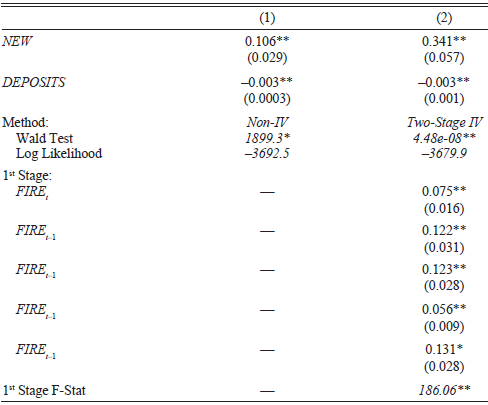
We first simply estimated (2) as a fixed effects Poisson model, that is, without instrumenting NEW in Equation (3). As can be seen from the first column of Table 3, one finds that there is a significant positive effect of new and renewed fire insurance policies on the number of small arson fires.Footnote 19 In the second column of the table, we present the results of the two-stage estimation, Equations (3) and (4), where we instrument the policies with large fires. Firstly, as can be seen, the instruments are all significant determinants of NEW. The highly significant joint Wald test statistic further cements their relevance in their predictive strength. Examining the second stage shows that new and renewed policies significantly increase the number of small fires by arson and that the size of the coefficient is more than three times that under OLS. One possibility driving this negative bias under OLS is perhaps that more arson incidences in a region may make fire insurance companies more reluctant to offer policies, or perhaps increase their prices, thus suggesting a reverse causality. Another possibility is that arsons are more likely in larger businesses, and a disproportionally higher number of larger businesses in an area might mean a lower number of policies, so the size distribution of businesses across space and time could result in omitted variable bias.
IMPACT OF NEW AND RENEWED POLICIES ON SMALL ARSON FIRES

* = Significant at the 5 percent level.
** = Significant at the 1 percent level.
Notes: (a) Robust standard errors in parentheses; (b) All regressions include prefecture-specific population, time trend, and year dummies; (c) The sample size is 1,126 and covers all prefectures over the years from 1909 to 1938; (d) NEW is normalized by 106 in order to make the coefficients more readable.
Source: This study.
The implied semi-elasticity from the IV results suggests that, for the average number of new and renewed policies, the number of arson related small fires increases by 1.4 percent. One might also note that a fall in the per capita deposits, arguably a proxy for poorer economic conditions in a prefecture, also increases the number of arson fires, with the implied semi-elasticity being 20.1 percent. One reason for this may be that poorer communities are more likely to resort to criminal activity, such as intentionally setting fires. Overall, the results suggest a change in fraudulent policyholder behavior due to the fire insurance policy uptake. The anecdotal evidence presented in the second section suggests that this was due to moral hazard rather than adverse selection.
CONCLUSION
In this paper, we investigated the role of large fires in the early development of the Japanese fire insurance industry. To this end, we constructed a 30-year time varying, prefecture-level data set of large fires, as identified in newspaper sources, and fire insurance data for early twentieth-century Japan. Our empirical analysis shows not only, as would be expected, that fire insurance claims increased after large fires, but also that this led to significant increases in new contracts and policy renewals. These results are in line with narrative accounts at the time where fire insurance companies used the incidence of large fires to advertise their business and the need of insuring against fires.
We also investigated whether the new policies and policy renewals might have influenced policyholder behavior by intentionally setting small fires. We found that the increase in new policies and policy renewals due to large fires did indeed increase the number of fires due to arson, where the semi-elasticity was much lower than the response due to worsened economic conditions. While our data did not allow us to identify whether the increase in arsons was because of the adverse selection of fraudulent policyholders in the insurance market or the attempted exploitation of fire insurance by existing policyholders, the declining trend of insurance prices and anecdotal evidence suggest that moral hazard may have been the more likely driving force.

 Open access

