





Introduction
The commercialization of genetically modified crops, including soybean [Glycine max (L.) Merr.], cotton (Gossypium hirsutum L.), and corn (Zea mays L.) with resistance to 2,4-D and glyphosate (i.e., Enlist™ Technology; Corteva, Indianapolis, IN) has led to widespread adoption of 2,4-D and glyphosate for weed control in these crops (Knezevic et al. Reference Knezevic, Osipitan and Scott2018; Manuchehri et al. Reference Manuchehri, Dotray, Keeling, Morgan and Byrd2020). Enlist™ technology allows growers to use 2,4-D formulations alone or in a mixture with glyphosate to effectively control Palmer amaranth (Amaranthus palmeri S. Wats.), horseweed [Conyza canadensis (L.) Cronq.], giant ragweed (Ambrosia trifida L.), [Amaranthus tuberculatus (Moq.) J. D. Sauer], and other difficult-to-control weed species with in-season applications (Dintelmann et al. Reference Dintelmann, Warmund, Bish and Bradley2020; Manuchehri et al. Reference Manuchehri, Dotray, Keeling, Morgan and Byrd2020; Shyam et al. Reference Shyam, Chahal, Jhala and Jugulam2020; Werle et al. Reference Werle, Mobli, Striegel, Arneson, DeWerff, Brown and Oliveira2022). However, a major concern is the risk of spray-tank contamination and off-target movement of 2,4-D choline/glyphosate–based herbicides to 2,4-D/glyphosate–sensitive crops grown in nearby fields.
In the southeastern United States, peanut is commonly grown in rotation or in close proximity to soybean, cotton, and corn (Johnson et al. Reference Johnson, Brenneman, Baker, Johnson, Sumner and Mullinix2001; Katsvairo et al. Reference Katsvairo, Wright, Marois, Hartzog, Rich and Wiatrak2006). At present, Enlist™ cotton, corn, and soybean varieties are widely adopted in the southeastern United States, with 2,4-D plus glyphosate regularly applied for effective weed management (Schwartz-Lazaro et al. Reference Schwartz-Lazaro, Norsworthy, Steckel, Stephenson, Bish, Bradley and Bond2018). The increased use of 2,4-D plus glyphosate throughout the growing season in southeastern cropping systems is likely to increase the risk of accidental exposure of neighboring peanut crops to these herbicides, which can cause injury and yield loss. Previous research has shown that 2,4-D and glyphosate are susceptible to off-target movement and cause damage to sensitive crops (Manuchehri et al. Reference Manuchehri, Dotray, Keeling, Morgan and Byrd2020; Shyam et al. Reference Shyam, Chahal, Jhala and Jugulam2020; Werle et al. Reference Werle, Mobli, Striegel, Arneson, DeWerff, Brown and Oliveira2022). Off-target injury of 2,4-D or glyphosate can occur through physical drift, volatility, sprayer contamination, and application error (Bish et al. Reference Bish, Oseland and Bradley2021; Jones et al. Reference Jones, Norsworthy and Barber2019; Werle et al. Reference Werle, Oliverira, Jhala, Procotor, Rees and Klein2018). High wind speed during application can result in off-target movement of the spray droplets to nearby fields (Soltani et al. Reference Soltani, Oliveira, Alves, Werle, Norsworthy, Sprague, Young, Reynolds, Brown and Sikkema2020; Wolf et al. Reference Wolf, Grover, Wallace, Shewchuk and Maybank1993). Likewise, volatility of 2,4-D can increase during a temperature inversion and high relative humidity conditions, thereby increasing the risk of unintended peanut exposure in nearby fields to the herbicide (Mueller and Steckel Reference Mueller and Steckel2019; Sosnoskie et al. Reference Sosnoskie, Culpepper, Braxton and Richburg2015).
The severity of peanut injury and yield loss from the off-target movement of 2,4-D and glyphosate is highly variable. It depends on several factors, including peanut growth stage during drift occurrence, exposure rate, application variables, formulations, and prevailing environmental conditions (Johnson et al., Reference Johnson, Fisher, Jordan, Edmisten, Stewart and York2012; Solomon and Bradley Reference Solomon and Bradley2014; Werle et al. Reference Werle, Mobli, Striegel, Arneson, DeWerff, Brown and Oliveira2022). For example, Johnson et al. (Reference Johnson, Fisher, Jordan, Edmisten, Stewart and York2012) reported that peanut exposure to the amine formulation of 2,4-D at 1/512 to 1/2 of the label rate of 540 g ae ha−1 resulted in 30% to 40% injury. However, the rate required to cause crop injury does not necessarily correlate with the rate required to cause yield loss (Werle et al. Reference Werle, Mobli, Striegel, Arneson, DeWerff, Brown and Oliveira2022). Leon et al. (Reference Leon, Ferrell and Brecke2014) observed 0% to 35% peanut injury and 11% to 41% yield loss following exposure to 2,4-D amine at 21 and 42 d after planting at a rate between 70 and 1,120 g ae ha−1. Leon et al. (Reference Leon, Ferrell and Brecke2014) further demonstrated that lower rates between 70 and 280 g ae ha−1 were not injurious to peanut but resulted in 11% to 19% yield loss (Leon et al. Reference Leon, Ferrell and Brecke2014). In another study, 2,4-D applied to peanuts at a rate between 67 to 1,066 g ae ha−1 at the V2 stage resulted in 10% to 20% injury but did not cause yield loss, whereas up to 35% injury and between 23% to 36% yield loss occurred following peanut exposure to 2,4-D at V3 and V5 growth stages (Blanchett et al. Reference Blanchett, Grey, Prostko, Vencill and Webster2017). Similarly, various degrees of peanut injury and yield loss were reported from glyphosate application (Grey and Prostko Reference Grey and Prostko2010; Lassiter et al. Reference Lassiter, Burke, Thomas, Pline-Srnić, Jordan, Wilcut and Wilkerson2007). Peanut exposure to glyphosate at a rate between 18 to 1,120 g ae ha−1 at 4 wk after planting and just before flower development resulted in 95% injury and caused >50% yield loss with a rate greater than 560 g ae ha−1 (Lassiter et al. Reference Lassiter, Burke, Thomas, Pline-Srnić, Jordan, Wilcut and Wilkerson2007). Grey and Prostko (Reference Grey and Prostko2010) also reported 12% to 32% yield loss following peanut exposure to glyphosate at 240 to 470 g ae ha−1. In addition, Grey and Prostko (Reference Grey and Prostko2010) showed that peanut yield loss from glyphosate was greater when exposed at 75 d compared with 90 and 105 d after planting.
In previous peanut studies, authors evaluated 2,4-D or glyphosate applied alone. In glyphosate-resistant corn, Soltani et al. (Reference Soltani, Shropshire and Sikkema2018) reported that a mixture of glyphosate plus 2,4-D accentuated 2,4-D injury and caused greater yield reduction than 2,4-D applied alone. The potential impact of 2,4-D applied with glyphosate (a herbicide widely used on Enlist™ crops) on peanut injury and yield response has not yet been investigated. Therefore, the objectives of this study were to 1) evaluate the impact of reduced rates of 2,4-D plus glyphosate on peanut injury and yield response, and 2) determine peanut response to reduced rates of 2,4-D plus glyphosate at various growth timings corresponding to vegetative, flowering/pegging, and pod development growth stages.
Materials and Methods
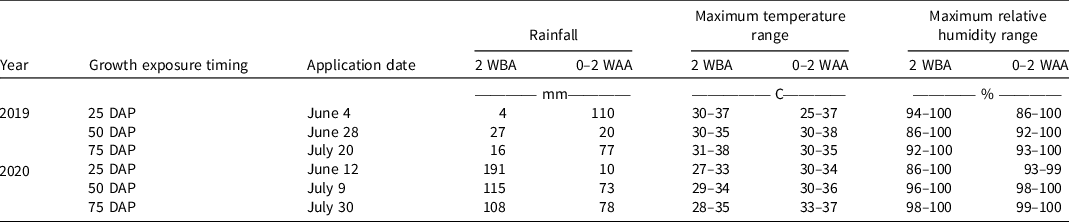
Field research was conducted at the University of Florida Institute of Food and Agricultural Sciences West Florida Research and Education Center at Jay, FL (30.774333°N, 87.137417°W) in the summer of 2019 and 2020. The soil in the research site was sandy loam (fine-loamy, kaolinitic, thermic typic kandiudult) with 1.5% organic matter. Weather data at 2 wk before application (WBA) of 2,4-D plus glyphosate and 0 to 2 wk after application (WAA) are presented in Table 1. Total rainfall 2 WBA ranged from 4 to 16 mm in 2019, and 108 to 191 mm in 2020 (Table 1). At 2 WAA, rainfall ranged from 20 to 110 mm in 2019, and 10 to 78 mm in 2020, across all exposure timings.
Total rainfall, temperature, and relative humidity range for each growth/exposure timing for 2 WBA and up to 2 WAA herbicide application. a, b, c
a Abbreviations: DAP, days after planting; WAA, weeks after application; WBA, weeks before application.
b Exposure timing represents the days after planting peanut.
c Experiments were carried out in 2019 and 2020 in Jay, Florida.
Georgia-06G peanut variety (Branch Reference Branch2007) was planted at 6-cm depth with a rate of 20 seeds per meter per row in mid-May in both years. Peanuts were planted in single rows spaced 91 cm apart. Individual plots (subplots) were 7.6 m long and 3.6 m wide, and contained four rows of peanuts. Flumioxazin (Valor SX; Valent USA Corporation, Walnut Creek, CA) was sprayed at 107 g ai ha−1 on the same day after peanut planting to provide preemergence weed control. Clethodim (Select Max; Valent USA Corporation) was sprayed at 136 g ai ha−1 6 wk after planting (WAP) for grass weed control. Broadleaf weeds were controlled early in the season by cultivation at 4 WAT, and with imazapic (Cadre; BASF Corporation, Research Triangle Park, NC) application at 70 g ai ha−1 during the mid and late seasons. Fertilizer, fungicide, insecticide, and gypsum were applied based on peanut production recommendations from the University of Florida Cooperative Extension Services (Wright et al. Reference Wright, Tillman, Small, Ferrell and DuFault2016).
The experiment was a randomized complete block design with a split-plot restriction on randomization with four replications and repeated over 2 yr. Peanut growth stage or exposure timing was the main plot factor and included 25, 50, and 75 d after planting (DAP) to represent vegetative flowering/pegging, and pod development stages. The subplot factor was 2,4-D plus glyphosate rates at 2.1 plus 2.2, 8.4 plus 8.8, 33.6 plus 35.4, or 134.6 plus 35.4 g ae ha−1, respectively. These rates represented 1/512× (0.2%), 1/128× (0.8%), 1/32× (3.1%), and 1/8× (12.5%) of the label rate of 2,4-D and glyphosate (Enlist Duo; Corteva Agriscience, Indianapolis, IN) at 1,077 and 1,132 g ae ha−1, respectively. In addition, a weed-free control was included for treatment comparisons. Herbicides were applied with a CO2-pressurized backpack sprayer equipped with TTI11002 nozzles (TeeJet Technologies, Glendale Heights, IL) calibrated to deliver 140 L ha−1 at 4.8 km h−1.
Data Collection
Peanut injury (aggregate of epinasty, chlorosis, and stunting) was visually estimated on a 0% to 100% scale (where 0% = no injury or plants similar to the weed-free control, and 100% = completely dead plants) at 2, 4, and 8 wk after treatment (WAT). Peanut canopy width and height were measured at 4 WAT to quantify the impact of 2,4-D plus glyphosate drift on peanut growth. Peanut canopy height and width were recorded from randomly selected spots at two middle rows (i.e., two height or canopy width data per plot). The height was recorded from the ground surface to the top of the peanut canopy. The width was recorded from one end of the peanut canopy to the other end. After determining the peanut pod maturity based on mesocarp color as described by Williams and Drexler (Reference Williams and Drexler1981), peanuts were dug from the middle two rows and left to dry for 3 to 5 d, after which pods were harvested. The yield was recorded, and the final yield was adjusted to 10% moisture content.
Statistical Analysis
For data analysis, the peanut canopy width, canopy height, and yield were converted to percent reduction as follows:
 \begin{align}&{\rm{Percent}}\;{\rm{reduction = }}[({\rm{value}}\;{\rm{forweed - free}}\;{\rm{control}}{\mkern 1mu} -\\
&\qquad {\rm{value}}\;{\rm{for}}\;{\rm{2}},{\rm{4 - D}}\;{\rm{plus}}\;{\rm{glyphosate}}\;{\rm{exposed}}\;{\rm{peanut}})/ \\ &\qquad{\rm{value}}\;{\rm{for}}\;{\rm{weed}} - {\rm{free}}\;{\rm{control}})]{\rm{*100}}\%\end{align}
\begin{align}&{\rm{Percent}}\;{\rm{reduction = }}[({\rm{value}}\;{\rm{forweed - free}}\;{\rm{control}}{\mkern 1mu} -\\
&\qquad {\rm{value}}\;{\rm{for}}\;{\rm{2}},{\rm{4 - D}}\;{\rm{plus}}\;{\rm{glyphosate}}\;{\rm{exposed}}\;{\rm{peanut}})/ \\ &\qquad{\rm{value}}\;{\rm{for}}\;{\rm{weed}} - {\rm{free}}\;{\rm{control}})]{\rm{*100}}\%\end{align}
Data were subjected to ANOVA using the GLIMMIX procedure with SAS software (version 9.4; SAS Institute Inc., Cary, NC). Initial analyses were performed on all dependent variables to determine the effect of the year as a fixed effect. The year, herbicide application timing, and herbicide application rate were independent variables. The preliminary analyses indicated significant interactions (P < 0.05) between year and treatments (herbicide application timing and herbicide application rate) for most response variables. However, the interactions were driven by the magnitude of differences among treatments but with similar trends across the years. Therefore, all subsequent analyses were performed for both years combined as a random effect. Box plots and residual plots were evaluated to determine whether the data violated ANOVA assumptions. The data did not violate ANOVA assumptions, so the transformation was not required. Peanut growth timing, herbicide rate, and their interactions were considered fixed effects, whereas year, replication nested within the year, and their interactions were considered random effects. Degrees of freedom were estimated using the Kenward-Roger method. The least-square means of fixed effects were computed, and differences among least-square means were compared using Tukey’s honestly significant difference test. The SLICE option for the LSMEANS command was used to partition significant interactions among fixed effects. To compare and contrast trends, linear and nonlinear regression models were evaluated to determine associations between herbicide rate and all dependent variables using the GLIMMIX procedure with SAS software. Treatment differences for all parameters were considered significant at P < 0.05. Pearson correlations were conducted among selected dependent variables for all years combined using the CORR procedure with SAS software and were considered significant at P < 0.05. All figures were generated using R software version 4.0.0 (R Core Team 2020).
Results and Discussion
Significant interactions were observed between exposure timing and 2,4-D plus glyphosate rates for all response variables (P ≤ 0.0001). However, this interaction was due to the difference in magnitude, which occurred from herbicide rates. Therefore, the results were separated by the main plot and subplot factors.
Peanut Injury
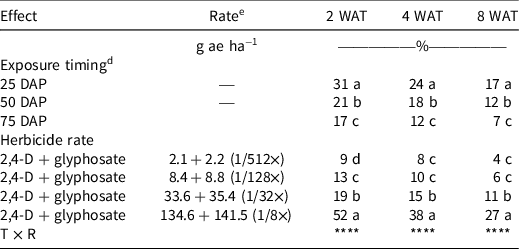
2,4-D plus glyphosate injury on peanuts (the aggregate response characterized by epinasty, chlorosis, and stunting) increased with the earlier exposure timings for all rating periods (Table 2). For example, injury at 2 WAT was 31% when peanut was exposed to 2,4-D plus glyphosate at 25 DAP, and greater than 21% and 17% injury was observed at 50 and 75 DAP exposure timings, respectively. At the same rating timing, the injury was greater for peanuts exposed to 2,4-D plus glyphosate at 50 DAP compared with 75 DAP. Although the severity of peanut injury after exposure to 2,4-D plus glyphosate was reduced over time for all exposure timings, the injury trend at 4 and 8 WAT was consistent with that at 2 WAT (Table 2). Peanut injury at 4 and 8 WAT (17% to 24%) was greater with 2,4-D plus glyphosate applied at 25 DAP than at 50 or 75 DAP (7% to 18%). Similarly, peanut injury at 4 and 8 WAT (12% to 18%) was greater at 50 DAP than at 75 DAP exposure timings when it was 7% to 12%.
Effect of peanut growth/exposure timing and 2,4-D plus glyphosate rate on injury at 2, 4 and 8 WAT. a, b, c, f
a Abbreviations: DAT, days after planting; R, herbicide rate; T, exposure timing; WAT, weeks after treatment.
b Peanut injury (aggregate of epinasty, chlorosis, and stunting) was visually estimated on a 0% to 100% scale where 0% = no injury or plants similar to the weed-free control, and 100% = completely dead plants at 2, 4, and 8 WAT.
c Means followed by the same superscript within a column are not significantly different at P ≤ 0.05 according to Tukey’s honestly significant difference test.
d Exposure timing represents the days after planting peanut.
e Reduced rates were applied as a fraction of the 1× rate of 2,4-D + glyphosate.
f Asterisks (****) indicate significance at P ≤ 0.0001.
These results indicate that the severity of peanut injury from 2,4-D plus glyphosate depends mainly on the peanut growth stage during exposure. This was probably due to differential absorption, metabolism, or translocation of the herbicides at different growth stages. Greater injury at early exposure timing (vegetative growth stage) could be due to the plants being younger, less mature, smaller in canopy size, and more susceptible. Furthermore, higher injury at the vegetative growth stage could be attributed to the potential of young, rapidly growing plants to absorb and concentrate more herbicide in the meristematic tissues (Orfanedes et al. Reference Orfanedes, Wax and Liebl1993). The young leaf surface has metabolically active tissue and an easily penetrable cuticle, which is usually more permeable to herbicide penetration (Bhatti et al. Reference Bhatti, Felsot, Al-Khatib, Kadir and Parker1995). In contrast, at the later growth stage (pod formation stage), the thick cuticle of older peanut leaves probably absorbed less herbicide, leading to comparatively less injury. In agreement with the result of this study, Merchant et al. (Reference Merchant, Eure and Prostko2014) reported that 2,4-D application at 30 DAP was more injurious to peanuts than applications at 60 and 90 DAP. Similarly, Marple et al. (Reference Marple, Al-Khatib and Peterson2008) reported greater cotton injury with 2,4-D (0 to 1/1,200× of the label rate) applied at the three- to four-leaf stage compared to the 18-node growth stage.
There was a significant response for peanut injury across all the 2,4-D plus glyphosate rates applied (Table 2). Peanut injury increased with an increasing rate of 2,4-D plus glyphosate from 1/512× (4% to 9%) to 1/8× (27% to 52%) of the label rates at 2, 4, and 8 WAT. At 2 WAT, the injury averaged across the exposure timings ranged from 9% to 52% as the 2,4-D plus glyphosate rate increased from 1/512× to 1/8×. However, the severity of the injury decreased over time, ranging from 8% to 38%, and 4% to 27% at 4 WAT and 8 WAT, respectively. Similar to the results of this study, Leon et al. (Reference Leon, Ferrell and Brecke2014) observed higher 2,4-D injury on peanuts at 1 WAT compared with 3 WAT. Also, Lassiter et al. (Reference Lassiter, Burke, Thomas, Pline-Srnić, Jordan, Wilcut and Wilkerson2007) reported 33% peanut injury from glyphosate at 140 g ae ha−1 at 2 WAT. Greater peanut injury in the present study may be due to the combined effect of 2,4-D and glyphosate. Soltani et al. (Reference Soltani, Shropshire and Sikkema2018) also reported a 15% greater corn injury with application of glyphosate with 2,4-D than glyphosate or 2,4-D alone.
At 1/512× and 1/128× of the label rates, the injury was <10% at 4 and 8 WAT, which suggests that 2,4-D plus glyphosate drift at these rates may not cause severe injury on peanuts. However, >1/32× of the label rate caused 11% to 38% injury, indicating that 2,4-D plus glyphosate drift above this rate has the potential to cause severe peanut injury. Peanut injury was 27% to 52% as the 2,4-D plus glyphosate rate increased to 1/8×. These results are consistent with those in the study by Blanchett et al. (Reference Blanchett, Grey, Prostko, Vencill and Webster2017), who reported increased peanut injury from 5% to 32% as the 2,4-D rate increased from 67 to 1,066 g ae ha−1. Leon et al. (Reference Leon, Ferrell and Brecke2014) also reported 15% to 35% peanut injury with an increased 2,4-D rate from 560 to 1,120 g ae ha−1. In another study, Lassiter et al. (Reference Lassiter, Burke, Thomas, Pline-Srnić, Jordan, Wilcut and Wilkerson2007) observed that glyphosate at 140 g ae ha−1 injured peanuts 33% at 7 DAT, with injury increasing to 95% when glyphosate was applied at 1,120 g ae ha−1.
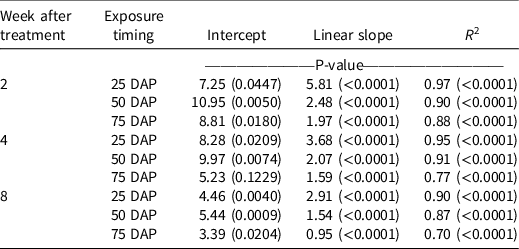
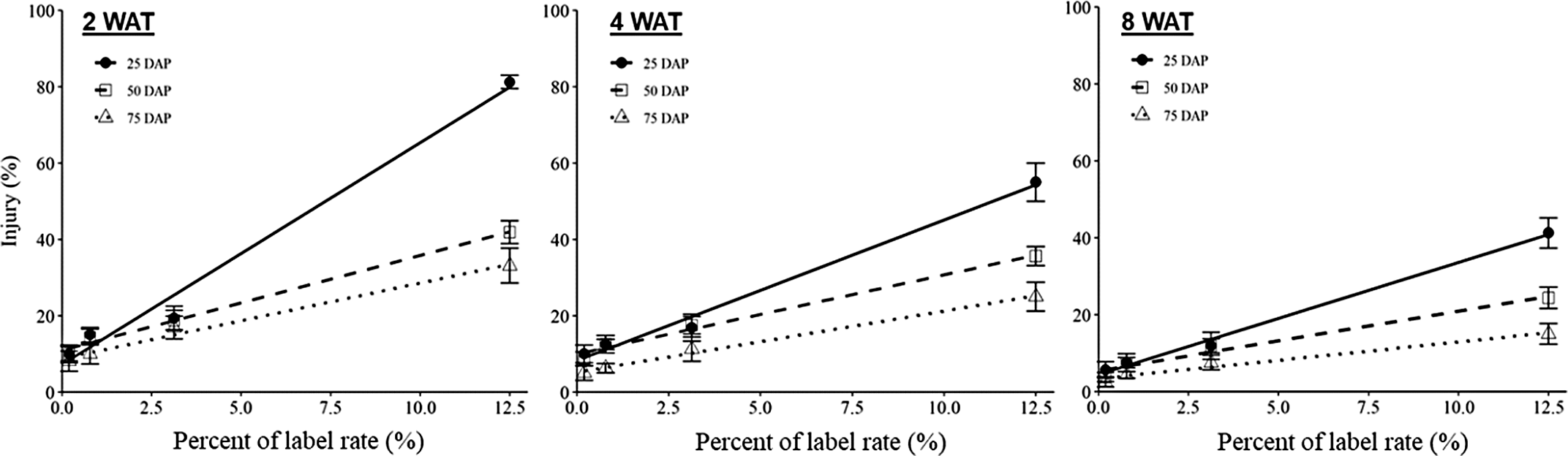
Although peanut injury increased with increasing rates of 2,4-D plus glyphosate from 1/512× to 1/8× at 2 WAT, and from 1/128× to 1/8× at 4 and 8 WAT (Table 2) with R 2 values ranging from 0.70 to 0.97, the rate of injury increase varied among the exposure timings (Table 3; Figure 1). Linear regression analysis indicated a 0.9% to 2.9% increase in peanut injury for an additional 1% of the label rate of 2,4-D plus glyphosate for the 50 and 75 DAP exposure timings. In contrast, the corresponding increase for the 25 DAP exposure timing (2.9% to 5.8%) was about two to three times higher (Table 3). These results further confirm that 2,4-D plus glyphosate is more injurious to peanut at 25 DAP (vegetative growth stage) compared with 50 or 75 DAP (flowering/pod formation stage).
Regression parameters for peanut injury response with different growth/exposure timings to increasing rates of 2,4-D plus glyphosate rates at 2, 4, and 8 WAT. a, b, c
a Abbreviations: DAP, days after planting; WAT, weeks after treatment.
b Peanut injury (aggregate of epinasty, chlorosis, and stunting) was visually estimated on a 0% to 100% scale where 0% = no injury or plants similar to the weed-free control, and 100% = completely dead plants at 2, 4, and 8 WAT.
c Exposure timing represents the days after planting peanut.
Effect of 2,4-D plus glyphosate exposure timing and rate on peanut injury at 2, 4, and 8 wk after treatment (WAT). Peanut injury (aggregate of epinasty, chlorosis, and stunting) was visually estimated on a 0% to 100% scale where 0% = no injury or plants similar to the weed-free control and 100% = completely dead plants at 2, 4, and 8 WAT.
Peanut Canopy Reduction
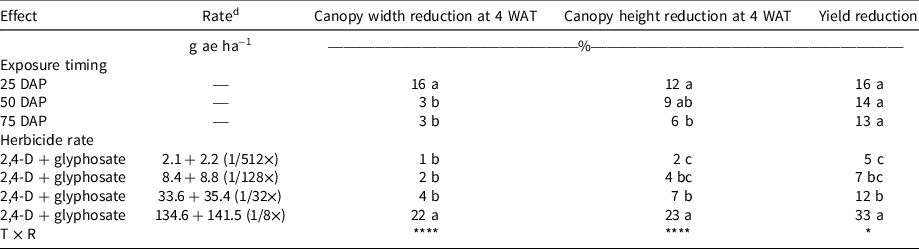
Peanut canopy height and width were significantly reduced following exposure to 2,4-D plus glyphosate at 4 WAT (Table 4). There was no difference in peanut canopy height reduction (≤9%) between 50 and 75 DAP exposure timings. However, exposure to 2,4-D choline plus glyphosate at 25 DAP resulted in twice as much peanut canopy height reduction (12%) than at 75 DAP (6%). A similar result was observed for peanut canopy width reduction, for which the 50 and 75 DAP exposure timings showed similar peanut canopy width reduction (3%). However, peanut exposed at 25 DAP was more sensitive to 2,4-D plus glyphosate with as much as 16% canopy width reduction (Table 4). Similarly, Blanchett et al. (Reference Blanchett, Grey, Prostko, Vencill and Webster2017) reported as much as a 24% reduction in peanut canopy width when 2,4-D was applied at 67 to 1,066 g ae ha−1 at the vegetative (V2/V3) stage.
Effect of exposure timing and 2,4-D plus glyphosate rate on peanut canopy width, height, and yield reduction. a, b, c, e
a Abbreviations: R, herbicide rate; T, exposure timing; WAT, weeks after treatment.
b Means followed by the same superscript within a column are not significantly different at P ≤ 0.05 (according to Tukey’s honestly significant difference test).
c Exposure timing represents the days after planting peanut.
d Reduced rates applied as a fraction of 1× rate of 2,4-D + glyphosate.
e Asterisks (****) indicate significance at P ≤ 0.0001.
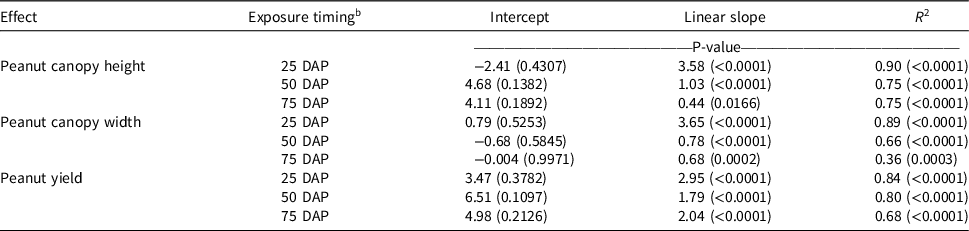
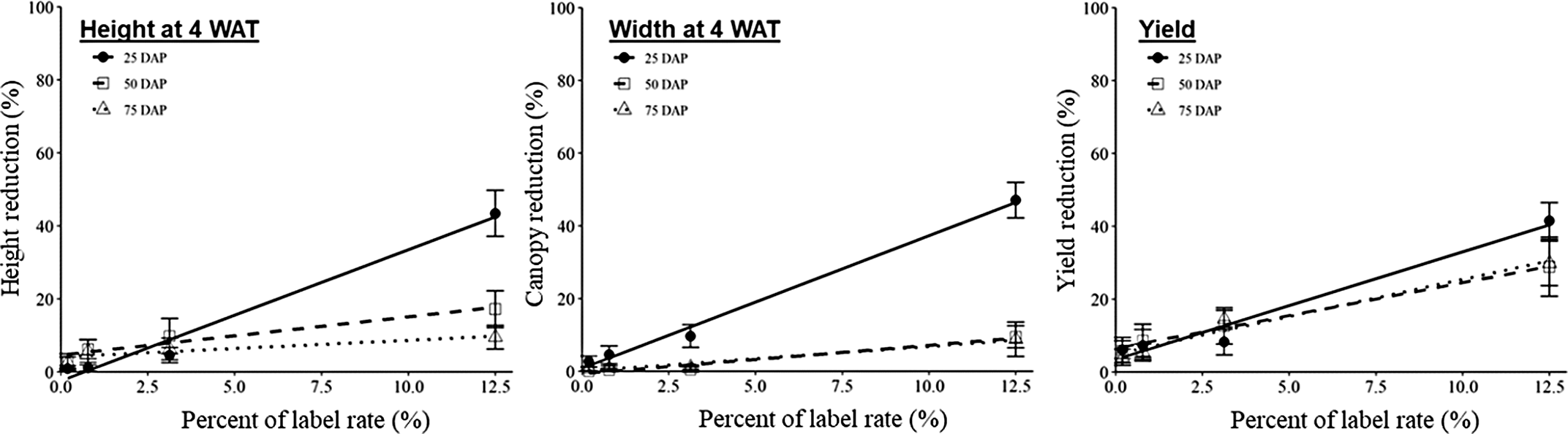
Linear regression analysis indicated that the intercept for height reduction was −2.4% at the 25 DAP exposure timing but was greater than 4.11 at 50 and 75 DAP (Table 5; Figure 2). However, the intercept for canopy width reduction was 0.8% for the 25 DAP exposure timing but was not greater than zero for the 50 and 75 DAP exposure timings. The result indicates that exposure to 2,4-D plus glyphosate at the vegetative growth stage (25 DAP) resulted in canopy width reduction even at low rates, while exposure at the flowering or pod formation stage (50 or 75 DAP) did not (Table 5). Furthermore, there was a ≤1% increase in peanut canopy height and width reduction with each 1% of the label rate of 2,4-D plus glyphosate when applied at 50 or 75 DAP, whereas the corresponding increase in peanut canopy height and width reduction for the 25 DAP exposure timing (4%) was at least four times higher (Table 5). This result reflects the greater injury observed on peanuts following 2,4-D plus glyphosate application at 25 DAP. There was a lack of information on the comparative response of peanut canopy characteristics to 2,4-D or glyphosate at the vegetative and reproductive growth stage. The present study demonstrates that peanut canopy height and width are susceptible to a more significant reduction at the vegetative than reproductive growth stage following exposure to 2,4-D plus glyphosate.
Regression parameters for peanut canopy height and width at 4 wk after treatment, and yield response with different growth/exposure timing to increasing rates of 2,4-D plus glyphosate rates. a
a Abbreviation: DAP, days after planting.
b Exposure timing represents the days after planting peanut.
Effect of 2,4-D plus glyphosate exposure timing and rate on peanut canopy height and width reductions at 4 wk after treatment (WAT), and yield reduction.
All the 2,4-D plus glyphosate rates caused a significant reduction in peanut canopy height and width at 4 WAT (Table 4). Peanut canopy height reduction (≤4%) was similar between the 1/512× and 1/128× rates. Canopy height reduction was similar for the 1/128× and 1/32× rates; however, canopy height reduction was greater than 3-fold with the 1/32× rate (4%) compared with the 1/512× rate (1%). Peanut canopy height reduction was 23% with an increased 2,4-D plus glyphosate rate of 1/8× of the label rate. Peanut canopy width reduction (<4%) was similar among 2,4-D plus glyphosate label rates at 1/512×, 1/128×, and 1/32×, which suggests that drift at these rates may not cause severe peanut canopy reduction. However, the 1/8× exposure rate resulted in a 22% canopy width reduction. The observed trend of increasing peanut canopy height and width reduction with increased exposure rate is consistent with previous studies that evaluated the effect of 2,4-D or glyphosate on peanut canopy at simulated drift rates (Blanchett et al. Reference Blanchett, Grey, Prostko, Vencill and Webster2017; Merchant et al. Reference Merchant, Eure and Prostko2014). Blanchett et al. (Reference Blanchett, Grey, Prostko, Vencill and Webster2017) estimated a 9% reduction in peanut canopy width following application of 2,4-D at the 1/8× the label rate of 1,066 g ae ha−1 between the V3 and V5 growth stages. Higher peanut canopy width reduction (22%) in the present study suggests that there could be a combined effect of 2,4-D and glyphosate that resulted in a greater negative impact on the peanut canopy. Therefore, peanut response to 2,4-D applied alone or in a mixture with glyphosate cannot be generalized because of the difference in the magnitude of the impact of these applications.
Peanut Yield Reduction
Peanut yield was not significantly affected by the stage of crop growth during exposure to 2,4-D plus glyphosate (Table 4). The yield reduction was 13% to 16% among the peanut growth stages compared with that of the d weed-free control, and the yield reduction trend was numerically greater for early season exposure. Regression analysis showed a 2% yield reduction for each 1% of the label rate of 2,4-D plus glyphosate applied at 50 or 75 DAP (Table 5), while yield reduction for each 1% of the label rate of 2,4-D plus glyphosate applied at 25 DAT was 50% higher (3%). This result followed a similar trend with injury and canopy reduction, indicating that peanut tolerance to 2,4-D plus glyphosate increases with delayed exposure timing. When exposed at 25 DAP (during the vegetative growth stage), higher peanut yield loss could be attributed to greater injury and canopy reduction compared with exposures at 50 DAP and 75 DAP (at the flowering and pod development stages). As previously discussed, young leaves could have thinner cuticles, resulting in more herbicide absorption, greater injury, slow recovery, and higher yield reduction. These results are consistent with those of previous studies evaluating the impact of 2,4-D or glyphosate on peanut yield at different exposure timings (Blanchett et al. Reference Blanchett, Grey, Prostko, Vencill and Webster2017; Grey and Prostko, Reference Grey and Prostko2010; Merchant et al. Reference Merchant, Eure and Prostko2014). Merchant et al. (Reference Merchant, Eure and Prostko2014) reported 24% and 7% yield reduction when peanut was exposed to 2,4-D at 30 and 90 DAP, respectively. Grey and Prostko (Reference Grey and Prostko2010) also reported a trend toward greater peanut yield reduction at 75 DAP compared with 90 or 105 DAP.
Peanut yield decreased linearly with increasing 2,4-D plus glyphosate rate (Table 5; Figure 2). The yield reduction ranged from 5% to 33% as the 2,4-D plus glyphosate rate increased from 1/512× to 1/8× of the label rate (Table 4). However, a significant difference in yield reduction was noted between the 1/512×, 1/32×, and 1/8× rates. Yield reduction (>10%) was notable with 2,4-D plus glyphosate at ≥1/32× of the label rate. Peanut yield reduction (33%) at the 1/8× rate was 2.7 times greater than at the 1/32× rate (12%). These results correspond with those of Leon et al. (Reference Leon, Ferrell and Brecke2014), who reported lower peanut yield reduction (≤19%) at lower rates (70, 140, and 280 g ha−1) of 2,4-D, whereas the yield reduction was as much as 41% at a higher rate of 1,120 g ae ha−1. Grey and Prostko (Reference Grey and Prostko2010) also reported that peanut yield reduction increased from 12% to 36% with an increased glyphosate rate from 240 to 470 g ae ha−1. Other crops have also observed significant yield reductions with 2,4-D and glyphosate. Johnson et al. (Reference Johnson, Fisher, Jordan, Edmisten, Stewart and York2012) reported that yield reductions in soybean and cotton were greatest with 2,4-D applied at 1/8× of the label rate. Similarly, Miller et al. (Reference Miller, Batts, Copes and Blouin2020) observed the greatest negative yield impact on sweetpotatoes with glyphosate plus 2,4-D applied at 1/10× of the label rate.
Correlation Analysis
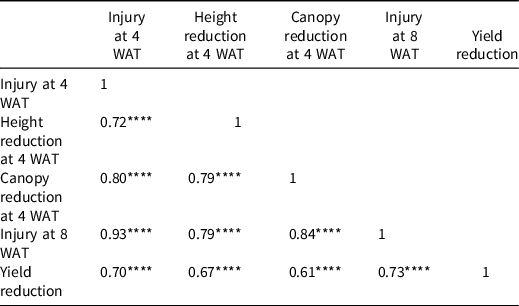
Correlation analysis (Table 6) showed a highly significant (P ≤ 0.0001) positive relationship between injury at 4 and 8 WAT, canopy height and width, and peanut yield reductions (R 2 = 0.61 to 0.93). The strong positive correlation (R 2 > 0.72) between peanut injury at 4 and 8 WAT, and canopy height and width reductions, suggest that peanut canopy characteristics are an important parameter for determining peanut injury from 2,4-D plus glyphosate. Blanchett et al. (Reference Blanchett, Grey, Prostko, Vencill and Webster2017) also reported a significant positive correlation (R 2 = 0.56) between 2,4-D injury and peanut canopy width. The strong positive correlation (R 2 = 0.93) between injury at 4 and 8 WAT indicates a slow peanut recovery from the injury with a possibly more significant negative impact on the yield. The strong positive correlation (R 2 = 0.72 to 0.73) between injury at 4 or 8 WAT and yield reduction suggests that injury parameters could be reliable indicators for predicting peanut yield loss following 2,4-D plus glyphosate drift. Lassiter et al. (Reference Lassiter, Burke, Thomas, Pline-Srnić, Jordan, Wilcut and Wilkerson2007) also reported a strong correlation (R 2 = 0.83 to 0.93) between peanut injury and yield following exposure to glyphosate drift rates at five locations.
Correlation analyses among peanut injury, canopy width, and height reduction at 4 WAT, peanut injury at 8 WAT, and yield reduction as influenced by 2,4-D plus glyphosate exposure. a, b, c
a Abbreviation: WAT, weeks after treatment.
b Correlation analysis was conducted on data combined across peanut exposure timing and 2,4-D plus glyphosate rate.
c Asterisks (****) indicate significance at P ≤ 0.0001.
This study showed that peanut is highly sensitive to 2,4-D plus glyphosate. Although peanut exposure to 2,4-D plus glyphosate at 25, 50, and 75 DAP resulted in statistically similar yield reductions (≤16%), the result showed that 2,4-D plus glyphosate is more injurious to peanuts at 25 DAP (vegetative growth stage) than at 50 DAP (flowering stage) and 75 DAP (pod development stage), presumably due to younger plants having a more permeable cuticle for herbicide penetration. Peanuts not only suffered a more significant injury following exposure to 2,4-D plus glyphosate at the vegetative stage but also showed slower recovery than exposures at the flowering and pod development stage. Also, peanut injury, canopy height and width, and yield reductions increased linearly with increasing rates of 2,4-D plus glyphosate. The maximum yield reduction was 33% with 1/8× of the labeled rate. Therefore, extreme care must be taken when using these herbicides on Enlist™ crops in fields that are near peanut fields. Canopy height and width reduction can be an early indicator of the injury severity from 2,4-D plus glyphosate. The high Pearson’s rho values (R 2 ≥ 0.70) observed in this study also suggest that injury can help predict yield reduction and make a rational decision on whether to continue, terminate, or replant peanut in the case of 2,4-D plus glyphosate drift incidence.
Acknowledgments
Support for this study was provided by U.S. Department of Agriculture–National Institute of Food and Agriculture Hatch project FLA-WFC-005843. We thank Navjot Singh, Greg Kimmons, and the field technical support staff at the West Florida Research and Education Center in Jay, FL. The authors declare no conflicts of interest.


 Open access

