




1. Overview
In this paper, I formulate an explanation of universal grammatical coding asymmetries in terms of predictability and efficiency of coding. I claim that many of the widespread and systematic coding patterns that we find in the world’s languages are due to well-understood functional-adaptive forces, and that there is no need to resort to ‘markedness’ or other poorly understood or idiosyncratic mechanisms.
By grammatical coding asymmetries, I mean minimal grammatical oppositions such as those in Table 1, where one member is typically zero-coded (or shorter), while the other member has an overt coding element or contains more segments. The table shows only a single example for each opposition type, but the claim is that all these asymmetries are universal tendencies in the world’s languages. The table’s last column indicates which section of the present article deals with a given opposition.
Examples of universal grammatical coding asymmetries.
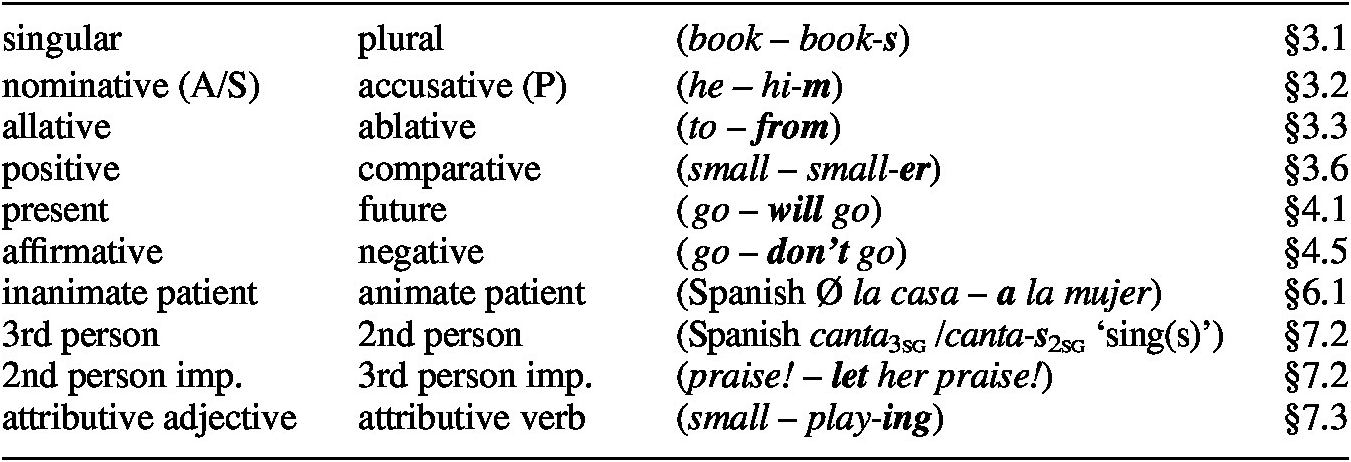
A = transitive subject, S = intransitive subject, P = direct object, Ø = no marker
The basic observation is that the zero-coded (or shorter) member of such an opposition is generally more frequent in language use. For example, singular nouns are more frequent than plural nouns, and present-tense forms are more frequent than future-tense forms. This can be related to the general observation in (1).

This is an old insight which is uncontroversial for word length (e.g. Zipf Reference Zipf1935: 23), but my claim here is that it is also generally valid for grammatical patterns, as formulated in (2) (which is just a special instance of (1)). The idea of form–frequency correspondences in grammar can be traced back to Greenberg (Reference Greenberg1966) (see also Croft Reference Croft2003: Chapter 4; Hawkins Reference Hawkins2004: Section 3.2.2; Haspelmath Reference Haspelmath2008a, Reference Haspelmath and Goodb; Diessel Reference Diessel2019: Chapter 11).
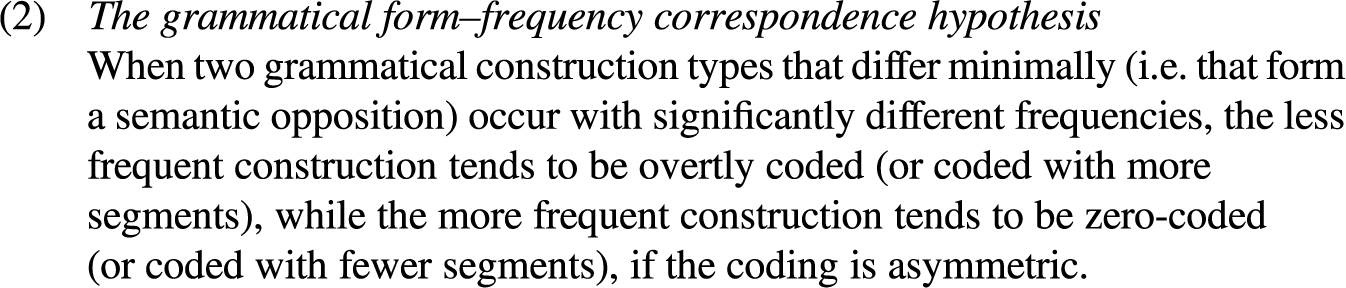
Since the coding asymmetries illustrated in Table 1 are strong universal tendencies (sometimes even exceptionless), there must be a highly general explanatory factor. I claim (in line with the earlier work by Greenberg and others) that the explanation lies in the predictability of frequently used grammatical construction types. The causal chain is thus as in (3).Footnote 2

This is thus a kind of ‘economy’ explanation (Haiman Reference Haiman1983): Speakers, and hence language systems, favour economical patterns, which require a greater amount of coding energy only for less predictable parts of linguistic messages. Hearers are more surprised by less frequent aspects of messages and thus need more robust coding for them. Another way of putting it is that language systems favour efficient coding (Hawkins Reference Hawkins2004, Reference Hawkins2014), or that they support efficient communication (Gibson et al. Reference Gibson, Futrell, Piandadosi, Dautriche, Mahowald, Bergen and Levy2019).
This explanation implies that language systems have adapted to the users’ needs. If language systems are viewed strictly from a synchronic and static perspective, as is still often the case in theoretical linguistics, this may appear puzzling. But language systems are flexible or malleable, in the sense that system-external functional-adaptive forces can have minute effects on the behaviour of individual speakers in individual utterances, which eventually have the cumulative result of creating efficient systems (Keller Reference Keller1994). We can get a better sense of these processes when we consider the diachronic origins of grammatical coding asymmetries (see Section 8 below).
I thus defend a functional-adaptive explanation of universal coding asymmetries, but it should be noted that this is not a traditional functional explanation of the type that establishes a direct link between meaning and form (note Bybee’s Reference Bybee1985 subtitle: ‘A study of the relation between meaning and form’). On the contrary, I reject explanations of coding asymmetries in terms of iconicity (meaning–form matching) (see Haspelmath Reference Haspelmath2008a), and I will summarize the arguments briefly below (Section 9.1). Likewise, markedness cannot be an explanatory factor (as argued by Haspelmath Reference Haspelmath2006). Instead of linking meanings and shapes directly, the explanation that I defend here makes crucial reference to predictability.
I will say more about the causal chain in Section 9 below, but first I will explain the nature of the universal claims (Section 2), and then I will give 25 examples of universally asymmetric pairs of grammatical construction types. First, there are 13 examples of simple meaning pairs (such as singular/plural and present/future), both from the nominal domain (Section 3) and from the predicational domain (Section 4). These are followed by 12 differential-coding pairs in Sections 5–7. Differential coding is a term that I use for a situation where a grammatical meaning is coded in two distinct ways depending on the grammatical or lexical context, as in differential object marking in Spanish (Veo la casa ‘I see the house’ vs. Veo a la mujer ‘I see the woman’, see Section 5). Such situations are quite parallel to simple pairs of grammatical meanings, and I subsume both under the general notion of ‘(pairs of) construction types’. I give six examples of differential-coding pairs from the nominal domain in Section 6, and six examples from the predicational domain in Section 7. Then in Section 8, I consider a number of paths of change that result in asymmetric coding patterns, and in Section 9, I discuss the nature of the predictability- and efficiency-based explanation in some more detail.
2. Universal grammatical coding asymmetries
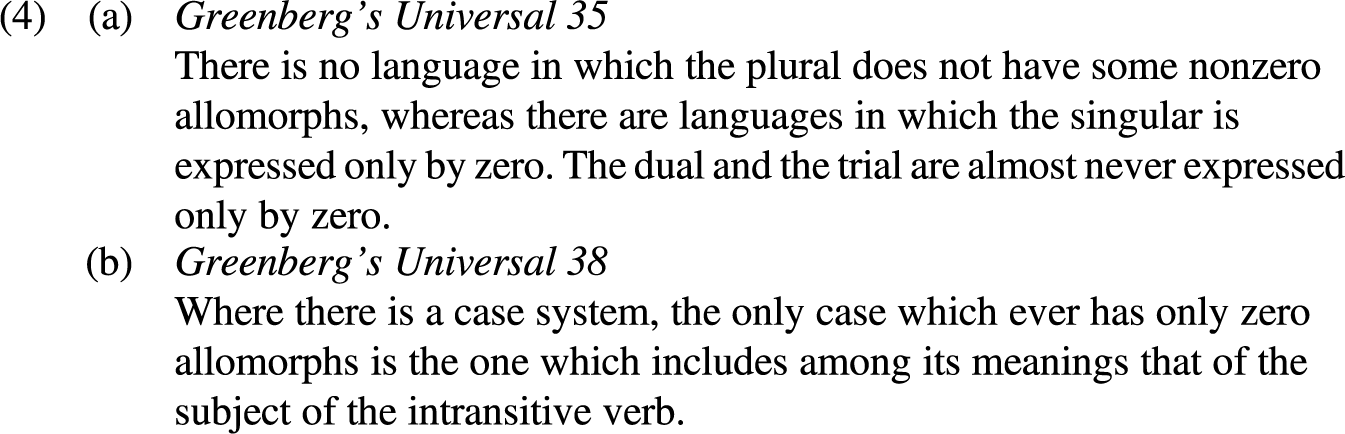
In this paper, I do not have space to justify the universality of all the grammatical coding asymmetries that I discuss and that I claim fall under the scope of the explanatory theory. So I refer to the existing literature, which begins with Greenberg (Reference Greenberg and Greenberg1963), who formulated the universals in (4).
Many more universals were stated or implicit in Greenberg’s later book (Reference Greenberg1966), where he noted that grammatical number, gender, person, case, tense, aspect, mood and other domains often show asymmetries which he described with the terms ‘marked/unmarked’. He did not provide much documentation for the claims (any more than he did in his 1963 article), but they were based on his very wide-ranging knowledge of the world’s languages, and it appears that none of his claims have been shown wrong.
In general, a universal coding asymmetry involving construction type 1 (e.g. singular) and construction type 2 (e.g. plural) implies the universal claim in (5).

Thus, the eleven pairs in Table 1 above stand for eleven implicational universals of the form in (5), and each of the 25 asymmetric pairs in Sections 3–7 corresponds to a universal.
Of course, when I claim that a grammatical coding asymmetry is universal, I do not mean to exclude the possibility of individual exceptions, and I merely claim that the asymmetry is found with much greater than chance frequency. This is conveyed by ‘strong tendency’ in (5).
It should be noted that the grammatical construction types that figure in the universals are comparative concepts, in the sense of Haspelmath (Reference Haspelmath2010). Thus, there is no claim that the construction pairs are completely identical across languages, or that they must instantiate the same innate grammatical features or categories. If one wanted to explain these universals by biocognitive constraints imposed by an innate grammar blueprint, then one would expect languages to show the same categories and features, but for the functional-adaptive explanation that I propose here, all we need is comparability through clearly defined comparative concepts. For example, languages may have fairly different kinds of passives, and fairly different kinds of ablatives. But if a construction turns the P-argument of the active into the new S-argument, and the A-argument is oblique-marked and optional or absent, then it counts as a passive for the purposes of the comparison. And if a case-marker or adposition expresses a spatial source, then it counts as an ablative marker, whatever its other properties.
Now of course, not all languages and all grammatical contrasts show asymmetric coding. For most of the universal coding asymmetries, there are some (and sometimes many) languages which have symmetric coding, where either both constructions are equally coded or both are left uncoded. For the simple case of singular and plural, these two cases can be illustrated by (6a–b).Footnote 3
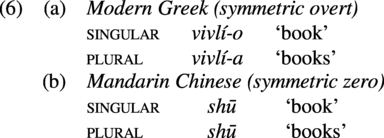
In languages with symmetric coding, the additional efficiency that is provided by asymmetric coding is not exploited, and a competing constraint takes precedence: In the case of Modern Greek, it is the general preference to express grammatical meanings explicitly, and in Mandarin Chinese, it is the general preference to save coding energy and to leave inferrable meanings unexpressed. We can thus say that English-type languages have an efficient coding system at the price of asymmetric or non-uniform coding, that Greek has a non-efficient but uniformly explicit coding system, and Mandarin Chinese has a non-efficient but uniformly parsimonious system. All three language systems are optimal in their own way, and the form–frequency prediction is relevant only to cases where the coding is asymmetric.Footnote 4
What the implicational universal in (4a) predicts not to occur is an asymmetric counter-efficient pattern, where the singular has an overt marker but the plural is left uncoded, as in the Pseudo-Greek pattern in (7), where the plural is uncoded.
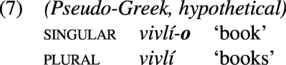
Languages with such a pattern are indeed (virtually) unattested, and similarly for all the patterns seen in Table 1 and in Section 3–7 below.
Thus, such gaps in attested patterns are our explananda, and I claim here that form–frequency correspondences and predictability provide the ingredients for an explanation. The hypothetical diachronic mechanism will be elucidated further in Section 8 below, but the bulk of the paper will consist of listing and briefly discussing a substantial range of universal coding asymmetries.
As I noted earlier, I do not have the space here to provide documentation for each of the asymmetric patterns, and in some cases, more thorough documentation is a task for future research. There is no space here either to justify the claim that one of the construction types occurs more frequently in all languages, as this would go far beyond the scope of an article whose goal is to provide an overview of the general approach. But most of the claims concerning frequency of use are very easy to test, and should thus not be particularly controversial.Footnote 5
Before I get to the various universal patterns, let us briefly consider why the functional-adaptive explanation is proposed at the level of language universals, not at the level of particular languages. Shouldn’t the explanation work similarly for language-particular asymmetries? For example, English has two future-tense constructions, with will and with going to (or gonna). These are slightly different semantically, and they are formally asymmetric (will is shorter than gonna, three vs. four segments). Is it claimed that this is because the will-future is more frequent than the gonna-future? The answer is no. I make no predictions about such cases, because functional-adaptive explanations only work at the population level (i.e. they explain tendencies found in populations of languages). Language histories are subject to a large number of contingencies, and the adaptive forces are relatively weak. The gonna-future could become popular very quickly for social reasons and thus more frequent than the will-future (this may well have happened in some varieties of English). But it would not be an exception to a general trend, because there is no general trend for languages to have two distinct future tenses of this sort. It is only when one considers a large enough number of languages that a general trend can emerge, and for a broadly comparative study, one must generally ignore subtle meaning differences such as the difference between the two English future forms. Language-particular patterns are often unrelated to any general trend, and they often arise due to historical contingencies.Footnote 6
In the next two sections (Sections 3 and 4), I give 13 examples of simple meaning pairs that are universally asymmetric. Then in Section 5, I explain the notion of differential coding, and in Sections 6 and 7, I discuss 12 differential-coding pairs.
3. Simple meaning pairs in the nominal domain
3.1. Singular vs. plural vs. dual
The most straightforward example is the singular vs. plural opposition. Greenberg (Reference Greenberg and Greenberg1963) observed that plurals tend to be overtly coded and singulars zero-coded (see Universal 35 in (4a) above), and Greenberg (Reference Greenberg1966: 32) showed that the singular tends to be more frequent than the plural, while the dual is the least frequent form. The asymmetric coding can be illustrated by Hebrew and Khanty (a Uralic language):
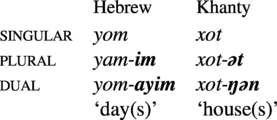
(Greenberg also included the dual, thus effectively dealing with a triple rather than with two meanings in opposition; alternatively, the dual could be contrasted with the plural, but the predictions are not different.)
3.2. Nominative vs. accusative
Many languages make a distinction between nominative (for the S/A-argument) and accusative (for the P-argument), and Greenberg (Reference Greenberg and Greenberg1963) noted that the nominative is always at least as short as the accusative (see Universal 38 in (4b) above). The nominative is also more frequent than the accusative, almost by definition, because it occurs in both intransitive and transitive clauses, whereas the accusative only occurs in the latter, e.g.

3.3. Allative vs. ablative
Within the oblique case-markers and adpositions, we find that allative and ablative are asymmetric, with allatives showing a much greater tendency to be zero than ablatives (Stolz, Lestrade & Stolz Reference Stolz, Lestrade and Stolz2014), and if both are overtly marked, the ablative tends to have a longer shape. Michaelis & APiCS Consortium (Reference Michaelis, Consortium, Michaelis, Maurer, Haspelmath and Huber2013) provide data from creole and pidgin languages.

3.4. Instrumental vs. comitative
As can be seen in the many examples in Stolz, Stroh & Urdze (Reference Stolz, Stroh and Urdze2006), comitative markers are generally longer than instrumental markers when there is a contrast in a language (see also Maurer & APiCS Consortium (Reference Maurer, Consortium, Michaelis, Maurer, Haspelmath and Huber2013) for pidgin and creole languages). The comitative is also generally less frequent.

3.5. Male vs. female occupational terms
At least in all the languages that I am aware of, female occupational and status terms tend to be longer than male occupational and status terms. Many languages do not have such gender contrasts, but when they make them, it seems that the male form is never longer than the female form. Because special occupational roles (and less often also special status roles) have long been confined to men, it is clear that the male terms have traditionally been more frequent.Footnote 7

3.6. Positive vs. comparative vs. superlative
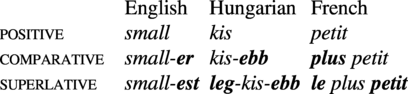
In languages that have special comparative and superlative forms of adjectives, the comparative is always derived by a special marker from the positive, and the superlative is often additionally derived from the comparative (Greenberg Reference Greenberg1966: 40; Bobaljik Reference Bobaljik2012). It seems that there is no language with a superlative marker that is shorter than the comparative marker. Greenberg (Reference Greenberg1966: 41) provides some frequency data showing that the comparative is less frequent than the positive, and the superlative is even less frequent. (The Hungarian and French examples have the same meaning as the English ones.)
3.7. Cardinal numerals vs. ordinal numerals
As has been extensively documented by Stolz (Reference Stolz, Igla and Stolz2001: 519), ordinal numerals are normally derived from cardinal numerals, i.e. they consist of an additional marker. Greenberg (Reference Greenberg1966: 42–43) cites some frequency data showing that they also tend to be much less frequent.

4. Simple meaning pairs in the predicational domain
4.1. Present tense vs. future tense
Present-tense forms tend to be much more frequent than future-tense forms (Greenberg Reference Greenberg1966: 48), and they also tend to be shorter (very often zero-marked, see Bybee Reference Bybee and Pagliuca1994).

4.2. Present tense vs. past tense
Past-tense forms show a similar asymmetry with respect to present-tense forms, both in terms of frequency (Greenberg Reference Greenberg1966: 48) and in terms of coding, though less clearly so than future-tense forms.

4.3. Active vs. passive
Passive verb forms are generally derived from active verb forms, i.e. they contain an additional marker (Haspelmath Reference Haspelmath1990).

And even in those few cases where active and passive verbs forms both contain markers, as in Latin (e.g. lauda-s ‘you (sg) praise’, lauda-ris ‘you (sg) are praised’; lauda-tis ‘you (pl) praise’, lauda-mini ‘you (pl) are praised’), the passive forms tend to be longer. Passive forms are also generally much less frequent than active forms (Greenberg Reference Greenberg1966: 46).
4.4. Basic vs. applicative
Many languages have applicative verb forms, i.e. forms which contain an additional marker whose function is to indicate that an argument other than the basic P-argument becomes the derived P-argument (Polinsky Reference Polinsky, Haspelmath, Dryer, Gil and Comrie2005, Peterson Reference Peterson2007).

Somewhat like in the case of the passive, it is part of the definition of ‘applicative’ that it is marked by a special affix, but the derived P-argument is not the most frequent type of argument of the basic verbal meaning, so extra coding on the verb is needed here.
4.5. Affirmative vs. negative
Negation is virtually always signaled by an overt negator (Dryer Reference Dryer, Haspelmath, Dryer, Gil and Comrie2005, Miestamo Reference Miestamo2005), which might seem trivial, but there are also some languages where there is a special affirmative marker, and there are quite a few languages where tense markers cumulate with affirmative and negative meaning (e.g. Coptic, where the negative past marker is longer than the affirmative past marker). Thus, the generally greater length of negative markers is best explained by the greater rarity of negative clauses.

4.6. Disjoint anaphoric vs. reflexive
Reflexive pronouns are generally longer than anaphoric pronouns which are used when the referent is disjoint from the subject. Again, this can be straightforwardly linked to the much lower frequency of coreference between the object and the subject (Haspelmath Reference Haspelmath2008c).

5. Differential coding
So far, we have seen what I have called simple meaning pairs, where the construction types in opposition are two contrasting grammatical meanings for which the wider grammatical context or lexical subclasses are not immediately relevant.
But form–frequency correspondences are also widely found in situations where a single grammatical meaning is coded differently in different grammatical contexts or in different lexical subclasses. I refer to such situations, where the two constructions in opposition express the same meaning, as differential coding. The best-known example of differential coding is differential object marking (or more precisely differential P flagging, because the core generalization concerns P-arguments of monotransitive verbs, and their flagging by case-markers or adpositions), as illustrated by the well-known contrasts in Spanish and Hebrew that we see in (8) and (9).
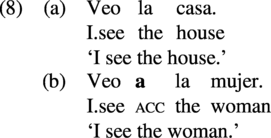
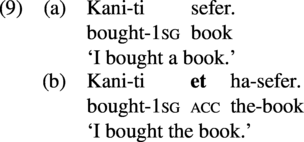
Here the patient meaning is expressed in two distinct ways, depending on whether the P nominal is inanimate or animate (in Spanish), or indefinite or definite (in Hebrew). The frequency claim for Spanish concerns the relative frequency of the patient meaning within the sets of all inanimate nominals and all animate nominals: The claim that inanimate Ps are more frequent than animate Ps means that a greater proportion of inanimate nominals have the P role than of animate nouns. The analogous situation holds for Hebrew indefinite and definite Ps.
Another example of differential coding comes from the expression of agent–patient coreference. In a variety of languages, grooming (or introverted) verbs like ‘wash’ or ‘shave’ show different behaviour from other-directed (or extroverted) verbs like ‘kill’ or ‘hate’, as seen in English (in 10) and Russian (in 11) (Haiman Reference Haiman1983: 803; Geniušienė Reference Geniušienė1987; König & Vezzosi Reference König, Vezzosi, Bisang, Himmelmann and Wiemer2004).

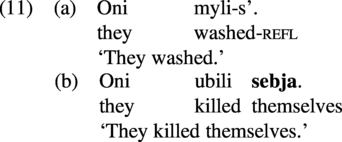
In these examples, reflexive marking is differential in that it depends on the lexical subclass (introverted vs. extroverted). The shorter forms (zero-coded in English, reflexive -s’ in Russian) are used with introverted verbs, because these are more frequently used with agent–patient coreference than extroverted verbs.
One can distinguish two subtypes of differential coding: split coding is differential coding that depends on the grammatical context (like differential object marking in Hebrew), while subclass-conditioned coding is differential coding that depends on the lexical subclass (like short reflexive coding of introverted verbs in English and Russian).
The explanation of the coding asymmetry is the same as with the simple meaning pairs: Since more inanimate nominals have P-function than animate nominals, hearers are less surprised when they encounter an inanimate P-argument and therefore have less need for special coding.Footnote 8 Likewise, since introverted verbs are more often used with agent–patient coreference, hearers are less in need of special reflexive marking than with extroverted verbs.
More generally, in a differential-coding pair, we are dealing with a usual association of a grammatical meaning with a grammatical context or a lexical subclass. The claim is that such usual associations need less coding than unusual associations.
6. Differential-coding pairs in the nominal domain
In this section, we consider six differential-coding pairs in the nominal domain, which will be followed by six pairs from the predicational domain in Section 7.
6.1. Accusative marking on inanimate vs. animate P-arguments
In many languages, P-arguments are coded differentially when they are animate, and as far as I know, the animate P always has a marker, whereas the inanimate P is uncoded (Bossong Reference Bossong1985, Reference Bossong, Kibbee and Wanner1991; Aissen Reference Aissen2003; Iemmolo Reference Iemmolo2013).

As is well-known, a very similar cross-linguistic pattern is found with definite vs. indefinite P-arguments, e.g. in Hebrew and Turkish. Some languages, such as Hindi-Urdu, have special accusative marking of P-arguments when they are animate or definite. The explanation is the usual association of the P role with inanimate and indefinite arguments (as was clearly stated already by Comrie Reference Comrie1989: 128; Bossong Reference Bossong, Kibbee and Wanner1991: Sections 2).
6.2. Ergative marking on 1st/2nd person pronouns vs. full nominals
In some languages, A-arguments are coded differentially when they are 1st or 2nd person (locuphoric), and this generally means that they lack an overt ergative marker, in contrast to other kinds of arguments, especially full nominals (Dixon Reference Dixon1994: 86).

This generalization about differential A marking is somewhat less robust than the differential object marking universal, but both belong to a much larger class of role–reference association universals (Haspelmath Reference Haspelmath2021), which all have the same explanation in terms of form–frequency correspondences, or more specifically in terms of the usual association of high-ranking roles (agent and recipient) with referentially prominent arguments (1st/2nd person, animate, definite, topical).
6.3. Locative marking on place names vs. inanimate nouns vs. animate nouns
In a substantial number of languages, locative flagging is differential, such that place names tend to have the shortest coding (often zero, as in Tswana), and animate nouns tend to have the longest coding, with inanimate nouns intermediate between the two (Aristar Reference Aristar1997, Creissels & Mounole Reference Creissels, Mounole, Kittilä, Västi and Ylikoski2011, Haspelmath Reference Haspelmath2019b). In Basque, we see a three-way contrast, while Tswana exemplifies a contrast between place names and inanimates, and Tamil shows a contrast between inanimates and animates.

Again, this is because place names are usually associated with locative use, while this is less common for inanimate nouns, let alone animate nouns. The parallels with differential object marking are so striking that Haspelmath (Reference Haspelmath2019b) calls this pattern ‘differential place marking’.
6.4. Plurative and singulative marking on individualist vs. gregarious nouns
In some languages, there is a subclass-conditioned difference in singular and plural coding, such that ‘individualist nouns’ (those that tend to occur with uniplex meaning) have overt plural (plurative) marking, while ‘gregarious’ nouns (those that are usually associated with multiplex meaning) have singulative (overt singular) marking (-en in Welsh, -ina in Russian). For detailed discussion, see Haspelmath & Karjus (Reference Haspelmath and Karjus2017) and Grimm (Reference Grimm2018).

The suffix -en in Welsh is generally regarded as an inflectional singulative marker, while -ina in Russian is treated as derivational. In the present context, this difference plays no role, and even the English unit noun grain can be seen as playing the same role.
6.5. Adpossessive marking with inalienable vs. alienable nouns
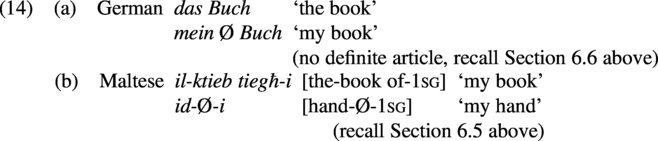
In languages where inalienable (kinship and body-part term) nouns behave differently from alienable nouns in adpossessive constructions, the possessive markers are shorter (and typically zero) for the inalienable subclass, because of the usual association of the adpossessive meaning with kinship and body-part nouns (Haspelmath Reference Haspelmath2017).

6.6. Definiteness marking with vs. without possessor
Some languages have differential definiteness marking, omitting the definite article in the presence of an adpossessive nominal.

This can be attributed to a form–frequency correspondence as well, as possessed nouns are usually associated with definiteness so that the definite meaning is relatively predictable and the extra coding is not required (Haspelmath Reference Haspelmath1999).
7. Differential-coding pairs in the predicational domain
7.1. Reflexive marking on introverted vs. extroverted verbs
As already discussed in Section 5, some languages have subclass-conditioned differential marking of reflexivity, with introverted verbs (those that are usually associated with coreferential objects) showing shorter coding than extroverted verbs (those that tend to have noncoreferential anaphoric objects) (Haiman Reference Haiman1983: Section 1.2.2; Haspelmath Reference Haspelmath2008c). This is illustrated by the following examples, which all have the same meaning as the English ones.

7.2. Addressee and 3rd person marking in imperatives vs. indicatives
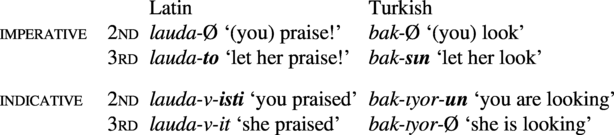
There is a usual association of person with mood, in that imperatives tend to have second person subjects and indicatives tend to have 3rd person subjects. Languages often have split coding of bound 2nd and 3rd person person forms, and as predicted, there is a tendency for 2nd person form to be short or zero in imperatives (Aikhenvald Reference Aikhenvald2010: 46), and 3rd person forms to be short or zero (Siewierska Reference Siewierska and Floricic2010).
7.3. Attributive and predicative marking on property roots (adjectives) vs. action roots (verbs)
Property concept roots tend to occur in attributive discourse function, while action roots are usually associated with predicative function. Thus, many languages have a split in how they treat content roots: Property concept roots tend to have short or zero coding in attributive function, while action roots tend to need overt attributive markers (participial affixes or other relativizers). By contrast, in predicative function, property concept roots tend to need special marking by a copula, while action roots do not (Croft Reference Croft1991: 67).
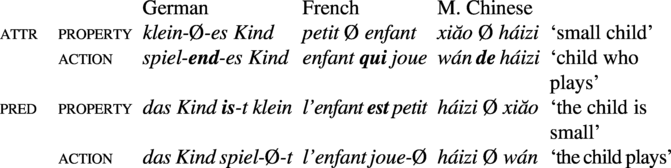
As Croft (Reference Croft, Vogel and Comrie2000) emphasized, it is these kinds of coding splits between different semantic types of roots that are the basis for word-class categorizations, and since they are universal tendencies, the word classes that correspond to the three main discourse functions can be said to be universal (nouns, verbs, adjectives).
7.4. Causative vs. anticausative marking with automatic vs. costly events
In some languages, there is a subclass-conditioned difference in noncausal and causal event coding, such that ‘automatic’ verb roots (those that tend to occur with noncausal meaning) have causative marking, while ‘costly’ verb roots (those that are usually associated with causal meaning) have anticausative marking. The basic cross-linguistic pattern is thus completely parallel to that of plurative and singulative marking (Section 6.4).
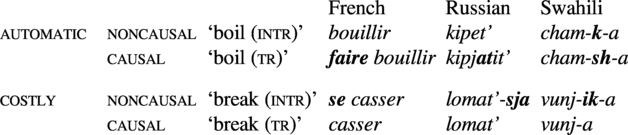
The semantic classes ‘automatic’ and ‘costly’ are similarly ad hoc as the classes of ‘individualist’ and ‘gregarious’ nouns that are used in Section 6.4 for the number-marking pattern. This is because the cross-linguistic patterns are much less regular than in other cases, and the splits are rather different in different languages. Still, when one looks at a wide range of languages, one sees clear cross-linguistic patterns which were first described in Haspelmath (Reference Haspelmath, Comrie and Polinsky1993) and linked to universal frequency patterns in Haspelmath et al. (Reference Haspelmath, Calude, Spagnol, Narrog and Bamyacı2014).Footnote 9
7.5. Subordinate clause marking with same vs. different subjects in ‘want’ complements
‘Want’ complement clauses tend to have the same subject as the main clause, so different-subject complements (‘you want me to eat’) are rare and unexpected. In accordance with the form–frequency correspondence universal, languages tend to have special subordinate markers for different-subject complements, e.g. dass in German and -te in Japanese, which are not required in the same-subject situation (see Haspelmath Reference Haspelmath2013).

7.6. Purpose-clause marking with motion vs. non-motion verbs
As noted by Schmidtke-Bode (Reference Schmidtke-Bode2009: 94), purpose clauses are particularly common (i.e. usually associated) with motion verbs in the main clause, so it is predicted that the purpose-clause marking is generally shorter when the purpose clause modifies a motion-verb clause. Schmidtke-Bode finds that this is generally confirmed, and German provides an illustrative example (zero marking, or pure infinitival marking, is possible only when the main-clause verb is a motion verb).

8. Paths of change
As I noted in Section 1, the functional-adaptive explanation of the universal tendencies that I propose here relies on the flexibility or malleability of language systems. Our languages are not rigid unchanging systems of rules that we have to simply obey, but they always have some ‘leaks’ or variable usage patterns, and they provide ways of saying things in a novel way. So while the precise pathways along which they change and adapt are usually hard to elucidate, it can at least be imagined how this happens: Language change can be seen as (at least partly) driven by the speakers’ preference for user-friendly utterances, and thus ultimately user-friendly (or adaptive) structures (Keller Reference Keller1994).
The way in which this works is probably most transparent in lexical change. As I noted briefly in the first section, lexical items show the same strong tendency to exhibit form–frequency correspondences (see the universal in (1)): Frequent words are short, and rare words are long in all languages (e.g. Bentz & Ferrer-i-Cancho Reference Bentz, Ferrer-i-Cancho, Bentz, Jäger and Yanovich2016). One mechanism by which words that get more frequent are shortened is by clipping (as originally noted by Zipf Reference Zipf1935). For example, advanced intellectual concepts with fairly long names such as ‘mathematics’ and ‘religion’ can become frequent everyday words when they are school subjects, so in colloquial German, the abbreviated forms Mathe and Reli for these subjects are very common. Clipping is not a regular diachronic process, and clipped forms of rarely used words are very strongly deviant (e.g. *Topo for Topologie ‘topology’, or *Theo for Theologie ‘theology’). Still, when a concept needs to be expressed frequently, it becomes very useful to have a short form for it, and even forms that sound ill-formed at the beginning have a good chance of spreading across the population, regardless of normative perceptions. Thus, usefulness can overcome convention, and new, more adapted conventions can spread across the community.
Another relevant mechanism of change that has been highlighted particularly by Joan Bybee is phonetic reduction. Some words are short because of reduction and overlapping of articulatory gestures, e.g. gonna (from going to), don’t (from do not) (e.g. Bybee Reference Bybee2015: Section 6.6). Phonetic reduction plays a role in explaining coding asymmetries in some cases, e.g.

In both pairs, the second member is more frequent and shorter and derives from a former longer form (my < mine; śpiewa < *śpiewa-t), apparently by phonetic reduction.
However, neither clipping nor phonetic reduction are the mechanisms of change in the great majority of asymmetric patterns that we saw in Sections 3–7 and Sections 6–7. In most cases, the asymmetries are the result of differential development of a new construction. For example, in the pairs in (13), the first member of the pair has a novel element that was created at some point, while the second member of the pair did not develop a marker for the relevant meaning.
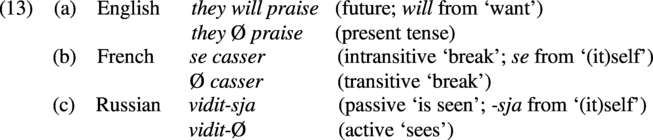
In many other cases, we do not know how the marker developed because it is very old – e.g. the comparative marker in small-er (Section 3.6) or the copula in the child is small (Section 7.3), or the 3rd person imperative marker in Turkish bak-sın ‘let her look’ (Section 7.2). But it is quite likely that these asymmetric patterns, too, arose by differential development.
Similar is the situation of differential expansion of a new marking pattern (Haspelmath Reference Haspelmath and Good2008b: 207). The newly developed definite article did not spread to possessed nominals in German (14a), and the newly developed possessive marker tiegħ- did not spread to inalienable nouns in Maltese (14b).
Another possible way in which asymmetric coding may come about is by eliminating a coding contrast only where it is not particularly needed. In Middle High German, all masculine nouns of the -n class made a nominative–accusative distinction, regardless of animacy. In Modern German, this distinction was given up for inanimates, but not for animates such as Affe ‘ape’, so that we get a situation with differential accusative marking, as seen in (15) (see Nübling Reference Nübling2008: 303–306).
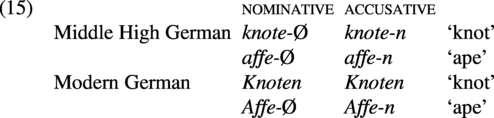
There are thus multiple ways in which asymmetric coding can come about in a language. This shows that the asymmetric coding patterns are not due to tendencies inherent in the kinds of changes that lead to them, but to factors favouring particular results (see Section 9.4 for more discussion).
9. Frequency and predictability in the causal chain
In this section, I discuss a few more aspects of the efficiency-based explanation of asymmetric coding tendencies.
9.1. Markedness and iconicity
In earlier work, I examined two alternative explanations for asymmetric coding and argued that they were less comprehensive or did not provide the necessary causal links.
In Haspelmath (Reference Haspelmath2006), I argued that markedness does not provide an explanation, because there is no unitary and generally recognized markedness concept, and if we adopted a single concept of markedness as a representational feature of universal grammar, we would not have a causal link. An explanation that provides causal links is preferable to an explanation that replaces the explanandum by another unexplained concept elsewhere for which there is no independent evidence.
In Haspelmath (Reference Haspelmath2008a), I argued that iconicity (or the tendency for meaning–form matching) cannot generally work as an explanation of the universals of asymmetric coding, because in many cases there are no meaning differences but we still find coding asymmetries. This is the case in all differential-coding pairs (Sections 5–7), where the same grammatical meaning is expressed in both construction types. For asymmetries like accusative marking of animate or inanimate objects, locative marking on place names and ordinary nouns, and attributive vs. predicative use of property words (adjectives), frequency-based predictability makes the right prediction, but iconicity does not seem to make any prediction. And in the case of positive vs. comparative (Section 3.6), it has often been argued that the comparative is actually simpler semantically.
Another possible alternative explanation might reverse the causal chain in (3) (frequency → predictability → shortness) and claim that higher frequency of use of shorter forms is due to the shortness of the forms. For example, the singular might be more frequent than the plural because its forms are shorter. This explanation is not only unintuitive (especially for coding asymmetries like affirmative–negative or positive–comparative), but it makes the wrong prediction that when a language has symmetric coding (e.g. when it has both a present-tense marker and a future-tense marker, both equally long), there should be no frequency difference. But in fact, the frequency differences are independent of the coding, as they are found in all languages, regardless of their coding patterns.
9.2. Coding efficiency and predictability
The explanation that I propose relies on the recognition that language systems tend to be efficient, i.e. they help the users make good use of scarce resources (speaker articulations) for the desired result of communication (understanding the speaker’s intentions). There should thus be a balance between parsimony and clarity: articulations should be reduced only to the extent that this does not threaten comprehension.
Such a balance or trade-off between ease of articulation and ease of decoding has often been postulated in linguistics, and there should be no need to justify the general principle here (see e.g. von der Gabelentz Reference von der Gabelentz1891; Langacker Reference Langacker and Li1977; Lindblom & Maddieson Reference Lindblom, Maddieson, Hyman and Li1988; Fedzechkina, Jaeger & Newport Reference Fedzechkina, Jaeger and Newport2012: 1; Gordon Reference Gordon2016: 17; Kemp, Xu & Regier Reference Kemp, Xu and Regier2018).
Now of course a key factor that aids comprehension is predictability: If the content of a message is not surprising, the message can be abbreviated. Speakers can afford to use short shapes or zero coding for predictable meanings, but they have to make a greater coding effort for unpredictable meanings.
If context is kept constant, higher-frequency meanings are more predictable than lower-frequency meanings because of their frequency: It is less surprising if my interlocutor uses a present-tense form than if she uses a future-tense form, just as it is less surprising if she talks about Mathe(matik) than if she talks about Topologie (recall Section 7 above). Thus, as was already noted in Section 1, the causal chain goes from high frequency to predictability, and from predictability to short coding.
The predictability-based explanation is confirmed by considering phenomena that involve predictability but not (necessarily) high frequency: I mean contextually high predictability of meanings.Footnote 10 For example, when an utterance is about a referent that has occurred just before, it is of course highly predictable (or accessible, Ariel Reference Ariel1990). In such situations, languages generally use short forms or zero, as is illustrated by the examples in (16).
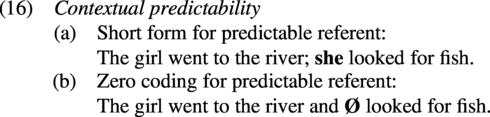
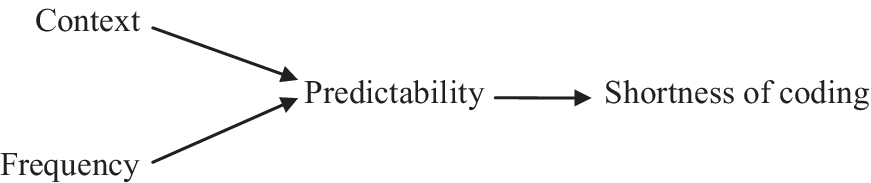
In these cases, the counter-efficient pattern, with the short form where the referent is unpredictable, is impossible (*She i went to the river and the girl i looked for fish). That personal pronouns and other anaphoric forms are generally shorter than full nominals is not in doubt but is rarely highlighted, because linguists have not often considered coding length as an important concept for understanding morphosyntactic patterns. But in the present context, these considerations support the explanation of universal asymmetries in terms of coding efficiency and predictability. The causal chain sketched in (3) can thus be expanded into the chain in Figure 1, showing two distinct causes of predictability, but a uniform result of predictability.
The causal chain leading to shortness of coding.
9.3. What is the ultimate cause?
When presenting the frequency- and predictability-based explanation of coding asymmetries over the years, I have often heard the comment that frequency cannot be the ultimate cause of the cross-linguistic patterns. Frequency itself must be caused by something, and this is not represented in the causal chain in Figure 1. What is it that causes the higher frequency of use of singular as opposed to plural, of present tense as opposed to future tense, of affirmative as opposed to negative, and so on? What causes inanimate nominals to occur in P function more frequently than animate nominals? Maybe this factor, whatever it is, could independently cause both frequency/predictability and shortness of coding, so that the causal chain would be different – as in Figure 2, and not as in Figure 1.
An alternative conception of the causal chain.
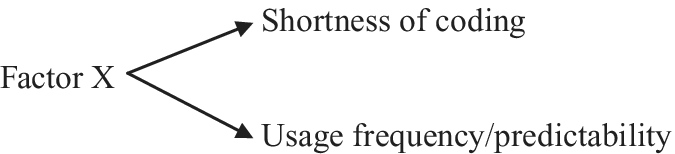
This is a possibility that must be taken seriously, but it is quite unclear what this factor X might be. Mayerthaler (Reference Mayerthaler1981: 136–140) proposed that markedness causes both high frequency and shortness of coding, but ‘markedness reversals’ show that this cannot be the explanation (see Haspelmath Reference Haspelmath2006: 44), and it is completely unclear how the abstract feature of markedness would lead to greater frequency of use. I do not know of any other candidate for such a factor X, so I will not discuss this possibility further here.
Ultimately, we would of course like to know the causes of frequency asymmetries, but the causes seem to be quite diverse. For example, the greater frequency of present tense vs. future tense seems to have to do with what we know about the present and about the future: The future is much less certain, so we cannot talk much about it. The greater frequency of male profession nouns vs. female profession nouns must have to do with frequency in the world: Male occupations are traditionally more diversified, so male profession nouns are (or were) used more frequently. But the greater frequency of singular vs. plural must have to do with our cognitive preferences – it cannot be due to the world (which does not contain more singular entities than pluralities) or to our knowledge of the world. It seems that we simply prefer to talk about individual entities.
In contrast to the diverse origins of the frequency asymmetries, their results are very uniform, and this is what the present paper aims to explain.
9.4. Ways of demonstrating the causal link
The focus of this paper has been on presenting a wide range of phenomena from the world’s languages, some of which have been studied extensively and are well known, highlighting that they are all special cases of the overarching form–frequency generalization of (2). I have also discussed a proposed causal link between frequency and asymmetric coding, in line with some earlier work. In this section, I will briefly consider two points of criticism that were raised by two reviewers.
On the one hand, one might ask what the evidence is that the disparate kinds of changes that I surveyed in Section 8 are indeed motivated by a preference for efficient coding. Cristofaro (Reference Cristofaro, Schmidtke-Bode, Levshina, Michaelis and Seržant2019: 27) thinks that ‘recurrent grammatical configurations do not appear to arise because of principles that that favor those particular configurations in themselves’. And indeed, historical linguists have often attributed diachronic changes to processes such as analogy, context-driven reinterpretation, metonymization, or grammaticalization, rather than to ‘efficientization’ processes. One might therefore say that the observed outcomes are not driven by functional adaptation, but by these classical processes and by the properties of the typical sources (Cristofaro Reference Cristofaro and Enfield2017 calls this the ‘source-oriented’ approach).
And indeed, language change often appears to be regular, and one might say that in addition to result-oriented functional-adaptive constraints, there are also mutational constraints (constraints on possible changes or possible diachronic sources) that lead to observed universals (Haspelmath Reference Haspelmath, Schmidtke-Bode, Levshina, Michaelis and Seržant2019a). However, as we saw in Section 8, there are a wide range of disparate paths of change that lead to uniform outcomes. This kind of multi-convergence of diverse changes cannot be explained by a source-oriented approach. Cristofaro (Reference Cristofaro, Schmidtke-Bode, Levshina, Michaelis and Seržant2019: 38) notes that ‘different diachronic processes can all lead to the same synchronic outcome for different reasons’, but this would be an accidental coincidence, and the universal claims of this paper go far beyond such possible coincidences. It may seem surprising that the resulting cross-linguistic regularities are unrelated to presumed regularities of change, but I would point to the analogous situation biological evolution, where functional-adaptive changes do not arise from regular changes either (but from functional selection; see Nettle Reference Nettle, Darnell, Moravcsik, Newmeyer, Noonan and Wheatley1999).
On the other hand, one might ask whether we can go beyond observing the correlations between asymmetric coding and frequency, and test the causal hypothesis experimentally. This has in fact been done in a number of studies using miniature artificial language learning paradigms. Thus, Fedzechkina et al. (Reference Fedzechkina, Jaeger and Newport2012) reported that learners restructured an artificial language with differential case-marking in such a way as to match the cross-linguistically common patterns, and Kurumada & Grimm (Reference Kurumada and Grimm2019) found that learners preferentially produced plural marking on nouns that are less probable to occur with plural meaning, in line with the cross-linguistic tendencies (recall Section 6.4 above).Footnote 11 There are also a number of experimental studies of languages with optional marking that point in the same direction, e.g. Kurumada & Jaeger’s (Reference Kurumada and Jaeger2015) experiments on optional case-marking in Japanese. These works have not been influential among linguists who are not specialized in psycholinguistics, but their results are fully compatible with the claims of this paper. Of course, there are many new issues that arise once one considers the precise psychological mechanisms that might be responsible for the speakers’ behaviour (see Jaeger & Buz Reference Jaeger, Buz, Fernández and Cairns2018 for a comprehensive survey). It is hoped that the present paper will contribute to bringing this line of work from psycholinguistics more closely together with comparative grammar research.
It is important to keep in mind, however, that even though not all questions about the causal connections may have been answered, there is no competing theory that can lay claim to explaining even a fraction of the phenomena of Section 3–7. In practice, the main alternative perspective that this paper argues against is that all these phenomena should be discussed (and perhaps explained) in isolation from each other.
10. Some history
The ideas presented here are not quite original, so I will briefly relate them to the most important earlier general work on asymmetric coding in grammar: Greenberg (Reference Greenberg1966), Croft (Reference Croft1990, Reference Croft2003), and Hawkins (Reference Hawkins2004).
Greenberg (Reference Greenberg1966) was the first to note that a wide range of simple meaning pairs (some of which we saw in Section 3–4) are asymmetric in a number of ways. He did not mention asymmetric coding in differential-coding pairs, but instead emphasized the apparent parallels with asymmetries in phonological segment inventories. He saw both asymmetric coding (‘zero expression of the unmarked category’) and frequency of use as manifestations (‘criteria’) of markedness, and did not focus on possible explanations of the patterns he discovered (much as in his 1963 paper, where explanations were secondary). However, he briefly noted that while the greater frequency of ‘unmarked’ phonological segments is the result of their other unmarked properties, ‘the role of frequency in grammar-semantics’ seems to be primary (Greenberg Reference Greenberg1966: 65).
Haiman’s (Reference Haiman1983) paper (see also Haiman Reference Haiman1985) was important because it discussed a diverse range of phenomena such as adpossessive marking (see Section 6.5 above), reflexive marking (see Section 7.1 above), and causatives (see Section 7.4 above) in terms of ‘iconicity’ and ‘economy’ and highlighted the role of tradeoffs (‘competing motivations’).
Croft (Reference Croft1990: Chapter 4) followed Greenberg closely and was inspired by Haiman, but in the 2003 version of the book (Croft Reference Croft2003), he no longer treats frequency as simply another criterion of markedness. The new version claims that frequency provides a ‘deeper explanation’ for the observed economy and iconicity effects (where ‘economy’ refers to parsimony, and ‘iconicity’ to explicitness in my terms). He notes that the explanation is the same as Zipfian explanation for the correlation between shortness and frequency (Croft Reference Croft2003: 112). He also deals with differential-coding pairs at length (Chapter 6), but he discusses these under the confusing heading of ‘typological prototypes’, and the relation between these patterns and usage frequency does not become very clear. Still, Croft’s work is the most important precursor to the present proposal.
Hawkins (Reference Hawkins2004: Section 3.2) formulates a very general principle (‘Minimize Forms’) which makes similar predictions to the explanations of asymmetric coding that I have proposed here. However, he only discusses case, number and gender asymmetries, and has almost nothing to say about differential coding (see also the summary in Hawkins Reference Hawkins2014: Section 2.2).Footnote 12 Outside of the typological community, the idea of a tradeoff between speaker effort and robust information transmission has also been pursued by a number of researchers, e.g. in phonology, variational corpus linguistics, and psycholinguistics (Aylett & Turk Reference Aylett and Turk2004, Jaeger & Tily Reference Jaeger and Tily2011, Hall et al. Reference Hall, Elizabeth Hume and Wedel2018, Gibson et al. Reference Gibson, Futrell, Piandadosi, Dautriche, Mahowald, Bergen and Levy2019, Levshina Reference Levshina2019).
Thus, the ideas and claims summarized in this paper are not completely novel, and the only claim I make is that this is the right way of explaining a large number of cross-linguistic patterns that are still often discussed in very different terms (apparently because the Greenberg–Croft–Hawkins insights have not become widely known throughout the discipline yet).
11. Conclusion
To summarize, I have claimed that when two minimally different grammatical construction types differ in frequency across languages, they will also show a universal tendency to exhibit asymmetric coding, i.e. the more frequently used construction will tend to be coded by a shorter form (or by zero), while the less frequently used construction will be coded by a longer form.
I have listed 25 pairs of construction types for which this claim either has been substantiated in the earlier literature or seems very plausible. I am planning to document quite a few further cases of coding asymmetries in future work.
I have proposed that the universal coding asymmetries can be explained as caused by the functional-adaptive force of coding efficiency. This means that speakers, and therefore also languages, must make a tradeoff between the conflicting pressures of parsimony and explicitness. While some languages in some patterns show fully explicit coding, and some languages in some patterns show no overt coding (i.e. maximal parsimony), many languages make an efficient compromise, where only the less predictable information gets overt coding, while the more predictable information is left uncoded (or is coded with fewer segments). Counter-efficient patterns are virtually unattested.
The tradeoff that languages make can be seen as a consequence of the tradeoffs that speakers make in language use, because through language change (a kind of cultural evolutionary process), languages can adapt to the needs of the speakers. There are multiple pathways by which efficient coding patterns can arise, which means that we have convergent cultural evolution.
For quite a few of the individual coding types, there is a rich earlier literature, and sometimes rather different explanations have been proposed. There was no space in this article to compare my explanation with other explanations, but some of my earlier papers include some specific comparisons (e.g. Haspelmath Reference Haspelmath1999: Section 6; Haspelmath Reference Haspelmath2008a, Reference Haspelmath2008c: Sections 2 and 8; Haspelmath et al. Reference Haspelmath, Calude, Spagnol, Narrog and Bamyacı2014: Section 3; Haspelmath Reference Haspelmath2017; Haspelmath & Karjus Reference Haspelmath and Karjus2017: Section 3). Here I have limited myself to a few remarks on iconicity and markedness explanations, but especially for the domain of argument coding and reflexivization, there is also a voluminous literature from a generative perspective where the attempt is sometimes made to explain implicational universals. I claim that all these explanations can and should be replaced by the functional-adaptive explanation in terms of predictability and coding efficiency that I have advanced here,Footnote 13 and I hope that future work will elaborate further on these ideas.


 Open access

