




Introduction
Environmental Education (EE) scholarship has long problematized the distance between lived ecological realities and pedagogies (For e.g., Hohti & Maclure, Reference Hohti and MacLure2021; Jukes, Reference Jukes2023; Krishna & King, Reference Krishna and King2025; Malone, Reference Malone2020; Merewether, Reference Merewether2018; Mishra, Reference Mishra2025; Pacini-Ketchabaw et al., Reference Pacini-Ketchabaw, Taylor, Blaise, Taylor and Hughes2016; Taylor & Pacini-Ketchabaw, Reference Taylor and Pacini-Ketchabaw2015). Schooling in India (and elsewhere) endorse “decontextualized universal frames of knowledge” (Batra et al., Reference Batra, Revi, Bazaz, Singh and Poonacha2021, p. 8 as cited in Krishna & King, Reference Krishna and King2025). Within EE (and elsewhere, which also includes cross-curricular connections), the narratives are majorly focused on What is in it for us humans? How do we create a better/sustainable future for our upcoming generations (humans)? (Davis et al., Reference Davis, Sumara and Luce-Kapler2015; Malone, Reference Malone2018; Spannring, Reference Spannring2019). Within this, the “I is prioritized over we” (Davis & McMurtry, Reference Davis and McMurtry2024, p. 40). The EE pedagogy (specifically within India and elsewhere) is largely performative based rather than a rooted in lived experiences or an invitation to inquire, critically think, question and/or embody ecological responsibility (Krishna & King, Reference Krishna and King2025) or as Haraway (Reference Haraway2016) would call it “response-ability.” For example, in their critical discussion of the Anthropocene, Raveendran and Srivastava (Reference Raveendran, Srivastava, Wallace, Bazzul, Higgins and Tolbert2022) highlight how EE within the official curriculum in postcolonial India often reproduces dominant narratives of development, environment and technoscience. In the same vein, in their study of high school science teachers in Indore, Haydock and Srivastava (Reference Haydock and Srivastava2017) found that although teachers recognized Gandhian and Eco-Marxist philosophies, their classroom teaching was largely textbook based (separate from their lived realities) and focused on Ecological Modernization. However, what gets lost in this, is the relationality. The impact that arises is twofold: first, it reinforces human superiority wherein more-than-humans are then just “dead, passive and lacking agency” (Jukes et al., Reference Jukes, Stewart and Morse2021, p. 347; Malone, Reference Malone2018). Secondly, the learning and knowing becomes separate from the lived realities (Krishna & King, Reference Krishna and King2025). In this (not so-new) dichotomies, what becomes marginalized are the onto-epistemologies that historically shaped communities, ways of knowing rooted in land, memories and intergenerational practices (Datta, Reference Datta2015; McGregor, Reference McGregor, Kulnieks, Longboat and Young2013). As such, Krishna and King (Reference Krishna and King2025) emphasize that “the inclusion of local knowledge systems, and collective action” (p. 4) has potential to bridge this by grounding education in community experiences and shared responsibilities. Although NEP 2020 (Ministry of Education, 2020) in India, discusses and (vaguely) places focus on land-based learning, they have yet to be meaningfully translated into everyday school practices (Kumar, Reference Kumar2009). For example, EE is largely embedded within science curricula rather than across other subject areas, and this “framing of EE in India emphasizes techno-centric perspectives” (Krishna & King, Reference Krishna and King2025, p. 3). Nevertheless, scholars in EE, specifically within Canada (and elsewhere) have been discussing how children intra-act within their Common World (Boileau, Reference Boileau2024; Taylor, Reference Taylor2013). For example, researchers (Bartnaes & Myrstad, Reference Bartnæs and Myrstad2022; Hohti & MacLure, Reference Hohti and MacLure2021; Malone, Reference Malone2018; Merewether, Reference Merewether2018; Nxumalo & Pacini-Ketchabaw, Reference Nxumalo and Pacini-Ketchabaw2017; Taylor, Reference Taylor2013) have discussed ways to reimagine children’s relations with more-than-humans, disrupt human-centred pedagogies and foreground ethical, material and affective entanglements in daily learning contexts. Similarly, Black (Reference Black2019), Born (Reference Born2019) and Boileau (Reference Boileau2022) in their doctoral theses ground their work in posthumanism, new materialism and Indigenous ways of knowing to explore how beings, lands and systems co-create worlds alongside children (Nxumalo & Vintimilla, Reference Nxumalo and Vintimilla2020). Scholars have also been problematizing dominant narratives and romanticized views of EE which includes powerful views such as “human societies used to be closer to nature and have now become distant,” the belief that “taking out children in nature would grant some utopian future” and the over-reliance on an idealized “Balance of Nature” that self-corrects environmental damage (Taylor, Reference Taylor2013; Haydock & Srivastava, Reference Haydock and Srivastava2017; Malone, Reference Malone2018). I echo scholar’s (Datta, Reference Datta2015; Krishna & King, Reference Krishna and King2025; Malone, Reference Malone2018; Taylor, Reference Taylor2013) provocation to move beyond this romanticized view and discuss the complexities/possibilities of what exists within our daily environment, what role communities play and how we can weave these experiences into the curriculum and into our pedagogical practices. This paper emerges from and highlights this tension. It explores how pedagogical and methodological practices can help us (re)story children’s (our) relationality with their (our) local environment and how communities come together to (re)imagine shared responsibilities toward more-than-humans (Roberts, Reference Roberts2024). As such, this paper takes up this possibility through two interrelated strands. First, drawing on a reflexive account of my childhood experiences in the Vasai–Virar region, I explore the entanglement (or as Barad would call it “to cut-together apart”) of a child (me) with more-than-human worlds to foreground the significance of relationality and community-rooted ecological knowledge. I draw from my memories, poems and embodied recollections as a practice of what Barad (Reference Barad2014) calls “re-turning.” Through this iterative re-turning, I ask: How did my early intra-actions (as a child) with land, water, plants and coastal ecologies shape what and how I know? What forms of community knowledge were already alive within these relations?
Second, by drawing on Haraway’s (Reference Haraway2016) provocation of being entangled in messy complex relations, I turn and re-turn (Barad, Reference Barad2014) to scholarship in environmental grassroots mo(v)ements in the Vasai–Virar region of coastal Maharashtra, India to look through the literature (specifically the grey literature) by using a diffractive practice to tell a story. This story illuminates how communities collectively respond to ecological degradation. As such, I ask: What stories, pedagogical and methodological possibilities for EE emerge from my intra-action with the scholarship and material of local environmental grassroots mo(v)ements in this region? Together, these two strands position lived experience and grassroots mo(v)ements as vital sites for (re)thinking beyond the dominant universal narratives and toward situated and relational pedagogies.
Interlude
I am inspired by Jaclin’s (2016) use of the term mo(v)ement. I have used this term intentionally throughout the paper since it holds together “movement” and “moment” which signals the inseparability of unfolding processes and situated events. In adopting this term, I emphasize that the local community’s mo(v)ements in Vasai–Virar are not fixed historical mo(v)ements confined to a past timeline, but ongoing: where each moment continues to move and reshape the ecological-political field across time or as Yunkaporta’s (Yunkaporta, Reference Yunkaporta2019), cited in Cutter-Mackenzie-Knowles et al. (Reference Cutter-Mackenzie-Knowles, Brown, Osborn, Blom, Brown and Wijesinghe2020) says, “no start and finish but a constant state where past, present and future are all one thing, one time, one place” (p. 44). I hope this research contributes to opening generative conversations about what it might mean to enact such shifts in practice.
Relational onto-epistemologies
Although, scholarship in EE has focused on the complexities within children’s surroundings (Nxumalo & Pacini-Ketchabaw, Reference Nxumalo and Pacini-Ketchabaw2017; Taylor, Reference Taylor2013), there is limited scholarship that examines how local onto-epistemologies in specific regions (such as Vasai-Virar) shape children’s relational engagements with land (Krishna & King, Reference Krishna and King2025). Datta (Reference Datta2015) reminds us that every land carries layered, diverse and often unheard stories that need to be recognized. He underscores that land is not an abstract ecological category but a lived, storied and relational space. Therefore, there is a critical need to situate conversations about nature, land and sustainability within everyday local practices. In the Vasai–Virar region, these onto-epistemologies (which often go unheard) are held by diverse communities (for e.g., Vadval communities, Adivasi communities, Koli fisherfolk and many more) whose embodied ecological knowledge rarely enters the school curriculum (and elsewhere). For example, among the Koli community, one of the region’s oldest fisherfolk groups, knowledge/learning is transmitted through close attentiveness to tides, lunar cycles, the colour of the water, the movements of fish and the health of coastal ecosystems (Arora et al., Reference Arora, Bharat and Lavangia2026). Koli people are able to predict which type of fish was likely to appear in the sea on the basis of the colour of the water and the direction of the wind (Himatsingka, Reference Himatsingka2025). This ecological knowledge emerges from everyday practice, intergenerational knowledge and traditional beliefs. Another example includes, setting nets at particular depths (i.e., 18 feet deep in water – they follow “Dol” method of fishing), looking at the tidal waves and so on (Hegde, Reference Hegde2015). The folksongs within the community carry generations of knowledge too (Joglekar & Pranita, Reference Joglekar and Harad2019). Diverse communities and cultural groups have unique insights on engaging with the water and the land. For Koli community, sea is a part of their tradition and culture. For example, Naarli Poornima, (translates to coconut full moon) is celebrated by the community to honour the nurturing relationship between the sea and the families. Through such practices, generations pass down knowledge, i.e., knowing when to fish and when to let the sea rest. Oral traditions such as storytelling, folk songs, dances, dialogues with elders form another foundational onto-epistemic framework across diverse communities (Hohti & Tammi, Reference Hohti and Tammi2023; Tsing & Bazzul, Reference Tsing, Bazzul, Wallace, Bazzul, Higgins and Tolbert2021). Various groups preserve ecological histories and relational ethics through stories, songs and ritual performances. For example, Thakars is a community in Maharashtra which relies on a combination of foraging, agriculture, fishing and hunting. Their cultural expressions, such as the folk songs and the Chitrakathi narrative art form (Sindhu, Reference Sindhu2024), celebrate identity, community and the human–nature relationship which reflects centuries of embodied ecological knowledge. Sindhu (Reference Sindhu2024) calls Bahulya and Chitrakathi Tradition of Thakars as “The Master Storytellers of Maharashtra.” For example, Mhatre & Shinde’s (Reference Mhatre and Shinde2017) ethnobotanical studies within the Thakar, Katkari/Kathodi and MahadeoKoli communities in Maharashtra illustrate their extensive knowledge of wild foods, medicinal plants and forest ecology. Such knowledge systems are deeply embedded in place, community and relational practices, and form a strong foundation for land-based environmental pedagogy. Similarly, Warli community, through their art, encode relationships between humans, animals, plants, forests and ancestral spirits (Patil, Reference Patil2017). These narratives are pedagogical tools that emphasize interdependence, respect and responsibility. As a symbolic representation of farming cycles, communal life and multispecies relations (Kadam, Reference Kadam2024), Warli art also serves as a visual curriculum on relational ontology.
Hence, although, children live in rural/semi-urban region and continuously encounter more-than-humans within their everyday intra-actions (Barad, Reference Barad, Carlile, Nicolini, Langley and Troikas2013; Malone, Reference Malone2018), their ways of knowing are rather considered as “inferior” or “less-than” as compared to people living in cities (or elsewhere) (Datta & Kairy, Reference Datta and Kairy2024). This is not uncommon for people belonging to minority or marginalized communities. For example, Datta and Kairy (Reference Datta and Kairy2024) highlights how epistemologies of Munda Indigenous communities residing in the coastal areas of Bangladesh are marginalized or categorized as “less-than.” Similarly, Krishna and King (Reference Krishna and King2025) highlights how there is a disconnect between school curricula and the children (specifically from marginalized groups) which “alienates children, especially those from disadvantaged groups” (p. 2), and often overlooks local knowledge systems and experiences. As such, children (including me) grow up perceiving knowing/learning as something external to their (our) lived experiences rather than rooted in “everydayness” of their living environment (Malone, Reference Malone2018, p. 43) i.e., intricately tied to their own land and communities (Jukes, Reference Jukes2023; Jukes et al., Reference Jukes, Stewart and Morse2021; A. Taylor, Reference Taylor2013). There appears to be no research and/or pedagogical framework that meaningfully examines the onto-epistemologies emerging from the Vasai–Virar region. This absence signals the continued marginalization of local knowledge systems that could contribute richly to EE discourse (Krishna & King, Reference Krishna and King2025). In response, I intend to open the conversation and offer pedagogical and methodological frameworks that engage with land, community histories and local grassroots mo(v)ements as sites of shared becomings.
Local context of Virar Vasai
The Vasai–Virar region is located in Palghar District (Maharashtra, India), approximately 50 km north of Mumbai, on the bank of Vasai Creek and surrounded by Arabian sea. It is a landscape shaped by centuries of ecological abundance, cultural memory and more recently the rapid urban transformation (Kamath & Raj, Reference Kamath and Raj2015). Historically known as Bassein, Vasai functioned as an important coastal settlement under various regimes such as the Portuguese and the British (Government of Maharashtra, n.d.). They each left imprints on its architecture, land use and economy (Baptista, Reference Baptista1967). Diverse communities that reside within these regions hold generations of knowledge about the sea, fishes, winds, plants and land.
Thinking-with theories while working with data
In this paper, I adopt a posthuman, reflexive-diffractive methodological stance by thinking-with theories of posthumanism and new materialism, specifically, by engaging with Barad’s (Reference Barad2003, Reference Barad2006, Reference Barad2014) and Braidotti’s (Reference Braidotti2013, Reference Braidotti2019) work. They emphasize the vitality and agency of matter and foreground the entanglements of humans, nonhumans and the material world (Jukes, Reference Jukes2023). I use Barad’s (Reference Barad2006) notion of intra-action to think-with my research. They emphasize that entities do not pre-exist their relations; rather, they emerge through entangled practices, each co-constituting the other – or what Jaclin (2016) would call as evenementiality – (the continual unfolding events of becoming) i.e., organisms (we) are always in the process of forming and reforming and never static. As such, the memories, stories, texts, language, community, land and objects are not passive backdrops but entangled with one another and active participants in shaping learning, affect and action (Barad, Reference Barad2006; Bayley, Reference Bayley, Bayley and Chan2023; Malone, Reference Malone2018). For example, the grassroots mo(v)ements that emerged in Vasai-Virar region as a response to the environmental issues, exerted material pressures that shaped community responses, collective mobilizations and lived experiences (Davis & McMurtry, Reference Davis and McMurtry2024). Together, these forces generate what Rautio (Reference Rautio2013) calls as a “relationship brought by intra-action” (p. 397). Malone (Reference Malone2018) describes this as “…myriad of ways that beings of all kinds, including human individuals and collectives, interact to create, sustain or dissolve community” (p. 47). Although I was not physically present within the grassroots mo(v)ements that took place in the Vasai-Virar region, my engagement with its material traces (scholarship) constitutes a form of intra-action (Jackson & Mazzei, Reference Jackson and Mazzei2013). This engagement entangles me within the mo(v)ement’s relational effects and positions me as a posthuman subject embedded in networks of knowledge, ethics, discourse and more-than-human relations (Braidotti, Reference Braidotti2013). My reflexivity, therefore, is the one that acknowledges how my re-reading, interpretation and re-reading actively participates in the ongoing shaping of meaning and understanding.
Through a “reflexive-diffractive re-reading” (Lennon, Reference Lennon2017, p. 535) of the poems, feelings, reports and literature while thinking to unsettle dominant colonial narratives, taken-for-granted methodological and EE pedagogical assumptions and everyday practices, I re-turn (Barad, Reference Barad2014) to those moments. In re-turning to these moments, I re-compose myself in relation to them (Datta, 2018). This process opens space for diverse understandings, affective encounters and shifting subjectivities to emerge – as ongoing becomings (Jackson & Mazzei, Reference Jackson and Mazzei2013). What emerges is a subject continually in formation. Hence, while thinking-with the theories and “plugging-in data,” I take up Jackson and Mazzei’s (Reference Jackson and Mazzei2013) provocation to work with texts (literature, poems, theoretical writings and fragments of memory). Learning, in this sense, arises from the messy intra-actions (Barad, Reference Barad2003) that unfold between myself and the texts. I am woven into an assemblage of theories, affects, histories and discourses that co-produce what becomes knowable (Datta, 2018). Thinking happens in the midst of these entanglements. My engagements with theorists, Braidotti (Reference Braidotti2013, Reference Braidotti2019), Haraway (Reference Haraway2007, Reference Haraway2016) and Barad (Reference Barad2006, Reference Barad, Carlile, Nicolini, Langley and Troikas2013, Reference Barad2014), my poems and scholarship forms a part of this assemblage and are conceptual companions that reconfigure what the data can do. Within this process, I find myself surrounded by texts, memories, theories, lived experiences, writing practices and my positionality as a woman in academia, a researcher and an educator from Vasai-Virar region, currently residing in Canada. These elements fold into one another and intra-act to produce something that exceeds conventional themes or patterns (Jackson & Mazzei, Reference Jackson and Mazzei2013).
Thinking-with theories (Barad, Reference Barad2003, Reference Barad2006, Reference Barad, Carlile, Nicolini, Langley and Troikas2013, Reference Barad2014; Braidotti, Reference Braidotti2013, Reference Braidotti2019; Haraway, Reference Haraway2007, Reference Haraway2016) opens up an onto-epistemological orientation in which knowing and being are inseparable. “The ‘I’ of the researcher is always becoming through the process of researching, listening and writing” (Jackson and Mazzei, Reference Jackson and Mazzei2013, p. 10). Thus, I invite readers into this assemblage, not to seek closure, but to participate in learning and unlearning alongside me.
Methodology
In this study, I employ a combination of Autoethnography, poetic inquiry and becoming-with literature as methodological approaches. Together, they allow me to foreground lived experiences, memory, affect and relationality. “There’s nothing in-active, non-political, or disengaged about this approach to methodology” (Bayley, Reference Bayley, Bayley and Chan2023, p. 5). Hence, I situate myself as an active participant within the research assemblage. “No single method can guarantee successful representation in itself. Reflexive research however accepts the messiness, ambiguity, polyvocality, non-factuality and multi-layered nature of meaning in “stories” that research produces” (Spyrou, Reference Spyrou2011, p. 162). Within this, Jaclin (2020) provides an important provocation that method is not just a static set of tools but a movement along traces – an active, ongoing process of paying attention to what happens “on the road” (p. 237). He argues that we should pay attention not just to the mechanical (writing, recording, reading) but also organic modes (moving, becoming-with others, embodying experience). These organic inscriptions matter just as much as the textual or digital ones (Tsing, Reference Tsing2015).
Autoethnography
As an autoethnographer, I occupy multiple roles simultaneously: I am “the one who tells and the one who experiences; the observer and the observed” (Pears-Scown, Reference Pears-Scown2024, p. 1170). Autoethnography recognizes storytelling as a way of knowing and sharing experiences (Holman Jones et al., Reference Holman Jones, Adams, Ellis, Jones, Adams and Ellis2013; Soini, Reference Soini2025). It situates lived experiences within the broader cultural, social and political landscape to weave together interpretation with embodied narrative voice (Datta et al., Reference Datta, Kayira, Datta and Walsh2022; Pears-Scown, Reference Pears-Scown2024). “Telling, retelling, writing, and rewriting stories is fundamental to our social lives” (Pears-Scown, Reference Pears-Scown2024, p. 1170). Yet autoethnography demands more than just recollection. It involves returning to fragments of lived experiences and engaging them anew, questing their significance within broader contexts and placing them in conversation with theory (Lennon, Reference Lennon2017). In this way, lived experiences, memory and reflection do not merely remain data but become active participants in knowledge production.
Poetic inquiry
I weave in poetic inquiry to express and explore my lived experiences. As Butler-Kisber and Stewart (Reference Butler-Kisber, Stewart, Prendergast, Leggo and Sameshima2009) suggest, poetry “can be used as an analytical or reflexive approach…It is a form of inquiry” (p. 3). Poetic inquiry is both reflexive and reflective, attends to the aesthetic, emotional and embodied dimensions of experience (Chanzà, Reference Chanzà2024; Clarke, Reference Clarke2019). By focusing on lived experiences, it challenges colonial and reductionist research norms (van Rooyen & d’Abdon, Reference Van Rooyen, D’Abdon, D’Abdon and Van Rooyen2025) and allows me to engage with relationality, complexity and emergence, rather than linear, cause–effect reasoning (Davis & McMurtry, Reference Davis and McMurtry2024). Researcher-voiced poem writing, often aligned with autoethnographia, foregrounds the embodied, affective and situated dimensions of knowledge production (Hough et al., Reference Hough, Sliep, Van Rooyen, D’Abdon and Van Rooyen2025). In this study, poetic inquiry along with autoethnography enables me to become-with the material and attend to my memories, emotions and embodied responses (shaped by childhood and the layered histories of place). Poems serve as both a method of inquiry and a medium of reflection to trace the entanglement of self, community and place.
Becoming-with literature
Following the poetic and autoethnographic engagement with lived experience, I turn to literature and scholarship on local grassroots mo(v)ements in Vasai-Virar region as part of the research and theoretical assemblage. This engagement is a becoming-with process, where texts, theories and historical accounts intra-act with my memories, poems and embodied reflections. Literature here is treated as an active participant in knowledge production which contributes to the assemblage alongside community knowledge, personal experience and ecological awareness. Following Barad (Reference Barad2014), these mo(v)ements can be understood as material-discursive phenomena, where bodies, practices, histories and discourse collectively produce effects.
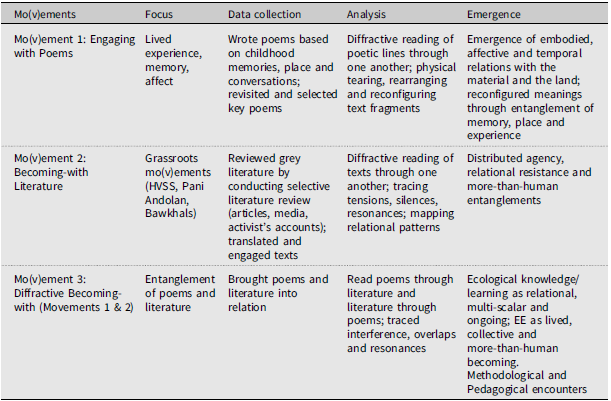
As such, this study unfolds through three intra-acting mo(v)ements (See Table 1). These mo(v)ements are not sequential but iterative and entangled, collectively constituting the analytical processes.
This table provides a visual summary of the analytical processes

Mo(v)ement 1: engaging with poetry
Staying close to the materiality of experience, I engaged in the process of writing poems. I spent time re-turning to my memories, reflections and affective responses, capturing them either in a Word document or in a journal (which I purchased very recently). These poetic exercises were a method for attuning to the relational and emergent qualities of experience. The first poem titled, Pause and See, was composed as part of my PhD course work assignment wherein I was asked to write about a topic that I felt closer to. The second one was written as a reflection after having conversation with one of the activists from my hometown. By returning to these texts repeatedly, I re-turn to the experiences they capture. These two poems were specifically chosen by me (from other poems that I wrote) since they discuss how early experiences with land, water, plants and community shaped what and how I know.
Maintaining journals?
It was not common for me (and many children) to maintain journals while growing up. For me, even purchasing a notebook was a privilege. Most of our knowledge and memories were shared through oral conversations and storytelling rather than written records. Writing materials were often reserved for schoolwork. Because of this, the practice of keeping a personal journal growing up was not something that many of us were encouraged to do or had the resources for. I still find it difficult to write in a Journal. I share this as an important reminder about how assumptions operate within research and educational practices. In many dominant research narratives, particularly within Western contexts, journaling is often presented as an universal entry point for reflection and documentation. Students and researchers are frequently asked to maintain reflective journals as if this practice is familiar, accessible and culturally neutral. However, such expectations may overlook the material and cultural realities of many communities. Beyond material constraints, different cultures also have diverse ways of remembering, reflecting and sharing experiences. For example, knowledge may circulate through dialogue, relationships and community practices rather than through written documentation (Kovach, Reference Kovach2021; Roberts, Reference Roberts2024). Recognizing these differences is important when thinking about research design and methodology (Absolon, Reference Absolon2022). This does not mean that journaling cannot be a meaningful tool; rather, it invites us to question the assumption that it is the only or the most appropriate way to engage participants in reflection.
Becoming-with through poetic inquiry and autoethnography
In the following section, I draw on two poems to trace and map memories, knowledge and lived experiences. “Mapping is not only the object of this research, but it also serves as a method and an abbreviation of place and space, with gaps left for the imagination to fill” (Pears-Scown, Reference Pears-Scown2024, p. 1172). These poems illuminate how specific moments in time, encounters with place and relational experiences have shaped me/continue to shape me (as a researcher, an academician and as a women) in particular ways and contribute/ed to the ongoing process of who I am becoming/unbecoming. We are always entangled with anticipation of futures that are yet to unfold and with echoes of pasts that continue to shape the present. While the poems I share are personal, they hold fragments of broader social, ecological and relational experiences.
Pause and see
I walked through the shore,
Thinking about the life that it holds.
The sand touched my bare feet,
My face embraced the salty wind.
Plastic bottles, wrappers, nets,
Littered the shore like careless debts.
The sea vomits what we discard,
A truth everyone understands.
I thought of fish in waters gray,
Of trees lost, swept all away.
How does it feel to live confined,
In seas with trash of humankind?
Why don’t we pause and see?
The shore is dying silently.
A little me, with heart in hand,
Forever hoping to heal with the land.
Does it Still Feel like My Home?
My land, the green one,
Curated by farmers under the sun.
Dumping, digging, endless fight,
Turned my heart heavy every night.
Did we succeed, or did we fail?
I asked myself.
Yes and no is what I heard,
A truth uncertain, perhaps slightly blurred.
The floods rushed in,
But where could they go?
Since Bawkhals starting vanishing some time ago.
The mangroves are cut, the marshes are gone,
The place I loved felt so withdrawn.
Why does my heart no longer roam,
With ease across the fields once known?
Why doesn’t it feel like home?
Perhaps it changed, or maybe I have grown.
Diffractive Analysis of Poems
Once I re-turned to these poems, I followed Barad’s (Reference Barad2006) concept of diffraction as both a methodological and onto-epistemological practice. Barad (Reference Barad2006) discusses how diffraction apparatuses:
…measure the effects of difference, even more profoundly they highlight, exhibit, and make evident the entangled structure of the changing and contingent ontology of the world, including the ontology of knowing. In fact, diffraction not only brings the reality of entanglements to light, it is itself an entangled phenomenon (p. 73).
Although, these poems appear in one linear order, these are not sequential, they are very interconnected, messy and alive and they revisit me in different ways. Ontologically, the sequence does not exist. “Diffraction as methodology means reading texts intra-actively through one another, enacting new engagement patterns, and attending to how exclusions matter” (Pears-Scown, Reference Pears-Scown2024, pp. 1177–1178).
In the below section, I explore ways to read and represent these experiences differently, following their natural, non-linear connections. I am inspired by Pears-Scown (Reference Pears-Scown2024) to create diffracted poems. Once I had gathered the two poems I had written, I typed and printed them and then physically tore (literally) them apart. “These patternings invite new ways of practising the multiple phenomena ‘research’. And such an onto-epistemic approach is nothing short of world-building. Nothing short of deeply pedagogical – where learning, doing, resisting, cutting-together-apart, moving, and resonating are part of an entanglement that makes worlds” (Bayley, Reference Bayley, Bayley and Chan2023, p. 7). Staying with the concept of diffraction or as Beeman and Blenkinsop Reference Beeman and Blenkinsop2019) would call “diffractive enmenshment,” (p. 1480) I worked with the printed pages by tearing them repeatedly. In this process, the linear order of the text was disrupted and I noticed how lines intertwined and overlapped (Pears-Scown, Reference Pears-Scown2024). I then arranged the fragments together in random orientations trying to make sure there exist a relationship between pieces. I re-arranged and arranged multiple times. Within this iterative process, diffractive material–discursive encounters emerged (Bayley, Reference Bayley, Bayley and Chan2023), as meanings were not simply interpreted but produced through the entanglement of text, movement, space and my embodied engagement. In a Baradian sense, the arrangement itself was a phenomenon, where matter and meaning became together (Pears-Scown, Reference Pears-Scown2024). The arranging of paper on my bedroom floor and touching the paper itself allowed me to observe how the material itself shaped my engagement and understanding. The way different lines and words on the paper came together allowed for unlearning (Roberts, Reference Roberts2024) that might appear random but are connected across different times, spaces and experiences in our lives. Something emerged when these words came together which neither poem could reveal in isolation. Reading them together allows us to see how memory, place and embodied experience intra-act across different contexts and produce insights about environmental loss, community stewardship and ethical response-ability (Haraway, Reference Haraway2016). Knowledge/learning in this sense is something that is produced within relational entanglements of memory, matter, affect and place (Bayley, Reference Bayley, Bayley and Chan2023).
I have discussed couple of combinations from my poems:
For example, the lines “The sand touched my bare feet” and “The place I loved felt so withdrawn” come together to illustrate how diffractive reading brings different temporal and spatial experiences into dialogue. The first line originates from a poem I wrote during a coursework assignment and captures an embodied experience of the shoreline. The second line comes from a later poem, showing the loss and withdrawal of a once-familiar place. When read through one another, these lines do not simply represent two separate moments; rather, they intra-act to reveal how my embodied and affective relation with the shoreline is reconfigured over time. What emerges is an ongoing relation shaped by memory, ecological change and shifting material conditions, where relationality and loss co-exist within the same experiential field.
Another example includes the lines “Why don’t we pause and see?” and “The mangroves are cut, the marshes are gone.” The first line captures an affective, reflective questioning of human (my) engagement with the environment, while the second line situates this reflection in the material reality of ecological loss. When read through one another, these lines intra-act to reconfigure the meaning of awareness, frustration and loss. This emerges with the ongoing degradation of mangroves and marshes. What becomes visible is a relational condition in which the call to “pause and see” is shaped by and implicated in, the material transformations of the landscape, where reflection and ecological loss co-constitute one another.
Although the poems were written at different times and in different affective states, diffraction reveals that they are not separate artefacts but part of a continuous field of becoming. Various lines that come together in these poems do not represent distinct moments but intra-act across time to produce a relational understanding of environmental transformation. These diffractive encounters generate what can be understood as response-ability, in Haraway’s (Reference Haraway2016) sense; not as individual responsibility, but as the capacity to be affected and to respond within entangled multispecies worlds. This also shows that memory and place are co-constituted, not linear and that understanding emerges in the overlaps rather than in chronological sequence (Taylor & Hughes, Reference Taylor and Hughes2016) or as Cutter-Mackenzie-Knowles et al. (Reference Cutter-Mackenzie-Knowles, Brown, Osborn, Blom, Brown and Wijesinghe2020) would say “past as continuing and enfolded within the present, with the similarly enfolded yet-to-come” (p. 107). Through this process, the intersections of words, lines and fragments produced diffractive poems. These diffractive poems (Pears-Scown, Reference Pears-Scown2024) illustrate how material, affective, temporal and spatial elements co-constitute each other by foregrounding the entanglement of researcher, material and data.
Mo(v)ement 2: diffractive engagement with theory and literature
Following the poetic and autoethnographic engagement with lived experiences, I turn to literature and scholarship on grassroots mo(v)ements as part of the research assemblage. Given the limited availability of formal academic work on these movements, I conducted a selective literature review that included going through grey literature such as community articles, local magazines, activist writings, media archives and informal documentation. These texts acted as co-constitutive sites of knowing which carried situated, affective and embodied histories. I then engaged in diffractive reading practice. The diffractive reading activated me as a part of the “waves of relational intra-actions between different bodies” (Hultman & Taguchi, Reference Hultman and Lenz Taguchi2010, p. 537) and mo(v)ements in an event with the literature. As I read, I situated myself in the literature and become-with (Haraway, Reference Haraway2016) it, where texts, theories and historical accounts intra-act. When I immersed myself in the literature, I did not look for what happened in the movements, but rather for my encounter with it, “In this event something new is created” (Hultman & Taguchi, Reference Hultman and Lenz Taguchi2010, p. 537). In approaching grassroots mo(v)ements, I consider how these mobilizations shape collective experience, ethical orientations and relationality with land and communities. Drawing on Barad’s (Reference Barad2003) concept of intra-action, I read the scholarship as dynamic forces that entangle with my reflections. This opens new patterns and/or phenomena (Barad, Reference Barad2006) of thought and emergent understanding (Datta, Reference Datta2015). It is a moment of plugging in, of “reading-the-data-while-thinking-the-theory…of entering the assemblage, of making new connectives” (Jackson & Mazzei, Reference Jackson and Mazzei2013, p. 264).
I will first discuss/summarize three significant local grassroots mo(v)ements in the Vasai–Virar region and explore how they have been discussed in the scholarship. Much of the existing documentation is drawn from news articles, local magazines and media reports. I will then conduct diffractive analysis of the literature that is summarized. Some of the literature is translated from Marathi to English.
Harit Vasai Saurakshan Samiti (Green Vasai)
A protest was organized by the Harit Vasai Saurakshan Samiti (HVSS) in 1989 to protect the Vasai region (also called as green belt) from government-led urban development (Dabre, Reference Dabre2009). Leaders from political and social organizations debated the issue. While some politicians and local people supported urban development of Vasai, many people especially the social workers and activists opposed it and placed emphasis on the maintenance of the region’s green belt (Sharma, Reference Sharma1991). The committee HVSS was formed with an aim to maintain the villages, farms, forests and fishing grounds and oppose the urbanization (Dabre, Reference Dabre2009). They argued that “indiscriminate urbanization of the region will adversely affect its ecology” (Sharma, Reference Sharma1991, p. 413). HVSS organized around 200 village meetings within the region to raise awareness about the impact of development on culture, traditions and the environment. HVSS led a march which included thousands of participants. Several more protests followed until 1993. In response to persistent opposition from the people, the Maharashtra government amended the development plan (Dabre, Reference Dabre2009; Libeiro, Reference Libeiro2019).
Pani/Paani Andolan (water protest)
The Pani/Paani Andolan which translates to Water protest in Vasai was a water rights mo(v)ement in the early 1990s, led by the HVSS and local residents, especially women. It emerged in response to builders extracting large amounts of groundwater from Vasai-Virar’s region, which threatened agriculture, drinking water and local livelihoods (Libeiro, Reference Libeiro2019). The well-owners were paid a good amount of money to sell water and thus with the hope to make money more and more residents started digging wells (Sharma, Reference Sharma1991). Thousands of residents joined protests against legal/illegal water extraction. Citizens demanded that the government revoke permissions for tanker operations since excess of extraction may cause wells to dry up and the fertile land might become barren (Sharma, Reference Sharma1991). Sharma (Reference Sharma1991) discusses how this threat to the ecology had ripple effect. For example, they discuss that the tankers which came to extract the water, also caused destruction of the roads and road accidents of the locals. The Pani Andolan is one of the examples of community-led environmental activism which emphasizes local agency, collective action and inter-relationships between different forces such as social, political and ecological forces.
Saving traditional water ponds (Bawkhals)
The Bawkhals – traditional water ponds in Vasai Taluka are integral to local hydrology, agricultural irrigation and cultural practices (Yuva Vikas Sanstha, 2013). Over the years, many ponds have been encroached upon, filled for construction and/or polluted. Community activists, often in collaboration with local youth and civic organizations, have undertaken campaigns to preserve and rejuvenate these water bodies. Activities include cleaning drives, advocacy with municipal authorities, legal petitions and public awareness campaigns (See Yuva Vikas Sanstha, 2013).
Diffractive analysis of Literature
In the below section, rather than drawing common themes, I have mapped these mo(v)ements diffractively with one another to trace patterns of relationality, emergence and distributed agency. Drawing on Barad’s (Reference Barad2006) notion of diffraction, this approach attends to how differences are produced through entanglements, rather than seeking similarity. This involved reading texts alongside one another (for instance, excerpts from articles and local magazines) as mutually constitutive, where meanings emerged through their relational positioning, tensions and points of resonance. I placed excerpts, narratives and moments from different sources in conversation with the theories, asking how they interfered, resonated and unsettled one another. These moments of interference became key analytic entry points. For example, a narrative of resistance by Dabre (Reference Dabre2009) in Harit Vasaicha Ladha (हरित वसईचा लढा) described community action as deeply embedded in everyday life, articulated through care for land, embodied presence and affective ties to place. Here, resistance emerged as relational, more-than-human and grounded in lived experiences. Additionally, an article on Traditional ponds by Libeiro (Reference Libeiro2019) framed resistance in more structured and strategic terms and emphasized human-centred forms of activism and research. Reading these accounts through one another produced a moment of interference: the localized, affective and more-than-human enactments of resistance unsettled the more formalized, anthropocentric representations in academic texts. Rather than privileging one account over the other, this diffractive reading made visible how resistance is not a singular or stable construct, but is enacted differently across contexts, as both embodied and strategic, emergent and organized, human and more-than-human. This tension reoriented the analysis from asking what resistance is, to tracing how resistance comes to matter through specific relational configurations. This also allowed new onto-epistemologies to emerge about how agency is distributed across bodies, environments and temporalities.
I also attended to disruptions, silences and tensions within and between texts. For instance, while academic texts (e.g., Marti & Libeiro, Reference Marti and Libeiro2024) described environmental degradation in human-centred terms, they remained silent on the role of more-than-humans as active participants in shaping these mo(v)ements. In the same vein, an article by Libeiro (Reference Libeiro2019) gestured toward relational ties with land, water and other species but did not always explicitly articulate these as forms of agency. This silence (across both bodies of texts) revealed how more-than-human participation is simultaneously present and obscured. Similarly, narratives that portrayed grassroots mo(v)ements as unified and cohesive often remained silent on internal differences, including tensions related to caste, gender, impacts of colonization and forms of labour. The absence of these accounts does not indicate their non-existence, but rather highlights how certain stories are foregrounded. Attending to these silences made visible the uneven and contested nature of collective action. These moments revealed how mo(v)ements are not unified or stable, but are continuously in the process of becoming, shaped by uneven relations and situated contexts. Throughout this process, I remained reflexively engaged by connecting it with how my own positionality, memories and embodied responses intra-acted with the literature. In this sense, analysis was performed with text, as part of an ongoing assemblage. Through this diffractive mapping, the analysis traces not fixed findings, but emergent patterns of relationality, distributed agency and more-than-human entanglements that constitute these grassroots mo(v)ements.
Drawing relationality between three mo(v)ements: A story
The urban development in Vasai-Virar region, did not begin with bulldozers arriving one day and flattening the landscape, but rather is the result of years of increase in encroachment of land. When the HVSS mobilized in 1989 to protect the land, the protest was not only about land-use zoning or state planning. Farming, fishing, forests and communities were already entangled in this messy sticky web of intra-actions (e.g., Figure 1). The land held groundwater, sustained agriculture and supported livelihood. This had/continues to have direct impact on the conditions of ecological continuity. Along with increase in urbanization and encroachment of land on one hand, builders also began extracting groundwater in the early 1990s. This caused wells to lose water; roads were fractured under tankers weight, accidents increased, soil dried and tensions increased within the community. As such, Pani Andolan mo(v)ement emerged/entangled with it. Groundwater withdrawal, infrastructural strain and collective resistance co-constituted one another. In the same vein, traditional ponds – Bawkhals which are embedded in local hydrology and cultural practice, folded into this story as another surface of the same ecological field. To build more housing, the traditional ponds were/continue to be gradually encroached upon or filled. Hence, when ponds are encroached, filled or polluted, recharge slows, flooding risks increases and groundwater systems destabilize. The drying well and the silted pond are diffraction patterns of one same messy sticky assemblage.
Relational Map of Mo(v)ements in Vasai-Virar.

The protest against urbanization was never solely about development; it was about relational consequence. For example, more urbanization requires more water. More extraction depletes shared reserves. As water levels decline, those who contributed least to this extraction (particularly farming communities who depended on groundwater) bear the greatest burden (Mies & Shiva, Reference Mies and Shiva1993). Wells dry, water flow is reduced, agricultural cycles are disrupted and livelihoods are strained. In the same vein, when bawkhals disappear and urbanization increases, rainwater has nowhere to go and hence the flooding increases. What appears as separate events such as construction, extraction, drought, flood are in fact entangled effects of a capitalist, extractive logic that assumes land and water exist as resources to be taken/consumed rather than relations to be sustained.
Within this complex system, cleaning drives, legal petitions and youth-led advocacy emerge through the material insistence of water bodies that can no longer regulate flow as they once did. What becomes visible across all these mo(v)ements is a thickening, sticky web of messy, complex entanglements (Davis & McMurtry, Reference Davis and McMurtry2024). Resistance, groundwater protest and pond preservation are iterative responses within a shared ecological-political becoming. None of these elements precede the others in any simple way. Alongside these material dynamics, the capitalist mindset which prioritizes profit over ecological and community needs intra-acts with the complexities within this system. This shapes who has access to water, who bears the brunt of scarcity and how resistance unfolds. These patterns emerge through intra-activity (Barad, Reference Barad2003). As such, agency, here, does not belong exclusively to activists, planners, government, people and/or builders. It emerges as wells recede, tanker trucks carve ruts into village roads, ponds overflow or dry out, the impact it creates on people who are marginalized and how the meetings gather momentum across hundreds of villages. The protests materialize where ecological strain and political decision-making meet. As such, infrastructure, land, water, human as well as other non-human forces participate. Resistance is shaped by it. These mo(v)ements do not remain confined to 1989 or the early 1990s. This is ongoing. Each struggle leaves sediment (memory, strategy, caution) that resurfaces when new threats emerge. The mo(v)ements/moments are part of the ecological processes through which Vasai–Virar continues to (still) become.
Discussion
Mo(v)ement 3: diffractive becoming-with mo(v)ement 1 and 2
In this final mo(v)ement, I bring the poetic/autoethnographic strand and the analysis of grassroots mo(v)ements into a diffractive relation with one another to think-with the theories about what emerges when they are read not separately, but through each other. This is similar to the process of diffractive analysis that I described above.
Read diffractively (Mo(v)ement 1 and 2), the poems show that ecological knowledge begins long before formal EE. This is rooted in sensory and affective encounters (Pacini-Ketchabaw et al., Reference Pacini-Ketchabaw, Taylor, Blaise, Taylor and Hughes2016) with land, water and coastal ecologies. The shoreline, mangroves and fields are active forces in shaping perception, care and ethical sensibility (Atkinson, Reference Atkinson2015; Barad, Reference Barad2014). These embodied memories reveal that EE is already lived as relation, where the self is formed through ongoing entanglement with more-than-human worlds; it is local and is situated within specific histories, ecologies and community relations, rather than abstract or universalized, always emerging through place-based, embodied and everyday practices of living-with more-than-humans (Malone, Reference Malone2018). At the same time, the grassroots mo(v)ements demonstrate that such relational knowledge does not remain at the level of individual experience but extends into collective and political practices of response. Water and land are active forces that shape and are shaped by community action, resistance and survival of which we all are part of. When these two strands are read together, what emerges is not two separate forms of environmental knowledge/learning (personal and collective), but a continuous field of ecological becoming across temporality. This is also highlighted in Jukes and Riley’s (Reference Jukes and Riley2024) discussion where they use non-linear, entangled temporality to rethink EE as a relational, ethical practice which is aimed at multispecies justice across past, present and future. In this sense, the analysis also resonates with Aoki’s (Reference Aoki2004) notion of curriculum as lived, where curriculum is not something delivered merely through formal structures, but something that is continuously lived in the relational in-between of bodies, places, memories and worlds. What emerges, then, is curriculum as a lived, more-than-human field of becoming, where EE is enacted through everyday encounters with land as well as through collective practices of care, resistance and survival.
Childhood intra-actions with place and community-based environmental struggles are revealed as part of the same material-discursive ecology, where knowing/learning is distributed across memory, bodies, landscapes and infrastructures (Boileau & Dabaja, Reference Boileau and Dabaja2020). The shoreline described in the poems and the contested water bodies of the Pani Andolan are different intensities of the same relational and temporal field where water, land and human life are mutually implicated (Jukes & Riley, Reference Jukes and Riley2024). Learning then, is not just located in either my reflection or analysis of the grassroot mo(v)ments, but in the entangled relations between them. What becomes visible is a multi-scalar pedagogy in which ecological understanding emerges through the intra-action of memory, mo(v)ements, material infrastructures and more-than-human forces. In this sense, both childhood experience and grassroots mo(v)ements (mo(v)ements 1 and 2) function as methodological and pedagogical encounters where EE is continuously produced, contested and (re)configured through relation.
Conclusion
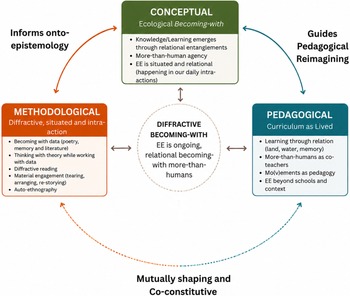
This paper has shown that methodology and pedagogy are not separate moments but entangled practices of becoming-with more-than-human worlds (Figure 2). Through a diffractive engagement with poems, embodied memories and grassroots mo(v)ements in the Vasai–Virar region, I have worked with rather than on texts. This allowed meaning to emerge through intra-action rather than interpretation. In doing so, I have contributed to (re)imagining EE as a relational, situated and more-than-human practice of response-ability. The analysis demonstrated that poems and accounts of mo(v)ements are not separate forms of data but co-constitutive sites where ecological relations, memory and political-material forces intra-act to produce knowledge. In this sense, learning is not located in the extraction of themes or findings (methodology) or mere transfer of knowledge from one head to the other (pedagogically), but in the relational encounters through which land, water, bodies and histories continuously reshape one another.
Framework: EE Learning is relational, situated and is always becoming-with more-than-humans.

As such, this paper did not merely understand or look at questions as prompts to be answered in a linear or definitive manner. Instead, I engaged them as ongoing methodological provocations that guided how I attended to memory, literature and place. To address the first question, I re-turned to childhood memories and discussed how community knowledge was already embedded in everyday relations with more-than-humans. These affective, embodied and situated ways of knowing shaped responses to environmental change long before formal EE. Through diffractive reading, patterns of relational knowing emerged, revealing how communities respond to ecological change through collective practices of care and response-ability. In responding to the third question, I traced how these entanglements opens up diverse ways of thinking about teaching and learning. These stories point toward situated, relational pedagogies grounded in lived experience, community knowledge and more-than-human connections. These pedagogies include (but not limited to): attending to embodied, local and place-based knowing; recognizing non-human forces as active participants in learning; engaging with uncertainty, complexity and non-linearity and fostering ethical responsiveness within ecological relations. Together, my intra-actions with lived experiences and scholarship generated a relational understanding of knowing, acting and learning. These strands collectively reposition EE as an emergent, situated practice, one that is always in the process of becoming through human and more-than-human entanglements.
Acknowledgements
I would like to thank editors and reviewers for their time and insights. I am deeply grateful to my kin (human and more-than-human) whose lives and stories are woven throughout this work. I acknowledge the waters, plants, animals and landscapes of the Vasai–Virar region that continue to teach, sustain and inspire this research. I also acknowledge that I currently reside and work on the unceded and unsurrendered territory of the Algonquin Anishinaabe people, whose enduring relationship with and care for these lands continue to this day.
Financial support
This research received no specific grant from any funding agency, commercial, or not-for-profit sectors.
Ethical statement
Nothing to note.
Author Biography
Steffie Selestin Dmello is a PhD candidate and part-time professor in the Faculty of Education at the University of Ottawa. She was born in India and has a background in Zoology (B.Sc., M.Sc.) and Education (B.Ed., M.Ed.). She worked as secondary school teacher for five years. Her research focuses on exploring the relational dynamics between children and more-than-humans by employing diverse methodologies such as multispecies ethnography. She aims to challenge the dualistic perspectives in education by emphasizing the interconnectedness of humans and more-than-humans. Drawing from various onto-epistemologies, her research seeks to foster a deeper understanding of ecological relationships within educational contexts.


 Open access

