


Introduction
Improving conservation education and fostering attachment to nature are considered essential to prepare future generations of conservation biologists and facilitate positive outcomes for conservation initiatives (Noss, Reference Noss1997; Orr, Reference Orr1999; Ewert et al., Reference Ewert, Place and Sibthorp2005). Simply placing children in natural settings for play or for study is not enough to foster biophilia (Turner, Reference Turner2003; Louv, Reference Louv2008). Developing engagement with nature requires an educational framework. One proposal is to use the naturalistic intelligence defined in Howard Gardner's theory of multiple intelligences (Gardner, Reference Gardner1999) to guide conservation education in schools and outreach programmes (Jacobson et al., Reference Jacobson, McDuff and Monroe2006; Hayes, Reference Hayes2009). This type of intelligence is identified as a cognitive capacity typical of naturalists and those who excel in the study of nature. Gardner's multiple intelligences have been characterized in a strong form as innate (thus largely unteachable), dedicated, computational capacities existing in discrete mental silos and characterized by a unique developmental style and a specialized language (Gardner, Reference Gardner1983), and in a weak form as clusters of competences that exist on a gradient and coalesce into culturally valued forms of learning and expression (Gardner, Reference Gardner1999). This theory is most often used to justify teaching in multiple formal languages (e.g. verbal, mathematical, dance) to reach multiple intelligences. We disagree with multiple intelligence theory on several grounds and propose alternative educational recommendations. Here we present a universal, targeted and interdisciplinary approach to conservation education.
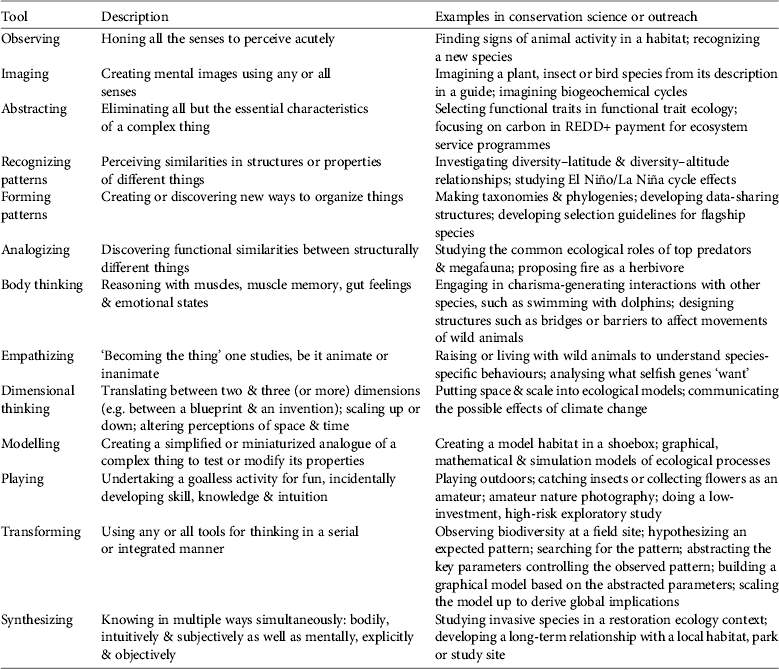
We propose that conservation education should be centred on teachable and learnable cognitive skills that are accessible to everyone. We believe that those who appreciate and study nature share a common set of tools for thinking with everyone else (Root-Bernstein & Root-Bernstein, Reference Root-Bernstein and Root-Bernstein1999) and that by stimulating and practising these skills everyone has the potential to develop an improved understanding of and appreciation for nature. Analysing what hundreds of scientists, artists and inventors have reported about their own thinking processes we have identified 13 cognitive skills or tools common to creative problem-solving endeavours across disciplines (Table 1; Root-Bernstein & Root-Bernstein, Reference Root-Bernstein and Root-Bernstein1999). Used serially or in an integrated manner, clustered according to task and talent, these tools reflect intuitive ways of thinking that yield formal understanding through sensual experience, emotional feeling and intellectual knowledge. Their exercise largely precedes the rational articulation of knowledge in words, numbers or artistic or other disciplinary expressions. One core difference between tools for thinking and multiple intelligences is thus that we put pedagogical emphasis on mode of cognition rather than mode of expression. Teaching in multiple formal languages is not on its own an adequate educational strategy because (as polymaths adept in multiple disciplines can demonstrate) formal expressions are interchangeable, translatable products whose forms are dictated by disciplinary norms, not the origins or bases of ways of learning and thinking.
Descriptions of the 13 tools for thinking, with examples of their application in conservation. Tools are listed in order of potential development, from basic to complex. For source material see Root-Bernstein & Root-Bernstein (Reference Root-Bernstein and Root-Bernstein1999).
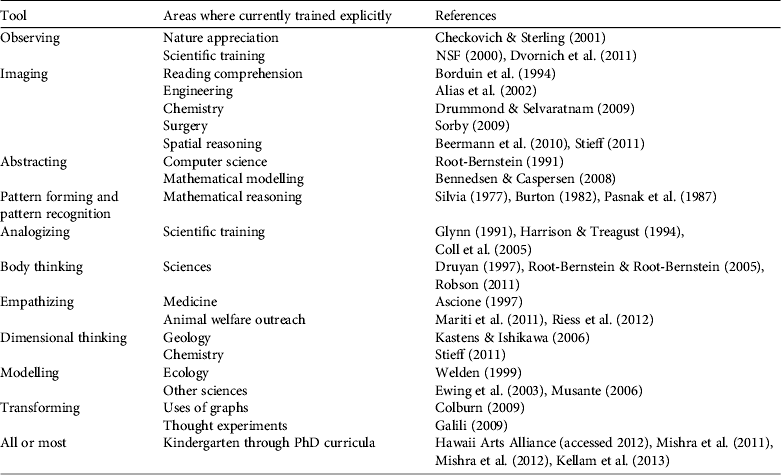
The tools for thinking are trainable and their practised, conscious use improves analytical and creative thought through learning how and when each tool can be applied to a given problem or situation. This is a second core difference between tools for thinking and multiple intelligences; training people to concentrate on a cluster of competences is contrary to the evidence that successful practitioners in any field learn to use many or all of the tools for thinking. Teaching should thus focus on training everyone to use each of the tools. However, systematic training in the use of specific tools has often been clustered in particular domains despite being applicable to a range of multidisciplinary activities (Table 2; Root-Bernstein, Reference Root-Bernstein1991; Root-Bernstein & Root-Bernstein, Reference Root-Bernstein and Root-Bernstein1999).
Examples of areas of learning where explicit training in the tools for thinking is provided.
One of our key arguments is that making the tools for thinking explicit in science-based and avocational conservation activities will improve performance in relevant thinking, feeling and problem-solving. This claim takes a position within the complex field involving consciousness, introspection and knowledge. Previously researchers believed that it was impossible for introspection to produce accurate reports of cognitive processes but this view has been critiqued and problematized (White, Reference White1988). There are many different aspects of a cognitive process (e.g. rules, intermediate outputs, causal explanations) and many forms in which they can be reported (White, Reference White1988). People appear to have little or no introspective insight into psychological processes underlying perception (e.g. illusions), motor learning (i.e. acquiring muscular patterns), attitudes or self-esteem (Wilson & Dunn, Reference Wilson and Dunn2004). By contrast, introspection can provide accurate reports of cognitive working memory (Baars & Franklin, Reference Baars and Franklin2003) and, as such, is interpreted as indicating the development of conscious knowledge (Baars & Franklin, Reference Baars and Franklin2003). A common definition of conscious knowledge is knowledge whose use can be controlled (Jacoby, Reference Jacoby1991). Knowledge may be unconscious when its representations are of too poor quality to support control, while still affecting performance (Cleeremans & Jiménez, Reference Cleeremans, Jiménez, French and Cleeremans2002). There is evidence that control, and hence consciousness, of different aspects of knowledge exists on a gradient and that as learning progresses, knowledge can come under greater control (Fu et al., 2007). Subjects who progress from unconscious to conscious knowledge during a learning task are able to use the knowledge strategically (Haider et al., Reference Haider, Eichler and Lange2011). When conscious knowledge is manipulated by intentional instruction, significant qualitative and quantitative improvements in performance are observed (Haider et al., Reference Haider, Eichler and Lange2011). Thus we argue that introspection by talented practitioners (who have developed high levels of control) is a valid tool for generating reports about cognitive processes using the tools for thinking. Explicit teaching and thinking with the tools is then expected to improve their control and strategic use by students and consequently improve measures of performance.
Here we make a case for the central role of tools for thinking in conservation-related research and nature appreciation, using qualitative research methods. We present examples from memoirs and other writings by and about naturalists, conservationists, ecologists and biologists. We also draw on ethnographic studies of the public's engagement with nature. The focus on thinking tools offers a novel approach to understanding that engagement. It also facilitates pedagogical replication of critical processes of that engagement, with implications for conservation education in the classroom and in the public arena.
The role of childhood experience
Childhood exposure to nature can be a defining experience (Louv, Reference Louv2008). The naturalist Gerald Durrell, founder of the first conservation-oriented zoo, published two memoirs about his childhood on the Greek island of Corfu, where he learned to train his eyes and body to observe nature (Durrell, Reference Durrell1956). The ethologist and artist Desmond Morris spent his childhood similarly. He described the experience of observing samples of pond water through a microscope:
‘I felt I was entering a secret kingdom, where flagella undulated, cilia beat, cells divided, antennae twitched, and tiny organs pulsated. I spent so much time with my head bowed over the eyepiece of this magical instrument, and became so engrossed with what I saw, that I would cheerfully have dived down the tube of the microscope…’ (Morris, Reference Morris1979, p. 15).
For Morris this was the first experience of an imaginative skill he later found critical to his work as a zoologist and artist (Morris, Reference Morris1979; Root-Bernstein, Reference Root-Bernstein2005). The lepidopterist and novelist Vladimir Nabokov also combined artistic and scientific response to nature. He described his numerous childhood hunts for new specimens as synaesthetic (multi-sensorial) experiences. His success in finding butterflies of which he had only read verbal descriptions (Nabokov, Reference Nabokov1947) implies a well-developed ability to recall what he had seen at first- or second-hand or to imagine what the unseen species might look like. It also suggests an ability to form patterns, to organize phenomena in systematic ways, to recognize gaps in that organization and conjecture the existence of new phenomena, all skills that would have served him well at the Museum of Comparative Zoology at Harvard University, where he made contributions to butterfly taxonomy (Lumenello, Reference Lumenello2005). Aware of the childhood foundation for his cognitive skills, Nabokov advised adults never to hurry children absorbed in play (Nabokov, Reference Nabokov1947).
The maturation of engagement and practice
The skilled analytical activities of biologists, such as decomposition of complex systems into functional parts or hypothesizing causal pathways, can all be reduced to constituent tools for thinking: analysis of complex systems is a combination of abstracting and patterning; hypothesizing causal pathways is a combination of patterning, analogizing and modelling. Here we review examples of how tools for thinking have contributed to the research or outreach of naturalists, biologists and conservationists.
Observing the natural environment leads to pattern recognition and formation, both of which are critical to teasing out ecological or biological structures and their functions. The 19th century philosopher and naturalist Henry David Thoreau recorded in prose and sketches the details of what he saw, heard, smelled, touched and tasted during his walks (Thoreau, Reference Thoreau and Searls2009). He also returned repeatedly to the question of how new oak forests were formed. After observing a squirrel burying a nut, he imagined the large-scale pattern that would emerge from repetition: ‘This, then, is the way forests are planted…If the squirrel is killed, or neglects its deposit, a hickory springs up’ (Thoreau, Reference Thoreau and Searls2009, pp. 454–455). Similarly, through the selection of key images, the biologist and writer Rachel Carson revealed ecological functions and patterns, with their particular rhythms over time and space. She supplemented her observations of ocean life by imaging deep-sea scenes and processes that she could not witness (Lear, Reference Lear and Carson2007).
Biogeography began with the search for repeating patterns in community composition over space, and has developed increasingly sophisticated tools, concepts and models of pattern-forming (Lomolino et al., Reference Lomolino, Sax and Brown2004). Current advances in ecology and biogeography are indebted to dimensional thinking, focusing on the influence of space on biological processes and exploring scale-dependence in space and time (Levin, Reference Levin1992; Whittaker et al., Reference Whittaker, Araújo, Jepson, Ladle, Watson and Willis2005). The naturalist E.O. Wilson describes how dimensional thinking granted him insight into how to conduct his experimental studies of island biogeography:
‘To an ant or spider one-millionth the size of a deer, a single tree is like a whole forest. The lifetime of such a creature can be spent in a microterritory the size of a dinner plate. Once I revised my scale of vision downward in this way I realized that there are thousands of such miniature islands in the United States, sprinkled along the coasts as well as inland in the midst of lakes and streams’ (Wilson, Reference Wilson1994, p. 262).
By contrast, many advances in animal behaviour research and outreach have occurred as a result of empathy. Jane Goodall wrote that ‘intuitive interpretations [of chimpanzee behaviour], which may be based on an understanding stemming directly from empathy with the subject, can be tested afterward against the facts set out in the data’ (Goodall, Reference Goodall1986). Combining empathizing with the kinaesthetic enactments of body thinking and playing, Konrad Lorenz would crouch and waddle like a goose to raise and study his goslings, or speak to birds using their own calls (Lorenz, Reference Lorenz1952). By these and similar means he was able to observe many species-specific behaviours, including imprinting and courtship (Lorenz, Reference Lorenz1952; Burkhardt, Reference Burkhardt2005). The neuroendocrinologist Robert Sapolsky also expressed a strong identification with the animals he studied: ‘I joined the baboon troop during my twenty-first year. I had never planned to become a savannah baboon when I grew up, instead, I had always assumed I would become a mountain gorilla’ (Sapolsky, Reference Sapolsky2001, p.1). Sapolsky's empathy and judicious anthropomorphism allowed him to develop a functional comparison between baboon personalities and society and human personalities and society. That extended analogy had clear scientific outcomes in his discoveries linking stress physiology, personality differences and the dominance hierarchy (Sapolsky, Reference Sapolsky2001). Although its validity as a research tool is debated, anthropomorphization can be helpful for engaging the public empathetically with other species and promoting conservation (Root-Bernstein et al., Reference Root-Bernstein, Douglas, Smith and Veríssimo2013).
Tools for thinking are usually used in clusters, according to problem-solving needs. The mathematical ecologist Robert MacArthur, who founded several subfields in ecology, had a passion for observing, abstracting, pattern recognition, and imaging or visualizing his models as memorable and elegant graphs (Pianka & Horn, Reference Pianka, Horn, Cuddington and Beisner2005). Observed data had first to be abstracted or simplified into generalizations. He then patterned generalizations in new ways to draw out new implications. He believed that the best science ‘comes from the creation of de novo and heuristic classification of natural phenomena’ (Wilson & Hutchinson, Reference Wilson and Hutchinson1989). He further excelled at the translation of derived patterns into the formalisms of mathematics and mathematical models, using mathematics to communicate ideas developed with multiple tools for thinking.
Accomplished biologists and naturalists demonstrate a capacity to use multiple tools for thinking, to transform or move serially from one to another and to use them simultaneously and synthetically. The naturalist and conservationist John Muir demonstrated an ability to observe with all his senses and with empathic sensitivity, to body-think a route over challenging landscapes while noticing the influence of large-scale geological patterns on smaller-scale patterns such as animal movements (Muir, Reference Muir and Teale1954). He communicated his experiences not in mathematics, like MacArthur, but in evocative prose.
Promoting engagement through conservation education
Imaginative, sensual thinking is central to the creative processes of biologists, ecologists and conservationists. Therefore incorporating tools for thinking explicitly in educational curricula at all levels and in outreach programmes would help to prepare future naturalists, biologists, conservationists and concerned citizens.
Anthropological research has shown that non-scientists relate to animals and nature through sensual engagement and use tools for thinking, such as imaging, body thinking, pattern recognition and empathizing, to understand their experiences. People who swim with dolphins, for instance, report experiencing transformative physical grace, a form of body-thinking that enables them to identify empathetically with dolphins and with nature as a whole (Peace, Reference Peace and Knight2005; Servais, Reference Servais and Knight2005). A reindeer herder has described empathizing with his reindeers at play in the snow (Lorimer, Reference Lorimer2006). Volunteers in a scientific study of corncrakes used auditory and kinaesthetic imaging, pattern recognition, and transforming to interpret radio-tracking noise (Lorimer, Reference Lorimer2008). Folk biology, local ecological knowledge and people's ability to recognize morphospecies (Dupré, Reference Dupré, Medin and Atran1999; Abadie et al., Reference Abadie, Andrade, Machon and Porcher2008) depend on pattern recognition and pattern forming, whether in terms of identifying morphospecies or categorizing them as edible or inedible, for example.
Researchers have tried to understand such engagement by invoking non-human charisma. Lorimer (Reference Lorimer2007) defined three types: ecological charisma refers to the way we detect or sense a species, corporeal charisma to the epiphanies we experience through physical engagement with a species, and aesthetic charisma to our emotional response to a species’ appearance. Non-human charisma is often misunderstood as an intrinsic characteristic of a species but it is intended to refer to the processes through which we understand species as fellow beings (Lorimer, Reference Lorimer2007). Tools for thinking can play a role in these processes. Observing, imaging and patterning can underlie ecological charisma, body thinking and empathizing can contribute to developing corporeal charisma, and synthesizing and synaesthetic thinking can lead to aesthetic charisma.
There are several ways in which tools for thinking can be implemented in conservation education. They can be used to make people more aware of how they can interact with nature in the most rewarding ways, to devise the most effective conservation education approaches, and to evaluate educational programmes.
The passive inclusion of tools for thinking in environmental education is not sufficient to make people aware of how they can apply these tools to understand nature (Turner, Reference Turner2003; Dvornich et al., Reference Dvornich, Petersen and Clarkson2011); teaching and outreach must be active and explicit. Although all the tools can be applied to conservation science and outreach (Table 1), tools are problem-specific and need not be taught as a complete group in each creative or problem-solving activity. Learning to observe well can help change young people's perceptions of nature from an empty, bewildering or meaningless place to a place filled with stories and secrets (Fig. 1). A tools-for-thinking approach emphasizes the universality of the thinking process, which can be expressed in many formal languages, and thus facilitates the incorporation of favourite skills and activities into an engagement with conservation.
An activity to train school students to use the tools of observation, pattern recognition and imaging (adapted from NatureMapping Foundation).

Using tools for thinking can alter both the content and delivery of conservation education. We have listed the tools in the order in which they are likely to be developed, from the simplest and most basic to those relying on the integration of prior tools (Table 1). Thus we would recommend employing only the first few tools with young children and reserving tools such as dimensional thinking, modelling, transforming and synthesizing for older children and adults. Although scientists use many and sometimes all of the tools for thinking, a study has suggested that only a few of the tools (observing, abstracting, patterning and analogizing) are explicitly taught in science textbooks (Lownds et al., Reference Lownds, Poff, Root-Bernstein and Root-Bernstein2010). Imaging, dimensional thinking, modelling, transforming and synthesizing are sometimes present implicitly in the form of illustrations but are rarely explicit. Body thinking, empathizing and playing are often rejected as being subjective and therefore non-scientific but they may be useful for amateur engagement with nature and for professional scientists. Fig. 2 is a summary of a workshop incorporating body thinking and empathy, intended for advanced undergraduates or graduate students with existing competence in mathematical ecology.
A workshop for undergraduate or graduate ecology students who already have well-developed mathematical skills. The use of dance to express observations about animal foraging helps to make students more aware of the steps prior to model building and may suggest new ways to think about their subject (adapted from Root-Bernstein & Overby, Reference Root-Bernstein and Overby2012).

Finally, tools for thinking can be used to evaluate the cognitive practices of students and the strengths and weaknesses of conservation education programmes. A good programme will incorporate many of the tools explicitly and student outcomes may be structured to demonstrate mastery within particular lessons and transfer of learning outcomes to other contexts.
We have noted a predominant use of certain tools by naturalists, biologists and conservationists: observation, empathy, pattern recognition and formation, dimensional thinking, modelling and synthesis. There are fewer reports of the use of imaging, abstracting, analogizing, body thinking, playing and transforming among this group. As tool use is problem-specific, what problems are we overlooking or failing to solve by not using these tools to their potential? What new chapters in the advancement of conservation and the social relationship to nature could be opened by focusing on these neglected tools for thinking in conservation education and outreach?
Acknowledgements
Meredith Root-Bernstein was supported by a graduate fellowship from CONICYT (no. 63105446) and a post-doctoral fellowship from FONDECYT (no. 3130336) during the preparation of this article.
Biographical sketches
Meredith Root-Bernstein researches interactions between animal behaviour and ecosystems and the ethnography of human–nonhuman relationships. Michele Root-Bernstein, a historian and poet, researches the invention of imaginary worlds by children and adults. She is a Kennedy Center teaching artist and has presented numerous workshops on tools for thinking for educators. Robert Root-Bernstein researches the evolution of physiological control systems and autoimmune diseases.



