


The Brazilian School Feeding Program (PNAE) started in 1954. It was seen for a long time as a targeted food aid programme designed to fight undernutrition and low levels of education. While over the years the programme maintained a focus on enhancing schoolchildren's diets, its specific objectives, institutional set-up and norms and regulations have evolved significantly over time.
The current paper argues that the PNAE is exemplary, a model from which other countries might draw important lessons. Brazil's multisectoral food and nutrition security strategy, developed from 2003, prioritized the expansion of school feeding and brought significant changes in the programme's design and implementation. Its objectives today are to contribute to the bio-psychosocial development and educational achievement of students by meeting their nutritional needs while in the classroom, and by supporting the formation of healthy habits through food and nutrition education(1). The programme also promotes local family farming.
The Brazilian programme is also exemplary for its scope, reaching more than forty-five million students, with an allocated budget of some $US 1·9 billion for 2012. School feeding in Brazil is a universal right of students enrolled in public basic education and a duty of the State, granted by the Constitution. The PNAE covers all public and community schools in the basic education system, from day care, kindergarten, elementary school, high school to education for young adults.
The paper first presents the PNAE and analyses how its objectives and standards were progressively developed as part of a multisectoral strategy for food and nutrition security. It then discusses monitoring, oversight and evaluation mechanisms. The last section presents evidence on the programme's results and discusses the role of Brazil's integrated policy approach and school feeding legal and regulatory frameworks in achieving these results.
Methodology
The paper is based on a review of technical documents and evaluation studies of PNAE, relevant federal legislation, technical and evaluative reports of the federal government, minutes of meetings and official documents of the National Council of Food and Nutrition Security and national conferences from 2003 to 2011, and interviews.
Results
School food policy, standards and implementation in Brazil
The PNAE is one of the most important strategies of Brazil's food and nutrition security policy. Its large coverage and innovative design act to strengthen family farming while promoting access to adequate and healthy diets in all public schools.
In Brazil, the number of people in food insecurity and poverty has decreased as a result of committed public policies. The percentage of households living in food insecurity fell from 34·8 % in 2004 to 30·5 % in 2009(2, 3) and extreme poverty fell from 17·4 % in 2001 to less than 9 % in 2008(3, Reference Levy-Costa4). However, fulfilling the Human Right to Adequate Food – as guaranteed in Constitutional Amendment no. 64/2010(5) – remains a challenge. A growing prevalence of diet-related diseases including overweight, obesity, hypovitaminosis A and anaemia coexists with food insecurity and malnutrition in populations that still have problems with access to adequate food, such as communities of descendants of slaves (quilombolas), indigenous people and the poorest groups. Latest estimates (2009) indicate that 49·9 % of adults are overweight and 14·8 % are clinically obese. Children and adolescents are also affected: in 2009, the prevalence of overweight was 34·8 % in children aged 5–9 years and 20·5 % in adolescents aged 10–19 years; the prevalence of obesity was 16·6 % in 5- to 9-year-old children and 4·9 % in adolescents(3). The rapid surge in obesity is correlated with an increased consumption of meat and industrialized foods with high levels of saturated and hydrogenated fats, sugar and soft drinks, and a reduction in the consumption of fruits, vegetables and basic traditional foods such as beans, tubers and rice(3, Reference Levy-Costa4, 6–8). The National Adolescent School-based Health Survey of 2009 confirmed the prevalence of these unhealthy eating habits among adolescents(Reference Levy, Castro and Cardoso9, Reference Malta, Sardinha and Mendes10).
An innovative policy approach linking food and nutrition security articulated in the Zero Hunger Strategy has emerged in Brazil in the last decade, aiming to overcome these problems stemming from multiple biological, socio-economic and cultural factors. The political leadership and support provided by the presidency, the insertion of food and nutrition security in the governmental agenda, and finally the combination of legal and institutional mechanisms for the participation of civil society and the partnership of different government sectors set the conditions for the promotion of intersectorality(Reference Burlandy, Rocha and Maluf11).
The Organic Law for Food and Nutrition Security adopted in 2006 is a landmark policy which established a food and nutrition security system. The system comprises a nineteen-ministry Interministerial Chamber of Food and Nutrition Security (CAISAN), a national council (CONSEA), and intersectoral chambers and councils at all levels of the government(12). These arenas assemble civil society organizations and different government sectors to coordinate and integrate programmes and actions for food and nutrition security. More recently, in 2011, the CAISAN, in consultation with these bodies, formulated the National Food and Nutrition Security Plan, which stipulates actions promoting production, the strengthening of family agriculture, food supply and healthy eating(8).
In this context, schools have emerged as an arena for developing initiatives linking access to adequate and healthy food, including vegetables and fruits; promotion of small family farms and their products; regulation of school food; and health and nutrition education – for instance through school gardens. The PNAE has been significantly redesigned as part of the comprehensive food and nutrition security approach and has become an example of the integration of education, agriculture, health and social protection to promote access to healthy diets at school while strengthening family farming.
The adoption of Law 11.947 in 2009(13), known as the School Feeding Law, was a milestone that institutionalized school feeding at federal level. The 1988 constitution ensured the universal right to free school meals for students enrolled in public primary schools. The 2009 law expanded it to all students enrolled in basic education from the age of 6 months. In order to reach all students, including the most marginalized ones, it includes high schools, philanthropic and community schools, special education, and students who attend youth and adult education.
Implementation of the PNAE is strongly regulated. School feeding is the responsibility of the National Fund for Development of Education (FNDE), a structure linked to the Ministry of Education. FNDE Resolution no. 38/2009 sets the administrative rules and technical standards for implementation of the School Feeding Law(1). The nutritional quality of meals is not a new concern: the 2001 National Plan of Education defined for the first time the minimum energy and protein levels by age to be provided by school meals and a 2006 interministerial ordinance set out further guidelines on the nutritional profile of school meals(14). However, the nutritional specifications of school meals detailed in Resolution no. 38/2009 represent a further step. The Resolution increased the proportion of daily nutritional needs to be covered by school meals: on average, meals should provide at least 20 % of the daily nutritional needs of students enrolled in part-time basic education when one meal is offered; and at least 30 % of the daily nutritional needs when two or more meals are offered and in schools located in indigenous communities and quilombos. The amount goes up to 70 % for children enrolled in full-time basic education where, in addition to the 4 h of compulsory education, students remain at school for complementary activities, with a total of 8 h spent in school.
More significantly, in line with the objective of promoting healthy eating habits, the Resolution sets standards on menu composition: respect of traditional practices and local eating preferences; recommended maximum values for added sugar, fat, saturated fat and salt; mandatory inclusion of fruits and vegetables (at a minimum, three portions or 200 g per student per week); and restriction of processed foods with high levels of sodium and saturated fats. The procurement of soft drinks with FNDE funds is forbidden. However, there are no standards on maximum energy content. In addition, the Resolution states that schools should promote and ensure the inclusion of food and nutrition education in the teaching and learning process.
The existence of a strong legal framework with operational regulations supports consistent, high-quality service delivery. Each executing unit must have a nutritionist who is in charge of the elaboration of menus in line with nutritional norms. However, in 2010, 15 % of municipalities did not have a nutritionist on their staff due to lack of resources and professionals in the region. In such cases, municipalities still need to contract the service of a professional nutritionist to sign off on the menus.
The connection between school feeding and agriculture is another key achievement of the Law. Since its adoption in 2009, 30 % of the financial resources transferred by FNDE must be used to procure food from family farmers and rural family enterprises, with a priority given to organic or ecological products. This is a strategy that not only supports family farming by connecting farmers with a secured market with pre-negotiated prices, but one that also increases the amount of local, fresh products available in school menus.
Civil society participation in the formulation of the school feeding legislation was strong and in fact crucial for its approval in the National Congress. Through CONSEA, representatives from different sectors of the government and civil society organizations (including non-governmental organizations, universities and social organizations) gathered to express their views on school feeding(Reference Burlandy, Rocha and Maluf11).
In response to the new standards, per capita amounts provided by the FNDE for food procurement have increased significantly since 2003 (Fig. 1). Currently, the amounts vary from $US 0·19 to $US 0·56 per student per day, depending on the type of school (higher amounts are allocated to kindergartens, indigenous and quilombolas schools and full day schools). For the year 2011, the PNAE budget was approximately R$ 3·2 billion ($US 1·94 billion) for 44·8 million students daily (equivalent, on average, to R$ 71 or $US 44 per student per annum, considering that some students receive up to three meals per day)(15). In 2010, PNAE represented 11·6 % of the national budget for food and nutrition security programmes and actions(16).
Evolution of funding ( $$$$) and number of beneficiaries (
 $$$$) of the Brazilian School Feeding Program (PNAE), 2003–2011(15)

The execution of the programme was progressively decentralized in the 1990s. Executing agencies (municipalities and State Secretariats of Education) are responsible for receiving and supplementing the resources of the federal government for the implementation of the programme. While the amount of additional resources varies greatly, the FNDE estimates that municipalities and states provide on average R$ 0·10 (US$ 0·06) per capita daily.
Monitoring, oversight and evaluation
PNAE has established different mechanisms to monitor the quality of implementation and to control that resources are spent in compliance with the rules established by law.
Monitoring activities are coordinated by a small team at central level which collects information through questionnaires, interviews and observations, and guides the implementation of the programme. FNDE works in partnership with eight Collaboration Centres on School Food and Nutrition (CECANE) within Federal Universities to implement the national food and nutrition security policy and to inform its public policy making through research and monitoring.
Since 2008, a main component of the monitoring system has been a computerized monitoring tool (SIM-PNAE) which was first introduced in two states and is progressively being rolled out to all states. SIM-PNAE is geared towards the management and implementation of the programme. It provides a tool for nutritionists to design menus that are compliant with FNDE regulations. The information provided by nutritionists can be used to analyse the school menus in each school and monitor indicators such as the percentage of menus that meet nutritional guidelines and the percentage of executing entities that spend 30 % of resources on family agriculture procurement.
Mandatory and elected School Nutrition Councils (CAE) are a strategic mechanism for civil society participation and control at local level. They monitor and control the implementation, meal quality and compliance with programme regulations. They are also responsible for the first approval of the municipalities’ and states’ financial reports. The accounts are then transmitted to FNDE for final approval, ensuring the transparent use of public resources.
It appears that, at the moment, PNAE monitoring and evaluation mechanisms focus on management and implementation. While CONSEA monitors indicators of food and nutrition security – and the Human Right to Adequate Food, there are no data on school feeding's specific role in relation to the improvement of these indicators. One challenge identified by FNDE is inadequate research to support the school feeding policy(17).
From 2010, a research programme funded by FNDE has been developed in partnership with CECANE. It includes the evaluation of local purchases from family farming, the nutritional composition of school meals, the impacts of food and nutrition education activities, and the influence of CAE. It also includes the anthropometric and food consumption profile of students. Baseline data were collected in 2010 from a random sample of municipalities. Final results are expected in 2012/2013.
Research design faces challenges inherent to the programme such as the multiple objectives and dimensions of school feeding to be evaluated and attribution issues. As school feeding is part of a comprehensive strategy for food and nutrition security, it is difficult to establish to what extent observed results are due to the school feeding programme specifically. As the 2009 Resolution does not include guidance and indicators for results measurement, indicators for all existing processes and indicators of effectiveness needed to be developed.
Impact of policy
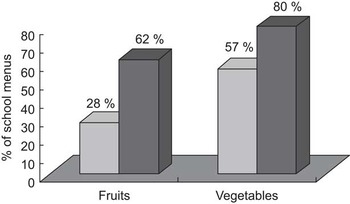
At school level, the PNAE, in combination with other programmes such as the Food Acquisition Program (PAA), has progressively improved the availability and consumption of fruits and vegetables. According to a survey conducted by PNAE in 2950 municipalities, in 2004, 28 % of school menus offered fruits and 57 % offered vegetables. By 2006 these values had risen to 62 % and 80 % respectively, as shown in Fig. 2(Reference Campbell18).
Provision of fruits and vegetables by the Brazilian School Feeding Program (PNAE) in 2004 ( $$$$) and 2006 (
 $$$$)(Reference Campbell18)
The PAA was established in 2003 to promote purchases of food products directly from family farmers. An evaluation of the PAA conducted in 2006 in the South and Northeast regions indicated that schools receiving food from PAA declared the programme had increased food quality and availability. The PAA has other benefits, such as lower cost of school meals, the elimination of intermediaries and the stimulation of the local economy(Reference Curralero and Santana19). It also contributes to an increase in the purchase of regional foods, especially fruits and vegetables, in schools and social institutions(Reference Sparowek20).
As per the preliminary findings of the baseline survey conducted in 2010 by the FNDE (ongoing research), the quality of menus has continued to improve in recent years, even if it still falls short of the recommendations. For instance, on average, in 2010 school meals provided 135 g of fruits and vegetables per week and 90 % of school menus offered vegetables (compared with 80 % in 2006). Menus included 1·5 g of added salt per week (the recommendation is a maximum of 1 g).Footnote * Considering that it was the first year of implementation of the new legislation, the government's expectation is that the quality of school meals will continue to move towards the recommendations established in FNDE Resolution no. 38/2009.
Municipal governments, particularly in metropolitan areas, face challenges when purchasing from family farmers. These are related to the farmers’ supply capacity and the difficulties encountered by small producers in dealing with technical procedures and delivery arrangements, budget and purchasing processes. Issues with meal preparation (time spent, ability to prepare fresh food), political resistance of former suppliers and economic interests linked to agri-business and the food industry are additional challenges to the inclusion of fresh products from family farmers in the school menus(Reference Burlandy, Rocha and Maluf11).
School feeding, along with other interventions, has contributed to important improvements in education, nutrition and food security in Brazil in the last 10 years. They build on past achievements and consequent programme adjustments to accomplish these goals.
As indicated before, the percentage of households living in food insecurity fell sizeably to reach 30·5 % in 2009. Although still a problem in some specific regions and for some specific groups such as indigenous people and quilombolas, the prevalence of child stunting in the poorest region of the country was also significantly reduced. In the Northeast, child stunting prevalence fell by one-third between 1986 and 1996 (from 33·9 % to 22·2 %) and by almost three-quarters between 1996 and 2006 (from 22·2 % to 5·9 %).
Conclusions
The example of the Brazilian school feeding programme shows that it is possible to link food production, school meals and nutrition education through comprehensive programmes and policies. It also shows that improving access to healthier foods, like fruits and vegetables, and respecting regional cultures, food habits and the specific nutritional requirements of the population can be treated successfully as integrated objectives. At the same time, of course, important challenges remain and must yet be addressed.
The paper explains the role of the comprehensive food and nutrition security approach to promote intersectorality in the food security system in Brazil. The approach has supported the articulation of actions to guarantee access to healthy food, especially in schools, and those to strengthen family farming. Strong government leadership, the intersectoral decision-making process and political pressure of civil society organizations were key factors in this process. Governments play an important leadership and support role in realizing these objectives, in particular through the elaboration of legislation and norms. The example of Brazil also shows that governments can play an important role in shaping procurement practices and supporting local agriculture due to the volume of the institutional purchases.
The results and innovative approaches of the Brazilian school feeding programme, as well as its policy and operational challenges, make it an interesting example from which other countries can draw lessons to develop and strengthen their own school food programmes. The institutional approach can also be an inspiration for developed countries which could benefit from strengthening the link between food provision at school, the development of healthy diets and local food production.
At the moment, however, there is little evidence available on the specific impacts of school feeding on schoolchildren's diets, nutrition and educational achievement, and on family farmers’ food security and income. Specific challenges in measuring results are related to one of the major strengths of the programme: its integrated and multisectoral approach.
Acknowledgements
Sources of funding: This research received no specific grant from any funding agency in the public, commercial or not-for-profit sector. Ethics: Ethical approval was not required. Conflicts of interest: D.B. is the former President of the FNDE and, since 2011, the Director of the WFP Centre of Excellence against Hunger. Authors’ contribution: E.S. wrote the paragraphs on nutritional standards and regulations and on overall costs in the ‘School food policy, standards and implementation in Brazil’ section and the ‘Monitoring, oversight and evaluation’ section. She edited the paper and wrote the abstract, introduction and conclusions with inputs from other authors. L.B. conducted the policy analysis and wrote the ‘School food policy, standards and implementation in Brazil’ section. In the ‘Impact of policy’ section, she contributed with the results of PAA, challenges and impacts on food security and nutritional status of children. D.B. provided overall guidance and contributed with the sections on implementation – nutritionists, decentralized implementation and costs at decentralized levels, role of CAE. In the section ‘Impact of policy’, he provided the information on the changes in menu composition over time and provided the related graph (Fig. 2). Each author has seen and approved the contents of the submitted manuscript. Acknowledgements: The authors would like to thank PNAE, and in particular Albaneide Peixinho, for the information and materials that contributed to a large extent to this paper. The authors also express their gratitude to Christiani Buani for her support in collecting data and information and for her input.



