DISCUSSION POINTS
• Our first guiding principle for nurturing research is as follows: focus on people, not on projects. A focus on projects mis-controls research by trying to eliminate the uncertainty inherent in exploring the unknown.
• Our second guiding principle for nurturing research is as follows: culturally insulate research from development, but not science from technology. Research requires a different organizational culture from development, and must therefore be culturally insulated (protected) from it; but an insulation of science from technology is a mis-protection that eliminates powerful symbioses between scientific and technological research, representing a major missed opportunity.
Introduction
It is self-evident that science and technology (S&T) have been key to humanity’s past and present, and that the research that advances S&T will be key to humanity’s future. It is also clear that a key area of S&T is energy: energy is a fundamental input to human productivity and welfare, thus energy research is critical to advances in human productivity and welfare.Reference Smalley1 Moreover, because of its current dependency on fossil-fuel-based technologies, energy has the potential for global-scale negative externalities to the environment such as climate change, and energy research is also critical to advancing technologies that might moderate those externalities.Reference Smil2
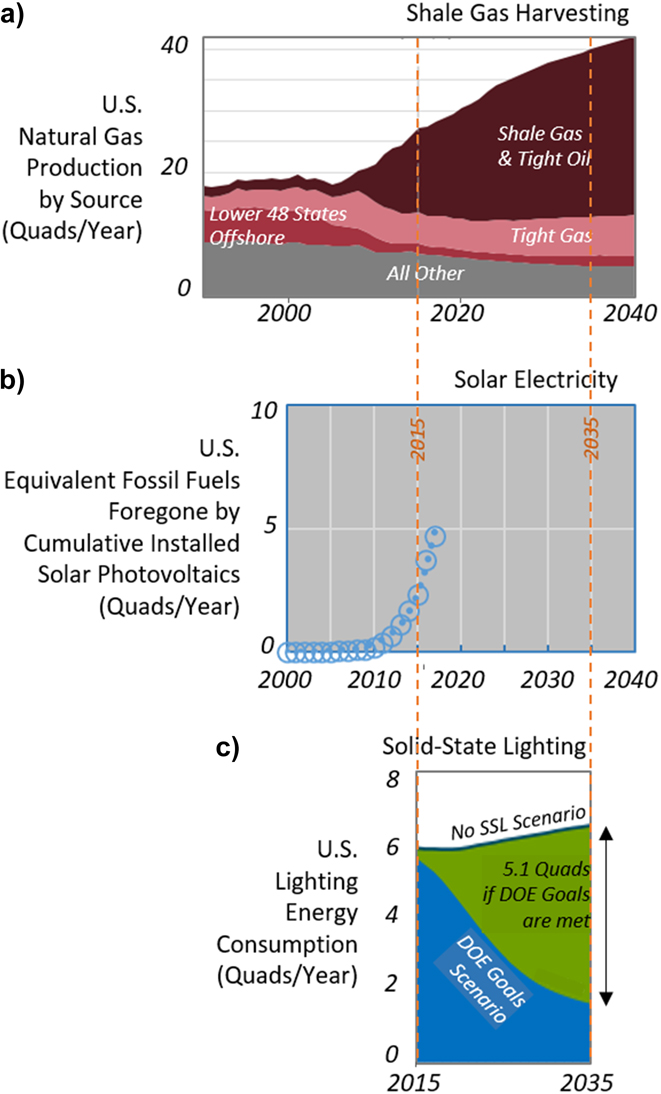
At a superficial level, all seems well. The pace of advance in energy S&T appears healthy. As illustrated in Fig. 1, shale gas harvesting,Reference Moniz, Jacoby, Meggs, Armstrong, Cohn, Connors, Deutch, Ejaz, Hezir and Kaufman3 solar electricity,Reference Polman, Knight, Garnett, Ehrler and Sinke4 and solid-state lighting (SSL)Reference Tsao, Crawford, Coltrin, Fischer, Koleske, Subramania, Wang, Wierer and Karlicek5 are three recent energy technologies for which S&T advances have already had, or will likely soon have, significant economic impact.
Figure 1.U.S. energy impact of three energy technologies. (a) Shale gas harvesting is responsible for a sharp increase in shale gas and tight oil plays, which as a percentage of U.S. natural gas production had risen to about 50% in 2015 and is projected to rise further to 69% by 2040. Adapted from the U.S. Energy Information Administration (EIA) Annual Energy Outlook 2016 (AEO2016) using a conversion factor of 1 Quad per trillion cubic feet of gas. (b) Solar electricity is responsible for a sharp recent increase in U.S. cumulative installed photovoltaic capacity to ∼53 GW, or ∼5.3 Quads/year of equivalent primary fossil-fuel power, in 2016. Data from The Solar Energy Industries Association (SEIA) “Solar Market Insight Report 2017 Year in Review,” using a conversion factor of 1 Quad/year (of equivalent primary fossil-fuel power) per ∼11 GW (of delivered electrical power). (c) SSL is responsible for a major projected decrease in U.S. energy consumption required for lighting. With a market penetration of 6% in 2015, energy savings were estimated to be 0.3 Quads; with a projected market penetration of 86% in 2035, energy savings are projected to be 5.1 Quads. Adapted from the U.S. DOE “Energy Savings Forecast of Solid-State Lighting in General Illumination Applications” (September 2016), and assuming a fossil-fuel-to-delivered-electricity energy-conversion efficiency of ∼1/3.
But energy innovation is a complex process, occurring over time and fractallyReference Narayanamurti, Anadon and Sagar6 at many levels in the chain from harvesting energy from the environment to delivering power to the consumer. Economic impact that is being manifested now is based on foundational energy research done decades ago.Reference Augustine and Lane7 This is certainly the case for the three examples just mentioned. For shale gas harvesting, whose major impact began to be felt in 2010, key earlier breakthroughs were directional drilling (1976), massive hydraulic fracturing in shale (1977), and three-dimensional microseismic imaging (1983)Reference Trembath, Nordhaus, Shellenberger and Jenkins8; and the scientific understanding of gas shale geophysics and mechanical properties (1970s and 1980s).Reference Monk, Close, Perez and Goodway9 For SSL, whose impact began to be felt in 2015 but whose most significant impact is yet to be felt, key earlier breakthroughs wereReference Patel and Tsao10,Reference Tsao, Han, Haitz and Pattison11 coherent visible light emission from semiconductors in 1962Reference Holonyak and Bevacqua12; InGaN semiconductor materials synthesis advances in the 1985–1995 time frameReference Amano, Sawaki, Akasaki and Toyoda13,Reference Amano, Kito, Hiramatsu and Akasaki14 ; and the candela-class (having a luminous intensity easily visible to the human eye) blue light-emitting diode (LED) in 1994.Reference Nakamura, Mukai and Senoh15 For solar photovoltaics, whose most significant impact is yet to be felt, key earlier breakthroughs were the silicon shallow-p–n-junction solar cell in 1954Reference Perlin16; and the many research advances associated with silicon semiconductor materials throughout the ensuing decades.Reference Green17 In other words, the current impact of research done decades ago is not a measure of the health of current research.
At a deeper level, indeed, we believe energy research, particularly that in the United States, is not well, and that this unwellness has at least three causes.
A first cause of the unwellness of U.S. energy research is underinvestment by the private sector.18 The underlying causes for this underinvestment are beyond the scope of this Commentary, but include the following. First, just as for all research, not just for energy research, the return on research is often shared, foundational knowledge that is difficult to appropriate, and thus uneconomical to invest in, by the private sector.Reference Stephan19,20 Second, energy companies find it especially difficult to translate energy research into profit due to the severe regulatory environment in which they operate, the commoditization of energy and hence absence of niche markets that can sustain emerging technologies, and the significant scale and long life of the hardware and infrastructure needed to demonstrate cost competitiveness. Third, for U.S. companies involved at the component level of emerging energy technologies, unfavorable manufacturing economics in the United States makes research on those technologies in the United States less economical.
A second cause of the unwellness of U.S. energy research is inconsistent investment by the public sector,Reference Chan, Goldstein, Bin-Nun, Anadon Diaz and Narayanamurti21 a cause of significant budget fluctuations (both operating and infrastructure), which is anathema to long-term research. The causes for this inconsistency are also beyond the scope of this Commentary, but include the following. First, fluctuating awareness of the importance of energy research, currently at a low ebb owing to the abundance of U.S. energy (an abundance brought about in part due to previous public-sector investments in fracking researchReference Anadon, Bunn and Narayanamurti22). Second, fluctuating philosophical and political views of the role of public-sector investment in energy research at all, exacerbated by the conflation of energy research with politically controversial climate-change-mitigation research. Third, tax and regulatory policy (e.g., solar electricity tax credits or fuel emission standards) is sometimes considered a substitute for research in advancing new technologies, when instead it often locks-in inferior current technologies.Reference Kelly23
A third cause of the unwellness of U.S. energy research is the one that we raise in this Commentary for debate and discussion within our own energy research community: a self-inflicted mis-control and mis-protection of energy research supported by the public sector. We use these terms purposefully to indicate behaviors that originate in well-intentioned human tendencies to control and protect, but that end up severely weakening that which was intended to be controlled and protected. In the remainder of this Commentary, we outline the origin of the mis-control and mis-protection, and propose two foundational guiding principles to mitigate them and instead nurture research. Our hope is to introduce these principles into the discourse now so that they can help guide U.S. energy R&D policy changes that are currently being driven by powerful geopolitical winds. Our hope is also to introduce the word “nurture” into the discourse. Research is motivated by deep human desires to discover, invent, explore, and learn, but is also fragile and by no means automatic.Reference Narayanamurti and Odumosu24 Cultures in which failure is overly feared even as success is prized do not easily grant the “freedom to fail and the patience to succeed.”25 Research must be nurtured, not simply managed.
Focus on people, not projects
Our first guiding principle stems from the need to counter a basic human tendency: to control. That tendency, especially in the context of research, is easy to appreciate. Research is the origin of uncertainty in science and technology. It is, in our view,Reference Narayanamurti and Odumosu24 the quest for paradigm-changing novelty and surprise: to discover what we do not yet understand, or to invent new ways of doing what we cannot yet do. In this there is great reward, as history has shown. But research progress, by its very nature, is impossible to schedule in advance; it is uncertain and therefore risky. It is a natural human tendency to reduce that risk by controlling research in some fashion.
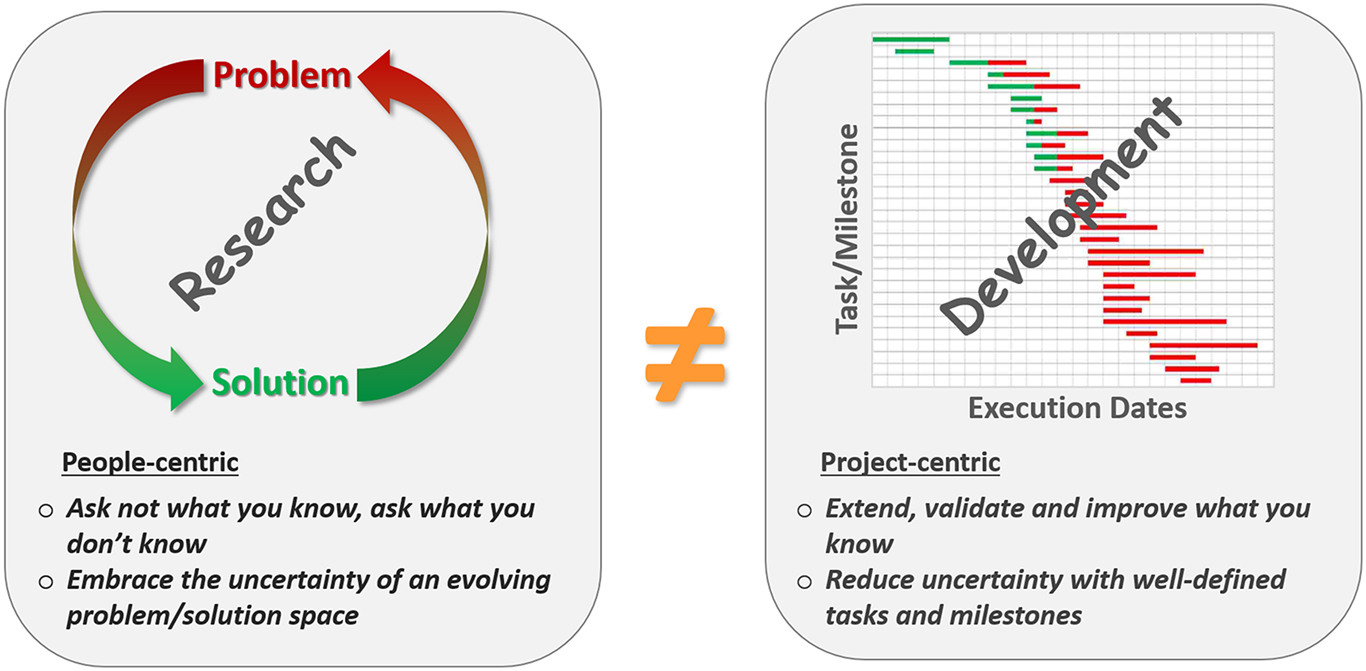
The most common way to control research is to borrow tools from development. Development, as illustrated on the right side of Fig. 2, is, in our view,Reference Narayanamurti and Odumosu24 the pursuit of specific goals and milestones: the validation and extension of what we already understand, or the improvement and particularization of what we can already do; and in this there is also great reward, as history has shown. The key tool for control of development is the project and all of its associated machinery: the proposal; the approach; the human resources and other capabilities to be brought to bear; the cost; the schedulable milestones and key results; and the final metric of success, the objective.
Figure 2.Research, the co-evolution of problems and solutions that emphasizes the less known and less predictable, must not be confused with development, the execution of tasks/milestones that emphasizes the better known and more predictable.
What better way to control research than to borrow this powerful tool and its methodological variants? In the proposal stage of the project, ask for clearly defined goals, milestones, approaches, personnel, and capabilities that will enable those approaches. In the execution stage of the project, monitor progress toward milestones, perhaps even shut the project down if milestones are not being met. After the project is over, measure success by whether the goals were met. In other words, give the researcher as little flexibility as possible to change direction.
The problem with this is obvious: if the project is that clearly defined, it is not research, it is development. Research and development are not the same, and controlling research to reduce its uncertainty instead turns it into development with its greater certainty. As illustrated on the left side of Fig. 2, uncertainty is inherent to research. There is uncertainty in the solution space: in classic “problem solving”Reference Newell and Simon26 the problem is known but the solution is not, and the more difficult the problem the greater the uncertainty around the solution or whether there even is a solution. There is also uncertainty in the problem space: discovery of a new problem that can be solved by known approaches is just as important as discovery of a new approach to a known problem.Reference Getzels27
Indeed, the opportunistic co-evolution of problems and solutions is the successful strategy of complex systems adapting to unknown environments. The system of human knowledge is no exception. It is the strategy of productive researchers exploring the frontiers of knowledge. It is the strategy of successful technology companies, underscored by the Bell Labs mantra “You don’t invent the transistor by continuing to improve the vacuum tube.”28 Success is made vastly more likely if problems and solutions are not fixed in advance, but treated as a co-evolving adaptive system in which emergence and emergent phenomena are the rule not the exception.
Such problem-solution co-evolution is important and universal to all research, and energy research, with its diverse and inhomogeneous intellectual space, is no exception. Fracking and its impact on the harvesting of shale gas was unexpected and could not have been top-down directed or project planned. Likewise, the advent of semiconductors as materials for energy (not just information) technologies was unexpected and could not have been top-down directed or project planned. The research underlying the energy technologies illustrated in Fig. 1 were unexpected outcomes of researchers who had the freedom to explore and bring together broad areas of science and technology, and who had the flexibility to co-evolve their goals and approaches along the way.
Thus, the seemingly most fundamental unit of research, the research project, is in fact less fundamental, and control of research via that unit inevitably becomes mis-control of research. Instead, the unit of research that is more fundamental is the researcher. It is the researcher who is the stable entity through the complex co-evolution of problems and solutions; it is the researcher who succeeds or fails. Thus, our first guiding principle of research: focus on people, not projects. This is not to say that projects are unimportant, but it is to say that, in research, they must be flexible and must cede primacy to people.Reference Bown29,Reference Nelson and Nelson30
Now, exactly what “focus on people” entails is complex, requires enormous human judgment, and is beyond the scope of this Commentary. However, one corollary principle seems clear: all the usual aspects of human resource management (recruiting, hiring, nurturing, supporting, stable (and long-term) funding, coaching, leading, evaluating, rewarding, promoting, arranging to move on if necessary) are critical. Research is not for everyone: it is demanding, risky, intense, uncomfortable, competitive, cooperative; requires rare combinations of intellectual humility and hubris, creative and critical thinking, rigor and flexibility, knowledge of existing paradigms and adaptability to new paradigms; and perhaps most of all requires an obsession with what one does not know, along with a deep appreciation for what one does know.
In other words, a focus on people, not projects, does not mean a free lunch. There must be high standards of excellence based on deep and deserved intellectual impact and reputation of researchers, over the longest possible time frames and over the broadest possible problem/solution spaces. Of course, this is more easily said than done. It requires butting up against the constraints of the organization’s mission and scale: small organizations cannot support time frames as long nor problem/solution spaces as broad as can large organizations. It requires human judgment, as inexact and error-prone as that might be, and hence requires, at all levels in the organization, an appreciation for intellectual excellence and creativity.
Indeed, we are well aware of how difficult and painful the judging of researchers can be in practice, and the extremes to which management at all levels can go to avoid it, including use of the following three strategies: (i) Asking researchers to set specific technical goals, then measuring them against achievement of those goals—a “projectizing/milestoning” performance-review strategy that enables managers to hide underperformers behind achievement of easily achievable goals; (ii) Judging researchers by peer review, a “consensus and immediate-customer” performance-review strategy that enables managers to hide behind the judgment of often-status-quo-defending peers; and (iii) Simply lowering standards so that all researchers are indiscriminately judged “excellent.”
Nonetheless, as difficult and painful as the judging of researchers can be, clearly there is evidence from some institutions that it can be successfully done at least for some duration of time: Bell Laboratories31,Reference Gertner32 and Janelia Farms are two examples,33,Reference Rubin34 but there are many others.Reference Narayanamurti and Odumosu24
Insulate research from development, but not science from technology
Our second guiding principle stems from the need to counter another basic human tendency: to protect. This tendency, especially in the context of research, is also easy to appreciate. As discussed above: research is uncertain; it is natural to reduce that uncertainty by turning research into development-like projects; but doing so destroys research. Research thus must be protected, and one important way is to focus on people, not projects—our first guiding principle. This is necessary, we believe, but insufficient: a focus on people is no guarantee that fruitful research will be performed. People must also be placed in a research culture that emphasizes the less known and less predictable, rather than in a development culture that emphasizes the better known and more predictable. And, because these two cultures are so different and so determinative of what people will do, research and development must be culturally and organizationally insulated (though not, as discussed elsewhere,Reference Narayanamurti and Odumosu24 intellectually isolated) from each other. However, largely because of a semantic misunderstanding that began decades ago, a very different and counter-productive kind of cultural insulation often takes place.
What is this semantic misunderstanding? It is a conflation of research with science and of development with technology—a conflation that is also easy to understand. The most singular advance of World War II was the atomic bomb, a technological development whose origin lay in special relativity, a scientific research discovery. In this hugely important (but by no means only) case, the research was of a scientific nature and the subsequent development was of a technological nature, so research was easy to conflate with science and development was easy to conflate with technology—as codified and popularized by Vannevar Bush in the 1950’s in “Science, the Endless Frontier.”Reference Narayanamurti and Odumosu24
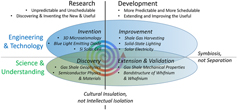
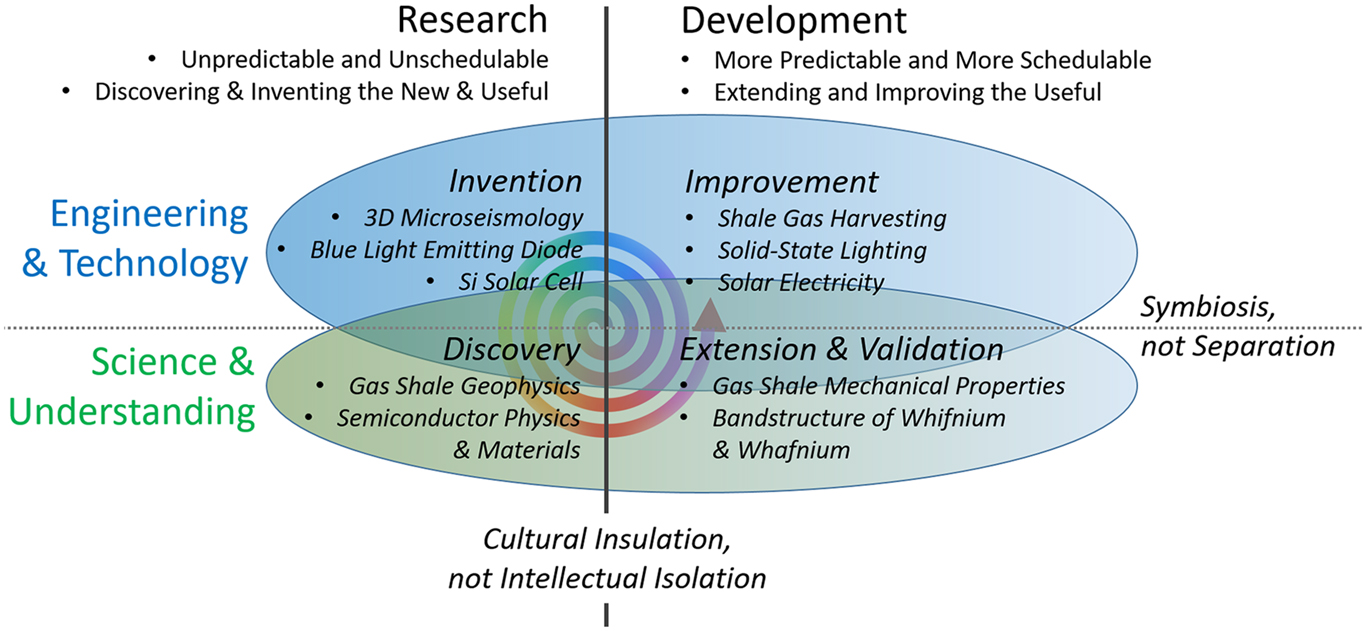
This conflation is seriously incorrect. Both scienceReference Kuhn35 and technologyReference Dosi36 advance through paradigm creation (research) and extension (development). Both research and development cut across both science and technology,Reference Tsao, Boyack, Coltrin, Turnley and Gauster37,Reference Narayanamurti, Odumosu and Vinsel38 forming a matrix like that illustrated in Fig. 3. On the one hand, research is not just science: it is paradigm creation whose outcomes cannot be scheduled or predicted in advance, a definition that cuts across science and technology. The technological invention of the blue LED was just as much “research” as was the scientific discovery of band structure theory (essential to explaining the optoelectronic and electronic properties of semiconductor materials). On the other hand, development is not just technology: it is paradigm extension, a definition that also cuts across science and technology. The increasingly accurate scientific elaboration of the bandstructure of various semiconductor materials (figuratively referred to as Whifnium and Whafnium in Fig. 3)Reference Goudsmit39 is just as much “development” as is the ongoing technological improvement of the blue LED for SSL.
Figure 3.Research and development apply to both science and technology, with the following approximate identifications: successful scientific research with “discovery,” successful technological research with “invention”; successful scientific development with “extension/validation,” and successful technological development with “improvement.” As symbolized by the spiral at the center of the figure, there are powerful feedback loops that produce cycles of invention and discovery, and of improvement and extension/validation, that ultimately produce emergent knowledge that could not have been created by any of the knowledge-production categories individually. Also indicated in the four knowledge-production categories are examples of discovery, invention, extension/validation, and improvement from shale gas harvesting, SSL, and solar electricity. The generic elements “Whifnium” and “Whafnium” are intended to convey that paradigms created (by research) for one set of elements are being applied without major change (by development) to other similar elements.
Nonetheless, conflated they have been, and the result has been that cultural insulation of research from development has almost always come to mean insulation of science from technology. This insulation of science from technology mis-protects research in two different ways.
First, research with science and technology flavors are highly symbiotic,Reference Arthur40 and separating them from each other cripples both. Examples abound of virtuous cycles in which they fed each other and accelerated progress in both: one hugely important example is the nearly simultaneous scientific discovery of the transistor effect and the technological invention of the transistor itself. Moreover, when research with science and technology flavors interact closely, they each cross-check the other and reduce errors in both.Reference Sarewitz41 Science and technology evolve interactively, indeed their interactive co-evolution is at least as important as their independent evolution, as is clear from the experience of the iconic Bell Laboratories.Reference Rubin34 Technological research grounds scientific research in the real world and in real problemsReference Whitesides and Deutch42 and is a key conduit through which nature surprises and forces us to be creative.Reference Narayanamurti43
Second, it provides a false sense that research has been protected from development, when nothing could be further from the truth. Whether segregated from each other or not, science and technology still exist on a continuum of research to development, of paradigm creation to paradigm extension. As discussed above, the overwhelming human bias is away from uncertainty, hence away from research and paradigm creation. Science of a development flavor is just as prone to crowd out science of a research flavor, as technology of a development flavor is to crowd out technology of a research flavor.
Thus, our second guiding principle of research: culturally insulate research from development, but not science from technology. Research and development must be culturally insulated from each other because they are culturally so dissimilar—research emphasizing the less known and less predictable, and development emphasizing the better known and more predictable. But they must not be intellectually isolated from each other—research must be exposed to a rich problem space, and development must be exposed to the forefront of discovery and invention. Moreover, science and technology must be neither culturally insulated nor intellectually isolated from each other; otherwise advantage will not be taken of the productive and deep symbiosis between them.
Note that in calling for this cultural insulation of research from development, we do not mean to suggest that development is in any way inferior or less important than research. We reject the elitism and snobbery that holds that either research or development is above the other in importance, status, difficulty, or even impact. Indeed, developmental advances accumulate and when they cross various thresholds often trigger explosive advances in interdependent areas of science and technology—a type of nonlinear, emergent system behavior. But we do mean to suggest that research is not the same as development and requires a different mindset and organizational culture if it is to thrive.
Implications for the U.S. department of energy
We began our Commentary by emphasizing that research is delicate. Because research is inherently uncertain, we try to control it and in doing so often mis-control it. Because we recognize this tendency toward mis-control, we try to protect it and in doing so often mis-protect it. We have proposed instead two foundational guiding principles for research. First, focus on people, not projects: researchers (not research projects) are the one constant in uncertain and co-evolving problem-solution spaces. Second, culturally insulate research from development, but not science from technology: research success requires a different organizational culture than development success; while both science and technology benefit powerfully from cross-fertilization.
These guiding principles of course apply broadly to all research. But they also apply particularly to the focus of this article: energy research, energy research in the United States, and especially energy research supported by the U.S. Department of Energy (DOE), the largest investor in energy R&D in the United States. Here, we articulate three implications of these guiding principles on such research, with the understanding that much stakeholder discussion must take place en route to implementation. Also, we emphasize that our focus is on energy research, not on other important piecesReference Anadon, Chan, Bin-Nun and Narayanamurti44 to the energy innovation puzzle.
The first implication for the U.S. DOE is a need to reorganize around research and development, not around science and technology.45 Until the recent creation of ARPA-E (Advanced Research Projects Agency-Energy) and the Energy Innovation Hubs (EIHs), the DOE had balkanized research into organizationally and programmatically separate science and technology offices. Research, particularly energy research, must be more integrative. From this perspective, some proposed DOE budgets are in exactly the wrong direction—eliminating not only one of the new organizations that does not balkanize science from technology (ARPA-E), but eliminating much engineering research (Office of Energy Efficiency and Renewable Energy) and the integrated EIHs almost entirely. This would be a huge missed opportunity to instead fix more constructively the current self-inflicted separation of science and technology that harms both.Reference Bozeman and Boardman46
The second implication is to experiment with research funding mechanisms, particularly the funding of people, not projects. There is much we do not yet know about ideal research environments and organizing principles. Experimentation is needed, and new mechanisms, such as ARPA-E, EIHs, and EFRCs (Energy Frontier Research Centers), should be viewed as opportunities to learn. Some areas of research may benefit from bottom-up, single-or-few-investigator efforts; other areas from larger top-down and coordinated efforts.Reference Andrews and Narayanamurti47 Some areas of research may benefit from strong peer review; other areas may benefit from savvy and empowered technical program management (e.g., ARPA-E). Big teams and big research are not always the way: many big problems will be solved not by big solutions but by unleashing diverse and inhomogeneous activities that can more nimbly cut across disciplines. Finally, we mention here the potential importance of experimenting with one mechanism: long-term (5–10-year) fellowships for researchers at all career stages along the lines of the Howard Hughes Medical Institute Investigators, which would give researchers the freedom to explore widely with a long leash, answerable to technically savvy managers and funders.
The third implication is to define energy research areas broadly. We cannot predict what advances in what areas might serendipitously enable breakthroughs in energy technology.Reference Schwarz48,Reference Stanley and Lehman49 Artificial intelligence is a good example: it may soon revolutionize our ability to personalize and trade electricity use and thereby smooth supply/demand fluctuations across space and time,Reference Tsao, Schubert, Fouquet and Lave50,Reference Ramchurn, Vytelingum, Rogers and Jennings51 but it would certainly not have been considered mainstream energy research. A corollary to this is not to define research success as impact just on one pre-prescribed narrow area of energy research: advances in one area of energy research that make an impact on another area of energy research should be rewarded.
Finally, we note that these implications apply across all the various mechanisms via which DOE supports energy research, including its researchers at the DOE National Laboratories. These have not been immune from the mis-control and mis-protection of U.S. energy research discussed at the beginning of this article.





 Open access


DISCUSSION POINTS
• Our first guiding principle for nurturing research is as follows: focus on people, not on projects. A focus on projects mis-controls research by trying to eliminate the uncertainty inherent in exploring the unknown.
• Our second guiding principle for nurturing research is as follows: culturally insulate research from development, but not science from technology. Research requires a different organizational culture from development, and must therefore be culturally insulated (protected) from it; but an insulation of science from technology is a mis-protection that eliminates powerful symbioses between scientific and technological research, representing a major missed opportunity.
Introduction
It is self-evident that science and technology (S&T) have been key to humanity’s past and present, and that the research that advances S&T will be key to humanity’s future. It is also clear that a key area of S&T is energy: energy is a fundamental input to human productivity and welfare, thus energy research is critical to advances in human productivity and welfare.Reference Smalley1 Moreover, because of its current dependency on fossil-fuel-based technologies, energy has the potential for global-scale negative externalities to the environment such as climate change, and energy research is also critical to advancing technologies that might moderate those externalities.Reference Smil2
At a superficial level, all seems well. The pace of advance in energy S&T appears healthy. As illustrated in Fig. 1, shale gas harvesting,Reference Moniz, Jacoby, Meggs, Armstrong, Cohn, Connors, Deutch, Ejaz, Hezir and Kaufman3 solar electricity,Reference Polman, Knight, Garnett, Ehrler and Sinke4 and solid-state lighting (SSL)Reference Tsao, Crawford, Coltrin, Fischer, Koleske, Subramania, Wang, Wierer and Karlicek5 are three recent energy technologies for which S&T advances have already had, or will likely soon have, significant economic impact.
U.S. energy impact of three energy technologies. (a) Shale gas harvesting is responsible for a sharp increase in shale gas and tight oil plays, which as a percentage of U.S. natural gas production had risen to about 50% in 2015 and is projected to rise further to 69% by 2040. Adapted from the U.S. Energy Information Administration (EIA) Annual Energy Outlook 2016 (AEO2016) using a conversion factor of 1 Quad per trillion cubic feet of gas. (b) Solar electricity is responsible for a sharp recent increase in U.S. cumulative installed photovoltaic capacity to ∼53 GW, or ∼5.3 Quads/year of equivalent primary fossil-fuel power, in 2016. Data from The Solar Energy Industries Association (SEIA) “Solar Market Insight Report 2017 Year in Review,” using a conversion factor of 1 Quad/year (of equivalent primary fossil-fuel power) per ∼11 GW (of delivered electrical power). (c) SSL is responsible for a major projected decrease in U.S. energy consumption required for lighting. With a market penetration of 6% in 2015, energy savings were estimated to be 0.3 Quads; with a projected market penetration of 86% in 2035, energy savings are projected to be 5.1 Quads. Adapted from the U.S. DOE “Energy Savings Forecast of Solid-State Lighting in General Illumination Applications” (September 2016), and assuming a fossil-fuel-to-delivered-electricity energy-conversion efficiency of ∼1/3.
But energy innovation is a complex process, occurring over time and fractallyReference Narayanamurti, Anadon and Sagar6 at many levels in the chain from harvesting energy from the environment to delivering power to the consumer. Economic impact that is being manifested now is based on foundational energy research done decades ago.Reference Augustine and Lane7 This is certainly the case for the three examples just mentioned. For shale gas harvesting, whose major impact began to be felt in 2010, key earlier breakthroughs were directional drilling (1976), massive hydraulic fracturing in shale (1977), and three-dimensional microseismic imaging (1983)Reference Trembath, Nordhaus, Shellenberger and Jenkins8; and the scientific understanding of gas shale geophysics and mechanical properties (1970s and 1980s).Reference Monk, Close, Perez and Goodway9 For SSL, whose impact began to be felt in 2015 but whose most significant impact is yet to be felt, key earlier breakthroughs wereReference Patel and Tsao10,Reference Tsao, Han, Haitz and Pattison11 coherent visible light emission from semiconductors in 1962Reference Holonyak and Bevacqua12; InGaN semiconductor materials synthesis advances in the 1985–1995 time frameReference Amano, Sawaki, Akasaki and Toyoda13,Reference Amano, Kito, Hiramatsu and Akasaki14 ; and the candela-class (having a luminous intensity easily visible to the human eye) blue light-emitting diode (LED) in 1994.Reference Nakamura, Mukai and Senoh15 For solar photovoltaics, whose most significant impact is yet to be felt, key earlier breakthroughs were the silicon shallow-p–n-junction solar cell in 1954Reference Perlin16; and the many research advances associated with silicon semiconductor materials throughout the ensuing decades.Reference Green17 In other words, the current impact of research done decades ago is not a measure of the health of current research.
At a deeper level, indeed, we believe energy research, particularly that in the United States, is not well, and that this unwellness has at least three causes.
A first cause of the unwellness of U.S. energy research is underinvestment by the private sector.18 The underlying causes for this underinvestment are beyond the scope of this Commentary, but include the following. First, just as for all research, not just for energy research, the return on research is often shared, foundational knowledge that is difficult to appropriate, and thus uneconomical to invest in, by the private sector.Reference Stephan19,20 Second, energy companies find it especially difficult to translate energy research into profit due to the severe regulatory environment in which they operate, the commoditization of energy and hence absence of niche markets that can sustain emerging technologies, and the significant scale and long life of the hardware and infrastructure needed to demonstrate cost competitiveness. Third, for U.S. companies involved at the component level of emerging energy technologies, unfavorable manufacturing economics in the United States makes research on those technologies in the United States less economical.
A second cause of the unwellness of U.S. energy research is inconsistent investment by the public sector,Reference Chan, Goldstein, Bin-Nun, Anadon Diaz and Narayanamurti21 a cause of significant budget fluctuations (both operating and infrastructure), which is anathema to long-term research. The causes for this inconsistency are also beyond the scope of this Commentary, but include the following. First, fluctuating awareness of the importance of energy research, currently at a low ebb owing to the abundance of U.S. energy (an abundance brought about in part due to previous public-sector investments in fracking researchReference Anadon, Bunn and Narayanamurti22). Second, fluctuating philosophical and political views of the role of public-sector investment in energy research at all, exacerbated by the conflation of energy research with politically controversial climate-change-mitigation research. Third, tax and regulatory policy (e.g., solar electricity tax credits or fuel emission standards) is sometimes considered a substitute for research in advancing new technologies, when instead it often locks-in inferior current technologies.Reference Kelly23
A third cause of the unwellness of U.S. energy research is the one that we raise in this Commentary for debate and discussion within our own energy research community: a self-inflicted mis-control and mis-protection of energy research supported by the public sector. We use these terms purposefully to indicate behaviors that originate in well-intentioned human tendencies to control and protect, but that end up severely weakening that which was intended to be controlled and protected. In the remainder of this Commentary, we outline the origin of the mis-control and mis-protection, and propose two foundational guiding principles to mitigate them and instead nurture research. Our hope is to introduce these principles into the discourse now so that they can help guide U.S. energy R&D policy changes that are currently being driven by powerful geopolitical winds. Our hope is also to introduce the word “nurture” into the discourse. Research is motivated by deep human desires to discover, invent, explore, and learn, but is also fragile and by no means automatic.Reference Narayanamurti and Odumosu24 Cultures in which failure is overly feared even as success is prized do not easily grant the “freedom to fail and the patience to succeed.”25 Research must be nurtured, not simply managed.
Focus on people, not projects
Our first guiding principle stems from the need to counter a basic human tendency: to control. That tendency, especially in the context of research, is easy to appreciate. Research is the origin of uncertainty in science and technology. It is, in our view,Reference Narayanamurti and Odumosu24 the quest for paradigm-changing novelty and surprise: to discover what we do not yet understand, or to invent new ways of doing what we cannot yet do. In this there is great reward, as history has shown. But research progress, by its very nature, is impossible to schedule in advance; it is uncertain and therefore risky. It is a natural human tendency to reduce that risk by controlling research in some fashion.
The most common way to control research is to borrow tools from development. Development, as illustrated on the right side of Fig. 2, is, in our view,Reference Narayanamurti and Odumosu24 the pursuit of specific goals and milestones: the validation and extension of what we already understand, or the improvement and particularization of what we can already do; and in this there is also great reward, as history has shown. The key tool for control of development is the project and all of its associated machinery: the proposal; the approach; the human resources and other capabilities to be brought to bear; the cost; the schedulable milestones and key results; and the final metric of success, the objective.
Research, the co-evolution of problems and solutions that emphasizes the less known and less predictable, must not be confused with development, the execution of tasks/milestones that emphasizes the better known and more predictable.
What better way to control research than to borrow this powerful tool and its methodological variants? In the proposal stage of the project, ask for clearly defined goals, milestones, approaches, personnel, and capabilities that will enable those approaches. In the execution stage of the project, monitor progress toward milestones, perhaps even shut the project down if milestones are not being met. After the project is over, measure success by whether the goals were met. In other words, give the researcher as little flexibility as possible to change direction.
The problem with this is obvious: if the project is that clearly defined, it is not research, it is development. Research and development are not the same, and controlling research to reduce its uncertainty instead turns it into development with its greater certainty. As illustrated on the left side of Fig. 2, uncertainty is inherent to research. There is uncertainty in the solution space: in classic “problem solving”Reference Newell and Simon26 the problem is known but the solution is not, and the more difficult the problem the greater the uncertainty around the solution or whether there even is a solution. There is also uncertainty in the problem space: discovery of a new problem that can be solved by known approaches is just as important as discovery of a new approach to a known problem.Reference Getzels27
Indeed, the opportunistic co-evolution of problems and solutions is the successful strategy of complex systems adapting to unknown environments. The system of human knowledge is no exception. It is the strategy of productive researchers exploring the frontiers of knowledge. It is the strategy of successful technology companies, underscored by the Bell Labs mantra “You don’t invent the transistor by continuing to improve the vacuum tube.”28 Success is made vastly more likely if problems and solutions are not fixed in advance, but treated as a co-evolving adaptive system in which emergence and emergent phenomena are the rule not the exception.
Such problem-solution co-evolution is important and universal to all research, and energy research, with its diverse and inhomogeneous intellectual space, is no exception. Fracking and its impact on the harvesting of shale gas was unexpected and could not have been top-down directed or project planned. Likewise, the advent of semiconductors as materials for energy (not just information) technologies was unexpected and could not have been top-down directed or project planned. The research underlying the energy technologies illustrated in Fig. 1 were unexpected outcomes of researchers who had the freedom to explore and bring together broad areas of science and technology, and who had the flexibility to co-evolve their goals and approaches along the way.
Thus, the seemingly most fundamental unit of research, the research project, is in fact less fundamental, and control of research via that unit inevitably becomes mis-control of research. Instead, the unit of research that is more fundamental is the researcher. It is the researcher who is the stable entity through the complex co-evolution of problems and solutions; it is the researcher who succeeds or fails. Thus, our first guiding principle of research: focus on people, not projects. This is not to say that projects are unimportant, but it is to say that, in research, they must be flexible and must cede primacy to people.Reference Bown29,Reference Nelson and Nelson30
Now, exactly what “focus on people” entails is complex, requires enormous human judgment, and is beyond the scope of this Commentary. However, one corollary principle seems clear: all the usual aspects of human resource management (recruiting, hiring, nurturing, supporting, stable (and long-term) funding, coaching, leading, evaluating, rewarding, promoting, arranging to move on if necessary) are critical. Research is not for everyone: it is demanding, risky, intense, uncomfortable, competitive, cooperative; requires rare combinations of intellectual humility and hubris, creative and critical thinking, rigor and flexibility, knowledge of existing paradigms and adaptability to new paradigms; and perhaps most of all requires an obsession with what one does not know, along with a deep appreciation for what one does know.
In other words, a focus on people, not projects, does not mean a free lunch. There must be high standards of excellence based on deep and deserved intellectual impact and reputation of researchers, over the longest possible time frames and over the broadest possible problem/solution spaces. Of course, this is more easily said than done. It requires butting up against the constraints of the organization’s mission and scale: small organizations cannot support time frames as long nor problem/solution spaces as broad as can large organizations. It requires human judgment, as inexact and error-prone as that might be, and hence requires, at all levels in the organization, an appreciation for intellectual excellence and creativity.
Indeed, we are well aware of how difficult and painful the judging of researchers can be in practice, and the extremes to which management at all levels can go to avoid it, including use of the following three strategies: (i) Asking researchers to set specific technical goals, then measuring them against achievement of those goals—a “projectizing/milestoning” performance-review strategy that enables managers to hide underperformers behind achievement of easily achievable goals; (ii) Judging researchers by peer review, a “consensus and immediate-customer” performance-review strategy that enables managers to hide behind the judgment of often-status-quo-defending peers; and (iii) Simply lowering standards so that all researchers are indiscriminately judged “excellent.”
Nonetheless, as difficult and painful as the judging of researchers can be, clearly there is evidence from some institutions that it can be successfully done at least for some duration of time: Bell Laboratories31,Reference Gertner32 and Janelia Farms are two examples,33,Reference Rubin34 but there are many others.Reference Narayanamurti and Odumosu24
Insulate research from development, but not science from technology
Our second guiding principle stems from the need to counter another basic human tendency: to protect. This tendency, especially in the context of research, is also easy to appreciate. As discussed above: research is uncertain; it is natural to reduce that uncertainty by turning research into development-like projects; but doing so destroys research. Research thus must be protected, and one important way is to focus on people, not projects—our first guiding principle. This is necessary, we believe, but insufficient: a focus on people is no guarantee that fruitful research will be performed. People must also be placed in a research culture that emphasizes the less known and less predictable, rather than in a development culture that emphasizes the better known and more predictable. And, because these two cultures are so different and so determinative of what people will do, research and development must be culturally and organizationally insulated (though not, as discussed elsewhere,Reference Narayanamurti and Odumosu24 intellectually isolated) from each other. However, largely because of a semantic misunderstanding that began decades ago, a very different and counter-productive kind of cultural insulation often takes place.
What is this semantic misunderstanding? It is a conflation of research with science and of development with technology—a conflation that is also easy to understand. The most singular advance of World War II was the atomic bomb, a technological development whose origin lay in special relativity, a scientific research discovery. In this hugely important (but by no means only) case, the research was of a scientific nature and the subsequent development was of a technological nature, so research was easy to conflate with science and development was easy to conflate with technology—as codified and popularized by Vannevar Bush in the 1950’s in “Science, the Endless Frontier.”Reference Narayanamurti and Odumosu24
This conflation is seriously incorrect. Both scienceReference Kuhn35 and technologyReference Dosi36 advance through paradigm creation (research) and extension (development). Both research and development cut across both science and technology,Reference Tsao, Boyack, Coltrin, Turnley and Gauster37,Reference Narayanamurti, Odumosu and Vinsel38 forming a matrix like that illustrated in Fig. 3. On the one hand, research is not just science: it is paradigm creation whose outcomes cannot be scheduled or predicted in advance, a definition that cuts across science and technology. The technological invention of the blue LED was just as much “research” as was the scientific discovery of band structure theory (essential to explaining the optoelectronic and electronic properties of semiconductor materials). On the other hand, development is not just technology: it is paradigm extension, a definition that also cuts across science and technology. The increasingly accurate scientific elaboration of the bandstructure of various semiconductor materials (figuratively referred to as Whifnium and Whafnium in Fig. 3)Reference Goudsmit39 is just as much “development” as is the ongoing technological improvement of the blue LED for SSL.
Research and development apply to both science and technology, with the following approximate identifications: successful scientific research with “discovery,” successful technological research with “invention”; successful scientific development with “extension/validation,” and successful technological development with “improvement.” As symbolized by the spiral at the center of the figure, there are powerful feedback loops that produce cycles of invention and discovery, and of improvement and extension/validation, that ultimately produce emergent knowledge that could not have been created by any of the knowledge-production categories individually. Also indicated in the four knowledge-production categories are examples of discovery, invention, extension/validation, and improvement from shale gas harvesting, SSL, and solar electricity. The generic elements “Whifnium” and “Whafnium” are intended to convey that paradigms created (by research) for one set of elements are being applied without major change (by development) to other similar elements.
Nonetheless, conflated they have been, and the result has been that cultural insulation of research from development has almost always come to mean insulation of science from technology. This insulation of science from technology mis-protects research in two different ways.
First, research with science and technology flavors are highly symbiotic,Reference Arthur40 and separating them from each other cripples both. Examples abound of virtuous cycles in which they fed each other and accelerated progress in both: one hugely important example is the nearly simultaneous scientific discovery of the transistor effect and the technological invention of the transistor itself. Moreover, when research with science and technology flavors interact closely, they each cross-check the other and reduce errors in both.Reference Sarewitz41 Science and technology evolve interactively, indeed their interactive co-evolution is at least as important as their independent evolution, as is clear from the experience of the iconic Bell Laboratories.Reference Rubin34 Technological research grounds scientific research in the real world and in real problemsReference Whitesides and Deutch42 and is a key conduit through which nature surprises and forces us to be creative.Reference Narayanamurti43
Second, it provides a false sense that research has been protected from development, when nothing could be further from the truth. Whether segregated from each other or not, science and technology still exist on a continuum of research to development, of paradigm creation to paradigm extension. As discussed above, the overwhelming human bias is away from uncertainty, hence away from research and paradigm creation. Science of a development flavor is just as prone to crowd out science of a research flavor, as technology of a development flavor is to crowd out technology of a research flavor.
Thus, our second guiding principle of research: culturally insulate research from development, but not science from technology. Research and development must be culturally insulated from each other because they are culturally so dissimilar—research emphasizing the less known and less predictable, and development emphasizing the better known and more predictable. But they must not be intellectually isolated from each other—research must be exposed to a rich problem space, and development must be exposed to the forefront of discovery and invention. Moreover, science and technology must be neither culturally insulated nor intellectually isolated from each other; otherwise advantage will not be taken of the productive and deep symbiosis between them.
Note that in calling for this cultural insulation of research from development, we do not mean to suggest that development is in any way inferior or less important than research. We reject the elitism and snobbery that holds that either research or development is above the other in importance, status, difficulty, or even impact. Indeed, developmental advances accumulate and when they cross various thresholds often trigger explosive advances in interdependent areas of science and technology—a type of nonlinear, emergent system behavior. But we do mean to suggest that research is not the same as development and requires a different mindset and organizational culture if it is to thrive.
Implications for the U.S. department of energy
We began our Commentary by emphasizing that research is delicate. Because research is inherently uncertain, we try to control it and in doing so often mis-control it. Because we recognize this tendency toward mis-control, we try to protect it and in doing so often mis-protect it. We have proposed instead two foundational guiding principles for research. First, focus on people, not projects: researchers (not research projects) are the one constant in uncertain and co-evolving problem-solution spaces. Second, culturally insulate research from development, but not science from technology: research success requires a different organizational culture than development success; while both science and technology benefit powerfully from cross-fertilization.
These guiding principles of course apply broadly to all research. But they also apply particularly to the focus of this article: energy research, energy research in the United States, and especially energy research supported by the U.S. Department of Energy (DOE), the largest investor in energy R&D in the United States. Here, we articulate three implications of these guiding principles on such research, with the understanding that much stakeholder discussion must take place en route to implementation. Also, we emphasize that our focus is on energy research, not on other important piecesReference Anadon, Chan, Bin-Nun and Narayanamurti44 to the energy innovation puzzle.
The first implication for the U.S. DOE is a need to reorganize around research and development, not around science and technology.45 Until the recent creation of ARPA-E (Advanced Research Projects Agency-Energy) and the Energy Innovation Hubs (EIHs), the DOE had balkanized research into organizationally and programmatically separate science and technology offices. Research, particularly energy research, must be more integrative. From this perspective, some proposed DOE budgets are in exactly the wrong direction—eliminating not only one of the new organizations that does not balkanize science from technology (ARPA-E), but eliminating much engineering research (Office of Energy Efficiency and Renewable Energy) and the integrated EIHs almost entirely. This would be a huge missed opportunity to instead fix more constructively the current self-inflicted separation of science and technology that harms both.Reference Bozeman and Boardman46
The second implication is to experiment with research funding mechanisms, particularly the funding of people, not projects. There is much we do not yet know about ideal research environments and organizing principles. Experimentation is needed, and new mechanisms, such as ARPA-E, EIHs, and EFRCs (Energy Frontier Research Centers), should be viewed as opportunities to learn. Some areas of research may benefit from bottom-up, single-or-few-investigator efforts; other areas from larger top-down and coordinated efforts.Reference Andrews and Narayanamurti47 Some areas of research may benefit from strong peer review; other areas may benefit from savvy and empowered technical program management (e.g., ARPA-E). Big teams and big research are not always the way: many big problems will be solved not by big solutions but by unleashing diverse and inhomogeneous activities that can more nimbly cut across disciplines. Finally, we mention here the potential importance of experimenting with one mechanism: long-term (5–10-year) fellowships for researchers at all career stages along the lines of the Howard Hughes Medical Institute Investigators, which would give researchers the freedom to explore widely with a long leash, answerable to technically savvy managers and funders.
The third implication is to define energy research areas broadly. We cannot predict what advances in what areas might serendipitously enable breakthroughs in energy technology.Reference Schwarz48,Reference Stanley and Lehman49 Artificial intelligence is a good example: it may soon revolutionize our ability to personalize and trade electricity use and thereby smooth supply/demand fluctuations across space and time,Reference Tsao, Schubert, Fouquet and Lave50,Reference Ramchurn, Vytelingum, Rogers and Jennings51 but it would certainly not have been considered mainstream energy research. A corollary to this is not to define research success as impact just on one pre-prescribed narrow area of energy research: advances in one area of energy research that make an impact on another area of energy research should be rewarded.
Finally, we note that these implications apply across all the various mechanisms via which DOE supports energy research, including its researchers at the DOE National Laboratories. These have not been immune from the mis-control and mis-protection of U.S. energy research discussed at the beginning of this article.
Acknowledgments
One of us (JYT) would like to acknowledge support from the Harvard Kennedy School’s Belfer Center’s Science, Technology and Public Policy (STPP) program; the Harvard Paulson School of Engineering and Applied Sciences for the award of a non-stipendiary fellowship with travel support; and Sandia National Laboratories, a multimission laboratory managed and operated by National Technology & Engineering Solutions of Sandia, LLC, a wholly owned subsidiary of Honeywell International Inc., for the U.S. Department of Energy’s National Nuclear Security Administration under contract DE-NA0003525. This paper describes objective technical results and analysis. Any subjective views or opinions that might be expressed in the paper do not necessarily represent the views of the U.S. Department of Energy or the United States Government.