




Prolegomena
Gotama the Buddha lived and taught about 2,500 years ago. For centuries, his teachings were passed on orally until eventually they were written down on birchbark, palm leaf, and paper, fragile materials that are unable to withstand the wear and tear of the centuries. In general, the Buddhist manuscripts that survive today belong to several traditions from different centres of Buddhist activity across Asia: from Afghanistan to Sri Lanka and from India to China. In this article, our concern is the Pali tradition that was transmitted by the Theravāda communities of Sri Lanka and Southeast Asia. In this tradition, the bulk of the extant manuscripts were written down in the eighteenth and nineteenth centuries. Relatively speaking, the manuscripts or physical supports are young compared to the teachings they purport to record.
There is, however, one significant exception to this dearth of ancient written evidence for Pali – the Pali inscriptions of Southeast Asia. Texts indited on enduring materials like stone and metal from about the seventh to the ninth centuries survive in Thailand, Cambodia, and Burma. These epigraphs give a rare glimpse of the state of the language in this relatively early period.Footnote 1
Pali literature is vast, and the comprehensive collections of Gotama the Buddha’s teachings compiled in the “Pali Tipiṭaka” fill many volumes – 45, for example, in the standard Thai-script Syāmaraṭṭha edition (1925–28). But those who produced the Pali epigraphs did not aim to transfer onto stone or other enduring materials the entire Tipiṭaka, or even smaller units of the Pali collections. The inscriptions present key teachings or excerpts as dhamma-cetiya, “epitomes”, or “mementos” of the Dhamma which function as shrines or potent memorials of the Dhamma.Footnote 2 The inscriptions give evidence not for the Buddhavacana (Word of the Buddha) writ large, but for “Buddhavacana in practice” – in rituals and, almost certainly, in liturgy.
Many of the epigraphs consist of a single verse or set of verses. Longer inscriptions from prose suttas (didactic episodes) are rare. The exception to this is what we will call the “epigraphic Dhammacakkappavattana”. Attested by carved stone wheels and pillars that carry excerpts from the Dhammacakkappavattana, these epigraphs predate the extant manuscript evidence by a thousand years and are our oldest witness for this iconic teaching of the Buddha.
Introduction
Thailand has a special relationship with the Dhammacakkappavattana Sutta or the Discourse on Setting in Motion the Wheel of Dhamma. What do we mean by this? First of all, a substantial number of carved stone dhammacakkas, some of them quite large, were produced during a period that we know today as the “Dvāravatī period” (roughly the sixth to ninth centuries).Footnote 3 They count as significant icons of Thailand’s material heritage. And secondly, excerpts from the Dhammacakkappavattana Sutta and related texts were engraved in the Pali language in inscriptions.
At least 40 three-dimensional Dvāravatī-period dhammacakkas have been recovered in Thailand.Footnote 4 They come in various sizes, some complete, some in fragments, and are finely carved with intricate and interlocking vegetal and geometric patterns; they constitute an aesthetic corpus of symbolic objects that were once raised on columns set in decorated bases. The dhammacakka or the expression of a turning dhammacakka (as the name of the Sutta implies)Footnote 5 denotes the beginning of the Buddha’s enduring teachings that lead one to liberation from pain and suffering, to everlasting bliss and peace, or nibbāna (Sanskrit: nirvāṇa). It is said that the wheel cannot be stopped by any being whether celestial, non-celestial or even the chief of evil himself, Māra.Footnote 6 These dhammacakkas are found mainly in today’s central Thailand, for example, in the provinces of Lopburi, Suphanburi, Chainat, Nakhon Pathom, Ratchaburi, Phetchaburi, and Nakhon Sawan. However, only a handful, approximately twelve at present count, of these dhammacakkas bear inscriptions.Footnote 7
For a period of perhaps 200 years, Dvāravatī Buddhists chose to engrave Pali texts on stone for public display and to inscribe Pali passages and deposit them within reliquary containers. Many of these texts were short, often a single stanza like the ye dhammā verse. As mentioned, one of the longest texts to be inscribed consists of core passages from the Dhammacakkappavattana Sutta. In this way, Siam is unique in that several epigraphic witnesses of the Pali Dhammacakkappavattana have been preserved.Footnote 8 Parts of the text were incised in Pali, sometimes on the felloes or on the spokes of the Dhamma wheels, sometimes in the spaces between the spokes or on other surfaces. The large Dhamma wheels did not, however, fare well across the centuries; surviving examples are broken with the unfortunate result that the inscribed texts are incomplete.
An example is the large broken Dhamma wheel that was found in Manorom district in Chainat province. This dhammacakka bears inscriptions of an important section of the Dhammacakkappavattana. Previously, information about this inscription and its related finds was based on the reading of Chaeme Kaewkly (ชะเอม แก้วคล้าย) in 1991.Footnote 9 However, the reading is not complete and in certain parts is doubtful.Footnote 10 In 2000, U-tain Wongsathit (อุเทน วงศ์สถิตย) published a further reading of the octagonal pillar.Footnote 11 Despite that, in order to obtain a clearer reading for the entire repertoire of inscriptions of the Chainat wheel, we visited the Chainatmuni National Museum in Chainat province in August 2023 and March 2024, and re-examined them. In this article, we present improved readings of the inscription and attempt to reconstruct an epigraphic recension of this important section of the Dhammacakkappavattana. In reconstructing this recension, we make note of the readings of the dhammacakka preserved in Newark Museum, New Jersey, USA, which is hypothesized to be from Si Thep in Phetchabun province,Footnote 12 as well as the corresponding texts from two printed editions of this sutta, namely the Siamese King Rama V edition (RV), and the Pali Text Society’s (PTS) Saṃyutta Nikāya Volume V (S5).Footnote 13 The Chainat recension, dating back to the second half of the first millennium, would be the earliest surviving material evidence of the sutta in the Pali language as it circulated in central Siam. We also include new readings of the spokes of the dhammacakka as well as the octagonal pillar that, we believe, was used to support this wheel.Footnote 14
The Dhammacakka from Chainat
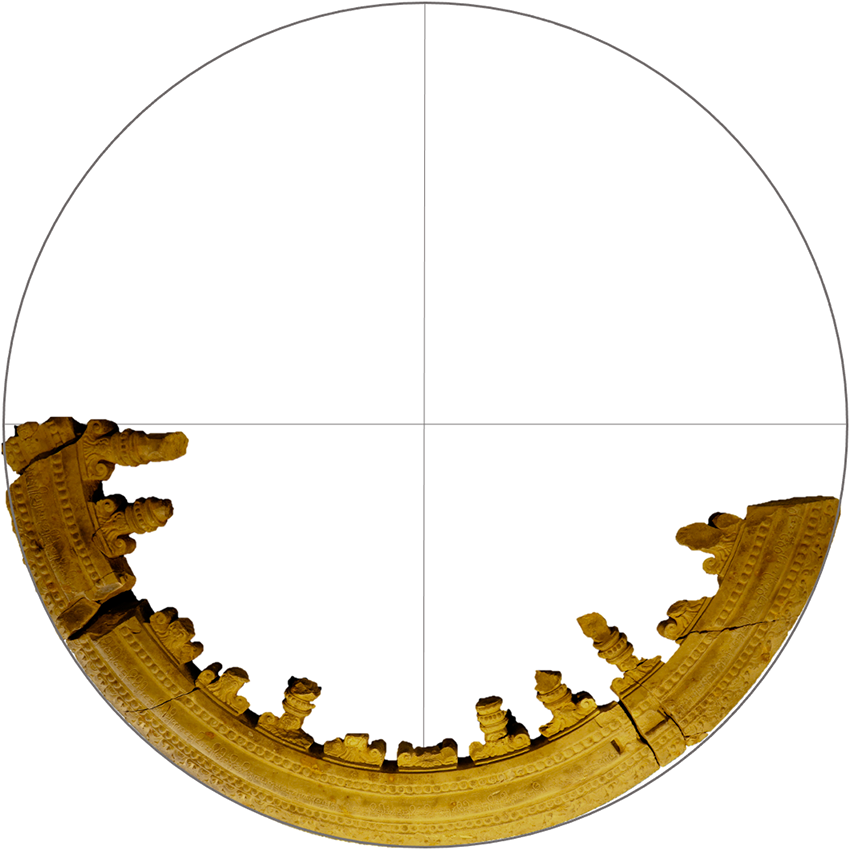
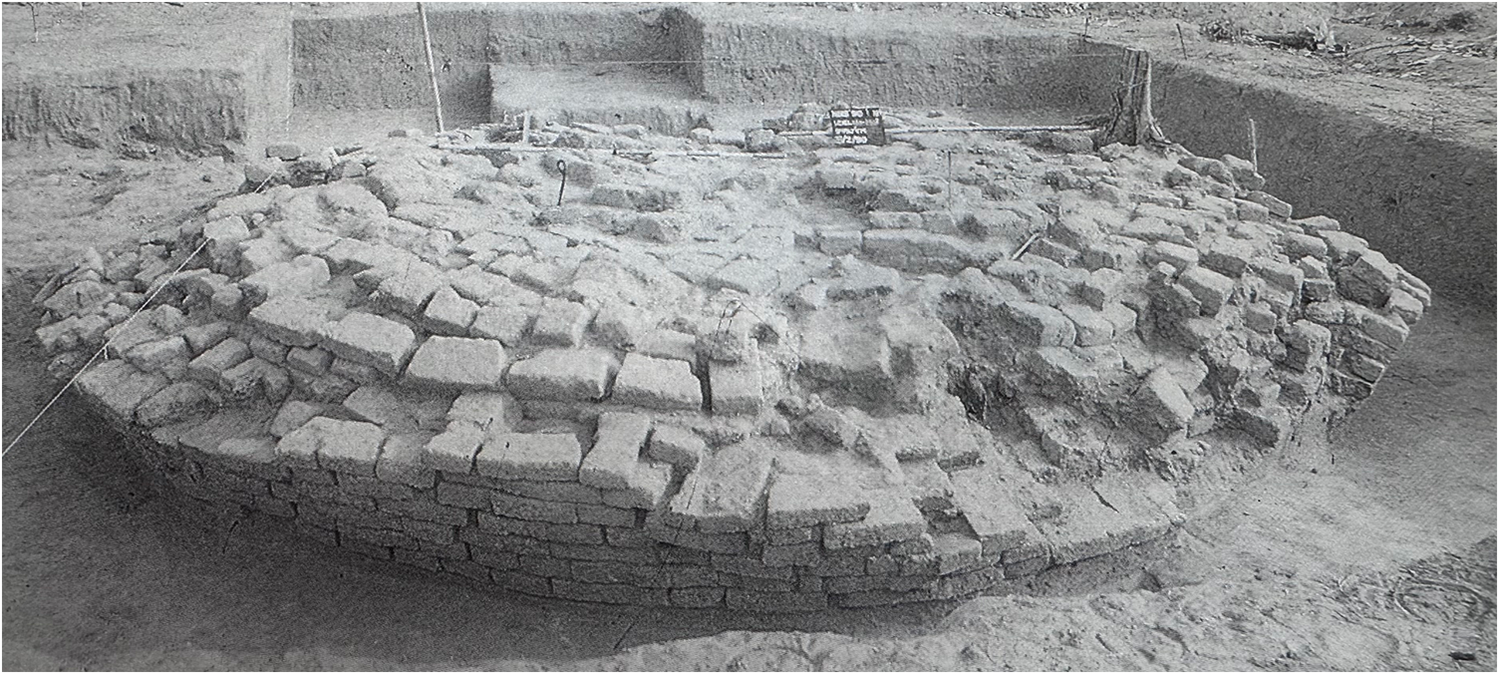
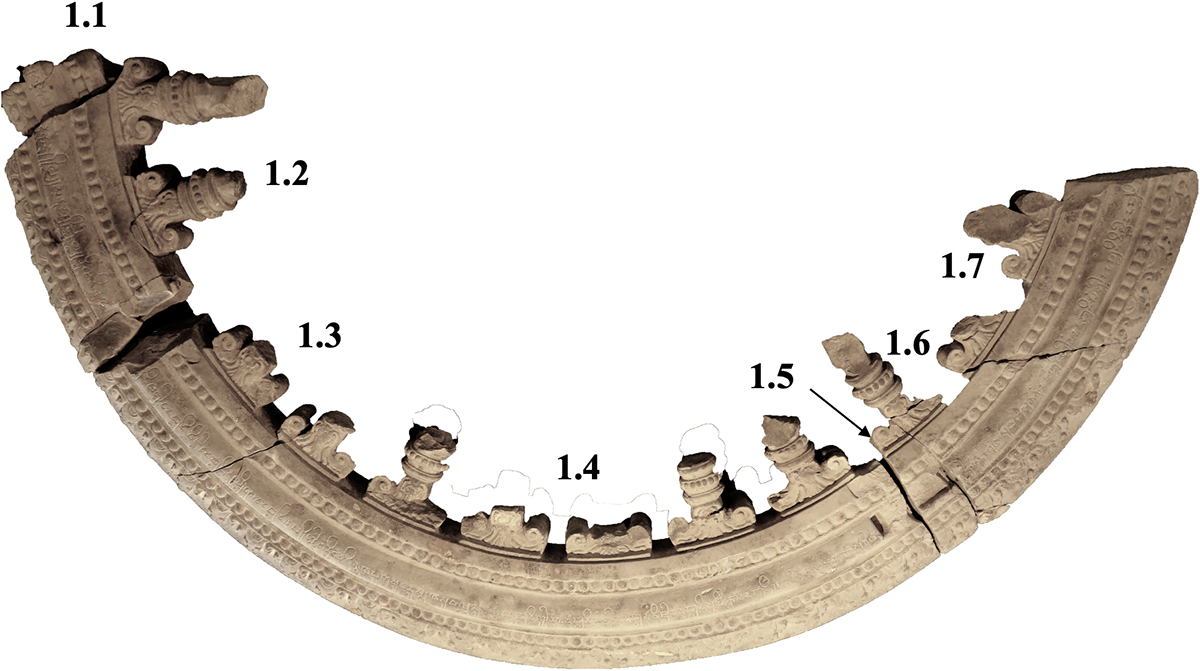
The Chainat wheel is ornate with decorative motifs. Unfortunately, it is broken (whether it fell down or was toppled cannot be determined), and slightly less than half of the wheel survives (Figure 1). The wheel’s history is not entirely clear. According to Chaeme Kaewkly, then an officer of the National Library, the library received an urgent note dated 24 October 1988 together with nine sheets of photocopied notes announcing the discovery of a dhammacakka and a fragment of an octagonal pillar in Chainat province, both with inscriptions. The Fine Arts Department then dispatched officers from the Archaeological Division to investigate the site. According to the report, the artefacts were found in a field in Village No. 5, Hang Nam Sakhon, Manorom district. At that time, the field belonged to a local medical doctor, Samnuan Palawatwichai (นายแพทย์สำนวน ปาลวัฒน์วิไชย), whose workers stumbled upon these artefacts while working in the field. Later in 1990, further excavation carried out by Charuk Wilaikaeo (จารึก วิไลแก้ว) revealed a circular platform in two different brick layers, 7 metres in diameter and 37 centimetres in height (Figure 2).Footnote 15 This solid base seems suited for holding up a stone pillar with a large dhammacakka of around 180 centimetres in diameter. Other finds scattered around one to four metres from the base, at a depth between 20 and 140 centimetres below the surface, included fragments of the spokes from the wheel, parts of the ear, nose, and mouth of a deer statue or deer statues, and broken pieces of the wheel of various sizes. Approximately ten sherds of pots and basins lying around the base were picked up as well.Footnote 16
The Chainat dhammacakka: slightly less than half the original wheel survives.

Brick base of the Chainat dhammacakka (Photo after: Charuk Wilaikaeo “Archaeological work at U-Ta Pao”, 9)

The find spot of the dhammacakka is located between two moated archaeological sites with ramparts, 1.7 km slightly southwest of Muang Nakhon Noi and 1.8 km northeast of U-Ta Pao within the Manorom District in Chainat. U-Ta Pao lies on the edge of the Hang Nam Sakorn waterway and is a relatively flat area. Dvāravatī-period objects were recovered west, east, and south of the town – for example, ancient structures, sherds of earthenware, and numerous silver coins stamped with the conch shell or the rising sun with śrīvatsa symbols.Footnote 17 At the northern side of this ancient town, iron slag and kilns were found indicating activities dating from the prehistorical period.Footnote 18 The dhammacakka site could have served as a place of veneration for local inhabitants and visitors from outside.
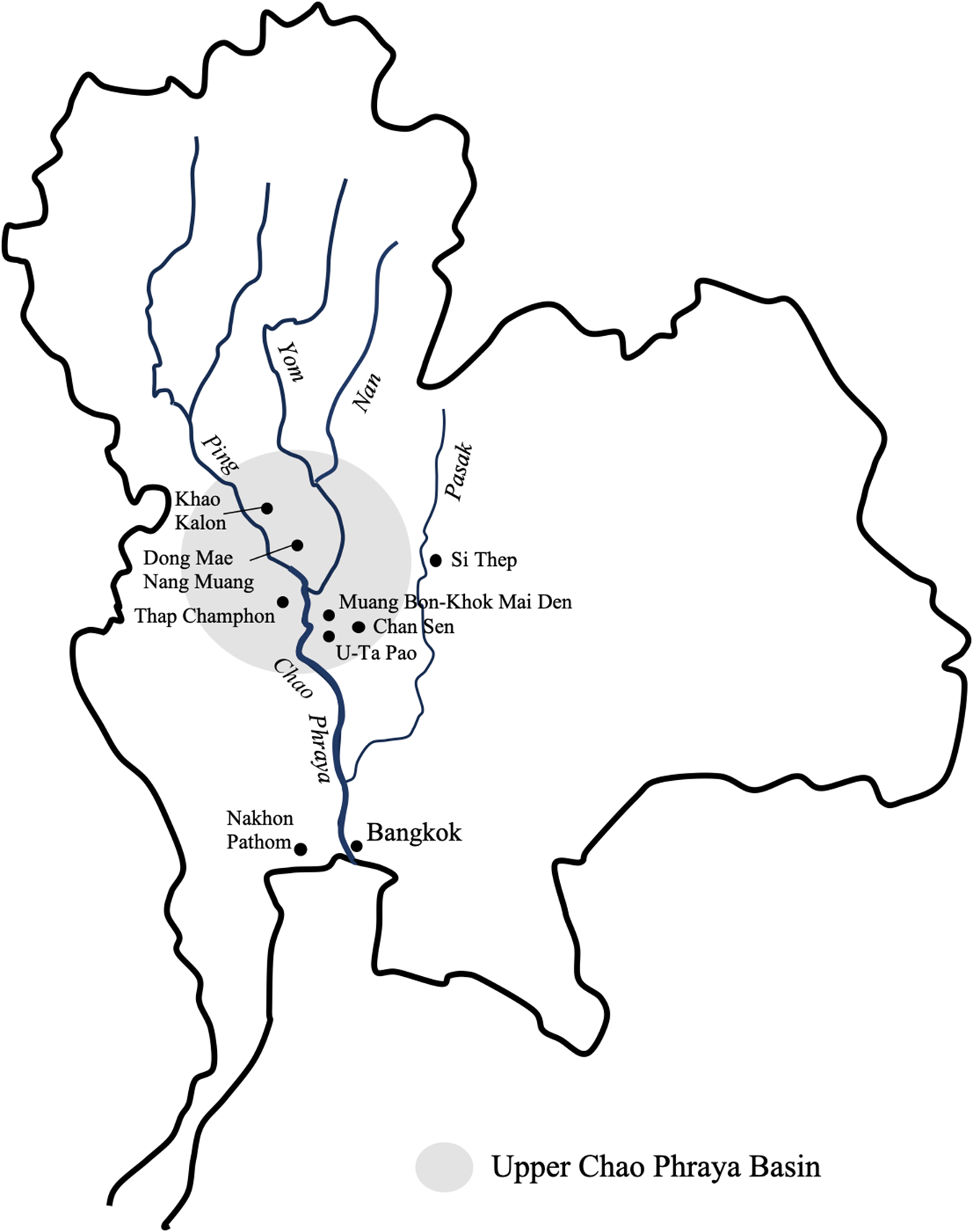
Chainat and its neighbouring provinces preserve a string of Dvāravatī period sites where significant remains and artefacts have been uncovered. This area, consisting of Kamphaeng Phet, Pichit, Pitsanulok, Nakhon Sawan and the upper part of Chainat province, is called the “Upper Chao Phraya Basin”.Footnote 19 Sites in this basin include U-Ta Pao in Chainat, as mentioned earlier; Khok Mai DenFootnote 20 and Muang Bon,Footnote 21 Thap Chumpon, Chan Sen, and Dong Mae Nang Muang in Nakhon Sawan; and Khao Kalon in Kamphaeng Phet (Figure 3).Footnote 22 The main waterways are the Lower Ping River, the Lower Yom–Nan River, and the Chao Phraya River. These river systems and their tributaries would have facilitated circulation throughout the area.
Some Dvāravatī sites in the Upper Chao Phraya Basin

Dr Samnuan was a local enthusiast for antiquities and the dhammacakka findings went under his care. He built a museum to house his collections and he kept the wheel there. When he passed away, his collections went to his family. According to an officer at the Chainatmuni Museum, in 2018 the wheel and associated finds were presented by Dr Samnuan’s sister to Her Royal Highest Princess Maha Chakri Sirindhorn, who then passed them over to the Fine Arts Department. Since 2018 they have been preserved at the Chainatmuni National Museum in Chainat.
The Chainat Dhammacakka (Cn) inscription
Script Southeast Asian Brāhmī
Language Pali
Date Seventh century ce (twelfth century Buddhist Era) (Inscriptions in Thailand Volume 1, Second Edition 2016)
Inscribed text Along the felloes of the wheel on both sides and on the spokes
Support Stone
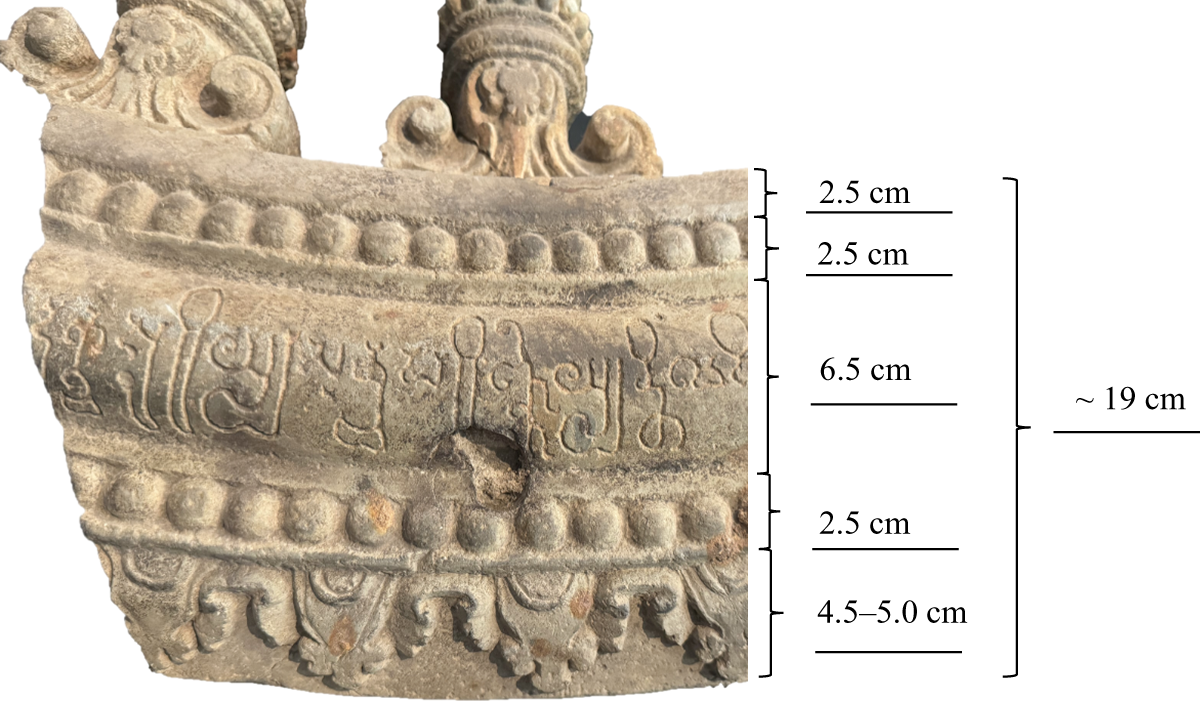
Dimensions Width of the rim ∼ 18.5−19.0 cm (see Figure 4)
Inner diameter of the wheel ∼ 161 cm
Outer diameter of the wheel ∼ 180 cm
Thickness of the wheel (widest) ∼ 13 cm
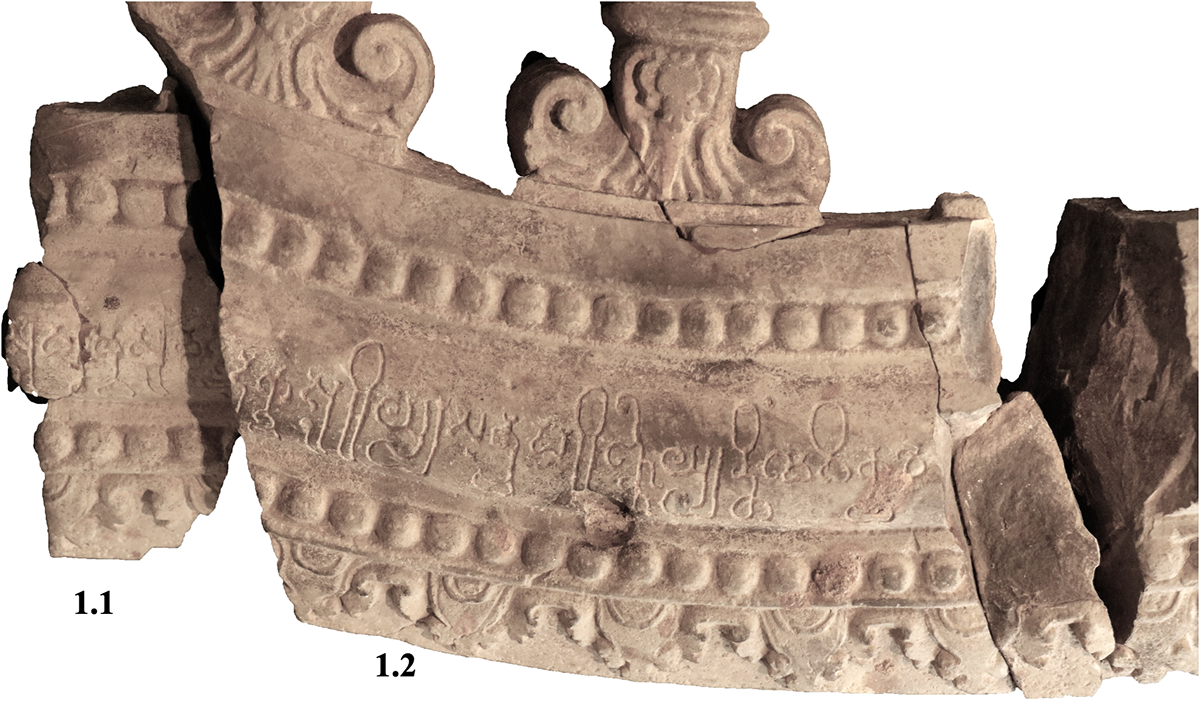
fragment 1.1: 9.5 cm; fragment 1.2: 28.0 cm; fragment 1.3: 22.0 cm; fragment 1.4: 111.0 cm; fragment 5: 7.0 cm; fragment 6: 26.0 cm; fragment 1.7: 26.0 cm.
(Fragment 1.1 has only one side with an inscription, the verso has broken off. The text on fragment 1.1 does not fit directly with fragment 1.2. These measurements are based on the length of the felloes with inscription.)
Inscription size (H): 3.0 cm to 7.5 cm (based on the convex surface of the felloe)
Record number CN. 14
Date of discovery 5 October 1988
Place of discovery Village No. 5, Hang Nam Sakhon, Manorom District, Chainat Province, Thailand
Discoverer Dr Samnuan Palawatwichai
Present location Chainatmuni National Museum, Chainat Province
Images
Figures 4, 5, 5.1, 5.2, 5.3, 5.4, 5.5, 6, 6.1, 6.2, 6.3, 6.4, 6.5, 6.6, 7, and 15
Measurements of the rim Side 1 of the Chainat Dhammacakka
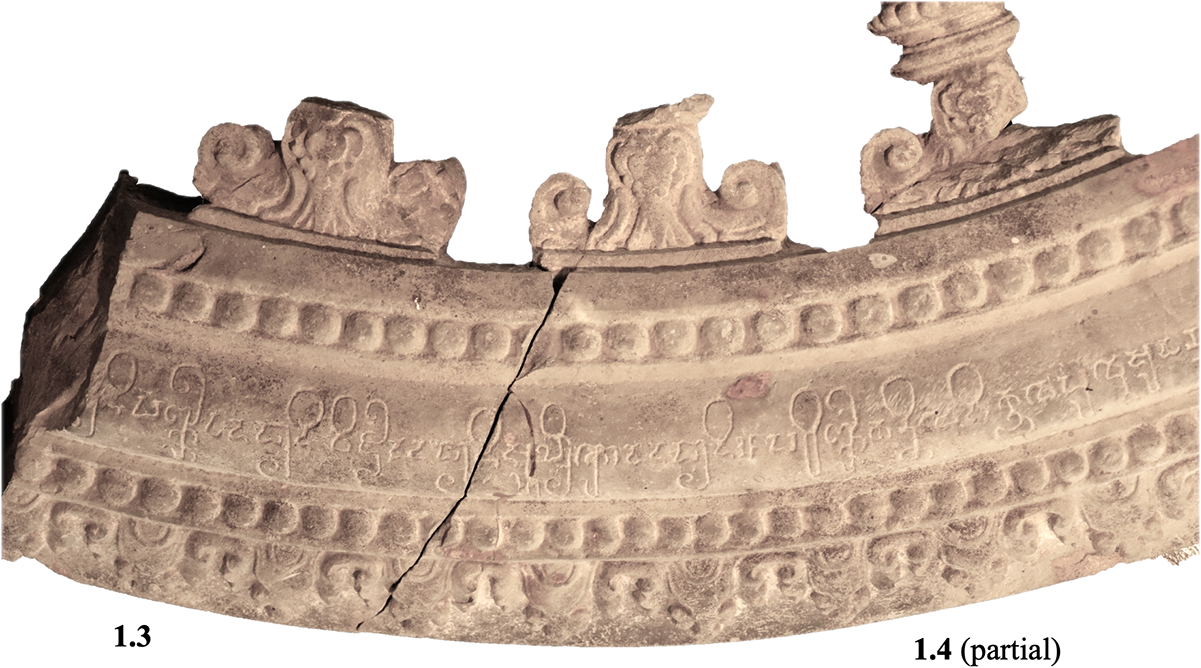
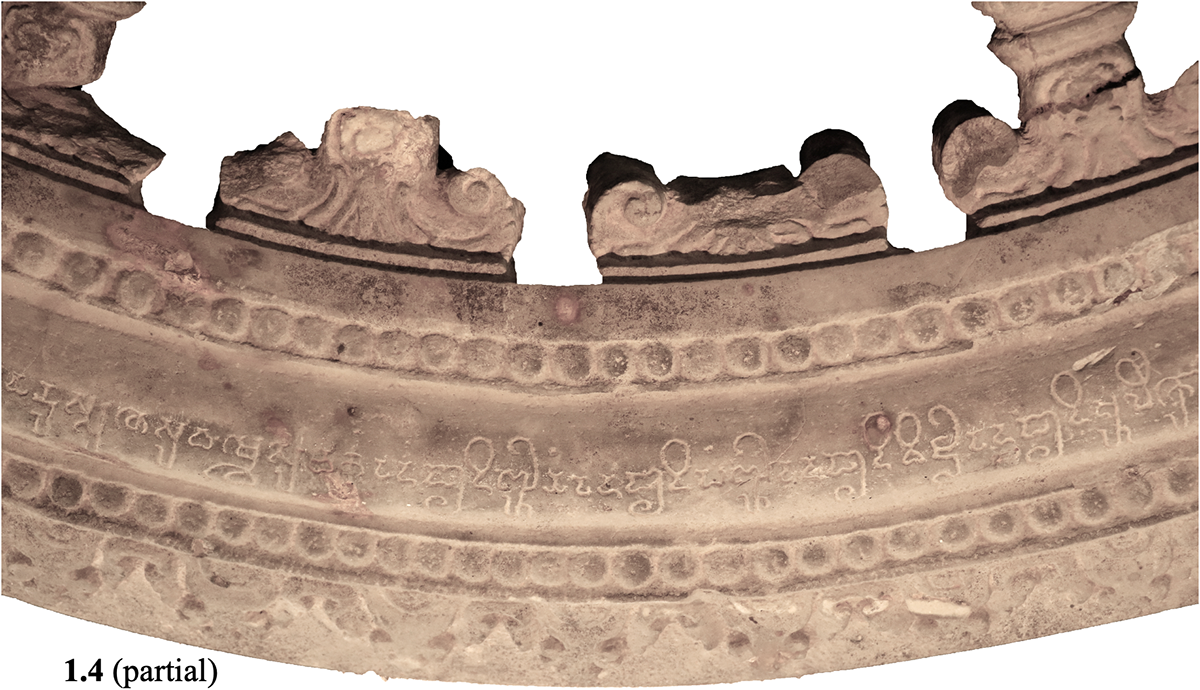
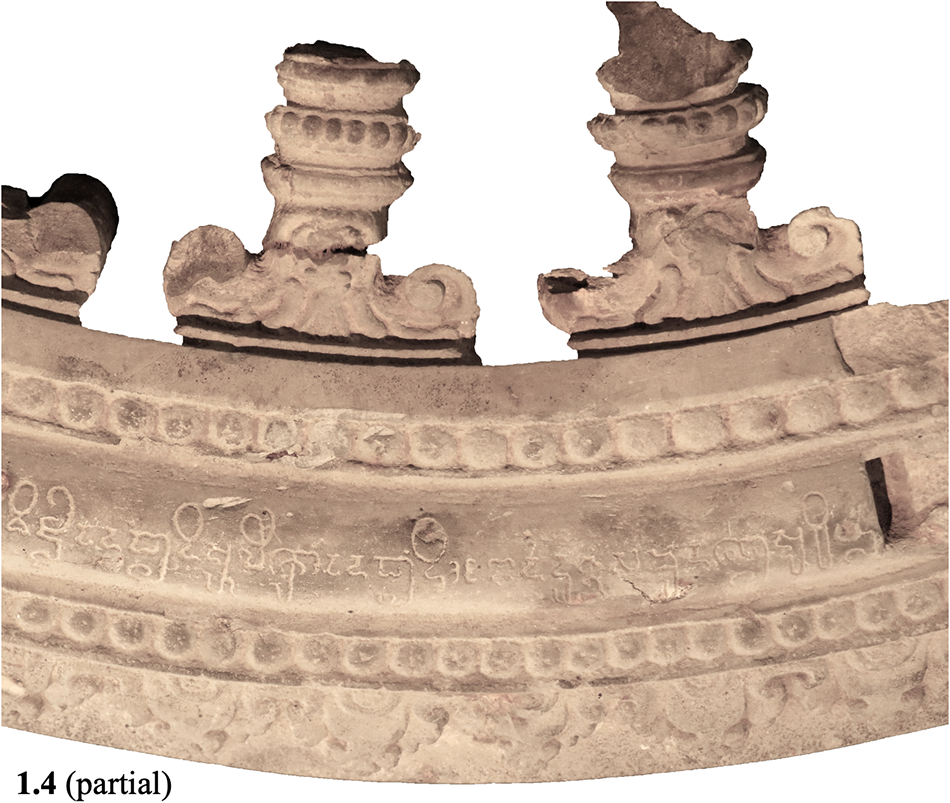
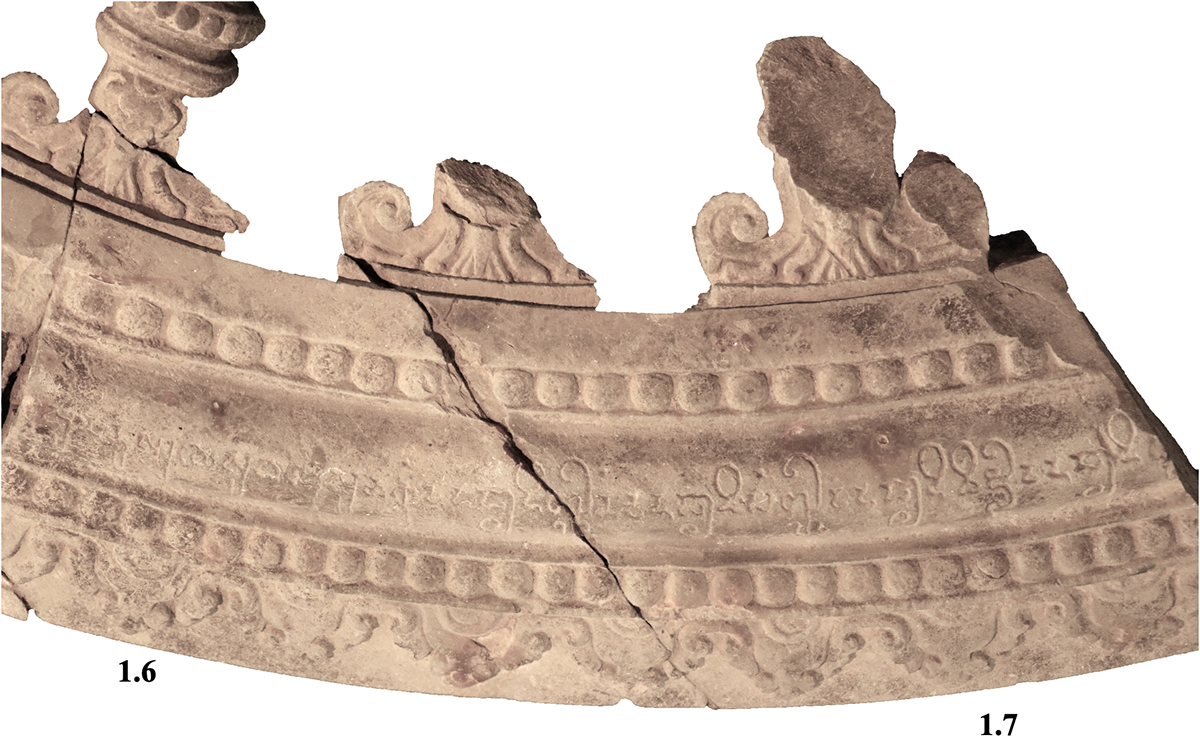
Side 1, fragments 1.1 and 1.2 Side 1, fragment 1.3, and fragment 1.4 (partial) Side 1, fragment 1.4 (partial) Side 1, fragment 1.4 (partial) Side 1, fragments 1.6, and 1.7. The small fragment 1.5 is not shown here as the text is completely abraded Side 2 of the Chainat Dhammacakka
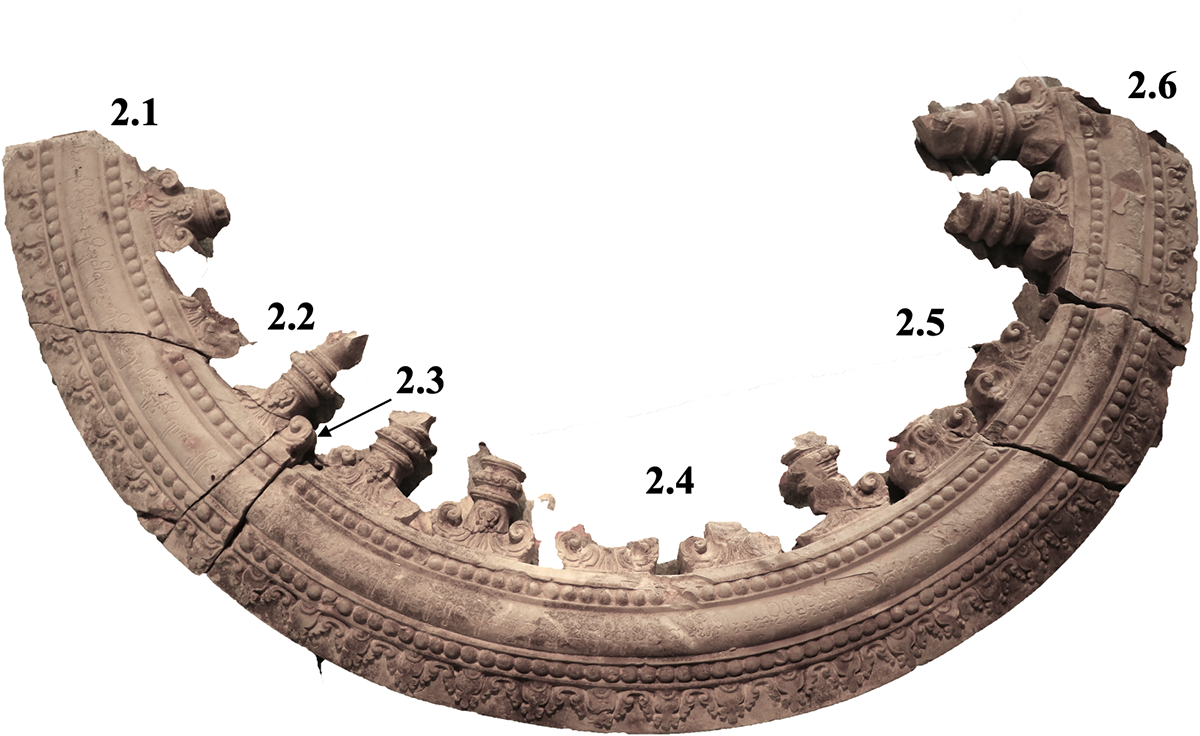
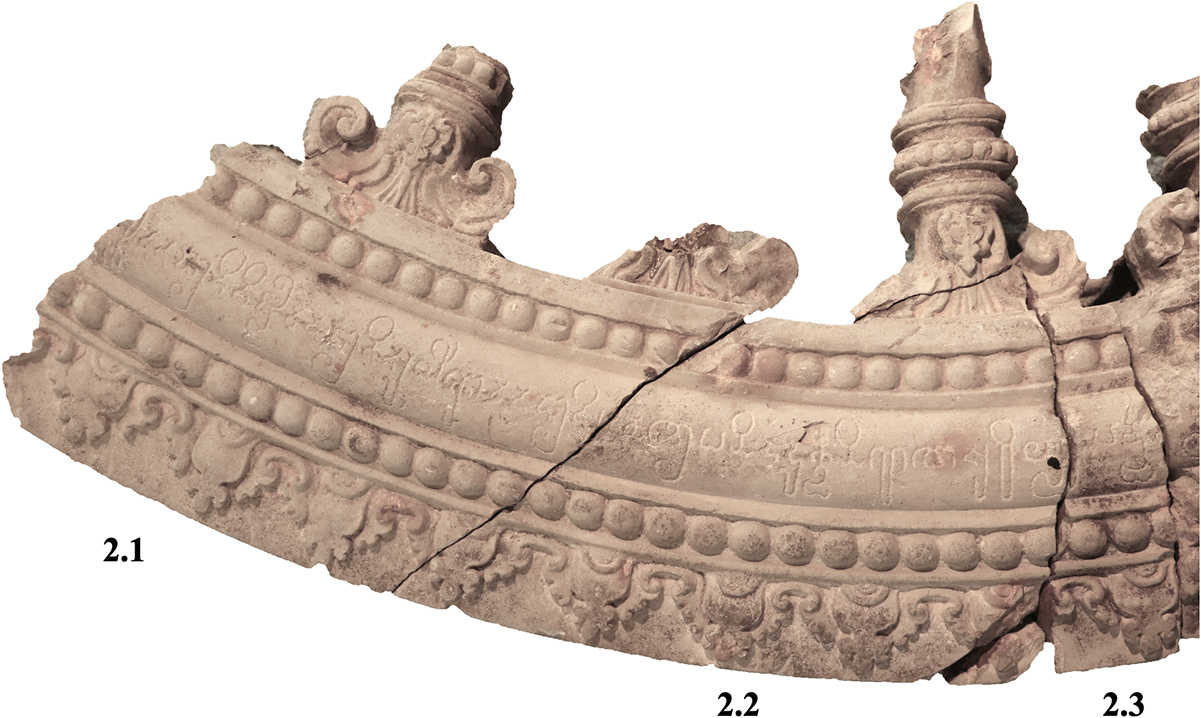
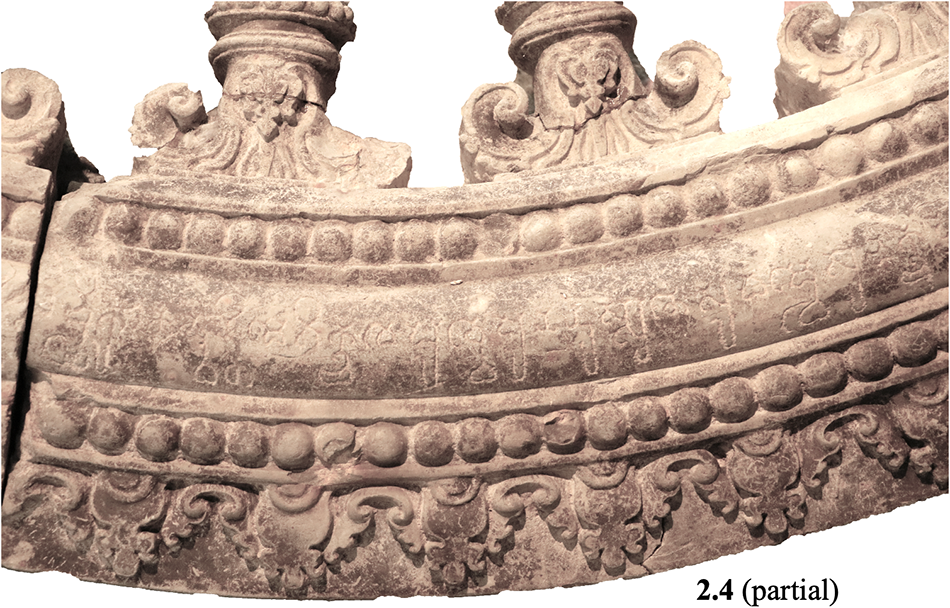
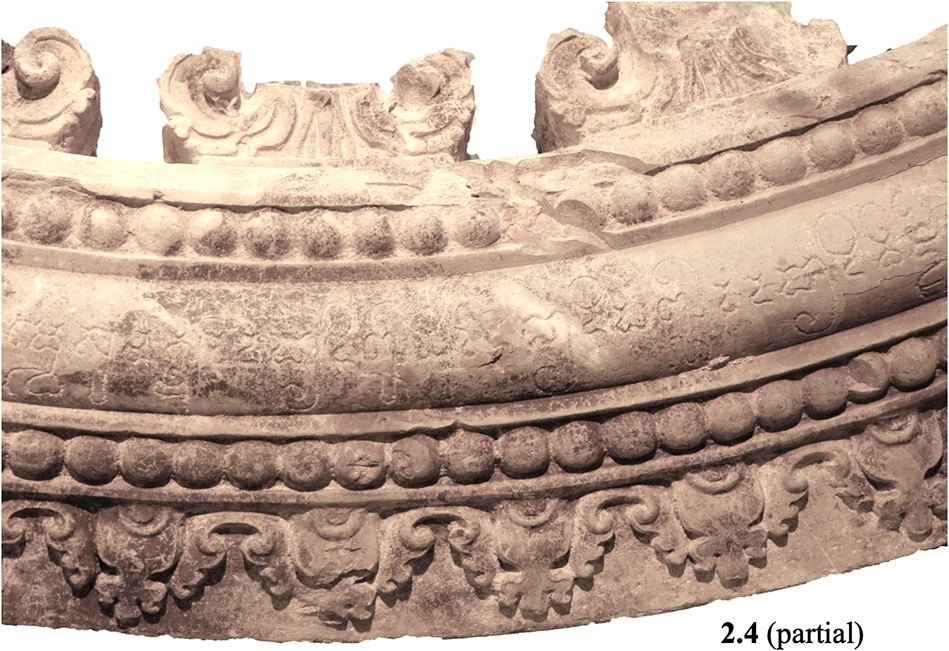
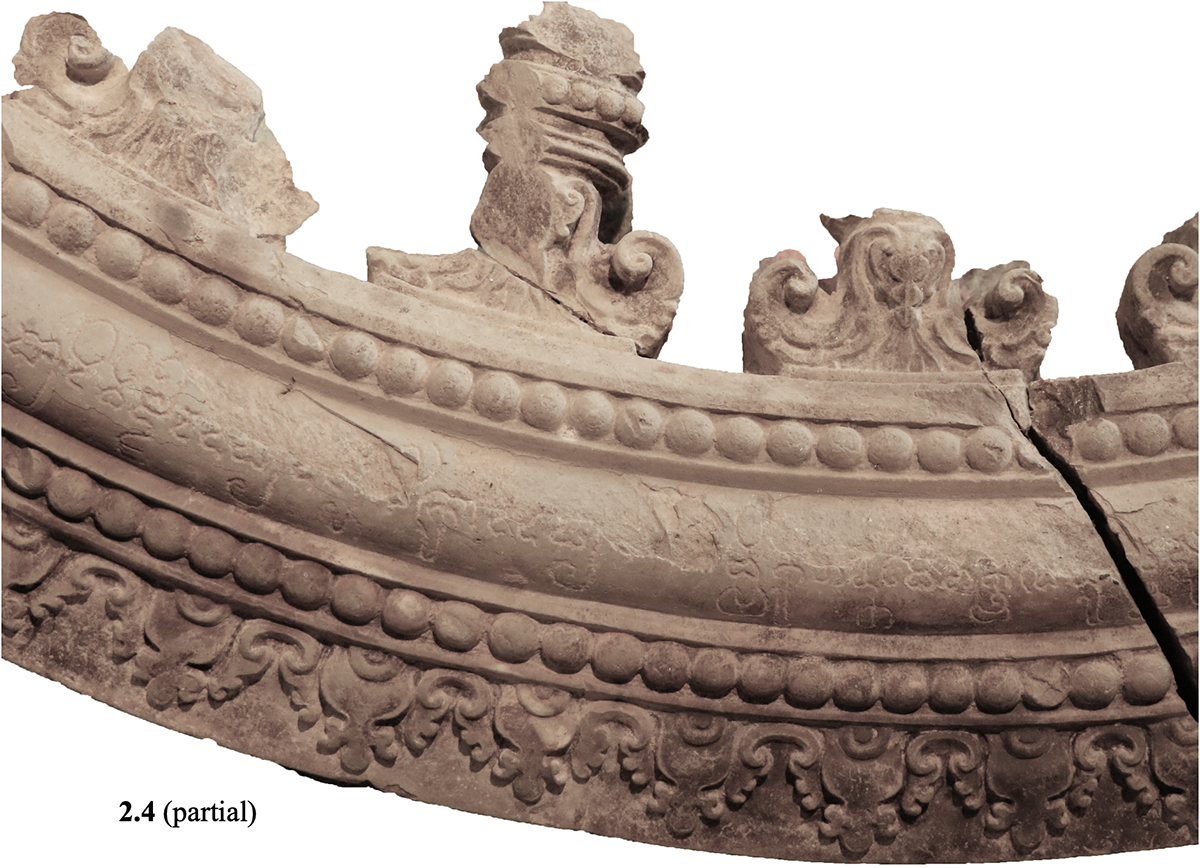
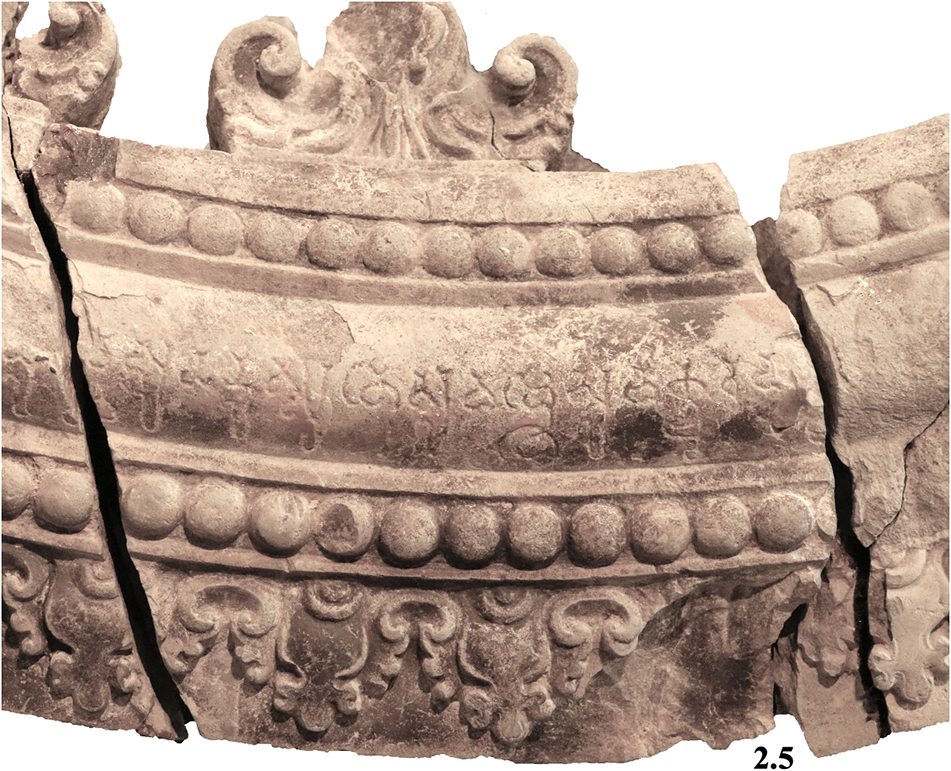
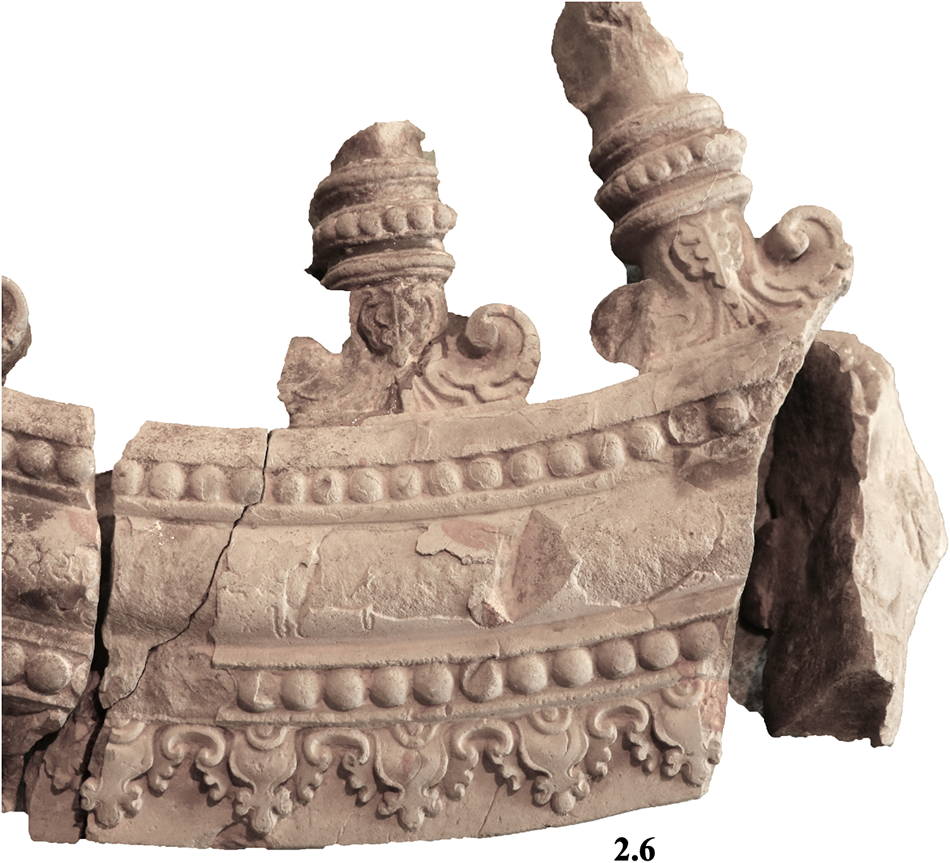
Side 2, fragments 2.1, 2.2, and 2.3 Side 2, fragment 2.4 (partial) Side 2, fragment 2.4 (partial) Side 2, fragment 2.4 (partial) Side 2, fragment 2.5 Side 2, fragment 2.6. Note that the small fragment on the right (side 2 of fragment 1.1) is broken off


Publication history
1. Chaeme Kaewkly, “Dharmachakra inscription and octagonal pillar”, 179−82;
2. Charuk Wilaikaeo, “Archaeological work at U-Ta Pao”, 4−50;
3. The Fine Arts Department, Archaeology of Meuang U-Ta Pao, 10−35.
4. Christian Bauer, “Notes on Mon epigraphy”, 48−55 (palaeographic analysis);Footnote 23
5. Chaeme Kaewkly, “Pali inscriptions in Pallava script”, 40−53;Footnote 24
6. Peter Skilling, “New inscriptions from South-east Asia”, 133−51;
7. Inscriptions in Thailand Volume 1, Second Edition 2016, 182−8.
Design of the wheel
The rim of the Chainat dhammacakka is about 19 centimetres wide. The felloe is surrounded by inner and outer bands of pearls, a fairly common feature seen in dhammacakkas found elsewhere in Thailand, for example, at Si Thep in Phetchabun province, and at several sites in Nakhon Pathom and at U-Thong in Suphaburi.Footnote 25 While the felloes between the bands of pearls in most of these wheels are generally flat and filled with patterns of various kinds,Footnote 26 the felloe of this Chainat dhammacakka is convex, plain without any pattern, but inscribed with text, which is unique in its own way.Footnote 27 The outer edge of both sides of the felloes, above the outer band of pearls, is decorated with a distinctive “foliage growth”-like pattern flanked by projecting-leaf designs.Footnote 28 The spoke displays a kind of Greek ionic-capital design attached to the rim of the wheel. Each spoke comes with three rings before the column, with the middle ring slightly larger and decorated with a band of pearls. The columns of the spokes were inscribed with text. This Greek ionic-capital design of the spoke appears to be a common feature among the Dvāravatī dhammacakkas as well.
Inscriptions of the wheelFootnote 29
Readings, side 1

() indicates the inscription is unclear or partly readable/intelligible; [] indicates the inscription is abraded or missing.
Readings, side 2

() indicates the inscription is unclear or partly readable/intelligible; [] indicates the inscription is abraded or missing.
The text
The text inscribed on the felloes of the wheel gives a passage from the Pali Dhammacakkappavattana Sutta regarding the four realities for the noble ones (ariyasacca): suffering (dukkha), its origin (samudaya), its cessation (nirodha), and the path leading to this (gāminī paṭipadā) in three phases (tiparivaṭṭa, literally in three cycles) and twelve aspects (dvādasākāra).Footnote 30 In this discourse, the path leading to the cessation of suffering is the eightfold path (aṭṭhaṅgiko maggo).Footnote 31 Each of the realities is applied in three phases:
-
1. The knowledge of each reality (saccañāṇa), for example, “Suffering; this is the reality for the noble ones”.
-
2. The knowledge of the task to be accomplished regarding each reality (kiccañāṇa), for example, “Suffering; this reality for the noble ones is to be fully understood”.
-
3. The knowledge of accomplishment regarding each reality (katañāṇa), for example, “Suffering; this reality for the noble ones has been fully understood”.Footnote 32
When these three phases are applied to each of the four realities for the noble ones, they are presented in twelve aspects (dvādasākāra).
Buddhist Sanskrit parallels to this passage on the three phases (triparivarta) and 12 aspects (dvādaśākāra) are preserved in the Mahāvastu (Mv), the Lalitavistara (Lal), and in the Vinaya of the Mūlasarvāstivādins.Footnote 33 In these Pali and Sanskrit texts, the Buddha declares that when his knowledge and vision of these four realities for the noble ones as they really are (yathābhūta) in their three phases and twelve aspects was thoroughly purified (suviśuddha) and he fully knew (abhyajñāsiṣa) them in this way, then only did he claim to have awakened to unsurpassed perfect enlightenment in this world.Footnote 34 The Buddha announced that these realities had never been heard before (pubbe ananussutesu dhammesu). This means that they were not part of the received knowledge of his time – he had not learned about them from anyone else but had realized them directly beneath the Bodhi tree at Bodhgaya.
The importance of this dvādasākāra passage is underscored by a similar statement that is transmitted as an independent sutta, the Tathāgata Sutta (SN56.12). In the Tathāgata Sutta, Gotama the Buddha universalizes his enlightenment experience of the four realities for the noble ones in three phrases and twelve aspects by rephrasing it as the realization of all buddhas (tathāgatā) showing that it is not limited to just his own experience.Footnote 35 This implies that all past and future Buddhas discover and teach the same four realities in the same way.
Sources of the Pali Dvādasākāra passage in printed editions
The Dhammacakkappavattana Sutta in the Pali language is preserved in different genres of texts in the Pali Tipiṭaka. A partial list of printed editions that contain the dvādasākāra passage followsFootnote 36 :
-
1. The Dhammacakkappavattana Sutta in the Saṃyutta Nikāya (Connected Discourses) Pali editions:

-
2. Vin I, H. Oldenberg (ed.), Vinaya Piṭaka Vol. I, the Mahāvagga (London: The Pali Text Society, 1997 [1879], 11.1–18.
-
3. Paṭis II, Arnold C. Taylor (ed.), Paṭisambhidāmagga II (London: The Pali Text Society, 1979 [1907], 148.7–35.

Sources of the Dvādasākāra passage in epigraphs
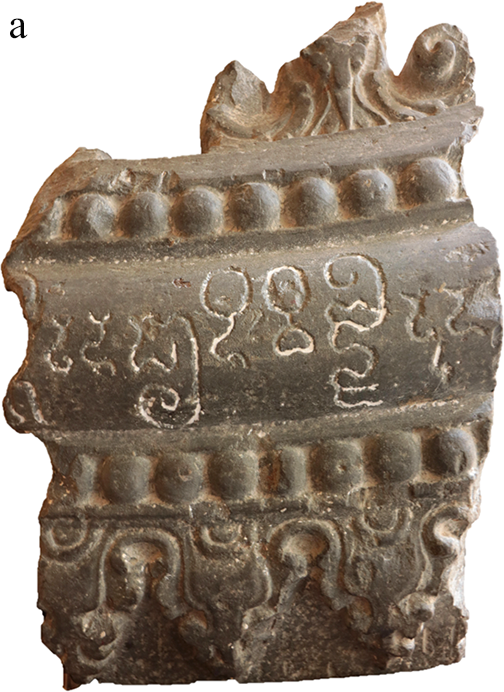
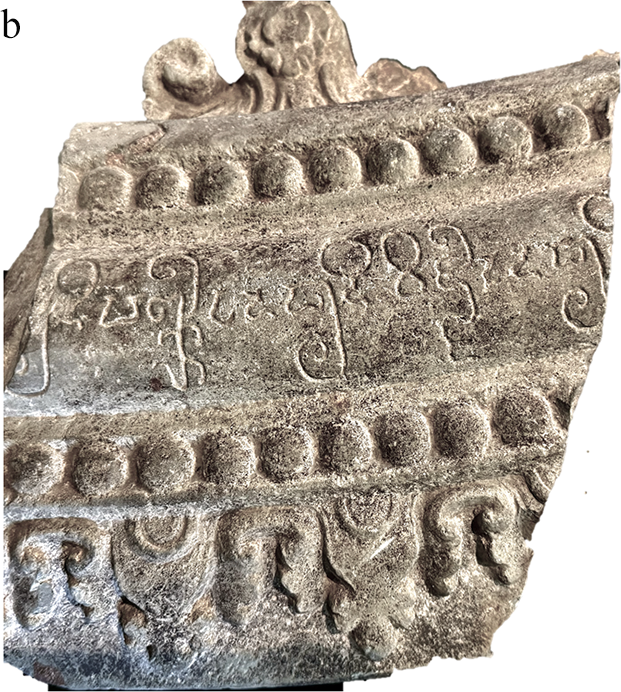
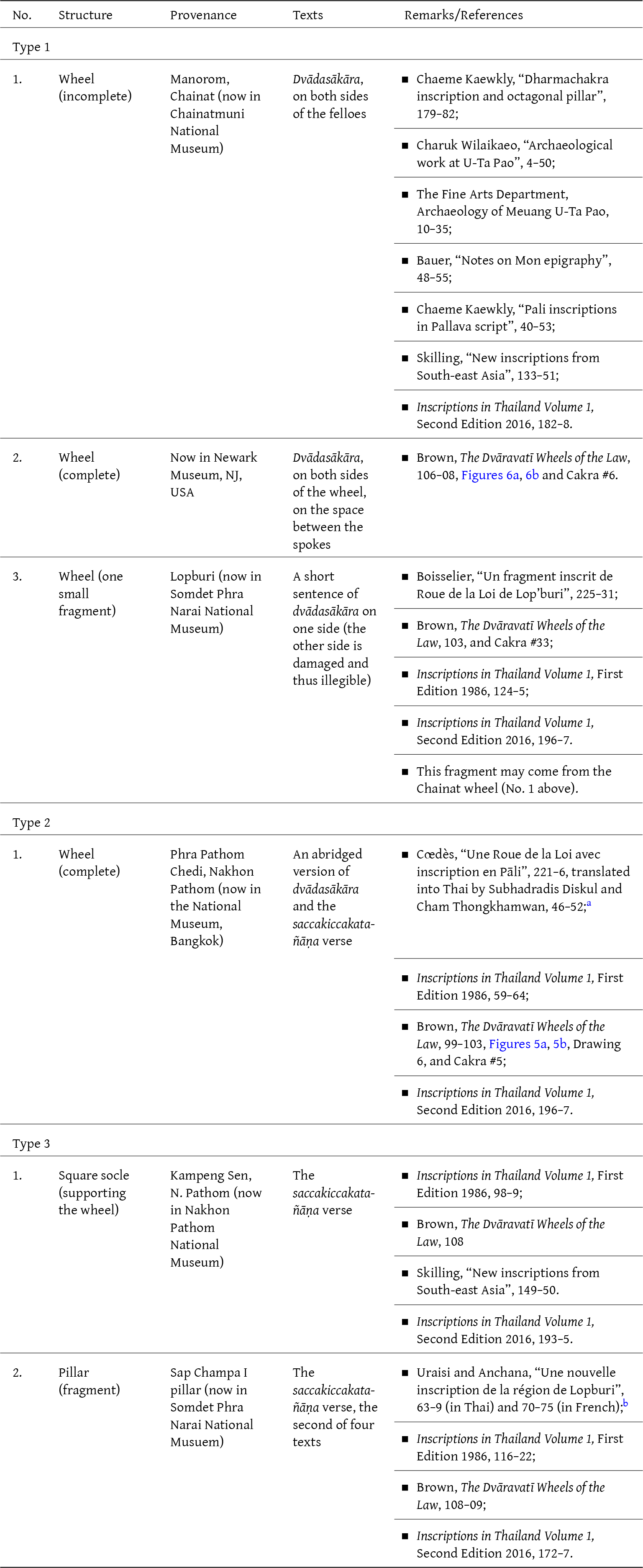
The dvādasākāra passage is presented in several ways in early Siamese epigraphs (Table 1). The first group of inscriptions preserves the passage somewhat in agreement with the printed editions except for the use of peyyāla at certain points.Footnote 37 This group includes the Chainat dhammacakka (Cn) that we discuss here, the Newark dhammacakka (ND),Footnote 38 and the small wheel fragment from Wat Phra Si Ratana Mahathat, Lopburi.Footnote 39 However, we suspect that the fragment from Wat Phra Si Ratana Mahathat is part of the Chainat dhammacakka which was brought to Lopburi under unknown circumstances at an unknown date and kept at the Wat before it was moved to its current location at Somdet Phra Narai National Museum. The Lopburi fragment and the Chainat wheel share the same size with a width of 19 cm. The floral designs and patterns of the two are almost identical as is the palaeography and textual tradition (Figures 7a, 7b). Moreover, due to a lack of any reports implying the Lopburi fragment’s archaeological context or history, and the absence of any related dhammacakka remains, we think it most likely that the two are from the same wheel that was found in Chainat.
A fragment from Wat Phra Si Ratana Mahatha

A fragment (1.3) from Chainat dhammacakka

Dhammacakka inscriptions related to the Dvādasākāra passage

a Subhadradis Diskul and Cham Thongkhamwan, “Phra Dhammacakra Pāli inscription from Nakhon Pathom province, translated into Thai ‘Une Roue de la Loi avec inscription en Pāli provenant du Site de P’ră Păthŏm, Artibus Asiae 19, 3/4’, in memory of Pierre Dupont”, in Corpus of Stone Inscriptions, Part 2 (Bangkok: Fine Arts Department, 1961), 46–52/“พระธรรมจักรศิลา จารึกภาษาบาลี ได้มาจากจังหวัดนครปฐม”, แปลโดย ม.จ. สุภัทรดิศ ดิศกุล และ ฉ่ำ ทองคำวรรณ, จาก Une Roue de la Loi avec inscription en Pāli provenant du site de P’ra Pathom, Artibus Asiae XIX, ใน ประชุมศิลาจารึก ภาคที่ 2: จารึกทวารวดี ศรีวิชัย ละโว้, พิมพ์ครั้งที่ 2 [แก้ไขใหม่] (กรุงเทพฯ: กรมศิลปากร, 2504), 46–52.
b Uraisri Varasarin and Anchana Imsombat, “Une nouvelle inscription de la région de Lopburi”, in Art and Archaeology in Thailand II (Bangkok: The Fine Arts Department, 1975), 63–69 (in Thai), 70–75 (in French)/อุไรศรี วรศะริน ร่วมกับ อัญชนา อีมสมบัติ, จารึกหลักใหม่จากบริเวณจังหวัดลพบุรี, ศิลปและโบราณคดีในประเทศไทย, เล่ม ๒, ๒๕๑๘, ๖๓-๖๙. กรมศิลปากร.
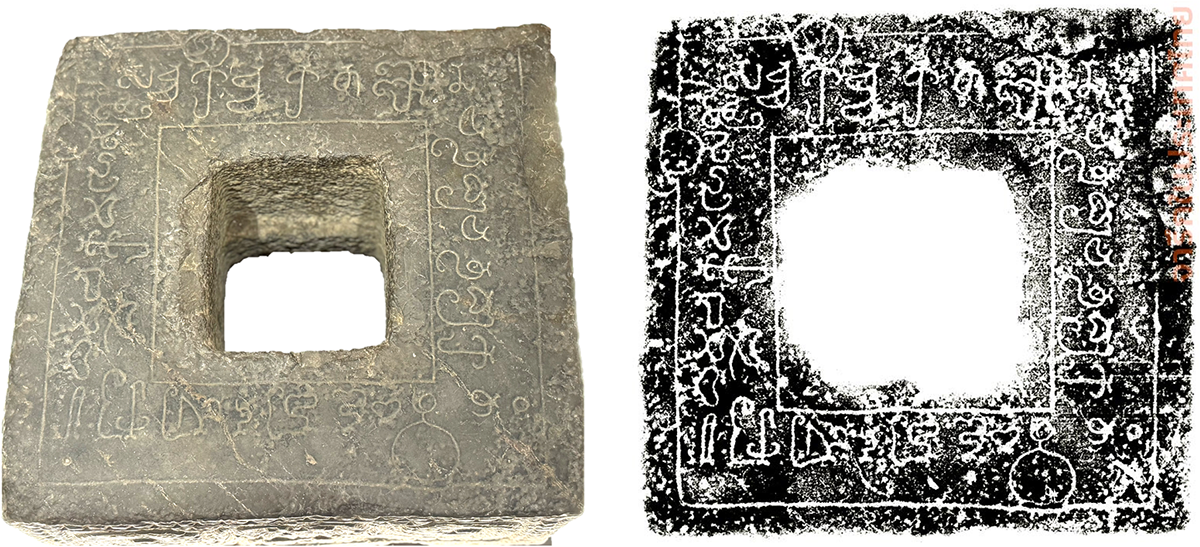
The second type of inscription expresses the idea of dvādasākāra in an abridged version, for example, without the word ariya- or the repetitive clause starting with cakkhum udapādi. This type consists of the Phra Pathom Chedi dhammacakka. Another group of inscriptions summarizes the nature of the Dhamma wheel of the Great Sage in a verse that we call the saccakiccakatañāṇa verse. This group consists of the inscription of the Kampeng Sen (Nakhon Pathom) socle (Figure 8) and part of the Sap Champa I octagonal pillar inscription. The verse also appears in the inner hub of the Phra Pathom Chedi dhammacakka.
Square socle from Kampeng Sen, Nakhon Pathom and its rubbing. (Rubbing photo after the webpage of The Princess Maha Chakri Sirindhorn Anthropology Centre, https://db.sac.or.th/inscriptions/inscribe/detail/294 accessed 26 May 2024)

The saccakiccakatañāṇa verse is not “canonical” but is a composition found, so far as we know, only in Pali and composed in anuṭṭhubha (anuṣṭubh) meter. The complete verse is preserved on the socle or the immediate base of a dhammacakka from Kampeng Sen in Nakhon Pathom province. Cœdès pointed out that this verse is found in the Dhammacakkappavattana chapters of later texts like the Paṭhamasambodhi and the Sāratthasamuccaya. The verse has been previously discussed at length,Footnote 40 and here we limit ourselves to presenting it with translation with a brief gloss to show how it neatly summarizes the Dvādasākāra passage.

Insight into reality, tasks, and accomplishment
Each is performed four times,
making up three phases and twelve aspects,
This is the Wheel of Dhamma of the Great Sage (the Buddha)Footnote 41
We understand the verse as follows:
The “three phases” (tivaṭṭa) are “knowledge” or “insight” (ñāṇa) into “reality” (sacca), the “task to be performed with regard to it” (kicca), and the “resultant accomplishment” (kata). These are applied to each of the four realities (catudhā catudhā kataṃ); these constitute the “twelve aspects” (dvādasākāra) of the knowledge into the truth, which are the Wheel of Dhamma taught by the Great Sage at the Deer Park.Footnote 42
To return to the Type 1 inscriptions, which are the focus of this article: less than half of the Chainat dhammacakka (Cn), approximately 44% to 46%, survives (Figure 1). Based on the readings of these surviving fragments and the size of the wheel,Footnote 43 we provide below a reconstructed recension based on Cn. In this edition, we take into account witnesses from the Newark dhammacakka (ND), RV, S5, and Vin I (VinI). The space available for text leads us to conclude that the intention was not to include the nidāna (introduction) and the opening sections of the sutta or, most probably, the conclusion (nigamana). That is, the intention was to give the Buddha’s words regarding the four realities without narrative interventions.
For the Newark dhammacakka, we refer to our reading (ND1) as well as the reading provided by Brown (ND2). Our reading is based on photographs received from Newark Museum.Footnote 44 As for Brown’s reading, according to him the inscribed portions were read by Anchana Chittasuttiyan based on his photographs.Footnote 45 Brown also indicated that, in general including for other wheels, he did not adjust the Pali transliteration even in cases where it looked incorrect to him.Footnote 46 We do notice some differences between our readings and Brown’s; for example in the orthography of pubbe, we read puvve, but Brown’s edition gives it as pubbe.Footnote 47 Nevertheless, we take into account both our own and Brown’s reading in the edition below.
The surviving textual tradition of Cn is fairly in agreement with RV. Therefore, in reconstructing the Cn recension of the dvādasākāra passage, we selected the readings from RV to fill the gaps in the passage. However, in doing so, we maintained the orthography of Cn and its use of peyyāla (-pe-, discussed further below). With this, we provide a “new” recension based on Cn as below. The passages extant in Cn are in bold.
Edition of the Chainat Dhammacakka (Cn)
idaṃFootnote 48 dukkhaṃFootnote 49 ariyyasaccanFootnote 50 ti me bhikkhave puvve ananussutesu dhammesu cakkhuṃ udapādi ñāṇaṃ udapādi paññā udapādi vijjā udapādi āloko udapādi.
taṃ kho panidaṃ Footnote 51 dukkhaṃ ariyyasaccaṃ Footnote 52 pariññeyyan ti me bhikkhave puvve ananussutesu dhammesu cakkhuṃ udapādi ñāṇaṃ udapādi paññā Footnote 53 udapādi vijjā udapādi āloko udapādi.
Footnote 54 pariññātan ti me bhikkhave puvve Footnote 55 ananussutesu dhammesu cakkhuṃ udapādi ñāṇaṃ udapādi paṃñā Footnote 56 udapādi vijjā udapādi āloko udapādi.
idaṃ dukkhasamudayo Footnote 57 ariyyasaccanFootnote 58 ti me bhikkhave puvve ananussutesu dhammesu cakkhuṃ udapādi ñāṇaṃ udapādi paññā Footnote 59 udapādi vijjā udapādi āloko udapādi.
taṃ kho panidaṃ dukkhasamudayoFootnote 60 ariyyasaccaṃFootnote 61 pahātavvan ti me bhikkhave puvve ananussutesu dhammesu cakkhuṃ udapādi ñāṇaṃ udapādi paññā udapādi vijjā udapādi āloko udapādi.
Footnote 62 pahīnan ti me bhikkhave puvve ananussutesu dhammesu cakkhuṃ udapādi ñāṇaṃ udapādi paññāFootnote 63 udapādi vijjā udapādi āloko udapādi.
idaṃ dukkhanirodhoFootnote 64 ariyyasaccan ti me bhikkhave puvve ananussutesu dhammesu cakkhuṃ udapādi ñāṇaṃ udapādi paññāFootnote 65 udapādi vijjā udapādi āloko udapādi.
taṃ kho panidaṃ dukkhanirodho Footnote 66 ariyyasaccaṃ Footnote 67 sacchikātavvan ti Footnote 68 me bhikkhave puvve Footnote 69 ananussutesu dhammesu cakkhuṃ udapādi ñāṇaṃ udapādi paññā udapādi vijjā udapādi āloko udapādi.
Footnote 70 sacchikatan ti me bhikkhave puvve Footnote 71 ananussutesu dhammesu cakkhuṃ udapādi ñāṇaṃ udapādi paññāFootnote 72 udapādi vijjā udapādi āloko udapādi.
idaṃ dukkhanirodhagāminīFootnote 73 paṭipadā ariyyasaccanFootnote 74 ti me bhikkhave puvve ananussutesu dhammesu cakkhuṃ udapādi ñāṇaṃ udapādi paññāFootnote 75 udapādi vijjā udapādi āloko udapādi.
taṃ kho panidaṃ dukkhanirodhagāminīFootnote 76 paṭipadā ariyyasaccaṃFootnote 77 bhāvetavvan ti me bhikkhave ananussutesu dhammesu cakkhuṃ udapādi ñāṇaṃ udapādi paññā udapādi vijjā udapādi āloko udapādi.
Footnote 78 bhāvitan ti me bhikkhave puvve ananussutesu dhammesu cakkhuṃ udapādi ñāṇaṃ udapādi paññā udapādi vijjā udapādi āloko udapādi.
Translation Footnote 79 :
“O monks, when I understood that ‘for the noble ones this is the reality of suffering’, then vision arose, insight arose, wisdom arose, knowledge arose, and light arose with regard to dhammas that had never been heardFootnote 80 before.”
“And now, O monks, when I understood that ‘for the noble ones this is the reality of suffering to be fully understood’, then vision arose, insight arose, wisdom arose, knowledge arose, and light arose with regard to dhammas that had never been heard before.”
“O monks, when [this] ‘has been fully understood’, then vision arose, insight arose, wisdom arose, knowledge arose, and light arose with regard to dhammas that had never heard before.”
“O monks, when I understood that ‘this for the noble ones is the reality of the origin of suffering’, then vision arose, insight arose, wisdom arose, knowledge arose and light arose with regard to dhammas that had never been heard before.”
“And now, O monks, when I understood that ‘this for the noble ones is the reality of the origin of suffering to be abandoned’, then vision arose, insight arose, wisdom arose, knowledge arose and light arose with regard to dhammas that had never been heard before.”
“O monks, when [this] ‘has been fully abandoned’, then vision arose, insight arose, wisdom arose, knowledge arose and light arose with regard to dhammas that had never been heard before.”
“O monks, when I understood that ‘this for the noble ones is the reality of the cessation of suffering’, then vision arose, insight arose, wisdom arose, knowledge arose and light arose with regard to dhammas that had never been heard before.”
“And now, O monks, when I understood that ‘this for the noble ones is the reality of the cessation of suffering to be realized’, then vision arose, insight arose, wisdom arose, knowledge arose and light arose with regard to dhammas that had never been heard before.”
“O monks, when [this] ‘has been fully realized’, then vision arose, insight arose, wisdom arose, knowledge arose and light arose with regard to dhammas that had never been heard before.”
“O monks, when I understood that ‘this is the reality for the noble ones, the path leading to the cessation of suffering’, then vision arose, insight arose, wisdom arose, knowledge arose and light arose with regard to dhammas that had never been heard before.”
“And now, O monks, when I understood that ‘this is the reality for the noble ones, the path leading to the cessation of suffering is to be developed’, then vision arose, insight arose, wisdom arose, knowledge arose and light arose with regard to dhammas that had never been heard before.”
“O monks, when [this] ‘has been fully developed’, then vision arose, insight arose, wisdom arose, knowledge arose and light arose with regard to dhammas that had never been heard before.”
Textual tradition and syntax
As we can see, the textual tradition of the Cn inscription generally agrees with the current printed editions, RV and S5.Footnote 81 There are, however, some differences in syntax and the use of peyyāla.
One of the dissimilarities in syntax between the inscription and S5 is in these two sentences: Cn, as in RV, have idam dukkhasamadayo ariyyasaccaṃ and idaṃ dukkhanirodho ariyyasaccaṃ, while in S5 it is idaṃ dukkhasamudayam ariyasaccaṃ and idaṃ dukkhanirodham ariyasaccaṃ. This syntax in S5 has already been the subject of considerable debate. Interpretations have ranged from the proposal that the correct sentence should be ayaṃ dukkhasamudayo ariyasaccaṃ and ayaṃ dukkhanirodho ariyasaccaṃ, to the idea that samudaya and nirodha, which are masculine nouns, be taken as neuter nouns, or to the suggestion that the “m” in between samudaya-m-ariyasaccaṃ is a consonant sandhi.Footnote 82 As the issue of syntax has been discussed elsewhere,Footnote 83 and also in light of different perspectives in interpreting the compound ariya-sacca as the reality for the spiritually ennobled, we interpret the sentence based on the syntax of the inscription which we think carries the following notions.
In Cn, idaṃ, a neuter pronoun, is in gender agreement with saccaṃ. Both are in the nominative case, which is then read as “this is the reality” (idaṃ saccaṃ) for the spiritually ennobled or the noble ones (ariya-). And what is the reality for the noble ones? It is the origin of suffering, dukkhasamudayo, which is to be abandoned through practice and fully abandoned when the aspirant achieves realization. Here, dukkhasamudayo, a masculine noun in nominative is taken as a predicate noun to saccaṃ. Thus, the sentence in the inscription is rendered as “the origin of suffering (dukkhasamudayo); this is the reality for the noble ones (idaṃ ariyyasaccaṃ)”.
Another divergence from “standard Pali” is that the geminate -vv- is used in puvve instead of the “standard” pubbe. This -vv- is characteristic in early Pali inscriptions.Footnote 84 For example, -vv- is used in pahātavvaṃ, sacch(i)kātavvaṃ, and bhāvetavvaṃ on a Dvāravatī period Phra Pathom Chedi dhammacakka recovered from Nakhon Pathom.Footnote 85 Von Hinüber has already noted similar usage in the Pali Vinaya folios of unknown (but because of the script, certainly mainland South Asian) provenance kept in the National Library, Kathmandu, and assigned to the eighth or the ninth century.Footnote 86 Another peculiarity in consonant gemination is ariyya in the inscription versus ariya in “standard Pali”. The other orthographical dissimilarity is paṃñā for paññā (wisdom). Notably, both orthographies, paṃñā and paññā, occur inconsistently in the Cn inscription and frequently in ND1. This might suggest that the Pali of the inscription was transmitted orally rather than in written form.
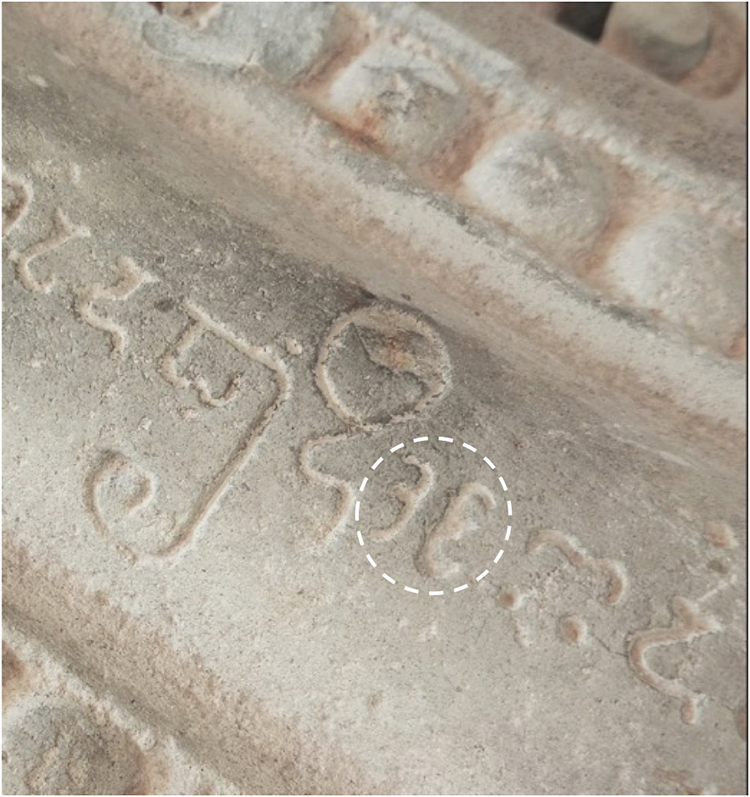
A further noticeable difference is the indication of abbreviation (known as peyyāla, although the term is not found in the inscription) in Cn as compared to the printed edition. While the use of peyyāla is not consistent as to which repeated passages are omitted in the printed edition, the inscription is quite consistent in omitting the phases “taṃ kho panidaṃ dukkhaṃ ariyyasaccaṃ or dukkhanirodho ariyyasaccaṃ” in the third and ninth aspects respectively in the twelvefold dvadasākāra as seen above. And with this, it is also reasonable to suspect that similar respective phases, which are not extant, are also omitted in the sixth and twelfth aspects. The points at which they are omitted are indicated by punctuation marks or daṇḍas (Figure 9).Footnote 87
A double “stroke” daṇḍa (in circle) between udapādi and idaṃ

The spokes
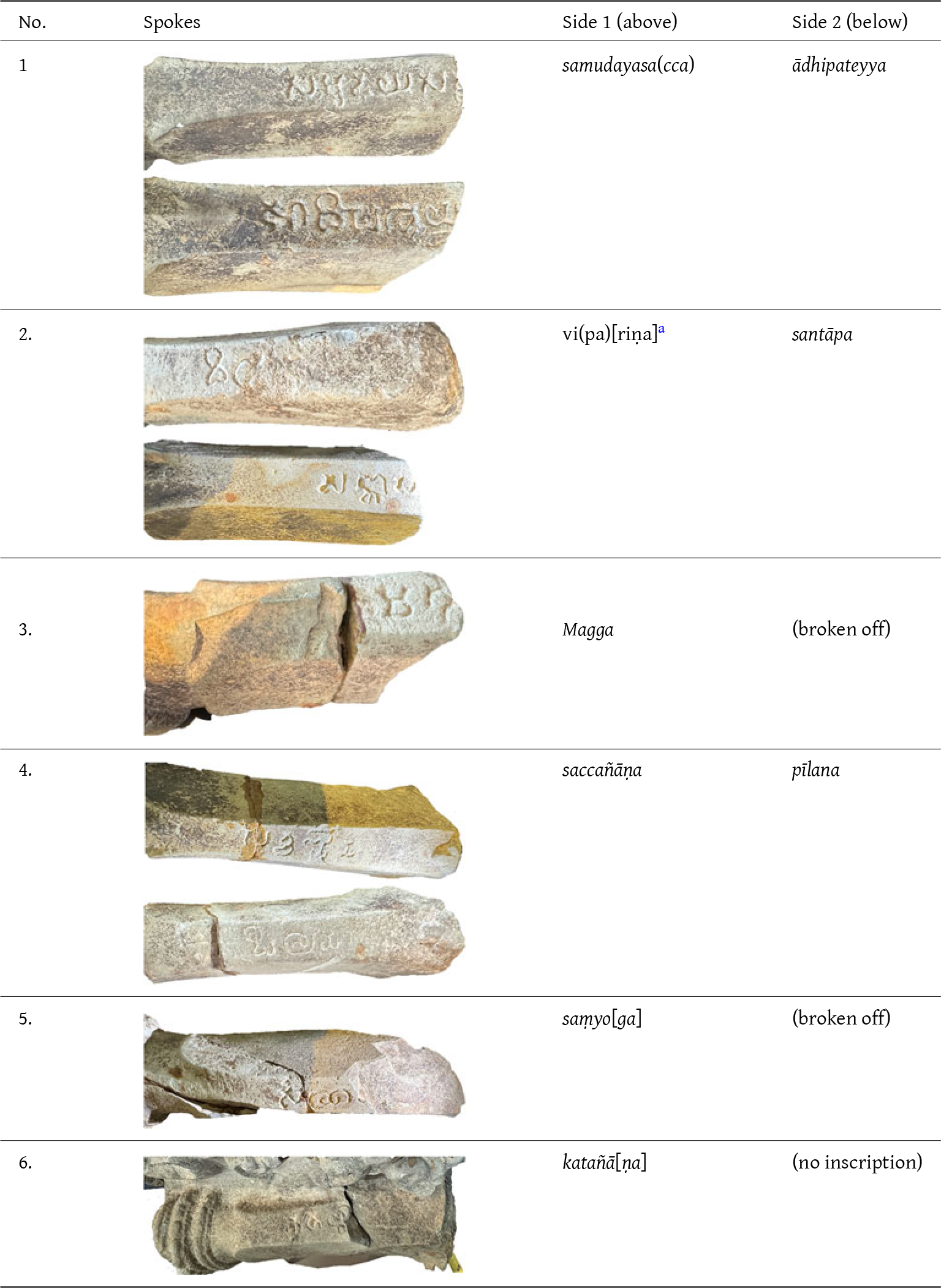
Not many spokes of the Chainat dhammacakka (Cn) survive. At the museum, there are only about 12 fragments of the possible 24–26 spokes of the wheel available for examination. Only six of these bear inscriptions; the rest are badly damaged with only the floral tips remaining. Most of the surviving spokes have been detached from the wheel. As a result, their placement is arbitrary and does not reflect the original order. Despite the fragmentary nature of the inscription on the spokes, we have been able to improve on the previously published readings. Certain keywords are identified, such as pīlana, santāpa, vipa[riṇa], saṃyo[ga], ādhipateyya, samudayasa[cca], magga, katañāṇa, and saccañāṇa (Table 2).
Inscriptions on the spokes

a We read the script as vi instead of dhi in the previous published reading as dhi is slightly broader in its circular shape.
Some of these keywords are part of the passage regarding the 16 aspects (soḷasa ākāra) that express the individual meanings of the four realities (see below). One part of this passage is also found in the inscriptions of the spokes of the Phra Pathom Chedi dhammacakka. Cœdès has numbered the relevant spokes of the Phra Pathom Chedi wheel as numbers 13, 14, and 15, which he reads as niyyānikahetudassanā, dhipateyyabhāvena maggasacce, and niyyānikahetudassanā respectively.Footnote 88 However, we read the inscription on spoke number 14 slightly differently from Cœdès; we read -ṭṭhena instead of -bhāvena, as the inscription appears to us as only showing one conjunct consonant syllable, and we think it is ṭṭhe rather than the two syllables bhāve (Figure 10).Footnote 89
Spoke number 14 (as in Cœdès, “Une Roue de la Loi avec inscription en Pāli”, 224, Figure 2) of the Phra Pathom Chedi dhammacakka. The picture is inverted (as reading of the inscriptions on the wheel is in counter-clockwise).
Line above: dhipateyya.
Line below: ṭṭhena maggasacca

This soḷasa ākāra passage can be found in the Paṭisambhidhāmagga (a canonical work of uncertain date, perhaps late centuries bce) and the works of the celebrated commentator Ācariya Buddhaghosa (fifth century ce), the Visuddhimagga (Vism), and the Samantapāsadikā (Vin-a), the commentary on the Vinaya (Discipline).Footnote 90
Skilling has discussed this particular passage in detail.Footnote 91 For our purpose here, it suffices to show how these keywords fit into the text, referring to the soḷasa ākāra passage from the Visuddhimagga (the Path of Purification). The extant inscriptions from Cn are highlighted in bold, and the readings from the Phra Pathom Chedi dhammacakka are underlined:
pīḷana -saṅkhata-santāpa-vipariṇām’-aṭṭhena vā dukkhaṃ ariyasaccaṃ,
āyūhana-nidāna-saṃyoga-palibodh’-aṭṭhena samudayaṃ,
nissaraṇa-vivekāsaṅkhata-amataṭṭhena nirodhaṃ,
niyyānika-hetu-dassanādhipateyyaṭṭhena maggaṃ Footnote 92
The reality of the noble ones regarding:
Suffering has the senses of (1) oppressing (2) being compounded (3) burning, and (4) change.
Origin has the senses of (5) accumulating, (6) source, (7) bond, and (8) obstructing.
Cessation has the senses of (9) final release, (10) solitude, (11) being uncompounded, and (12) free from death.
The path has the senses of (13) way out, (14) cause, (15) seeing, and (16) predominance. Footnote 93
The Paṭisambhidāmagga expresses these 16 aspects in a slightly different way to the passage above and utilizes the same keywords of these 16 aspects with the exception of saññoga instead of saṃyoga Footnote 94 in the Visuddhimagga.Footnote 95 At the moment, it is impossible to determine from which text the editor or scribe selected the readings for the inscriptions on the spokes. Despite the Paṭisambhidāmagga being included in the Khuddaka-nikāya of the Pali Suttapiṭaka, stylistically it is related to the Abhidhamma and commentarial literature.Footnote 96 Furthermore, the date of the Paṭisambhidhāmagga has not been determined, even approximately.Footnote 97 Nevertheless, what is certain is that the scribe has selected a composition related to the four realities which are in line with the dvādasākāra passage.
Other keywords invoke the four realities, like samudayasacca, magga likely to have been intended to be maggasacca,Footnote 98 emphasizing again the four realities, while the spokes referring to dukkhasacca and nirodhasacca are not extant. On the other hand, saccañāṇa and katañāṇa are parts of the three phrases (tipavaṭṭa) discussed above, while the middle referring to kiccañāṇa does not survive.
The octagonal pillar
Inscriptions of the Chainat octagonal pillar
Script Southeast Asian Brāhmī
Language Pali
Date Seventh century ce (twelfth-century Buddhist Era) (Inscriptions in Thailand Volume 1, Second Edition 2016)
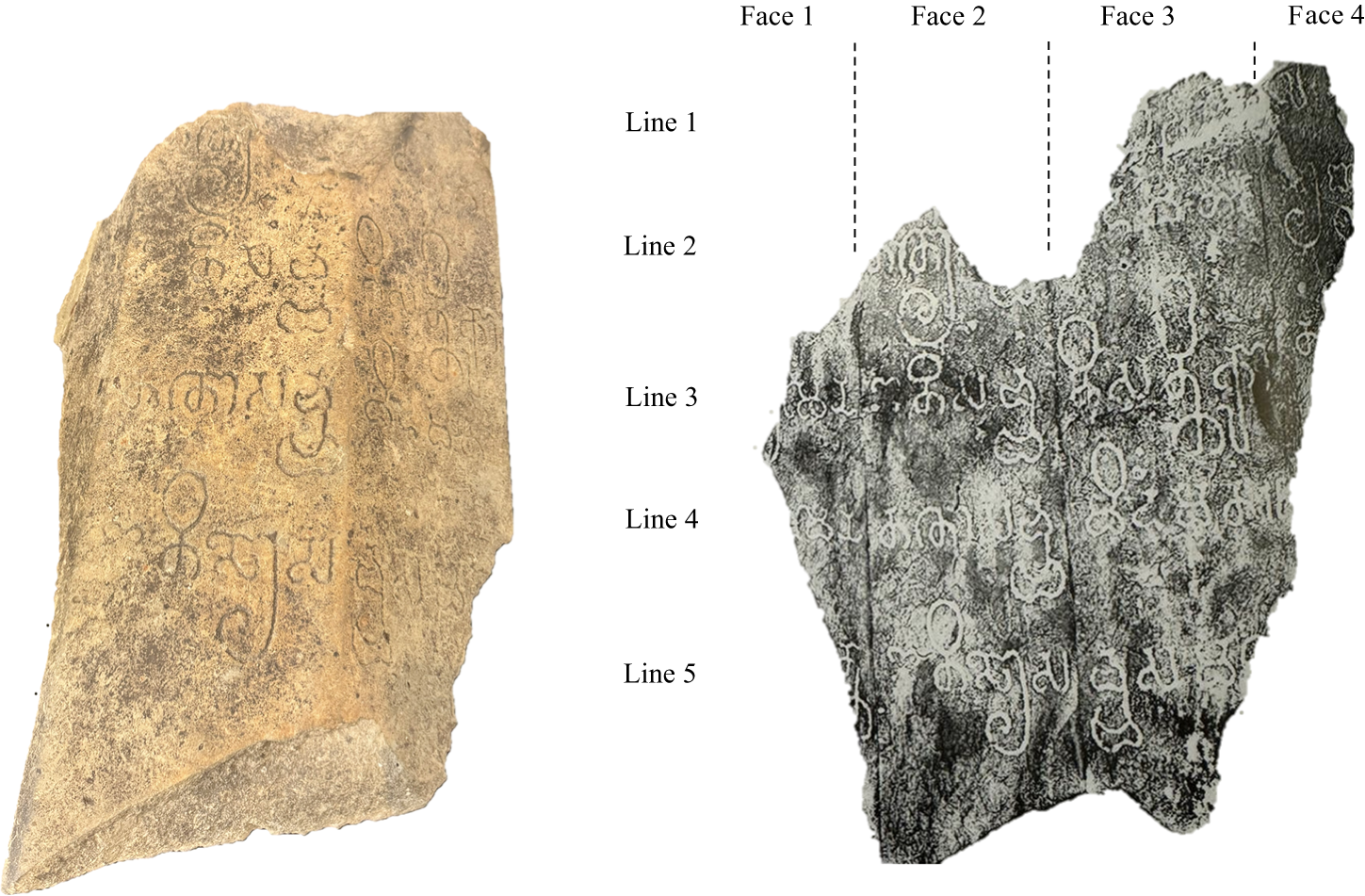
Sides/Lines Around the octagonal pillar. Four lines of inscriptions are extant
Support Stone
Dimensions Width at each flank of the octagonal pillar, 16 cm; Length (longest extant), 60 cm.
Number CN. 15
Date of discovery 5 October 1988
Place of discovery Village No. 5, Hang Nam Sakhon, Manorom District, Chainat Province, Thailand
Discoverer Dr Samnuan Palawatwichai
Present location Chainatmuni National Museum, Chainat
Rubbing Figure 11
Images
Figures 11, 12, and 15.
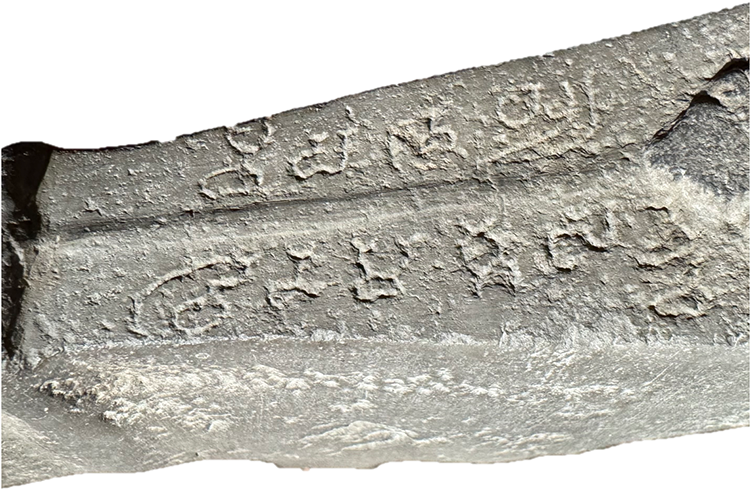
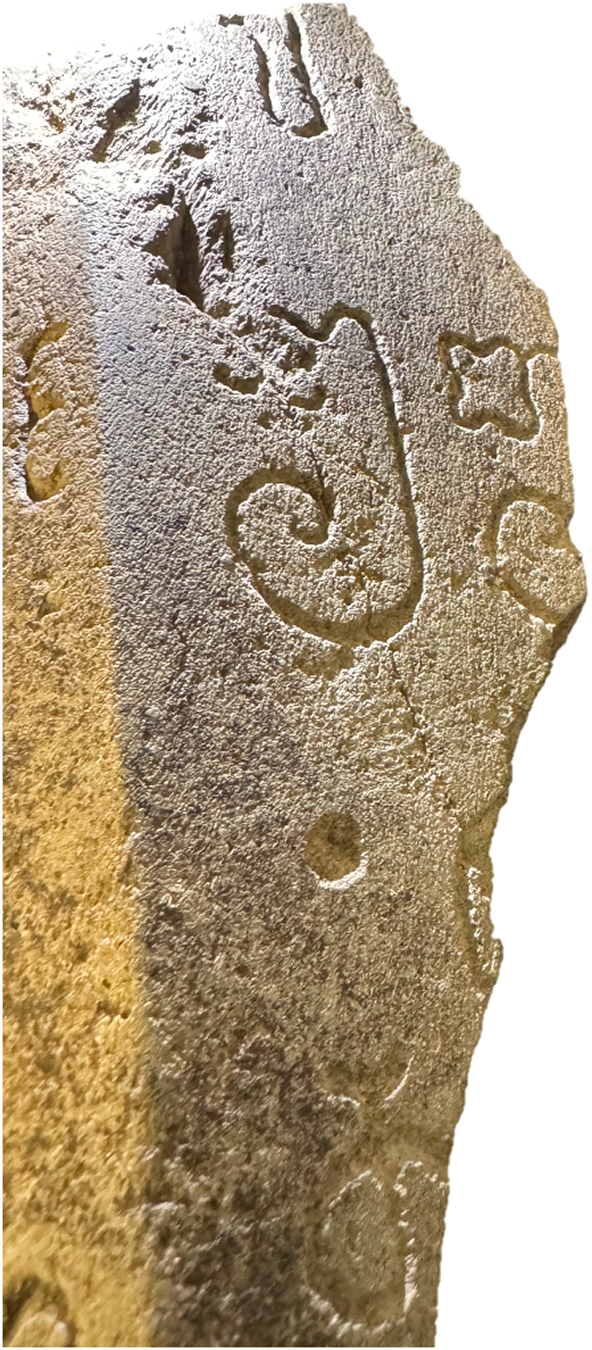
Fragment of the octagonal pillar and its rubbing. (Rubbing photo after Inscriptions in Thailand Volume 1, Second Edition 2016, 182) Face 4, on the centre is nābā, and on its left is the daṇḍa. Below nābā is the character taṃ, and part of the i of vi.


Publication history
-
1. Chaeme Kaewkly, “Dharmachakra inscription and octagonal pillar”, 179–82;
-
2. Charuk Wilaikaeo, “Archaeological work at U-Ta Pao”, 4–50;
-
3. The Fine Arts Department, Archaeology of U-Ta Pao, 33;
-
4. Christian Bauer, “Notes on Mon epigraphy”, 48–55 (palaeographic analysis);
-
5. Chaeme Kaewkly, “Pali inscriptions in Pallava script”, 40–53;
-
6. Peter Skilling, “New inscriptions from South-east Asia”, 133–51;
-
7. Inscriptions in Thailand Volume 1, Second Edition, 182–3;
-
8. U-tain Wongsathit, “Octagonal pillar inscription from Chainat”, 56–77.
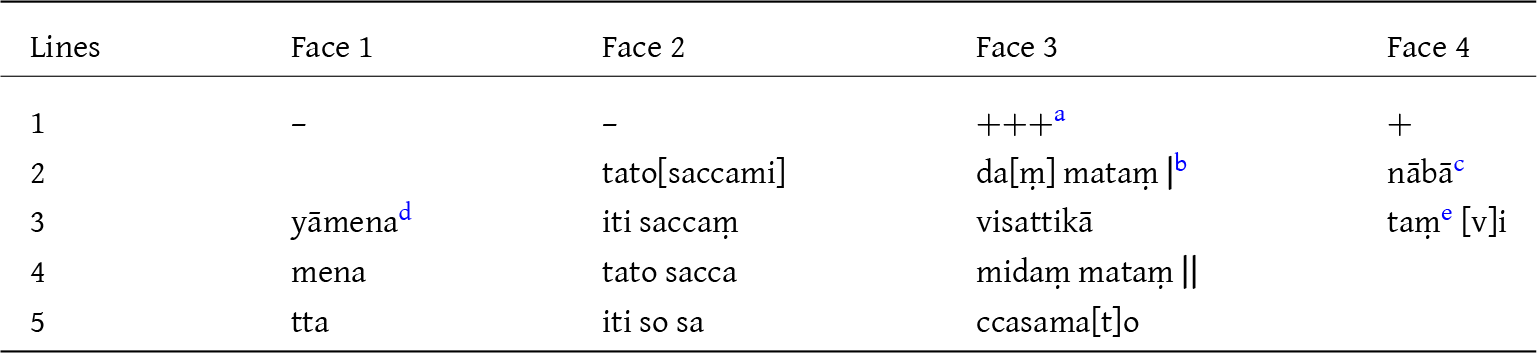
Readings

a Broken lines indicate the presence of a line of inscription, but it is too fragmentary to read.
b The punctuation daṇḍa (|) indicates that the reading in the line ends here and is not followed by nābā in the next face.
c Previously it was read as tobā (Chaeme Kaewkly, “Dharmachakra inscription and octagonal pillar”, 181, and “Pali inscriptions in Pallava script”, 47), Skilling noted that the reading could not be correct but did not propose any solution (Skilling, “New inscriptions from South-east Asia”, 136 and note 12). Nevertheless, U-tain Wongsathit got it right with nābā (U-tain Wongsathit, “Octagonal pillar inscription from Chainat”, 63). We now see that the reading is nābā, see Figure 12 .
d Yā is not in the rubbing, but from a small detached piece now restored.
e Taṃ is not in a parallel position with “visattikā” but slightly higher,
Sources of the text on the pillar
As pointed out by Skilling,Footnote 99 the counterparts of the inscriptions on the octagonal pillar occur in two commentarial works of Buddhaghosa, the Sammohavinodanī (Vibh-a, the Dispeller of Delusion) and the Visuddhimagga (Vism), when he explains the phrase “idaṃ dukkhan ti bhikkhave tathaṃ etam avitatham etam anaññatatham etaṃ” (Monks, this suffering is real, not unreal, not otherwise) from the Discourse on Reality (Tatha) of the Saṃyutta Nikāya.Footnote 100 The verses could also be traced in an early sixth-century commentary by Mahānāma, the Saddhammapakāsinī (Paṭis-a), a commentary on the Paṭisambhidhāmagga (Paṭis). At the beginning of Paṭis-a, Mahānāma explains that Sāriputta, one of the Buddha’s chief disciples, composed the Paṭisambhidhāmagga in order to explain the Dhammacakkappavattana Sutta, and thus, according to Norman, indicating that the main theme to attain liberation is by understanding the four realities.Footnote 101 The passage on the octagonal pillar is also found in a text that is later than the inscription, the Sāratthadīpanī, commentary on the Samantapāsadikā, (Vin-ṭ), which is a sub-commentary (ṭīkā) on the Vinaya. The Sāratthadīpanī was composed probably in the second half of the twelfth century during the reign of Parākkamabāhu I (1153–86 ce) of Laṅkā.Footnote 102 In the printed editions, the passage is as below:
-
1. Vism, Rhys Davids (ed.), The Visuddhi-magga, 496.17–30; Khemacari Thera et al. (eds), (Thai-script Syāmaraṭṭha edition), Visuddhimagga Pakaraṇavisesa, 79.14–80.3.Footnote 103
-
2. Vibh-a, Buddhadatta, ed. the Sammoha-vinodanī, 85.23–86.1 (similar passage as Vism with a small variant in the fifth verse, dukkhādisv’ avisesena instead);Footnote 104
-
3. Paṭis-a I, Joshi (ed.), the Saddhammmappakāsinī, 63.6–28;Footnote 105
-
4. Vin-ṭ, Kitti Sobhana Thera et al. (eds) (Thai-script Syāmaraṭṭha edition), the Sāratthadīpanī Vinayaṭīkā Samantapāsādīkā Vaṇṇanā, 76;Footnote 106 the Mahavagga-ṭīkā, 1.14 in Chaṭṭhasaṅgāyana Tipiṭaka Version 4 (CST4).
The passage contains five verses, one for each of the four realities in due order followed by a concluding verse. Below we provide the five verses from the Visuddhimagga edited by Caroline A.F. Rhys Davids. The phrases extant on the pillar inscription are presented in bold.

Translation
Bhikkhu Ñāṇamoli translated these verses in his translation of the Visuddhimagga, the Path of Purification, in 1956, first published by Ananda Semage of Colombo and later by the Buddhist Publication Society (BPS).Footnote 109 An earlier English translation of these verses was provided by Pe Maung Tin in his 1931 translation of the Visuddhimagga as the Visuddhimagga, The Path of Purity, and published by The Pali Text Society in three volumes.Footnote 110 The passage here seems to provide the ontological and epistemological meaning of the word sacca, which we interpret in this article as “reality”. Here, we reproduce Bhikkhu Ñāṇamoli’s translation with minor modifications, such as replacing the word “truth” with “reality” for sacca.Footnote 111 Phrases that are extant in the inscription are highlighted.Footnote 112
There is no pain but is affliction,
And naught that is not pain afflicts:
This certainty that is afflicts
Is what is reckoned here as reality.
No other source of pain than this, Footnote 113
Nor aught that source provides but pain:
This certainty in causing pain
Is why craving Footnote 114 is considered reality.
There is no peace except nibbāna,
Nibbāna cannot but be peace;
This certainty that it is peace
Is what is reckoned here as reality.
No outlet other than the path,
Nor fails the path to be the outlet:
Its status as the very outlet
Has made it recognized as reality.
This real infallibility
Which is their true essential core,
Is what the wise declare to be
Reality’s meaning common to all four.
Associated finds
Two lions
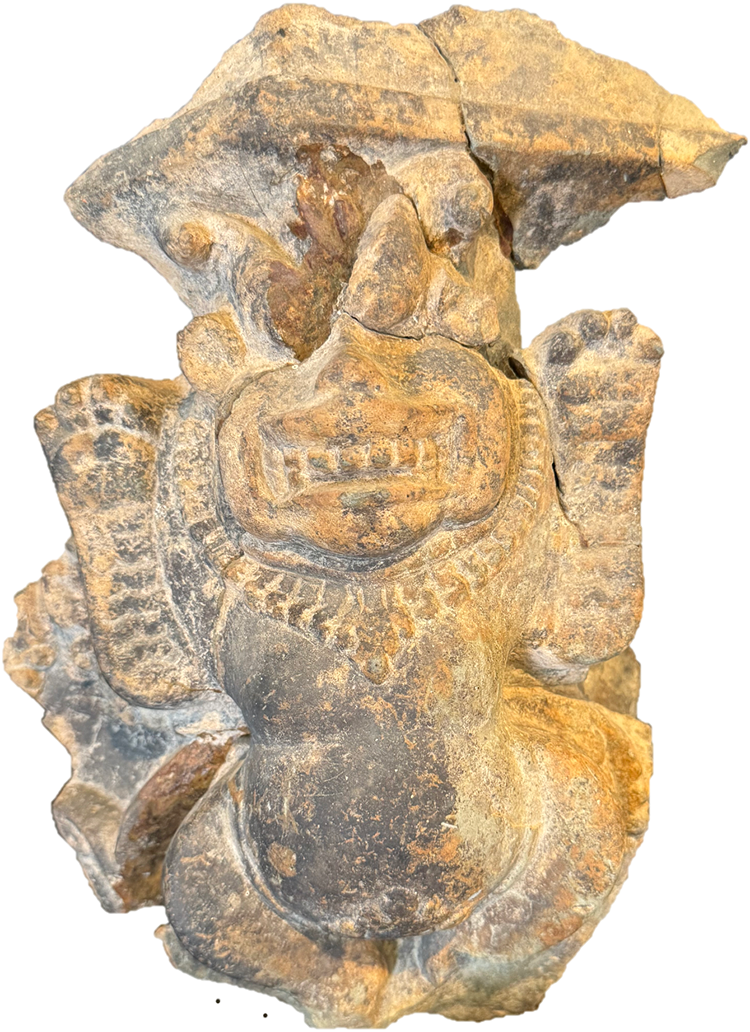
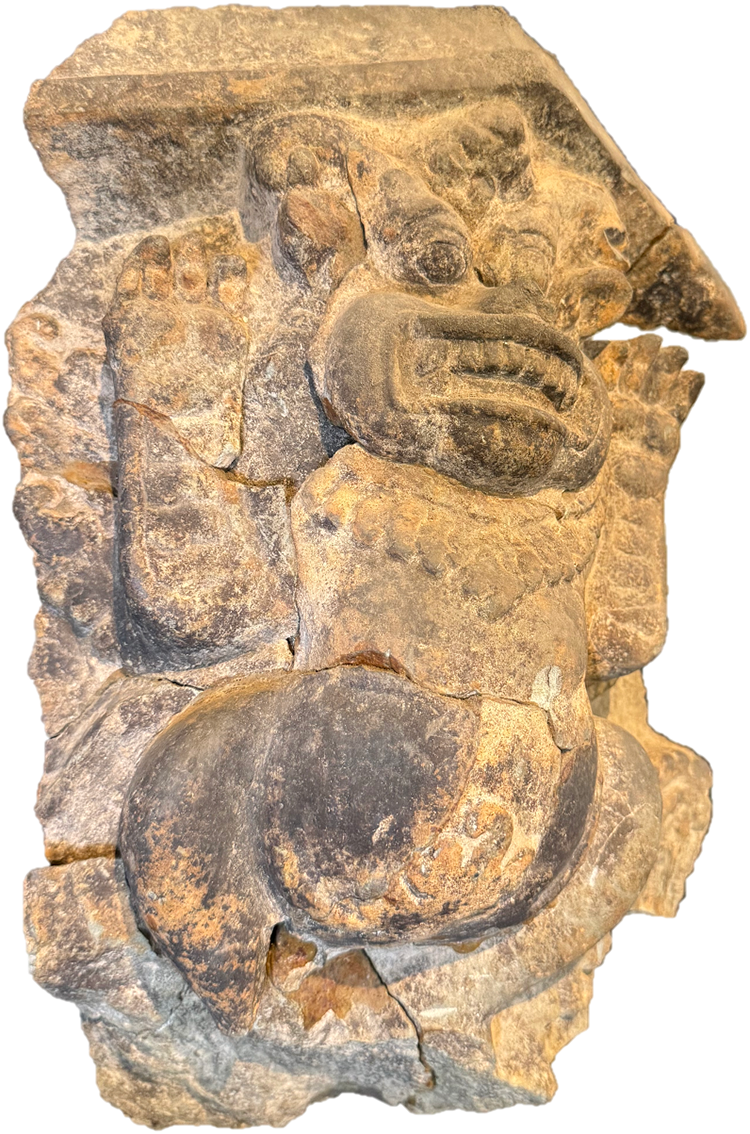
Two lion sculptures (Figures 13 and 14) were found among the fragments of the Chainat dhammacakka. Their design and features belong to the “Dvāravatī style” of art. The two raised forearms of these lions closely resemble the lion-like relief at the end of a stone fragment thought to be part of the Buddha’s throne found at Wat Phra Meru in the ancient city of Nakhon Pathom.Footnote 115 A similar raised forearm is also depicted on the stucco lion sculpture found in Stupa No. 1 at Khok Mai Den and a lion sculpture kept at U-Thong National Museum in Suphanburi province.Footnote 116 The head and mane of these two lions of Chainat closely resemble the one found at the northern side of Stupa No. 3 at Khok Mai Den.Footnote 117 On the evidence of its stucco art, Dvāravatī was a veritable pride of lions, engagingly fashioned in striking poses with lively and expressive faces.Footnote 118
Lion 1. Size: 28 cm (H) and 17 cm (W)

Lion 2. Size: 28 cm (H), 19 cm (W)

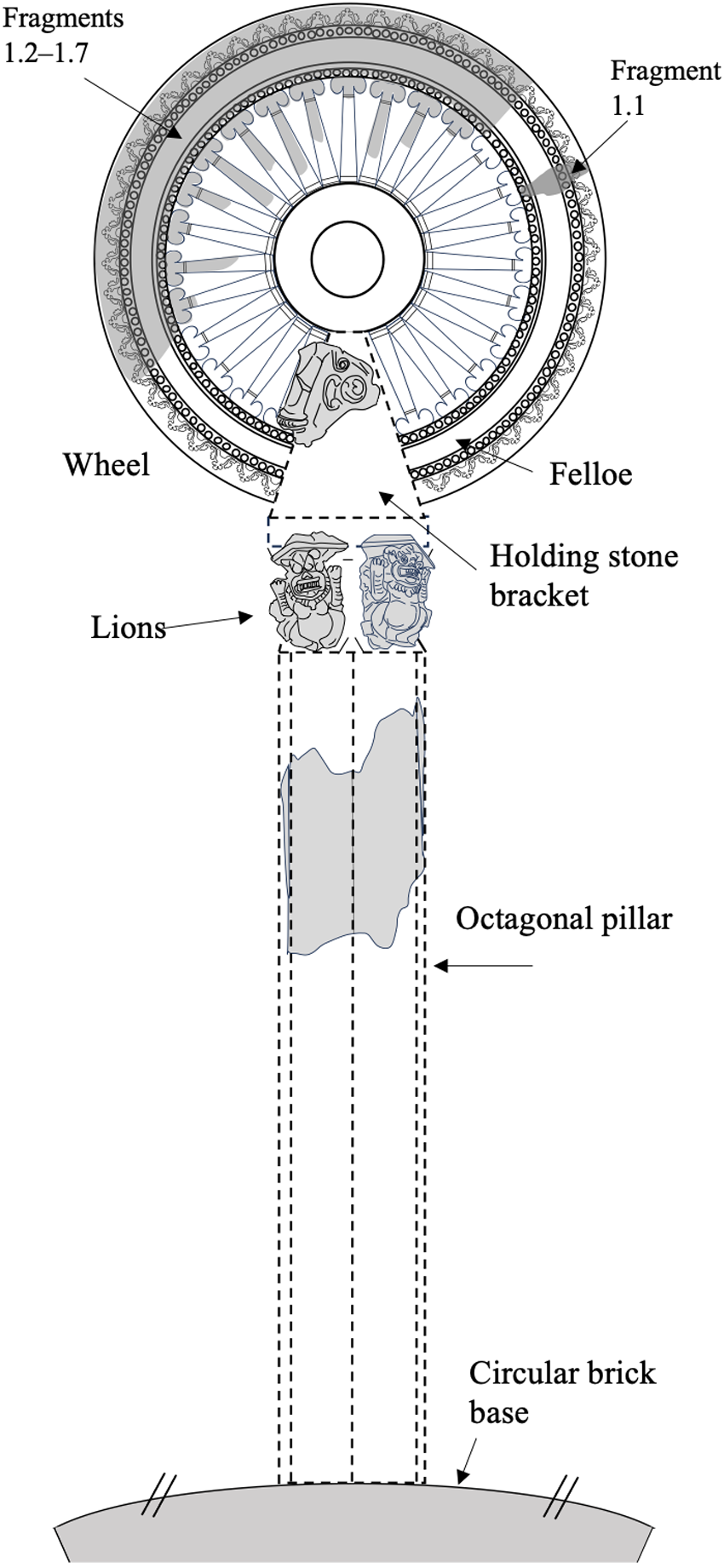
Their presence brings to mind the relief image of the four-lion capital (only three depicted) surmounted by a dhammacakka displayed on the southern gateway of the first-century ce Sanchi stupa No. 3.Footnote 119 The angled-flat structure above the two Chainat lions indicates that it could be the abacus that supported the holding stone bracket and the wheel (Figure 15). This arrangement could be similar to the structure of four pot-bellied dwarfs on a rectangular pillar supporting the architrave of the same Sanchi stupa gateway, just above the wheel and lion relief. As the Chainat dhammacakka structural complex is very fragmentary, it is uncertain whether there were four lions in the original structure of which only two survived or whether the original design included only two lions. If there were only two lions, either the other two would have represented different animals or there may have just been a filler structure with floral design.Footnote 120 A single unprovenanced fragment in the Somdet Phra Narai National Museum in Lopburi points to the existence of similar iconographic conceptions elsewhere in the adjacent cultural areas. Nevertheless, this reveals an Indic referentiality of dhammacakka complex even if it reveals the concretization of local inspiration.
Artistic conceptualization of the Chainat dhammacakka and supporting pillar (not to scale). Shaded areas indicate extant portions.

Holding stone bracket
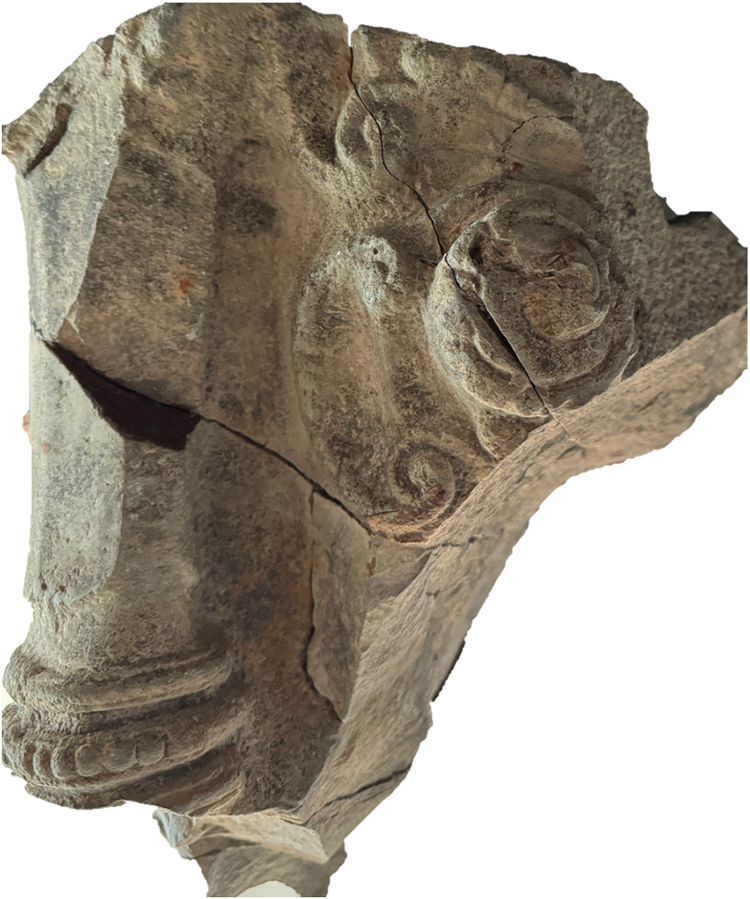
A stone block, thought to be part of the holding stone bracket that held the wheel in an upright position, was also recovered (Figure 16). The block consists of a spoke, with one side of the spoke bearing the inscription katañā[ṇa] (No. 6, Table 2 above). The design of the holding stone bracket is difficult to determine due to its fragmentary nature, but most likely it is triangular in shape and part of it seems to be a sort of floral design.Footnote 121
Part of the holding stone bracket and a spoke

Remnants of a deer statue
The excavation report mentions that fragmentary pieces of the mouth, nose and ear of a deer statue were recovered.Footnote 122 We have not had the chance to examine these pieces as they are not on display at the museum. Nevertheless, a pair of deer, symbolizing the Deer Park in Sarnath where the Buddha delivered the first sermon on Dhammacakkappavattana which carries the message of the four realities has been associated with the dhammacakka wheel elsewhere in Thailand. For example, the Phra Pathom Chedi dhammacakka in Nakhon Pathom is accompanied by a deer.Footnote 123
Conclusion
The four realities do not signify or have any special relation to the Theravāda tradition alone. They are shared by all the known Āgama/Sūtra traditions and available Vinayas. They are also shared by the known scholastic traditions, where they are set into different exegetical interpretations. In addition to the Theravāda systems explicated in the Vibhaṅga, Visuddhimagga, and the Paṭisambhidāmagga and their commentaries as seen in this article, there are detailed Vaibhāṣika systems in the Abhidharmakośa and other works;Footnote 124 and a Sāṃmitīya system recorded in Daśabalaśrīmitra’s Saṃskṛtāsaṃskṛta-viniścaya, preserved in Tibetan translation;Footnote 125 the Mūlasarvāstivāda Vinaya, the Saṃghabhedavastu preserved in Sanskrit;Footnote 126 and the Sarvāstivāda Vinaya preserved in Chinese.Footnote 127 Epigraphic examples of the four realities continue to come to light, for example, in 1991, a stone slab inscription was found at Cave II in Bagh, Madhya Pradesh, India, detailing the four realities in a Middle Indic language.Footnote 128
The four realities are the basis of much Buddhist exegesis. Vaipulya/Mahāyāna dharmaparyāyas elaborate on the four realities, for example, the Prajñāpāramitās, the Akṣayamatinirdeśa, the Bodhisatvapiṭaka, and many others. Nāgārjuna presents a robust exposition of the realities in relation to emptiness in his Mūlamadhyamaka-kārikā.Footnote 129
The epigraphic record shows that the Buddhist intellectuals of Dvāravatī valued the four realities highly and were familiar with the Paṭisambhidāmagga system. They appear to have adopted the four realities as the didactic frame of their Buddhism as exemplified in the saccakiccakatañāṇa verse. Their epigraphic use of categories from the Paṭisambhidāmagga is noteworthy. The Dvāravatī inscriptions count among the oldest evidence for this work of scholasticism: they can hardly prove or even suggest that the Paṭisambhidāmagga circulated in Southeast Asia in its present form, but they do prove a familiarity with its teachings. The Paṭisambhidāmagga is unknown to other schools apart from the Theravāda either as a system or a work, but at least by the time of the Mahāvihāra (of Sri Lanka) master Buddhaghosa the work had been canonized by inclusion in the Theravāda Khuddaka-nikāya. Although the production of ornate and monumental dhammacakkas is not seen in other cultures where Theravāda was practised, the use of Pali, both on the dhammacakkas themselves and in adjacent/nearby inscriptions found at the same sites, we may surmise that the production of dhammacakkas was a unique ritual or devotional practice characteristic and distinctive of the Theriya culture of ancient Dvāravatī.
In conclusion, the four sacca were iconic in ancient Dvāravatī, to use this tired term overworked by current fashion. They are iconic in the sense of exemplary teachings and iconic in terms of visual representations as dhammacakkas and attendant deer and/or lions. This iconography developed in India, where it is seen in stone reliefs from south to north, and is eventually exemplified in the symbolic conjunction of the Dhamma wheel flanked by a pair of deer, for example, in the clay seals of the great vihāra of Nālandā in northern India and on the stone sculptures of Phanagiri in Telangana. To this day the motif graces the central roof-ridge of Tibetan monasteries around the world.
Acknowledgements
We sincerely thank Santi Pakdeekham for sharing his wide knowledge with us and Somneuk Hongprayoon, and Natthawat Channgaṃ (Ming) for their skilled photographic documentation and their technical and logistical support. We also thank Laksana Janechang (Khun Kung) for her smooth coordination. We express our appreciation to the staff at the Chainatmuni National Museum, especially the director, Dongaor Pengcha-oum (ดงอ้อ), for readily granting us the opportunity to study the wheel and related objects carefully. We are also indebted to the staff of Newark Museum (New Jersey, USA), especially Alison Edwards, Andrea Ko, Atteqa Ali, and Heidi Warbasse, for providing photographs of the Newark wheel. Special thanks are due to the Fragile Palm Leaves Foundation and the Henry Ginsburg Fund, and especially to the Khyentse Foundation for its continuous support of our endeavours. We express our appreciation to the two reviewers for their input and valuable comments, and to Disapong Netlomwong of the Office of the National Museum and Trongjai Hutangkura of the Princess Maha Chakri Sirindhorn Anthropology Centre (Public Organization) for their support. In addition, we are happy to thank Rosemarie Oong, and Vijaya Samarawickrama for their assistance.
Conflicts of Interest
None

 Open access

