




Introduction
In 2020 the Covid-19 pandemic took the world by surprise. In England neither the government nor the Church had prepared sound plans for such contingencies. On 23 March 2020 the government imposed a lockdown on the nation. The following day the Church of England imposed a lock-up on all its churches. Churches were closed almost completely: they were closed for private prayer in a way that impacted the laity, and they were closed even for the clergy who were obliged to livestream eucharistic worship from their home. Churches remained open only for essential services, like foodbanks. Writing in Journal of Anglican Studies, McGowan (Reference McGowan2020) observed how such disruption may impact the wellbeing of Anglicans at a time of national emergency, noting that:
The problems were immediate and obvious, except perhaps to the Archbishops and their immediate staff. Many worshippers, not just clergy, wanted to be connected with the spaces and places that meant so much to them. (McGowan, Reference McGowan2020, p. 3)
Working as empirical theologians, responding to the dominical call to observe, map, and monitor patterns of growth and decline in responses to the reign of God (see Francis & Village, Reference Francis and Village2015), we worked with a group of colleagues and in collaboration with the Church Times to design the Coronavirus, Church & You online survey, using the Qualtrics XM platform. The survey was launched on 8 May 2020 with a link distributed through the Church Times and a number of participating Church of England dioceses. The survey was closed 23 July 2020, by which time there were over 7,000 responses, 5,347 of which were from respondents affiliated with the Church of England. The survey included a number of strands that led to a range of publications, including work reported by Francis and Village (Reference Francis and Village2021a, Reference Francis and Village2021b, Reference Francis and Village2022a), Francis, Village, and Lawson (Reference Francis, Village and Lawson2020), Francis, Village, and Lewis (Reference Francis, Village and Lewis2021), Village and Francis (Reference Village and Francis2020, Reference Village and Francis2021a, Reference Village and Francis2021b, Reference Village and Francis2021c), and McKenna (Reference McKenna2022, Reference McKenna2023).
By the time of the third national lockdown in England at the beginning of 2021, and having learned a great deal from the Coronavirus, Church & You survey, we were ready to design and launch a second survey, again on the Qualtrics XM platform, and again promoted by the Church Times and a number of Church of England dioceses. The Covid-19 & Church-21 survey was live between 22 January and 23 July 2021. This second survey also included a number of strands that led to a range of publications, including work reported by Francis, Village, and Lawson (Reference Francis, Village and Lawson2021), Village (Reference Village2022), Village and Francis (Reference Village and Francis2022a, Reference Village and Francis2022b, Reference Village and Francis2022c, Reference Village and Francis2022d, Reference Village and Francis2023a, Reference Village and Francis2023b), and Francis and Village (Reference Francis and Village2023). This second survey was slightly shortened and adapted to suit the USA context of the Episcopal Church. It is data from this survey on which the present paper builds.
Focusing on Psychological Wellbeing
A core strand of the Coronavirus, Church & You survey concerned the assessment of psychological wellbeing among both clergy and laity. Our understanding of psychological wellbeing had been shaped by our previous research into clergy work-related psychological wellbeing and professional burnout. Initially we had worked with the three component model of burnout proposed by the Maslach Burnout Inventory (MBI; Maslach & Jackson, Reference Maslach and Jackson1986) among various groups of clergy in the UK including Anglican clergy (Francis & Rutledge, Reference Francis and Rutledge2000; Rutledge & Francis, Reference Rutledge and Francis2004; Hills, Francis, & Rutledge, Reference Hills, Francis and Rutledge2004; Francis & Turton, Reference Francis, Turton, Hermans and Moore2004a, Reference Francis, Turton, Herl and Berman2004b; Randall, Reference Randall2004, Reference Randall2007, Reference Randall2013; Rutledge, Reference Rutledge2006; Turton & Francis, Reference Turton and Francis2007), Catholic priests (Francis, Louden, & Rutledge, Reference Francis, Louden and Rutledge2004; Francis, Turton, & Louden, Reference Francis, Turton and Louden2007), and Pentecostal pastors (Kay, Reference Kay2000). These studies caused us to challenge the conceptualisation of the MBI on three grounds: that the items were a poor fit for clergy experience; that the three factor structure was uncertain; and that the theoretical model failed to offer strategic preventative insights. This challenge led to the development of the Francis Burnout Inventory (FBI; Francis, Kaldor, Robbins, & Castle, Reference Francis, Kaldor, Robbins and Castle2005). The FBI conceptualises poor work-related psychological wellbeing and professional burnout in terms of the classic balanced affect approach to wellbeing (Bradburn, Reference Bradburn1969). According to this approach, positive affect and negative affect operate as partially independent systems within which positive affect can ameliorate the deleterious consequences of negative affect. The preventative and therapeutic consequence of the model is that intervention strategies can be targeted to enhance positive affect more readily than the removal of the causes of negative affect.
Within the broader field of the psychology of individual differences, Bradburn was by no means alone in identifying the independence of the two psychological systems of positive affect and negative affect. For example, the PANAS scales, developed by Watson, Clark, and Tellegen (Reference Watson, Clark and Tellegen1988) have gained good recognition in the field, with the two ten-item scales of positive affect (PA) and negative affect (NA) recording levels of internal consistency reliability ranging between .84 and .90. Repeated studies have generally confirmed the factor structure of these two measures, including most recently data reported by Díaz-García, González-Robles, Mor, Mira, Quero, García-Palacios, Baños, and Botella (Reference Díaz-García, González-Robles, Mor, Mira, Quero, García-Palacios, Baños and Botella2020).
In the FBI negative affect is assessed by the Scale of Emotional Exhaustion in Ministry (SEEM) and positive affect is assessed by the Satisfaction in Ministry Scale (SIMS). The factor structure, internal consistency reliability and construct validity of the FBI has been tested in a series of studies among clergy serving in The Presbyterian Church USA (Francis, Village, Robbins, & Wulff, Reference Francis, Village, Robbins and Wulff2011), clergy serving in the Church of England (Francis, Laycock, & Brewster, Reference Francis, Laycock and Brewster2017a; Francis, Laycock, & Ratter, Reference Francis, Laycock and Ratter2019), Catholic priests and religious sisters serving in Italy (Francis, Laycock, & Crea, Reference Francis, Laycock and Crea2017; Francis, Crea, & Laycock, Reference Francis, Crea and Laycock2017, Reference Francis, Crea and Laycock2021), Anglican clergy serving in the Church in Wales (Village, Payne, & Francis, Reference Village, Payne and Francis2018), and Methodist circuit minsters serving in Great Britain (Francis, Village, & Haley, Reference Francis, Village and Haley2023).
Designing the Coronavirus, Church & You survey we recognised that what we needed was not a measure of psychological wellbeing per se, but a measure of perceived change in psychological wellbeing. For this reason we developed for the survey a new measure that we styled The Index of Balanced Affect Change (TIBACh). In the foundation paper for this measure, Francis and Village (Reference Francis and Village2021b) tested a pool of items following the prompt, ‘How would you rate the effect of the lockdown on you so far?’ Each item was rated on a three-point bipolar scale to indicate whether that aspect of wellbeing had declined, increased or remained unchanged during the lockdown. Exploratory factor analysis (principal components extraction and varimax rotation) indicated two factors of five items each that represented positive effect (excitement, thankfulness, hopefulness, trust, and happiness) and negative affect (exhaustion, anxiety, stress, fatigue, and frustration). Positive affect items were coded so that a high score indicated an increase in positive aspects of wellbeing during the lockdown (α = .70); negative affect items we coded so that a high score indicated an increase in negative aspects of wellbeing during the lockdown (α = .83). Construct validity was tested against an independent measure of coping during lockdown. Coping was positively correlated with positive affect and negatively correlated with negative affect. Crucially, for the balanced affect model, there was a significant interaction effect of positive and negative affect on coping, showing that the ameliorating effect of positive affect on coping increased with increasing levels of negative affect.
Exploring Change in Psychological Wellbeing in England
Drawing on data from the Coronavirus, Church & You survey and the Covid-19 & Church-21 survey among clergy and laity in England, we employed TIBACh in a sequence of six papers that enabled us both to test the instrument and to draw out a cumulative picture of the correlations of individual differences in perceived changes in positive and negative affect during the pandemic. In the first paper, Village and Francis (Reference Village and Francis2021c) analysed together responses of Anglican clergy and laity to the first survey. Their findings drew attention to the importance of personality factors (poor wellbeing was associated with high neuroticism scores), personal factors (poor wellbeing was associated with younger people), ecclesial factors (poor wellbeing was associated more with Anglo-Catholics than with Evangelical Anglicans), with environmental factors (poor wellbeing was associated with inner city living), and with social factors (poor wellbeing was associated with lack of interpersonal support).
In the second paper, Village and Francis (Reference Village and Francis2022d) combined data from the first and second survey to explore how the psychological wellbeing of Church of England clergy and laity changed from the first to the third national lockdown. The core finding from this study was that both clergy and laity showed increased proportions reporting lower positive affect and increased proportions reporting higher negative affect in the second survey, suggesting psychological wellbeing had continued to deteriorate as lockdown persisted.
In the third paper, Village and Francis (Reference Village and Francis2022a) focused especially on the effect of sources of support for Church of England clergy and laity during the third national lockdown. Among lay people sources of support were more effective in enhancing positive affect than in mitigating negative affect. Significant mitigation of negative affect (at the .001 level of probability) was recorded only by friends. Significant enhancement of positive affect (at the .001 level of probability) was recorded not only by friends, but also by extended family, the congregation, the Church nationally, the local clergy and the local lay ministers. Among clergy in the second lockdown there was a shift in the effectiveness of support from what had been reported in the first lockdown. In the second lockdown clergy were reporting more effective support from their bishop and from their diocese.
In the fourth paper, Village and Francis (Reference Village and Francis2023a) turned their attention to theological issues and explored the connection between perceived change in psychological wellbeing during the pandemic and belief in divine control over the pandemic. In this study they drew on data from the second survey provided by 1,841 lay or ordained members of the Anglican Church residing in England. After controlling for personal factors, their data demonstrated a positive association between belief in divine control and increase in positive affect, but no association between belief in divine control and change in negative affect.
In the fifth paper, Village and Francis (Reference Village and Francis2023b) turned their attention to spiritual practices and explored the connection between spiritual wellbeing and perceived change in mental and physical health. This study employed a newly-constructed five-item scale of perceived change in spiritual health. The five items concerned perceived change in personal prayer, Bible reading, quality of spiritual life, trust in God, and spiritual health. In this study the TIBACh was employed as a control variable. Their data demonstrated that, after controlling for changes in psychological wellbeing, better change in spiritual wellbeing was positively correlated with better change in both mental health and physical health.
In the sixth paper, Francis and Village (Reference Francis and Village2023), turned their attention to the impact of the move to the digital and online expression of church. Drawing on data provided by 544 Church of England clergy under the age of 70, they differentiated between the effect of engagement with digital/online church and attitude toward online church by employing two behavioural measures and an attitudinal measure. The findings from this study both confirmed the greater predictive power of the attitudinal measure and demonstrated how the variance predicted by the behavioural measure was absorbed by the attitudinal measure. Francis and Village (Reference Francis and Village2023) argued that these findings held implications both for future research among clergy and for intervention strategies. Future clergy-related research may benefit from giving attention to attitudinal measures. Future intervention strategies designed to enhance clergy wellbeing may be advised to focus on shaping attitudes alongside fostering behavioural skills.
Research Aim
Against this background, the aim of the present study is to draw on the data from the Covid-19 & Church-21 survey administered in the USA to examine the perceived change in psychological wellbeing (as identified by TIBACh) among clergy in the USA serving in the Episcopal Church during the 2021 Covid-19 pandemic, and to employ the individual differences approach (as refined in the analyses of the comparable English data) to identify the salient predictors of variability within these changes. The individual differences approach, employed in this way, can be interpreted to identify those more vulnerable to or more resilient against poor psychological wellbeing, and to propose intervention strategy. In light of the analyses of the comparable English data seven sets of predictor variables have been identified for inclusion within the analyses among Episcopal clergy, and were available within the data set. These concern personal factors, psychological factors, contextual factors, ministry status, church orientation, theological stance, and attitudinal factors. Further clarification is needed in respect of our approach to psychological factors, church orientation, theological stance, and attitudinal factors.
Psychological factors in terms of personality have emerged as core predictors of wellbeing among clergy (Francis, Reference Francis and Brouwer2018). The model of personality employed within the Coronavirus, Church & You survey and the Covid-19 & Church-21 survey was psychological type theory as grounded in the work of Jung (Reference Jung1971) and operationalised by the Francis Psychological Type and Emotional Temperament Scales (FPTETS; Village & Francis, Reference Village and Francis2023c). Psychological type theory was selected, rather than the Big Five Factor Model of personality (Costa & McCrae, Reference Costa and McCrae1985), the Three Major Dimensions of Personality (Eysenck & Eysenck, Reference Eysenck and Eysenck1991), or the 16 Personality Factors (Cattell, Eber, & Tatsuoka, Reference Cattell, Eber and Tatsuoka1970) in light of its better fit with a theology of individual differences that distinguishes between personality and character. In particular, the work of Lloyd (Reference Lloyd2008, Reference Lloyd2012, Reference Lloyd2015, Reference Lloyd2022) has critiqued the implicit value assumptions within the Big Five Factor Model of personality that confuse personality and character. The psychometric properties of the Francis Psychological Type Scales (FPTS) have been well supported in studies among clergy (see Francis, Laycock, & Brewster, Reference Francis, Laycock and Brewster2017b; Francis & Village, Reference Francis and Village2022b; Payne, Lewis, & Francis, Reference Payne, Lewis and Francis2021; Village, Reference Village2021). The psychometric properties of the more recent FPTETS has been documented by Village and Francis (Reference Village and Francis2022e, Reference Village and Francis2023c).
Church orientation emerged from the English surveys as relevant for predicting individual differences in wellbeing among clergy. In these surveys church orientation was conceptualised and operationalised in the tradition pioneered by Randall (Reference Randall2005). Consolidating earlier work reported by Francis and Lankshear (Reference Francis and Lankshear1995a, Reference Francis and Lankshear1995b, Reference Francis and Lankshear1996), and by Francis, Lankshear, and Jones (Reference Francis, Lankshear and Jones1998, Reference Francis, Lankshear and Jones2000), Randall (Reference Randall2005) developed and tested two semantic differential grids: one to map the differences between Anglo-Catholic, Broad Church, and Evangelical positions within the Church of England, and the second to assess the influence of the Charismatic movement. The validity and utility of these measures were further tested by the two earlier Church Times surveys conducted in 2001 and 2013 as reported by Francis, Robbins, and Astley (Reference Francis, Robbins and Astley2005) and Village (Reference Village2018a). In the Church of England, Anglo-Catholics tend to be liberal on moral issues and prefer traditional worship, while the reverse is true for Evangelicals (Village, Reference Village, Anthony and Ziebertz2012, Reference Village2018b).
Theological stance also emerged from the English surveys as relevant for predicting individual differences in wellbeing among clergy. In these surveys theological stance was conceptualised and operationalised in the tradition pioneered by Village (Reference Village2018b). In a detailed investigation among 9,339 ordained and lay members of the Church of England, Village (Reference Village2018b) demonstrated that it was misleading to construe the distinction between theological conservatism and theological liberalism as a single continuum. Rather the data suggested three continua, operating in somewhat different ways, distinguishing among preference for modern versus traditional worship, preference for liberal versus conservative doctrinal belief, and preference for liberal versus conservative views on morality.
Attitudinal factors were introduced into models exploring individual differences in clergy psychological wellbeing by Francis and Village (Reference Francis and Village2023). Within an individual differences approach to psychology, there is a long-established tradition that conceptualises attitudes as concerning affective responses differentiated from cognitive (beliefs) responses and behavioural (activities) responses (see Fishbein, Reference Fishbein1967). In their analysis, Francis and Village (Reference Francis and Village2023) found that, among clergy, affective (attitudinal) responses toward the future served as a significant predictor of psychological wellbeing, after personal, psychological, contextual, ecclesial, theological, and behavioural factors had been taken into account. The current data for the USA contained two relevant attitudinal measures concerning confidence in the digital/online future and pessimism about the offline future.
Method
Procedure
The Covid-19 & Church-21 survey was originally designed in association with the Church Times to explore the impact of the pandemic on Anglican clergy and laity in England. It was opened on the Qualtrics XM platform on 22 January and closed on 23 July 2021. This survey was slightly shortened and adapted to suit the USA context of the Episcopal Church. There it was publicised and distributed through Virginia Theological Seminary, was live from 1 June to 23 August 2021 and attracted over 5,000 responses from across the USA. An overview of the responses from laity and clergy from the Episcopal Church were published by Village and Francis (Reference Village and Francis2021d).
Measures
Personal variables included sex (male = 0, female = 1), ethnicity (white = 1, not white = 0), and age (by decade 18–29 = 2, 30s = 3, 40s = 4, 50s = 5, 60s = 6, 70s = 7, 80+ = 8).
Contextual variables differentiated between those living alone (=1) and those living with others (=0) and created dummy variables for those with children (aged 0 to 12) or for those with teenagers (aged 13 to 18) living with them.
Ministry status differentiated among stipendiary parochial, stipendiary extra-parochial, self-supporting ministry active, self-supporting ministry retired, retired stipendiary with active bishop’s license, and retired stipendiary no longer active.
Church orientation variables included church tradition and Charismaticism. Church tradition was assessed using a seven-point semantic differential scale labelled ‘Anglo-Catholic’ at one end and ‘Evangelical’ at the other. This scale provides a good indication of differences in belief and practice in the Church of England (Randall, Reference Randall2005; Village, Reference Village, Anthony and Ziebertz2012). A second seven-point semantic differential scale was used to assess Charismaticism.
Theological stance was assessed on three seven-point semantic differential scales (similar to the church tradition scale) that measured theological stance in three areas: modern versus traditional worship, liberal versus conservative doctrine, and liberal versus conservative stance on moral issues. These are related, but slightly different, aspects of overall liberal versus conservative expressions of faith in the Church of England (Village, Reference Village2018b).
Psychological variables were assessed using the revised version of the Francis Psychological Type and Emotional Temperament Scales, FPTETS-R (Village & Francis, Reference Village and Francis2022e, Reference Village and Francis2023c, Reference Village and Francis2023d). This 50-item instrument comprises four sets of ten forced-choice items related to each of the four components of psychological type: orientation (extraversion or introversion), perceiving process (sensing or intuition), judging process (thinking or feeling), and attitude toward the outer world (judging or perceiving), and ten items related to emotional temperament (calm or volatile). Scores (rather than binary preferences) were used to indicate inclinations for extraversion, sensing, thinking, judging, and emotional volatility. Alpha reliabilities in this sample ranged from .77 to .87.
Psychological wellbeing change during the pandemic was assessed by the two components of The Index of Balanced Affect Change (TIBACh; Francis & Village, Reference Francis and Village2021b; Village & Francis, Reference Village and Francis2021c, Reference Village and Francis2022d). This instrument consists of two five-item scales: Positive Affect (PA), comprising happiness, excitement, thankfulness, hopefulness, and confidence; and Negative Affect (NA), comprising exhaustion, anxiety, stress, fatigue, and frustration. Each item was rated on a five-point Likert scale ranging from ‘much more’ (5) through ‘about the same’ (3) to ‘much less’ (1). In this sample, the scales had good internal reliability as measured by Cronbach’s alpha (PA = .79, NA = .87).
Confidence in the digital/online future was assessed by the seven-item Scale of Confidence in the Digital/Online Future (SoCiDOF) (Francis & Village, Reference Francis and Village2023), with each item rated on a five-point Likert scale ranging from ‘strongly agree’ (5) to ‘strongly disagree’ (1). Scores could range from 7 to 25, a high score indicating a positive attitude toward engaging with online worship and digital manifestations of church.
Pessimism about the church’s offline future was assessed by the eight-item Scale of Pessimism about the Church’s Offline Future (SoPaCOF), with each item rated on a five-point Likert scale ranging from ‘strongly agree’ (5) to ‘strongly disagree’ (1). Scores could range from 8 to 40, a high score indicating a negative attitude toward the sustainability of offline church after the pandemic.
Participants
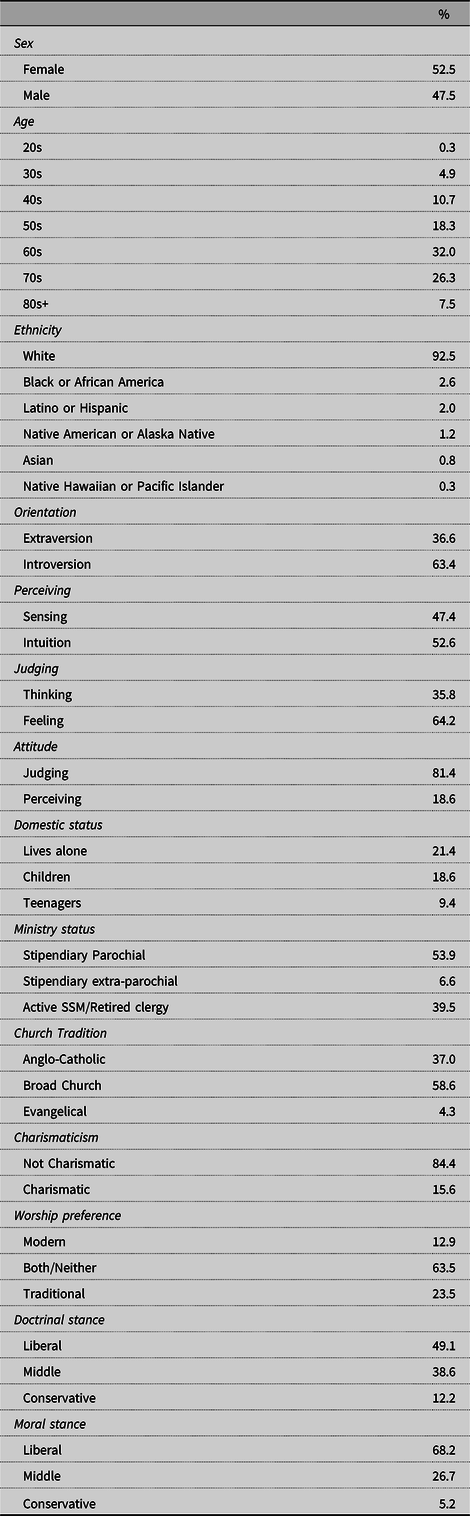
The present analyses were conducted on a sub-set of clergy who responded to the survey, namely those currently engaged in active ministry (N = 737). Table 1 provides an overview of the sample profile. There were slightly more clergywomen (52.5%) than clergymen (47.5%); nearly two-thirds were over the age of 59 (65.8%); the majority were white (92.5%), 21.4% lived alone, 18.6% lived with children aged 0 to 12, and 9.4% lived with teenagers aged 13 to 18. Slightly over half (53.9%) were engaged in stipendiary parochial ministry, 6.6% in stipendiary extra-parochial ministry, and 39.5% were active self-supporting ministers or active retired clergy. In terms of church tradition only 4.3% identified as Evangelical compared with 37.0% who identified as Anglo-Catholic, with the remaining 58.6% occupying middle territory; 15.6% identified as charismatic. Nearly half (49.1%) identified as aligning with a liberal doctrinal stance and a little over two thirds (68.2%) as aligning with a liberal moral stance; 23.5% preferred traditional worship, compared with 12.9% who preferred modern worship. In terms of psychological type profiling there were more introverts (63.4%) than extraverts (36.6%), more intuitive types (52.6%) than sensing types (47.4%), more feeling types (64.2%) than thinking types (35.8%), and more judging types (81.4%) than perceiving types (18.6%). This overall profile of preferring introversion, intuition, feeling, and judging (INFJ) is consistent with the profile of Church of England clergy as reported by Francis, Craig, Whinney, Tilley, and Slater (Reference Francis, Craig, Whinney, Tilley and Slater2007).
Sample profile
Note: N = 737.
Analysis
The primary analysis employs hierarchical linear regression designed to test the incremental effect of seven sets of predictor variables separately on perceived change in positive affect and perceived change in negative affect as assessed by the two measures proposed by the TIBACh. Predictor variables were entered in seven blocks: block one, personal variables (sex, age, and ethnicity); block two, psychological variables (extraversion, sensing, thinking, judging, and emotional volatility); block three, contextual variables (living alone, living with children aged 0 to 12, and living with teenagers aged 13 to 18); block four, ministry status (stipendiary, extra-parochial clergy, and active self-supporting clergy/active retired clergy, with stipendiary parochial clergy as the base line); block five, church orientation (Catholic –Evangelical continuum and non-Charismatic – Charismatic continuum); block six, theological stance (modern – traditional worship continuum, liberal – conservative doctrine continuum, and liberal – conservative morality continuum); and block seven, attitudinal factors (confidence in the digital future, and pessimism about the church’s offline future). This sequence is designed to test the power of attitudinal variables to predict significant additional variance in perceived change in wellbeing after controlling for all the other factors.
Results and Discussion
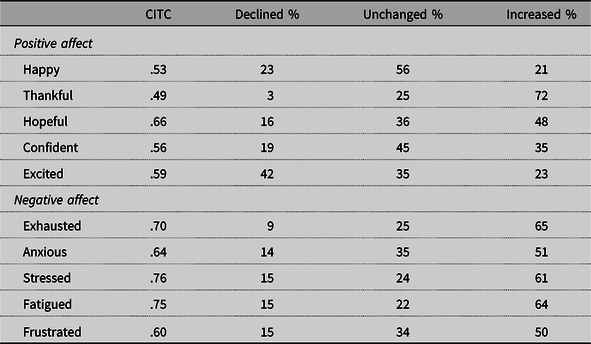
Table 2 presents the properties of the two measures (positive affect and negative affect) proposed by The Index of Balanced Affect Change (TIBACh). The measure of negative affect change recorded an alpha coefficient (Cronbach, Reference Cronbach1951) of .87. Each of the five items correlated well with the other four items. Item endorsement showed that at least half of the clergy experienced increased levels of negative affect across all five items: 50% reported increased feelings of frustration, 51% were more anxious, 61% were more stressed, 64% were more fatigued, and 65% were more exhausted. It is clear from these data that living through the pandemic brought increased levels of negative affect for a number of clergy. The measure of positive affect change recorded an alpha coefficient (Cronbach, Reference Cronbach1951) of .79. Each of the five items correlated well with the sum of the other four items. Item endorsement reflected wide variation. Nearly three-quarters of the clergy reported increased feelings of thankfulness (72%) and nearly half reported increased feelings of hopefulness (48%). Over one-third reported increased feelings of confidence (36%). Between one in four and one in five reported increased feelings of excitement (23%) or happiness (21%). It is clear from these data that living through the pandemic brought increased levels of positive affect for some clergy. The correlation between positive affect and negative affect (r = .55, p < .001) shows that, while there is an inverse relation between these two measures, one is not merely the mirror image of the other.
The Index of Balanced Affect Change (TIBACh): scale properties
Note: N = 737.
CITC = Corrected Item-Total Correlation.
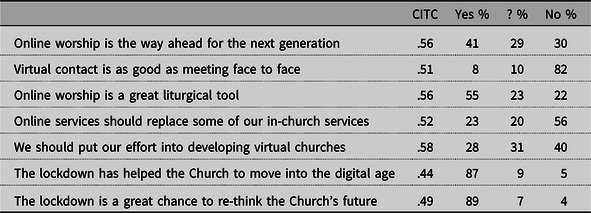
Table 3 presents the properties of the seven-item Scale of Confidence in the Digital/Online Future (SoCiDOF). The alpha coefficient of .79 shows good internal consistency reliability and the item endorsements show a wide range of responses across the seven items. The majority of clergy agreed that the lockdown was a great chance to re-think the Church’s future (89%) and had helped the Church to move into the digital age (87%). That said, the proportions dropped to 55% who agreed that online worship is a great liturgical tool and to 41% who agreed that online worship is the way ahead for the next generation. The proportions dropped even further to 28% who agreed that we should put our effort into developing virtual churches, and to 23% who agreed that online services should replace some of our in-church services. Just 8% agreed that virtual contact is as good as meeting face-to-face.
Scale of Confidence in the Digital/Online Future (SoCiDOF)
Note: N = 737.
CITC = Corrected Item-Total Correlation.
Table 4 presents the properties of the eight-item Scale of Pessimism about the Church’s Offline Future (SoPaCOF). The alpha coefficient of .84 shows good internal consistency reliability. The item endorsements show that two-fifths of the clergy were convinced that their church would not return to how it was before the (40%) and that many people will not return to church after the pandemic (44%). Nearly one third of the clergy envisaged that key lay people will step down and be difficult to replace (30%), while one quarter of the clergy envisaged that the church’s income will be permanently lower (25%). One in six of the clergy envisaged that we will not be able to serve children and young people (17%), that our congregations will be too small to be sustainable (17%), or that we will need to merge with other churches to be viable (17%). One in eight of the clergy envisaged that their church building will not be financially viable (13%). The independence of the two measures concerning confidence in the digital/online future and pessimism about the church’s offline future was confirmed by the small correlation between these two measures (r = .08, p < .05).
Scale of Pessimism about the Church’s Offline Future (SoPaCOF)
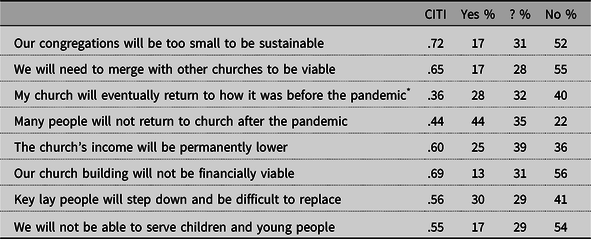
Note: N = 737.
CITC = Corrected Item-Total Correlation.
* This item was reverse coded to calculate CITI.
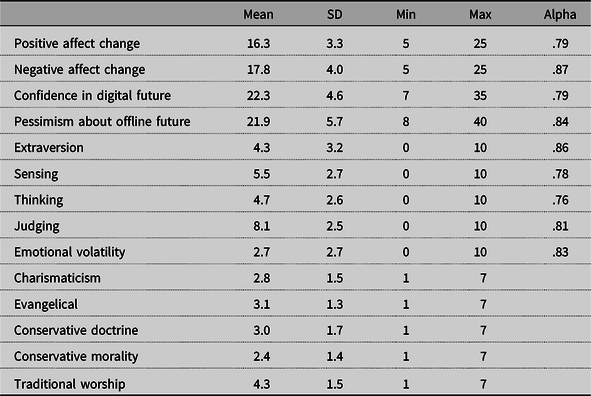
Table 5 draws together the properties of the continuous measures that will progress into the correlational analyses and regression models. These data confirm that the five measures proposed by the Francis Psychological Type and Emotional Temperament Scales (FPTETS) all achieved satisfactory alpha coefficients, ranging from .76 to .86.
Properties of measures employed in correlational analysis
Note: N = 737.
CITC = Corrected Item-Total Correlation.
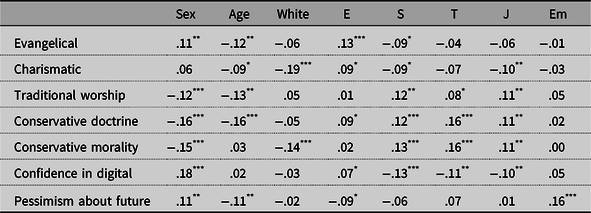
Before examining the association between all the predictor variables and the two key dependent variables (perceived change in positive affect and perceived change in negative affect), Table 6 examines the bivariate correlations between the variables associated with personal and psychological factors and the variables associated with church orientation, theological stance, and attitudinal factors. Accepting the one percent probability level as the threshold for interpreting significance, the following salient features emerge from these correlations. First, in terms of personal factors, clergywomen are more likely than clergymen to report as Evangelical. They are less likely to espouse traditional worship, conservative morality, or conservative doctrine. They show greater confidence in the digital future and greater pessimism regarding the church’s offline future. Younger clergy are more likely to report as Evangelical. They are less likely to support traditional worship and conservative doctrine. They are less likely to be pessimistic about the church’s offline future. Clergy who do not report as white are more likely to be charismatic and to support conservative morality.
Bivariate correlations: personal and psychological factors with church orientation, theological stance and attitudinal factors
Note: E = extraversion; S = sensing; T = thinking; J = judging; Em = emotional volatility.
*p < .05; **p < .01; ***p < .001.
N = 737.
Second, in terms of individual differences in personality, Evangelicals are more likely to be extraverts and charismatics are more likely to be perceiving types. Preferences for traditional worship, conservative doctrine, and conservative morality are higher among sensing types, thinking types, and judging types. Confidence in the digital future is higher among extraverts, intuitive types, feeling types, and perceiving types. Pessimism about the church’s offline future is higher among the more emotionally volatile.
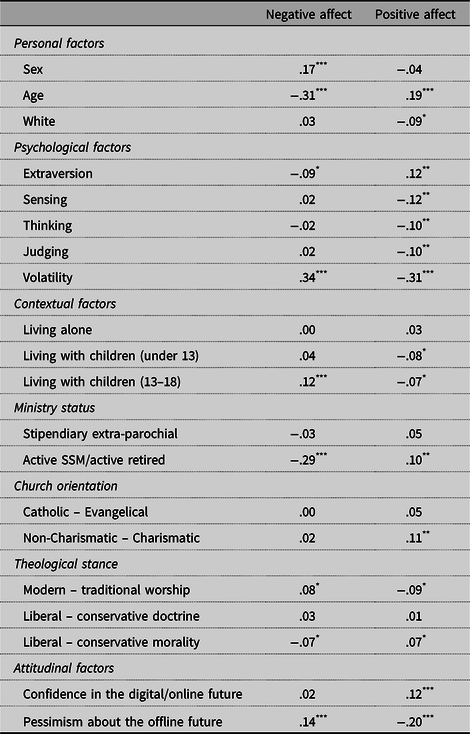
Table 7 displays the bivariate correlations between each of the predictor variables and the two measures concerning perceived change in positive affect and perceived change in negative affect. Seeing these two sets of correlations side-by-side illustrates how these two affect systems seem to be influenced by somewhat different factors. The following salient features emerge from these correlations. First, there are some predictor variables that are related in opposite directions to both positive affect and negative affect. Older clergy perceived less increase in negative affect and greater increase in positive affect. Extraverts perceived less increase in negative affect and greater increase in positive affect. Living with teenagers was associated with greater increase in negative affect and less increase in positive affect. Compared with stipendiary parochial clergy, active SSM and active retired clergy perceived less increase in negative affect and more increase in positive affect. Clergy who took a traditional stance on worship perceived greater increase in negative affect and less increase in positive affect. Clergy who took a conservative stance on morality perceived less increase in negative affect and greater increase in positive affect. Pessimism about the church’s offline future was associated with greater increase in negative affect and less increase in positive affect. Second, there are some predictor variables that are correlated with positive affect, but unrelated to negative affect. Thus, clergy who did not report as white, sensing types, thinking types, judging types, clergy with children under the age of 13 living at home, non-charismatic clergy, and clergy who lacked confidence in the digital online future perceived less increase in positive affect. Third, there is one predictor variable (sex) that is correlated with negative affect, but unrelated to positive affect. Thus, perceived change in negative affect was greater among clergywomen.
Bivariate correlations with positive affect and negative affect change
Note: *p < .05; **p < .01; ***p < .001.
N = 737.
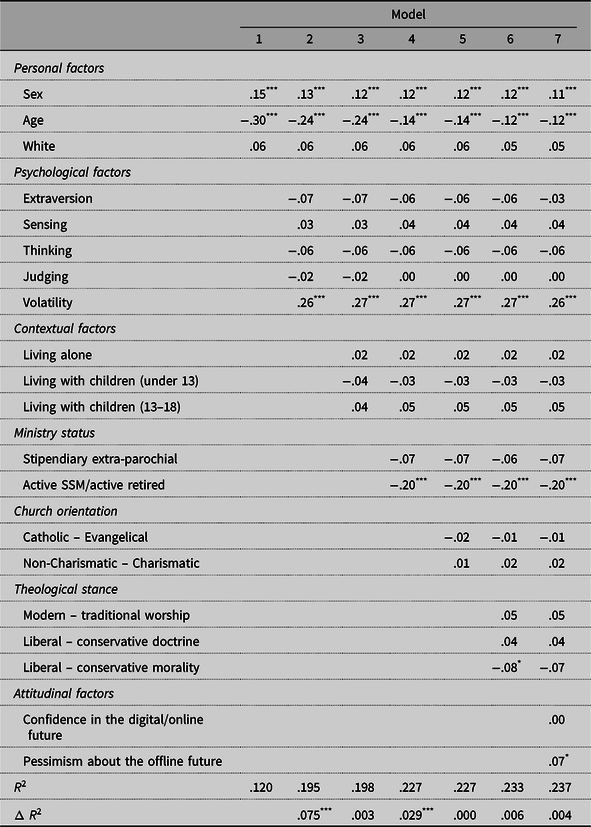
Table 8 presents the sequence of regression models for examining the cumulative impact of the sequence of predictor variables on perceived change in negative affect. It is model seven that is of greater interest. The key predictors identified by this model are personal factors (sex and age), psychological factors (emotional volatility), ministry status, and pessimism about the church’s offline future. Greater perceived increases in negative affect were associated with female clergy and with younger clergy, with greater emotional volatility, with greater pessimism about the church’s offline future, and with serving in stipendiary parochial ministry.
Hierarchical linear regression of negative affect change
Note: *p < .05; ***p < .001.
N = 737.
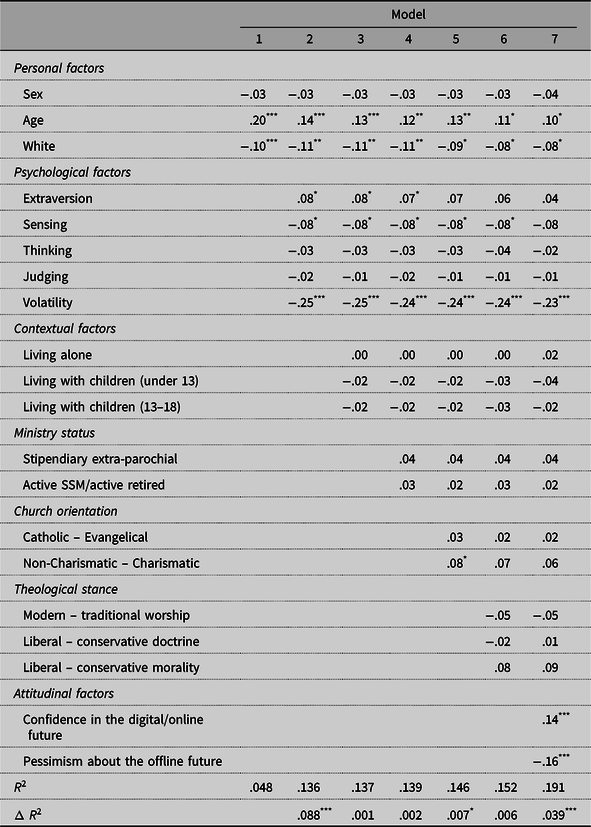
Table 9 presents the sequence of regression models for examining the cumulative impact of the sequence of predictor variables on perceived change in positive affect. The key predictors identified by this model are personal factors (age and ethnicity), psychological factors (emotional volatility), and attitudinal factors (confidence in the digital/online future and pessimism about the church’s offline future). Greater perceived increases in positive affect were associated with older clergy, with being white, with emotional stability with greater confidence in the digital/online future and with lower pessimism abut the church’s offline future.
Hierarchical linear regression of positive affect change
Note: *p < .05; **p < .01; ***p < .001.
N = 737.
Conclusion
The present study was designed to examine the perceived changes in psychological wellbeing among clergy serving in the Episcopal Church during the 2021 pandemic and to employ the individual differences approach to identify the salient predictors of variability within these changes. This aim was operationalised in light of experience in England derived from the Coronavirus, Church & You survey and the Covid-19 & Church-21 survey, and executed on data provided by 737 Episcopalian clergy who had participated in the USA adaptation of the Covid-19 & Church-21 survey. Seven main conclusions emerge from the analyses of these data.
First, these data support the internal consistency reliability and construct validity of The Index of Balanced Affect Change (TIBACh; Francis & Village, Reference Francis and Village2021b) among Episcopal clergy. In these data satisfactory alpha coefficients were recorded by measure of positive affect (α = .79) and by the measure of negative affect (α = .87). The relative independence of these two systems of positive and negative affect was confirmed by differences in their relation with predictor variables. For example, negative affect was higher among women, but there was no sex difference in positive affect. Negative affect was higher among stipendiary parochial clergy, but ministry status had no effect on positive affect. Confidence in the digital/online future was associated with higher levels of positive affect, but unrelated to negative affect. In terms of negative affect two-thirds of clergy reported increase in their sense of exhaustion. In terms of positive affect, half of clergy reported increase in their sense of hopefulness. In other words during the pandemic there was affective change for the better as well as affective change for the worse. The TIBACh can be commended for further use in research among Episcopal clergy in the USA.
Second, in terms of personal factors, clergy women fared less well than clergy men, experiencing greater increase in negative affect. Younger clergy fared less well than older clergy, experiencing greater increase in negative affect and less increase in positive affect. Clergy who did not report as white perceived less increase than white clergy in positive affect.
Third, in terms of psychological factors, emotional volatility emerged as the strongest predictor of greater increase in negative affect and of lower increase in positive affect. In other words, routine screening of clergy on this dimension of personality could assist in identifying those most vulnerable to the detrimental impact of sudden predicaments like the pandemic. In turn, such identification could assist with targeted self-development programmes.
Fourth, in the context of Episcopal clergy contextual factors related to their living environment carried no predictive power in the regression models in terms of positive affect or negative affect. However, the bivariate correlations suggest that having teenagers in the house was associated with greater increase in negative affect and lower increase in positive affect.
Fifth, ministry status was a significant predictor of change in negative affect but not of change in positive affect. Stipendiary parochial clergy experienced greater increase in negative affect. This was consistent with the trend in England as reported by Francis and Village (Reference Francis and Village2023).
Sixth, among Episcopal clergy in the USA neither church orientation nor theological stance were relevant for predicting individual differences in changes in clergy wellbeing during the pandemic.
Seventh, attitudinal factors were shown to have a part to play in predicting individual differences in changes in Episcopal clergy wellbeing during the pandemic, especially in respect of positive affect. Increases in positive affect were significantly greater among clergy who had more confidence in the digital/online future and who held less pessimism about the offline future. This final observation is of strategic relevance for two reasons. First, the theoretical roots of the balanced affect approach to psychological wellbeing suggests that growing positive affect helps to mitigate the deleterious consequences of negative affect. Second, it is possible for clergy professional development programmes to target affective development, rather than or alongside cognitive development (knowledge and belief based) or behavioural development (practice and skill based). At the heart of clergy poor psychological wellbeing stands a loss of faith in the Church’s very future. Now this really may be something worth addressing.
Limitations with the present study concern the number of clergy participants, the non-systematic way in which participants were recruited into the study, and the design of a cross-sectional survey that is able to express correlation rather than causation. In light of such limitations, it would be unwise to make generalisations about the levels of positive affect and negative affect change among Episcopal clergy across the USA or about the causes of such change. Nevertheless, an opportunity sample of this nature is robust to assess associations among variables and to test hypothesised causal models by hierarchical linear regression. These limitations could be addressed by the establishment of panel studies resourced by the appropriate conceptualisation and measures.
Acknowledgements
We thank Jennifer McKenzie and the Virginia Theological Seminary for promoting the survey among the Episcopal Church.
Competing interests
No potential conflict of interest was reported by the authors.
Ethical approval
Ethical approval was granted by the Research Ethics Committee for the School of Humanities, Religion and Philosophy at York St John University (approval code: HRP-RS-AV-0240-01). All participants had to affirm they were 18 or over and given their informed consent by ticking a box that gave access to the rest of the survey.


 Open access

