




Introduction: From Faces to Walls
While most prominent as a historian of anarchism and a catalyst for Canadian culture, George Woodcock was also a prodigious travel writer.Footnote 1 Of all the countries that occupied his attention, India was paramount. Indeed, as he wrote, his feelings for India were borne “out of love”, for there was “no country whose […] faces I am more deeply attached [to]”.Footnote 2 As Eva-Marie Kröller notes, however, because travel writing is “one of the mainstays of popular culture”, it is vulnerable to being used “for imperial […] propaganda”.Footnote 3 Such an admonition may seem misplaced when considering Woodcock. He was, after all, a prominent figure in an anarchist movement that foregrounded a critique of imperialism.Footnote 4 Moreover, he developed close friendships with several radical Indian writers, and collaborated with other British critics of imperialism, notably George Orwell.
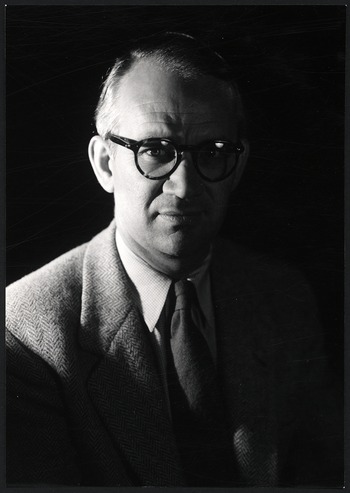
Born in Canada but raised in Britain, George Woodcock (1912–1995) became involved in Britain’s anarchist movement in the mid-1930s as he was finding his voice as a poet and essayist (Figure 1).Footnote 5 Tiring of post-war austerity, he left for British Columbia in 1949, where he rose to prominence as a “pathfinder” for Canadian literary culture.Footnote 6 While there, he also wrote the widely read Anarchism: A History of Libertarian Ideas and Movements (1962).Footnote 7 This book captured Woodcock’s shifting relationship to anarchism; he described the process of its writing as an “exorcism” as he began to identify with a “philosophical anarchism”.Footnote 8
George Woodcock.

Figure 1 Long description
Nine men are in a newsroom setting. They are seated and standing around desks with papers and books. Some are writing or reading. The room has high ceilings and two large portraits are hung on the wall. A calendar is visible, showing the number 23. The men are dressed in suits and the room has a formal atmosphere.
Woodcock’s friend, the Indian novelist Mulk Raj Anand, saw the consistent element in his politics as “faith in the protesting individual”, and this found expression in his attraction to M.K. Gandhi.Footnote 9 Indeed, Woodcock’s first trip to India in 1961 was in search of Gandhi’s afterlife, and he examined this fascination further in his book Gandhi (1972), an expression of the “confident intimacy” he felt with his example.Footnote 10 In “A Cycle of Ind”, a later reflective piece on his long association with India, Woodcock would write that Gandhi had shaped his “mental development”, moving him into the orbit of anarchist ideas through his “profound misgivings” about the “pernicious” nation state.Footnote 11
Despite his politics, our aim in this article is to illustrate that, like others of his generation, such as George Orwell in Britain or Louis Fischer in the United States, Woodcock wrote within then-prevalent Western imperial–oriental tropes when talking about the East.Footnote 12 While some scholars have seen Woodcock’s travel writing as offering a “postcolonial cosmopolitanism” congruent with his anarchism, and others have viewed it as evidence of the severing of his connection to the anarchist tradition, this article examines the extent to which his textual cosmopolitanism was carried on within the categories of colonialism.Footnote 13 We define the colonialism that Woodcock was contesting as an expansive “cultural project of control”, which carried with it an inherent self-legitimation by presenting this expansion as a duty or burden, and informed a tendency towards the homogenization of India’s institutions and structures.Footnote 14
Our objective, as Woodcock’s readers, is therefore to privilege a hermeneutical engagement with his travel writings to show that his encounters with India were, ultimately, “acts of intellectual mastery”, reflecting Dorothy Figueira’s insight that all travellers create “a vision of the other to better understand the self”.Footnote 15 This article thus offers the first composite, critical treatment of his travel writings on India, adding to scholarship that has concentrated on his British, Canadian, or primarily political activities.Footnote 16 To this end, the article probes Woodcock’s labour of love to demonstrate how his radical critique of empire was complicated by the enduring influence of his cultural frames, revealing the paradoxes inherent in Western anti-imperialist engagements with postcolonial societies.
Indeed, in reading him thus, we abide by the principles that defined Woodcock’s own writing, notably espoused in his work on his friend Orwell, in which, notwithstanding deep personal and intellectual attachments, he remained committed to the intellectual project of a “critical study” that acknowledged the multifaceted nature of a complex figure.Footnote 17 This article attempts a similar “critical study” of Woodcock’s travelogues on India, and demonstrates the extent to which he remained, despite his best efforts, a product of his time in ways that the power of his cultural context made it difficult for him to recognize. This is an effort therefore to doubly situate Woodcock’s traveller’s steps: first, within the strictures of his own intellectual system; and second, within the powerful cultural-linguistic context to which he remained indebted.
What follows is divided into five sections, structured around Woodcock’s multiple visits to India and the key texts they produced. The first section contextualizes Woodcock’s engagement with India by examining the three key contexts that shaped it: his involvement with anarchist anticolonial activism in World War II; his developing sense of himself as a critical intellectual; and the Indian expatriate literary connections that facilitated his contact with the country. The following three sections chart his evolving assessment of the Indian nation state, each centred on the texts that his visits inspired. Section two focuses on his first visit, Faces of India: A Travel Narrative (1964) and considers the power of his political–literary framework of analysis. Section three, focusing on Kerala: A Portrait of the Malabar Coast (1967), examines his effort to make sense of Kerala’s communism and reconcile it with his political attitudes. The fourth section forms an interregnum, considering Woodcock’s reflections on India in his historical assessments of British imperialism published between his travel narratives. It shows the extent to which these materials, shaped by his sources and the specific focus of each text, revealed the tensions between his anticolonial politics and cultural education. Finally, a fifth section considers his last India book, The Walls of India (1985). It shows that, even at the end, Woodcock was torn between his radical politics and the inherited frames of his cultural education.
“A missing part of myself was waiting to be recovered there”: Politics, Literature, and Friendship
Woodcock was the most devoted observer of Indian affairs among Western anarchists from the 1940s until his death in 1995. This engagement unfolded within three overlapping contexts that shaped the distinctive character of his responses to the country. While Woodcock’s vision of the nation was distinct in drawing on a vocabulary of political concepts inspired by his anarchism, it also followed a pattern familiar to Western anticolonial engagements with India, carrying internal contradictions conditioned by his cultural upbringing at the heart of empire. The three contexts structuring his approach to India will be considered in turn. The first of these is Woodcock’s active involvement in anarchist anti-imperialist politics in the 1940s, especially focused on India. The second is his reassessment of anarchism, which occurred in tandem with his efforts to define the duties and methods of the truly independent intellectual. In this project he shared much with Orwell, who was similarly perturbed by the dangers of ideological thinking; yet Orwell also proved a foil in Woodcock’s assessment of India, which he found wanting. Finally, Woodcock’s literary connections – especially his friendships with expatriate Indian writers, which were essential in shaping both his initial impressions and his future access to the country – left a clear imprint on his vision of India.
The British anarchist movement provided an enduring lens through which Woodcock approached Indian affairs. In an atmosphere characterized by what Nicholas Owen describes as a “weakness of metropolitan anti-imperialism”, anarchists privileged anticolonialism to a degree that marked it out from its political rivals, as Eleanor Strangways has shown.Footnote 18 British anarchists were keen to highlight this too, presenting themselves as a more consistent rallying point for opponents of imperialism, while criticizing the inconsistencies of the Communist Party of Great Britain (CPGB), which found itself locked in febrile debate and buffeted by the demands of the international communist leadership.Footnote 19 As the Soviet Union’s wartime alliance with Britain tested its theoretical commitment to Indian independence, Woodcock and his colleagues probed the hypocrisies this entailed, particularly in the periodical War Commentary.Footnote 20 For example, they honed in on the silence of the CPGB on the oppression of members of the Indian Communist Party (CPI), mocking the limits of communist solidarity in an age of realpolitik.Footnote 21 Elsewhere, they reported the alleged involvement of the CPI in the suppression of rioting, with one commentator lamenting that “in its hour of need, British imperialism looks about for new allies – and the Communists immediately come to its aid”.Footnote 22
As they criticized international communism for its acquiescence to the immediate realities of imperial control, the anarchists with whom Woodcock associated insisted that the only logical, and indeed morally consistent, position was to insist on India securing its immediate liberation from imperial dominion. Moscow’s tether, they thought, meant that the CPGB failed to recognize this position, while the Independent Labour Party (ILP) found itself trapped by its commitment to parliamentary politics and by its own internal intellectual and ethical divisions. As a result, anarchists argued that the ILP hesitated in a moment of supreme possibility. For the Quaker and anticolonial activist Reginald Reynolds, who was pushed towards anarchism in this era precisely because of the ILP’s perceived shortcomings, the party displayed the “nauseating vice of hypocrisy”, which was even more egregious than Conservative Party imperialism because of its renunciation of supposedly core values.Footnote 23
The looming Japanese invasion of India in 1942 hardened positions, but whereas many socialists and communists argued that winning the war must precede independence, British anarchists saw the instability of the period as an opportunity to secure Indian freedom immediately.Footnote 24 The solution to the challenge of Indian defence in the event of Japanese invasion was simple, one anarchist commented in 1942: “arm the Indian people” so that they could defend themselves.Footnote 25 That neither the British nor Indian authorities were willing to take this step exposed the hollowness of their commitment to Indian independence. Indeed, Woodcock himself insisted that capitalizing on this revolutionary situation depended on rejecting the temptations of conventional politics, which would inevitably lead to the betrayal of any project of social renewal. The opportunity for colonized peoples to “evolve their own social and economic life in freedom” could only be secured, he argued in 1943, by “throwing aside the native as well as the British politician”.Footnote 26
Woodcock’s wartime anarchist activism left important legacies for his future assessment of India. While his relationship to anarchism changed, he would hold fast to the position that state action tended to corrode the true source of India’s political and cultural vibrancy: its people. Coupled with this political background, the second key context that shaped Woodcock’s assessment of India was, ironically, his developing sense of himself as a critical intellectual increasingly detached from ideological filiations. In this context, his relationship with Orwell, who shared similar antipathies to ideological thinking, is revealing, especially as it demonstrates the extent to which Woodcock saw British hypocrisy over India’s status as a defining political issue.
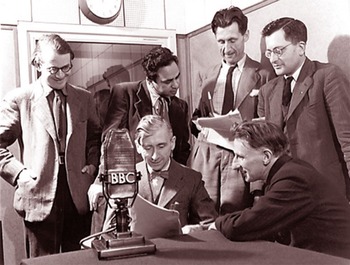
Woodcock’s and Orwell’s disagreement over India revolved around their competing assessments of revolutionary tactics and the conditions created by the war, but it also shaped their respective sense of the stance required for the engaged intellectual. As Eric Laursen has shown, an assessment of Gandhi heated these debates.Footnote 27 Woodcock cleaved to the anarchist position that the surest route to Indian independence was revolution, and that empowering Indians to mount their own defence against Japan could presage a liberation of their own making.Footnote 28 He added to this, however, an increasingly visible pacifism. Advocating non-violent resistance to fascism, he found his literary magazine Now, judged “objectively pro-Fascist” for this stance by Orwell in Partisan Review in 1942. Woodcock repaid the invective, criticizing Orwell for “return[ing] to his old imperialist allegiances and work[ing] for the B.B.C., conducting British propaganda to fox the Indian masses”.Footnote 29 An unlikely invitation to participate in one of Orwell’s discussions on the British Broadcasting Corporation’s (BBC) Eastern Service followed (Figure 2), which, despite their developing friendship, confirmed Woodcock’s feeling that the project was designed “to keep India out of the clutches of the Fascists”, only to “keep it in the clutches of the British”.Footnote 30
Recording session at the BBC, c.1943, with George Woodcock (left), Mulk Raj Anand, George Orwell, William Empson, Herbert Read and Edmund Blunden. Unknown photographer.
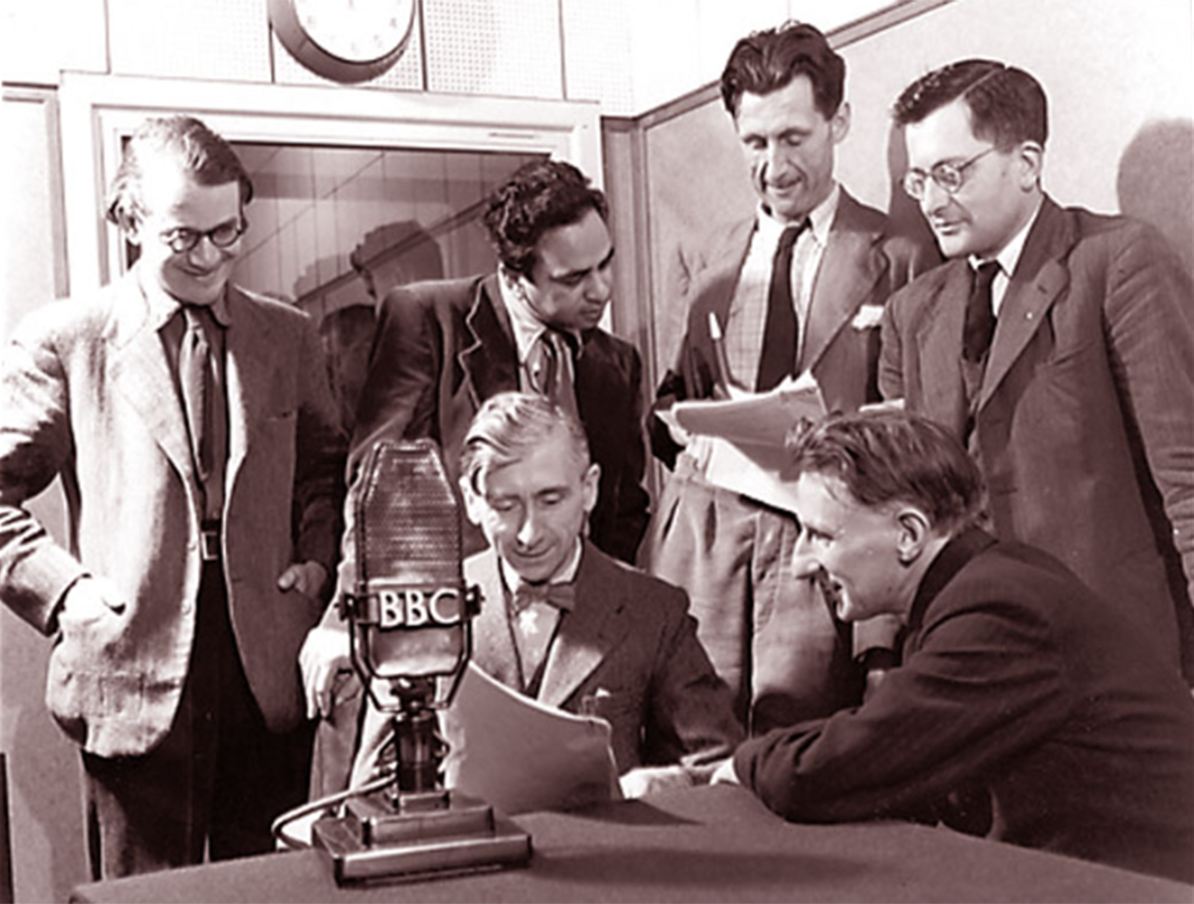
Figure 2 Long description
The image shows a large group of men seated in rows within a theater setting. The men are dressed in formal attire, including hats and suits. The room is spacious, with decorative elements such as mirrors and lights on the walls. The men are facing the stage, suggesting they are attending an event or meeting. The seating arrangement is orderly, with chairs aligned in rows. The room has high ceilings and is well-lit, contributing to a formal atmosphere.
As Laursen has argued, a key factor motivating the wartime contretemps between Orwell and the anarchists was an “insider” versus “outsider” politics. Notwithstanding the strength of his moral commitment to exposing political falsity, as Orwell moved in “mainstream channels”, it meant that when he called on the individual to “choose sides, he generally meant one state over another”.Footnote 31 To Woodcock, this made Orwell essentially an “old-style liberal”, too ready to accept bourgeois homilies like “Fair Play”, and displaying a parallel failure to understand the real causes of contemporary “social evils” to consistently criticize them.Footnote 32 In the Indian context, this manifest as an inability to comprehend “the mentality and peculiar problems of Oriental people […] Orwell never tried to think like an Oriental”.Footnote 33 While sharing a desire to see the end of British imperialism, Orwell thought that, in the context of war, it was his duty to assist in the government’s effort to persuade Indians that, in the immediate, loyalty was their best option. Indeed, as he wrote, in words directed at their mutual friend Anand, “Indian independence is a lost cause if the Fascist nations […] dominate the world”.Footnote 34
Woodcock and Orwell shared a commitment to the notion of the critical intellectual, and their conflict over India was a neglected context in which these ideas were forged.Footnote 35 This increasingly sharpened attachment formed a key context for Woodcock’s political evolution. While this process provoked a critical reassessment of his anarchism, its conclusion was a qualified return to the anarchist tradition, and the assumption of a stance deliberately distinct from Orwell’s acceptance of a “liberal pessimism”.Footnote 36 While London’s drabness encouraged Woodcock’s exit for Canada, dissatisfaction with its anarchist milieu also hastened the move. Wearying of what he saw as the movement’s “parochial fanaticism”, he gravitated towards a “philosophical anarchism” that would henceforth provide a unifying thread through his work.Footnote 37 A contested term in the anarchist tradition, for Woodcock, “philosophical anarchism” reflected a belief that the age of mass revolutionary action had passed, but that anarchism should be considered a vital “touchstone by which existing societies could be judged and their creative elements […] fostered”.Footnote 38
This assessment shaped Woodcock’s most famous work, Anarchism (1963), although it was not uncontroversial. Criticized by other anarchists for presenting a premature “obituary” for a still-active movement, his identification with philosophical anarchism also provoked accusations of privileging intellectualism over activism.Footnote 39 Woodcock’s reassessment of his own politics also carried with it a tendency to reconceptualize, and thereby distort, the arguments of those anarchists who most inspired him, notably Kropotkin, in order to buttress his new theoretical position. In Woodcock’s hands, Kropotkin similarly drifted away from belief in revolutionary change to a form of evolutionism, with the result that this imagined stance reflected Woodcock’s own: stressing mutual aid and gradualism in ways that prioritized pacifistic methods of social change.Footnote 40 Culture similarly became a key element in this complex of ideas. His scepticism at state patronage in the arts; criticism of censorship; and argument that “regionalism” – as opposed to centralizing “nationalism” – informed cultural activity, all reflected his political thought.Footnote 41
Woodcock’s evolving definition of the critical intellectual carried with it an aesthetic and methodological stance that shaped his assessment of India. As early as 1944, he was echoing anarchist assessments of the CPGB’s inconsistencies on Indian affairs in his reflections on the intellectual, by criticizing communist writers for personifying dogma rather than pursuing “true revelation”.Footnote 42 Explicitly ideological writing was one source of frustration, but he also despaired at contemporary academic fashions for obscuring true understanding. Critical of what he later termed the “jargon-ridden patois” dominating historical writing, he saw himself instead offering “serious non-academic history”.Footnote 43 These perspectives fed into his work on India. Writing that it was his exposure to the “great travel narratives of the nineteenth-century naturalists” – Darwin, Thomas Belt, Henry Walter Bates – that had introduced him to the genre, Woodcock added that this entailed a rejection of “Jacobean extravagances” in favour of a “direct expression” best suited to providing readers with a fact-based sense of place.Footnote 44
Such aesthetic commitments also focus attention on the third crucial context for understanding Woodcock’s approach to India: his literary connections. Orwell was one of these associations, but he sat, as Kristin Bluemel has shown, in a network of “radical eccentrics” that drew in a number of expatriate Indian writers.Footnote 45 These relationships functioned in two crucial ways. First, the work of these Indian writers provided Woodcock’s initial exposure to contemporary India, notably the writing of Anand and the novelist R.K. Narayan. Second, in the case of Anand, this connection blossomed into friendship in wartime London, and Anand would become a vital contact in accessing post-war India, guiding his future travels in the country. Anand, and Narayan whom he met in India, but also the writer and publisher Patwant Singh, whom he encountered on his first trip to India, and the academic and diplomat Balachandra Rajan, whom he met in Canada, thus played a vital role in defining both the India that Woodcock expected to see, but also the one that he did see, with both positive and negative consequences.Footnote 46
Of these connections, his long friendship with Anand was particularly significant, and his attraction to the writing of Narayan the most consequential for shaping his assessment of India. It was partly through Anand, for example, one of the first notable Indian writers working in English in interwar England, that Woodcock learned of Indian affairs, while Narayan, whom he deemed “the finest of all Indian writers”, would prove a key source for his reading of Indian village life.Footnote 47 While these literary connections provided insight and access, another product of them was that Woodcock’s later travel writings were bound by these Anglophone/Anglophile elites, rather than vernacular literary spheres. In this way, these elite contacts could also prove limiting in his access to the country. This fact is especially evident when considering Indian society’s central spine of caste, whose treatment by these novelists ranged from either ignoring it (like Narayan) to imbricating it (like Anand), “with other reactionary and oppressive forces”, like class.Footnote 48 Caste had a defining relationship with British colonialism, too. As Nicholas Dirks points out, caste provided the frames for the colonial state to subsume India’s diverse “social identity”.Footnote 49 While Narayan evoked an India that was “eternal and spiritual”, Anand’s departure from this Orientalist–Nationalist vision with his 1930s novel Untouchable became dated by the 1960s, given its “silences” on the Untouchable leader–scholar Dr B.R. Ambedkar and his affirmative action programme.Footnote 50 But, drawn to this literature as a point of access for understanding Indian society, Woodcock remained prone to reproducing its defining elements in detailing what he saw in the country.
The ambivalent consequences of Woodcock’s friendships with Indians are similarly shown by his access to India’s religious and linguistic life. Just as his association with educated, upper-caste Hindus tended to shape his appreciation of caste, his sense of Islam’s position in Indian history reflected these relations too. While his friendship with the Sikh scholar Patwant Singh, and Woodcock's wife Inge’s deep interest in Buddhism – she was also his constant travel companion – fostered a sensitivity born of familiarity with the status of both religions in Indian culture, Islam fell outside his associational vantage point. Woodcock’s comments on language reflect similar tensions. While his lack of proficiency in Hindi or any of India’s regional languages had a limiting effect in terms of his ability to communicate across class lines, his literary and political sensibilities simultaneously furnished considerable sensitivity to the politics of language in the country. As will be shown, he captured well the regional–national tensions that reflected the principles of his anarchism, especially the conflict between promoters of Hindi versus defenders of Tamil and Malayalam regional identity. However, such reflections stopped short in the case of Hindi versus Urdu. The latter language tended to remain external to his idea of India, captured in his recourse to phrasing that stressed its Islamic “background” and “Persian past”, in distinction to a Hinduism that, for him, approximated a common culture “understood over most of India”.Footnote 51
Woodcock’s first visit to India came in 1961, but his perspective on the country was shaped by three contexts all with their roots in the 1940s. First, in this era, the British anarchist movement in which he participated treated India as a locus of the brutalities of imperialism and its vulnerabilities. Anarchists were also keen to demonstrate that competing political radicalisms struggled to achieve coherence on India’s status as international war upset existing calculations. Second, Woodcock embarked on a reassessment of his ideological convictions, paralleling that of his friend Orwell. For Woodcock, however, a lacuna in Orwell’s vision was precisely his reading of British imperialism as evidenced in India. Third, Woodcock’s early literary exposure to India, especially through the work of Anand and Narayan, shaped his perspective on the country. Both would become mediators as he toured India.Footnote 52 These contexts combined to equip Woodcock with a sense that he saw India with a clarity distinct from that of other Western anti-imperialists, a conviction reinforced by his methodological commitment to “good writing”. The reality, however, was that for all his insight, Woodcock, like Orwell, was trapped by the contradictions inherent in being a Western anti-imperialist, inhabiting colonial patterns of thought that he could neither fully recognize nor rein in.Footnote 53 This was a tension that Woodcock himself occasionally appreciated. He noted that he possessed a paradoxical “fascination with Empire – amounting almost to identification”; and, as this article illustrates, his upbringing in the heart of empire imparted a set of perceptual frames through which he viewed India that proved difficult to dislodge.Footnote 54
Innocent Abroad: Faces of India: A Travel Narrative (1964)
Woodcock’s first visit to India was motivated by a desire to search for Gandhi, thirteen years after his assassination, in the then-Nehruvian Indian state.Footnote 55 This was, he commented later, a project defined by a “quality of innocence”, and reflected the admission that he made a hero of Gandhi more than of “any other person”.Footnote 56 Accordingly, a key refrain in his assessment was the sense that Nehru’s India had squandered a Gandhian developmental trajectory. Recognizing that Gandhi had become the “political equivalent of Christ in the West”, Woodcock’s lament was compounded by Anand’s comment to him shortly after his arrival that there was now “a worship of Gandhi rather than the execution of [his] principles”.Footnote 57 While recognizing Gandhi’s evolving status, the desire to look for his legacy also shaped his vision of India in ways that he found more difficult to challenge. For Woodcock, Gandhi sat alongside Kropotkin and Narayan in perceiving the true potential of village life contra the state, but this also encouraged a romanticism that tended to obscure, in particular, the realities of caste, something exacerbated by his elite connections in the country.
A key thread in Faces is Woodcock’s interest in tracing Gandhi’s legacy in Indian village life. This reflected commitments to regionalism and local democracy, inspired particularly by Kropotkin, which were central to his philosophical anarchism, but it also drew on his literary introduction to the country, especially through the work of Narayan.Footnote 58 Indeed, the very effort of looking for Gandhi away from the “dead sprawl” of state capitals reflected an assessment of the hubris of the modernizing state. In this reading, Nehru’s Delhi embodied a physical renunciation of the Gandhian directive to regenerate society “village-up” in order to counter the inherent corruption of the top-down state.Footnote 59
While committed to understanding village life in India, the two resources upon which Woodcock drew most heavily to comprehend its dynamics – Kropotkin and Narayan – posed interpretative challenges. Although the political vivacity of village life was a lesson gleaned from Gandhi, it also reflected his reading of Kropotkin, who had pointed to community “mutual aid” as an antidote to the modern state.Footnote 60 Following Kropotkin’s historical sociology closely, Woodcock treated village communities through the ages as evidence of human propensity for regenerative cooperation in the face of state centralization.Footnote 61 Woodcock also remained committed to the idea that communal federalism held considerable promise for attaining a different kind of society, and India was an example of it in action. While Kropotkin was often charged with romanticism, Woodcock’s assessment of a possible communal future was similarly the subject of suspicion from critics, who questioned his political theory on the basis of practicality and its blithe assessment of human characteristics.Footnote 62
Rooted in Western political contexts, Woodcock’s anarchism was therefore not a nimble vehicle in navigating the realities and complexities of Indian village life, with his sources and friendships compounding this issue. This is most obvious in his treatment of caste. His reverence for Gandhi, who, as Tanika Sarkar suggests, was inconsistent on such matters, also shaped this, and Woodcock was far from alone among radical Western students of Indian affairs in struggling with its legacies.Footnote 63 His anarchist regard for communal living tended to overlook the divine sanction, discriminatory hierarchy, and ritualistic context that often operated against it in practice.Footnote 64 Moreover, Woodcock’s silence on Ambedkar is striking. Ambedkar was not unknown to Western intellectuals in this era – as one reviewer of Woodcock’s Gandhi (1972) made clear – and his celebrated remark that Indian villages were “a sink of localism, a den of ignorance and narrow-mindedness” puts a different shade on Woodcock’s celebration of their potential.Footnote 65 Instead, Woodcock’s vision resembled that of his friend Anand. Writing Untouchable after the First Round Table Conference (1930), which brought their “doubly marginalized” condition in British India to London in the person of Ambedkar, Anand overlooked his role and significance. Rather, he concentrated, much as Woodcock later would, on presenting Gandhi as their “saviour”.Footnote 66
If Woodcock’s politics and networks informed a degree of romanticism in his approach to village life, his literary connections and influences reinforced this tendency, especially his attraction to Narayan’s novels as a source of knowledge for rural India.Footnote 67 Indeed, reflecting on Narayan in a critical essay, he argued that it was precisely this insight that was enshrined in his work: the capacity of communities “in places comfortably distant from the main cities” to “live and evolve without recourse to the aid of government”.Footnote 68 Fusing Narayan with the politics of Gandhi and Kropotkin, he proceeded to declare that India’s resilience was a product of the relative distance of village life from centralizing government. There, he commented, a “native substratum of entirely non-political institutions” thrived, independent of the perfidies of the emerging Indian state.Footnote 69 While aware that caste was significant for understanding Narayan as a novelist, Woodcock nevertheless struggled to extend this perspective to the worldview Narayan presented in his novels.Footnote 70 Woodcock’s reliance on his literary friends, men of a particular generation and social experience, therefore meant that he proceeded to repeat their common habit of, as Tabish Khair has discussed, approaching “the lower caste […] from [an] upper caste perspective”, of which Narayan was a leading example.Footnote 71
The political and literary perspectives that Woodcock brought with him to India meant that the politics of caste remained a puzzle, but his appreciation of race/ethnicity also revealed that even thinkers at the cutting edge of anticolonial efforts could struggle to emancipate themselves from a colonial language of East–West encounters. An early example in Faces was his description of a “gigantic and taciturn Sikh”, as he uncritically passed through a Kipling-esque world of “tough, unwesternised Gurkhas” and “fierce-looking Dogras”.Footnote 72 Similarly, discussions of “short, dark and fat” Bengalis, ruing their “ancient resentment” of the British, point to his struggle in developing a language free from the imperial cultural context in which he grew to maturity.Footnote 73
Woodcock was not unique in recourse to racialized language, but the deeper point – aside from the fact that his anticolonialism should have led to greater reflection – was that such language betrayed the tenacity of an education at the heart of empire. His imbibing of “the colonial construction” of communalism – understood as the relations between India’s religious communities – shows the extent to which he bought into James Mill’s vision of the history of British India with its Hindu insiders, Muslim outsiders, their inherent differences, and immutable enmity.Footnote 74 This is apparent, for example, in the division that he imposed on the beggars that he met at Khuldabad, distinguishing between Hindus (“plaintive and persistent”) and Muslims (“aggrieved and aggressive”).
Such comments betray the power of this communal frame in defining not only Woodcock’s historical understanding of the subcontinent, but also his quotidian experiences as he moved through it.Footnote 75 This framing led him, for example, to overlook the historical power dynamics underlying the contrast he drew between the “ugly piles of stone” at Seringapatam, associated with Tipu Sultan, and the “antique elegance of Rajput fortresses”.Footnote 76 Woodcock did not appreciate that Tipu’s capital had been reduced to rubble by the East India Company in 1799 – a conflict in which Tipu himself died – whereas the Rajput strongholds retained their elegance precisely because their rulers had collaborated. Nuance was frequently a victim of this communal framing. In place of the layered and overlapping realities of “India’s Islamic traditions”, Woodcock – influenced by his local connections and inherited perspectives on empire – reached instead for sweeping statements about “Moslem iconoclasm”.Footnote 77 This all-consuming binary led to him categorizing Agra as a Muslim city and Mathura as Hindu, while underplaying their “hybridisation of art” and “religious syncretism”.Footnote 78
Although Woodcock’s cultural politics could make it difficult for him to appreciate key features of Indian society in the 1960s, his anarchism equipped him with a keen eye for the “other” God that, by now, had failed in the West: Marxism. Here, he found kindred spirits among the Indian socialist politicians he met, who had also “moved towards Gandhi”.Footnote 79 While accepting the foundational anarchist critique of Marxism, Woodcock grafted onto it a particular disdain for “Leninoid” hacks who, in his view, had abandoned the truth-telling duties of the critical intellectual.Footnote 80 Thus, when Asoka Mehta, a leading socialist ideologue, listed for his visitor the specific Gandhian influences on Indian socialism – namely “the right means for the right ends”, “the primacy of the peasant”, and “traditional technology” – Woodcock took this as a triumphal affirmation that Gandhi “was a libertarian”.Footnote 81 Upon reaching Kerala, a state until recently governed by the CPI, Woodcock greeted his first sightings of the fluttering “red flag” with the claim that, in this case, “political leftism did not interfere greatly with tradition”. He thus recognized the overlapping character of communism in Kerala, with its high-caste historical roots and its colonial governmental legacy;Footnote 82 yet, while he underestimated its capacity for “political adaptation”,Footnote 83 Woodcock nonetheless acknowledged that it was “a movement of the middle class and the embittered intellectuals”.Footnote 84 This was a theme he would return to later when he turned his attentions to Kerala in late 1965.
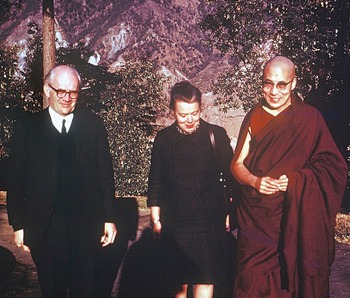
Woodcock’s stance on communism in Indian contexts was emboldened by his interest in Buddhism, particularly the plight of the Tibetan refugees seeking sanctuary in the country after their failed uprising in 1959. His wife, Inge, inspired a sensitivity to Buddhism’s spiritual claims. Intellectually, he was also drawn to the idea of Buddhism’s “middle-path”, following Thomas Merton in his attraction to its encouragement that the follower should “think for himself” – a principle that he welcomed as an antidote to most forms of religious orthodoxy.Footnote 85 Yet, it was his anarchism that united these positions. For Woodcock, the treatment of Tibet’s Buddhists by the Chinese state was a barometer of the generalized authoritarianism hidden in Marxist theory, manifest in China’s “anti-religious tyranny”.Footnote 86 This was a feeling intensified by a developing personal relationship with the Dalai Lama, whom he met for the first time in a personal audience at Dharamsala, enjoying a long and wide-ranging discussion (Figure 3).Footnote 87
The Woodcocks meet the Dalai Lama in Dharamsala in the winter of 1961–1962. Unknown photographer.
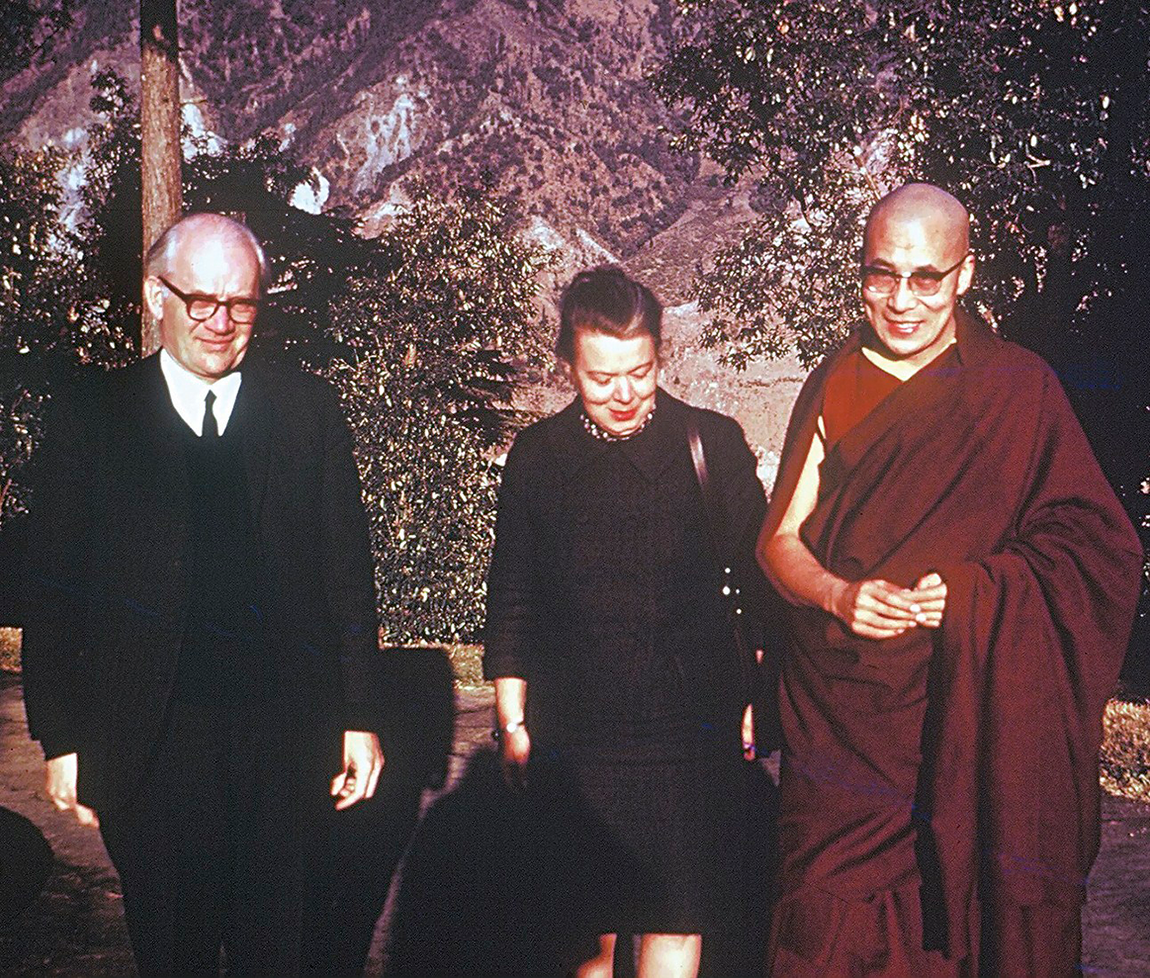
Figure 3 Long description
Two men are walking side by side on a sidewalk. Both are dressed in suits and bowler hats. The man on the left is holding a cane, while the man on the right is holding an umbrella. They are positioned close to a building with visible architectural details. In the background, other pedestrians are walking, including a man wearing a hat and a coat. The scene appears to be in an urban setting with a structured environment.
Filtered through his politics, Woodcock saw the “tragedy” of Tibet as evidence of the moral bankruptcy of actually existing communism, and another example of the centripetal “onslaught of modern politics”.Footnote 88 It also, however, provoked a desire to move beyond the role of tourist and offer substantive help. The charitable work that would become a key component of the Woodcock’s interactions with India started at this point, but it involved a degree of soul-searching that was eased, characteristically, by connecting the project with the spirits of Gandhi and Kropotkin. Reckoning with an instinctual hostility to self-righteous charity, Woodcock concluded that this initiative meant, as Gandhi would have understood it, “providing the means […] to people who want them”.Footnote 89 In terms of the charitable structures that would emerge from this desire to help, they bore an anarchist imprint by focusing on voluntarism, self-organization, and mutual aid, and had a particular focus on protecting imperilled cultures.Footnote 90 In this spirit, within a few months of returning to Canada, he was writing to the Dalai Lama to inform him of the establishment of the Tibetan Refugee Aid Society (TRAS), enclosing a cheque for $700 to improve local schools.Footnote 91 Two years later, the campaign was boasting funds of approximately $23,000, and would raise nearly $3 million by 1980, today enduring as the Trans-Himalayan Aid Society.Footnote 92
Faces of India was Woodcock’s first sustained piece of writing on India and the product of his first visit. His trip was motivated by an interest in the country, cultivated through tales of British imperialism and reinforced by his growing commitment to anti-imperialism within the British anarchist movement. He arrived confident in his intellectual identity, believing himself unencumbered by ideological baggage and intent on exposing the realities of life. The experience, however, was more complex than he anticipated, regardless of how much “sharper and freshly coloured” he later believed his vision to have been.Footnote 93 While the book was well received, some readers recognized this tension, notably his friend the academic–diplomat Rajan, who found it “engrossing” but spied in it a “defensive blindness” about the country.Footnote 94 What he perceived was the romanticism furnished by Woodcock’s Gandhi–Kropotkin–Narayan triad. Seeing India through lenses shaped by his life and experiences in Britain, his elite connections within the country similarly framed his perspective. As they prepared to leave the country, however, the Woodcocks resolved to return to that “exasperating […] and endlessly fascinating land”.Footnote 95
History as Journey: Kerala: A Portrait of the Malabar Coast (1967)
In the winter of 1965–1966, with the zeal of a “committed stranger”, the Woodcocks returned to India, this time spending three months in one state, Kerala. This trip was another product of their expatriate connections: the relatives of two Keralan students, whom Woodcock had taught at the University of British Columbia, had put them in contact with the state’s director of tourism.Footnote 96 Woodcock pronounced Kerala “a microcosm of India”, highlighting its garrulous public sphere and distinctive linguistic identity, and the book’s subtitle announced its author’s intention to offer a historical portrait of the region.Footnote 97 Such a framing was consequential for the book emanating from this visit. While in Faces the intent had been to introduce India’s variety, the desire to fix a portrait of Kerala encouraged him to reach for a series of binaries. These included tendencies to juxtapose education and unemployment, Hindu caste and non-Indian religions, and agriculturalism versus mercantilism, but the one to which he was most devoted – and which was therefore most consequential for his analysis – was the tension between Kerala’s social conservatism and its radical politics. Given his anarchist commitments, Kerala’s embrace of communism was a challenge for Woodcock’s assessment. His approach was to recast Keralan communism as an indication of local resistance to the domination of the Indian state, a solution that had ambivalent consequences for his assessment of the region. Reflecting later, he captured this sense that the book was a journey of a different kind to Faces, one “through the past”, which revealed patterns increasingly threatened in a modernizing nation.Footnote 98
As with Woodcock’s first trip to India, his return to Kerala was driven by his politics, particularly his sense that the nation state’s treatment of local cultural idiosyncrasy exposed its inherent tendency towards domination. This found expression in his reading of Tibetan affairs, but it was also a theory he was concurrently applying to Canada, as he advanced an argument that political centralization threatened the country’s regional vibrancy and therefore cultural diversity.Footnote 99 This stance structured his engagement with Kerala, as he feared that India presented similar conditions, where a state intent on centralizing control posed a threat to inherently local cultures.Footnote 100 Given his literary sensibilities, Woodcock was sensitive to what he saw as a “Hindi imperialism”, and he read the reassertion of local linguistic identities as a reaction to the centripetalism of the modern Indian state.Footnote 101
However, complicating Woodcock’s assessment of Kerala’s cultural politics was the fact that a key indication of the state’s idiosyncrasy was precisely its embrace of a politics he abhorred as the quintessence of authoritarian centralization: communism. One way he attempted to solve this riddle was by focusing on Kerala’s unique history. The potted history that Woodcock offered his readers was designed to show how it paved the region’s “road to Communism”, beginning with the arrival of the “Moors [and] Catholics” and ending with that of the French and the British.Footnote 102 The region saw “significant political activity” in the interwar years, which Woodcock framed in overlapping circles of a “political fight against British domination”, an “outbreak of religious fanaticism”, and lower caste “resentment against landlords”. He located this especially in the region of Malabar, which saw the founding of a clandestine CPI in the aftermath of the anti-fascist United Front in Europe. Early communists there were “disguised as socialists”, until they surfaced in 1942.Footnote 103 Princely Travancore, on the other hand, flirted with independence in 1947, before being brought to heel by both the departing colonialists and the incoming nationalists; following its union with Cochin, it was integrated into India in 1949.Footnote 104 Malabar joined them in 1956 after the movement for a united Kerala.Footnote 105 This political aggregation was accompanied by “the break-up of inheritance” that affected the Nairs; the temple-entry movement that “destroyed the pollution rules [of] the Nambudiris”; and the age of elections that arrived in the 1950s, amidst a population that was 25 per cent Christian, 20 per cent Ezhavas, 18 per cent Nairs, and 17 per cent Muslim. This produced “double loyalties”, “but the Malayali [was] also a self-seeking individualist”, and this complexity saw nine governments in twenty years.Footnote 106
Another solution was to present Kerala’s communism as precisely an example of this individualism. While Woodcock habitually saw communism as the enemy of freethinking and cultural vibrancy, by recasting popular support for communists as less a product of ideological identification, and more as a popular protest against the (north) Indian state, it allowed him to offer a qualified defence of Kerala’s political journey. A historical gaze informed this reading too. He presented, for instance, the communist vote share in the 1965 election – which remained similar to that of 1957 despite the 1962 Sino–Indian war –as a healthy example of an absence of “ultra-patriotic sentiments”.Footnote 107 The 1957 election, in turn, which received “international attention” as a “triumph of world revolution”, Woodcock preferred to treat as a product of “a general disillusionment” with the other parties.Footnote 108 Notwithstanding this electoral preference for communists, Woodcock argued that, when viewed through this lens, Keralans were best understood as either “intellectual” or “emotional anarchists”.Footnote 109 This reading preserved the core political claim that Woodcock sought to make about the capacity for regions to manage their own affairs and manifest a “strange mixture of conservatism and rebellion” that he saw as peculiar to anarchism.Footnote 110
Woodcock’s reading of Keralans as “emotional anarchists” allowed him to fit their perceived obstreperousness into the framework of his politics, but it also had the effect of rendering them rather child-like, defining their politics as a matter of instinct and emotion rather than reason and reflection. Viewed another way, while India’s political realities could clearly be a potential source of disillusionment in the context of Woodcock’s philosophical anarchism, he displayed a tendency to compensate for this by reading his own ethical stance into others. His image of heroically contrarian Keralans refusing to be cowed by the Indian state – a vision magnified by the empirical issue that his expatriate networks and linguistic abilities limited his practical contact with the people he was discussing – reflected this habit, something Canadian interlocutors noticed.Footnote 111 As George Rawlyk noted, the vision of direct democracy fuelled by virtuous individual participation, which Woodcock presented as a solution to the dominating nation state, stumbled before the reality that “most Canadians could not care less”.Footnote 112 On Kerala, his assertion that “every Malayali feels happier when he is in opposition” similarly suggests a projection of Woodcock’s own stance onto the actions of others.
Woodcock’s overriding interest in Kerala, however, was to examine the state’s distinctive political culture and to root this in an analysis of its history. For even an accomplished writer, this was a challenge. As he intrepidly navigated a labyrinth peopled by four socialist parties, two communist parties, the Congress and right-wing parties, a Muslim League, and their leaders – eight Nairs, six Pillais, five Thomases and Georges, and many Menons – his reportage grew increasingly dense. Indeed, in a scathing assessment of his book, one reviewer thought he had failed on both fronts: the book was “far too heavily documented for the general reader and far too derivative for the specialist”.Footnote 113 In his autobiography, Woodcock acknowledged the tension, noting that Kerala was a “bizarre epitome of India yet also unique”.Footnote 114 His effort to fathom this uniqueness relied heavily on his anarchist sensibilities. The conundrum confronting him was a sense of the “incorrigible individualism of Keralans” – a product of the complex history of the region – which was manifest in their political eccentricities and informed a communist electoral dominance out of step with his anarchism.Footnote 115 Admiring their cultural and political rebelliousness, but sceptical of Kerala’s political choices, Woodcock’s answer was to reformulate communist support as evidence of the very individualism he celebrated. Seen in this way, as a protest against New Delhi’s centralism and further evidence of India’s enduring localism, he returned his analysis to the orbit of his politics.
“Clearly history […] was the medium”: Historical Interregnum
As Woodcock indefatigably pursued commissions in the periods between his visits to India, the country remained a common focus in the flurry of paper leaving his desk. While frequently writing on its political issues, a key focus of his attention was India’s history and its imperial contexts. Indeed, commenting later, he saw this effort as being as much a reflection of his personal psychology as a scholarly enterprise. History was “the medium”, he wrote, to “keep alive in my mind that India which I had first encountered”.Footnote 116 Of these efforts to keep India alive, two works are significant: The British in the Far East (1969) and Who Killed the British Empire? (1974). While historical rumination was a common theme in his travel writing, these texts demonstrate the enduring power of Woodcock’s cultural education in the 1930s and vent a frequent ambiguity over British imperialism otherwise incongruous with his anticolonial politics.
Commissioned by History Today’s founding editor Peter Quennell, The British in the Far East (1969) was destined for his series “A Social History of the British Overseas”. Aimed at a general reading public, the “social” focus of these texts did not carry the imprimatur of Marxist social history, but rather reflected the “mild and liberal social history with conservative streaks” characteristic of the work of Quennell’s parents, whose earlier efforts to write a series of books on A History of Everyday Things in England had shaped this approach.Footnote 117 Woodcock’s contribution likewise carried a mandate to write social history lightly. As he remarked at the outset, his task was to deal with the “social history of the British as founders and custodians of empire”.Footnote 118
In presenting a history of the British in the Far East that rested on a synthesis of existing scholarship, Woodcock’s historical work remained situated in that “rift between the [colonizer] subject and the [colonized] object”, which Michel de Certeau argues produced Western historiography.Footnote 119 Woodcock was certainly not blind to the exploitation and oppression at the heart of the imperial project.Footnote 120 However, limited by both the sources he employed and the focus of the book series itself, the text ultimately marginalized local voices in favour of contemplating the deeds of the colonialists.
This tension informed a general ambivalence in the book with which both reviewers and Woodcock grappled. For some, the book sat comfortably within the context of his politics, with one review ruing the fact that the text was “tinged slightly with moral disapproval” for the acts of empire, while also conceding the partiality of a project that offered a “European view of the truth”.Footnote 121 Another critic hinted at the prevailing ambiguity of the text by lamenting its lack of a more positive conclusion. For the naval historian C. Northcote Parkinson, a discussion of the “lingering” British influence in region would have proven a “more fitting (if nostalgic) end”.Footnote 122 For others, however, “nostalgia” was precisely the problem. The historian Hugh Tinker argued that Woodcock’s book was a work that presented “some scholarship, some […] word-pictures” and “some reflections (not too harsh)” on British actions. Yet, by excluding local voices, it downplayed the parasitic nature of British imperialism and ultimately presented a story with a troubling sense of “affection for a system based on exploitation”.Footnote 123 If reviewers struggled with the ambiguity of The British in the Far East Woodcock did too. Indeed, it was precisely in discussing this text that he observed a defining contradiction in his assessment of imperialism: “a fascination with the Empire – amounting almost to identification” nevertheless animated by his “long dedication to anti-imperialism”.Footnote 124
While Woodcock accepted that there was an ambivalence in his reading of empire informed by the tension between his personal enthrallment and competing ideological hostility to imperialism, the sources he used to understand its history further constrained him. His other key historical work on imperialism, Who Killed the British Empire? (1974), offered itself as an “inquest”, and the book’s remit furnished more space to trace the legacies of the anticolonial activism enshrined in his politics. To an extent, the book reflected these commitments. While observing that such a complex phenomenon as the collapse of an empire could not be attributed to a single will, he did, nevertheless, conclude that Gandhi was “more responsible than others” for its death.Footnote 125 Reaching back to the anarchist assessment of India during World War II, Woodcock argued that Gandhi’s fortuitousness was to emerge as a key political actor just as Japanese expansion revealed the “hollowness of British prestige”. His skill as a political leader lay in devising tactics well suited to India’s conditions, while also exemplifying the moral stand he vaunted.Footnote 126
Woodcock’s assessment of Gandhi broadly fit the pattern of his anarchist convictions in esteeming his courage and self-sacrifice but, in other ways, Who Killed the British Empire? bore the imprint of more conventional scholarship. Indeed, here, too, some caught sight of the jarring “identification” with empire. “The appearance of some pro-empire sentiment in a man identified with anarchism”, wrote the academic Martin Green, “offers surprising testimony to the power of the empire to move its citizens”.Footnote 127 While valuing the book, Green’s words hinted at the extent to which Woodcock trod a familiar path by accepting the premises of late-Whiggish historiography that treated British imperialism as a progressive force. Gandhi was important in Woodcock’s assessment, but his overarching argument accepted the essential premises of the modernization theory, which held that imperialism created the conditions for a durable freedom in India. To this end, he listed a familiar set of gifts that Britain bequeathed India, namely a liberal understanding of “freedom” and a developing “unity” that compensated for a regional diversity that could hamper concerted action; Macaulay’s educational policy; and a Westernized Indian intelligentsia fit for the tasks of administration and increasingly wary of the British presence.Footnote 128 The notion that the British Empire engendered its future gravediggers was a familiar theme, but his innovation was to stress the importance of the Canadian quest for self-government. Canada’s success, he argued, achieved through “mutual agreement”, created the conditions for the decolonization of India that, without it, would have been “more prolonged, violent and difficult”.Footnote 129
Perhaps recognizing the uncomfortable ground on which his analysis stood, Woodcock attempted to temper his invocation of Macaulay by adding a radical source to the mix. Rather than Kropotkin, however, it was Karl Marx to whom he turned, arguing that his modernization thesis was a peculiarly perceptive assessment for someone who “talked of India without seeing it”.Footnote 130 This acknowledgement of Marx sat uncomfortably with Woodcock’s broader embrace of Kropotkin’s historical sociology.Footnote 131 Where Kropotkin saw a continual conflict between the forces of authority and freedom weaving the fabric of history, Marx recognized, Woodcock argued, Britain’s “double role” in hastening the decline of a “dying civilization” as an agent of “modernizing regeneration”, which, in turn, paved the way for its own eventual collapse.Footnote 132 While departing from Kropotkin’s historical vision, Woodcock also demonstrated the tenacity of his historical sources by returning this Marxist assessment to the essentially Whiggish starting point of his assessment, while neglecting Marx’s own shifts on British imperialism.Footnote 133
Woodcock’s historical writing on India was characterized by a tension manifest in his travel writing. Despite his anticolonial politics and genuine attachment to India, he often struggled to emancipate his vision from a set of perspectives inculcated by his education in the Britain of the 1920s and 1930s. While exacerbated in his travel writing by his elite contacts and literary sources of knowledge, shaping his historical writing was a stylistic and intellectual attraction to Whiggish historiography. This informed an ambivalence of which he was well aware: “fascination”, almost to the point of “identification”.Footnote 134
Old India Hand: The Walls of India (1985)
In 1982, seventeen years after their visit to Kerala, the Woodcocks returned to India for the final time. By now, George Woodcock was arguing that his knowledge of the country would “justify me in assuming the dubious title of Old India Hand”.Footnote 135 The book that emerged from the trip, Walls of India, made patent Woodcock’s dissatisfaction with the political, economic, and social direction India had taken since his first visit in pursuit of Gandhi’s ghost. While this perception remained rooted in his political convictions and, at the same time, unconsciously drew on the precepts of his education at the heart of empire in the 1930s, the project was also circumscribed by the book’s specific charitable focus. Targeting wide appeal, the itinerary was firmly touristic, which worked against the moments of insight that had characterized his early texts. At the same time, the tourist trail, with its signs of Westernization and Americanization, was evidence of unwelcome changes that Woodcock had long criticized. Although this leant the effort a generally threnodic tone, shoots of his Gandhian optimism remained as he pondered India’s possibilities.
The motivation behind their 1982 visit was explicitly charitable, as the Woodcocks hoped to contribute to Patwant Singh’s Kabliji Hospital near Delhi.Footnote 136 This latest charitable venture led to the creation of a broader organization, after friction caused by the decision of the TRAS board to deny Singh support on the basis that funds had already been allocated for projects, while “the Woodcocks wanted money from TRAS immediately”.Footnote 137 The problem was precisely this “spontaneous request”, which may have aligned to Woodcock’s voluntarism but not to the developing organizational processes of the charity.Footnote 138 By this point, TRAS had expanded beyond its initial focus on Tibet, and, in the 1970s, had coordinated support for those fleeing communist Vietnam, Laos, and Cambodia. Woodcock judged this a “Gandhian one step”, and it drew heavily on the solidarity of the residents of Vancouver’s Chinatown.Footnote 139
Just as TRAS reflected Woodcock’s political values in striving to protect Tibetan cultural distinctiveness, the Canada India Village Aid (CIVA), which emerged in response to this dispute, was inflected with his Gandhian views by looking, once more, to “village regeneration”.Footnote 140 It similarly privileged principles of self-help and local cooperation, relying on informal methods of fundraising in an effort to resist the bureaucratic bloat of large-scale charities.Footnote 141 Describing CIVA’s formation, Woodcock detailed how, despite his disenchantment with independent India’s trajectory, his faith in the country continued, as there he found “Buddha’s doctrines – and Christ’s as well – activated in quite different ways by Gandhi”.Footnote 142 The Walls of India therefore emerged from this context, with the Canadian artist Toni Onley, an early member of the organization, joining the Woodcocks on their tour. “It looks to me as if you’re piddling away your time to earn a few dollars”, he told Woodcock. “Why don’t you and I go to India together? I’ll paint; you can write”.Footnote 143
For all its philanthropic objectives, however, and despite the Woodcocks' prodigious fundraising efforts, the book also exposed his pessimism concerning India's evolution. A self-consciously commercial book, The Walls of India attempted to combine general historical and geographical reflection with the ethnography pursued in previous works substituted by Onley’s watercolours. However, the optimism guiding his first visit to the country had largely evaporated. It was also a self-referential work, as he carried a copy of Faces of India and retraced his steps in an effort to gauge India’s transformation. Commencing their journey with Singh’s hospital set the tone for the mixed feelings that pervaded the entire trip. Back in the “hopeless countryside” for the first time since 1961, Woodcock saw that the hospital had improved the local area, but he also discerned “something disturbingly patriarchal” and elitist in its organization.Footnote 144
The book demonstrated the enduring power of the frames of reference shaping Woodcock’s perception of India, conditioned by his cultural education, as well as his continuing struggle with the politics of caste. Aggravating this was his persistent reliance on the transnational network he developed across the 1930s and 1940s; Indian writers who were themselves similarly out of step with many of the changes underway in Indian society. Predictably, the team began with Rajasthan, the land of forts and walls, with Woodcock rekindling an oriental fascination for its rajas and against the “waves of Muslims”. When the Maharaja of Jodhpur offered him “excellent scotch”, alongside his hypocritical admiration for the teetotal and ascetic Gandhi, the continuing absence of Ambedkar in Woodcock’s knowledge of India becomes all the more striking.Footnote 145 As Gopal Guru observes, in the twenty years of Woodcocks’ travels to India, Ambedkar was “reaffirmed through absence rather than presence” in the country.Footnote 146 In December 1980, however, just before the Woodcocks arrived, a Backward Classes Commission had presented its report to the Government of India describing the criteria by which to identify “backwardness” across the country, while recommending an Ambedkarite affirmative action programme to counter its effects.Footnote 147 Woodcock’s position thus remained consistent with his literary friends’ “occlusion of Ambedkar”, as Gauri Viswanathan notes, but his lack of awareness highlights both his and their isolation from the changes shaping Indian society.Footnote 148
The itinerary for the trip was touristy – Rajasthan, Kerala, Bangalore, Hyderabad, Orissa, Darjeeling, and Delhi – informed by the ambition of appealing to a large market by producing a coffee-table book of prose and paintings. The writing, however, proved a tonal challenge for Woodcock. While reaching for a conversational tone informed by worldliness and a lightly borne erudition to accompany the itinerary, he struggled to maintain this in the face of his general distaste for India’s political direction. Recourse to racialized language, which sat uneasily with his anticolonial credentials, was perhaps one expression of this frustration.Footnote 149
While Woodcock’s mood, contacts, and politics shaped his writing in Walls, he was also constrained by the nature of the project itself. Conscious of what would raise money from his readers in the West for his charity in the East, the companions kept to the temple trail and listened for the Raj’s echoes. While Woodcock’s earlier efforts to appreciate Indian society and culture were prone to simplifications that were common even among Indophile Western writers, the form of this project amplified that tendency, as the generality it demanded encouraged recourse to sweeping binaries. For example, as they traversed the country from Kerala to Orissa, Woodcock reflected on the marvels of “karma and caste” contrasting it with “cynical commercialism, deep poverty”, and celebrated Buddhist “righteousness, circumspection [and] effort”.Footnote 150 Onley, largely working en plein air like “a true heir to […] Victorian painters”, struggled with the task at hand too.Footnote 151 While his palette and technique were appropriate for capturing the sweeping seascapes of western Canada, as one reviewer noted, the aqueous blues, greys, and greens of his watercolours were ineffective for capturing India’s light and climate.Footnote 152 Indeed, as Shehla Burney has argued, this exposed the essentially “distorted Western vision” framing the project. India, a land of “bright reds, paddy-field greens, peacock blues”, was reduced to “whitewashed”, indomitable walls, blocking any view of the nation’s variety.Footnote 153
Whatever the hue on this trip, Woodcock’s vision of Kerala’s transformation was evidence of the processes he feared. Where once he saw the state as a microcosm of India in its diversity and individuality, now it captured the country’s increasing conformism. His impression of Kerala was of a place corrupted by “oil money”, and he leant on his anarchist sensibilities in tracing the lamentable effects of capitalism manifested in a corrosion of the state’s cultural distinctiveness.Footnote 154 For many anarchist intellectuals of his generation, Americanization was the crass nadir of this process, and he saw it as rampant.Footnote 155 This “new Kerala”, he wrote, was one of “conspicuous spending and inferior American bestsellers”, a far cry from the “strange, sweet land” he had once visited.Footnote 156
Woodcock’s reassessment of India up to this point was dispiriting, as he saw homogenization stripping away the variety that captivated him in Faces. However, some of his enthusiasm returned as he reconnected with the Tibetan community in Darjeeling, the British-built hill station, whose 10,000 Tibetan refugees were now absorbed in places like the Tibetan Self-Help Centre.Footnote 157 Here, in a small-scale and self-sufficient environment, 400 workers and their families, plus orphans and the elderly, formed a community of carpet-weaving, spinning, masonry, and metalwork. As he and Inge walked back to their hotel, he mused that “the proliferation of such limited efforts”, was effectively “keeping alive the true spirit of Gandhism” and “must in the end bring changes for the better”.Footnote 158
These reflections offered an optimistic note on which to end the book and should perhaps have sufficed as the Woodcocks’ epitaph for their India, but returning to New Delhi after a disrupted journey, he vented his frustration at a “second-rate” city that he held as a “rejection” of Gandhi. His timing for this return to the national capital was unpropitious, as preparations for the government’s Soviet-style military parade on Republic Day were underway.Footnote 159 Surrounded by the nation’s colonial “martial races”, he fumed at the spectacle, “governed by native-born sahibs, with the cities ruling and plundering the villages”.Footnote 160
To Woodcock, this distance between the rulers in Delhi and the “real misery” experienced by the people was “the greatest of all the walls” bisecting the country. Tellingly, he reached not for an Indian thinker nor a recent commentator, but for Disraeli to inform these concluding reflections, invoking his notion of “two nations” to capture the key divide he saw troubling India: the wall between the “privileged and the people”.Footnote 161 If Woodcock hoped that Walls would be the concluding testament to his relationship with India, he must have found its reception dispiriting. One reviewer, echoing Woodcock's appraisal of Orwell, confessed to wondering “where all the people are”. Woodcock's habit, she added, was to stand outside, “looking on with great interest, but never [being] part of the life he admires”.Footnote 162 Another declared it a “dilettantish” work, faulting the book for falling into a trap of which a self-described “Old India Hand” should have been more aware: extrapolating regional patterns from local data.Footnote 163
For all its pessimism, however, the fundamental optimism of Woodcock’s Gandhian-Kropotkinian–Narayanian frame left its legacy. Despite having long been turned into a monumental mockery by both disciples and detractors alike, Gandhi remained, for Woodcock, the only truth; and the village – surviving, as his work with CIVA testified – endured as the potential crucible of rebirth. Closing the book, and concluding his long relationship with India in print, Woodcock highlighted CIVA’s progress in “penetrating hundreds of villages and continuing the peaceful revolution which Gandhi began”. This persisted, he argued, despite the “industrialized nationalism” of the modern Indian state, and while “driven underground”, it would, he anticipated, stubbornly survive.Footnote 164
Conclusion: “a cycle of Ind”
Looking back, Woodcock framed his attraction to India in cyclical terms, noting that this was an appropriate metaphor given the “karmic” patterns of Indian philosophy.Footnote 165 But the India that he went to in 1982 was distant from the starving and war-ridden country that he had visited in 1961. On his first trip, he went looking for an ecology of Gandhian ideas. Twenty years later, he visited conscious of the contribution that he was able to make to this then-Third World society. On both occasions, though, he struggled to untangle the external complexities of class and race, just as he struggled to understand the internal complexities of religion and caste. This is perhaps the central irony of Woodcock’s vision of India, and it was one that, at times, he seemed to grasp. The “fascination with Empire – amounting almost to identification” did indeed leave its imprint.Footnote 166
While his reading of India was shaped by the anarchist radicalism that he came to identify with in the late 1930s, and even though anarchism’s inherent anti-imperialism was sharpened in Woodcock’s hands by his association with a cluster of Indian émigré writers, his engagement with India remained marked by unresolved tensions between his political ideals and the cultural frameworks he inherited. As such, it highlights the difficulty of Maia Ramnath’s demand for “decolonizing our concept of anarchism itself”.Footnote 167 Even a figure like Woodcock, passionately attracted to India’s struggle for freedom and drawing on anarchism’s anti-imperialist resources, faltered in making this final step. If Woodcock, despite his “love” for India and genuine fascination with its histories and cultures, struggled to evade the frames of reference foisted by his upbringing, other anarchists no doubt fared worse in their superficial reflections.
The tonal shift occurring his works is also revealing. The excitement of Faces of India was, in part, a reflection of Woodcock coming back to politics in the 1960s. This return to the struggle would see him become embroiled in debates surrounding Canadian nationalism at the dawn of the 1970s, in the context of Cold War inter-nationalism.Footnote 168 He viewed non-aligned India through this lens too – as a country embodying difference and promising bottom-up social regeneration. Across the twenty years between Faces and The Walls of India, this optimism faded, something implied by the operative metaphors of his chosen titles for the books: the human and organic variety of his first work, superseded by the cold, obdurate, and foreclosing implications of his final text. For Woodcock, the tragedy of what he perceived in India was in its un-Gandhian pursuit of nation-state status, accompanying cultural assimilation, participation in world competition, and – above all – the neglect of the human in the pursuit of the technological.
Does Woodcock’s involvement with India and Gandhi amount to an indulgence of his anarchist–litterateur self? Or is it a feeling that such exercises of immersion engendered an authority to write about it, whether superficial or authentic depending on the changing fashions of time and shifting registers of the readership? Woodcock’s wishes, not to mention his status, implicate him in the power structure of the White Westerner in the East, which go back to the then-hardly distant colonial past. Arguably, the decay that he encounters speaks more about his desires than about India’s deformities. His inheritance of Gandhism clashes with what is in front of him, during his first trip, and when he returns to retrace his steps, he ruminates on his earlier travel, carrying its text, thereby constantly looking back. It is just that these texts were not as detached as he thought them, and himself, to be. The “fascination with Empire” forged his excursions within a racially and colonially marked field of East–West relations, despite his desire to truly see India.
Acknowledgements
The authors wish to thank the journal’s anonymous reviewers and the Editorial Committee for their comments on earlier versions of this article. They are also indebted to Peter Ackers for his advice.

 Open access

