


Introduction
What people think and do—their political attitudes and behaviours—help explain why particular types of leaders get elected and why certain policies succeed as others fail. While we know a great deal about how people think and act at the federal level in Canada, we know much less about these things at the provincial level (Roy and McGrane, Reference Roy and McGrane2015; Gidengil, Reference Gidengil2022). This research note introduces the Viewpoint Alberta Consolidated Dataset, a novel resource for understanding political attitudes and behaviours in Alberta which includes over 10,000 interviews with approximately 6,500 respondents across nine waves in 5 years. The resulting dataset, which combines both cross-sectional and longitudinal elements, provides an important contribution to our understanding of provincial and Canadian politics.
Data Collection and Variables
Viewpoint Alberta is a living dataset, with successive waves of survey data being added to the main consolidated data file as they are collected. At the time of writing, the dataset has nine waves of data spanning the period from October 2019 to July 2024. During this period, we conducted a survey every 6–12 months, based on funding availability. The first two waves of the survey (representing 15% of the total data) were collected through Qualtrics. The rest of the data were collected through Leger Opinion, either using their own panel (77%) or when necessary, going to external sample providers such as Dynata (8%).Footnote 1 All of our panel data were collected by Leger Opinion. When starting a new survey wave, we tried to maximize the re-interview rates from the previous wave first before seeking fresh sample. A range of mechanisms were employed to ensure sample quality. Specifically, we excluded respondents who sped or straight-lined through the survey, as well as those who failed several subsequent attention check questions. In each case, the samples were stratified by age, gender, region and visible minority status within Alberta according to census demographics. As of wave 9 of the survey, Viewpoint includes 11,059 interviews with 6,479 respondents.
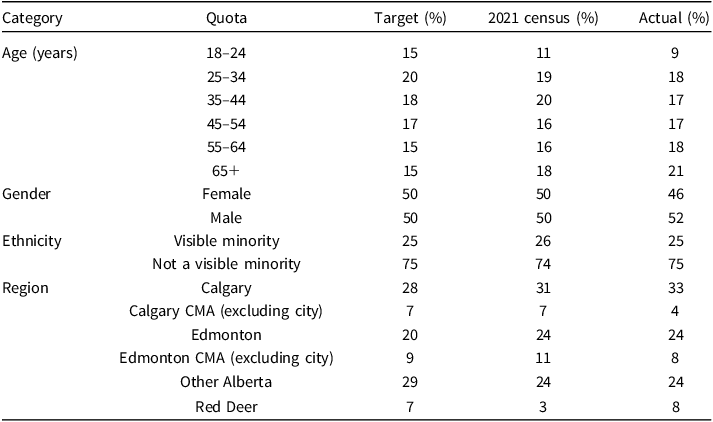
Table 1 presents a summary of our quota targets as they compare with the 2021 census. As the table shows, we oversampled younger respondents and those outside of Calgary and Edmonton. We pursued this approach because these demographic groups are more difficult to reach, and while the weighting percentages correspond to the census percentages, we wanted to ensure we were not relying on weighting to a greater degree than necessary. Indeed, the actual percentages of respondent groups ended up closely mirroring the census demographics through this approach.
Sampling Quotas, Census Demographics and Sample Information for the Viewpoint Alberta Survey

Note: Census percentages represent those over 18 years old (or in the case of visible minority status and geography, over 15 years old where only those data are available). Numbers do not always add up to 100 owing to rounding.
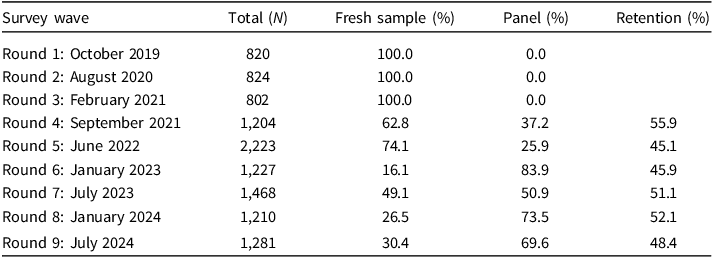
One of the most important aspects of the Viewpoint Alberta data is its longitudinal structure. We began to re-interview respondents from February 2021 in September 2021 and have continued to collect longitudinal data to the time of writing. Panel data are among the most effective ways for researchers to understand populations of interest, allowing for a much richer portrait of continuity and change within the province of Alberta. It also provides rich opportunities for researchers interested in causality, as panel data continue to be one of the most effective ways to estimate causal effects from observational survey data. Table 2 presents the sample size of each Viewpoint wave, the proportion of each survey which was from the fresh sample versus previously interviewed respondents, as well as the wave-over-wave panel retention rate. While the majority of observations (59%) in the dataset come from respondents who have only participated in the survey once, 23 per cent of the sample participated in three or more waves. The average re-interview rate from the wave immediately prior is 49.8 per cent. A full breakdown of participation patterns by wave is available in the supplementary appendix (Table A1).
Sample Composition for Viewpoint Waves

Note: Panel (%) denotes the percentage of survey respondents who have been previously interviewed. Retention (%) denotes the percentage re-interviewed from the wave immediately prior. For example, 448 out of 802 people from round 3 were re-interviewed in round 4, for a wave-over-wave retention rate of 55.9 per cent.
Variable Categories for Viewpoint Alberta Consolidated Dataset, Rounds 1– 9
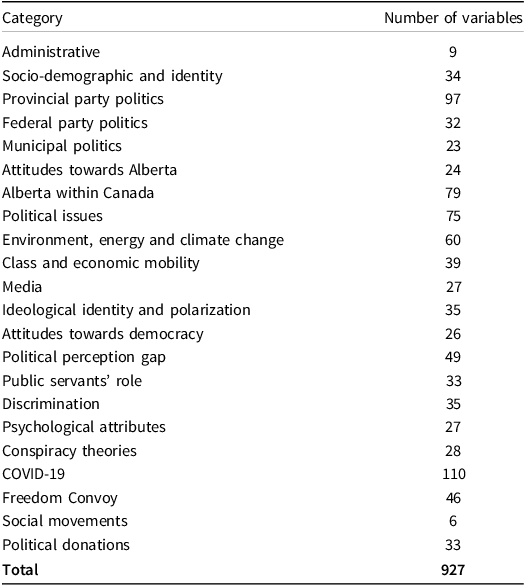
Note: The “socio-demographic and identity variables” section of the dataset includes 28 additional indicators, which represent a “select all that apply” approach to capturing ethnicity used in the 2019 and 2020 surveys. We do not include these 28 in the table above so as not to artificially inflate the number of variables in that section, since we already include “ethnicity” in the count of 34 for that section. With these 28 included, the total number of variables in that section is 60.
In addition to their causal power, panel data are useful because it has been increasingly difficult to collect high-quality, probability-based cross-sectional data for respondents in Canada, let alone in a specific province or territory. Indeed, there has been a well-documented and precipitous decline in survey response in many developed countries rates over the last 50 years, representing a drop from surveys, which would frequently have response rates of 70 per cent or more to those now in the single digits (Williams and Brick, Reference Williams and Brick2018). One reason may be that researchers are “overextracting” from the pool of potential survey respondents through ever-more frequent requests for survey participation (Leeper, Reference Leeper2019; Eggleston, Reference Eggleston2024). Partly as a result of the increasing costs associated with these trends, researchers are increasingly turning to nonprobability-based samples to answer their research questions. For example, the Canadian Election Study (CES) has used nonprobability sampling since 2019, first as a supplement to random digit dialing (RDD) and eventually as a replacement for it (Stephenson et al., Reference Stephenson, Harell, Rubenson and John Loewen2020b; Reference Stephenson, Harell, Rubenson and John Loewen2020a; Reference Stephenson, Harell, Rubenson and John Loewen2021; Reference Stephenson, Harell, Rubenson and John Loewen2022). These techniques have allowed researchers to collect much larger samples from groups historically under-represented (and therefore understudied) in survey samples. Moreover, while there is considerable debate regarding the merits of nonprobability sampling, well-constructed nonprobability samples can provide valuable insights into political attitudes and behaviour (Sanders et al., Reference Sanders, Clarke, Stewart and Whiteley2007; Ansolabehere and Schaffner, Reference Ansolabehere and Schaffner2014; though see Pasek (Reference Pasek2016) for a discussion of when these data are less effective). As a result, nonprobability samples have become more commonplace and accepted among political science researchers, and broadly following the CES methodology, this is the approach we use here.
One of the primary goals of the Viewpoint Alberta project is to understand public opinion, political behaviour and political culture across a range of issues in Alberta (see Table 3). This goal necessitates balancing a common core of survey questions (such as voting behaviour and class) while introducing new topics as they arise in Alberta politics (such as the Freedom Convoy and gender-affirming care for transgender youth). Survey length and budget constraints mean that, while the dataset is wide-ranging in scope, not all variables are available for all survey waves. Table 2 summarizes the broad types of variables included in the dataset, as well as the number of variables that fall under each topic. All told, there are 927 different indicators in the dataset, though of course far from all of them represent questions asked in each survey wave.
Socio-demographic and identity variables
The Viewpoint Alberta dataset includes the usual socio-demographic suspects that most surveys of political behaviour rely on, such as age, gender, marital status, income, union and membership. However, we also ask about religion and religiosity, immigration history, home ownership, self-position on the gender spectrum and ethnic identity, as well as several others.
Provincial party politics
Since Viewpoint Alberta is primarily a survey about provincial affairs, it is no surprise that one of the largest stand-alone categories in the dataset pertains to provincial politics. This category includes data on provincial party identification (ID), negative provincial party ID, provincial vote choice and vote intention (depending on the wave), leader thermometers, issue importance and party membership. In some waves, we also asked respondents to describe the words and labels they associate with party leaders and provincial parties, as well as specific questions about misinformation circulating during the 2023 provincial election.
Federal party politics
A more limited subset of questions has been asked about federal politics. The Viewpoint Alberta dataset includes questions about federal party vote intention and vote choice (depending on the wave), issue importance, leader thermometers and a battery of questions about the 2022 Conservative Party of Canada leadership contenders.
Municipal politics
We asked a number of questions about the 2021 municipal elections in Edmonton and Calgary to better understand voters’ views of municipal politics. In addition to vote choice, we asked respondents about their values regarding municipal elections, as well as their current assessments of the extent to which those values are realized.
Attitudes towards Alberta and Alberta within Canada
Federalism has been a contentious issue in Alberta since the province was established. We asked respondents about the extent to which they were excited, optimistic, contented or frightened, pessimistic and angry about Alberta’s position within Canada and its economic future and the extent to which they were attached to various geographical identifiers. We have also asked about various components of the “fair deal” panel, such as changing the Equalization framework, a provincial pension plan, police force, tax agency, etc. We have also asked about respondents’ views towards separatism.
Political issues
This is a heterogenous category of variables pertaining to the healthcare system, the economy, taxation, provincial budgets, inflation, addiction and social issues. These issues were selected from wave-to-wave on the basis of the research team’s evaluation of what the important issues in a given time period were.
Environment, energy and climate change
Energy politics are highly contentious in Alberta, and understanding Albertans’ attitudes towards climate change and energy transition is critical to understanding the province’s political culture. This section includes questions about pipelines, climate change policy such as the carbon tax, attitudes towards renewable energy and fossil fuels, and the 2023 wildfires.
Class and economic mobility
Affordability and class are critical to understanding how people approach politics. Some of the questions we have asked most consistently throughout the life of the project have pertained to social class identity, economic and intergenerational mobility and household finances. We have also asked a more limited subset of respondents about their likelihood of moving away from the province, and why that might be.
Media
How Albertans get their political information can tell us a lot about their politics. Within this category, we asked how often respondents get their news from a variety of sources, as well as how much they trust those sources. These include mainstream news outlets such as the CBC, CTV and Global News; American news outlets (Fox and CNN); newer media (Facebook, Twitter/X, YouTube, Podcasts and TikTok); and print media (Postmedia, The Sun and Western Standard).
Ideological identity and polarization
Our research team has been substantively interested in the kinds of groups Albertans see themselves as belonging to, as well as the labels they see as applying to themselves. These include some measures of social distance (Mason, Reference Mason2018), the extent to which respondents like and trust members of various parties and the frequency with which they engage in political discussions with others.
Attitudes towards democracy
Widespread support for democratic norms and principles is critical to well-functioning democratic societies, and several of the questions we have asked throughout the life of the project pertain to these attitudes. These include satisfaction with democracy, attitudes towards populism, perceptions of corruption, zero–sum thinking and attitudes towards political violence.
Political perception gap
Our research team has been interested in the persistent chasm between Albertans’ actual political attitudes and their perceptions of the typical Albertans’ political attitudes (Wesley et al., Reference Wesley, Diner and Walker2024). We call this the “political perception gap.” To better understand the dimensions of this gap, we asked about respondents’ views on a range of political attitudes such as federalism, healthcare, gender pronouns, the carbon tax and safe consumption sites. These same issues were also asked from the perspective of the “typical Albertan,” and in some cases, the typical New Democratic party (NDP) or United Conservative party (UCP) supporter. The results inform our understanding of where Albertans are, and where they think they are, on a range of political issues.
Public servants’ role
Public servants (broadly defined) play an important role within public life, and understanding the extent to which respondents trust public actors and institutions to do the right thing matters for the health of democracy. These questions include the extent to which respondents have confidence in institutions such as the public service, parliament, media and academia, as well as actors such as doctors, teachers, judges and police officers.
Discrimination
Not all groups in society benefit equally from the same level of structural privilege. In some waves of the survey, we asked respondents about how much discrimination they think is present in Alberta against a range of groups, such as Indigenous people, Black people, immigrants, gender minorities and religious groups.
Psychological attributes
In addition to questions about various political issues, actors and institutions, some waves of Viewpoint Alberta asked about a limited subset of psychological attributes. These include social dominance orientation (Pratto et al., Reference Pratto, Çidam, Stewart, Zeineddine, Aranda, Aiello and Chryssochoou2013) as well some questions about feeling upset, nervous, confident, overwhelmed, etc.
Conspiracy theories
Both top-down and bottom-up conspiracy theories have flourished in Alberta, and our research team has tried to understand respondents’ views about a number of them. This includes respondents’ attitudes towards conspiracy theories such as microchips in coronavirus disease 2019 (COVID-19) vaccines, climate change being a hoax and the presence of a “deep state” embedded in government, as well as explicitly racist conspiracy theories such as the “white replacement” conspiracy and a secret Jewish world government. In these batteries, we also included a few questions that sounded conspiratorial but were in fact true so as to get a rough estimate of the extent to which respondents were likely to accept or reject anything that merely sounded as though it could be a conspiracy, such as COVID-19 being airborne or that big tobacco companies knew smoking caused cancer much earlier than they disclosed.
COVID-19
The category of questions we undoubtedly expected the least when we began the project pertained to the COVID-19 pandemic. During the first 2 years of the pandemic, we asked Albertans their attitudes towards a range of COVID-19-related issues, such as their trust in political actors and institutions to handle the crisis, the extent to which they supported public health restrictions such as limits on public gatherings, masking and vaccine passports and their own attitudes towards vaccination, as well as the impacts of the pandemic on their personal and economic wellbeing.
The Freedom Convoy and social movements
During the pandemic, a range of social movements became important for politics across the country, including Alberta. Perhaps the most high-profile of these was the “Freedom Convoy,” which consisted of a blockade at Ottawa and Coutts. Shortly after the convoy, as well as some months later, we asked respondents about Convoy participants’ motivations, how they felt about the Convoy’s message and the conduct of their participants and the impact of the Convoy on the country. We also asked general thermometer-style questions about the convoy, as well as about a subset of other types of social movements such as Black Lives Matter, Wet’suwet’en land defenders and anti-Russian War protesters.
Political donations
The final subset of questions asked in Viewpoint Alberta pertain to respondents’ attitudes towards political donations at the local, provincial and national levels. These pertained to donation limits, campaign spending limits, third-party spending, disclosure and corporate and union donations, as well as the role of foreign donations.
Example Applications
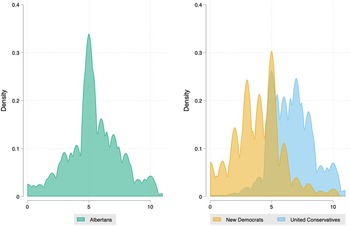
There are many promising avenues of research available to those interested in the Viewpoint Alberta data. We present a small sample of these below, which reveal a portrait of a provincial electorate that is moderate both in terms of ideology and their view of the province’s position within Confederation. Indeed, when it comes to their ideological self-awareness, most Albertans demonstrate centrist tendencies and see themselves as having multiple political identities. As Figure 1 shows, when asked to place themselves on a spectrum from far left (0) to far right (5), most Albertans fall at or near the centre (10). These findings call into question many of the stereotypes which abound regarding Alberta as a deeply conservative society.
Ideological Self-Placement.

This finding is robust. Not only is this pattern consistent across all waves of our dataset, it also aligns with similar academic surveys (Sayers and Stewart, Reference Sayers, Stewart and Wesley2016), the Canadian Election Study (Stephenson et al., Reference Stephenson, Harell, Rubenson and John Loewen2022) and commercial polls (Anderson, Reference Anderson2018). What is more, these self-placements hold up among most demographic groups, with men and women, rural and urban dwellers, public- and private-sector workers, baby boomers and millennials and most others demonstrating these centrist tendencies (Wesley et al., Reference Wesley, Diner and Walker2024). Only partisanship appears to divide Albertans along ideological lines, with New Democrats and United Conservatives positioning themselves more to the centre-left and centre-right, respectively. Nevertheless, the centre (5) remained the modal response for both groups.
This middle-of-the-road bent extends to Albertans’ political identities. We provided respondents with a list of political groups and asked them to select all that applied to them. In a follow-up question, we asked which term came closest to their own identity. As shown in Figure 2, the most commonly held identity in Alberta is “moderate,” followed by “progressive” and “conservative.” In fact, 8 in 10 Albertans choose some combination of the three identities, revealing a tremendous breadth of internal complexity (if not dissonance) within Alberta voters. When asked to choose, Albertans were slightly more likely to identify as conservative, yet the distribution was relatively even among left-wing, centrist and right-wing identity categories.Footnote 2
Group Identities in Alberta.

As discussed above, the Viewpoint Alberta dataset incorporates a panel component from waves 3 (February 2021) to 9 (July 2024), allowing us to track individual respondents’ attitudes between earlier time periods and later ones. For instance, most Albertans maintain their political identities over time (Figure 3). Compared with moderates, centrists, progressives and liberals, Albertans who claimed “conservative” as their primary political identity in earlier waves (T0) were more likely to retain that identification across waves (T1). Moderates/centrists and progressives/liberals were more likely to trade identities with each other than switch to being conservative. This suggests more fluidity on the centre-left than on the centre-right, but a lot of stability in general.
Changes to Group Identity in Alberta.
Note: Here, we use “identities” in lower case, in contrast to upper-case “Political Party Affiliations.”

Contribution
The Viewpoint Alberta consolidated dataset makes two important contributions. First, to the authors’ knowledge, this is the largest and most comprehensive dataset of political attitudes in a single province that has ever been publicly released. This matters because we know much less about political behaviour at the provincial level than the national level—in large part because of data availability. However, many of the most interesting and important developments in electoral competition, public policy and even party system formation occur at the provincial level. The Viewpoint Alberta dataset helps to remedy this gap because of its scale, both in terms of the number of respondents and the scope of the included survey questions. Having a large sample of respondents allows researchers to perform more detailed subgroup analysis—particularly for groups that have historically been excluded from political behaviour research. By contrast, having a broader range of measures allows researchers from different subfields to work on common problems. It is our hope that datasets such as Viewpoint Alberta will lead to greater interest in provincial politics among researchers, and through them a richer understanding of political life.
The second principal contribution of the dataset is its longitudinal structure. By following the same respondents over multiple periods of time, we are able to develop a more comprehensive understanding of stability and change within Alberta. However, the results of longitudinal analyses may also be relevant for those who seek to understand trends in other provinces, or in Canada as a whole. Panel data present an opportunity to understand how specific groups of voters change their minds—whether about their political identities, election-specific issues such as vaccine mandates or long-term phenomena such as climate change and the transition towards renewable energy. These insights are critical as we continue to learn how to best persuade people that tackling these large and often daunting concerns is both possible and necessary.
Supplementary material
The supplementary material for this article can be found at https://doi.org/10.1017/S0008423925100656.
Competing interests
The author(s) declare none.



 Open access

