





Introduction
Turkey’s European Union (EU) candidacy has been essential in harmonizing Turkish laws and regulations with EU standards through the Europeanization of national policies (Sedelmeier Reference Sedelmeier2011). Turkey, an upper-middle-income country, has enjoyed a period of high economic growth with fast-growing energy, infrastructure, and transportation sectors. The rapid expansion of these sectors has brought about serious environmental problems, such as high levels of greenhouse gas (GHG) emissions and air pollution. These environmental issues have become increasingly severe since the 1990s (Savaşan Reference Savaşan, Savaşan and Sümer2020a). Technical challenges and disputes that have delayed the ratification of the Paris Agreement, delayed participation in major environmental treaties coupled with a lack of institutional capacity have deepened Turkey’s environmental problems.
Traditionally considered a policy laggard with respect to environmental protection, Turkey’s accession negotiations with the EU led to an acceleration of environmental policy adoption. Turkey adopted a significant number of additional environmental laws and policies in order to meet EU requirements.Footnote 1
However, in December 2006, the EU suspended accession negotiations because Turkey refused to extend the EU–Turkey Customs Union agreement to the new EU member states, including the Republic of Cyprus (Schimmelfennig Reference Schimmelfennig, Reiners and Turhan2021). The EU decided that eight chapters relevant to Turkey’s restrictions with regard to Cyprus will not be opened, and no chapter will be provisionally closed until Turkey fulfills its commitments under the additional protocol to the EU–Turkey Association Agreement that extended its customs union to the new EU member states including Cyprus (Council of the European Union 2006). The ongoing Cyprus dispute, Turkey’s backsliding on fundamental rights and separation of power, which are essential elements of the rule of law, as well as lack of political pluralism have brought accession negotiations to a standstill (Lippert Reference Lippert2021). Continued deterioration of democratic standards, along with the “sheer size” of its economy and population, create additional challenges for Turkey’s full membership, considering the EU’s integration capacity (Kollias Reference Kollias2021). Besides, internal issues within the EU, such as enlargement fatigue, have made Turkey’s EU membership an increasingly distant and unlikely prospect.Footnote 2
Nevertheless, EU-style policymaking has persisted in various policy areas, including environmental and climate policy, even as the EU’s influence generally decreased (Savaşan Reference Savaşan2019). Although EU–Turkey relations have become increasingly strained, it seems that the EU still plays a prominent role in shaping climate policies in Turkey. For example, Turkey ratified the United Nations Framework Convention on Climate Change (UNFCCC), which in many ways forms the basis of the EU’s climate acquis, in 2004 – the same year in which the EU agreed to start accession negotiations with Turkey. In the same vein, Turkey’s ratification of the Kyoto Protocol coincided with the opening of negotiations under the Environment and Climate Change Chapter in 2009.Footnote 3 İzci (Reference İzci, Özer and Nas2012) shows that the Aarhus and Espoo Conventions represent two additional international treaties that the EU conditionality has “forced” Turkey to participate in. Turkey has declared its intention to become a party to these conventions upon achieving full EU membership. All these developments imply that Turkey uses its climate policy as a bargaining chip in negotiations for EU membership. In this regard, it is essential to consider the political and economic dynamics with the EU when analyzing Turkey’s climate policy.
This pervasive and long-lasting policy influence of the EU on non-EU countries – also called the “Brussels effect” – is increasingly well documented in the literature (Bendiek and Stuerzer Reference Bendiek and Stuerzer2023; Bradford Reference Bradford2020; Dabrowski et al. Reference Dabrowski, Musialkowska and Polverari2018). The Brussels effect is a form of unilateral regulatory power in which the EU is able to externalize its laws and regulations outside its borders through market mechanisms. This influence may lead to a process resulting in policy convergence where the similarity between policy characteristics increases over time (Holzinger and Knill Reference Holzinger and Knill2005). Knill (Reference Knill2013) defines policy convergence as:
any increase in the similarity between one or more characteristics of a certain policy (e.g. policy objectives, policy instruments, policy settings) across a given set of political jurisdictions (supranational institutions, states, regions, local authorities) over a given period of time.
It can also be a conscious choice in order to facilitate entry to the EU’s internal market (Bradford Reference Bradford2020) or a way of benefiting from the EU’s considerable regulatory capacity in lieu of domestic policy prowess (Holzinger and Knill Reference Holzinger and Knill2005).
It is worth noting that more than two decades have passed since the establishment of the customs union, which forms the backbone of economic relations between the EU and Turkey. Consequently, almost all industrial goods and processed agricultural products are exempt from customs tariffs. Since then, international trade and investment between Turkey and EU member states has increased significantly, reaching a point where approximately more than half of Turkey’s total exports are delivered to EU member states. However, considering the current trends in global trade, the scope of the existing customs union needs to be expanded and modernized to better reflect the interests of both parties (Yalcin and Felbermayr Reference Yalcin and Felbermayr2021). Aligning climate policy is particularly important for the modernization of the customs union, as it is integrated with the EU’s new Circular Economy Action Plan (CEAP) and the EU’s Carbon Border Adjustment Mechanism (CBAM) as part of the European Green Deal (Ülgen et al. Reference Ülgen, Selamoğlu and Yıldırım2021). Considering the potential impacts on different sectors, including agriculture, industry, and transportation, the Green Deal is much more than an environmental strategy; it represents a comprehensive approach to the design of a new international trade order (Aşıcı and Acar Reference Aşıcı and Acar2022). Turkey’s relationship with the EU is unique in this regard. While it is not a member state, it has a closer relationship with the EU than most other third countries due to the large trade volume between Turkey and the EU. Consequently, these developments become even more critical for Turkey, not only for maintaining its access to the EU market but also for improving its competitive advantage in the evolving international trading system. So, Turkey’s climate policy is one of the areas where the Brussels effect may occur.
This article contributes to the policy convergence theory by engaging in one of the first empirical evaluations of the Brussels effect in the area of climate policy. Despite the growing interest in policy convergence studies, especially in comparative public policy research, it remains unclear whether policies do indeed converge in practice and what are the driving forces of this phenomenon. Past research reveals mixed results due to theoretical deficits, operationalization issues, methodological limitations, and lack of empirical evidence. Accordingly, this paper offers a conceptual framework and empirical strategy towards bridging the gap between policy convergence theory, the Brussels effect and its empirical understanding.
In this study, we use quantitative data to map the EU and Turkey’s relative policy positions as a means of illustrating policy convergence. Through multidimensional scaling (MDS) this paper provides an empirical grounding to the theoretical assumptions of policy convergence theory and the Brussels effect. MDS is a multivariate technique that allows us to visualize and analyze the connectivity and intensity of cooperation between states and the dynamic behavior between countries; specifically, to analyze convergence–divergence dynamics between the EU and Turkey’s climate policy over time. To allow for comparison, the analysis is repeated for different periods from 2007 to 2023. Each period in the analysis represents a period in which major developments in EU–Turkey relations took place. While this visualization cannot confirm the drivers of the convergence–divergence dynamics, which are already widely discussed in the literature, the data used in this article can help explain the relative convergence of Turkey’s climate policy with the EU.
The remainder of this article proceeds as follows: the next section outlines the conceptual framework grounded in policy convergence theory; then is presented the climate performance data used for our analysis; the following section is the Methods, finishing with discussion of the empirical findings, and the Conclusion.
Cross-national climate policy convergence
Since the 1990s, the study of cross-national policy convergence and its mechanisms has been a prominent focus for political scientists, in parallel with the developments in European integration. Past research has shown that various domestic and international factors may contribute to policy convergence including culture, institutions, and socio-economic structure as domestic factors; and harmonization, imposition, and diffusion as international factors (Busch and Jörgens Reference Busch and Jörgens2005; Lenschow et al. Reference Lenschow, Liefferink and Veenman2005).
Policy convergence has been observed in a wide range of policy areas including fiscal policy, health policy, trade policy, and energy policy (Blank and Burau Reference Blank and Burau2006; Blot and Serranito Reference Blot and Serranito2006; Jacobs Reference Jacobs2016). Like many other policy areas, climate policies are subject to policy convergence. It is unlikely that countries will independently develop policies and laws to combat climate change. Instead, they are likely to develop similar policies through various motivations and mechanisms (Arbolino et al. Reference Arbolino, Carlucci, De Simone, Ioppolo and Yigitcanlar2018; Schoenefeld et al. Reference Schoenefeld, Schulze and Bruch2022; Strunz et al. Reference Strunz, Gawel, Lehmann and Söderholm2018).
Holzinger and Knill (Reference Holzinger and Knill2005) identify the drivers and stimulus of policy convergence as outlined in Table 1.Footnote 4 In brief, drivers refer to the mechanism or method of policy convergence, while the stimuli represent the rationale or reason behind the convergence.
Drivers and stimuli of policy convergence
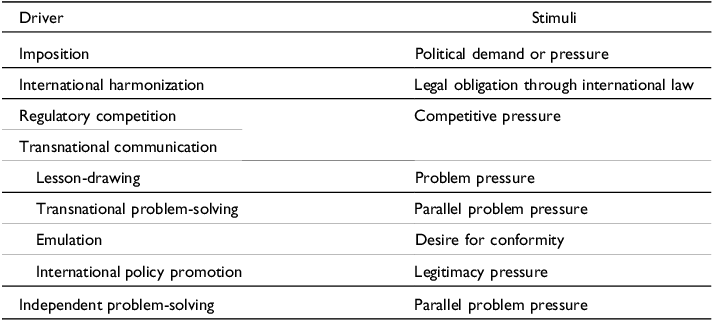
Source: Holzinger and Knill (Reference Holzinger and Knill2005).
EU membership is an example of the harmonization effect, where convergence happens via the harmonization of national policies through supranational law (Holzinger et al. Reference Holzinger, Knill and Sommerer2008). Policy convergence can also be driven by the demand for similarity as in the case of transnational communication. When an environmental pioneer initiates environmental policy innovations, these may develop into best practices that others also adopt. Alternatively, countries may seek social acceptance by conforming to the behavior of other states (Meyer et al. Reference Meyer, Boli, Thomas and Ramirez1997).
While we place our research in the policy convergence theory literature, another relevant literature relates to the so-called Brussels effect, coming from legal scholarship. The Brussels effect describes a transfer process of a law or policy innovation from one state to another (Bradford Reference Bradford2020). A fundamental difference between the two theories is that the Brussels effect does not explicitly rely on coercion by the rule-setting country (but rather on “involuntary incentives” stemming from market forces), whereas policy convergence theory does explicitly include the possibility of coercion through policy imposition by external actors (see also Table 1). In line with this distinction, the Brussels effect refers to a different and more limited set of drivers as compared to policy convergence theory: market power, strong political and economic institutions, and regulatory capacity. One of the main reasons behind the EU’s ability to externalize its regulatory measures to third countries is having a large and competitive internal market, which also serves as a strong indicator of economic power. In addition to that, the EU has also one of the world’s largest consumer markets. The EU, possessing this power, can demand that third countries accept certain standards in return for access to the EU internal market or to be able to continue to use export opportunities to its market.
Given our focus on the Turkey–EU relationship, it is also worth noting a specific sub-set of these literatures that focus on this dynamic and have applied policy convergence theory. Burgin (Reference Burgin2019) highlights the importance of the EU-induced learning mechanism to analyze the impact of the EU on Turkish politics and policies. The study suggests that policy-learning processes through the interaction of Turkish actors (bureaucratic actors, non-governmental organizations, and policy networks at local and national levels) with the EU may present an alternative path of Europeanization in Turkey, especially when considering the stalled accession talks. In an earlier study, Burgin shows the importance of the Instrument for Pre-Accession Assistance for the promotion of administrative capacity and policy-learning processes within Turkey’s bureaucracy (Burgin Reference Burgin2016). Demirbilek and Benson (Reference Demirbilek and Benson2019) examine the EU Water Framework Directive policy transfer outcomes and assess the level of convergence between the EU and Turkey. The results reveal that the implementation of key institutions continues, mainly through emulation, despite the viability of Turkey’s EU accession process having dramatically decreased.
Despite the extensive body of literature on policy convergence and diffusion, studies examining Turkey’s Europeanization process often overlook the EU’s ability to externalize its laws and regulations outside its borders. Thus far, there have not been any applications of the Brussels effect on Turkey; however, given that the EU is Turkey’s biggest trading partner and by far its most important export market, it is reasonable to assume that this mechanism also holds explanatory power for policy convergences between the two actors. For Turkey, joining a customs union with the EU has resulted in the adoption of a variety of Turkish regulations to achieve approximation with the EU acquis.Footnote 5 While the latter is not an example of the Brussels effect per se – the adoption of legislation to join a customs union cannot be seen as an entirely voluntary act – the continued approximation of Turkish laws with the EU, even during periods of political distancing, could be seen to fall within that category.
Climate policy performance data
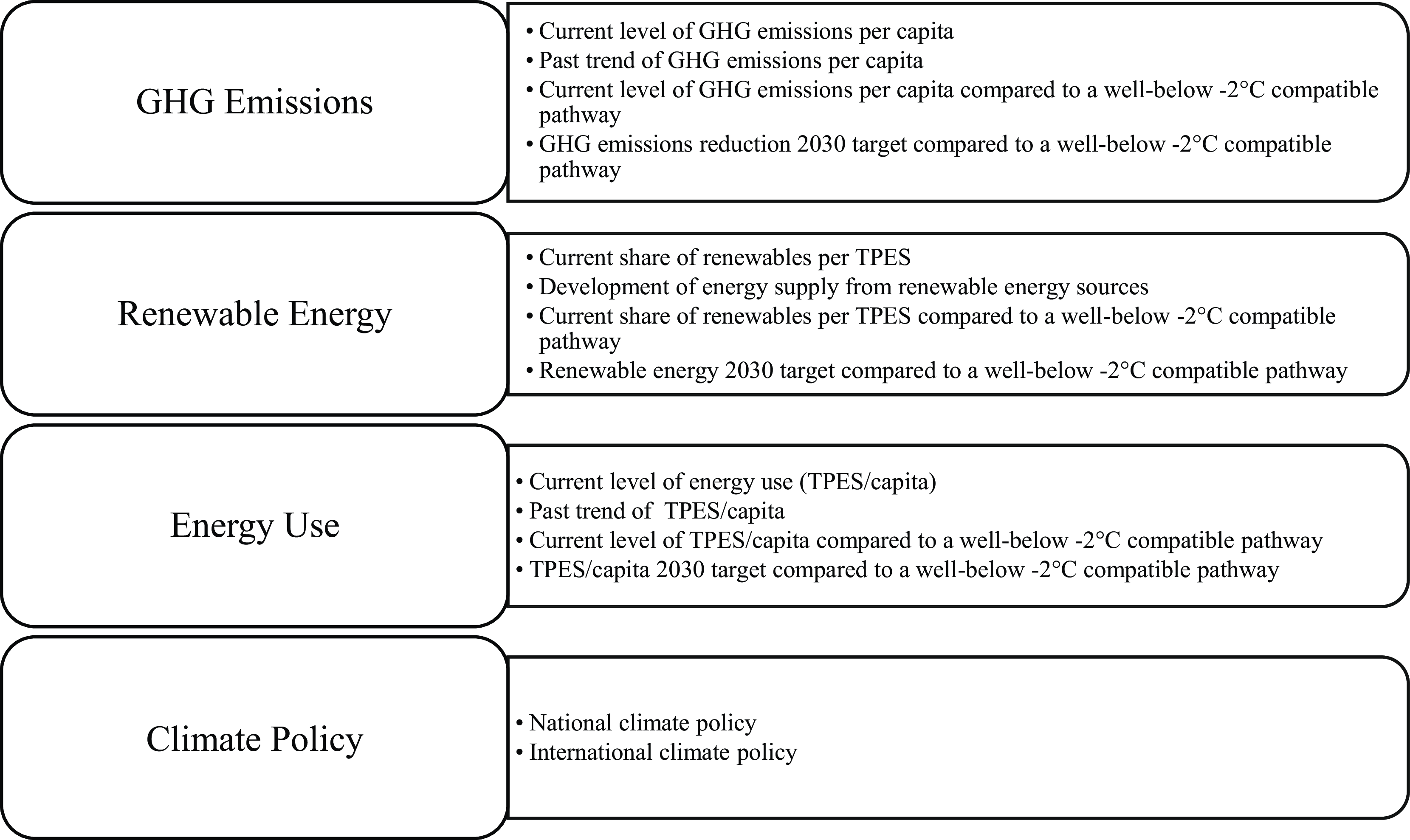
Convergence is defined as the increasing similarity of policies in terms of their structures, processes, and performances implemented by different political entities. So, we need access to climate policy performance indicators that can be compared across countries and throughout different time periods to analyze the convergence process of the EU and Turkey’s climate policies. Identifying such indicators is challenging as there is no standard definition or practice around these indicators. Some studies measure policy performance through outcome variables such as emission levels or emission trends. Others prefer composite indices such as the Climate Change Cooperation Index (Bernauer and Böhmelt Reference Bernauer and Böhmelt2013), the Environmental Performance Index (Wendling et al. Reference Wendling, Emerson, de Sherbinin and Esty2020), or the Environmental Policy Stringency Index (Botta and Koźluk Reference Botta and Koźluk2014). The data in this article come from the Climate Change Performance Index (CCPI), which is published by Germanwatch (2024). The CCPI measures countries’ climate change mitigation efforts through fourteen indicators divided over four main pillars as presented in Figure 1.
Components of the Climate Change Performance Index (CCPI). GHG, greenhouse gas; TPES, total primary energy supply.
Source: Burck et al. (Reference Burck, Uhlich, Bals, Höhne, Nascimento, Wong, Tamblyn and Reuther2021)
In order to obtain the CCPI of specific countries, the weighted average of normalized indices for each of the pillars is calculated and measured on a scale ranging from 0 to 100. The aspirational goal is designated as 100; scores closer to 100 represent better climate change performance, whereas scores closer to 0 represent lower climate change performance (Burck et al. Reference Burck, Uhlich, Bals, Höhne, Nascimento, Wong, Tamblyn and Reuther2021). The CCPI’s data cover the EU-28 (twenty-eight EU countries) members, Turkey, and the EU itself from 2007 until 2023. CCPI data are available for each EU member state since the index was first published. However, the EU’s data are available only for the years between 2018 and 2023. For this reason, the EU-28 averageFootnote 6 and the EU-15 (fifteen EU countries January 1, 1995–April 30, 2004) average are used to assess the EU’s climate policy performance for the entire period.
Our choice for the CCPI is motivated by several factors; most importantly, the CCPI bases countries’ international and national climate policy performances on legislation, as well as on the assessment of national emissions targets, sectoral targets, and their implementation. We believe that the latter factors are particularly important, as exclusive reference to legislation (“law in the books”) – without considering performance (“law in action”) – can easily lead to under- or overestimation of country performance.
Furthermore, the methodology employed by the CCPI differs significantly from others. The first three pillars of the CCPI – GHG Emissions, Renewable Energy, and Energy Use – are based on quantitative data. In contrast, the fourth pillar, Climate Policy, covers the most recent developments in national climate policy frameworks and is annually evaluated through an extensive survey conducted by climate and energy policy experts from each country. This survey delves into various topics, including the strengths and weaknesses of climate policy frameworks, sectoral targets and their implementation levels, performance in international and informal negotiations, and climate policy actions. These aspects cannot be solely captured through quantitative data. The reliance on national expert assessments for the Climate Policy pillar is a distinctive characteristic of the CCPI. Compared to other outcome variables like GHG emissions or renewable energy use, the CCPI’s indicators can better represent both climate policy outputs and outcomes. Even so, as Ylä-Anttila et al. (Reference Ylä-Anttila, Gronow, Stoddart, Broadbent, Schneider and Tindall2018) argue, today’s emission levels are a result of long-term processes and may depend on many factors other than climate policies that cannot alone represent the policy profile of a country. Ideally, outcome variables are replaced with more comprehensive indicators that cover more than one dimension to measure climate policy performance more accurately. Therefore, CCPI is a good candidate as a proxy variable for measuring climate policy performance by combining outcome variables (emission levels and emission trends) with policy outputs.
One potential drawback of the CCPI is its revised methodology. One needs to be very careful when employing long-term analysis since the methodological revision has changed the list of indicators as well as their weighting scheme, making it hard to compare country statistics over time. However, the MDS technique used in this paper allows us to include differently scaled variables while calculating and graphically visualizing the distances between objects.
Methods
This section explains the choice for MDS as the method of analysis for the suspected convergence–divergence dynamics between the EU and Turkey’s climate policy. MDS, in different forms, has been used in a wide variety of fields including psychology, political science, and marketing. An earlier version of MDS, also known as classical scaling, was proposed by Torgerson (Reference Torgerson1952). There are two types of MDS, metric and non-metric. This paper uses metric (classical) MDS that applies Euclidean distance to computing similarities.
MDS is a class of data analysis techniques for graphically visualizing the distances between objects. Technically, it approximates the real distances between units by distances in low-dimensional Euclidean space (Michailidis Reference Michailidis, Chen, Härdle and Unwin2008). Preferably the setting is a two-dimensional space as it is easy to detect points in the Cartesian plane and trace their movements. In our case, objects are countries where MDS provides these countries’ relative positions. By comparing country positions over time, we will be able to map the process of convergence between units. In addition, results will reveal any structural patterns of the data, country clusters, groups, and outliers.
MDS is based on a form of distance matrix that represents the dissimilarities between pairs of objects. The idea behind MDS is the visualization of the dissimilarity matrix in a small number of dimensions that represent the actual distance between objects (Bartholomew et al. Reference Bartholomew, Steele, Moustaki and Galbraith2008). The dissimilarity matrix can be created in many ways, according to the context. Various dissimilarity measures are available in the literature that describe pairwise distinction. The dissimilarity matrix can be computed by using actual data like geographical distances or subjective judgments like individual ratings and rankings. This study uses a dissimilarity matrix that represents the difference between climate policy performances of countries.
The CCPI is time-series data obtained from 2007 to 2023. It is important to decide from which year’s data the dissimilarity matrix will be created. There are a few options such as aggregating data over a given period, averaging data over five years, or comparing maps for selected years. However, those methods also come with some potential drawbacks. Aggregating data over a given time might yield a loss of information because it ignores year-to-year country variations and fluctuations. On the other hand, country performances fluctuate year by year. Therefore, the selection of a specific year might create biased results. For this reason, we first divided the analysis period into four main periods by taking the evolution of the EU–Turkey relations, as well as the data availability, into account. These four periods are: early accession (2007–2009); stagnation (2010–2014); suspension (2015–2020); and recent developments (2021–2023).Footnote
7
Following Rapoport (Reference Rapoport1990), each period is then created as a multidimensional policy space where countries have to choose their level of ambition through their national contributions, each year. Let the n-dimensional policy space be denoted by $\;{P^n}$
. A point
$\;{P^n}$
. A point ${x_i} \in {P^n}$
represents the policy profile of the country
${x_i} \in {P^n}$
represents the policy profile of the country $\;i$
and the distance
$\;i$
and the distance $d\left( {{x_i},{x_j}} \right)$
between any two points represents the policy performance dissimilarity between the two parties. In an n-dimensional policy space, the policy distance between country
$d\left( {{x_i},{x_j}} \right)$
between any two points represents the policy performance dissimilarity between the two parties. In an n-dimensional policy space, the policy distance between country $i$
and country
$i$
and country $j$
can be calculated by using the Euclidean distance formula as follows:
$j$
can be calculated by using the Euclidean distance formula as follows:
 $${d_{ij}} = {\left\{ {{{\left( {{x_{i1}} - {x_{j1}}} \right)}^2} + {{\left( {{x_{i2}} - {x_{j2}}} \right)}^2} + \cdots + {{\left( {{x_{in}} - {x_{jn}}} \right)}^2}} \right\}^{1/2}}$$
If ${d_{ij}}$
is the distances between the points in the configuration and
${d_{ij}}$
is the distances between the points in the configuration and $_{ij}$
is the observed distances between the objects, the following stress function is the goodness-of-fit measure that represents how good the configuration approximates the real distances (Kruskal Reference Kruskal1964):
$_{ij}$
is the observed distances between the objects, the following stress function is the goodness-of-fit measure that represents how good the configuration approximates the real distances (Kruskal Reference Kruskal1964):
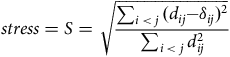 $$stress = S = \sqrt {{{\sum\nolimits_{i \lt j} {{{({d_{ij}}{ - \delta_{ij}})}^2}} } \over {\sum\nolimits_{i \lt j} {d_{ij}^2} }}} $$
MDS estimates the policy positions of the EU and Turkey using Euclidean distances for each period. This will enable us to locate the EU and Turkey in the policy space, analyze their movement in time, and provide a map of their respective convergence–divergence.
Empirical results of the MDS analysis
This section presents and discusses the empirical results obtained from the MDS. Figure 2(a) shows relative country positions for the period between 2007 and 2009.Footnote 8 Several country clusters emerged from the MDS map; Sweden and Germany are among the best-performing countries, both performing well above the EU averageFootnote 9 in climate change policy performance. The second cluster in the middle-left side of the figure comprises Hungary, the United Kingdom, Portugal, Denmark, and France. Generally, country groupings are in line with the environmental leaders and laggards as identified in environmental policy-making literature (Knill et al. Reference Knill, Heichel and Arndt2012). However, there are also outliers; Luxembourg, for example, is associated with the country’s lower performance in all domains.
Multidimensional scaling for the comparison of climate policy performances. AUT, Austria; BEL, Belgium; BGR, Bulgaria; CYP, Cyprus; CZE, Czechia; DEU, Germany; DNK, Denmark; ESP, Spain; EST, Estonia; EU, European Union; EU-15, fifteen EU countries; FIN, Finland; FRA, France; GBR, United Kingdom; GRC, Greece; HRV, Croatia; HUN, Hungary; IRL, Ireland; ITA, Italy; LTU, Lithuania; LUX, Luxembourg; LVA, Latvia; MLT, Malta; NLD, the Netherlands; POL, Poland; PRT, Portugal; ROU, Romania; SVK, Slovakia; SVN, Slovenia; SWE, Sweden; TUR, Turkey.
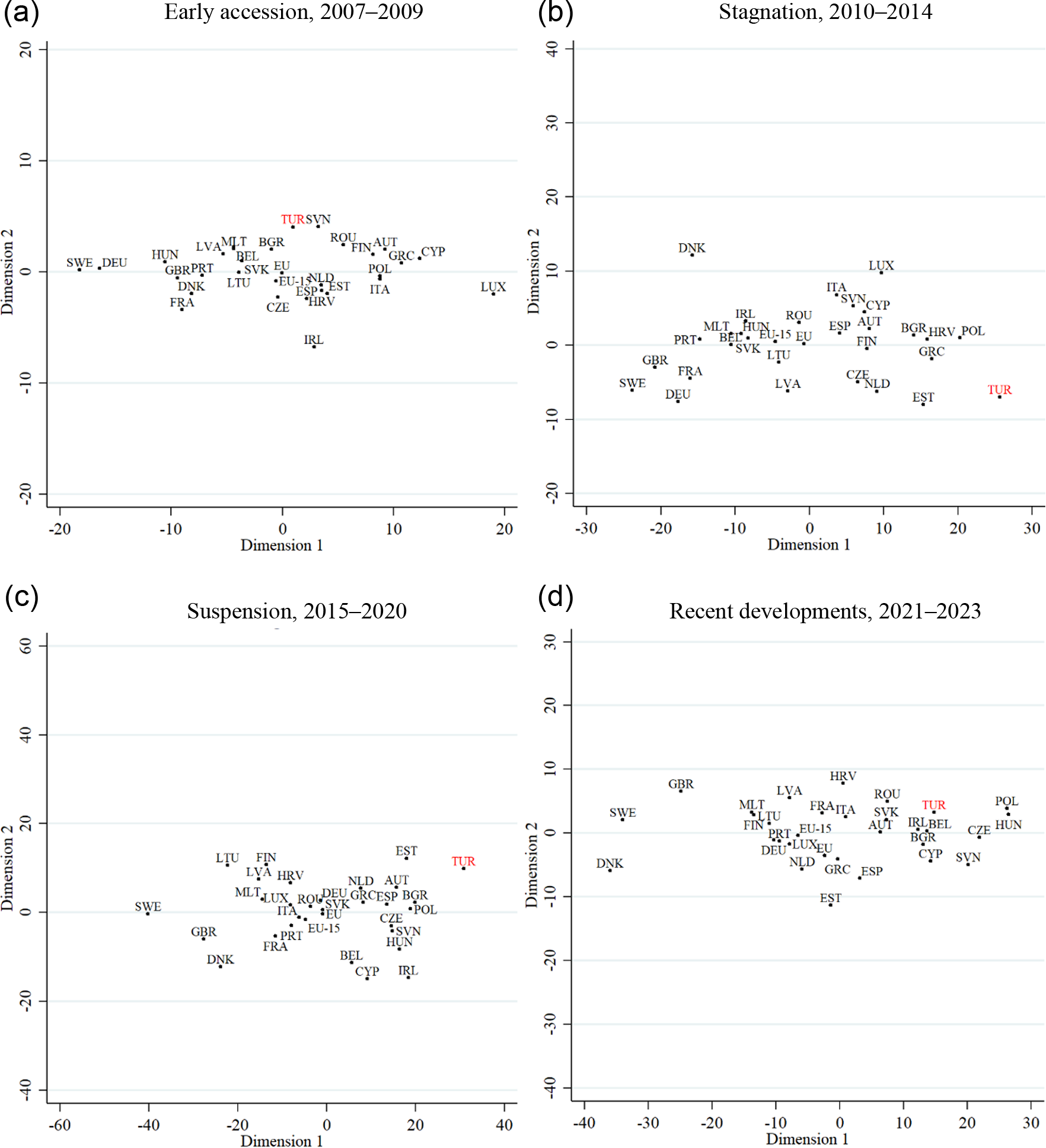
Turkey’s performance is similar to those of the Central and Eastern European (CEE) countries, closest to Slovenia and Bulgaria. In Turkey, there had been a broad-reaching effort to manage the environment since environmental issues had become increasingly severe due to the fast-growing energy, infrastructure, transportation, and tourism sector during this period (Savaşan Reference Savaşan, Savaşan and Sümer2020a). However, besides national factors, international factors may have played a more prominent role in shaping Turkey’s position. In fact, Turkey ratified the UNFCCC in 2004, which coincided well with its intention to send a positive signal to the EU, which is one of the most important actors and global standard-setter in international climate change politics (Şahin Reference Şahin2014). Moreover, during this early accession period, Turkey adopted a significant number of environmental laws and policies to meet the EU requirements. Turkey ratified and officially became a party to the Kyoto Protocol in 2009 when the EU acquis on Environment and Climate Change opened for negotiations.
Figure 2(a) reflects the EU’s influence in shaping Turkey’s climate policy where position similarity indicates convergence in climate policies (Cao Reference Cao2012). Interactions during accession negotiations may facilitate a convergence process driven by learning and emulation. Policy learning refers to governments deriving lessons from their own policies or the past policy experiences of other governments.
In this scenario, as the success rate regarding the policy’s outcomes increases, the probability of this policy being adopted by other governments also rises. On the other hand, for imitation, policies are transferred through peer effect regardless of the costs and benefits associated with that policy innovation (Berry and Baybeck Reference Berry and Baybeck2005; Shipan and Volden Reference Shipan and Volden2008). During accession negotiations, political and bureaucratic actors interact more and gain a deeper understanding of policy instruments and their implications. Increased communication between parties fosters the implementation of more successful/similar policies.
Tocci (Reference Tocci2014) characterizes EU–Turkey relations as cooperative and convergent with cyclical ups and downs over the decades. The European debt crisis, following the 2008 global financial crisis, has raised concerns regarding future EU enlargement (Hauge et al. Reference Hauge, Eralp, Wessels and Bedir2016). For Turkey, this confirmed that full membership will not happen anytime soon. During this period, Turkey became one of the worst European representatives of climate policy. CCPI reports state that Turkey, Poland, Croatia, and Greece hold some of the lowest positions in the overall rankings (Burck et al. Reference Burck, Bals and Parker2010, Reference Burck, Bals and Bohnenberger2011). It is worth noting that, although having ratified the Kyoto Protocol, Turkey did not make any emission reduction commitments during the first period of Kyoto as it was not a party to the Convention during the negotiations, and it was not listed under Annex-B countries because of its special circumstances. Unfortunately, those actions may have a negative impact on its international reputation on climate change, through the “too little too late” syndrome (Adaman and Arsel Reference Adaman and Arsel2016). All these developments pushed Turkey further away from the EU norms and policies. This situation is reflected in Figure 2(b). Turkey is one of the bottom five countries in climate policy performance and stands close to some other countries with lower scores including Spain, Croatia, Poland, and Greece.
The European Parliament voted in favor of freezing accession talks with Turkey because of “disproportionate repressive measures” taken by the Turkish government following the failed coup attempt in 2016 connected to the violation of human rights and fundamental freedoms (European Parliament 2016). In 2018, the EU froze Turkey’s accession negotiations in response to democratic backsliding and moving further away from the EU path. The Council notes that “Turkey’s accession negotiations have therefore effectively come to a standstill and no further chapters can be considered for opening or closing and no further work towards the modernisation of the EU–Turkey Customs Union is foreseen” (Council of the European Union 2018). Throughout this period, Ankara aimed to expand its market reach, and, to some extent, has achieved success in diversifying its trading partners. While the European market remains by far the most important destination for Turkish exports, the EU’s share of Turkey’s total trade has gradually decreased over time. The Brussels effect thesis suggests that “the better the exporter’s ability to divert trade to third-country markets or increase demand in its home market, the less likely the Brussels Effect will occur” (Bradford Reference Bradford2020, 27). Consequently, it is not anticipated that there will be policy alignment between the EU and Turkey in this period.
Figure 2(c) depicts relative country positions for the years between 2015 and 2020. The MDS map further proves that any environmental and climate policy development is, for sure, conditioned by the political and economic situation. Deepening tensions between the EU and Turkey coupled with Turkey’s internal challenges increase the policy distance between these two. Besides migration, security, and political challenges during this period, Turkey also has experienced a worsening in climate change performance. Low-performing countries are clustered on the right side of the map. Turkey is relatively close to low-performing countries which are generally CEE countries that are regarded as environmental policy laggards. Despite its relatively low level of emissions, Turkey’s emissions have increased rapidly over time. Contrary to expectations, Turkey also increased its coal-fired power capacity during this period despite developments in the renewable energy sector. National climate experts asserted that the lack of a national planning policy that aims primarily to combat climate change is the main reason behind Turkey’s low performance. When it comes to the international climate policy dimension, Turkey’s rating reflects weak policy performance because the country had not yet ratified the Paris Agreement, has still not submitted its nationally determined contributions (NDCs) and had no 2050 low emission strategy during this period (Burck et al. Reference Burck, Marten and Bals2014, Reference Burck, Marten and Bals2016, Reference Burck, Hagen, Hohne, Nascimento and Bals2019).
Just before the beginning of COP26, Turkey decided to ratify the Paris Agreement five years after the agreement was signed and announced a 2053 net zero emission target. Although Turkey signed the Paris Agreement as a developing country receiving financial support to meet the Paris goals without harsh emission reduction targets, it was viewed as a positive step forward in the fight against climate change. However, Turkey’s updated NDCs are not aligned with the objectives of the Paris Agreement’s objectives Specifically, Turkey has not set an absolute cap on emissions, and the business-as-usual scenario used for its GHG emission reduction target is far below Turkey’s actual capability (Climate Action Tracker 2024).
Another underlying reason for ratifying the Paris Agreement can be attributed to the European Green Deal, of which the CBAM and CEAP, crucial components, hold potential implications for the Turkish economy. CBAM aims to prevent the creation of pollution havens resulting from the shifting of EU production to countries with less stringent policies, while also preserving the competitive positions of EU producers. CEAP, on the other hand, aims to promote sustainable production and consumption patterns within the EU, which will substantially alter production and consumption models and consequently reshape trade relations (Emil and Bayülker Reference Emil and Bayülker2021). The Brussels effect implies that foreign producers will be motivated to comply with the strict standards of the importing jurisdiction only when the economic gains from market access surpass the associated adjustment costs. Given that the EU is one of Turkey’s largest trading partners, this decision has the capacity to have a direct impact on the Turkish economy. All in all, because the EU’s climate and environmental policy becomes more integrated into its trade policy, the Brussels effect is more likely to occur in Turkey’s climate policy.
As illustrated in Figure 2(d), the results provided good support for the policy convergence as the member states have become more clustered over time. Although the MDS analysis provides several country clusters, it can be seen that country performances have become more similar over time. As in the case of macroeconomic performances, CEE countries try to catch up with their Western neighbors because the EU accession has required adopting necessary regulations to reach the EU environmental standards. Moreover, the EU has assisted in administrative and environmental capacity building as well as investment support to assist accession countries with their obligations concerning EU acquis. Although the adoption of EU standards is complex and costly, most CEE countries have experienced quick developments in environmental conditions through implementing a new set of strict regulations (Andonova Reference Andonova2003). As a result of a convergence process, the climate policy gap between leaders and laggards is closing.
This argument holds partial validity for Turkey as well. It is evident that Turkey made significant progress in aligning itself with the EU’s acquis during the early accession years, resulting in relatively close policy positions on the map. However, political obstacles and strained relations between Turkey and the EU constituted the primary reasons for policy divergence observed in the second and third phases of the analysis. Nevertheless, recent developments, particularly the publication of the Green Deal Action Plan in 2022 following the ratification of the Paris Agreement, suggest a potential shift in this trajectory. This plan emerges as a crucial step taken by Turkey to advance its economic goals and foster more favorable relations with the EU. The Green Deal seems like Turkey’s last opportunity to harmonize its policies with a climate-neutral and sustainable economy without jeopardizing its trade relations with the EU. Failure to adopt environmentally sustainable policies is likely to result in adverse consequences for Turkey’s trade with the EU in the coming years, more than ever before, imposing a substantial economic cost. On the other hand, the benefits derived from aligning with EU policies will significantly outweigh the economic burdens expected from the future impact of the green transformation. With rampant inflation and a collapsing currency, Turkey’s immediate focus is on strengthening macroeconomic and financial stability.Footnote 10 However, transitioning to a green economy can offer a viable pathway out of the current economic difficulties and contribute to sustainable long-term development.
Further political and economic steps are required for Turkey’s green transition in line with the Green Deal. Aşıcı and Acar (Reference Aşıcı and Acar2022) compare the Green Deal Action Plan of Turkey with the European Green Deal policy areas and suggest that “(1) clean energy transformation and carbon pricing; (2) sustainable industry and circular economy; (3) sustainable agriculture; (4) sustainable mobility; (5) access to green finance and capacity building” are the five priority policy fields for environmental cooperation between the EU and Turkey.
Conclusion
This article attempts to analyze the climate change policy convergence–divergence phenomena between the EU and Turkey. In doing so, the article uses novel methodology and data to map these convergences (and divergences) over time. Our findings are based on the climate policy performances of the EU, its member states, and Turkey during the period from 2007 to 2023, using data from the CCPI. MDS analysis was used to visualize and map climate policy distances between the (groups of) countries. By comparing relative country positions over different time periods, MDS maps help us to detect country movements and drive the process of convergence between states.
In general, the MDS results support the idea that the climate policy performances of member states have converged over the last two decades and become increasingly similar. This result can be explained by the catch-up process of the CEE countries, at least in the area of climate policy. The results also reveal several country clusters. Germany, Sweden, and Denmark cluster together, representing the climate policy leaders. CEE countries create separate clusters, and Turkey consistently stays closest to this group from all others in the policy matrix. Despite differences in economic and political structures, as latecomers to the EU, they have developed similar forms of environmental policy development stages to achieve legislative alignment with the EU acquis.
In general, the results of the MDS analysis reveal that climate policy convergence between the EU and Turkey is influenced by political and economic relations. Beyond legally binding rules, the convergence process between Turkey and the EU is affected by policy learning and emulation, which require strong interaction between the parties. MDS results prove that a higher degree of climate policy convergence occurred during the early accession years; however, the climate policy performance of Turkey moved (far) away from the EU average during the stagnation period. In addition, results reveal that policy divergence occured when the EU’s share of Turkey’s total trade decreased and when both economic and political challenges were experienced. In contrast, EU and Turkey relations began to ease since the late 2010s. The Positive Agenda proposed by the European Council in 2021 and Turkey’s Green Deal Action Plan, along with the ratification of the Paris Agreement, have encouraged dialogue and reconciled the two parties after the period of divergence. According to all accounts, the convergence–divergence dynamics between the EU and Turkey’s climate policy confirm the assumptions of the “Brussels effect” thesis.
Climate change now plays a prominent role in world politics, and the EU has long aspired to exert leadership in this field. Turkey can reinforce this position by cooperating with its largest trading partner and can create an impulse for the others to follow. Green partnership with the EU also creates important opportunities for Turkey during her transformation to a low-carbon economy, develop its renewables sector, and increase its trade volume with the EU (Aydıntaşbaş and Dennison Reference Aydıntaşbaş and Dennison2021). Transforming its economy and energy sector in line with the Green Deal seems to be the only realistic solution for Turkey to protect and maintain its competitiveness in the European marketplace. Through the Green Deal, Turkey and the EU may build a green partnership to sustain good relations and deepen mutually beneficial cooperation.
While our study shows the role of the Brussels effect on Turkey’s climate policy, more strong quantitative evidence is needed to investigate causal relationships. Future research could provide more precise empirical evidence based on a larger data set, by taking economic/political characteristics of countries into account and by using different metrics to map policy performances, which could result in minor changes to our model.
Acknowledgements
This work was supported by the Jean Monnet Scholarship Programme under grant no. TR2018/DG/01/A1-01/-0070.
Conflicts of interest
The authors report there are no competing interests to declare.


 Open access

