

The Judeo-Spanish speaking population of Istanbul is the result of migrations that were due to the edict of expulsion of King Ferdinand and Queen Isabella in 1492. The Ottoman ruler Bayezid II provided a haven to the exiles in his realm, and many came as immigrants to the capital Istanbul and other major port cities in that year. A continuous trickle of immigration of Jews originating in Spain continued after that date, as some of those who had gone to exile in other Mediterranean and Western European countries eventually also decided to resettle in Ottoman cities. Some Spanish-speaking families continued to migrate from the cities of the Italian peninsula to Istanbul and other centers of the Ottoman empire up until the eighteenth century. Another stream included Hispano-Portuguese families, Jews who had resettled in Portugal after the expulsion but were forced to undergo conversion there in 1497, and after a period of clandestine Jewish existence started emigrating to other countries in the sixteenth century. First Bayonne in France, then Amsterdam and other Hanseatic cities became important centers for Hispano-Portuguese families that returned to Judaism, and these maintained relations with, and occasionally sent immigrants to, the Jewish communities of the Ottoman cities.
In Istanbul, the Iberian exiles encountered a Greek-speaking community of local Jews including Greek-speaking members of the sect of Karaim, which after 1475 had been augmented by Tatar speakers from Crimea belonging to the same sect. In Istanbul, there were also some Jewish immigrants from German-speaking lands and Italy. Initially the immigrants founded separate congregations named after the countries or cities from which they hailed. From the early sixteenth century these congregations started blending and merging, the local Greek-speaking Jews were overshadowed, and the main lines of the Ottoman Sephardic culture began to evolve. Istanbul, Salonika, Edirne (Adrianople), Jerusalem, Safed, Cairo, Alexandria, Izmir (Smyrna), and Damascus had major Iberian Jewish congregations. People and writings circulated among members of these congregations and also between them and North African and Western European Jewish communities of Iberian origin.
From the start, Iberian Jews established presses in Istanbul and the other cities where they went. They wrote and printed the Judeo-Spanish language they spoke in Hebrew characters, in a typeface developed from the cursive writing common in Spain and referred to as ‘Rashi’.Footnote 1 The different speaking and writing conventions of the Judeo-Spanish communities dispersed in a large geographic area were reflected in this literature. Judeo-Spanish printing underwent a great renaissance in the nineteenth century, especially with the development of a press from mid-nineteenth century on, which became very lively toward the end of the century, and the emergence of new genres such as the novel and stage plays as part of the modernizing influences of Western Europe.
The Judeo-Spanish language evolving in Istanbul was exposed to influences from many languages: Hebrew and Aramaic, which were cultivated for religious purposes; Turkish and Greek, which the Jews learned for daily purposes; French, which became widely spoken toward the end of the nineteenth century, especially because of the vast effort of primary education undertaken by the Alliance Israelite organization based in Paris; and Italian, because of similar efforts guided by the Italian government in the Balkan cities and the presence of Italian-speaking congregations among the late immigrants to Judeo-Spanish-speaking communities, as well as centuries of trade relations with Jews and Gentiles in the port cities of Italy (see Varol Reference Varol Bornes2008a: 69–88).
After 1930, the Judeo-Spanish-speaking community of Istanbul and other centers in Turkey were subjected to nationalist pressures to adopt Turkish, and in response Judeo-Spanish was used in public spaces more reluctantly. But until the 1960s the vast majority of Istanbul Jews used it as the primary language of communication in the family and in community events. In the 1960s the school-going generation stopped speaking Judeo-Spanish, becoming practically monolingual in Turkish. Today the Jewish community of Istanbul, estimated around 26,000, is mostly Turkish-speaking, although the majority above the age of fifty are also fluent in Judeo-Spanish. The last weekly newspaper published exclusively in Judeo-Spanish, Şalom, was transformed into a mostly Turkish-language paper in the early 1980s, but it may still carry a column on religion that is written in Judeo-Spanish. In 2005, a new monthly magazine, entirely in Judeo-Spanish, called El Amaneser, grew out of this newspaper. At present the largest Judeo-Spanish-speaking community is in Israel, where old immigrants from the various Balkan and Mediterranean Sephardic communities mingle with Spanish-speaking Jews hailing from Argentina and other Latin American countries, who are mostly not of Sephardic origin, but the generational trend there, too, is similar to the one that occurred in Istanbul (see Harris Reference Harris1994, Reference Harris2006).
The sound system of Istanbul Judeo-Spanish (IJSp)Footnote 2 differs in important and interesting ways from those of all contemporary Spanish varieties spoken in Spain (Peninsular Spanish, PenSp) and Latin America (LASp). This is both because Judeo-Spanish did not participate in sound changes that have affected Mainstream SpanishFootnote 3 since the 16th century and because of its own internal evolution since that time (see Bunis Reference Bunis and Beinart1992, Quintana Rodríguez Reference Quintana Rodríguez2006, among others).
Some developments in Judeo-Spanish are due to influence from other languages. At the earliest stage there was dialect mixing with non-CastilianFootnote 4 Hispano-Romance languages, since the founding populations came from all over the Iberian Peninsula (Penny Reference Penny1992). However, Istanbul Judeo-Spanish has fewer noticeable non-Castilian Ibero-Romance features than one finds in Balkan varieties (Wagner Reference Wagner1930: 21–24). As for later influence from non-Hispanic languages, important sources of borrowings in Istanbul Judeo-Spanish have been Turkish, Greek, Hebrew and French. Contact with these languages has affected the sound system and phonotactics of Istanbul Judeo-Spanish.
The description in this Illustration is based on the speech of the second author, who grew up in Istanbul with Judeo-Spanish as his home language and with Turkish as his language of schooling and wider interaction. A version of this article annotated with embedded sound files for all the Istanbul Judeo-Spanish examples is available on the journal website, as supplementary material to this Illustration.
Consonants

In the above table, under dental/alveolar we group the plosives /t d/, which may be defined as denti-alveolar, and /s z n l r/, which have a more retracted, alveolar, articulation. Establishing the exact place of articulation of these consonants awaits articulatory study.
Comparison with the consonant chart of Standard Peninsular Spanish (Martínez-Celdrán, Fernández-Planas & Carrera-Sabaté Reference Martínez-Celdrán, Fernández-Planas and Carrera-Sabaté2003, Hualde Reference Hualde2005) shows at a glance that Istanbul Judeo-Spanish possesses several phonemes not found in Standard Peninsular Spanish, namely the fricatives /v/, /z/, /ʃ/, /ʒ/ and the affricate /ʤ/. On the other hand, it lacks the phonemes /Ɵ/ and /ʎ/ of conservative Standard Peninsular Spanish, but these phonemes are also lacking in many other Spanish varieties (/Ɵ/ in all of Latin American Spanish and /ʎ/ in most contemporary varieties in both Spain and Latin America). For the status of [ɲ], see under ‘Nasals’ below. There are also some differences regarding the status and distribution of other consonants: the phonological status of [ð] and [ɣ] (not listed in this table of phonemes) will be considered in section ‘Plosives and related consonants’, and the phonological analysis of the rhotics (in which Mainstream Spanish makes a contrast between trill and flap) will be presented in section ‘Laterals, rhotics and approximants’.
The examples below illustrate each of these consonant phonemes in word-initial, word-medial, syllable-final and word-final position.
Today in Turkey Judeo-Spanish is written in an essentially phonemic alphabet based on Turkish orthographic conventions which was developed in the 1930s to replace the Rashi script. Here we follow this practice for the most part in our orthographic representations, except that we use 〈dj〉 instead of 〈c〉, 〈sh〉 instead of 〈ş〉 and 〈ch〉 instead of 〈ç〉. This is the same orthography that is also used in Varol (Reference Varol [Bornes]2008b).
Plosives and related consonants
Voiceless and voiced plosives
Istanbul Judeo-Spanish has a contrast between voiceless /p t k/ and voiced /b d ɡ/. In utterance-initial position, /p t k/ are realized with somewhat longer VOT, on average, than in Peninsular (Castañeda Reference Castañeda1986) and Latin American Spanish (Williams Reference Williams1977), and sometimes are clearly aspirated (see the transcription of ‘The North Wind and the Sun’ below).Footnote 5 It should be noticed in this respect that in the main contact language, Turkish, in which all speakers are bilingual, prevocalic /p t k/ are aspirated (Kallestinova Reference Kallestinova2004, Göksel & Kerslake Reference Göksel and Kerslake2005: 35–36). The voiced stops /b d ɡ/ are generally realized with prevoicing in utterance-initial position.
Word-finally, we find /d/ in words of Spanish origin such as edad /eˈdad/ ‘age’, sivdad /sivˈdad/ ‘city’ (although not, for instance, in vedrá /veˈdra/ ‘truth’, where it has been lost, cf. MSp verdad), and the voiceless plosives /t/ and /k/ in borrowings: berit /beˈrit/ ‘circumcision’ (from Hebrew), pasuk /paˈsuk/ ‘religious verse’ (from Hebrew), torik /toˈrik/ ‘type of tuna’ (from Turkish).
In preconsonantal position, the contrast between voiced and voiceless plosives is neutralized. The voicing feature is determined by the following consonant: akseptar /aksepˈtar/ ‘to accept’, obtener /opteˈner/ ‘to obtain’, egzemplo /eɡˈzemplo/ ‘example’.
Labialization of labial and velar stops after /u/, as in asu[kw]ar ‘sugar’ has been documented for Istanbul Judeo-Spanish (Quintana Rodríguez Reference Quintana Rodríguez2006: 38–39, 363, 462–472; see also Varol Reference Varol [Bornes]2008b). In the specific variety described here, this phenomenon only affects /ɡ/ [ɣ], as in djugar ~ djuguar [ʤuˈɣʷar] ‘to play’, lugar ~ luguar [luˈɣʷar] ‘place’.Footnote 6
We now turn to consider the phonetic realization of the voiced plosives /b d ɡ/ and the phonological status of quasi-homorganic voiced fricatives and approximants vis-à-vis [b d ɡ]. For the labials, there is a phonological contrast, in part inherited from Medieval Spanish, between /b/ and /v/, which is challenged at the phonetic level by the possibility of realizing both phonemes as approximants. On the other hand, for the dentals (denti-alveolars), and to a lesser extent for the velars, we find an incipient split between plosive and continuant realizations of what originally were merely allophones in complementary distribution.
Voiced labial plosive /b/: Contrast with /v/ and phonetic realization
Unlike Mainstream Spanish, Istanbul Judeo-Spanish has a phonological contrast between /b/ and /v/. This is a conservative trait, since Old Spanish also had a contrast between /b/ and, depending on the region, /β/ or /v/ (later lost in Mainstream Spanish by lenition of /b/). In word-initial position, the lexical distribution of these phonemes in words of Spanish origin is as in Old Spanish, e.g. boka ‘mouth’, bever ‘to drink’, vijitar ‘to visit’, ventana ‘window’. It is important to note that the word-initial contrast is usually maintained even after a vowel: la boka [laˈboka] ‘the mouth’ (see Figure 1) vs. la vida [laˈviða] ‘the life’.
la boka [laˈboka] ‘the mouth’

In intervocalic word-internal position there is also a phonemic contrast. Regarding the lexical distribution of these phonemes, however, it is clear that the Old Spanish lexical contrast has not been preserved here, unlike the situation in word-intial position, since in words of Spanish origin we find only /v/ word-internally between vowels, regardless of etymological origin. It appears that in Old Spanish (OSp) word-internal intervocalic /b/ was found in words where Latin (Lat) had -p-, e.g. OSp saber ‘to know’ < Lat sapēre and OSp cabeça ‘head’ < Lat capitia; whereas either /β/ or /v/, depending on the area, was found in words where Latin had -b- or -v-, e.g. OSp aver ‘to have’ < Lat habēre, OSp cavallo ‘horse’ < Lat caballum (see Penny Reference Penny2002: 72–74, 96–98). In Istanbul Judeo-Spanish we find /v/ in words of both origins: IJSp saver /saˈver/ ‘to know’(MSp saber /saˈber/ [saˈβer]). The phoneme /v/ is also found in onset consonant clusters palavra /paˈlavra/ ‘word’, puevlo /ˈpuevlo/ ‘people’, avlar /aˈvlar/ ‘to speak’ (MSp palabra, pueblo, hablar).
Old Spanish intervocalic /b/ has nevertheless been preserved after the prefix /a-/: abasho /aˈbaʃo/ ‘below’ (cf. /baˈʃiko/ ‘short’, MSp bajo ‘low; short’), aboltar /abolˈtar/ ‘to turn’(cf. OSp bolver ‘return’, MSp vuelta ‘turn’) (see Figure 2). The position after this productive suffix has thus been treated as word-initial for phonological purposes.
abasho [aˈbaʃo] ‘below’ Example of /b/ [b] in intervocalic position after a prefix.

The word-internal contrast between /b/ and /v/ has also been reinforced by borrowings containing intervocalic /b/. A minimal pair is haber ‘news’ (from Turkish) vs. haver ‘business associate’ (from Hebrew).
The two phonemes /b/ and /v/ also contrast in word-internal postconsonantal position (at least after some consonants): ambezar [ambeˈzar] ‘to learn, to teach’ vs. invyerno [iɱˈvjerno] ‘winter’; albondigás /albondiˈɡas/ [alβondiˈɣas] ‘meatballs’ vs. Kalvo [ˈkalvo] (a surname).
In addition, Istanbul Judeo-Spanish has preconsonantal /v/, on the one hand, in words like sivdad [sivˈdad] ‘city’ (OSp cibdad, MSp ciudad), kovdo [ˈkovdo] ‘elbow’ (OSp cobdo, MSp codo), devda [ˈdevda] ‘debt’, with preservation of an Old Spanish coda consonant, and, on the other hand, in words like Evropa [evˈropa] ‘Europe’, from the consonantization of labiovelar glides in falling diphthongs, an areal feature also found in Greek.
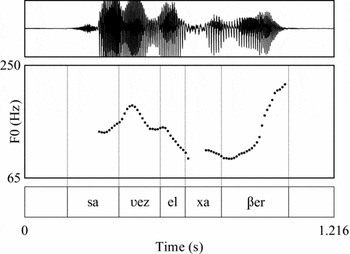
In spite of the fact that the phonemic contrast between /b/ and /v/ is stable (in the sense that speakers know which words have one phoneme and which have the other), it must be said that the phonetic distance between these two phonemes can be very small on occasion. This is because both plosive /b/ and fricative /v/ may optionally be realized as approximants in word-internal intervocalic position (and sometimes in other contexts). We notice in this respect that in Turkish, /v/ also has approximant allophones (Göksel & Kerslake Reference Göksel and Kerslake2005: 6–7). An example showing an approximant realization of both of these two phonemes, /b/ and /v/, is given in Figure 3.Footnote 7 The realization of /b/ as [β] in this example can be compared with the realization of the same phoneme in Figures 1 and 2, where it is realized as [b]. Notice the presence of formant structure in Figure 3 and its absence in the previous two figures.
Saves el haber? [ˈsaʋezelxaˈβe ] ‘Do you know the news?’
Example containing both intervocalic /v/ and /b/ realized as approximants in this instance.

Voiced dental /d/: Incipient split between [d] and [ð]
Whereas in the case of /b/ and /v/ we find, to some extent, preservation of a historical contrast lost in Mainstream Spanish, an innovation in Istanbul Judeo-Spanish is a marginal phonemic split between [d] and [ð], two sounds that in Old Spanish were only allophones of a single phoneme (as they still are in Mainstream Spanish, e.g. MSp dama [ˈdama] ‘lady’, la dama [laˈðama] ‘the lady’). Unlike in Mainstream Spanish, where /d/ is consistently realized as an approximant in intervocalic position, both inside words and across word boundaries, in Istanbul Judeo-Spanish the general situation is the following: Word-internally, between vowels, we normally find [ð] (fricative or approximant), and not [d], as in sefaradí [sefa aˈði] ‘Sephardic’ (see Figure 4). Word-initially, on the other hand, we tend to find the sound [d], even after a vowel, as in el ayre del norte [eˈla
 ɾe delˈnorthe] ‘the north wind’ (in the transcribed text at the end of this article).
sefaradí [sefaaˈði] ‘Sephardic’
Example of word-internal intervocalic /d/ realized as a continuant [ð] with an intermediate degree of constriction.

A complication is that intervocalic [d] is also found after ‘strong’ morpheme boundaries, including after the prefix /a-/ (a context where, as we saw above, OSp [b] has also been maintained), as in adulsar [adulˈsar] ‘to sweeten’ (from dulse ‘sweet’), and in initial position in the suffix -dear, which is used productively to adapt borrowings from Turkish, as in boyadear [bojadeˈar] ‘to paint’ (< Turkish boyamak; see Perahya & Perahya Reference Perahya and Perahya1998: 34).Footnote 8 These affixes can thus be taken to introduce a phonological word boundary, in a possible morphophonological analysis. Except for these morphologically conditioned exceptions, word-internally we generally find [ð], as stated. Appeal to morphosyntactic boundaries would allow us to maintain a one-phoneme analysis, with allophones in complementary distribution where /d/ is realized as [ð] after a vowel provided that no word-boundary or strong morpheme boundary intervenes. A difficulty for this analysis is that in borrowings from Turkish, such as adá ‘island’, the consonant is consistently realized as [d], without lenition. There are also a few Romance words (where influence from French cognates may play a role), such as idea ‘idea’, in which intervocalic [d] also resists weakening to [ð] (see Perahya & Perahya Reference Perahya and Perahya1998: 34).
A second complication for the phonemic analysis of these sounds, this time against considering [d] and [ð] different phonemes, is that, in actual speech, a great degree of variation is found, even in the same context, so that the distribution of [d] and [ð] summarized above is only a matter of strong tendencies, at least for the speaker whose speech we are analyzing here. Compare the two examples of the word kada ‘each, every’, one in Figure 5, [ˈkada], where the intervocalic dental was realized as a stop, and the other in Figure 6, kada diya [ˈka aˈðia] ‘every day’, where the same phoneme in the same word and in the same reading style was realized as almost completely vocalized. Notice, furthermore, that the word-initial consonant of diya ‘day’ was also spirantized in this example, even though, as mentioned above, word-initially the tendency is to produce [d].
kada [ˈkada] ‘each, every’
Example of constricted realization of intervocalic /d/ in a context where [ð] is the norm.

kada diya [ˈkaaˈðia] ‘every day’
Example of open realizations of intervocalic /d/. Notice that the /d/ of kada is especially open or vowellike in this example and that the word initial consonant of diya ‘day’ has also been realized as an approximant.

Intervocalic /d/ may also be realized as a flap [ɾ], causing neutralization with phonemic /r/ (although no examples of this phenomenon are included in the recordings for this article).
We may conclude that there is a quasi-phonemic, incipient, opposition between [d] and [ð]. The sounds are still in variation within the same lexical item, but there are words that resist lenition of /d/. Historical bilingualism in Greek, where /d/ and /ð/ are independent phonemes, would have increased awareness of the inherited allophony as involving an alternation between different sounds. This tendency would also have been reinforced by bilingualism in Turkish, which would have increased awareness of the difference in pronunciation between, say, kada and adá (on quasi-phonemic contrasts in Spanish, see Hualde Reference Hualde, Chand, Kelleher, Rodríguez and Schmeiser2004).Footnote 9
Voiced velar plosive: Incipient lexicalization of [ɡ] and [ɣ] in word-initial position
In general, the distribution of [ɡ] and [ɣ] is predictable and not contrastive. In intervocalic position, whether word-internal or word-initial, we usually find [ɣ], siguro [siˈɣuɾo] ‘safe’, dos amigos [ˈdozaˈmiɣos] ‘two friends’ (see Figure 7). Where we find a tendency to have a contrast is after pause. The contrast appears to be between words that admit variation between stop and approximant realizations in utterance-initial position, and words whose initial consonant is consistently realized as a stop in this position, as in gato [ˈɣato] ‘cat’, godro [ˈɣoðro] ‘fat’ vs. gerra [ˈɡerːa] ‘war’, with a stop. It appears that the quality of the following vowel may be a conditioning factor.
dos amigos [ˈdozaˈmiɣos] ‘two friends’ Example illustrating intervocalic /ɡ/ [ɣ]. Notice also phrase-initial /d/ (prevoiced stop).

Fricatives and affricates
Labiodental fricatives
One of the few clear non-Castilian features of Istanbul Judeo-Spanish is the preservation of Latin f- in some words like firido ‘wounded’ (MSp herido), fedor ‘stench’ (MSp hedor), fuyir ‘to flee’ (MSp huir), foya ‘hole’ (MSp hoya), forka ‘gallows’ (MSp horca), etc. In most words, however, we find loss of this consonant where it was lost (through aspiration) in Castilian, e.g. avlar ‘to speak’ (MSp hablar < Lat fabulāri), azer ‘to do, make’ (MSp hacer < Lat facere), ijo ‘son’ (MSp hijo < Lat fīlium), etc.Footnote 10 The presence of the group /fl-/ in flama ‘flame’(MSp llama) is also attributable to Eastern-Iberian (Aragonese or Catalan) influence (on the influence of Aragonese on Judeo-Spanish, see Quintana Rodríguez Reference Quintana Rodríguez2001).
For /v/ see above, section ‘Plosives and related consonants’.
Alveolar and postalveolar fricatives and affricates
As already mentioned, the most striking difference between Judeo-Spanish and both Modern Peninsular and Latin American Spanish is found in the sibilants. This is primarily because Judeo-Spanish has not undergone the devoicing of sibilants and velarization of postalveolars that affected other Spanish varieties. Regarding the lexical distribution of intervocalic IJSp /s/ and /z/, first, consider the following numbered correspondences:
Sibilants: Correspondences with Peninsular Spanish and Latin American Spanish
As shown in the examples above, in Istanbul Judeo-Spanish, the contrast between voiced and voiceless sibilants has been preserved, whereas the medieval contrast between fricatives and affricates (continued in Standard Peninsular Spanish as /s/ vs. /Ɵ/) has been lost. That is, Istanbul Judeo-Spanish has had the same evolution from the medieval Western Romance system of sibilants that we find in Portuguese and in Catalan (and in French). Interestingly, an exception to the correspondences above is found in the numerals dodje /ˈdoʤe/ ‘twelve’, tredje /ˈtreʤe/ ‘thirteen’. In these words the Judeo-Spanish of Istanbul (and Salonika, Nehama Reference Nehama1977) agrees more closely with Catalan than with Portuguese, e.g. Catalan dotze /ˈdoʣə/ vs. Portuguese doze /ˈdoze/, PenSp doce /ˈdoƟe/ (on these and other exceptions to the general correspondences, see Quintana Rodríguez Reference Quintana Rodríguez2006: 71–79).
As for the postalveolars, Judeo-Spanish has the three phonemes /ʃ/, /ʒ/ and /ʤ/ corresponding to the velar fricative /x/ of Mainstream Spanish. Old Spanish, on the other hand, had a simpler contrast between voiceless /ʃ/ and /ʒ/, which most likely had [ʤ] and [ʒ] as allophonic variants:
Postalveolar fricatives and voiced affricate: Correspondences with Old Spanish and modern Mainstream Spanish
What we find is that Old Spanish /ʒ/ continues as /ʒ/ word-medially, but has become /ʤ/ in word-initial position in Judeo-Spanish. In Old Spanish, most likely, word initially, fricative and affricate alternated in the same word, depending on the phrasal context: [ʤ]ente ‘people’, con [ʤ]ente ‘with people’, but la [ʒ]ente ‘the people’ (as in some present-day Catalan varieties).Footnote 11
In Judeo-Spanish, [ʤ] and [ʒ] do not alternate. These are now independent phonemes, rather than allophones in complementary distribution. Word-initially, the affricate was generalized in all phrasal contexts, including after vowels.Footnote 12 The phonemic split was caused by the introduction of both word-initial /ʒ/ and word-medial /ʤ/ in borrowings: jurnal /ʒurˈnal/ ‘newspaper’ (from French), kavedjí /kaveˈʤi/ ‘coffee-shop owner’ (from Turkish), with a likely later change /ʣ/ > /ʤ/ in the few native words like dodje /ˈdoʤe/ ‘twelve’ that had preserved the old affricate /ʣ/.
The affricate phoneme /ʧ/ does not present any important difference in its distribution with respect to Mainstream Spanish. In word-final position it is found only in a few words, including the old borrowing harach /xaˈraʧ/ ‘extorsion’ (historically ‘a tax paid by non-Muslims’), and recent borrowings like mach ‘match’.
The voice contrast in syllable-final and word-final fricatives tends to be neutralized. The allophonic distribution of [s] and [z] is essentially as in Catalan (see e.g. Wheeler Reference Wheeler2005: 145–149) and most likely as in Old Spanish as well. Word-internally, [s] is found before voiceless consonants, and [z] before voiced consonants. Word-finally, [s] is found before voiceless consonants and before pause, and [z] before voiced consonants and vowels (Sala Reference Sala1971, Bradley Reference Bradley, Bainbridge and Agbayani2007a, among others).
Neutralization of /s/ and /z/
• Word-internal preconsonantal
e[s]te ‘this’, mo[s]trar ‘to show’, di[s]persar ‘to scatter’
mi[z]mo ‘same’, a[z]no ‘donkey’, pe[z]gado ‘heavy, boring’, e[z]vachear ‘to give up’
• Word-final
do[s] ‘two’, do[s] kavesa[s] ‘two heads’, ma[s] ‘more’
do[z] gatos ‘two cats’, do[z] mansevikos ‘two boys’, do[z] ijos ‘two sons’, ma[z] agua ‘more water’
Final devoicing results in alternations like una ve[s] ‘once’, dos ve[z]es ‘twice’.
The same alternation is also found between word-final [ʃ] and [ʒ]: entende[ʃ] ‘you (pl) understand’, entende[ʒ] esto ‘you (pl) understand this’, entende[ʃ] todo ‘you (pl) understand everything’.
Nevertheless, phrase-final devoicing appears not to be completely categorical and may be lexically-conditioned to a certain extent. Before pause, some lexical items, such as nariz ‘nose’ and mesaj ‘message’, may be more likely to be realized with at least some voicing than other words.
A characteristic feature of Judeo-Spanish is the palatalization of /s/ before velars, as in moshka /ˈmoʃka/ ‘fly (n)’, bushkar /buʃˈkar/ ‘to search’, pishkado /piʃˈkado/ ‘fish’, cf. MSp mosca, buscar, pescado. This palatalization is not totally systematic, cf. eskola ‘school’. Note also the word eskenazí ‘Ashkenazi’, without palatalization. Word-finally /s/ has become /ʃ/ after a palatal glide, with absorption of the glide: seis > sesh /seʃ/ ‘six’, cantáis > kantásh /kanˈtaʃ/ ‘you (pl) sing’.
Voiceless velar fricative /x/
The voiceless velar fricative /x/ is found in borrowings from Hebrew and Turkish, including morphologically fully integrated ones, like aharvar /axarˈvar/ ‘to beat’ (Figure 8), and also in some words of Arabic origin that were current in Old Spanish such as haragan [xaɾaˈɣan] ‘lazy’ (cf. MSp haragán) and hazino ‘sick’.Footnote 13 In borrowings from Turkish, /x/ may be used to replace Turkish /h/ (in other borrowings of this origin /h/ is deleted).Footnote 14 Its actual place of articulation and the amount of friction with which it is produced appears to be variable, although a velar articulation seems to be most common.
aharvar /axarˈvar/ ‘to beat’

Nasals
There are two nasal phonemes, bilabial /m/ and alveolar /n/. Corresponding to the palatal nasal of Mainstream Spanish, we find the bi-phonemic sequence /nj/, e.g. espanyol /espanˈjol/ ‘Spanish’, anyo /ˈanjo/ ‘year’, inyeto /inˈjeto/ ‘grandson’, cf. MSp español, año vs. nieto. There is some variation in the pronunciation of 〈ny〉 including a nasalized palatal glide, as in our recording of anyo [ˈa o] ‘year’, and realizations appear to also include a palatal nasal stop [ɲ], as in our recording of espanyol [espaˈɲol] ‘Spanish’ (although to verify this point an articulatory study would be necessary). Nevertheless, we do not include /ɲ/ in our phonemic inventory, for several reasons. To begin with, [ɲ] does not appear to ever contrast with the sequence [nj], unlike in MSp alimaña ‘wild beast’ vs. Alemania ‘Germany’. Secondly, in the variety that we are describing, [ɲ] does not occur word-initially (and neither does [nj]), cf. anyudo ‘knot’ < Leonese ñudo, inyeto < nieto ‘grandson’.Footnote 15 Finally, the syllabification intuition of the second author, as a native speaker, is that there is a syllable boundary between nasal consonant and glide in all cases: es-pan-yol, in-ye-to (which explains the historical epenthesis of a word-initial vowel).Footnote 16
The two nasal phonemes, /n/ and /m/ contrast in syllable-initial position and word-finally, although word-final /m/ only occurs in borrowings from Hebrew like Nisim /niˈsim/ (a man's name) and benadam /benaˈdam/ ‘great guy, mensch’.
Before a consonant, nasals are homorganic with the following segment: kampo [ˈkampo] ‘field’, enforka [eɱˈforka] ‘s/he executes by hanging’, kantar [ka ˈtar] ‘to sing’, mansevo [manˈsevo] ‘young man’, muncho [ˈmunʲʧo] ‘much’, manko [ˈmaŋko] ‘I need, lack’, manga [ˈmaŋɡa] ‘sleeve’. More or less arbitrarily (since the contrast in place is neutralized), in our phonemic representations we write /m/ before a labial and /n/ before any other consonant.
Words like muestro [ˈmwestro] ‘our’ (< nuestro), [ˈmwevo] ‘new’(< nuevo), ermuera [erˈmweɾa] ‘daughter-in-law’ (< nuera) show the presence of a diachronic assimilation rule: /n/ > /m/ before [w].
Laterals, rhotics and approximants
The apico-alveolar lateral /l/ is realized without velarization. It appears as long or geminated in a few borrowings from Hebrew, e.g. tallet /taˈlːet/ ‘ritual shawl’, and from Turkish, e.g. mallé /maˈlːe/ ‘neighborhood’ (< Turkish mahalle).
As in most present-day Spanish varieties, the lateral palatal orthographically represented as 〈ll〉 in standard Spanish (as in gallo ‘rooster’) has been delateralized, merging with the phoneme represented as 〈y〉 in standard orthography (as in mayo ‘May’). The resulting /j/ is a voiced palatal approximant or glide in Istanbul Judeo-Spanish: gayo [ˈɣajo] ‘rooster’, mayo [ˈmajo] ‘May’. Note also famiya [faˈmi(j)a] ‘family’, kayente [kaˈjente] ‘hot’, cf. MSp familia, caliente, where the historical sequence [lj] has had the same evolution. This sound is normally noticeably more open than the standard Peninsular Spanish approximant represented with [ ] and most of the time does not appear to differ from the initial sound in English yes.
Judeo-Spanish shows a tendency to neutralize the inherited contrast between rhotic tap and trill (Sala Reference Sala1971: 80; Hetzer Reference Hetzer2001: 8, 12; Quintana Rodríguez Reference Quintana Rodríguez2006: 84–88). In Istanbul Judeo-Spanish, this contrast, which in all Spanish varieties is restricted to the word-internal intervocalic position, is preserved, but shows some instability. For this variety it seems preferable to interpret the contrast phonologically, as one between single /r/ and long or geminate /rː/, where the long trill is the marked term in the opposition: e.g. pera /ˈpera/ ‘pear’, oro /ˈoro/ ‘gold’ vs. perro /ˈperːo/ ‘dog’, yerro /ˈjerːo/ ‘fault, mistake’, fyerro /ˈfjerːo/ (or /fiˈjerːo/) ‘iron’, gerra /ˈɡerːa/ ‘war’. Notice that, in this analysis, we find a structural parallel between rhotics and laterals; that is, for both liquids there is a phonological contrast between single and geminate consonant in intervocalic position.
The long trill /rː/ is consistently found only in a small number of words, many words with an etymological long trill being realized with short /r/ instead or showing fluctuation: arankar /aranˈkar/ ‘to unroot’, arimarse /ariˈmarse/ ‘to lean, rest on’, arriva /aˈrːiva/ ~ ariva /aˈriva/ ‘up’; cf. MSp arrancar, arrimarse, arriba (after a-, often a prefix; see Varol Reference Varol [Bornes]2008b: 302 for more examples). There are also alternations among morphologically related words. Thus, the gerund of korrer /koˈrːer/ ‘to run’ is usually koryendo /korˈjendo/, with simplification before the glide. Rhotics are very often produced without complete occlusion, as approximants (Bradley & Delforge Reference Bradley, Delforge, Face and Klee2006). Intervocalic /r/ is phonetically realized as a tap or as an approximant. For approximant realizations, we use the symbols [], [], with the IPA ‘lowered’ or ‘more open’ subscript, rather than [ɹ], because the latter symbol is employed in the IPA chart in the transcription of the initial consonant of English react, which auditorily and articulatorily is a very different type of rhotic approximant.
Unlike in Mainstream Spanish, there is no strengthening of word-initial rhotics: riko /ˈriko/ ‘rich’, rezyo /ˈrezjo/ ‘strong’, raton /raˈton/ ‘mouse’. This may be a relatively recent development (see Quintana Rodríguez Reference Quintana Rodríguez2006: 87, fn. 189).Footnote 17
A feature of Judeo-Spanish is the historical metathesis of /rd/ > /dr/ (see Bradley Reference Bradley2007b for a recent study), as in the following examples:
Metathesis /rd/ > /dr/
This is no longer an active process, as can be seen by the existence of words like dakordo ‘in agreement’ < French d'accord.Footnote 18
Vowels and diphthongs
Istanbul Judeo-Spanish has the same five-vowel system /i e a o u/ as Mainstream Spanish, with essentially the same distribution (although other vowels, in particular front rounded vowels, may appear in unadapted borrowings). It does not have the systematic raising of unstressed mid vowels that one finds in other Judeo-Spanish varieties such as that of Bucarest (Sala Reference Sala1971) and Monastir (Luria Reference Luria1930) (see also Quintana Rodríguez Reference Quintana Rodríguez2006: 40–57). The chart in Figure 9 shows formant values taken at mid-point of the stressed vowels of bivo /ˈbivo/ ‘alive’, bezo /ˈbezo/ ‘kiss’, abasho /aˈbaʃo/ ‘below’, moshka /ˈmoʃka/ ‘fly’ and bushka /ˈbuʃka/ ‘s/he looks for’. These values are very similar to those reported for Standard Peninsular Spanish in Martínez-Celdrán et al. (Reference Martínez-Celdrán, Fernández-Planas and Carrera-Sabaté2003).
Vowel phonemes: vowels in stressed position

The following rising diphthongs are found:
Word-initial [w] has been systematically strengthened to [ɣw], like in many other (non-standard) Spanish varieties: guevo [ˈɣweʋo] ‘egg’, guerta [ɣwerta] ‘yard, garden’, gueso [ˈɣweso] ‘bone’, cf. MSp huevo, huerta, hueso. More surprisingly, we also find strengthening after /s/ in esfuenyo [esˈfwenjo] ‘dream’(< sueño), esfuegra [esˈfweɣra] ‘mother-in-law’ (< suegra), with an initial epenthetic /e/ before the resulting consonant cluster (as already noted in Wagner Reference Wagner1930: 17; see Bradley Reference Bradley, Masullo, O'Rourke and Huang2009 for a recent phonological analysis). Another interesting example of strengthening is found in the word djugueves [ʤuˈɣweves] ‘Thursday’ (< jueves) and similar words (see Quintana Rodríguez Reference Quintana Rodríguez2006: 34–40).
Given the fact that [w] cannot be syllable-initial, we have not included it in our consonant table. Phonologically it may be best analyzed as an allophone of /u/ immediately before another vowel. Another analytical possibility would be to postulate that [ɣw] is the surface realization of phonemic /w/.
Falling diphthongs are found with [], but apparently not with [ ]:Footnote 19
As already mentioned, the replacement of diphthongs such as [a
], [e
] with the sequences [av], [ev] is an areal feature: Evropa ‘Europe’ (cf. Turkish Avrupa ‘Europe’).
Stress
Stress is lexically contrastive in Istanbul Judeo-Spanish, e.g. pera /ˈpera/ ‘pear’, perro /ˈperːo/ ‘dog’ vs. Perá /peˈra/ (name of a neighborhood), parás /paˈras/ ‘money’, pashá /paˈʃa/ ‘dear child’. Like in all Spanish varieties, stress may fall on any of the last three syllables of the word. There are, however, relatively few nominal forms with antepenultimate stress: lágrima /ˈlaɡrima/ ‘tear’, múzika /ˈmuzika/ ‘music’. Many nouns with antepenultimate stress in Mainstream Spanish, instead, in Istanbul Judeo-Spanish have final stress: pasharó /paʃaˈro/ ‘bird’, numeró /numeˈro/ ‘number’, guerfanó ‘orphan’, albondigás ‘meat balls’, cf. MSp pájaro, número, huérfano, albóndigas, cf. also arvolé ‘tree’(MSp árbol). This shift of the stress to the final syllable in formerly proparoxytones was apparently not found in the variety of Salonika (see Nehama Reference Nehama1977) and may be a relatively recent development, since Wagner (Reference Wagner1914) makes no reference to it either.Footnote 20 The shift of the stress from antepenultimate to final position may have taken place under the influence of Turkish and, for cognate words, such as numeró, French. Antepenultimate stress is found in verbal forms like kantávamos /kanˈtavamos/ ‘we used to sing’, ívamos /ˈivamos/ ‘we were going’, azíamos /aˈziamos/ ‘we used to make’.
Another remarkable stress-related fact is the reduction of some historical hiatus sequences to diphthongs, with shift of the stress to the most open vocoid, as in judío > djudyó /ʤuˈdjo/ ‘Jewish’, gallina > */ɡaˈjina/ > */ɡaˈina/ > gayna /ˈɡana/ ‘hen’.
Figure 10 illustrates the contrast between avlo /ˈavlo/ ‘I speak’ and avló /aˈvlo/ ‘s/he spoke’ in citation form. As shown in the figure, duration, intensity and pitch all contribute to highlighting stressed vowels in the citation form of words. (In Turkish, word-level prominence appears to be conveyed primarily by pitch, Levi Reference Levi2005.)
avlo /ˈavlo/ ‘I speak’, avló /aˈvlo/ ‘s/he spoke’

Intonation
Among Judeo-Spanish speakers from Istanbul there is awareness that their intonational patterns are different from those of Turkish, so that the transfer of intonational features to Turkish is seen as stereotypical of a Judeo-Spanish background.
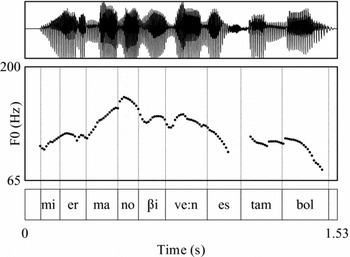
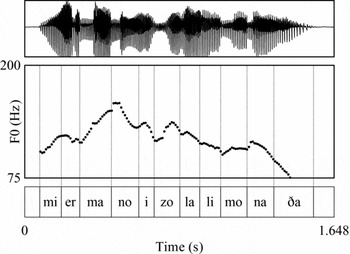
In simple declarative sentences, stressed syllables are associated with rises in pitch, which are progressively downstepped from the beginning of the sentence. The pitch falls steeply after the last accentual peak. In the last or nuclear accent, the F0 peak is contained within the stressed syllable. In prenuclear accents, on the other hand, the peak is typically displaced to the following syllable. This is illustrated in Figures 11 and 12 (for clarity, we mark all stressed syllables in orthographic representations in the text and figure captions in this section). The two sentences in Figures 11 and 12 differ in the location of the lexical stress of the last word, final (Estamból) vs. penultimate (limonáda), which determines the point at which the final fall starts. Notice also the displacement of the pitch peak to the last syllable of the word in ermáno ‘brother’ in both figures. (There is also continuation of the rise after the stressed syllable in the other prenuclear accent in both examples, but this is disturbed by the dip caused by the voiced fricative in bíve ‘he lives’ and ízo ‘he made’.)
Mi ermáno bíve en Estamból [merˈmanoˈβiveːnestamˈbol] ‘my brother lives in Istanbul’
Mi ermáno ízo la limonáda [merˈmanoˈizolalimoˈnaða] ‘My brother made the lemonade’
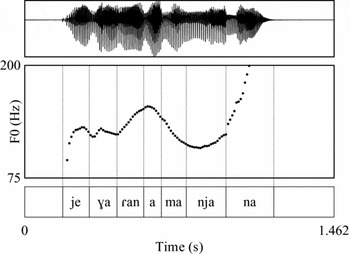
Total (yes–no) interrogatives may not differ at all from declaratives in their syntax, so that intonation is crucial to convey interrogative force. In these sentences we generally observe a final rise starting from a low point at the beginning of the last stressed syllable. Examples are given in Figures 13–15. The use of a final rise in total interrogatives is in striking contrast with Turkish, where these questions are marked by an interrogative particle and display a final circumflex pattern, with a pronounced rise and fall (Queen Reference Queen2001, Göksel & Kerslake Reference Göksel and Kerslake2005: 35–36).
Yegarán amanyána? [jeɣaˈɾanamanˈjana] ‘Will they arrive tomorrow?’
Mis amígos, yá yegáron? [mizaˈmiɣozˈjajeˈɣaɾon] ‘Did my friends arrive?’

Sáves el habér? [ˈsaʋezelxaˈβe] ‘Do you know the news?’
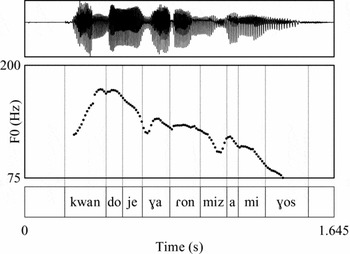
In partial or pronominal questions, there is a high tone on the stressed syllable of the question word (generally without displacement of the peak) and declining pitch after that point. Like in declaratives, the last stressed syllable of the utterance contains an accentual peak immediately after which the pitch drops sharply. This is illustrated with an example sentence in Figure 16.
Kuándo yegáron mis amígos? [ˈkwandojeˈɣaɾonmizaˈmiɣos] ‘When did my friends arrive?’
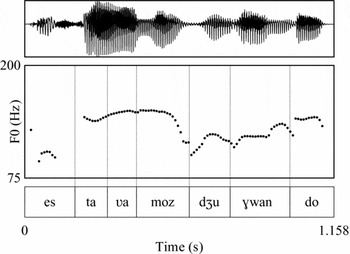
Continuation in declaratives is signaled by a rise to a mid level, as in the example in Figure 17 Mi ermáno bíve en Estamból, en úna káza muéva ‘My brother lives in Istanbul, in a new house’, where there is a continuation rise after Estamból, and in Figure 18, which displays the F0 contour of the first clause in the sentence Estávamos juguándo, kuando oyímos el habér ‘We were playing when we heard the news’.
Mi ermáno bíve en Estamból, en úna káza muéva [m erˈmanoˈbiveːnestamˈboleˈnunaˈkazaˈmweʋa] ‘My brother lives in Istanbul, in a new house’

Estávamos juguándo . . . [esˈtaʋamozʤuˈɣwando] ‘We were playing . . . (when we heard the news)’
In general, the main intonational contours of Istanbul Judeo-Spanish do not differ significantly from those of Peninsular Spanish (see, for instance, Hualde Reference Hualde2005, Chapter 14). In contrast, there appear to be significant differences with Turkish, including not only the contour of yes–no questions, but also the distribution of prenuclear pitch-accents, which seems to be much more sparse in Turkish, and the position of the nuclear accent, which in Turkish, a verb-final language, falls on the constituent immediately preceding the verb (Göksel & Kerslake Reference Göksel and Kerslake2005: 37–38).
The North Wind and the Sun
Orthographic version
El ayre del norte i el sol sestavan peleando para saver ken era el mas fuerte i en este punto vyene de pasar un pasajero kon un palto godro. Se metieron dakordo ke el ke puede azer kitar su palto al pasajero antes del otro iva ser konsiderado komo el mas fuerte. El ayre del norte empeso a azer una furtuna, ama lo mas fuerte el ayre soplava lo mas apretado el pasajero se embolvia en su palto. Al kavo el ayre del norte se ezvacheo. El sol salio i empeso a azer kalor i pishin el pasajero se kito su palto. I el ayre del norte tuvo ke rekonoser ke el sol era el mas fuerte de los dos.
Semi-narrow phonetic transcription of recorded passage
Acknowledgements
We are grateful to four reviewers for this journal and to the editor John Esling for comments and suggestions.



