




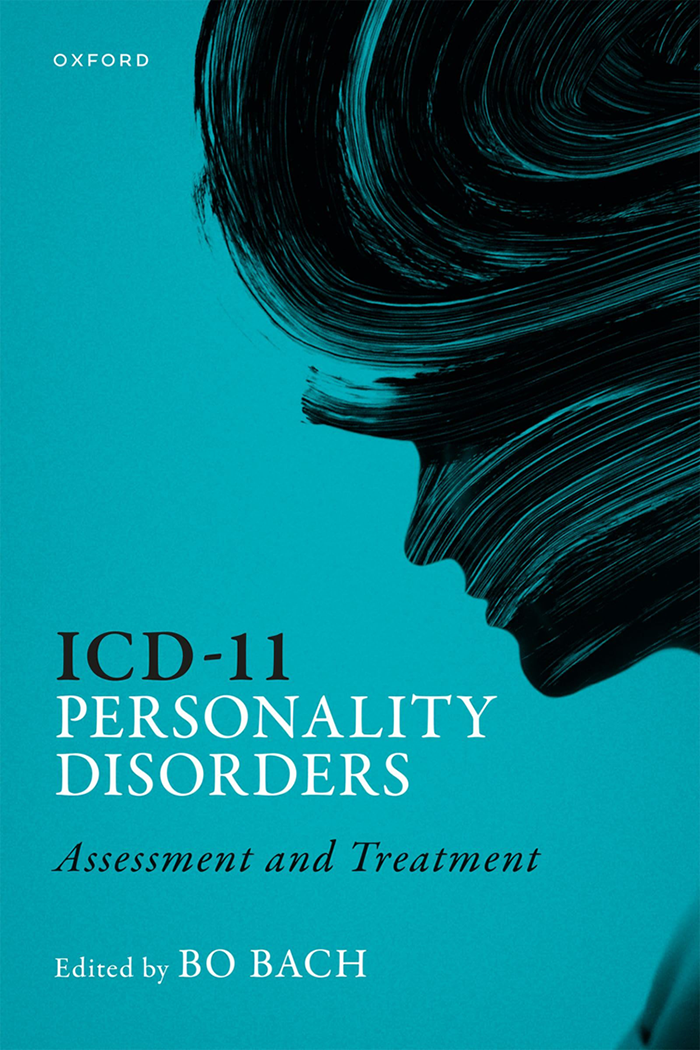
I recall reading a review by Tyrer of Livesely’s Handbook of Personality Disorders wherein he suggested that if such a weighty book were a meal, it was a feast not a light snack. Bach’s 700-page tome certainly took me several months to digest. In short, it is a very important, comprehensive book for the post-ICD-11 Personality Disorders era. It can be a little repetitive when it comes to hammering home the basics of the radical new classificatory process, and not all the perspectives in its broad church chime with my stances; but the merits outweigh these setbacks. I have taken each section in turn; perhaps that is useful.
Part One focuses on assessment. It is logical and systematic. Highlights include, in Chapter One, a table of essential first elements of evaluating general diagnostic requirements, which sounds dry but contains very accessible and salient clinical reasoning. I was excited to read about the assessment instruments, and enjoyed the time spent on layers of assessment extending to more curious Rorschach-influenced approaches, which reminded me of Timothy Leary’s multilevel diagnosis of personality, spanning public behaviour, conscious descriptions, private symbolisation, the unexpressed unconscious and values. Nevertheless, after seeing a presentation on the book editor’s work on the impressive Development of Diagnostic Interview for Personality Pathology in ICD-11 (DIPP-11) I think that it would be more necessary than vain to offer a few more glimpses of what is to come from that focused 22-item interview-based instrument.
Part Two is engaging, addressing intersections between the ICD-11 classification with clinically interesting phenomena including antagonism, dissociation, perspective-taking and harm to self. The strongest chapters, on narcissism, dissociative and psychotic phenomena, and psychopathy, include both helpful tables encapsulating ICD-11 and clinical vignettes. This part of the book adds a clinical conceptual richness that breaks through areas of thinking previously walled off by categorical approaches.
Part Three focuses on ten different intensive treatments. Many explore the intersections between personality disorder severity and the particular treatment, using engaging case examples. The most impressive chapters go a step further by exploring differences in treatment according to prominent trait domains as well as the severity of personality disorder.
Part Four appears to be the any-other-business section of the book. As is often the case in meetings, this section is both varied and more interesting than some of the routine chapters. It is a little odd to site the neuroscientific and cultural aspects alongside practical interventionist chapters on treatment planning and psychoeducation, but I wouldn’t cut them out. The specialties quartet of young people, older people, forensic and substance use perspectives are particularly rich despite their niche foci. The lived-experience chapter is particularly inspiring and enlivens some of the drier material.
The length of this book is reflected in the length of this review, but times of radical conceptual change need hefty books like this. Its particular strengths lie in efforts to connect concepts and empiricism, with accessible practical tips and case studies.

 Open access


eLetters
No eLetters have been published for this article.