

9.1 Introduction
The term ‘cleft’ is commonly used to subsume several disparate constructions of the English language. What all of these have in common is that they can typically be related to a more basic non-cleft clause which they ‘cleave’ into two parts, of which one is backgrounded in a subordinate clause and one foregrounded in the main clause. Thus, the non-cleft sentence Sigrid loves linguistics can be cleft into Sigrid loves and linguistics. These parts occur in different syntactic functions and orders in the different types of cleft constructions, summarised in Table 9.1.

Table 9.1 Long description
The table provides five examples of cleft constructions in linguistics, detailing their types and the corresponding components of subject S, verb V, and cleft structure C S. The table is divided into two columns with the headers example and cleft type, abbreviation, and characteristics. The five examples are arranged in five rows. The corresponding data is arranged from left to right as follows:
1. Example 1: What Sigrid loves is linguistics, the data is:
Equals basic w h-cleft or W H C L, S: nominal relative clause, V: specifying B E, and C S: highlighted element.
2. Example 2: Linguistics is what Sigrid loves.
Equals reversed w h-cleft or R W H C L, S: highlighted element, V: specifying B E, and C S: nominal relative clause.
3. Example 3: The thing that Sigrid loves is linguistics.
Equals paraphrased basic w h-cleft, or W H C L, S: general noun plus adnominal relative clause, V: specifying B E, and C S: highlighted element.
4. Example 4: Linguistics is the thing that Sigrid loves.
Equals paraphrased reversed w h-cleft, or R W H C L, S: highlighted element, V: specifying B E, and C S: general noun plus adnominal relative clause.
5. Example 5: It’s linguistics that Sigrid loves.
Equals it cleft or I T C L, expletive it, V: specifying B E, and C S: highlighted element plus relative-like cleft clause.
In (basic) wh-clefts (WHCLs) like (1), the backgrounded part becomes part of a nominal relative clause in subject (S) position, while the highlighted element functions as a subject complement (CS) after specifying be. Reversed wh-clefts (RWHCLs) like (2) invert this order of subordinate clause and highlighted element. WHCLs and RWHCLs are also understood to comprise so-called paraphrased variants, in which the relativiser of the nominal relative clause is replaced by a general noun and an adnominal relative clause as in (3) and (4). In an it-cleft (ITCL) like (5), finally, the highlighted constituent occurs as the CS of the main clause, introduced by expletive it (cf. Hedberg Reference Hedberg2000: 891; Huddleston & Pullum Reference Huddleston and Pullum2002: 67) and specifying BE. The rest becomes part of ‘a relative-like’ ‘cleft clause’ ‘introduced by that, who/which, or zero’ (Biber et al. Reference Biber, Johansson, Leech, Conrad and Finegan2021: 950).Footnote 1
English clefts have only become the focus of linguistic attention at the beginning of the twentieth century. While much linguistic work on clefts focuses on their syntactic or formal analysis, a first influential functional description of WHCLs and RWHCLs was provided by Halliday in Reference Halliday1967 in the larger context of his discussions of the thematic clause structure in English. Halliday described the two types of clefts as identifying clauses, in which a ‘thing to be identified’, realised as a nominal relative clause, is equated with an ‘identifier’. ‘What is significant is that, whichever of the two occurs in first position, the whole of that element is thematic’ (Halliday Reference Halliday1967: 224, 226). While Halliday’s examinations focused primarily on thematic structure, Prince’s groundbreaking study from 1978 concentrated on information-structural characteristics. It was the first to study clefts in naturally occurring discourse. Although with 37 WHCLs and 186 ITCLs Prince’s corpus (Reference Prince1978: 886) was small as measured by twenty-first-century standards, Prince provided descriptions of the information structure and discourse conditions of both constructions and established a taxonomy of ITCLs, all of which are still valid today (cf. Section 9.4). Collins (Reference Collins1991) was the first large-scale corpus investigation of cleft constructions, covering both spoken and written language. In the London-Lund Corpus and the Lancaster-Oslo/Bergen Corpus, he identified 1,785 tokens and analysed them as to formal characteristics, information structure, thematic structure, communicative meanings, and register variation. Prince (Reference Prince1978) and Collins (Reference Collins1991), the primary influences upon this study, and subsequent smaller-scale studies (e.g., Weinert & Miller Reference Weinert and Miller1996; Calude Reference Calude2007; Gast & Levshina Reference Gast, Levshina and De Cesare2014) showed that various (interconnected) factors such as the formality of a communicative situation, mode, register, but also informativity, ‘topicality, presupposition and weight’ (Collins Reference Collins2006: 1706) influence the use of clefts. For example, ITCLs are particularly frequent in academic prose, while RWHCLs highlighting a demonstrative pronoun (e.g., That’s what she said.) are very common in conversation (Collins Reference Collins1991: 181–2; Biber et al. Reference Biber, Johansson, Leech, Conrad and Finegan2021: 952).
What has not been tackled so far, however, is the question of how the communicative purpose influences the use of cleft constructions. Therefore, this contribution aims to answer the questions whether the primary textual purpose of evaluating is a factor conditioning the use of clefts and, if so, how the individual types of clefts contribute to the linguistic expression of evaluation. To this end, it applies both a quantitative and a qualitative approach. It studies the expression of evaluation in (primarily) evaluative texts (in comparison to primarily non-evaluative texts), as well as the interplay between evaluation and the above-mentioned factors of informativity, topicality, presupposition, and weight in cleft constructions. This contribution is based on the hypotheses that the textual communicative purpose of evaluating is indeed a factor conditioning the use of cleft constructions (H1) and that the linguistic expression of evaluation and certain subtypes of evaluation, occurring in specific positions within the clause, are more characteristic of some types of clefts than of others (H2).
After a discussion of how interpretations of non-canonicity predominant in linguistics may be applied to the different types of cleft constructions, Section 9.3 will introduce the concept of evaluation. Section 9.4 will then provide an overview of the major characteristics of the different types of clefts, before Section 9.5 will introduce the data base of this study and relevant categories of analysis. Then, the results of quantitative and qualitative analyses will be presented (Section 9.6) and Section 9.7 will provide a discussion and conclusion.
9.2 Clefts and Non-Canonicity
The aim of this chapter is to discuss how, first, theory- and then frequency-based approaches to syntactic non-canonicity apply to English clefts. Huddleston and Pullum (Reference Huddleston and Pullum2002: 46) explicitly mention ITCLs as an example of a non-canonical construction, related to a ‘syntactically more basic or elementary’ canonical clause. As mentioned in the Introduction to this volume, this description implies a definition of canonical structures as ‘minimally complete’. Consequently, since all types of clefts involve lexical material absent from the corresponding non-cleft (cf. Table 9.1), all of these are, in fact, non-canonical according to this theory-based approach to syntactic non-canonicity. But while WHCLs and RWHCLs can be accounted for by ‘canonical’ syntactic concepts (cf. Table 9.1), the syntactic analysis of ITCLs, especially the expletive it and the cleft clause, remains controversial. Hence, the latter may be regarded as more non-canonical than the former, making non-canonicity a gradable concept. Furthermore, cleft constructions are now firmly established as a means of information packaging (cf. e.g., Huddleston & Pullum Reference Huddleston and Pullum2002: 67; Ward et al. Reference Ward, Birner, Huddleston, Huddleston and Pullum2002: 1424–5). As Section 9.4 will show in more detail, each type of cleft construction is characterised by a typical distribution of (relatively) given and new information within the clause. Information-structural approaches, which consider SVX the canonical word order and are thus ultimately both theory- and frequency-based, consequently regard all types of clefts as non-canonical. Finally, with overall frequencies (across registers and modes) of approximately 17 WHCLs, 37 RWHCLs, and 40 ITCLs per 100,000 words (calculation based on Biber et al. Reference Biber, Johansson, Leech, Conrad and Finegan2021: 952),Footnote 2 cleft constructions are clearly rare in comparison to other constructions like relative clauses (more than 1,000 per 100,000 words; cf. Biber et al. Reference Biber, Johansson, Leech, Conrad and Finegan2021: 597). Purely frequency-based approaches would thus clearly regard all types of clefts as non-canonical, WHCLs even more so than RWHCLs and ITCLs. As mentioned in Section 9.1, however, previous studies on clefts showed that factors like formality, mode, and/or register influence the frequency of clefts. ITCLs, for example, occur frequently in academic discourse, while RWHCLs, especially those which highlight a demonstrative, are popular in unplanned spoken discourse (cf. Collins Reference Collins1991: 181–2; Biber et al. Reference Biber, Johansson, Leech, Conrad and Finegan2021: 952). Consequently, when the scope of these frequency-based approaches is narrowed down to specific styles, modes, or registers, individual types of clefts may well turn out to be less non-canonical, while probably still non-canonical in comparison to other syntactic constructions.
In summary, all types of clefts are clearly non-canonical – both in consideration of what dominant theoretical approaches define as the basic or elementary (i.e., canonical) clause of the English language and in consideration of overall frequencies. But the above discussion also showed that what is so clearly non-canonical may turn out to be less non-canonical if we narrow our perspective to modes, styles, or specific registers. The present study aims to find out whether clefts may be called canonical when the scope is confined to texts with a specific communicative purpose, namely evaluating.
9.3 Evaluation
Although there is a long research tradition of exploring concepts like modality (e.g., Palmer Reference Palmer1986), evidentiality (e.g., Chafe Reference Chafe, Chafe and Nichols1986), and hedging (e.g., Hyland Reference Hyland1998), research on assessments, attitudes, and feelings truly gained momentum only in the 1990s. Common umbrella terms are now, amongst others, ‘appraisal’ (Martin & White Reference Martin and White2005), ‘affect’ (Ochs & Schieffelin Reference Ochs and Schieffelin1989), ‘stance’ (e.g., Biber et al. Reference Biber, Johansson, Leech, Conrad and Finegan2021), and ‘evaluation’ (Thompson & Hunston Reference Thompson, Hunston, Hunston and Thompson2000). Research on evaluation faces the difficulty that evaluation is often ‘context-dependent’ and only ‘implied’ (Hunston Reference Hunston2011: 10, 13). Consequently, it has mostly been perceived as ‘not amenable to large-scale corpus investigations’ (Biber & Zhang Reference Biber and Zhang2018: 119) and has primarily been ‘explored in lexical terms’ (Hunston & Sinclair Reference Hunston, Sinclair, Hunston and Thompson2000: 74), studies often focusing on specific word classes or even single lexical items. In various publications, however, Biber and others show that there are ‘stance constructions’, that is, ‘lexico-grammatical devices’ (Biber & Zhang Reference Biber and Zhang2018: 104) which feature an overtly evaluative lexeme framing or controlling a grammatical constituent with a proposition (e.g., to like that …, happy that …).Footnote 3 These stance constructions are explicitly evaluative and can easily be identified in large corpora. Furthermore, Hunston and Sinclair (Reference Hunston, Sinclair, Hunston and Thompson2000: 89) also claim that it is possible to identify syntactic constructions or ‘patterns’ typical of evaluative language, mentioning, amongst others, WHCLs. This suggests that cleft constructions might indeed be an important syntactic means for the expression of evaluation.
For the present purpose, ‘evaluation’ is understood to be the verbal expression of attitude towards or feelings about entities, actions, or propositions (cf. Thompson & Hunston Reference Thompson, Hunston, Hunston and Thompson2000: 5). Following Biber and other linguists (e.g., Biber & Finegan Reference Biber and Finegan1989: 94; Biber & Zhang Reference Biber and Zhang2018: 104), ‘stance’ is defined as the explicit expression of evaluation in lexico-grammatical constructions. Contrary to Biber and Zhang (Reference Biber and Zhang2018), however, stance constructions are regarded as a subcategory of evaluation, because these lexico-grammatical devices require an evaluative lexeme.
9.4 Characteristics of Cleft Constructions
Besides the syntactic characteristics mentioned above, the different types of clefts share semantic characteristics: The subordinate clause of all clefts carries a presupposition (cf. Keenan Reference Keenan, Fillmore and Langendoen1971: 45) in the form of an open proposition containing a variable (i.e., ‘Sigrid loves x’), for which the highlighted element specifies a value (i.e., x = ‘linguistics’). All clefts are thus identifying constructions, ‘expressing a relationship between an element that is to be identified (the ‘identified’) and an element that identifies it (the ‘identifier’)’ (Collins Reference Collins1991: 67; cf. Halliday Reference Halliday1967: 223–4) but mentioning these in different order. It might seem contradictory to state that certain types of clefts (see below) contain brand-new information in their subordinate clauses. However, informativity and presupposition represent two distinct concepts (cf. Collins Reference Collins2006: 1710). In fact, placing brand-new information in a subordinate clause which contains a presupposition triggers a ‘known fact’ effect (Prince Reference Prince1978: 904), that is, it marks this information as ‘not-at-issue’, ‘non-negotiable’, ‘non-controversial’ (Collins Reference Collins1991: 119), or known to the recipient, even though this may, strictly speaking, not be the case (cf. Prince Reference Prince1978: 903). Furthermore, all clefts trigger an ‘exhaustiveness implicature’ (Huddleston & Pullum Reference Huddleston and Pullum2002: 1416): the assumption that the highlighted element constitutes ‘an exhaustive listing of the entities which satisfy the identified clause’ (Collins Reference Collins1991: 71).
While all three cleft constructions share these semantic characteristics and have the same propositional content as the corresponding non-cleft, they are by no means interchangeable. First, there are restrictions as to which relativisers can occur and which formal and functional categories may be highlighted.Footnote 4 Furthermore, as is to be expected against the background of their syntactic structure, the information principle, and the principles of end-focus and end-weight (Biber et al. Reference Biber, Johansson, Leech, Conrad and Finegan2021: 888–90), the three cleft constructions differ as to the topicality and typical (relative) information status of their constituents. In WHCLs, the nominal relative clause is thematic, that is, ‘what the sentence is primarily about’ (Collins Reference Collins2006: 1707). Only given or inferable information, ‘which the coöperative speaker may assume is appropriately in the hearer’s consciousness’ (Prince Reference Prince1978: 903), is acceptable, while brand-new information is (usually) out of place. The subordinate clause is thus ‘very low in communicative dynamism’ (Collins Reference Collins2006: 1714). The rhematic highlighted element, by contrast, typically conveys new information (Collins Reference Collins1991: 117), or at least information which ‘must not be assumed to be more prominent in the hearer’s consciousness than the information in the wh-clause’ (Prince Reference Prince1978: 892; emphasis in the original). This mapping of a constituent of low information status ‘on to the semantic function of “identified”, the textual function of theme, and the logico-semantic function of presupposition’ gives WHCLs ‘a characteristically “interpersonal” flavour’ (Collins Reference Collins1991: 133). This is illustrated in (6), where the evaluation as fascinating is inferable, while the CS is brand-new.
In typical RWHCLs, by contrast, the thematic highlighted element contains given information. The rhematic nominal relative clause ‘is more likely to contain new information than that’ in WHCLs (Collins Reference Collins1991: 145), but even where new, it typically makes only a small contribution to the development of the discourse, such as in generalisations or clichés (e.g., That’s the way it goes., cf. Collins Reference Collins1991: 146). This limited communicative dynamism of their clausal CS and the overall shortness of RWHCLs suggest that their primary function is that of text-structuring or ‘internal referencing’ (Collins Reference Collins1991: 146). In (7), the demonstrative that is an extended anaphoric reference (i.e., textually evoked), while the cleft clause contains inferable information.
So that’s why I love them so much.
For ITCLs, Prince’s study (Reference Prince1978) established the existence of two basic types. In the most frequent type, renamed ‘old-presupposition it-clefts’ by Collins (Reference Collins2006), the thematic foregrounded CS conveys new (or given, but contrastive; cf. Collins Reference Collins1991: 168) information in combination with inferable or evoked information in the cleft clause. In (8), the positive evaluation in the cleft clause is textually evoked in the preceding sentence, but the foregrounded element lists brand-new arguments for this evaluation.
it was the small things like homemade scones, nice teas, and coffee, ham, cheese and milk in the fridge […] that made this apartment special.
‘New-presupposition it-clefts’, by contrast, contain brand-new (anchored) information in the cleft clause, which they mark as non-negotiable or non-controversial. More precisely, ‘not only is the hearer not expected to be thinking about the information in the that-clause, but s/he is not expected even to know it’ (Prince Reference Prince1978: 898). Collins distinguishes two subtypes of new-presupposition ITCLs: In the first, the highlighted element is also brand-new, albeit of low communicative dynamism, since it has ‘a “circumstantial” or “scene setting” role’ (Collins Reference Collins2006: 1710). This is the case in (9), from the beginning of a restaurant review, where neither the temporal setting nor the proposition expressed in the cleft clause has been textually evoked. The second subtype of new-presupposition ITCLs highlights an element representing given or inferable information, as in (10) where the personal pronoun is clearly an anaphoric reference.
It was little more than a year after opening in 2010 that TV chef Tom Kitchin’s second Edinburgh restaurant was awarded a Michelin star.
he it wǎs ⌴ who built Saint Paul’s chùrch ⌴ in Stoke róad himsélf ⌴ at his own expénse
Finally, Collins (Reference Collins1991: 84), following Halliday (Reference Halliday1967: 236–7), outlines one last difference between the different types of clefts: the theme in ITCLs is given ‘textual prominence’ due to its being predicated, while the theme in WHCLs is given cognitive or ‘ideational prominence’ as one of the two members in an equative relationship.
9.5 Data and Method
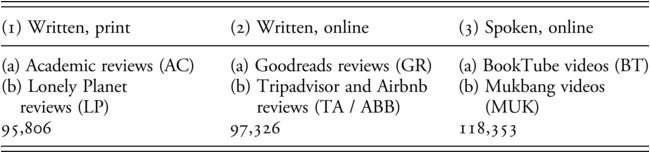
This study of clefts in evaluative language is based on the Corpus of Evaluative Language, henceforth the ‘EVLA-Corpus’, a corpus of approx. 310,000 words of English texts from six different primarily evaluative registers, represented in roughly equal shares (cf. Table 9.2). To cover as wide a range of linguistic uses as possible within the scope of this study, the subcorpora represent (1) written language published in print, (2) written language published online, and (3) transcripts of spoken language recorded in videos and published online. While subcorpora (1) and (2) share the mode of transmission, subcorpora (2) and (3) share the medium of publication and a lower degree of formality, related to a lower degree of planning and editing. Each subcorpus combines texts of two different registers evaluating (a) books and (b) food and accommodation, respectively. These were chosen because they represent entities commonly and publicly evaluated or reviewed in everyday life. This enabled the compilation of a representative corpus and ensured that the analysed linguistic features are entrenched as part of established registers. Subcorpus (1) contains 20 academic book reviews (from ten journals representing five humanities) as well as 917 reviews of eating and drinking places and accommodations from three Lonely Planet guidebooks. Subcorpus (Footnote 2) contains 840 non-academic book reviews (of 28 books) from the social cataloguing website Goodreads.com and 450 reviews of eating and drinking places and accommodations from each Tripadvisor and Airbnb. All three online platforms permit users to publish reviews and thus offer reading, travel, or accommodation guidance, respectively. The spoken subcorpus was sampled from the video sharing platform YouTube, more precisely its sub-registers BookTube and Mukbang. The 16 BookTube videos (by four different booktubers) selected for the present purpose were all book reviews and did not include other types of BookTube videos like bookshelf tours or book haul videos.Footnote 6 Mukbang, finally, originated in South Korea in the late 2000s. In its asynchronous Westernised form, Mukbang consists of audiovisual recordings shared on platforms like YouTube in which a so-called mukbanger consumes and comments on a meal.Footnote 7 The 20 mukbang videos (by five different mukbangers) transcribed for the present purpose are all reviews of dishes (some by fast-food chains). As far as (author-/user-)names, places of residence, and language use permitted, only texts by writers/speakers with English as an L1 were included. Doubtful cases were excluded from the corpus. Finally, this EVLA-Corpus was complemented by a primarily non-evaluative Control Corpus (CC) of approx. 60,000 words, structured into the same subcorpora (1)–(3).
The primarily manual analysis of these corpora yielded a total number of 532 clefts: 433 in the EVLA-Corpus (120 WHCLs, 268 RWHCLs, 45 ITCLs) and 99 in the CC-Corpus (25 WHCLs, 61 RWHCLs, 13 ITCLs). These were extracted with a context of five preceding and five subsequent C-Units (cf. Biber et al. Reference Biber, Johansson, Leech, Conrad and Finegan2021: 1060–103) and then annotated for various variables related to clefts and evaluation, summarised in Table 9.3 and Table 9.4.

Table 9.3 Long description
The table is segmented into two columns with the header variables related to clefts and levels of cleft-related variables. The data is presented in different rows. The second row is subdivided into 4 sections while the third row into 3 sections. The data filled in from left to right in the table are as follows:
The levels for the type of clefts are W H CL, R W H C L, I T C L.
For highlighted constituent, the data is:
The levels for form are noun phrase (N P), adverb phrase, adjective phrase, prepositional phrase, finite clause, non-finite clause, verbless clause.
The levels for syntactic function in corresponding non-cleft are subject, direct object (O d), prepositional object, subject complement (C S), adverbial, predication, premodifier, prepositional complement.
The levels for weight are 1 to 10 orthographic units.
The levels for information status are new, inferable, evoked.
For subordinate clause, the data is:
The levels for relativiser are what, who, why, where, when, how (plus adjective/ adverb), that, zero, non-finite clause.
The levels for weight are 1 to 10 orthographic units.
The levels for information status are new, inferable, evoked.

Table 9.4 Long description
The table is divided into two columns and labeled as variables related to evaluation and levels of evaluation-related variables. The data is arranged in different rows from left to right. The data is as follows:
For the variable syntactic function of the evaluative constituent, the levels are subject, subject complement (C S), cleft clause, adverbial, predicate, (plus superordinate, subordinate, conjoin).
For the variable semantic category, the levels are epistemic modality, deontic modality, affect, judgment, appreciation, style of speaking, stance, and graduation.
For the variable degree of directness, the levels are direct and indirect.
For the variable information status of evaluation, the levels are new, inferrable, and evoked.
a The levels ‘superordinate’, ‘subordinate’, and ‘conjoin’ were used as classifications of the syntactic function of evaluations which occurred in the same sentence as, but outside the cleft constructions themselves.
The variables related to clefts are those which previous studies have shown to be predictors for the differences between as well as within the different types of clefts (cf. Prince Reference Prince1978; Quirk et al. Reference Quirk, Greenbaum, Leech and Svartvik1985; Collins Reference Collins1991; Biber et al. Reference Biber, Johansson, Leech, Conrad and Finegan2021). For analyses of the form and function of constituents, Quirk et al. (Reference Quirk, Greenbaum, Leech and Svartvik1985) was used as a reference grammar. Weight was measured in number of orthographic units (OUs; cf. Biber et al. Reference Biber, Johansson, Leech, Conrad and Finegan2021). For determining the information status of constituents (as well as evaluations, see below), this study reverted to Prince’s influential taxonomy (Reference Prince and Cole1981), which distinguishes seven degrees of assumed familiarity (‘brand-new’, ‘brand-new anchored’, ‘unused’, ‘inferable’, ‘containing inferable’, ‘textually evoked’, and ‘situationally evoked’) and groups these into three principal degrees of assumed familiarity: ‘new’, ‘inferable’, and ‘evoked’ (or ‘given’). It is important to note that ‘in those constructions sensitive to discourse-old status, inferrable information consistently patterns with discourse-old information’ (Ward & Birner Reference Ward, Birner, Horn and Ward2004: 156).
Example (11) illustrates the cleft-related variables: It is an ITCL which highlights and negates the lexically headed noun phrase a flash Edwardian-era villa (4 OUs), which in the non-cleft would function as the prepositional complement of in. The cleft clause (4 OUs) is introduced by that. While the CS represents brand-new information, the subordinate clause contains information inferable in this context.
The operationalisation of evaluation is naturally difficult, since it is inherently subjective and elusive. Following the above definition, sentences were classified as evaluative when they expressed an attitude or feeling.Footnote 9 The classification used in this study primarily follows Biber et al., who distinguish Epistemic stance (expressions of ‘certainty (or doubt), actuality, precision, or limitation’, Biber et al. Reference Biber, Johansson, Leech, Conrad and Finegan2021: 964), Attitudinal stance (expressions of ‘personal attitudes or feelings’, Biber et al. Reference Biber, Johansson, Leech, Conrad and Finegan2021: 966), and Style of Speaking stance (‘writer comments on the communication itself’, Biber et al. Reference Biber, Johansson, Leech, Conrad and Finegan2021: 967) as the three principal semantic categories. It relies, however, on Martin and White (Reference Martin and White2005: 35–6) for a subcategorisation of Attitude into Affect (expressions of feelings or emotions), Judgment (assessments of behaviour or actions), and Appreciation (evaluations of entities, individuals, or facts) to specify this semantic category. Finally, this study adds the traditional category of Deontic modality, that is, expressions of ‘permission, obligation, or volition (or intention)’, subsumed by Biber et al. (Reference Biber, Johansson, Leech, Conrad and Finegan2021: 483, 967) under Attitudinal stance, and Martin and White’s (Reference Martin and White2005: 37) category of Graduation, which includes, for example, intensifiers, downtoners, and adjustments of category boundaries and is not included as a stance marker by Biber et al. (Reference Biber, Johansson, Leech, Conrad and Finegan2021). Consequently, this study distinguishes seven semantic categories of evaluation (see Table 9.4).
These semantic categories are illustrated by explicitly evaluative examples from the EVLA-Corpus: (12) shows two instances of Epistemic modality (would and definitely), while (13) contains instances of Deontic modality (have to), Affect (fall in love), and Appreciation (amazing journey). Honestly in (14) expresses Style of Speaking Stance, while the prepositional phrase to no end intensifies (Graduation) the expression of Affect (intrigues). (15), finally, evaluates positively the author’s creation of the plot from little pieces (Judgment) and intensifies this evaluation by so (Graduation).
this is something that I would definitely recommend, erm, for you to try out […].
That’s all you have to know to pick it up and fall in love with it and just like go on this amazing journey.
It’s […] something that just honestly intrigues me to no end every time I turn the page.
And one thing she does so well is that […].
Following Martin (Reference Martin, Hunston and Thompson2000), the present study further distinguishes two degrees of explicitness of evaluation: direct (or explicit) evaluations include those expressed by lexemes with an evaluative denotation, but also evaluations expressed by metonymies, metaphors, or idioms, or through entailments. For example, the mukbanger in (16) makes use of a metaphor to judge a certain behaviour as immoral or problematic. By contrast, evaluations which require an inference or a conversational implicature or for which knowledge of specific (social) norms or values is required are regarded as indirect (or implicit). So when the reviewer in (17) states that a LOT of fudging may be involved in what claims to be a scientific approach, any reader acquainted with scientific standards will be able to infer that the approach of the reviewed book is evaluated as unreliable. For reasons of clarity and simplicity, the following discussions will rely primarily on examples of direct evaluations.
So what I’m saying is that that’s a red flag.
here’s where a LOT of fudging can come in […].
Due to the difficulty of the operationalisation of evaluation and the potential subjectivity of categorisations relating to evaluation and information status, the author and a specifically trained research assistant coded a random selection of 411 clefts from both corpora, achieving an agreement rate of 82.5%. Discrepancies in coding were resolved through discussions.
9.6 Analysis and Results
Figure 9.1 gives an overview of the normalised frequencies (per 100,000 words) of clefts in the subcorpora of the EVLA-Corpus and the Control Corpus. Contrary to expectations, in a two-sided binomial probability test, the frequency of all cleft constructions turns out to be significantly lower in the EVLA-Corpus and its subcorpora than in the Control Corpus and its subcorpora (total: p = 0.007; subcorpus (1): p = 0.005; subcorpus (2): p = 0.011; subcorpus (3): p < 0.001). At first, this seems to suggest a correlation between the primary textual communicative purpose and frequency of use. However, while ITCLs are less frequent, WHCLs and RWHCLs are considerably more frequent in both the EVLA and the Control Corpus than in other corpora containing texts with mixed communicative purposes (cf. Collins Reference Collins1991; Biber et al. Reference Biber, Johansson, Leech, Conrad and Finegan2021),Footnote 10 which disproves hypothesis H1. As expected based on previous studies like Biber et al. (Reference Biber, Johansson, Leech, Conrad and Finegan2021: 953), in both the EVLA and the Control Corpus, ITCLs are significantly more common in formal written discourse than in the other subcorpora (p < 0.001), and particularly frequent in academic writing (EVLA subcorpus 1(a): 40.0 per 100,000 words). RWHCLs, by contrast, occur significantly more frequently in spoken language than in the other subcorpora (p < 0.001), while register and medium differences are less drastic for WHCLs.
Cleft constructions in the subcorpora of the EVLA-Corpus and the Control Corpus (normalised frequencies per 100,000 words)

Figure 9.1 Long description
The vertical axis marks rate per 100,000 words and ranges from 0 to 300, in increments of 50. The horizontal axis marks the two categories of corpora: E V L A, or corpus of evaluative language, and C C, or control corpus, in four different scenarios:
1. Written, print
2. Written, online
3. Spoken, online
4. Total
The vertical bar is divided into three sections and denotes three different clefts, namely I T C L, R W H C L, and W H C L, all in dark to light shades. The dominating cleft is R W H C L in all domains and peaks for the spoken, online segment. The frequency of I T C L cleft is high in the first segments but declines gradually. A data table is provided at the bottom of the bar graph with eight columns marking the E V L A and Control corpus for the four above-mentioned scenarios. The table rows are filled with data for the three clefts. The data filled from left to right is as follows:
For I T C L, the corresponding values are 23, 29.9, 15.4, 5.1, 6.8, 25.7, 14.4, and 20.7.
For R W H C L, the corresponding values are 15.7, 51.2, 43.2, 75.9, 178.30, 174.5, 86, and 97.3.
For W H C L, the corresponding values are 28.2, 12.8, 34.9, 40.5, 49.9, 71.9, 38.5, and 39.9.
While the following paragraphs will focus on aspects directly relevant to answer the above research questions, suffice it to mention that the results of the quantitative and qualitative analyses of the clefts of both the EVLA and the Control Corpus largely confirm the results of previous analyses (Collins Reference Collins1991; Biber et al. Reference Biber, Johansson, Leech, Conrad and Finegan2021), concerning the relativisers which can occur in clefts, the forms and functions of highlighted elements, and the information status of constituents. This shows that not only do the clefts in the present study behave like clefts on average, but there is also no considerable difference between the clefts used in primarily evaluative texts and those used in primarily non-evaluative texts as far as formal, functional, and informational characteristics are concerned.
The analysis of informativity, however, revealed one unexpected result: typical RWHCLs, as illustrated by (12), have a given thematic highlighted element and a nominal relative clause of a comparatively newer or the same information status. Its being part of the presupposed subordinate clause imbues this new information with a ‘non-controversial flavour’ (Collins Reference Collins1991: 119). While the majority of RWHCLs in the present study (EVLA: 94.0%, CC: 85.2%) conform to that distribution, there are 25 clauses which feature a new highlighted element and a communicatively less salient nominal relative clause. Of these, seven highlight a cataphoric or interrogative element. The remaining 18 clauses, however, are genuine exceptions from the typical information structure of RWHCLs. Example (18), for example, features brand-new anchored information as the highlighted constituent and a given nominal relative clause. Note that the formal definiteness of the highlighted element is due to the presence of an individuating post-modification (cf. Birner & Ward Reference Birner and Ward1998: 134). This RWHCL resembles new-presupposition ITCLs, subtype 1, in that the highlighted element has a circumstantial meaning and, despite its newness, low communicative salience. Example (19) shows a RWHCL with a brand-new foregrounded constituent and a brand-new anchored subordinate clause. Beautiful wooden villas have not been mentioned before and are also not situationally evoked. The noun phrase (NP) is therefore informationally indefinite (Prince Reference Prince, Mann and Thompson1992: 300) or brand-new, its newness attenuated by its topicality. Its formal definiteness, however, seems to mark the existence of these villas as common ground. These RWHCLs with an exceptional information structure are not restricted to the EVLA-Corpus, since four comparable clauses can also be found in the Control Corpus. The effect of (possibly strategically) placing these brand-new NPs in sentence-initial position is similar to the ‘known fact’ effect achieved by placing brand-new information in the subordinate clauses of ITCLs and RWHCLs. At the same time, the exclusiveness implicature characteristic of clefts gives these subjects prominence by exclusion (cf. Collins Reference Collins1991: 156) and suggests that it is these villas and nothing else that is under consideration.
[I just kept listening to it.]Footnote 11 The last time that I was home at my family’s was when I was listening to Ninth House.
These beautiful wooden villas are what Auckland’s inner suburbs are all about.
In the following analyses, only evaluations contained in the cleft constructions themselves will be included (EVLA: 756 evaluations, CC: 185 evaluations). Figure 9.2 shows impressively that the majority of all types of clefts in the two corpora is used to express evaluations and that the overall probability of cleft constructions being used evaluatively is roughly the same regardless of whether the primary textual purpose is to evaluate or not. While WHCLs are most frequently evaluative, considering the absolute numbers of evaluations in the different types of cleft constructions in relation to their different average lengths reveals that RWHCLs, which are on average comparatively short (9.8 words vs. WHCLs: 19.2 words; ITCLs: 15.7 words), are most densely evaluative across both corpora (2.0 evaluations per 10 words vs. WHCLs and ITCLs: 1.3 evaluations per 10 words each).
Evaluative and non-evaluative cleft constructions in the EVLA-Corpus and the Control Corpus (relative frequencies)

Figure 9.2 Long description
The vertical axis marks relative frequencies that range from 0 to 100% in increments of 20%. The horizontal axis marks the two categories of corpora: E V L A, or corpus of evaluative language and C C, or control corpus, in four different scenarios of clefts:
1. W H C L
2. R W H C L
3. I T C L
4. Total
The vertical bar is divided into two sections and denotes non-evaluative and evaluative in dark and light shades. The dominating section is evaluative and peaks for C C in W H C L cleft. The relative frequency is lower for the non-evaluative section under all domains. A data table is provided at the bottom of the bar graph with eight columns marking the E V L A and C C corpus for the four above-mentioned scenarios. The table rows are filled with data for the two sections. The data filled from left to right is as follows:
For non-evaluative, the corresponding values of relative frequencies are 17.5%, 4.0%, 28.0%, 32.8%, 24.4%, 14.4%, 24.7%, and 23.2
For evaluative, the corresponding values of relative frequencies are 82.5%, 96.0%, 72.0%, 67.2%, 75.6%, 85.6%, 75.3%, and 76.8%.
As far as the different semantic categories of evaluation are concerned, what seems most interesting and confirms hypothesis H2 is that the different types of clefts behave mostly similarly in both corpora: across both corpora, Epistemic modality and Affect are perspicuously less frequent in ITCLs (7.6% and 9.5%) than in WHCLs (15.5% and 19.7%) and RWHCLs (20.2% and 21.2%), while Appreciation is more frequent in ITCLs (48.6%) than in WHCLs (28.5%) and RWHCLs (15.8%). The remaining four semantic categories of evaluation are represented roughly equally in the different cleft constructions, expressions of Deontic modality, Judgment, and Style of Speaking Stance being generally infrequent and Graduation being amongst the most frequent semantic categories (22.4–32.8%). Moreover, the huge majority of evaluations contained in the clefts of this study are direct across both corpora (EVLA: 94.7%; CC: 93.0%) and all three cleft constructions (WHCLs: 92.7%, RWHCLs: 94.9%, ITCLs: 97.1%). Since this study focuses on evaluative texts, that is, texts with the manifest purpose of assessing entities (e.g., books, chapters, hotels, food, prices) or actions (e.g., writing, cooking, decorating), examples will primarily display direct Appreciation and Judgment from the EVLA-Corpus.
If we consider the syntactic positions in which evaluations are expressed, we find that there are considerable differences between the three cleft constructions but that, again, characteristics of clefts are mostly stable across the two corpora (cf. Figure 9.3): in both corpora, most evaluations are contained in those constituents which are either foregrounded or backgrounded by the cleft constructions. Unsurprisingly, evaluations contained in non-clausal adverbials are most frequently of the semantic categories Epistemic modality (e.g., probably, definitely) and Graduation (e.g., pretty much, kind of), while predicates typically express Epistemic or Deontic modality (e.g., would or have to). Also rather unsurprisingly, in all types of clefts and in both corpora, the information status of the evaluations typically matches the information status of the constituents in which these evaluations are contained. To illustrate their particular use for the expression of evaluation, the following paragraphs will discuss a selection of typical examples of each type of cleft, also considering the availability of agnate alternatives and the effect of a potential substitution by these alternatives on the expression of evaluation(s) and on the aforementioned pragmatic meanings of clefts (the presupposition, the ‘known fact’ effect, and the exclusiveness implicature).
Syntactic positions of evaluations in the EVLA-Corpus and the Control Corpus (relative frequencies)

Figure 9.3 Long description
The vertical axis marks relative frequencies that range from 0 to 100% in increments of 20%. The horizontal axis marks the two categories of corpora: E V L A, or corpus of evaluative language and C C, or control corpus, in three different scenarios of clefts:
1. W H C L
2. R W H C L
3. I T C L
The vertical bar is divided into five sections and denotes a cleft clause, subject complement, predicate, non-clausal adverbial, and subject from dark to light shades. The relative frequency follows a varying trend across each domain. A data table is provided at the bottom of the clustered bar graph indicating the trends. The data from left to right for each category is as follows:
For the cleft clause, the corresponding values of relative frequencies are 0, 0, 0, 0, 40.3%, and 69.7%.
For the subject complement, the corresponding values of relative frequencies are 50.2%, 44.3%, 84.8%, 80.2%, 40.3%, and 30.3%.
For predicate, the corresponding values of relative frequencies are 0.4%, 1.6%, 0.5%, 1.1%, 1.4%, and 0.
For non-clausal adverbial, the corresponding values of relative frequencies are 4.1%, 9.8%, 10.4%, 9.9%, 0, and 6.9%.
For subject, the corresponding values of relative frequencies are 45.3%, 44.3%, 4.3%, 8.8%, 0, and 0.
Figure 9.3 shows that, in WHCLs, evaluations occur nearly as frequently in subjects as in subject complements. Evaluations contained in subject nominal clauses most frequently express Affect (30.2%) or Appreciation (21.5%) (across both corpora).
the thing that I loved the most about this book was the characters.
The paraphrased WHCL in (20) highlights the NP the characters, the direct object (Od) of loved. The proposition ‘I loved x the most about this book’ is inferable from the previous passionate introduction of the reviewed book. That the book features characters is also inferable but certainly more communicatively dynamic than the information contained in the subject. The subject expresses Affect (loved) and Graduation (the most). Interestingly, the expression of personal feelings is thus backgrounded and becomes less obtrusive, less conspicuous than in a main clause. Both the agnate RWHCL (?The characters were the thing/what I loved …) and ITCL (It was the characters that I loved …) maintain the backgrounding of Affect but make the characters the theme. This decrease in communicative dynamism in the course of the clause is inappropriate in RWHCLs but is, in fact, characteristic of old-presupposition ITCLs. Both the ITCL and the original WHCL contain the same presupposition and thus also present the evaluation as non-controversial. Its thematic position in the original WHCL additionally presents the presupposition as given in the hearer’s consciousness. This ‘interpersonal’ flavour (Collins Reference Collins1991: 133) is absent in the corresponding ITCL, where information is presented simply as known. Furthermore, while in the ITCL the theme is given textual prominence by its being predicated, highlighting the identity of the characters, the original WHCL gives ideational prominence (cf. Halliday Reference Halliday1967: 236–7) to the characters, representing them as participants in the process described in the relative clause. Finally, while the agnate non-cleft (I loved the characters the most about this book.) has the same proposition, there are considerable differences: end-focus falls on the final adverbial, the original backgrounding of Affect and foregrounding of the object are lost, and so are the exclusiveness implicature, the presupposition, and the ‘known fact’ effect. Note that these pragmatic meanings and the backgrounding effect associated with the subject clauses of WHCLs may be particularly helpful in those few clauses whose subjects express brand-new (anchored) evaluations (EVLA: 18, CC: 3).
So for those that don’t know how to eat this, what you do is you just pour this delicious kind of smelly […] sauce all over your food.
Evaluations contained in the highlighted CS of WHCLs, by contrast, most frequently express Appreciation (35.8%) or Graduation (29.6%), as in (21) (delicious, smelly, and kind of). This WHCL highlights a brand-new anchored predication. In the subordinate clause, it uses the substitute verb do. In the context of a discussion about how to eat a specific dish, this reference to an unspecified action is inferable and can be assumed to be in the hearer’s consciousness. The evaluations occur in the foregrounded constituent, but in inconspicuous position as premodifiers in the Od of the predication. Neither RWHCLs nor ITCLs can foreground a predication (cf. Quirk et al. Reference Quirk, Greenbaum, Leech and Svartvik1985: 1386). The corresponding non-cleft (You just pour …) is information-structurally less appropriate than the original WHCL since it does not show the same increase in communicative dynamism: It does not presuppose ‘you do x’, much less present this information as in the hearer’s consciousness.
[And they feel like friends.] And that’s what I really like, that he does with stories.
In RWHCLs, most evaluations occur in nominal relative clauses in subject complements (see Figure 9.3). This is unsurprising, since foregrounded subjects are frequently demonstrative pronouns. Across both corpora, evaluations contained in nominal relative clauses of RWHCLs can most frequently be assigned to the semantic categories of Graduation (33.4%) and Affect (24.7%): in (22), the nominal relative clause emphatically (Graduation) states that the fact that fictitious characters feel like friends (anaphoric text reference) – and only this fact – is what the BookTuber likes (Affect). Strikingly, these evaluations are again backgrounded as part of the subordinate clause. What has been foregrounded is the raised Od of does from the object clause. Since the BookTuber’s love for this author’s characters is inferable from the preceding context, we may conclude that it is ‘the equative relationship itself [in combination with the exclusiveness implicature] which may provide the primary informational contribution of the construction to the discourse’ (Collins Reference Collins1991: 146). This stage-ending function makes the RWHCL particularly appropriate here. The agnate WHCL (?What I really like that … is that.) not only runs counter to the principle of end-weight but is also thematically less appropriate due to the givenness of the foregrounded constituent and the resulting decrease in communicative dynamism. The corresponding (old-presupposition) ITCL (?It’s that that I really like …) with highlighted given information suggests an inappropriate contrastive reading of that. Finally, the agnate non-cleft (I really like that he does that …) is textually less coherent since it places the anaphoric and thematic demonstrative in subordinate position late in the sentence. It also lacks the exclusiveness implicature, the presupposition, the ‘known fact’ effect, and the summarising function and elevates the BookTuber’s emphatic expression of Affect to the main clause. It thus evaluates more obtrusively than the original RWHCL.
This writing talent is possibly the only reason I gave it three stars over two.
Non-pronominal subjects in RWHCLs contain a further 26 evaluations (Appreciation: 53.9%). In (23), the highlighted assessment that the author of the reviewed book is talented (Appreciation) is inferable from the preceding sentence. The CS, which reports that the reviewer rated the reviewed book as acceptable (Appreciation), is situationally given. Therefore, the corresponding WHCL (?The only reason I gave it … is …) and non-cleft (?I gave it … because of …) both seem thematically less appropriate than the original RWHCL. Furthermore, the non-cleft lacks the presupposition, the ‘known fact’ effect, and the exclusiveness implicature and emphasises the evaluation of the author by end-focus. The agnate ITCL highlighting a prepositional phrase (?It’s possibly because of … that I gave it …), finally, would have to be interpreted as an old-presupposition it-cleft with an inappropriate contrastive focus. The original RWHCL with very low overall communicative dynamism thus achieves what none of the agnates could: It summarises a previous argument by highlighting an inferable, thematic, non-contrastive, and impersonally evaluative constituent, while backgrounding a rhematic, but situationally given evaluation, which is explicitly ascribed to the reviewer by the use of the first-person pronoun. Moreover, the fact that the author is talented is not directly asserted but only as part of the existential presupposition triggered by the definite NP. The effect of placing brand-new information in non-pronominal subjects of RWHCLs, comparable to the ‘known fact’ effect, was already discussed previously for examples (18) and (19).
It wasn’t until it was assigned in one of my 11th grade courses that I realized she was just a dumb old biddy and she was clearly missing out on one of the most perfect books ever to be written.
Finally, despite generally low numbers, there are clear tendencies as to where the different types of ITCLs typically feature evaluations: while across both corpora old-presupposition ITCLs contain evaluations slightly more frequently in the highlighted constituent (48.4%) than in the cleft clause (45.2%), new-presupposition ITCLs of both types favour evaluations placed in the cleft clause (type 1: 87.5%; type 2: 75.8%). Evaluations in all types of ITCLs belong most frequently to the semantic categories of Appreciation (43.0%) and Graduation (22.8%). The ITCL in (24) contains brand-new anchored information in both the foregrounded constituent and the cleft clause. The circumstantial role of the former, however, makes the cleft clause the primary contribution to the discourse. As is typical of new-presupposition ITCLs, the evaluations – of the former teacher as a dumb old biddy (Appreciation), of the reviewed novel as the most perfect book (Appreciation and Graduation), and of the certainty of the truth of the proposition (clearly; Epistemic modality) – are contained in the cleft clause where they are backgrounded as part of the presupposition. Despite their newness they are presented as non-negotiable, as known facts, possibly unknown just to the reader, not as the reviewer’s personal opinion. These evaluations may thus have been strategically positioned to make this section of the review more impersonal and objective and potentially more convincing. While there are no WHCL and RWHCL alternatives, the circumstantial clause receives end-focus and has more communicative salience in the corresponding non-cleft (I realized … when it was assigned …), in which the ‘known fact’ effect is lost.
This discussion shows that a substitution of an ITCL by a WHCL or RWHCL is indeed not always possible (cf. Collins Reference Collins2006: 1716) but may be impeded by factors like the form or function of the foregrounded constituent. It also shows that each type of cleft can be used to thematise or rhematise and background or foreground chunks of given or new information depending on the writer’s or speaker’s communicative intentions. The cluster of cleft constructions thus presents itself as a flexible tool particularly useful for the expression of evaluation.
9.7 Discussion and Outlook
Based on the EVLA-Corpus, a corpus of primarily evaluative language, and a Control Corpus of primarily non-evaluative language, this study set out to analyse the interaction between the primary communicative purpose and the use of the different cleft constructions. It permitted a number of important conclusions.
To begin with, hypothesis H1 needed to be refuted. This conclusion was based on the comparison of the frequencies and the syntactic, semantic, and information-structural characteristics of the three types of clefts in the EVLA- and the Control Corpus as well as the comparison with other corpora containing texts with mixed communicative purposes (Collins Reference Collins1991; Biber et al. Reference Biber, Johansson, Leech, Conrad and Finegan2021). This revealed that the use of cleft constructions is not directly correlated with the primary textual communicative purpose of evaluating, but, rather, as established in previous studies (e.g., Biber et al. Reference Biber, Johansson, Leech, Conrad and Finegan2021), with mode, style, and other register characteristics (and possibly also the operationalisation of the three types of clefts).
Second, the consideration of the frequencies of each type of cleft in the two corpora and in specific registers and the comparison with other constructions like relative clauses clearly demonstrated that frequency-based judgments of the (non‑)canonicity of clefts confirm the traditional classification of clefts: Although WHCLs and RWHCLs are slightly more frequent (i.e., less non-canonical) than ITCLs in overall language use, all clefts are comparatively infrequent (i.e., non-canonical) both in general language use and in specific registers, such as spoken language, academic writing, or evaluative texts. In other words, against previous expectations, it could not be shown that, based on their frequency, clefts are canonical in texts with the primary communicative purpose of evaluating.
Third and most impressively, the quantitative analyses showed that the majority of examples of each of the three cleft constructions is evaluative and, in fact, directly evaluative, irrespective of whether they occur in the primarily evaluative or the primarily non-evaluative corpus. Moreover, RWHCLs are most densely evaluative, featuring the highest number of evaluations in relation to their average overall length, thus confirming hypothesis H2. This means that, regardless of the primary overall textual communicative purpose, all clefts, and especially RWHCLs, are constructions which are very closely associated with the direct expression of evaluation (i.e., with an immediate intention to evaluate). In other words, since clefts are virtually always used to evaluate directly, it is possible to conclude – even without a comprehensive study of the multifaceted phenomenon of the language of evaluation – that cleft constructions are, in fact, an expectable and thus canonical choice in communicative situations in which the speaker or writer intends to express an evaluation. Consequently, while the overall textual communicative purpose of evaluating did not turn out to be a factor increasing the frequency or canonicity of cleft constructions, the immediate communicative intention to evaluate did so, most clearly for RWHCLs.
Fourth, this important finding permits another even more far-reaching conclusion, namely that clefts are not only indeed a syntactic ‘pattern’ typical of evaluative language (Hunston & Sinclair Reference Hunston, Sinclair, Hunston and Thompson2000: 89) but, even more importantly, can be regarded as belonging to an extended set of overtly evaluative lexico-grammatical stance constructions. Clefts differ from the stance constructions discussed, for example, by Biber and Zhang (Reference Biber and Zhang2018: 106) primarily in that the overtly evaluative lexeme(s) do(es) not control a syntactic constituent with a proposition but may occur in different syntactic constituents of the cleft itself. Consequently, in an empirical study of such an extended set of lexico-grammatical stance constructions, clefts can be expected to present themselves as a frequent and thus canonical syntactic choice.
Last but not least, further qualitative and quantitative analyses and comparisons between the three constructions demonstrated that the various combinations of given/new material in thematic/rhematic and foregrounded/ backgrounded positions make the cluster of cleft constructions a flexible tool especially when it comes to the expression of evaluation – which might indeed be one explanation for their frequent evaluative use: Thus, the individual cleft constructions have specific preferences as to where they feature evaluations most frequently and as to which semantic types of evaluation they express, again confirming H2. These preferences are also influenced by factors such as the weight, informativity, and thematicity of their constituents, which in many contexts make the three cleft constructions non-interchangeable. Further, all clefts carry an exclusiveness implicature; their subordinate clauses trigger presuppositions and the ‘known fact’ effect, that is, even brand-new information is presented as uncontroversial and non-negotiable. An effect similar to the ‘known fact’ effect was demonstrated for a subtype of RWHCLs which, to the author’s best knowledge, has not been discussed in the literature so far. These RWHCLs foreground brand-new information in the thematic subject, presented as information that should already be in the hearer’s consciousness and only needs a casual reminder. It is these pragmatic meanings of clefts, absent from corresponding non-clefts, which permit the speaker or writer either to put particular emphasis on an evaluation or to make an evaluation seem more non-negotiable, objective, impersonal, and/or unobtrusive. Thus, cleft constructions may even leave the recipient with the impression of being manipulated (cf. Collins Reference Collins2006: 1712).
In conclusion, the present study has important implications for the theory and analysis both of linguistic evaluation and of syntactic (non‑)canonicity. On the one hand, a corroboration of the assumption that cleft constructions belong to an extended set of explicitly evaluative lexico-grammatical stance constructions could make the analysis of linguistic evaluation in large-scale corpora more viable. The fact that individual cleft constructions occur particularly frequently in certain registers calls for future research to focus on the particular positions and forms of evaluations in clefts in different registers. Thus, since evaluations can occur in different syntactic constituents of clefts, it would be worthwhile for future research to investigate whether clefts might be a means to support both the explicit expression of evaluation in opinionated registers and also the less explicit expression of evaluation in other registers (cf. Biber & Zhang Reference Biber and Zhang2018). Finally, the findings also call for the analysis of other non-canonical syntactic constructions which typically contain evaluative lexemes such as tough-constructions to test whether these might also belong to this extended set of explicitly evaluative lexico-grammatical stance constructions.
On the other hand, the present study showed that the immediate communicative purpose of evaluating may indeed be a factor influencing the use of cleft constructions. It illustrated the particular value of a flexible frequency-based approach to syntactic (non-)canonicity, which permits us to narrow down the scope of our data to specific communicative situations and redefine cleft constructions as a canonical choice when it comes to explicitly expressing evaluations with the help of stance constructions.


 Open access