





Introduction
The plasticulture system involves plastic mulches, drip irrigation, and soil fumigation. It is widely adopted among specialty crop growers in the southeastern United States due to improved yields, increased water and fertilizer use, and reduced weed pressure (Freeman and Gnayem Reference Freeman and Gnayem2005; Lamont 1996). Black polyethylene mulch inhibits sunlight penetration, preventing the germination and growth of most weeds. However, over the season, broadleaf and grass weeds can emerge in the space between the beds (row middles) and punctures in the plastic mulch that serve as transplant holes, which can affect the yield (Buzanini and Boyd Reference Buzanini and Boyd2024), shelter nematodes (AbdelRazek et al. Reference AbdelRazek and Balah2023), and diseases (Dentika et al. Reference Dentika, Ozier-Lafontaine and Penet2021).
The fumigation process consists of applying volatile chemical compounds to the soil prior to planting a crop. This practice is commonly used to control soil-borne fungal pathogens, nematodes, and weeds in the plasticulture system (Castellano-Hinojosa et al. Reference Castellano-Hinojosa, Boyd and Strauss2022). However, no fumigant is applied to row middles, which can contribute to the most challenging aspects of weed control. To avoid the direct and indirect effects of weeds emerging in row middles on crop quality and yield, weed control typically relies on the use of preemergence and postemergence herbicides due to their effectiveness, ease of use, and low cost compared with other management options such as hand weeding (Dittmar Reference Dittmar2013; Fennimore and Doohan Reference Fennimore and Doohan2008). Using technologies to apply herbicides specifically where weeds occur should reduce overall herbicide use.
Weeds in row middles are often managed with preemergence herbicides applied shortly after fumigation and before crop transplant, with postemergence herbicides applied in conjunction with preemergence herbicides or as needed after transplant during the crop cycle (Sharpe and Boyd Reference Sharpe and Boyd2019). Multiple herbicide applications are typically required to achieve season-long weed control. In addition, mixtures of postemergence herbicides are often used to broaden the weed control spectrum. Previous research has attempted to identify effective mixture options of postemergence herbicides (Buzanini et al. Reference Buzanini, Schumann and Boyd2023; Sharpe et al. Reference Sharpe, Schumann, Yu and Boyd2020) or combinations of preemergence and postemergence herbicides (Boyd Reference Boyd2016; Gilreath et al. Reference Gilreath, Stall and Locascio1987) for row middles. However, very few publications have examined row middle weed management with herbicides, and most of the research was conducted in Florida.
Flumioxazin is a N-phenyl phthalimide herbicide with excellent efficacy that has an inhibitory effect on the protoporphyrinogen oxidase enzyme in a wide range of weed species (Iwashita et al. Reference Iwashita, Hosokawa, Ihara, Miyamoto, Otani, Abe, Asano, Mercier, Miyata and Barlow2022; Price et al. Reference Price, Pline, Wilcut, Cranmer and Danehower2004). It is widely used in row middles and has both soil surface residual and foliar contact properties (Iwashita et al. Reference Iwashita, Hosokawa, Ihara, Miyamoto, Otani, Abe, Asano, Mercier, Miyata and Barlow2022). Tank mixes of preemergence herbicides with different action modes can broaden the weed control spectrum and enhance overall efficacy. For example, Boyd (Reference Boyd2016) reported that weed control in vegetable row middles increased from 42% to 73% with S-metolachlor and flumioxazin applied separately, to 91% when both modes of action were applied in a tank mixture (Boyd Reference Boyd2016).
Glufosinate is a nonselective, postemergence herbicide that was recently registered for use on row middles of fruiting vegetables. It was previously used primarily in non-crop areas or glufosinate-resistant agronomic crops for postemergence and pre-plant burndown (Dayan et al. Reference Dayan, Barker, Bough, Ortiz, Takano, Duke and Moo-Young2019). Mixing different herbicides in a tank is often necessary to control broadleaf, grass, and nutsedge in row middles. This approach broadens the range of weeds that can be controlled and reduces the overall cost of application compared to using the herbicides separately (Kammler et al. Reference Kammler, Walters and Young2010).
In most cases, herbicides are applied to row middles using shielded applicators that band the herbicides between the raised beds. Herbicides are sprayed across the entire middle area of the row, even though weeds typically emerge in non-uniform patterns. Applying herbicides only where weeds occur would reduce herbicide use and input costs and minimize unnecessary environmental pesticide inputs. Object detection based on convolutional neural networks (CNNs) has shown significant potential in detecting weeds and saving herbicides in comparison to other applications (Buzanini et al. Reference Buzanini, Schumann and Boyd2023; Etienne et al. Reference Etienne, Ahmad, Aggarwal and Saraswat2021; Epée Missé Reference Epée Missé, Werner and Almond2020; Lati et al. Reference Lati, Rasmussen, Andujar, Dorado, Berge, Wellhausen, Pflanz, Nordmeyer, Schirrmann, Eizenberg, Neve, Jørgensen and Christensen2021; Partel et al. Reference Partel, Charan Kakarla and Ampatzidis2019). CNNs are subjected to supervised training using labeled image data sets to build robust models to identify desired objects (Sharpe et al. Reference Sharpe, Schumann, Yu and Boyd2020). CNNs, like YOLO (You Only Look Once), can classify different categories of objects (Liu and Wang Reference Liu and Wang2020), which is an important aspect required for weed detection. Previous research has proven that targeted spray technology is viable for postemergence herbicides in row middles (Buzanini et al. Reference Buzanini, Schumann and Boyd2023). Still, there is a need to determine how this technology could optimally be integrated into an overall spray program over the vegetable season in the plasticulture system.
This research aimed to evaluate the efficacy and costs of preemergence and postemergence herbicide combinations in row middles when applied with conventional or targeted spray technology. For Experiment 1, we hypothesized that herbicide savings with targeted application technology would be more significant in the presence of preemergence herbicides, and the better the control achieved with preemergence herbicides, the greater the herbicide savings achieved with targeted postemergence applications. For Experiment 2, the hypothesis was that herbicide savings and weed control could be improved by mixing preemergence herbicides.
Materials and Methods
Application Technology
A smart-spray system with machine vision that was developed at the University of Florida (Sharpe and Boyd Reference Sharpe and Boyd2019) to identify and spray herbicides only where weeds occur was used for all experiments in this paper. The system consists of a digital camera (C922x – Pro Stream Webcam -1080p HD camera; Logitech, Newark, CA) connected to a Linux computer (Jetson Nano; NVIDIA, Santa Clara, CA) programmed to capture real-time digital images of the vegetable row middles ahead of two nozzles per row middle. The sprayer boom, attached to a tractor, was 1.85 m long and positioned approximately 0.35 m above the ground. The boom had two 8002EVS spray nozzles (TeeJet Technologies, Glendale Heights, IL), and the width between them was 0.28 m. The smart spray could spray one row middle per pass. The herbicide treatments were mixed in aluminum spray cans pressurized with CO2 at 0.24 MPa and connected to the prototype sprayer. The tractor’s speed for all applications was 3.4 km h−1.
The study used an algorithm (YOLOv3-tiny-3L) that had been pre-trained for weed identification in images with 4,035 images and 21,467 annotations of weeds on vegetable row middles. The analysis was conducted on a Linux computer developed in 2019 when version 3 of YOLO (YOLOv3) was one of the best state-of-the-art object detection models available. The tiny variant of YOLOv3 was selected because it produced sufficient accuracy and high inference speed (frames per second) on the limited compute capacity of NVIDIA Jetson Nano used for the controller, because the full-size YOLOv3 was too slow. As the equipment moves in the field, the image processing software can differentiate between three weed classes: broadleaf, nutsedge, and grass. The model analyzes each image and sends triggering information to the corresponding solenoid valve, which opens and closes the spray nozzles when weeds are detected. The system latency factor was 0.254 s, which is used as a look-ahead calculation during a real-time operating system.
Site Description
Two field experiments were conducted in spring 2020, fall 2020, and spring 2021 at the Gulf Coast Research and Education Center (GCREC; 27°45N, 82°13W) in Balm, FL, to evaluate smart-spray technology in plasticulture row middles. The soil at all research sites used for these experiments is a Myakka fine sand. The site for spring 2020 had a pH of 7.9, 1.26% organic matter, 92.4% sand, 4.8% silt, and 2.8% clay. The site for fall 2020 and spring 2021 had a pH of 8.0 and 0.68% organic matter, with sand, silt, and clay at 92%, 5.2%, and 2.8%, respectively. Fields were disked and leveled before the experimental setup. Historically, plasticulture crops have grown for several years and are known to have significant nutsedge, grass, and broadleaf weed populations. The beds are 30.5 cm tall, 66 cm wide at the top, and spaced 81 cm apart. They were formed and fumigated with 118 kg ha−1 of 56.6% chloropicrin + 37.1% 1,3-dichloropropene (Pic-Clor 60 Fumigant; TriEst Ag Group Inc., Greenville, NC) with a standard pretransplant rig equipped with three back-swept shanks set (20 cm apart) to uniformly distribute fumigant throughout the bed (Kennco Manufacturing Inc, Ruskin, FL). Immediately following fumigation, two drip tape lines with emitters every 30 cm and a flow rate of 1.57 L min−1 were buried 2.5 cm beneath the soil surface. The beds were simultaneously covered with a black Totally Impermeable Film (TIF) in the spring and white TIF in the fall (Berry Global Films LLC, Sarasota, FL).
No crop was grown in these trials because the focus was on weed management in the row middles, but the field was managed as if a crop was present to ensure realistic field conditions. All experiments were designed as a randomized, complete block design with four blocks. Preemergence and postemergence herbicide applications (Table 1) occurred after bed formation (within 14 d of bed formation following the first flush of weeds in the row middle) and at the time of standard transplant (within the time frame when crops were transplanted in surrounding trials at GCREC). The estimated transplant date fell within the normal range for vegetable production in central Florida and aligned with activities on commercial farms in the surrounding area.
Herbicide product, application rate, and manufacturer information.
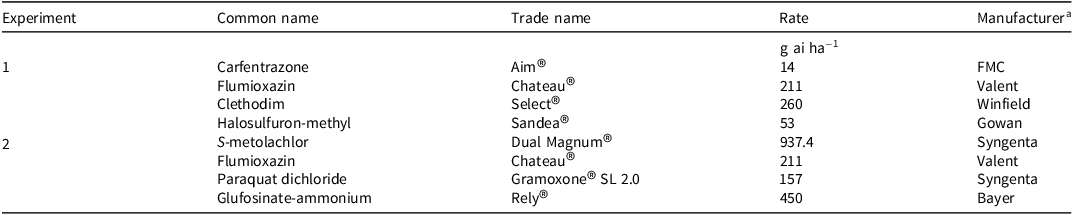
a Manufacturer locations: Bayer Crop Science, St. Louis, MO; FMC Corporation, Philadelphia, PA; Gowan Company, Yuma, AZ; Syngenta Crop Protection, Greensboro, NC; Valent U.S.A., Walnut Creek, CA; Winfield Solutions, LLC, St. Paul, MN.
In all site-years the most common weed species observed included carpetweed (Mollugo verticillate L.), threelobe morningglory (Ipomoea triloba L.), purple nutsedge (Cyperus rotundus L.), common lambsquarters (Chenopodium album L.), wild radish (Raphanus raphanistrum L.), goosegrass [Eleusine indica (L.) Gaertn.], common ragweed (Ambrosia artemisiifolia L.), cutleaf evening-primrose (Oenothera laciniata Hill), Brazil pusley (Richardia brasiliensis Gomes), and southern crabgrass [Digitaria ciliaris (Retz.) Koeler].
Experiment 1
Experiment 1 aimed to compare targeted postemergence herbicide tank mixes with no-, one, or two banded preemergence flumioxazin applications (Table 2). The primary objective was to determine the most effective way to use targeted herbicide application technology within an herbicide program for row middles. It is essential to note that all preemergence herbicide applications were banded, whereas postemergence herbicides were either banded or applied using targeting technology. Treatments (Table 2) included the following: 1) nontreated control; 2) two banded preemergence and postemergence herbicides applied after bed formation and at standard crop transplant dates (2 PRE followed by [fb] 2 POST B), 3) two banded preemergence herbicides fb two targeted postemergence herbicides applied immediately after bed formation and at standard crop transplant dates (2 PRE fb 2 POST T), 4) one banded preemergence herbicide fb two targeted postemergence herbicides following bed formation and targeted transplant dates (1 PRE fb 2 POST T), and 5) two targeted postemergence applications following bed formation and targeted transplant date with no preemergence (2 POST T). The preemergence herbicide was flumioxazin (211 g ai ha−1), and the postemergence herbicides were a tank-mix of carfentrazone-ethyl (14 g ai ha−1) for broadleaf control, clethodim (260 g ai ha−1) for grass control, and halosulfuron-methyl (53 g ai ha−1) for nutsedge control. We recognize that halosulfuron is a soil residual herbicide, but it is primarily used in row middles for postemergence control of nutsedge species and select broadleaf weeds. No surfactants were used in this experiment. The 2 banded PRE fb 2 banded POST treatment and the 2 banded PRE fb 2 targeted POST treatment differ only in the application method and allow a comparison of banded versus targeted herbicide application technology following two preemergence applications. The 1 banded PRE fb 2 targeted POST treatment enables a comparison of targeted application technology following one less preemergence herbicide than the previous two treatments. The two targeted postemergence (2 POST T) treatment allows us to evaluate the same postemergence herbicides without a preemergence application.
Herbicide programs evaluated for row middles in plasticulture vegetable production systems. a – c
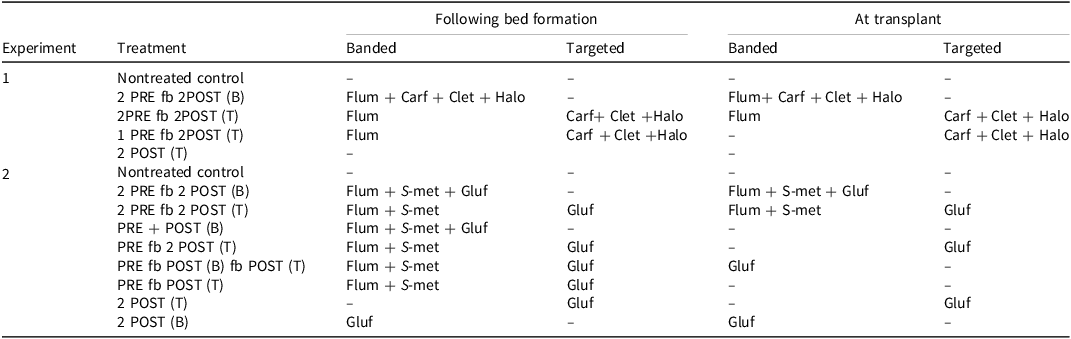
a Abbreviations: B, banded; Carf, carfentrazone; Clet, clethodim; fb, followed by; Flum, flumioxazin; Gluf, glufosinate-ammonium Halo, halosulfuron-methyl; POST, postemergence application; PRE, preemergence application; S-met, S-metolachlor; T, targeted.
b The paraquat dichloride was not included in this table because no data from the spring of 2020 were included in the following analysis.
c A number 2 indicates two successive applications; a 1 indicates one application only (within 14 d of bed formation). A plus (+) symbol indicates a tank mix.
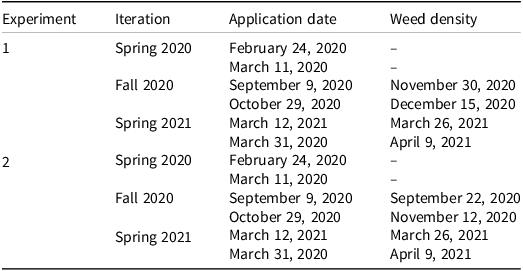
Experiment 1 was repeated three times. For spring 2020, herbicides were applied on February 24, 2020, and March 11, 2020. In fall 2020 (iteration 2), herbicides were applied on November 2, 2020, and November 16, 2020. On the third iteration of Experiment 1 (spring 2021), herbicides were applied on March 11 and 31, 2021, respectively (Table 3).
Data collection dates for each experiment and iteration.
Experiment 2
The objectives of Experiment 2 were to evaluate glufosinate as a row middle herbicide within an overall herbicide program when applied using banded or targeted technology. Glufosinate was assessed with no, one, or two banded preemergence applications of a tank mix of flumioxazin plus S-metolachlor. Treatments (Table 2) included the following: 1) nontreated control; 2) banded preemergence and banded postemergence applications following bed formation and at the anticipated transplant date (2 PRE fb 2 POST B); 3) banded preemergence applications following bed formation and at the anticipated transplant date fb targeted postemergence applications on the same dates (2 PRE fb 2 POST T); 4) one banded preemergence and postemergence application following bed formation (1 PRE + 1 POST B); 5) one banded preemergence application fb two targeted postemergence applications with one after bed formation and one at the expected transplant date (1 PRE fb 2 POST T); 6) one banded preemergence application fb one banded postemergence after bed formation and one targeted postemergence at the expected transplant date (1 PRE fb 1 POST B fb 1 POST T); 7) one banded preemergence fb one targeted postemergence application after bed formation (PRE fb POST T); 8) two targeted postemergence applications (2 POST T) with the first following bed formation and the second at the expected transplant date; and 9) two banded postemergence applications (2 POST B) with the first following bed formation and the second at the expected transplant date. The treatments were selected to offer a comparison of one or two banded or targeted postemergence glufosinate applications following no, one, or two preemergence herbicide applications. The preemergence herbicide was flumioxazin (211 g ai ha−1) tank mixed with S-metolachlor (937g ai ha−1). The postemergence herbicide used in spring 2020 was paraquat dichloride (157 g ai ha−1). Due to the known presence of paraquat-resistant goosegrass, in fall 2020 and spring 2021, the postemergence herbicide was switched to glufosinate-ammonium (450 g ai ha−1). No surfactants were used in this experiment.
Experiment 2 was also repeated three times. For spring 2020, the herbicide was applied on February 24, 2020, and March 11, 2020, after bed formation and at transplant time, respectively. In the fall of 2020 (iteration 2), herbicides were applied on September 9, 2020, and October 29, 2020. In the third and final iteration of Experiment 1 (spring 2021), the herbicides were applied on March 12 and 31, 2021, respectively (Table 3).
Data Collection
Data collection included weed density before and after treatments, herbicide usage, and herbicide costs (Table 3). The number of weeds in each plot was counted using two randomly placed permanent quadrats during the whole season, each 0.79 m2. Each date’s counts were categorized (broadleaf, grass, and nutsedge). Herbicide usage for each plot was calculated by subtracting the remaining volume of liquid in the spray bottles (2-L plastic bottles) immediately following application from the known volume needed for the treated area. The volume applied to each plot was then used to calculate the grams of active ingredient used for each treatment. The cost per treatment was calculated based on herbicide prices provided by local vendors in central Florida for the year the experiment occurred. Differences in cost reflect only differences in herbicide usage and do not consider additional expenses such as equipment and labor.
Data Analysis
Data were analyzed using the Mixed procedure with SAS software (v. 9.4; SAS Institute, Cary, NC). Block was considered a random variable, and herbicide treatments were a fixed variable. Experimental runs were analyzed separately because data collection occurred on different dates. Data assumptions were checked for normality and constant variance before analysis. Treatment means were separated using the least squares means statement in SAS with the post hoc Tukey adjustment at α = 0.05.
Results and Discussion
Experiment 1
Two targeted postemergence (carfentrazone + clethodim + halosulfuron) applications were as effective as two banded applications in the presence of preemergence flumioxazin in fall 2020 and spring 2021 (Table 4). Targeted and banded methods lowered the total weed density by 96% 14 d after transplant (DATr) (Table 4). One application of preemergence flumioxazin instead of two did not result in higher weed density. Two targeted postemergence-herbicide applications in the absence of flumioxazin lowered the weed density by 50% and 78% in the fall 2020 and spring 2021, respectively. All weed control programs reduced broadleaf and nutsedge density. However, broadleaf density tended to be higher without preemergence flumioxazin, especially in the fall. No consistent effect on grasses was observed, possibly due to the low population.
Effect of herbicides on weed density when applications are banded or targeted in row middles in Experiment 1. a – e
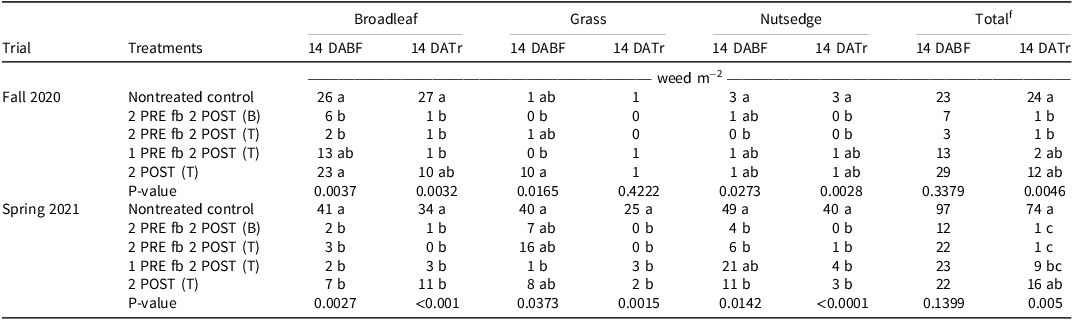
a Abbreviations: B, banded; DABF, days after bed formation; DATr, days after transplant; fb, followed by; POST, postemergence application; PRE, preemergence application; T, targeted.
b A number 2 indicates two successive applications; a 1 indicates one application only (at pre-transplant time). A plus (+) symbol indicates a tank mix.
c Means within a column followed by the same letter are not significantly different according to Tukey’s test (α = 0.05).
d The PRE herbicide was flumioxazin (211 g ai ha−1).
e The POST herbicides included carfentrazone (14 g ai ha−1) + clethodim (260 g ai ha−1) + halosulfuron-methyl (53 g ai ha−1).
f Total average of density between all weed classes and evaluation dates.
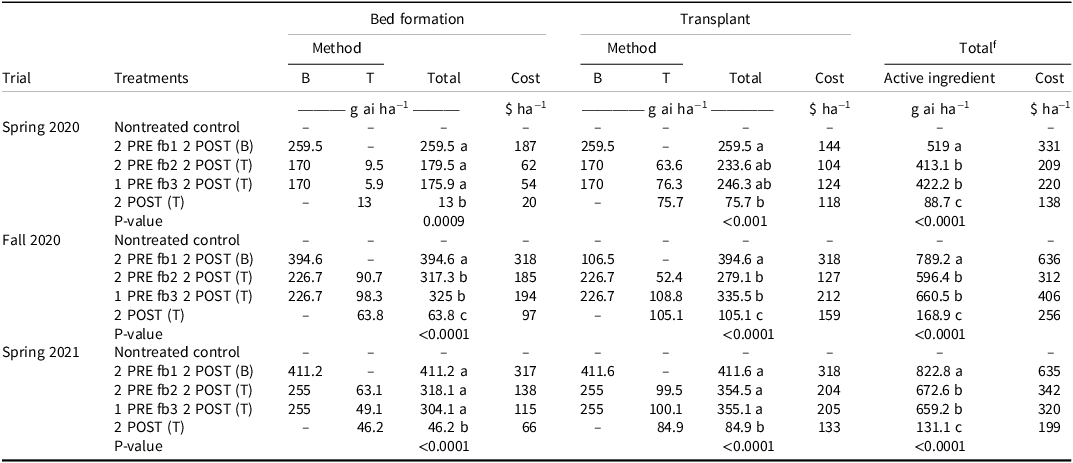
When applying two applications of preemergence flumioxazin, the amount of active ingredient used in targeted applications versus banded applications decreased by 31%, 20%, and 23% following bed formation in spring 2020, fall 2020, and spring 2021, respectively (Table 5). The reduction in active ingredients when applied at transplant was 10%, 29%, and 14% in spring 2020, fall 2020, and spring 2021, respectively. Reductions in herbicide use through targeted application methods led to a significant decrease in input costs, ranging from 37% to 51%, compared to the banded method. Applying one preemergence flumioxazin application followed by two targeted postemergence applications resulted in savings ranging from 34% to 50%. However, the one flumioxazin application followed by two targeted carfentrazone + halosulfuron + clethodim applications did not have significantly lower costs when compared to the two preemergence flumioxazin applications followed by two targeted postemergence applications; the lack of difference results from increased postemergence herbicide usage with only one preemergence herbicide application. The relative costs of the preemergence and postemergence herbicides must be considered when selecting the most cost-effective herbicide combination with smart-spray technology. Preemergence herbicides tend to lower weed densities and require the use of fewer postemergence herbicides when using targeted technology (Buzanini et al. Reference Buzanini, Schumann and Boyd2024). However, if the cost of the postemergence active ingredient is low, there may be less incentive to apply preemergence herbicides. Herbicide resistance management may be an additional consideration, as the use of both preemergence and postemergence herbicides can slow the resistance evolution (Somerville et al. Reference Somerville, Powles and Walsh2017) and, at the same time, maximize the benefits achieved with targeted spray technology.
The costs and amount of active ingredient used when applying various herbicides in row middles with banded and targeted technologies for Experiment 1. a – e
a Abbreviations: B, banded; fb, followed by; POST, postemergence application; PRE, preemergence application; T- targeted.
b Means within a column followed by the same letter are not significantly different according to Tukey test (α = 0.05)
c A number 2 indicates two successive applications; a 1 indicates one application only (at pre-transplant time). A plus (+) symbol indicates a tank mix.
d PRE-The PRE herbicide was flumioxazin (211 g ai ha−1).
e The POST herbicides included carfentrazone (14 g ai ha−1) + clethodim (260 g ai ha−1) + halosulfuron-methyl (53 g ai ha−1).
f Total active ingredient applied and cost over two application times.
It is important to note that two targeted postemergence herbicide applications without flumioxazin used 82% more active ingredients than the treatment with two preemergence herbicide applications. However, in fall 2020, the total average weed density that persisted in this treatment was not significantly different from that of the nontreated control. This highlights the importance of using preemergence herbicides, even though they may incur additional costs. The findings of this study are consistent with the reports by Buzanini et al. (Reference Buzanini, Schumann and Boyd2024), that the application of flumioxazin led to a reduction in overall weed density. However, they also observed lower costs in treatments when a preemergence herbicide was used, as higher savings were observed from targeted glyphosate application. In the present study, the non-preemergence herbicide application led to lower costs, with a significant active ingredient reduction compared to preemergence herbicide treatments. The differences between the studies can be correlated with weed density and the postemergence-herbicides used.
Experiment 2
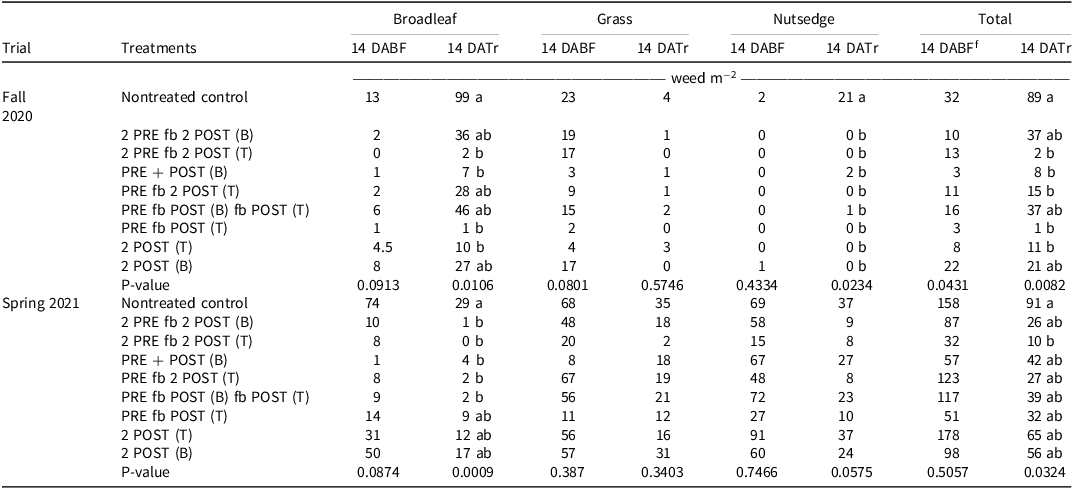
Herbicide treatments had no statistical effect on weed density at 14 d after bed formation (DABF) in fall 2020 and spring 2021 (Table 6). However, 14 DATr the two preemergence herbicide (flumioxazin + S-metolachlor) applications with two targeted postemergence herbicide (glufosinate-ammonium) applications significantly reduced the total weed density by 98% in fall 2020 and by 89% in spring 2021 compared with weed density in the nontreated control. In fall 2020, the nutsedge density observed after all treatments was significantly lower than that from the nontreated control 14 DABF; however, in spring 2021, the treatments did not result in a significant difference from the nontreated control. The nutsedge densities were also dramatically different between seasons.
Effect of herbicides on weed density when applied with a banded or targeted applicator in row middles in Experiment 2. a – e
a Abbreviations: B, banded; DABF, days after bed formation; DATr, days after transplant; fb, followed by; POST, postemergence application; PRE, preemergence application; T, targeted.
b A number 2 indicates two successive applications; a 1 indicates one application only (at pre-transplant time). A plus (+) symbol indicates a tank mix.
c Means within a column followed by the same letter are not significantly different according to Tukey’s test (α = 0.05).
d The PRE herbicides were flumioxazin (211 g ai ha−1) + S-metolachlor (937.4 g ai ha−1).
e The POST herbicide was glufosinate ammonium (133 g ai ha−1).
f Total density between all weed classes and evaluation dates.
For broadleaf weed density in both seasons, the two targeted glufosinate-ammonium applications were equivalent to the banded method in the presence of preemergence herbicide applications 14 DATr. There was no significant difference in broadleaf density following one or two preemergence applications. In the absence of flumioxazin + S-metolachlor, the broadleaf density was not significantly different from that of the nontreated control. Combining S-metolachlor and flumioxazin in a tank mix is more effective than using S-metolachlor alone. Incorporating flumioxazin into the tank mix can improve weed control because it provides some localized postemergence control of broadleaf weeds, which may be adequate to kill small weeds that may have emerged before preemergence herbicide applications (Boyd Reference Boyd2016; Clewis et al. Reference Clewis, Everman, Jordan and Wilcut2007).
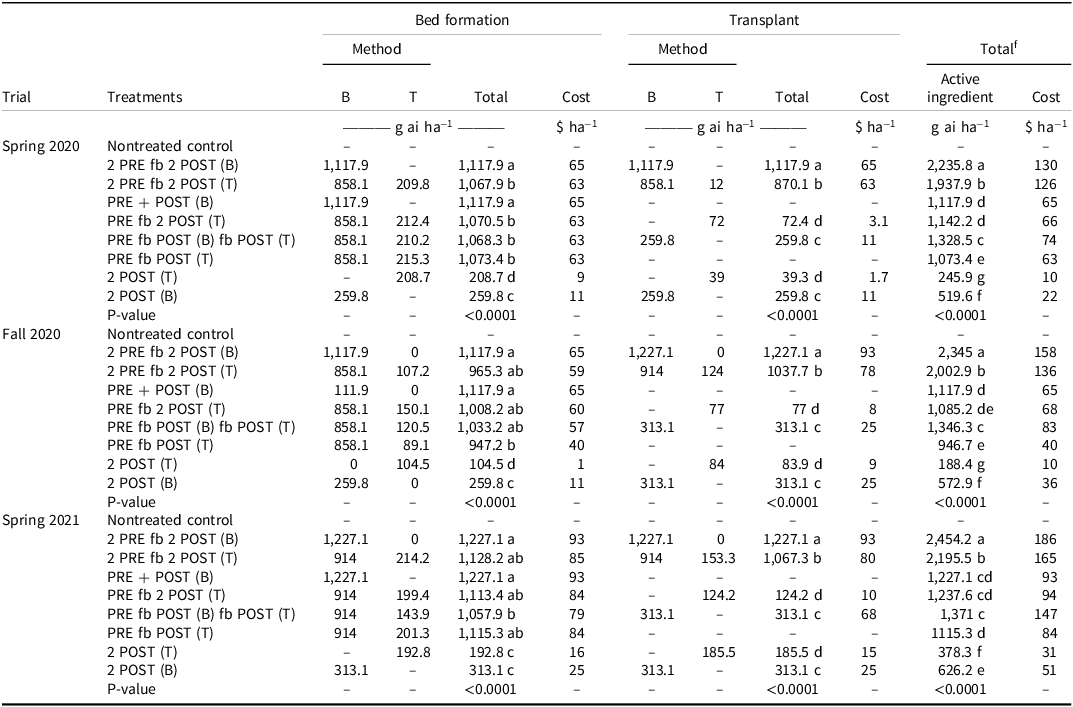
Two flumioxazin + S-metolachlor applications associated with two targeted glufosinate-ammonium applications lowered herbicide costs by 13% to 15% and decreased the herbicide costs by 9% compared to the banded method (Table 7 ). One preemergence application at bed formation plus two targeted postemergence herbicide applications reduced the final herbicide costs by an average of 51% compared to two preemergence applications and two postemergence banded applications. Two targeted glufosinate-ammonium applications with no flumioxazin + S-metolachlor applied lowered the total cost by 55% compared to the banded method by significantly reducing the amount of active ingredient applied by 40% to 53%. The application of one preemergence herbicide, followed by two targeted postemergence herbicides, did not significantly reduce the amount of active ingredient or the total costs compared to using one preemergence herbicide and one banded postemergence herbicide application at bed formation, along with one targeted application at transplant.
Costs and amount of active ingredient used when applying varying herbicide programs in row middles with banded and targeted technologies for Experiment 2. a – e
a Abbreviations: B, banded; fb, followed by; POST, postemergence application; PRE, preemergence application; T, targeted.
b A number 2 indicates two successive applications; a 1 indicates one application only (at pre-transplant time). A plus (+) symbol indicates a tank mix.
c Means within a column followed by the same letter are not significantly different according to Tukey’s test (α = 0.05).
d PRE-The PRE herbicides included flumioxazin (211 g ai ha−1) + S-metolachlor (937.4 g ai ha−1).
e The POST herbicide was glufosinate ammonium (133 g ai ha−1).
f Total active ingredient applied and cost over two application times.
The amount of herbicide and number of active ingredients needed can vary based on a few factors such as the type of weeds, their growth stage, weed density, weather during spraying, and if any weeds present are resistant to the herbicide (Dammer and Wartenberg Reference Dammer and Watenberg2007). Gutjarh and Gehards (Reference Gutjar and Gerhards2010) found that using a GPS-guided sprayer resulted in herbicide savings of up to 90% for grass weeds in winter cereals, 78% in maize, and 36% in sugar beet. Using a prototype variable rate sprayer, Esau et al. (Reference Esau, Zaman, Chang, Groulx, Schumann and Farooque2014) observed 51% herbicide savings from wild blueberry fields. Buzanini et al. (Reference Buzanini, Schumann and Boyd2023) reported that using smart-spray technology can reduce the postemergence herbicide volume application by 26% to 42% in jalapeno pepper (Capsicum annuum L.) plasticulture fields without a preemergence herbicide application.
Based on these findings, we conclude that the smart-spray system is an effective technology for selectively applying herbicides only where needed, and this technology has the potential to reduce herbicide usage. Preemergence herbicides meant overall herbicide costs were higher, but weed densities tended to be lower. Using a tank mix of flumioxazin + S-metolachlor can play a crucial role in the initial management of weeds and enhance the efficacy of subsequent targeted postemergence herbicide applications.
Practical Implications
Targeted weed control systems that use artificial intelligence for weed detection and identification effectively reduce herbicide inputs, herbicide costs, crop damage, labor, and risks. The system presented in this paper detected and localized weeds and reduced herbicide usage compared to conventional techniques. Targeted postemergence herbicide applications should be used with preemergence herbicides to optimize cost reductions and weed control. The absence of preemergence herbicides can reduce herbicide costs compared to using two preemergence applications, but weed density may be higher and postemergence herbicide savings lower. This study was carried out based on real-world field trials following commercial standards, and we are therefore confident that similar results would be obtained on commercial farms.
Acknowledgments
We thank Mike Sweatt, Laura Reuss, and the farm crew at the Gulf Coast Research and Education Center for their assistance with crop management.
Funding
This research was funded by grants from the Florida Department of Agriculture and Consumer Services.
Competing of interests
The authors declare they have no competing interests.


 Open access

