

The question of how and when a candidate’s gender might affect voter decision-making in US elections has received considerable attention among scholars of women and politics, and the answer is complex and contingent on many factors. Primary among these is the importance of partisanship. It is well-established that political party is the foremost driver of voter decision-making in the United States (e.g., Campbell, et al Reference Campbell, Converse, Miller and Stokes1960). Partisanship serves as a powerful cue for citizens during an election, and voters who identify as members of a political party are likely to support that party’s candidates, ideology, and specific policy stands. Partisanship is also a powerful social identity and partisan sorting over the past decades has led to increasingly homogeneous parties and high levels of affective polarization (e.g., Iyengar et al. Reference Iyengar, Lelkes, Levendusky, Malhotra and Westwood2019; Mason Reference Mason2018). Because of partisanship’s overwhelming effects, some scholars have found that other cues, like candidate gender, are unlikely to factor into actual vote decisions (e.g., Brooks Reference Brooks2013; Dolan Reference Dolan2014b; Hayes Reference Hayes2011).
On the other hand, evidence suggests that there are limits to partisan loyalty and that learning negative information can sway voters away from supporting their preferred party’s candidate in certain circumstances (e.g., Arceneaux Reference Arceneaux2008; Boudreau and MacKenzie Reference Boudreau and MacKenzie2014; Ciuk and Yost Reference Ciuk and Yost2016; Gooch and Huber Reference Gooch and Huber2018; Jessee Reference Jessee2012). Policy incongruence, or when partisan candidates take policy positions that are outside the norm for their political party, can lead voters to abandon their copartisan candidates (e.g., Arceneaux Reference Arceneaux2008; Fowler Reference Fowler2020; Mummolo, Peterson, and Westwood Reference Mummolo, Peterson and Westwood2021). Candidates who are caught in a scandal can also lose partisan support (e.g., Funck and McCabe Reference Funck and McCabe2022; Rottinghaus, Reference Rottinghaus2023). Negative information can influence the extent to which voters rely on partisanship to make their vote decisions and it seems that information which implies that an in-party candidate deviates from expectations in a negative way (what we term “transgressions”) may lead voters away from their reliance on party ID.
In this study, we examine whether this is particularly true for women candidates. Is partisan loyalty more limited when a voter’s in-party candidate is a woman? Put another way, is being a woman candidate a transgression in itself in the minds of voters? We present results of a computer-based experiment simulating a congressional campaign and election that asks subjects to learn about realistic yet fictitious general election candidates, evaluate them, and “vote” for the candidate of their choice. We vary whether the candidate in the voter’s own party is a man or a woman, and whether they are associated with certain “transgressions” designed to push participants away from their preferred party’s candidate. First, their candidate could appear ideologically incongruent with major aspects of their party’s platform and, second, the candidate could have been involved in one of several different scandals.
We find that candidate gender does play a role in how voters evaluate in-party candidates who violate their expectations. Men and women candidates are evaluated differently, and women are sometimes rated more negatively — particularly if they are both policy incongruent and subject to certain types of scandals. Importantly for women candidates, these differences in evaluation are conditional upon what other information subjects learn about both candidates. When women transgress, voters seem more open to considering the out-party candidate., suggesting that partisan loyalty does seem more likely to waver for women candidates.
Partisan Loyalty and Its Limits
The most important piece of information about a candidate in a US general election is usually their party. This is because party provides a signal about what a candidate stands for, what they prioritize, and what their values are (Fowler Reference Fowler2020). As voters learn more specific information about candidates, such as actual policy stances, they update their evaluations of those candidates in line with what they learn, but usually still through the lens of partisanship (e.g., Bartels Reference Bartels2000; Campbell et al. Reference Campbell, Converse, Miller and Stokes1960; Goren, Federico, and Kittilson Reference Goren, Federico and Kittilson2009; Zaller Reference Zaller1992). This partisan filtering of information often results in motivated reasoning, where any new negative information learned about one’s preferred candidate can be dismissed and perhaps even strengthen already positive attitudes (Kunda Reference Kunda1990; Lodge and Taber Reference Lodge and Taber2005, Reference Lodge and Taber2013; Redlawsk Reference Redlawsk2002; Taber and Lodge Reference Taber and Lodge2006). This tendency toward motivated reasoning means that it should be very difficult to persuade a voter with a strong partisan attachment that they should seriously consider voting for someone else.
Overcoming partisanship in vote choice may be difficult, but it is not impossible. There are several reasons why partisans may defect — such as not liking a copartisan’s issue stances or personality, or discovering that they have a scandal that affects how they are evaluated. There is a “tipping point” when the amount or nature of negative information available about an in-party candidate becomes so overwhelming that partisan voters stop engaging in motivated reasoning, seek out new information, and update their evaluations in a more balanced way (Redlawsk, Civettini, and Emmerson Reference Redlawsk, Andrew and Emmerson2010). The point at which this shift happens is likely different for different people and in different contexts, and there are many factors that might push an individual to make this change in information processing. We expect that any sort of candidate attribute that deviates from expectations about what a typical candidate of a particular party “should” look like is going to push people closer to making that switch. While there are many possible deviations or transgressions that could fit into this category, we focus on three prominent ways in which candidates can deviate from partisan expectations: candidate gender, policy incongruence, and the presence of a scandal.
Gender Stereotypes, Voter Expectations and Partisan Uncertainty
The question we seek to answer in this paper is whether women candidates are affected more for deviating from expectations than men are, and if this can be detected in information-seeking behavior, candidate evaluation, and/or vote choice. We expect women candidates to be more vulnerable to unexpected negative information than men candidates for several reasons. Previous research has found that women candidates are subject to gender-based stereotypes, and these stereotypes may change the way that voters evaluate them (e.g., Bauer Reference Bauer2015b; Cook Reference Cook2019; Ditonto, Hamilton, and Redlawsk Reference Ditonto, Hamilton and Relawsk2014; Dolan Reference Dolan2004; Dolan Reference Dolan2014a; Dolan Reference Dolan2010; Reference Dolan2014a; Huddy and Terkildsen Reference Huddy and Terkildsen1993a, Reference Huddy and Terkildsen1993b; Kahn Reference Kahn1994; Krupnikov and Bauer Reference Krupnikov and Bauer2014; Meeks Reference Meeks2013; Meeks and Domke Reference Meeks and Domke2016; Mo Reference Mo2015; Rosenwasser and Seale Reference Rosenwasser and Seale1988; Schneider and Bos Reference Schneider and Bos2014, Reference Schneider and Bos2016).Voters assume that women candidates have more feminine and communal personality traits, such as being compassionate, gentle, warm, cautious, trustworthy, and emotional (Eagly and Karau Reference Eagly and Karau2002; Rudman, Greenwald, and McGhee, Reference Rudman, Greenwald and McGhee2001; Huddy and Terkildsen Reference Huddy and Terkildsen1993a, Reference Huddy and Terkildsen1993b; Kahn Reference Kahn1994; Leeper Reference Leeper1991). These stereotypically feminine traits are not seen as compatible with political leadership (or are at least secondary in importance to more masculine traits like being tough and aggressive) and therefore women candidates can face more scrutiny in terms of their competence, qualifications, and leadership ability (Bauer Reference Bauer2013, Reference Bauer2015b, Reference Bauer2020; Bos, Schneider, and Utz Reference Bos, Schneider and Utz2018; Carroll and Dittmar Reference Carroll and Dittmar2013; Ditonto Reference Ditonto2017; Ditonto, Hamilton, and Redlawsk Reference Ditonto, Hamilton and Relawsk2014; Eagly and Karau Reference Eagly and Karau2002; Funck and McCabe, Reference Funck and McCabe2022; Huddy and Terkildsen Reference Huddy and Terkildsen1993a, Reference Huddy and Terkildsen1993b; Mo Reference Mo2015; Schneider and Bos Reference Schneider and Bos2014).
Further, while gender-based stereotypes can be descriptive in nature (describing how women candidates are assumed to be), they can also be both prescriptive (describing how women ought to be) and proscriptive (describing how women ought not to be: Eagly and Karau Reference Eagly and Karau2002; Rudman and Glick Reference Rudman and Peter2001; Rudman and Phelan Reference Rudman and Julie2008; Schneider, Bos, and DiFillippo Reference Schneider, Bos and DiFilippo2022).
While some studies have found that gender-based stereotypes do not affect election outcomes directly (Brooks Reference Brooks2013; Dolan Reference Dolan2014b; Hayes Reference Hayes2011), other scholarship suggests that gender stereotypes may play an indirect role in voter decision-making or may be contingent on other campaign and individual-level variables (Bauer Reference Bauer2015b; Reference Bauer2019; Bos Reference Bos2011; Cassese and Holman Reference Cassesse and Holman2018; Ditonto Reference Ditonto2017; Ditonto, Hamilton, and Relawsk Reference Ditonto, Hamilton and Relawsk2014). For example, they can be influential when stereotypes are activated by campaign messages (Bauer Reference Bauer2015b), when considering certain types of voters (Bauer Reference Bauer2015a), when cognitive demand is low (Higgle et al. Reference Higgle, Miller, Shields and Mitzi1997), in low-information elections (Funck and McCabe Reference Funck and McCabe2022; Matson and Fine Reference Matson and Fine2006), and in times of national security threat (Dolan Reference Dolan2004, Lawless Reference Lawless2004; Holman, Merolla, and Zechmeister Reference Holman, Merolla and Zechmeister2016).
Findings that gender stereotypes affect women candidates differently in different electoral scenarios makes sense if one views voting as an information-processing task, and the act of casting a vote the last step in an often long, complex process (e.g., Lau and Redlawsk Reference Lau and Redlawsk2006). This model suggests that while candidate characteristics like gender can affect vote choice, they probably do so through their influence on information search and processing, and in conjunction with other important information, rather than directly or in isolation. Candidate gender is a piece of information that voters encounter and evaluate as they do other information about candidates — things like issue positions and background characteristics.
Evidence from psychology suggests that stereotypes may or may not be applied automatically in the course of social interaction, and that they often need to be activated by pertinent information in order to be applied to an individual (Bargh Reference Bargh1999; Blair Reference Blair2002; Blair and Banaji Reference Blair and Banaji1996; Devine Reference Devine1989; Kunda Reference Kunda, Chaiken and Trope1999; Kunda and Spencer Reference Kunda and Spencer2003; Lepore and Brown Reference Lepore and Brown1997; Sinclair and Kunda Reference Kunda, Chaiken and Trope1999). Bauer (Reference Bauer2015a) finds that baseline gender-based stereotypes have no discernible effects on women candidates until and unless they are activated by campaign messages. This suggests that the other information available about women who run for office may be crucially important for how voters see and evaluate them, and that both the search for and use of information about candidates may be different based on the gender of the candidate. Indeed, evidence suggests that voters seek out more information about women candidates, and particularly information that taps into concerns about possible stereotypical weaknesses they may possess (Andersen and Ditonto Reference Andersen and Ditonto2020; Ditonto, Hamilton, and Redlawsk Reference Ditonto, Hamilton and Relawsk2014).
At the same time, women are still under-represented in US politicsFootnote 1 and evidence suggests that voters’ expectations about political leaders are gendered masculine (Dittmar Reference Dittmar2017; Eagly and Carli Reference Eagly and Carli2007; Koenig et al. Reference Koenig, Eagly, Mitchell and Ristikari2011; Schneider and Bos Reference Schneider and Bos2014; Kaslovsky and Rogowski, Reference Kaslovsky and Rogowski2022). Even though women are becoming more common in positions of political power, when voters learn that their party’s candidate is a woman, they may still perceive her very presence as an unexpected sort of “deviation” from the norm. This can have consequences for how voters process information about both women candidates and their opponents. For example, Andersen and Ditonto (Reference Andersen and Ditonto2020) find that voters who are presented with a woman candidate in their own party change their behavior during a simulated campaign in ways that suggest that they are less certain of their partisan vote. Voters seek out more information about men out-party candidates than subjects whose in-party candidate is also a man (suggesting that they are giving more consideration to “the other guy” when their “guy” is a woman). They also give more positive evaluations to men out-party candidates and are ultimately more likely to defect and vote for men out-party candidates.
Scandal and Policy Deviations as Partisan Transgressions
Another major consideration that may drive partisans away from their candidate is the presence of a scandal during the campaign. Evidence suggests that consequences can be significant for candidates involved in a political scandal, including more negative evaluations and a lower likelihood of gaining voters’ support (Basinger Reference Basinger2013; Bhatti, Hansen, and Olsen Reference Bhatti, Hansen and Olsen2013; Carlson, Ganiel, and Hyde Reference Carlson, Ganiel and Hyde2000; Doherty, Dowling, and Miller Reference Doherty, Dowling and Miller2011; Funk Reference Funk1996; Groseclose and Krehbiel Reference Groseclose and Krehbiel1994; Jacobson and Dimock Reference Jacobson and Dimock1994; McDermott, Schwartz, and Vallejo Reference McDermott, Schwartz and Vallejo2015; Mitchell Reference Mitchell2014; Peters and Welch Reference Peters and Welch1980; von Sikorski, Knoll, and Matthes Reference von Sikorski, Knoll and Matthes2018; Welch and Hibbing Reference Welch and Hibbing1997), even among copartisans (Walter and Redlawsk, Reference Walter and Redlawsk2019; Funck and McCabe Reference Funck and McCabe2022). This is perhaps not surprising, since involvement in a scandal gives voters cues about the traits and moral character of the candidates involved, and both traits and morals are an important part of candidate evaluation (Bertolotti et al. Reference Bertolotti, Catellani, Douglas and Sutton2013; Funk Reference Funk1996; Wattenberg Reference Wattenberg1991; Wojciszke and Klusek Reference Wojciszke and Klusek1996).
The evidence as to whether candidate gender affects the public’s reaction to scandals is mixed. Some evidence suggests that women candidates are not differentially affected by political scandal (Bhatti, Hansen, and Olsen Reference Bhatti, Hansen and Olsen2013; Eggers, Vivyan, and Wagner Reference Eggers, Vivyan and Wagner2018; Smith, Powers, and Suarez Reference Smith, Powers and Suarez2005). On the other hand, some have found that women are more negatively impacted (McGraw, Timpone, and Bruck Reference McGraw, Timpone and Bruck1993; Żemojtel-Piotrowska et al. Reference Żemojtel-Piotrowska, Marganski, Baran and Piotrowski2017) while still others have found that women are actually less likely to be suspected of participating in a scandal and less likely to be negatively affected (Barnes and Beaulieu Reference Barnes and Beaulieu2014; Barnes, Beaulieu, and Saxton Reference Barnes, Beaulieu and Saxton2020; Courtemanche and Green Reference Courtemanche and Green2020; Ogletree, Coffee, and May Reference Ogletree, Coffee and May1992). Some studies have also found that women may be evaluated differently depending on the type of scandal involved (Cassesse and Holman Reference Cassesse and Holman2018; Okimoto and Brescoll Reference Okimoto and Brescoll2010; Stillwell and Utych Reference Stilwell and Utych2022). Smith, Powers, ans Suarez (Reference Smith, Powers and Suarez2005), for example, find that women involved in political scandals that are unexpected for their gender (i.e., that counter gender-based stereotypes) are punished less harshly than those involved in gender-congruent scandals. Cassesse and Holman (Reference Cassesse and Holman2018) similarly find that scandals that catch women candidates in areas where they are expected to be strong (such as issues of health care or having traits such as compassion) are particularly damaging because they violate preexisting expectations that voters have of women candidates. In contrast, Okimoto and Brescoll (Reference Okimoto and Brescoll2010) find that women are punished more for scandals that involve (typically-masculine) power-seeking behavior, due to backlash and moral outrage (Rudman Reference Rudman1998).
While there is conflicting evidence as to whether women tend to be more or less negatively affected by involvement in a scandal, and which sorts of scandals might be particularly damaging, we expect that women candidates in our study will be punished more heavily for a scandal than men for a few reasons. First, we utilize a unique experimental design and consider unique dependent variables. While most prior research on gender and scandals uses survey or vignette-type experiments which mimic a very low-information environment, we simulate a high-information campaign and ask participants to learn a great deal about the candidates in the race. We also examine information search behavior during the experiment, along with more traditional measures. Prior research suggests that gender effects are often subtle and contingent, so we have a better chance of finding them using a variety of behavioral and attitudinal measures.
Second, and because prior research has found conflicting results in terms of which types of scandals may affect women more, we vary the type of scandal that the candidates could be involved in. The scandals in our study allow us to examine the effects of both financial scandals and personal scandals (Rottinghaus Reference Rottinghaus2023), as well as scandals that violate both prescriptive and proscriptive stereotypes.
Overall, this leads to hypothesis 1: women candidates who are involved in a political scandal will be punished from in-party voters more than in-party men candidates involved in the same scandal when compared to the control condition, though the literature leaves us agnostic as to which scandals ought to be most harmful.
Another key consideration for voters may be when a candidate who takes issue positions that are outside of the party’s mainstream. Seeing a copartisan reject core party beliefs may lead voters to rely less on partisan cues and more seriously consider substantive information. Redlawsk, Civettini, and Emmerson (Reference Redlawsk, Andrew and Emmerson2010) find that encountering enough incongruent policy-related information in a primary campaign can lead motivated reasoners to change their evaluations of their previously preferred candidates. Mummalo et al. (Reference Mummolo, Peterson and Westwood2021) also find that partisan candidates who deviate on too many issues (or issues that are particularly salient) can also lose support from copartisans, and Fowler (Reference Fowler2020) finds that ideology and issue positions can be more powerful than partisanship in determining a vote choice.
Previous studies have demonstrated that voters expect women candidates to adhere to their party’s platform, while giving greater latitude to “go maverick” to men candidates (Vraga Reference Vraga2017). For men, deviating from the party’s typical stances can be perceived as bold leadership, while for women it is considered a sign of disloyalty. Similarly, women officeholders in Congress are evaluated more strongly on their party-line votes than their male colleagues (Kaslovski and Rogowski Reference Kaslovsky and Rogowski2021). Women seeking elected office, it would seem, are expected to be team-players rather than innovators. Taken together, the above evidence leads us to hypothesis 2: women candidates who hold incongruent policy positions will receive less favorable evaluations from in-party voters than will in-party men candidates who hold incongruent positions, compared to the control condition.
While the previous discussion focuses on the ultimate evaluations voters make, the process by which they get to that evaluation should also be affected by candidate gender. The dominant schema of a “candidate” remains male and masculine (e.g., Eagly and Carli Reference Eagly and Carli2007; Koenig et al. Reference Koenig, Eagly, Mitchell and Ristikari2011; Schneider and Bos Reference Schneider and Bos2014) and when voters are introduced to a woman candidate, they may perceive her as counter to stereotypical expectations. This does not necessarily always negatively impact women at the ballot box, but it does lead voters to seek out more information about them and rely upon that information to a greater degree (Andersen and Ditonto Reference Andersen and Ditonto2020; Ditonto Reference Ditonto2017; Ditonto, Hamilton, and Redlawsk Reference Ditonto, Hamilton and Relawsk2014). Learning something negative about a woman candidate, then, should have a greater impact on voters’ decision-making than learning something similarly negative about a man since voters are likely to rely on substantive information to a greater degree for women (as opposed to easy cues like partisanship).
Evidence of differential search patterns based on candidate gender leads to our final hypothesis, hypothesis 3: the substantive information that subjects access will be more influential in determining overall candidate evaluations for women candidates than for men candidates.
Method
To test these hypotheses, we conducted a computer-based experiment using the Dynamic Process Tracing Environment (DPTE) platform. DPTE permits us to create an information environment that more closely approximates a typical campaign, embed experimental manipulations within it, and observe subject interaction with the various stimuli they encounter (see Andersen, Redlawsk, and Lau Reference Andersen, Redlawsk and Lau2019 for a detailed explanation of DPTE). This method has been demonstrated to produce results that are more externally valid and conservative than techniques like survey experiments (Andersen and Ditonto, Reference Andersen and Ditonto2018, see also Lau and Redlawsk, Reference Lau and Redlawsk1997, Reference Lau and Redlawsk2006).
Sample and Procedure
We obtained a sample of approximately 1,700 adult Americans from Qualtrics Panels to participate in our study. The study fielded online in late April 2020, during the 2020 presidential election and the worldwide COVID-19 pandemic. While this was an unusual time overall, we have no reason to believe that this unduly influenced our results. Both party presidential nominees had been decided by this point and the campaigns were not very active due to the pandemic, limiting interference from actual campaigning. There were no prominent scandals or policy discussions other than COVID responses ongoing at the time that may have systematically influenced our subjects’ reaction to our study.
To participate, subjects first had to attest to being 18 years or older and an American citizen. They then followed a link to a study designed within the DPTE. Because our primary focus is the effect of candidate gender and transgression on partisan loyalty, subject recruitment aimed to produce an approximately equal number of Democrats, Independents, and Republicans. 36% of our subjects were Democrats, 29% Independent, and 35% Republican. The mean age was 50 years old, and the sample was 84% white, 7% Black, 6% Asian-American, and 6% identified as Latino. 55% of our subjects were female and 51% had at least a college degree.
Upon entering the DPTE study, subjects first answered an extensive questionnaire about their demographics and political predispositions. Subjects were then sorted into partisan groups based upon their answers to the political predisposition questionnaires. Subjects who reported being Republicans or leaning toward the Republican party were put in the Republican in-party group, with Democrats and Democrat-leaners put into the Democrat in-party group. For the remaining 253 pure independents, we used feeling thermometer scores for typical partisan candidates to determine party preference. Subjects who reported warmer feelings toward Democratic candidates over Republican were placed in the Democratic in-party group, while the rest were placed in the Republican in-party group. Throughout the study, the experimental manipulations only affected the subject’s in-party candidate and the out-party candidate was always presented as a moderate white man.Footnote 2 This consistent out-party candidate provides a stable alternative to the in-party candidate, allowing us to isolate the effect of how changes in the in-party candidate affects support while holding everything about the out-party candidate constant.
The experiment began by introducing subjects to two candidates running for a congressional office, a Democrat and a Republican. The first manipulation encountered by subjects was candidate gender. The in-party candidate appeared as either a man or a woman and gender was conveyed via names (James/Jamie Anderson for the Republicans and Patrick/Patricia Martin for the Democrats), pronouns in the information items, and thumbnail-sized photographs that appeared on each scrolling information box.Footnote 3 This manipulation was randomly applied prior to subjects learning anything about the candidates and remained stable throughout the study. The out-party candidate always appeared as a moderate, white man.
In DPTE simulations, information boxes scroll down a participant’s screen at a steady pace, with each box containing one piece of information and a label which describes the information inside the box (Patrick Martin’s Stance on Abortion, for example). Participants have the option to click on the boxes as they appear to learn what’s inside, or they can let each box scroll by without opening it. Once they do click on a box, it expands to fill the entire screen, and they are presented with a more detailed description of that particular information item. As the participant reads that item, other boxes continue to scroll behind it. This mimics the information flow of an actual campaign, where attending to one piece of information may lead to missing other information. This encourages subjects to prioritize their information search.
In this study, we split our campaign into three “months” each lasting about 2 minutes — September, October and November — and made different information available in each “month.”Footnote 4 At the beginning of the month, subjects viewed a brief introduction informing them of what the candidates would be discussing that month. Five individual information items were available per candidate in each month and each of the five items appeared twice in random order. In September, we presented basic demographic and background information about the two candidates, including a description of their family, a positive editorial from a newspaper, prior work experience, political experience, and their social philosophy. All these items were neutral or positive in tone, allowing subjects to develop neutral to positive first impressions of both candidates. After two minutes of learning about the candidates, September ended and subjects gave a prospective vote choice and feeling thermometer ratings of the two candidates.
In October, subjects again viewed a brief introduction informing them that the two candidates would be discussing major partisan issues,Footnote 5 including their stances on energy policy, gun control, climate change, and taxes. These are some of the key issues that are central to the two parties and have easily recognizable partisan differences. The second manipulation affected the issue positions the in-party candidate presented. While the out-party candidate always presented moderate stances on these issues, the in-party candidate either took clearly liberal or conservative positions. Subjects either saw their in-party candidate present “congruent” positions that were in-line with what would be expected or “incongruent” positions that went against their party’s typical ideological predisposition (i.e., liberal positions for the Republican and conservative stances for the Democrat). Importantly, in the month of October the in-party candidate was either completely congruent or completely incongruent, presenting four policy positions that indicated how aligned with their party’s central platform they were. Subjects could open any number of these items however, encountering a different amount of information about this level of congruence. After two minutes of learning about the candidates, October ended, and subjects again gave a prospective vote choice and feeling thermometer ratings of the two candidates.
Finally, subjects entered the last campaign month, November. Before the dynamic information board began, subjects outside of the control condition were informed that their in-party candidate had been accused of a scandal, but received no information about what the scandal was. Within the dynamic information board, they were able to view a news article about the scandal by clicking on the information box, but they had to choose to do so. If they chose to open this box, they would discover what the scandal was about and also that the candidate did not deny or apologize for the action but instead admitted to the action without remorse. The decision to have candidates’ admit to the action in this way keeps the analysis focused on the response to the scandal itself rather than entangling other concerns, such as whether subjects believed the candidate’s denial or distrusted the media report, into that response. If the candidate were to deny or apologize for the action, our subjects would have to evaluate the scandal accusation, their faith in the media to accurately report the scandal, and the quality of the candidate’s refutation and explanation, introducing several confounds. While this does limit external validity, as candidates rarely admit to scandals without remorse, this is a trade-off that we find necessary to maintain conceptual validity.
In this month, the candidates revealed five more partisan issue positions (stances on crime, education policy, job creation, terrorism, and the defense budget), this time presenting stances that were again congruent with ideological expectations. The four possible scandals were selected from a pre-test of slightly altered vignettes developed by Clifford et al. (Reference Clifford, Iyengar, Cabeza and Sinnott-Armstrong2015).Footnote 6 They involved: being caught viewing pornography at a campaign event (“Pornography”), laughing at a person experiencing homelessness (“Laugh”), tearing up a copy of the Constitution (“Constitution”), or spending government money on private home renovations (“Embezzle”).Footnote 7
These scandals were selected to provide a variety of transgressions based upon the severity of the perceived scandal and the gendered nature of the transgression. One of our scandals portrays a candidate acting in an uncompassionate way (laughing at a person experiencing homelessness), which runs counter to the prescriptive (and descriptive) feminine stereotype that women ought to be (and are) compassionate (e.g., Rudman and Glick Reference Rudman and Peter2001). The “Constitution” scandal condition shows a candidate challenging authority, which is a proscriptive “power-seeking” behavior for women (e,g, Eagly and Karau Reference Eagly and Karau2002; Okimoto and Brescoll Reference Okimoto and Brescoll2010). Embezzling is an action that suggests traits that would be undesirable for any politician, regardless of gender, and is generally viewed by voters as the most egregious type of scandal (Basinger Reference Basinger2013; Courtemache and Green Reference Courtemanche and Green2020; Doherty et al. Reference Doherty, Dowling and Miller2014). At the same time, corruption is also gendered, as women candidates are often seen as less corrupt and more trustworthy (Barnes et al. Reference Barnes and Beaulieu2014, Reference Barnes and Beaulieu2019; Fridkin Reference Fridkin1996). A fourth condition portrays a candidate in a minor sex scandal (viewing pornography in public), which is another activity that is proscribed for all candidates but may be seen as more appropriate for men than women (Lykke and Cohen Reference Lykke and Cohen2015). These various conditions allow us to examine whether certain types of scandals (all of which are gendered, but in slightly different ways) are more detrimental for women candidates than for men, as well as which types of scandals are most harmful.
After two minutes, the campaign concluded and subjects cast their vote, evaluated the candidates a final time along a range of measures, and were debriefed about the study. In total, participation in the study lasted about 15 minutes and permits both within-subject and between-subject analysis, allowing us to test our hypotheses in a robust and precise manner (Clifford, Sheagley, and Piston Reference Clifford, Sheagley and Piston2021). Manipulation checks suggest that participants paid attention to the study and that our treatments were effective.Footnote 8
Results
The nature of this studyFootnote 9 allows us to examine our results in several different ways, using standard measures of attitudes and vote intention, as well as behavioral measures related to the information subjects accessed. We begin with a standard intent-to-treat experimental analysis, using the assigned manipulations as predictors of various attitudinal measures taken at the conclusion of the study. We conduct a series of regressions (both OLS and logistic as appropriate) upon typical measures of post-campaign candidate evaluations controlling only for the subject’s preliminary preference scores for their in-party, taken before they were introduced to the candidates.Footnote 10 The dependent variables we examine are:
-
• In-party candidate preference — the final in-party candidate’s feeling thermometer score minus the final out-party candidate’s feeling thermometer score.
-
• In-party Vote — Did the subject choose to vote for the in-party candidate?
The comparison made is always of each candidate gender/policy congruence/scandal condition grouping compared to the control condition, which is a man with no policy deviations and no scandals. While it is possible to focus purely on the role of candidate gender to compare how man and women candidates fare compared to each other in each grouping, our theoretical focus is on how the constellation of deviations from the expected in-party candidate affect a candidate’s evaluations overall, and not purely how just their gender drives this. We treat gender as one of a series of factors that subjects use in assessing how far the in-party candidate they see deviates from what they expected to encounter. More discussion about the actual treatment effects of learning both policy and scandal information will be discussed later.
In general, Table 1 shows that the results for both the in-party preference measure and the in-party vote results align quite closely, strengthening our confidence in these measures. The pattern of reactions toward the men and women in-party candidates is also often similar, but with a few important differences.
Regressions, final in-party candidate preference, and in-party vote choice

Table 1. Long description
The table is divided into six columns. The first two columns list manipulations: Policy (Congruent or Incongruent) and Scandal (No scandal, Pornography, Laughing, Constitution, Embezzle). The next two columns show In-party preference using O L S for In-party man and In-party woman. The final two columns show In-party vote using logit for In-party man and In-party woman.
Under Congruent Policy:
* No scandal: In-party woman preference is minus 4.110 (4.939); vote is 0.145 (0.393).
* Pornography: In-party man preference 0.012 (4.592); woman 2.056 (4.742). Vote man 0.341 (0.367); woman minus 0.040 (0.368).
* Laughing: In-party man preference minus 4.123 (4.807); woman minus 4.223 (4.820). Vote man minus 0.545 (0.363); woman minus 0.531 (0.360).
* Constitution: In-party man preference minus 0.970 (4.696); woman minus 2.026 (4.742). Vote man minus 0.396 (0.353); woman minus 0.405 (0.369).
* Embezzle: In-party man preference minus 11.369* (4.877); woman minus 11.976* (4.696). Vote man minus 0.776* (0.361); woman minus 0.808* (0.347).
Under Incongruent Policy:
* No scandal: In-party man preference minus 2.759 (4.730); woman minus 10.835* (4.990). Vote man 0.056 (0.370); woman minus 0.353 (0.375).
* Pornography: In-party man preference minus 9.473* (4.653); woman minus 8.886 (4.642). Vote man minus 0.898** (0.345); woman minus 0.727* (0.347).
* Laughing: In-party man preference minus 11.902* (4.820); woman minus 7.996 (4.877). Vote man minus 0.914** (0.356); woman minus 0.540 (0.363).
* Constitution: In-party man preference minus 8.288 (4.754); woman minus 11.103* (4.674). Vote man minus 0.614 (0.355); woman minus 0.839* (0.346).
* Embezzle: In-party man preference minus 24.089*** (4.695); woman minus 21.463*** (4.719). Vote man minus 1.438*** (0.350); woman minus 1.732*** (0.354).
Model Statistics:
* Initial in-party preference: O L S 0.596*** (0.022); Logit 0.023*** (0.002).
* Constant: O L S 1.313 (3.605); Logit 0.118 (0.275).
* N: 1,758 for both models.
* Adjusted or Pseudo R super 2: O L S 0.306; Logit 0.123.
* F stat: 0.000 for both.
Notes: Table entries are regression coefficients (OLS in columns 1 and 2, Logit in columns 3 and 4). Standard errors are in parentheses.
* p < .05; ** p < .01; *** p < .001.
In the congruent policy conditions, where the scandals were the only transgressions, the scandals generally played a minimal role. Partisans who saw their in-party candidate caught viewing pornography, laughing at a person who is homeless, or tearing up a copy of the Constitution did not significantly decrease their evaluations or likelihood of voting for those in-party candidates, regardless of if they were a man or woman. The coefficients are of similar size and direction, indicating that there do not appear to be any serious deviations in how men and women candidates are treated when they present themselves as typical partisans, but suffer a fairly minor scandal. This does not support our expectations for H1.
Only the “embezzle” scandal produced significant decreases, but those were nearly identical for candidates of both genders. Both men and women candidates were evaluated 11 points less positively when they encountered this scandal (11.369 for men and a slightly stronger 11.976 for women). This “major” scandal did significantly and seriously weaken subjects’ preference for both men and women candidates, but we find minimal support here for our expectation that scandals alone would affect our woman candidate more than the man. The differences in preference score, while slightly greater for women, are very similar in size. The strong effects seen from this scandal are sensible, as this is the only action we presented which indicated illegal behavior rather than just immoral or controversial.
When policy positions were incongruent with expectations, however, more interesting differences emerged. First, we can look at the “no scandal” condition, where candidates had presented incongruent policy stances but then were not involved in a scandal. In this condition, women candidates who held incongruent positions were evaluated significantly more negatively compared to the baseline condition (a male candidate with congruent issue stances) while male candidates with incongruent positions were not. Men were permitted to deviate with their policy stances with no penalty, but the 11-point drop in preference for the woman candidate is nearly equivalent to the decrease for either candidate when policy-congruent but involved in the most severe “embezzle” scandal. This provides evidence supporting our second hypothesis (H2) that women candidates are provided less latitude to deviate from the party standard than are men and are punished for presenting policy positions outside of what their partisans expect. It is important to note here that, while policy incongruence has near-equivalence to the effect of the embezzlement scandal for women, these are not equal treatments. The policy incongruence treatment presented four different issues where the candidate deviated from expectations while the embezzle scandal was a single deviation. This analysis can only point to how subjects reacted overall to these treatments but cannot speak to the treatment effect of each individual policy deviation. We will return to this finding later in the analysis.
When policy incongruence is combined with the presence of a scandal, even stronger results emerge. When an incongruent candidate was caught viewing pornography, the male candidate was significantly hurt, while the woman was not. However, the coefficients are quite similar (−9.473 compared to −8.886) and the woman candidate only just fails to reach conventional statistical significance (p = 0.056). Both candidates are significantly less likely to receive the in-party vote. Our conclusion is that the two candidates are treated rather similarly here. Coupling policy deviation and a minor scandal is sufficient to harm both candidate’s evaluations.
When caught in the “laugh” condition, the male candidate is significantly harmed in the preference scores, while the woman candidate is not punished nearly as much (−11.902 compared to −7.996). When candidates experienced the scandal of tearing up the Constitution (violating the masculine norm of questioning authority), it is the women candidates who are significantly harmed while the men are hurt less (−11.103 compared to −8.288). These findings are repeated when looking at the in-party vote. We take this as support for the idea that women candidates are more heavily punished for violating proscriptive gender stereotypes and participating in more stereotypically masculine behaviors. At the same time, men seem to be punished more heavily for the scandal which brought their compassion into question, suggesting that both men and women may be more negatively impacted by transgressions that relate to traits they are stereotypically not assumed to have (or that they ought not to have).
In the embezzling condition, we found significant negative effects on preference scores for candidates of both genders when coupled with policy incongruence. Men candidates suffered a 24-point decrease in preference scores, while women candidates dropped 21.5 points. Given that the average in-party preference score before any of the policy deviations or scandals were presented was 28.6 points, these decreases suggest a dramatic decrease in the electability of candidates tainted by both policy incongruence and a clear criminal scandal. These results carry over to the in-party vote, where both candidates have significant and strong negative effects. Candidates of both genders who strongly deviate from what voters expect are clearly punished for it.
Given these results, just how much were our candidates harmed in the ultimate measure of vote choice? Figure 1 presents the predicted probability of the in-party vote for the various conditions, and Table 2 presents the predicted probabilities for the average voter. In general, the likelihood of an in-party vote tracks well with candidate preference scores and in almost all cases, despite the presence of policy incongruence and scandal, subjects were still more likely to vote for their in-party candidate than not. Partisanship clearly still dominates other considerations when making vote decisions.
In-party vote by candidate gender and experimental condition.
Note: Error bars represent 95% confidence intervals.

Figure 1. Long description
The Y-axis represents predicted vote share from 0.0 to 0.9. The X-axis is divided into two primary sections: Congruent and Incongruent. Each section contains five categories: Control, Porn, Laugh, ToreCon, and Embezzle. Within each category, a solid blue bar represents I P Man and a patterned bar represents I P Woman.
In the Congruent section:
* Control: I P Man is at 0.72 and I P Woman is at 0.75.
* Porn: I P Man is at 0.78 and I P Woman is at 0.72.
* Laugh: Both are approximately 0.62.
* ToreCon: Both are approximately 0.65.
* Embezzle: Both are approximately 0.57.
In the Incongruent section:
* Control: I P Man is at 0.73 and I P Woman is at 0.66.
* Porn: I P Man is at 0.54 and I P Woman is at 0.58.
* Laugh: I P Man is at 0.54 and I P Woman is at 0.62.
* ToreCon: I P Man is at 0.60 and I P Woman is at 0.55.
* Embezzle: I P Man is at 0.42 and I P Woman is at 0.36.
Vertical error bars are present on all data points, indicating the 95 percent confidence intervals.
Predicted probability of an in-party vote, by experimental condition
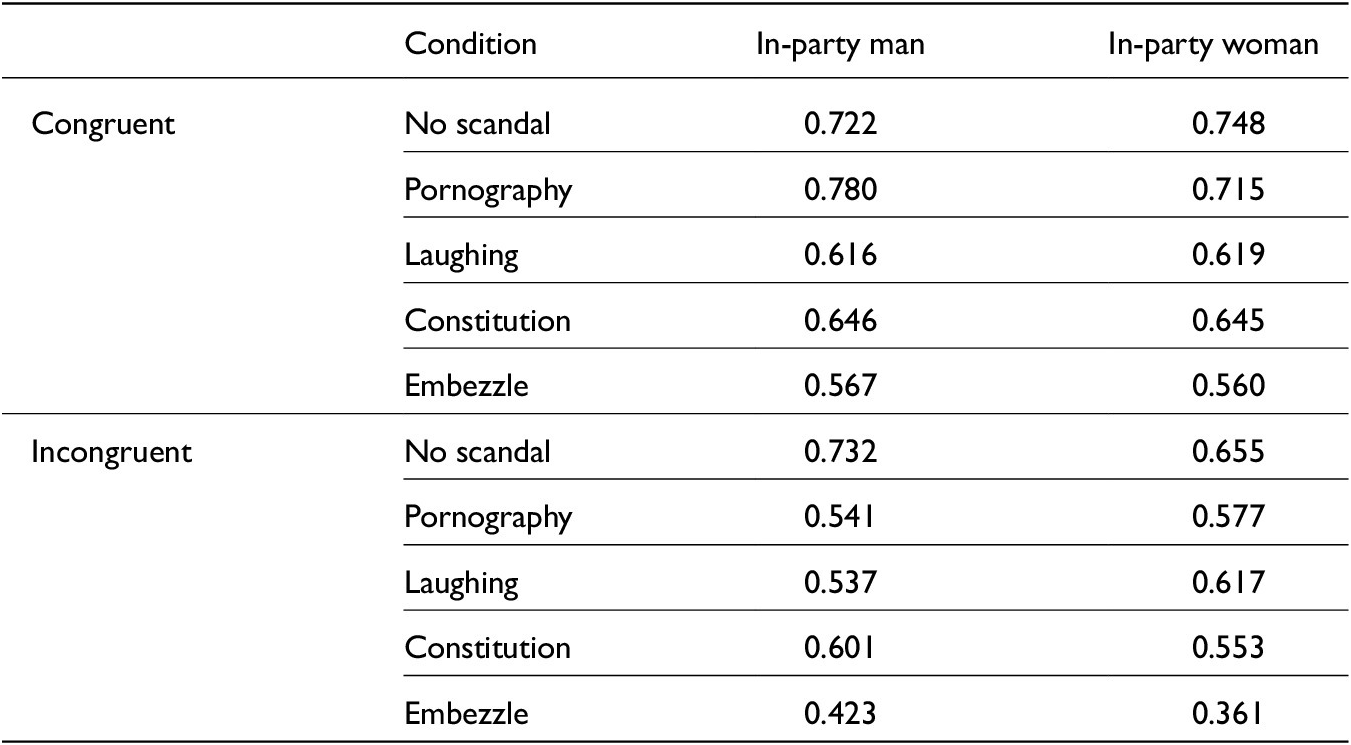
Table 2. Long description
The table is divided into two main sections: Congruent and Incongruent. Each section lists five experimental conditions with probabilities for an In-party man and an In-party woman.
Congruent Section:
* No scandal: Man 0.722, Woman 0.748.
* Pornography: Man 0.780, Woman 0.715.
* Laughing: Man 0.616, Woman 0.619.
* Constitution: Man 0.646, Woman 0.645.
* Embezzle: Man 0.567, Woman 0.560.
Incongruent Section:
* No scandal: Man 0.732, Woman 0.655.
* Pornography: Man 0.541, Woman 0.577.
* Laughing: Man 0.537, Woman 0.617.
* Constitution: Man 0.601, Woman 0.553.
* Embezzle: Man 0.423, Woman 0.361.
There was one scenario, however, where the predicted in-party vote drops below the 0.50 threshold. Only when in-party candidates displayed policy incongruence and embezzled money did predicted probabilities dip below 0.50 (0.42 for the man and 0.36 for the woman), and only the woman candidate also had confidence intervals that did not cross the 0.50 margin. This one condition — a woman candidate who has policy deviations and a major scandal — was the only one in which our subjects were clearly more likely to support the out-party candidate than to support their own party’s candidate. This suggests that women candidates who hold incongruent policy stances and are also involved in a major scandal will be treated the most harshly of all candidate profiles. The man candidate does have a stronger negative effect on his feeling thermometer score, but it is the woman candidate who suffers the greater vote loss, which is ultimately probably the more important metric.
While this is ouronly treatment condition to push people beyond their partisan predispositions, teasing out exactly what about this condition did so is an area for future research. The “embezzle” condition was our most serious scandal and clearly criminal in nature. It was also the only financial scandal, which may have implications about how trustworthy the candidate would be in office when dealing with public finances. Future research should examine what exactly it is about this scandal that, when coupled with issue incongruencies, pushed voters to finally turn against their in-party candidate.
Information Search
From the intent-to-treat analysis above, we know that there are several differences in how men and women candidates were evaluated depending upon their policy congruence and the scandal they exhibited. While we know that the experimental manipulations resulted in these effects, we are less certain about how subjects developed their preferences. One of the key strengths in using the DPTE platform is that the simulation allows us to monitor subject behavior during the campaign, which can provide insight into how they responded to what they saw and read. We can see what information subjects chose to view and then how that information affected their opinions. One possibility is that when subjects saw an in-party man or woman they altered how they chose to learn about those candidates, or their opponents. Perhaps, for example, subjects would want to see a woman candidate’s views on masculine issues, such as defense or terrorism, to bolster their confidence that she was “tough” enough in these areas. We can assess this by simply examining crosstabulations of which items subjects chose to view during the study, based upon the gender of the in-party candidate.
Table 3 shows that there were almost no observed differences in specific information search throughout the entire experiment based upon candidate gender. Only three items produced significant results: In-party Social Philosophy and Out-party Social Philosophy during the first “month” of campaigning and the News Item discussing the scandal manipulation in the final “month.” For both Social Philosophy items, subjects who saw a woman candidate were significantly more likely to view these items compared to when subjects saw a man candidate. These information items revealed how the candidates generally described their ideology in relation to social issues, providing subjects insight into their general policy positions on social matters. It is likely that subjects early in the campaign used this information item to gain further insight into the women candidate’s ideological position. This makes sense, because subjects reacted negatively when women candidates became policy incongruent later in the campaign.
Rate of viewing each information item, by in-party candidate gender
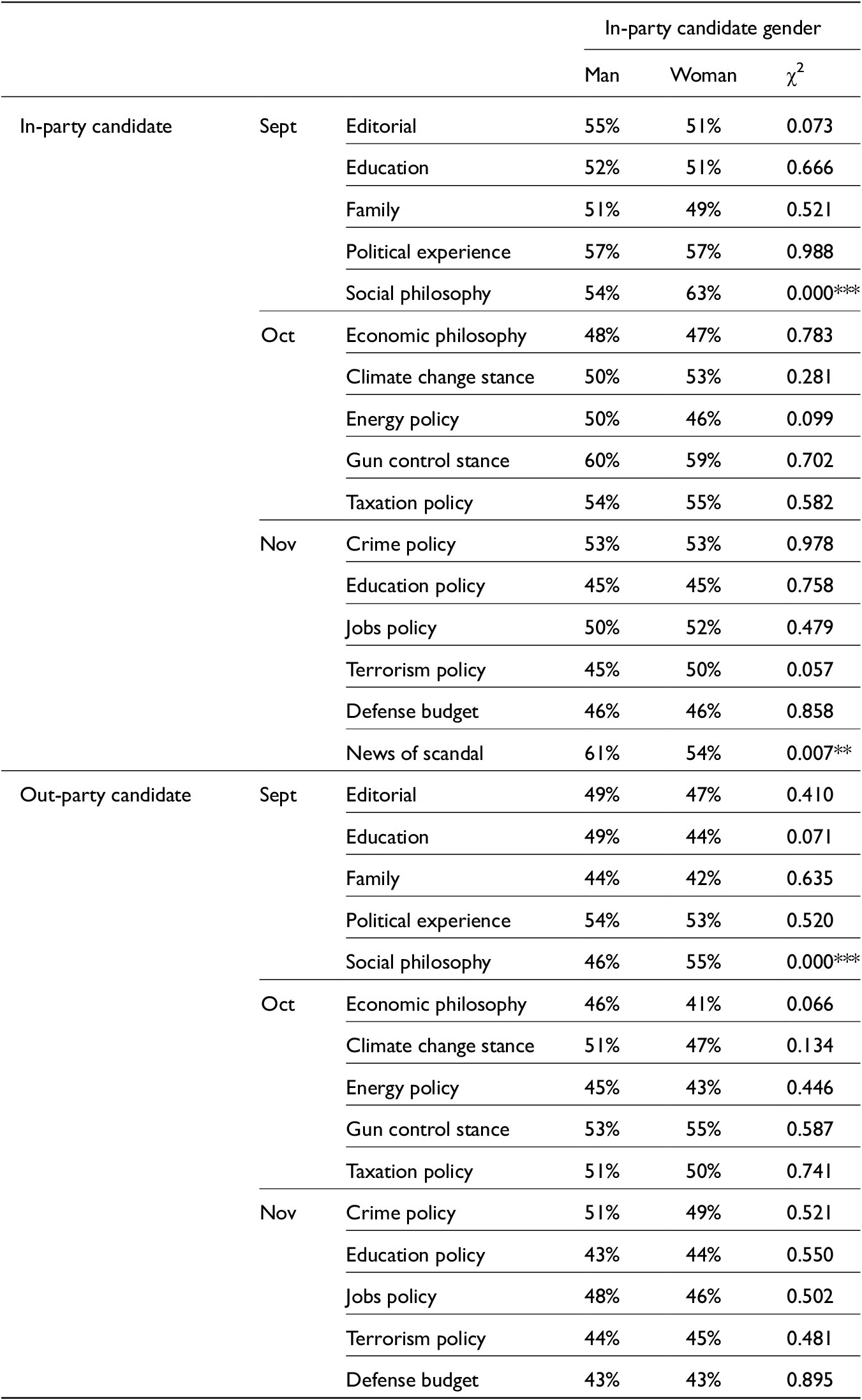
Table 3. Long description
The table compares viewing rates for Man versus Woman candidates across various political and personal topics.
For the In-party candidate section:
- In September, Social philosophy shows a significant difference with 54% for Man and 63% for Woman (chi-squared 0.000). Other items like Editorial, Education, Family, and Political experience range from 49% to 57%.
- In October, items include Economic philosophy, Climate change, Energy policy, Gun control, and Taxation, with rates between 46% and 60%.
- In November, News of scandal shows a significant difference with 61% for Man and 54% for Woman (chi-squared 0.007). Other items like Crime, Education, Jobs, Terrorism, and Defense budget range from 45% to 53%.
For the Out-party candidate section:
- In September, Social philosophy again shows a significant difference with 46% for Man and 55% for Woman (chi-squared 0.000). Other items range from 42% to 54%.
- In October, items range from 41% to 55%.
- In November, items range from 43% to 51%.
The note indicates N = 1,758 and uses asterisks to denote p-value significance levels for the chi-squared chi super 2 values.
Note: N = 1,758.
* p < .05, ** p < .01, *** p < .001.
The other item that produces a significant result is viewing the news item about a scandal. Subjects were much more likely to view this item if it was about an in-party man candidate than an in-party woman candidate. Subjects were attracted to the scandal item overall to a greater degree than other items but were significantly less likely to seek out further information about the nature of the scandal if the candidate was a woman. This runs counter to our expectations, as we anticipated that subjects would be more curious about a woman candidate accused of a scandal and would seek to learn more about the accusation. This is an interesting finding, as within November this is the most frequently opened item for both the man and woman candidate but significantly more so for the man. Our anticipation was that subjects would start out less certain about a woman candidate than a man and would seek out information necessary to confirm that she was in fact an appropriate party candidate. While there is some support for this in the fact that this was the most viewed item for the woman candidate, it seems that it was even more of a draw for the man. This may be an indication that — for men — the expectation is that they will be good representatives of the party ideologically but that the area in which voters are most concerned about them is their potentially scandalous behavior. Women sometimes benefit from the stereotype of being viewed as more moral than men (Fridkin Reference Fridkin1996; Barnes et al. Reference Barnes, Beaulieu and Saxton2018; Barnes and Beaulieu Reference Barnes and Beaulieu2019), and this may be why our subjects decided not to learn more information about the scandal for her.
This is a finding that is worthy of future research, and given the unique design of the DPTE study, we are able to tease some of this out here. If subjects are more suspicious of men committing scandals than women, they may react differently to finding out that their in-party candidate has admitted to the scandal if she is a woman because this defies expectations to a greater degree. As DPTE permits subjects to choose what they wish to learn and allows researchers to monitor what they choose to view, we can assess how choosing to learn this information shifts preferences dependent upon the gender of the candidate.
The Role of Information
Another way to examine the ways candidate gender altered subjects’ reactions to our candidates is to take a closer look at how the information they chose to view altered their preference scores in each month. We know that, on average, our subjects tended to look at the same types of information at about the same rate for both our man and woman in-party candidates and their opponents (except for Social Philosophy and the scandal). But did they react in the same way to the identical information they viewed about our men and women candidates? To assess this, we conduct OLS regressions on the end-of-month preference scores for our in-party candidates, controlling for the prior month’s preference score and the information items they viewed during that campaign month. This allows us to see how subjects changed their preferences between the candidates based upon the information they chose to view during the campaign.
To be clear, this is using a post-treatment variable as an independent variable within a regression — which can be a risky methodological choice (Montgomery, Nyhan, and Torres Reference Montgomery, Nyhan and Torres2018). Here we consider it an acceptable risk, as we have already run the intent-to-treat analysis and demonstrated the effect of these stimuli overall. Now, we are curious about the specific effect that viewing information had upon subject opinions. Even though the information viewed is not randomly assigned — and may be biased by the candidate gender treatment — this analysis seeks to understand whether/how seeing a woman candidate leads subjects to interact with and use information differently. This provides analyses of the treatment effect of information viewed, providing insight into how people rely on the information they choose to view when learning about candidates.
September’s results are shown in Table 4. In September we can see strong differences in how subjects reacted to the information they viewed. This first month presented subjects with generally positive background information about the two candidates, such as their political and work background and family. Viewing any of this information is unlikely to provoke negative feelings toward either candidate, so in general we expect that subjects should increase their preference scores when viewing more in-party candidate information and decrease if it when viewing out-party information (because by finding out positive information about the opponent, preference for the in-party candidate should soften).
Effects of viewing information items on in-party preference in September
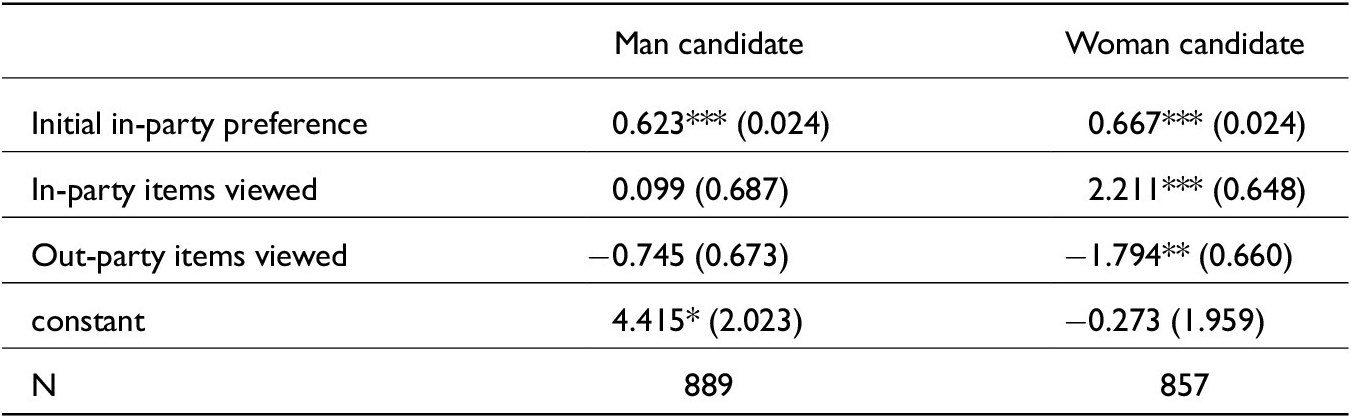
Table 4. Long description
The table presents O L S regression coefficients with standard errors in parentheses. It compares two models: Man candidate and Woman candidate.
* Initial in-party preference: 0.623 with standard error 0.024 for Man candidate; 0.667 with standard error 0.024 for Woman candidate. Both are significant at p < .001.
* In-party items viewed: 0.099 with standard error 0.687 for Man candidate; 2.211 with standard error 0.648 for Woman candidate. The latter is significant at p < .001.
* Out-party items viewed: minus 0.745 with standard error 0.673 for Man candidate; minus 1.794 with standard error 0.660 for Woman candidate. The latter is significant at p < .01.
* Constant: 4.415 with standard error 2.023 for Man candidate (p < .05); minus 0.273 with standard error 1.959 for Woman candidate.
* N (Sample size): 889 for Man candidate; 857 for Woman candidate.
Notes: Table entries are OLS regression coefficients. Standard errors are in parentheses.
* p < .05, ** p < .01, *** p < .001.
Subjects viewing an in-party man based their in-party preference scores largely upon their prior opinions about the political parties. The information they viewed did not significantly influence those preference scores one way or the other. For subjects who viewed an in-party woman however, the information they viewed did significantly alter their preference scores in the manner we expected. We take from these results that subjects largely discount biographical information about men, while taking it into account for women. This is more evidence that subjects are willing to rely exclusively on their partisanship to a greater extent when they see a man candidate, and that for women candidates’ actual information matters more. This confirms our expectation in H3 that substantive information would matter more for women candidates than for men.
In October (Table 5), we take into account that some subjects saw congruent policy information, while others viewed incongruent information. We did not manipulate one of the information items — Economic Philosophy — as we did not believe that having a Republican label themselves “Liberal” or a Democrat calling themselves “Conservative” would be believable or relevant in the current political environment. This information item is thus treated as separate from the other four items which corresponded to the experimental manipulation. Here we would expect to see that subjects viewing congruent information should either increase or hold steady their preference scores as their policy expectations are largely met. Instead, five of the eight coefficients are negative, but none reach statistical significance. In the congruent condition neither the man nor woman candidate experienced any significant changes to their preference scores based upon the information subjects viewed about them.
Effects of viewing information items on in-party preference in October
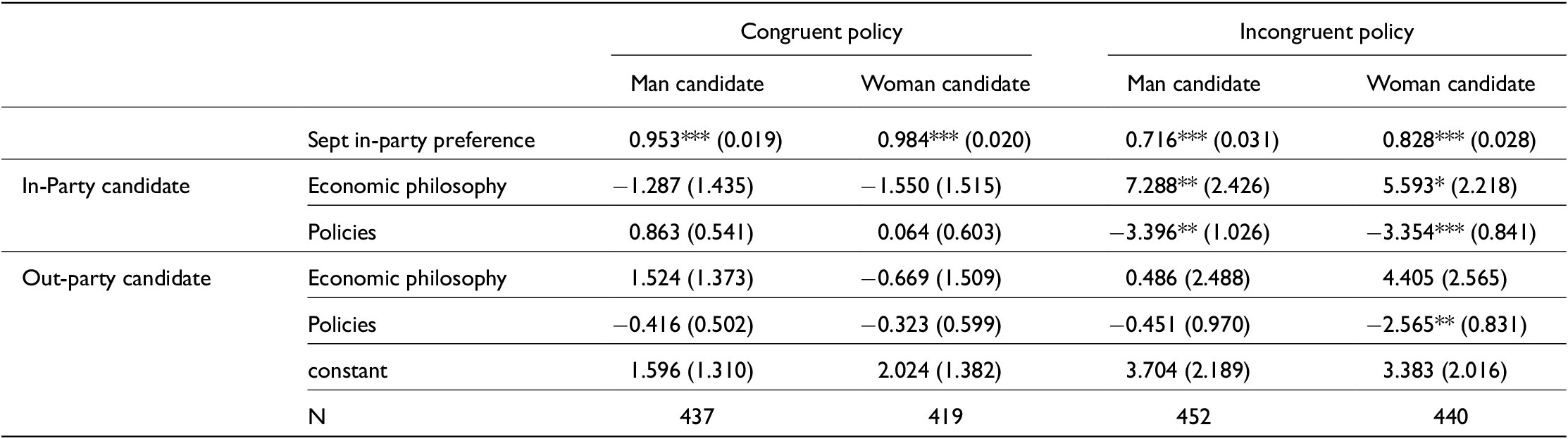
Table 5. Long description
The table is organized into four main columns under two primary headers: Congruent policy and Incongruent policy. Each policy type is further divided into Man candidate and Woman candidate.
Row 1: Sept in-party preference.
- Congruent: Man 0.953, Woman 0.984.
- Incongruent: Man 0.716, Woman 0.828. All are significant at p < .001.
Rows 2-3: In-Party candidate factors.
- Economic philosophy: Congruent Man -1.287, Woman -1.550; Incongruent Man 7.288 (p < .01), Woman 5.593 (p < .05).
- Policies: Congruent Man 0.863, Woman 0.064; Incongruent Man -3.396 (p < .01), Woman -3.354 (p < .001).
Rows 4-7: Out-party candidate factors and model statistics.
- Economic philosophy: Congruent Man 1.524, Woman -0.669; Incongruent Man 0.486, Woman 4.405.
- Policies: Congruent Man -0.416, Woman -0.323; Incongruent Man -0.451, Woman -2.565 (p < .01).
- Constant: Congruent Man 1.596, Woman 2.024; Incongruent Man 3.704, Woman 3.383.
- N (Sample Size): Congruent Man 437, Woman 419; Incongruent Man 452, Woman 440.
Standard errors are provided in parentheses for all coefficients.
Notes: Table entries are OLS regression coefficients. Standard errors are in parentheses.
* p < .05, ** p < .01, *** p < .001.
When those issue positions were incongruent however, they were more influential. We expect that incongruent issue positions should reduce preference scores, as subjects learn that the candidates do not stand for what they would expect partisan candidates to endorse. Since in the incongruent condition the out-party candidate adopted a moderate stance, we would expect that viewing both in-party or out-party items would decrease preference scores, as those candidates become more viable alternatives. For our woman candidate this is exactly what we find. For each policy item subjects viewed for the in-party woman, their preference scores tended to drop by about 3.3 points, while each item they viewed for the out-party candidate decreased their preference score by about 2.5 points. The in-party man had a slightly different result, with in-party policy views dropping his ratings by about 3.4 points, but out-party policy views produced no significant effects. Again, we find here that subjects took more of the information they viewed into account for the woman candidate than the man. As in September, when the information that subjects viewed was influential for the woman candidate only, here we find that both in-party and out-party stances influence women’s preference scores, while for men it is only their own in-party stances. This suggests that subjects may have been more open to learning about the out-party candidate in this condition and is more support for H3.
Finally, we can examine how information affected the final preference ratings based upon what subjects viewed in the last month of the campaign (November; Table 6). This month presented the scandals, which we take into account individually, as the News Item subjects viewed was different in each of these conditions. Opening the “News Item” scandal information box provided information about the exact nature of the scandal and the candidate’s admission that they were involved. Subjects did not have to expose themselves to this information, however, so could avoid the scandal information even if it was available. Here we test the effect of viewing the information item versus not viewing it as our measure of the treatment effect of each scandal. The other information items were all congruent with partisan expectations, so should again be expected to produce either weak positive or neutral affects. This is largely what we find.
Effects of viewing information items on in-party preference in November
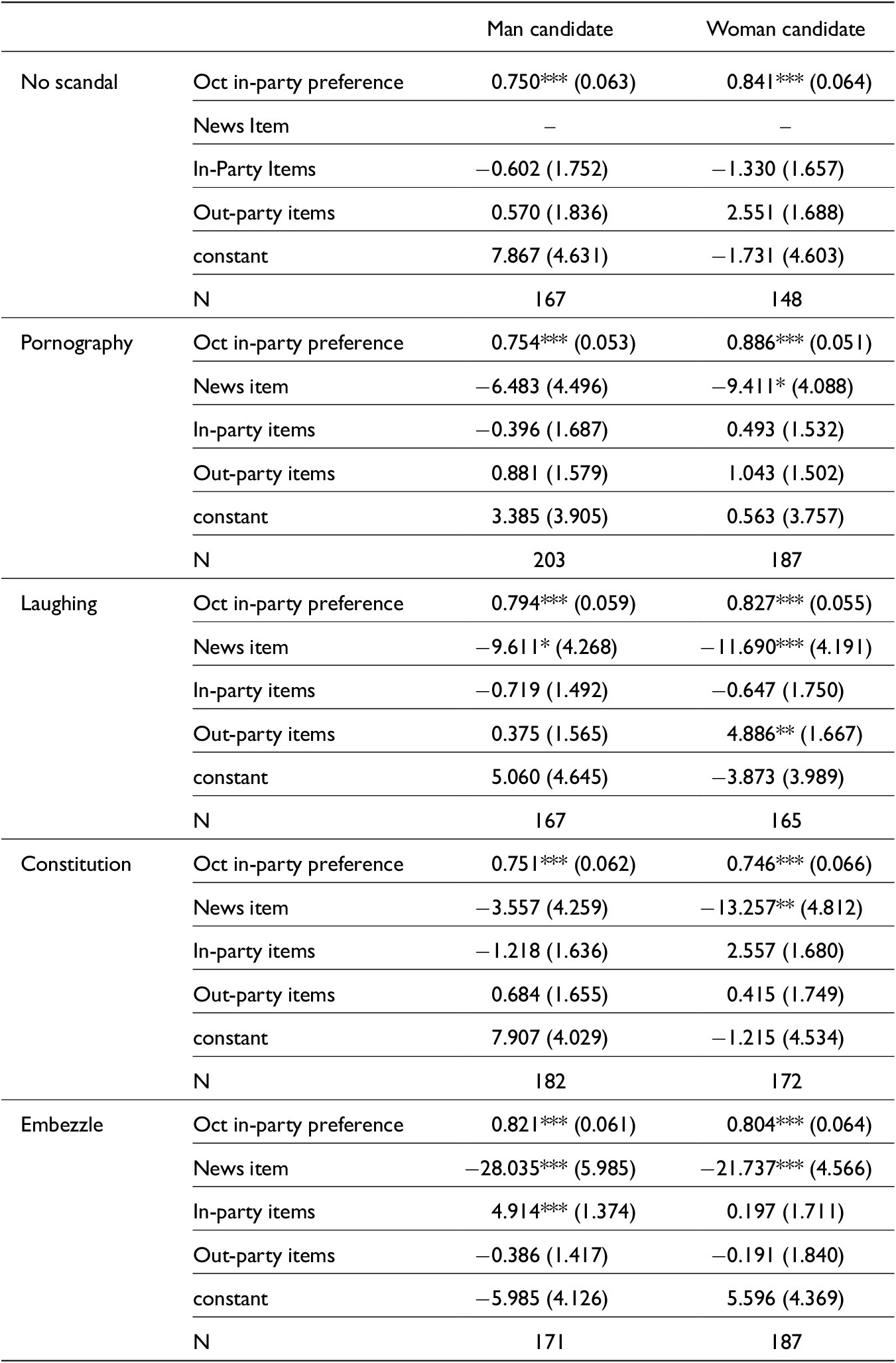
Table 6. Long description
The table is organized into five main rows representing scandal types, each containing sub-rows for variables: October in-party preference, News Item, In-Party Items, Out-party items, constant, and N (sample size). Data is split into two columns: Man candidate and Woman candidate.
1. No scandal: October preference is 0.750 for men and 0.841 for women. N equals 167 for men and 148 for women.
2. Pornography: News item effect is minus 6.483 for men and minus 9.411 for women. N equals 203 for men and 187 for women.
3. Laughing: News item effect is minus 9.611 for men and minus 11.690 for women. Out-party items for women show a significant positive effect of 4.886. N equals 167 for men and 165 for women.
4. Constitution: News item effect is minus 3.557 for men and minus 13.257 for women. N equals 182 for men and 172 for women.
5. Embezzle: News item shows the strongest negative effects at minus 28.035 for men and minus 21.737 for women. In-party items for men show a significant positive effect of 4.914. N equals 171 for men and 187 for women.
Standard errors are provided in parentheses next to each coefficient. Asterisks indicate statistical significance levels.
In the control condition both the man and woman candidate experience no significant change for item views, indicating that the policy information subjects viewed did not significantly alter their preference scores. This is what we would expect. Interestingly, the scandal news item produces significant and stronger negative coefficients for the woman candidate in three of the scandal scenarios, Pornography, Laugh, and Constitution. This is the case despite the fact that in the intent-to-treat analysis, no significant results were detected in the Pornography or Laughing condition. This must be caused by fewer subjects choosing to open the scandal item for the woman. Those subjects who did choose to view the item exhibited larger treatment effects when their in-party candidate was a woman than for those who viewed the man’s scandal. This may be evidence that the scandal was more surprising when involving a woman, and thus a greater deviation from their prior expectations.
In two of the scandal conditions, tearing up the Constitution and viewing pornography, the news item significantly damages the woman candidate but not the man, and the magnitude of the negative coefficient is greater for the woman candidate, which is yet more support for H1, that scandals will harm women more than men. Viewing other information is not significantly influential upon preference scores.
In the “Laugh” scandal condition, both candidates are hurt by the scandal item, but only the woman candidate is helped when subjects view out-party information, suggesting that, once again, subjects are paying more attention to the other information available in the experiment when their candidate is a woman. In the initial intent-to-treat analysis we found that the woman candidate was not significantly hurt in this condition. These results suggest that the lesser damage for the woman candidate is conditional upon subjects viewing more information about the woman that allowed them to increase their evaluations in compensation.
Finally, in the “embezzle” condition the news item explaining the scandal produced large significant negative effects on both the man and woman, as expected. While the coefficient for the man is greater than that for the woman (−28 vs. −22), for the man candidate viewing in-party items also significantly increased his preference rating, while similar effects do not occur for the in-party woman. This is the one instance in which the male candidate seems to be more affected by other available information than the woman candidate, who seemingly was damaged irreparably by the presence of this most serious scandal. The man candidate was able to somewhat improve his standing if he could still demonstrate — through his policy positions — that he was an acceptably in-line with the party’s policy positions.
Discussion and Conclusion
These results are generally in line with our expectations, but with a couple of interesting twists. First, we found that scandals alone were rarely sufficient to alter candidate evaluation or vote intention. On its own, only the most severe scandal produced any significant effects in either candidate preference or vote intention. Partisans clearly stuck by their candidate — regardless of gender — if that candidate aligned with their policy preferences. This matches well with existing literature that shows that party loyalty is strongly tied to policy congruence (i.e., Fowler Reference Fowler2020). This is also likely an overstatement of the effect of these scandals, as our candidates readily and unremorsefully admitted to them. In the real-world candidates typically attempt to deny, explain, or shift blame for scandals, which likely allows copartisans to discount the accusations more than we observe here.
When no scandal was present but the candidates did present policy deviations, only the woman candidate was punished. This was evident in the large reduction in preference scores for the woman candidate and large (though not significant) decreases in the likelihood that partisans would vote for her. These penalties are not apparent for similarly deviant men. This suggests that women are provided less latitude for policy deviation and that women who do deviate are treated similarly to candidates who have major scandals but are policy congruent.
While scandals and policy incongruence on their own generally were not enough to harm either men or women candidates at the “ballot box,” we consistently found that coupling policy deviation and scandal produced significant effects, and gender played an important role. Our man candidate was affected when caught viewing pornography, laughing at a person experiencing homelessness and embezzling, but not when tearing up a copy of the Constitution. In contrast, our woman candidate suffered when caught viewing pornography, tearing up the Constitution, or embezzling, but not for laughing at a person who is homeless only if subjects also viewed compensatory information about her.
This supports findings by Okimoto and Brescoll (Reference Okimoto and Brescoll2010) and others which suggests that women candidates may be given the benefit of the doubt when it comes to evidence that they lack feminine traits, but a scandal in which they try to exhibit masculine behavior in a negative way is seen as unacceptable. Our candidates were least hurt when violating prescriptive stereotypes about care and compassion and most negatively affected when violating proscriptions against challenging authority. This suggests that, when considering different types of gender-based stereotypes, proscriptive stereotypes (and their violations) may be more influential in how voters evaluate candidates.
Further, our examination of subjects’ information search showed that subjects gave more weight to information about women candidates than men. While they didn’t necessarily seek out different information about women candidates, the information accessed was more consistently influential in determining voter attitudes toward them. This suggests that subjects may be happier to rely on heuristics and other non-substantive considerations when evaluating men candidates. They simply trust men to be typical candidates. But voters are less certain about women candidates, even when they appear in their own party, and the available information about women candidates is especially important for the outcome of their elections.
Overall, our research here agrees with prior studies finding that women candidates can be, and often are, just as successful as men when campaigning for election. However, this does not mean that the route to election is the same for them. Through this study we have simulated what happens when men and women candidates deviate from expected partisan positions and from expected ethical norms. We find that neither is immune to negative effects and that men and women may be more susceptible to different kinds of negative information. However, voters begin campaigns with greater uncertainty about women candidates than they do with men, leading them to use the available information to a greater extent when forming opinions of them. Men, who still are by far the majority of office holders in the United States, seem to benefit from a default assumption that they will turn out as expected, based upon predispositions. We have demonstrated here that if women candidates adhere to expectations, they are able to achieve similar results to men. When women deviate however, there can be significant consequences.
What does this mean for women candidates? As others have pointed out previously, women candidates can expect to need an active campaign amid an electorate that starts out uncertain that women candidates are necessarily good party representatives. Voters are open to learning this but need to see this confirmed before they are convinced. Women candidates must work harder to provide the necessary information to voters so that even copartisans can be assured that she aligns well with the party’s platform. Without reinforcing information, voters remain somewhat skeptical and unsure of women candidates, and even partisan voters are willing to examine their other options. Women office seekers and their campaign staff should recognize that, while this is not insurmountable, it is a hill they have to climb.
Since this is experimental research, we also must question the external validity of our findings. Our use of DPTE helps to create a more realistic information environment for our voters but still falls far short of creating the intense, active experience of a real political campaign. Our subjects both had less information about the candidates that could have primed partisan predispositions and received less campaign pressure to support one candidate over another. On average, our subjects learned just 15 pieces of information about the two candidates: eight for the in-party candidate and seven for the out-party. All of this was designed to be informative but not persuasive. In an actual campaign the two candidates would define themselves and their stances better but also attack each other more. It is likely that the strength of influence for each piece of information is tied to how the two campaigns emphasize and frame them. These results are tied to this information environment but in different contexts may vary, as is the case with all experimental research. While this study is more realistic than, for example, a vignette-style survey experiment, it still lacks the full dynamism of a real campaign. Also, it is important to remember that we forced all of our subjects into an in-party, even when they declared being pure Independents. While methodologically necessary, this artificially depresses the average in-party preference of our subject pool. Many of the defecting voters we observe were in fact weakly-aligned Independents. While this has clear analogies in the real world and persuadable voters, it perhaps overstates what it takes to shift partisan preferences.
Another limitation of this research is that our “scandals” were both fictitious and minimal. Scandals typically draw massive media attention and become a focus of the opposing campaign. We merely alerted our subjects that “something” had happened and then allowed them to learn what the scandal was. Our candidate even admitted to the scandal, in order to defuse any confounds with subjects not trusting the media or interpreting an in-party candidate’s denials. We intentionally chose scandals that did not clearly align with actual scandals so as not to bring in outside interpretations or assumptions about who or what we were studying. None of this is particularly realistic but was done to maintain conceptual and methodological precision. Future work should alter the details of the scandals, testing how the public reacts to candidate denials, explanations, refutations, and excuses. There are almost certainly gendered and partisan implications in a candidate’s ability to be accused of a scandal and then defuse responsibility but that is well beyond the scope of this research.
Similarly, we selected only a small number of core partisan issues for our candidates to deviate from, forcing them to adopt the other party’s position. Another interesting test would be to take nonpartisan issues, or non-core issues, and test whether candidates have more latitude to deviate when partisan attitudes are not hardened. Another area which we did not manipulate was the gendered nature of our issue deviations. We demonstrate that our scandals were clearly gendered in their impact but focused our issue areas on being central partisan issues. An interesting area for future research would be to assess whether women and men are “allowed” to deviate from their party on different issues. It is possible that women may be permitted to deviate on education and health care while men are granted more latitude on defense and the economy.
Another key difference in our approach here is that we always present the out-party candidate as a moderate white man. We chose this because it is the most realistic choice, we believe, but also because it is the most likely to produce results. Prior research has demonstrated that voters are less likely to consider women out-party candidates as viable alternatives (Andersen and Ditonto Reference Andersen and Ditonto2020) and rational choice theory suggests that ideologically extreme opponents should similarly be less likely to attract votes from the opposite party (Downs Reference Downs1956). Partisans who can portray their opponents as more extreme or deviant in expectations in some way — be it by gender, race, lifestyle, or ideology — may thus better insulate themselves against partisan defections.
One implication of this research is that partisans, and likely all voters, do hold expectations of what an acceptable candidate looks like — physically, ideologically, and morally. This likely extends into other areas that we have not considered here such as dress, demeanor, and issue prioritization. While we use gender as our key manipulation, these results are likely to also have implications for other major demographic factors, such as race, ethnicity, religion, and age, all of which are ripe for further study.
Supplementary material
The supplementary material for this article can be found at https://doi.org/10.1017/S1743923X25100159.
Acknowledgments
We would like to acknowledge the excellent commentary and feedback we have received from Nichole Bauer, Rachel Bernhard, Rosalyn Cooperman, Kathy Dolan, Maggie Martin, Jenn Merolla, Heather Ondercin, Katelyn Stauffer, Erin Tolley, and Asha Venugopalan. Additionally, we would like to thank our anonymous reviewers for providing superb comments and guidance in revising this article.
Competing interests
The authors declare none.


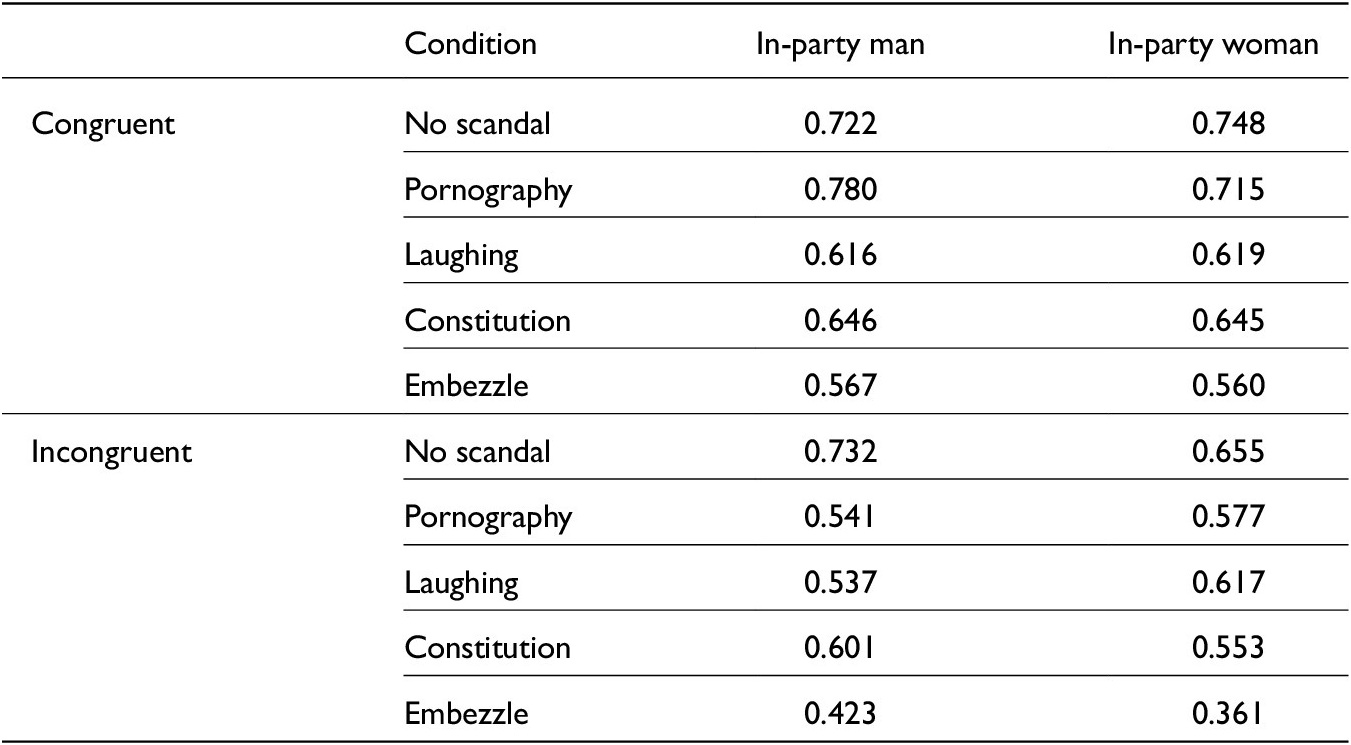
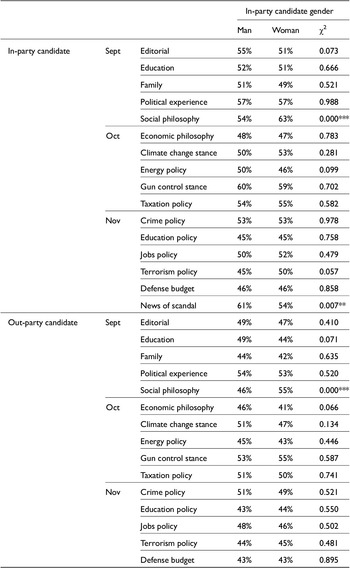
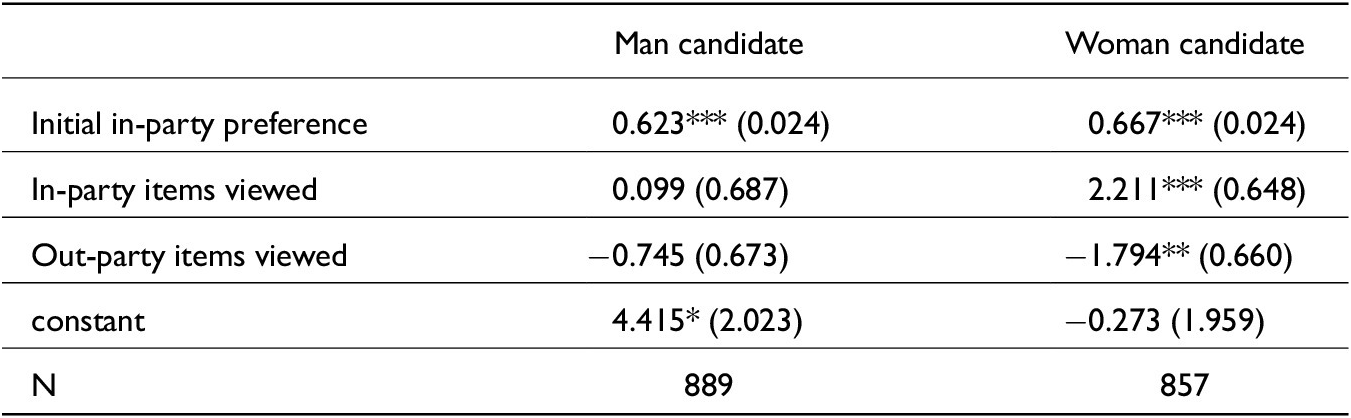
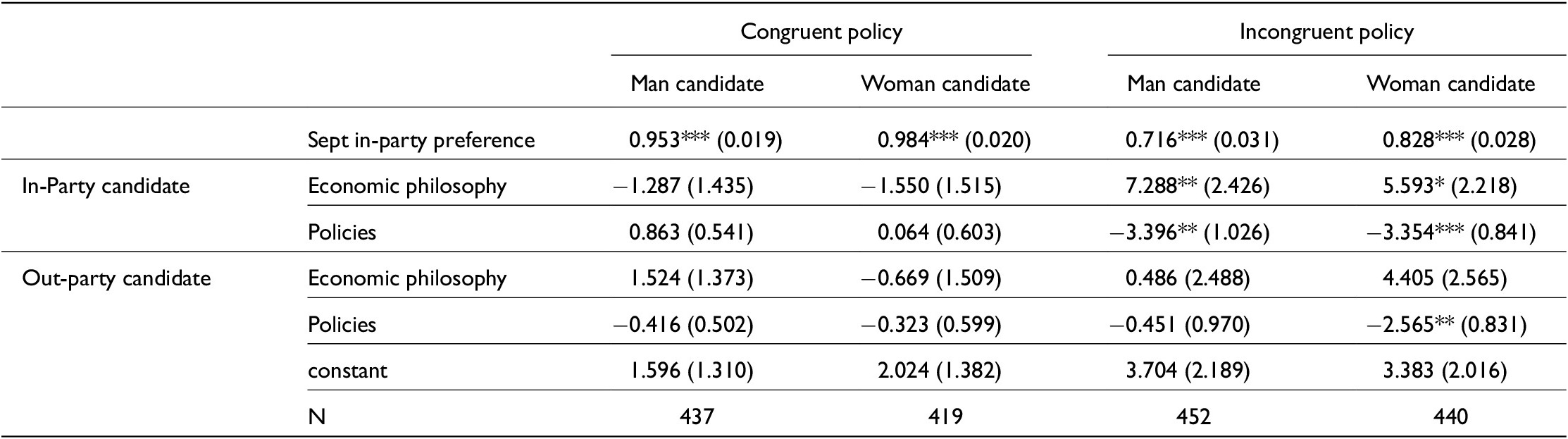
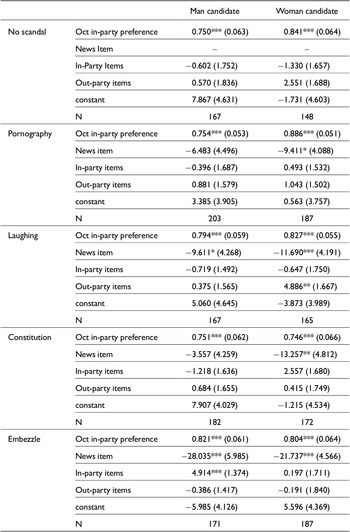


 Open access

