

Hostname: page-component-6766d58669-76mfw Total loading time: 0 Render date: 2026-05-20T01:41:16.531Z Has data issue: false hasContentIssue false

Hydrodynamics and scaling laws for intermittent S-start swimming

Published online by Cambridge University Press:  26 March 2024

Dewu Yang
Affiliation:
Key Laboratory of Unsteady Aerodynamics and Flow Control, Ministry of Industry and Information Technology, Department of Aerodynamics, Nanjing University of Aeronautics and Astronautics, Nanjing 210016, PR China School of Aeronautics and Astronautics, Shanghai Jiao Tong University, Shanghai 200240, PR China
Jie Wu*
Affiliation:
Key Laboratory of Unsteady Aerodynamics and Flow Control, Ministry of Industry and Information Technology, Department of Aerodynamics, Nanjing University of Aeronautics and Astronautics, Nanjing 210016, PR China
Kaustubh Khedkar
Affiliation:
Department of Mechanical Engineering, San Diego State University, San Diego, CA 92182, USA
Li-Ming Chao*
Affiliation:
School of Mechanical Engineering and Automation, Harbin Institute of Technology (Shenzhen), Shenzhen 518055, PR China
Amneet Pal Singh Bhalla*
Affiliation:
Department of Mechanical Engineering, San Diego State University, San Diego, CA 92182, USA
*
Email addresses for correspondence: wuj@nuaa.edu.cn, chaoliming92@gmail.com, asbhalla@sdsu.edu

Abstract

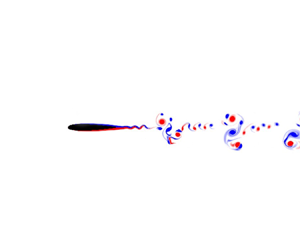
The hydrodynamics of a self-propelling swimmer undergoing intermittent S-start swimming are investigated extensively with varying duty cycle $DC$, swimming period $T$, and tailbeat amplitude $A$. We find that the steady time-averaged swimming speed $\bar {U}_x$ increases directly with $A$, but varies inversely with $DC$ and $T$, where there is a maximal improvement of $541.29\,\%$ over continuous cruising swimming. Our results reveal two scaling laws, in the form of input versus output relations, that relate the swimmer's kinematics to its hydrodynamic performance: swimming speed and efficiency. A smaller $DC$ causes increased fluctuations in the swimmer's velocity generation. A larger $A$, on the other hand, allows the swimmer to reach steady swimming more quickly. Although we set out to determine scaling laws for intermittent S-start swimming, these scaling laws extend naturally to burst-and-coast and continuous modes of swimming. Additionally, we have identified, categorized and linked the wake structures produced by intermittent S-start swimmers with their velocity generation.

Information

Type
JFM Papers
Copyright
© The Author(s), 2024. Published by Cambridge University Press

Access options

Get access to the full version of this content by using one of the access options below. (Log in options will check for institutional or personal access. Content may require purchase if you do not have access.)

Article purchase

Temporarily unavailable

Supplementary material: File

Yang et al. supplementary movie

Comparison between the swimming behavior of zebrafish larvae using the S-start swimming and continuous swimming pattern.
Download Yang et al. supplementary movie(File)
File 8.2 MB