





1. Introduction
Magnetized electron–positron (EP) plasmas widely exist in many high-energy astrophysical environments, such as accretion disks (Filho Reference Filho2009), pulsar magnetospheres (Sturrock Reference Sturrock1971; Luo & Ji Reference Luo and Ji2012), black holes (Putten & Maurice Reference Putten and Maurice1999; Laurent & Titarchuk Reference Laurent and Titarchuk2018) and so on. In the pulsar magnetosphere, pair plasma is generated through a cascade process of EP pair production, and becomes highly magnetized due to the super-strong magnetic field of the pulsar. Additionally, EP plasmas form near black hole horizons during gamma-ray flares emitted by stellar-mass black holes. Therefore, these environments serve as natural laboratories for studying interactions between electromagnetic waves and magnetized EP plasmas.
In recent years, with the rapid development of laser technology, both experimental and theoretical studies have pointed out that an EP plasma can also be generated under laboratory conditions (Sarri et al. Reference Sarri, Dieckmann, Kourakis, Piazza and Zepf2015). In 1997, Burke et al. (Reference Burke1997) reported the first laboratory production of positrons by colliding a 46.6 GeV electron beam with a terawatt laser pulse at 527 nm wavelength. Ridgers et al. (Reference Ridgers, Brady, Duclous, Kirk, Bennett, Arber, Robinson and Bell2012) numerically simulated the pair-production process in which a laser with an intensity of $4\times 10^{23} \textrm{W}\, \textrm{cm}^{-2}$
strikes an aluminum target, producing an EP plasma with the maximum density of
$4\times 10^{23} \textrm{W}\, \textrm{cm}^{-2}$
strikes an aluminum target, producing an EP plasma with the maximum density of $10^{26}\,\textrm{cm}^{-3}$
. Used the ASTRA-GEMINI laser system (the peak intensity of the laser is
$10^{26}\,\textrm{cm}^{-3}$
. Used the ASTRA-GEMINI laser system (the peak intensity of the laser is $3\times 10^{19} \textrm{W}\, \textrm{cm}^{-2}$
), Sarri et al. (Reference Sarri2015) achieved an EP plasma density of
$3\times 10^{19} \textrm{W}\, \textrm{cm}^{-2}$
), Sarri et al. (Reference Sarri2015) achieved an EP plasma density of $10^{16}\,\textrm{cm}^{-3}$
. Li et al. (Reference Li2017) proposed an all-optical scheme for ultra-bright gamma-ray emission and dense positron production with lasers at an intensity of
$10^{16}\,\textrm{cm}^{-3}$
. Li et al. (Reference Li2017) proposed an all-optical scheme for ultra-bright gamma-ray emission and dense positron production with lasers at an intensity of $10^{22-23}\textrm{W}\, \textrm{cm}^{-2}$
, in which a positron beam with a density of
$10^{22-23}\textrm{W}\, \textrm{cm}^{-2}$
, in which a positron beam with a density of $2.5\times 10^{22}\, \textrm{cm}^{-3}$
was achieved. Gong et al. (Reference Gong, Li, Xie and Li2020) investigated the momentum spectrum and number density of created EP pairs in frequency-modulated laser fields. These studies provide a window for investigating laboratory astrophysics at laser facilities.
$2.5\times 10^{22}\, \textrm{cm}^{-3}$
was achieved. Gong et al. (Reference Gong, Li, Xie and Li2020) investigated the momentum spectrum and number density of created EP pairs in frequency-modulated laser fields. These studies provide a window for investigating laboratory astrophysics at laser facilities.
If there exists a magnetic field, we will achieve a magnetized EP plasma in the laboratory. The magnetic source may be an external magnetic field, such as in magnetic confinement fusion experiments where a strong magnetic field is applied to the plasma, or may be a self-generated magnetic field arising from laser–plasma interactions (Lehner Reference Lehner2000; Najmudin et al. Reference Najmudin, Tatarakis, Pukhov, Clark, Clarke, Dangor, Faure, Malka, Neely and Santala2001; Tatarakis et al. Reference Tatarakis, Gopal, Watts, Beg, Dangor, Krushelnick, Wagner, Norreys, Clark and Zepf2002; Abudurexiti, Okada & Ishikawa Reference Abudurexiti, Okada and Ishikawa2009). Self-generated magnetic fields can also be generated by a laser-induced plasma in the process of inertial confinement fusion implosion (Srinivasan, Dimonte & Tang Reference Srinivasan, Dimonte and Tang2012; Walsh et al. Reference Walsh, Chittenden, Mcglinchey and Niasse2017; Sadler et al. Reference Sadler, Walsh, Zhou and Li2022).
In the previously mentioned high-energy astrophysical environments and intense laser–plasma systems, plasmas typically possess well-defined temperatures. For example, the order of magnitude of the plasma temperature in the pulsar magnetosphere is reported to be $10^6\,\textrm{K}$
(Helfand, Chanan & Novick Reference Helfand, Chanan and Novick1980; Timokhin & Harding Reference Timokhin and Harding2019). This kind of plasma is referred to as a cold or warm plasma, in which the thermal energy of a particle is much smaller than its rest energy, that is
$10^6\,\textrm{K}$
(Helfand, Chanan & Novick Reference Helfand, Chanan and Novick1980; Timokhin & Harding Reference Timokhin and Harding2019). This kind of plasma is referred to as a cold or warm plasma, in which the thermal energy of a particle is much smaller than its rest energy, that is $k_{\textrm{B}}T_{j}\ll m_{\!j}c^2$
, with
$k_{\textrm{B}}T_{j}\ll m_{\!j}c^2$
, with $k_{\textrm{B}}$
being the Boltzmann constant, the subindex
$k_{\textrm{B}}$
being the Boltzmann constant, the subindex $j$
denoting the species of the particles in the plasma,
$j$
denoting the species of the particles in the plasma, $T_{j}$
being the temperature of the
$T_{j}$
being the temperature of the $j$
type of particle,
$j$
type of particle, $m_{\!j}$
being the rest mass of the
$m_{\!j}$
being the rest mass of the $j$
type of particle,
$j$
type of particle, $c$
being the speed of light in vacuum. An electron temperature in the laser channel was found to be several MeV, which is given by the two-dimensional particle-in-cell (PIC) simulations of the laser channeling in millimeter-scale underdense plasmas for fast ignition (Li et al. Reference Li, Yan, Ren, Wang, Tonge and Mori2008). A peak plasma temperature as high as 40 MeV was achieved in laser-driven ion acceleration processes, studied via PIC simulations (Weng et al. Reference Weng, Liu, Sheng, Murakami, Chen, Yu and Zhang2016). Such plasmas are termed relativistic hot plasmas due to the condition
$c$
being the speed of light in vacuum. An electron temperature in the laser channel was found to be several MeV, which is given by the two-dimensional particle-in-cell (PIC) simulations of the laser channeling in millimeter-scale underdense plasmas for fast ignition (Li et al. Reference Li, Yan, Ren, Wang, Tonge and Mori2008). A peak plasma temperature as high as 40 MeV was achieved in laser-driven ion acceleration processes, studied via PIC simulations (Weng et al. Reference Weng, Liu, Sheng, Murakami, Chen, Yu and Zhang2016). Such plasmas are termed relativistic hot plasmas due to the condition $k_{\textrm{B}}T_{j}\gg m_{\!j}c^2$
.
$k_{\textrm{B}}T_{j}\gg m_{\!j}c^2$
.
In this paper, we focus on the modulational instability (MI) of intense electromagnetic waves in a magnetized EP plasma, which is one of the fundamental phenomena in the nonlinear interaction between electromagnetic waves and plasmas (Shukla, Marklund & Eliasson Reference Shukla, Marklund and Eliasson2004; Sprangle, Hafizi & Peñano Reference Sprangle, Hafizi and Peñano2020). Nonlinear development of the MI plays a key role in many nonlinear processes, such as envelope solitons, envelope shocks, freak waves and self-focusing of electromagnetic waves (Jha et al. Reference Jha, Mishra, Upadhyaya and Raj2006; Lehmann, Laedke & Spatschek Reference Lehmann, Laedke and Spatschek2008; Abedi-Varaki & Jafari Reference Abedi-Varaki and Jafari2017; Roozehdar Mogaddam et al. Reference Roozehdar Mogaddam, Sepehri Javan, Javidan and Mohammadzadeh2018; Das, Chandra & Ghosh Reference Das, Chandra and Ghosh2020; Cheng et al. Reference Cheng, Deng, Yu and Wu2023). Spurred by the significance of MI in electromagnetic waves, researchers have extensively studied this phenomenon under different kinds of physical conditions over the past few decades (Shukla & Bharuthram Reference Shukla and Bharuthram1987; Chen, Liu & Li, Reference Chen, Liu and Li2011; Sprangle, Esarey & Hafizi Reference Sprangle, Esarey and Hafizi1997; Rozina et al. Reference Rozina, Tsintsade, Maryam and Komal2016; Luo & Wang Reference Luo and Wang2020). Some studies have specifically addressed MI in magnetized plasmas. For instance, the MI of laser pulses in transversely magnetized underdense plasmas is investigated by Jha et al. (Reference Jha, Kumar, Raj and Upadhyaya2005), analyzing magnetic field effects. The MI of the right-hand elliptically polarized laser pulses in cold magnetized EP plasmas is explored by Chen et al. (Reference Chen, Liu and Li2011). While the MI of circularly polarized electromagnetic waves and the formation of the solitary waves in hot magnetized EP plasmas are studied by Asenjo et al. (Reference Asenjo, Borotto, Chian, Muñoz, Alejandro Valdivia and Rempel2012). The MI of intense lasers in hot magnetized EP plasmas in the quasi-neutral limit is examined by Sepehri Javan (Reference Sepehri Javan2012), discussing the dependences of the MI on the plasma temperature and external magnetic fields. Sobacchi et al. (Reference Sobacchi, Lyubarsky, Beloborodov and Sironi2021) investigated self-modulation of fast radio bursts in pulsars, analyzing instabilities developing for arbitrary directions of the perturbation wave vector. However, these researchers primarily focus on the propagation of electromagnetic waves with normalized amplitude $a_0\lt 1$
(corresponding to laser intensities
$a_0\lt 1$
(corresponding to laser intensities $I\lt 10^{18}\textrm{W}/\textrm{cm}^2$
) in low-temperature plasmas where
$I\lt 10^{18}\textrm{W}/\textrm{cm}^2$
) in low-temperature plasmas where $k_{\textrm{B}}T_{j}\lt m_{\!j}c^2$
. To date, the MI of electromagnetic waves with arbitrary intensity in relativistic hot plasmas is rarely discussed. This paper addresses this gap by studying MI across intensities ranging from weakly relativistic (
$k_{\textrm{B}}T_{j}\lt m_{\!j}c^2$
. To date, the MI of electromagnetic waves with arbitrary intensity in relativistic hot plasmas is rarely discussed. This paper addresses this gap by studying MI across intensities ranging from weakly relativistic ( $a_0\ll 1$
) to ultra-relativistic (
$a_0\ll 1$
) to ultra-relativistic ( $a_0\gg 1$
) regimes in magnetized EP plasmas. For this purpose, we employ a fully relativistic fluid model (Asenjo et al. Reference Asenjo, Muñoz, Alejandro Valdivia and Hada2009), incorporating a temperature-dependent function to characterize plasma thermal effects.
$a_0\gg 1$
) regimes in magnetized EP plasmas. For this purpose, we employ a fully relativistic fluid model (Asenjo et al. Reference Asenjo, Muñoz, Alejandro Valdivia and Hada2009), incorporating a temperature-dependent function to characterize plasma thermal effects.
The paper is structured as follows. In § 2, a nonlinear wave equation is obtained under the weak magnetization approximation, which characterizes the amplitude evolution of electromagnetic waves in magnetized EP plasmas. In § 3, the growth rate of MI is derived. In § 4, through numerical analysis in both low-temperature and high-temperature regimes, we examined the dependence of the MI growth rate on some key physical parameters. Furthermore MI characteristics of $\gamma$
-rays emitted by a pulsar are investigated. Finally, the principal findings are summarized in § 5.
$\gamma$
-rays emitted by a pulsar are investigated. Finally, the principal findings are summarized in § 5.
2. Nonlinear wave equations
In the following, the propagation of an electromagnetic wave in a magnetized EP plasma is investigated. The plasma system maintains local equilibrium with charge neutrality, expressed as $n_{e0}=n_{\!p0}$
, where
$n_{e0}=n_{\!p0}$
, where $n_{e0}$
and
$n_{e0}$
and $n_{\!p0}$
are unperturbed densities of electrons and positrons in the laboratory frame. A circularly polarized electromagnetic wave is considered to propagate along the external magnetic field
$n_{\!p0}$
are unperturbed densities of electrons and positrons in the laboratory frame. A circularly polarized electromagnetic wave is considered to propagate along the external magnetic field ${\boldsymbol{B}}_0=B_0\hat {{\boldsymbol{e}}}_{z}$
. The corresponding vector potential
${\boldsymbol{B}}_0=B_0\hat {{\boldsymbol{e}}}_{z}$
. The corresponding vector potential $\boldsymbol{A}$
of the laser can be expressed as
$\boldsymbol{A}$
of the laser can be expressed as
 \begin{equation} {\boldsymbol{A}}=\tfrac{1}{2}A(z,t)(\hat {{\boldsymbol{e}}}_{\!x}+{i}\sigma \hat {{\boldsymbol{e}}}_{\!y})\exp [{i}(k_0z-\omega _0 t)]+c.c., \end{equation}
where $\omega _0$
is the frequency of the wave,
$\omega _0$
is the frequency of the wave, $k_0$
is the wavenumber,
$k_0$
is the wavenumber, $\sigma = +1$
(−1) denotes the right-hand (left-hand) circularly polarized wave and
$\sigma = +1$
(−1) denotes the right-hand (left-hand) circularly polarized wave and $A(z,t)$
is the slowly varying amplitude satisfying the condition
$A(z,t)$
is the slowly varying amplitude satisfying the condition
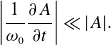 \begin{equation} \left |\frac {1}{\omega _0}\frac {\partial A}{\partial t}\right |\ll |A|. \end{equation}
From the Maxwell equations and using
 \begin{equation} {\boldsymbol{E}}=-\frac {1}{c}\frac {\partial {\boldsymbol{A}}}{\partial t}-\nabla \phi , {\boldsymbol{B}}=\nabla \times {\boldsymbol{A}}+{\boldsymbol{B}}_0, \end{equation}
we can obtain the wave equation
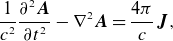 \begin{equation} \frac {1}{c^2}\frac {\partial ^2{\boldsymbol{A}}}{\partial t^2}-\nabla ^2{\boldsymbol{A}} =\frac {4\pi }{c}{\boldsymbol{J}}, \end{equation}
where ${\boldsymbol{J}}=\sum _{j}-\eta _{j}en_{\!j}{\boldsymbol{p}}_{\!j}/(\gamma _{j}m)$
is the current density of the pair plasma,
${\boldsymbol{J}}=\sum _{j}-\eta _{j}en_{\!j}{\boldsymbol{p}}_{\!j}/(\gamma _{j}m)$
is the current density of the pair plasma, $e$
is the charge of an electron or a positron,
$e$
is the charge of an electron or a positron, $j=e, p$
denote the electron and positron, respectively,
$j=e, p$
denote the electron and positron, respectively, $\eta _{e}=1$
and
$\eta _{e}=1$
and $\eta _{p}=-1$
are charge polarity indicators,
$\eta _{p}=-1$
are charge polarity indicators, $m$
is the rest mass of an electron or a positron and
$m$
is the rest mass of an electron or a positron and $n_{\!j}$
,
$n_{\!j}$
, ${\boldsymbol{p}}_{\!j}$
and
${\boldsymbol{p}}_{\!j}$
and $\gamma _{j}=[1+p_{j}^2/(m^2c^2)]^{1/2}$
are the number density, momentum and Lorentz factor of
$\gamma _{j}=[1+p_{j}^2/(m^2c^2)]^{1/2}$
are the number density, momentum and Lorentz factor of $j$
sort of particles, respectively.
$j$
sort of particles, respectively.
The relativistic fluid momentum equation for the $j$
type of plasma particle can be represented as (Asenjo et al. Reference Asenjo, Borotto, Chian, Muñoz, Alejandro Valdivia and Rempel2012)
$j$
type of plasma particle can be represented as (Asenjo et al. Reference Asenjo, Borotto, Chian, Muñoz, Alejandro Valdivia and Rempel2012)
 \begin{align} \left (\frac {\partial }{\partial t}+\frac {{\boldsymbol{p}}_{\!j}}{\gamma _{j} m}\cdot \nabla \right ) (f_{\!j}{\boldsymbol{p}}_{\!j}) & =\eta _{j} \left [\frac {e}{c}\frac {\partial {\boldsymbol{A}}}{\partial t}+e\nabla \phi -\frac {e}{\gamma _{j}mc}{\boldsymbol{p}}_{\!j}\times (\nabla \times {\boldsymbol{A}}) -\frac {\omega _{c}}{\gamma _{j}}{\boldsymbol{p}}_{\!j}\times {\boldsymbol{e}}_{z}\right ]\nonumber\\[5pt]& \quad -\frac {1}{n_{\!j}}\nabla \unicode{x1D6F1} _{j}, \end{align}
where the pressure of particles $\unicode{x1D6F1} _{j}=n_{\!j}k_{\textrm{B}}T_{j}$
for an ideal gas,
$\unicode{x1D6F1} _{j}=n_{\!j}k_{\textrm{B}}T_{j}$
for an ideal gas, $\omega _{c}=eB_0/(mc)$
is the electron cyclotron frequency, and
$\omega _{c}=eB_0/(mc)$
is the electron cyclotron frequency, and $\phi$
is the scalar potential satisfying Poisson’s equation
$\phi$
is the scalar potential satisfying Poisson’s equation
 \begin{equation} \nabla ^2\phi =4\pi e(n_{e}-n_{p}). \end{equation}
In the equation (2.5), $f_{\!j}$
is a function of temperature. It can be expressed as
$f_{\!j}$
is a function of temperature. It can be expressed as $f_{\!j}=K_{3}(mc^2/k_{\textrm{B}}T_{j})/K_{2}(mc^2/k_{\textrm{B}}T_{j})$
, assuming that the plasma system follows a relativistic Maxwell–Jüttner distribution, where
$f_{\!j}=K_{3}(mc^2/k_{\textrm{B}}T_{j})/K_{2}(mc^2/k_{\textrm{B}}T_{j})$
, assuming that the plasma system follows a relativistic Maxwell–Jüttner distribution, where $K_{3}(x)$
and
$K_{3}(x)$
and $K_{2}(x)$
are modified Bessel functions of order 3 and 2 (Asenjo et al. Reference Asenjo, Borotto, Chian, Muñoz, Alejandro Valdivia and Rempel2012; Banerjee, Dutta & Misra Reference Banerjee, Dutta and Misra2020). The function can be approximated by
$K_{2}(x)$
are modified Bessel functions of order 3 and 2 (Asenjo et al. Reference Asenjo, Borotto, Chian, Muñoz, Alejandro Valdivia and Rempel2012; Banerjee, Dutta & Misra Reference Banerjee, Dutta and Misra2020). The function can be approximated by $f_{\!j}\approx 1+5k_{\textrm{B}}T_{j}/(2\, \mathrm{mc}^{2})$
in the low-temperature limit
$f_{\!j}\approx 1+5k_{\textrm{B}}T_{j}/(2\, \mathrm{mc}^{2})$
in the low-temperature limit $k_{\textrm{B}}T_{j}\ll mc^2$
, while
$k_{\textrm{B}}T_{j}\ll mc^2$
, while $f_{\!j}\approx 4k_{\textrm{B}}T_{j}/(mc^2)$
in the high-temperature limit
$f_{\!j}\approx 4k_{\textrm{B}}T_{j}/(mc^2)$
in the high-temperature limit $k_{\textrm{B}}T_{j}\gg mc^2$
.
$k_{\textrm{B}}T_{j}\gg mc^2$
.
By substituting equation (2.1) into (2.5), we can obtain the momentum of plasma particles from the high-frequency response of moving particles to the incident wave
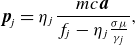 \begin{equation} {\boldsymbol{p}}_{\!j}=\eta _{j}\frac {mc{\boldsymbol{a}}}{f_{\!j}-\eta _{j}\frac {\sigma \mu }{\gamma _{j}}}, \end{equation}
where $\mu =\omega _{c}/\omega _0$
is the normalized cyclotron frequency, and
$\mu =\omega _{c}/\omega _0$
is the normalized cyclotron frequency, and ${\boldsymbol{a}}=e{\boldsymbol{A}}/(mc^2)$
is the normalized vector potential.
${\boldsymbol{a}}=e{\boldsymbol{A}}/(mc^2)$
is the normalized vector potential.
Substituting the expression (2.7) into $\gamma _{j}=[1+p_{j}^2/(m^2c^2)]^{1/2}$
, we can derive
$\gamma _{j}=[1+p_{j}^2/(m^2c^2)]^{1/2}$
, we can derive
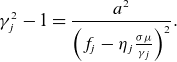 \begin{eqnarray} \gamma _{j}^2-1=\frac {a^2}{\left(f_{\!j}-\eta _{j}\frac {\sigma \mu }{\gamma _{j}}\right)^2}. \end{eqnarray}
For weakly magnetized plasmas, the condition $\mu \ll f_{\!j}\gamma _{j}$
holds. In this limit, the right-hand side of the (2.8) can be expanded as a power series in
$\mu \ll f_{\!j}\gamma _{j}$
holds. In this limit, the right-hand side of the (2.8) can be expanded as a power series in $\mu$
. Retaining terms to first order in
$\mu$
. Retaining terms to first order in $\mu$
, the equation for the Lorentz factors simplifies to
$\mu$
, the equation for the Lorentz factors simplifies to
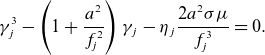 \begin{eqnarray} \gamma _{j}^3-\left (1+\frac {a^2}{f_{\!j}^2}\right )\gamma _{j}-\eta _{j}\frac {2a^2\sigma \mu }{f_{\!j}^3}=0 . \end{eqnarray}
Thus the approximate solutions for the Lorentz factors of each fluid can be expressed as
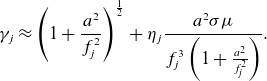 \begin{eqnarray} \gamma _{j}\approx \left (1+\frac {a^2}{f_{\!j}^2}\right )^\frac {1}{2}+\eta _{j}\frac {a^2\sigma \mu }{f_{\!j}^3\left(1+\frac {a^2}{f_{\!j}^2}\right)}. \end{eqnarray}
From equation (2.5), we can also obtain the equation that the plasma density perturbation satisfies
 \begin{eqnarray} k_{\textrm{B}}T_{j}\nabla \ln n_{\!j}=\nabla \left (\eta _{j} e\phi -\varphi _{pj}\right ), \end{eqnarray}
where $\varphi _{pj}$
is the relativistic ponderomotive potential, expressed as
$\varphi _{pj}$
is the relativistic ponderomotive potential, expressed as
 \begin{eqnarray} \varphi _{pj}=mc^2\left (f_{\!j}\gamma _{j}+\eta _{j}\frac {\sigma \mu }{2}\ln \gamma _{j} -\eta _{j}\frac {\sigma \mu }{4\gamma _{j}^2}\right ). \end{eqnarray}
In the absence of an external magnetic field, the ponderomotive potential reduces to the standard expression in a cold plasma $\varphi _{pj}=mc^2\gamma _{j}$
. By integrating equation (2.11), and assuming the plasma being unperturbed at infinity, i.e. using the boundary conditions
$\varphi _{pj}=mc^2\gamma _{j}$
. By integrating equation (2.11), and assuming the plasma being unperturbed at infinity, i.e. using the boundary conditions $n_{e,p}=n_{e0,p0}$
,
$n_{e,p}=n_{e0,p0}$
, $\phi \rightarrow 0$
and
$\phi \rightarrow 0$
and $\gamma \rightarrow 1$
at
$\gamma \rightarrow 1$
at $|z|\rightarrow \infty$
, we can obtain the number densities of electrons and positrons
$|z|\rightarrow \infty$
, we can obtain the number densities of electrons and positrons
 \begin{align} n_{\!j}=n_{j0}\exp \left \{\beta _{j}\left [\eta _{j}\unicode{x1D6F7} -f_{\!j}(\gamma _{j}-1)-\eta _{j}\frac {\sigma \mu }{2}\ln \gamma _{j} -\eta _{j}\frac {\sigma \mu }{4}\left (1-\frac {1}{\gamma _{j}^2}\right )\right ]\right \},\nonumber\\ \end{align}
where $\unicode{x1D6F7} =e\phi /(mc^2)$
,
$\unicode{x1D6F7} =e\phi /(mc^2)$
, $\beta _{j}=mc^2/(k_{\textrm{B}}T_{j})$
.
$\beta _{j}=mc^2/(k_{\textrm{B}}T_{j})$
.
Substituting (2.13) into the quasi-neutrality condition $n_{e}-n_{p}-n_{i0}=0$
, we obtain
$n_{e}-n_{p}-n_{i0}=0$
, we obtain
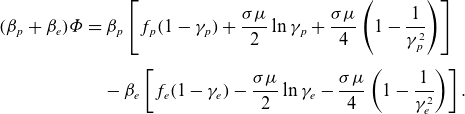 \begin{align} (\beta _{p}+\beta _{e})\unicode{x1D6F7} & = \beta _{p}\left [f_{p}(1-\gamma _{p})+\frac {\sigma \mu }{2}\ln \gamma _{p}+\frac {\sigma \mu }{4}\left(1-\frac {1}{\gamma _{p}^2}\right)\right ]\nonumber \\[5pt]& \quad -\beta _{e}\left [f_{e}(1-\gamma _{e})-\frac {\sigma \mu }{2}\ln \gamma _{e}-\frac {\sigma \mu }{4}\left(1-\frac {1}{\gamma _{e}^2}\right)\right ]. \end{align}
Substituting the expression of $\unicode{x1D6F7}$
into (2.13), and assuming the plasma to be in thermal equilibrium, i.e.
$\unicode{x1D6F7}$
into (2.13), and assuming the plasma to be in thermal equilibrium, i.e. $f_{e}=f_{p}=f$
, the number density of the j-particle can be rewritten as
$f_{e}=f_{p}=f$
, the number density of the j-particle can be rewritten as
 \begin{equation} n_{\!j}=n_{j0}\exp \{\beta \xi (\gamma _{e},\gamma _{p})\} , \end{equation}
where $\beta =2\beta _{e}\beta _{p}/(\beta _{p}+\beta _{e})$
is the temperature parameter, the function
$\beta =2\beta _{e}\beta _{p}/(\beta _{p}+\beta _{e})$
is the temperature parameter, the function
 \begin{eqnarray} \xi (\gamma _{e},\gamma _{p})=\left [f(1-\bar {\gamma })+\frac {\sigma \mu }{4}\ln \frac {\gamma _{p}}{\gamma _{e}}+\frac {\sigma \mu }{8} \left (\frac {1}{\gamma _{e}^2}-\frac {1}{\gamma _{p}^2}\right )\right ], \end{eqnarray}
and $\bar {\gamma }=(\gamma _{e}+\gamma _{p})/2$
.
$\bar {\gamma }=(\gamma _{e}+\gamma _{p})/2$
.
Substituting the vector potential $\boldsymbol{A}$
and current density
$\boldsymbol{A}$
and current density $\boldsymbol{J}$
into (2.4) yields the electromagnetic-wave envelope equation
$\boldsymbol{J}$
into (2.4) yields the electromagnetic-wave envelope equation
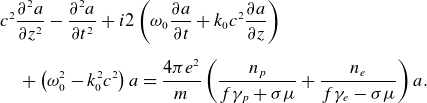 \begin{align} & c^2\frac {\partial ^2 a}{\partial z^2}-\frac {\partial ^2 a}{\partial t^2}+{i}2\left (\omega _0\frac {\partial a}{\partial t}+k_0c^2\frac {\partial a}{\partial z}\right )\nonumber\\[5pt]& \quad +\left(\omega _0^2-k_0^2c^2\right)a =\frac {4\pi e^2}{m}\left (\frac {n_{p}}{f\gamma _{p}+\sigma \mu }+\frac {n_{e}}{f\gamma _{e}-\sigma \mu }\right )a. \end{align}
Linearizing equation (2.17), we can get the nonlinear dispersion relation of the wave
 \begin{eqnarray} \omega _0^2-k_0^2c^2=Q_{L}\omega _{pe}^2 , \end{eqnarray}
where $\omega _{pe}=(4\pi e^2n_{e0}/m)^{1/2}$
is the plasma frequency in the laboratory frame, and
$\omega _{pe}=(4\pi e^2n_{e0}/m)^{1/2}$
is the plasma frequency in the laboratory frame, and
 \begin{eqnarray} Q_{L}=\left (\frac {1}{f+\sigma \mu }+\frac {1}{f-\sigma \mu }\right ). \end{eqnarray}
The dispersion relationship can also be expressed in a more common form
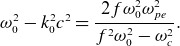 \begin{eqnarray} \omega _0^2-k_0^2c^2=\frac {2f\omega _0^2\omega _{pe}^2}{f^2\omega _0^2-\omega _{c}^2}. \end{eqnarray}
For $f=1$
, the dispersion relation for a cold plasma is recovered. Let
$f=1$
, the dispersion relation for a cold plasma is recovered. Let $k_0=0$
, the cutoff frequency of the electromagnetic wave in the magnetized pair plasma can be obtained as
$k_0=0$
, the cutoff frequency of the electromagnetic wave in the magnetized pair plasma can be obtained as
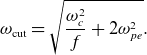 \begin{eqnarray} \omega _{\mathrm{cut}}=\sqrt {\frac {\omega _{c}^2}{f}+2\omega _{pe}^2}. \end{eqnarray}
Obviously, the cutoff frequency of waves decreases with the increasing of the plasma temperature in the hot plasmas.
Substituting equations (2.15) and (2.18) into equation (2.17), leads to
 \begin{eqnarray} \frac {1}{2}\left (c^2\frac {\partial ^2a}{\partial z^2}-\frac {\partial ^2a}{\partial t^2}\right ) +{i}\left (\omega _0\frac {\partial a}{\partial t}+k_0c^2\frac {\partial a}{\partial z}\right ) +D_{NL}\omega _{pe}^2a=0, \end{eqnarray}
where $D_{NL}=\{Q_{L}-Q \exp [\beta \xi (\gamma _{e},\gamma _{p})]\}/2$
and
$D_{NL}=\{Q_{L}-Q \exp [\beta \xi (\gamma _{e},\gamma _{p})]\}/2$
and
 \begin{eqnarray} Q=\left (\frac {1}{f\gamma _{p}+\sigma \mu }+\frac {1}{f\gamma _{e}-\sigma \mu }\right ) .\end{eqnarray}
Introducing the dimensionless variables $\tau =\omega _{pe}^2t/\omega _0$
,
$\tau =\omega _{pe}^2t/\omega _0$
, $\tilde {z}=\omega _{pe}z/c+u_{g}\tau$
,
$\tilde {z}=\omega _{pe}z/c+u_{g}\tau$
, $u_{g}=(\omega _0/\omega _{pe})v_{g}/c$
, where
$u_{g}=(\omega _0/\omega _{pe})v_{g}/c$
, where $v_{g}=kc^2/\omega _0$
is the group velocity of the wave, we write (2.22) as
$v_{g}=kc^2/\omega _0$
is the group velocity of the wave, we write (2.22) as
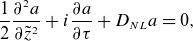 \begin{eqnarray} \frac {1}{2}\frac {\partial ^2a}{\partial \tilde {z}^2}+i\frac {\partial a}{\partial \tau }+D_{NL}a=0, \end{eqnarray}
where the slowly varying envelope approximation is used. Equation (2.24) is the modified nonlinear Schrödinger equation governing the dynamics of the envelope of an electromagnetic wave in magnetized EP plasmas.
The theoretical framework is derived under the weakly magnetized approximation, requiring the magnetic field strength to satisfy $\omega _{c}\ll f_{\!j}\gamma _{j}\omega _0$
. This condition remains broadly applicable to most contemporary laser–plasma experiments and high-energy radiation processes on stellar surfaces.
$\omega _{c}\ll f_{\!j}\gamma _{j}\omega _0$
. This condition remains broadly applicable to most contemporary laser–plasma experiments and high-energy radiation processes on stellar surfaces.
For instance, in experiments utilizing magnetic fields of the order of $10^{4}-10^{5}$
G, such as those in magnetic confinement fusion research, the weak magnetization condition is trivially met. Modern solid-state and conventional electromagnets can generate fields up to
$10^{4}-10^{5}$
G, such as those in magnetic confinement fusion research, the weak magnetization condition is trivially met. Modern solid-state and conventional electromagnets can generate fields up to $10^{6}$
G (Sims et al. Reference Sims, Rickel, Swenson, Schillig and Ammerman2008), corresponding to electron cyclotron frequencies of
$10^{6}$
G (Sims et al. Reference Sims, Rickel, Swenson, Schillig and Ammerman2008), corresponding to electron cyclotron frequencies of $\omega _{c}\sim 10^{13}\, \textrm{s}^{-1}$
. To satisfy
$\omega _{c}\sim 10^{13}\, \textrm{s}^{-1}$
. To satisfy $\omega _{c}\ll f_{\!j}\gamma _{j}\omega _0$
in such systems, laser wavelengths below 10
$\omega _{c}\ll f_{\!j}\gamma _{j}\omega _0$
in such systems, laser wavelengths below 10 $\mu \textrm{m}$
(
$\mu \textrm{m}$
( $\omega _0\gt 10^{14}\,\textrm{s}^{-1}$
) are typically sufficient. In scenarios involving stronger fields, such as inertial confinement fusion experiments with
$\omega _0\gt 10^{14}\,\textrm{s}^{-1}$
) are typically sufficient. In scenarios involving stronger fields, such as inertial confinement fusion experiments with $10^{6}-10^{7}$
G fields (
$10^{6}-10^{7}$
G fields ( $\omega _{c}\sim 10^{13}-10^{14}\, \textrm{s}^{-1}$
), near-infrared lasers (e.g. Nd lasers at 1.06
$\omega _{c}\sim 10^{13}-10^{14}\, \textrm{s}^{-1}$
), near-infrared lasers (e.g. Nd lasers at 1.06 $\mu \textrm{m}$
,
$\mu \textrm{m}$
, $\omega _0=1.8\times 10^{15}\, \textrm{s}^{-1}$
) still comply with the approximation. This robustness extends to ultra-intense laser–plasma interactions generating several kilo-tesla fields (Knauer et al. Reference Knauer2010; Fujioka et al. Reference Fujioka2013), where
$\omega _0=1.8\times 10^{15}\, \textrm{s}^{-1}$
) still comply with the approximation. This robustness extends to ultra-intense laser–plasma interactions generating several kilo-tesla fields (Knauer et al. Reference Knauer2010; Fujioka et al. Reference Fujioka2013), where $\omega _{c}\sim 10^{15}\, \textrm{s}^{-1}$
. Here, even mid-infrared lasers (3–10
$\omega _{c}\sim 10^{15}\, \textrm{s}^{-1}$
. Here, even mid-infrared lasers (3–10 $\mu \textrm{m}$
) remain viable due to the relativistic and thermal effects (
$\mu \textrm{m}$
) remain viable due to the relativistic and thermal effects ( $f_{\!j}\gamma _{j}\gg 1$
). Recently, some studies have proposed laser-driven schemes to generate ultra-strong magnetic fields of the order of
$f_{\!j}\gamma _{j}\gg 1$
). Recently, some studies have proposed laser-driven schemes to generate ultra-strong magnetic fields of the order of $10^8$
G (corresponding to
$10^8$
G (corresponding to $\omega _{c}\sim 10^{15}\, \textrm{s}^{-1}$
) (Wilson et al. Reference Wilson, Sheng, Eliasson and McKenna2021; Shi et al. Reference Shi, Arefiev, Hao and Zheng2023). For such fields, in cold and weakly relativistic plasmas (
$\omega _{c}\sim 10^{15}\, \textrm{s}^{-1}$
) (Wilson et al. Reference Wilson, Sheng, Eliasson and McKenna2021; Shi et al. Reference Shi, Arefiev, Hao and Zheng2023). For such fields, in cold and weakly relativistic plasmas ( $f_{\!j}\gamma _{j}\approx 1$
), the laser frequency must far exceed
$f_{\!j}\gamma _{j}\approx 1$
), the laser frequency must far exceed $10^{15}\, \textrm{s}^{-1}$
. If ultraviolet or X-ray lasers (
$10^{15}\, \textrm{s}^{-1}$
. If ultraviolet or X-ray lasers ( $\omega _0\geq 10^{16}\, \textrm{s}^{-1}$
) are used, the model remains applicable. While relativistic hot plasmas (
$\omega _0\geq 10^{16}\, \textrm{s}^{-1}$
) are used, the model remains applicable. While relativistic hot plasmas ( $f_{\!j}\gamma _{j}\gg 1$
) significantly relax this constraint. The weak magnetization condition still holds even for laser frequencies below
$f_{\!j}\gamma _{j}\gg 1$
) significantly relax this constraint. The weak magnetization condition still holds even for laser frequencies below $10^{15}\, \textrm{s}^{-1}$
.
$10^{15}\, \textrm{s}^{-1}$
.
This framework also accommodates astrophysical environments like pulsar surfaces, where typical magnetic fields reach $10^{12}$
G (
$10^{12}$
G ( $\omega _{c}\sim 10^{19}\,\textrm{s}^{-1}$
). For such systems, the weak magnetization condition demands radiation frequencies exceeding
$\omega _{c}\sim 10^{19}\,\textrm{s}^{-1}$
). For such systems, the weak magnetization condition demands radiation frequencies exceeding $10^{19}\, \textrm{s}^{-1}$
, naturally aligning with X-ray or
$10^{19}\, \textrm{s}^{-1}$
, naturally aligning with X-ray or $\gamma$
-ray emission processes.
$\gamma$
-ray emission processes.
3. Modulational instability
The MI of electromagnetic waves can be analyzed using a common method introduced in references (Shukla & Bharuthram Reference Shukla and Bharuthram1987; Shukla et al. Reference Shukla, Marklund and Eliasson2004). Assume that
 \begin{eqnarray} a=(a_0+a_1)e^{{i}\delta \tau }, \end{eqnarray}
where $a_0$
is a real constant,
$a_0$
is a real constant, $a_1(\ll a_0)$
denotes the small perturbation amplitude and
$a_1(\ll a_0)$
denotes the small perturbation amplitude and $\delta$
represents the nonlinear frequency shift. Substituting (3.1) into (2.24), and linearizing the resulting equation with respect to
$\delta$
represents the nonlinear frequency shift. Substituting (3.1) into (2.24), and linearizing the resulting equation with respect to $a_1$
, we obtain the nonlinear frequency shift at the lowest order
$a_1$
, we obtain the nonlinear frequency shift at the lowest order
 \begin{eqnarray} \delta =D_{NL}(|a|=a_0), \end{eqnarray}
where $D_{NL}(|a|=a_0)=[Q_{L}-Q_0 e^{\beta \xi (\gamma _{e0},\gamma _{\!p0})}]/2$
,
$D_{NL}(|a|=a_0)=[Q_{L}-Q_0 e^{\beta \xi (\gamma _{e0},\gamma _{\!p0})}]/2$
, $Q_0=1/(f\gamma _{\!p0}+\sigma \mu )+1/(f\gamma _{e0}-\sigma \mu )$
and
$Q_0=1/(f\gamma _{\!p0}+\sigma \mu )+1/(f\gamma _{e0}-\sigma \mu )$
and $\gamma _{j0}=\gamma _{j}(|a|=a_0)$
.
$\gamma _{j0}=\gamma _{j}(|a|=a_0)$
.
By analyzing the first-order terms in the derived equation, we obtain an equation governing the perturbation amplitude
 \begin{eqnarray} \frac {1}{2}\frac {\partial ^2a_1}{\partial \tilde {z}^2} +i\frac {\partial a_1}{\partial \tau } +\unicode{x1D6EC} a_0^2(a_1+a_1^\ast )=0, \end{eqnarray}
where
 \begin{align} \unicode{x1D6EC} =\frac {1}{4}\exp [\beta \xi (\gamma _{e0},\gamma _{\!p0})]\left [\frac {f\unicode{x1D6E4} _{p}}{(f\gamma _{\!p0}+\sigma \mu )^2} +\frac {f\unicode{x1D6E4} _{e}}{(f\gamma _{e0}-\sigma \mu )^2}-\beta Q_0(s_{e}\unicode{x1D6E4} _{e}+s_{p}\unicode{x1D6E4} _{p})\right ], \end{align}
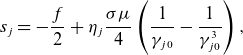 \begin{eqnarray} s_{j}=-\frac {f}{2}+\eta _{j}\frac {\sigma \mu }{4}\left (\frac {1}{\gamma _{j0}}-\frac {1}{\gamma _{j0}^3}\right ), \end{eqnarray}
and
 \begin{eqnarray} \unicode{x1D6E4} _{j}=\frac {1}{f^2\big(1+a_0^2/f^2\big)^{1/2}}+\eta _{j}\frac {2\sigma \mu }{f^3}\left [\frac {1}{\big(1+a_0^2/f^2\big)^{1/2}}-\frac {a_0^2}{f^2\big(1+a_0^2/f^2\big)^{2}}\right ]. \end{eqnarray}
Inserting $a_1=X+\textrm{i}Y$
into (3.3) yields
$a_1=X+\textrm{i}Y$
into (3.3) yields
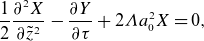 \begin{eqnarray} \frac {1}{2}\frac {\partial ^2X}{\partial \tilde {z}^2} -\frac {\partial Y}{\partial \tau } +2\unicode{x1D6EC} a_0^2X=0 ,\end{eqnarray}
and
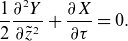 \begin{eqnarray} \frac {1}{2}\frac {\partial ^2Y}{\partial \tilde {z}^2} +\frac {\partial X}{\partial \tau }=0. \end{eqnarray}
For the real part $X$
and imaginary part
$X$
and imaginary part $Y$
of
$Y$
of $a_1$
, we consider the following oscillation forms:
$a_1$
, we consider the following oscillation forms: $X=\tilde {X}\exp ({i}K\tilde {z}-{i}\Omega \tau )$
and
$X=\tilde {X}\exp ({i}K\tilde {z}-{i}\Omega \tau )$
and $Y=\tilde {Y}\exp ({i}K\tilde {z}-{i}\Omega \tau )$
, where
$Y=\tilde {Y}\exp ({i}K\tilde {z}-{i}\Omega \tau )$
, where $\tilde {X}$
and
$\tilde {X}$
and $\tilde {Y}$
are the real amplitudes,
$\tilde {Y}$
are the real amplitudes, $K$
is the modulation wavenumber normalized by
$K$
is the modulation wavenumber normalized by $\omega _{pe}/c$
and
$\omega _{pe}/c$
and $\Omega$
is the modulation frequency normalized by
$\Omega$
is the modulation frequency normalized by $\omega _{pe}^2/\omega _0$
. The nonlinear dispersion relation of MI is obtained as
$\omega _{pe}^2/\omega _0$
. The nonlinear dispersion relation of MI is obtained as
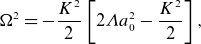 \begin{eqnarray} \Omega ^2=-\frac {K^2}{2}\left [2\unicode{x1D6EC} a_0^2-\frac {K^2}{2}\right ], \end{eqnarray}
from which we can extract the MI growth rate $\unicode{x1D6E4} =-{i}\Omega$
as follows:
$\unicode{x1D6E4} =-{i}\Omega$
as follows:
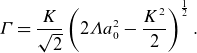 \begin{eqnarray} \unicode{x1D6E4} =\frac {K}{\sqrt {2}} \left (2\unicode{x1D6EC} a_0^2-\frac {K^2}{2}\right )^{\frac {1}{2}}. \end{eqnarray}
We can see that the result degenerates to the growth rate formula of Shukla et al. (Shukla et al. Reference Shukla, Marklund and Eliasson2004), for the cold non-magnetized pair plasmas.
When $K=(2\unicode{x1D6EC} )^{1/2}a_0$
that is the modulation wavenumber of the fastest-growing mode, the growth rate of MI has a maximum
$K=(2\unicode{x1D6EC} )^{1/2}a_0$
that is the modulation wavenumber of the fastest-growing mode, the growth rate of MI has a maximum
 \begin{eqnarray} \unicode{x1D6E4}_{\mathrm{max}}=\unicode{x1D6EC} a_0^2. \end{eqnarray}
As can be seen from the previous derivation process, the MI of the electromagnetic field in the magnetized plasmas is closely related to the coupling effect of the ponderomotive force, thermal pressure, relativistic effect and magnetic field.
4. Numerical results and discussions
In this section, we numerically analyze factors influencing the growth rate of MI, with a focus on two plasma regimes: the low-temperature limit ( $\beta _{j}\gg 1$
) and high-temperature limit (
$\beta _{j}\gg 1$
) and high-temperature limit ( $\beta _{j}\ll 1$
). Owing to the symmetry of the EP plasma, the modes of the circularly polarized electromagnetic waves do not affect its MI. Therefore, we set
$\beta _{j}\ll 1$
). Owing to the symmetry of the EP plasma, the modes of the circularly polarized electromagnetic waves do not affect its MI. Therefore, we set $\sigma =1$
in the numerical calculations presented below.
$\sigma =1$
in the numerical calculations presented below.
4.1. Numerical analysis
4.1.1. In the low-temperature limit
For the case of the low-temperature limit, $k_{\textrm{B}}T_{j}\ll mc^2\approx 510$
keV (
$k_{\textrm{B}}T_{j}\ll mc^2\approx 510$
keV ( $\beta _{j}\gg 1$
). The dependence of the maximum growth rate of MI (
$\beta _{j}\gg 1$
). The dependence of the maximum growth rate of MI ( $\unicode{x1D6E4}_{\mathrm{max}}$
) on the amplitude of electromagnetic wave
$\unicode{x1D6E4}_{\mathrm{max}}$
) on the amplitude of electromagnetic wave $a_0$
is shown in figure 1, where the particle temperatures
$a_0$
is shown in figure 1, where the particle temperatures $k_{\textrm{B}}T_{e,p}$
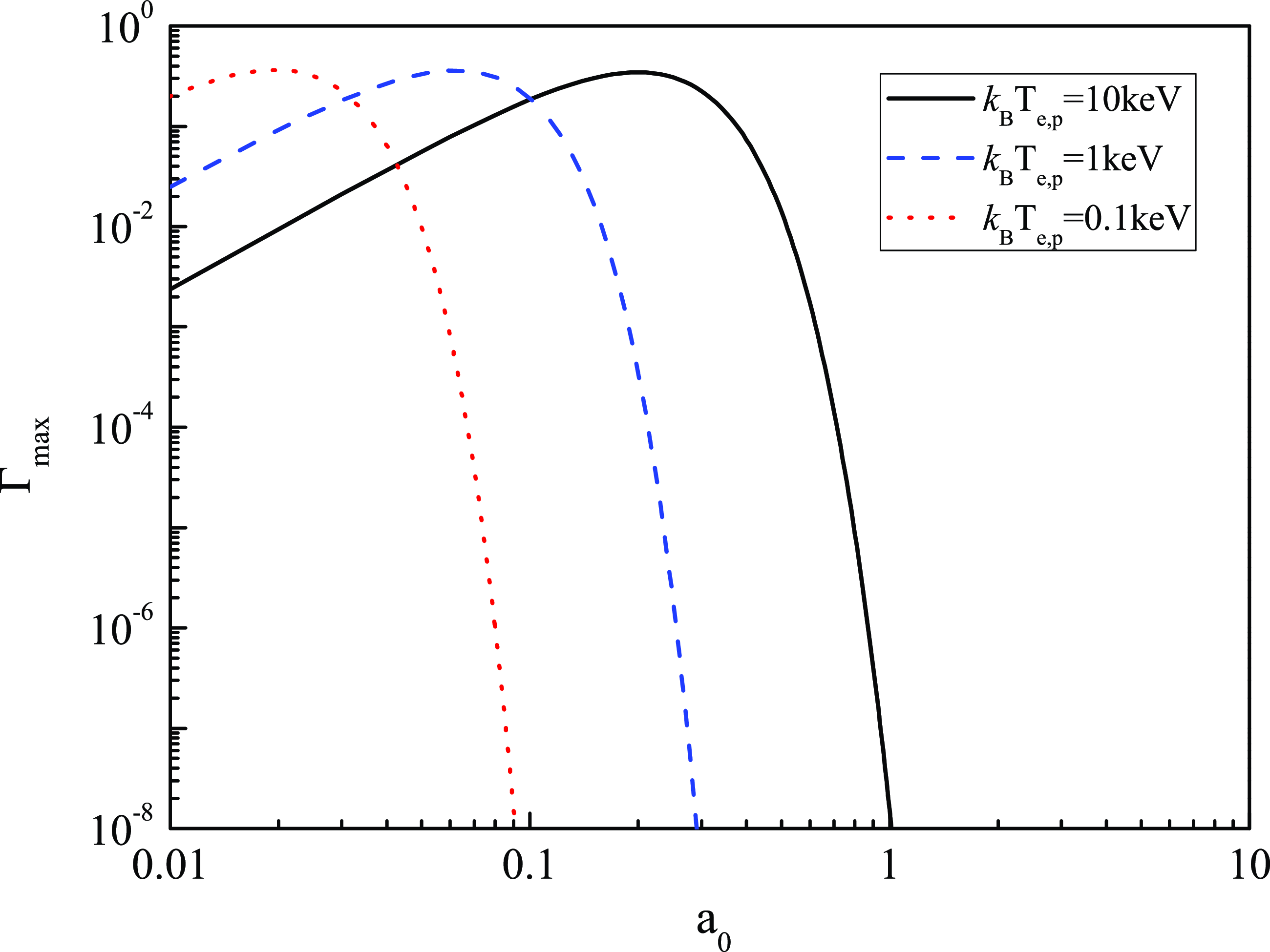
are 0.1, 1 and 10 keV, respectively. It can be seen that, initially, the maximum growth rate gradually increases with an increase in the amplitude of electromagnetic wave for a fixed particle temperature. When the amplitude of the electromagnetic wave increases to a critical value (threshold), the maximum growth rate reaches its peak (maximum value), and then begins to decrease. This behavior can be attributed to the competition between the ponderomotive force of the electromagnetic wave and relativistic effects. As the intensity of the electromagnetic wave increases, the ponderomotive force also increases, causing more particles to be pushed out of their original regions and thereby enhancing the disturbance acting on the electromagnetic wave. However, when the amplitude of the electromagnetic wave increases further, the mass of the particle becomes larger, and the relativistic effect gradually takes over. This makes it increasingly difficult for the ponderomotive force to displace the particles.
$k_{\textrm{B}}T_{e,p}$
are 0.1, 1 and 10 keV, respectively. It can be seen that, initially, the maximum growth rate gradually increases with an increase in the amplitude of electromagnetic wave for a fixed particle temperature. When the amplitude of the electromagnetic wave increases to a critical value (threshold), the maximum growth rate reaches its peak (maximum value), and then begins to decrease. This behavior can be attributed to the competition between the ponderomotive force of the electromagnetic wave and relativistic effects. As the intensity of the electromagnetic wave increases, the ponderomotive force also increases, causing more particles to be pushed out of their original regions and thereby enhancing the disturbance acting on the electromagnetic wave. However, when the amplitude of the electromagnetic wave increases further, the mass of the particle becomes larger, and the relativistic effect gradually takes over. This makes it increasingly difficult for the ponderomotive force to displace the particles.
The variations of the function $\unicode{x1D6E4}_{\mathrm{max}}$
with the electromagnetic-wave amplitude
$\unicode{x1D6E4}_{\mathrm{max}}$
with the electromagnetic-wave amplitude $a_0$
for different particle temperatures
$a_0$
for different particle temperatures $k_{\textrm{B}}T_{e,p}$
in the low-temperature limit, with fixed parameter
$k_{\textrm{B}}T_{e,p}$
in the low-temperature limit, with fixed parameter $\mu =0.1$
.
$\mu =0.1$
.
The maximum growth rate $\unicode{x1D6E4}_{\mathrm{max}}$
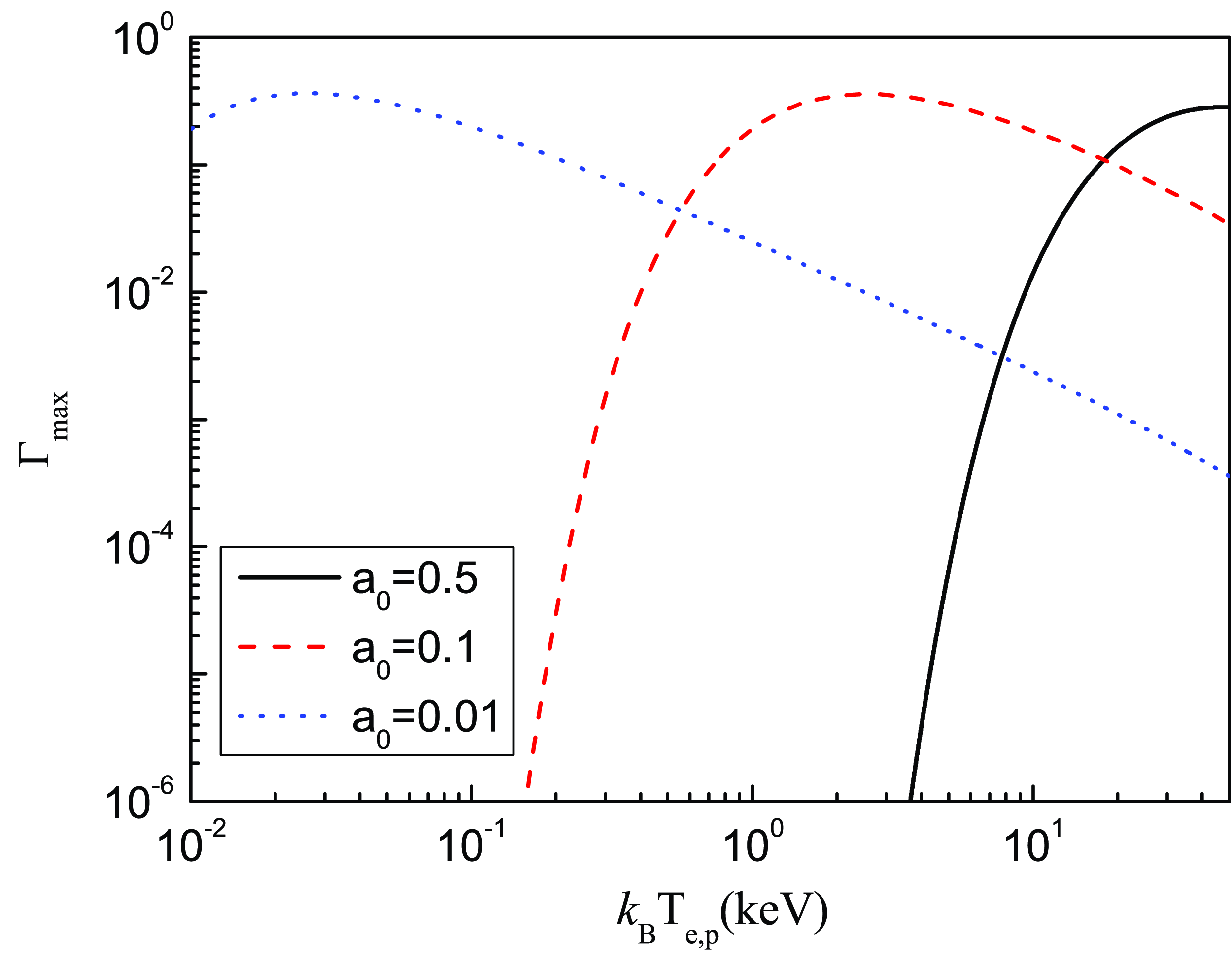
as a function of the particle temperature
$\unicode{x1D6E4}_{\mathrm{max}}$
as a function of the particle temperature $k_{\textrm{B}}T_{e,p}$
for different amplitudes of electromagnetic wave
$k_{\textrm{B}}T_{e,p}$
for different amplitudes of electromagnetic wave $a_0=0.01, 0.1, 0.5$
is shown in figure 2. For a fixed amplitude
$a_0=0.01, 0.1, 0.5$
is shown in figure 2. For a fixed amplitude $a_0$
, with the increase of temperature, the function
$a_0$
, with the increase of temperature, the function $\unicode{x1D6E4}_{\mathrm{max}}$
initially increases and then decreases. As the temperature rises, the thermal pressure increases significantly. It should be noted that the ponderomotive force also increases, as indicated by the exponential term
$\unicode{x1D6E4}_{\mathrm{max}}$
initially increases and then decreases. As the temperature rises, the thermal pressure increases significantly. It should be noted that the ponderomotive force also increases, as indicated by the exponential term $\exp \{\beta \xi (\gamma _{e0},\gamma _{\!p0})\}$
in the expression of
$\exp \{\beta \xi (\gamma _{e0},\gamma _{\!p0})\}$
in the expression of $\unicode{x1D6E4}_{\mathrm{max}}$
. At low temperatures, the ponderomotive force exceeds the thermal pressure and dominates, leading to an enhancement of MI. The growth rate reaches its maximum when these two forces balance each other. However, as the temperature continues to increases, the thermal pressure becomes dominant, resulting in a suppression of MI.
$\unicode{x1D6E4}_{\mathrm{max}}$
. At low temperatures, the ponderomotive force exceeds the thermal pressure and dominates, leading to an enhancement of MI. The growth rate reaches its maximum when these two forces balance each other. However, as the temperature continues to increases, the thermal pressure becomes dominant, resulting in a suppression of MI.
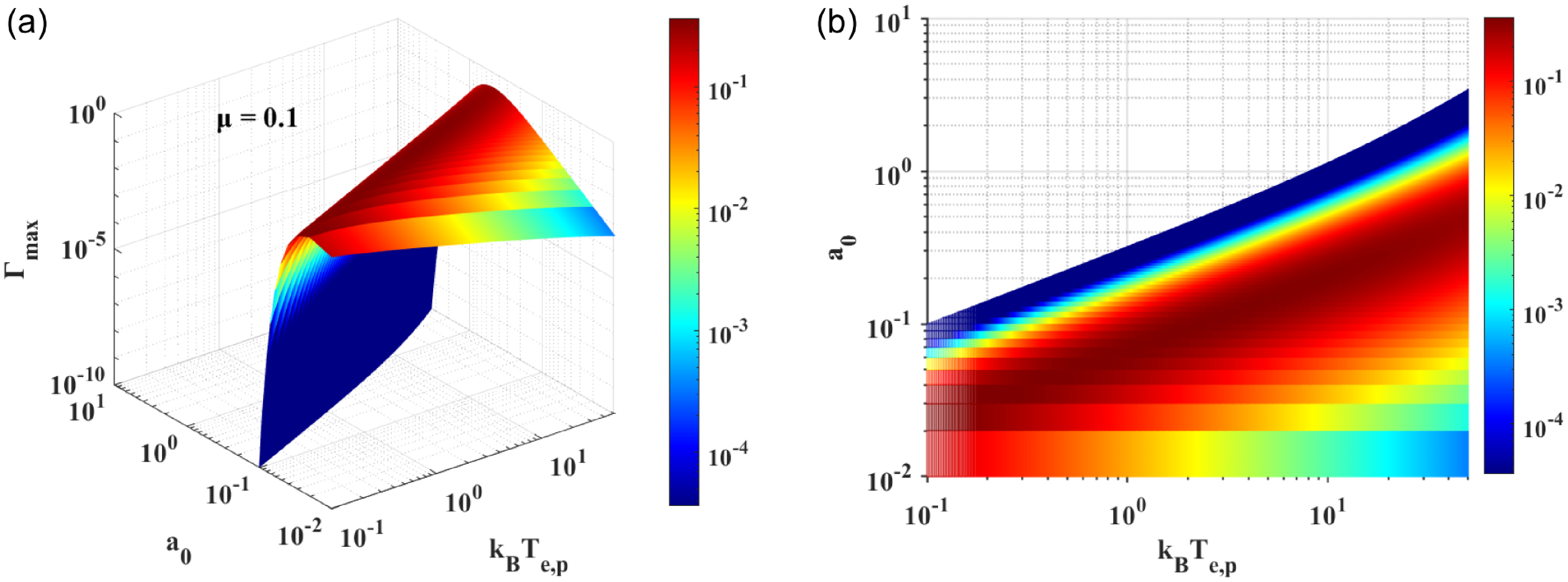
In order to give the law of the growth rate of MI with the amplitude of electromagnetic waves $a_0$
and particle temperature
$a_0$
and particle temperature $k_{\textrm{B}}T_{e,p}$
more clearly, we plot the results in figure 3. Figure 3(a) presents a three-dimensional plot of the maximum growth rate
$k_{\textrm{B}}T_{e,p}$
more clearly, we plot the results in figure 3. Figure 3(a) presents a three-dimensional plot of the maximum growth rate $\unicode{x1D6E4}_{\mathrm{max}}$
versus
$\unicode{x1D6E4}_{\mathrm{max}}$
versus $a_0$
and
$a_0$
and $k_{\textrm{B}}T_{e,p}$
under low-temperature conditions, where
$k_{\textrm{B}}T_{e,p}$
under low-temperature conditions, where $a_0$
ranges from 0.01 to 10, and
$a_0$
ranges from 0.01 to 10, and $k_{\textrm{B}}T_{e,p}$
spans 0.1 to 50 keV. Figure 3(b) displays the MI phase diagram in the
$k_{\textrm{B}}T_{e,p}$
spans 0.1 to 50 keV. Figure 3(b) displays the MI phase diagram in the $a_0$
-
$a_0$
- $k_{\textrm{B}}T_{e,p}$
parameter space. These figures clearly reveal the combinations of physical parameters associated with higher instability, providing insights for controlling electromagnetic-wave propagation in plasmas.
$k_{\textrm{B}}T_{e,p}$
parameter space. These figures clearly reveal the combinations of physical parameters associated with higher instability, providing insights for controlling electromagnetic-wave propagation in plasmas.
The variations of the function $\unicode{x1D6E4}_{\mathrm{max}}$
with the particle temperature
$\unicode{x1D6E4}_{\mathrm{max}}$
with the particle temperature $k_{\textrm{B}}T_{e,p}$
in the low-temperature limit for different electromagnetic-wave amplitudes
$k_{\textrm{B}}T_{e,p}$
in the low-temperature limit for different electromagnetic-wave amplitudes $a_0$
, with fixed parameter
$a_0$
, with fixed parameter $\mu =0.1$
.
$\mu =0.1$
.
Low-temperature limit ( $\mu =0.1$
): (a) dependence of
$\mu =0.1$
): (a) dependence of $\unicode{x1D6E4}_{\mathrm{max}}$
on
$\unicode{x1D6E4}_{\mathrm{max}}$
on $a_0$
and
$a_0$
and $k_{\textrm{B}}T_{e,p}$
, (b) phase diagram of MI in the
$k_{\textrm{B}}T_{e,p}$
, (b) phase diagram of MI in the $a_0$
-
$a_0$
- $k_{\textrm{B}}T_{e,p}$
plane.
$k_{\textrm{B}}T_{e,p}$
plane.
The variations of the function $\unicode{x1D6E4}_{\mathrm{max}}$
with the magnetic parameter
$\unicode{x1D6E4}_{\mathrm{max}}$
with the magnetic parameter $\mu$
for different electromagnetic-wave amplitudes
$\mu$
for different electromagnetic-wave amplitudes $a_0$
and particle temperatures
$a_0$
and particle temperatures $k_{\textrm{B}}T_{e,p}$
in low-temperature limit.
$k_{\textrm{B}}T_{e,p}$
in low-temperature limit.
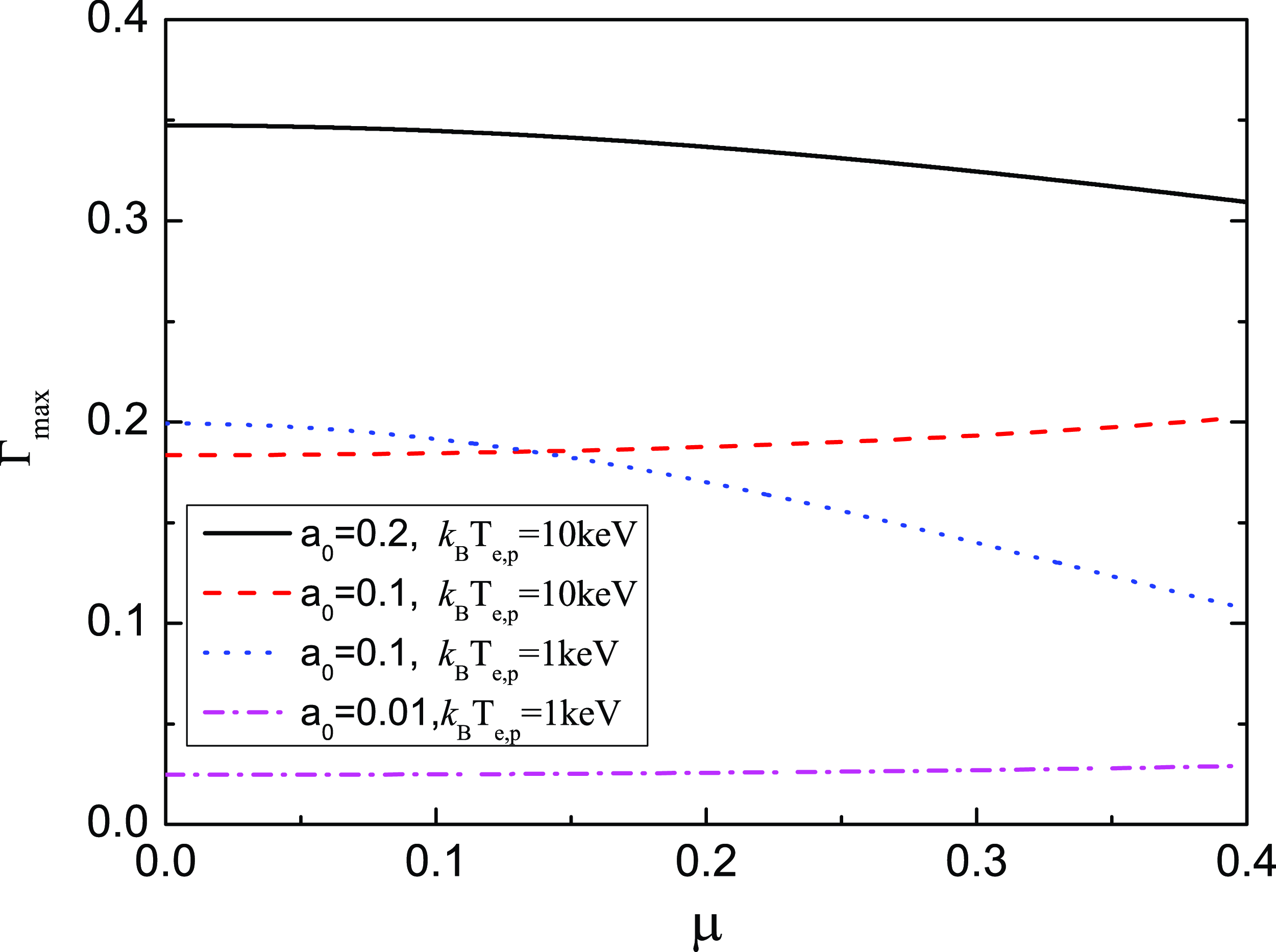
Figure 4 depicts the dependence of the maximum growth rate $\unicode{x1D6E4}_{\mathrm{max}}$
on the magnetic parameter
$\unicode{x1D6E4}_{\mathrm{max}}$
on the magnetic parameter $\mu$
under low-temperature conditions. The dependence of the growth rate on the magnetic field is governed by the electromagnetic-wave intensity
$\mu$
under low-temperature conditions. The dependence of the growth rate on the magnetic field is governed by the electromagnetic-wave intensity $a_0$
and plasma temperature
$a_0$
and plasma temperature $k_{\textrm{B}}T_{e,p}$
. For example, at
$k_{\textrm{B}}T_{e,p}$
. For example, at $a_0 = 0.1$
and
$a_0 = 0.1$
and $k_{\textrm{B}}T_{e,p} = 1$
keV,
$k_{\textrm{B}}T_{e,p} = 1$
keV, $\unicode{x1D6E4}_{\mathrm{max}}$
exhibits a monotonic decrease with increasing magnetic field. Conversely, at
$\unicode{x1D6E4}_{\mathrm{max}}$
exhibits a monotonic decrease with increasing magnetic field. Conversely, at $a_0 = 0.1$
and
$a_0 = 0.1$
and $k_{\textrm{B}}T_{e,p} = 10$
keV,
$k_{\textrm{B}}T_{e,p} = 10$
keV, $\unicode{x1D6E4}_{\mathrm{max}}$
increases gradually with the increasing of the magnetic field. Furthermore, for fixed temperatures (
$\unicode{x1D6E4}_{\mathrm{max}}$
increases gradually with the increasing of the magnetic field. Furthermore, for fixed temperatures ( $k_{\textrm{B}}T_{e,p} = 1$
or 10 keV), at low intensities (
$k_{\textrm{B}}T_{e,p} = 1$
or 10 keV), at low intensities ( $a_0 = 0.01$
or 0.1), enhancing the magnetic field elevates
$a_0 = 0.01$
or 0.1), enhancing the magnetic field elevates $\unicode{x1D6E4}_{\mathrm{max}}$
, while at high intensities (
$\unicode{x1D6E4}_{\mathrm{max}}$
, while at high intensities ( $a_0 = 0.1$
or 0.2), the trend reverses. These observations align with the predictions in Sepehri Javan (Reference Sepehri Javan2012), which focused on weakly relativistic and low-temperature regimes.
$a_0 = 0.1$
or 0.2), the trend reverses. These observations align with the predictions in Sepehri Javan (Reference Sepehri Javan2012), which focused on weakly relativistic and low-temperature regimes.
The variations of the function $\unicode{x1D6E4}_{\mathrm{max}}$
with the electromagnetic-wave amplitude
$\unicode{x1D6E4}_{\mathrm{max}}$
with the electromagnetic-wave amplitude $a_0$
for different particle temperatures
$a_0$
for different particle temperatures $k_{\textrm{B}}T_{e,p}$
in the high-temperature limit, with fixed parameter
$k_{\textrm{B}}T_{e,p}$
in the high-temperature limit, with fixed parameter $\mu =0.1$
.
$\mu =0.1$
.
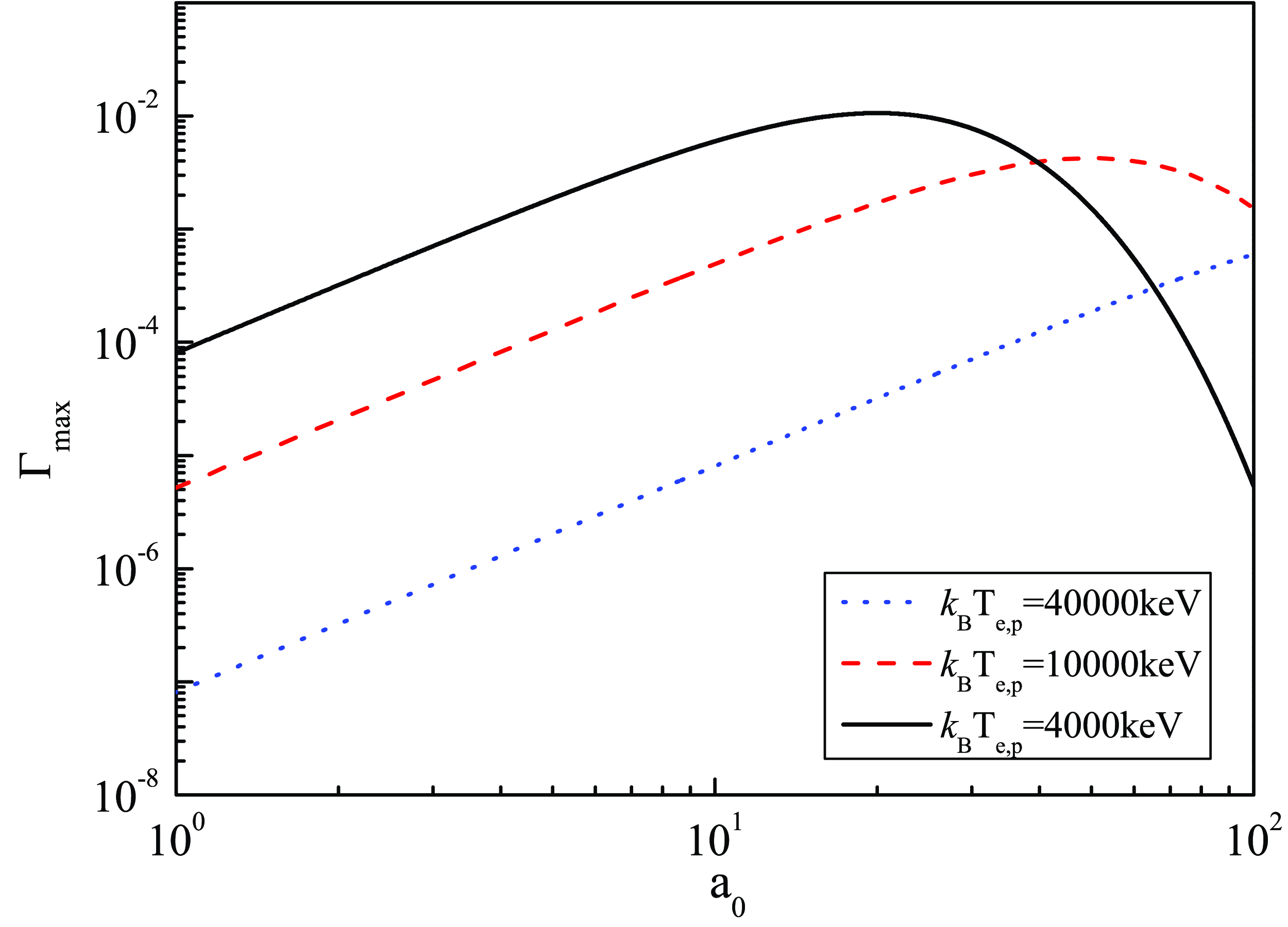
4.1.2. In the high-temperature limit
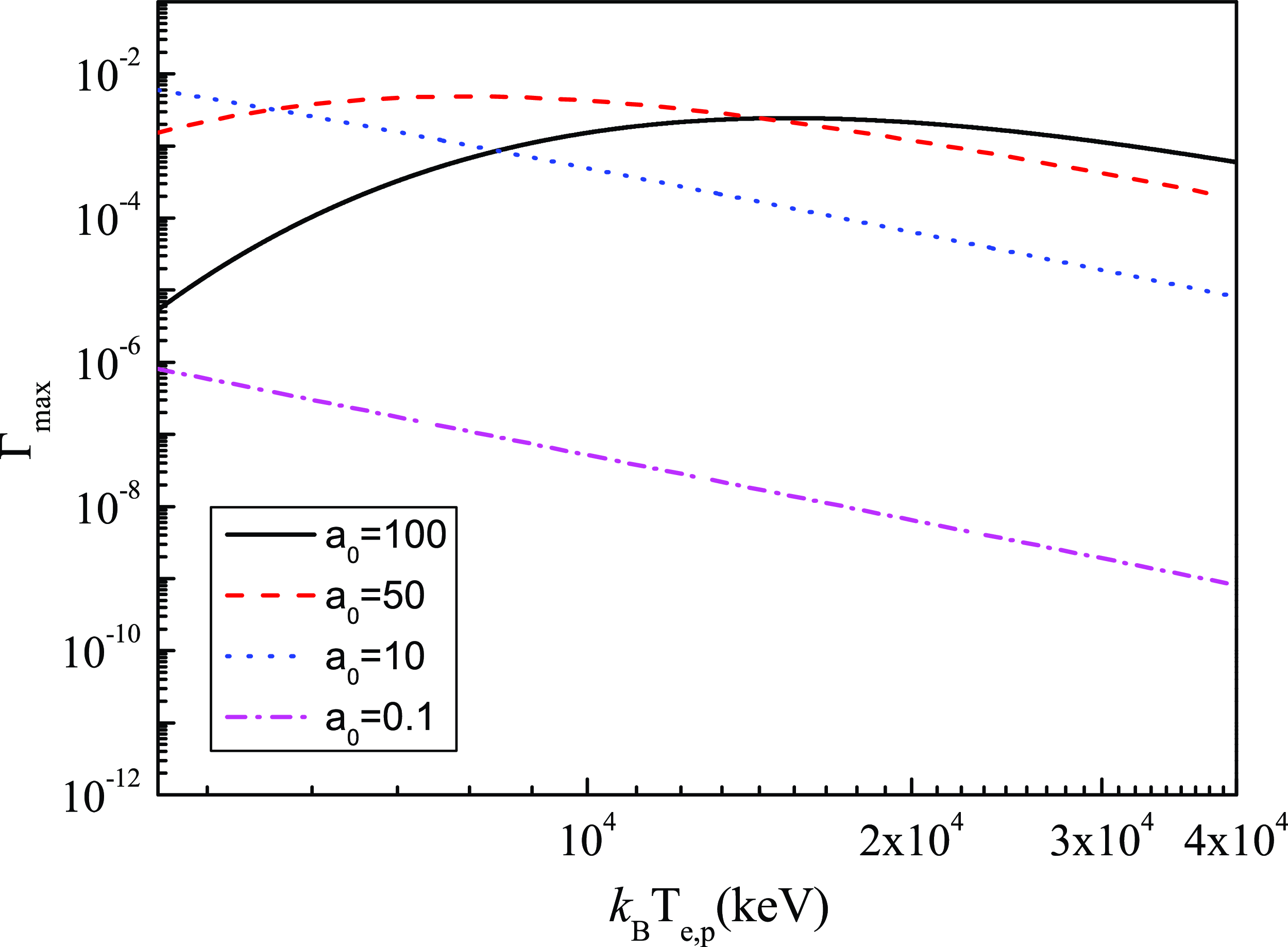
Figures 5–8 demonstrate the growth rate of MI versus the amplitude of electromagnetic waves $a_0$
, particle temperatures
$a_0$
, particle temperatures $k_{\textrm{B}}T_{e,p}$
and magnetic field strength in the high-temperature limit
$k_{\textrm{B}}T_{e,p}$
and magnetic field strength in the high-temperature limit $k_{\textrm{B}}T_{j}\gg mc^2\approx 510$
keV (
$k_{\textrm{B}}T_{j}\gg mc^2\approx 510$
keV ( $\beta _{j}\ll 1$
). A comparison between figures 1 and 5 reveals that the growth rate of MI increases firstly and then decreases with rising
$\beta _{j}\ll 1$
). A comparison between figures 1 and 5 reveals that the growth rate of MI increases firstly and then decreases with rising $a_0$
, while the value of
$a_0$
, while the value of $a_0$
corresponding to the maximum value of the curve becomes larger.
$a_0$
corresponding to the maximum value of the curve becomes larger.
Figure 6 shows the behavior of the function $\unicode{x1D6E4}_{\mathrm{max}}$
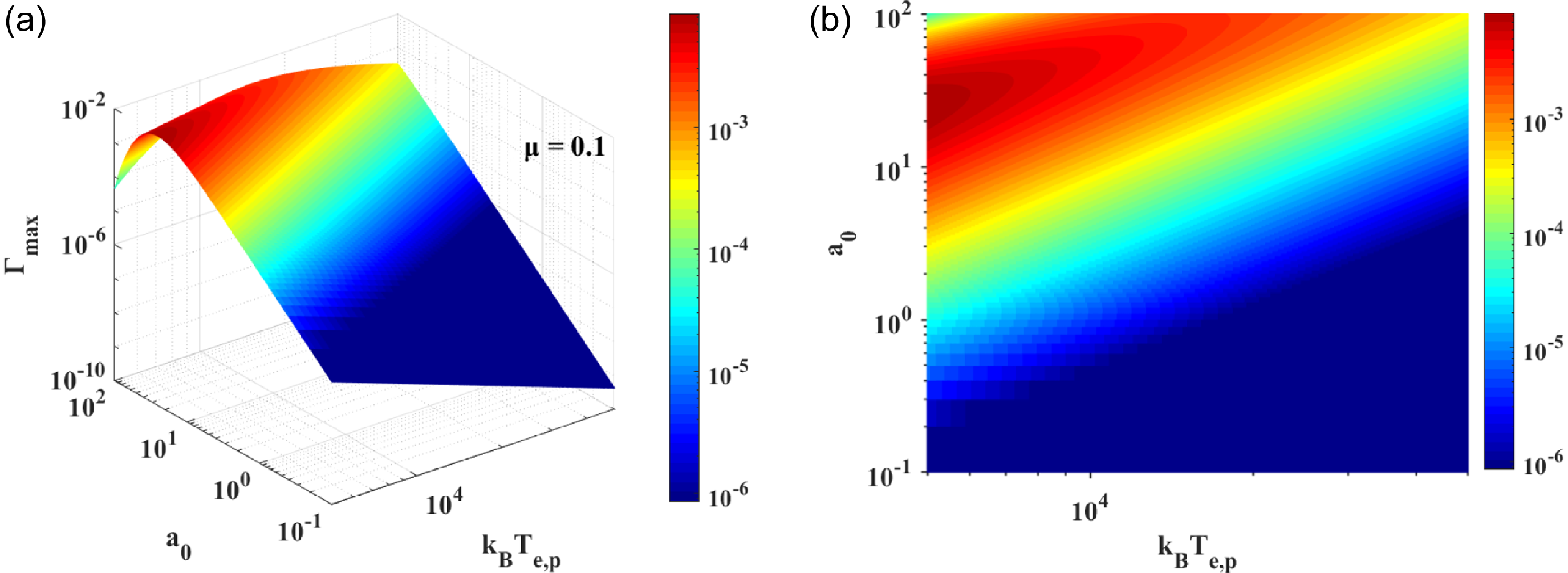
with the particle temperatures, where relativistic-temperature plasma exhibits stronger modulation efficiency on high-intensity electromagnetic waves. The corresponding three-dimensional plot and the phase diagram in the
$\unicode{x1D6E4}_{\mathrm{max}}$
with the particle temperatures, where relativistic-temperature plasma exhibits stronger modulation efficiency on high-intensity electromagnetic waves. The corresponding three-dimensional plot and the phase diagram in the $a_0$
-
$a_0$
- $k_{\textrm{B}}T_{e,p}$
plane are given in figure 7, where
$k_{\textrm{B}}T_{e,p}$
plane are given in figure 7, where $a_0$
ranges from 0.1 to 100, and
$a_0$
ranges from 0.1 to 100, and $k_{\textrm{B}}T_{e,p}$
ranges from 5 to 50 MeV. The analysis reveals a suppression of MI growth rate for low-intensity waves (
$k_{\textrm{B}}T_{e,p}$
ranges from 5 to 50 MeV. The analysis reveals a suppression of MI growth rate for low-intensity waves ( $a_0\lt 1$
) in relativistic hot plasmas, whereas high-intensity waves (
$a_0\lt 1$
) in relativistic hot plasmas, whereas high-intensity waves ( $a_0\gt 1$
) experience enhanced modulation.
$a_0\gt 1$
) experience enhanced modulation.
The variations of the function $\unicode{x1D6E4}_{\mathrm{max}}$
with the particle temperature
$\unicode{x1D6E4}_{\mathrm{max}}$
with the particle temperature $k_{\textrm{B}}T_{e,p}$
in the low-temperature limit for the different electromagnetic-wave amplitudes
$k_{\textrm{B}}T_{e,p}$
in the low-temperature limit for the different electromagnetic-wave amplitudes $a_0$
, with fixed parameter
$a_0$
, with fixed parameter $\mu =0.1$
.
$\mu =0.1$
.
High-temperature limit ( $\mu =0.1$
): (a) dependence of
$\mu =0.1$
): (a) dependence of $\unicode{x1D6E4}_{\mathrm{max}}$
on
$\unicode{x1D6E4}_{\mathrm{max}}$
on $a_0$
and
$a_0$
and $k_{\textrm{B}}T_{e,p}$
, (b) phase diagram of MI in the
$k_{\textrm{B}}T_{e,p}$
, (b) phase diagram of MI in the $a_0$
-
$a_0$
- $k_{\textrm{B}}T_{e,p}$
plane.
$k_{\textrm{B}}T_{e,p}$
plane.
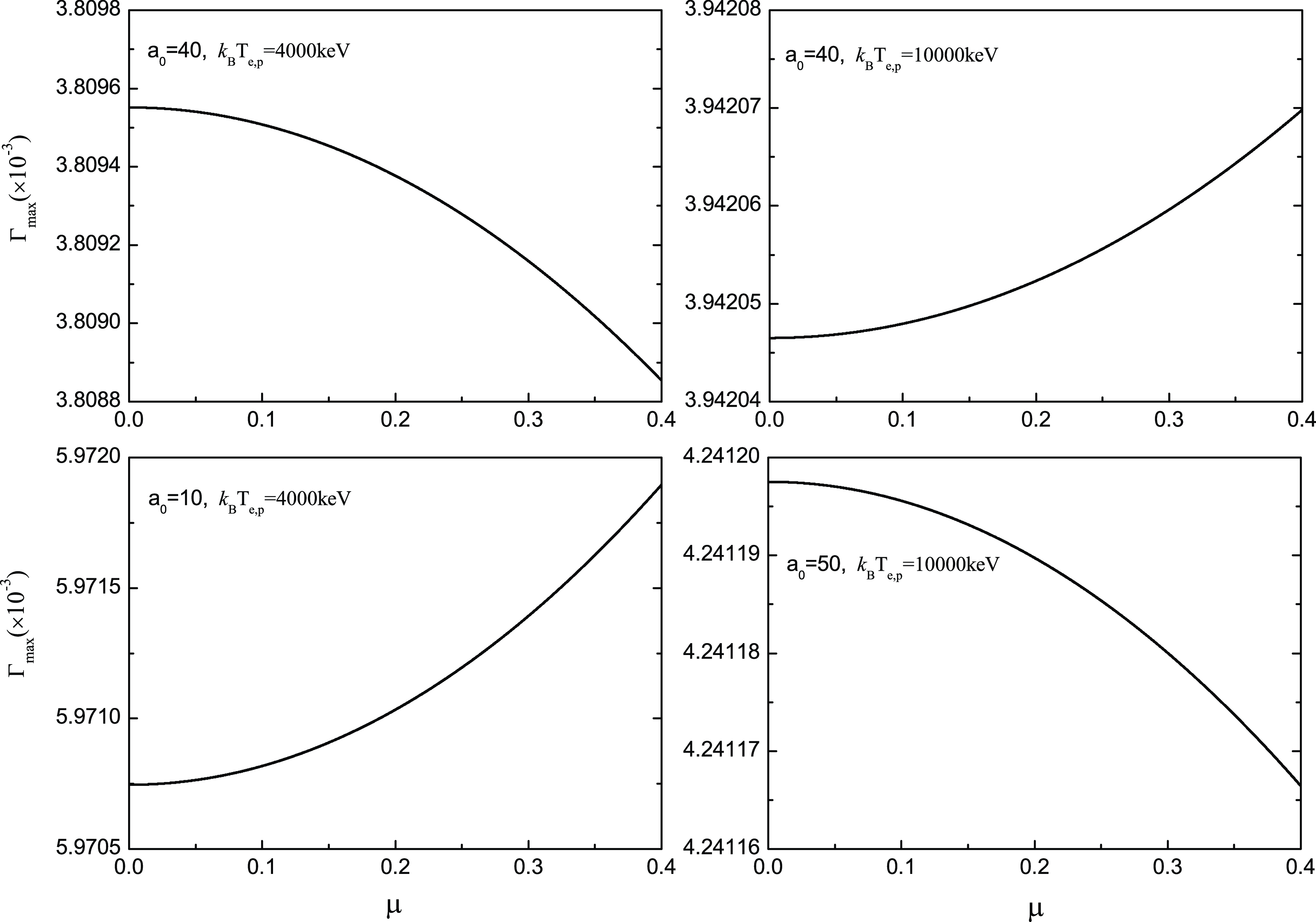
The dependence of the function $\unicode{x1D6E4}_{\mathrm{max}}$
on the magnetic parameter
$\unicode{x1D6E4}_{\mathrm{max}}$
on the magnetic parameter $\mu$
in the limit of high temperature is shown in figure 8. The figure demonstrates that variations in magnetic field strength exhibit negligible influence on the MI of the electromagnetic wave under high-temperature plasma conditions. For example, at
$\mu$
in the limit of high temperature is shown in figure 8. The figure demonstrates that variations in magnetic field strength exhibit negligible influence on the MI of the electromagnetic wave under high-temperature plasma conditions. For example, at $a_0=40$
and
$a_0=40$
and $k_{\textrm{B}}T_{e,p}=4000$
keV,
$k_{\textrm{B}}T_{e,p}=4000$
keV, $\unicode{x1D6E4}_{\mathrm{max}}$
decreases marginally from
$\unicode{x1D6E4}_{\mathrm{max}}$
decreases marginally from $3.80955\times 10^{-3}$
to
$3.80955\times 10^{-3}$
to $3.80885\times 10^{-3}$
as the parameter
$3.80885\times 10^{-3}$
as the parameter $\mu$
increases from 0 to 0.4, corresponding to a relative reduction of 0.018 %.
$\mu$
increases from 0 to 0.4, corresponding to a relative reduction of 0.018 %.
The variation of the function $\unicode{x1D6E4}_{\mathrm{max}}$
with the magnetic parameter
$\unicode{x1D6E4}_{\mathrm{max}}$
with the magnetic parameter $\mu$
for different amplitudes of electromagnetic waves
$\mu$
for different amplitudes of electromagnetic waves $a_0$
and particle temperatures
$a_0$
and particle temperatures $k_{\textrm{B}}T_{e,p}$
in the high-temperature limit.
$k_{\textrm{B}}T_{e,p}$
in the high-temperature limit.
4.2. Examples: MI of high-energy radiation in pulsar
In the following, we investigate the MI of the $\gamma$
-ray radiation emitted from the pulsar as it propagates through the magnetized pair plasmas. Here, we consider a typical pulsar with an intense intrinsic magnetic fields
$\gamma$
-ray radiation emitted from the pulsar as it propagates through the magnetized pair plasmas. Here, we consider a typical pulsar with an intense intrinsic magnetic fields $B_{\textrm{s}}\approx 10^{12}$
G at the pulsar surface, a rotation period
$B_{\textrm{s}}\approx 10^{12}$
G at the pulsar surface, a rotation period $P_\ast \approx 1$
s and a radius
$P_\ast \approx 1$
s and a radius $R_\ast \approx 10$
km. In the polar cap regions, the pair plasma (with the density
$R_\ast \approx 10$
km. In the polar cap regions, the pair plasma (with the density $n_0\approx 10^{14}-10^{16}\,\textrm{cm}^{-3}$
(Daugherty & Harding Reference Daugherty and Harding1982)), is produced via cascade processes of EP pairs, from which high-energy radiation is emitted. The pair plasma typically forms behind a thin layer termed the ‘pair formation front’, located at an altitude
$n_0\approx 10^{14}-10^{16}\,\textrm{cm}^{-3}$
(Daugherty & Harding Reference Daugherty and Harding1982)), is produced via cascade processes of EP pairs, from which high-energy radiation is emitted. The pair plasma typically forms behind a thin layer termed the ‘pair formation front’, located at an altitude $h\approx 10^{4}\,\textrm{cm}$
from the star’s surface. After generation, the plasma moves outward at high velocity, and may propagate to altitudes of up to
$h\approx 10^{4}\,\textrm{cm}$
from the star’s surface. After generation, the plasma moves outward at high velocity, and may propagate to altitudes of up to $100R_\ast$
.
$100R_\ast$
.
The plasma temperature in the pulsar magnetosphere is reported to be $10^6$
K (Helfand et al. Reference Helfand, Chanan and Novick1980), corresponding to
$10^6$
K (Helfand et al. Reference Helfand, Chanan and Novick1980), corresponding to $k_{\textrm{B}}T_{e,p}=0.1$
keV. The amplitude of the electric field
$k_{\textrm{B}}T_{e,p}=0.1$
keV. The amplitude of the electric field $E_0$
(in the laboratory frame) produced by the high-energy radiation can be estimated from the luminosity of pulsars as
$E_0$
(in the laboratory frame) produced by the high-energy radiation can be estimated from the luminosity of pulsars as
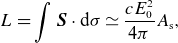 \begin{eqnarray} L=\int {\boldsymbol{S}}\cdot {\rm d}\sigma \simeq \frac {cE_0^2}{4\pi }A_{\textrm{s}}, \end{eqnarray}
where $\boldsymbol{S}$
is the Poynting vector describing the electromagnetic (EM) energy flux, and
$\boldsymbol{S}$
is the Poynting vector describing the electromagnetic (EM) energy flux, and $A_{\textrm{s}}$
is the transverse area though which the energy flux flows. Therefore we have
$A_{\textrm{s}}$
is the transverse area though which the energy flux flows. Therefore we have
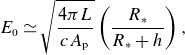 \begin{eqnarray} E_0\simeq \sqrt {\frac {4\pi L}{cA_{\textrm{p}}}}\left(\frac {R_{\ast }}{R_{\ast }+h}\right), \end{eqnarray}
where $A_{\textrm{p}}$
is the polar cap area (with radius
$A_{\textrm{p}}$
is the polar cap area (with radius $r_{\textrm{p}}=10^4P_\ast ^{-1/2}\,\textrm{cm}$
), and
$r_{\textrm{p}}=10^4P_\ast ^{-1/2}\,\textrm{cm}$
), and $h$
is the altitude from the stellar surface. In polar gap models, high-energy emissions originate at lower altitudes
$h$
is the altitude from the stellar surface. In polar gap models, high-energy emissions originate at lower altitudes $h\approx 10^{-2}R_\ast =10^4$
cm (Ruderman & Sutherland Reference Ruderman and Sutherland1975; Hibschman Reference Hibschman2002). Strong radiation in the bands of
$h\approx 10^{-2}R_\ast =10^4$
cm (Ruderman & Sutherland Reference Ruderman and Sutherland1975; Hibschman Reference Hibschman2002). Strong radiation in the bands of $\gamma$
-rays with luminosity
$\gamma$
-rays with luminosity $L_{\gamma }\approx 10^{33}-10^{36}\textrm{erg/s}$
has been observed from a few pulsars (Ulmer Reference Ulmer1994). Therefore, the amplitude of the electric field
$L_{\gamma }\approx 10^{33}-10^{36}\textrm{erg/s}$
has been observed from a few pulsars (Ulmer Reference Ulmer1994). Therefore, the amplitude of the electric field $E_0\approx 10^7-10^9 \textrm{esu}$
for
$E_0\approx 10^7-10^9 \textrm{esu}$
for $\gamma$
-rays is estimated. Correspondingly, the normalized vector potential is
$\gamma$
-rays is estimated. Correspondingly, the normalized vector potential is $a_0=eE_0/(m_ec\omega _0)\approx 10^{-6}-10^{-4}$
for
$a_0=eE_0/(m_ec\omega _0)\approx 10^{-6}-10^{-4}$
for $\gamma$
-rays with
$\gamma$
-rays with $\omega _0\approx 10^{20}\, \textrm{s}^{-1}$
.
$\omega _0\approx 10^{20}\, \textrm{s}^{-1}$
.
The local magnetic field follows the dipolar approximation
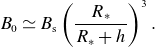 \begin{equation} B_0\simeq B_{\textrm{s}}\left(\frac {R_\ast }{R_\ast +h}\right)^{3}. \end{equation}
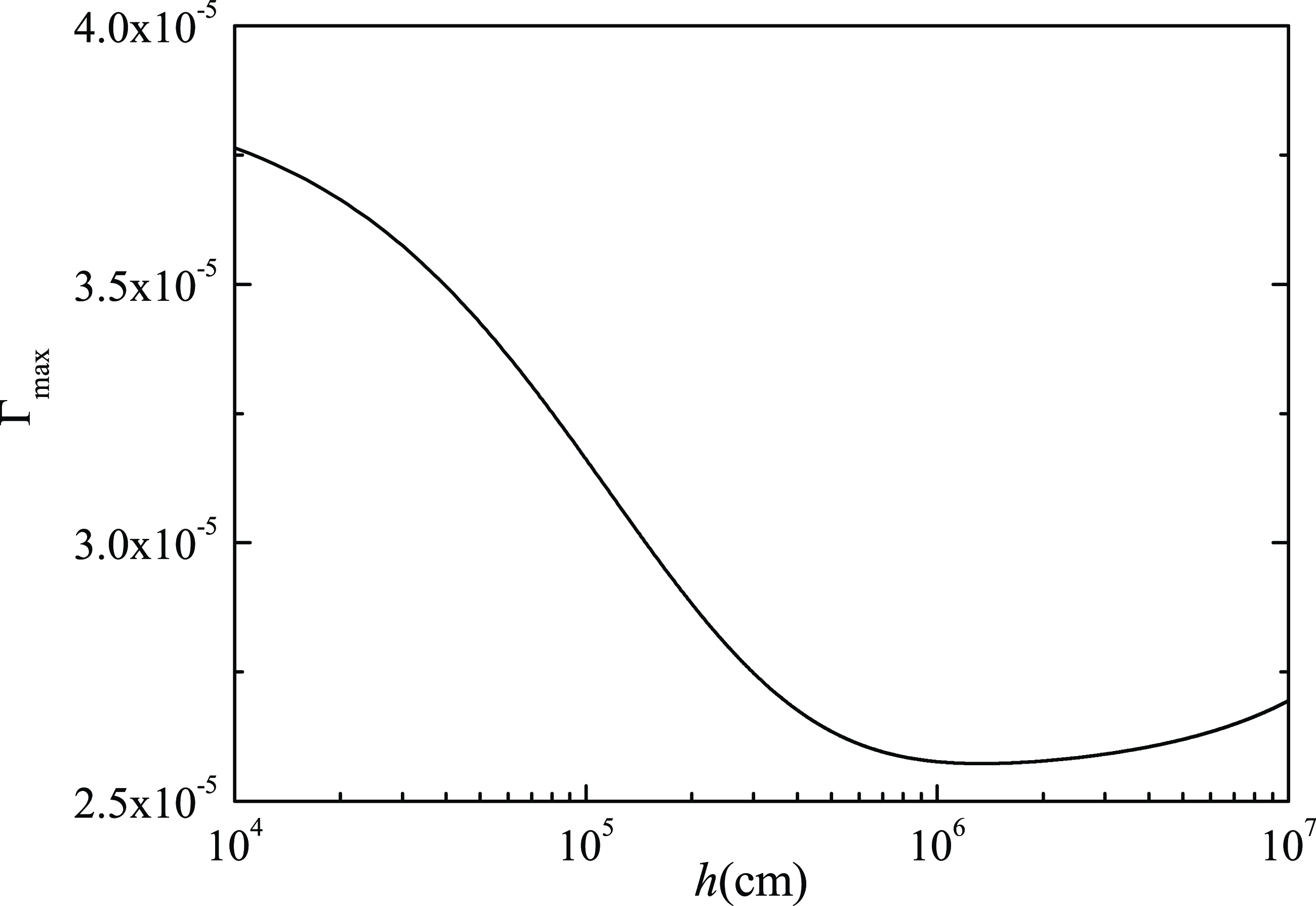
Figure 9 shows the dependence of $\unicode{x1D6E4}_{\mathrm{max}}$
on altitude
$\unicode{x1D6E4}_{\mathrm{max}}$
on altitude $h$
for
$h$
for $a_0=10^{-4}$
and
$a_0=10^{-4}$
and $n_0\approx 10^{16}\,\mathrm{cm}^{-3}$
(corresponding to
$n_0\approx 10^{16}\,\mathrm{cm}^{-3}$
(corresponding to $\omega _{pe}=5.64\times 10^{12}\,\textrm{s}^{-1}$
), as
$\omega _{pe}=5.64\times 10^{12}\,\textrm{s}^{-1}$
), as $\gamma$
-rays propagate from
$\gamma$
-rays propagate from $h\approx 10^{4}\textrm{}$
to
$h\approx 10^{4}\textrm{}$
to $h\approx 10^{7}\, \textrm{cm}$
. The curve showed a trend of decreasing firstly and then increasing, which is caused by changes in the strength of the magnetic field and the amplitude of the electromagnetic wave.
$h\approx 10^{7}\, \textrm{cm}$
. The curve showed a trend of decreasing firstly and then increasing, which is caused by changes in the strength of the magnetic field and the amplitude of the electromagnetic wave.
The variation of the function $\unicode{x1D6E4}_{\mathrm{max}}$
with the altitude
$\unicode{x1D6E4}_{\mathrm{max}}$
with the altitude $h$
for
$h$
for $a_0=10^{-4}$
and
$a_0=10^{-4}$
and $n_0\approx 10^{16}\,\textrm{cm}^{-3}$
.
$n_0\approx 10^{16}\,\textrm{cm}^{-3}$
.
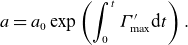
Using the dimensional growth rate $\unicode{x1D6E4}'_{\mathrm{max}}=\unicode{x1D6E4}_{\mathrm{max}}\omega _{pe}^2/\omega _0$
, the amplitude of electromagnetic radiations being modulated can be written as
$\unicode{x1D6E4}'_{\mathrm{max}}=\unicode{x1D6E4}_{\mathrm{max}}\omega _{pe}^2/\omega _0$
, the amplitude of electromagnetic radiations being modulated can be written as
 \begin{equation} a=a_0\exp \left (\int _0^t\unicode{x1D6E4}'_{\mathrm{max}}\textrm{d} t\right ). \end{equation}
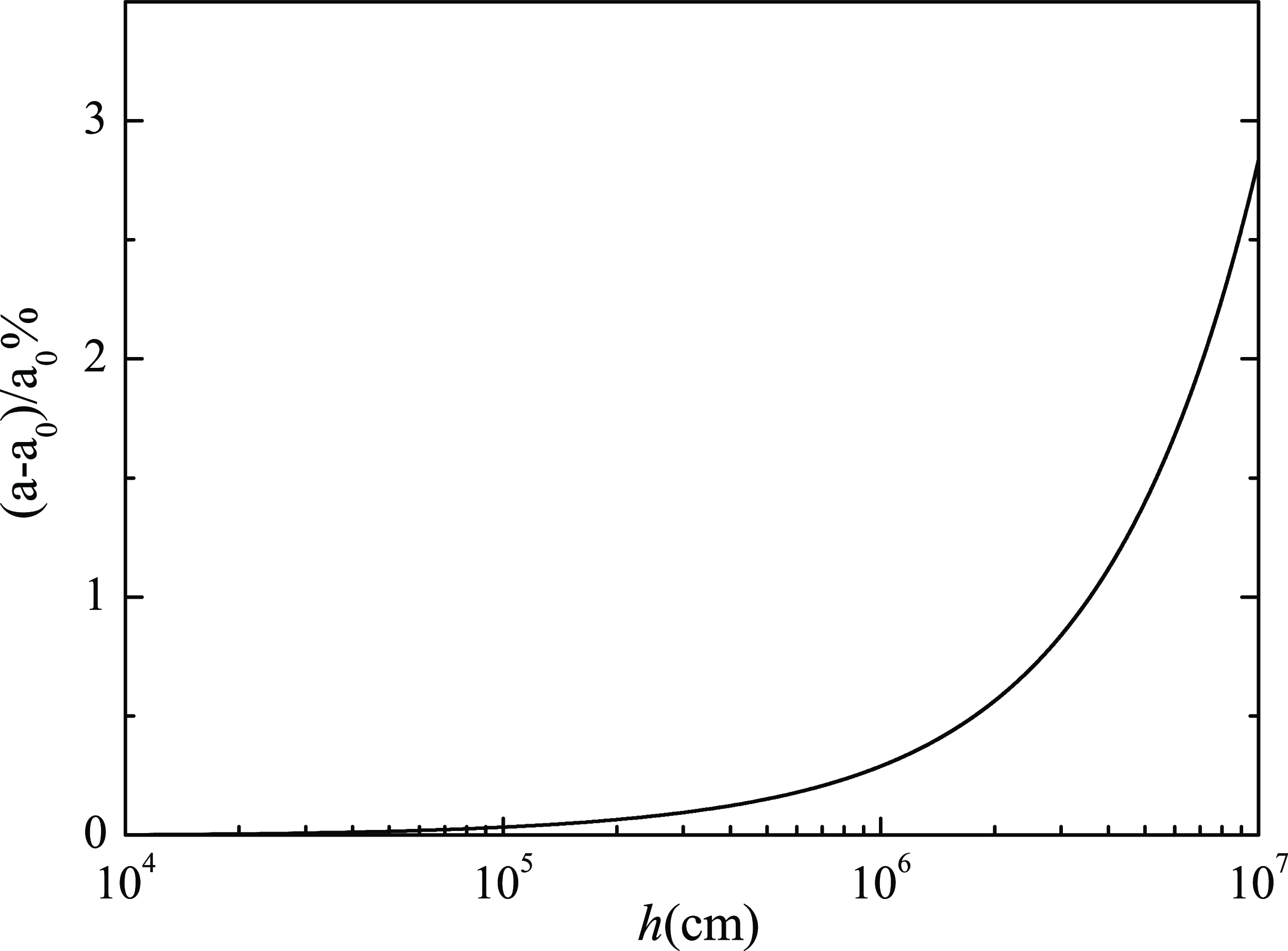
The relative amplitude increase $[(a-a_0)/a_0]\,\%$
with the altitude
$[(a-a_0)/a_0]\,\%$
with the altitude $h$
is shown in figure 10. It shows that the amplitude of the electromagnetic radiation increases by
$h$
is shown in figure 10. It shows that the amplitude of the electromagnetic radiation increases by $2.81\,\%$
, when it travels from
$2.81\,\%$
, when it travels from $10^{4}\textrm{}$
to
$10^{4}\textrm{}$
to $10^{7}\, \textrm{cm}$
in the magnetosphere of the pair plasma.
$10^{7}\, \textrm{cm}$
in the magnetosphere of the pair plasma.
The relative amplitude increase $[(a-a_0)/a_0]\,\%$
with the altitude
$[(a-a_0)/a_0]\,\%$
with the altitude $h$
for
$h$
for $a_0=10^{-4}$
.
$a_0=10^{-4}$
.
5. Summary and conclusion
In this work, the MI of an electromagnetic wave propagating along an external magnetic field in an EP plasma is investigated. The normalized amplitude of electromagnetic waves $a_0$
considered in this work ranges from 0.01 to 100, covering regimes from weakly relativistic to ultra-relativistic. A fully relativistic fluid model for particles is used, in which a temperature-dependent function
$a_0$
considered in this work ranges from 0.01 to 100, covering regimes from weakly relativistic to ultra-relativistic. A fully relativistic fluid model for particles is used, in which a temperature-dependent function $f_{\!j}=K_{3}(mc^2/k_{\textrm{B}}T_{j})/K_{2}(mc^2/k_{\textrm{B}}T_{j})$
is included to account for thermal effects. In the regime of weakly magnetized plasmas, we derive a modified nonlinear Schrödinger equation that describes the evolution of the envelope of an electromagnetic wave in magnetized EP plasmas. The dispersion relation and the growth rate of MI are studied theoretically and numerically. The variation of the MI growth rate with the wave amplitude
$f_{\!j}=K_{3}(mc^2/k_{\textrm{B}}T_{j})/K_{2}(mc^2/k_{\textrm{B}}T_{j})$
is included to account for thermal effects. In the regime of weakly magnetized plasmas, we derive a modified nonlinear Schrödinger equation that describes the evolution of the envelope of an electromagnetic wave in magnetized EP plasmas. The dispersion relation and the growth rate of MI are studied theoretically and numerically. The variation of the MI growth rate with the wave amplitude $a_0$
, particle temperature
$a_0$
, particle temperature $k_{\textrm{B}}T_{e,p}$
and magnetic field strength is analyzed in detail for two limiting cases: the low-temperature limit (
$k_{\textrm{B}}T_{e,p}$
and magnetic field strength is analyzed in detail for two limiting cases: the low-temperature limit ( $k_{\textrm{B}}T_{j}\ll mc^2$
) and the high-temperature limit (
$k_{\textrm{B}}T_{j}\ll mc^2$
) and the high-temperature limit ( $k_{\textrm{B}}T_{j}\gg mc^2$
).
$k_{\textrm{B}}T_{j}\gg mc^2$
).
Due to the coupled multi-parameter effects, the MI exhibits a non-monotonic dependence on the individual parameters. From the numerical analysis, we draw the following conclusions:
-
i. When the plasma temperature and magnetic field intensity are fixed, the growth rate of MI increases first and then decreases with increasing wave amplitude.
-
ii. When the wave amplitude and magnetic field intensity are fixed, the growth rate of MI also demonstrates a non-monotonic trend, initially increasing then decreasing with rising plasma temperature.
-
iii. At fixed plasma temperature, the growth rate of MI increases with external magnetic field strength for low-intensity waves but decreases for high-intensity waves.
-
iv. At fixed wave amplitude, the MI growth rate decreases with increasing magnetic field strength for lower plasma temperatures, whereas it increases for higher temperatures. It should be pointed out that the magnetic field-induced variation in growth rate becomes negligible in the high-temperature limit.
We apply the theoretical results obtained in this paper to analyze the MI of gamma rays emitted from the pulsar surface. The result shows that the amplitude of the radiation increases by $2.81\,\%$
when propagating from
$2.81\,\%$
when propagating from $10^{4}\textrm{}$
to
$10^{4}\textrm{}$
to $10^{7}\, \textrm{cm}$
in the magnetosphere of the pulsar. This study enhances our understanding of the nonlinear dynamics in electromagnetic radiation propagating through magnetized pair plasmas on pulsar surfaces, and provides insights into intense laser–plasma interactions in magnetized hot pair plasmas.
$10^{7}\, \textrm{cm}$
in the magnetosphere of the pulsar. This study enhances our understanding of the nonlinear dynamics in electromagnetic radiation propagating through magnetized pair plasmas on pulsar surfaces, and provides insights into intense laser–plasma interactions in magnetized hot pair plasmas.
Acknowledgements
Editor Luís O. Silva thanks the referees for their advice in evaluating this article.
Funding
This work is supported by the Project of Jingdezhen University (Grant No. 2022xjkt-02); the Open Fund of the National Demonstration Center for Experimental College Physics Education (NCHU) (Grant No. SY2304); the Science and Technology Planning Project of Jingdezhen City (Grant No. 20161GYZD001-16) and the Science and Technology Project of Provincial Education Department of Jiangxi Province (Grant No. GJJ202816).
Declaration of interests
The authors report no conflict of interest.


 Open access

