


The dominant debates in reproductive ethics tend to revolve around a number of questions. Who should have access to fertility treatments, and on what basis (Brown et al. Reference Brown, Rogers, Entwistle and Bhattacharya2016)? Who should bear their costs when resources are limited (McTernan Reference McTernan2015)? How should reproductive autonomy be balanced against other moral goods (Johnson and Zacharias Reference Johnston and Zacharias2017; Knight and Miller Reference Knight and Miller2021)? What is the normative significance of human reproduction for parenthood attribution (Austin Reference Austin2016)? Questions such as these all rely on the assumption that we know what reproduction is. But with further developments in biomedical technology, it is becoming increasingly evident that reproduction itself is a concept in need of clarification (Franklin Reference Franklin2007).
In the following analysis, we explore four biological components of reproduction: sex, gestation, birth, and genes. We draw on Sally Haslanger’s analysis of the biological/social division between sex and gender to analyse the degree to which reproduction itself is socially constructed. We show that without a rigorous philosophical analysis, the concept of reproduction is hostage to a variety of uses and interpretations that reinforce entrenched assumptions while masquerading as biological facts. Moreover, we cannot assume we know what other people mean when they talk about reproduction, nor what ought to count as reproduction.
1. Is reproduction biological, social, or both?
According to Sally Haslanger, some phenomena have both social and biological components. She gives the example of sex and gender to illustrate her point. Sex is generally taken to be biological, while gender is social. However, Haslanger suggests that this simple dichotomy is not the whole answer when it comes to understanding the relationship between the social and the biological. She acknowledges that the biological/social division between sex and gender is useful in some respects. In very crude terms, it can be understood to entail that biological sex is what is “given,” as opposed to socially constructed (gender). But Haslanger shows that the “biological” component of sex is also socially constructed. That is because it is a matter of social judgment and negotiation as to which biological criteria we regard as being necessary or sufficient to indicate whether a person is biologically male or female. We might choose to say that chromosomes are what counts. Or testosterone levels. Or the ability to produce eggs or sperm. Or the ability to gestate babies. Or the appearance of one’s genitals (Haslanger Reference Haslanger2017).
The question of sex and gender, and the relationship between them has been widely discussed by biologists, bioethicists and many others and is today a subject of ongoing scholarly debate (Beauvoir Reference Beauvoir1972; Mikkola Reference Mikkola2007; Jenkins Reference Jenkins2016; Gheaus Reference Gheaus2023). Likewise, the meaning of parenthood has been extensively analysed, with debates focusing on the significance of genetic and/or other biological ties (O’Neill and Ruddick Reference O’Neill and Ruddick1979; Richards Reference Richards2010; Silver Reference Silver2001; Shoeman Reference Shoeman1980). But reproduction has not been the focus of similar attention, despite its powerful place in our lives. Yet it is obvious, when comparing reproduction with sex, as above, that there are many similarities between the two phenomena. As long as there is a social or negotiated element in defining concepts, Haslanger suggests, we should think about what normative work we want this concept to perform.
Like sex and gender, reproduction and biological parenthood are linked in ways that are not “given” biologically, even though they may have biological components. Because of this, certain interpretations of reproduction exclude people from the status of biological parenthood. Conversely, fertility treatments selectively pick out some biological factors as being essential for reproduction, while others are regarded as irrelevant. Prospective parents whose needs align with the dominant biological interpretations are thus benefitted, and those whose do not, are dismissed. The status of reproduction and its relationship with biological parenthood are thus in need of the same kind of analysis that is widely recognized as being integral to conceptions of sex and gender. In what follows, we undertake this analysis.
2. Historical understandings of reproduction
Historically, much of the biological focus on reproduction seems to have arisen from men’s anxiety as to whether they were the “real” fathers of their offspring. As the owner and transmitter of property, a man needed to know if the children due to inherit his estate were his own and not those of some other man (NeJaime Reference NeJaime2017). Therefore, it was in his interests to ensure that only he had sexual access to the womanFootnote 1 who was to become his offspring’s mother (Coontz and Henderson Reference Coontz and Henderson1986). Thus women’s sexual freedom was severely curtailed, both through directly coercive means (confining them to the home) and through subtler psychological means (impressing upon them that extramarital sex was immoral) (Buss Reference Buss1994).
There are, of course, cultural differences in the degree to which men have or express these interests. However, these concerns are very widespread across different communities, and the institution of marriage and—specifically female—fidelity are to be found all over the world (Strassmann et al. Reference Strassmann, Kurapati, Hug, Burke, Gillespie, Karafet and Hammer2012; Schacht and Kramer Reference Schacht and Kramer2019). Certainly, in much of Western Europe, anxieties and preoccupations with paternity and virginity have been extremely powerful. Our argument applies primarily to countries that share a Judeo-Christian heritage. Historically, questions of paternity have been an ongoing source of concern and also humour and ridicule in these societies (Brundage Reference Brundage2009).
In contrast, it was widely accepted that a woman never had reason to doubt whether the child she gave birth to was “really” hers. A woman might, of course, have been uncertain as to whether the child she was raising was in fact the same one she had given birth to. These uncertainties, both as to maternity and paternity, feature widely in literature and folklore (Muir Reference Muir1982; Hartland Reference Hartland1909). The historical preoccupation with virginity, sex, birth, and paternity can be seen as an attempt to ensure that nurturing efforts were directed to offspring who would perpetuate their parents’ (or perhaps more properly, fathers’) genes. Yet of course, our ancestors knew nothing about genes per se. Their account of what made a child “their own” was frequently described in terms of “blood” (Crawford Reference Crawford2015). The blood link was created and evidenced via sexual begetting and birthing. These are biological phenomena in one sense; they involve the body, they are physical processes. But they are also cultural and symbolic.
For our ancestors, the relationship between biology and symbolism was fluid. The biblical stories of Sarai and Hagar and Rachel and Bilhah describe practices and rituals designed to function as a symbolic substitute for the biological processes of sex and birth (Jacobs Reference Jacobs1997; Crane Reference Crane2017). These rituals enabled the transfer of parenthood, not via legal or social contracts, but because the physical and biological processes had been symbolically replicated. These practices were not “reproductive medicine” in terms that today’s fertility clinicians would recognize. They were symbolic rituals. One might assume that there is nothing ritualistic or symbolic about what happens in our fertility clinics. Fertility treatment is medical and scientific. It corrects biological failures and facilitates appropriate biological pathways towards parenthood. If so, modern fertility medicine facilitates reproduction—thus creating biological parents—whereas these past practices did not. However, we will go on to suggest that the supposedly scientific approach to reproduction represented in today’s fertility clinics is illusory. Reproduction and fertility medicine today are still defined in accordance with cultural, symbolic, and normative values despite the significant role played by biology in our understandings of these phenomena.
3. The biological reproduction paradigm
Despite our increasing knowledge about the biology of reproduction, it does not seem evident that we have a clearer picture of what reproduction actually is, compared to people in the past. People in our societies reproduce, seek fertility treatments in order to have “their own” children, and distinguish between biological and social parenthood. It has been taken for granted in many of these endeavors that we know what we are doing, and—in fertility medicine—what we are replicating. Yet in practice, biologists and philosophers of biology are not at all unified in their understanding of what reproduction is, what exactly is reproduced, or how (Veigl et al. Reference Veigl, Suárez and Stencel2022; Brandon and Rosenberg Reference Brandon and Rosenberg2003).
Given this, one might wonder how the medical, social, and legal structures in our societies can really be certain about whether it is reproduction that they are reflecting, enforcing, or facilitating in the clinic. The idea that reproduction is a straightforward biological process that makes one the biological parent of any resultant offspring is persuasive and powerful in Western societies (Franklin Reference Franklin2002). We term this the biological reproduction paradigm. The biological reproduction paradigm also serves as a touchstone for the related concept of infertility. In this paradigm, infertile couples are those who require medical help in order to have, preferably, “their own” biological child (Segers et al. Reference Segers, Pennings and Mertes2019). Fertility medicine facilitates or replicates the features of biological reproduction, and in doing so, creates biological parents (Testa and Harris Reference Testa and Harris2005).
Yet although the biological reproduction paradigm enforces the idea of reproduction as the process by which people become biological parents, there is an inbuilt instability in the relationship between the paradigm and fertility treatments (Smajdor and Cutas Reference Smajdor and Cutas2015). This instability has been noted by a number of scholars, many of whom are critical of the idea that biology alone should be used to determine parenthood (Hill Reference Hill2017).
In many cases, new technological possibilities fragment the biological components of reproduction in ways that call into question the integrity of the concept (Romanis and Brown Reference Romanis and Brown2024; Margalit et al. Reference Margalit, Levy and Loike2014). For example, a woman can give birth to a baby conceived with someone else’s egg (Pasch Reference Pasch2018). A baby can be gestated in a uterus removed from one woman and transplanted into the body of another (Brännström et al. Reference Brännström, Johannesson, Bokström, Kvarnström, Mölne, Dahm-Kähler, Enskog, Milenkovic, Ekberg, Diaz-Garcia and Gäbel2015). Gametes can be retrieved from young children (Dong et al. Reference Dong, Kristensen, Hildorf, Gul, Clasen-Linde, Fedder, Hoffmann, Cortes, Thorup and Andersen2019; Szymanska et al. Reference Szymanska, Vash-Margita, Gunther, Rodriguez-Buritica and Oktay2021), and also from comatose, dying, or dead people (Ovics et al. Reference Ovics, Baram, Nothman, Weiss and Beck-Fruchter2022; Boothroyd and Kruger Reference Boothroyd and Kruger2022). Ovarian tissue can be transferred from one woman to another. Mitochondrial DNA donation enables the birth of babies with DNA from three adults (Craven et al. Reference Craven, Murphy and Turnbull2020).
For these procedures to be offered to patients in the clinic, some kind of narrative is required, which accounts for their place in fertility medicine and mirrors the biological processes of reproduction. Yet the various narratives involved tend to be hazy, inconsistent, or self-contradictory, as several philosophers have noted (Douglas and Devolder Reference Douglas and Devolder2019; Kukla Reference Kukla2019). The biological essence of reproduction shifts depending on what it is that is needed in order to enable parenthood. Reproduction is about genes, when the medical procedures involve collecting gametes (Mertes Reference Mertes2014), but about chromosomes when it comes to mitochondrial donation. It is about gestation when it comes to uterus transplantation, but about genes again in cases of gestational surrogacy (Kukla Reference Kukla2019). Moreover, the understanding and implementation of the biological reproduction paradigm in the clinic does not necessarily mirror other social structures—in particular the law, where different norms and paradigms apply (Romanis and Brown Reference Romanis and Brown2024), sometimes based on genes (in cases of paternity disputes), sometimes on gestation and birth (in the ascription of legal motherhood), and sometimes on subdivisions within the DNA (in the exclusion of mitochondrial donors from biological parenthood status in the UK, for example: Turkmendag Reference Turkmendag2018).
All of the possibilities listed above—genes, sex, gestation, birth—are biological in fairly obvious ways. Yet they raise questions about how and whether biology alone can tell us who has reproduced and who is a biological parent. It is tempting, when this happens, to look back to “nature” to work out which biological connections constitute “reproduction” and which constitute—something else. However, we will show that biological connections do not after all straightforwardly answer the question “who has reproduced?”. Moreover, the paradigm case of natural reproduction is in fact not as simple as the biological reproduction paradigm suggests.
This being the case, when we use the term “reproduction” it is not always obvious to what we are referring. Accordingly, related concepts such as biological parenthood and infertility that build on assumptions about reproduction are likewise unstable and inconsistent. In turn, this calls into question a wide variety of social, political, and legal norms governing reproduction.
In short, according to the biological reproduction paradigm:
-
Reproduction is biological.
-
Biological parents are necessarily those who have reproduced.
-
There are exactly two biological parents, one of each sex.
-
When conception happens through intercourse, the two sexual partners are the biological parents.
-
Biological parenthood is a matter of fact, not negotiation or opinion.
-
The biological reproduction paradigm explains why some technological possibilities (such as in vitro fertilization (IVF) or introcytoplasmic sperm injection (ICSI)) are reproductive, while others (reproductive cloning, mitochondrial donation) are not.
4. In what way is human reproduction “biological”?
In this section we discuss some of the biological components of human reproduction: namely, sex, gestation, birth, and genetic connection. We show that each of these components offers a number of different permutations. We should clarify here that these biological categories of reproduction are not intended to represent an exhaustive account of human biological reproductive possibilities. One could include other phenomena, such as breastfeeding. In some cultures, people who have been breastfed by the same woman are regarded as “milk siblings” and thus barred from marrying each other (Thorley Reference Thorley2014). Milk kinship can be understood as biological because it involves an exchange of bodily fluids, and because it brings about epigenetic effects on the child. These biological links are regarded as significant in some places, but not in most Western societies today (Struyf Reference Struyf2025).
In picking out the categories we focus on, there is an inescapable element of cultural influence. What we deem to be biologically significant in reproduction varies between cultures and over time. Our own culture emphasizes certain aspects of biology, and it is primarily these that we address here. However, the broader message is that—whichever aspects of biology we examine—we are likely to find that they give an inadequate or unsatisfactory account of reproduction, at least in terms of the biological reproduction paradigm.
4.1 Sex, begetting, and conception
In the past, sex was a necessary part of reproduction. The term “begetting” refers to the link between sexual intercourse and the moment of conception. In modern medicine, however, the significance of “begetting” as a biological component of reproduction seems to have been sidelined. Is this because sex is not inherently an important component of biological reproduction? If so, why not, given how important it used to be to our ancestors? One possible answer is that sex was never important in itself, but simply as a means to an end—the method by which humans, unaided by medicine, managed to get their gametes together. If so, it is the gametes that are important, and not the mode of delivery.
The role that sex plays in the biological reproduction paradigm is complicated, however. Until recently, any conception that arose through sex would necessarily involve the gametes of two sexual partners. People who could not produce gametes could therefore not reproduce sexually. If they were to have children at all, it would be via non-sexual methods. This is no longer the case. A child can in principle be “begotten” sexually without her being the gametic offspring of either of the sexual partners: for example, where ovarian tissue is transplanted into a woman, who then becomes pregnant through sex (Silber and Gosden Reference Silber and Gosden2007; Silber Reference Silber2008; Brundage Reference Brundage2023). Similarly, a man who has undergone a testicular tissue transplant may be able to ejaculate during intercourse, resulting in conception (Silber and Rodriguez Reference Silber and Rodriguez1980). But the sperm that emerge are not genetically “his.” This potential separation enables us to ask whether sex itself has any significance when it is a causal biological component of reproduction but does not transmit the gametes of the sexual partners themselves. Would patients who received these transplants and conceived a child through begetting have reproduced? Would they be the biological parents of the resulting offspring? When we consider these possibilities, we can see the fracture lines appearing between common-sense accounts of reproduction and parenthood, and legal and medical accounts.
Sexual begetting is neither a necessary nor a sufficient biological component of reproduction in the context of fertility medicine. In non-clinical settings, however, such as self-insemination undertaken by lesbian couples, a sexual element can be an important part of the procedure. Indeed, it may be that, in some cases, non-medical, unregulated, and informal arrangements are preferred for precisely the reason that to beget offspring, even if unrelated genetically, is regarded as being valuable (Nordqvist Reference Nordqvist2011).
Since the advent of IVF, conception has become separable from sex. This makes it possible to ask new questions as to the significance of conception as a phenomenon in its own right. Conception is the biological process that occurs when a sperm and an egg unite to form a zygote. This moment involves comprehensive changes to the formerly individual gametes, as they become one organism. In “natural” reproduction, conception happens within the body. In assisted reproduction, it can be undertaken in a laboratory with various degrees of intervention. Sperm and egg can be placed in a vessel together in the hope that conception will occur. Or using ICSI a sperm cell can be injected directly into an egg. Since historically, there was no intentional act involved in conception (aside from the act of sexual intercourse), there was no need to question whether the people doing the conceiving had reproduced, or whether they were the parents of the resulting offspring. The people who had sex were the parents; conception and sex could not be separated. Nevertheless, given the very different degree of intent and intervention in ICSI, for example, perhaps there are some grounds for thinking of the act of conception as something that should be considered as one among the other biological components of reproduction (Laing and Oderberg Reference Laing and Oderberg2005).
Currently, all existing humans were conceived, either in the body or in vitro. However, in the future other modes of creation may be possible, including for example cloning, as in the case of Dolly the sheep, or the development of synthetic DNA. Because Dolly was not conceived through the union of a sperm and an egg, one can claim that the process through which she came to be is not conception at all, but something else. Similarly, with synthetic DNA creation, there would be no need for conception or fertilization as we know it. Rather, a genome is constructed de novo and inserted into a cell (Hughes and Ellington Reference Hughes and Ellington2017).
4.2 Gestation
Gestation is the biological process by which the fetus grows and develops in the uterus. Biological materials are exchanged between the fetus and the woman who gestates: each changes the other biologically to some degree. The fetus draws oxygen and nutrients from the woman’s bloodstream. The woman’s activities and environment feed through to the fetus, influencing the expression of their genes. Her body changes and adjusts as the fetus develops (Kazma et al. Reference Kazma, van den Anker, Allegaert, Dallmann and Ahmadzia2020).
The role of gestation in reproduction has become contested in a way that “begetting” has not. This is largely because of the possibility of enabling a separation between gestation and other biological components of reproduction. People who use gestational surrogates commonly construe themselves, rather than the surrogate, as the biological parents, if they are the ones who have provided the gametes. If the surrogate is not a/the biological parent, it seems to entail either a separation between the inexorability of the link between reproduction and biological parenthood, or alternatively, to imply that the surrogate has not reproduced.
In recent years, further complexities have arisen with the advent of uterus transplantation. This is an intervention characterized by significant risk imposed on otherwise healthy patients, involving highly invasive surgery to transplant the uterus, often obtained from a living donor: thus surgery is imposed on two healthy women. The transplanted uterus is, like any other transplanted organ, at risk of rejection: recipients must take anti-rejection drugs, which carry an elevated risk of cancer, and they must undergo the subsequent surgical removal of the organ after a specified number of years. These are extraordinary endeavors, in medical terms, even in the highly sophisticated field of transplant medicine (Cavaliere Reference Cavaliere2022). The costs, risks, and research required to achieve this is indicative of the high value that is placed on pregnancy itself (Johansson forthcoming)—provided that the recipient is deemed a woman by the medical establishment (in this case, womanhood is defined chromosomally: Aljerian Reference Aljerian2021).
Thus, it seems that gestation is a hugely significant part of the biological reproduction paradigm. The case of uterus transplants contrasts strikingly with that of ovarian/testicular tissue transplants. Allowing people to beget their children sexually has not been prioritized in the way that medically facilitated gestation has. Although ovarian/testicular tissue transplant are both medically feasible, and considerably less risky to both donors and recipients than uterus transplantation, they are rarely undertaken. And testicular tissue transplants in particular are far less common than ovarian transplants (Silber Reference Silber2018). This could represent a response to patient demand. Perhaps men simply don’t care about the possibility of “begetting” their child. As noted earlier, there is evidence that lesbian couples do place value on a form of begetting, though this often has to happen outwith the clinical context (see also Topper and Bauermeister Reference Topper and Bauermeister2022).
Alternatively, it might indicate that genes are, or should be, the central focus of reproductive medicine. It may be, of course, that different components of biology are differently significant depending on the sex, or more specifically, sex and sexuality of the reproducers. A recurrent theme in the empirical literature relating to women’s experience of uterus transplantation is the urge to realize the goal of being a “complete woman,” which is taken to include gestation (Järvholm et al. Reference Järvholm, Enskog, Hammarling, Dahm-Kähler and Brännström2020; Wall et al. Reference Wall, Johannesson, Sok, Warren, Gordon and Testa2022). Clearly, these assumptions raise some troubling questions. Our purpose here is not to endorse such assumptions, but to note that they exist, and that they may be extremely powerful. Moreover, it is important to recognize that the willingness of fertility medicine to accommodate some desires and not others is deeply imbued with normative significance. Since uterus transplantation became possible, it has opened the question as to whether any patient who lacks a uterus could access this intervention. The answer, so far, is a resounding no. As noted, only those deemed women on the basis of their XX chromosomal makeup have been permitted to undergo this treatment (see also Brännström et al. Reference Brännström2014; Balayla et al. Reference Balayla, Pounds, Lasry, Volodarsky-Perel and Gil2021). This reveals how far the choice of which biological aspects of reproduction are facilitated, and for whom, is colored by assumptions about what is deemed appropriate.
4.3 Birth
Like gestation, birth is an active biological process. During “natural” birth, the baby is populated with micro-organisms from the birth canal. The birthing woman undergoes significant biological alterations both during and after the birth process, both in terms of physical changes—stretching and tearing of tissue—and hormonally. Thus, the process of birth is a dynamic physical relationship that impacts both parties.
We can ask whether the person who gives birth to a baby has reproduced. Until biotechnology made it possible for a woman to give birth to a child that was not genetically “hers,” birth was regarded as indisputable evidence of reproduction, and the woman who gave birth was de facto the mother of the child. In many jurisdictions (including the UK, Canada, Australia, New Zealand, Germany, France, and Spain, to name a few), a woman who gives birth is still by default the legal mother of that child. However, due to the possibility of separating birth from the other biological components of reproduction, it has become less evident that birth is either necessary or sufficient for biological motherhood. The relationship between birth, reproduction, and motherhood is contested, especially in relation to the debates on gestational surrogacy (Ber Reference Ber2000; Asghari Reference Asghari2008; Murphy and Parks Reference Murphy and Parks2020).
Birth in the jurisdictions noted above is treated as a fundamental change of status. It is the moment at which a fetus becomes a baby and acquires full legal rights. In the future, birth may not be associated with gestation in the way it is today. If artificial wombs become a reality, babies may be removed from the artificial uterine environment without any human having to “give birth” per se (Bulletti et al. Reference Bulletti, Sciorio, Palagiano and Bulletti2023; Horn and Romanis Reference Horn and Romanis2020; Räsänen and Smajdor Reference Räsänen and Smajdor2020). In the future it may be possible to transfer fetuses between different gestators, so that the person who gives birth is not necessarily the only one who contributed to the gestation of the fetus. This means that we can, in principle, conceptually separate birth from gestation.
4.4 Genes
Genes are commonly regarded not just as an essential component of reproduction, but in some contexts as the single essential component. We can see this view endorsed by, for example, DNA paternity testing; the ascription of parental status to genetic, rather than gestational contributors in cases of surrogacy, etc. This may explain the rather variable status of the other biological components of reproduction listed above. They are significant only insofar as they are in fact necessary for the transmission of genes. In the absence of such necessity, they simply fall out of the picture. It is this genetic approach to reproduction that makes donor conception a last resort in the clinic. The “social” father of a child conceived with donor sperm may be faced with explicit or implicit assumptions that he is not the “real” or “biological” father (Velleman Reference Velleman2008).
If we take genetic transmission to be the essence of reproduction and genetic resemblance as the key to understanding biological parenthood, this leads to a number of other problems and anomalies. Many scholars have queried the tendency to over-privilege genetic accounts of parenthood, with good grounds (Segers et al. Reference Segers, Pennings and Mertes2019; Nucci Reference Nucci2016; Mertes Reference Mertes2014; Hill Reference Hill2017, 29–96; Romanis and Brown Reference Romanis and Brown2024). However, in addition to these objections, we believe there are further reasons to look sceptically at the idea that genes are a necessary or sufficient component of reproduction.
Genes exemplify copying and transmission in a way that other biological components of reproduction do not. Etymologically as well as biologically, therefore, genes seem to make sense as the focal point of biological reproduction. Existing social and medical norms often reinforce this genetic understanding. As noted above, offspring conceived after sperm donation are sometimes referred to as having a “natural,” “biological,” or even “real” father—the sperm donor—and a “social” father (Velleman Reference Velleman2008; Pennings Reference Pennings2021; Draghici Reference Draghici2022; Widbom et al. Reference Widbom, Isaksson, Sydsjö, Skoog Svanberg and Lampic2021). In questions relating to parenthood and surrogacy, the genetic parents are also sometimes regarded as the “real,” or “biological” parents, despite the fact that gestation itself is also clearly a biological endeavor. In questions of paternity disputes, a determining point is whether a man is deemed to be the genetic father.
All of this seems to suggest that, if a child has the requisite proportion of “your” genes, it is possible to infer that you have reproduced, and accordingly that you are that child’s parent. Yet, as we will go on to show, this approach is fraught with difficulties. Since the genetic understanding of reproduction is so central to current thinking, we spend some time in this section expanding on the conceptual problems that arise when one attempts to locate the “essence” of biological reproduction in genes.
In fact, reproduction as a specifically genetic phenomenon does not really map onto the biological reproduction paradigm very well at all. Consider identical twins—on a purely genetic understanding of reproduction, both twins have reproduced every time one of them has a child. This would mean that the offspring of an identical twin could be argued to have three genetic parents: the twins, and the other parent (or four or more, depending on how many identical siblings both parents have). We do not need science fiction or even fertility medicine to facilitate the birth of children with more than two genetic parents. It may be unusual, but it is in no way unnatural.
A further challenge here is a more speculative one: should it turn out that some random person has a genetic configuration that is what “my” child would have had, this would also suggest that I have reproduced, even if I have not had a baby nor had any contact with this stranger and have played no biologically causal role leading to her existence. Moreover, this stranger might be older than I am. Here, it seems that the sufficiency of a genetic account of reproduction falters. It is entirely possible that strangers could exist with whom I bear a certain genetic similarity. But to regard myself as having reproduced does not follow smoothly from this mere genetic resemblance. What is missing here is some additional component: a pathway by which this genetic relationship is established. In “natural” reproduction, this would be sexual intercourse. In assisted reproduction, it may be IVF.
However, among the possibilities on the horizon are some techniques that allow for new modes of genetic “transmission.” That is, scientists are now able to construct DNA molecules from scratch, building block by block (Hughes and Ellington Reference Hughes and Ellington2017; Blount et al. Reference Blount, Lu, Driessen, Jovicevic, Sanchez, Ciurkot, Zhao, Lauer, McKiernan, Gowers and Sweeney2023; Smajdor and Villalba Reference Smajdor and Villalba2023). While there are still some functional limitations to what can be achieved using such techniques, it seems plausible that fertility doctors in the not so distant future will be able to construct “my” eggs in vitro, and even “my” embryos, without having any need for physical interaction with me, my gametes, or my cells. All they would need is a copy of the genetic code, such as one might transcribe into a Word document. In a sense, this is the equivalent of the stranger whose genetic relationship with me mirrors that of someone who would be my offspring. In both cases, the resulting person is related to me in a specific genetic way, but without there having been any biological pathway that leads from me to her.
If we do not accept the validity of the claim that I have (been) reproduced in this scenario, it seems that indeed biological reproduction is more than a certain degree of genetic resemblance. It presupposes a biological pathway from me to my offspring. Richard Dawkins argued in The selfish gene (2006) that we are programmed to replicate our genes. It seems to be this kind of view that underpins much of the rhetoric used in the discourse of reproductive longings. However, an acceptance of Dawkins’s arguments can result in some anomalous conclusions, if a focus on genes as the essence of reproductive longings is pursued to its logical limits.Footnote 2 If what matters is precisely the replication of genes, it should not matter how this replication takes place—what is important is that the genes are perpetuated. And to push this even further, there is nothing about genes that necessitates their being embodied in babies. A stem cell line preserved in a laboratory may effectively maintain my genetic makeup forever. My baby will eventually grow old and die. If she reproduces before then, she will dilute my genes—the ones I am trying to replicate—with those of some other individual. From the selfish gene perspective, an individual should simply take their cells to a laboratory and create a stem cell line that will continue their genetic heritage unadulterated until the end of time. Genetically, this is the logical end point of technologically aided reproduction. No babies required.
Here, it may be worth considering how well we really understand the role of genes in reproduction. What is it that makes my genes “mine” in a way that also makes me the parent of my offspring? We know that children typically inherit 23 chromosomes from each parent and that genes are located in these chromosomes. Each time a sperm or egg is formed, the genetic information in the chromosomes is reshuffled. This is why children born to the same parents are not identical copies of one another. Each gamete is different.
Genes of course may be preserved within the unshuffled parts of a chromosome. But what does it mean to say that I pass on a particular gene to my offspring? And what form does this “passing” have to take? Is it sufficient that a stranger “contains” the relevant genetic pattern? Or do I have to be involved somehow in the transmission of that genetic pattern? If so, does the mode of transmission (intercourse, IVF, ICSI, cloning or DNA synthesis) play any significant role? And should we look at genes per se, or DNA more generally, mitochondria or chromosomes, or single nucleotides?
Genes are sequences of chemicals, represented by the letters GATC. The entire DNA strand consists of a long string of these letters, but only some of them are genes. We can imagine DNA as a double string of Christmas lights where each bulb is one of four colors. How do we decide that a particular part of that string is a gene? And what makes the gene more important for reproduction than DNA itself, particular nucleotides, or chromosomes? The answer here seems to be that genes do something that marks them out from other groupings of DNA. Genes code for proteins. Identifying genes is thus not just about finding a sequence in a particular order. It is about the functional capabilities of these selected stretches of DNA. It is this, perhaps, that makes genes significant in a way that DNA more broadly is not.
Each gene has the capacity to generate a certain kind of chemical. In many cases, it is not yet known exactly how this affects the person who has that gene. Nevertheless, these proteins are specifically the mechanism by which genes influence our behavior and appearance. Thus, if I have my mother’s eyes, it’s not simply because I have her genes per se, but rather because both of us have genes that produce certain sorts of proteins. Yet even though we both have this gene, if it is activated in only one of us, I will not “have my mother’s eyes” although I do have her genes. Thus genes are an important part of what makes us resemble our parents, but they are not the whole answer.
One of the problems here when thinking about genetic transmission is that any sequence of DNA that codes for a particular protein is pretty much the same as anyone else’s. In much the same way, my €2 coin is the same as someone else’s. Of course, if we looked really closely perhaps there would be some identifying marks on a coin that make it genuinely unique. But the important thing is that it is a coin of a certain denomination and has the same buying capacity as any other €2 coin. It would seem very strange to suppose there was something special about the business of bequeathing “my” €2 coin to my child, rather than anyone else’s coin. In a sense, currency belongs to everyone. Perhaps we should think of genes in the same way. Like coins, there are certain genes in common circulation at a certain time and in a certain area. For any specific gene I can identify, like any particular denomination of coin, there will be many people, perhaps billions, who have it too.
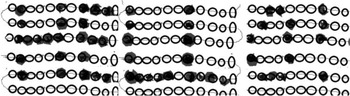
Yet the coin example, though apt in some regards, fails to capture one of the most important aspects of genetics: gene expression. Turning back to the Christmas lights analogy, we can think of DNA like a long thread of such lights, folded back and forth as in Figure 1.
A thread with many light bulbs.

The child inherits the string of bulbs from their parents. The eventual pattern is formed not just by the mere fact of having these bulbs themselves in a certain configuration, but on whether they are turned on or off. If all are off, nothing shows at all, as in Figure 1. If all are on, we see something like Figure 2.
All the light bulbs are on.

But with selective activation, we have a whole different array of possibilities, as in Figure 3:
Selected bulbs are on.

In this analogy, Baby X’s genes may have the potential to write HELLO! or HAPPY CHRISTMAS! depending on which bulbs are switched on. These possibilities are limited by the genes they inherit. The message cannot suddenly change to JOYEUX NOEL! if this was not one of the inherent possibilities in the genetic line-up. But whatever it displays is not something the baby inherits straightforwardly from their parents either. They inherit a variety of possibilities. What is actually displayed depends on whether the baby was conceived in a laboratory, and if so, what culture medium they were kept in as an embryo, where they live, with whom, what their daily activities are. It depends on whether their grandparents suffered from stress or starvation, whether their relatives or those around them smoked or on what other stressors their bodies may have been subjected to (Cavalli and Heard Reference Cavalli and Heard2019).
The point here is that, while we think of genes as being the essence of biological reproduction, this does not separate them from the social aspects of human life. These social aspects—diet, stress, etc.—influence which genes we express, and thus are profoundly entwined with our biological identity. Viewed in this way, it hardly makes sense to regard reproduction as something essentially biological, as opposed to social. It is both. But then this is not about genes any longer, but a complex interplay between configurations of genes and the factors that activate or deactivate genes: epigenetics. Moreover, children—as part of the environment—can have epigenetic effects on the adults around them, including their parents.
It seems undeniable that genes play an important role in reproduction and in people’s understanding of what makes their children “theirs.” But perhaps this is simply the modern take on the age-old concern for “blood” relationships. The discourse of genes may seem authentically biological, but it might be regarded more properly as a metaphor for feelings, symbols, and values which are altogether harder to identify, and which are the modern-day equivalent of our ancestors’ preoccupation with virginity, sex, and birth.
One might speculate that thinking about reproduction in terms of genes has a secular, scientific feel about it. For many people, the motivation to become a parent is not just the wish to parent a child, but to parent one’s own child (Warnock Reference Warnock1985, 8). The link between genes and parenthood seems to offer a way of achieving this. The focus on genes allows fertility medicine to pursue certain avenues and privileges certain accounts of parenthood. It also allows men to be construed as biological parents in a way that makes them women’s equals. If genes are what matters, women’s additional biological activities—gestation, birth, and the provision of mitochondrial DNA—are irrelevant. And yet, as we have shown, there is a lack of consistency in the way that these phenomena are dealt with medically. In some contexts, genes are paramount; in others, women’s interest in gestating is privileged.
Of the possibilities that modern medicine offers, we can identify several possible biological criteria for reproduction:
-
providing 50% of the offspring’s chromosomes;
-
providing the offspring’s mitochondrial DNA;
-
ovulating the egg from which the embryo is conceived;
-
ejaculating the sperm from which the embryo is conceived;
-
gestating the embryo/fetus;
-
providing the uterus in which the embryo/fetus is gestated;
-
shaping a child’s development epigenetically.
Readers will note that, of these possibilities, some are very explicitly excluded from current understandings of biological reproduction, and hence, parenthood. For example, when mitochondrial DNA donation was legalized in the UK, it was vociferously denied that this should be viewed as a form of reproduction (De Campos and Milo Reference De Campos and Milo2018). Women who donated were told that they were giving something more or less meaningless for the identity of the future baby: what they were giving was mere “batteries” that power the cells. There is an underlying normative drive here: to avoid challenging the notion that babies have exactly two (genetic) parents. As Haslanger suggests, we need to ask the question: whose interests does this conviction really serve?
One answer may be that it is the babies themselves who benefit. Typically, those who advocate strongly for the reinforcement of the biological reproduction paradigm rely on this kind of argument (Laing and Oderberg Reference Laing and Oderberg2005; Cohen Reference Cohen and Cohen1996). If children are at risk of being confused or psychologically damaged by unorthodox reproductive techniques that undermine the simplicity of the connection between biological reproduction and parenthood, to regard mitochondrial donation as non-reproductive may help to justify keeping offspring and donors separate. There is no need for them to know about each other, since they have no parent/child connection, and therefore lack any relevant relationship. Yet it is not clear that this separation and classification necessarily benefits the child. Rather, it helps the adults concerned to make sense of themselves as the “real” parents. There is a disconcerting parallel here with the past insistence that the use of donor gametes be kept secret. It has become apparent that this did not necessarily benefit offspring; rather, it enabled adults and institutions to pursue their aims and preserve their norms in ways that have left many donor-conceived people suffering distress (Indekeu and Hens Reference Indekeu and Hens2019).
Years of painstaking psychological research and follow-up do not indicate that children themselves benefit from constraints that enforce the biological reproduction paradigm. What matters primarily is that children feel secure, loved, and respected (Golombok Reference Golombok2015). One finding that has emerged during the decades in which ARTs have become commonplace is that suffering arises not in relation to “complicated” reproductive or parental circumstances per se, but as a result of children feeling deceived or manipulated in respect to understanding their origins (Frith et al. Reference Frith, Blyth, Crawshaw and van den Akker2018). Minimizing the significance of sperm, in the past, or mitochondrial donation, in the present, helps the adults who plan to raise the child to feel that the child is “theirs” and no one else’s. But it does not necessarily help children, whose options are constrained at the outset. Nor does it necessarily benefit the adults whose biological input is sought but simultaneously devalued. When some biological connections are deemed irrelevant or meaningless, this implied set of values may not necessarily be shared by the offspring. Thus, the simultaneous valuing and devaluing of genes that occurs in gamete donation and mitochondrial donation is risky, since the offspring may be caught in the cross-hairs, so to speak, of conflicting interpretations.
In determining that mitochondrial donation is not reproduction, and that mitochondrial donors are not mothers, the chromosomal contributors attempt to preserve the biological reproduction paradigm as far as possible. Yet the biological reproduction paradigm itself cannot really support this exclusionary approach. People undertake mitochondrial donation because they want to have their own genetic offspring. Otherwise, they would use a whole donated egg, rather than just its mitochondria. Yet if genes are indeed the essence of human biological reproduction, it would seem that we do not have a coherent basis on which to exclude mitochondrial donors from being recognized as reproducers: mitochondrial DNA also contains genes.
Preserving the biological reproduction paradigm in this context thus requires a further hierarchical division: a new forum for exclusion. Genes are important—essential, in fact—but only chromosomal genes, and mitochondrial DNA does not contain chromosomal genes. Thus we see that as technology progresses, we scramble to reassert control over the biological reproduction paradigm. When women act as surrogate mothers and give birth to babies who are not “theirs,” we locate genes as the true essence of reproduction. When eggs contain DNA from two people, we locate chromosomal genes as the essence of reproduction. These are processes designed to exclude some biological contributors while enabling others to fulfill their reproductive projects.
It seems questionable to what degree these ideological advantages that pertain to genes should really count when determining their priority in our understanding of what constitutes biological reproduction. If the central aim is to identify biological reproduction, then the project of finding useful biological markers for enforcing social norms just doesn’t seem convincing. There are too many biological possibilities to choose between. Overall, then, if certain biological markers are preferable, it is because of social or normative assumptions that we happen to hold.
But maybe it is worth interrogating the notion that biological reproduction itself should tell us who the “real” parent is. We have noted that the biological reproduction paradigm takes there to be certain biological facts that make it true or false that one has reproduced, and that these facts then indicate whether one is a biological parent. Since we have shown that the factual claims related to biological reproduction in connection with the biological reproduction paradigm are in fact mistaken, it seems that we no longer have any firm basis on which to assert that A is a biological parent while B is not, when both have contributed biologically. Perhaps then one response to recognizing that the biological reproduction paradigm fails to map neatly onto the biological facts about reproduction should be to separate the concepts of reproduction and parenthood altogether.
As Haslanger states:
to claim that our concept of X … is socially constructed can be more than to claim that we developed it through a socio-historical process. It adds to this that nature … doesn’t necessitate that we opt for one particular understanding, but leaves it at least somewhat open. … If our particular conception of X is “not inevitable” or required, then we should not only question our thinking, but also the practices that depend on it and enforce it. (2017, 157–67)
Indeed, as we have shown, “reproduction” is a socially constructed concept. Among the practices that are dependent on this concept are ascription of parenthood and access to fertility treatment. The basis on which these are provided is inconsistent, because of the flaws in the biological reproduction paradigm that we have discussed. Attempts to reinforce the biological reproduction paradigm through the regulation of ARTs have failed, largely because the degree to which reproduction is socially constructed—in Haslanger’s sense—has not been recognized.
5. Conclusion
In this paper, we analyse what we call the biological reproduction paradigm. As we have shown, there are at least four plausible biological aspects of reproduction. Some of these seem intuitively to be important, perhaps even sufficient to constitute reproduction, while others are less so. But for our purposes here, it is enough to show that whichever biological components one might fix on, the choice of what to select as meaningful is not given by biology. What constitutes “reproduction itself” cannot be determined merely through a study of biological facts or possibilities. Rather, human beings with their complex sets of values, assumptions, and ideologies pick out certain biological phenomena as being those that constitute reproduction. Others, meanwhile, are excluded.
By carefully probing the concept of biological reproduction, we recognize that the biological reproduction paradigm does not correspond neatly with any one account of biological transmission. Instead, it unrealistically constrains and simplifies the complexity of human reproduction. It does this because of the need to “massage” biology to fit with our idea of how one becomes a parent. Instead, what we need may be to separate the concept of reproduction from the concept of parenthood altogether. These are two different phenomena, and by attempting to force them together, we do an injustice to the complexities of both biology and human relationships.
As we have shown, it is not easy to categorize phenomena purely as biological or social. These categories in themselves are premised on overly simplistic ideas (Singh Reference Singh2012). The supposed divide between the biological and the social is illusory in many respects. This is unsurprising, since we are not only biological but also social creatures. The dynamic aspect of our nature means that biological design influences our social practices, and our social practices likewise influence the ways in which we are physically constructed, and the ways in which our genes are expressed. Our social practices encourage us to ascribe value to certain phenomena that we deem “biological.” It is this that gives rise to the biological reproduction paradigm. Over time, the biological reproduction paradigm evolves and adapts as our moral beliefs change, and is reconfigured in the light of new biomedical possibilities. This being the case, the least we can do is recognize and question the tendency to ascribe special value to certain aspects of reproduction on the basis that they are “biological,” when they fall in line with our norms, while explaining away as insignificant those which do not. When we do make these choices, we should acknowledge that they are based on moral, social, or legal preferences, and not simply on biological facts. In this way, we can see that reproduction is in itself socially constructed.
Acknowledgements
The authors thank the anonymous reviewers and the editor of this journal for their helpful feedback in improving this paper. We also thank the Marcus and Amalia Wallenberg Foundation (MAW2020.0074) for supporting this work. Anna Smajdor initiated this paper and wrote the first draft. Both authors further developed the draft together, approve the final submission, and take responsibility for the content.
Anna Smajdor is professor of practical philosophy at the University of Oslo, Norway.
Daniela Cutas is associate professor of medical ethics at Lund University, Sweden.



 Open access

