


Undernutrition early in life has been associated with adulthood obesity in some(Reference Ravelli, Stein and Susser1–Reference Soares-Wynter and Walker4), but not all, studies(Reference Han, McNeill and Seidel5–Reference Valdez, Athens and Thompson7). According to Prentice(Reference Prentice8) whether malnutrition in childhood predisposes to later obesity is difficult to analyse owing to the lack of prospective cohorts in developing countries.
Cross-sectional studies in Brazil have shown that short adult stature, a marker for early undernutrition, is a risk factor for obesity among women, but not men, even after adjusting for contemporary differences in socio-economic status(Reference Velásquez-Meléndez, Martins and Cervato3, Reference Sichieri, Siqueira and Moura9). In addition, associations among women have only been observed in studies conducted in the developed regions of the country, suggesting that a minimum of food availability or the kind of food availability present in developed urban centres would be required for the expression of a possible metabolic programming at an early age(Reference Sichieri, Silva and Moura10). In a recent study, a more accurate marker of early undernutrition – the ratio of height to sitting height – was also associated with a high percentage of fat and obesity in a survey of Brazilian women(Reference Velásquez-Meléndez, Silveira and Allencastro-Souza11).
A possible physiological mechanism to explain these associations is low energy expenditure among women exposed to energy restriction during development, as shown for Brazilian adolescents with stunting(Reference Hoffman, Sawaya and Verreschi12, Reference Grillol, Siqueira and Silva13). A complementary rather than alternative hypothesis in explaining the effects of early undernutrition is that promotion of growth by increased postnatal nutrition increases later risk as observed in a randomised trial of CVD(Reference Singhal, Cole and Fewtrell14). This growth acceleration hypothesis according to Singhal et al. (Reference Singhal, Cole and Fewtrell14) could also apply to obesity, based on data from animal studies and two recent systematic reviews, which suggest an association between faster growth in infancy and later obesity in both richer and low-income countries and for both faster weight and length gain.
The great change in the prevalence of obesity in Brazil over time(Reference Veiga, Cunha and Sichieri15), associated with geographical disparities in prevalence of obesity as well as in the prevalence of stunting among regions in Brazil, may allow testing whether environmental determinants of undernutrition, such as diet, behaviour, socio-economic and demographic factors could explain an association between short stature and increased BMI.
Methods
The present study was based on a cross-sectional telephone survey (surveillance system of risk factors for chronic diseases through telephone interviews; VIGITEL) carried out in 2006(Reference Moura, Morais Neto and Malta16). Individuals aged 18 years or more living in households with access to telephone lines were included. Further details on the methodological procedures employed both in the sampling process and in the questionnaire are available at the website www.saude.gov.br/svs (questionário VIGITEL). In short, VIGITEL was conducted on the urban areas of the twenty-six Brazilian state capitals and federal district. The sample size allows estimating the frequency of the risk factors with a 95 % CI and a maximum error of about 2 %. At least 2000 individuals in each city were interviewed. Sampling was done in two stages. In the first stage, households with telephone lines were randomly selected based on the city directory of telephone numbers. In the second stage one individual per telephone line was interviewed.
Of 76 330 eligible lines, about 20 % were not included in the survey because the line was frequently busy or no one answered after five calls. A total of 54 390 subjects (21 294 men and 33 075 women) completed the interview, with a non-response rate of 29·8 % and 9 % refusing to participate.
For the present study, individuals were excluded who did not give their weight and/or height measures (n 4487) and pregnant women (n 487). Then, the present study population included 49 395 subjects (20 622 men and 28 773 women).
Measurements and analysis
Variables included in the analysis were: age, sex, race/ethnicity, schooling, number of rooms in the household and number of phones and cell phones; frequency of regular consumption of fruit and vegetables (five or more times per week) and of foods rich in saturated fats, frequency and duration of physical exercise and facilities; weight, height and smoking. The sex-specific 5th percentile of the survey height distribution was used as a marker of early undernutrition. These values were 149 cm for women and 160 cm for men.
All these variables were also treated as city-level variables as means or overall percentage (shown in Table 2).
Healthy diet
Individuals reported how many times per week or per d they consumed fruits, cooked vegetables, salads, non-diet soft drinks and diet soft drinks. They also were asked about eating chicken skin, the apparent fat in red meat and type of milk usually drunk. Frequency of consumption of these items was used to produce a score for healthy eating using factor analysis through principal components in SAS (version 8.2; SAS Institute, Inc.)(17). Factor loadings varied from 0·48 for frequency of fruit intake to 0·28 for the habit of usually removing chicken skin. Due to the low loading for chicken skin, this variable was excluded from analysis. The score had an Eigenvalue of 1·9, which explained 27 % of the variance of the seven variables. The mean of the score per city was the city-level variables.
Statistical analysis
BMI was treated both as a continuous variable and also using the cut-off for obesity (30 kg/m2). BMI was log-transformed because distribution was skewed to the right. Estimates incorporated the sample design and weights with the procedures Proc Surveymeans, Surveyfreq and Surveylogit from the SAS software package (version 8.2; SAS Institute, Inc.). The multilevel analysis used the procedure Proc Mixed that allowed us to account for the clustering by cities. A secondary multivariate analysis of association between short stature and obesity was done using reported BMI at age 20 years, which only 66·9 % of men and 50·3 % of women answered, and adjusted individual- and city-level variables considered to be potential confounders.
Associations between short stature and current BMI and obesity were based on multivariate linear regressions and multivariate logistic regression, respectively, and considered confounding by age, schooling, smoking status, race, physical activity, intake of a healthy diet and regular intake of fruits and vegetables (five or more per d).
Since interviews were carried out by telephone, free informed consent was replaced by verbal consent obtained from subjects during the telephone contacts. The study was approved by the Research Ethics Committee of the Brazilian Ministry of Health.
Results
Of the 21 294 men interviewed, 98·3 % reported body weight, 98·5 % reported height, and 96·8 % reported both measures. Among the 33 075 women interviewed, these percentages were 95·0, 88·9 and 87·0 %, respectively.
The association between short stature and obesity as well as confounding variables that could explain the associations between short stature and obesity are shown in Table 1. Prevalence of obesity was associated with short stature, age, score of healthy diet, and schooling for both sexes. Frequency of leisure physical activity and race was associated only among women, while current smoking and familiarity with a place for exercise was associated only among men.
(Mean percentages with their standard errors)

There was a striking difference in the prevalence of short stature ranging from 1 to 9 %, and in the prevalence of obesity, ranging from 8 to 14 % among the state capital cities. Most of the selected study variables also showed important differences among cities (Table 2).
(Mean values and standard deviations and medians and ranges)
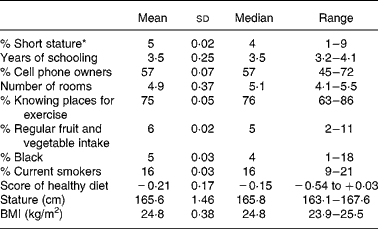
* Less than 160 cm for men and less than 140 cm for women (fifth percentile).
The city-level variables that had significant correlation with prevalence of obesity were mean score of healthy diet, mean percentage of blacks, and of individuals' familiarity with places to exercise. These correlation coefficients were all negative, with values of − 0·43, − 0·38 and − 0·36 (P < 0·05), respectively.
Analysis of associations among individual- and city-level variables with BMI adjusted for age is shown in Table 3. The age-adjusted associations with BMI at the individual-level had almost the same pattern found for obesity, except for frequency of exercise and smoking (Table 1). For the city-level variables, only percentage of the Black population was associated with BMI among men. For women, places to exercise, mean number of rooms in the house and mean of the city score for healthy diet were statistically significant. After adjustment for all variables with P < 0·20 in Table 3, individual short stature maintained the strong association with BMI (data not shown).
Age-adjusted regression coefficients (β) of associations among individual-level and city-level variables with BMI

Multivariate analysis adjusted for all individual- and city-level variables indicated a strong association between short stature and obesity. OR were greater for women compared with men, and values of the OR at age 20 years were about three times the current ones (Table 4). Despite the small prevalence of obesity at age 20 years and the large number missing for this variable, associations for current obesity are almost the same observed for the overall sample, if only those with reported weights at age 20 years were analysed (data not shown).
(Odds ratios and 95 % confidence intervals)
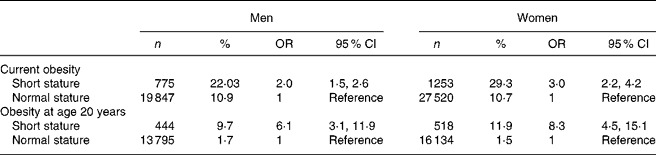
* Adjusted for age, score of healthy diet, leisure physical activity, race, and the city-level variables place to exercise, mean number of rooms and percentage of Blacks.
The amount of variance in BMI explained by cities was small. Before including the explanatory variables, cities explained only 9 % of the BMI variance among women and 8·5 % among men.
Discussion
The present study examined whether city disparities and individual-level factors among more than 50 000 Brazilian adults could explain associations between short stature and obesity. After adjusting for individual socio-economic and behavioural characteristics and city indicators of socio-economic level, the odds of obesity among men of short stature (5th percentile) was two times greater compared with men with stature above the 5th percentile. Among women, the OR was three times greater. When comparisons were made for BMI at age 20 years, the OR were even larger (about six times greater for men and eight times greater for women). This larger effect of short stature at a young age may indicate that BMI is strongly influenced by the individual's early nutrition, an effect that loses magnitude with adulthood because of the many other factors contributing to weight gain.
Our findings were consistent with findings from other population-based studies in Brazil(Reference Velásquez-Meléndez, Martins and Cervato3, Reference Sichieri, Siqueira and Moura9, Reference Sichieri, Silva and Moura10) and with a study recently conducted in Germany which showed a positive association between short stature and obesity among adults, but lack of association among the youngest(Reference Bosy-Westphal, Plachta-Danielzik and Dörhöfer18).
Although city-related indicators were associated with prevalence of obesity and BMI, city factors accounted for only a small amount of the BMI variance. Cities with a large proportion of individuals having healthy diets, and also large mean percentages of individuals knowing places to exercise, had a lower prevalence of obesity, whereas the percentages of Blacks showed a negative association with prevalence of obesity. At the individual level, at least among women, non-Whites had a high risk of being obese.
A limitation in using cities as a marker of environmental factors related to obesity is that cities are too large for accounting for all contextual social and environmental factors related to health. Neighbourhoods are considered better markers of conditions that may help prevent weight gain. However, for the purpose of adjusting for individual and environmental factors that could explain the association between short stature and obesity, adjusting for city characteristics may be more appropriate than for neighbourhoods, due to the large variations observed among Brazilian cities for both obesity and short stature.
There are also limitations due to the telephone coverage in Brazil. It has grown in recent years, but based on the 2002–3 Household Budget Survey, the more recent national data, only 66·4 % of all households spent money on telephone service. This selection bias probably left out many short stature individuals.
On the other hand, compared with other telephone interviews carried out periodically in the USA such as the ‘Behavioural Risk Factor Surveillance System – BRFSS’, the VIGITEL system had a lower refusal rate(19).
Studies of the reproducibility and validity of VIGITEL instruments showed good reproducibility and adequate validity for food and beverage variables (κ coefficient ranged from 0·57 to 0·80) and for indicators of physical activity and sedentariness (κ coefficient ranged from 0·53 to 0·80)(Reference Monteiro, Moura and Jaime20–Reference Coqueiro, Borges and Araújo23).
There are plausible explanations for a causal relationship between short stature and obesity. Biological mechanisms associated with undernutrition early in life, called metabolic programming, could increase susceptibility to diabetes, CVD and also for obesity later in life in an environment rich in high-density diets and with low energy expenditure(Reference Barker24–Reference Sawaya and Roberts26).
In conclusion, despite evidence that environmental factors such as poor food choices and physical inactivity are the main determinants of the worldwide obesity epidemic, the greater difference in BMI and prevalence of obesity in the Brazilian capitals was explained mainly by individual factors. We found a strong association between obesity and short stature after adjustment for diet, physical activity, and many environmental factors. Intra- and inter-generational consequences of undernutrition are an alternative explanation for the growing prevalence of obesity in Brazil.
Acknowledgements
The study was funded by the Brazilian Ministry of Health.
R. S. contributed to collecting, analysing and interpreting the data, and drafting the manuscript. F. S. B. conducted the literature search, data analysis and interpretation. E. C. M. contributed to the project design and data collection. All authors helped to conceptualise ideas, interpret findings and review the manuscript.
There are no conflicts of interest.



