



Over the past several decades, dramatic nutritional changes, termed the ‘nutrition transition’( Reference Popkin, Adair and Ng 1 ), have occurred worldwide. These nutritional changes are characterised by a shift from traditional diets to diets with an increasing contribution of (highly) industrialised processed foods usually rich in energy, saturated fat, sugar and salt, and poor in micronutrients( Reference Duncan, Duncan and Fernandes 2 ). This nutrition transition has led to a worldwide double burden of malnutrition, which includes both undernutrition and overweight, and that is being experienced more acutely by the less developed countries( 3 ). The consequences of this dietary shift are mirrored in the rapidly increasing rates of obesity, diabetes and other non-communicable diseases in the lower- and middle-income countries( Reference Popkin 4 ). To address this complex situation and to design effective national and international initiatives aiming to reverse this alarming picture, it is necessary to understand how nutrition and related health conditions have developed together over the last decades( Reference Popkin 4 ). However, existing knowledge is insufficient due to the lack of reliable common methodologies and support infrastructures to measure, monitor and better understand this nutritional transition and its association with the current worldwide disease burden.
The International Agency for Research on Cancer (IARC), a WHO–UN organisation, has successfully developed, validated and implemented a highly standardised interview- and computer-based 24h dietary recall (24-HDR) program called GloboDiet, formerly known as the EPIC-Soft software because it was implemented initially in the largest European cohort study on diet, lifestyle and cancer, i.e. the European Prospective Investigation into Cancer and Nutrition (EPIC)( Reference Slimani, Deharveng and Charrondiere 5 , Reference Slimani, Ferrari and Ocke 6 ). GloboDiet versions have already been developed in different study contexts through different international epidemiological studies and monitoring settings in twenty countries( Reference Slimani, Deharveng and Charrondiere 5 – Reference Freisling, Ocke and Casagrande 10 ). A major achievement was the finalisation of the Korean GloboDiet version as the first version created beyond the European framework for piloting in an Asian population( Reference Park, Park and Nicolas 11 ). Furthermore, a comprehensive concept of a (web-based) infrastructure (GloboDiet-research infrastructure) was developed and its integration with other research infrastructures such as the European Food Information Resource (EuroFIR) infrastructure was pilot-tested in a case study of the EuroDISH project (www.eurodish.eu). Although different soft and hard elements of this infrastructure are already functional, its full development and integration into broader food and health research infrastructures in Europe (still under discussion) is planned to support the implementation and maintenance of this standardised dietary methodology in international study contexts. IARC’s previous international experiences could serve to implement common dietary methodologies in Latin America (LA).
The GloboDiet LA branch aims to pilot the implementation of the IARC standardised dietary methodology in nutrition surveillance systems in several countries of LA, with the ultimate goal of enabling comparisons of dietary intakes within and between Latin American (LA) countries, as well as transcontinental comparisons. The initiative seeks to adapt and validate the existing IARC international dietary methodology, i.e. 24-HDR GloboDiet program and its related tools, for LA, starting with Brazil (in Portuguese) and Mexico (in Spanish) as the two first countries, before considering expansions to other possible countries.
The perspectives of having a common methodology and comparable dietary data across LA will represent a major step forward to better understand the common and country-specific features of the rapid nutritional transition observed in LA. In the present paper, we describe the procedure and approaches used to adapt and harmonise the computerised 24-HDR GloboDiet methodology for use in two LA countries, Brazil and Mexico.
Methods
General characteristics of the GloboDiet program
The structure of the software and detailed information about the interview steps have been described in detail elsewhere( Reference Slimani, Casagrande and Nicolas 12 ). Briefly, it consists of an interview-based 24-HDR that systematically follows four main steps: (i) general non-dietary information; (ii) quick list of consumed items; (iii) description and quantification of reported foods and recipes; and (iv) description and quantification of dietary supplements. General non-dietary information on the interviewer, the interviewee (i.e. sex, age, height and weight) and the recalled day (i.e. special day and special diet) is collected in order to conduct systematic checks during and after the interview. The so-called ‘quick list’ is an open field where the interviewer briefly enters in all the foods and composed dishes consumed on the day preceding the interview. Once completed, the next phase consists of describing in detail and quantifying the foods and recipes reported in the quick list following four systematic steps: search and identification, description, quantification and probing.
This interview-based international dietary tool was designed to remain highly standardised and robust, independently from age, sex, socio-economic status, language, literacy and/or Internet access, as a prerequisite for worldwide expansion. The standardisation of a dietary method aims to prevent and minimise systematic and random errors during the dietary interview( Reference Slimani, Deharveng and Charrondiere 5 , Reference Slimani, Ferrari and Ocke 6 , Reference Slimani, Casagrande and Nicolas 12 ); however, there are no study design guidelines specific to the GloboDiet methodology. Nevertheless, the methodology has been applied to different study contexts where study design guidelines have been published, e.g. common calibration design guidelines used in the EPIC study( Reference Slimani, Kaaks and Ferrari 13 ), dietary surveillance guidelines for the pan-European food consumption survey EU Menu of the European Food Safety Authority( 14 ), validation study guidelines as part of the European Food Consumption Validation (EFCOVAL) project( Reference de Boer, Slimani and van ’t Veer 8 ), and guidelines for feasibility pilot studies in adolescents, adults and elderly, i.e. the PILOT-PANEU project( Reference Ambre, Horváth and Farkas 15 ), and in children, i.e. the PANCAKE project( Reference Ocké, de Boer and Brants 16 ). Although study designs differ across these projects depending on the main purpose of the study, GloboDiet is usually used in studies aiming to ensure a high level of standardisation, including their own study design protocols.
GloboDiet comprises about seventy databases, including common and country-specific databases. The types of files to be customised, their content and the key task(s) conducted during the process are described in Table 1. Figure 1 shows the general concept of the standardised customisation process of GloboDiet( Reference Slimani and Valsta 17 ). The common databases ensure standardisation within and between countries of a given project( Reference Slimani, Casagrande and Nicolas 12 ). The customisation process should ideally be conducted by personnel trained in nutrition and/or dietetics with a thorough knowledge of the local foods and eating habits. The GloboDiet database library contains all the common reference databases which, in addition to facilitating standardisation among versions, also serves as a starting point for the development and customisation of new GloboDiet versions.
Overview of the standardised customisation process of the GloboDiet methodology (adapted from Slimani and Valsta( Reference Slimani and Valsta 17 ))

Description of the type of files and key tasks conducted during the GloboDiet methodology customisation process

HHM, household measures.
Country-specific databases are meant to capture existing differences in diet within and between countries and were prepared using data available in Brazil and Mexico, but also from already customised European GloboDiet versions. These databases comprise food and recipe lists; synonym lists; brand name lists; facets, probing questions and quantification methods specific to foods and recipes; coefficient files for edible portion, density, fat left on the plate, raw-to-cooked conversion factors, default standard percentages for fat, sauce and sweeteners added to foods and recipes and for fat used for cooking foods; and databases for quality controls. For dietary supplements, facets and descriptors were also selected from the library databases. Country-specific files were developed in parallel in Mexico and Brazil but independently by each country, to acknowledge and integrate the country-specific features and pre-existing available data. All the common and country-specific GloboDiet databases were adapted and translated into Brazilian Portuguese and Mexican Spanish by the Brazilian and Mexican teams, respectively.
Identification of foods and recipes
Predefined food and recipe lists are used to identify the specific foods and recipes entered in the quick list. Therefore, food and recipe lists were modelled on European food lists and using local data based on their reported frequencies of consumption in national and/or regional dietary surveys, specifically the 2008–2009 Brazilian National Dietary Survey( 18 ) and the Inquérito de Saúde em São Paulo (ISA)( Reference Fisberg and Marchioni 19 , 20 ) surveys in Brazil and the Encuesta Nacional de Salud y Nutrición 2012 (ENSANUT)( Reference Romero-Martinez, Shamah-Levy and Franco-Nunez 21 ) in Mexico. All the identified foods and recipes were listed in the country-specific language and in English and classified according to the adapted GloboDiet classification. For vegetables, fruits and fish, scientific/taxonomic names were included to ease their identification and appropriate classification. In addition, recipes were entered into the Recipe Manager application( Reference Slimani, Casagrande and Nicolas 12 ), a specialised module of the GloboDiet methodology to manage recipes.
Description of foods and recipes: facets and descriptors
The description of foods and recipes uses a facet–descriptor approach, which allows the standardisation of the level of detail in order to describe foods and recipes in a comparable manner within and between countries. The ‘facets’ are questions about the different characteristics of the foods, e.g. physical state, cooking method, etc., whereas the ‘descriptors’ are the predefined possible answers to the facets, e.g. ‘liquid’, ‘powdered’, ‘spread’ for the facet ‘Physical state/format’ or ‘grilled’, ‘roasted’, ‘fried’ for the facet ‘Cooking method’. Detailed explanations on the facet–descriptor approach can be found elsewhere( Reference Slimani, Deharveng and Charrondiere 5 , Reference Slimani, Ferrari and Ocke 6 ). Facets and descriptors were selected from the IARC GloboDiet database library. Descriptors available in the database library for each facet were evaluated by the Brazilian and Mexican teams and those not applicable to either country were discarded. In addition, missing descriptors necessary to describe the food items were identified and added into the common files and into the IARC library upon agreement by both countries. Joint online meetings were organised to discuss and reach an agreement on the final content of the files to be used in the LA project.
Quantification of foods and recipes
Several quantification methods are available in GloboDiet to estimate consumed quantities: weight and volume (systematically proposed), photos, household measures (HHM), shapes (estimating the surface area and thickness) or standard units (e.g. an apple, a can). At the country level, the number and types of quantification methods were defined for each specific food and recipe according to the food/recipe classification and the physical state in which they are consumed. Photos of portions, HHM and shapes are available in the IARC GloboDiet library, which was used by each country to evaluate its needs based on local national dietary data to produce a local picture book.
Each country team defined a list of HHM commonly used in their country to estimate the volume of different portions including soup plates, spoons, glasses, cups and bowls. Most of the HHM pictures were newly taken for the purpose of developing the Brazilian GloboDiet picture booklet version( Reference Crispim, Fisberg and Almeida 22 ). The remaining HHM were sourced from the Brazilian Household Budget Survey (Pesquisa de Orçamento Familiar) 2008–2009( 18 ). Shapes to quantify breads, rusks, cakes, terrines, pies – and alike – and also their spreads were defined by each country based on specific national needs. The drawings of the selected shapes and related thicknesses were all taken from the IARC GloboDiet picture library.
Standard units are used for foods that exist in countable units or where standard weights are well defined like for commercially defined (e.g. yoghurt, cakes, a can/bottle of soda, etc.) or relatively calibrated (fruits, vegetables, etc.). Country-specific standard units were gathered by each country. Information on Brazilian and Mexican commercial products was collected locally by each team by searching for food packaging labels on the local Internet search engines or surveying street vendors, markets and/or supermarkets. Country collaborators collected in situ information on the weight (in grams) or volume (in millilitres) quantity of the standard unit; whether this weight/volume referred to the uncooked or ready-to-eat product, with or without inedible part; and the brand, if applicable. A label was assigned to each standard unit and included dimensions, type of packing, the preservation method and the brand names, if applicable. The suitability of those already available in the existing GloboDiet versions was also assessed and used when appropriate in a given country.
Photo series with different portion sizes of prepared foods and dishes can be used during the 24-HDR interview to estimate the consumed quantity when none of the abovementioned methods can be used. The selection of the photos was done separately for Brazil and Mexico( Reference Crispim, Fisberg and Nicolas 23 ) following IARC’s technical guidelines for development of pictures within the GloboDiet methodology. Briefly, the list of foods that required photos for portion quantification was created from adult data participating in the latest national surveys( 18 , Reference Romero-Martinez, Shamah-Levy and Franco-Nunez 21 ). Each one of the most consumed foods was evaluated by IARC and the country team for its inclusion in the country’s picture album, considering also other quantification methods available for a given food. Selected foods were then searched in the existing GloboDiet album and divided into existent and new photos to be created. For the existing photos, intake ranges were compared between those from the national survey data( 18 , Reference Romero-Martinez, Shamah-Levy and Franco-Nunez 21 ) and those of GloboDiet photos. For the new photos, intake ranges were compared between national surveys( 18 , Reference Romero-Martinez, Shamah-Levy and Franco-Nunez 21 ) in order to define the range from the smallest to the largest portion of each photo series.
Coefficients
Following the standard operating procedures, i.e. a set of fixed steps to be followed routinely to perform a specific operation/task, and guidelines provided by IARC and having values from other GloboDiet versions at their disposition, the Brazilian and Mexican teams customised the coefficient databases on density, edible portion, raw-to-cooked weight conversion, standard percentages of fat, sauce and sweeteners added to food and recipes, and standard percentages of absorbed fat during cooking and of fat or sauce left on the dish. These coefficient values questions were assigned to each food and recipe included in the lists, as applicable for the Brazilian or Mexican context. Information to customise these files was obtained from three sources: (i) national dietary data available in each country( 18 – 20 , 24 , 25 ); (ii) available existing values compiled in the GloboDiet library from other, mostly European, countries using GloboDiet; and/or (iii) published sources of information( Reference Pinheiro 26 – Reference Pacheco 29 ).
Quality controls
Quality controls are carried out at different stages of the interview procedure in terms of potential outlier values, missing quantities, potentially forgotten foods, and controls at nutrient level. Existing food composition databases in Brazil( 24 , 30 ) and Mexico( 25 ) were used to assign total energy, carbohydrate, protein, fat and alcohol values to each food. The US Department of Agriculture food composition databases were also consulted when nutrient data were not available in the country-specific databases (http://ndb.nal.usda.gov/). These nutrient values are used for a final quality control at the end of the interview; however, they will not generate a posteriori nutrient composition values for nutrient data analysis. Maximum portion sizes for each food item and recipe were assigned as warnings to detect extreme or implausible reported quantities during the interview. These maximum plausible portion sizes were calculated as either 1·2 times the largest photo portion or twice the medium standard unit weight, when available. If neither of these quantification methods was available for a food, national survey data( 18 – 20 , 24 ) or values from a similar food available in the GloboDiet library were used.
Checklists contain lists of broad food items by food consumption occasions, such as breakfast, lunch, etc., to remind the interviewer of food items expected in each of the food consumption occasions. These lists were adapted based on the specific dietary and meal patterns of each country. Subject’s sex, age, height and weight are used for quality controls at the end of the recall comparing reported energy intakes with energy and macronutrient requirements( Reference Crispim, Nicolas and Casagrande 31 ). That anthropometric database is used to fill non-completed fields and check out-of-range values. The file was filled out according to sex-, age- and country-specific maximum and minimum values for height and weight using nationally available data( 32 ) or applying average anthropometric values from European GloboDiet users. Further adaptations using more up-to-date national data on weights and heights need to be carried out before piloting the version.
Results
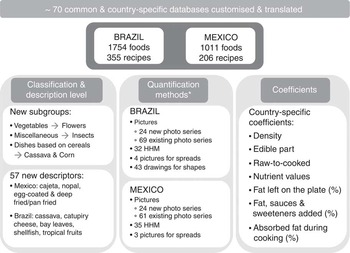
The existing Portuguese and Spanish GloboDiet versions were used as starting points for the Brazilian and Mexican versions, respectively, mainly due to the fact that the language was the same. Texts for the user interface of the GloboDiet software were adapted into Portuguese and Spanish languages used in Brazil and Mexico, respectively. The general non-dietary information asked during the interview as well as the recall aids such as places of consumption, food consumption occasions, special occasions and special types of diets were customised and translated based on the IARC GloboDiet library proposals. Figure 2 shows the main features of the customisation of GloboDiet for Brazil and Mexico.
Main features of the customisation of GloboDiet for Brazil and Mexico. *Brazil: thirty-two pictures for HHM, four pictures for spreads, forty-three existing drawings for shapes. Mexico: thirty-five pictures for HHM, three pictures for spreads, drawings for shapes still under evaluation (HHM, household measures)
Identification of foods and recipes
New food and recipe groups were added to the common classifications identified by the Brazilian and Mexican teams. Specifically, the subgroups ‘Flowers’ and ‘Insects’ were added under the group ‘Vegetables’ and ‘Miscellaneous’, respectively, given that they are commonly consumed foods in Mexico. Since the classification files are common GloboDiet files, these new subgroups were also included in the IARC GloboDiet library. Due to the high reported consumption and large number of recipes that incorporate corn in Mexico and cassava in Brazil, two new subgroups i.e. ‘Corn’ and ‘Cassava’ were created under the recipe groups ‘Based on cereal and cereal products’ and ‘Based on vegetables (including potatoes)’, respectively. The ‘shadow list’ gathers synonym names for the listed food items and recipes, aiding in proper identification of foods during the interview. Numerous names for the same food were identified by Brazilian colleagues, e.g. ‘macauba’ with twenty-one shadow names and ‘Brazilian pepper – pimenta, rosa’ with seventeen. The Brazilian shadow list included more than 300 food items of which 11 % had five or more shadow names. These shadow names are important to facilitate the search by interviewers in different regions of the country while still ensuring that the same foods are not listed twice in a food list and/or classified differently due to differences in eating habits between regions. In some instances, shadow names represented similar names with small spelling differences, e.g. ‘pequi’ and ‘piqui’ (pequi/souari nut). Problems due to misspelling, however, can still occur, e.g. ‘jiló’ (scarlet eggplant) v. ‘giló’ (misspelled), and the food item can be entered as a new food because it is presumed that it is not in the food list. To avoid this problem, the software offers the possibility of using a search string where different parts of a word can be searched.
The brand name lists for Brazil and Mexico included product and brand names for relevant food (sub)groups based on country-specific existing brands. Nevertheless, GloboDiet is an open-ended method, meaning that more food items, recipes and/or brand names, among others, can be entered during the interview in case they are not included in the predefined lists.
Description of foods and recipes: facets and descriptors
Sixteen GloboDiet facets for foods and three for recipes were selected for describing Brazilian and Mexican foods and recipes. A total of fifty-seven new descriptors were found to be lacking in the GloboDiet library and coded for these two LA GloboDiet versions (Table 2). The majority of these new descriptors were listed under the facet ‘Flavoured/added component’. Two were specific to the Mexican context, i.e. ‘cajeta’ (caramelised goat’s milk) and ‘nopal’ (pad from prickly pear). The remaining fifty-three descriptors were identified for the Brazilian version, most of them (forty-eight descriptors) referring to local tropical fruits such as ‘guaraná’ or ‘açaí’, among others, to describe the wide range of freshly squeezed or frozen fruit juices consumed in the country. This also reflected the large variety of fruits available in Brazil, many of them not available in other countries. The remaining five descriptors were ‘cassava’, ‘catupiry cheese’, ‘bay leaves’, ‘shellfish’ and ‘ovomaltine’. Given the widespread cooking technique in Mexico of coating vegetables in whipped egg before frying them, the descriptors ‘egg-coated and deep fried’ and ‘egg-coated and pan fried’ were included under the facet ‘Cooking method’. These amendments of the common files did not affect the common structure and, therefore, the concept of standardisation of the GloboDiet software across countries.
List of descriptors added to the GloboDiet library for customisation purposes
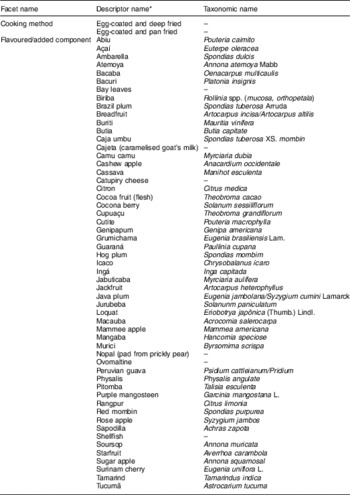
* Brazilian Portuguese names were considered when no English translation was available.
Based on the common files, the description of foods and recipes was customised by the Mexican and Brazilian teams to limit the number of questions during the interview. For example, asking the facet ‘Skin consumed’ available for fruits could be skipped for the item ‘banana’. Figure 3 shows screenshots illustrating the description of ‘frijol negro’ (black beans) by a series of facets and descriptors in the Mexican GloboDiet version. A series of windows automatically displayed in the screen asks the characteristic (facet) of the consumed food. These series of prompt boxes also contain predefined descriptors (facet-specific answers) that were adapted to the Mexican and Brazilian food and recipe groups.
Description of food by a series of facets and descriptors in the Mexican version of GloboDiet: an example of ‘frijol negro’ (black beans)

For dietary supplements, only the mandatory facet ‘Physical state/format’ was retained and translated by the two countries as it is needed for quantification of a dietary supplement. Given the open-ended nature of the database, no predefined list of dietary supplements was entered.
Quantification of foods and recipes
As a real example of the adaptability of the GloboDiet picture book guidelines to LA, the Brazilian picture book includes ninety-three pictures of foods and recipes, four pictures for spreads, thirty-two Brazilian HHM and forty-three with shape drawings of real size( Reference Crispim, Fisberg and Almeida 22 ). The same process and guidelines were applied in Mexico for the selection of quantification methods. The Mexican picture book comprises eighty-five pictures of foods and recipes, three pictures for spreads and thirty-five Mexican HHM. However, the picture book has not been physically produced yet, as it will depend upon the specific needs and study population’s characteristics where GloboDiet will ultimately be implemented.
The pictures of foods and recipes belong to two categories: (i) general pictures showing different portion sizes for the quantification of the amount consumed by the subject (eighty-two for Brazil, seventy-nine for Mexico) and (ii) help pictures (eleven for Brazil, six for Mexico) to ease the identification of food form/parts or size, which are linked to standard units, e.g. type of biscuits or bananas, chicken leg, breast or drumstick. For Brazil, twenty-four new photos were created and sixty-nine were taken from previous GloboDiet versions. Likewise, twenty-four new pictures are planned to be developed for Mexico after initial analysis and sixty-one already existing, from which eleven were already taken for the Brazilian version.
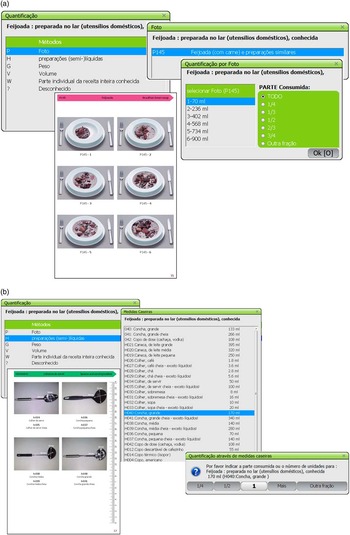
An example of food portion quantification in the Brazilian version of GloboDiet, using ‘feijoada’ (Brazilian bean soup) as an example, is shown in Fig. 4. The quantification methods preselected for the specific food item are proposed on the screen. If quantification by photo is selected, a window opens indicating the code and name of the series. Once a series is selected, the codes of each picture with the weight corresponding to the portions are proposed to the interviewer. The series should be looked up in the photo album using the code and the subject should select the portion and indicate whether the whole portion size or only a fraction of it was consumed. Several servings can be entered (Fig. 4(a)). When the HHM method is chosen, the software opens a window with the entire country-specific list of HHM and their volumes. The HHM are identified by a code corresponding to the number indicated on the HHM available during the interview or on the picture book. The next window proposes predefined fractions of the HHM and the options ‘more’ and ‘other fraction’ (Fig. 4(b)). If relevant for the food, questions are asked on whether the estimated quantity is raw or cooked and/or with or without its inedible part.
Recipe portion quantification in the Brazilian version of GloboDiet: an example of ‘feijoada’ (Brazilian bean soup). (a) Quantification using photos; (b) quantification using household measures
Quality controls
Related to the quality control processes applied during the interview, checklists and probing files were filled by considering country-specific dietary habits. Country-specific probing files were developed by listing foods linked with other items (foods and recipes) and that can be easily forgotten, e.g. fat added to bread, in order to be used as a reminder. New items such as ‘tortilla’ for Mexico and ‘farelo, aveia and farinhas’ (bran, oat and flour) for Brazil, which often complement many foods and recipes, were added to the probing questions. A new probing group called ‘Savoury potato/corn chips and biscuits’ was created.
Discussion
The Brazilian and Mexican GloboDiet versions are the first two LA versions of the international interview-based 24-HDR software. They are based on the versions fully implemented in Europe( Reference Freisling, Ocke and Casagrande 10 , Reference Slimani, Casagrande and Nicolas 12 , Reference Ocke, Slimani and Brants 33 ) and the recently developed Korean version being the first Asian GloboDiet version( Reference Park, Park and Nicolas 11 ). The basic structure of the databases was not modified when developing the two versions, which emphasises the highly flexible structure of the software and, therefore, its potential to be expanded to other LA countries, which is the ultimate objective of the GloboDiet LA branch. In addition, the use of a common and standardised methodology across countries will allow minimising (differences in) measurement error associated with self-reported data.
The customisation process of the GloboDiet software for Brazil and Mexico faced several challenges related to the standardisation process between the two countries, but also some in relation to the specific characteristics of each country. One of the innovative features of conducting this project in these two LA countries was the development of GloboDiet versions in such large countries, mainly when compared with European countries or Korea, which resulted in a great variability in terms of local dietary habits. Preparations of foods and recipes are different across country regions evidencing the need to capture these differences so that the software could perform equally well in the future regardless of the region in which it is applied. Nutritionists from different regions were consulted in order to account for these differences. In this regard, four out of five Brazilian regions, i.e. South, Southeast, Northeast and Central West, took part in the customisation process, whereas in Mexico, the process was centralised in the National Institute of Public Health.
Another issue, more prevalent in Brazil, was the existence of numerous names for the same food. Therefore, food items were properly differentiated in both the country-specific name and the English name to avoid any misidentification of food items during the interview and further analyses. As mentioned before, the existing GloboDiet versions in Portuguese and Spanish available at IARC were used as starting points, respectively for Brazil and Mexico. Although the origin of languages was initially the same, several adaptations were made to the files considering three mains aspects: (i) differences in availability of food items between Europe and LA, e.g. fruits; (ii) different dietary patterns and eating behaviours, i.e. different food consumption occasion patterns or consumption habits which modified probing questions and checklists, e.g. bread (in Europe) v. tortilla (in Mexico) or rice (in Brazil); and (iii) use of different naming due to country-specific terminology, i.e. peach: ‘melocotón’ (in Spain) v. ‘durazno’ (in Mexico), and courgette: ‘curgete’ (in Portugal) v. ‘abobrinha’ (in Brazil), among others. Furthermore, a large variability in HHM was encountered across regions. After evaluation of the HHM available in the IARC GloboDiet library, Brazil chose a list of HHM and selected all the necessary photos. Mexico, however, faced more difficulties to list a representative set of HHM and could not evaluate fully from the IARC GloboDiet library. Therefore, the current list of Mexican HHM is considered provisional and it is intended to be revised and updated once the pilot study is put in place.
Brazil and Mexico were selected as the two first pilot countries within the GloboDiet LA initiative given the increasing rates of overweight and obesity observed in these countries. Mexico is currently facing very high rates of overweight and obesity, i.e. 33–82 % across age groups( Reference Kroker-Lobos, Pedroza-Tobias and Pedraza 34 ). In Brazil, one out of two adults was overweight and one out of six men and one out of eight women were obese in 2008–2009( Reference Conde and Monteiro 35 ). If the present trends remain, it is estimated that about 70 % of Brazilian adults could be overweight by 2050( Reference Rtveladze, Marsh and Webber 36 ). In addition to this, the volume of sales of ultra-processed foods in LA increased by almost 50% from 2000 to 2013; indeed, the sales of carbonated soft drinks doubled during the same period( 37 ). A matter of concern is the positive strong association that was found between the prevalence of obesity and higher sales per capita of ultra-processed products in LA, with those countries having higher sales of these products, such as Mexico, having also higher mean body mass( 37 ). These alarming figures call researchers and policy makers to action to fight against this tendency and highlight the need to reformulate prevention policies and programmes. For that purpose, appropriate and standardised dietary methodologies are needed to accurately measure food intake, monitor trends, and better understand the current global nutrition transition, its determinants and associations with diet-related non-communicable diseases so that effective policies and programmes can be developed and evaluated.
In Brazil, the national dietary survey used two non-consecutive 24 h food records in which the individuals recorded the quantities and preparation methods for each food consumed using HHM and/or volumes( Reference Yokoo, Pereira and Veiga 38 ). On the other hand, the ISA regional dietary survey conducted two interview 24-HDR( Reference Fisberg and Marchioni 19 , 20 ) based on the previously developed Multiple Pass Method of the US Department of Agriculture( Reference Moshfegh, Rhodes and Baer 39 ) together with an FFQ. The national dietary survey in Mexico applied two interview-based 24-HDR (in a random sub-sample) and a semi-quantitative FFQ( Reference Romero-Martinez, Shamah-Levy and Franco-Nunez 21 , Reference Lopez-Olmedo, Carriquiry and Rodriguez-Ramirez 40 ). This highlights the diversity of methods currently used to monitor dietary intake in these two countries, even within the same country. This heterogeneity in terms of methodology is very likely to be similar in other LA countries. To the best of our knowledge, there is not yet a standardised dietary assessment methodology to be applied in dietary surveillance systems across LA countries.
If fully implemented, the standardised GloboDiet methodology could provide high-quality, comparable and detailed dietary information within and between countries that will serve multiple objectives including surveillance, risk assessment, prevention and research. In that sense, these unique data will directly address the diet-related targets and indicators included in the WHO Global Monitoring Framework for non-communicable disease control and will support policy makers to define, implement and evaluate cost-effective and concerted actions to fight against the current burden of diet-related non-communicable diseases, including obesity, at both national and international levels. In addition, implementing GloboDiet in LA could contribute to the transfer of knowledge as well as building capacities in the countries applying this standardised methodology. However, the implementation of a common dietary methodology in LA raises specific challenges given the large and heterogeneous populations, the high proportion of illiteracy and lack of communication means to approach them, as well as the lack of trained personnel, prerequisite adequate resources and/or fully functional infrastructure for long-term sustainability. Limited data availability, access and quality also pose additional difficulties to the development process. All these difficulties and their related implications need to be taken into consideration to successfully implement and expand a common methodology such as GloboDiet in LA. In this sense, innovative technologies have been shown to have practical advantages when conducting dietary assessment in large-scale multi-centric studies, being more cost-effective, less laborious and more acceptable ways of data collection( Reference Illner, Freisling and Boeing 41 ). They could represent an alternative to partially overcome the barriers associated with conventional 24-HDR, mainly in LA populations; however, innovative technologies such as interactive computer-based 24-HDR require literacy and computer skills, in addition to Internet access, as is the case for web-based 24-HDR( Reference Illner, Freisling and Boeing 41 ), which might be a major limitation in less developed countries such as Brazil and Mexico compared with other, more developed countries.
In conclusion, the Brazilian and Mexican versions of GloboDiet were completed, as the first two versions in LA for multiple surveillance, research and prevention purposes. The needed adaptations were done without challenging the standardisation concepts and structure of the software, and only minimal changes were carried out in the common databases, i.e. additional specific food and recipe classification groups and descriptors, to adapt the software to the country-specific context of each country. This highlights the flexibility and robustness of this international dietary methodology to be customised to other countries in LA and worldwide. The implementation of a common dietary methodology to improve data quality and comparability across LA countries and other countries using the GloboDiet methodology is possible to allow monitoring and better understanding of the current nutrition transition, specifically in LA, which will provide researchers and policy makers with more reliable data to fight against the global burden of non-communicable diseases.
Acknowledgements
Acknowledgements: The authors would like to thank Corinne Casagrande, Nancy López Olmedo, Gabriela García and Aline Beatriz Ossowski for their technical assistance. Financial support: The present study was conducted and financially supported by the IARC, the owner of the GloboDiet methodology, the University of São Paulo, the National Institute of Public Health of Mexico, and the National Council for Scientific and Technological Development (Conselho Nacional de Desenvolvimento Científico e Tecnológico; CNPq). Conflict of interest: None. Authorship: D.M.M., R.A.P., R.S. and N.S. coordinated the project; S.B.-S. wrote the article; D.M.M., S.P.C., R.A.P., R.S. and N.S. conceived, designed and supervised the study; S.B.-S., V.K., G.N., A.M., J.S., S.P.C., M.C.A., L.S.P., T.C.A. and T.S.-P. contributed to data collection and databases customisation; N.S. had primary responsibility for the final content. Working procedures for the development of the GloboDiet versions were developed at IARC. S.B.-S., V.K., G.N., A.M., J.S., D.M.M., S.P.C., R.A.P., M.C.A., R.S., L.S.P., T.C.A., T.S.-P. and N.S. critically reviewed the article. All authors read and approved the final manuscript. Ethics of human subject participation: Not applicable.



