

Preface
How should I attempt to solve this conundrum? Our teenage son came to me one day and asked, “Dad, why did you not speak to me in Èkpèyè and teach me the language when I was little?” Taken by surprise, I answered something like, “You are American; you don’t need it. You should be learning a language that will be useful to you.” To address this seemingly benign question, I turn to okà, an Èkpèyè multidimensional, organic, aesthetic, discursive approach to celebrations and to solving complex problems, for retrieving answers for an atonement, which will also contribute toward architectural knowledge.
Okà, Let Us Fix It
Our son’s question further paved the path to writing this article with the unexpected observation that my nieces and nephews, both older and younger than he, were no more accomplished in speaking Èkpèyè, despite growing up in households where both mother and father spoke the language. Their inability to speak Èkpèyè signaled that we were unintentionally sidelining the language as we communicated with our children. The next opportunity that ultimately led to this article was when Benjamin N. Lawrance invited me in 2018 to write “a review essay on current trends in scholarship on architecture in Africa,” for an “interdisciplinary African studies review audience (ASR)” as part of the new Keywords essay series. As I worked with the journal editorial team, instead of a review of trends in scholarship, this essay became an exploration of the keyword “Architecture” from an African perspective. This invitation coincided with a third opportunity, presented by my arrival in Johannesburg at the University of the Witwatersrand (Wits) to start work as head of the School of Architecture and Planning in 2018. Beginning in that year, we combined our first year “history and theory of settlements” and the first year “history and theory of architecture” courses; these were two courses that had previously been taught separately. When the new combined class was taught for the first time in 2019, the assignments required the students to conceptualize architectural and planning ideas in their first languages. The students who only spoke English were encouraged to select ideas about architecture and planning and share how they were used within their family and circles of friends. At first the students approached the assignments by researching, analyzing, and documenting historical sites such as ancient Egypt, great Zimbabwe, and the Jenne mosque, as they would have done if they had been assigned to write about any architectural or planning history topic of their choice. Using Raymond Williams’s (Reference Williams1983) famous essay, we clarified the steps for completing the assignments.
Encouraged by the students’ enthusiastic reception of the course, in 2019 we founded a forum, Wits Vernacular Innovations in Science & Technology (Wits-VITS), which became a platform for examining scientific “concepts, ideas, and theories in African languages.”Footnote 1 The students were curious. They wanted to know about Africa’s contributions to architectural and planning discourses, since the continents’ cities had been built by colonial planning and architectural projects. Moreover, they wanted to know why African architecture is framed as consisting only of indigenous dwellings and settlements.
I anticipated these questions. In 2012, when I was on sabbatical at the School of Architecture, Planning and Geomatics at the University of Cape Town, I co-taught a third-year architectural history and theory course, and students asked similar questions. Moreover, our students’ concerns paralleled discussions had after I presented the keynote lecture, “Mandela’s Cell, A College of Rebellion, the Sociology of Redemption,” to the student chapter of the National Organization of Minority Architects (NOMA) at the University of Illinois, Urbana-Champaign, on April 3, 2021.
On the surface, our son’s query about my failure to teach him Èkpèyè language and the curiosities of the students about the contributions of Africa to the discourses on modern and contemporary architecture were unrelated. Upon closer consideration, however, it became clear that our son and the students were interrogating the disjunctions in the ways their parents and teachers had communicated to them in exclusively English language and cultures while teaching them to learn to forget Africa’s heritage. For our son, the disjunction was the failure of his father to teach him Èkpèyè, a language he wanted to speak as his heritage, while encouraging him to learn other languages. For the students, the disjunction was being taught excellent skills that would prepare them to practice architecture globally, while at the same time recouping colonial architectural histories cultures and displacing their individual, group, and postcolonial national memories and identity. Moreover, the students wanted to draw from their African heritage to enrich their practices because they knew that architectural practitioners and others in different regions of the world design and construct structures according to the climate, historical precedents, technology, available resources, beliefs, and the intended function of the structure (Rapoport Reference Rapoport1969; Elleh Reference Elleh2014).
The ASR essay invitation, along with the questions raised by our son and the students, compelled me to investigate architecture from a trajectory that has not previously been studied. I knew that approaching our son’s question from an architectural trajectory would not fulfill the language culture gap between us, at least not immediately. Nevertheless, it would be the metaphorical “baby step,” an atonement, that might also benefit our students. This led me to consider Okà, an Èkpèyè people’s multidimensional, organic discursive approach to celebrating life and solving its complex problems. Okà translates approximately from Èkpèyè to English as “aesthetic” (Gage Reference Gage2011; Ducasse Reference Ducasse1966), and it connotes fineness, fragility, goodness, properness, and how the language is the habitus of Èkpèyè people. It is the overarching aesthetic practice that manifests in different forms and contexts, as seen in the connections among the people and their heritage, the environment, architectural thinking, carving, leadership, and the performed masquerade traditions for delivering public instructions.
In the first part of this article, prompted by the questions of our son and the students and drawing from an okà discursive approach to solving complex problems, I elucidate how the lack of generational transfer of cultural knowledge, be it within the family circles or in the academy, has ricocheted to the displacement of individual, group, and national identity, and consequently resulted in the recolonization of the postcolonial artistic imaginations of the people in the public squares. I illustrate how projects from Ghana, Tanzania, and Nigeria were inadvertently teaching the citizens to forget local artistic and urban spatial traditions in the pursuit of national development. In contrast, Mali’s Independence Monument showed that design precedents from local cultures can play a part in cementing national identity in postcolonial African societies. In the next section, I investigate how, where okà is most successful in conserving heritage histories by cultural groups such as the Èkpèyè people, it is also in tumult, because of the absence of the mechanisms for incorporating the traditions within innovations and modernity. I show in the subsequent section how the multidimensional organic elasticity of okà can be used to integrate abstract and concrete social experiences into the spatial layouts of family units, extended family dwellings, and the village within settings where the language became the habitus of Èkpèyè people. Finally, I discuss how okà is the Èkpèyè people’s system of cultural instruction that is conserved and conveyed by carved masks and masquerade performances. I end the study with a summary of key points that were raised by the questions posed by our son and the university students.
The research method and the data collection for this text developed organically. I began experiencing the practices of okà—the ways of celebrating and solving complex life’s problems—from the age of seven in Ubalama village, the home of my ancestors and the site of investigation, where we took refuge in 1967 during the outbreak of the Nigeria-Biafra Civil War. From the age of ten, I served in the court where cases were judged within the family’s compound, including sensitive matters that pertained to husbands and wives, land disputes, and thefts. I kept the records, and if an announcement were required in the village, I delivered the message to the village crier (okpo okwé) if he was not in the meeting. All speeches began with the recitation of salutations called bowing the head to the ground (ukpo ishi li èlè). With each line, the reciter bowed the head, raised it again, and started reciting the next line, until the greeting came to an end. Translated from Èkpèyè to English, the salutations began with: “may we attend to the reason for our gathering properly” (amé ka nyi okà). The reciter continued by saying: “may the earth bring blessings and kindness to this gathering; and may we live long in good health, peace, harmony, and in riches.” The audience always responded in chorus, and the first response to the initial line of the recitation was: “the blessings belonged to all of us” (nma ayi). If it were a male who greeted the audience, the next line of response from the audience was “good man” (onyé oma). The greeting etiquette was common among Èkpèyè people, and it was never violated, regardless of the occasion. Most importantly, these were not mere greetings. The salutations were performed as solidarity rituals for confirming Èkpèyè oral history, and solicitations to the audience to reach consensus in whatever they were discussing. Explored in this article as a discursive approach, the greeting etiquette recalls how Ghana, Tanzania, and Nigeria constructed post-independent monuments with disregard for local artistic traditions that had the potential to visually enunciate and reinforce national cultural solidarity.
The act of bowing when greeting an audience was different for men and women. Women began their recitations with: “may I stay in peace” (kam noro na udo), which also meant “may we stay in peace.”Footnote 2 The audience always responded to the first line with “queen of women,” (Ézé nwanyi). To the next line, they responded, “the great daughter” (Ada-ukwu). And to the next, “good woman” (onyé oma). The length of the recitations and the responses depended on the blessings and the honors the woman wanted to bestow on the audience. Regardless of whether it was a man or a woman who was reciting the salutes, the first honor always went to the kinsmen of the reciters’ mothers, if they were present. But in their absence, it went to the elders, and then to the audience. Even if the person who was reciting the salutations were an elder, and the mother’s kinsman in the audience were younger, the latter person must be the first recipient of the honor. Violators of the salutation etiquette were held in contempt, and it could cost the individual kola nut, a keg of palm wine, a chicken, or a goat. This strong matrilineal leaning of the salutes recalls the power the earth wields, and it is further explored in this essay as “Rhythms of the Seasons, and the Archetypal Priest.” Like the mothers of all daughters and sons, the earth is the mother of all living kinds in Èkpèyè tradition, and she is emphasized in the felicity greetings.
In all of the salutations, whether by a man or a woman, when the recitations drew to an end, the speaker always expressed gratitude for the opportunity to participate, offering a “thank you” (méka nyi o). In the context of ending the salutation or a speech, this gratitude was also a persuasion of the audience for the proceedings of the gathering to go in peace, and for its aims to be achieved (amé ka nyi okà). And, although only the “thank you” (méka nyi o) was spoken at the end of the recitations, the audience understood its responsibilities, and responded in chorus, “Iyááá…ááá!” Some people echoed “Owééé…ééé!” until all the voices faded away like the ending of a song.
I began to observe certain aspects of Èkpèyè architectural thinking and building construction aesthetics in 1972 when the compound where my extended family resided was rebuilt. It was at that time when the thatched houses were replaced with zinc roofs and new adobe walls. My father, being busy with work in Port Harcourt, delegated the day-to-day management of the reconstruction to me until he came to the village on weekends, whereupon he would review the work that had been completed and present the tasks for the workers to do next. The workmen and women were extended family members from nearby villages and from our village, and I knew all of them. I met with the workers early in the morning before I went to school and again after school. On Fridays, I arranged for the materials they needed, paid them, and kept record of the transactions. I have drawn from similar practical and disursive experiences in writing the section, “Okà, an Aesthetic Theory in Èkpèyè Language.” There are performative aspects of okà’s multidimensional discursive aesthetics that are challenging. Convicted thieves were required to perform a shame dance in public. The individuals and their families were shunned by the village if the convicted did not comply. Shame dance was traumatic to the family, the unwilling dancer, and the village as a whole, and it left lasting emotional scars. Although it was instructional when the convicted individual who was dancing exhorted the spectators to desist from stealing, as was required, the costume and the dancer’s movements to the beat of the music were neither cathartic, healing, poetic, nor redemptive. Instead, it was oppressively punitive to the whole village, perhaps except for those who gloated that justice had been done. In my estimation, should there be another conviction in the future, the gloating became the memory bank for the retrieval of revenge justice by the family and the friends of the convict who had danced on the stage. The memory banks were the triggers of the cycles of future revenge justice, and everyone knew it. The instructions for the performed masquerade are elaborated further in the last section, titled “The Mask: The Artistic and the Political Cultures [Sculptures] of an Age.”
Ubalama is located in Rivers State, Nigeria. It is approximately 2.5 kilometers from Akabuka along the Ahoada-Omoku Road, and about 10 kilometers from Ahoada, the main town of Èkpèyè people (see Figs. 1 and 2). Compared to the studies of many large ethnic groups in Nigeria, literature on Èkpèyè culture is scarce. One of the earliest documents about Èkpèyè people is the Colonial Intelligence Report of 1933, but this report was not prepared for the benefit of the people. It was a study of how the British colonial authorities would govern the people and fulfil imperial goals. It is read critically here, as it is well-known that such reports were full of errors and European biases (Desai & Masquelier Reference Desai and Masquelier2018). It is not my objective here to rebut the biases in the 1933 colonial report, but nevertheless there is opportunity to examine the erroneous narratives in multiple sections of the report in Èkpèyè contexts. These narratives include the origins of Èkpèyè people (Colonial Intelligence Report 1933:4, 5); origins of the families and the clans (1933:6); cultures and festivals (1933:7); and leadership organizations and the keepers of the ancestors’ oaths (1933:8).
Map of Rivers State showing Èkpèyè territory and the adjacent states of Delta, Bayelsa, Imo, and Abia.

Map of Èkpèyè territory drawn after the Colonial Intelligence Report on Èkpèyè Clan, 1933, and showing the location of Ubalama village and the four clans identified in bold letters.

David J. Clark was the first scholar to observe that Èkpèyè is an independent language from Igbo (Ibo), although many scholars lumped everyone in the region together. The relationships between Èkpèyè and Igbo languages is analogous to the cognate terms among the Latin Languages, French, Italian, Portuguese, and Spanish, and among English, German, and Dutch, which are distinct languages. Between 1965 and 1966, Clark was residing in Ula-Upata with his wife and daughter while conducting his PhD research on Èkpèyè language. He estimated the population of Èkpèyè people to be around fifty thousand and stated that they resided in about 70 villages. Clark also observed that the clans spoke four different Èkpèyè dialects which were mutually understandable to each other; he considered the hierarchies of the language structure, how features related to each other, and the recurring patterns (Clark Reference Clark1969).
Clark’s observation recalls that words and languages have rules by which they are arranged in the contexts they are used (Vansina Reference Vansina1985; Guyer Reference Guyer, Desai and Masquelier2018). Èkpèyè scholars started contributing to the literature, but it is still incomplete. Maxwell S. Ikpe (Reference Ikpe1972) wrote the first children’s language book, while Isaac C. Amini-Philips (Reference Amini-Philips1994, Reference Amini-Philips1998) wrote a thesis on King Nworisa of Èkpèyèland, and another about the chronology of Èkpèyè history. Ozo-Makuri Ndemele (Reference Ndemele2011) prepared an Orthography of Èkpèyè Languages, and Roger Blench (Reference Blench2013) prepared a dictionary of Èkpèyè language. I have benefited from the contributions of Clark, Maxwell, Amini-Philips, Ndemele, and Blench to the brief history, grammar, phonetics, and the names of things and places they provided. They underscore that all area studies must have language foundations that will facilitate research and the exchange of ideas. In this essay, the questions of our son and the students and the goals of the ASR series are making contributions to the foundations laid by Clark and other emerging Èkpèyè scholars by expanding a trajectory that shows how Okà, the multidimensional, organic discursive approach to complex topics, connects Èkpèyè people to everyday aesthetic practices.
Okà: A Reminder about the Displacements of Personal, Local, and National Memories
The conundrum I found myself in when addressing these questions was not only personal. It also manifested at the national levels as the ideologies that guided the production of post-independent monuments in colonial imageries. When Ghana gained independence in 1957, the Public Works Department (PWD) designed and built a triumphal arch to commemorate the occasion that could be at home in Rome, London, or Paris (Elleh Reference Elleh and Enwezor2001). Nkrumah’s Independence Monument was intended to symbolize the cultural and political disjunctions at which Ghanaians broke away from Britain’s rule and cultural imperialism. Instead, Ghana symbolized its national freedom with an object from Greco-Roman traditions which signified that the cultural break was incomplete. Like the father who failed to teach his son his first language in preference for external languages, the PWD’s monument was the disjunction where the national memory and the identity of Ghanaian people were displaced from their heritage by the unintended recolonization of their cultural imaginations in a colonial monument.
Ghana is not the only independent country to make this cultural error. In 1973, President Julius Nyerere initiated the transfer of the capital of Tanzania from Dar Es Salaam to Dodoma. In the same period in 1975, General Murtala Muhammed began relocating the Nigerian capital from Lagos to Abuja. Both leaders wanted to centralize their national seats of governments for easy access by their citizens from different parts of the respective countries and to increase infrastructure development in the interior. President Shehu Shagari continued the development of the Nigerian project when he was elected in 1979; however, neither of the two large-scale urban design projects incorporated cultural design precedents from local sources (Elleh Reference Elleh and Enwezor2001, Reference Elleh2017) (see Fig.3 and Fig.4). Instead, Nyerere and Shagari typified how “in the eighteenth century and later, colonial governors and elites often sought to express their political authority through physical form of ports and towns, and using the civic design language of baroque avenues, esplanades and public buildings” (Nyerere Reference Nyerere1974; Home Reference Home1997:3).
President Julius Nyerere meeting the members of the firm of Webb Zerafa Menkes Housden Partnership (WZMHP) who formed the consortium, Project Planning Associates (PPA), Canada, and designed the capital in Dodoma. Photo was taken in Dar Es Salaam, Tanzania, 1974.

President Shagari receiving a copy of the Master Plan of the Central City from Kenzo Tange. Third from left: Justice Akinola Aguda, Kenzo Tange, Mrs. Tange, President Shagari, Dr. Sharma (Presidential Advisor), and E. A. D. Nsiegbe, 1981.

In the last quarter of the twentieth century, these two projects defaulted into the post-WWII decolonization development projects zone—a sort of “cosmopolitan” safe space—where modernization programs were imagined as the facilitators of the dialogue of Africa’s artistic cultures with European cultures. However, in reality it was a backdoor to shaping Africans’ urban spatial memories in the images of European and American cities. In architectural design discourses from the early to mid-twentieth century, the supposed safe space was the ubiquitous International Style (Hitchcock & Johnson Reference Hitchcock and Johnson1931). These projects have been celebrated as monuments to independence, despite the fact that the meanings they disseminated in Africa were contrary to decolonization in regard to planning, architecture, and the reclamation of national memory (Kultermann Reference Kultermann and Flesh1963, Reference Kultermann and Maass1969; Enwezor Reference Elleh and Enwezor2001; Herz et al. Reference Herz2015).
The mega-urban ensembles in Tanzania and Nigeria belonged in the space where design knowledge is the postcolonial colony, and they carry the burdens of the identity of “Westernization,” creating anguish and anxieties between tradition and modernity for the African intellectuals who think and write about the continent in foreign concepts, languages, and visions (Appiah Reference Appiah1992, Reference Appiah2006). Moreover, the projects were really never called African. Instead, they bear the epithets (colonial, international, and westernized), and they have the publicly acknowledged but unspoken subtexts that describe the flow of the knowledge with which they were designed and built as alien to Africans’ abilities to initiate and achieve such projects without European and American assistance. The students were aware of this neocolonial cultural mentality, and that was the reason they demanded changes in the architectural curriculum.
In 1996, A. Sidibe and V. Galioutine retrieved an autochthonous visual language of archways that utilized the well-known Sudanese style of architecture in West Africa for the design of the Independence Monument in Bamako, Mali. These architects were decolonizing the spatial experiences of their fellow citizens in Malian architectural design with visual cultural icons that Malians recognized. The Malian monument has a historical pedigree for the West African region; its origin is still debated, regarding whether it was from local or from outside the continent via North Africa (Davidson Reference Davidson1985; Davidson et al. Reference Davidson, Bourgeois and Pelos1989; Aredeon Reference Aradeon1989; Prussin Reference Prussin1986 Preston-Blier Reference Preston-Blier1999). Just as in Mali, after 1994, architects in South Africa began to explore architectural tectonics from the cultures of the land. Some examples of this trend are the Mpumalanga Provincial Government Legislature Complex in Nelspruit and the Freedom Park in Pretoria, both of which adopted design precedents from Great Zimbabwe, a Shona culture that dates to about 1000 CE (Noble Reference Noble2011). The contrasts among the Ghanaian, Tanzanian, and Nigerian national projects and the later Malian Independence Monument show that the ability of an architect to communicate his design intentions to builders so that the contractor can construct the object to meet the needs of its users, while disseminating the intended aesthetic and symbolic meanings to the larger public, remains a priority to architects, cultural historians, and to students (Okoye Reference Okoye2002; Djerbi Reference Djerbi2002). The students’ question and Mali’s national monument remind us that African aesthetics should be included in national cultural policy and incorporated into the curriculum in the universities alongside the other body of knowledge.
Okà, Rhythms of the Seasons, and the Archetypal Priest
In the previous section, the questions raised by our son and the students reminded us of the necessity of embracing education without disregarding Africa’s heritage, because neglecting local knowledge has consequences that reverberate beyond the individual. We saw how the postcolonial monuments in Ghana, Tanzania, and Nigeria caused disjunctions among the citizens, their heritage, and national identity because they were built without consideration for the local artistic cultures of their respective countries. In contrast, the architects of Mali’s Independence Monument demonstrated that design precedents from the communities can enrich national culture. We will expand on the thoughts of the Malian Monument architects about recognizing local art conventions by demonstrating how Èkpèyè people utilize the practices of okà in celebrating and remembering their history, and for cementing their relationship to the environment. The position here is not that Èkpèyè people’s culture is the only one to be emulated as an example of post-independence national culture. On the contrary, it is one among thousands of African heritages that can benefit and enrich contemporary national cultures.
The Èkpèyè people’s territory lies in the dense, swampy forest region of the delta, mostly between the Niger River tributaries of River Sombriero in the east, with the Ikwere people on the opposite bank, the Orashi River to the west where the Abua people settled across the river, and where Ogba people reside in the north. Èkpèyè territory is approximately 400 square miles, and a 1921 census put the population at 28,169 people residing in 69 villages (Colonial Intelligence Report on Èkpèyè Clan 1933) (see Fig. 2).
The generally accepted oral tradition is that Akalaka and his first son Èkpèyè migrated from Benin Kingdom in the middle of fifteenth century (c. 1452), during the reign of the great Oba Ewuare, who was credited with establishing the royal ceremonies for projecting the Kingdom’s power (Ben-Amos Reference Ben-Amos1995; Enya et al. Reference Enyia2011). They settled at Ikodu, at the bank of River Orashi, a tributary of the River Niger, where they inaugurated the Èkpèyè Festival to help them recall the festivals they had left behind in Benin. They founded the shrine of Odereke at the outskirts of their settlement at Ikodu. Akalaka and Èkpèyè then moved further inland and settled at Ula-Ubie (village of Ubie), the place where the people now trace the origins of their settlements. Èkpèyè had four sons, whose descendants became the four clans, and Ubie was the eldest. The other three brothers were Akoh, Upata, and Igbuduya, but the four clans speak four mutually understandable dialects. Ubie became the chief priest of Èkpèyè people after their father died.
Annually, Èkpèyè people celebrate and instruct future generations about the history of their origin, settlements, and environments. After the dry season, the end of the planting period, the clan of the descendants of Ubie celebrate the First Son’s Festival (Ogwu Ukpkukpumini) to commemorate their ancestor and welcome the rainy season. They are the only group among the four clans who celebrate this particular festival. Toward the end of the rainy season, usually in late September and depending on the Lunar Calendar which varied from year to year, the elders of the extended families from the clans send delegates to the shrine of Akalaka at Odereke to fix the dates for the major festivals: the Èkpèyè Festival (Ogwu Èkpèyè), the Festival of the Plume of the Rafia Palm, the Festival of the First Son, and the Festival of the First Daughter. The elders know when to send the rains off when they see the sprouting golden-palm fronds slowly unfolding, their plumes still tucked in the buds like the wings of the butterfly in the cocoon. The village criers sound the gong, go around to their villages, and announce the dates for the festivals in all the settlements when the delegates return from Odereke.
Usually, the date for the first festival coincides with the new moon that marks the beginning of the new season. If the ceremony is held late, the unfolding palm-fronds look like shielded golden tassels up high in the middle of the palm tree. In Èkpèyè calendar, there are four days (Éké, Udhyé, Izu, and Ewho). The festival usually falls on Izu mornings after the elders have driven death, bad spirits, and diseases away, and bade goodbye to the rainy season in a parade that processes from one end of the village to the other the previous night. The elders carry flaming torches, and musicians follow with gongs, drums, jingling bells, and xylophones, while spectators sing and cheer from the sidelines. On the morning of the festival, the elder of the extended family, for the Umu-abi (from the lineage of Abi)—as far as I can remember from the age of seven, it was Adaà-Idu (grandfather Idu, who died in 1975)—performed the cleansing ceremony.
Historically, the ritual usually took place under a shrub that Èkpèyè people call uchibélébé. With palm wine in his drinking horn, Adaà-Idu called on Heaven and Earth, the Sun, and the Moon (daughter of the sky), while pointing the horn to the sky and to the ground. He evoked the Left and the Right, the Front and the Back, and each zone was personified like a divinity in solemn recognition of the beings, creatures, and lives in the areas. In each declaration he gestured with the horn in those directions and tipped it so droplets of palm wine, a local beer, fell to the ground. Moreover, Adaà-Idu also invited all the living and non-living entities to the send-off party—birds, animals, insects, trees, landscapes, rivers, and fishes—and he placed all of them in the care of The One Who Lives Forever (Ébri Kpa Bé). The name “Ébri Kpa Bé” is derived from the expression “to dwell” (Ubé ébé). In this reading, Èkpèyè people understand God as the Living Time (the Eternal), the divinity, which dwells forever.
Èkpèyè festivals are highly structured. The elders are the leaders, men and women, and children respect their spaces; each holds greenish-yellowish strands of sprouting palm fronds knotted in a bow, the sign of newness. The bows swirl overhead as if one were standing under mistletoe, while the bearer recites, “may the diseases and pains depart with the rains.” People know that the rains bring different maladies, including malaria, and of course mosquitos. In the rainy season, people gather after dinner in the uluu by the fires and told stories. (Uluu is the term for the family gathering place.) Produce from the harvest such as pears, corn, and pumpkins are shared, and food and fish are plentiful.
This essay is not intended as a projection of an idyllic Èkpèyè universe. Major cultural disruptions happened in 1900 when the British Forces landed at Ogbele on the banks of River Sombriero. Some villages welcomed and escorted the newcomers and helped them to conquer other villages, but Edoha, Ihuaba, Ndoki, and Ihuowo resisted. However, the resistance soon evaporated and gave way to the emerging British imperial world order. Queen Victoria presented a charter to the people of Ogbele for their support (Intelligence Report 1933:11). Elders such as my grandfather Adaà-Idu, who probably organized the resistance in their villages, were distrusted by the colonial authorities. Moreover, with respect to the elders, the joint titles of the custodians (Nye-Nwe- Èlè) and the priests who sacrificed to the cult of the Land (Nyé Soèja Èlè) were marginalized by colonial authorities as unscientific “juju” practices.
The festivals that commemorated the Èkpèyè people’s origins and settlements represent an institutional approach for coping with timelessness by transferring knowledge of the fragile environment and ever-changing seasons to the future generations (Smythe Reference Smythe2015; Carroll Reference Carroll2016; Gardner Reference Gardner2016). I am a beneficiary of Adaà-Idu’s schooling, as I observed and participated in his rituals for several seasons. Adaà-Idu’s practice of Okà, demonstrated by his discursive libations to the universe, was original. It recalled for me the post-industrial age and post-WWII modern architectural ideas that consider the environment with a sense of cultural loss. We find such uncertainties in the evocative tones of Martin Heidegger’s (Leach Reference Heidegger and Leach1997:102) “primal oneness” in four entities, the earth, sky, divinities, and mortals. We also find the tone in Jacques Derrida’s (Reference Derrida and Hays1998:572) interrogations about who is the architect of the architecture in the current global systems (cultural, economic, climate change, and political discourses).
I am not suggesting that Adaà-Idu (d. 1975), who did not attend school, Jacques Derrida (1930–2004), and Martin Heidegger (1889–1976) were exchanging ideas about global environmental concerns. However, knowledge such as that which I learned from Adaà-Idu should be included in the architectural curriculum as part of the contribution of African knowledge to current global environmental discourses. The absence of these types of local knowledge is one of the reasons that the students want curriculum changes to include their heritage in planning and architectural disciplines.
Okà, An Aesthetic Theory in Èkpèyè Language
The lack of succession for the priestly figures such as Adaà-Idu created a crisis for okà, with the loss of the organic knowledge that connected the individual, the community, the processes of building and inhabiting a structure, and the language. It was a given in Ekpéyé culture that the task of building was communal, and generally, architecture is unushi udho (the art of building a house). The architect was known by the ways that identified his tasks; he was the one who drew the outlines of the house (nyé doshi-agili udho), who measured the outline of the house (udho), and who built it. When the land had been acquired, plans were ready, and all the materials were available, building a house began with a foundation ceremony, which is a common practice around the world.
However, in Èkpèyè this process required the intermediary of the archetypal priests such as Adaà-Idu, who poured libations to Èlè (the earth). Digging the foundation of a house, uwa èlè, symbolized a caesarian surgery that cut open the womb of the earth, which provided fertility, received the foundation, and took custody of the house and its future occupants. Unlike the supplications to the earth to receive the foundation, the language instructed the roofer to use raffia palm leaves, weave the sheets of the roof, mat them together, and install them to construct the thatched house (udho okài), the quiet house. The language further expanded the meanings of okài to silence (nwokài) and to stems that include, peace, quietness, rest, solitude, and contemplation. Secured on the foundation, the walls were built up by weaving vertical posts (ukwa) and horizontal splits from bamboo poles that were tied together with strips from raffia palms, at spaced, double lattice intervals, which gave the structure rigidity (see Fig. 5). Once a site was identified for procuring the sand (uza) for the walls, the diggers commenced excavating and accumulating the sand, mixing it with water, and repeatedly stepping on it with bare feet for the mud to soften into wet clay. When the desired mix and softness was reached, it was portioned out onto dried heavy platters stripped from the bark of trees and carried on the head by men and women to the waiting team, who began using it to fill in the structure of the wall. The wall was given about four to seven days to cure and retain some moisture before plastering began.
Idu-Èkpèyè village. A family unit dwelling in construction showing structural wall lattice before plastering with wet sand. Change is shown in the installation of a zinc roof instead of thatch. Photo by the author, 2017.

The stage where Èkpèyè language conveyed the art of plastering to the workers as governing the sand (uchi uza) was the liminal space in the building process where women took over. This liminal space was the building cycle where the women’s bodies and the tasks they were doing completed one unbroken holistic loop which joined body painting, plastering the wall, and how Èkpèyè language was inhabited. Body and wall painting can be done in black ink (utéshi abee), in indigo color (ugwashi umowhu), and in white colored fine grain-less soft clay that does not scratch the skin. Executed in intricate geometries by women, painting the body was part of the celebratory ornamentation for occasions such as girls’ coming-of-age celebrations, weddings, childbirth, and the festival of the daughter.
Celebrations were discursive spaces where body art (utéshi abee), dancing (uté éli), and wall painting (uté udho) coincided to signify how the language was inhabited and mediated. The bark of the plantain plant was beaten into pulp with the desired texture before it was used like cloth (the brush) which, when dipped in the pigment or in wet clay, picked up grains of sand. When the pigments were applied onto the body, the colors and the shapes of the forms in motion signified figural dances and movements on the skin. For the wall, the painter applied the wet clay by moving the hand according to the intended patterns, sometimes in repeated semi-circular, wavy motions, one semi-circle joining the other horizontally and vertically, and if the colors varied, the sand stucco had the effect of multiple loops of dancing choreographed rainbow arches (see Fig. 6). I fetched water for my aunts the previous nights or early in the mornings before I went to school when the compound was rebuilt in 1972. When I returned, if they were still painting, I observed that although the women were separated by the corners of the walls and they were not able to see each other, they echoed each other’s songs in chorus while they moved their hands and bodies in painting. Since this was a dry season activity, the spatters of the clay stuccos on their bodies, the contrasts between the dried areas of the walls, and the freshly painted wet areas in the shadows of the bright tropical sunlight were cohesive, memorable, wall painting instructions from the teachers to the pupil.
Idu-Èkpèyè village. Stucco wall after plastering with clay. Photo by the author, 2017.

Okà, the multidimensional organic approach to solving problems, prescribes how private, semi-private, and public spaces were delineated and inhabited simultaneously in built form, as well as in the language. In the dry season, families cooked outside, while activities were moved inside during the rainy season. The house of cooking (kitchen) is where the pot (ité) and the lid were kept. These were placed on the woven bamboo branche shelves (igéé), under which the tripod (okini igwé) was placed over the fire for cooking. The most important function of the kitchen can be discerned from its name, the House of Talk (udho okwu). It is the center for the family’s nourishment and the space where the nuclear family held its most intimate discussions. Metaphorically, nuclear families wanted to put a situation in a pot, cover it with a lid, and put it away in a corner on the shelf to avoid its migrating to the uluu where it would become the business of the extended family.
The nuclear family dwelling also includes the Houses for Sleeping. The nuclear family and extended family dwellings were the smaller units of the houses that made up the compounds (èlè ézhi), which were separated by meandering paths. This type of settlement has been discussed extensively (Dmochowki Reference Dmochowski1990; Denyer Reference Denyer1978; Fassassi Reference Fassassi1998; Bourdier and Minh-ha Reference Bourdier and Minh-ha1996; Preston-Blier Reference Suzanne1987). In many Èkpèyè people’s compounds, the largest space was the extended family gathering place, the uluu. This was a barn-like structure with a fireplace on one side or in the center. Although people were variously employed as teachers, preachers, engineers in the oil industry, or in various trades, Èkpèyè people who resided in the villages were mostly farmers, fishermen, and hunters. The hunters cleaned the skulls of large game and arranged them onto stacks (ukpà), which were usually the focal point of every uluu besides the extended family shrine. Ukpà was the woven structure on which the smoke from the fireplace turned the newest trophies of the hunt into milky-white, then yellow, and finally to charcoal black installations. The racks looked like quilted protuberances of jaws of different types and sizes, teeth, nostrils, eye-sockets, and crania. It was not just one person’s kill that were on a rack in the uluu; they were continually added onto from generation to generation, and this was a source of pride for the residents of the compounds. However, the racks had one major downfall. As they were situated by the fire and were always in the process of drying, sparking embers increased fire hazards for the thatched roofs. Yam stacks (ukpà gbidyi), which represented the main staple food, were also kept in the barn behind the house, and each nuclear family had its own (see Fig. 7). Thus, okà, the art of arranging yams to store them on the stacks of ukpà, was also the record of food sources and storage.
Chima Okorafor, 2018. An imaginary illustration of Okonwkwo Adi’s compound as described by Chinua Achebe in Things Fall Apart.

The village of Ubalama is organized into two areas, which are named after the grounds where the respective communities gathered, and the village is filled with extended family compounds which are separated by pathways. The first settlers in Ubalama were the Amas, after whom the village was named the Path-of-Ama (Ubali-Ama). This name was spelled and pronounced in two ways, Ubalama and Ubarama. Like all Èkpèyè villages (ula), Ubalama had entry points called Head of the Village (ishi ula). This was the place where one entered or exited the original perimeters of the village, depending on the direction one came from or departed. Ubalama had four entry points that were guarded by The Protector (Égbo-gbo) (see Fig. 8). Also, each village had a center (échi-ula), the gathering place for major communal events, and numerous neighborhood playgrounds (unama). Both sides of the village often competed against each other in wrestling, but they performed Ogbukéré and Agala masquerades collectively. The cultural boundary between the two sides was amorphous, and both sides were bound by the ways of doing things in the land (omé na la), and by the village laws (oloko ula). My family’s failure to speak Èkpèyè language to our children shows the widening cultural distances between us, the ways of doing things and the rules of the land, and how fragile okà really is in the contemporary times.
Ubalama village. The entry and exit point (gate) of the side of Umu-ogeze showing The Protector (Ègbo-gbo). Photo by the author, 2017.

The Mask: The Artistic and Political Cultures [Sculptors] of an Age
Masks and mask-making reinforce how the questions posed by our son and the students were reminders that one of the most well established methods of educating and handing traditions from one generation to another is also in danger of vanishing for Èkpèyè people. The art of carving in wood (ushi) produced masks for masquerades which mimed human experiences in performances which were intended as instructions. Similar to the way Èkpèyè language expanded the meaning of mixing the sand for plastering to governing the sand (uchi uza), the language also expanded the meanings of carving in wood to governing the wood (uchi ushi). Thus, the art of governing (uchi èchi), is also the process of sculpturing, and regardless of whether the medium was sand (uchi uza), or wood (uchi ushi), the language registers governing as bringing diverse entities into harmony. Carving—governing the wood—is the process by which the sculptures that were performed in masquerades in different educational and celebratory festivals, Agala, Arugu, Ogbukele, and Owu, were produced (Picton Reference Picton1988). Whereas Arugu was conservative, and it reproduced the known traditions of the ancestors, Ogbukele and Owu incorporated new ideas into the sculptures. Diverse subject matters, mythical figures, wildlife, foreigners, technology, and pop icons which featured in the performances showed that the traditional educational system was dynamic. Owu performances started from the youngest groups to the oldest, and each person performed the theme of his choice.
Ogbukele and Agala are specialized festivals which are restricted to older age groups. All performances are accompanied by live music, and men and women, old and young, collectively play their parts, singing and dancing to unique musical rhythms that reflect the characters of each mask. Carving (uchi iyè) is mostly a subtractive process from the trunk of the wood, and it involves peeling off, shaping, smoothing, and painting. Carving is also partly additive in joining pieces together, and its meanings expanded to the regulatory process of leadership. Among Èkpèyè people, as in many traditional southeastern Nigerian customs, one attained ruling privileges according to age (Colonial Intelligence Report 1933; Fraser & Cole Reference Fraser and Cole1972; Cole Reference Cole1989).
Two groups whose memberships are based on hierarchy by age, the sons of kings (Umu Ézé) and the elders who belong in the highest ruling body in the village (Élu Oha), are responsible for governing Ubalama. If people had a disagreement, the case is first sent to Umu Ézé. If the matter is not settled, it is sent to Élu-Oha. If it is still not settled, it is sent to a shrine where an oracle and the mediums of the spirits mediate. In the past, the shrines were the final adjudicators. However, in recent times, if there is still no resolution, the case is sent to two alien adjudicators, the police and the court, which operate differently from the local system of discussions, okà, and which prescribe working together to fix the problem (Lugard Reference Lugard1965). During the colonial search for tax collectors in 1928, it was determined that a new group of leaders who were close to the elders but not part of the ruling elite, and who wielded power in their respective communities, should be selected for the job. The introduction of schools for training teachers and clerks to serve in the colonial government, and the building of medical dispensaries persuaded the new recruits to unlearn the masquerade tradition of education. Consequently, the recruits were gradually alienated from their roots and language (Fanon Reference Fanon1967:38; Mudimbe Reference Mudimbe1988, Reference Mudimbe1994:109; Ngũgĩ Wa Thiong’o Reference Thiong’o2005:16). The question is, what became of the first-generation, re-educated class of people in Èkpèyè land?
The first group to emerge under the new system were teachers, pastors, clerks, messengers, laborers, gardeners, cooks, maids, housekeepers, the police, and the court-man (bailiff), who began to earn income in ways that were different from the traditional opportunities. Exports in palm oil, timber, and animal hides, among other products, were booming. It was a slow process, but ultimately, a post that Èkpèyè people had not known before was established, and the first man who occupied it was Chief Ashrim Unoshi of Ihuaba, with the title of King of Èkpèyè (Ézé Èkpèyè). In 1976/77, he was succeeded by a flight lieutenant in the Nigerian air force, Robinson Okpolounwo (d. 2018), from Odereke in Ubie Clan. The first meeting to strategize which clan would claim Èkpèyè chieftaincy after Ashrim was held at our home in Port Harcourt, and in attendance were my father, the physician Dr. Obusor (who had been trained in the US), and his younger brother Nnamdi Obusor, who was a lecturer. I was on holiday from school, and it was my honor to pour the first drinks after opening the occasion with the recitation of blessings for everyone, and with good wishes to Robinson Okpolunwo to succeed Ashrim.
Unlike his predecessor Ashrim, who was known as Ézé Èkpèyè (king of Èkpèyè), Robinson was coronated as King of the Whole Èkpèyè people, (Ézé Èkpèyè Logbo) in order to assert his powers and fend off challenges from any other quarters of Èkpèyè. King (Ézé), as his title was abbreviated, was trained in Germany, and he spoke the German language as well as English fluently. Years later, when I called on him during visits to family, I began my salutation recitations and good wishes to him by praising him as “the king that is greater than kings” (Ézé ka Ézé). He always wondered how I remembered Èkpèyè etiquettes after spending more years of my life abroad than I had lived in the land. His peers were ruling the country in the 1980s and 1990s when the military had a number of coup d’état governments that succeeded each other. His position gave him total access and power, as he was relied on to keep order in his domain and to assist the governor in similar tasks around Rivers State. He took control of the commemorative festivals and modeled himself after the Oba of Benin, a claim to his heritage from Akalaka and his son Èkpèyè, who left the Benin royal court in the fifteenth century. His archrival, among others, was Chief C. C. Nwuche, a wealthy businessman, who also got himself a first-class chief title, and whose son, Chibudom Nwuche, became the Deputy Speaker of the National Assembly at Abuja, one of the highest posts held by an Èkpèyè person in the national government.
In the Èkpèyè method of absorbing, digesting, and transmitting knowledge, the benevolent warrior personality who rose to the height of society with total control is personified in the Owu masquerade as The One Who Kills and Lives (Ogbu Madu Bé). Despite his anthropomorphic appearance, The One Who Kills and Lives is more than human. His hairs are vulture feathers, and he carries a sharp machete to cut down anything in his path (see Fig 9). He sees through his big nose and perforated bulging eyes. He wears a long skirt of golden palm tassels that falls to the ankle. Apkili bracelets, made of a greyish dried nut (about an inch long), are tied in bundles with little bells and worn on the wrists, waist, and ankles. The apkili and the bells jingled and produced assorted tones when he walked, ran, charged at people, and stamped his feet on the ground. A chain is tied to a belt around his waist for someone to restrain him. Despite the jingling akpili and bells, he likes to show up on the grounds in stealth to surprise the crowd, although the calls to his name in the music rhythm serve as notice to the enchanted public that he is arriving. When he shows up at the corner of the playground, he tilts his big head, raises his machete in attack posture, and slowly turns his head in an eerie way to survey where the crowd was thickest so he would know where to charge. The pounding drums, xylophones, gongs, singing, and dancing in the praises of his might emphasized his presence, urging the crowd to an inebriating climax. Suddenly, he would charge forward, zigzagging to the left and to the right, causing panic, and sending the enthusiastic audience to flee. He would come to a full stop in front of the loudest drum and xylophone that were calling him rhythmically. The music stopped while he stood still and surveyed the crowd again, turned his oversized head slowly, and one could hear a pin drop. This part human, part colossal head-figure had now arrived on the mythical avenue to dance. With his own unique music, The One Who Kills and Lives showed in his dance that nothing could stand in his path—not the people, not the law, and not the most sacred. He would demolish it all.
Ubalama village. Onije family artist. The One Who Kills and Lives (Ogbu Madu Bé). Performed by Eke Onije. Early twentieth century.
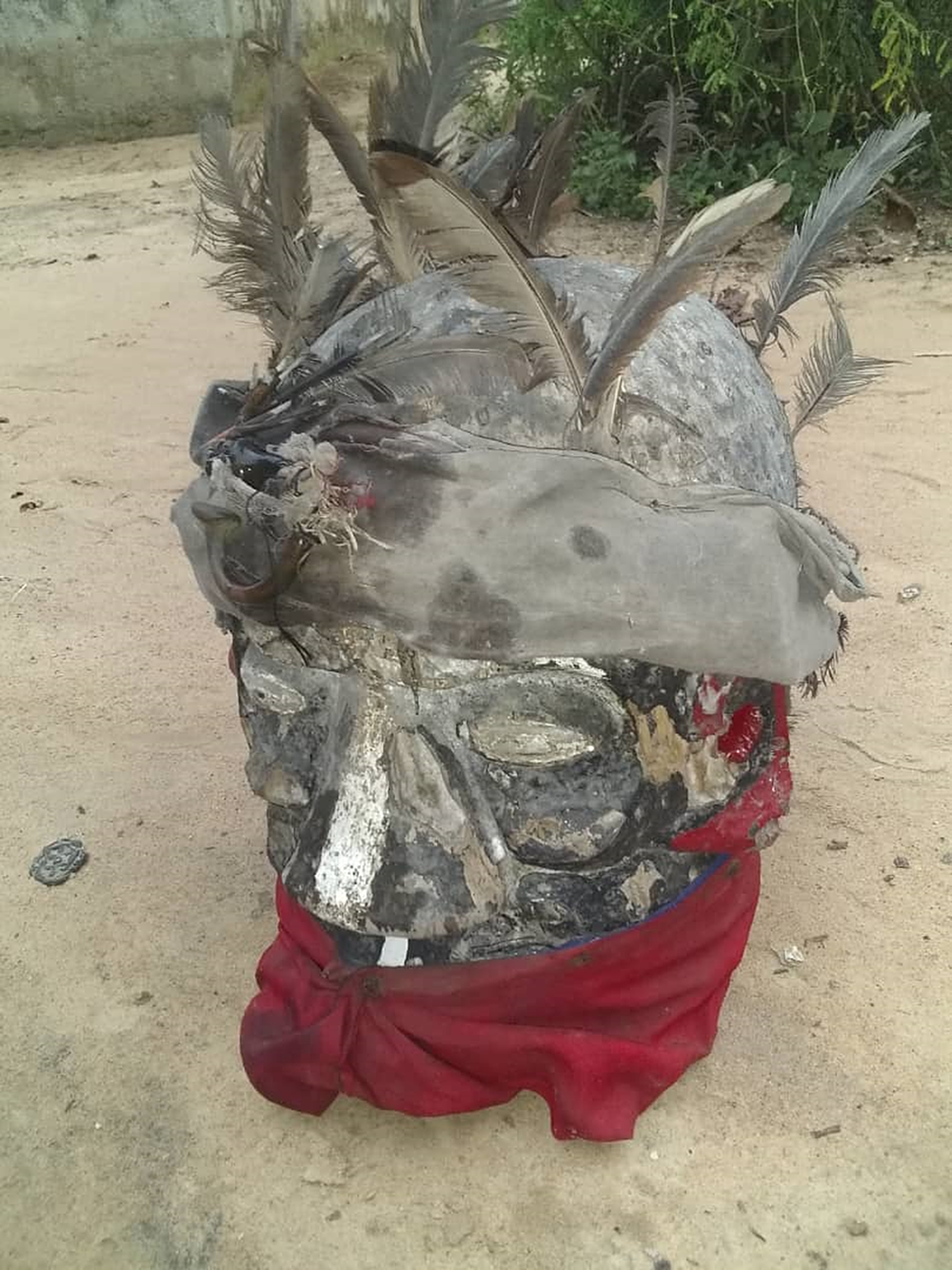
Èkpèyè masquerades are not mere objects and plays from the past; they are the archives of traditions and evolving modernity that cut across all geographies, and which are encountering temporal resistances and disjunctions of continuity that are similar to Marshall Berman’s (Reference Berman1982) global “unity of disunity” in modernity. Cousin Olunwo performed the Obgu Madu-Bé and the Anyi-gbudi, the elephant; cousin Echichala performed the buffalo, and Ifanyi-Chukwu Ijélé performed the White-Man and the Police (Police li Igbéké), who came to the village together to collect taxes and arrest people. Each masquerade was accompanied by its own unique musical rhythm. There used to be over five performers from the Abi family during each Èkpèyè festival season. However, since 2012, the Abis have not fielded any performers in the Owu masquerade. Okà, as a mode of masquerade discussion and conveying knowledge is facing the challenges of transferring the knowledge to future generations.
Okà: The Apotheosis of Modernity
My conundrum began with three opportunities. The first was our son’s interrogation about why I had failed to teach him the Èkpèyè language. The second was our students’ curiosities to learn about the contributions of their African heritage to modern and contemporary planning and architectural discourses. On the surface, the questions both diverged; however, closer examination showed that they were interrogating the ways their parents and their teachers were communicating the lifeworld to them while inadvertently teaching them to forget their African heritage. Third, I adopted okà, an Èkpèyè people’s discursive approach to celebrations and to solving problems to respond to the ASR. My approach is the metaphorical “baby-step”—an atonement—which I hope will encourage our students’ curiosities, while acknowledging that our son’s immediate interest in Èkpèyè language was outside architectural discourses.
Clark’s study and the emerging contributions by Èkpèyè scholars are the communication foundations that will facilitate research and an exchange of ideas in Èkpèyè studies. This essay contributes to the literary foundations in Èkpèyè studies by bringing to the fore okà, Èkpèyè people’s multidimensional, organic, aesthetic discursive process, which intertwines the individual, the body, the community, and abstract thought. Okà expands architectural thinking and building processes; it is the mechanism for conserving Èkpèyè heritage in oral traditions for the culture as a way to cope with timelessness. As a required greeting etiquette during celebratory and problem-solving occasions, okà is the continuous practice for confirming Èkpèyè culture and the solicitations for people to work together and achieve amicable solutions. Adopted as discursive methodology for addressing complex questions and for cultural solidarity in this article, okà reminds us about the absence of local artistic traditions at the national levels in the post-colonial projects of Ghana, Tanzania, and Nigeria, in contrast with Mali’s Independence Monument, which benefited from autochthonous design precedents that are familiar to the citizens.
Adaà-Idu, the archetypal priest and cultural custodian, was a teacher. After he passed away, uncles and aunts—my teachers—from his generation also died in their natural turns. His son, cousin Echikwa, continued to perform his responsibilities, but he stopped over seven years before he passed away in 2019. Echikwa’s son, a younger cousin Madu-Abuchi, stepped in during the interim period when his father was ill, but in 2021, he decided not to continue performing the rituals. As the discursive etiquette in gatherings that requires unity, okà would be the apotheosis of the modernity that counters Berman’s “unity of disunity,” but it is not. Lack of interest or unavailability of succeeding generations to continue the traditions are its internal crisis. For the first time in the known village oral history, the Umu-abi failed to participate in the fire procession for driving away evil spirits on the eve of the Èkpèyè festival in 2021. Ubalama village held the Abis in contempt and fined them. Unbeknown to our son, the students, and the ASR’s editorial team, their questions and the original invitation may well be the collective voices of the oracles who are announcing in the town squares that, without collecting, studying, documenting, and disseminating the traditions of small African cultural groups like the Èkpèyè people, they will vanish, leaving only the customs of the large groups whose languages are spoken broadly, to survive. Am I the only person experiencing this conundrum?
Amé ka nyí okà.
Íyááá…ááá!
Owééé…éééé!


 Open access

