





Information about work and remuneration provides much of the foundation of our understanding of economic history, largely through studies on real wages. Through them, we sketch the development of modern economies and estimate the ebbs and flows of household well-being. These studies, both classic and contemporary, have provided important insight and enabled comparisons across centuries and continents.Footnote 1 However, they are also fraught with difficulties, and assumptions used to work around difficulties and missing data, which can lead to misleading conclusions.Footnote 2 How much people worked and how this changed over time is a particularly pertinent example.
Understanding the length of the working year, and the extent to which people actually did work for pay, has been a long-standing hurdle. Implicitly, the literature has assumed that the number of days worked is a matter of labour's decision about how much labour to supply – that there is a ready availability of employers who are hiring and that workers will work as many days as they are able to maximize cash incomes. This is true both in the standard contemporary methodology, as introduced by Allen (2001), and the theoretical interpretation of early modern economic and social development.Footnote 3 Comparative real wage studies have relied on an approximation of 250 workdays a year, derived by assuming that a labourer would choose to work and could find paid work every day except for Sundays and explicit holidays.Footnote 4 Two of the most influential theories assume that the unskilled working class worked, on their own accord, well beyond their subsistence needs in order to increase their own standard of living, exemplified by the Industrious Revolution (De Vries 2008) and the Golden Age of the peasantry following the Black Death.Footnote 5 This, despite Hatcher (2011) noting that a peasant labourer in the high-day-wage period following the Black Death would have become far wealthier than their local land owners if they worked for 250 days.Footnote 6
There has been considerable progress towards a better understanding of early modern work in the past decades, and how it has both changed over time and how specific regional characteristics – weather and climate, worker mobility, and institutional or cultural norms that form labour relationships – determine labour market parameters. The default 250-day assumption is generally accepted as too broad.Footnote 7
This paper seeks to understand the seasonality of the casual labour market, the amount of work available, and how it changed in early modern Southern Sweden, using information from wages paid to construction workers between 1500 and 1799. This is approached from three points:
1) How much work was available, and when?
2) Did this change over time?
3) Did workers actually work this much?
The Scanian case is unique because of its semi-coercive labour regime, which demanded rent payments in the form of corvée labour. Between the corvée system and the predominance of live-in servants, the market for casual labour in agriculture was much smaller than in other countries, or even in other parts of Sweden.Footnote 8 This means that, although construction labour was not the largest sector in the economy, it allows us to capture a disproportionately large share of the casual labour market when compared with many other European regions.
Findings indicate that the median worker could probably not work for more than 140 days in a year as a casual construction worker, and the peak periods of work availability were concurrent with peaks in agriculture and shipping, which limited access to income diversification. Large-scale building projects that hired day labour were generally undertaken by municipalities and churches while manors tended to rely on workers hired on annual contracts or labour rent.
However, casual workers do not seem to have aimed to maximize income from day labour. Most worked for only a few days even when demand was particularly high, and evidence of longer “careers” in construction work is minimal. This can be understood through a combination of specific institutional factors, which impacted the free sale of labour, seasonal constraints, and a cultural dependence on a multi-earner model.
Early Modern Seasonality, Labour, and the Working Year
Climate and seasonal changes are a fundamental determinant of working patterns in a pre-industrial context, and therefore a key determinant of income. Agricultural production is intrinsically tied to the seasons. Other activities, including construction work, are hindered by winter weather – mortar laid at temperatures below 4.4°C sets poorly and can cause structural weaknesses, and the lack of daylight at a time when light and fuel costs were high precluded long workdays year-round. Transportation could be easier in winter when muddy roads froze solid, or more difficult when water routes were covered with ice or inclement weather prevented travel. The season and climate thus had a direct impact on how people were able to earn a living.
The historiography investigating historical working time can be roughly divided into two primary groups: studies that investigate changes in the seasonality of labour, which determines when work was available; and the plausible length of an average labourer's working year. Until recently, the majority of studies about historical working time have relied on indirect evidence: the past few years have seen a surge in studies that endeavour to measure historical working time, and how it changes, more directly.
While seasonality itself is not a direct measure of the work year, strong patterns of seasonality constrain available work and contract flexibility within the labour market. Perhaps the most well-known study of labour seasonality is Ann Kussmaul's (1993) study of the timing of early modern English servants’ marriages.Footnote 9 She finds a declining seasonality of marriages over time, which she attributes to a decrease in the intensity of seasonality of labour. Marriage celebrations were held when people had more free time to celebrate. In a rural environment, the busy harvest work season saw fewer marriages while the spring slow season became a popular wedding period. In a more urban or industrialized environment, Christmas and other religious holidays were the free period. Marriage records confirm this pattern. Kussmaul further shows that the extent of this marriage “heaping” decreased over time, indicating that the working year, too, became less strictly seasonal alongside improvements in agricultural technology. Dribe and Van de Putte (2012) use a similar approach to Kussmaul to estimate Swedish labour seasonality from 1690 to 1895, also finding a flattening out of a “grain class” seasonal marriage pattern, but with increases in December marriages.Footnote 10 The authors do point out the differences in the potential validity of this method in Protestant vs Catholic countries; Catholics were prohibited from marrying during Lent and Advent, which would decouple some marriage and labour seasonality patterns.
Other indirect measures, such as changes in seasonal wage premiums, provide an indication of the degree of competition for labour within a larger labour market and indicate changes in seasonality – Engerman and Goldin's (1991) study of harvest wage premiums in nineteenth-century America also indicates a declining agricultural seasonality over time, adding to the robustness of quantitative, though indirect, estimates of labour demand seasonality.Footnote 11
Labour seasonality can indicate large-scale patterns and shifts but does not give as much insight into the specific underlying developments. More direct changes in specific workdays or holidays are, however, sometimes reflected in court and other social, qualitative records that allow insight into how people occupied their time on particular days and times. These studies are most closely associated with De Vries's work (1994, 2008), as well as Voth's (1998) use of court records, where witnesses reported their activities at, for example, the time a crime was witnessed.Footnote 12 These have indicated an increase in the European working year over the early modern period, largely as customary “saint Mondays”, which had treated Monday as a non-working day, along with a large number of specific saints’ days, shifted from holidays to working days. This evidence has been used to support the theory of an “industrious revolution”, a period towards the end of the early modern era during which workers, fuelled by a desire to purchase the new and more varied goods that became available through the consumer revolution, worked more days within the year in order to raise their annual income. However, this theory, too, is necessarily based on indirect pieces of evidence, and the gap between traditional real wage accounts and GDP estimates. Other interpretations suggest that while the standard working year may have increased, it could, at times, be largely out of necessity, as lower real wages required labourers to work more to make ends meet. This was especially likely to be the case in rural economies.Footnote 13
Employing text-based sources, such as court records, has also highlighted less regular forms of work along with where, when, and by whom they were done. Paid work done within the home could help keep cash coming in during slow periods. Unpaid repair, upkeep, and preparation tasks were necessary ahead of the spring and summer farm work. These were both important but obviously impacted income in different ways. Whittle and Hailwood (2020) find a large proportion of “work” tasks, separate from household or care tasks, which were carried out within early modern English homes.Footnote 14 Even the “classic” domestic tasks of care and housework were highly commercialized. Small-scale carpentry, like the barrel and trough construction and tool repair that Ågren (2017) describes Elias Jonsson carrying out in 1758, could also be undertaken during the off-season.Footnote 15 Other tasks, like spinning, typically associated with women's work, are not as seasonally dependent as agriculture. These studies highlight the complementarity of paid and unpaid labour and the different kinds of work people cobbled together to keep a household going. They also emphasize the difficulties associated with identifying the boundaries of work itself, which, in turn, complicates the idea of a “working year”. While the current study is explicitly interested in opportunities for paid work and in the implications for how we measure wages, income, and living standards, a stronger understanding of house-based work, both paid and unpaid, is critical for guiding these investigations.
In recent years, there has been an increased attempt to make direct estimates of historical working years, both at the industry or whole-economy level as well as the individual level. Typically, models assume that workers laboured for 250 days a year, though some assume as many as 260.Footnote 16 This is based as much on the number of non-holiday working days available in a year as it is on direct data or on the amount of work needed to meet household needs. It is also influenced by modern preconceptions of work patterns, in which individuals are consistently employed in the same occupation for the majority of the year.
Using the wages paid to labourers who work by the day is a standard way to estimate annual income, and, as an extension, well-being; methodologically, the length of the working year has a direct influence on measurement outcomes.Footnote 17 But little is known about the amount of working days in a typical year, both on an industry level and on the individual level, which presents large theoretical and empirically problems when, definitionally, the number of work days is a direct determinant of annual income estimates.
Allen and Weisdorf (2011) invert the standard real wage methodology, estimating the number of days an unskilled man would have needed to work in order to meet his living needs in a year;Footnote 18 in other words, annual income is assumed and held constant instead of presumed work days. Results show an increasing number of work days needed in order to meet subsistence. These proxy estimates of what Allen and Weisdorf call the “implied working year” line up fairly well with the scattered available direct evidence of the length of the working year.
Robust indications of an increasing work year come from Humphries and Weisdorf, who estimate annual incomes from unskilled female (2015) and male (2017) workers both in casual employment and in annual service.Footnote 19 There is a discontinuity between the two types of wage systems, with, again, an increasing number of casual work days required to earn an income equal to annually employed counterparts. Gary and Olsson (2020) find a related relationship in early modern southern Sweden, where increasingly more work days are needed for casual workers to both meet their subsistence needs and to make the same wage as those employed on annual contracts.Footnote 20 These findings all indicate that the work year for casual workers would be increasing over time.
Direct evidence from days worked also highlights both changing work patterns over time and a disconnect from 250-day assumptions. Ridolfi (2021) observes a decrease in French labourers’ working days from the end of the fourteenth century,Footnote 21 followed by a slower and steady increase until the mid-nineteenth century, with both levels and trends comparable to those in England.Footnote 22
Stephenson (2019) uses a similar approach as the current paper in the London construction sector, examining builders’ work years, hours, and pay in the eighteenth century.Footnote 23 Her study covers only a few years but has the great benefit of directly addressing the data upon which many of the great economic history debates have been constructed. Her findings reflect those found in this study; the typical working year (or possible working year) for construction workers was far shorter than what real wage estimates assume, perhaps something around 180 days. However, there was a substantial degree of bi-modality in work years: a split between “regular” employees, who were essentially full-time, though still paid by the day, and those who were truly casual workers and worked far less than their regular peers.
The Early Modern Swedish Context
The Swedish case presents an appealing test environment. Sweden is one of the northernmost areas where agricultural-based economies were sustainable, with substantial variation at different latitudes. While only some ten to twenty-five per cent of central Sweden was arable, over half of the southern province Scania could support cultivation in 1700. Northern Sweden was not suitable for grain cultivation at all.Footnote 24 However, Scania lay on the periphery of early modern agricultural-based economies. Its longer and darker winters meant a shorter and riskier growing season, with crop yields more susceptible to damages from late spring freezes or early autumn frosts. Margins for planting and harvesting could be narrower than in continental Europe or even England, and like other peripheral regions, these constraints put Scania at higher risk for famine.Footnote 25 Both the constraints from dark and cold winters as well as agricultural needs are likely to have contributed to a stronger impact of seasonal change on labour markets.
A later industrialization compared to European growth leaders and slow urbanization preserved many older systems of production. Only with the Swedish industrial revolution, in the later part of the nineteenth century, was there rapid development of population and urban centres.Footnote 26 This means that Sweden was dependent on the natural economy and constrained by low-technological paradigm though the entire period studied here. The patterns that can be observed in the Swedish data as late as the eighteenth century possibly provide insight into the realities of rural European life in a more distant past. This was especially the case in the peripheral south; still, in 1750, over sixty per cent of Sweden's manufacturing workers were located in Stockholm, the only truly urbanized area in the country. Scania, the “breadbasket” of Sweden, industrialized at a much slower pace.Footnote 27
Swedish cities were small, and only about ten per cent of the population could be considered “urban” by 1800; by 1850, it was still only about twenty per cent urbanized, though in a Swedish context this still referred to quite small population centres.Footnote 28 Rural labour markets and small population centres meant a thin labour market throughout much of early modern Sweden. The current paper focuses on Malmö, the largest city in the Scanian region, and Kalmar, a small but historically important town half-way up the east coast to Stockholm.
Scania is the southernmost region of what is now Sweden, and belonged to Denmark until it was ceded to Sweden in 1658. Malmö, positioned across the Oresund straight from Copenhagen, had been an important sister city to the Danish capital, but its relative significance declined as a part of Sweden.Footnote 29 Malmö boasted some 2800 inhabitants in 1571, which increased to 5700 in 1699, but the eighteenth century saw population decline and stagnation; 1699 levels were not reached again until 1810.Footnote 30 Following Sweden's annexation of Scania, the crown enacted a project of “Swedification” to integrate its new territories both economically and culturally, as well as to reinforce defensive infrastructure. As a part of this, the castle and fortifications in Malmö and other existing towns were strengthened and extended. These projects form a backbone of the data used in this study.
Kalmar was even smaller than Malmö, with about 1500 inhabitants in 1571 and only 2000 in 1699.Footnote 31 But Kalmar was significant: in 1397, the town witnessed the signing of the Kalmar Union, a political alliance between Norway, Denmark, and Sweden created in response to the power of the Hansa. In the early seventeenth century, the town was largely destroyed by the Kalmar War, and, as part of the rebuilding process, Kalmar was granted a cathedral.Footnote 32 The rebuilding of the town and construction of the cathedral are Kalmar's contribution to this study's data.
Southern Swedish Labour Markets and Regimes
The labour markets in early modern Scania were somewhere between fully “free” and purely coercive. Scanian labour regimes followed many classic patterns common to Western Europe, but also had some additional characteristics that set it apart from surrounding regions. Scania exhibited many classic attributes of the (Western) European marriage pattern (EMP) and associated lifecycle service, but, in addition, it also had its own, more local institution of corvée labour. Together, these supplied the majority of agricultural labour to early modern farms. Both of these systems were contracted on a long-term basis, which reduced the market for casually hired agricultural workers, even in peak periods.
Lifecycle servanthood was a classic feature of early modern Western Europe, including large parts of Sweden.Footnote 33 Servants were contracted by the year and were responsible for a broad range of domestic and agricultural duties. In agriculture- and manor-rich Scania, a substantial proportion of the population would have worked as a live-in servant at some point in their lives.Footnote 34 Servant Acts and other legal frameworks penalized those without means or employment and pushed workers into annual service,Footnote 35 despite the extremely low cash payments that Swedish servants received, especially when compared to their English counterparts.Footnote 36
Scania has always had somewhat distinct labour regulations, both when it was part of Denmark and as a part of Sweden. As a part of Denmark, Scania had never been subject to any of the more stringent forms of serfdom that existed in other Danish regions from the fifteenth to eighteenth centuries.Footnote 37 However, under Danish rule, Scanian nobility established independent control over their land and its use, including the right to demand labour as a form of rent payment from their tenants, and to evict said tenants with virtually no process or protection. These rights were extended under Swedish rule. This coercive system of corvée labour only increased from the seventeenth into the eighteenth century.Footnote 38 While, in theory, labour payments were set in a written contract, these contracts often included a clause that required the tenant to provide additional labour “whensoever requested”.Footnote 39 A crofter could, however, have his own servants who could be sent to perform the labour payments – and this would have become necessary by the nineteenth century, by which point the corvée requirements averaged 118 days in 1800 and 314 days by 1850.Footnote 40 Corvée labour accounted for a large proportion of Scania's agricultural labour needs.
Corvée labour and lifecycle servant institutions supplied a large proportion of Scania's agricultural labour, leaving a much smaller market for casually hired day workers, especially on larger estates for which records were kept and preserved. It was not until the eighteenth century was well underway that substantial increases in agricultural productivity together with widespread proletarianization created both demand and supply for a casual labour force in agriculture on larger Scanian estates.Footnote 41
Migration was also limited. While those who worked as servants might relocate on an annual basis, most people did not move long distances.Footnote 42 Travel for the sake of work by the day was also burdensome – one of the forces behind the decline of the corvée labour institution in the nineteenth century was the inefficiency and costs incurred when larger estates required day labourers to travel longer distances.Footnote 43
Data about labourers in urban areas, especially those working in construction, is not representative of a typical early modern Swedish labour market. Urban construction labourers are even less representative: Enflo and Missiaia (2020) estimate the share of GDP attributable to the construction industry at only seven per cent nationally in 1571, and estimate that Malmöhus County, where Malmö town is located, had a roughly eighty per cent labour force share in agriculture in 1750, above Sweden's national average of seventy-six per cent.Footnote 44 Malmöhus's agricultural share rose slightly through the 1770s, and had only declined to about seventy-nine per cent in 1800, after which it dropped more steadily to about sixty-six per cent in 1850. This is a region that clearly remained agricultural and rural late into the early modern period. But, given the strong reliance of agricultural production on long-term contracted labour, the casual market in construction captures a larger proportion of casual labour markets.
The data sources represent large, multi-decade projects that were managed and paid for by the cities. The projects were conspicuous – in Malmö, repairs and expansions on the castle and the erection of new fortifications, and in Kalmar reconstruction following the Kalmar War and erection of a cathedral in the centre square. A rural setting and diminished availability of casual labour in agriculture before the nineteenth century increased the costs of finding day-work elsewhere. Because of this, the employers who are recorded here are treated as quasi-monopsonies, setting both wage rates and employment levels. This is not unreasonable given the broader context – there is substantial evidence to suggest that early modern Swedish (and Danish) labour markets, generally, were characterized by monopsony.Footnote 45
Data
The primary data used come from payments for construction labour in Southern Sweden between 1500 and 1799. The sample used in this study is drawn from a dataset of over 27,000 observations of casual day labourers in construction, which represent approximately 117,000 individual paid workdays. Missing information on the month of employment in approximately 8.5 per cent of the total sample reduces the final sample to nearly 25,000 observations representing nearly 95,000 paid days of labour. The majority of the dropped observations come from the early sixteenth century in Malmö.
Records come from the account books of different kinds of institutions; in order to survive, the institutions needed to have been large enough to require record keeping, and for those records to have survived. This means that smaller private residences are not represented in the dataset. Four main categories of institutions are represented: city halls or municipal councils; churches or cathedrals; manors and private estates; and Malmö hospital, a poor house and charity institution. Each account book records wage payments to both employees paid by the year as well as those hired on a short-term, casual basis. This study is interested in the patterns related to short-term or casual employment, but comparisons with annual hiring patterns give additional insight into labour alternatives.
All records in this study refer to direct payment to individuals, or to a specified small number of labourers, working in construction or carrying out tasks on construction sites. The majority of the records include a clear date of employment. Some 400 observations refer to the timing of church holidays instead of a calendar month; the timing of these is determined using historical liturgical calendars.
The account books typically include a description of the construction project itself, as well as an occupational title or indication of the type of work being done, and skilled workers – carpenters and masons – are clearly delineated from unskilled workers. Of the final sample, 5557 observations are skilled builders and 19,274 are unskilled – 1678 of these unskilled builders are women.
Table 1 shows the sources of the data and number of observations of casual (day) labour in construction. The dominance of Malmö borgerskap (Malmö city hall) is clear, with substantial building work also undertaken at Malmö's Saint Petri's church, located 150 metres from the town hall, and Malmö hospital, also nearby. Malmö borgerskap's projects include reinforcement and improvements to the castle and city walls as well as work on the building itself. The second largest employer of building workers was Kalmar cathedral, which was built during this time as part of a redevelopment and relocation of the town after the Kalmar War.Footnote 46 Vittskövle and Trolle-Ljungby are two fairly typical Scanian estates, located on the eastern side of the region, and are the largest “private” employers in the dataset. Smaller municipalities and other manorial estates record only a scattering of casual construction labour during the study period.
Sources of paid day labour in construction.
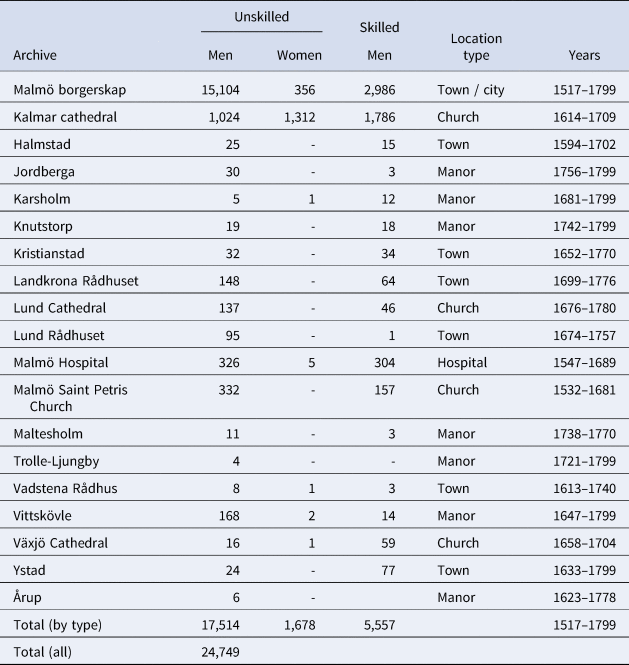
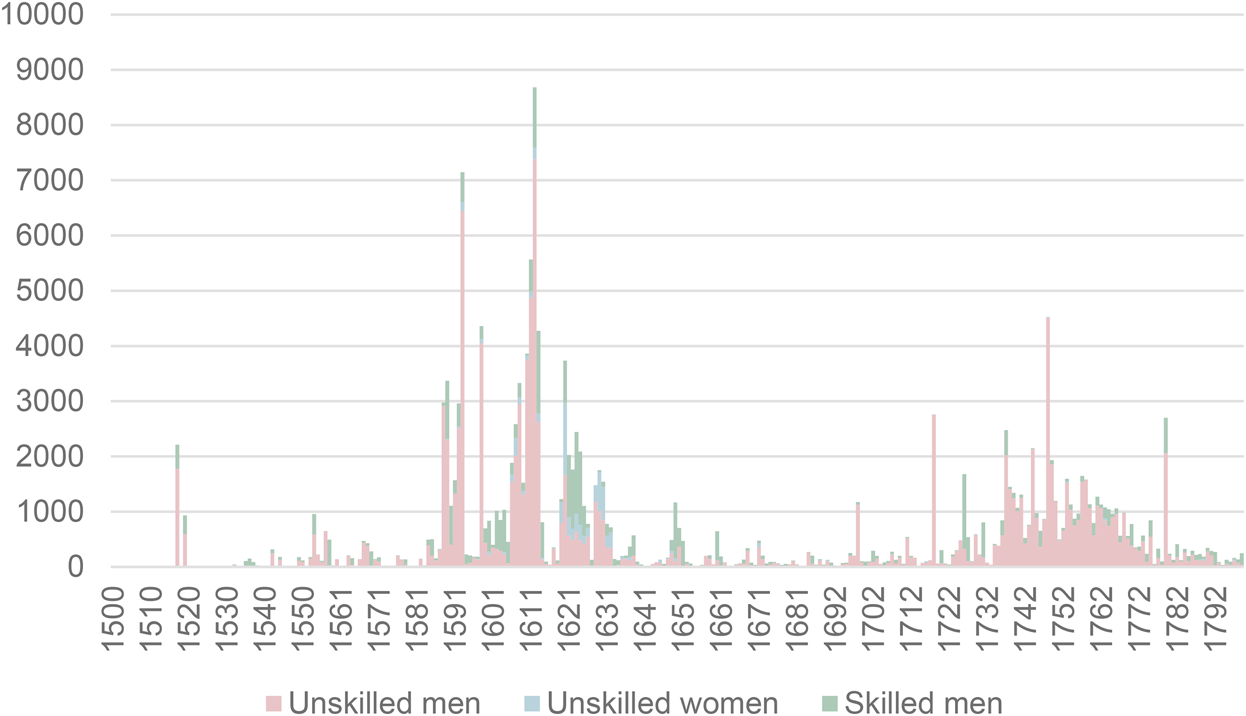
Figure 1 shows the temporal distribution of the number of paid workdays in the final sample. The major spikes correspond to large municipal building projects in the late sixteenth century in Malmö and, from the early seventeenth, Kalmar as well. The increase in building work in the eighteenth century is again driven by Malmö's major projects together with an increased use of day labourers in Vittskövle and Trolle-Ljungby.
The Seasonality of Construction Labour
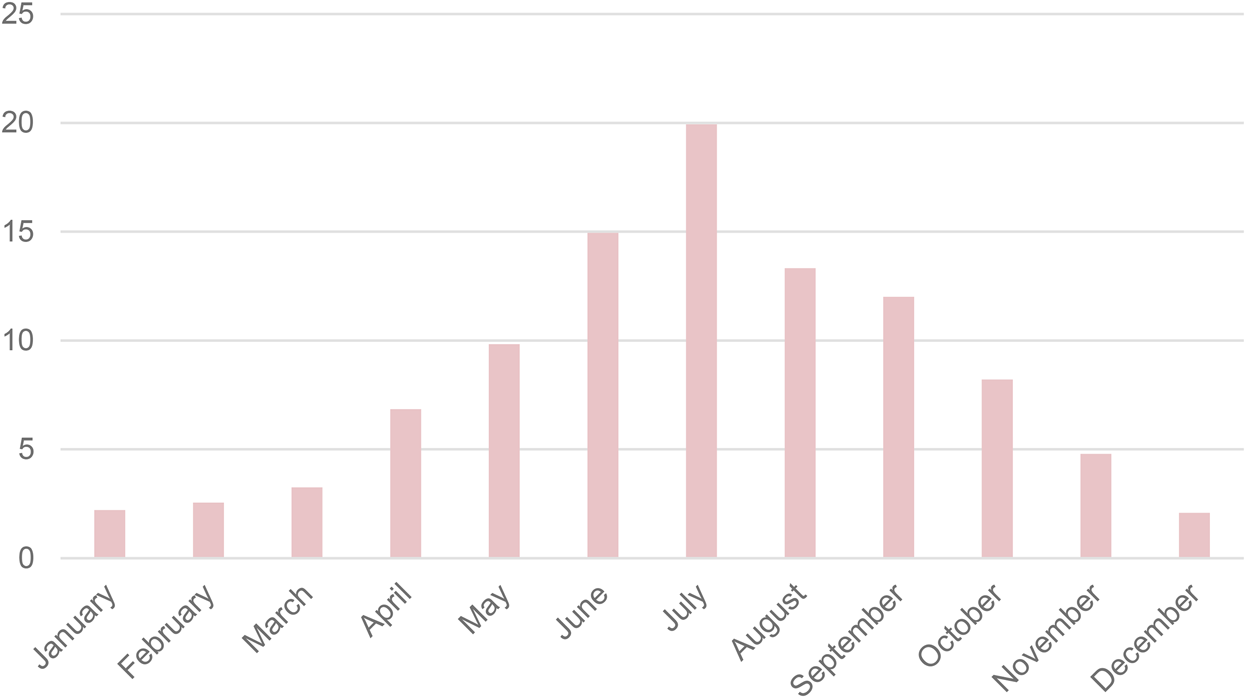
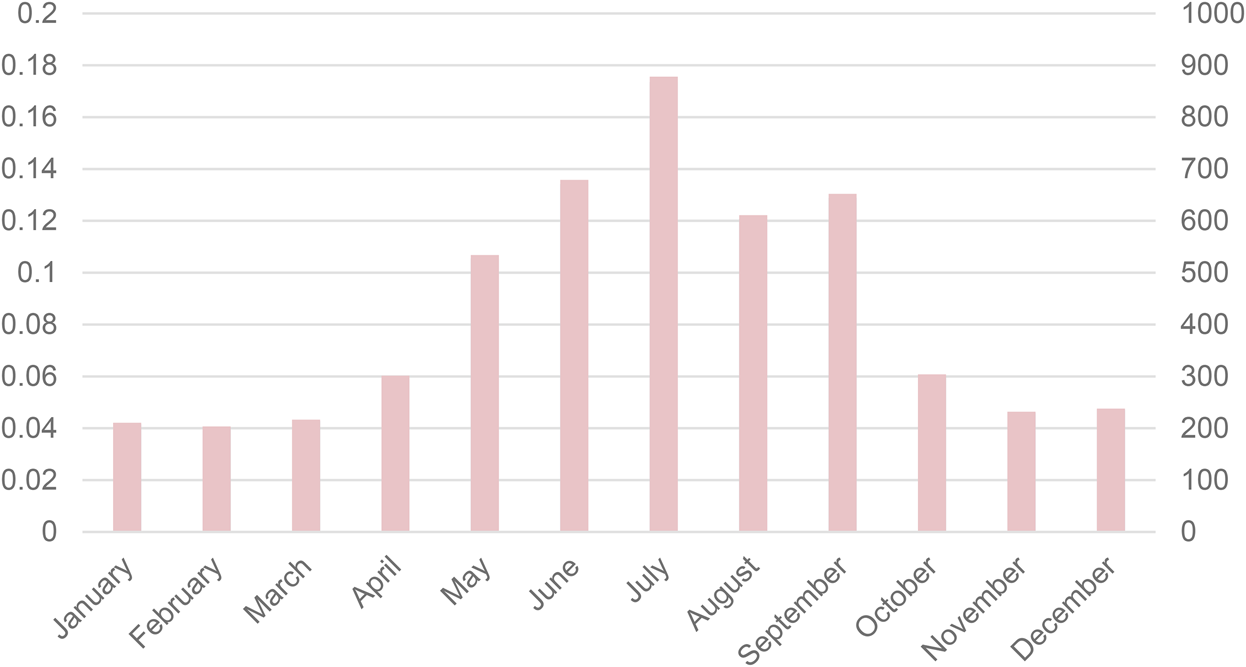
Given the constraints of geography and climate, it is not surprising to find that paid days of construction work follow a seasonal distribution that peaks in warmer, lighter months. Figure 2 shows the monthly distribution of paid work days for unskilled men working in the casual construction industry in Southern Sweden, including both Kalmar and Malmö, as well as casual building work on nearby rural manors, over the entire period of study. The pattern is overwhelmingly seasonal, with peak labour periods in June, July, and August. The differences are large: almost twenty per cent of paid days of labour are in July, with an average of only about three per cent undertaken each month from December through March.
Distribution (per cent) of workdays in construction by month when month of work is known, 1500–1799. All workers.
Source: see Table 1.
What did this seasonal distribution of workdays mean for labourers’ ability to earn a living? Classic methodology based on Allen (2001) assumes 250 days of work.Footnote 47 Gary and Olsson (2020), using the same wage data utilized in the present study, calculate that 200 work days, with some deviations over time, would have sufficed to keep a family of four comfortable.Footnote 48
Assuming a work week of six days, as is typical in the sources, 200 days of labour would require full-time employment for 33.3 weeks or 8.3 months. A five-day work week, which is less common though not abnormal in Malmö, would require ten full months’ employment. At these levels, approximately twelve per cent of workers would have access to a 250-day work year, and seventeen per cent to one of 200 days. If we discard December, January, and February with their very low per centage of workdays and take April to November as the eight month “core” working year, it is clear that only a small minority of workers would have been able to access 200 workdays per annum. With only about five per cent of paid work done in November, and July accounting for a full twenty per cent of paid workdays, only about one quarter of those employed during the peak summer period could hope for a job by the end of the fall. The slower pick-up in the spring months means that even fewer would have been employed before the building boom. The winter workforce was cut to a minimum, and work would have been very scarce within the construction industry.
Taking the months in the top half distribution of paid work days, we can estimate the amount of work available to the worker at the median – or, the time that fifty per cent of those working at the peak summer boom might expect to be able to find reliable work. May, June, July, August, and September all fall in the top half of the distribution of paid working days. Assuming a six-day working week, this gives some 120 days that would be available to these median-and-above workers. Including October, the next busiest month, only takes us to 144 available workdays. This falls substantially short of the Allen (2001) 250-day mark, and is still far from the 200 suggested by Gary and Olsson (2020), meaning that even if a labourer worked all the days available they would not be able to comfortably support a family from casual labour.Footnote 49
Seasonality over Time
It is clear from above that the work year in construction was strongly seasonal, but was employment consistently seasonal over the 300 years investigated here? Figure 3 divides the sample into fifty-year periods, from 1500 through 1799, and shows the distribution of paid workdays by month separately for skilled and unskilled workers. The decline in seasonality for both skilled and unskilled male workers is suggestive – from peaks of 25–35 per cent of construction labour carried out in the summer months in the first two periods, to under fifteen per cent in the later periods. Also important is the shift to more work being done in the late winter and early spring in later periods. It is worth noting that the most extreme periods of summer peaks are also those when the large state projects are at their height.
Distribution (per cent) of unskilled and skilled workdays by month in fifty year periods.
Source: see text. Unfortunately the data in the first half of the sixteenth century are the least likely to include a time specification beyond the year. Around 35 per cent of these observations cannot be included in this analysis because of this missing information. Missing seasonal information in other periods ranges between around 3 and 16 per cent.
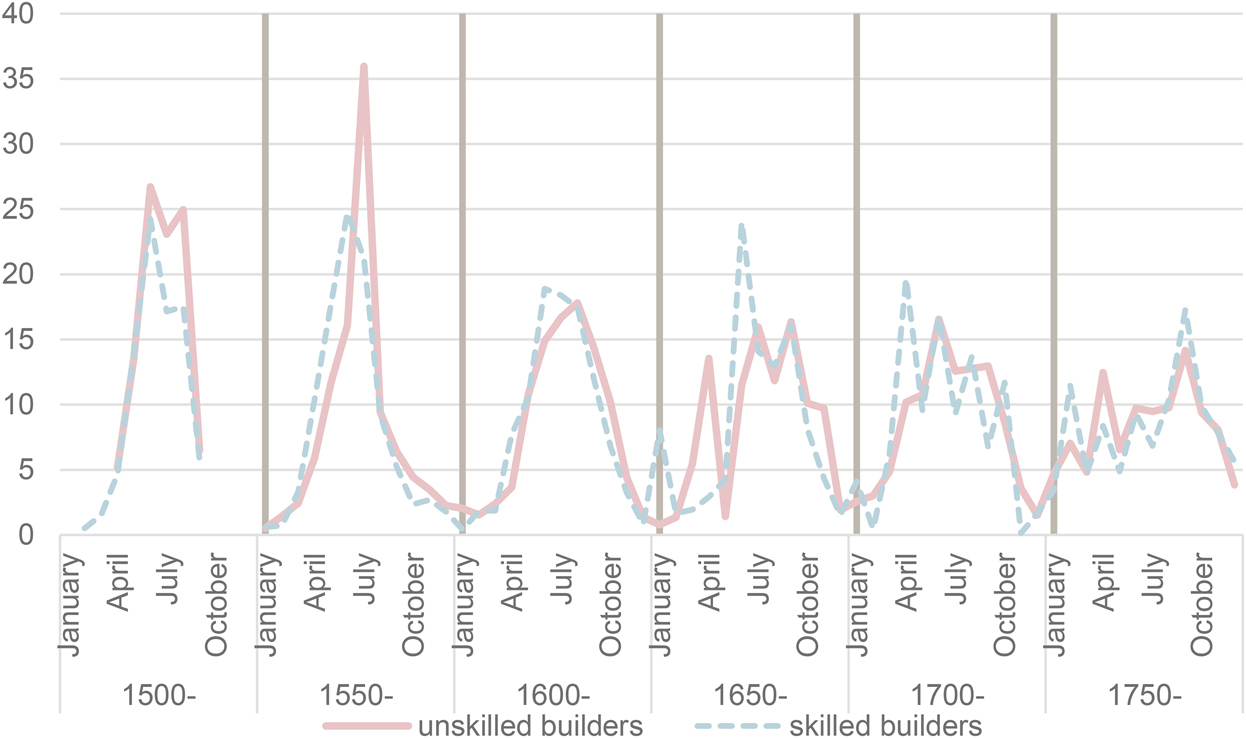
There are surprisingly few differences in seasonal labour patterns between skilled workers (masons and carpenters) and the unskilled labourers. Skilled workers tend to have their labour peaks slightly before their unskilled coworkers, especially in later periods when skilled workers are working earlier in the season. This could be connected to a change in the structure of the labour market, or perhaps to a greater need (or ability) to prepare when building projects are smaller.
The overall trend indicates a decreasing dependence on seasonal conditions for labour. A flatter distribution of paid working days can give the impression of a longer working year and increased industriousness; that is, it could imply that people started working more. But this does not necessarily mean that there was more work being done, or remunerated, at either the individual level or in the economy at large; it could also indicate that while some workers could work longer, fewer individuals could access work. Figure 1, above, shows the overall decrease in the extensiveness of work throughout the seventeenth century, at the same time as Figure 3 shows decreasing seasonal peaks. This relationship is important to bear in mind when assessing changes in industriousness in the very long term – industrious for some may be unemployment for others.
Individual Work Patterns
So far, this paper has investigated the seasonality of paid construction labour and its development over time, and speculated about the number of days a builder in the top half of the distribution would be able to work. These discussions have still rested on the underlying assumption that labourers were willing and eager to supply as much labour as the market made available.
But was this the case? This section looks at individual workers’ supply of labour rather than employers’ demand for labour. As discussed above, the large-scale nature of the building projects would suggest a degree of monopsony; that workers had access to information about available work and that these projects would have been the dominant source of casual construction labour in their respective towns.
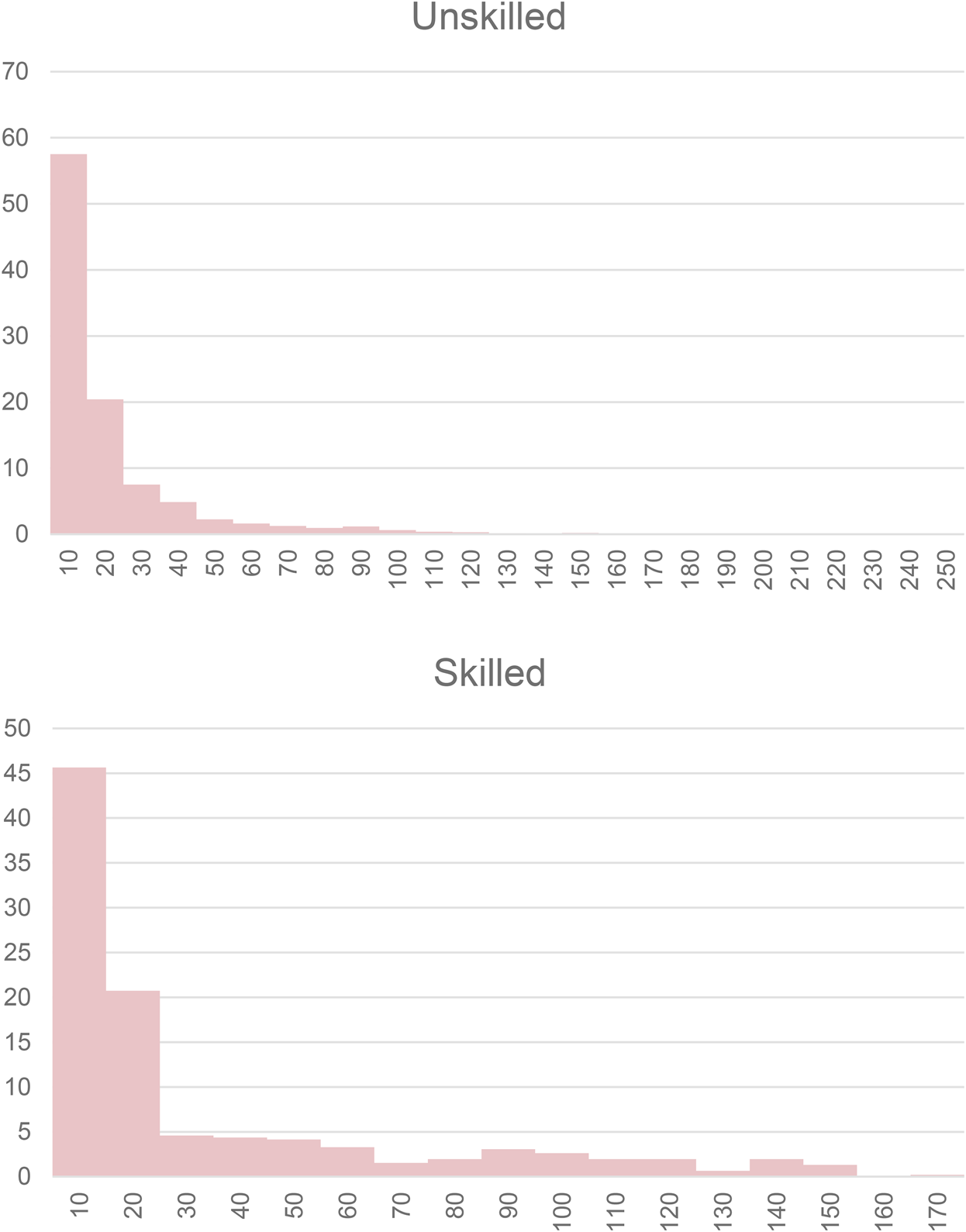
Approximately 11,400 observations of paid workdays include workers’ names; these represent nearly 2,900 individuals for whom we can calculate the number of days they were at a specific building site in a given year. Figure 4 shows the distribution of mean individual work years, on the same site, separately for skilled and unskilled workers. Nearly sixty per cent of unskilled workers work ten days or fewer on a particular worksite, with a median of eight and a mean of eighteen. Skilled workers work somewhat more than unskilled workers with a mean of twenty-eight and a median of ten days, which is reasonable given their human capital investment and likely roles as project leads. However, a full forty-five per cent of skilled workers still only work up to ten days a year on a particular site. These figures are far below the 200- or 250-day levels that are suggested as necessary for a family to live comfortably, or even the 140 to 150 that the distribution suggests might have been possible for some.
Distribution (percentage) of unskilled (top) and skilled (bottom) workers’ annual days of work in the entire sample, 1500–1799.
Source: see text.
However, some years had much lower building demand than others, which might be impacting these results. in Malmö, major project years record over 6,500 days of labour, with work available in all twelve months, while quieter years paid for fewer than one hundred days of labour, and only in the busy summer season. Did labourers’ supply of labour increase when demand was higher? If Malmö city purchased several thousand days of labour per year in the early seventeenth century, during a period when the town had only some 2,000 inhabitants, the scale of the building projects would have been conspicuous. We could expect to see increases in individual's working years if workers aimed to maximize their cash income.
We can use the variability in the extent of Malmö's public building projects to simulate market size and test the impact of changes in labour demand. The sample is restricted to records from Malmö borgerskap to maintain continuity. Out of almost 15,500 observations, approximately 11,400 observations include names, which correspond to approximately 2900 individuals who can be connected across observations to investigate individual work patterns.
The work intensity is represented by the number of work days that Malmö borgerskap “bought” in a given year. Levels of intensity are broken into categories: years with fewer than 100 paid workdays; years with between 100 and 400 paid worker days; years with 400 to 1000 work days; between 1000 and 2000; 2000 to 4000; and years when Malmö borgerskap paid for more than 4000. Table 2 shows the median, mean, and standard deviation of individuals’ days worked in a year. It is presented for each of these levels of intensity, separated into skilled and unskilled workers. While the unit of observation has previously been working days, we are now interested in individual workers – note that a worker may appear in multiple years, and that multiple years are binned together. The first row indicates that 201 unskilled men are paid for day labour in years where there were fewer than 100 paid worker days. In these low-demand years, they worked a mean of 4.95 days, but only a median of three. In these same low-demand years, twenty-eight skilled men worked for a mean of 6.1 days and a median of 3.5.
Median and mean number of men's workdays in Malmö, by project-site work intensity.
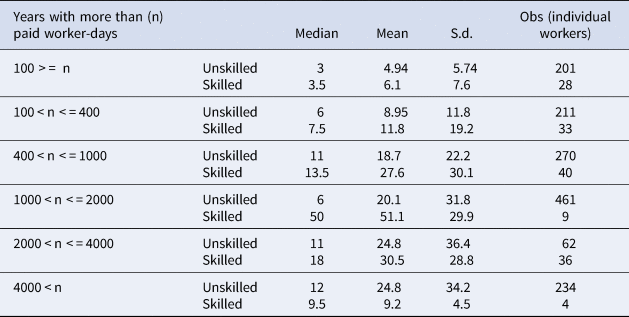
Individual worker working years are a slightly longer in years with more demand. In years when Malmö borgerskap paid for between 400 and 999 days of labour, mean unskilled days rise to 18.6 and the median to eleven; for skilled workers, work days increased to a mean of 27.6 and median of 13.5. But when Malmö's building demand increases from between 400 and 1000 paid workdays to several thousand work days, we see little reaction from individual workers, especially those who are unskilled. The rather high standard deviations recall the long right tail of the distribution shown in Figure 4. But this also indicates that a worker who works as much as two standard deviations more than the mean would only be working 30–85 days in a given year, in years when Malmö borgerskap purchased more than 100 days of casual paid labour.
Skilled workers hired by the day did work more, but the difference is usually not very large. As is visible in Figure 4, there is a much shorter right tail for skilled workers’ individual working patterns, probably because of the smaller number of observations. Even in the periods with the largest number of unskilled workers – when we observe between 1000 and 2000 days of paid work – there are only nine individual skilled workers recorded. However, this is also when the skilled workers were working the most. Given a hundred or more days of paid work in the year, a skilled worker who works for two standard deviations beyond the mean is still only working thirty to 110 days, though the number is likely closer to eighty-nine.
These are very low numbers of workdays. It is certainly not enough to meet standard methodological assumptions; nor is it enough to meet Gary and Olsson's (2020) substantially lower estimation of 200 workdays necessary for Scanians’ comfortable support.Footnote 50
The sample is dominated by workers who worked very short periods. This high level of turnover perhaps left room for “career” workers to subsist more reliably on casual construction income. Some workers did work quite long years, and a few even as many as 200 days in the same place. But the numbers are small; of the 2900 identifiable individuals, 180 worked more than fifty days in one place in a year; fifty-eight worked more than 100 days, and only eleven more than 200. These distributions are also all left-skewed, with means higher than medians, and there is no clear grouping that would indicate a “typical” pattern within this worker group.
Workers who worked fifty days or more in the same place in a year worked a mean of ninety-seven and a median of eighty-two days, and those who worked more than 100 days worked a mean of 153 and a median of 132. This does show a tendency towards higher worksite attachment for some “regulars”, but these workers are also more skilled than the full sample. Some twenty-eight per cent of fifty- and twenty-six per cent of hundred-day-or-more workers are skilled, compared to about thirteen per cent skilled in the general sample. These patterns indicate that individual attachment to a single work source was uncommon, even in periods and places where paid day labour was abundant and visible.
Workers also did not return to building sites in subsequent years. About eighty-five per cent of workers cannot be linked together over more than one year, and less than fifteen per cent can be seen across two to five years. This is despite the nature of the data – the only personal information given are names and occupation – leading to potential over-matching within the sample. In Malmö, only twenty individuals are identifiable for more than five years’ of work. Kalmar's Anna Dikerska, the worker with the longest attachment to any building site in the entire sample, appears across fourteen individual years between 1619 and 1637. However, her work patterns are so extreme as to be the exception that proves the rule.
Workers who were reliant on casual paid work would have been required to work for several different employers, and within different “industries”, both across and within years. Given the low number of individuals’ workdays even in high demand periods, other family members must also have been doing substantial work to support the household.
Seasonality in Other Industries
Seasonal availability of construction work is important not only because of work availability within the construction industry itself, but also because of how it impacts individuals’ ability to work in other industries. While this paper does not permit connecting workers between multiple industries or work sites, comparing seasonal labour demand can give us some insight into the options that would have been available.
Agricultural Labour
Agriculture was the dominant sector in early modern Sweden, especially in Scania. In the British case, we see that landowners utilized a variety of strategies, with substantial variation in the ratio of short-term and annually hired workers between estates, and a preference among the servants themselves to work the (potentially) more lucrative spot labour market.Footnote 51 As discussed above, Scania's semi-coercive labour regimes resulted in a relatively low demand for day labour in agriculture, especially at larger estates that were able to command the labour of others either through hiring live-in servants or extracting corvée labour.
There seems to have been a minimal market for casual agricultural workers at larger estates or institutions. Trolle Ljungby and Vittskövle are both fairly typical Scanian manors and are the two largest “private” employers in this data set. Bookkeeping from their initial construction, both in the sixteenth century, does not survive; but we can observe wage records from periods of renovation and modernization in the eighteenth and first part of the nineteenth centuries. Table 3 shows the number of observations of unskilled paid labour, both by the day and on annual contracts, as well as skilled construction labour at Trolle Ljungby and Vittskölve Manors.
Selected wage observations at Trolle Ljungby and Vittskövle manors.

* The periods shown here are the full periods for which data is available, extending beyond the 1799 cutoff point for the present study.
Sources: Trolle Ljungby godsarkiv, Vittskölve godsarkiv. See also Gary and Olsson 2020.
These two manors are highlighted because of the larger number of observations, but the patterns from other manors in the dataset are not different. Scanian estates show a strong preference for hiring workers on annual contracts. The difference is even stronger because of the unit of observation; an individual hired by the year can only be recorded once each year, or perhaps twice in cases where hires are recorded by the half-year. An individual hired by the day is recorded in weekly or monthly registers and can appear several times. The day labour hired by these manors is nearly entirely construction work; there is no agricultural day labour recorded at Trolle Ljungby. There are eight observations from the mid-eighteenth century of men being paid for threshing work at Vittskölve, usually one man for a period of several weeks. While Scania's restrictive labour regulations surely played a part in the disproportionate number of agricultural labourers being hired by the year, both Trolle Ljungby and Vittskölve also show a strong preference to keep “in-house” skilled building labour as well (Table 3). This indicates that the construction sector in Scania may capture a larger proportion of the paid casual labour market than in other economies, including elsewhere in Sweden. Construction work certainly dominates the casual labour hired by manorial estates.
Other larger institutions also seem to have had low need for casual agricultural labour. Of approximately 640 observations of casual labour, Malmö Hospital records fifty that refer to agricultural labour, primarily between 1548 and 1598. Much of this work is also threshing, either rye or barley, or bundling and loading grain “for the poor” – tröskat spannmål; slagit hö i de fattigas vång; bundit de fattigas korn. But accounting for these workers as day labour is slightly misleading; approximately half of these observations are true day labour, usually for a small group of women and men, paid together for one day's work, during the peak months of late summer. The other half are for between one and four individuals paid for between five and thirty-nine weeks, and commonly begin in late winter and early spring. Wages are low; in 1593, a day of construction work in Malmö paid nearly 2.5 times more than what these agricultural workers at Malmö hospital received, and it is possible that the work was connected to the hospital's role as a poor house for those who were unable to work in other capacities (Malmö hospital G2:1 – G2:12).
While larger estates and institutions show a clear preference away from day labour, peasant farmers, crofters who paid others to take on their corvée duties, and others who did not want to take on the upfront costs of full year servants still hired labour by the day. We do not have strong records for these kinds of transactions. However, we can look to the nineteenth century, when day labour in agriculture became much more common, to infer what seasonal hiring patterns might have been.Footnote 52 If anything, we could anticipate that nineteenth-century patterns might under-represent the seasonality of previous periods due to a decrease in agricultural seasonality in eighteenth- and nineteenth-century Scania.Footnote 53
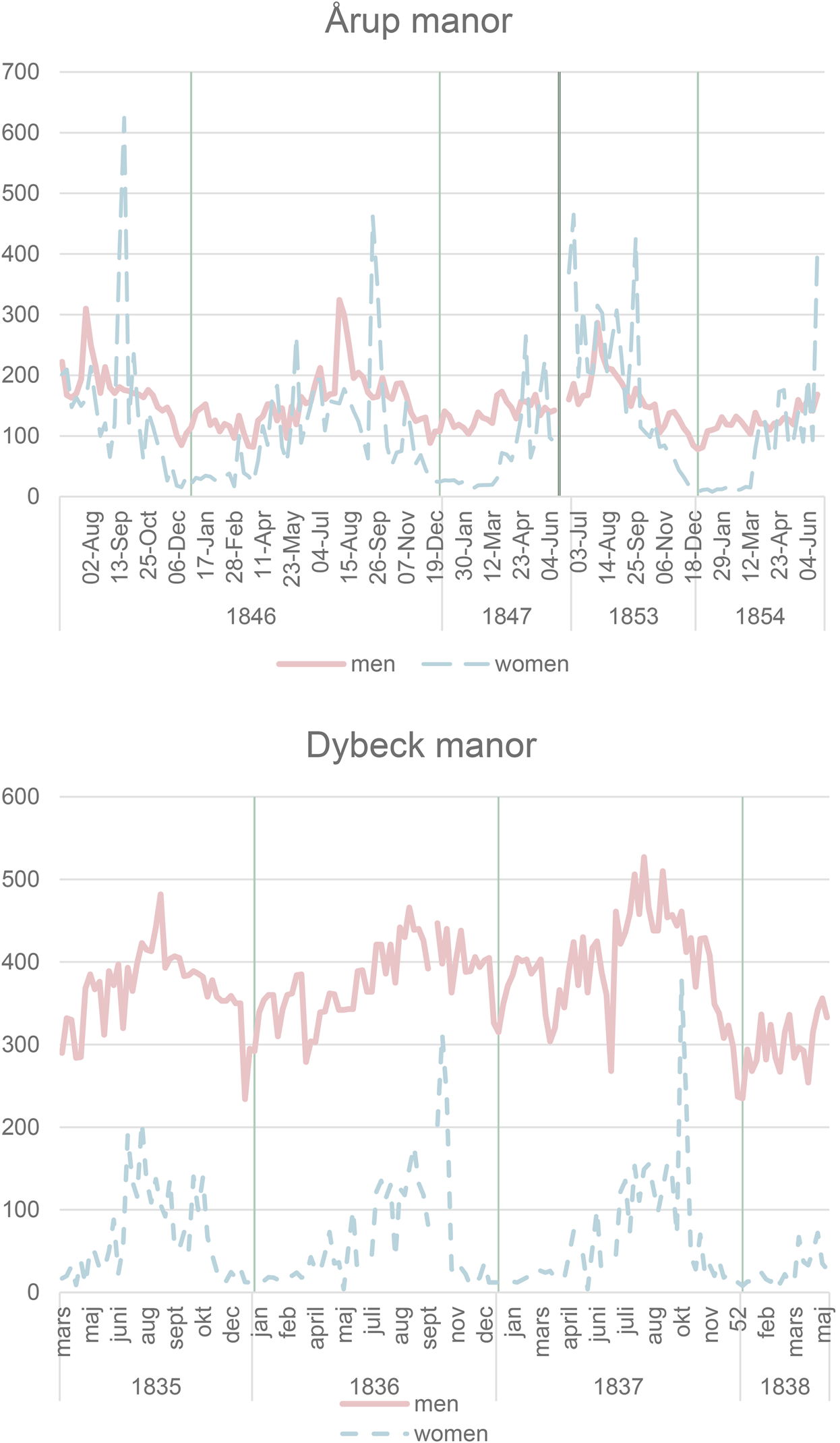
Figure 5 shows the number of day labourers working at Årup Manor and Dybeck Manor, also fairly typical manors in Scania, in the mid-nineteenth century. It shows a seasonality pattern in agriculture very similar to that found in construction, especially for men, with peak labour needs typically occurring in high summer. Årup relies on a large amount of female labour, which has sharp peaks in September during the potato harvest – a new agricultural process following the recent introduction of potatoes to Sweden. But women's work is also in relatively high demand in the summer months associated with other traditional crops, alongside men's and construction labour. Dybeck Manor has a similar seasonal pattern to Årup but with lower degrees of seasonal variability. Dybeck also has a spike in female labour during the potato harvest season, which would not have been relevant in previous centuries. The overall picture makes clear that the similar seasonal patterns would make finding complimentary employment between construction and agriculture difficult.
Annual days of labour at Årup and Dybeck manors.
Source: Mats Olsson, Storgodsdrift. Godsekonomi och arbetsorganisation i Skåne från dansk tid till mitten av 1800–talet. Doctoral disertation, Lund University (2002).
Harbour Work
Comparing seasonality between construction labour and other casual labour within the city is also difficult; there simply are no cohesive records from most institutions or from private individuals. But some proxy comparisons can be made.
Malmö city was an important port town in the early modern period, and casual labour in the harbour has some parallels with construction work. They both relied heavily on menial, manual labour, together with a smaller group of skilled overseers, and there is also substantial construction work to support harbour activities.
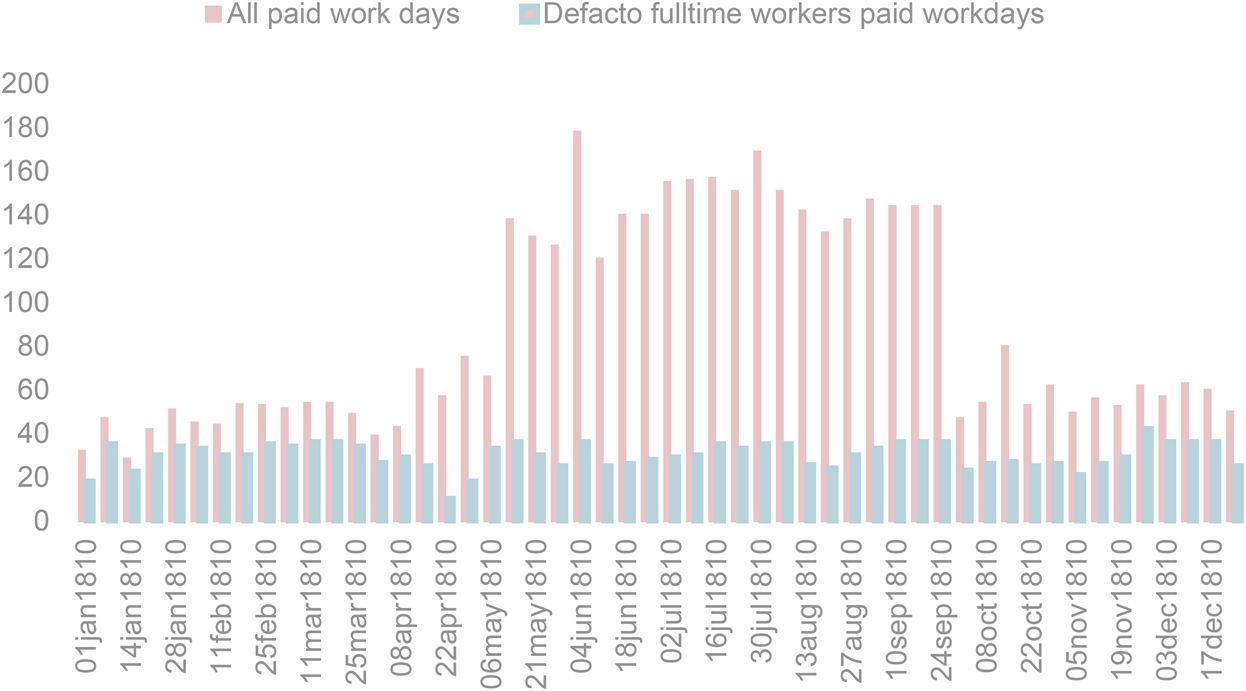
Again, we can borrow data from later periods to draw inferences about the seasonal aspects of unskilled day labour. Recorded payments refer primarily to what is probably construction work to assist the summer-time dredging of the harbour. There are three primary tasks recorded: general or unspecified labour (diverse arbeta), which is probably construction or upkeep related; dredging the harbour from a barge on the water; and carpentry work. Figure 6 shows paid workdays at Malmö Harbour in 1810. Harbour work followed a seasonal pattern much like construction, though with a (very) slightly lower July peak and somewhat flatter winter season.
Distribution (left) and number (right) of paid work days at Malmö Harbor, 1810.
Source: see text.
But this overview conceals a two-tiered system of hiring, consisting of named “regulars” who receive both higher average wages as well as access to more work, and groups of unnamed soldiers who only appear in the summer months. The regular men (and one boy) work on the barge and as skilled carpenters in the summer, and in the winter perform unspecified diverse arbeta at lower wages. It is only in mid-May that they move their work to the barge, and in mid-June that some of the men are explicitly identified as doing carpentry work. It is only because of consistent naming in the records that we can observe the individual workers’ changes in work description and wage levels.
Throughout the summer, the workload increases and the regulars are assisted by groups of unnamed soldiers, who constitute the bulk of the summer labour force (Figure 7). The soldiers are paid less than the regulars’ summer rates, though still above the regulars’ winter rates. Their work tasks are unspecified; either diverse arbeta or they are called “the workers at the harbour” (Arbetarene vid Hamnen). This picture is likely one that is reflected through much of the early modern casual labour market, where a core number of workers were retained throughout the larger part of the year, leaving the seasonal swells to others who would have to seek alternative work through much of the rest of the year.
Weekly days of paid work by worker frequency, Malmö harbour 1810.
Source: see text.
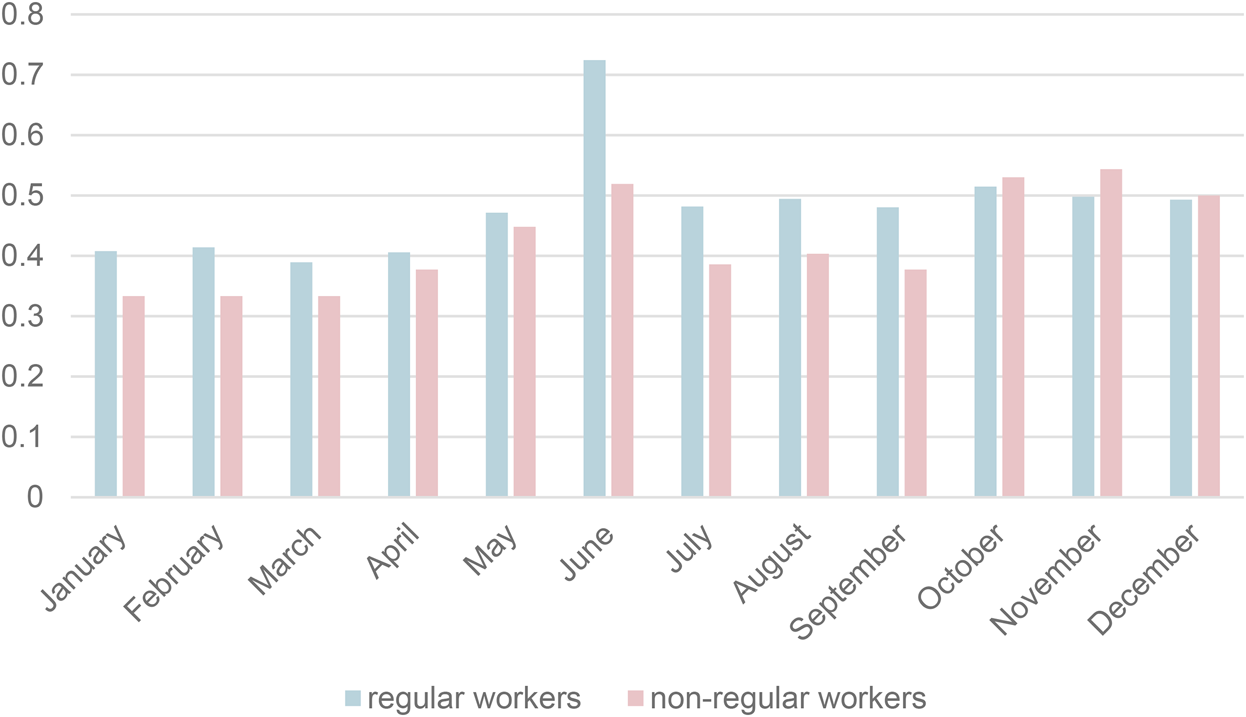
Regular workers also commanded a wage bonus. Figure 8 reveals a clear difference in the average day wage in each month paid to “regulars” and the more casual workers. The most industrious regular worker was actually a youth, gossen Anders (the boy Anders), who is paid a lower rate than the adult workers. He is excluded from the calculations underlying Figure 8, but the results are not impacted by his inclusion. The regular workers receive higher wages in every month except October and November – these months included extra carpenter labour and few lower-earning casual workers, perhaps due to the need to finish a project as the weather grew colder. This is true even when the regulars are recorded as doing general unskilled work. They also received an additional piece rate bonus during the summer for the number of “loads” dredged from the harbour each week, which is not included here. The non-regular workers did not have access to this additional income. The picture gleaned is one where, even in the case of an evolving nineteenth-century labour market, where day labour plays a larger role than in previous centuries, it is difficult for truly casual labourers to access reliable work.
Monthly average wages by work frequency, Malmö harbour 1810.
Other Labour
The records assessed in this text have come from prominent public institutions with a clear need to keep formal financial records. However, a dominant proportion of work, paid and unpaid, would have been carried out in the home. A primary reason why we know so little about such a basic question – how much did people work, when was it, and was it hard to get work – is because of the scarcity or ambiguity of records about everyday activities, especially in the home. Text and verbal-based investigations like those undertaken by Ågren (2017) and Whittle and Hailwood (2020) give us valuable insight, but are not directly comparable with the payroll data used in the current study.Footnote 54 Some of the most important sources of income, like spinning, would have been an important strategy for off-season income. Spinning is notoriously under-recorded, but there are some indications of increases in home spinning production in the off-season.Footnote 55 Other income streams, including small-scale commerce, such as fruit stands or peddling and in-home pubs (krogar), were similarly important but hard to compare directly.Footnote 56 The winter season also gave ample opportunity for repairing tools as well as handicraft production. While legally, trade and commerce in the countryside was restricted, Sweden's rural nature precluded total oversight from state authorities.Footnote 57 The short individual working spells make it clear that individuals would have depended on more than one income source in order to support themselves year-round, as well as income from other household members – findings in line with what we know about the early modern labour market generally, as well as in Sweden.Footnote 58
Implications for the Working Year
Two types of comparisons between wages and prices have inferred a working year based on either what was needed to reach subsistence or what was needed to earn the same wage as an annual worker.Footnote 59 Instead of assuming a fixed number of days, it is presumed that casual employees would work enough to meet consumption goals, after which they would prefer leisure or non-market work. Obviously, these are not direct estimates of a working year, but this type of inferential estimate can provide a more plausible metric of what the labour market could have looked like, especially if there is even a small amount of market equilibrium between different types of work.
Figure 9 shows the number of days of casual work needed for unskilled men and women to meet the level of income that they could receive if they were employed on an annual contract, as well as the number of casual work days an unskilled man needed to make enough to support himself at a “respectable” level of subsistence, defined as the costs of food, other consumables, and the rent needed to support one man for a year.Footnote 60 The “respectable” level simply indicates that the goods included in the calculation represent a comfortable lifestyle, rather than simply the basics needed to survive.Footnote 61
Days of casual work needed to equal an annual wage, and a respectability basket.
Source: Gary and Olsson 2020.

There is a fairly clear trend towards a need for more work days in order to meet an annual wage; the large increase in the late eighteenth and early nineteenth century is particularly apparent. These years featured particularly low wages and high prices, most likely related to a rise in costs following the Napoleonic Wars and Sweden's continued (and not particularly successful) military engagement with Russia during this period. After the Finish War ended in 1809, the relationship returned to levels closer to its previous trajectory.
The average number of work days needed to earn the equivalent of an annual income through the entire period is about 150 days of work, though, of course, increasing over time. Surprisingly, this is in line with estimates from both the seasonality patterns in construction and the individual work patterns of the highly attached workers, though it is on the upper end of those estimates. A work year of 150 days is also marginally above the number of work days that are needed to earn one respectability basket. This is a reasonable benchmark estimate for a typical Scanian work year. The figure fits well within the earning needs of an individual supporting themselves. It is slightly above what is suggested for a “full year” by the highly industrious workers directly in the sample of paid construction workers, but it is reasonable to set a benchmark a few days above these levels. This adjustment accounts for the fact that both the median and mean values in the data fall significantly below what a full year's support must have been. In some ways, this makes 150 days a conservatively high estimate, though still one much below what previous literature have assumed.
One hundred and fifty days of work is enough for one man to support himself comfortably, but it is not enough for a man to support a wife and children as the sole earner; substantial contributions from other household members would have been essential. But this is well in line with previous research indicating that even state employees, who were expected to be married, were not paid enough to support more than their own needs.Footnote 62 This is additional confirmation of previous findings, for both Sweden and other parts of Europe, that the male breadwinner model is not a realistic representation of early modern household economies or social expectations.
Is Labour Seasonality Universal?
Sweden is a northern country, with strong seasonal changes in temperature and, especially, in hours of daylight. This has a big impact on the amount of work that can be carried out outside and the periods in which it can be executed. The restrictions are, of course, strongest on agriculture, but, as we have seen above, construction also follows a strong seasonal pattern. We have also seen that institutional frameworks have a substantial impact on the availability of paid seasonal work in agriculture, and that this changed substantially at the turn of the nineteenth century.
The seasonal constraints on construction work were temperature and daylight – construction labour, in particular masonic or brickwork, could not be carried out in the winter or during very cold periods. If the brick or mortar froze before it was completely dried and set, the ice crystals inside would destroy the structural integrity, and anything using these materials would be fragile and unsafe. Even if it were possible to reliably predict mild temperatures through the winter season, the shorter length of the day greatly restricted winter working hours. In the preindustrial period, it would have been costly and difficult to illuminate a workspace during dark hours. Even in the first part of twentieth century, construction work in Sweden was still seasonally constrained, with a strong impact on the bargaining power and, subsequently, wages of masons relative to those who worked in manufacturing, i.e. indoors all year round. Swenson (1991) connects the construction wage premium in Stockholm and Copenhagen to the average winter temperature, comparing it to much lower (or negative) construction wage premia in cities such as Rome, where the winter temperature was substantially higher.Footnote 63 A growing body of work has been able to demonstrate longer, though still varied, working years moving southward in early modern Europe, sometimes reaching levels that approach the 250 day threshold.Footnote 64 But other northern regions were similarly constrained – Stephenson (2019) suggests that building labourers on London's eighteenth-century construction sites worked for about 180 days a year – considerably more than the Swedish data suggest, but also substantially below the number that has been used since Allen (2001).Footnote 65 Regions eastward and more inland than Scania face even stronger constraints.
Conclusions
This paper has measured the seasonal patterns of paid work in construction, the industry typically used to measure and calculate real wages in early modern Europe. It has shown that the Swedish construction industry was highly seasonal, and is increasingly seasonal the further one goes back in time. Individual work patterns show a low attachment to any particular work site and a low recurrence of work done in the same place; this indicates frictions in the labour markets and likely high levels of inefficiency involved in matching workers and employer.
How can we account for the low number of annual workdays? This can be understood both through the inherently seasonal nature of the industry as well as the empirical working patterns observed among individuals? It is clear from the evidence presented here that there was substantially more work done in the summer than in the winter, and that the overwhelmingly seasonal nature of several different industries would have made it quite difficult to string together predictable work throughout the year. When people did perform paid work it was necessary to spread it between several different worksites and, likely, types of work, but it appears that individuals still engaged in less paid work than we have assumed – not more than 150 days a year for men, and in all probability substantially fewer.
This study does have limitations – it relies predominantly on a single industry, and on data from only a few, albeit major, sources. While the data used here captures a larger proportion of day labour hired by larger institutions than in regions with different labour institutions, it is still not possible to identify all the activities that households use to generate income. More importantly, the construction industry was not a dominant economic factor, as discussed above. It is, however, the basis upon which many of our conclusions about early modern European working lives and living standards are founded. It remains important to test our understanding of the sources and assumptions we use to construct our larger narratives.
Appendix: Primary Sources
Lunds Landsarkiv (Lund Regional Archives)
Urban archives:
Landskrona rådhusrätt och magistrat (Landskrona city court and magistrate)
Lunds domkyrkas arkiv (Lund Cathedral archive)
Lunds stadsarkiv: Rådhusrättens och magistratens arkiv (Lund city archive: City Hall Court and magistrate archive)
Ystad stadsarkiv: Rådhusrättens och magistratens arkiv (Ystad city archive: City Hall Court and magistrate archive)
Manorial archives:
Jordberga godsarkiv
Karsholm godsarkiv
Knutstorp godsarkiv
Maltesholm godsarkiv
Rosendal godsarkiv
Rydsgård godsarkiv
Skarhult Manor
Trolle Ljungby godsarkiv
Vittskövle godsarkiv
Malmö Stadsarkiv (Malmö City Archives)
Urban archives:
Borgerskapet i Malmö 1517–1862 (Burghers in Malmo 1517–1862)
Malmö Hospital 1528–1923 (Malmö Hospital 1528–1923)
S:t Petri kyrkoarkiv (Saint Petri church archive)
Malmö hamndirektionen (Malmö harbor)
Landsarkivet i Vadstena (Regional Archives in Vadstena)
Kalmar rådhusrätt och magistrat 1600-1850 (Kalmar city court and magistrate 1600–1850)


 Open access

