


Introduction
Age-friendly community (AFC) initiatives are deliberate, multi-sector efforts that aim to make social, service and built environments within place-based communities more conducive to long and healthy lives (WHO 2007; Greenfield et al. Reference Greenfield, Oberlink, Scharlach, Neal and Stafford2015). Older adults have long been emphasized as focal actors who motivate, orient and drive AFC initiatives (Warth Reference Warth, Moulaert and Garon2016). For example, in its foundational report promulgating the concept of age-friendly communities, the World Health Organization (WHO) outlines a guiding philosophy of a ‘participatory approach’ involving ‘older people as full partners at all stages’ spanning the development of action plans, programme monitoring and advocacy (WHO 2007, p. 11). Older adult participation has since been described as the ‘most important principle’ in the implementation of AFC initiatives (WHO 2016, p. 11). The WHO (2016) has positioned older adult participation – referring to the behaviours or actions of involvement in social, civic and political efforts (Serrat et al. Reference Serrat, Scharf, Villar and Gómez2020) – as part of AFC initiative implementation, wherein ‘people are enabled to become actively and genuinely involved in defining issues of concern to them, in making decisions about factors that affect their lives, in formulating and implementing policies, in planning, developing and delivering services and in taking action to achieve change’ (p. 11).
This study seeks to understand older adults’ participation in AFC initiatives by examining the ways in which they advance AFC implementation processes. Our study focuses on older adults who are participating in AFC initiatives as leaders (e.g. by serving as an AFC committee member or regular volunteer). In so doing, it seeks to advance knowledge to better translate the espoused value of older adult participation in AFC implementation into more effective practice. Guided by concepts from implementation science, this study draws upon in-depth qualitative interviews with older adults leading or supporting AFC initiative implementation from multiple contexts in the United States (US) to explore the functions that older adults exhibit in the process of AFC implementation – that is, the underlying purposes and processes operating through older adults’ implementation actions.
Overview of AFC initiatives
Since the launch of the AFC framework and the establishment of the Global Network of Age-Friendly Cities and Communities (GNAFCC) in 2010 with an initial 11 cities (WHO 2018), AFC initiatives have grown into a global movement. As of 2025, over 1,700 initiatives across 57 countries have joined the GNAFCC (WHO, n.d.) – over 1,000 of which are members of the AARP Network of Age-Friendly States and Communities, the domestic network in the US (AARP 2025). AFC initiatives collectively focus their change efforts on multiple domains of community liveability, including housing, transportation, outdoor spaces and buildings, social participation, respect and social inclusion, civic participation and employment, communication and information, and community support and health services (WHO 2007). Programmatically, initiatives are encouraged to follow a planning structure that begins with applying for membership to formal AFC networks (e.g. the WHO’s GNAFCC), followed by developing and implementing a data-based action plan in repeating cycles (WHO 2018). However, the approach a particular initiative takes in implementing its action plan is highly variable and locally responsive.
Often, AFC initiatives are led by a core team that is responsible for the administration of the initiative, typically accompanied by committee structures focused on specific topics, projects or constituent groups (e.g. organizational partners or older adults) (Black and Oh Reference Black and Oh2022; AARP 2023). Organizational structures vary across and within countries, spanning community- and non-profit-led efforts to municipally-led initiatives (WHO 2023). In addition to older adult engagement, defining features of AFC initiative implementation include cross-sectoral partnerships (Doran et al. Reference Doran, Yarker, Buffel, Satake, Watanabe, Kimoto, Kodama, Kume, Suzuki, Makabe and Ota2025) and efforts to build age-inclusive community awareness and culture (Rémillard-Boilard et al. Reference Rémillard-Boilard, Buffel and Phillipson2021; Forsyth and Lyu Reference Forsyth and Lyu2023; Greenfield and Pope Reference Greenfield and Pope2025).
Empirical background on older adult participation in AFC implementation
Within the growing body of literature exploring AFC development and implementation (refer to Torku et al. Reference Torku, Chan and Yung2021), empirical research has recognized older adults as critical implementation actors. Specifically, older adults have been identified in coordinating programme administration (e.g. serving as leaders or members of governance bodies or being volunteers; Brossoie et al. Reference Brossoie, Hwang, Burks and Wenzel2021; Rémillard-Boilard et al. Reference Rémillard-Boilard, Buffel and Phillipson2021; Russell et al. Reference Russell, Skinner and Fowler2022), as actors in AFC initiative activities (e.g. consulting on AFC action plans, policies and programmes, or co-producing research or events; Garon et al. Reference Garon, Paris, Beaulieu, Veil and Laliberté2014; Greenfield and Reyes Reference Greenfield and Reyes2022; Yarker and Buffel Reference Yarker and Buffel2022) and as the beneficiaries of outcomes from programmes and of the broader impact on ageing of AFC initiatives (Forsyth and Lyu Reference Forsyth and Lyu2023). Several studies have also evaluated AFC initiative successes and challenges drawing on the perspectives of older adults, often alongside other community actors (Winterton Reference Winterton2016; Colibaba et al. Reference Colibaba, McCrillis and Skinner2020; Mo et al. Reference Mo, Ng, Woo, Jian and Chen2025; Simard and Paris Reference Simard and Paris2025).
Despite this discourse, there has been relatively little research on older adults’ experiences of participating in AFC initiatives, especially from the perspectives of older adults themselves (Forsyth and Lyu Reference Forsyth and Lyu2023). This paucity of research is accentuated by the tendency for older adults to primarily be positioned in AFC implementation as sources of information or as recipients of activities and outputs (Mo et al. Reference Mo, Ng, Woo, Jian and Chen2025), rather than as leading or advancing AFC efforts. Illustratively, Black and Oh (Reference Black and Oh2022) found in their study of AFC initiative reports in the US that, while all the reports highlighted older adults as beneficiaries of the initiatives’ work, only half of the initiatives documented older adults as implementation actors.
Accordingly, only five articles to our knowledge have systematically explored the ways that older adults advance AFC implementation processes. One article (Rémillard-Boilard et al. Reference Rémillard-Boilard, Buffel and Phillipson2017) was a conceptual framework of older adult AFC participation according to progressively active levels, following from the International Association for Public Participation’s ‘Spectrum of Public Participation.’ Other articles, including those by Blakey and Clews (Reference Blakey and Clews2020), Narushima et al. (Reference Narushima, Gardner, Gnanendran, Ryder, Low and McCleary2025), Yarker and Buffel (Reference Yarker and Buffel2022) and Greenfield and Reyes (Reference Greenfield and Reyes2022), qualitatively explored older adult AFC implementation participation in geographic cohorts of AFC initiatives in Australasia, North America and Europe. Three of these studies (Blakey and Clews Reference Blakey and Clews2020; Yarker and Buffel Reference Yarker and Buffel2022; Narushima et al. Reference Narushima, Gardner, Gnanendran, Ryder, Low and McCleary2025) drew on data with older adults, whereas Greenfield and Reyes (Reference Greenfield and Reyes2022) used interviews with AFC leaders of diverse ages, who described their perspectives on older adults’ involvement.
Two of the above-referenced papers, Rémillard-Boilard et al. (Reference Rémillard-Boilard, Buffel and Phillipson2017) and Greenfield and Reyes (Reference Greenfield and Reyes2022), typologized the full range of older adult participation in AFC implementation, spanning more passive levels (i.e. where older adults are positioned as consumers of AFC efforts or are asked to share information about their experiences and perceptions of ageing in their communities) to more active levels of participation wherein older adults serve as volunteers, advocates/champions and primary leaders of age-friendly efforts. The other three studies offered insights into the ways older adults co-created and co-produced AFC efforts in their localities. Blakey and Clews (Reference Blakey and Clews2020) explored examples of leadership in the narratives of four older adult members of a senior advisory panel championing an AFC effort in Auckland, New Zealand. This theoretically guided study highlighted how older adults used relational and process-oriented leadership (e.g. utilizing partnerships to achieve outcomes), advocated for political support for the initiative (e.g. gave presentations to elected officials) and seeded new policy ideas for the community. Narushima et al. (Reference Narushima, Gardner, Gnanendran, Ryder, Low and McCleary2025) explored concrete ways in which older adults (in a sample of 48 AFC advisory committee members) were involved in AFC efforts in the Niagara region (Canada). Their findings highlighted routine tasks (e.g. attending meetings and organizing events, developing action plans and engaging in advocacy), as well as accomplishments and experiences of frustration. Using a spatial justice lens, Yarker and Buffel (Reference Yarker and Buffel2022) examined how organizational and neighbourhood contexts facilitate and impede older adult AFC participation, especially among older adults with marginalized social identities, in the context of Greater Manchester (United Kingdom). While their paper did not limit its analysis to more involved levels of participation, the findings highlighted the range of concrete ways in which older adults advance AFC implementation, most notably by serving on advisory committees and ideating age-friendly projects (i.e. ‘pitching’ age-friendly projects for a community funding project).
These studies collectively offer preliminary insights into the ways older adults advance AFC implementation through leadership and supporting capacities, spanning both organizational positions and implementation activities. The studies recognize leading and supporting as qualitatively distinct aspects of older adults’ experience that carry high degrees of responsibility, interaction and influence on AFC implementation processes. The studies demonstrate the importance of future explorations into how older adults work to enact age-friendly social change in the context of AFC implementation, especially from their own voices. The present study aims to address these knowledge gaps and opportunities.
Focus of the current study
Based on older adults’ narratives concerning their own experiences of participating in AFC implementation processes, our study’s research question was: what are the underlying functions that older adults employ in their AFC work? This research question is based on the concept of intervention functions. Grounded in systems theorizing and complexity science (Sherblom Reference Sherblom2017), intervention functions are an implementation science concept describing the purpose of how intervention actions and elements (i.e. forms) are intended to lead to outcomes (Hawe Reference Hawe2015; Kirk et al. Reference Kirk, Haines, Rokoske, Powell, Weinberger, Hanson and Birken2021). Intervention functions can further be understood as the multi-level processes of human influence operating through implementation, spanning micro-social changes (e.g. learning, reflecting or sharing) to meso/macro contextual changes (e.g. engaging, restructuring or adopting at organizational or community levels) (May Reference May2013; Lewis et al. Reference Lewis, Klasnja, Powell, Lyon, Tuzzio, Jones, Walsh-Bailey and Weiner2018). This concept is especially important for research on complex interventions, such as AFC initiatives that have multiple interacting components, variable outcomes and flexible implementation that occurs within dynamic and changing contexts (Craig et al. Reference Craig, Dieppe, Macintyre, Michie, Nazareth and Petticrew2008; Hawe Reference Hawe2015) – a conceptual framing that is particularly compelling for AFC initiatives given the diversity of AFC implementation across geographies (Black and Oh Reference Black and Oh2022).
In exploring our focal research question, this study was grounded in a strengths-based, agentic view of older adult participation in the implementation of AFC initiatives. Specifically, we were sensitized to the centrality of older adult engagement in AFC initiatives (Menec Reference Menec2017; Rémillard-Boilard et al. Reference Rémillard-Boilard, Buffel and Phillipson2017; Greenfield and Reyes Reference Greenfield and Reyes2022) alongside more critical perspectives challenging normative views of later-life social and civic engagement (Martinson and Halpern Reference Martinson and Halpern2011). Concerns about over-reliance on older adult volunteers for AFC initiatives were also informative in our orientation to the topic (Russell et al. Reference Russell, Skinner and Fowler2022). While we did not expressly design our study to test these dimensions, they helped to motivate our interest in the range of ways older adults might advance AFC implementation processes and the implications of this knowledge development for AFC practice and future research.
Methods
Here we provide an overview of our study setting and design, sampling and data collection, and analytic approaches. Additional documentation is provided in Supplemental Material A.
Study setting and design
Our study is based on AFC initiatives across four states in the central and northeastern US (for more information, refer to the ‘Sampling and data collection’ section). To date, there has been minimal federal support for AFC initiatives in the US. Instead, AARP, as a private non-profit, has served as the national champion for AFC initiatives. Even still, there is notable local-level involvement from the public sector in the US context, such that public sector commitment is required for a municipality, county or state to join the AARP Network of Age-Friendly States and Communities (e.g. through a resolution or letter from a high-ranking official). Moreover, nearly two-thirds of AARP network members report a public administration, municipal department or regional/metropolitan planning organization as their lead organizer (W. Armbruster and D. Hwang, personal communication, 23 October 2025). Even still, it is notable that as many as a third of AFC initiatives in the US are led by private non-profit organizations, higher education or civic groups.
Regarding study design, we conducted 22 semi-structured qualitative interviews with 23 older adults involved with AFC initiatives in a leadership capacity (e.g. committee chair, task force member, regular volunteer). The interviews took place in two phases. The first phase (March–April 2021) consisted of eight interviews with older adults in New Jersey (US) exploring their participation in AFC implementation during the Covid-19 pandemic. After this first phase, EAG and NEP determined that the interviews were sufficiently rich to speak to the broader concept of older adult AFC participation beyond the pandemic context. Reflecting this broadened analytic scope, in the second phase of the project (August 2021–January 2022), we (a) added a later-life volunteerism expert to the research team (QC), (b) conducted 14 additional interviews spanning a greater diversity of organizational structures and geographies, and (c) restructured the interview guide to focus broadly on AFC participation. The next sections detail the second phase of the project.
Sampling and data collection
We used a two-level nested theoretical sampling strategy to identify eligible AFC initiatives within which individuals were recruited. In Level 1 sampling, AFC initiatives were identified using heterogeneity sampling to reflect their variations in organizational structures and geographies. We intentionally aimed to include a variety of AFC organizational structures given that these structures create the parameters for older adults’ AFC participation (Lui et al. Reference Lui, Everingham, Warburton, Cuthill and Bartlett2009; Lehning et al. Reference Lehning, Scharlach and Wolf2012). Our sampling approach was designed to gather data regarding AFC participation across a range of contexts, rather than facilitate a comparative analysis of how different structures might engender varying patterns of participation in the implementation processes. We sampled AFC initiatives in New Jersey (NJ), Maine (ME), Kentucky (KY) and Pennsylvania (PA). These geographies balanced theoretical and feasibility considerations (Braun and Clarke Reference Braun and Clarke2022). Each state represented distinct organizational tendencies (e.g. AFCs in NJ and ME were part of statewide or regional networks that connected AFC initiatives, and AFCs in KY and PA were led by local multi-sector coalitions) and were locations wherein we had established professional connections for feasibility of recruitment.
For Level 2 sampling, we used typical case sampling (Patton Reference Patton2015) to recruit older adults who exemplified a threshold level of AFC participation for an initiative. Specifically, individuals were eligible for inclusion if they participated in a leadership capacity with the initiative, typically involving membership on an AFC committee, work group or task force, but also encompassing regular volunteers who consistently assisted with implementation activities. Infrequent volunteers or those who only received services or attended events were not included. While other studies have delineated and focused on a much wider range of participation roles (e.g. including responding to a community assessment, participating in an AFC event; refer to Greenfield and Reyes [Reference Greenfield and Reyes2022] for an example), this study was designed to focus on older adults who were regularly participating in leading and supporting AFC initiative implementation. Only community-dwelling older adults ages 60 years or over were eligible for study participation.
The research team facilitated recruitment through key points of contact with the AFC initiatives selected in the Level 1 sampling phase. The key contact, in turn, shared project recruitment materials with relevant older adults in their AFC initiatives. Prospective study participants were invited to contact the research team to confirm their eligibility for the study. Incentives ($25 electronic gift cards) were provided to participants in ME, KY and PA, as funding was not available at the time of the interviews in NJ.
One-hour interviews were primarily conducted via Zoom (one participant requested a phone interview). Most participants (n = 21) were interviewed individually, and two individuals within the same household participated in a joint interview upon request for a total of 22 interviews across the 23 participants. The interview guide (displayed in Supplemental Material B) consisted of iterative questions exploring study participants’ AFC implementation experiences. Interviews were transcribed manually by NEP in the first phase and via a secure transcription service in the second phase. The research team concluded data collection upon determining a satisfactory balance of data adequacy to address the research topic with pragmatic considerations of research capacity (Braun and Clarke Reference Braun and Clarke2021a). The study received ethical approval from the Rutgers University Institutional Review Board in the spring of 2021 (Pro2021000289).
Table 1 displays geographic and organizational information about the AFC initiatives in the sample. The majority of the 15 AFC initiatives were from NJ and ME (n = 12). The sample consisted of geographies spanning moderate-sized cities in KY and PA, primarily suburban municipalities in NJ and rural towns in ME. As of May 2025, 17 per cent of the residents across the communities were aged 65 years and above on average, with ME communities representing older, less racially/ethnically diverse populations and NJ communities consisting of younger, more diverse older adults. The AFC initiatives were variably led by multi-organizational coalitions, social service non-profits and local government entities.
Age-friendly community initiative and corresponding community characteristics

* Community-level descriptives collected from US Census Data Quick Facts as of May 2025, www.census.gov/quickfacts.
** Weighted average of community demographics per state, except for PA (which only had one locality represented in the sample).
† We computed the weighted average of two adjacent localities in the one instance where an AFC initiative (in NJ) spanned more than one locality.
Table 2 displays the characteristics of study participants. On average, the sample of 23 participants had been engaged in their AFC for five years (ranging from two to seven years). Participants were 75 years old on average (ranging 62–92 years), and the majority identified as female (n = 18), White (n = 19) and holding a graduate degree (n = 15). Over half (n = 13) had household incomes equal to or less than US$125,000. Most participants were either leaders of the AFC initiative (n = 7) or leaders/members of specific committees (n = 14).
Participant characteristics

Analytic approach
To analyse the data, we used reflexive thematic analysis (RTA), which is a qualitative modality that facilitates the development of parsimonious, non-obvious, and rich themes centring researcher subjectivity, iterative coding and prolonged engagement with the data (Braun and Clarke Reference Braun and Clarke2019). The RTA method is well-suited to explorations such as the present analysis of people’s ‘sense-making’ of their contextually bound behaviours, practices and actions (Braun and Clarke Reference Braun and Clarke2022).
Reflexive thematic analysis consists of multiple steps that systematically span data familiarization through thematic development (Braun and Clarke Reference Braun and Clarke2006, Reference Braun and Clarke2021b). Following these steps, we first explored the nature and structure of the data to generate preliminary “buckets” of analytic focus by reading post-interview analytic memos and excerpting four transcripts from participants representing different geographies and organizational titles. We then conducted multiple rounds of iterative coding using Dedoose informed by both Braun and Clarke (Reference Braun and Clarke2006) and Saldaña (Reference Saldaña2021), spanning a first-cycle coding round exploring processes and activities of implementation followed by iterative rounds of second-cycle coding progressively using focused and theoretical coding. Code development is presented in Supplemental Material C. The first round of coding was jointly coded by two team members (NEP and QC), after which each team member led subsequent rounds of coding along divergent analytic focuses. Specifically, NEP independently conducted subsequent coding rounds focused on implementation actions, and QC focused on the value that older adults ascribe to their AFC participation (Cao et al. Reference Cao, Pope and Greenfield2024). All team members engaged in frequent consultation and debriefing. Analysis concluded when the authors determined that themes were ‘meaning-rich’, which, in RTA, refers to when themes have clear definitions while capturing the depth and variations of the conceptual patterns (Braun and Clarke Reference Braun and Clarke2022).
Reflexivity
We used several techniques to explore how our assumptions, values, personal position and expectations might influence the research design and analysis process (Braun and Clarke Reference Braun and Clarke2019, Reference Braun and Clarke2021b, Reference Braun and Clarke2022). The research team primarily processed their positionalities through team/peer debriefing sessions and analytic memo writing during coding (Cao et al. Reference Cao, Pope and Greenfield2024). Supplemental Material D contains the reflexivity statements for each member of the research team.
Findings
We organize the presentation of our findings in terms of two overarching thematic categories, each with respect to a distinct purpose of AFC implementation: (a) advancing the AFC programme process and (b) strengthening network capacity. Within each category, we present subthemes concerning the processes that undergird how the actions of older adults involved in leading or supporting AFC implementation processes serve to generate intended results.
Overarching purpose #1: advancing the AFC programme process
Advancing the AFC programme process refers to implementation activities that are in service to administering the core elements of AFC initiatives – namely, the ‘AFC Program Cycle’ elements of ‘Engage, Plan, Act, and Measure’ (WHO 2018; AARP 2020). These elements includejoining (inter)national AFC affiliation networks followed by, planning, implementing and evaluating activities according to data-based action plans. Example activities that the participants described associated with these administrative and operational aspects included attending and facilitating meetings, events or programmes; generating income; creating promotional and communications pieces; and designing survey questionnaires. Within and across these activities, participants’ narratives about their work reflected two interwoven processes: (a) guiding the work and (b) carrying out the work. Guiding the work refers to determining AFC goals and priorities. In contrast, carrying out the work refers to the hands-on doing of operations, processes and logistics within existing structures. We describe each of these subthemes next.
Participants described guiding AFC work by acting within governing structures, determining strategic priorities for the AFC initiative and engaging in long-term planning. Participants shared being part of a range of governing bodies related to their AFC work, spanning the leadership/steering or advisory committees for the overall initiative, topic area or project committees, municipal advisory committees on ageing and a national AFC committee. Participants variably described guiding AFC work by approving and determining the course of the work through these governing bodies. For example, members of advisory committees (particularly in NJ) described giving their ‘blessing’ or feedback on AFC efforts. In contrast, participants serving as chairs and members of steering committees or work groups determined the direction of AFC work, as one steering committee member in ME shared: ‘We meet monthly initially, of course, to see what our goals are, to develop a plan to proceed, and then to make things happen and to see if we can complete the goals that we had set’.
Participants further illustrated the process of guiding in their descriptions of identifying and setting strategic priorities for the AFC initiative and related structures. For example, participants frequently illustrated a deep awareness of issues facing older adults generally and within their communities, such as digital literacy, accessing assistive technologies, vetting home maintenance providers and maintaining social connections, as well as organizational priorities, including marketing and volunteer recruitment. Beyond identifying critical areas for their AFC efforts to address, participants – primarily those in PA, ME and KY – described prioritizing goals, either on their own or in partnership with others. As one PA work group chair shared: ‘The goals come from the group itself. We talk about and then we all sit together, and we get our goals together and what we want to achieve as a group’.
Guiding also included long-term planning for the initiative and its core operations. Participants described long-term planning as balancing the need for the initiative to be continually responsive to community needs to remain relevant, while also being responsible stewards of financial and human resources in the pursuit of current and future priority areas. One AFC chair in ME reflected on the interconnected nature of long-term planning as a dynamic process of adapting priorities and managing resources, saying:
We had to say, ‘Okay, are we going to put our resources here? Well, if we don’t respond to what the community needs, how viable are we?’ I think it’s always that challenge of keeping close to the things that you want to do, but also being open to what’s changed, what’s happened, and those kinds [of] things.
Relatedly, participants described working to build long-term reserves of human and financial resources, such as recruiting volunteers and developing grant funding strategies. Long-term planning also included advising on partnerships and organizational structures conducive to programmatic sustainability, such as an NJ advisory committee member who supported an AFC coordinator in strategizing about the initiative’s long-term auspice organization arrangement.
The second subtheme of carrying out the work of AFC operations reflects participants’ participation in time-limited or routine tasks related to ‘getting things done’. Participants described engaging in time-limited tasks in their own direction or in the direction of others. Examples of the former included designing communication materials, compiling ageing-related resource guides or writing an article in a local newspaper. With the latter, participants, primarily those in NJ, described carrying out specific tasks as ‘lending a helping hand’, such as helping to decorate a parade float, handing out food or presents during holiday-related events or collecting items for a donation drive. One person in NJ, who was a member of their AFC advisory committee, summarized this participation as: ‘My role is to do what [the AFC coordinator wants] me to do. If they need somebody, you know, do something, we do it. I do it’. Other participants, often those in ME, PA and KY, described carrying out AFC work within processes and routines, such as writing a regular newsletter column, managing the procedures of service-based programmes and ‘figuring out how to handle’ logistical challenges that emerged during implementation (e.g. event communication and coordination).
Importantly, the guiding and carrying out processes often mingled in participants’ experiences. For example, multiple participants described a blend of guiding and carrying out AFC work wherein the main focus of their participation was carrying out AFC work while also mentioning that they were members of the steering or leadership meeting, where they would discuss new directions for the initiative. Similarly, participants described instances where they blended guiding the work in a new direction with the hands-on carrying out of the idea. One ME work group member illustrated this dual process in sharing: ‘I’m part of making the project happen by calling, by delivering something, or on occasion initiating. We’re not all the time trying to get something new going but we’re trying to keep going what we have’.
Overarching purpose #2: strengthening network capacity
The second thematic category was strengthening network capacity. In contrast to advancing the AFC programme process, this thematic category was not expressly identified as an inherent aspect of the AFC programme model. Instead, this overarching purpose relates to processes involved in altering, expanding and enhancing the social and relational connectivity within the AFC initiative and the broader community to advance age-friendly work and goals. We identified two categories of processes corresponding to this purpose: (a) connecting and (b) spreading. Connecting reflects efforts to expand and solidify linkages across actors and resources towards age-friendly progress, whereas spreading relates to diffusing or embedding age-friendly practices and mindsets across older adults’ place-based social networks. In other words, this second overarching thematic category included strengthening network capacity through forging structural connections (i.e. connecting) and strengthening network capacity through the transfer of ideas and actions (i.e. spreading).
Regarding the first subtheme, connecting as an underlying process refers to altering and expanding relational linkages to advance AFC work, as well as increasing the connections of older residents and other community members with local resources on ageing. Participants described advancing AFC efforts by making connections with key actors in two overarching ways: (a) leveraging existing relationships and (b) creating new linkages to bring people and organizations together in new collaborative endeavours. Multiple participants, mostly from NJ, discussed being well-connected members of the community, who could connect the AFC initiative to key people and organizations. As one NJ advisory committee member stated:
I know the town well, and I’m able to do anything they need done. If I can’t do it, I can find people to do it. I’ve been in a number of organisations, all this time, and I sorta got a feel for the town, and I know I could help out.
Additional examples of activating relationships to further AFC work included connections that could help recruit volunteers, secure speakers for an event, reach specific segments of older residents and advocate with political figures.
In parallel, participants most often described creating new, external connections between the AFC initiative and other community entities to facilitate collaboration with key actors and organizations towards AFC projects and goals. Examples included partnering with a local civic organization to create a neighbour-helping-neighbour programme, embedding an AFC committee chair into the board of other social service agencies, and building multi-sectoral relationships to better problem-solve and take action together. For example, one PA work group chair described intentionally collaborating with diverse organizations, saying that age-friendly work is ‘all connected. Different organizations have different specialities, and when you bring them all together like Age-Friendly has brought them all together, then there’s a common goal that can be reached out there’. Relatedly, an AFC chair in ME stressed that collaboration is an inherent aspect of their AFC effort and necessary to offset limited human capacity in a rural context, such that ‘in a community our size, you can’t do anything unless you do collaborate because there are too many players and too many great plans being formed, but not enough people to do it’.
Another way in which participants worked to strengthen network capacity was by connecting older adults and other key actors to resources on ageing. Participants described serving as a ‘clearing house’ of ageing-related resources for other older adults in their communities and their AFC initiatives. Participants shared resources created and offered directly by the AFC initiative (such as resource guides and programming) to state- and federal-based resources on ageing, such as tax relief programmes or veteran benefits. Several participants championed their AFC initiative to increase older residents’ awareness of important resources, such as through e-newsletter updates or by curating ageing-related resource repositories (e.g. resource guides or lists). More frequently, participants assumed personal responsibility for sharing ageing-related resources (both specific to the AFC initiative and in the community more broadly) with older adults in their communities, often expressing deep concern regarding the engagement of hard-to-reach older adults. In some cases, participants framed their AFC participation as enhancing their ability to connect older adults with needed resources, a commitment that often predated and transcended their AFC participation. One KY work group chair described this fluidity between their AFC participation and their broader effort of connecting older adults with resources, sharing that, through their AFC participation,
I’ve gotten to know several people [in different communities and organizations] that I didn’t know before, and that’s allowed me to be helpful to some other people who might need some help. I think it’s just expanding my area of contacts to people that I know, and knowing where I can go get help for somebody if they need some help.
The second subtheme, spreading, represents the process wherein participants work to diffuse age-friendly practices and mindsets throughout their social networks on ageing. This process consisted of participants sharing information about AFC efforts to encourage or convince others to adopt views and actions that advance age-friendly goals and objectives. Regarding age-friendly practices, participants described encouraging other individuals and organizations to adopt actions and efforts that align with age-friendly values and goals, such as creating new programming for older adults, making existing programming and resources more age-inclusive or advocating for local ordinances to benefit older adults (e.g. new policies supporting accessory dwelling units [ADUs]). Participants described spreading age-friendly practices across multiple levels, including micro/interpersonal exchanges, lateral efforts among AFC initiatives within a broader geographic region and meso/macro approaches for community-level actions. Most common were descriptions of lateral spreading of practices with other AFC leaders. This type of initiative-to-initiative spreading of practices was particularly common in ME, given that multiple study participants from this state were part of a statewide community of practice for AFC leaders.
Beyond the lateral dissemination of age-friendly practices, participants also described working to spread age-friendly practices in more micro and macro capacities across individuals and organizations. For example, participants described encouraging individual community residents to adopt more age-friendly practices by working with local medical students to help them ‘[get] to know older people and learn how to work with them’ or encouraging a doctoral student to engage in a local dementia-friendly initiative – efforts conducted external to their official AFC initiative. In other instances, participants described spreading age-friendly practices to other organizations and institutions in their communities, often as an extension of their personal civic participation, spanning consulting with a local organization on age-friendly language for promotional materials or developing new programmes geared towards older adults. One AFC chair in ME expressed this idea as: ‘We work with the libraries and the YMCA so far just to encourage and instigate programming for seniors’. Other participants described infusing age-friendly efforts into other civic groups they were connected with, such as women’s clubs, religious institutions and fellowship/service organizations.
Furthermore, participants described working to spread age-friendly mindsets – attitudes and views supporting age-friendly principles and goals – across multiple levels. Participants aimed to educate the community about the age-friendly cause, with the goal of making people more aware of ageing and more supportive of the age-friendly effort. Examples included participants sharing information about the AFC initiative with specific constituencies in the community, infusing an age-friendly perspective in local organizations by joining their boards, and participating in a variety of promotional efforts, spanning writing articles about the initiative and holding community events about specific topics on ageing (e.g. ADUs and other later-life housing issues). Participants also described challenging ageist views at a community level. While some participants described their participation overall as a means of countering ageism, others shared specific instances where they advanced more age-inclusive mindsets in the community, such as one steering committee member in NJ who began their AFC participation when they saw that ‘nobody cared’ about making events age-inclusive and another ME work group member who wrote a rebuttal to an article in a local paper expressing ageist ideas.
Participants also described spreading age-friendly mindsets by sharing information about the AFC initiative or specific ageing-related topics with individuals or groups in the community. Examples included participants sharing community survey reports to make a positive impression of the initiative and its age-friendly cause with a municipal governing body and meeting with business leaders to impress upon them the importance of older workers in their organizations. Others shared that they would frequently talk about their AFC initiative and efforts with individuals in their immediate social networks, with one work group chair in KY sharing:
I think age-friendly cities is something I never knew about. I’m a big advocate of it now, and I’ve told a lot of people about it who don’t know anything about it, what it’s all about, why it’s important and why we need to look at it in our city.
Additionally, participants often described spreading mindsets and practices as interrelated, such that educating or ‘convincing’ others about the importance of age-friendly topics (i.e. spreading an age-friendly mindset) encouraged related changes in practices. For example, one advisory committee member in NJ shared an instance in which they sought to make their local women’s club more aware of the prevalence of older adults in their community, as a way to encourage them to do more older adult-focused programming. Specifically, the participant shared that ‘[older adults] do represent a big part of your population, and we should do something’ for members of the women’s club. Subsequently, ‘they developed a committee called “[Older Adult Programme]” and we’re gonna be focusing on sending them cards during certain holidays, maybe little goodie bags, providing them with programmes’.
Discussion
Drawing on qualitative interviews with older adults collectively engaged with 15 AFC initiatives across four states in the US, this analysis explored the ways in which older adults advance AFC implementation in a leadership capacity. We focused specifically on implementation functions, encompassing the underlying purposes of and the processes operating through their AFC work. As displayed visually in Figure 1 (for greater detail, refer to Table 3), we identified two overarching processes. The first purpose reflects the intent to enact the core elements of the AFC programme process (e.g. conducting a community assessment and implementing an action plan). This purpose was advanced through two processes in which participants strategically guided the work and carried out day-to-day operations. The second purpose regarding strengthening network capacity encompassed participants’ intent to alter the social, relational and information contexts on ageing in their communities. They worked towards this purpose by using connecting and spreading processes to optimize relational and resource linkages and disseminate age-friendly mindsets and practices.
Diagram of thematic functions of older adult participation in AFC implementation.
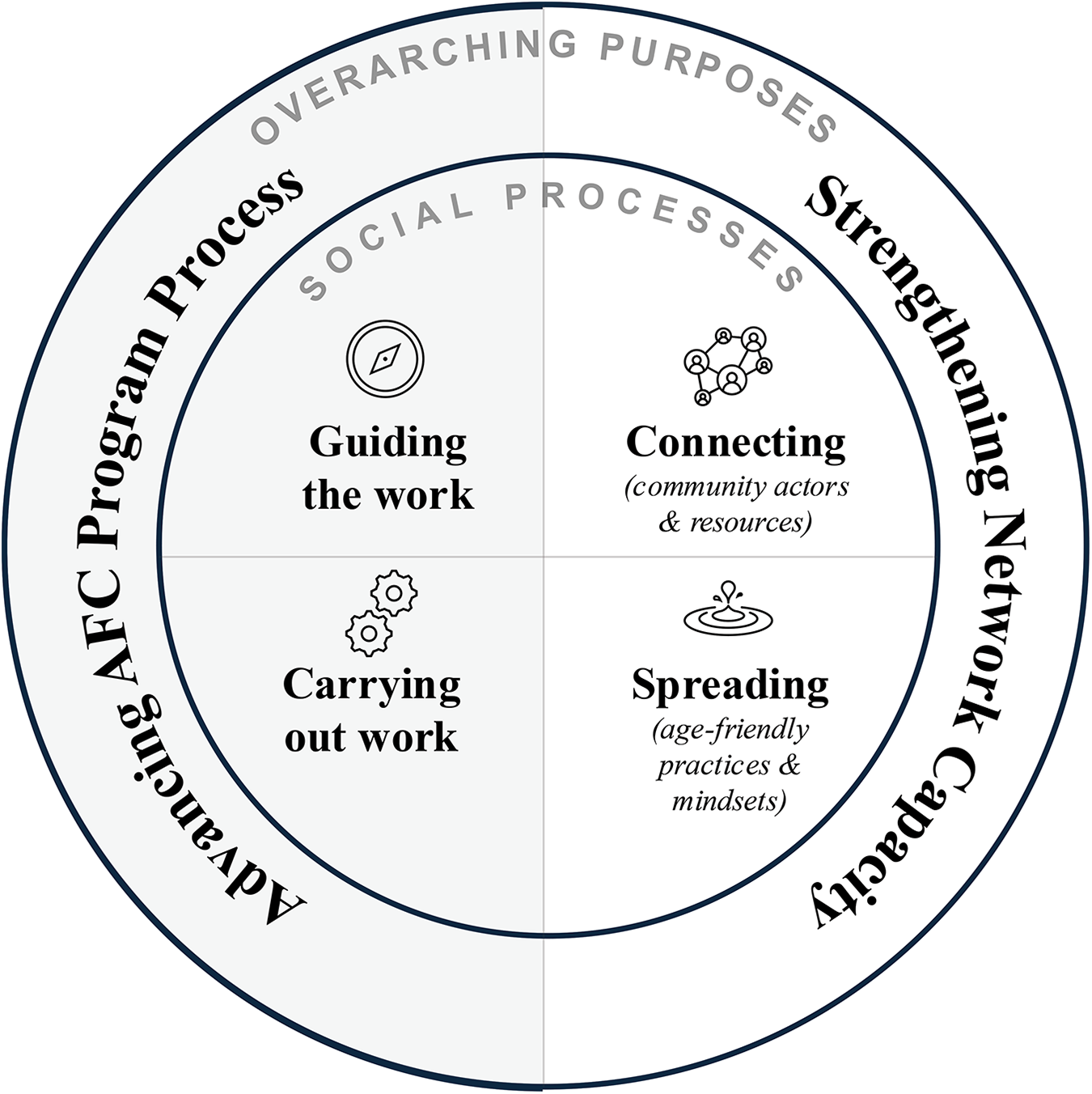
Thematic functions of older adult participation in AFC implementation

Broadly, these findings demonstrate how older adult participation in AFC initiatives can be conceptualized beyond a linear continuum of passive to active participation (see Rémillard-Boilard et al. Reference Rémillard-Boilard, Buffel and Phillipson2017; Greenfield and Reyes Reference Greenfield and Reyes2022) towards co-occurring dimensions of participation, such that participants with differing ‘levels’ of participation employ similar functions. For example, an older adult regular volunteer (with a relatively lower level of participation) and an older adult initiative chair (with a relatively higher level of participation) similarly described connecting and spreading as processes in their experiences. The findings also support a dynamic view of older adults’ participation as AFC leaders, such that some individuals might be engaged in guiding and carrying out AFC operations as founders of the initiative and then transition to primarily connecting people and resources later in their involvement. In so doing, the findings counter conceptualizations of AFC participation that equate progressively higher levels of participation as a normative goal.
Findings suggest the importance of future research on the skills, leadership and political processes among older adults as actors in AFC initiatives. For example, the concept of complexity leadership encompasses generative (i.e. activities encouraging innovation), administrative, community-building and information-gathering/using functions (Hazy and Uhl-Bien Reference Hazy and Uhl-Bien2015). This type of leadership echoes the operational-oriented functions under advancing AFC programme processes, as well as the relational and resource flow processes towards strengthening network capacity. Future research could build on this idea by being more deductively informed by concepts of leadership (such as complexity leadership) and theorizing on older adult social networks (Cornwell Reference Cornwell2009) to further empirically explore the ways in which older adults drive and lead AFC implementation.
Another important direction for future research is to explore how older adults’ participation in AFC implementation activities might translate to functions in other community-based initiatives. For example, a recent scoping review that explored older adult roles and functions in community-based health initiatives for ageing with chronic conditions similarly found that older adults contribute vis-à-vis intervention delivery, serving as advocates and change agents working to change practices, and advancing collaboration and networking (Kokorelias et al. Reference Kokorelias, Hayes, Lim Fat, Abdelhalim, Singh, Saragosa and Sheppard2024). The overlap in older adult functions across different types of ageing-related interventions suggests that the functions identified herein might reflect, to some degree, participation modes with particular relevance to older adults. Future studies should explore whether these findings might apply to AFC leaders of diverse ages and positionalities (e.g. as paid staff or community volunteers), and the extent to which the functions might reflect more core (versus adaptable) functions in AFC implementation.
Further, this study invites investigations of AFC initiatives as platforms facilitating social, civic and political participation in later life (for further discussion of dimensions of social participation in the context of civic and political involvement, refer to Raymond et al. Reference Raymond, Sévigny, Tourigny, Vézina, Verreault and Guilbert2013). Of particular note, participants illustrated that non-conventional forms of political action (Serrat et al. Reference Serrat, Scharf and Villar2022) were commonly part of their AFC participation. For example, participants described, often as part of the strengthening network capacity theme, instances of altering connections with and priorities/actions of the public sector, including developing relationships with elected officials, advocating for local and state-level policy (e.g. letter writing supporting ageing-related state tax policy) and working towards changing community-level mindsets of public officials to prioritize ageing-related topics and policies. Accordingly, these findings highlight the opportunities for further investigation into the ways in which older adults serve as both civic and political actors in their age-friendly work (del Barrio et al. Reference del Barrio, Marsillas, Buffel, Smetcoren and Sancho2018; Serrat et al. Reference Serrat, Scharf, Villar and Gómez2020), such as Narushima et al. (Reference Narushima, Gardner, Gnanendran, Ryder, Low and McCleary2025) and Cao et al. (Reference Cao, Pope and Greenfield2024) framing AFC initiative implementation as a distinct form of civic and political participation platforms wherein older adults participate in a range of advocacy roles to influence local policies and practices. Overall, our findings support the view that AFC initiatives offer multifaceted civic, political and social participation opportunities that blend elements of traditional organizational volunteering and other manifestations of social and civic participation.
At the same time, it is important to situate this study within more critical discourse that calls attention to issues of power and public resource allocations. Even though the themes identified in the study do not directly address these elements, the overall topic of this study foregrounds AFC initiatives as being a venue of agency and empowerment for older adult community members (albeit among those with the capacity to participate) while also holding the potential to shift the responsibility for structural change away from the public sector to the local communities and individuals most impacted by the complex social challenges (Winterton Reference Winterton2016; Menec Reference Menec2017; Joy Reference Joy2020, Reference Joy2021; Russell et al. Reference Russell, Skinner and Fowler2022). This tension of power and responsibility for social change presents a challenge for both AFC practice and research. Specifically, the AFC initiative model can serve as a ‘pressure release’ for government action on ageing leading to over-reliance on (unpaid) older adult volunteers (especially in under-resourced and/or rural geographies, Russell et al. Reference Russell, Skinner and Fowler2022), while also being a social change effort grounded in the lived experiences, social networks and agency of older adults. Future research could be more attuned to this dynamic by exploring the ways that the implementation experiences of older adults and other implementation actors might reflect and intersect with broader systems-level challenges.
This study’s findings also offer insights for AFC programme theory more broadly, specifically speaking to the extent to which AFC efforts might align with social planning and community capacity-building approaches. The social planning approach views AFC initiatives as, generally, top-down and centralized efforts that use a data-based action plan to guide local-level efforts on ageing (Yeh et al. Reference Yeh, Greenfield, Plasencia, Buffel, Doran and Yarker2024). This understanding of AFC initiatives is reflected in advancing the AFC programme process, as this purpose reflects the efforts to enact the planning steps and phases encouraged by the WHO and the AARP in a top-down organization of age-friendly action across national and international contexts (WHO 2018; AARP 2020). In contrast, the community (capacity-)building approach emphasizes AFC initiatives as multi-sectoral efforts wherein community capacity is both a focal outcome and a tactic (Greenfield et al. Reference Greenfield, Black, Oh and Pestine-Stevens2022) – a view that closely resonates with strengthening network capacity, given the emphasis on the collaborative nature of AFC efforts towards social change. For related discussion on conceptualizing AFC initiatives as social connectivity interventions, refer to Menec (Reference Menec2017).
The co-occurrence of social planning and community capacity-building approaches within the participants’ descriptions situates these findings within an evolving conversation in the AFC development and implementation literature on the programme theory of AFC initiatives. Whereas earlier literature tended to frame AFC initiatives as fitting the social planning approach (Lui et al. Reference Lui, Everingham, Warburton, Cuthill and Bartlett2009), more recent discourse has encouraged viewing AFC initiatives as community (capacity-)building efforts based on empirical insights into how the initiatives are implemented in practice (Garon et al. Reference Garon, Paris, Beaulieu, Veil and Laliberté2014; Greenfield et al. Reference Greenfield, Black, Oh and Pestine-Stevens2022). The findings of this study offer empirical support for the presence of both social change approaches within AFC implementation. This view encourages future research to explore integrative models of social change underpinning AFC implementation.
In terms of practice implications, the findings help better understand the people resources needed to advance AFC work. In highlighting an expansive range of ways in which AFC implementation might offer opportunities for older adult leadership, the findings herein could support more customized and tailored participation opportunities for older adults in AFC initiatives that are built into the structure and design of the AFC initiative. Examples include providing feedback and advice, ideating and taking charge of a new programme, being a point of contact to facilitate new relationships or being on hand to help with specific projects as needed. Alternatively, these insights into the core types of function for AFC implementation can prioritize human resources towards the most critical areas for a particular initiative to optimize the time, strengths and capacities of its contributors, including older adult leaders and volunteers.
This practice implication could be particularly resonant for areas where human resources are already stretched thin, such as in rural communities wherein declining (and ageing) populations present particular challenges for AFC implementation, exacerbating the broader potential for AFC work to over-burden (older) volunteers (Russell et al. Reference Russell, Skinner and Colibaba2021, Reference Russell, Skinner and Fowler2022). Further, older AFC volunteers in lower-resource areas could experience the psychosocial and pragmatic benefits of organized volunteering in AFC initiatives differently (e.g. social support and access to community resources) compared to older AFC volunteers in more resourced areas and initiatives (Cao et al. Reference Cao, Dabelko-Schoeny, White, Maleku and Sheldon2021). Our findings can help AFC organizers optimize older adults’ AFC participation in AFC implementation in ways that facilitate social integration and empowerment as opposed to devolution and marginalization (refer to Skinner et al. Reference Skinner, Joseph, Hanlon, Halseth, Ryser, Skinner and Hanlon2015 for further discussion).
Limitations
Although our study’s sample is one of the few and largest to date of older adults involved with AFC implementation, the number of participants is relatively small based on standards for one-time, semi-structured interviews (Patton Reference Patton2015) Further, the sample is majority White, female, economically well-off and well-educated, a homogeneity that limits the study’s transferability to the experiences of more diverse older adults in AFC implementation (Gonyea and Hudson Reference Gonyea and Hudson2015). As might be expected, the high level of social and economic capital of participants echoes the broader dynamics that class, health status and technology access/skills pose for structural barriers of later-life volunteerism and civic participation and suggests that informal modes of volunteerism (more common among racially minoritized groups of older adults) are often ‘invisible’ forms of civic participation (Martinez et al. Reference Martinez, Crooks, Kim and Tanner2011; Townsend et al. Reference Townsend, Chen and Wuthrich2021). Geographically, the sample does not include major metropolitan areas, or some areas of notable AFC concentration in the US, such as the South and the West Coast (AARP 2025). While this geographic range offers valuable insights into older adult implementation experiences outside of major urban centres, it nevertheless lacks representation of such geographically prominent areas. Further, this study does not address older adult participation in geographies outside the US and non-English language contexts, which is particularly notable given the global scope of the AFC movement.
Further, the study did not explore the full range of ways in which older adults might engage with AFC initiatives, including in more distal capacities as beneficiaries of AFC efforts or even a complete lack of engagement (as highlighted by Simard and Paris Reference Simard and Paris2025). Our focus on only those older adults involved in the process of AFC implementation likely privileges the lived experiences of individuals with higher capacities (e.g. physical/mental abilities, financial and time resources, and digital access/skills). Additionally, this study primarily focused on positive implementation experiences. While negative experiences emerged organically in interviews, such topics were not systematically explored. Selection bias and social desirability bias might have further contributed to a positive bias in the study by influencing who opted to participate and how they communicated about their experiences. Future research should continue to draw on older adult perspectives to explore the negative and challenging aspects of implementing AFC initiatives (e.g. Garon et al. Reference Garon, Paris, Beaulieu, Veil and Laliberté2014; Colibaba et al. Reference Colibaba, McCrillis and Skinner2020; Mo et al. Reference Mo, Ng, Woo, Jian and Chen2025).
Finally, this study cannot make causal claims about the outcomes of the functions that older adults advance in their AFC work. Even as some of the themes suggest that participants achieved certain results by enacting functions, establishing these linkages is beyond the scope of this study. The impact of AFC initiatives remains a dynamic focus of current research, including recent findings that suggest inherent challenges and limited outcomes (Joy Reference Joy2021; Russell et al. Reference Russell, Skinner and Fowler2022; Annear et al. Reference Annear, Li and Sugimoto2025), alongside re-conceptualizations of AFC initiatives drawing on more diffuse notions of social impact (Coyle et al. Reference Coyle, Gleason and Mutchler2022; Greenfield and Pope Reference Greenfield and Pope2025).
Conclusion
This study expands the empirical understanding of how older adults advance and drive AFC implementation by offering a multidimensional conceptualization of the underlying purposes and processes of their activities. In doing so, it contributes to a growing body of inquiry exploring the nature of older adult involvement in AFC implementation – and notably is among the first to do so by drawing directly from older adult perspectives – while also advancing insights into the inner workings of how AFC initiatives are implemented more generally. As AFC initiatives work towards meaningful social change on ageing in the coming decades, this study encourages further exploration into how people enact age-friendly change in their particular contexts. This research has strong translational potential for strengthening AFC practice and policy, as well as broader understandings of AFC initiatives as a social movement to galvanize local leaders – including older residents themselves – to engage in a range of activities towards social impact on ageing.
Supplementary material
The supplementary material for this article can be found at https://doi.org/10.1017/S0144686X26100737.
Acknowledgements
We thank the study participants for sharing their time and experiences with the research team during this project. Your insights into AFC implementation and commitment to making your communities better spaces and places for people to age with wellbeing and dignity have been a renewing source of inspiration. We remain grateful to our contacts across the four states who generously offered their assistance in connecting us with prospective participants in their geographies. We finally thank Drs. Clara Scher and Allison Zippay, along with other members of NEP’s dissertation committee, for their guidance and support at varying stages in the development of this project.
Author contributions
All authors contributed meaningfully to the present article and approved the final version for publication.
Financial support
We are grateful for the generosity of David Stern SSW 72, alumnus of the Rutgers University School of Social Work, whose gift to the school helped support this project. This project was also supported by the generous funding of The Henry and Marilyn Taub Foundation for the Rutgers Hub for Aging Collaboration and its age-friendly research efforts.
Competing interests
We do not have any competing interests to declare.
Ethical standards
The study received ethical approval from the Rutgers University Institutional Review Board (Pro2021000289).


 Open access

