

1. Introduction
Global marine sustainability is a critical component of the United Nations Sustainable Development Goal (SDG) 14, which aims to conserve marine ecosystems and ensure their long-term viability (Ntona and Morgera, Reference Ntona and Morgera2018; Scott, Reference Scott, Ebbesson and Hey2022; Haas, Reference Haas2023). In particular, SDG 14.5 mandates that at least 10 per cent of coastal and marine areas be protected by 2020, based on scientific and legal frameworks (United Nations, 2015). Despite these efforts, coastal and marine environments remain under threat from various unsustainable practices, especially overfishing, which depletes valuable fish stocks and encourages illegal, unreported and unregulated fishing activities (Chapman and Kramer, Reference Chapman and Kramer1999; Edgar and Barrett, Reference Edgar and Barrett1999; McClanahan et al., Reference McClanahan, Muthiga, Kamukuru, Machano and Kiambo1999). Such harmful activities not only diminish biodiversity but also destabilize marine ecosystems, compromising the availability of critical resources over time.
To mitigate these pressures, marine protected areas (MPAs) have emerged as one of the most important strategic tools for sustainable marine resource management (Agardy, Reference Agardy1994; Gaines et al., Reference Gaines, Lester, Grorud-Colvert, Costello and Pollnac2010). MPAs designate specific marine or coastal zones where activities are regulated to achieve conservation objectives, such as safeguarding marine biodiversity, supporting sustainable fisheries and alleviating climate change impacts (Kelleher, Reference Kelleher1999). Initially designed with a narrow focus on conservation alone, MPAs have evolved to encompass a broader range of sustainable-use activities (including fisheries and tourism), reflecting the growing global emphasis on integrated marine governance (Dudley, Reference Dudley2008). By 2019, the International Union for Conservation of Nature (IUCN) clarified that MPAs must have a primary objective of nature conservation. However, this does not exclude sustainable human activities such as fishing or tourism, provided they align with conservation goals (Day et al., Reference Day, Dudley, Hockings, Holmes, Laffoley, Stolton, Wells and Wenzel2019). This evolution highlights the increasing recognition of the need to balance conservation with sustainable use in global marine governance.
Global MPA coverage has expanded substantially in recent years, partly due to international initiatives such as the Aichi Biodiversity Targets and SDG 14 (Grorud-Colvert et al., Reference Grorud-Colvert, Constant, Sullivan-Stack, Dziedzic, Hamilton, Randell, Fulton-Bennett, Meunier, Bachhuber, Rickborn, Spiecker and Lubchenco2019). As a result, the proportion of the world’s oceans under protected status approached approximately 9.4 per cent by 2023 (Jang et al., Reference Jang, Lee and Cho2022; Atlas of Marine Protection, 2024). However, effectiveness varies widely, depending on design, implementation and governance. Well-managed MPAs have been shown to mitigate pollution, restore habitats and curb destructive fishing methods (Allison et al., Reference Allison, Lubchenco and Carr1998). Yet, many MPAs often exist only on paper and are known as ‘paper parks’, which offer minimal actual protection due to insufficient enforcement, inadequate financial resources or ineffective stakeholder engagement (Agardy et al., Reference Agardy, Bridgewater, Crosby, Day, Dayton, Kenchington, Laffoley, McConney, Murray, Parks and Peau2003, Reference Agardy, Notarbartolo di Sciara and Christie2011; Rife et al., Reference Rife, Erisman, Sanchez and Aburto-Oropeza2013; Pelletier, Reference Pelletier2020).
Such challenges are especially pronounced in developing countries where financial, technical and institutional constraints frequently undermine MPA governance (Balmford et al., Reference Balmford, Gravestock, Hockley, McClean and Roberts2004; Mwebaze and MacLeod, Reference Mwebaze and MacLeod2013; Davis et al., Reference Davis, Vianna, Meeuwig, Meekan and Pannell2019). Although coastal resources are pivotal for livelihoods and food security in these regions, limited budgets and shortages of trained personnel hamper the effective implementation and monitoring of MPAs (Teelucksingh and Watson, Reference Teelucksingh and Watson2013; World Bank, 2013). Consequently, Official Development Assistance (ODA) has become a vital mechanism for bolstering capacity and ensuring that marine conservation efforts achieve meaningful results (Stepping and Meijer, Reference Stepping and Meijer2018). ODA refers to government aid provided by bilateral donors and multilateral institutions to promote the economic development and welfare of developing countries. It is delivered in various financial forms, including grants, concessional loans, debt forgiveness and interest subsidies, with eligible recipients being low- and middle-income countries on the OECD Development Assistance Committee list.
This study aims to provide a comprehensive, quantitative analysis of how MPAs are associated with fish stock sustainability across countries with varying economic backgrounds. Specifically, we employ the Pressure–State–Response (PSR) framework to examine fishing pressure, fish stock status (FSS) and MPA policies. We also investigate how single-purpose ODA contributes to expanding MPA coverage and improving conservation outcomes. By assessing ecological, economic and governance-related dimensions of MPA effectiveness, this study offers strategic insights into enhancing marine conservation and resource management in diverse national contexts. Ultimately, our findings aim to offer higher-level insights into how economic and governance contexts condition the effectiveness of MPAs, thereby contributing to broader discussions on marine conservation and resource governance, particularly in economically constrained settings.
2. Literature review
2.1. The ecological and socio-economic impacts of MPAs
MPAs are broadly recognized as vital instruments for conserving marine ecosystems and enhancing fish stocks (Jennings and Polunin, Reference Jennings and Polunin1995; McClanahan et al., Reference McClanahan, Muthiga, Kamukuru, Machano and Kiambo1999; Francour et al., Reference Francour, Harmelin, Pollard and Sartoretto2001; Roberts et al., Reference Roberts, Bohnsack, Gell, Hawkins and Goodridge2001; Halpern, Reference Halpern2003). A large body of evidence indicates that MPAs can lead to significant ecological improvements, such as increases in biomass, species diversity and organism density (Kamukuru et al., Reference Kamukuru, Mgaya and Öhman2004; Claudet et al., Reference Claudet, Pelletier, Jouvenel, Bachet and Galzin2006; Guenther et al., Reference Guenther, López-Carr and Lenihan2015; Favoretto et al., Reference Favoretto, López-Sagástegui, Sala and Aburto-Oropeza2023). For instance, Lester et al. (Reference Lester, Halpern, Grorud-Colvert, Lubchenco, Ruttenberg, Gaines, Airamé and Warner2009) reported that fully protected MPAs contributed to a 446 per cent rise in biomass, a 166 per cent surge in density and a 21 per cent increase in species diversity, based on a global analysis of 124 sites. Likewise, Ferreira et al. (Reference Ferreira, Magris, Floeter and Ferreira2022) noted a 45 per cent increase in biodiversity in fully protected areas in the Southwestern Atlantic Ocean, underscoring MPAs’ potential to foster ecosystem recovery.
In addition to ecological gains, MPAs offer socio-economic benefits by protecting critical habitats and promoting sustainable fishing practices (Francour et al., Reference Francour, Harmelin, Pollard and Sartoretto2001; Halpern, Reference Halpern2003; Sainsbury and Sumaila, Reference Sainsbury, Sumaila, Sinclair and Valdimarsson2003). Nevertheless, the effectiveness of MPAs varies substantially depending on species mobility, habitat structure and local management policies (Takashina and Mougi, Reference Takashina and Mougi2014; Batista et al., Reference Batista, Henriques, Pais and Cabral2015). For example, Davies et al. (Reference Davies, Holmes, Rees, Attrill, Cartwright and Sheehan2021) observed that commercial fish species exhibited significant benefits under MPA protection, whereas certain non-target species declined. These outcomes highlight the need for holistic strategies that account for the entire ecosystem, not merely commercially valuable stocks.
Conversely, research also documents cases in which MPAs have minimal or even adverse effects due to weak design or inadequate enforcement. Freitas et al. (Reference Freitas, Costa, Alvite, Balensiefer, Barros and Prado2022) found that limited engagement with small-scale fishers undermined the effectiveness of Brazil's Right Whale Environmental Protection Area. Magris (Reference Magris2021) argued that large-scale MPAs often fail to reduce fishing pressure if monitoring and compliance are insufficient, while Smith et al. (Reference Smith, Free, Lopazanski, Brun, Anderson, Carr, Claudet, Dugan, Eurich, Francis, Hamilton, Mouillot, Raimondi, Starr, Ziegler, Nickols and Caselle2023) indicated that MPA networks did not enhance ecosystem resilience to marine heatwaves. Collectively, these findings underscore the importance of effective governance, thorough policy design, and broad stakeholder engagement as essential factors in realizing MPAs’ conservation objectives (Jones and De Santo, Reference Jones and De Santo2016; Pendleton et al., Reference Pendleton, Ahmadia, Browman, Thurstan, Kaplan and Bartolino2018; Álvarez-Fernández et al., Reference Álvarez-Fernández, Freire, Naya, Fernández and Sánchez-Carnero2020; Hampton et al., Reference Hampton, Lehodey, Senina, Nicol, Scutt Phillips and Tiamere2023).
2.2. The role of ODA in biodiversity conservation and MPA expansion
Developing countries often rely heavily on marine resources for food security and economic development but face persistent constraints in managing and enforcing MPAs (World Bank, 2012, 2013; Andradi-Brown et al., Reference Andradi-Brown, Veverka, Amkieltiela, Crane, Estradivari, Fox, Gill, Goetze, Gough, Krueck, Lester, Mahajan, Rulmal, Teoh and Ahmadia2023). Financial and technical shortcomings diminish the efficacy of conservation measures, especially in regions where government agencies lack consistent funding and institutional support (Niesten et al., Reference Niesten, Gjertsen and Fong2013). In these contexts, ODA has become integral to bridging capacity gaps, offering critical funding and expertise to expand and manage MPAs (Stepping and Meijer, Reference Stepping and Meijer2018; Deutz et al., Reference Deutz, Heal, Niu, Swanson, Townshend, Zhu, Delmar, Meghji, Sethi and Tobin-de la Puente2020).
ODA has substantially bolstered biodiversity-related initiatives in many low- and lower middle-income countries by funding capacity-building efforts, infrastructure development and ecological monitoring (Drutschinin et al., Reference Drutschinin, Casado-Asensio and Corfee-Morlot2015). However, ensuring long-term financial sustainability remains a major challenge, as MPAs demand continuous investment in enforcement and community engagement (Bohorquez et al., Reference Bohorquez, Dvarskas and Pikitch2019). Past research suggests that single-purpose ODA, focused narrowly on area expansion, may overlook the broader ecological and governance needs required to maintain effective MPAs (Hein et al., Reference Hein, Miller and de Groot2013; Waldron et al., Reference Waldron, Mooers, Miller and Gittleman2013). In contrast, multi-purpose ODA programmes, which address a range of marine sustainability objectives such as pollution control, stakeholder outreach and climate resilience, appear more likely to deliver sustained conservation gains (Fox et al., Reference Fox, Soltanoff, Mascia, Haisfield, Lombana, Pyke and Wood2012; OECD, 2017).
Overall, these studies highlight both the promise and the pitfalls of relying on external funding for MPA management. While ODA is pivotal in helping to establish and sustain MPAs in low-capacity regions, the effectiveness of such aid depends on well-designed programmes that integrate comprehensive governance frameworks, local stakeholder participation and ongoing financial commitments. This underscores the necessity of further empirical research to evaluate how different forms of ODA can optimize ecological outcomes in MPAs, particularly in countries where marine resources are crucial for both economic survival and environmental conservation.
3. The PSR framework
The PSR framework provides a systematic means of analysing environmental issues by categorizing interactions among human-induced pressures, resulting environmental states and societal responses (OECD, 2013; Huang et al., Reference Huang, Wei, Meng and Zhang2016). Originally conceptualized in the 1970s and formally adopted by the OECD in 1989, this framework facilitates both the design and evaluation of targeted environmental policies. It has been especially useful for examining complex marine resource management challenges, where ecological, economic and governance elements intersect.
Within the PSR model, ‘pressure’ refers to direct and indirect human activities that affect the environment, including overfishing, coastal pollution and habitat destruction. ‘State’ describes the condition of an ecosystem and its resources, as influenced by these pressures. ‘Response’ encompasses the actions taken by governments, organizations, and other stakeholders to mitigate pressures and improve environmental conditions – ranging from regulatory interventions to public awareness initiatives.
When applied to marine conservation, the PSR framework underscores the necessity for integrated strategies that address ecological resilience, economic viability and institutional capacity. For instance, well-managed MPAs can reduce fishing pressures and promote ecosystem health (Pelletier, Reference Pelletier2020). Research has shown that MPAs with stringent enforcement mechanisms often see measurable improvements in fish stocks, biodiversity and reef conditions (Strain et al., Reference Strain, Edgar, Ceccarelli, Stuart-Smith, Hosack and Thomson2019). However, variable success rates among MPAs have also been documented. Huang et al. (Reference Huang, Wei, Meng and Zhang2016), for instance, attributed marine biodiversity decline in parts of Fujian Province, China, to pressures such as pollution and unregulated tourism, pointing to the importance of management approaches tailored to local context. Similarly, Pelletier (Reference Pelletier2020) highlighted how stakeholder collaboration and robust scientific monitoring can substantially enhance MPA governance and ecological outcomes. For our analysis, the PSR framework is used as a heuristic lens to organize variables rather than to assume strict causal pathways.
In this study, we employ a modified PSR framework specifically adapted to assess MPA effectiveness and global marine sustainability. Here, ‘pressure’ is captured through nearshore fish catch, representing the intensity of fishing activities that directly influence marine ecosystems. ‘State’ is measured using the FSS index, which indicates the proportion of catch originating from overexploited or collapsed stocks (Wolf et al., Reference Wolf, Emerson, Esty, de Sherbinin and Wendling2022). ‘Response’ is represented by the share of a country’s Exclusive Economic Zone (EEZ) designated as MPAs (Atlas of Marine Protection, 2024), reflecting a nation’s commitment to safeguarding marine resources and conservation efforts.
This adapted framework enables comparative analyses of MPA performance across various economic contexts. High-income countries often benefit from strong regulatory systems that effectively mitigate pressures and enhance the state of fish stocks. By contrast, low-income countries may struggle with limited enforcement capacity, inadequate financial resources and the persistence of ‘paper parks’, wherein official MPA designations yield little real-world impact (Agardy et al., Reference Agardy, Bridgewater, Crosby, Day, Dayton, Kenchington, Laffoley, McConney, Murray, Parks and Peau2003; Rife et al., Reference Rife, Erisman, Sanchez and Aburto-Oropeza2013).
Previous PSR-based studies reveal multiple drivers of MPA success. Effective governance and consistent enforcement are commonly highlighted as cornerstones of ecological benefits (Verheij et al., Reference Verheij, Makoloweka and Kalombo2004; Bohorquez et al., Reference Bohorquez, Dvarskas and Pikitch2019). Ramirez (Reference Ramirez2016) underscored how rapid MPA establishment without thorough community engagement can undermine long-term conservation outcomes. Furthermore, financial and capacity-building mechanisms – such as ODA – are increasingly recognized as essential for advancing MPA coverage and effectiveness in resource-constrained settings (Drutschinin et al., Reference Drutschinin, Casado-Asensio and Corfee-Morlot2015; Deutz et al., Reference Deutz, Heal, Niu, Swanson, Townshend, Zhu, Delmar, Meghji, Sethi and Tobin-de la Puente2020).
By adopting this holistic PSR perspective, our study aims to elucidate the key factors and processes that are associated with MPA outcomes. In doing so, we provide evidence-based insights for policymakers and practitioners seeking to design, implement and refine MPAs across diverse socio-economic environments (US EPA, 2006).
4. Data and model specifications
4.1. Key variables
In alignment with the PSR framework, this study incorporates variables that capture the multifaceted relationships among fishing pressures, environmental conditions and interventions designed to enhance marine sustainability. The core variables reflect the fundamental components of the PSR model.
FSS measures the proportion of a country's fish catch obtained from overexploited or collapsed stocks within its EEZ. A lower FSS value indicates reduced reliance on overexploited stocks (Verheij et al., Reference Verheij, Makoloweka and Kalombo2004), while a higher FSS implies a greater reliance on unsustainable fish stocks. Conversely, a lower FSS suggests more sustainable exploitation of marine resources. We treat FSS as a key indicator of the ‘state’ dimension in the PSR framework.
MPA coverage is calculated as the percentage of a country’s EEZ designated as a protected area (Atlas of Marine Protection, 2024). This metric reflects societal and governmental ‘response’ to overfishing and other threats, serving as an essential measure of policy efforts directed towards marine conservation (Kelleher, Reference Kelleher1999; Day et al., Reference Day, Dudley, Hockings, Holmes, Laffoley, Stolton, Wells and Wenzel2019).
Catch refers to total fisheries production from nearshore waters, excluding aquaculture and high-seas fisheries. While high catch volumes are not inherently problematic, they often correlate with unsustainable fishing practices in the absence of effective management (Jesintha and Madhavi, Reference Jesintha and Madhavi2020). Hence, catch represents a principal ‘pressure’ variable within the PSR framework.
ODA data, sourced from OECD’s Ocean Economy records, are used to evaluate how international funding supports MPA expansion and improvements in marine sustainability. We distinguish between single-goal ODA, which specifically targets MPA coverage, and multi-goal ODA, addressing broader sustainability objectives, community engagement and ecological monitoring. Because annual fluctuations in ODA tend to be modest, we use cumulative values to better capture long-term influences on marine conservation (Ferreira et al., Reference Ferreira, Magris, Floeter and Ferreira2022; Andradi-Brown et al., Reference Andradi-Brown, Veverka, Amkieltiela, Crane, Estradivari, Fox, Gill, Goetze, Gough, Krueck, Lester, Mahajan, Rulmal, Teoh and Ahmadia2023).
Single-purpose ODA refers to funding streams in which SDG 14.5 is explicitly designated as a sub-target. For example, in 2010 the United Kingdom provided a standard grant to Ecuador under the category of Biodiversity, for a project titled ‘Innovative Governance Models for Marine Protected Area Management in Ecuador’. This project explicitly referenced SDG targets 14.2 (Protect and Restore Ecosystems) and 14.5 (Conserve Coastal and Marine Areas), illustrating how donor support was directly tied to strengthening governance models for MPAs in South America. By contrast, multi-purpose ODA refers to funding that contributes to SDG 14 objectives but does not explicitly specify target 14.5. For instance, in 2010 Denmark provided a standard grant to Viet Nam under the category of Fishing policy and administrative management, for a project titled ‘Small-scale activities aggregated’. While not directly linked to MPA expansion, this project exemplifies how donor assistance supported broader fisheries management in lower-middle-income countries, thereby indirectly contributing to marine sustainability.
Moreover, our specification includes two sets of controls: coastline length and GDP in the FSS equations; and – in the MPA expansion model – government effectiveness (GVE) and trade openness (TO) to capture institutional capacity and market integration, with marine plastic pollution (MPP) used as a proxy for policy salience (Fox et al., Reference Fox, Soltanoff, Mascia, Haisfield, Lombana, Pyke and Wood2012; Jones and De Santo, Reference Jones and De Santo2016; Ramirez, Reference Ramirez2016; OECD, 2017; Pelletier, Reference Pelletier2020).
Table 1 summarizes the definitions and data sources for these key variables, while Table 2 provides descriptive statistics.
Data descriptions

Descriptive statistics

Figures A1–A3 (online appendix) illustrate temporal trends of FSS, MPA coverage and catch production, respectively, disaggregated by World Bank income groups.
4.2. Econometric models
Given that FSS and MPA coverage are bounded between 0 and 100, we use panel Tobit models as a likelihood-based approach suitable for bounded outcomes (Alan et al., Reference Alan, Honoré, Hu and Leth-Petersen2011; Liu et al., Reference Liu, Zhang, Zhang and Qin2020). This specification provides a coherent framework for modeling variables with bounded support (Wooldridge, Reference Wooldridge2010). Formally, for country i in year t, the observed dependent variable  ${Y_{it}}$ is related to a latent variable $Y_{it}^*$ through
 \begin{equation} Y_{it} = \begin{cases} 0 & \text{if } Y_{it}^* \leq 0, \\
Y_{it}^* & \text{if } 0 \lt Y_{it}^* \lt 100, \\
100 & \text{if } Y_{it}^* \geq 100. \end{cases} \end{equation}
\begin{equation} Y_{it} = \begin{cases} 0 & \text{if } Y_{it}^* \leq 0, \\
Y_{it}^* & \text{if } 0 \lt Y_{it}^* \lt 100, \\
100 & \text{if } Y_{it}^* \geq 100. \end{cases} \end{equation} The latent variable  $Y_{it}^*$ is modeled as
 \begin{equation}Y_{it}^* = {{\textrm X}_{}}\beta + {\mu _i} + {\varepsilon _{it}}\end{equation}
where  ${{\textrm X}_{it}}$ includes our explanatory variables (e.g., catch, MPA coverage, ODA and controls), ${\mu _i}$ is a country-specific random effects and ${\varepsilon _{it}}$ is the idiosyncratic error term. We estimate two main sets of equations: one focusing on FSS with lagged MPA coverage and other covariates as key predictors, and another focusing on MPA coverage to evaluate how single-goal versus multi-goal ODA shapes MPA expansion.
This dual-model design enables an exploration of both the effectiveness of MPAs in improving fish stock sustainability and the role of ODA in facilitating or impeding the establishment and proper management of MPAs. By applying this integrated approach across different income-level groups, we aim to determine whether the same policy measures consistently yield comparable results in diverse economic contexts. It is important to note that our empirical strategy does not establish causal relationships. The estimated associations between MPA coverage and FSS, as well as between ODA and MPA expansion, should be interpreted as statistical correlations rather than strict causal pathways. While we control for key observables and employ lagged specifications to mitigate reverse causality concerns, unobserved heterogeneity and potential simultaneity mean that our findings reflect patterns of association that warrant cautious interpretation.
Overall, these methods allow us to address two core inquiries: whether expanded MPA coverage is associated with reduced reliance on overexploited fish stocks under varying governance conditions and economic scales, and whether targeted international assistance is associated with the implementation of MPAs, including how broader sustainability-oriented ODA initiatives relate to more narrowly focused MPA funding. Answers to these questions provide empirical insights for policymakers seeking to reconcile conservation objectives with socio-economic realities, particularly in regions where marine resources are critical for economic development and food security.
5. Estimation results and discussion
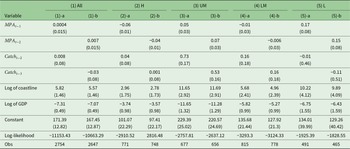
The panel Tobit estimations, summarized in Table 3, reveal a nuanced picture of how lagged MPA coverage and other key factors are associated with FSS, with results disaggregated by income group to capture economic-context-specific dynamics. In high-income countries, the coefficient of lagged MPA coverage is consistently negative and statistically significant, suggesting that expanding MPAs is associated with reduced overexploitation of fish stocks. This finding aligns with the notion that robust institutional frameworks and rigorous enforcement capacities may support high-income countries in more effectively implementing conservation policies.
Results of panel Tobit model analysis (dependent variable: FSS)

Notes: (·) are standard errors. The catch variable is adjusted for the size of each country’s EEZ (Flanders Marine Institute, 2023).
By contrast, low-income countries exhibit a positive and significant coefficient for lagged MPA coverage, suggesting that this pattern may be consistent with MPAs that, as noted in prior studies, often exist primarily on paper and face challenges in enforcement or resource management (Agardy et al., Reference Agardy, Bridgewater, Crosby, Day, Dayton, Kenchington, Laffoley, McConney, Murray, Parks and Peau2003, Reference Agardy, Notarbartolo di Sciara and Christie2011; Rife et al., Reference Rife, Erisman, Sanchez and Aburto-Oropeza2013; Takashina and Mougi, Reference Takashina and Mougi2014; Pelletier, Reference Pelletier2020). This divergence suggests the relevance of targeted capacity-building efforts, which may help low-income countries better translate nominally protected areas into sites with tangible conservation benefits.
A similar pattern emerges for upper-middle-income countries, where short-term changes in MPA coverage do not show a clear association with FSS. However, increased MPA coverage from 2 to 5 years earlier is positively correlated with FSS (see Table A1, online appendix). This result suggests that destructive fishing practices may gradually reemerge within or around MPAs, which is consistent with the possibility that insufficient or incoherent management over time can diminish the intended benefits of expansion efforts.
This divergent outcome in upper-middle-income countries warrants closer consideration. Unlike high-income countries, where stronger enforcement capacity is often associated with more effective MPA implementation, upper-middle-income countries exhibit characteristics that may contribute to this divergence. In particular, many of these countries combine sizable export-oriented industrial fisheries with relatively weaker enforcement and monitoring capacity. As a result, MPA expansion in these settings may coincide with destructive practices such as effort displacement, ‘fishing the line’ or nominal ‘paper parks’. This dynamic may help contextualize why lagged MPA coverage is positively associated with overexploitation in the short to medium term. The fact that lagged catch is statistically significant only for this income group is consistent with the possibility that higher levels of industrial fishing 2–3 years earlier may have been associated with more unsustainable exploitation patterns. However, the lack of significant long-term associations may indicate gradual improvements in fisheries management, even if immediate conservation gains remain limited.
More broadly, these findings suggest that expanding MPAs without addressing enforcement and governance gaps may be associated with heightened exploitation pressures. In particular, under weak enforcement and partial protection, mapped MPA expansion can coincide with persistent threats (‘paper parks’), effort displacement (including ‘fishing the line’) and non-compliance, all of which have been documented as important factors in the literature (Kellner et al., Reference Kellner, Tetreault, Gaines and Nisbet2007; Rife et al., Reference Rife, Erisman, Sanchez and Aburto-Oropeza2013; Horta E Costa et al., Reference Horta E Costa, Claudet, Franco, Erzini, Caro and Gonçalves2016; Cabral et al., Reference Cabral, Gaines, Johnson, Bell and White2017; Gill et al., Reference Gill, Mascia, Ahmadia, Glew, Lester, Barnes, Craigie, Darling, Free, Geldmann, Holst, Jensen, White, Basurto, Coad, Gates, Guannel, Mumby, Homas, Whitmee, Woodley and Fox2017; Iacarella et al., Reference Iacarella, Clyde, Bergseth and Ban2021). Taken together, this pattern underscores the relevance of coupling area-based conservation targets with investments in sustained enforcement capacity and institutional support.
Additional findings provide insight into other variables associated with FSS. Catch shows an insignificant or inconsistent association across most models. This pattern does not allow for any inference about enforcement conditions or oversight effectiveness but simply indicates that aggregate catch volumes are not systematically associated with variations in FSS in our specifications. However, a statistically significant association emerges between catch from 3 to 5 years prior and lower FSS in some analyses, suggesting the possibility that regulatory responses to overfishing may become more apparent over longer horizons (see Table A1). Coastline length is positively associated with FSS in most income groups – except high-income countries – indicating a statistical association between more extensive coastal areas and higher reliance on overexploited stocks. In contrast, GDP shows a negative association with FSS across multiple models. While this pattern aligns with the broad idea that economic capacity and fishery sustainability may be linked, we limit our interpretation to this empirical association.
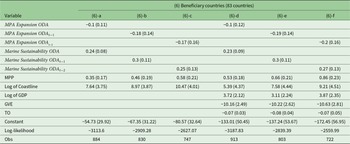
Turning to the determinants of MPA coverage, Table 4 presents the auxiliary analysis focusing on how ODA is associated with the expansion of MPAs.
Results of panel Tobit model analysis for beneficiary countries (dependent variable: MPA)

Note: (·) are standard errors.
Multi-purpose ODA, aimed at broader sustainability objectives, is consistently positive and significant in its association with MPA expansion (Ferreira et al., Reference Ferreira, Magris, Floeter and Ferreira2022; Andradi-Brown et al., Reference Andradi-Brown, Veverka, Amkieltiela, Crane, Estradivari, Fox, Gill, Goetze, Gough, Krueck, Lester, Mahajan, Rulmal, Teoh and Ahmadia2023). This pattern is consistent with the possibility that integrated approaches – such as community engagement, ecosystem restoration and enforcement capacity building – may be more conducive to supporting MPA expansion than more narrowly focused, single-purpose ODA.
Environmental issues such as MPP also correlate positively with MPA coverage, implying that escalation in visible pollution prompt greater public or political attention. However, this pattern appears to reflect a largely reactive stance rather than a forward-looking strategy. Longer coastlines similarly show a positive association with MPA coverage, potentially reflecting a greater perceived need to protect extensive marine territories. GDP also displays a positive association with MPA coverage, aligning with arguments that wealthier states may be better positioned to mobilize resources for conservation efforts. In contrast, GVE exhibits a negative coefficient, which may be consistent with the possibility that ambitious MPA expansions occur in contexts where governance is relatively weak, potentially reflecting top-down policy tendencies rather than well-coordinated initiatives involving local participation (Ramirez, Reference Ramirez2016). This result should be interpreted cautiously, however, as GVE is a broad governance indicator rather than a direct measure of institutional or enforcement capacity specific to MPAs. TO does not display robust significance, indicating that it may not play a decisive role in MPA establishment.
Overall, these findings indicate that the association between MPA coverage and FSS tends to be stronger in settings with robust enforcement capacity and greater economic resources. Multi-purpose ODA may contribute to more sustainable outcomes, particularly in countries that lack the infrastructure or expertise to manage MPAs over the long term. Nonetheless, the variability observed across income groups and governance contexts suggests that a one-size-fits-all approach may be insufficient. Accordingly, MPA strategies could be more effective when tailored not only to local ecological conditions but also to institutional realities, with attention to both short-term objectives – such as enforcement and stakeholder engagement – and longer-term goals, including systematic monitoring and adaptive policy refinement.
6. Conclusions
Global marine conservation efforts have accelerated substantially in recent decades, as evidenced by significant increases in MPA coverage worldwide (Toropova et al., Reference Toropova, Meliane, Laffoley, Matthews and Spalding2010; Grorud-Colvert et al., Reference Grorud-Colvert, Constant, Sullivan-Stack, Dziedzic, Hamilton, Randell, Fulton-Bennett, Meunier, Bachhuber, Rickborn, Spiecker and Lubchenco2019; Atlas of Marine Protection, 2024). This study examined the period from 1995 to 2021 to assess whether MPAs are associated with reductions in overexploited fish stocks and to explore how different types of ODA – single-purpose and multi-purpose – relate to MPA expansion and fish stock sustainability. By applying the PSR framework, we provided an integrated approach that links fishing pressure (catch), the state of fish resources (FSS) and policy responses (MPA coverage), thereby offering comparative insights across different income-level groups.
The findings suggest that MPAs tend to be more effective in high-income countries, where comprehensive regulatory structures, adequate funding and robust enforcement capacities are more likely to support reductions in dependence on overexploited stocks. In contrast, low-income and upper-middle-income countries often exhibit limited or even adverse outcomes despite increases in MPA coverage, potentially reflecting systemic challenges such as resource constraints, governance gaps and insufficient enforcement. Lower-middle-income countries do not exhibit negative effects, although the results generally remain statistically insignificant, implying that increases in MPA coverage may not be systematically associated with measurable conservation gains. These disparities highlight the importance of institutional capacity and fiscal investment, which may be relevant for enabling MPA designations to be associated with more tangible conservation outcomes.
Our analysis also indicates that ODA may contribute to the expansion of MPAs, with its effectiveness depending heavily on programme design. While single-purpose ODA focused narrowly on establishing protected areas shows limited association with improved outcomes, multi-purpose ODA targeting broader sustainability agendas – such as ecological restoration, enforcement capacity-building and stakeholder engagement – appears more strongly associated with both increased MPA coverage and improved fish stock sustainability. This pattern underscores the value of integrated funding programmes that align with the complex ecological and socio-economic realities of recipient countries, particularly in lower-income settings where high-level political commitments may otherwise result in ‘paper parks’.
From a policy perspective, our findings provide higher-level insights into how different economic contexts condition the outcomes of MPAs. In high-income countries, coordination between MPA policies and broader fisheries management emerges as an important theme, while in developing countries, the results highlight the persistent need for international support to strengthen governance, enforcement and community engagement. More broadly, the study highlights the relevance of ODA initiatives that embed MPAs within comprehensive sustainability strategies, offering a potential pathway to address disparities in conservation effectiveness across diverse economic settings.
Despite adopting a global, comparative methodology, several limitations warrant attention. First, the reliance on aggregated national-level data may obscure regional or local nuances in MPA implementation and enforcement. Second, treating income-level groups as homogeneous clusters of countries can mask variations in governance quality, political stability and stakeholder participation. Third, the classification of ODA into single-purpose or multi-purpose categories simplifies inherently complex funding flows, limiting the ability to capture overlapping or evolving conservation goals. Finally, this study does not distinguish among MPAs based on their ecological objectives, management effectiveness or degree of protection – factors that can substantially modify conservation outcomes. Future research should incorporate local-scale analyses, more granular governance indicators and qualitative assessments of MPA management, thereby deepening our understanding of how best to protect and sustain marine ecosystems worldwide.
Supplementary material
The supplementary material for this article can be found at https://doi.org/10.1017/S1355770X2610045X.
Data availability statement
Data will be made available on request.
Acknowledgements
Declaring AI Usage. The authors acknowledge the use of artificial intelligence (AI) tools for translating and editing portions of non-English text into English. The AI assistance was limited to language translation and stylistic refinement; all substantive content, analysis, and conclusions are solely the responsibility of the authors.
Funding statement
This research is supported by a Korea University Grant.
Competing interests
The authors declare none.
CRediT authorship contribution statement
Dae Eui Kim: Conceptualization, Methodology, Data collection, Data analysis, Writing – original draft. Song Soo Lim: Supervision, Writing – review and editing.




 Open access

