


Personality traits and suicide
Suicide is the culmination of a complex interaction of social, psychological and biological factors. As psychological variables vary from person to person, it is important to identify personality traits that predispose individuals to suicide, acknowledging that personality traits might have biological origins.Reference O'Connor and Nock 1 Neuroticism, broadly defined as the tendency to experience negative emotions in response to stress,Reference Barlow, Ellard, Sauer-Zavala, Bullis and Carl 2 has been linked to the full spectrum of suicidal behaviours, although most research has focused on suicidal ideation and non-lethal attempts.Reference Batterham and Christensen 3 – Reference Yen, Shea, Sanislow, Grilo, Skodol and Gunderson 13 One study found that knowledgeable informants rated 52 individuals who died by suicide as more neurotic than matched controls.Reference Duberstein, Conwell and Caine 9 Research has also documented longitudinal associations between suicide and traits similar to neuroticism, such as anxiety, affective instability, self-blame, impulsivity and anger/aggression.Reference Brezo, Paris and Turecki 5 To our knowledge, no study has examined the prospective association of neuroticism per se and suicide deaths using longitudinal data.
Neuroticism and social factors
Neuroticism is a distal and non-specific risk factor for suicide – it appears to be more strongly associated with depression and other mental disorders than suicide per se.Reference Chioqueta and Stiles 6 , Reference Ormel, Jeronimus, Kotov, Riese, Bos and Hankin 12 Neuroticism is thought to be the common dimension of personality underlying mood and anxiety disorders,Reference Ormel, Jeronimus, Kotov, Riese, Bos and Hankin 12 both of which independently and additively increase suicide risk.Reference Sareen, Cox, Afifi, de Graaf, Asmundson and ten Have 14 Neuroticism is also closely associated with borderline personality disorder,Reference Moller-Leimkuhler 15 , Reference Distel, Trull, Willemsen, Vink, Derom and Lynskey 16 another strong risk factor for suicide.Reference Paris and Zweig-Frank 17 Borderline personality disorder may represent an extreme form of neuroticism,Reference Samuel, Carroll, Rounsaville and Ball 18 possibly with shared genetic underpinnings, although other personality domains such as agreeableness may be needed to fully describe borderline personality disorder.Reference Distel, Trull, Willemsen, Vink, Derom and Lynskey 16 Neurotic individuals tend to use alcohol,Reference Kuntsche, Knibbe, Gmel and Engels 19 cigarettesReference Zvolensky, Taha, Bono and Goodwin 20 and illicit drugsReference Valero, Daigre, Rodriguez-Cintas, Barral, Goma and Ferrer 21 as coping mechanisms, all of which are associated with self-injury and suicide.Reference Darvishi, Farhadi, Haghtalab and Poorolajal 22 – Reference Zhang, Mckeown, Hussey, Thompson and Woods 26 It is possible that using these substances directly makes users more vulnerable to suicide.Reference Hughes 27 Neuroticism has also been linked to poor social and economic outcomes,Reference Blakely, Collings and Atkinson 28 – Reference Swickert, Hittner and Foster 31 divorce,Reference Costa, Herbst, McCrae and Siegler 32 – Reference Solomon and Jackson 35 unemployment,Reference Costa and Mccrae 36 , Reference Uysal and Pohlmeier 37 inadequate social support,Reference Kleiman and Liu 38 area-level deprivationReference Brock, Baker, Griffiths, Jackson, Fegan and Marshall 39 , Reference Rezaeian, Dunn, St Leger and Appleby 40 and psychiatric disorders,Reference Nock, Borges, Bromet, Cha, Kessler and Lee 41 , Reference Qin, Agerbo and Mortensen 42 all of which are associated with higher suicide risk. Mood instability, defined as rapid and intense mood swings,Reference Marwaha, He, Broome, Singh, Scott and Eyden 43 appears to be a core component of neuroticism that is associated with psychological distress,Reference Bowen, Balbuena, Leuschen and Baetz 44 depression,Reference Bowen, Wang, Balbuena, Houmphan and Baetz 45 – Reference Thompson, Berenbaum and Bredemeier 47 substance use,Reference Bowen, Block and Baetz 48 , Reference Simons and Gaher 49 impulsivityReference Maples, Miller, Hoffman and Johnson 50 , Reference Peters, Balbuena, Marwaha, Baetz and Bowen 51 and suicidality.Reference Bowen, Baetz, Leuschen and Kalynchuk 52 – Reference Palmier-Claus, Taylor, Varese and Pratt 54
Our primary objective was to test the hypothesis that neuroticism is a risk factor for suicide. Our secondary objective was to determine whether neuroticism is associated with suicide after adjusting for potential confounders, including mood disorders as well as lifestyle and socioeconomic variables.
Method
Sample
This study used data from 389 365 adults aged 40 to 69 years (mean age = 56.9, s.d. = 8.07; % female = 53.8) who participated in the UK Biobank Project (http://www.ukbiobank.ac.uk).Reference Sudlow, Gallacher, Allen, Beral, Burton and Danesh 55 This particular age group was selected because these people are at proximal risk for developing ageing-related diseases whose risk and preventive factors could be examined.Reference Sudlow, Gallacher, Allen, Beral, Burton and Danesh 55 The selection of participants was based on living within 10 miles of assessment centres located in areas of high population density. 56 Potential participants were identified via National Health Service (NHS) registries and contacted by mail. All participants provided written informed consent. Baseline assessments involving questionnaires, physical measurements and collection of biological samples took place at 22 assessment centres across the UK between 2006 and 2010. At baseline assessment, participants granted consent to link their past and future general practice and hospital records, entries in various disease registries, and cause of death should this occur. Ethical approval for the UK Biobank was granted by the NHS National Research Ethics Service. The UK Biobank approved the current study (application 18046) and granted access to their database. This project also received institutional ethical approval and was conducted in accordance with the Declaration of Helsinki.
Measures
Neuroticism
Neuroticism was measured with the 12-item neuroticism subscale from the short form of the revised Eysenck Personality Questionnaire (EPQ-N).Reference Eysenck, Eysenck and Barrett 57 From his earliest studies, Eysenck was interested in traits that patients shared and that military commanders could identify in young army recruits unsuitable for service. He later used the term ‘emotional instability’ to refer to the neurotic characteristics that were applied to young soldiers and people who did not do well psychologically.Reference Eysenck 58 In the present study, the questionnaire was administered during computerised touchscreen interviews as part of the Biobank baseline assessments. Responses to each item are ‘Yes’ (coded as 1) or ‘No’ (coded as 0), which are summed to yield a total score ranging from 0 to 12.Reference Links, Eynan, Heisel and Nisenbaum 53 This subscale has demonstrated good internal consistency and convergent validity.Reference Eysenck, Eysenck and Barrett 57 Cronbach's alpha of the EPQ-N for the present study was 0.84.
Suicide
Suicide was established through the UK Biobank's linkage with mortality data from the Office of National Statistics.Reference Sudlow, Gallacher, Allen, Beral, Burton and Danesh 55 Mortality data are ICD-10 coded for underlying cause based on the death certificates issued by medical practitioners or following a coroner's conclusion of cause of death. We followed the conventional definition of suicide as those where the coroner ruled a death as suicide or having undetermined intent.Reference Linsley, Schapira and Kelly 59 , Reference While, Bickley, Roscoe, Windfuhr, Rahman and Shaw 60 To be specific, suicide was defined as a death with any of the following ICD-10 codes: X60–84, Y10–34 (excluding Y33.9) and Y87.0 (excluding Y87.2). The follow-up period in which suicide deaths were tracked lasted until 2015 for participants in Scotland and 2016 for participants in England and Wales.
Covariates
We chose to include a number of sociodemographic and lifestyle variables likely to be associated with both neuroticism and suicide: unemployment,Reference Blakely, Collings and Atkinson 28 , Reference Costa, Herbst, McCrae and Siegler 32 , Reference Uysal and Pohlmeier 37 , Reference Nock, Borges, Bromet, Cha, Kessler and Lee 41 community economic deprivation,Reference Roberts, Caspi and Moffitt 30 , Reference Costa, Herbst, McCrae and Siegler 32 , Reference Uysal and Pohlmeier 37 , Reference Brock, Baker, Griffiths, Jackson, Fegan and Marshall 39 social support,Reference Swickert, Hittner and Foster 31 , Reference Kleiman and Liu 38 living with a spouse or partner,Reference Costa, Herbst, McCrae and Siegler 32 , Reference Solomon and Jackson 35 , Reference Qin, Agerbo and Mortensen 42 living with a child,Reference Costa, Herbst, McCrae and Siegler 32 , Reference Solomon and Jackson 35 , Reference Qin, Agerbo and Mortensen 42 cigarette smoking,Reference Zvolensky, Taha, Bono and Goodwin 20 , Reference Li, Yang, Ge, Hao, Wang and Liu 23 , Reference Poorolajal, Bahrami, Karami and Hooshmand 24 , Reference Zhang, Mckeown, Hussey, Thompson and Woods 26 alcohol use,Reference Kuntsche, Knibbe, Gmel and Engels 19 , Reference Darvishi, Farhadi, Haghtalab and Poorolajal 22 , Reference Wilcox, Conner and Caine 25 and stressful life events in the past 2 years, including getting divorced,Reference Costa, Herbst, McCrae and Siegler 32 , Reference Evans, Scourfield and Moore 33 , Reference Solomon and Jackson 35 the death of a spouse or partnerReference Luoma and Pearson 61 , Reference Wyder, Ward and De Leo 62 and financial difficulties.Reference Roberts, Caspi and Moffitt 30 , Reference Costa, Herbst, McCrae and Siegler 32 , Reference Uysal and Pohlmeier 37 , Reference Coope, Donovan, Wilson, Barnes, Metcalfe and Hollingworth 63 Categorical covariates were coded such that the hypothesised risk or protective factor for suicide was coded as 1 (present) and 0 (absent). We had two continuous covariates: age and the Townsend deprivation index. The Townsend index is a small-area measure of economic deprivation that takes into account the prevalence of unemployment, non-ownership of a car, non-ownership of a home and households with more than one person per room.Reference Adams, Ryan and White 64
Lifetime diagnoses for probable mental disorders were available for the subset of 172 000 participants recruited from 2008 to 2010.Reference Smith, Nicholl, Cullen, Martin, Ul-Haq and Evans 65 Major depression was assessed following the items in the Patient Health Questionnaire,Reference Spitzer, Kroenke and Williams 66 whereas the algorithm for diagnosing bipolar disorder followed the Structured Clinical Interview for DSM-IV Axis I Disorders.Reference First, Spitzer, Gibbon and Williams 67 Following previous work, we used a composite variable with categories ordered by increasing severity: no mood disorder, single major depression episode, recurrent major depression with moderate severity, recurrent major depression with high severity, bipolar disorder type 2 and bipolar disorder type 1.Reference Smith, Nicholl, Cullen, Martin, Ul-Haq and Evans 65 These categories were formed by assigning each participant to the most severe category for which criteria were met.Reference Smith, Nicholl, Cullen, Martin, Ul-Haq and Evans 65 Treating these DSM diagnoses as a single ordinal variable is consistent with a dimensional concept of mood disorders. Although the DSM follows a categorical approach, dimensional concepts of mood disorders (the bipolar spectrum)Reference Cassano, Rucci, Frank, Fagiolini, Dell'Osso and Shear 68 and personality disorders (as extremes of normal personality)Reference Suzuki, Samuel, Pahlen and Krueger 69 are gaining acceptance. This alternative understanding – combined with empirical evidence that suicide risk increases from single-episode unipolar depression to recurrent unipolar depression to bipolar depressionReference Brown, Beck, Steer and Grisham 70 , Reference Holma, Haukka, Suominen, Valtonen, Mantere and Melartin 71 – motivated our decision to use depression as an ordinal variable.
Analysis
Cox regression modelling was used to assess the prognostic value of candidate risk factors for suicide. The outcome variable was the dichotomous variable suicide or undetermined death (coded as 1) and all other deaths and alive as censored (coded as 0). Our time variable was the number of months between the date of baseline assessment and the date of suicide death or censorship.
Our modelling was done in four steps. First, we created a series of Cox regression models in which a single explanatory variable was entered. Second, all of the covariates (excluding neuroticism) were entered as explanatory variables into a multiple Cox regression model, hereafter referred to as the nested model. Third, neuroticism scores were added to the nested model to create the full model. Finally, we conducted a series of analyses to examine any interactions between neuroticism and the covariates. In all steps, separate regression models for males and females were created. We calculated Harrell's concordance index (C-index) for the univariate, nested and full Cox regression models. The C-index is interpreted as the area under the receiver operating characteristic curve, with 0.5 indicating random guessing and 1.0 indicating perfect discrimination. The advantage of using the C-index for prognostic value is that models are compared on the basis of their ability to distinguish people who committed suicide from those that did not.Reference Harrell FE, Lee, Califf, Pryor and Rosati 72 The proportional hazards assumption for each model was tested by assessing the linearity of Schoenfeld residuals.Reference Schoenfeld 73
In an attempt to differentiate the role of neuroticism from a mood disorder, we created Cox models that included only neuroticism and lifetime mood disorder status. As mentioned earlier, mood disorders were assessed only for later recruits into the UK Biobank Project. Because of drastically reduced suicide deaths among these recruits, the analytic models did not include the rest of the covariates. We likewise calculated the C-index for these Cox models and tested the proportional hazards assumption.
Results
During the follow-up period, more than twice as many men as women died by suicide as women (112 v. 42). The difference between proportions for men (0.062%) and women (0.020%) was statistically significant (z = 6.61, P < 0.001). Table 1 presents descriptive statistics for participants who died by suicide compared with the rest of the cohort.
Characteristics of participants dying of suicide versus the rest of the sample, UK Biobank Data

Univariate models
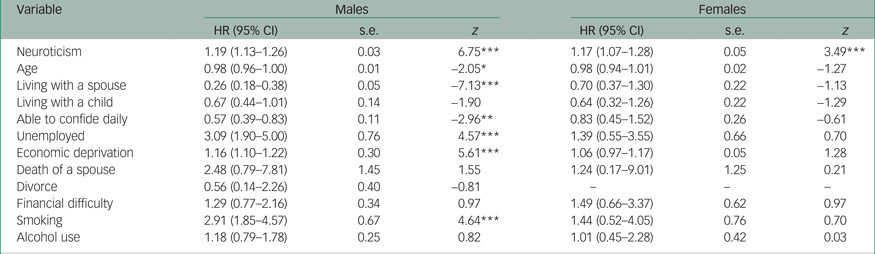
Among men, high neuroticism, younger age, unemployment, living in an economically deprived community and daily smoking were associated with suicide. On the other hand, living with a spouse and having someone to confide in daily were inversely related to suicide. In all univariate models for men, neuroticism best discriminated suicides from the rest of the cohort (C-index = 0.66, 95% CI 0.60–0.72). Among women, only high neuroticism scores were associated with suicide (C-index = 0.63, 95% CI 0.54–0.72). None of the 42 women who died by suicide had been divorced. As such, a hazard ratio (HR) could not be estimated and divorce was dropped from all subsequent models for women. Univariate results are presented in Table 2.
Univariate Cox regression models of suicide, UK Biobank data
* P < 0.05, **P < 0.01, ***P < 0.001.
Bivariate models
Interaction effects
Among men, we found a significant interaction between neuroticism and daily confiding (HR = 1.13, s.e. = 0.06, P = 0.025) such that at lower levels of neuroticism, daily confiding decreased suicide risk, whereas at higher levels of neuroticism, daily confiding increased suicide risk. None of the other covariates had significant interactions with neuroticism. We found no significant interactions with neuroticism among females.
Post hoc models
Given the pattern of univariate results for men, we examined two bivariate models post hoc. To determine whether daily confiding was independent of living with a spouse, we performed a Cox regression that included both variables. This model showed that living with a spouse remained significant (HR = 0.28, s.e. = 0.06, P < 0.001), whereas daily confiding did not (HR = 0.83, s.e. = 0.17, P = 0.36). To determine whether living in an economically deprived area was independent of unemployment, we entered both variables in a Cox regression model simultaneously. Both economic deprivation (HR = 1.13, s.e. = 0.03, P < 0.001) and unemployment (HR = 2.13, s.e. = 0.56, P = 0.004) remained significant.
Multiple variable models
Males
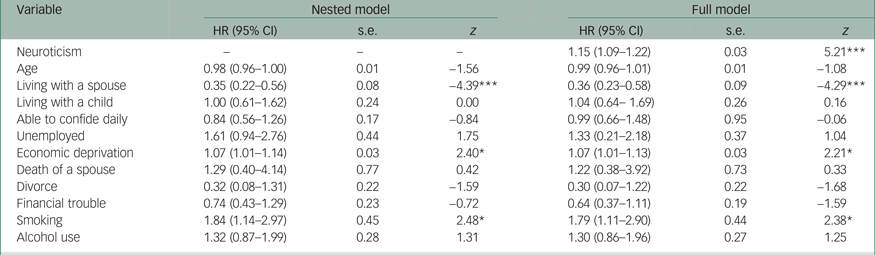
In the nested model, the effects of economic deprivation, living with a spouse and smoking were statistically significant; unemployment was marginally significant (P = 0.08). When neuroticism was added, living in a deprived area, living with a spouse, smoking and neuroticism significantly explained suicide. The C-index for the nested model was 0.72 (95% CI 0.66–0.78), which increased to 0.75 (95% CI 0.69–0.81) with the addition of neuroticism in the full model (Table 3).
Multiple variable Cox regression models of suicide (males), UK Biobank data
* P < 0.05, **P < 0.01, ***P < 0.001.
Females
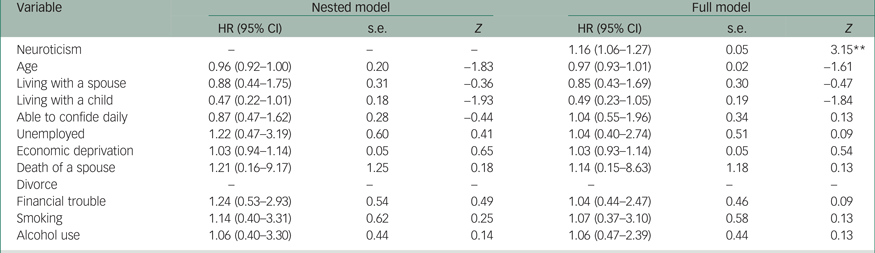
In the nested model, having a child in the home became marginally significant (P = 0.05). In the full model, this association became nonsignificant, whereas neuroticism remained significant. The C-index index for the nested model was 0.65 (95% CI 0.56–0.74), increasing to 0.67 (95% CI 0.60–0.74) with the addition of neuroticism in the full model (Table 4).
Multiple variable Cox regression models of suicide (females), UK Biobank Data
* P < 0.05, **P < 0.01, ***P < 0.001.
Models with both neuroticism and mood disorder diagnoses entered together
In the subset of participants assessed for mental disorders, there were only 14 suicide deaths (0.03%) among males and 12 among females (0.02%). Accordingly, we performed a Wald test to determine whether it was justified to treat clinical diagnosis as a continuous variable. Doing so would avoid having imprecise estimates owing to low suicide numbers in some categories. The Wald test showed that having five ordered categories did not result in a better statistical fit (χ2 = 2.68, d.f. = 4, P = 0.44); therefore, using the continuous variable was justifiable.
Among males, the association of neuroticism with suicide became nonsignificant when mood disorder status was entered. The opposite pattern was found among females – neuroticism remained significantly associated with suicide, although mood disorder status was not (Table 5). The C-index for the model was 0.71 (95% CI 0.56–0.86) for males and 0.81 (95% CI 0.64–0.98) for females. Note that these models are not comparable to the earlier ones because of sampling differences.
Multiple variable Cox regression models with neuroticism and mood disorder diagnoses as explanatory variables of suicide, UK Biobank 2008–2010 participants

aOrdinal variable treated as continuous with levels: 0 = no mood disorder, 1 = single major depression episode, 2 = recurrent major depression with moderate severity, 3 = recurrent major depression with high severity, 4 = bipolar disorder type 2, and 5 = bipolar disorder type 1.
* P < 0.05.
Proportionality of hazards testing
We tested the proportionality assumption for each variable in all regression models by plotting residuals against time. We also performed global tests for the multiple regression models. A violation of proportionality indicates that the hazard associated with a given covariate is not constant with time. We found no violations of proportionality except for daily smoking in the full model for women (χ 2 = 4.62, d.f. = 1, P = 0.03). On further examination, we found that this resulted from a single outlier. Removing this observation did not substantially change the coefficient estimates.
Discussion
We found that neuroticism was a risk factor for suicide among men and women in a large sample of UK residents followed for up to 10 years. To our knowledge, we are the first to report a link between neuroticism and suicide deaths, as opposed to attempts or ideation. This is consistent with previous research reporting associations of neuroticism with suicidal ideation and attempts.Reference Batterham and Christensen 3 – Reference Cox, Enns and Clara 8 , Reference Enns, Cox and Inayatulla 10 , Reference Fergusson, Woodward and Horwood 11 , Reference Yen, Shea, Sanislow, Grilo, Skodol and Gunderson 13 In addition, we found that among men, living with a spouse was associated with lower suicide risk, whereas daily smoking and living in an economically deprived area increased suicide risk.
Among women, but not men, the association of neuroticism with suicide remained significant after accounting for mood disorder diagnoses. This is consistent with a cross-sectional study reporting an association of neuroticism with increased suicidality (i.e. ideation, past attempts and intent), in women only, which controlled for depression.Reference Bluml, Kapusta, Doering, Brahler, Wagner and Kersting 4 Neuroticism may represent an intermediate phenotype that is on the same genetic or developmental pathway as depression and suicide.Reference Brent and Mann 74 – Reference Munafo, Clark, Roberts and Johnstone 76 A recent meta-analysis that included data from the UK Biobank found multiple candidate genes for neuroticism,Reference Smith, Escott-Price, Davies, Bailey, Colodro-Conde and Ward 77 one of which also appears to differentiate people with depression who die by suicide versus other causes.Reference Gray, Hyde, Deep-Soboslay, Kleinman and Sodhi 78 Further research in this area is needed, as the genetic basis of neuroticism is not completely understood,Reference Middeldorp, de Geus, Beem, Lakenberg, Hottenga and Slagboom 79 , Reference Willis-Owen, Turri, Munafo, Surtees, Wainwright and Brixey 80 nor is the relationship between neuroticism and depression.Reference Ormel, Jeronimus, Kotov, Riese, Bos and Hankin 12 , Reference Middeldorp, de Geus, Beem, Lakenberg, Hottenga and Slagboom 79 – Reference Kendler, Neale, Kessler, Heath and Eaves 81
Mental illness is thought to be a stronger risk factor for suicide among women compared with men.Reference Maples, Miller, Hoffman and Johnson 50 , Reference Kendler, Neale, Kessler, Heath and Eaves 81 , Reference Moller-Leimkuhler 82 Our results suggest that neuroticism may be a more important predictor of suicide in women than lifetime mood disorder diagnosis. It is important to point out, however, that the participants were not necessarily suffering from a mood disorder at the time of assessment. Interestingly, our results suggest the opposite pattern for men, in whom neuroticism may be less relevant to suicide after taking into consideration the presence of a lifetime mood disorder diagnosis. However, the effect sizes were small when both mood disorders and neuroticism were entered simultaneously. It is tempting to posit depression as a mediating variable in the relationship between neuroticism and suicide for men, although our data did not allow us to identify a temporal relationship between neuroticism and depression. There is overlap between the symptoms of depression and the content of neuroticism questionnaires,Reference Ormel, Jeronimus, Kotov, Riese, Bos and Hankin 12 , Reference Middeldorp, de Geus, Beem, Lakenberg, Hottenga and Slagboom 79 – Reference Kendler, Neale, Kessler, Heath and Eaves 81 but a diagnosis of depression includes symptoms related to sleep, appetite and energy, which could impair overall function more than the dysphoria experienced by neurotic individuals. Socioeconomic factors are thought to be more strongly associated with suicide in men;Reference Evans, Scourfield and Moore 33 , Reference Kposowa 34 , Reference Qin, Agerbo and Mortensen 42 , Reference Coope, Donovan, Wilson, Barnes, Metcalfe and Hollingworth 63 , Reference Moller-Leimkuhler 82 , Reference Payne, Swami and Stanistreet 83 this may explain why neuroticism became nonsignificant when mood disorders were added to the model. This gender difference needs to be replicated in other larger studies, and our interpretations should currently be considered only speculative.
The interaction between neuroticism and daily confiding among men is counterintuitive, and would be best considered tentative until replicated. It is also difficult to know the clinical significance of a small hazard ratio based on a somewhat vague social support variable – particularly in contrast to, for example, the smoking and neuroticism variables, which are more quantifiable. A possible, albeit speculative, interpretation is that neurotic individuals are more likely to become dependent and excessively seek reassurance, ultimately straining relationships and leading to rejection.Reference Bagby, Costa, Widiger, Ryder and Marshall 84 – Reference Trull, Widiger and Burr 89 Neurotic individuals also tend to negatively interpret social interactionsReference Bromberger and Matthews 90 , Reference Serfass and Sherman 91 and may lash out angrily in response to perceived criticism and rejection.Reference Bagby, Costa, Widiger, Ryder and Marshall 84 , Reference Trull, Widiger and Burr 89 Neurotic men might also consider suicide as an altruistic act to rid their partners of the burden of themselves. These maladaptive patterns of social interaction could explain how more social contact could exacerbate emotional distress, isolation and, ultimately, suicide risk.
Men are thought to be at greater risk for suicide than women if they are unmarried or become divorced,Reference Evans, Scourfield and Moore 33 , Reference Kposowa 34 , Reference Qin, Agerbo and Mortensen 42 , Reference Moller-Leimkuhler 82 , Reference Payne, Swami and Stanistreet 83 consume alcohol,Reference Moller-Leimkuhler 82 , Reference Payne, Swami and Stanistreet 83 or experience unemployment and economic hardships.Reference Coope, Donovan, Wilson, Barnes, Metcalfe and Hollingworth 63 , Reference Moller-Leimkuhler 82 , Reference Payne, Swami and Stanistreet 83 Our results are partially consistent with these findings, as unemployment, community economic deprivation, and living with a spouse or partner were all associated with suicide risk in men but not women. In the multiple regression models, the association of unemployment with suicide became nonsignificant, whereas that of economic deprivation remained significant. It is possible that unemployment, as assessed at study entry, changed in the succeeding months, whereas economic conditions at an area level were more enduring and may be a better index of economic and health inequality. Our alcohol use variable was not associated with suicide in either gender, possibly because it only assessed the number of days per week in which participants consumed alcohol, which may not adequately represent disordered patterns of alcohol use that increase suicide risk. Recent divorce or the death of a spouse was also not associated with suicide in men, possibly because the UK Biobank participants were aged 40 to 69, whereas previous studies have suggested that separation in early adulthoodReference Luoma and Pearson 61 , Reference Wyder, Ward and De Leo 62 is what increases suicide risk.
Cigarette smoking was associated with suicide in men but not women. By comparison, two meta-analyses found increased rates of suicide in smokers of both genders,Reference Li, Yang, Ge, Hao, Wang and Liu 23 , Reference Poorolajal, Bahrami, Karami and Hooshmand 24 whereas an older study found that only male smokers were more likely to have previously attempted suicide.Reference Zhang, Mckeown, Hussey, Thompson and Woods 26 It is likely that smoking is simply a marker for underlying psychopathology, part of an intercorrelated pattern of high-risk behaviours related to suicide, but it is also possible that the toxins contained in cigarettes may biologically predispose people toward suicide.Reference Hughes 27 This topic requires further research with regard to parameters such as the number of cigarettes smoked and the effect of other tobacco products.
The main strength of this study was the linkage of deaths from suicide with a large cohort of participants while controlling for other relevant sociodemographic risk factors. The main limitation was that clinical psychiatric diagnoses were available for a smaller subset. With a much lower number of suicide deaths in this subset, we could not examine the effects of other variables together with both neuroticism and depression. Another limitation was the restricted age range of the participants. For this reason, our findings are most relevant to middle- and older-aged individuals. Future research will need to replicate our results with samples from other age groups to determine generalisability across the lifespan. We were also unable to control for other aspects of personality. We do not believe that that this would have a huge influence on our results, because neuroticism appears to be the personality trait most strongly associated with suicidality.Reference Brezo, Paris and Turecki 5 , Reference Yen, Shea, Sanislow, Grilo, Skodol and Gunderson 13 Neuroticism may interact with other personality risk factors for suicide (e.g. impulsivity), although there is some evidence against this hypothesis.Reference Yen, Shea, Sanislow, Grilo, Skodol and Gunderson 13
Neuroticism has important public health implications.Reference Lahey 92 , Reference Widiger and Oltmanns 93 It is relatively easy to administer self-rated neuroticism scales, and our results suggest that this could potentially be incorporated into suicide prevention strategies for both men and women. Given the stability of neuroticism compared with depression,Reference Ormel, Jeronimus, Kotov, Riese, Bos and Hankin 12 neuroticism may be a more accurate marker of chronic rather than acute suicide risk. This could be useful, for example, in the assessment of longer-term suicide risk among psychiatric patients whose symptoms have otherwise remitted. Our results suggest that this may be particularly useful for female patients with a history of a mood disorder. Interventions targeting neuroticism may be important for early suicide prevention.
Funding
This research received funding from the University of Saskatchewan. L.B. is supported by a grant from the Saskatchewan Health Research Foundation.
Acknowledgements
We thank the UK Biobank Project for making the data available, and Erin Scobie of the Data Access team for facilitating the data transfer.


 Open access


eLetters
No eLetters have been published for this article.