





Our main objective is to study how the transition to a modern monetary system occurred in Spain, which is characterized by the persistence of traditional city-based inland bill of exchange markets. These markets were the basis for a traditional system to transfer liquidity between cities; in short, it was a city-based monetary system grounded in commercial finance.Footnote 1 Simply put, the singularity of the Spanish case relies on the short transition from a city-based monetary system to a central banking system in the absence of a developed banking system with nationwide scope. To this end, this article provides novel empirical evidence. First, it analyzes the decline of the city-based monetary system when arbitrage is driven by more than one price, i.e. taking into account the observers of the market prices in each marketplace of the city pairs.Footnote 2 Our objective is to uncover the mechanisms that contributed to the formation of prices in these markets, generated in a framework of asymmetric information, to detect the reasons for their persistence and the conditions of their rapid disappearance. Secondly, we find new empirical support to analyze the last decade of this city-based system, when the inland bill of exchange markets could not respond to a greater need for payment means and the monetary system had to respond to a growing economy, being replaced by payment services and the financial innovations implemented by the Bank of Spain.
I
Following the main conclusions of Maixé-Altés and Iglesias (Reference Maixé-Altés and Iglesias2009) and the recent results of Nogués et al. (Reference Nogues-Marco, Herránz-Loncán and Aslanidis2019a), and using their same methodology for comparative purposes, this article presents new findings. First, we introduce market arbitrage, considering the exchange rate of pairs of cities in both directions. We aim to detect convergence factors in the inland bill of exchange prices from 1825 to 1885. The adjustment mechanism of the inland bill of exchange prices is fundamental to understanding and analyzing the convergence in these money markets. Within this framework, the consideration of double arbitrage leads to the discovery of unprecedented results.
For this reason, we construct a novel time series in the literature: the market of bills from Barcelona, payable in Madrid (i.e. Barcelona–Madrid). We chose Madrid and Barcelona since both cities were the main economic centers in Spain at this time. There are many examples where data constraints determine the scope of historical research (Badia-Miró et al. Reference Badia-Miró, Carreras-Marín and Rayes2023), and new manually collected data allow for a better understanding of different events in history (Hanedar et al. Reference Hanedar, Hanedar and Erdost Torun2016). Our new time series also allows us to uncover new features of the Spanish money market transition that are currently unprecedented in the literature. We argue that the Barcelona–Madrid and the Madrid–Barcelona exchange rate time series were structurally different (arbitrage is driven by more than one price), contained different information and were able to allow for different transaction costs, depending on which of the two time series were observed to engage in arbitrage. It must be noted that the transaction costs in the bill of exchange markets were significant and especially sensitive in this period due to the substantial evolution of communication and transport infrastructures, legal and financial developments, and an acceleration of the credit risk due to default in Spain.Footnote 3 In other words, we allow for two transaction costs of transporting metal from Barcelona to Madrid and vice versa for agents observing the Barcelona–Madrid exchange rate and another two transaction costs of transporting metal between the two cities for agents observing the Madrid–Barcelona exchange rate. Our results are consistent with Li (Reference Li2015), who, using data from the sixteenth-century bill of exchange markets, showed that we can find structural differences in the London–Antwerp and the Antwerp–London exchange rates due to different market conditions and political circumstances. We have also referred to the work by Coleman (Reference Coleman1998, Reference Coleman2009), as we allow for price adjustment in both locations (see, e.g., Canjels et al. Reference Canjels, Prakash-Canjels and Taylor2004; p. 872). González-Val et al. (Reference González-Val, Tirado and Viladecans2017) showed that the 1860–1900 period experienced a polarization of Spanish cities, where Madrid showed structural differences since it was growing at a much faster rate than other cities. This aligns with our results showing that agents observing the Barcelona–Madrid exchange rate (those agents were understood to be primarily based in Barcelona) may have different transaction costs than agents engaging in arbitrage by observing the Madrid–Barcelona exchange rate (primarily based in Madrid). We suggest that this mechanism was significant in the formation of prices in these markets.
Second, along with the transaction costs, it is necessary to consider efficiency and the speed of price adjustments in these markets. In other words, we must study the capacity of these markets to facilitate payments and meet the economy's demands in terms of the factors that converge in this period (both economic and institutional), analyzing the behavior of their prices. In the methodology section, we will define the model, using the estimation of transaction costs, efficiency and the speed of adjustment to study the integration of the money market. We argue that this analysis should be carried out from 1825 to 1885, during which time city-based markets were in place and documented, taking into account the previous work by Nogués et al. (Reference Nogues-Marco, Herránz-Loncán and Aslanidis2019a), which ends in 1874 (see Appendix 1). We argue that the instrument to measure the integration of the money market in the decade prior to 1885 continues to be the inland bill of exchange market since the financial innovations implemented by the Bank of Spain were a work in progress during this period (e.g. the transfer service, undoubtedly crucial, was not activated until 1884; see Table 1). We show that transaction costs decreased more rapidly in the 1875–85 period than in 1825–74, while inefficiency was even higher in the 1875–85 period than in 1825–74. Our findings suggest that inland bill of exchange markets could not respond to a greater need for means of payment and the business expansion of the Spanish economy from the early 1870s to the mid 1880s, a period in which economic activity experienced considerable growth.Footnote 4 It was in the mid 1880s when the old system gave way to a central banking monetary system.
The money transfer system in Spain 1875–90 (value in millions of pesetas)

Sources: Maixé-Altés and lglesias (Reference Maixé-Altés and Iglesias2009), table 5 from Tedde and Tortella (Reference Tedde, Tortella and Tortella1974), vol. II, tables VII-32-41,VII-3,4,8. Castañeda (Reference Castañeda2001), table II.2. Prados (Reference Prados De La Escosura2017).
Note: between 1886 and 1890, discounts have been estimated by segregating them from a total which includes treasury discounts in provinces (see Castañeda Reference Castañeda2001, p. 110).
We proceed by focusing briefly on certain early international and Spanish literature, which we believe has a remarkable impact on the topic, and we suggest some topics of discussion related to recent debates. In the case of Europe, special attention has been given to the configuration of the money markets prior to their unification, studying the inland bill of exchange markets. Different authors suggest that the decline in inland bills of exchange was mainly due to the improvements in transportation and communication. However, the bank merger movements and the expansion of the networks of bank branch offices also played an important role.Footnote 5 In the case of Spain, in the second half of the 1990s, some authors first considered these markets, with a focus on the Barcelona market, showing evidence of their support for the payment system in a context of intense industrial development and a framework of banking underdevelopment and a shortage of legal currency (Castañeda and Tafunell Reference Castañeda and Tafunell1993; Maixé-Altés Reference Maixé-Altés1997; Cuadras-Morató and Rosés Reference Cuadras-Morató and Rosés1998). A decade later, Maixé-Altés and Iglesias (Reference Maixé-Altés and Iglesias2009), analyzing the century 1775 to 1885, showed that the money markets in Spain were structured over a very long period, based on the inland bill of exchange markets. Using multivariate GARCH models,Footnote 6 it is suggested that ‘the general tendency in how these markets operated was towards a multilateral system of the balance of payments between cities’. It can thus be argued that the Spanish money market's final unification process occurred due to the financial innovations that took effect in the mid 1880s. Recently, Nogués et al. (Reference Nogues-Marco, Herránz-Loncán and Aslanidis2019a), using a symmetric Band-Threshold Autoregression (Band-TAR) model applied to the market rates in Madrid for inland bills of exchange in nine Spanish cities, estimated the market convergence and efficiency during the 1825–74 period. These authors examined and successfully answered a very relevant research question in terms of the economic history of Spain, namely convergence/efficiency and the transformation of European payment systems. Some of their main conclusions are: there is price convergence, the convergence speed has slowed over time and the market efficiency indicator shows no improvement.
As a result, in showing that the reduction in transaction costs caused by different factors explored in Nogués et al. (Reference Nogues-Marco, Herránz-Loncán and Aslanidis2019a) was not necessarily efficient, this article argues that ‘creating a national currency’ was not linear. However, the Bank of Spain's expansion caused the integration by introducing a qualitative leap forward in the development of money markets that would not have necessarily emerged otherwise. This debate on the effectiveness of money transfers before modern banking systems can lead us to a further debate on the performance of developing banking systems. On the one hand, our argument concerning the persistence of these markets, the fast replacement by the innovations introduced by the Bank of Spain and the insufficiency of the rest of the banking system, at least until the turn of the century, supports the hypothesis regarding the imperfections of the Spanish market in the 1860s and 1870s. This aspect emphasizes certain initial conditions influencing successive financial reforms (Hermes and Lensink Reference Hermes and Lensink2013). On the other hand, our approach to the money markets before the consolidation of the central banks, marked by the persistence of a peer-to-peer (P2P) lender system in light of a poorly developed banking system, suggests some ideas about the limitations of P2P banking. Indeed, these limitations shed light on the challenges faced by P2P platforms today as they compete with traditional banks despite their advantages in terms of innovation and accessibility (Tang Reference Tang2019).
The article is organized as follows. Section II presents a historical narrative, Section III provides the empirical base of our analytical approach, Section IV presents our findings and Section V offers some conclusions.
II
In this section we discuss the historical events surrounding the turning points, considering the evolution and transformation of the Spanish economy and institutions. The Spanish economic and financial framework in the first half of the nineteenth century was affected by the consequences of the Napoleonic invasion and the 1814 colonial crisis. After this came a period of institutional change that led to one of the first stages in consolidating more efficient property rights (the First Commercial Code, 1829). The Spanish economy underwent a dynamic economic transition within the international economic cycle, which continued until the middle of the century. In fact, the monetary situation and the various attempts at monetary reform were not enough to prevent the centrifugal movements of Spanish currency and the instability derived from the Spanish Civil War (1833–9). The international crisis of 1848 mainly affected the more developed regional economies, such as Catalonia. This economy was affected by a growing lack of confidence in the fiduciary circulation in the hands of the issuing banks, a circumstance that also affected the credit offering (e.g. the suspension of the discount at the Bank of Barcelona; Sudrià and Blasco-Martel Reference Sudrià and Blasco-Martel2016).
Substantial changes began in the Spanish economy during the second half of the century. As Prados (Reference Prados De La Escosura2017) indicates, these decades were a period of consolidation in the Spanish economy; however, the gap widened with the development of Europe. The Spanish case has singular differences compared to the rest of Europe. Banking network branches and money transfer systems were more developed in the rest of Europe in the 1870s and 1880s. The Bank of France had 94 branches and 205 offices, and other French banks opened branches in the mid-century (Bouvier Reference Bouvier1968; Guille Reference Guille1970; Cameron Reference Cameron2000). The Bank of England only had eight branches.Footnote 7 However, if we consider the joint-stock banks in England and Wales, the transfer system had as many as 120 branches, totaling 1,814 offices (Nishimura Reference Nishimura1971).
There is some agreement in the literature, particularly the most recent, on the diversity of processes that occurred in Europe when implementing financial innovations that favored integrating national money markets. In Germany, the political unification process affected the monetary system, and this framework gave rise to the Reichsbank (1875). This institution quickly imposed its leadership over other issuing banks. In 1883, it promoted the first clearinghouse in Berlin (Morys Reference Morys, Pfister, Hesse, Spoerer and Wolf2021). In the case of Italy, the 1861 political unification process initiated the march towards monetary and financial unification. The Banking Act of 1874 established a comprehensive regulation of the operations of the six banks of issue in the country. However, in the Italian case, the unification of the financial market was delayed by an institutional framework that maintained certain advantages in the hands of local interests (Toniolo et al. Reference Toniolo, Conte and Vecchi2003). Klovland and Øksendal (Reference Klovland and Øksendal2017) point out that in the Norwegian case, the branches did not play a direct role in the integration process, which originated thanks to advances in communications, the development of the private banking sector and the development of the Norwegian economy. In short, the deployment of branch networks and centralized transfer services by a significant issuing bank positioned the Bank of Spain as the leading actor in the integration process of the Spanish monetary market. It highlighted the variety of paths taken in the monetary integration processes in Europe.
The Bank of Spain's financial innovations led to the disappearance of a system for mobilizing liquid balances between national markets through the eight days' sight inland bill of exchange markets (Castañeda Reference Castañeda2001; Maixé-Altés and Iglesias Reference Maixé-Altés and Iglesias2009; Nogués et al. 2019). Empirical evidence shows how the Spanish city-based money markets had only minor importance after 1884–85. Quotes for these became a fixed rate, precisely a fixed fee.Footnote 8
Table 1 summarizes the changing features of the Spanish banking system in the years in which the institutional framework moved from a city-based monetary system to a central one. A wide range of agents participated in the city-based money markets, characteristic of the Spanish nineteenth-century system. Alongside the incipient role of banks, we must consider a set of local agents, the so-called merchant capitalists. These merchants simultaneously conducted an active business in the national payment system around these bill of exchange markets.Footnote 9 In reality, banking establishments in Spain were scarce and considered local private banks without a branch network. The Banks of Issue Act of 1856 favored the creation of provincial banks of issue, which remained in force until the Bank of Spain's Monopoly of Issue Decree of 1874 (1876 Act). However, their impact at the national level was, with some exceptions, relatively small and was limited to the creation of 18 new banks with a provincial scope.Footnote 10 The size of Spanish banking in terms of its ability to manage payments was far from that of the Bank of Spain, especially from 1884 on, once its new payment instruments were fully implemented. Table 1 shows how effectively banks, through their correspondent accounts (assets and liabilities), offered a very low volume of services in relation to their total assets and in terms of GDP. Spanish banks only started to extend their presence nationwide in the early twentieth century. This situation highlights, on the one hand, the inadequacy of the banking system and, on the other, the weight of traditional markets (which had become increasingly inefficient) in the context of economic growth. We also should not forget the effect of the civil conflicts during this time, such as the ‘Third Carlist War’ (1872–6) and the successive political conflicts that occurred in the context of the First Spanish Republic (1873–4) and the subsequent restoration of the monarchy. In general terms, the literature suggests an unequal impact on the different marketplaces according to specific economic and institutional circumstances.Footnote 11 From 1875 to 1883, the Bank of Spain incorporated new payment systems, such as notes, and saw increasing activity by bank branches, which represented 6.9 percent of the GDP in the last year. However, as Castañeda (Reference Castañeda2001, p. 90) points out, ‘The general circulation of notes culminated in March of 1884, but far from being established very rapidly, it was a prolonged process that was initiated in 1878, and only at the end was it accelerated due to the pressures that were coming from outside of the institution.’ In addition, the weakness of the branch network before 1884 is reflected by the low volume of current accounts, which between 1875 and 1883 represented an average of 1.6 percent of the GDP, while between 1884 and 1890, they grew substantially and came to represent an average of 3.3 percent of the GDP (Table 1). From 1884 onwards, this process accelerated substantially, thanks to implementing a new transfer system (all services related to the payment system accounted for 14.3 percent of the GDP, 7.4 percentage points above the previous year; this increased to 37.3 percent of the GDP in 1890). As the literature has already pointed out, between 1884 and 1905, private banking was overshadowed by the Bank of Spain (Tortella Reference Tortella1994; Castañeda Reference Castañeda2001), which explains the importance of the financial innovations implemented by the Bank of Spain and their impact on the payment system, especially after 1884, once the innovations above were fully implemented. The city-based money markets ceased to be operational.
The inland transfer system had to respond to a growing economy, with some regions industrializing while others remained backward and agrarian. However, certain agrarian regions had international surpluses due to agricultural goods and mineral exports (as in Andalusia, among others). The industrializing regions (Catalonia, the Basque Country and Asturias) had a home trade surplus and a deficit with foreign markets due to their industrial raw materials and machinery imports. Similarly, Madrid received the tax receipts from the rest of the country and redistributed them across the country (for example, to pay the military and administrative expenses). These regional disequilibria multiplied due to Catalonia's rapid growth and industrialization. Therefore, it is likely that the traditional system of inland transfers was subject to increasing pressure. Furthermore, it is also likely that some regions retained the increasing benefits of their industrial success and accumulated capital. This changing context suggests why the system suffered in the 1860s and 1870s when the disequilibria became increasingly acute.
III
This section examines the empirical base of our analytical approach, considering the data, model, analytical assumptions and some estimation results of our new hypotheses. Appendix 1 (Figures A1–A18) shows the evolution of the exchange rates in Madrid for the same nine cities analyzed in Nogues-Marco et al. (Reference Nogues-Marco, Herránz-Loncán and Aslanidis2019a) during the period 1825–74 and in our extended period 1875–85, offering an essential geographic coverage of the inland bill money markets in Spain (i.e. Barcelona, Bilbao, Cadiz, A Coruña, Malaga, Santander, Seville, Valencia and Zaragoza). Our study uses the Madrid exchange rate data of more than 110,000 hand-collected observations, kindly provided by Nogues-Marco et al. (Reference Nogues-Marco, Herránz-Loncán and Aslanidis2019b) for 1825–74. By adding our extended period from 1875 to 1885, we contribute an additional 3,190 daily hand-collected observations of the exchange rates for all nine cities. We have obtained the data for the 1875–85 period from the same data sources as Nogues-Marco et al. (Reference Nogues-Marco, Herránz-Loncán and Aslanidis2019a): exchange rate prices published in the Gazeta de Madrid. Moreover, for the period 1825–85, we have constructed an unpublished time series of exchange rates for Barcelona payable in Madrid using the published quotations in the Diario de Barcelona, obtaining a hand-collected series of 10,554 observations, which is entirely novel in the literature.
Methodology and analytical assumptions
Following the seminal paper by Canjels et al. (Reference Canjels, Prakash-Canjels and Taylor2004), where we are under the assumption that all arbitrage in the system is driven by one price (referring to the market of bills of only one of the two locations), a band-threshold autoregressive (Band-TAR) model may be used, which simultaneously measures both convergence and efficiency. Our objective is to extend the analysis by Nogues-Marco et al. (Reference Nogues-Marco, Herránz-Loncán and Aslanidis2019a) to learn whether, when we also allow for a second type of agent that engages in arbitrage by observing the market of bills of Barcelona payable in Madrid, transaction costs (and half-lives) are significantly different from transaction costs (and half-lives) for agents that engage in arbitrage by observing the bills market in Madrid payable in Barcelona. In this way, the half-life is defined as the number of days necessary to reduce prices' distance to the equilibrium bands by 50 percent. Therefore, half-lives provide a way to get a feel for how fast prices revert by asking how long it would take to reduce the distance by 50 percent.
The symmetric version of the Band-TAR model also assumes that the transaction costs of transporting metal from city 1 to city 2 are the same as for city 2 to city 1 for the same type of agent. On the other hand, the asymmetric version of the Band-TAR model allows for different transaction costs of transporting metal between the two cities (see, e.g., Canjels et al. Reference Canjels, Prakash-Canjels and Taylor2004; Jacks Reference Jacks2006). It is important to note that, even in the asymmetric version of the Band-TAR model, if we only analyze the exchange rate of the market of bills of one location, we are under the assumption that all arbitrage is driven in the market of bills of that single location. Trenkler and Wolf (Reference Trenkler and Wolf2005) and Nogues-Marco et al. (Reference Nogues-Marco, Herránz-Loncán and Aslanidis2019a) assumed symmetric transaction costs. Also, they assumed that price adjustment was only driven in one of the bill markets at one location (the half-lives were assumed to follow the same structure).
On the other hand, Li (Reference Li2015) states that when studying two cities, London and Antwerp, we can find structural differences in the London–Antwerp and the Antwerp–London exchange rates due to different market conditions and political circumstances. Using the same theoretical reasons, based on market conditions and political circumstances, we propose that the exchange rate in city 1 payable in city 2 may be structurally different from the exchange rate in city 2 payable in city 1. in addition, we argue that, in the Spanish case, transaction costs and half-lives may differ if we relax the assumption that arbitrage (price adjustment) only takes place in the market of bills of one of the two locations in the nine analyzed cities. These cities had very different market conditions and political circumstances in 1825–85, as described in the previous section (see Castañeda Reference Castañeda2001). Recent estimates have also shown that territorial inequalities in the Spanish economy remained present between 1860 and the end of the century.
Meanwhile, some mobility is also observed in the regional income distribution, to the extent that the provincial ranking experienced changes in that period.Footnote 12 As González-Val et al. (Reference González-Val, Tirado and Viladecans2017) highlight, the final decades of the century experienced a polarization of Spanish cities, according to which Madrid had structural differences. Consequently, our objective is to extend this analysis to learn whether, when we also allow for a second type of agent that engages in arbitrage by observing the market of bills of Barcelona payable in Madrid, transaction costs (and half-lives) are significantly different from transaction costs (and half-lives) for agents that engage in arbitrage by observing the bills market in Madrid payable in Barcelona.
Based on the fact that convergence and efficiency are the dimensions for the study of the integration process of a money market, we acknowledge that the behavior of these markets can be captured through two symmetric TAR-type models, which allow for the simultaneous analysis of the convergence and efficiency dimensions of market integration, as established by Nogues-Marco et al. (Reference Nogues-Marco, Herránz-Loncán and Aslanidis2019a). The symmetric Band-TAR model also assumes that arbitrage only takes place in one of the two locations (determined by the x t series that we choose). It takes the form of:

where x t is the percentage deviation of the market exchange rate from the official parity and Δ is the first difference operator. The parameter γ is the threshold that proxies for transaction costs, while λ indicates the speed of adjustment to equilibrium. Following the method used by Nogues-Marco et al. (Reference Nogues-Marco, Herránz-Loncán and Aslanidis2019a), half-lives are calculated as ln(0.5)/ln(1- λ) and the Band-TAR model is estimated by maximum likelihood under the assumption that errors are Gaussian.
For analytical purposes, we focus on two market locations (i.e. the price in Madrid of bills of exchange payable in Barcelona and the price in Barcelona of bills of exchange payable in Madrid, due to the availability restrictions of our data), and we allow for two types of arbitrage by allowing for two different analyzed x t series. First, we have agents that engage in arbitrage, which we obtained by observing the exchange rate in the market of bills in Madrid payable in Barcelona and comparing it to their corresponding transaction costs of transporting metals (as in the case analyzed by Nogues-Marco et al. Reference Nogues-Marco, Herránz-Loncán and Aslanidis2019a). Moreover, we add a second type of agent that engages in arbitrage by observing the exchange rate in the market of bills in Barcelona (i.e. in this case focusing on the exchange rate from Barcelona to Madrid), and where we once again impose the very reasonable assumption made by Nogues-Marco et al. (Reference Nogues-Marco, Herránz-Loncán and Aslanidis2019a), i.e. we have symmetric transaction costs of transporting metals between the two cities for this second type of agent, again employing another symmetric Band-TAR model.
Regarding transaction costs, Figures A19–A27 (Appendix 2) show the graphs of their estimated values. We add 3,190 novel daily observations to the series of the nine cities (by including the 1875–85 period). Therefore, we have extra estimated transaction costs to add to the sample at the end of the sample compared to those obtained in the previous literature. Adding the 1875–85 period also alters the adjusted series for outliers in the 1825–74 period, and it creates some divergences in the estimated transaction costs in the overlapped period from 1825 to 1874 (see the differences between the black and grey lines in Figures A19–A27, Appendix 2). We observe that the estimated transaction costs decrease when adding 1875–85. Also, in the overlapping period of 1825–75, we see that the differences between the black and grey lines are minimal, showing the procedure's robustness.
Moreover, in Table 2, we provide evidence that in the period 1875–85, the estimated trend is always more negative in all nine cities than in the period 1825–85 (the same is true for the period 1825–75, given the recent literature). These new results suggest that transaction costs decreased more sharply in 1875–85 than in 1825–74. This will be discussed in greater detail in Section IV.
Time trend coefficients of transaction costs estimates in the Spanish money market having Madrid as the base market

* indicates significant at the 5% level. ** indicates significant at the 1% level. Regression results by ordinary least squares and Heteroskedastic and Autocorrelation (HAC) standard errors are shown in brackets. Note: We have checked that the results are robust when using least absolute deviations and bootstrapped standard errors.
Regarding the half-lives, Table 3 shows the corresponding estimated time trend coefficients of half-life. Figures A28–A36 (Appendix 2) show the detailed graphs of estimated half-lives (speed of adjustment) in the Spanish money market, establishing Madrid as the base market. We observe how the estimated half-lives continue to increase when the 1875–85 period is added in eight cities, except A Coruña. In A Coruña, half-lives decreased significantly in 1825–74 and the 1825–85 periods (see Table 3). However, in the 1875–85 period, half-lives increased significantly, showing inefficiency in the A Coruña market, which is part of the general trend. Table 3 shows that in the 1875–85 period, the estimated trends are always positive and larger than in 1825–85 for all cities except Valencia and Zaragoza. Valencia was the only exception with a negative estimated half-life, where inefficiency and transaction costs in the period 1875–85 significantly decreased. These behaviors will be discussed in Section IV.
Time trend coefficients of half-live estimates in the Spanish money market having Madrid as the base market
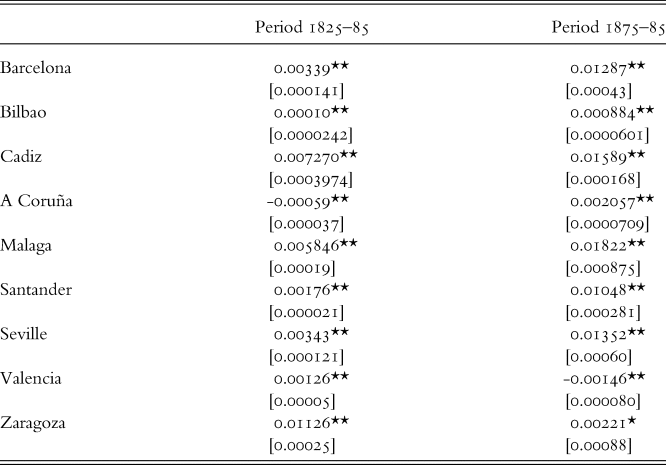
* indicates significant at the 5% level. ** indicates significant at the 1% level. Regression results by ordinary least squares and Heteroskedastic and Autocorrelation (HAC) standard errors are shown in brackets. Note: We have checked that the results are robust when using least absolute deviations and bootstrapped standard errors.
Are transaction costs and half-lives symmetric between city pairs?
We allow for estimating two symmetric Band-TAR models in the two market of bill locations (Madrid and Barcelona). We test whether the two transaction costs from the two symmetric Band-TAR models are equal. We use the two time-series of quasi-daily exchange rates of Barcelona–Madrid and Madrid–Barcelona, and we retain only those observations for which we have a quotation in both markets on the same day. Figure 1 represents the evolution of both time series, showing a clear symmetric pattern, as is to be expected. For 1825–85, both series in Figure 1 share a correlation coefficient of -0.927. The vertical dotted line in Figure 1 indicates when Nogues-Marco et al. (Reference Nogues-Marco, Herránz-Loncán and Aslanidis2019a) stopped their analysis.
Exchange rates for Barcelona–Madrid (grey line) and Madrid–Barcelona (black line)
Sources: Exchange rates for Barcelona–Madrid, own elaboration from Diario de Barcelona, 1825–62 available at https://arca.bnc.cat/arcabib_pro/ca/publicaciones/numeros_por_mes.do?idPublicacion=384 and Historical Archive of the City of Barcelona, Newspaper Library (1863–85). Exchange rates for Madrid–Barcelona, available from Nogues-Marco et al. (Reference Nogues-Marco, Herránz-Loncán and Aslanidis2019a) until the dotted line, i.e. until 1874. From 1875 to 1885, own elaboration from Gazeta de Madrid, available at www.boe.es/buscar/gazeta.php, for the period 1825–85 on days where we have a quotation in both markets.

We then proceeded to test whether transaction costs using the Barcelona–Madrid and Madrid–Barcelona exchange rates are the same for both types of agent. First, we remove the outliers from our exchange rates, defined as observations with absolute median deviations larger than three times the interquartile range. Canjels et al. (Reference Canjels, Prakash-Canjels and Taylor2004) refer to the difficulties of testing for the symmetry of thresholds since the nuisance parameters (i.e. possible thresholds) are not identified under the null hypothesis. Canjels et al. (Reference Canjels, Prakash-Canjels and Taylor2004, p. 878) propose the following testing procedure: ‘We take a moving window of 1500 observations … and estimate a constant threshold model in each window … we estimate a model with symmetric thresholds, but examine whether thresholds that are identified mainly from lower-regime data are different from thresholds identified mainly from upper-regime data.’ We have two observed time series (Barcelona–Madrid and Madrid–Barcelona) consisting of 10,554 observations. Following the method described by Canjels et al. (Reference Canjels, Prakash-Canjels and Taylor2004), based on the symmetric Band-TAR model, we use windows of data of 5,000 observations (as did Nogues-Marco et al. Reference Nogues-Marco, Herránz-Loncán and Aslanidis2019a). We estimated the transaction costs and half-lives.Footnote 13 Figures 2 and 3 show the estimated transaction costs and half-lives for the market of bills on the y-axes for the two locations: the Barcelona–Madrid (grey line) and the Madrid–Barcelona (black line) exchange rates, which were previously shown together in Figure 1 above. The x-axes in Figures 2 and 3 show the year of the last observation that is included in the windows of 5,000 observations.
Estimated transaction costs for the exchange rates shown in Figure 1 for Barcelona–Madrid (grey line, own elaboration) and Madrid–Barcelona (black line, available in Nogues-Marco et al. (Reference Nogues-Marco, Herránz-Loncán and Aslanidis2019a) until 1874; from 1875 to 1885, own elaboration)

Estimated half-lives for the exchange rates shown in Figure 1 for Barcelona–Madrid (grey line, own elaboration) and Madrid–Barcelona (black line, available in Nogues-Marco et al. (Reference Nogues-Marco, Herránz-Loncán and Aslanidis2019a) until 1874; from 1875 to 1885, own elaboration)

In Figure 2, we observe that transaction costs for Barcelona–Madrid (with an average of 1.16) tend to be higher than for Madrid–Barcelona (with an average of 1). According to Canjels et al. (Reference Canjels, Prakash-Canjels and Taylor2004), under the null hypothesis (of the existence of a unique standard transaction cost), when we allow for arbitrage in the market of bills in Madrid and the market of bills in Barcelona, the symmetric unique threshold identified with the symmetric Band-TAR model applied to the Madrid–Barcelona exchange rate series should be equal to the symmetric threshold applied to the Barcelona–Madrid series. Suppose we test the null hypothesis that the differences in the means of the estimated thresholds obtained with the Madrid–Barcelona and the Barcelona–Madrid series (obtained from windows of data with 5,000 observations) is equal to zero. In that case, we reject it with a p-value close to zero. This shows evidence that transaction costs were greater when arbitrage was allowed in the market of bills in Barcelona, as opposed to when we allow for arbitrage in the market of bills in Madrid. We also reject the null hypothesis of the equality of the variances of the estimated transaction costs in the Barcelona–Madrid and Madrid–Barcelona series in 1825–85.Footnote 14
Following the same reasoning for half-lives as for thresholds, in Figure 3, we observe that half-lives in the Barcelona–Madrid series (with an average of 4.77) tend to be much smaller than in the Madrid–Barcelona series (with an average of 15.95). Suppose we test the null hypothesis that differences in the means equals zero. In that case, we reject it with a p-value close to zero. This shows that estimated half-lives were smaller in the market of bills in Barcelona than when arbitrage took place in the market of bills in Madrid during the 1825–85 period.Footnote 15 We also reject the null hypothesis of the equality of the variances of the estimated half-lives in the Barcelona–Madrid and Madrid–Barcelona series.
IV
These results allow us to establish some findings and discuss the consequences of introducing double arbitrage in price formation throughout the period. The analytical premises we have established alter the behavior of the transaction costs and half-lives (speed of adjustment) in the different city-based markets considered. Therefore, our approach sheds light on how the money market behaves in a context of economic growth, in which strong territorial imbalances persisted in the Spanish economy.
The empirical results show that there were very few exceptions to this decrease in efficiency. However, this occurred more intensely in some cities than in others. The case of A Coruña is consistent with the relative position of the province of Coruña and its capital in that it was found to be in the poorest quintile in terms of regional per capita GDP (by province) in Spain (Tirado et al. Reference Tirado, Díez-Minguela and Martínez-Galarraga2016). The exception of Valencia can be considered to be the consequence of regional market dynamics,Footnote 16 in which the textile development of Alcoy was important. This city hosted a manufacturing center where secondary and informal liquidity markets were necessary, as Cuevas (Reference Cuevas2002) indicated. In this way, an efficient system for allocating the necessary resources for industrialization was developed without resorting to external liquidity markets. The Andalusian focus of Alcoy's production, the Valencian regional market and Madrid allow us to interpret the persistence and efficiency of the city-based Valencian market. Specifically, in the Valencian regional market, Madrid played a substantial role as the hub of the articulation of the domestic market, as both a trading center for commodities and goods and a center for the negotiation of bills of exchange (see Cuevas Reference Cuevas1999). These circumstances, along with the acceleration of the modernization and mechanization processes of Alcoy's industry starting in the 1870s, suggest that the behavior of the Valencia market can be associated with the system's improved efficiency. Table 3 also shows that Zaragoza, A Coruña and Bilbao, while still inefficient in the 1875–85 period, were less inefficient than the other five cities (Barcelona, Cádiz, Málaga, Santander and Seville), as a result of the regional and provincial disparities that were characteristic of Spanish economic growth.Footnote 17
Focusing on banking aspects, specific circumstances that affected some of the marketplaces involved should be pointed out. The entire set of marketplaces studied are found in those cities where a branch of the Bank of Spain was set up: Valencia in 1873 and the rest in 1874–75. However, the degree of penetration in the commercial and business activity of each of these branches was very different insofar as the problems with new shareholders, management inefficiency and the response of the economic agents – including the former issuing banks and the rest of the banking institutions and local authorities – were very different (see Castañeda Reference Castañeda2001, pp. 58–60). As we have already indicated, in general terms, the literature suggests an unequal impact on the different marketplaces according to specific economic and institutional circumstances.
Despite the empirical evidence that reveals the decline of these markets in the last stage of their existence, the specific results of some cities suggest that, in some cases, they maintained their vigor better than the rest. In this sense, a contradictory phenomenon occurred in the last stage of the operation of these markets: the increase in traded marketplaces. Considering two significant places (Madrid and Barcelona), we can verify the increase in the number of traded marketplaces at the end of the period. Between 1875 and 1880, the Madrid market increased from 47 traded marketplaces to 61; after 1870 in Barcelona, bills of exchange were traded in 45 marketplaces, while a few years earlier, in 1865, only 29 Spanish marketplaces traded them. The results suggest that the accelerated decrease in transaction costs could explain the multiplication of the cities included on this circuit in the final years that these markets were in operation. This is an aspect that the literature, to the best of our knowledge, has failed to explain so far. However, it seems a reasonable hypothesis, based on our findings about the decreased efficiency of these markets in the last decade of their existence, in which the increase in bills in circulation, favored by the drop in transaction costs, allowed access by less solvent agents to these markets, thus reducing their liquidity and accelerating the decline in their efficiency.
As a result, even in the early stages of the development of the modern Spanish economy, there was a noticeable trend towards the asymmetrical development of the market potential of the different regions and cities. This phenomenon had intense effects on the spatial distribution of economic activity. Between 1860 and 1890, regional inequalities within the Spanish economy remained present. Meanwhile, some mobility was also observed in the regional income distribution to the extent that the provincial ranking changed between 1860 and 1930 (see Tirado et al. Reference Tirado, Díez-Minguela and Martínez-Galarraga2016). Consequently, specific urban and regional conjunctures justify the different rates of the decrease in the efficiency of the city-based money markets.
The empirical analysis suggests how the factors that explain this behavior are articulated from a historical point of view. The systematic increase in the half-lives and the decrease in the transaction costs occurred within a framework of global growth of the Spanish economy, accompanied by regional solid imbalances. Analytically, this process could be considered as the classic inverted U-shaped pattern.Footnote 18 Recent literature further supports this pattern between Spanish economic development and regional inequality (provinces and regions) between 1860 and the end of the twentieth century. Regional disparities seem to peak around 1920, with the convergence of the process starting as of this point.Footnote 19 According to this approach, integration, favored by falling transaction costs (i.e. railroads and telecommunications), allows new players to enter the market, accompanied by an increase in default (by those with an unreliable credit history). These circumstances induced an increase in the half-lives, which could be caused by a change in the quality of the domestic bill issuer (coming from new marketplaces). This reduced the overall liquidity of the bill market despite it being more logistically integrated. As a result, these differences in the loss of efficiency by the city-based money markets that we have detected confirm structural changes that occurred in the Spanish economic geography, unevenly affecting each territory.
Along with the asymmetries above in market potential, specific conditions that contributed to these differences arose in these urban markets (see also Li Reference Li2015). As a result, the reduction in transaction costs was not associated with increased efficiency in 1875–85 in all nine cities. Therefore, we provide empirical evidence that full market integration did not occur in Spain in 1875–84 via city-based money markets. Progressive market integration had to wait until the expansion of the Bank of Spain, once the aforementioned financial innovations were indeed installed and effective in most of the Spanish territory. From this perspective, the expansion of the Bank of Spain contributed to finalizing an ongoing process, accelerating it and improving market efficiency.
V
The results of our research show that a complex market mechanism contributed to the formation of prices in the city-based money markets. If we allow arbitrage in two locations, Madrid and Barcelona, agents who observe the exchange rate market of bills in Madrid have different transaction costs than agents who observe the exchange rate in the market of bills in Barcelona. We have verified this behavior, considering the changes between the two most important marketplaces during the nineteenth-century period, Madrid and Barcelona, using the prices of the short-term bills of exchange from Madrid for Barcelona and Barcelona for Madrid. These results refer to the different conditions for each urban market (market conditions and political circumstances) and the asymmetrical development of the market potential in the Spanish economic geography. They are consistent with the results found by Coleman (Reference Coleman1998, Reference Coleman2009), González-Valet al. (Reference González-Val, Tirado and Viladecans2017) and Li (Reference Li2015), offering a more consistent approach to price formation in these markets and the dynamics of the Spanish economic geography in the nineteenth century.
The analysis in this article suggests that a city-based monetary system structured around the inland bill of exchange markets operated during a large part of the nineteenth century in Spain. These markets were very active practically until the mid 1880s. However, the unification process of the money market did not occur due to the positive evolution of the operation of said markets; instead, it resulted from the practical and progressive dissemination of a series of financial innovations implemented by the Bank of Spain. It was precisely in these later years when the economic growth experienced by the Spanish economy pressured the structuring of these markets, which could not respond to a greater need for means of payment and business expansion in the context of banking underdevelopment. Applying Band-TAR models for quasi-daily trading of inland bills of exchange on the Madrid market for nine Spanish cities (for an extended decade, 1875–85) provides new empirical evidence that the inland bill of exchange markets became more inefficient. The reduction of transaction costs was not associated with an improvement in efficiency during its last decade. These results suggest that these markets, despite the improvement in communications, by both road and railway, and the deployment of the telegraph network, gradually lost their capacity to meet the payment needs that the economic growth and progress of the Spanish economy generated over the last quarter of a century. A progressively inefficient system disappeared, replaced by the financial innovations implemented by the Bank of Spain.
In short, only the modernization of the currency and payment systems created a modern financial structure that could replace the already inefficient city-based monetary system. This transition occurred with a lag behind industrialized Europe, which enjoyed levels of access to banking services far superior to those of Spain, thanks to a more developed banking system that allowed a more progressive convergence in the money market. The singularity of the Spanish case lies in the short transition from a city-based monetary system to a centralized banking system in the absence of a developed banking system with a nationwide scope. These circumstances highlight the severe imperfections of the Spanish market in the transition period, establishing starting conditions that would have consequences on the successive financial reforms.
The lessons that can be learned from the Spanish case should be centered on the fact that it allows us to verify how a private and decentralized system was more inefficient (despite the improvement in transaction costs) than the new central banking system that replaced those markets and progressively unified the monetary system. Bearing in mind that the central banking system is still in force nowadays, this historical process, considered through an institutional approach, is very relevant. It can offer analytical support for recent issues if we consider the analysis of the new current private currencies in a co-evolutionary perspective, based on blockchain technology, and their implications in terms of efficiency compared to regulated and fiat money systems and, more recently, digital fiat money (see Peneder Reference Peneder2022). Finally, our arguments highlight the ongoing debate on the possible limitations of P2P banking concerning traditional banking (especially credit risk, supervision, financing cost, access to capital, poor diversification, reputational problems and default (Tang Reference Tang2019)).
Appendix 1: Figures of unadjusted data
Sources: Data for the period 1825–74 is from Nogues-Marco et al. (Reference Nogues-Marco, Herránz-Loncán and Aslanidis2019b), while data from 1875–85 corresponds to the authors' own work, based on the Gaceta de Madrid, available at www.boe.es/buscar/gazeta.php
Madrid/Barcelona 1825–74

Madrid/Barcelona 1875–85

Madrid/Bilbao 1825–74

Madrid/Bilbao 1875–85

Madrid/Cadiz 1825–74

Madrid/Cadiz 1875–85

Madrid/A Coruña 1825–74

Madrid/A Coruña 1875–85

Madrid/Malaga 1825–74

Madrid/Malaga 1875–85

Madrid/Santander 1825–74

Madrid/Santander 1875–85

Madrid/Seville 1825–74

Madrid/Seville 1875–85

Madrid/Valencia 1825–74

Madrid/Valencia 1875–85

Madrid/Zaragoza 1825–74

Madrid/Zaragoza 1875–85

APPENDIX 2: Series with data until 1874 (in black), adding the 1875–85 period (in grey)
ESTIMATED TRANSACTION COSTS
Madrid/Barcelona

Madrid/Bilbao

Madrid/Cadiz

Madrid/A Coruña

Madrid/Malaga

Madrid/Santander

Madrid/Seville

Madrid/Valencia

Madrid/Zaragoza

ESTIMATED HALF-LIVES (SPEED OF ADJUSTMENT)
Madrid/Barcelona

Madrid/Bilbao

Madrid/Cadiz

Madrid/A Coruña

Madrid/Malaga

Madrid/Santander

Madrid/Seville

Madrid/Valencia

Madrid/Zaragoza


 Open access

