


Highlights
-
• Orthostatic hypotension affected over half of patients with Parkinson disease and was usually asymptomatic.
-
• Patient-reported outcome measures showed good sensitivity for identifying measured orthostatic hypotension.
-
• Blood pressure drops varied with dopaminergic medication timing, and delayed orthostatic hypotension was linked to worse mobility-related quality of life.
Introduction
Orthostatic hypotension (OH) affects 30–60% of people with Parkinson disease (PD) seen in specialist clinics. Reference Velseboer, de Haan and Wieling1,Reference Senard, Raï and Lapeyre-Mestre2 OH is defined by a sustained blood pressure (BP) drop of 20 mmHg systolic or 10 mmHg diastolic within 3 minutes of standing or head-up tilt Reference Gibbons, Schmidt and Biaggioni3 and predicts a higher risk of injury, falls and shorter survival in PD. Reference LeWitt, Kymes and Hauser4,Reference Goldstein, Holmes and Sharabi5
OH can also occur without overt symptoms (asymptomatic OH) Reference Merola, Romagnolo and Rosso6–Reference Palma and Kaufmann8 or with nonspecific symptoms like fatigue, poor mobility or cognitive impairment. Reference Chen, Wang and Zhou9,Reference Wang, Zhang and Xu10 While guidelines encourage clinicians to ask about symptoms and measure lying to standing BP, Reference Grimes, Fitzpatrick and Gordon11 there are marked practice variations in movement disorder clinics, Reference Azizi, O’Shea and Timmons12 with clinicians citing time constraints as an important barrier. Reference McDonagh, Cross and Masoli13 More efficient approaches to OH risk assessment are needed for routine clinical care of PD.
We conducted a pragmatic cross-sectional study in consecutive patients with PD in a movement disorder clinic over three months. We collected patient-reported outcomes, reported the presence or absence of lightheadedness and dizziness during orthostatic vital sign measurement and assessed relationships of early, delayed and persistent OH with clinical features and medication dose timing. We assessed the predictive value of patient-reported outcomes for the presence or absence of clinic-measured OH.
Methods
Study design and ethics
This was a cross-sectional study at the Humphreys Family Movement Disorders Clinic, Kelowna, British Columbia. The Interior Health Research Ethics Board approved the protocol (H21-01032), and participants gave written informed consent.
Sample size estimation
A representative sample size to estimate the prevalence of OH in our clinic population was calculated using the Wald method with finite population correction. Reference Lwanga and Lemeshow14 Clinic records identified 601 active patients with PD over the preceding two years. Assuming an expected OH prevalence of 30–40% based on prior reports, Reference Velseboer, de Haan and Wieling1,Reference Senard, Raï and Lapeyre-Mestre2 a sample size of 71–80 participants was planned to allow estimation of prevalence within ±10% at 95% confidence. Based on an average of 31 unique PD patients per month in the prior year and anticipating an 80% participation rate, we expected to meet our enrollment target within a focused three-month recruitment period.
Participants
Consecutive adults with clinically established PD based on Movement Disorder Society criteria Reference Postuma, Berg and Stern15 and scheduled for routine care visits between February 26 and May 29, 2024, were screened for participation. Patients were excluded if they had heart failure, unstable arrhythmia, resistant hypertension (BP not in target despite three or more antihypertensive agents) or were unable to complete 5 minutes of supine rest, standing BP measurement or other study procedures. Of 85 patients screened, 57 were enrolled (72%). Ten declined consent, and 14 were ineligible due to medical instability (n = 5), competing care priorities (n = 4), last-minute appointment changes (n = 4) or revised diagnosis (n = 1). An additional four participants consented but did not complete key study measures.
Study measures
Demographic and historical data (i.e., age, sex, date of symptom onset and diagnosis of PD) were abstracted from the medical chart. Patient-reported outcomes included the Orthostatic Hypotension Questionnaire (OHQ), Symptom Assessment (OHSA) and Daily Activity Scale (OHDAS), Reference Kaufmann, Malamut, Norcliffe-Kaufmann, Rosa and Freeman16 the SCale for Outcomes in PArkinson’s disease–Autonomic Dysfunction (SCOPA-AUT) Reference Visser, Marinus, Stiggelbout and van Hilten17 and the 39-item Parkinson’s Disease Quality of Life (PDQ-39). Reference Peto, Jenkinson, Fitzpatrick and Greenhall18,Reference Horváth, Aschermann and Ács19 Participants were asked about the number of falls or fainting episodes within the preceding 12 months. These outcomes were completed after the consent process, prior to the appointment date, supported by research coordination staff. In a minority of patients without a device to submit electronic patient-reported outcome responses, paper copies were completed with research staff on the appointment date.
Potential contributing comorbidities (including diabetes mellitus, spinal cord injury, polyneuropathy, cardiac conditions, kidney disease, anemia) and medications of interest (antihypertensive treatments or alpha-1 adrenergic antagonists including terazosin, tamsulosin, silodosin) were recorded. Active medication lists were reconciled by interview, cross-referencing with provincial electronic pharmacy dispensing records. Levodopa-equivalent daily dose was calculated and recorded, with the time of the most recent dose.
BP and heart rate were measured using a Welch Allyn Connex Spot Monitor 6000 in a clinic room after 5 minutes of supine rest on a padded exam table and again at 1, 2 and 3 minutes after standing. BP was measured on the less affected side for those with rest tremor. Measurements were timed as a convenience sample at the scheduled appointment time, without instructing patients to alter their medication use, food or fluid intake or health behaviors. Symptom awareness was assessed at the time of testing by (a) advising patients to report emergent symptoms upon lying to standing transition and (b) asking participants, “Do you feel dizzy or lightheaded?” If testing was terminated early due to symptoms or safety concerns, the reason and time since standing were recorded. Measurements were taken in a clinical setting by a registered nurse with the supervising physician present.
The Movement Disorder Society modification of the Unified Parkinson Disease Rating Scale part III (MDS-UPDRS III) was completed by a single examiner (DW) for all patients.
Statistical analysis
Receiver operating characteristic analyses were performed for self-reported symptom awareness and patient-reported outcomes. Optimal cutoffs for each curve were determined using the Youden index, with corresponding sensitivity and specificity at these thresholds. Because OHQ combines the presence of symptoms (OHSA) and functional impact (OHDAS), we examined the OHQ and each component’s value for discriminating clinic-measured OH. Similarly, we looked at both the SCOPA-AUT total score and cardiovascular item subscore (SCOPA-CV).
OH subtypes were coded based on when the diagnostic BP drop occurred, and OH was classified as early when criteria were met at 1 minute, delayed when criteria were met after 2 or 3 minutes and persistent (at both 1 and 3 minutes); participants could meet more than one definition.
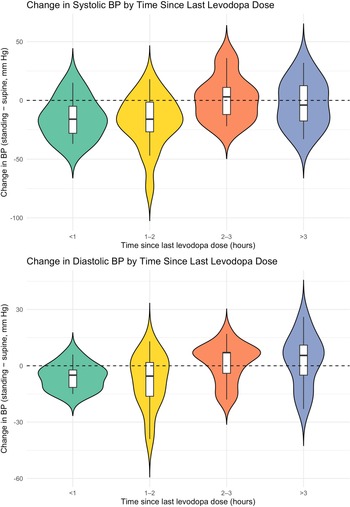
Changes in systolic and diastolic BP (3-minute standing minus supine) were evaluated using linear regression with time since last dopaminergic medication as a categorical variable (<1 hour, 1–2 hours, 2–3 hours, >3 hours). Models were adjusted for mean-centered age, sex and years since diagnosis. Adjusted marginal means for each dose-timing category were estimated, and pairwise comparisons were evaluated using Tukey-adjusted contrasts to control familywise error.
Additional models examined associations of OH phenotype with PDQ-39 Summary Index, Mobility and Activities of Daily Living (ADL) domains, adjusting for age and sex. Regression analyses included 53 participants after excluding four with missing dose-timing data. Analyses used R version 4.3 with α = 0.05. All regression models were multivariable, including time since last levodopa dose, age, sex and years since PD diagnosis as covariates.
Results
Participant characteristics are shown in Table 1. OH occurred in 29 of 57 patients (50.9%; 95% CI: 38.5% to 63.3%). Early OH was seen in 19 participants, delayed in 10 and persistent in 16; 12 participants met more than one subtype definition. Only 3 of 29 participants with OH (10%) reported symptoms during testing. There were no differences in 12-month fall or faint events between participants with and without OH.
Clinical and demographic characteristics by OH status

OH = orthostatic hypotension; PD = Parkinson disease; LEDD = levodopa-equivalent daily dose; MDS-UPDRS III = Unified Parkinson Disease Rating Scale part III; SCOPA-AUT = SCale for Outcomes in PArkinson’s disease–Autonomic Dysfunction; SCOPA-CV = SCOPA cardiovascular item subscore; OHQ = Orthostatic Hypotension Questionnaire; OHSA = Orthostatic Hypotension Symptom Assessment.
Values expressed as †mean (SD) or ‡median [min, max].
Receiver operating characteristic analysis is illustrated in Figure 1. The OHDAS subscore had the strongest discriminative value for OH at any time point (Area Under the Curve (AUC) 0.78; sensitivity 81%; specificity 80%). The OHQ total score performed well (AUC 0.74; sensitivity 81%; specificity 73%), followed by the OHSA subscore (AUC 0.68; sensitivity 86%; specificity 57%). In contrast, the SCOPA-AUT total score and its cardiovascular subscore showed limited discrimination (AUC 0.60 and 0.59), and symptom reporting performed poorly (AUC 0.48).
Discriminative value of risk stratification approaches for orthostatic hypotension. Receiver operating characteristic curves for self-reported symptom awareness and questionnaire measures of orthostatic hypotension, including Orthostatic Hypotension Daily Activity Scale (OHDAS) and Orthostatic Hypotension Symptom Assessment (OHSA) scores and the Orthostatic Hypotension Questionnaire (OHQ) total score. OHDAS showed the highest discrimination (AUC 0.78), followed by the OHQ composite (AUC 0.74) and OHSA (AUC 0.68). Symptom awareness performed poorly (AUC 0.48). The diagonal line represents chance performance.

The effect of dopaminergic medication timing on orthostatic BP responses is shown in Figure 2 and Table 2. Systolic BP adjusted mean dropped significantly within 1 hour (−17.4 mmHg; 95% CI −30.4 to −4.4) and 1–2 hours (−17.2 mmHg; −26.8 to −7.6) after a dopaminergic dose. Systolic BP was significantly higher at 2–3 hours post-dose compared to <1 hour (β = +18.99 mmHg; 95% CI 3.92 to 37.40), based on post hoc Tukey-adjusted contrasts.
Change in blood pressure (BP) by time since last dopaminergic medication. Mean change in BP from supine to 3 minutes standing, stratified by time since last dopaminergic medication dose. Estimates are adjusted for age, sex and disease duration. Testing within <1 hour or 1–2 hours after dosing was associated with a greater drop in systolic and diastolic BP.

Adjusted differences in systolic and diastolic blood pressure (standing − supine) by time since last dopaminergic dose

Adjusted marginal means for dose-timing categories were estimated from the fitted linear models with Tukey-adjusted pairwise contrasts. Continuous covariates (age, years since diagnosis) and sex did not contribute to marginal means and are shown separately as model regression coefficients (β) with 95% confidence intervals and p-values.
Diastolic BP adjusted mean showed a significant decrease at 1–2 hours (−7.4 mmHg; −13.0 to −1.8). Post hoc comparisons showed no statistically significant differences in diastolic BP at later time points.
Regression models for quality-of-life outcomes (Supplemental Data) showed age was associated with higher disability on the PDQ-39 Summary Index and Mobility domain. A delayed OH phenotype was associated with worse Mobility scores (+18.9 points), and other phenotypes were not significantly related to PDQ-39 Summary Index, Mobility or ADL domain scores.
Discussion
In this Canadian PD sample, orthostatic hypotension was seen in 50.9% of patients (95% CI: 38.5% to 63.3%). Asymptomatic OH was common and associated with worsened mobility-related quality of life, consistent with prior studies. Reference Palma and Kaufmann8–Reference Wang, Zhang and Xu10
We collected patient-reported outcomes of OH burden and severity in a pragmatic manner prior to scheduled appointments, as an adjunct to measuring orthostatic vital signs. OHQ and SCOPA-AUT are not diagnostic tools, and their discriminative performance in our sample is insufficient to rule out clinically relevant OH. However, the OHQ, which can be completed independently in approximately 5–6 minutes, offers a feasible pre-appointment approach to identify people for whom OH assessment should be prioritized. Integrating structured outcomes in the electronic clinic record can support clinical workflow for these complex and time-pressured encounters.
In our sample, a delayed OH phenotype was independently associated with a clearly meaningful worsening of PDQ-39 mobility-related quality of life (+18.9 points). Reference Horváth, Aschermann and Ács19 This highlights the potential importance of detecting delayed OH for leisure, home and public aspects of mobility and function that are important to people with PD.
Dopaminergic medications including levodopa can precipitate hypotension in PD, but this vulnerability is not universal or well understood. Reference Cani, Guaraldi and Giannini20–Reference Sánchez-Ferro, Cubo and Mena-Segovia22 Our pragmatic in-clinic design allowed variations between medication dose and assessment times, and we saw greater vulnerability to orthostatic BP drops within 1–2 hours of dopaminergic medication. This should be viewed with some caution, as many factors were not controlled; most appointments were scheduled in the morning, which may bias the dose-timing effect seen in this sample. Dopaminergic medication effects on OH may vary throughout the day and may interact with volume status and the osmopressor response to water intake. Reference Oyewunmi, Lei and Laurin23 Exercise behaviors, time since the last meal and composition of food intake were not recorded. These limitations affect the interpretability and generalizability of our findings to other practice settings but reflect realities of how OH is assessed in practice. Longitudinal or ambulatory BP assessments can be paired with symptom diaries to provide a better understanding of this relationship in those affected. Reference Vallelonga, Romagnolo and Merola24,Reference Stuebner, Vichayanrat and Low25
Conclusion
OH was common in our single clinic sample of people with PD, and delayed OH was a contributor to mobility-related disability. Pre-appointment patient-reported outcome measures were predictive of OH in our sample, and this approach could cue clinicians for closer review. Vulnerability to OH in our sample was most pronounced soon after medication doses.
Supplementary material
The supplementary material for this article can be found at https://doi.org/10.1017/cjn.2026.10595.
Acknowledgments
The authors would like to thank Cheryl Martinson, RN, and Carmen Logan, RN, for assistance with orthostatic vital sign measurements and data capture.
Author contributions
DW, CW, PH, ED and CDM conceived, designed and revised the study protocol. DW, PH, ED and CDM collected the data. AS, PH, LP and DW performed the statistical analysis. DW drafted the manuscript. JW, AS, LP, ED, CDM, PH and CW contributed to the interpretation of the data, critically revised the manuscript and approved the final version for submission.
Funding statement
This project was supported by a Seed Grant from the University of British Columbia Southern Medical Program Centre for Chronic Disease Prevention and Management. Dr. Wile reports grant funding from Parkinson Society Canada and a speaker honorarium from Abbvie, Inc.
Competing interests
No competing interests are identified.




 Open access

