


Introduction
The lion Panthera leo is categorized as Vulnerable on the IUCN Red List (Bauer et al., Reference Bauer, Packer, Funston, Henschel and Nowell2016); further declines are projected across Africa, except in the southernmost countries (South Africa, Zimbabwe, Botswana and Namibia), and India (Bauer et al., Reference Bauer, Chapron, Nowell, Henschel, Funston and Hunter2015). The threats that drive these declines are believed to be understood, even though their relative importance is debated and may vary spatially and temporally (Dickman et al., Reference Dickman, Macdonald and Macdonald2011; Packer et al., Reference Packer, Loveridge, Canney, Caro, Garnett and Pfeifer2013; Lindsey et al., Reference Lindsey, Petracca, Funston, Bauer, Dickman and Everatt2017). Surprisingly, we found no complete formal analysis of threats that included a description of causal relations (situation or problem tree analysis; IUCN, 2008), nor a formal ranking of threats. Tranquilli et al. (Reference Tranquilli, Abedi-Lartey, Abernethy, Amsini, Asamoah and Balangtaa2014) ranked threats for protected areas in Africa generally, but did not include threats to wildlife outside protected areas, such as so-called human–wildlife conflict. Lindsey et al. (Reference Lindsey, Petracca, Funston, Bauer, Dickman and Everatt2017) used expert ratings of threats on a five-point Likert scale to derive a ranking that provided a useful overview of the geographies in which specific threats emerge, but the data were not designed to facilitate a comparison of the intensity of each threat among sites. Here we build on existing work to analyse lion population trends and to describe and rank threats. We discuss the implications of our work for priority setting in lion conservation.
In 2005, the Wildlife Conservation Society and the IUCN held a workshop with various stakeholders and experts who listed and ranked threats by lion population (Table 1). The threats were loosely defined but here we provide a formal description for each threat. Environmental problems can often be traced back to multiple causes along causal chains; on those chains are human activities that constitute threats (Callicott et al., Reference Callicott, Crowder and Mumford1999; Salafsky et al., Reference Salafsky, Margoluis, Redford and Robinson2002). Problems are best defined as human activities; by influencing these activities threats become greater or lesser. Human–lion conflict, prey depletion and habitat conversion have been cited as major threats to lions (e.g. Bauer et al., Reference Bauer, Packer, Funston, Henschel and Nowell2016), which is useful in a colloquial sense, but analytically these threats are effects of multiple human activities. For a logical framework of solutions to problems in lion conservation, we need an analytical framework identifying pathways from human activities to their effects on lion distribution and abundance. Here, we use problem tree and root cause analysis to provide such a framework.
Threats to the lion Panthera leo identified by experts at a workshop organized by the Wildlife Conservation Society and the IUCN in 2005. These threats form the basis of a problem tree analysis (see text for details) that captures most of the terms used in the literature on lion conservation. We have not listed disease as a specific threat as it is part of natural ecological processes and only becomes problematic in populations that are affected by other threats, including increased exposure to pathogens from domestic animals; some experts listed disease and small population size as threats and therefore they appear in our ranking of threats.

Although we focus on lions, much of our analysis is relevant to other large carnivores but we lack similar data for such analyses. As the lion is an apex predator and its status is closely related to the status of its habitat and prey, the root cause analysis is informative for African ecosystems more generally.
Methods
The 2005 Wildlife Conservation Society and IUCN workshop brought together various stakeholders and > 50 lion experts to use an adapted version of the range-wide priority setting methodology that had previously been used for the jaguar Panthera onca and tiger Panthera tigris (Sanderson et al., Reference Sanderson, Redford, Chetkiewicz, Medellin, Rabinowitz, Robinson and Taber2002). Experts were asked to describe all significant Lion Conservation Units (here we use the term population) (IUCN, 2006a,b). Thirteen years later, in 2018, the IUCN compiled a status update through online consultation of the same experts and new published and unpublished sources; the 2018 dataset was more comprehensive but still included the populations assessed in 2005 (Bauer et al., Reference Bauer, Page-Nicholson, Hinks and Dickman2018b). The 2018 assessment included c. 600 lions in India and c. 600 lions in small fenced South African reserves, but threats in these areas are different and therefore outside our scope. In Supplementary Table 1 we provide the 2005 and 2018 data but we refer to the original documents (IUCN, 2006a,b; Bauer et al., Reference Bauer, Page-Nicholson, Hinks and Dickman2018b) for further information on methodology and information sources.
In the 2005 workshop, threats were listed and ranked per population. Experts chose from a list of threats or nominated a new threat under ‘other’. Among the threats was the ambiguous category ‘lion killing’; the discussions at the time clearly situated it in the context of so-called human–lion conflict and that is how we report it here. We made some semantic adjustments that reflect our approach of labelling a threat by the human activity at the root, rather than by the consequences along the causal chain: ‘declining prey base’ was translated as bushmeat poaching, ‘habitat conversion’ as cropland expansion, ‘livestock encroachment’ as livestock expansion. Small population size and disease were both ranked highly by several experts; these now refer to the small population vortex but they are listed and ranked among the threats. The threats identified per population are also given in Supplementary Table 1, in the order in which they were ranked.
We used these data for three lines of investigation: (1) ranking of threats based on expert knowledge in 2005, (2) framing those threats using problem tree and root cause analysis, and (3) an analysis linking threats to population trends up to 2018.
Threat ranking
Experts ranked all relevant threats; the highest number of threats listed for any population was eight. Overall ranking of threats across all populations was then ranked by assigning 8 points to a threat every time it was scored first, 7 points for every time it was scored second, and so on, and then ranking the sums per threat. We present the score per threat as a per cent of the total number of points.
Threat analysis
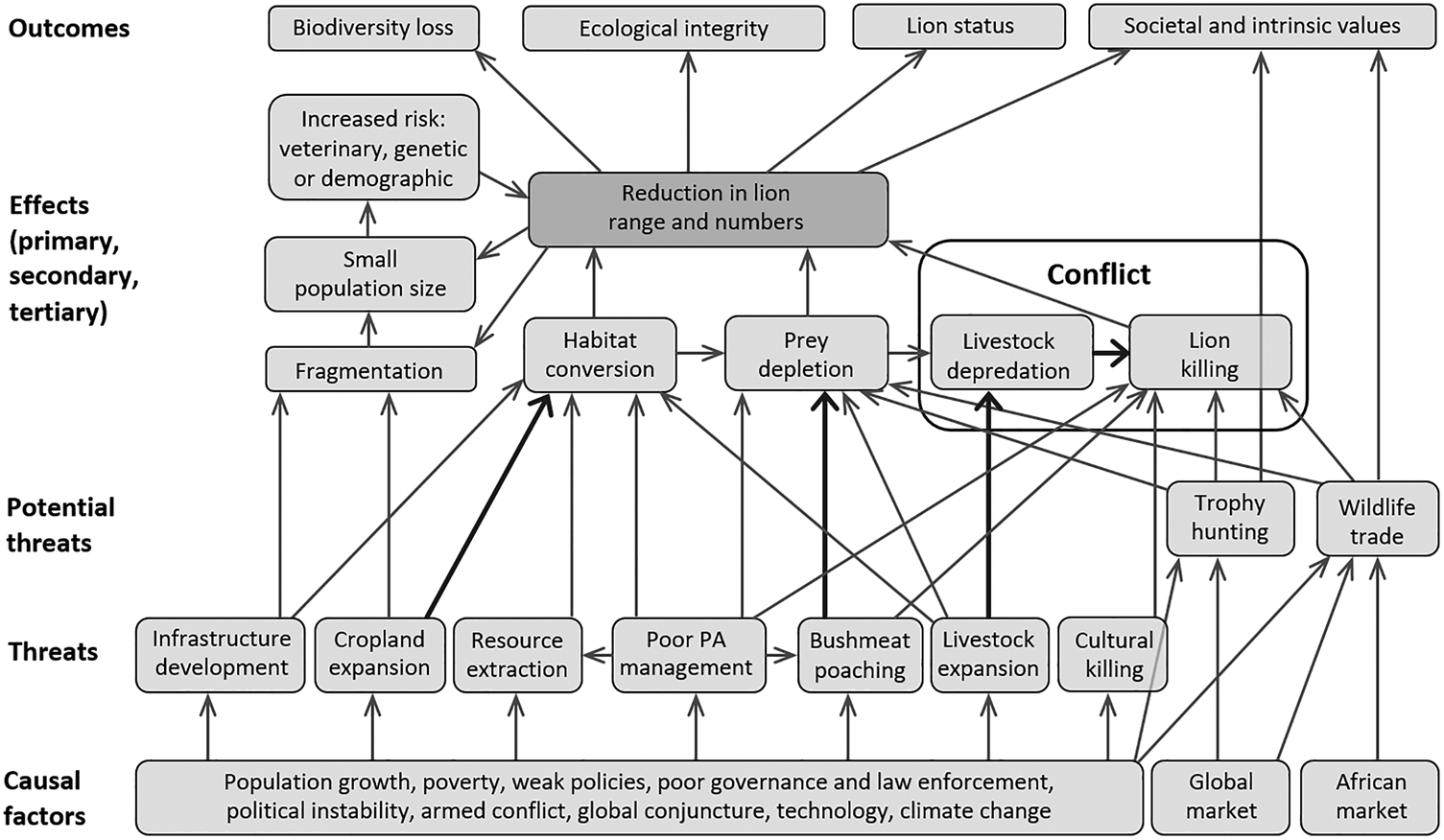
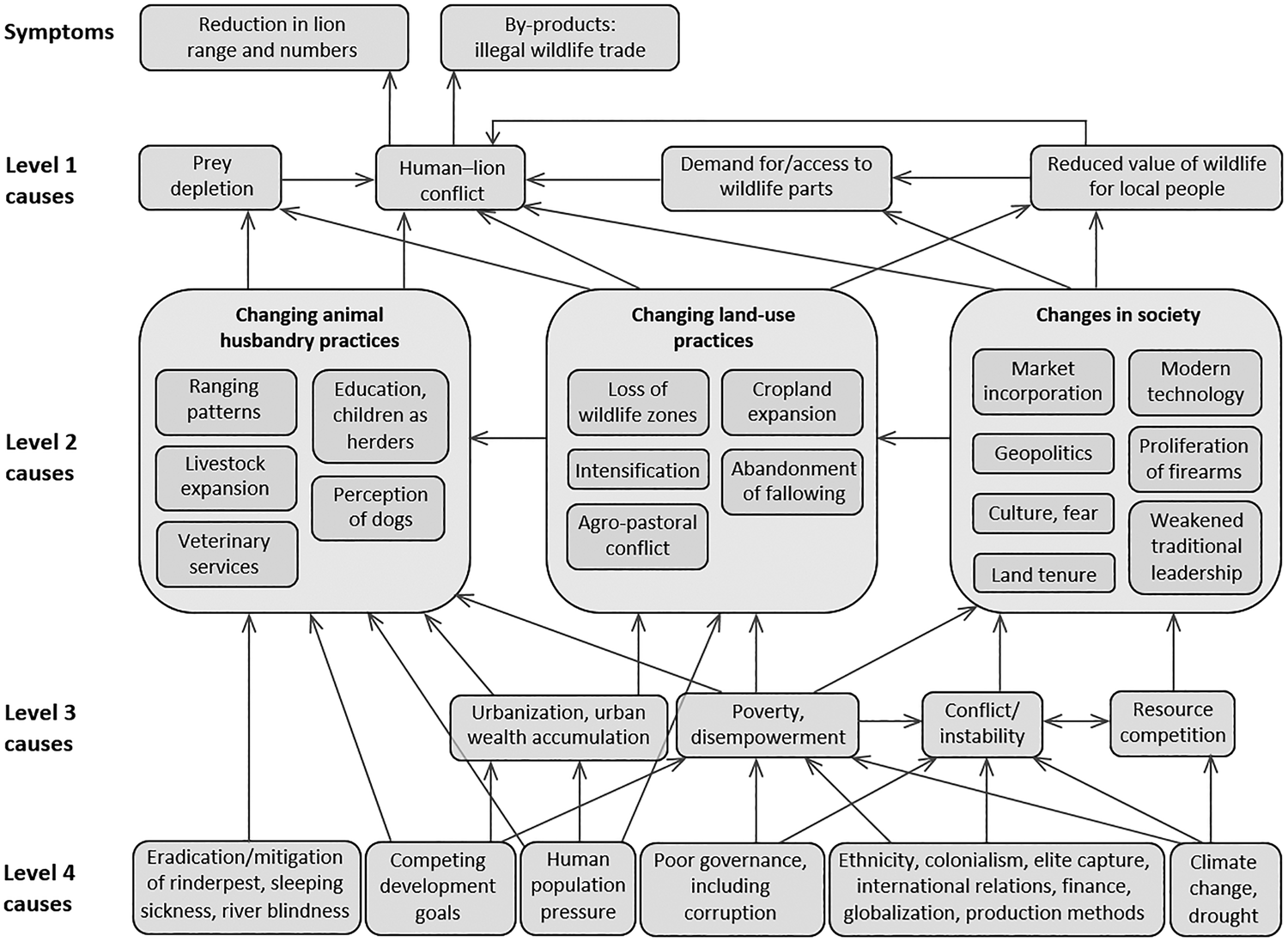
We constructed a problem tree, with root causes at the base as the drivers of threats; these root causes are not exhaustively listed and described here but some appear in the text below. Above the root causes are the threats described in Table 1 (nine of them appear as threats, see below for ‘conflict’ and ‘small populations’), with interactions indicated by arrows. These threats lead to various effects, often in synergistic ways, whereby primary effects lead to secondary or tertiary effects, also indicated by arrows. These effects lead to a normative problem: the decline in lion range and numbers. Human–lion conflict did not fit into the problem tree in the same way as other threats, and therefore we performed a root cause analysis (Wilson, Reference Wilson1993) for this. Small population size is shown as a vicious circle of negative reinforcement, as explained in Table 1.
Threat impact
To assess the impact of threats on population trends, we used the 2005 and 2018 data to follow the fate of individual populations for which threats were listed. This was done to determine whether different threats had led to different population declines and whether some threats were particularly important over this period. However, the data ranked threats relative to each other within a population and not on a scale comparable among populations. For example, in one population illegal killing could be ranked the third most important threat, but still be of higher intensity than in another population where it was ranked the most important threat. We could not therefore use threats as independent variables to predict population trend. Instead, we used a linear model (analysis of variance) to determine whether population decline could be explained by the presence of threats. We also looked at these trends qualitatively to highlight apparent patterns. For one apparent pattern, we generated a list of countries that experienced armed conflict between 2005 and 2018, using Pettersson et al. (Reference Pettersson, Högbladh and Öberg2019).
Results
In 2005, 78 lion populations assessed contained an estimated total of 33,292 lions and all were used for threat ranking. The 2018 assessment was more comprehensive and included 25,580 lions in 99 populations, and the 78 populations assessed in 2005 contained 24,480 lions. The 2018 assessment retained 2005 data for eight populations where no new information was available and these were excluded from the analysis so that matching data pairs were available for 71 populations comprising 32,237 lions in 2005 and 21,906 lions in 2018 (Supplementary Table 1).
Threat ranking
Seven threats were ranked, and there was a category of other threats comprising those mentioned only a few times: problem animal control, bush fire, lake fluctuation and armed conflict (Supplementary Table 1). Figure 1 shows the threat ranking across populations; human–lion conflict and prey depletion emerge as the two threats that, almost equally, affect most populations and most lions.
Ranking of threats to lion Panthera leo populations, attributed by experts in the Wildlife Conservation Society/IUCN workshop in 2005. The score for each threat is presented as a per cent of the total number of ranking points (see text for details).

Threat analysis
Figure 2 presents the problem tree, Fig. 3 the root cause analysis. Both figures are generic in that they are constructed from labels used by experts across Africa, using labels most commonly occurring in the literature. They are neither exhaustive nor tailored to specific sites, and different factors may be identified for particular sites or research interests.
Problem tree model of threats (Table 1) to African lions; note that nine threats are listed horizontally above the bottom row, and small population size and human–lion conflict appear higher up (see text for explanation). Arrows represent causal links (with single arrowheads to stress the flow, although many links are in fact bidirectional; particularly important links are displayed with heavy lines and arrows, for emphasis). PA, protected area.
Root cause analysis of human–lion conflict.
Threat impact
The linear model showed no significant relation between population trends and threats. Nevertheless, we observed an apparent pattern: the 20 populations extirpated, excluding two outliers with high but uncertain estimates (northern Guinea, Luzaches in Angola), were small populations with a mean of 28 lions, and 14 of these extirpations occurred in countries with armed conflict (Supplementary Table 1).
Discussion
Expert panel data can potentially be misleading, and we urge caution in the interpretation of subsets of the data presented here, especially with respect to the numbers of lions. However, despite the fact that the 2005 data are from an interactive workshop and the 2018 data from online consultations, there were comparable data pairs giving changes over time that suffer less from bias than absolute numbers. The 2005 data identified human–lion conflict and bushmeat poaching as the main threats, but we failed to identify differential impact of threats on population declines. Our analysis reveals a multitude of threats stemming from a complex web of drivers; this may explain why we did not find a significant relation between population trajectories and individual threats. We infer that the prevalence of threats is more important than the nature of those threats in driving population declines. By extension, our ranking analysis provides empirical evidence for the contention that human–lion conflict and prey depletion are the most serious threats to lions, and our problem analyses deconstruct these terms to show the underlying causes.
Because of the complexity of human–lion conflict, and to show how multiple threats occur concurrently and interact, we illustrate the use of our root cause analysis (Fig. 3) with a recent example from northern Kenya. The Laikipia–Samburu region is home to several pastoralist and crop-farming ethnic groups, commercial ranchers and private conservancies. Lions occur throughout the landscape; they thrive best on those commercial ranches and private conservancies with good livestock husbandry and abundant wild prey, leading to low livestock depredation. Long-term viability probably depends on this source population, as other land-use types are primarily sinks for lions (Oriol-Cotterill et al., Reference Oriol-Cotterill, Valeix, Frank, Riginos and Macdonald2015). Long-standing tensions between ethnic groups (Level 4 in Fig. 3) lead to regular periods of instability in the region (Level 3) compounded by a proliferation of firearms (Level 2). Human population growth (Level 4) and dependence of pastoralists on livestock directly result in increased livestock numbers, as does accumulated wealth amongst the pastoralist elite, such that large prestige herds of livestock are owned by a few individuals (livestock expansion, Level 2). Livestock expansion puts pressure on resources and aggravates poverty amongst pastoralists (Level 3), because land tenure is communal (Level 2). Traditional boundaries between grazing lands are regularly disputed, and individual ownership of land is often not recognized by pastoralists, exacerbating instability. A drought in 2017 (climate change, Level 4) forced many traditional pastoralists to move their livestock (ranging patterns, Level 2). During the general election in the same year there was rhetoric from politically motivated individuals encouraging people to appropriate commercial ranch land, private conservancies and protected areas. The widespread use of mobile phones and social media (modern technology, Level 2) facilitated this political incitement and the coordinated movement of large numbers of warriors and their livestock, bypassing traditional decision-making processes (weakening traditional leadership, Level 2). The resultant mass movement of livestock and people caused the effective loss of some wildlife areas (Level 1) and the increase in availability of weak and poorly guarded livestock induced large carnivores to switch from wild prey to livestock, further compounded by drought-induced prey declines (Level 1), disease transmitted from domestic livestock and dogs, and hunting by armed livestock herders.
Kenya is a relatively stable country, although human conflicts also played a role in these changes. Recent extirpations of lions have often occurred in areas with armed conflict; this factor was mentioned as one of many root causes but emerged in our analysis, especially for fragile populations (e.g. Comoé, Cote d'Ivoire: Henschel et al., Reference Henschel, Coad, Burton, Chataigner, Dunn and MacDonald2014) but also for larger populations (Angola: Funston et al., Reference Funston, Henschel, Petracca, Maclennan, Whitesell, Fabiano and Castro2017; Central African Republic: Bouché et al., Reference Bouché, Mange, Tankalet, Zowoya, Lejeune and Vermeulen2012). This underscores the impact of war on wildlife (Daskin & Pringle, Reference Daskin and Pringle2018), with chaos in society leading to increased levels of all threats, including anarchic livestock movements and killing of lion prey and lions facilitated by proliferation of firearms. In the context of lion conservation, war has hitherto received little attention, possibly because no work with a species focus is being done in war zones (Hickisch et al., Reference Hickisch, Hodgetts, Johnson, Sillero, Tockner and Macdonald2019). There has been debate regarding the effects of conflict on biodiversity, focusing on the myth of poachers as terrorists (Duffy, Reference Duffy2016) and the resultant militarization of conservation (Büscher & Fletcher, Reference Büscher and Fletcher2018). In our analysis, armed conflict is a higher level cause, and Fig. 3 and provides insight into possible pathways by which it specifically affects lions.
Several cases suggest a successional pattern of synergistic threats leading to decline and finally extirpation. An illustrative example is that of the lion population in Waza National Park, Cameroon, historically part of a major population in northern Cameroon and southern Chad. The demise of this lion population occurred in phases; although not limited to human–lion conflict we refer to cause levels of Fig. 3 where relevant. This landscape was fragmented in the 1970s and 1980s, with the eradication of rinderpest and sleeping sickness facilitating human settlement (Level 4). In the 1990s, there was intense conflict over livestock outside Waza National Park (Level 1; Bauer, Reference Bauer2003). In the 2000s, declines inside the Park were a result of decreased park management effectiveness (Level 2; Tumenta et al., Reference Tumenta, Kok, van Rijssel, Buij, Croes and Funston2010) along with falling prey densities (Scholte, Reference Scholte2014). In the 2010s, the Boko Haram group intensified the already existing armed conflicts in the region (Level 3), indirectly leading to almost complete degradation of the Park (Pennaz et al., Reference Pennaz, Ahmadou, Moritz and Scholte2018), with few lions remaining (P. Tumenta, pers. comm., 2017). The nature of the threats varies, but a succession of threats, first affecting the periphery and then the core of protected areas, is a pattern that led to major declines and extirpations. The height of this decline across West Africa may have been in the 1990s (Henschel et al., Reference Henschel, Coad, Burton, Chataigner, Dunn and MacDonald2014), in Central Africa a decade later (Bouché et al., Reference Bouché, Mange, Tankalet, Zowoya, Lejeune and Vermeulen2012; Brugiere et al., Reference Brugiere, Chardonnet and Scholte2015), and in East Africa in the 2010s, whereas southern Africa is less affected (Bauer et al., Reference Bauer, Chapron, Nowell, Henschel, Funston and Hunter2015). Little is known about the impact of climate change (Level 4), but this could exacerbate root causes and threats (Tuqa et al., Reference Tuqa, Funston, Musyoki, Ojwang, Gichuki and Bauer2014; Carter et al., Reference Carter, Bouley, Moore, Poulos, Bouyer and Pimm2018).
Our analyses can help lion conservationists define more clearly all the issues relevant to achieve management objectives before they address threats to local lion populations. They can implement tried and tested activities such as de-snaring, patrolling, building bomas or collaring but, whatever activity they consider most suitable under local circumstances, it is most likely to be effective if it is informed by a thorough understanding of the threats. The complexity and scale of problems in biodiversity conservation transcends the traditional skills of conservation biologists. Our findings demonstrate that the conservation of lions, as with the conservation of other species, requires a holistic approach involving the natural and social sciences, and higher level policy and international relations (Pooley et al., Reference Pooley, Barua, Beinart, Dickman, Holmes and Lorimer2017; Montgomery et al., Reference Montgomery, Elliott, Hayward, Gray, Millspaugh and Riley2018; Beck et al., Reference Beck, Lopez, Mudumba and Montgomery2019). What may seem a problem preoccupying biologists may actually be framed by matters such as war or poverty that biologists cannot presume to resolve alone. Lion conservationists must engage with organizations that are more qualified, experienced and resourced to address such matters, to increase their effectiveness. The first step is to frame the problems of and solutions to lion conservation in wider societal contexts.
Acknowledgements
The data used here came from IUCN (2006a,b) and Bauer et al. (Reference Bauer, Page-Nicholson, Hinks and Dickman2018b); we acknowledge the many contributors listed in these documents.
Author contributions
Problem tree and root cause analyses: HB, AD, AO-C; quantitative analysis; HB, SN, GC; writing: all authors.
Conflicts of interest
None.
Ethical standards
This research complied with the Oryx guidelines on ethical standards.


 Open access

