


I. Introduction
For centuries, preindustrial societies were dominated by two main types of assets: land or cattle. Both were thought of, respectively, as leading types of immovable and movable assets. Both produced cultures, myths, representations, and systems of political power based on them. There were “land-based” societies (such as feudal Europe) and “cattle-based” societies (such as many East African societies), depending on the type of farming that was locally dominant.
In this article, I provide causal evidence of a cultural heritage from agriculture. My main hypothesis is that individuals from societies traditionally dominated by crop agriculture—in which the main asset was land and immovable assets were thus relatively better considered—are still inclined to desire immovable assets relatively more, and are thus more likely to be homeowners. I confirm that this cultural heritage can explain an economically meaningful part of the persisting variation in home ownership rates across countries, regions, and individuals.
To justify this hypothesis, I start by providing ethnographic evidence that societies in which the dominant form of farming was based either on land or on cattle often produced a whole culture around these assets. I additionally show that people living primarily out of either cropland or cattle, respectively, developed more land-related and cattle-related motifs in their local folklore and mythologies. This cultural background can be seen as providing individuals with preferences and beliefs about the relative value or “safety” of immovable or movable assets. Theoretically, such cultural backgrounds can display high persistence from one generation to the next, even in the face of a changing environment (Bisin and Verdier (Reference Bisin and Verdier2000), (Reference Bisin and Verdier2001)).
Empirically, I start by showing that cross-country home ownership patterns in the OECD—the largest data set in which measurement is similar across countries—are consistent with my hypothesis. I measure the historical prevalence of crop agriculture with data on land use: for every country, I construct a continuous variable, called CropShare, which measures the relative importance of cropland and pasture areas on average over the period from 1800 to 2010. In the OECD sample, I find an economically large effect: a 1-standard-deviation increase in CropShare is associated with an increase in home ownership rate of about 6 percentage points, which amounts to one half of the cross-country standard deviation (equal to 0.120). To establish the robustness of this stylized fact, I repeat the same analysis in a sample of 253 European regions. In regressions with country fixed effects, I confirm that, after holding country-level institutions fixed, regions with a history of crop agriculture have significantly higher home ownership rates.
While consistent with my hypothesis, cross-country and cross-region regressions cannot be given a causal interpretation. The main concern is that countries or regions differ along many other dimensions, including institutions (Osili and Paulson (Reference Osili and Paulson2008)), experiences (Malmendier and Wellsjo (Reference Malmendier and Wellsjo2024)), or demographic and financial characteristics that are conducive to home ownership. To the extent these institutions, experiences, and characteristics could systematically correlate with a heritage of either land-based or cattle-based agriculture, they would be a concern for inference. A key identification challenge is to isolate a specific role of culture—and more specifically of a cultural heritage from agriculture.
To address these challenges, I use the so-called “epidemiological approach” pioneered by Fernandez and Fogli (Reference Fernandez and Fogli2009) (see Fernandez (Reference Fernandez, Benhabib, Jackson and Bisin2011), for a survey). The idea is to “fix” institutions and experiences—that is, to focus on within-country variation—and to study decisions by individuals with heterogeneous cultural backgrounds. Specifically, I study the home ownership decisions of second-generation immigrants in the United States, that is, individuals born in the United States but whose both parents are born abroad. As opposed to first-generation immigrants, who have been directly exposed to the institutions or to experiences in their country of origin, second-generation immigrants have only been indirectly exposed to countries of origin via cultural transmission. They grew up under similar institutions and faced identical macroeconomic experiences. I use data from the March Supplement of the Current Population Survey, which is currently the only data set in the United States in which respondents are asked about the country of birth of their parents.
Across a variety of specifications, I confirm that individuals whose parents migrated from countries historically dominated by crop agriculture—in which culture developed around immovable assets—are significantly more likely to be homeowners. This holds after including several fixed effects and controls for standard determinants of home ownership. In addition to demographic controls, I explicitly control for financial factors that may facilitate the purchase of a home: I control for the household’s income and for the average GDP per capita in the parents’ countries of origin.
While these results causally identify a persistent effect of the country of origin’s culture on home ownership decisions, it remains partially unclear whether this cultural effect is indeed an heritage from agriculture, or reflects some other cultural traits that could be correlated with the prevalence of crop agriculture across countries. Another remaining concern could be the partial endogeneity of CropShare, as countries with more advanced agricultural techniques may be able to grow crops in areas that other countries could only use as pasture. If the level of technological advance also affects the ability to become a homeowner, the inference could be biased.
I address these concerns in several ways. Most importantly, I instrument the prevalence of either cropland or pasture at the country level with biochemical properties of soil. On one hand, fertile soils are likely to be used to grow crops. On the other hand, according to the Food and Agriculture Organization (FAO), the main determinant of soil fertility is the amount of subsoil organic carbon. I thus use detailed raster data on global soils from the Harmonized World Soil Database to construct country-level measures of organic carbon, as instruments for CropShare (i.e., the prevalence of crop agriculture relative to cattle grazing). The instrumental variable (IV) regression results confirm my hypothesis: an economically meaningful part of the cross-individual variation in home ownership can be causally interpreted as a cultural heritage from agriculture.
I additionally show that my results are robust to controlling for a number of distinct cultural traits at a country level, such as the six dimensions of culture famously identified by Hofstede (see, e.g., Hofstede, Hofstede, and Minkov (Reference Hofstede, Hofstede and Minkov2010)). Finally, following up on the pioneering work by Huber and Schmidt (Reference Huber and Schmidt2022), I show that it is not high home ownership per se (in the country of origin) that explains the decision to own a home by second-generation immigrants, but only high home ownership related to soil conditions (and thus to agricultural heritage).
To summarize, my results show that households attach more value to housing if they grew up in a society that traditionally attached greater cultural, political, or even religious value to land and immovable assets, as opposed to cattle and movable assets. This finding contributes to explain the considerable cross-country variation in household portfolios, which has often puzzled economists (Badarinza, Campbell, and Ramadorai (Reference Badarinza, Campbell and Ramadorai2016)).
Related Literature
This article relates to two main strands of the literature. First, a large number of papers have demonstrated the impact of culture on economic outcomes (Guiso, Sapienza, and Zingales (Reference Guiso, Sapienza and Zingales2006), Algan and Cahuc (Reference Algan and Cahuc2010)). A common theme is that culture shapes individuals’ beliefs and preferences and can be extremely persistent, including over centuries (Voigtländer and Voth (Reference Voigtländer and Voth2012)) and when institutions change. For example, Alesina, Giuliano, and Nunn (Reference Alesina, Giuliano and Nunn2013) show that culturally transmitted gender norms persist after individuals with heterogeneous backgrounds migrate. Giuliano (Reference Giuliano2007) shows that culture determines living arrangements, notably the fraction of young adults living with their parents, while Fernandez and Fogli (Reference Fernandez and Fogli2009) shows that it affects women’s work and fertility behavior.
Second, there is a large literature in household finance that seeks to understand cross-country or cross-individual variation in portfolio allocations, including home ownership decisions. This literature is largely surveyed by Campbell (Reference Campbell2006), Badarinza et al. (Reference Badarinza, Campbell and Ramadorai2016), and Gomes, Haliassos, and Ramadorai (Reference Gomes, Haliassos and Ramadorai2021). The main cultural factor that has been related to household finance is trust or “social capital.” Guiso, Sapienza, and Zingales (Reference Guiso, Sapienza and Zingales2004) show that Italian households living in high-social-capital areas are more likely to use checks, invest less in cash and more in stocks. Relatedly, Guiso, Sapienza, and Zingales (Reference Guiso, Sapienza and Zingales2008) show that less trusting individuals are less likely to buy stocks, while El-Attar and Poschke (Reference El-Attar and Poschke2011) show that they are more likely to invest in housing. Other papers pointing to a role of culture on household finance include Haliassos, Jansson, and Karabulut (Reference Haliassos, Jansson and Karabulut2016) and Huber and Schmidt (Reference Huber and Schmidt2022). The latter paper also studies home ownership decisions of second-generation immigrants to show that culture plays a role. Relative to these papers, which either show an impact of culture in general (without reference to any specific cultural trait) or of trust, I provide evidence in favor of a novel deeply rooted cultural trait affecting households financial decisions. Also related is Gorback and Schubert (Reference Gorback and Schubert2024), who show that cultural differences in the desire to own a home give rise to significant differences in the transmission of credit shocks, and can explain a sizable part of cross-individual differences in personal wealth and tenure decisions over the lifecycle. Beyond culture, households’ financial and home ownership choices have been shown to depend notably on exposure to certain institutions (Osili and Paulson (Reference Osili and Paulson2008)), on experiences (Malmendier and Nagel (Reference Malmendier and Nagel2011), Malmendier and Wellsjo (Reference Malmendier and Wellsjo2024)), or on social interactions (Hong, Kubik, and Stein (Reference Hong, Kubik and Stein2004)).
II. Historical Background and Main Hypothesis
I start by providing a brief historical background on the cultural legacy of agriculture. Understanding cultural views about the respective valuation and safety of movable and immovable assets across societies helps justifying my main hypothesis on home ownership.
A. The Cultural Legacy of Agriculture
Representations according to which there fundamentally exists two types of assets—immovables and movables—are at least several millennia old. For example, Benveniste (Reference Benveniste2016) shows that, instead of a simple term that would designate total “wealth,” Greeks from the Homeric period (1200 to 800 BC) were using distinct terms for movable and immovable wealth.
There are strong reasons to think that the first concepts of immovable and movable assets were given substantive meaning based on prevailing farming practices. In particular, the association between movable assets and cattle can be seen in many examples. Benveniste ((Reference Benveniste2016), Book I, Chap. 3) shows that the Greek terms designating “sheep” and “movable wealth” are derived from the same root. Similarly, a number of terms related to movable wealth across European languages are derived from the Latin “pecus”—such as “pecuniary” in English—which means “cattle.” In common law countries, movable assets are legally called “chattel,” a term which derives from the same root as “cattle.” Similarly, the term “capital,” which was historically used to designate financial wealth, as opposed to real estate, derives from the Latin “capitālis,” which meant “head of cattle.”
While the linguistics confirms a close association between early concepts of assets and farming practices, the relation goes much beyond. It is often an entire culture that built around either land or cattle. Both of them have been associated with divinities, myths, legal representations, and systems of power which often favored one type of wealth at the expense of others. The ethnographic and historical literature on them is enormous and cannot be surveyed here in its entirety. I will simply provide two examples.
European countries, from Ancient Greece, through the Roman era, and until the Middle Ages, have tended to be land-based societies: political power was associated with land holding in Greek cities, in Rome, as well as throughout the feudal society until the French Revolution, while movable wealth was often despised (Ellul (Reference Ellul2013)). Writing about the premodern society, Dumont ((Reference Dumont1977), p. 5) notes that “In the traditional type of society, immovable wealth (estates) is sharply distinguished from movable wealth (money, chattels) by the fact that rights in land are enmeshed in the social organization in such a manner that superior rights accompany power over men. Such rights or ‘wealth’, appearing essentially as a matter of relations between men, are intrinsically superior to movable wealth, which is disparaged, as is natural in such a system for a mere relation between men and things.” For example, a common saying in French medieval law is “res mobilis, res vilis” (“movable asset, vulgar asset”). Instead, throughout the feudal period, the same Latin term (“dominium”) designates power over land and the power over people, and is positively connoted.
The opposite hierarchy is found in other societies, in which cattle is the most valued asset. This is notably the case in East African societies. In his classical study on the Nuer, Evans-Pritchard (Reference Evans-Pritchard1940) called them a “cattle people.” In another famous study, Herskovits (Reference Herskovits1926) writes about the “cattle complex” in East Africa, that is, the mix of myths, representations, and political structures that are based on cattle. He cites evidence that “among the Nuer, wealth is judged entirely by the number of cattle and sheep a man possesses” (p. 257). In contrast, other tribes that practice agriculture are regarded with contempt. Galaty and Bonte (Reference Galaty and Bonte2020) further note that, in these societies, political power is derived from cattle, not from land: “in full-fledged pastoral aristocracies, cattle are distinctly associated with kingship.” They also note that the pastoral specialization of East African societies is very old, as it is already attested in the 3rd millennium BC.
These brief elements confirm that key assets in preindustrial societies were much more than assets. They were cultural objects surrounded with myths, representations, and power structures. The question I seek to answer is whether this cultural background still affects the way societies perceive immovable or movable assets, even after most institutions surrounding land and cattle have stopped to exist.
B. Hypothesis
My main hypothesis is based on the idea that societies in which land was the dominant asset—in which political power and representations were also based on land—have endowed individuals with a cultural background leading them to attach a relatively greater value to real estate.
Hypothesis 1. Individuals from cultures with a history of crop agriculture are more likely to be homeowners.
This hypothesis requires that culture has a persistent component, even in the face of changing infrastructures and economic environment. Evidence for this persistence has been demonstrated in a variety of contexts (Guiso et al. (Reference Guiso, Sapienza and Zingales2004), Voigtländer and Voth (Reference Voigtländer and Voth2012)). If persistence is large enough, preferences and beliefs about the relative value of immovable and movable assets, inherited from an agricultural past, could still shape financial decisions long after agriculture stopped being the main economic sector in many countries.
C. Measurement
The formulation of Hypothesis 1 has implications for measurement. First, as understood here, culture is slow-moving. Therefore, it is expected to explain primarily long-term average differences across groups of individuals with heterogeneous backgrounds, as opposed to short-run deviations from the average. To smooth away the effect of such short-term deviations, I work whenever possible with long-term averages for both the home ownership rate and for the variable measuring the prevalence of crop agriculture.
Second, Hypothesis 1 guides the construction of the main independent variable. To measure the relative predominance of farming based either on land or cattle—that is, on immovable or movable assets—I obtain data on global land use broken down, at the country level, between cropland and pasture. I then define the main independent variable, $ {CropShare}_c $
, as
$ {CropShare}_c $
, as
 $$ {CropShare}_c=\frac{\hskip0.1em \mathrm{Cropland}\;{\mathrm{area}}_c-{\mathrm{Pasture}\ \mathrm{area}}_c}{\hskip0.1em \mathrm{Cropland}\;{\mathrm{area}}_c+{\mathrm{Pasture}\ \mathrm{area}}_c}, $$
that is, a number between −1 (if a country $ c $
has only pasture) and 1 (if a country
$ c $
has only pasture) and 1 (if a country $ c $
has only cropland). To compute CropShare, I rely on data from Taylor and Rising (Reference Taylor and Rising2021), further discussed in Section A.4 of the Supplementary Material, which measure the relative share of cropland and pasture over the period from 1800 to 2010. Throughout the article, I work with the long-term average of CropShare, over the 1800–2010 period. This ensures that I capture a structural element of each country’s farming model.Footnote 1
$ c $
has only cropland). To compute CropShare, I rely on data from Taylor and Rising (Reference Taylor and Rising2021), further discussed in Section A.4 of the Supplementary Material, which measure the relative share of cropland and pasture over the period from 1800 to 2010. Throughout the article, I work with the long-term average of CropShare, over the 1800–2010 period. This ensures that I capture a structural element of each country’s farming model.Footnote 1
A potential concern with the measurement of CropShare could be that, while cropland areas are usually well delineated, pasture areas can be more open, without clear limits or well-defined property rights. I address this concern in several ways. First, by using total agricultural area (cropland $ + $
pasture) as denominator in equation (1), instead of a country’s total area, I avoid biasing the measurement for countries with large pieces of land used neither for cropland nor for pasture. Second, the data by Taylor and Rising (Reference Taylor and Rising2021) explicitly account for the fact that large pieces of land have no agricultural use (“natural land,” “protected land,” “tropical forest,” etc.). They define as pasture only pieces of land that are explicitly used for cattle grazing. Third, to get a sense of potential measurement errors, I compute, for each country, the share of its total area that is classified as either cropland or pasture in 2010 (i.e., the last year in the data by Taylor and Rising (Reference Taylor and Rising2021)). On average over 160 countries, this share is equal to 33.4%. Not surprisingly, countries that have low values of this ratio tend to be those with large areas of natural land in which the measurement of pasture may be more problematic, such as Sweden (1.7%), Canada (6.6%), Libya (8.2%), or Russia (10.8%). To make sure that my results are not driven by these observations, I later reproduce my main specifications after excluding countries for which this ratio is below or above specific percentiles.
$ + $
pasture) as denominator in equation (1), instead of a country’s total area, I avoid biasing the measurement for countries with large pieces of land used neither for cropland nor for pasture. Second, the data by Taylor and Rising (Reference Taylor and Rising2021) explicitly account for the fact that large pieces of land have no agricultural use (“natural land,” “protected land,” “tropical forest,” etc.). They define as pasture only pieces of land that are explicitly used for cattle grazing. Third, to get a sense of potential measurement errors, I compute, for each country, the share of its total area that is classified as either cropland or pasture in 2010 (i.e., the last year in the data by Taylor and Rising (Reference Taylor and Rising2021)). On average over 160 countries, this share is equal to 33.4%. Not surprisingly, countries that have low values of this ratio tend to be those with large areas of natural land in which the measurement of pasture may be more problematic, such as Sweden (1.7%), Canada (6.6%), Libya (8.2%), or Russia (10.8%). To make sure that my results are not driven by these observations, I later reproduce my main specifications after excluding countries for which this ratio is below or above specific percentiles.
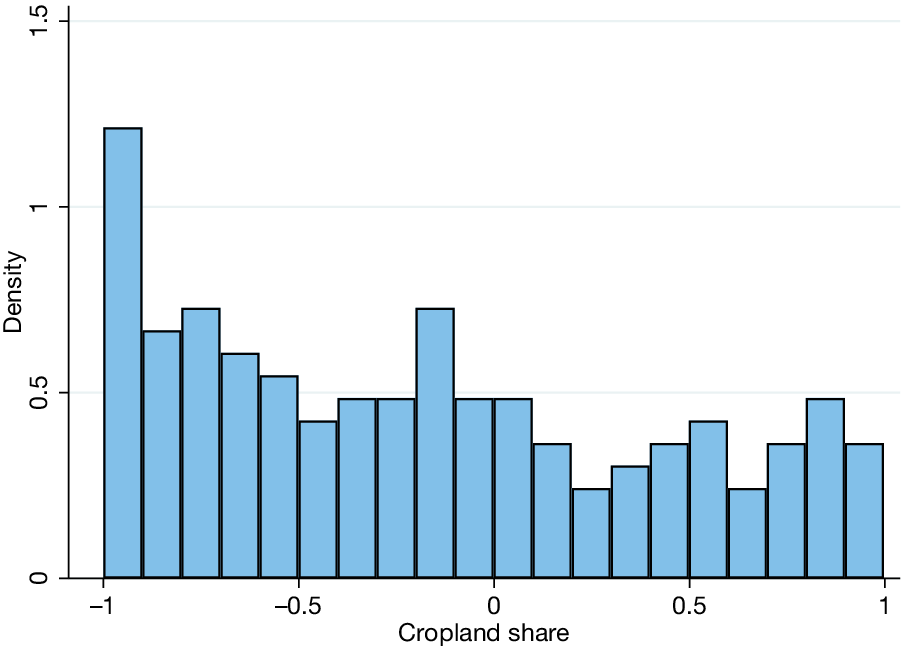
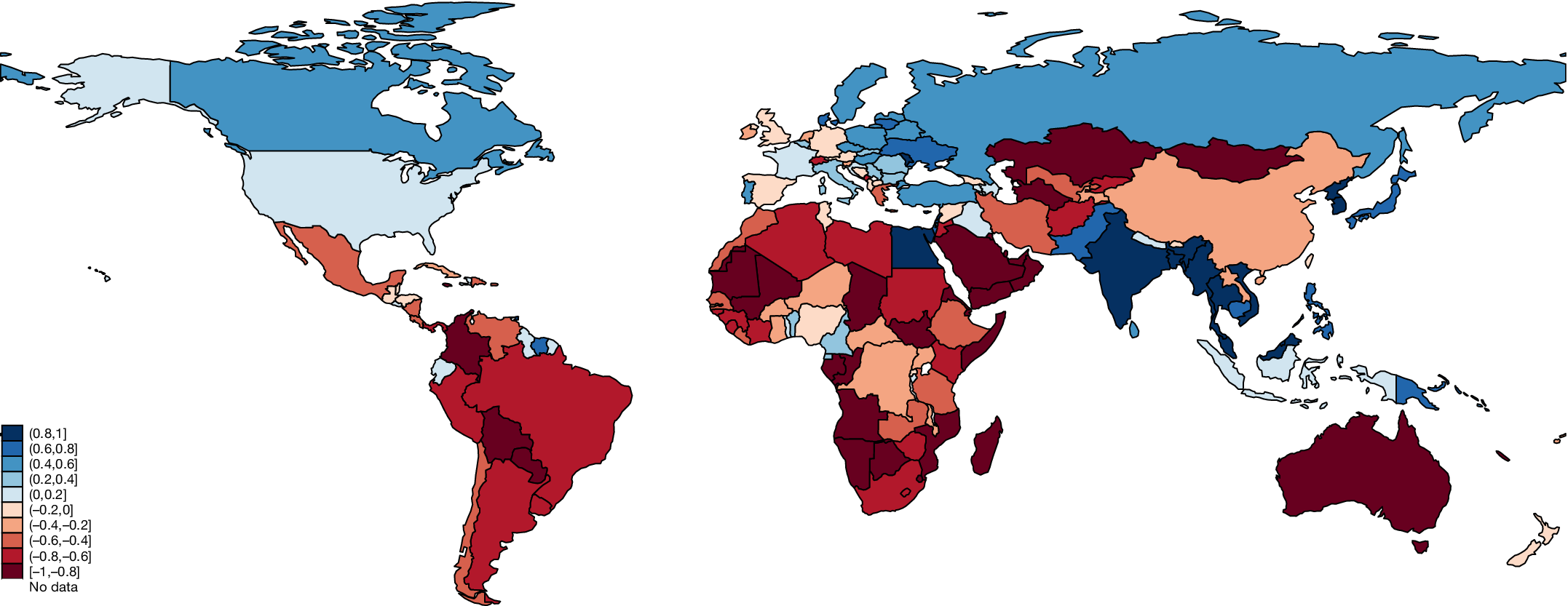
The cross-country distribution of the variable CropShare is plotted in Figure 1 and mapped in Figure 2. As can be seen, there is considerable cross-country heterogeneity, as CropShare spans the full range of values from close to −1 (countries such as Saudi Arabia or Mongolia) to close to 1 (countries such as India or Myanmar).
Figure 1 plots a histogram of the main independent variable CropShare, defined in equation (1), computed in the cross section of countries at the global level. Negative values correspond to countries dominated by pasture and positive values to countries dominated by cropland. Additional details on the data sources and on the construction of the variables are provided in Section A of the Supplementary Material.

Figure 2 maps data on cropland share, measured by the variable CropShare, at the country level. This variable is defined in equation (1). Values closer to −1 (respectively 1) correspond to countries in which pasture (respectively cropland) dominates in relative terms. Additional details on the data sources and on the construction of the variables are provided in Section A of the Supplementary Material.

D. Agricultural Heritage and Cultural Representations
For Hypothesis 1 to be confirmed, it must be the case that the prevailing type of farming, based either on land or cattle, translates into cultural representations. Beyond the linguistic and ethnographic evidence discussed in Section II.A, I can now explicitly test whether the variable CropShare is associated with differences in cultural representations related to land or cattle across countries.
To do so, I use data from Berezkin’s (Reference Berezkin2015) Folklore and Mythology Catalog, as compiled by Michalopoulos and Xue (Reference Michalopoulos and Xue2021). For a total of 958 societies in the world, this data set compiles data on the presence or absence of 2,564 folkloric motifs. In the local folklore, tales, or mythologies, a motif is “an episode or an image found in the set of narratives recorded in an ethnolinguistic community” (Michalopoulos and Xue ((Reference Michalopoulos and Xue2021), p. 1995)). The data by Michalopoulos and Xue (Reference Michalopoulos and Xue2021) map local folklore both to major concepts and to present-day countries. While their results show that images used in local folklore are related to the physical environment in which people live (e.g., there are more earthquake-related motifs in earthquake-prone regions), I use their data to specifically focus on motifs related to dominant types of assets in preindustrial societies—land and cattle—and to check whether these motifs are related to the prevailing form of agriculture.
I use Michalopoulos and Xue’s (Reference Michalopoulos and Xue2021) classification of land-related and cattle-related motifs, and measure their frequency at the country level, normalized by the total number of motifs. This variable is denoted $ {Freq}_c^m $
in country
$ {Freq}_c^m $
in country $ c $
for motives
$ c $
for motives $ m $
related to either land or cattle. To illustrate, an example of cattle-related motif (labeled k136) is “A lad becomes a master and a leader of great amount of cattle (cows or buffaloes) and meets a princess (usually after she finds his hair fallen into a river).” I then estimate the cross-country regression
$ m $
related to either land or cattle. To illustrate, an example of cattle-related motif (labeled k136) is “A lad becomes a master and a leader of great amount of cattle (cows or buffaloes) and meets a princess (usually after she finds his hair fallen into a river).” I then estimate the cross-country regression
 $$ {Freq}_c^m=\beta \cdot {CropShare}_c+{FE}_{cont}+{\unicode{x025B}}_c, $$
where $ {FE}_{cont} $
is a continent fixed effect.
$ {FE}_{cont} $
is a continent fixed effect.
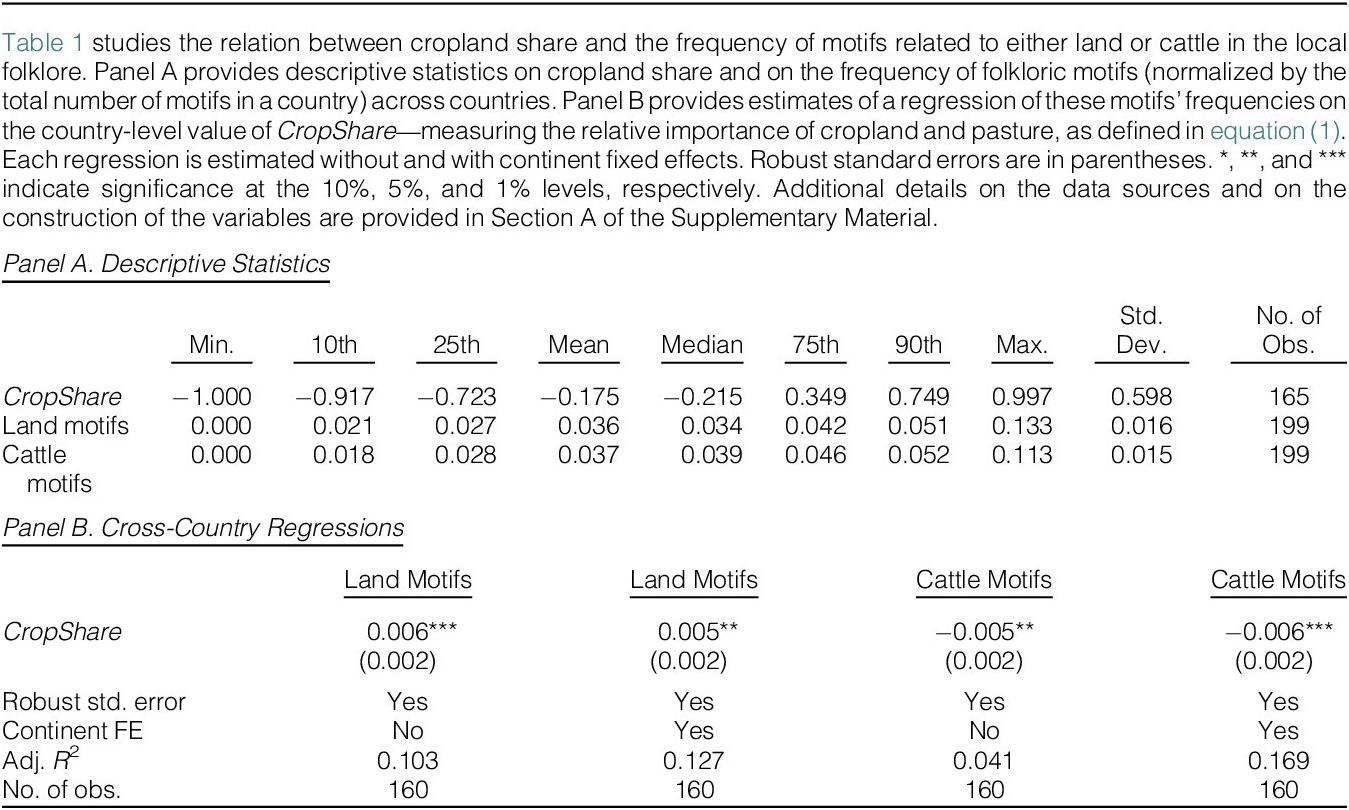
The results, in Panel B of Table 1, confirm that there is a significant association between the type of agriculture prevailing historically, as measured by CropShare, and cultural representations in the local folklore. In countries where crop agriculture is most prevalent, land-related motifs are more common (with an estimate of $ \beta >0 $
). Instead, in countries in which pasture grazing is dominant, cattle-related motifs are more frequent (with an estimate of
$ \beta >0 $
). Instead, in countries in which pasture grazing is dominant, cattle-related motifs are more frequent (with an estimate of $ \beta <0 $
). While descriptive, these results confirm the idea that farming practices shaped cultural views: land or cattle were more than productive assets. They became part of popular representations and systems of values, as reflected in local folklore and mythologies.
$ \beta <0 $
). While descriptive, these results confirm the idea that farming practices shaped cultural views: land or cattle were more than productive assets. They became part of popular representations and systems of values, as reflected in local folklore and mythologies.

III. Stylized Facts
I now test Hypothesis 1, that is, I explore whether a cultural heritage from agriculture can explain home ownership decisions. Before providing plausibly causal evidence, I assess whether stylized facts, across and within countries, are consistent with this hypothesis.
A. Cross-Country Evidence
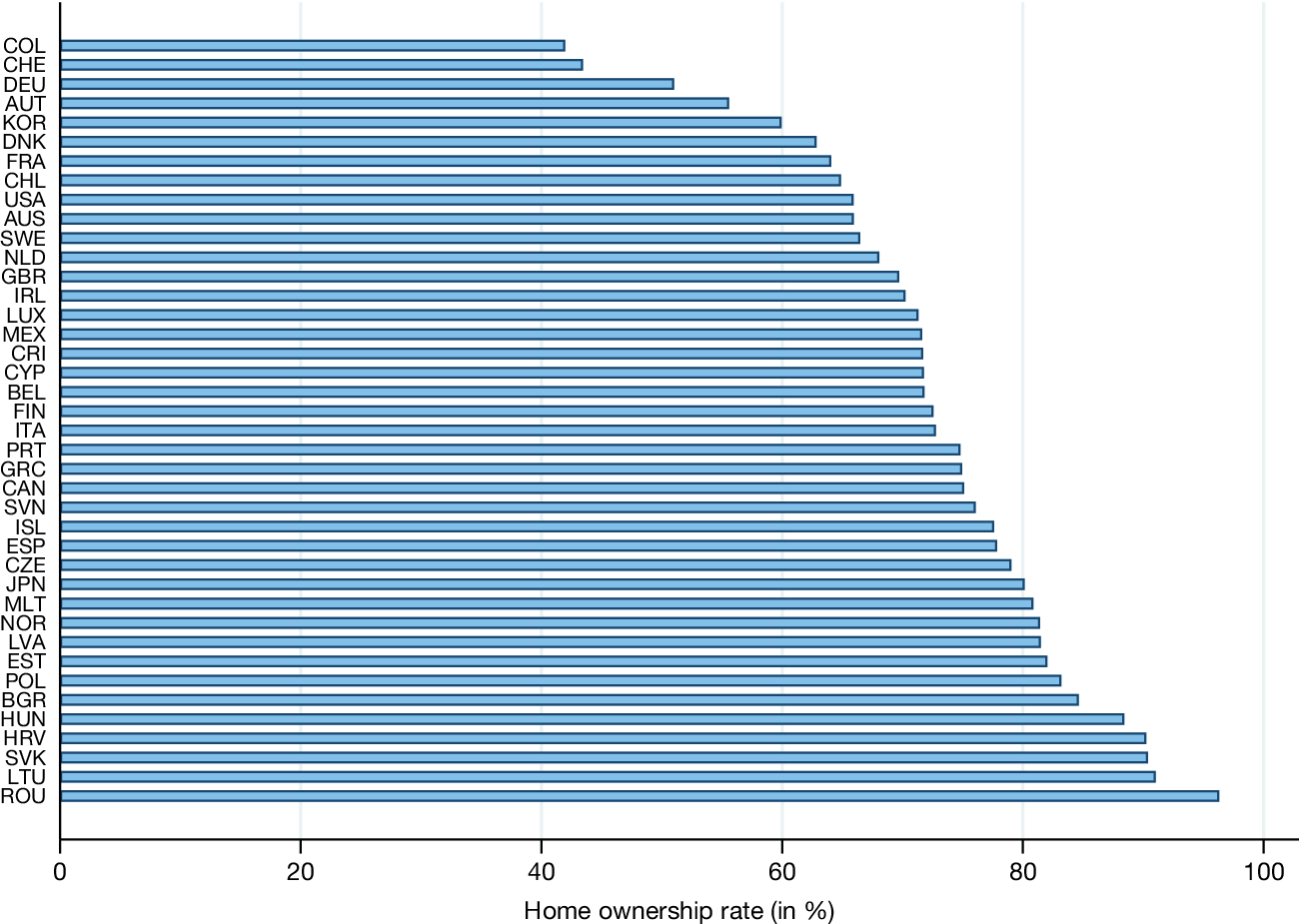
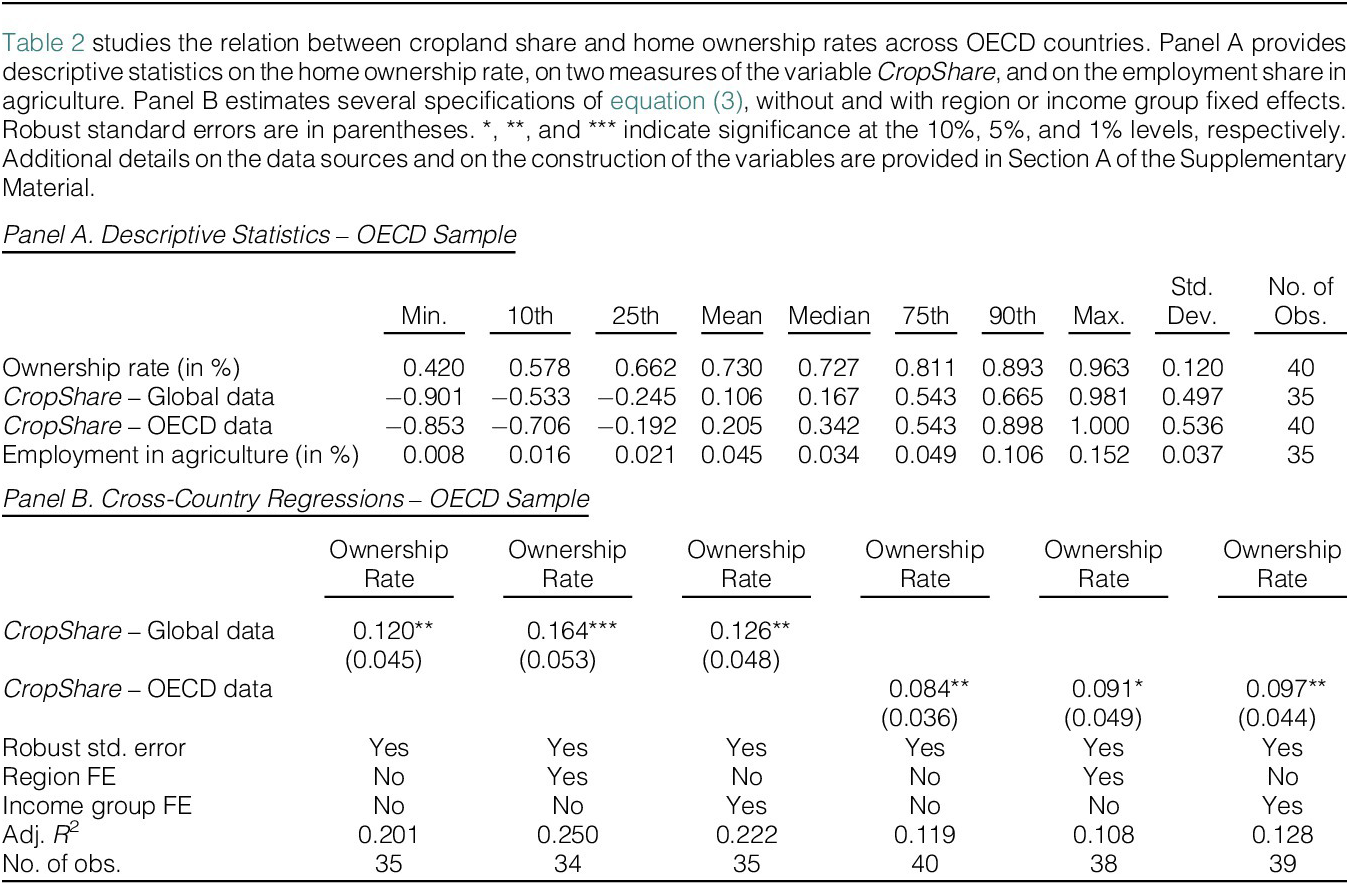
To study the relation between crop agriculture and home ownership in a cross section of countries, the main challenge is one of measurement: there is generally no unique method to compute home ownership rates across countries. To the best of my knowledge, the best data are those by the OECD, covering 41 countries, which have the benefit of homogeneous measurement across countries.Footnote 2 For each country, I compute home ownership as the sum of outright ownership and ownership with a mortgage, and focus on the average rate over the 2010–2020 period. As illustrated in Figure 3, there is considerable heterogeneity in the cross section: home ownership rates range from close to 40% (42.0% in Colombia or 43.4% in Switzerland) to above 90% (91.0% in Lithuania or 96.3% in Romania). As reported in Panel A of Table 2, there is also large heterogeneity in cropland shares across the subset of OECD countries, since the 10th and the 90th percentiles, respectively, equal −0.533 and 0.665 (for a variable ranging theoretically from −1 to 1).
Figure 3 plots the average home ownership rate for OECD countries over the period from 2010 to 2020. The data combine outright ownership and ownership with a mortgage. Additional details on the data sources and on the construction of the variables are provided in Section A of the Supplementary Material.


To test whether this cross-country heterogeneity is consistent with Hypothesis 1, I start by estimating
 $$ {OwnRate}_c=\alpha +\beta \cdot {CropShare}_c+{FE}_{reg}+{FE}_{inc}+{\unicode{x025B}}_c, $$
where $ {OwnRate}_c $
is the average home ownership rate in country
$ {OwnRate}_c $
is the average home ownership rate in country $ c $
and
$ c $
and $ {CropShare}_c $
is the measure of cropland share defined in equation (1).
$ {CropShare}_c $
is the measure of cropland share defined in equation (1). $ {FE}_{reg} $
and
$ {FE}_{reg} $
and $ {FE}_{inc} $
are, respectively, fixed effects at the regional level (as defined by the United Nations, that is, Americas, Asia, Europe, and Oceania) and at the income group level (i.e., high income or upper middle income).
$ {FE}_{inc} $
are, respectively, fixed effects at the regional level (as defined by the United Nations, that is, Americas, Asia, Europe, and Oceania) and at the income group level (i.e., high income or upper middle income).
The estimation results, together with robust standard errors, are reported in Panel B of Table 2. Columns 1–3 are estimated using the baseline measure of CropShare, that is, country-level data from Taylor and Rising (Reference Taylor and Rising2021). The coefficients show a positive association between cropland share and the home ownership rate. Across specifications without and with fixed effects, the estimate is statistically significant at the 5% or 1% levels. In terms of magnitude, it is also economically large: a 1-standard-deviation increase in CropShare is associated with an increase in home ownership rate of about 6 percentage points, which amounts to one half of the cross-country standard deviation (equal to 0.120). Therefore, countries in which crop agriculture has been the dominant form of farming over the past 200 years tend to have significantly higher home ownership rates today—even so agriculture is now a minor economic sector in most OECD countries.Footnote 3
In columns 4–6 of Table 2, I reproduce the same regressions, with an alternative measure of CropShare, computed from OECD data on land use (see Section A.2 of the Supplementary Material for details). These data have the additional benefit of covering a few extra European countries not included in the global data set from Taylor and Rising (Reference Taylor and Rising2021).Footnote 4 Once re-estimated, the results remain statistically significant, albeit at lower levels (10% or 5%) and with a slightly lower economic magnitude: a 1-standard-deviation increase in CropShare is associated with an increase in home ownership rate of about 4.5 percentage points, which amounts to one third of the cross-country standard deviation.
B. Cross-Region Evidence
While informative about broad patterns, cross-country regressions raise a number of concerns. One of them is related to measurement. Country averages for the variable CropShare may hide significant within-country variation in the relative importance of cropland and pasture. A second concern is that, across countries, many institutional factors beyond the agricultural heritage could drive differences in home ownership (e.g., land regulation, ownership regimes, mortgage design).
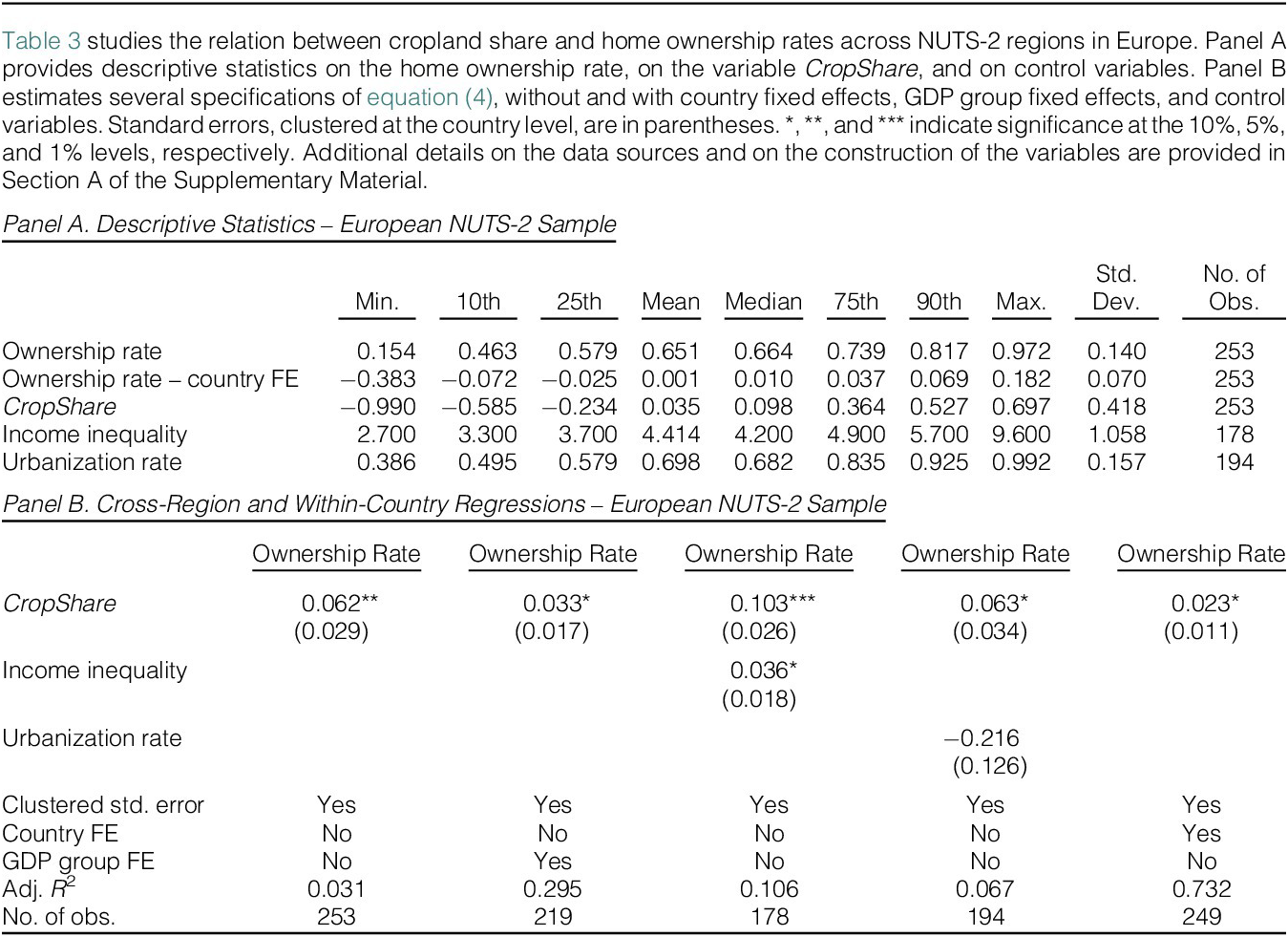
A first method to address these two concerns is to restrict the focus to variation across regions but within the same country. The European Union (EU) provides an interesting setup to establish cross-region stylized facts: it is partitioned into administrative units, called NUTS (Nomenclature of Territorial Units for Statistics), which have roughly the same size throughout the EU, and for which it is possible to obtain both homogeneous home ownership rates and data on land use. I work at the level of NUTS-2 regions, that is, 253 statistical units between 0.8 and 3 million inhabitants. Variation in CropShare across NUTS-2 regions is large, ranging from a value of −0.648 at the 10th percentile to 0.533 at the 90th percentile (see Panel A of Table 3).

Using these data, I estimate
 $$ {OwnRate}_{reg}=\alpha +\beta \cdot {CropShare}_{reg}+\gamma \cdot {Controls}_{reg}+{FE}_c+{FE}_{gdp}+{\unicode{x025B}}_{reg}, $$
where $ {OwnRate}_{reg} $
and
$ {OwnRate}_{reg} $
and $ {CropShare}_{reg} $
are, respectively, the home ownership rate and the cropland share at the NUTS-2 region level,
$ {CropShare}_{reg} $
are, respectively, the home ownership rate and the cropland share at the NUTS-2 region level, $ {FE}_c $
is a country fixed effect, and
$ {FE}_c $
is a country fixed effect, and $ {FE}_{gdp} $
a fixed effect for groups of regions based on their GDP per capita. In some regressions, I control for income inequality or the urbanization rate, in order to rule out alternative explanations (see Section IV.D). I cluster standard errors at the country level.
$ {FE}_{gdp} $
a fixed effect for groups of regions based on their GDP per capita. In some regressions, I control for income inequality or the urbanization rate, in order to rule out alternative explanations (see Section IV.D). I cluster standard errors at the country level.
The estimation results are in Panel B of Table 3. Across specifications without or with fixed effects and controls, I confirm that a greater historical prevalence of land-based agriculture is associated with higher home ownership rates today (with statistical significance ranging from a 1% to a 10% level). The magnitude of the within-country effect (column 6) is smaller than in cross-country regressions, but remains economically meaningful: a 1-standard-deviation increase in CropShare is associated with an increase in home ownership rate corresponding to about 14% of its cross-region standard deviation (equal to 0.070).
These cross-region results confirm the cross-country stylized facts. But, while they are consistent with Hypothesis 1, they are still far from providing causal evidence that a history of crop agriculture led to a culture valuing real estate relatively more than other assets. First, while within-country regressions hold country-level institutions fixed, it could still be the case that there exists variation in local institutions that are more or less conducive to home ownership. To the extent these local institutions may correlate with the prevailing type of agriculture, no causal interpretation of the earlier results is possible. Second, there could be alternative explanations for the documented fact. For example, if it is the case that people historically practicing crop-based or cattle-based agriculture systematically faced distinct experiences in terms of inflation, housing returns, war destruction, etc., these experiences could also lead them to desire home ownership relatively more or less (Happel, Karabulut, Schäfer, and Tuzel (Reference Happel, Karabulut, Schäfer and Tuzel2024), Malmendier and Wellsjo (Reference Malmendier and Wellsjo2024)).
IV. Identification Using Second-Generation Immigrants
To address these concerns, I turn to the first main element of my identification strategy. Studying the home ownership decisions of second-generation immigrants with heterogeneous cultural backgrounds allows me to isolate the role of culture from that of other confounding factors, notably institutions and experiences.
A. Identification Strategy
To identify the role of culture, as opposed to institutions and experiences, my strategy is to fix institutions and experiences and to study variation in financial decisions across individuals with heterogeneous cultural backgrounds. As in Fernandez and Fogli (Reference Fernandez and Fogli2009), I rely on the fact that a cultural background is “portable,” while institutions remain attached to specific countries. Consequently, the financial decisions of immigrants can be particularly informative about the causal role of culture.
Focusing on the home ownership decisions of first-generation immigrants (i.e., individuals born abroad who are now living in a new country) would not alleviate all endogeneity concerns. Indeed, individuals born abroad have been exposed to other institutions, and this exposure itself may have lifetime consequences even after moving (Osili and Paulson (Reference Osili and Paulson2008)). To overcome this concern, as in Fernandez and Fogli (Reference Fernandez and Fogli2009) or Alesina et al. (Reference Alesina, Giuliano and Nunn2013), I focus on home ownership decisions of second-generation immigrants, that is, individuals born in a country, but whose parents were born abroad and moved to this country. Second-generation immigrants have never been directly exposed to the institutions of their parents’ country of origin; the only exposure they retain to this country is through the cultural background that may have been transmitted via parents. Similarly, they have had no personal macroeconomic experiences in their parents’ country of origin, but only in their new country.
Data sets in which one can observe both some household finance variables, including home ownership, the country of birth, and the country of birth of both parents, are rare. In the United States, the only data set with such information is the March Supplement of the U.S. Current Population Survey (also called Annual Social and Economic Supplements), publicly available from the U.S. Census. For my tests, I combine the three latest vintages of the data set, corresponding to years 2022, 2023, and 2024.Footnote 5
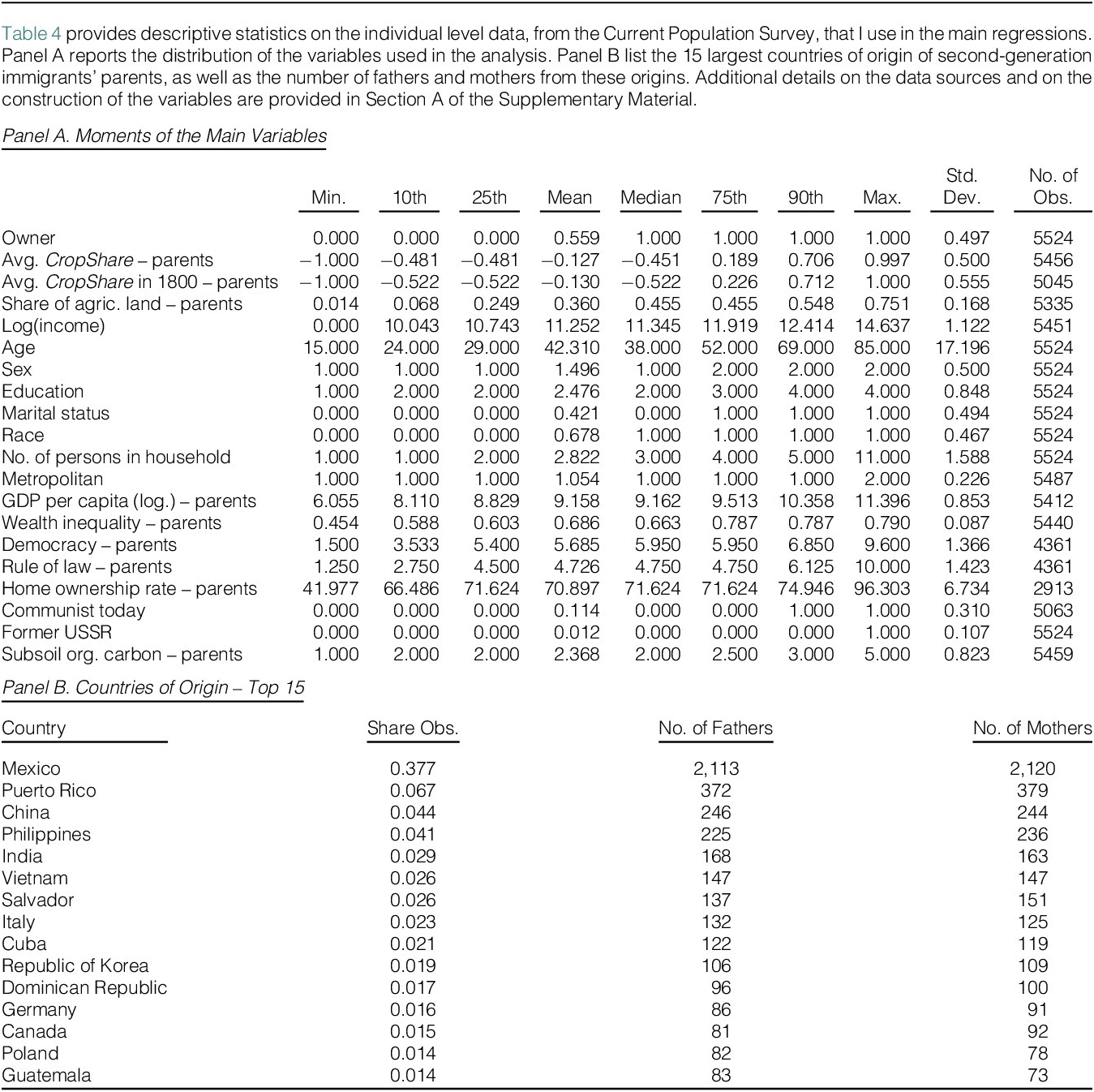
To get the tightest identification possible, I focus on second-generation immigrants whose both father and mother are born outside the United States. This leaves me with a sample of 5,524 individuals, whose parents are born in 145 countries. For each of them, I obtain a dummy variable equal to 1 if they are homeowners, as well as other demographic and financial variables that may affect home ownership. In Table 4, I provide descriptive statistics on these variables (Panel A) and list the 15 most represented countries of origin (Panel B).Footnote 6 I am then able to match the variable CropShare for 94 countries of origin, representing 5,456 persons.Footnote 7

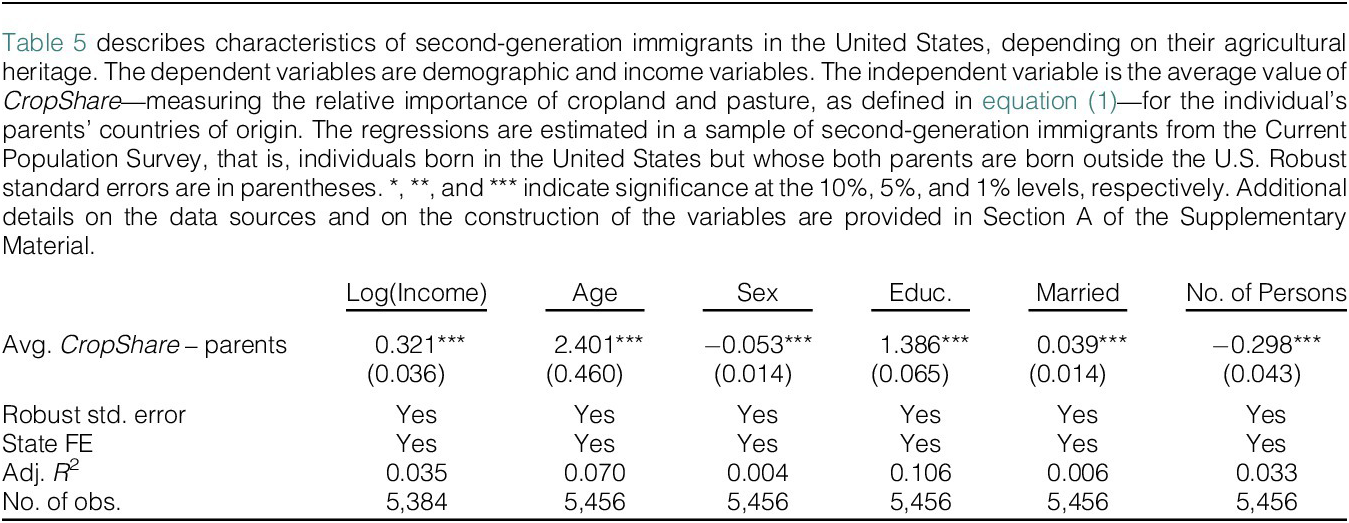
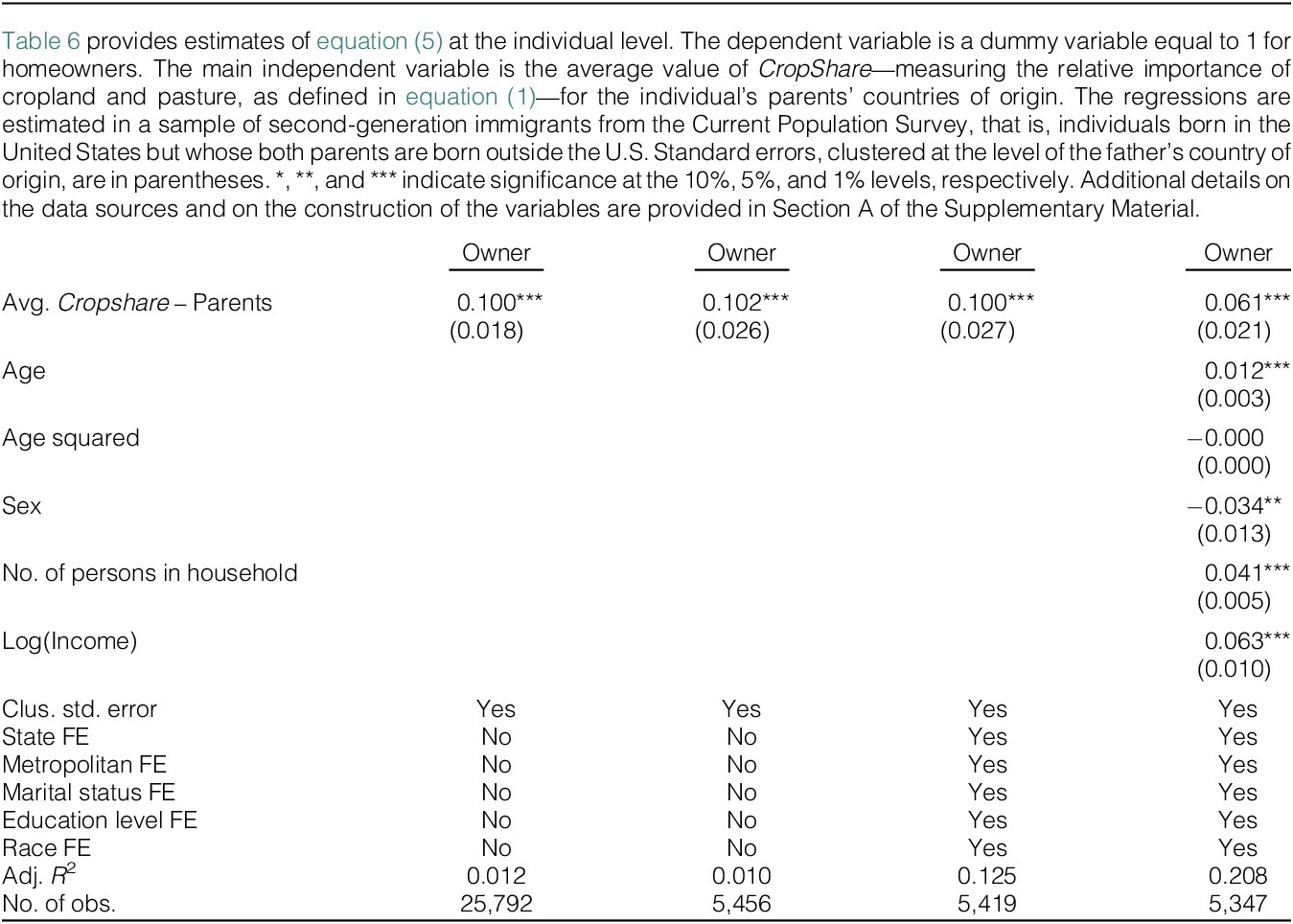
One potential concern about second-generation immigrants is that they may not be randomly selected: individuals descending from countries historically practicing crop agriculture or cattle grazing may differ along other demographic and financial characteristics. To assess whether this is the case, I regress in Table 5 a number of individual characteristics on the average value of CropShare in the parents’ countries of origin. The results show that individuals whose parents came from countries where crop agriculture is dominant have on average higher income, are older, more educated, more likely to be male, less likely to be married, and live in households with fewer members. These correlations would be problematic if these characteristics are also conducive to home ownership. To alleviate this concern, I systematically control for these variables in the regressions below.

B. Baseline Estimation
In the sample of second-generation immigrants, I estimate
 $$ {\displaystyle \begin{array}{c}{Owner}_i=\alpha +\beta \cdot {CropShareParents}_i+\gamma \cdot {Controls}_i\\ {}+{FE}_{state}+{FE}_{metropolitan}+{FE}_{marital}+{FE}_{educ}+{FE}_{race}+{\unicode{x025B}}_i,\end{array}} $$
where $ {Owner}_i $
equals 1 if individual
$ {Owner}_i $
equals 1 if individual $ i $
is a homeowner. The main dependent variable,
$ i $
is a homeowner. The main dependent variable, $ {CropShareParents}_i $
, is defined as the average value of
$ {CropShareParents}_i $
, is defined as the average value of $ CropShare $
for
$ CropShare $
for $ i $
’s mother’s and father’s countries of origin. This approach avoids taking a stance on whether culture transmits primarily through the father or the mother, which may differ across cultures.Footnote 8
$ i $
’s mother’s and father’s countries of origin. This approach avoids taking a stance on whether culture transmits primarily through the father or the mother, which may differ across cultures.Footnote 8
The approach taken in equation (5) alleviates two additional concerns. First, I include a number of fixed effects for states, metropolitan areas, marital statuses, race, and levels of education. These fixed effects mitigate the concern that immigrants from certain origins may be over- or under-represented in certain geographical areas or have characteristics that are conducive to home ownership.
Second, since equation (5) is estimated at the individual level, I also include a number of personal characteristics that are known to be associated with home ownership. The vector of controls includes demographic characteristics: age, age squared, sex, and the number of persons in the household. Furthermore, to alleviate the concern that the ability to be a homeowner may depend on a household’s financial condition, I include the logarithm of the household’s income as a control. I also cluster standard errors at the level of father’s country of origin.
Estimates are reported in Table 6. From columns 1–4, I sequentially make the specification more complete. In column 1, I report an estimate for all individuals whose parents are born outside the United States, regardless of whether they are themselves born in the United States. In column 2, I further restrict to persons born in the United States, that is, second-generation immigrants. Both regressions yield a positive estimate of $ \beta $
, statistically significant at the 1% level. Its magnitude is fairly comparable to the one found using cross-country data in the OECD. In column 3, I add all fixed effects and, in column 4, I add all control variables. This reduces the magnitude of the effect by about 40%, but the estimate remains statistically significant at the 1% level. The economic magnitude remains sizable: a one-unit increase in CropShare generates a 3.0 percentage points increase in the probability of being a homeowner (compared to an average home ownership rate of 49.7% in the sample). These results point to a causal effect of culture on home ownership, driven by historical exposure to agriculture.
$ \beta $
, statistically significant at the 1% level. Its magnitude is fairly comparable to the one found using cross-country data in the OECD. In column 3, I add all fixed effects and, in column 4, I add all control variables. This reduces the magnitude of the effect by about 40%, but the estimate remains statistically significant at the 1% level. The economic magnitude remains sizable: a one-unit increase in CropShare generates a 3.0 percentage points increase in the probability of being a homeowner (compared to an average home ownership rate of 49.7% in the sample). These results point to a causal effect of culture on home ownership, driven by historical exposure to agriculture.

C. Robustness
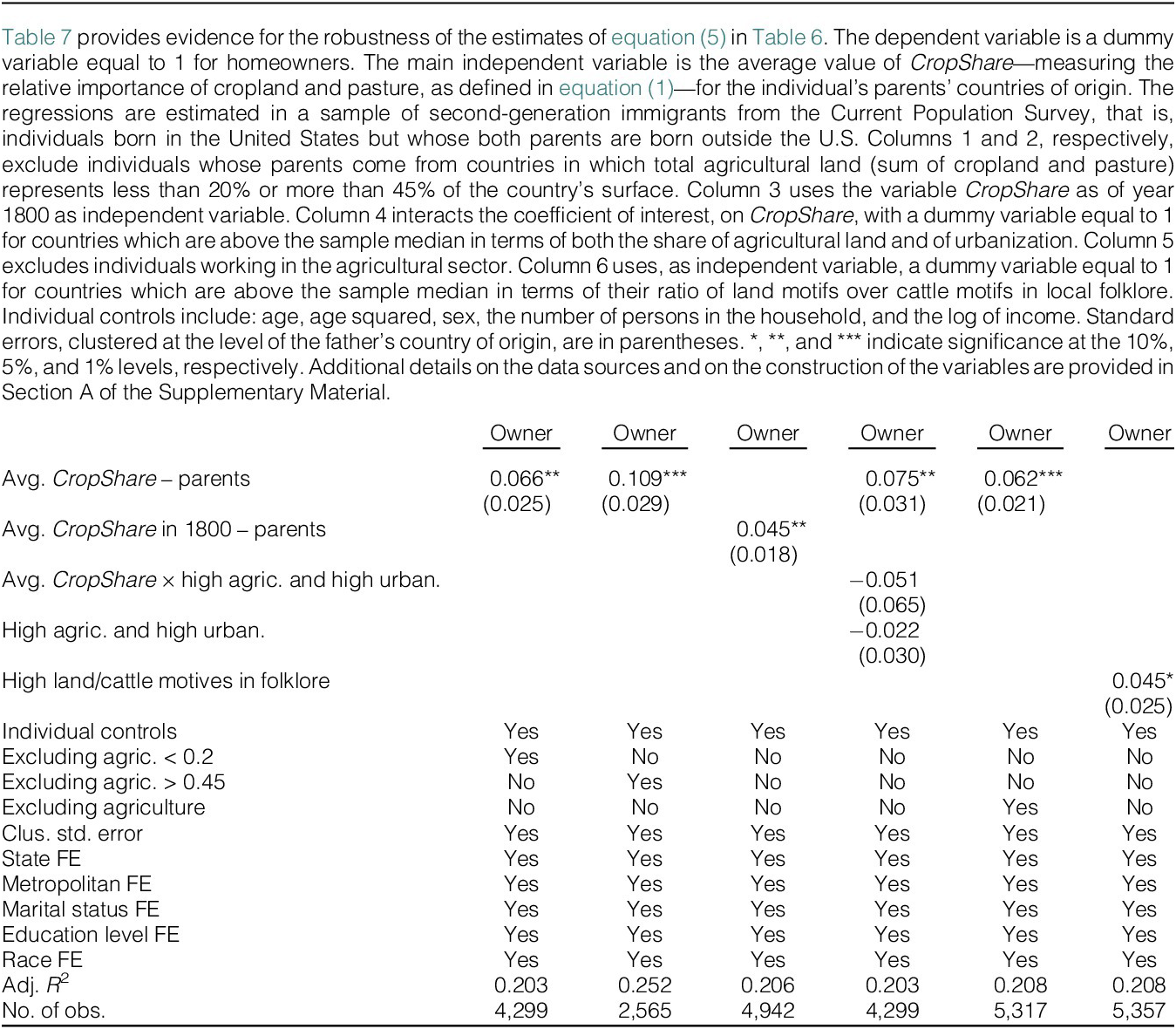
I next explore the robustness of the most complete specification—the one in column 4 of Table 6—to various alternatives. First of all, I address the concern that, for some countries, there could be a mismatch between the areas covered by the CropShare and the areas in which most people live. To this end, I first compute, for each country, the fraction of total land which qualifies as agricultural land (either cropland or pasture). Descriptive statistics are provided in Panel A of Table 4 (line 4). Concerns about the mismeasurement of CropShare are arguably more acute when this ratio takes extreme values. Thus, in columns 1 and 2 of Table 7, I re-estimate my baseline specification after excluding countries of origin with a ratio of agricultural land to total land, respectively, below 20% or above 45% (corresponding roughly to the 25th and 75th percentiles of the distribution). The baseline results hold and, if anything, become slightly larger (estimates of 0.066 and 0.109 vs. 0.061 in the baseline model).

As another way to address the same concern, I re-estimate the baseline specification, but with the independent variable CropShare measured in 1800 (as opposed to the average over the 1800–2010 period). The idea is that, as of 1800, this variable measures land use before the rural exodus that started in the 19th century (e.g., in the United Kingdom) or much later in the 20th century (e.g., in China). Estimates in column 3 of Table 7 show that my results are robust to this change of variable.
As a third way to address the measurement concern, I rely on the idea that countries with a significant mismatch between the locations where agriculture takes place and the locations where most of the population lives are likely to be characterized simultaneously by i) a high ratio of agricultural land to total land and ii) a high urbanization rate. I construct a dummy variable equal to 1 for countries which are above the median along both these dimensions. In column 4 of Table 7, I interact CropShare with this dummy variable. While the baseline coefficient on CropShare remains positive and statistically significant, the interaction is insignificant. This confirms that concerns arising from mismeasurement are minor.
In column 5 of Table 7, I address the issue that the results could be coming from individuals working directly in the agricultural sector in the United States. Indeed, a concern could exist that individuals coming from societies with an agricultural background are more likely to continue working in agriculture once in the United States, and that agriculture requires ownership of real estate. Re-estimating the baseline model after excluding individuals working in agriculture does not affect the results.
Then, in column 6 of Table 7, I provide more direct evidence of a mechanism working via an “agricultural culture” by re-estimating the baseline regression, but with a different independent variable. Instead of CropShare, I use a measure of the prevalence of land motifs (relative to cattle motifs) in local folklore (see Section II.D). The estimates confirm that a higher relative prevalence of land motifs in the country of origin’s folklore is associated with a higher probability to own a home among U.S. second-generation immigrants.
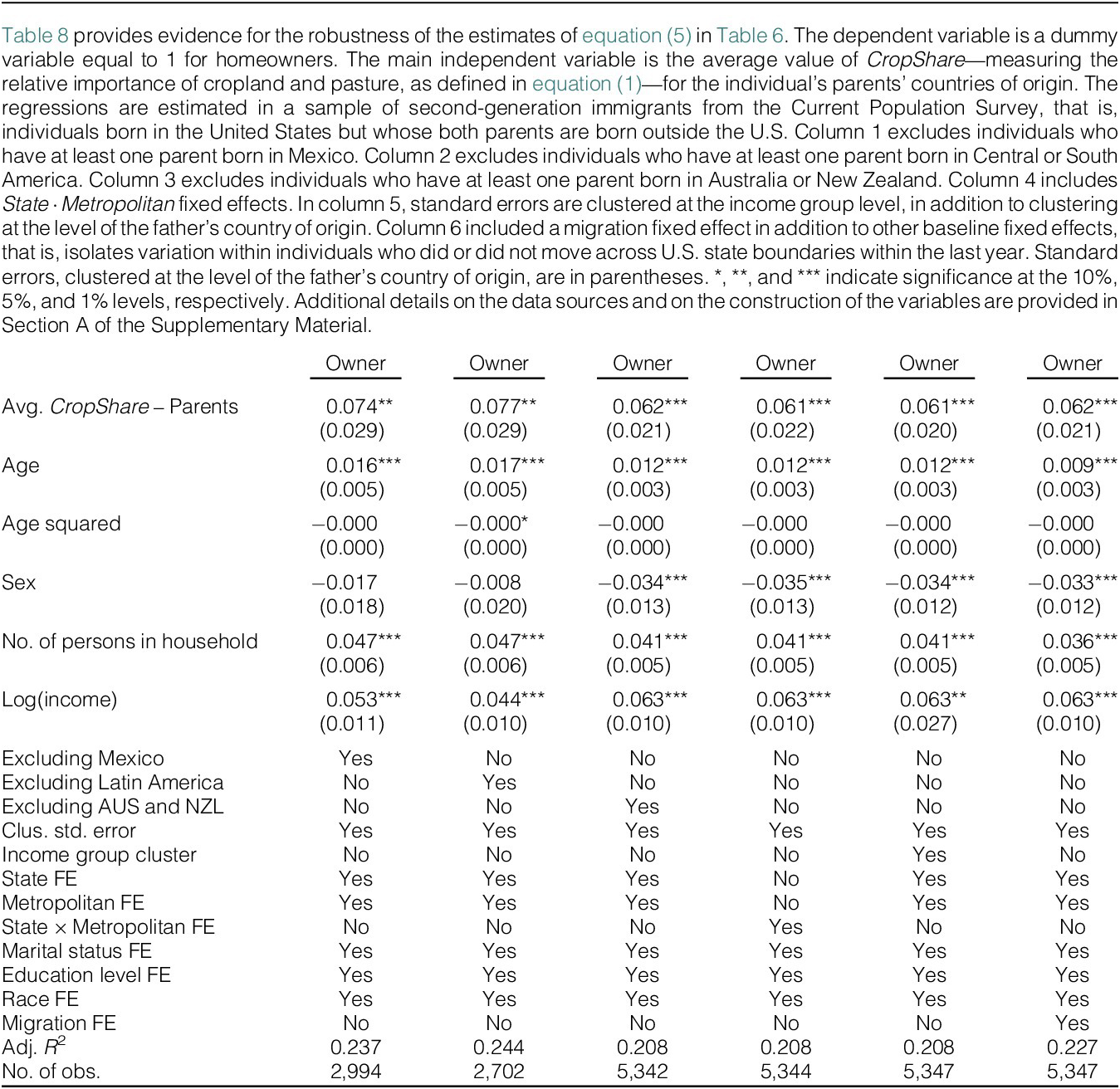
Table 8 provides another set of robustness tests. In column 1, I exclude second-generation immigrants from Mexico, which are over-represented in the sample of countries of origin (see Panel B of Table 4). In columns 2 and 3, I, respectively, exclude all individuals from Latin America or Australia and New Zealand. The concern is that such regions have been heavily colonized, potentially picking up a culture unrelated to traditional forms of farming. In all cases, I find very similar estimates of the coefficient on CropShare.

In column 4 of Table 8, I use a tighter fixed effect strategy, by including $ State\cdot Metropolitan $
fixed effects, rather than
$ State\cdot Metropolitan $
fixed effects, rather than $ State $
and
$ State $
and $ Metropolitan $
fixed effects separately. This allows me focus on variation within metropolitan or nonmetropolitan areas of any given state. The baseline estimate of
$ Metropolitan $
fixed effects separately. This allows me focus on variation within metropolitan or nonmetropolitan areas of any given state. The baseline estimate of $ \beta $
is economically and statistically unchanged.
$ \beta $
is economically and statistically unchanged.
In column 5 of Table 8, I cluster standard errors by income groups, in addition to clustering by the father’s country of origin. Theoretically, clustering should be done along dimensions in which the sampling may not reflect random draws from the entire population (Abadie, Athey, Imbens, and Woolridge (Reference Abadie, Athey, Imbens and Woolridge2023)). In the case of the Current Population Survey, a common concern is that certain income groups (particularly the richest) are oversampled. Once again, clustering by income groups does not significantly affect the results.
In column 6 of Table 8, I include an additional “migration” fixed effect, equal to 1 for individuals who moved across state borders during the preceding year. This is meant to address the concern that individuals with a background of cattle-based farming could be more mobile (since their livelihood is traditionally based on a mobile asset). The fixed effect ensures that I compare individuals with the same migration status, and the results are almost unchanged.
D. Alternative Explanations
I now discuss potential alternative explanations. One broad concern is that the results could be driven by the exposure of individuals with distinct agricultural backgrounds to different institutions or experiences. In a strict sense, this concern is fully taken care of in my estimation, given the focus on second-generation immigrants born in the United States. These individuals have had no personal experience with institutions in their parents’ country of origin. They also have not personally faced distinct macroeconomic experiences in their country of origin. Instead, in the literature on experience effects, it is almost always personal experiences that are extrapolated and guide decision making (Agarwal, Hu, and Huang (Reference Agarwal, Hu and Huang2016), Kuchler and Zafar (Reference Kuchler and Zafar2019), Happel et al. (Reference Happel, Karabulut, Schäfer and Tuzel2024), and Malmendier and Wellsjo (Reference Malmendier and Wellsjo2024)).
A related concern is that second-generation immigrants with distinct agricultural background may end up in different areas within the United States. If so, they may face distinct experiences about housing returns or other local economic outcomes that are conducive to home ownership. However, this concern is taken care of in my regressions using state fixed effects and metropolitan fixed effects: my baseline specification compares individuals with distinct agricultural background but within the same state, and within either metropolitan or rural areas. By the same token, the state fixed effects also alleviate the concern that results may be driven by differences in state-level institutions (e.g., mortgage design, personal bankruptcy rules, bank regulation, etc.).
Another argument could be that individuals originating from countries in which crop agriculture is dominant are more likely to find it optimal to stay longer in the same place. As a consequence, they may desire home ownership more, as a way to hedge against rent risk (Sinai and Souleles (Reference Sinai and Souleles2005)). As discussed earlier, my findings are robust to the inclusion of migration fixed effects (column 6 of Table 8). To further address the concern, I re-estimate my baseline specification, but with a migration dummy (as opposed to the home ownership dummy) as dependent variable. The results, in Table A4 in the Supplementary Material, show either insignificant results (columns 1–3) or estimates that have the opposite sign of what we would expect: if anything, individuals with a background of crop agriculture are more likely to move from state to state once in the United States. Thus, if we believe that more mobile persons are, all else equal, less likely to be homeowners, it is unlikely that preferences for mobility drive my results. It should instead bias me against finding significant results.
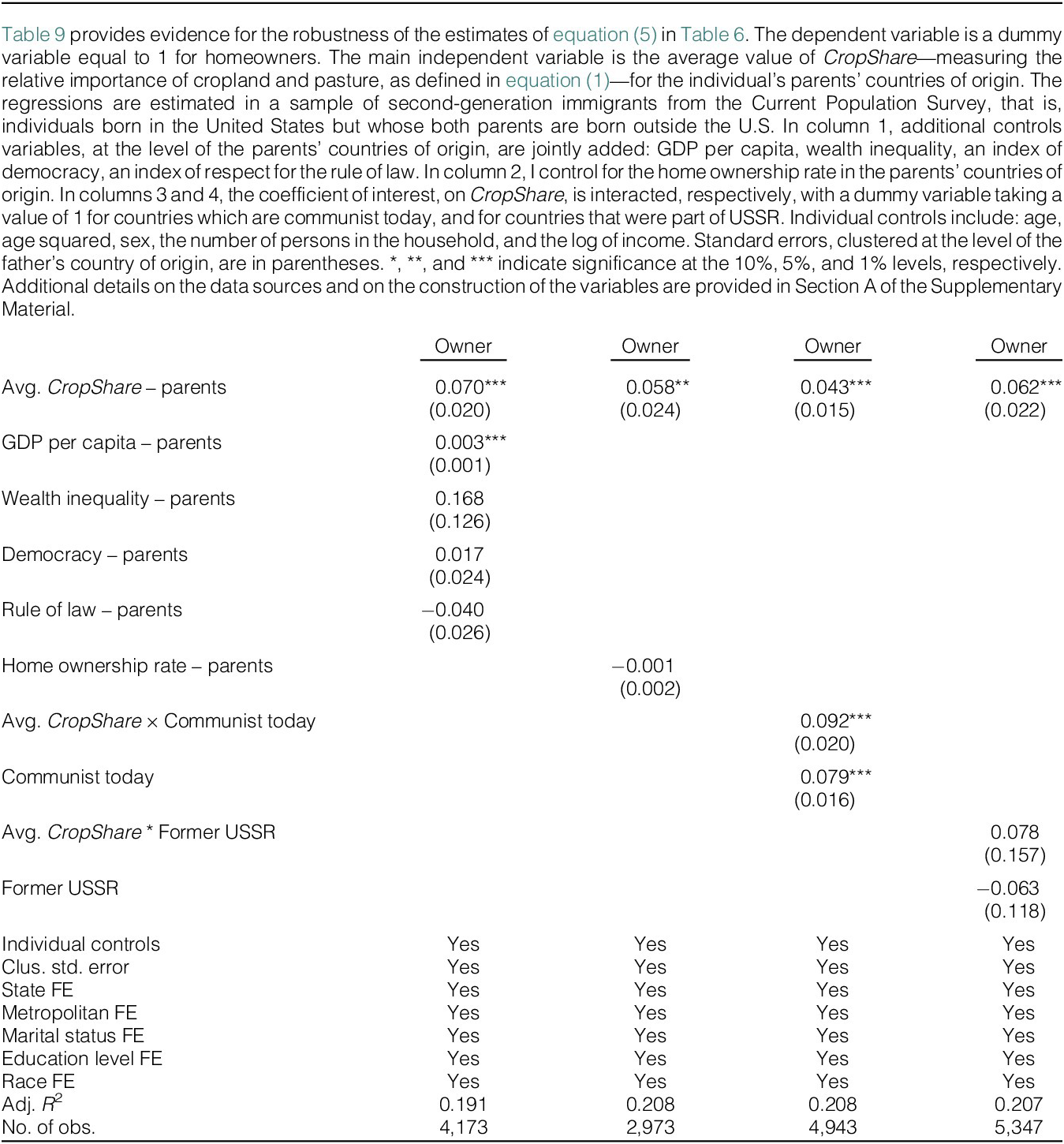
Another set of concerns could come from the fact that, while my earlier results identify an impact of culture—transmitted from parents to children—on home ownership, one could still question whether I truly identify a cultural heritage from agriculture (i.e., views about the relative desirability of movable or immovable assets originating from the fact that, for long periods of time, dominant assets were either land or cattle). Indeed, it is possible that other characteristics of the country of origin—including other cultural traits—conducive to home ownership are correlated with the prevailing form of agriculture. For example, it could be that countries with more crop agriculture are richer (because the soil is more fertile) or more equal (because a greater attachment to land increased the likelihood of land reforms).Footnote 9 It could also be that institutions such as democratic institutions or the rule of law in immigrants’ countries of origin shape culture in important ways. To address such concerns, I reproduce my baseline specification after controlling for GDP per capita, wealth inequality (measured as the wealth share of the top 10%), the existence of democracy, and the prevalence of the rule of law in the country of origin. The results, in column 1 of Table 9, confirm the robustness of the baseline estimate.

Along the same lines, in column 2, I control for the home ownership rate in the country of origin: the fact that my coefficient on CropShare remains significant indicates that I am likely to truly identify and “agricultural culture” channel, as opposed to a general culture valuing home ownership (but disconnected from the agricultural past). In the same spirit, one may wonder whether the results hold for countries of origin which are either communist today, or have been communist in the past. In columns 3 and 4 of Table 9, I interact my coefficient of interest (on CropShare) with a dummy variable equal to 1 for countries which are currently communist, and with one equal to 1 for countries from former USSR. In both cases, the uninteracted coefficient on CropShare remains positive and significant.Footnote 10
Finally, in Table A5 in the Supplementary Material, I sequentially add variables controlling for six key dimensions of culture, as identified in the seminal work by Geert Hofstede (e.g., Hofstede et al. (Reference Hofstede, Hofstede and Minkov2010)): power distance, individualism, masculinity, uncertainty avoidance, long-term orientation, and indulgence.Footnote 11 The results turn out to be robust to controlling for all six dimensions of culture, even though the magnitude of the coefficients is, at times, attenuated.
V. Identifying the Mechanism
I now turn to a deeper inspection of the mechanism, using two methods. Both of them rely on the idea that biochemical properties of the soil act as exogenous shifters of the prevalence of agriculture (or CropShare) at a country level. These tests further address the concerns raised in the previous section.
A. Exegenous Shifters of CropShare
To precisely assess the mechanism behind my results, it is useful to find a variable that shifts the extent of crop agriculture (measured by CropShare) at a country level, but that is unrelated to other social, cultural, or political characteristics or experiences in that country. Such a variable could be used as an instrument to address concerns about the potential endogeneity of CropShare, but could also pin down a cultural effect originating in the practice of specific types of agriculture (as opposed to other cultural traits or experiences correlated with them).
A natural candidate for such instrument are the biochemical properties of the soil that are conducive to soil fertility. The idea is that crop agriculture requires a certain degree of soil fertility to be viable. In regions where these properties do not exist, the main way for people to obtain food is to rely more on cattle and products derived from cattle (herbivores eat plants that humans cannot digest and produce digestible food out of them, including meat, butter, or milk). In addition, biochemical soil properties can be treated as exogenous: even though human activities can affect the properties of soils, they are extremely slow-moving. For example, it takes about 300 years for just 1 cm of soil to form. To further alleviate concerns that soil properties may be partially endogenous, I rely only on measures related to subsoil as opposed to topsoil.
The main issue that soil fertility raises is one of measurement. While biologists have long attempted to come up with a unique metric for soil fertility, this has proved impossible to obtain. Fertility exists only as a combination of several biochemical properties that need to be jointly satisfied. That said, not all properties are as important as others. According to the Food and Agriculture Organization (FAO), “organic carbon is […] the best simple indicator of the health status of the soil. Moderate to high amounts of organic carbon are associated with fertile soils with a good structure” (FAO (2009), p. 14). This gives me a rationale to use a measure of subsoil organic carbon as an exogenous shifter for the prevalence of crop agriculture, that is, the variable CropShare.
To construct this instrument, I proceed in several steps. First, I obtain the Harmonized World Soil Database (HWSD) from the FAO. This data set is a raster providing soil properties—including subsoil organic carbon and subsoil pH—for every 0.25° (approximately 5 km by 5 km) for the entire earth. I then assign a longitude and a latitude to each cell in the raster and map these coordinates to a country. I then compute average soil properties for each country in the world. Finally, I follow the guidelines by the FAO to define subsoil organic carbon more precisely: I transform the raw percentage into a categorical variable that takes five values, using the thresholds suggested by the FAO ((2009), p. 14).Footnote 12
Figure A2 in the Supplementary Material maps both subsoil organic carbon at the global level. Beyond large cross-country variation in these two dimensions, visual comparison of this map with Figure 2 gives preliminary indication that biochemical properties that make soils fertile are also conducive to a relatively greater reliance on crop agriculture over cattle grazing.
B. “Agricultural Culture” Versus “Home Ownership Culture”
I now use biochemical soil properties for two purposes. A key challenge is to determine whether the effect identified in the previous section really works through an “agricultural culture” that persist even in modern societies, or whether it could be a more general “cultural” effect, unrelated to agriculture. For example, it could be that home ownership is highly valued in some societies for reasons unrelated to traditional forms of farming. This concern is especially valid given the work by Huber and Schmidt (Reference Huber and Schmidt2022), who provide evidence of a general “cultural” effect, by showing that home ownership decisions of second-generation immigrants in the United States depend on home ownership rates in their parents’ countries of origin. While I already showed the robustness of my results to the inclusion of several variables controlling for other cultural traits (and for the overall home ownership rate) at a country level, one could wonder whether omitted cultural traits could still explain the findings.
I address this concern by designing a test in the spirit of Huber and Schmidt (Reference Huber and Schmidt2022). It relies on the idea that home ownership rates, in immigrants’ countries of origin, can be thought of as a combination of two forces: they are partly driven directly by the agricultural past (and transmitted through values, folklore, etc.), and partly driven by other cultural forces unrelated to agriculture. In that sense, if a U.S. descendant from a country with a high home ownership rate is relatively more willing to own a home, it could be because of either element. The idea behind my tests is to use a regression approach to decompose home ownership rates in countries of origin between i) one part predictable based on biochemical soil properties (and thus presumably directly related to agricultural factors) and ii) the “excess” home ownership rate, not predicted by soil properties. This decomposition can be obtained by country-level regressions,
 $$ {OwnRate}_c=\alpha +\beta \cdot {SOC}_c+{\unicode{x025B}}_c, $$
where $ {OwnRate}_c $
and
$ {OwnRate}_c $
and $ {SOC}_c $
are, respectively, the home ownership rate and average subsoil organic carbon in country
$ {SOC}_c $
are, respectively, the home ownership rate and average subsoil organic carbon in country $ c $
. After these regressions are estimated in the sample of countries for which home the ownership rate is available (i.e., the sample of OECD countries), one can compute the “predicted” and “excess” home ownership rates, respectively, as
$ c $
. After these regressions are estimated in the sample of countries for which home the ownership rate is available (i.e., the sample of OECD countries), one can compute the “predicted” and “excess” home ownership rates, respectively, as
 $$ {PredictedOwnRate}_c=\hat{\alpha}+\hat{\beta}\cdot {SOC}_c $$
and
 $$ {ExcessOwnRate}_c={OwnRate}_c-{PredictedOwnRate}_c, $$
where $ \hat{\alpha} $
and
$ \hat{\alpha} $
and $ \hat{\beta} $
denote the coefficients estimated from equation (6).
$ \hat{\beta} $
denote the coefficients estimated from equation (6).
I then test separately whether $ {PredictedOwnRate}_c $
and
$ {PredictedOwnRate}_c $
and $ {ExcessOwnRate}_c $
in the countries of origin predict home ownership decisions by second-generation immigrants in the United States. This essentially replicates the main test in Huber and Schmidt (Reference Huber and Schmidt2022), but after breaking down the overall home ownership rate between one part predicted by soil conditions (i.e.,
$ {ExcessOwnRate}_c $
in the countries of origin predict home ownership decisions by second-generation immigrants in the United States. This essentially replicates the main test in Huber and Schmidt (Reference Huber and Schmidt2022), but after breaking down the overall home ownership rate between one part predicted by soil conditions (i.e., $ {PredictedOwnRate}_c $
) and one part driven by factors unrelated to soil or agriculture (i.e.,
$ {PredictedOwnRate}_c $
) and one part driven by factors unrelated to soil or agriculture (i.e., $ {ExcessOwnRate}_c $
). If the effect I am documenting is a general “home ownership” effect (i.e., individuals desire homes because their parents come from countries with high home ownership, regardless of the agricultural past), then both variables should predict home ownership decisions of second-generation immigrants. Instead, if the effect is specifically related to an “agricultural culture” transmitted across generations, only the coefficient on
$ {ExcessOwnRate}_c $
). If the effect I am documenting is a general “home ownership” effect (i.e., individuals desire homes because their parents come from countries with high home ownership, regardless of the agricultural past), then both variables should predict home ownership decisions of second-generation immigrants. Instead, if the effect is specifically related to an “agricultural culture” transmitted across generations, only the coefficient on $ {PredictedOwnRate}_c $
should be positive and statistically significant.
$ {PredictedOwnRate}_c $
should be positive and statistically significant.
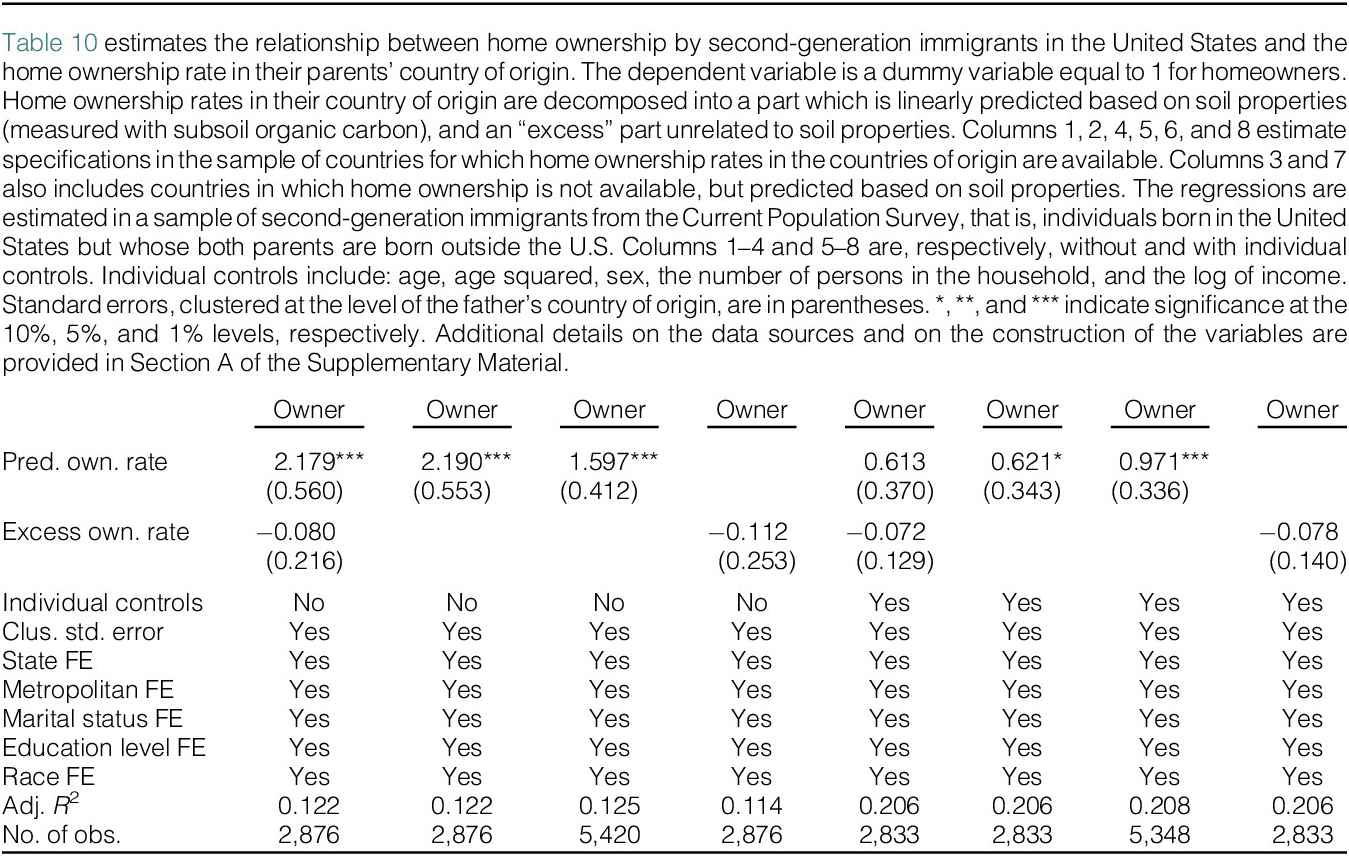
This is exactly what we observe in Table 10. In columns 1–3 and 5–7, I find that home ownership rates predicted based on soil conditions in the country of origin are positively related to home ownership decisions of second-generation immigrants in the United States. The relationship is statistically significant in all but one case (and most often at the 1% level). This is true both in the sample of countries in which the home ownership rate is observed (columns 1, 2, 5, and 6) and in a sample that includes other countries for which home ownership rates are not available but predicted using soil properties and the coefficients $ \hat{\alpha} $
and
$ \hat{\alpha} $
and $ \hat{\beta} $
estimated from equation (6) (columns 3 and 7). Instead, the “excess” home ownership rate, which should capture all determinants of ownership beyond soil conditions, is not predictive of immigrants’ ownership decisions, both when added as a control in columns 1 and 5, and when tested independently (columns 4 and 8). This provides evidence in favor of a mechanism working via an “agricultural culture,” as opposed to other features of culture.
$ \hat{\beta} $
estimated from equation (6) (columns 3 and 7). Instead, the “excess” home ownership rate, which should capture all determinants of ownership beyond soil conditions, is not predictive of immigrants’ ownership decisions, both when added as a control in columns 1 and 5, and when tested independently (columns 4 and 8). This provides evidence in favor of a mechanism working via an “agricultural culture,” as opposed to other features of culture.

C. Instrumental Variable Estimation
I finally use the biochemical properties of the soil explicitly as an instrument. The goal is to explicitly address the concern that CropShare could be endogenous, and driven by omitted cultural traits unrelated to the agricultural heritage. The instrumental variable (IV) approach consists in instrumenting for $ {CropShareParents}_i $
in equation (5) with the average soil properties of individual
$ {CropShareParents}_i $
in equation (5) with the average soil properties of individual $ i $
’s parents’ countries of origin. That is, I estimate the following first-stage equation
$ i $
’s parents’ countries of origin. That is, I estimate the following first-stage equation
 $$ {\displaystyle \begin{array}{c}{CropShareParents}_i=\phi +\mu \cdot {SOCParents}_i+\eta \cdot {Controls}_i+{FE}_{state}\\ {}+{FE}_{metropolitan}+{FE}_{marital}+{FE}_{educ}+{FE}_{race}+{\varepsilon}_i,\end{array}} $$
where $ {SOCParents}_i $
is the average subsoil organic carbon in soils in
$ {SOCParents}_i $
is the average subsoil organic carbon in soils in $ i $
’s parents’ countries of origin. I then use a two-stage least squares estimation to obtain the coefficients of interest.
$ i $
’s parents’ countries of origin. I then use a two-stage least squares estimation to obtain the coefficients of interest.
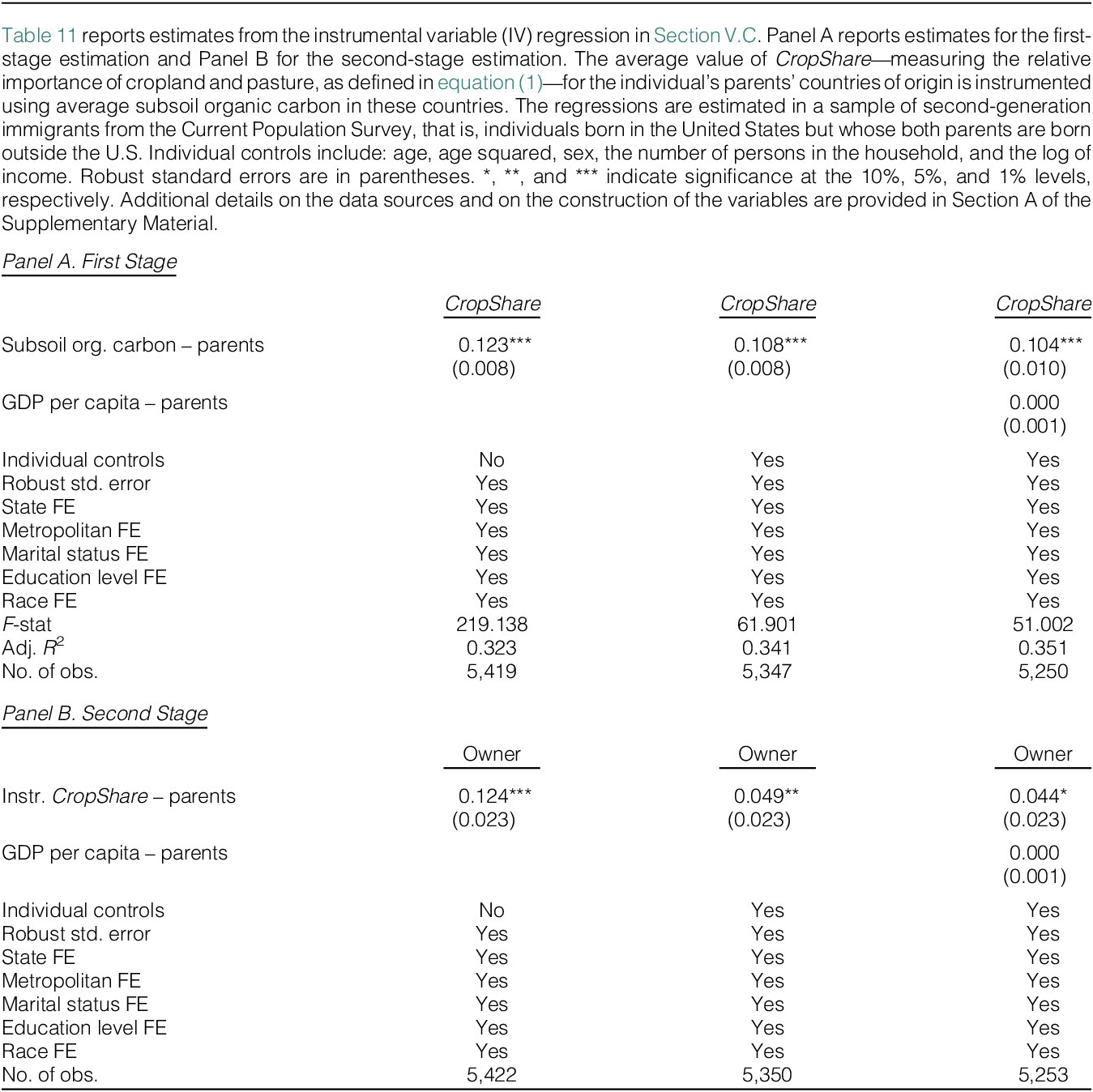
I report estimates of the first-stage and second-stage regressions, respectively, in Panels A and B of Table 11. In the first stage, I find statistically significant estimates for the coefficient $ \mu $
, at the 1% level, and with the expected signs, across all specifications: a higher level of subsoil organic carbon is conducive to a higher share of land devoted to crop agriculture as opposed to cattle grazing. I additionally report
$ \mu $
, at the 1% level, and with the expected signs, across all specifications: a higher level of subsoil organic carbon is conducive to a higher share of land devoted to crop agriculture as opposed to cattle grazing. I additionally report $ F $
-statistics, which are high in all cases (above 50). This give confidence about the relevance of the instrument.
$ F $
-statistics, which are high in all cases (above 50). This give confidence about the relevance of the instrument.

In the second stage, I also find statistically significant coefficients across specifications. Once individual controls are included (columns 2 and 3), the magnitude of the coefficient of interest is comparable, albeit a bit smaller, to the one in the most complete OLS specification (0.049 vs. 0.061, see column 4 of Table 6). These estimates highlight that the endogeneity of CropShare is unlikely to be a major concern in our case. Finally, the IV results also contribute to a tighter interpretation of the mechanism: the cultural traits that lead to home ownership decisions can be causally related to an agricultural heritage, which was itself shaped by soil properties.
VI. Conclusion
For most households, choosing to own a home is the single most important financial decision they take in their lifetime. When they do so, real estate becomes their dominant asset, and their exposure to shocks changes (Gorback and Schubert (Reference Gorback and Schubert2024)). In this article, I use several identification strategies to show that this decision is significantly influenced by a cultural heritage from agriculture. For centuries, dominant assets in preindustrial economies were either land or cattle, so that preferences and views about the relative value of immovable and movable assets were largely shaped by the prevailing type of farming. In particular, societies dominated by crop agriculture tended to view land as the preferred and “safest” asset. Today, individuals originating from societies with a history of crop agriculture are significantly more likely to own a home, even after they migrate.
These results open the question whether the cultural heritage of agriculture also explains other financial decisions by households, beyond home ownership, such as a differential valuation for movable real assets (e.g., precious metals) or financial assets. Testing these additional hypotheses would require more granular data on portfolio allocation, and is left for future research. Another interesting avenue would be to directly relate the cultural heritage of agriculture to belief about assets. For the U.S., Adelino, Schoar, and Severino (Reference Adelino, Schoar and Severino2018) report beliefs that are puzzling from the vantage point of financial theory: 71% of U.S. households believe that housing is safe, while this percentage is only 55% for bonds. Unfortunately, standard cross-country data sets on beliefs and values, such as the World Values Survey, currently do not include questions on assets, so that it remains hard to identify the role of culture in these broader beliefs.
Supplementary Material
To view supplementary material for this article, please visit http://doi.org/10.1017/S0022109025102524.


 Open access

