



Adequate nutrition is a human right, a fundamental premise enshrined in major international conventions and declarations, but it is dependent upon technical capability and organisation across a range of specific areas of human experience for its realisation in practice. The complexity of the problems to be addressed has become more evident over the past three decades( Reference Patton 1 , Reference Jonsson 2 ). One evident reason is that the increasing global population has to be adequately fed. Another is the clear recognition of the increasing complexity of the problems, in particular the nature of the double burden of nutrition-related disease. To effectively address these problems requires a multi-sectoral and multi-disciplinary approach, but critical advice has to be provided by trained nutrition professionals with knowledge of the basic principles of nutrition and capable of identifying, assessing the nature of the problems at local level, and determining how these can be best addressed. It is clear that for many parts of the world, especially areas where the immediate need is greatest such as sub-Saharan Africa, the necessary capability is severely limited and there is the need to develop greater human capacity. Changes in the nature of the nutritional problems being faced, and in particular the increased prevalence of the double burden of nutrition-related disease, necessitate a focus on the needs of the health workforce and its access to competent support from nutrition professionals. Our purpose has been to assess the perceived needs of those engaged in training in nutrition in sub-Saharan Africa, and to gain an impression of the magnitude of the gap which must be corrected in order to better identify the nature of the imperative that has to be addressed if progress in this area is to be achieved.
International context
Linked to the Millennium Development Goals, the International Malnutrition Task Force (IMTF) was established by the International Union of Nutrition Sciences in conjunction with the International Pediatric Association, with a key objective being to advocate for the inclusion of appropriate nutrition training in the undergraduate curricula for health professionals( Reference Jackson, Ashworth and Khanum 3 ). It was expected that this training would be supported and enabled by those with appropriate training in nutrition. The scale and magnitude of ill health and death associated with poor child nutrition were brought into sharp focus by the Lancet series on child survival( Reference Black, Morris and Bryce 4 – Reference Black, Victora and Walker 6 ); the extent of impaired personal and social development( Reference Walker, Wachs and Grantham-McGregor 7 – Reference Grantham-McGregor, Cheun and Cueto 9 ); the wider social, economic and development costs by the World Bank( 10 ), the WHO Commission on the Social Determinants of Health( 11 ) and the Copenhagen consensus on nutritionally related health interventions as economically feasible and effective global interventions( Reference Horton, Alderman and Rivera 12 , 13 ). The failure to prevent and treat malnutrition in all its forms is a critical constraint on national development, and effective prevention and treatment would have high personal, social and economic benefits. Society looks to those professionals with special technical capability in these areas for guidance, and adequate technical and professional capacity in these areas is an absolute requirement for sustained and effective change at scale. At the 26th Congress of the International Pediatric Association in Johannesburg in August 2010, a resolution was adopted that the identification and treatment of malnutrition should become a core competency for all paediatricians and related health professionals( Reference Schofield, Ashworth and Annan 14 ). A similar resolution was adopted by the Africa Nutrition Epidemiology Conference in Nairobi in October 2010( 15 ). These resolutions were widely supported by national government representatives, international agencies, local and international non-government organisations. For nutritionists it was explicitly recognised that to build a country's capacity for tackling nutrition issues, there is a need to ensure that nutrition professionals are trained appropriately and critically this will require a move towards competency-based curricula( 16 ).
We outline here the work which has been undertaken to forward this agenda, some of which has been reported in brief.
Developing nutrition training in Africa: considerations from workshop in Nigeria
The IMTF in conjunction with the African Nutrition Society and the Africa Graduate Students Network convened a workshop during the 2nd Federation of African Nutrition Societies Congress in Abuja, Nigeria in 2011. The objective was to bring together those with responsibility for training in nutrition from sub-Saharan Africa to share experience and to explore both commonalities and differences in approach. It was also an opportunity to assess the extent to which there were opportunities for co-operation and the possibility of adopting common curricula, with common standards of competency and assessment. The focus of the facilitated workshop was on developing competency-based curricula for training nutritionists in Africa; a willingness to work together to common purpose; identification of strengths that currently exist; the opportunity to work towards common, defined standards.
Eighty participants from more than twenty-five academic institutions, mainly Universities, and five non-academic institutions in nine countries namely Ghana, Kenya, Nigeria, Tanzania, Zambia, Uganda, the UK, South Africa and the USA attended the workshop. Over 95% of the institutions represented were within Africa. The workshop outcomes fall into three categories: firstly assessing the current activity in relation to nutrition training and reflections on the capabilities of a trained nutritionist; secondly, exploring the nature and extent of their professional responsibilities; thirdly, consideration of the next steps that could be taken collectively to make progress towards commonly defined ambitions.
Capabilities of a trained nutritionist
Nutritionists fill a range of roles as educators, researchers and interventionists. It was recognised that a good nutrition educationalist must have a secure knowledge of the underpinning biological sciences. However, in addition they have to be able to help people change their behaviour, in order to enable people at all levels, from policy makers to communities, to adopt better practices. Nutritionists have responsibilities to plan, implement, monitor and deliver projects, working with and training others to measure and assess situations. This requires knowledge and skills often called ‘know how’ and ‘show how’( 16 ).
Nutritional professionals need to possess the capability to develop and provide a service which enables resolution of the problems of malnutrition, but also the problems associated with emergent chronic non-communicable diseases. Individuals working within the sector have to recognise that malnutrition and nutrition-related chronic diseases have multiple direct and indirect causes which require cooperative efforts across issues and sectors. This has to reflect in training in academic institutions and be communicated at national level to policy makers and to those within organisations with responsibility for the delivery of services, with a clear sense of the absolute imperative that nutrition-related considerations are an integral aspect of all development efforts. Therefore, the necessary skill mix includes a sound understanding of the underlying biomedical considerations, sociological, economic and psychological determinants of human behaviour, and the role of agriculture and local government.
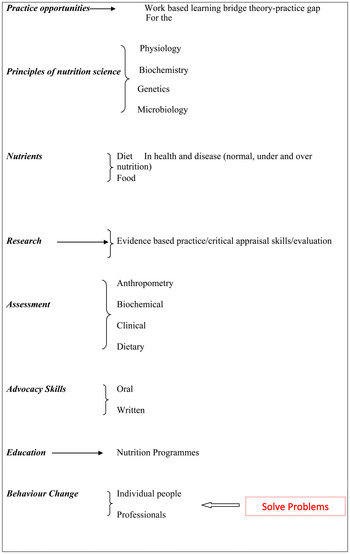
Attendees shared their own experiences related to their training in Africa, or as trainers of nutritionists across the continent, and identified and grouped thematically, what they considered to be the core knowledge and skills, needed for competent and effective practice both in poorly resourced and well-resourced countries. The outputs have been presented elsewhere and are summarised in Fig. 1 ( Reference Ellahi, Paul and Annan 17 ).
(Color online) Suggested curriculum required by nutritionists summarised from workshop.
Professional responsibilities
There was a strong feeling expressed that despite the best efforts to date, the problems of poor nutrition had not been adequately addressed, and therefore a recognition of the need for a fundamental re-think of the current focus and direction with a recommendation to invest much more substantially in appropriate training, if the stated policy ambitions were to be realised within the next 20 year timespan.
Overall participants were largely supportive of the need to address training in terms of competencies, not just knowledge. Shared effort in meeting this agenda would bring immediate benefit to work across Africa and would be a sound investment with even greater benefits being realised in the medium to longer term. For these benefits to be realised, there was general agreement that a common curriculum, fit for purpose at different levels of skill and competency would be necessary.
The task of working towards common curricula was presented as an exercise to the participants who worked collectively in groups. Coming to an agreement on what every nutritionist should know was seen as the expected outcome for the workshop, summarising the training that could be delivered. The suggested curriculum that was produced comprised core knowledge that all agreed represented the basics for the discipline. Core competencies while more difficult to characterise in detail in such a workshop, were commonly agreed although it was acknowledged that determining the competencies would require further detailed follow-up work beyond the workshop.
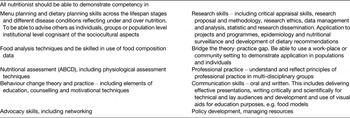
An agreed summary for the curriculum which was drafted is presented in Fig. 1. Gaps in the current provision were also identified and these would need further development if the problems related to the limited existing capacity were to be addressed. For example, interviewing techniques is currently not part of the curriculum for any of the nutrition courses discussed. Skills and competencies required by a nutritionist to help address the key nutritional problems identified are summarised in Table 1 as competencies and skills (‘show-how’). While produced by African nutritionists, it is clear that these are not Africa-specific and can be applied more widely across especially high-burden countries as previously identified in the WHO Nutrition Landscape Analysis( Reference Nishida, Shrimpton and Darnton-Hill 18 ) and in other regions which lack nutrition workforce capacity.
Suggested outcomes for what a nutritionists should be able to do from Africa workshop
Highlights of some particular areas of agreement were to:
-
Increase use of a variety of media to raise awareness of nutrition issues;
-
Create centres of excellence demonstrating developed nutrition training; innovations and best practice in teaching, learning and assessment for others to learn from;
-
Encourage Higher Education Institutions (HEI) to review curricula and undertake gap analysis in light of the workshop findings and recommendations;
-
Design learning objectives based on professional functions of nutritionists;
-
Increase public profile role of nutritionists;
-
Engage in public–private partnerships to support nutrition efforts;
-
Create enabling supportive training environments which engage and enthuse;
-
Develop networks and collaborations;
-
Develop clear indicators of progress and success for example, performance on problem-solving, employability of graduates;
-
Professional educators should develop competencies in reliably and consistently functioning in ‘information transmission’.
Consideration of next steps
Links between collaboration, engagement and development were clearly identified as essential and the role of national institutions, the health sector and governments emphasised as necessary to attain the goals agreed. It was also emphasised that African HEI need to take the initiative, develop training courses fit-for-purpose and to advocate for their adoption in-country. To do this would require approaches that involve and engage all those who might be considered to be curriculum stakeholders (students, lecturers, government, health service, community-based organisations, non-governmental organisations, industry, developmental partners etc.). However for these to be achieved, academic institutions need to take the lead in developing their programmes and producing graduates with the right knowledge, skills and competencies to justify their undoubted role as leaders in the developmental agenda.
From the participants’ perspective, a move towards a standardised nutrition competency-based curriculum which built on the experience and achievements of the workshop would be an important step forward.
Furthermore, the workshop recognised that there was an opportunity for groups operating across the continent to make a special contribution by facilitating the sharing of examples of better practice, and ensuring common standards of competence and performance. The ultimate goal agreed by all was to move towards the development of internationally recognised and accredited competency-based curricula, contextualised for different African countries. Achievement of an action-oriented, competency based training would go towards making the Nairobi Declarations( 15 ) a reality in practice. The existing scientific professional bodies within Africa, i.e. the African Nutrition Society and the Federation of African Nutrition Societies; as well as the IMTF (which is a taskforce within the International Union of Nutrition Sciences, the global umbrella organisation of nutritional sciences) were noted as carrying a special responsibility in this regard going forward.
Current nutrition training opportunities in sub-Saharan Africa
Following the Abuja Workshop, a desk review of available nutrition-related training opportunities being offered by HEI across Africa was undertaken, and focused on types and levels of courses, staffing capacity and the most common destinations and careers of graduates( Reference Amuna 19 ). In that review, the sampling was taken from institutional members of the Association of African Universities, from which a database of institutions offering programmes in nutrition-related subjects was created. All institutions included in the database were invited to participate in a questionnaire-based audit of their courses via email.
In the absence of any generally agreed benchmarks which might be used to standardise nutrition-training courses being offered by HEI in Africa, a reference benchmark used by the Association for Nutrition in its external assessment of nutrition courses was used for the desk review( 20 ). The Association for Nutrition is a voluntary professional regulatory body which holds a register of nutritionists that are deemed fit to practice as nutritionists in the UK. It has a set of standards for registration as a nutritionist and for the accreditation of courses. The course accreditation criteria cover core knowledge and skills for courses and the registration criteria cover core knowledge, skills and competencies for practicing nutritionists( Reference Cade, Eccles and Hartwell 21 ). An important component of the latter is that it includes information on institutional quality assurance processes, staffing capacity and facilities( 20 , 22 ).
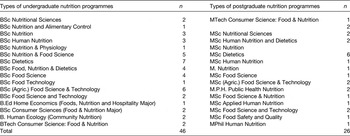
Of 274 institutions included in the audit, seventy-two institutions (26·28%) offered a range of nutrition-related courses (Table 2)( Reference Amuna 19 ). Of the courses reviewed, fifty-four (75%) showed wide variations in content, focus and target outcome award. Few courses were designed to focus on nutrition alone. Quality assurance was not standardised and therefore it is not possible to make any comment on the consistency or quality of the training being offered, but few measured well against the external benchmark used (Table 3)( Reference Amuna 19 ). Course specifications were not standardised and training focus and its end points were not well defined in many cases, nor was training harmonised within countries or coordinated across the regions.
Number* of African higher education institutions (HEI) reviewed and the numbers offering nutrition-related courses (derived from( Reference Amuna 19 ))

QA, quality assurance.
* The number of Africa HEI reviewed was based on sample of institutions compiled from the Association of African Universities database (http://www.aau.org, 2011). It is worth noting that numbers of colleges and universities in Africa are high, and increasing e.g. in Ethiopia (153); Nigeria (196 colleges and universities; ninety-six polytechnics); Egypt (fifty-one universities); Ghana (sixty colleges and universities); South Africa (forty-six, including twenty-three private colleges/universities).
† Benchmarks are external but national; in Kenya, thirteen HEI are currently accredited by the Kenya Nutrition and Dietetics Institute and three HEI in 2015 have full accreditation.
‡ Include national and international benchmarks. Four HEI in South Africa also met international benchmarks.
Types of nutrition-related courses offered across *fifty-four African higher education institutions (HEI) reviewed( Reference Amuna 19 )
* The number of Africa HEI reviewed was based on sample of institutions compiled from the Association of African Universities (AAU) database (http://www.aau.org, 2011).
There wide variations in curricula, scope, content and exit awards as shown in Table 2, there was very wide variation among the curricula and for the content for courses with a similar title being offered in different institutions. In some countries, the majority of food and nutrition-related courses were offered either through the Faculty of Agriculture or Home Economics/Consumer Sciences, or were the responsibility of a Department of Food Science and Technology (Table 3). This was particularly true in Nigeria, some institutions in Egypt and others in Southern Africa. In other countries, the courses were offered within the Science Faculty and linked to Physiology or Biochemistry while in others, they were offered within the Faculty of Health/Medical Sciences, Nursing or Public Health, e.g. some Francophone countries such as Senegal and some North African HEI. This varying presentation of the discipline of nutrition across the different academic areas reflects the pervasive importance of nutritional consideration for professional practice and mirrors a situation similar to the UK and elsewhere. However, one consequence has been increasing confusion around perceived relevance of content, scope and application. This lack of clarity within the sphere of education and pre-service training mirrors the confusion within many governments about where nutrition related considerations sit and how they might best be harmonised to deliver effective services, e.g. health, agriculture, food and industry, and social/community services. This further raises the important consideration of who provides the teaching and training in the subject of nutrition, their skill level, competence and scope of practice; and their ability to see the relevance of their own contribution within the broader responsibilities of delivering quality nutrition both in a clinical and population context; and to know what skills and competencies are required for graduates to practice effectively.
Training gaps
Subjects labelled ‘food science and nutrition’ or ‘nutrition and food technology’ were largely food science and/or food technology courses with very little nutrition content. Such courses tended to lack core scientific and practical elements required for competences in nutrition knowledge and practice. Courses under the label ‘Nutrition and dietetics’ were essentially dietetics courses without wider nutrition considerations. Without exception, this was uniformly the case when all such courses were examined closely within and across countries. The three core elements of nutrition and dietetics course provision were: community nutrition, food service management and therapeutic nutrition. In a recent survey on training and competences among recent graduate dietitians in South Africa( Reference Parker, Steyn and Mchiza 23 ), the authors noted that the weakest competencies of dietetics graduates working in the community was in community/public health nutrition. They recommended that academic programmes ‘include more community-based nutrition theory and management programmes’ to enable the graduates to address nutritional needs of South Africans.
The gaps identified in the current structure of programmes with the title ‘nutrition’ and the weaknesses observed in the competencies of graduates is a reflection of the level and nature of training, in addition to capacity and competencies of staff who support the learning in HEI. Although a few institutions had a full complement of highly trained staff, in many cases HEI and their equivalent, relied heavily upon part-time provision and practitioners without pedagogical experience to fill staffing gaps.
Implications for nutrition workforce capacity building
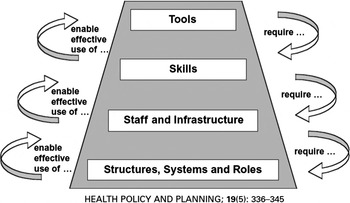
There is no doubt that there is a major nutrition dimension to all of the current development challenges faced by countries in sub-Saharan Africa. The available evidence and refined economic analysis shows clearly that all of these considerations could be addressed at relatively low cost with a considerable multiplier effect( 10 – 13 ). The problems have been variously characterised as human rights based or as technical considerations( Reference Patton 1 , Reference Jonsson 2 ), both of which require competent trained professional engagement for their effective and sustained resolution. ‘Capacity building’ has been an objective of many development programmes but in practice, has often been used as a euphemism referring to little more than training. Gillespie( Reference Gillespie 24 ) suggests that it is a nebulous concept, ‘often invoked as a reason for failure, yet rarely analysed in its conceptual or operational complexity’. This appears to reflect its numerous uses and definitions( Reference Gillespie 24 – 30 ). Potter et al. ( Reference Potter and Brough 28 ) refer to systemic capacity building, identifying a pyramid of nine separate but interdependent components to emphasise that capacity can only be developed in the context of the purpose for which it is seeking to operate or address issues. These form a four-tire hierarchy of capacity building needs: (1) structure, systems and roles; (2) staff and facilities; (3) skills; and (4) tools, as outlined in Fig. 2. All are necessary but none is sufficient and hence the development of capacity in nutrition is integral to, and a critical component of, the development of national capability. For the individual, personal capacity has a focus on skills and aptitudes which are acquired and augmented through training. It is deemed a necessary part of a capacity coalition, but not enough on its own without being harnessed and translated into organisational capacity through appropriate development.
Systemic capacity. Four-tire hierarchy of capacity building needs.
In the context of ‘nutrition workforce training and practice’, we use the term here to reflect all the ‘elements of academic and professional provision in relevant nutrition-related training, mentoring, knowledge transfer, practical and transferrable skills development, research and competences in individuals’ that clearly distinguish competent nutrition professionals capable of making a significant contribution to national nutrition agenda.
The evidence provided in this review and others( Reference Parker, Steyn and Mchiza 23 , Reference Gillespie 24 , Reference Sodjinou, Bosu and Fanou 31 , Reference Sodjinou, Bosu and Fanou 32 ) raise serious questions about nutrition training in Africa and the cadre of workforce being developed to support Scaling-Up-Nutrition (SUN) interventions. The key questions are: how can capacity be built for a clear purpose?; how can training programmes be made fit for practice and purpose within the context of national/regional and continent nutritional challenges?; what are the key quality assurance issues to be addressed and by whom and at what level?; what is needed to empower nutrition graduates to transform Africa's nutrition landscape?
This analysis shows that there are only limited good quality training opportunities currently available when compared with the need. It underscores the need to build capacity, and the likely importance of the alignment of the standards of training and education. Concerns relate to course structure, content of curricula, standardisation, benchmarks for courses in addition to knowledge, practical and interpersonal skills and competences and how these are nurtured and/or transferred from academic staff responsible for course delivery. Concerns about these issues have been expressed as important points for discussion and action in a number of recent workshops, including ANEC VI in 2014( 33 ). Both students and senior academics have reached agreement that standardisation of training to defined levels of competency and harmonisation of course accreditation are necessary if the quality and range of services being provided are to be improved across the board. In countries such as Kenya and South Africa, there have been national legislation with bodies being set up to regulate training and practice (e.g. Health Professions Council of South Africa; Kenya Nutrition and Dietetics Institute). These provide excellent examples of the necessary direction of travel but more needs to be done. In Kenya, of thirteen courses accredited by the Kenya Nutrition and Dietetics Institute, three have met the full accreditation criteria in 2015( 34 ). On the South African Nutrition Society Register in 2013, there were only fifty-one qualified nutrition registrants for the entire country, further demonstrating the problem of capacity( 40 ).
The SUN movement offers great ambition and hope for country-level inter-sectoral engagement. It is an important initiative which aspires to engage the entire community, but for this movement to be successful there is the imperative to address capacity needs in terms of nutrition professionals required for implementing programmes and for training trainers. The African Nutrition Society, a member based organisation, is part of the SUN movement and has the potential to play an enabling role in bringing nutrition professionals together and setting in place the infrastructure required to develop a strong professional presence.( 34 )
Conclusion
There is a wide gap in nutrition workforce capacity to meet present and future expectations for meeting the objectives for SUN interventions in Africa. The outcomes of the Abuja and Accra workshops reported here and the substantial gap identified by the review of HEI nutrition-related programmes make clear that serious commitment will be required to mitigate the shortfall in order to have any possibility of sustaining the interventions that are necessary for meeting the needs and targets of SUN in high-burden countries, the majority of which are in sub-Saharan Africa. The nature of the training needs and indications of the professional attitudes and skills required have been reviewed previously, but the response in terms of action has been modest( Reference Land 35 ). The pattern is mixed across Africa, with some regions having achieved greater maturity as a consequence of significant investment in personal human resources in nutrition. This only serves to indicate the magnitude of the task ahead, but there is a base from which to work. There are defined competencies and standards available and work on core competencies is underway. African Nutrition Matters is an African Nutrition Society e-bulletin which seeks to facilitate communication across the continent and featuring articles on global initiatives to improve nutrition( Reference Morgan 36 , 37 ). This has opened up a means of dissemination to which those in nutrition in Africa can contribute. One potential approach might be the formation of a communities of practice to enable those with a common to come together to share experience and work towards better practice( Reference Wenger, McDermott and Snyder 38 ). This model encourages disciplinary and inter-disciplinary exchange among people with shared purpose, finding value in interacting to solve common problems. The concept is not new but may have particular resonance in working together to address the complex issues around high-quality nutrition training in Africa.
There is an urgent need to address the building of systemic capacity in Africa as a formal structured process, supported by the highest levels of policy but enabled by an emerging and growing group of professional nutritionists. The building of systemic capacity has the potential to identify sectoral shortcomings, improve curriculum design, monitoring progress leading to more effective use of resources in the goal of SUN. Capacity building in the context of nutrition has commonalities with, and provides mutual support for institution building and institutional development as the foundation for national development and opportunities for lifelong health for all.( Reference Pielemeier, Salinas-Goytia, Maconick and Morgan 39 )
Acknowledgements
We are grateful to the IMTF for sponsoring the workshop in Abuja. We thank the many participants who attended and contributed to the workshop and those that responded to the audit. R. A. and S. S. are co-authored in recognition of their contribution to organising and recording the workshop and undertaking the audit of organisations, respectively.
Financial Support
The Workshop was funded by the IMTF.
Conflicts of Interests
None.
Authorship
Paper was prepared and edited by B. E. and A. A. J. All authors approved the drafts prepared by B. E. and A. A. J.



