


Introduction
Livestock herding is the primary land use and major source of pastoral livelihoods across the trans-Himalayan rangelands (Fox et al., Reference Fox, Nurbu, Bhatt and Chandola1994; Mishra, Reference Mishra2001). The livestock sector contributes 20–35% of the total household income in the Himalaya–Karakoram–Hindu Kush mountain ranges of Gilgit–Baltistan, Pakistan (Beg, Reference Beg, Kreutzmann, Abdulalishoev, Zhaohui and Richter2010) and > 80% of local people in this region depend upon livestock herding for their livelihoods. With a growing human population, livestock production has increased in Gilgit–Baltistan, including in the valleys surrounding Central Karakoram National Park (Khan et al., Reference Khan, Awan, Bocci, Khan, Abbas, Khan and Abbas2014). Although large predators and their prey species, including livestock, have coexisted in these mountainous landscapes since ancient times (Fox et al., Reference Fox, Nurbu, Bhatt and Chandola1994; Schaller, Reference Schaller1998), the increasing encroachment of pastoral activities on wildlife may lead to conflict (Rozen et al., Reference Rozen, Hussain, Mohammad, Jackson, Janečka and Michel2012).
Livestock depredation by large mammalian predators results in significant economic losses for poor pastoral communities across the Himalayas, including in Pakistan (Malik, Reference Malik, Jackson and Ahmad1997; Hussain, Reference Hussain2000, Reference Hussain2003; Dar et al., Reference Dar, Minhas, Zaman and Linkie2009; Din & Nawaz, Reference Din and Nawaz2011), and also threatens village-level food security (Rozen et al., Reference Rozen, Hussain, Mohammad, Jackson, Janečka and Michel2012). Hence, predation on livestock is one of the primary reasons for human–carnivore conflict, and a challenge for conservation (Oli et al., Reference Oli, Taylor and Rogers1994; Jackson et al., Reference Jackson, Ahlborn, Gurung, Ale, Timm and Crabb1996; Mishra, Reference Mishra1997; Hussain, Reference Hussain2003; Jackson & Wangchuk, Reference Jackson and Wangchuk2004; Namgail et al., Reference Namgail, Fox and Bhatnagar2007). It becomes a major concern when livestock predation intensifies with increasing numbers of predators as a result of strict enforcement of conservation rules (Namgail et al., Reference Namgail, Fox and Bhatnagar2007; Alexander et al., Reference Alexander, Cusack, Pengju, Kun and Riordan2016) or when domestic stock outnumber wild prey (Jackson & Wangchuk, Reference Jackson and Wangchuk2004), especially in montane areas where livestock herding is a substantial source of livelihood (Beg, Reference Beg, Kreutzmann, Abdulalishoev, Zhaohui and Richter2010). The conflict intensifies if there is poor understanding of the social, economic and ecological interaction between pastoral communities and threatened wildlife species (Bagchi & Mishra, Reference Bagchi and Mishra2006). We undertook this study, therefore, to investigate the socio-economic significance of livestock herding, the pattern of livestock herding and depredation, and the possible causes and implications of livestock depredation for local livelihoods and conservation of large predators with a view to devising appropriate conservation measures to create harmony between pastoral activities and conservation of mammalian predators.
Study area
The Hushey Valley (832 km2; WWF-Pakistan, 2008) forms the south-eastern part of the Central Karakoram National Park, 45 km north of Khaplu in Baltistan, Pakistan (Fig. 1). The valley lies at 2,500 m in the south and rises to > 5,000 m towards the north, including peaks of > 8,000 m (Khan et al., Reference Khan, Awan, Bocci, Khan, Abbas, Khan and Abbas2014). The area has a dry and cold desert mountain ecosystem, with most of the precipitation occurring in the form of heavy snowfall during November–March and the mean rainfall rarely exceeding 200 mm; most of the area is unaffected by the summer monsoon (WWF-Pakistan, 2008). The valley is characterized by rugged terrain with steep slopes (> 50°; Hussain, Reference Hussain2003). It is a refuge area not only for threatened species, such as the snow leopard Panthera uncia, but also for other important mammalian fauna, such as the Himalayan ibex Capra sibirica, the lynx Lynx lynx and the Tibetan wolf Canis lupus chanko (Roberts, Reference Roberts2005; Lovari & Bocci, Reference Lovari and Bocci2009). The predominant plants include species of Artemisia, Ephedra, Rosa, Hippophae, Myricaria and Berberis, and trees are dominated by species of Juniperus, Salix, Populus and Betula (WWF-Pakistan, 2008).
Land cover in the Hushey Valley, Central Karakoram National Park, Pakistan. (Source: WWF-Pakistan, 2008)

The valley is inhabited by c. 1,365 people (Government of Pakistan, 1998; with projected 2.5% annual increase) living in 130 households. Major sources of livelihood are agriculture and livestock herding, supplemented with cash incomes earned from tourism and services in the public sector (Hushey Village Conservation Committee, 2011). Since 1997 a community-based conservation programme has been operational in the valley, with support from various national and international conservation organizations. The valley is a Community Controlled Hunting Area, where limited trophy hunting of ibex is permitted, to earn revenue for local conservation and livelihood initiatives, such as the repair of irrigation water channels, tree plantation and paying honoraria to village wildlife guards. National and international hunters harvest 2–4 ibex each year for trophies, and 42 trophies were taken between 1997 and January 2012 (M. Aslam, pers. comm., 1 March 2012). A livestock insurance programme is also operational in the valley, with seed money capitalized in a local bank; the interest is used to provide compensation in cases of predation, following verification by a local livestock insurance committee.
Methods
Data were gathered by interviewing local community members in the Hushey Valley using a mix of qualitative (key informant interviews) and quantitative methods (structured interviews using a detailed questionnaire; Supplementary Material). These methods have been widely used to evaluate predation patterns, perceptions and human–carnivore interactions in Trans-Himalayan mountain ranges (e.g. Jackson et al., Reference Jackson, Ahlborn, Gurung, Ale, Timm and Crabb1996; Namgail et al., Reference Namgail, Fox and Bhatnagar2007; Suryawanshi et al., Reference Suryawanshi, Bhatnagar, Redpath and Mishra2013). The structured questionnaire was pre-tested in a pilot study with 15 respondents, and modified where necessary. The final questionnaire consisted of three main sections: (1) demographic and socio-economic profile of respondents, including the types, numbers, and economic value of livestock owned, (2) predation details, and (3) response to predation, opinion about causes of predation, and predator management.
In structured interviews the respondents represented 99 of the 130 households in the valley and were contacted through door-to-door surveys during March–September 2013. Following informed consent, respondents took 30–40 minutes to complete the questionnaire. With the help of local interpreters, questions were translated into Balti, the local dialect, when required.
The key informant interviews were conducted with employees of the Central Karakoram National Park Directorate and the Livestock & Dairy Development Department, members of the Hushey Village Conservation Committee and people who had suffered large losses of livestock, especially within pens. This process helped us to understand the dynamics of village conservation programmes, their collective efforts, communal pastoral activities, equitable benefit sharing, and the challenges involved. Discussions were recorded using a voice recorder, with the interviewees’ permission, and important points were also recorded in a notebook.
Analysis
All data were numerically coded and entered into SPSS v. 20 (IBM, Armonk, USA). The financial loss incurred by each respondent from livestock depredation was calculated based on the mean local price (in PKR) during 2012, calculated for each type of livestock by dividing the total number of animals sold by total amount earned from that particular type of livestock (subsequently converted to USD; PKR 99 = USD 1): PKR 42,500 for yak Bos grunniens, PKR 35,268 for cattle Bos taurus, including a crossbreed of yak and cow, PKR 13,478 for goats Capra aegagrus, and PKR 7,818 for sheep Ovis aries.
Demographic and socio-economic variables were coded as follows: age (young, ≤ 40 years; old, > 40 years); education (uneducated, no schooling or < 5 years of basic formal education; educated, ≥ 5 years of formal education); occupation (farmers; non-farmers); landholding status (low, < 1 acre of cultivated land; medium, 1–2 acres of cultivable land; high, > 2 acres of cultivable land); status of yearly cash income (low, < USD 2 per day; medium, USD 2–5 per day; high, > USD 5 per day); status of livestock holding (low, < 10 animals; medium, 10–20 animals; high, > 20 animals per household); predation losses in the last 5 years (no losses, no animals lost to predators; normal losses, 1–5 animals; high losses, > 5 animals), and compensation for livestock losses (yes/no).
Data on livestock composition, grazing patterns, predation patterns, local perceptions of key predators, causes of predation, and predator management were compiled using descriptive and inferential statistics. A series of univariate analyses (χ 2 tests) were run to identify the association between response variables (perception of predator populations; causes of predation, response to predation incidents and predator management) and hypothesized predictors (age, education, income class, land and livestock holding, predation losses; Naughton-Treves et al., Reference Naughton-Treves, Grossberg and Treves2003; Dar et al., Reference Dar, Minhas, Zaman and Linkie2009). The response variables were coded as follows: perceptions of predator population (a, increase; b, maintain; c, decrease; d, eliminate; e, don't know); response to predation (a, did nothing; b, rushed to kill the predator; c, went to the Village Conservation Committee for help; d, reported the case to a government authority; e, other); causes of predation (a, not enough natural prey; b, livestock are the favourite food; c, livestock were not guarded and were exposed to the predator; d, livestock are easy to kill; e, don't know); appropriate management strategies (a, increased guarding of livestock; b, increase in wild prey base; c, habitat improvement measures; d, lethal control; e, other).
Results
In 2013 a total of 2,290 head of livestock were reared by 98% of the 130 households. Goats comprised 33%, followed by sheep (32%), cattle, including a crossbreed of cow and yak (30%), yak (3%) and equines (2%). The mean number of livestock head per household was 17.6 ± SD 11.6. Most households (58%) owned > 20 animals; 32% owned 10–20 animals, 25% owned < 10 animals, and only 2% did not own any livestock. The grazing cycle comprised four phases: gradual upwards movement of livestock to spring pastures as the snow melted (May–June); partly attended and unattended grazing in summer pastures (July–August); gradual downwards movement in autumn (September–October); free grazing in and around the village (November–April).
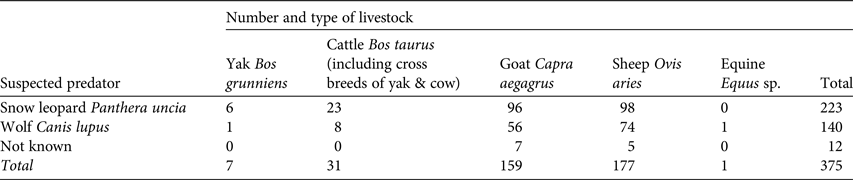
Of the 99 households interviewed, 90 confirmed they had lost livestock to mammalian predators, accounting for 375 kills during 2008–2012. The annual loss was 4.3% of the total livestock holdings in the village, or a mean of 0.8 livestock head per household per year (with losses of 1–21 animals per household). The greatest loss was of domestic sheep (47%), followed by goats (42%), cattle (8.3%), yak (1.9%) and equines (0.3%; Table 1). Of the total losses the majority (58%) were reported to be female animals. Snow leopards were reportedly responsible for 223 (60%) of the killings, and wolves for 140 (37%); in 12 (3%) cases the predator was unknown. Thus, snow leopards alone were responsible for more than half of predation incidents, accounting for 2.6% of the total livestock holdings in the valley.
Numbers of livestock killed by predators in the Hushey Valley, in the Central Karakoram National Park, Pakistan (Fig. 1) during 2008–2012.
A considerable portion (41%) of the predation incidents reported occurred in summer pastures, 29% during spring and 21% during autumn in intermediate pastures, and only 9% in winter pastures. During heavy snowfall in winter livestock remained in sheds or close to settlements, under surveillance. A large number of killings (51%) occurred at night in open spaces when livestock could not be penned for some reason; 36% of killings occurred in open pastures during grazing; 5% occurred inside pens; 4% occurred during movement from one pasture to another; and in 5% of cases the circumstances were unknown.
The total estimated economic loss incurred in Hushey from livestock depredation during 2008–2012 was PKR 4,926,596 (USD 51,620). Thus, the mean annual loss incurred by a household from livestock depredation was PKR 9,853 (USD 101), which equates to 10% of the mean annual cash income of a household.
The responses of local people (n = 99) to incidents of predation varied significantly (χ 2 = 153, df = 4, P < 0.01). The majority (64%) reported the incidents to their Village Conservation Committee to receive compensation from the livestock insurance fund, 32% did not respond, 1% reported to the relevant government department, and another 1% attempted to kill the predator. Among those who indicated no response (n = 32) 53% stated that they were unable to do anything, 31% were of the view that they could bear some losses of their livestock or tolerate the predators, and 16% provided no answer. There was significant difference in the perceived causes of predation (χ 2 = 84, df = 2, P < 0.001), which included poor or lax guarding practices (77%), a reduction in wild prey (13%), and livestock being the preferred food of predators (10%).
The respondents considered snow leopards and wolves to be equally threatening to their livestock but were more afraid of snow leopards (53%) than wolves (42%); 5% of respondents perceived no difference between the predators in relation to livestock depredation. Most of the respondents (88%) were of the view that lynx were absent from the valley.
Regarding appropriate measures to manage predators, the majority of the respondents (72%) suggested improved animal husbandry, such as guarded grazing and construction of predator-proof corrals; 18% preferred to promote habitat improvement measures to increase the natural prey base; and 10% were in favour of lethal control. A majority (71%) of the respondents who favoured lethal control were old and poorly educated.
Discussion
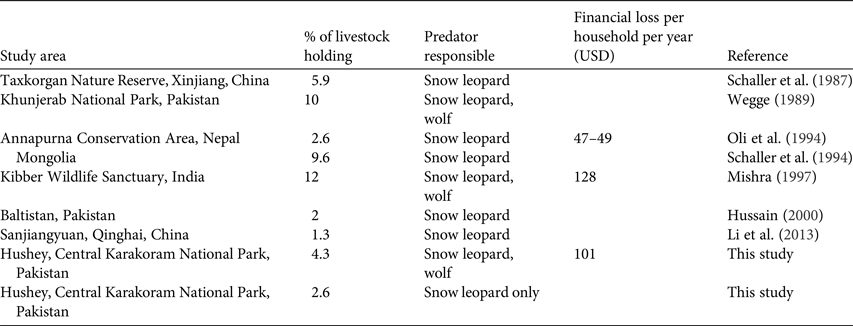
Our results show that the alleged losses of livestock to snow leopards and wolves are considerably higher in the study area than in most of the neighbouring mountain ranges (Table 2). Thus the mean annual monetary loss per household (10% of the mean cash income) is also relatively high, given the low cash income (mean USD 1,010 per household per year; for comparison, the sale of agricultural produce (cereals, vegetables and fruits) contributes 11% of the annual cash income per household. Sheep and goats were found to be the major victims of predation, as has also been reported in other parts of the Trans-Himalayan highlands (Namgail et al., Reference Namgail, Fox and Bhatnagar2007). That the majority of the animals killed were reported to be female can be attributed to the vulnerability of females to predators during lambing (Jackson et al., Reference Jackson, Ahlborn, Gurung, Ale, Timm and Crabb1996). In the study area there is an association between the occurrence of predation and livestock herding patterns, which changes with the seasons, livestock types, and agro-pastoral activities. Livestock depredation increases in spring and reaches a maximum in summer, when livestock are moved to higher pastures away from the village settlements. It declines gradually with the downwards movement of livestock from higher pastures with the onset of winter. Similar patterns have also been observed in Annapurna, Nepal (Jackson et al., Reference Jackson, Ahlborn, Gurung, Ale, Timm and Crabb1996). Although Dar et al. (Reference Dar, Minhas, Zaman and Linkie2009) reported a significant and positive relationship between temperature and fatal attacks by leopards Panthera pardus, we assume the pattern observed in Hushey is a product of herding patterns rather than changing temperatures, with livestock being less guarded when they reach more open grazing grounds at higher altitudes. The impact of climate change cannot be ruled out, however, with an upwards shift in the snowline bringing predators and livestock into closer proximity.
Annual % livestock depredation by large predators in various locations in the Asian highlands, and financial loss per household.
The number of herders tending livestock in the study area is inadequate, with only 2–4 male shepherds herding > 1,000 sheep and goats during the summer in high pastures, and 2–6 women tending a similar number of cattle in intermediate pastures. This problem is likely to intensify in the future as the younger generation becomes more involved in education, tourism and other off-farm income-generating opportunities.
More cases of predation (60%) in the study area were attributed to snow leopards compared to wolves (37%). However, such perceptions may not always reflect reality (Suryawanshi et al., Reference Suryawanshi, Bhatnagar, Redpath and Mishra2013). Our study of food habits of large predators in Hushey (M.Z. Khan et al., unpubl. data) showed that wolves consumed a higher proportion of livestock than did snow leopards. There are two possible reasons for this difference between perception and actual predation: (1) an earlier livestock insurance programme run by a local NGO, Baltistan Wildlife Conservation and Development Organization, provided compensation for cases of predation by snow leopards only, and therefore local people tended to attribute more cases to snow leopards; (2) mass killings by snow leopards, either within a pen or in an open area, aggravated local people's perceptions of the threat posed by snow leopards. The respondents reported three mass killings by snow leopards during 2008–2012: two inside a pen and one in an open area. Snow leopards have been observed entering pens and killing large numbers of sheep or goats at a time (Namgail et al., Reference Namgail, Fox and Bhatnagar2007).
Despite the alleged livestock losses to snow leopards and the greater perceived threat, people in Hushey tend to tolerate snow leopards, indicating the effectiveness of community-based conservation programmes. However, conservation initiatives focused on the snow leopard may also result in increased populations of sympatric carnivores, leading to more human–carnivore conflict (Alexander et al., Reference Alexander, Cusack, Pengju, Kun and Riordan2016). Despite attributing fewer livestock kills to wolves and perceiving them as a relatively smaller threat, people in Hushey exhibited negative behaviour towards wolves. This type of negative behaviour is likely to exacerbate persecution of wolves in the future and may also eventually affect snow leopards and other predators. For instance, local herders lace carcasses with poison to kill wolves or other unwanted predators, but this could also threaten other sympatric carnivores, especially snow leopards, whose habit is to return to an unfinished kill (Li et al., Reference Li, Yin, Wang, Jiagong and Lu2013).
According to the respondents the preferred strategies for predator management were improved guarding of livestock, coupled with measures to improve habitat conditions, such as rotational grazing and cultivation of fodder crops on more barren lands. Other recommended options included exploring income-generating opportunities for local communities that are not benefiting directly from a conservation programme (Mishra et al., Reference Mishra, Allen, McCarthy, Madhusudan, Bayarjargal and Prins2003), and compensating for losses of livestock to predators by initiating community-based livestock insurance schemes (Nowell & Jackson, Reference Nowell and Jackson1996), which have proved to be effective in similar mountain ecosystems; e.g. in the Spiti region of India (Mishra et al., Reference Mishra, Allen, McCarthy, Madhusudan, Bayarjargal and Prins2003) and in Baltistan, Pakistan (Hussain, Reference Hussain2000; Rozen et al., Reference Rozen, Hussain, Mohammad, Jackson, Janečka and Michel2012). Although not much encouraged within the local culture, a potential option that could be explored in Hushey is the use of improved breeds of guard dogs to ward off predators, as is also recommended in other snow leopard range countries (e.g. Nepal, Jackson et al., Reference Jackson, Ahlborn, Gurung, Ale, Timm and Crabb1996; India, Namgail et al., Reference Namgail, Fox and Bhatnagar2007). However, guard dogs must be well kept, and fed and controlled appropriately, otherwise they become problematic to wildlife.
Livestock depredation by snow leopards and wolves is a serious economic concern for agro-pastoral communities in Karakorum and adjacent montane landscapes, and the situation could jeopardize community-based conservation initiatives by triggering human–carnivore conflict. Attacks on domestic livestock have been attributed to lax guarding practices, but may also be attributable to increasing carnivore populations as a result of stringent conservation measures (Alexander et al., Reference Alexander, Cusack, Pengju, Kun and Riordan2016). The lax guarding is a product of a traditional transhumance grazing system that has been modified over time with changing livelihood options. The herding patterns evolved over centuries, adapting to local circumstances, but weakened over time as the number of shepherds declined and the younger generation pursued alternative livelihoods, such as growing potatoes as a cash crop. Now there are fewer and less skilled shepherds tending a large number of livestock, and we recommend that they be trained in anti-predator measures and employed for longer periods by paying them from the village conservation fund or from trophy hunting revenues.
Threats to large predators are interrelated; e.g. a poison used with the intention of killing one predator may also affect others. Thus, human–wildlife conflict is not a simple issue that can be addressed through a single species-focused conservation action but rather requires an integrative conservation initiative (e.g. a livestock insurance programme that compensates for predation by both snow leopards and wolves).
Acknowledgements
We thank WWF-Pakistan and Ev-K2-CNR for logistical support. We express our gratitude to Professor Sandro Lovari, University of Siena, Italy, for his technical guidance and review of this article. We appreciate the help of Ismail, Musa and Sakhawat with conducting interviews, and field staff of the Directorate of the Central Karakoram National Park and the local communities of Hushey for their assistance, support and hospitality during the fieldwork.
Author contributions
MZK conducted the field surveys and drafted the article. BK participated in some field surveys and reviewed the article. MSA helped to design and review the research design. FB helped with data analysis and a literature review.
Biographical sketches
Muhammad Zafar Khan’s research interests include ecology and conservation of large mammals, community-based conservation and human–carnivore interactions. Babar Khan is interested in the distribution of mammals, protected area management and climate change. Muhammad Saeed Awan’s research focuses on vertebrate pest management and sustainable agriculture. Farida Begum’s research focuses on soil ecology, biology and water quality monitoring.



