





Introduction
Scholars have studied human deception for over a century, examining its morality, frequency, and evolution (e.g., Bok, Reference Bok1978; Hall, Reference Hall1891; Hartshorne & May, Reference Hartshorne and May1928; Piaget, Reference Piaget1932/Reference Piaget1965). Recent research has focused on the development and maintenance of deception from childhood to adulthood (e.g., Talwar & Crossman, Reference Talwar, Crossman and Benson2011, Reference Talwar and Crossman2022; Walczyk et al., Reference Walczyk, Harris, Duck and Mulay2014), showing that, although deception emerges early in preschool-aged children (e.g., Evans & Lee, Reference Evans and Lee2013) and is associated with their social cognitive abilities (e.g., Talwar & Lee, Reference Talwar and Lee2008), not all those who are capable of lying choose to do so frequently. Indeed, most adults lie infrequently, and overall rates of lying tend to decline with age (Debey et al., Reference Debey, Schryver, Logan, Suchotzki and Verschuere2015; Levine et al., Reference Levine, Serota, Carey and Messer2013; O’Connor et al., Reference O’Connor, Kea, Li, Ding and Evans2022). Nevertheless, a small subset of individuals lie prolifically and problematically (Serota & Levine, Reference Serota and Levine2015; Serota et al., Reference Serota, Levine and Boster2010), but why and how they follow divergent trajectories of lying remains poorly understood.
Recent work suggests that there may be distinct developmental patterns of lie-telling (Lavoie et al., Reference Lavoie, Leduc, Arruda, Crossman and Talwar2017; Markowitz, Reference Markowitz2023). For some, lying begins and remains an occasional or even rare behavior, while for others, it evolves into a more habitual and possibly maladaptive practice (Curtis & Hart, Reference Curtis and Hart2020; Markowitz, Reference Markowitz2023, Reference Markowitz2025). These differing trajectories suggest the need for a more nuanced, developmental approach to studying deception. One theoretical framework guiding recent investigations is the transactional model of lie development (Crossman & Talwar, Reference Crossman and Talwar2021; Talwar & Crossman, Reference Talwar, Crossman and Benson2011, Reference Talwar and Crossman2022). This model conceptualizes lie- and truth-telling behaviors as dynamic outcomes of continuous interactions between cognitive development (e.g., theory of mind, executive functioning), social-environmental factors (e.g., parenting style, disciplinary strategies), and individual differences (e.g., temperament, personality). Rather than viewing dishonesty as a fixed trait, the transactional model emphasizes the evolving nature of lying, shaped over time by reciprocal influences between the individual and their environment (Bronfenbrenner & Morris, Reference Bronfenbrenner, Morris, Damon and Lerner2006). This framework underscores the importance of examining lying behavior not in isolation, but in relation to the broader developmental context in which it unfolds and emphasizes the reciprocal and cumulative nature of developmental processes that give rise to different lying patterns over time.
Empirical support for this framework comes from two complementary streams of research. The first is experimental, laboratory-based studies, particularly in children, which have yielded important insights into the early emergence of lie-telling abilities and their associations with cognitive milestones (e.g., see Lee & Imuta, Reference Lee and Imuta2021; Sai et al., Reference Sai, Shang, Liu, Sheng, Fu, Ding, X. and Lee2021; Talwar & Crossman, Reference Talwar and Crossman2022 for review). These studies have clarified how skills such as inhibitory control and theory of mind are necessary precursors to successful lying (e.g., Ding et al., Reference Ding, Wellman, Wang, Fu and Lee2015; Evans & Lee, Reference Evans and Lee2013; Lavoie et al., Reference Lavoie, Leduc, Arruda, Crossman and Talwar2017; Sai et al., Reference Sai, Shang, Liu, Sheng, Fu, Ding, X. and Lee2021; Talwar & Lee, Reference Talwar and Lee2008; Williams et al., Reference Williams, Leduc, Crossman and Talwar2016; Zhao et al., Reference Zhao, Shang, Compton, Fu and Sai2021). However, these investigations are typically limited to structured tasks, capture behavior in isolated, artificial contexts, and do not reflect broader patterns of how lying unfolds in real-world contexts or across long periods of time (Lavoie et al., Reference Lavoie, Leduc, Arruda, Crossman and Talwar2017). The second stream includes self-report and informant-report studies, especially prevalent in the adult literature (e.g., Debey et al., Reference Debey, Schryver, Logan, Suchotzki and Verschuere2015; Dykstra et al., Reference Dykstra, Turchio, Willoughby and Evans2023; Gouwy et al., Reference Gouwy, Dierckx, Ivanova, Roets and De Clercq2024; Halevy et al., Reference Halevy, Shalvi and Verschuere2014; Markowitz, Reference Markowitz2025; Serota & Levine, Reference Serota and Levine2015; Serota et al., Reference Serota, Levine and Boster2010). This research has illuminated the role of lying as an everyday interpersonal strategy and highlighted meaningful individual differences in lie frequency and employment of lying as an interpersonal communicative strategy (e.g., DePaulo et al., Reference DePaulo, Kashy, Kirkendol, Wyer and Epstein1996; Halevy et al., Reference Halevy, Shalvi and Verschuere2014; Hart et al., Reference Hart, Lemon, Curtis and Griffith2020; Serota & Levine, Reference Serota and Levine2015; Serota et al., Reference Serota, Levine and Boster2010). While this literature contributes to understanding the interpersonal and dispositional aspects of deception, it is often cross-sectional. Crossman and Talwar (Reference Crossman and Talwar2021) note that the majority of work focuses on narrow age ranges of childhood, adolescence, or young adulthood and that examination of the transactional model across the lifespan is essential for identifying stable versus changing patterns of lying from childhood through adulthood. Moreover, it can elucidate how early lie-telling behaviors relate to later outcomes such as psychiatric diagnoses or criminal involvement (Curtis & Hart, Reference Curtis and Hart2022) and offer insights into potential interventions for problematic lying (Curtis & Hart, Reference Curtis and Hart2022). The current study aims to fill gaps in the literature by identifying trajectories of lie-telling behavior longitudinally and examining their childhood predictors and associations with psychiatric diagnoses and criminal records in early adulthood.
Individual differences and patterns of lying behavior
Lie-telling emerges in the preschool years and improves through the school years with cognitive development playing a significant, facilitating role (e.g., Sai et al., Reference Sai, Shang, Liu, Sheng, Fu, Ding, X. and Lee2021; Talwar & Lee, Reference Talwar and Lee2008). Cross-sectional research suggests that lying then peaks, typically in young adulthood and declines through adulthood, alongside inhibitory control (Debey et al., Reference Debey, Schryver, Logan, Suchotzki and Verschuere2015; Dykstra et al., Reference Dykstra, Willoughby and Evans2023; Jensen et al., Reference Jensen, Arnett, Feldman and Cauffman2004; Levine et al., Reference Levine, Serota, Carey and Messer2013). Lying also becomes more selective with age, with most adults predominantly honest in daily interactions (Serota et al., Reference Serota, Levine and Boster2010). Yet, individual differences exist, with some individuals becoming frequent liars (Curtis & Hart, Reference Curtis and Hart2020; Serota & Levine, Reference Serota and Levine2015). However, there has been little research examining varied patterns or trajectories of lying.
The limited cross-sectional evidence suggests that patterns of lie-telling might emerge in childhood. For instance, Lavoie et al. (Reference Lavoie, Leduc, Arruda, Crossman and Talwar2017) found that 51% of children between ages 3 and 14 years were reported by parents as occasional liars, 42% lied primarily for material benefit, and 7% were antisocial liars who frequently lied to avoid personal consequences. Though chronic lying seems to be less common, estimated prevalence rates for frequent lying in children vary from as low as 3% to 23%, based on different reporters (Stouthamer-Loeber, Reference Stouthamer-Loeber1986). In adults, approximately 13% self-identify as pathological liars who lie frequently (Curtis & Hart, Reference Curtis and Hart2020).
The few longitudinal studies to date on the development of lying have been of short duration (1–3 years; e.g., Carl & Bussey, Reference Carl and Bussey2022; Dykstra et al., Reference Dykstra, Turchio, Willoughby and Evans2023; Talwar et al., Reference Talwar, Lavoie and Crossman2019; Zhao et al., Reference Zhao, Shang, Compton, Fu and Sai2021). One study found that occasional lying in children (according to parent and teacher reports) was widespread at school entry, but persistent lying over 3 consecutive years was low at 4.9% for boys and 2.2% for girls (Gervais et al., Reference Gervais, Tremblay, Desmarais-Gervais and Vitaro2000). Taking the child and adult literatures together, findings suggest that lying patterns may diverge over time, with a small proportion of individuals developing frequent, maladaptive lie-telling, which could be related to other problem behaviors and/or disorders over time (e.g., Curtis & Hart, Reference Curtis and Hart2020; Hart et al., Reference Hart, Lemon, Curtis and Griffith2020; Rogers et al., Reference Rogers, Bender and Hartigan2024). Recent latent profile work (Dykstra et al., Reference Dykstra, Willoughby and Evans2023) identified subgroups of adolescent (10 to 16 years of age) liars differing in depression, relationship quality, and externalizing problems, illustrating that varied developmental patterns of dishonesty may be present by adolescence.
Trajectory of problematic lying
While most people lie with low frequency (Curtis & Hart, Reference Curtis and Hart2020; Lavoie et al., Reference Lavoie, Leduc, Arruda, Crossman and Talwar2017), limited evidence exists to inform a developmental picture of the emergence and development of problematic lying and its predictors. For instance, children who tend toward a trajectory of persistent lying also seem likely to show higher rates of externalizing problems (Lavoie et al., Reference Lavoie, Wyman, Crossman and Talwar2018; Mugno et al., Reference Mugno, Malloy, Waschbusch, Pelham and Talwar2019; Talwar & Lavoie, Reference Talwar and Lavoie2022). Gervais et al. (Reference Gervais, Tremblay, Desmarais-Gervais and Vitaro2000) found that children who were more persistent liars over time were reported as more disruptive by teachers. Once identified, it is also important to understand which outcomes later are associated with early problematic lie-telling patterns. For instance, frequent lie-telling tends to be associated with antisocial behaviors such as aggression, delinquency, and conduct problems and so may be an early indicator of future problematic behaviors or disorders (Gervais et al., Reference Gervais, Tremblay, Desmarais-Gervais and Vitaro2000; Ostrov et al., Reference Ostrov, Ries, Stauffacher, Godleski and Mullins2008; Salekin et al., Reference Salekin, Kubak, Lee, Harrison and Clark2008; Stouthamer-Loeber, Reference Stouthamer-Loeber1986; Zanette et al., Reference Zanette, Walsh, Augimeri and Lee2020). In fact, lying is often seen as one of a broader array of antisocial tendencies and problematic behaviors (Mugno et al., Reference Mugno, Malloy, Waschbusch, Pelham and Talwar2019; Ostrov, Reference Ostrov2006; Ostrov et al., Reference Ostrov, Ries, Stauffacher, Godleski and Mullins2008; Stouthamer-Loeber, Reference Stouthamer-Loeber1986; Stouthamer-Loeber & Loeber, Reference Stouthamer-Loeber and Loeber1986). For example, Stouthamer-Loeber and Loeber (Reference Stouthamer-Loeber and Loeber1986) found that childhood lie-telling was significantly associated with delinquency, theft, and fighting, with these associations increasing with age. Ostrov (Reference Ostrov2006) found that both relational and physical aggression during early childhood significantly predicted concurrent deception. This aligns with findings by Mugno et al. (Reference Mugno, Malloy, Waschbusch, Pelham and Talwar2019), who reported that children with disruptive behavior disorders engage in instrumental lying for personal gain. Adolescence, a time of increased risk-taking and independence, could further influence lying trajectories and later outcomes (Engels et al., Reference Engels, Finkenauer and van Kooten2006). To understand these associations and test whether they extend to predict problematic behavior in adults, it is crucial to examine longitudinal relations among trajectories of lying and later maladaptive outcomes such as antisocial personality disorder and criminal behavior (Talwar & Crossman, Reference Talwar and Crossman2022).
At the same time, it is important to explore potential mechanisms underlying the theoretical, dynamic relations among lie trajectories and later outcomes. For instance, aggression and impulsivity, although distinct traits, each may differentially contribute to both lie-telling (to deny one’s misdeeds) and antisocial behaviors (the misdeeds; Dykstra et al., Reference Dykstra, Turchio, Willoughby and Evans2023; Rogers et al., Reference Rogers, Bender and Hartigan2024; Spide et al., Reference Spidel, Hervé, Greaves and Yuille2011). For instance, Dykstra et al. (Reference Dykstra, Turchio, Willoughby and Evans2023) found in a 1-year longitudinal study that adolescents’ impulsivity predicted their lying to parents and teachers. Such early, heightened lie-telling tendencies may predict later antisocial personality and criminal actions in adulthood (Jiang et al., Reference Jiang, Liu, Liao, Ma, Rong, Tang and Wang2013; Salekin et al., Reference Salekin, Kubak, Lee, Harrison and Clark2008; Satterfield & Schell, Reference Satterfield and Schell1997). Lying, while not required to meet diagnostic criteria for antisocial personality disorder, is nevertheless a prominent feature of the diagnosis and may emerge early in youth, predicting later antisocial symptoms (Holmes et al., Reference Holmes, Slaughter and Kashani2001; Salekin et al., Reference Salekin, Kubak, Lee, Harrison and Clark2008). Parent reports of adolescent lying have also been associated with increased criminality and arrest rates in young adulthood (Satterfield & Schell, Reference Satterfield and Schell1997), while juvenile offenders are more likely to engage in deception as an interpersonal strategy for personal gain (Spidel et al., Reference Spidel, Hervé, Greaves and Yuille2011). These findings suggest possible overlap among impulsivity, aggression, patterns of problematic lying, antisocial personality disorder, and criminal behavior. They also align with the transactional model’s emphasis on the dynamics around persistent lie-telling trajectories (Talwar & Crossman, Reference Talwar, Crossman and Benson2011; Reference Talwar and Crossman2022). Crossman and Talwar (Reference Crossman and Talwar2021) highlight that chronic dishonesty can undermine moral development and social relationships, may signal broader behavioral and psychosocial issues and, especially when uncorrected, can be associated with psychopathology and externalizing problems that extend into adulthood (Talwar & Crossman, Reference Talwar and Crossman2022).
Current study
Given evidence suggesting childhood lying could be associated with future antisocial behavior, identifying early, maladaptive lie-telling trajectories could aid with early intervention. To explore this possibility, the current longitudinal study followed a large sample of children for 16 years, from childhood to early adulthood, using parent and teacher reports to track their lying. Including multiple informants familiar with the children in different contexts (parents at home, teachers at school) provided an opportunity to assess and compare the consistency and persistence of reported lying patterns.
Although self-reports and laboratory studies provide valuable insight into cognitive and moral processes underlying deception, the present study takes a complementary approach by examining observed, detected dishonesty as reported by parents and teachers – adults who interact with children across multiple developmental stages and distinct contexts. These reports capture socially meaningful instances of lying that have real-world interpersonal consequences (Dykstra et al., Reference Dykstra, Willoughby and Evans2020; Lavoie et al., Reference Lavoie, Wyman, Crossman and Talwar2018; Levine, Reference Levine2022; Talwar & Lavoie, Reference Talwar and Lavoie2022). While such measures do not encompass undetected lying (e.g., parent reports may underestimate adolescent lying; Dykstra et al., Reference Dykstra, Willoughby and Evans2020), perceived dishonesty is meaningful for understanding how others respond to children’s behavior and how such perceptions may shape later outcomes (Gouwy et al., Reference Gouwy, Dierckx, Ivanova, Roets and De Clercq2025; Levine, Reference Levine2022; Ostrov et al., Reference Ostrov, Ries, Stauffacher, Godleski and Mullins2008; Talwar et al., Reference Talwar, Renaud and Conway2015). Parents and teachers therefore provide unique and complimentary perspectives that, together, offer an ecologically valid picture of children’s lie-telling over time (Ostrov et al., Reference Ostrov, Ries, Stauffacher, Godleski and Mullins2008), emphasizing the value of multi-informant data despite potentially limited convergence between reporters.
Given existing gaps in the literature, this study extends prior short-term research employing parent and teacher informants (e.g., Gervais et al., Reference Gervais, Tremblay, Desmarais-Gervais and Vitaro2000; Gouwy et al., Reference Gouwy, Dierckx, Ivanova, Roets and De Clercq2024; Lavoie et al., Reference Lavoie, Wyman, Crossman and Talwar2018), with a longer-term longitudinal study. Specifically, this study uses longitudinal data to identify distinct developmental trajectories of lie-telling behavior from childhood through early adulthood. It further investigates early predictors of these trajectories and their associations with adult psychiatric and behavioral outcomes, with the goal of informing theory and guiding potential interventions for problematic deception.
Based on previous literature, the following hypotheses are posited. Note that, because the analyses were not preregistered, these hypotheses should be considered exploratory. First, divergent lie-telling trajectories (e.g., consistently low versus consistently high lie-telling rates over time) will be detectable from middle childhood through early adulthood (Lavoie et al., Reference Lavoie, Leduc, Arruda, Crossman and Talwar2017). Second, most children will show increasing dishonesty that peaks in early adolescence followed by a decline (Debey et al., Reference Debey, Schryver, Logan, Suchotzki and Verschuere2015), but a small group of children are expected to persist with higher rates of dishonesty (Gervais et al., Reference Gervais, Tremblay, Desmarais-Gervais and Vitaro2000; Serota et al., Reference Serota, Levine and Boster2010). Third, children with higher levels of aggression and impulsivity are expected to have more dishonest trajectories (Mugno et al., Reference Mugno, Malloy, Waschbusch, Pelham and Talwar2019; Talwar & Lavoie, Reference Talwar and Lavoie2022). Fourth, trajectories of higher rates of dishonesty will predict adult antisocial personality disorder and criminal records (Salekin et al., Reference Salekin, Kubak, Lee, Harrison and Clark2008).
Method
Participants
Participants were from Quebec Longitudinal Study of Kindergarten Children (QLSKC), a population-based sample of children (n = 3,017) attending kindergarten in Quebec in the 1986–1987 and 1987–1988 school years. The cohort was selected by a random sampling procedure (47.2% girls, 52.8% boys; see cohort profile: Rouquette et al., Reference Rouquette, Côté, Pryor, Carbonneau, Vitaro and Tremblay2014). Schools were randomized and stratified by administrative region and school board size (small, medium, large). Participants were around 6 years old when first enrolled in the study. The cohort comprised sub-samples of (a) 2,000 children representative of Quebec kindergarteners; and (b) 1,017 children who, in kindergarten, scored at the >80th percentile on the disruptive behavior scale of the Social Behavior Questionnaire. The current study uses parent and teacher report data on children’s lying and other behaviors between 6 and 19 years of age; as well as data on psychiatric symptoms at age 22 and lifetime criminal activity (ages 13–17 years and 18–25 years combined). The cohort data was linked to official court records detailing juvenile and adult criminal convictions with full coverage (i.e., no missing data on the outcomes). The study was approved by the University of Montreal Ethics Board Ethics Board (#2009-198). Written informed parental consent was obtained prior to participation.
Participants with a least one wave of parents’ reports of lying (n = 3,014) were included in the parent report analyses and had an average of 5.65 (SD = 1.91) completed parent reports (out of 8). Participants with at least one wave of teachers’ reports of lying (n = 3,002) were included in the teacher report analyses and had an average of 4.54 (SD = 1.24) completed teacher reports (out of 6). Fifteen participants had parent reports but no teacher reports, and three had teacher reports but no parent reports of lying.
Measures
Data for the current analyses came from multiple informants, including parent reports (97.8% mothers), teacher reports, mental health diagnostic assessments, and official criminal records. All survey measures were originally collected in French.
Parents’ and teachers’ reports of lying
Parents and teachers responded to a single item from the Social Behavior Questionnaire (SBQ; Collet, Tremblay, Boivin, & Côté., Reference Collet, Orri, Tremblay, Boivin and Côté2023) asking how often the child told lies on a 3-point Likert-type scale with 0 = does not apply, 1 = occasional, and 2 = frequent. Because the response scale was categorical, these measures index relative frequency categories rather than absolute counts. Therefore, changes in trajectories reflect shifts between ordinal categories rather than continuous increases in lie frequency. Parents answered this question about their child’s lying at ages 6, 7, 8, 10, 11, 12, 15, and 19 years. Teachers reported on the same child starting at age 7 years and at 8, 10, 11, 12, and 15 years.
Given evidence that parents and teachers may detect only a subset of children’s lies (Evans et al., Reference Evans, Bender and Lee2016; Talwar et al., Reference Talwar, Renaud and Conway2015), these reports are best understood as indexing detected or observable deception within the home and school environments, which is important for assessing the social impact and external correlates of lying. They provide information about socially visible dishonest behaviors that have real interpersonal and developmental consequences (Gongola et al., Reference Gongola, Scurich and Quas2017). Accordingly, parent and teacher data were analyzed separately to preserve the reporters’ unique vantage points, consistent with multi-informant approaches in developmental research that treat differing reports as informative rather than redundant (Dirks et al., Reference Dirks, De Los Reyes, Briggs-Gowan, Cella and Wakschlag2012).
Parent reports of aggression
Parents rated children’s aggressiveness at ages 6 and 19 years via 12 items from the SBQ (Collet et al., Reference Collet, Orri, Tremblay, Boivin and Côté2023) which has good predictive validity for various outcomes such as educational attainment, employment earnings, and psychiatric problems (e.g., Brezo et al., Reference Brezo, Barker, Paris, Hébert, Vitaro, Tremblay and Turecki2008). Items were rated on a three-point scale: 0 = never applies, 1 = applies sometimes, and 2 = frequently applies. Cronbach’s alphas ranged from 0.83–0.94. Items included ratings of child fighting, biting/hitting others, bullying others, being disobedient, blaming others, being inconsiderate, irritability, not sharing, fidgeting, destroying belongings, not being liked, and restlessness. Parent reports of aggressiveness at age 6 were used to predict lying trajectory membership, while aggression at 19 years was used as an outcome of lying trajectory membership.
Teacher report of impulsivity
Teachers rated children’s level of impulsivity at age 12 via 7 items from the SBQ (Collet et al., Reference Collet, Orri, Tremblay, Boivin and Côté2023; α = 0.93). Items were rated on a three-point scale: 0 = never applies, 1 = applies sometimes, and 2 = frequently applies. Items included ratings of moving continuously, jumps from one activity to another, irritability, agitation, seeks attention by shouting, difficulty remaining still and acting without thinking. Teacher reports of impulsivity were used as predictors of lying trajectory membership.
Mental health diagnoses
At age 22 years, participants completed the French version of the Diagnostic Interview Schedule (DSM-III-R; Robins et al., Reference Robins, Helzer, Cottler and Goldring1989) to assess clinical symptoms/diagnoses for adults. Trained research assistants conducted assessments based on the DSM-III-R criteria for antisocial personality disorder (such as illegal activities, impulsivity, and remorselessness).
Criminal records
Information on juvenile (13–17 years old) and adult (18–25 years old) criminal convictions was obtained from the official records of the juvenile court and the adult courts of Quebec. We distinguished between violent crimes (e.g., sexual assault, battery, homicide) with and without a weapon and nonviolent crimes (e.g., credit card fraud, drug possession). Lifetime criminal convictions were computed by combining juvenile and adult records.
Analytic plan
After descriptive analyses, we analyzed the data using latent growth models for the overall sample to determine the baseline models for mixture analyses. We compared no-growth (intercept-only), linear, and quadratic latent growth models representing sample-average trajectories for parent and teacher reports of lie-telling, respectively. We also compared models assuming equal intervals between measurements to models using latent growth factor loadings to accurately reflect the unequal intervals between measurements. Model fit was evaluated using multiple fit indices (CFI, TLI > 0.90 for acceptable fit; ≥0.95 for excellent fit; RMSEA, SRMR < 0.08 for acceptable fit; <0.06 for excellent fit; Hu & Bentler, Reference Hu and Bentler1999). Next, growth mixture modeling (GMM) involved comparing 2- to 4-class models (i.e., assuming 2, 3, or 4 latent trajectory groups) for parents’ and teachers’ reports of lying with class-specific intercept and slope estimates. Bayesian Information Criterion (BIC) was used to narrow down potential class solutions, with smaller values of BIC indicating better fit (Nylund et al., Reference Nylund, Asparouhov and Muthén2007). The theoretical interpretability of class solutions and likelihood ratio tests were also considered in the selection of the final class solutions (Grimm & Ram, Reference Grimm and Ram2009; Nylund et al., Reference Nylund, Asparouhov and Muthén2007).
To examine correlates of trajectory class membership, including mental health diagnoses and criminal records, we used an approach that minimizes bias in model estimates by accounting for uncertainty in class membership (Asparouhov & Muthén, Reference Asparouhov and Muthén2014). Rather than treating class membership as an observed and error-free variable, this three-step approach involves estimating the GMM (Step 1) as described above, then using each case’s most likely class membership assigned based on logit probabilities (Step 2) as categorical latent variables in relation to selected correlates (Step 3). This approach takes into account the uncertainty of classification in the second step (Asparouhov & Muthén, Reference Asparouhov and Muthén2014; Bakk & Vermunt, Reference Bakk and Vermunt2016). Predictors were all entered together with latent class membership as the outcome variable, thus controlling for each other in the multinomial logistic regression.
Parent and teacher data were modeled separately to preserve each informant’s unique, context-specific perspective on children’s dishonesty. The modest convergence between parent and teacher reports supports analyzing them separately, as each provides a distinct and context-specific perspective on children’s dishonesty, reflecting different relationships and environments in which deception is observed over time.
Preregistration statement. This study was not preregistered. The analyses were conducted using an archival longitudinal dataset that was originally collected beginning in the 1980s, prior to the widespread adoption of preregistration practices in psychological research. As such, the analytic strategy and hypotheses reported here were developed after the data had already been collected. Accordingly, the analyses should be interpreted as exploratory.
Results
Descriptive statistics and correlations
Descriptive statistics and correlations for the study variables are displayed in Supplemental Tables S1 to S4, including frequencies of lies reported at each age by informant (parent: Supplementary Table S1 and teacher: Supplementary Table S2) and child sex. Parent and teacher reports were correlated only weakly at each time point (7 years = 0.207; 8 years = 0.209; 10 years = 0.217; 11 years = 0.196; 12 years = 0.193; 15 years = 0.235, all p’s < .001), suggesting that each informant contributed unique information. Parents’ reports of their children’s lying averaged between 0.56–0.78, with parents initially reporting the children lying infrequently and appearing to slightly decline, on average, across ages (see Supplemental Figure S1). Teacher report means appeared to be even lower, M = 0.27–0.35 (see Supplemental Figure S1). Although these measures only ranged from 0–2, raising potential concerns about normality and the appropriateness of growth modeling for this data, skewness and kurtosis for parents’ reports were quite low, with skewness ranging from −0.006 to 0.44 and kurtosis ranging from −0.74 to −0.34. Teachers’ reports appeared to be a bit less normally distributed, with skewness from 1.40 to 1.73 and kurtosis from 0.93 to 2.13, but still within ranges considered to be acceptable for structural equation modeling (Brown, Reference Brown2006). Visual inspection of histograms for these variables further supported the normality assumption.
Missing data analysis
Supplemental Tables S3 and S4 show sample sizes for each variable and time point. Missing data ranged from 0.4% to 50% for teacher and parent reports of lying, with the largest amounts of missing data (42.8% for teachers, 50.0% for parents) at age 10. For antisocial personality and aggression measures, missing data ranged from 28.7% to 44.5%. Rouquette et al., Reference Rouquette, Côté, Pryor, Carbonneau, Vitaro and Tremblay2014 contains additional information about sources and patterns of attrition; overall, the nature and amount of missing data showed typical patterns for longitudinal studies (30%–70%; Gustavson et al., Reference Gustavson, von Soest, Karevold and Røysamb2012).
To characterize potential bias in estimates due to missing data, we examined several correlates in relation to missing data patterns in the sample. To do this, we created a variable indicating counts of how many lying reports each participant had from parents (M = 5.65 out of a possible 8, SD = 1.91) and teachers (M = 4.54 out of a possible 6, SD = 1.24). Correlations indicated that missing data for parental lying reports was significantly but weakly associated with sex (r = −.237, p < .001), baseline (age 6) aggression diagnosis (r = −.152, p < .001), crime convictions (r = −.100 to −.083, ps < .001), and antisocial personality diagnosis at age 22 (r = −.081, p < .001), such that boys and participants with crime convictions and diagnoses tended to have more missing data than girls or those without crime convictions or diagnoses. Missing data for teacher lying reports showed similar patterns (r sex = −.274, p < .001; other rs = −.097 to −.045, ps ≤ .001 to .013), except that missing data for teacher reports was not significantly associated with non-violent crime convictions or antisocial personality diagnoses. Thus, we concluded that boys, individuals with diagnoses, and individuals with crime convictions may be relatively underrepresented in our data and thus in our estimates; however, this limitation is perhaps balanced by the overrepresentation of participants with particularly high disruptive behavior at age 6 in the sample. Missing data was handled using full information maximum likelihood estimation, which includes all cases with at least one of the variables in the analysis (Enders, Reference Enders2022). For analyses examining correlates of trajectory class membership, cases with missing data on correlates were deleted listwise per software constraints.
Teacher reports
Average trajectories
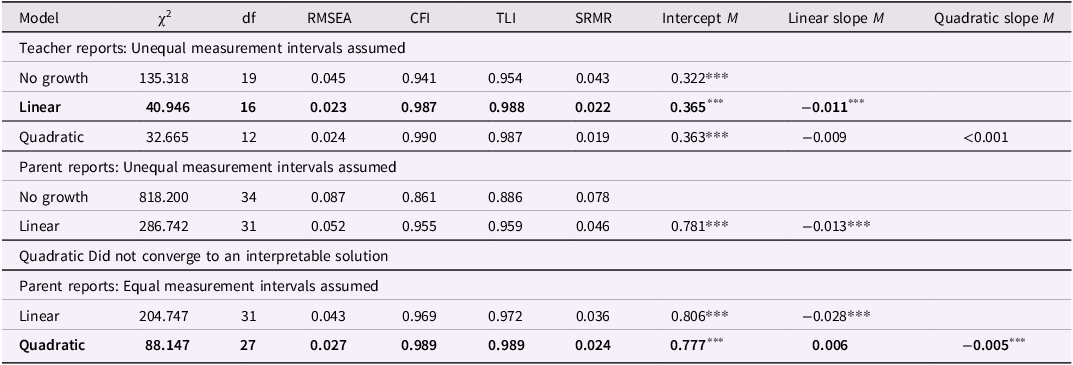
For the overall sample, a linear model showed excellent fit to the teacher report data, with significantly better fit than the no-growth model as indicated by ΔCFI (see Table 1). Loadings of individual measurement occasions on the latent slope were specified to accurately reflect the unequal intervals (years) between measurements (0, 1, 3, 5, 8). The mean of the linear slope was significantly different from 0, although small (M = −0.011, SE = 0.02, p < .001). The quadratic growth model showed similar model fit to the linear model, and neither the linear slope nor the quadratic slope was significantly different from 0. Thus, as a baseline model to be used in the mixture analyses for teacher reports, the linear model was selected as the most parsimonious model that also fit the data well. The model-implied trajectory for sample-average teacher reports of lying is displayed in Supplemental Figure S2. The intercept (M = 0.37, SE = 0.009, p < .001) indicated teachers reported almost no lying to occasional lying, on average, at age 7, with the slope as reported above indicating very slight declines until age 15 but overall remaining between no lying and occasional lying over these years. Both the intercept variance (0.14, SE = 0.007, p < .001) and the slope variance (0.001, SE < 0.001, p < .001) estimates were significant, indicating individual slopes and intercepts varied significantly around the estimated sample-average intercepts and slopes.
Fit statistics for latent growth models including the full sample

Note. Selected baseline overall-sample models are shown in bold. Teacher reports N = 3,002. Parent reports N = 3,014. Lie-telling variables were ordinal (0–2) but displayed acceptable skewness and kurtosis for structural-equation modeling (Brown, Reference Brown2006).
***p < .001.
Heterogeneous trajectory classes
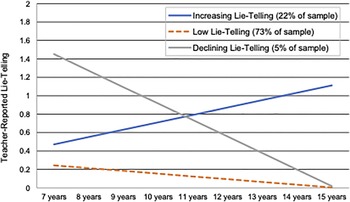
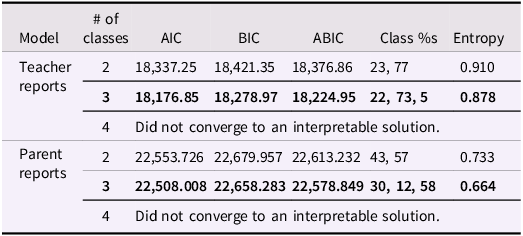
Growth mixture model results supported a 3-class solution for teacher reports of lying (see Table 2). Compared to the 2-class model, the 3-class solution had lower AIC, BIC, and ABIC. The 4-class model was non-interpretable due to local maxima and a non-positive definite covariance matrix, even after increasing starts and iterations, which is a common issue with GMMs and often an indicator of over-extraction (i.e., estimating too many trajectory classes). Classification quality was high as indicated by an average latent classification probability for most likely class membership of 0.88. Figure 1 shows the model-implied trajectories for the three classes of teacher-reported lying.
Model-implied trajectories of teacher reports of lie-telling from the 3-class GMM solution. Note. Model-implied trajectories of lie-telling using teacher reports from the 3-class GMM solution. Teacher reports ranged across ages 7–15 years, though no actual measurements were taken at 9 years, 13 years, or 14 years of age. Teachers reported at each time point how often the child told lies on a 3-point Likert-type scale with 0 = does not apply, 1 = occasional, and 2 = frequent.

Fit statistics and sample proportions for growth mixture models
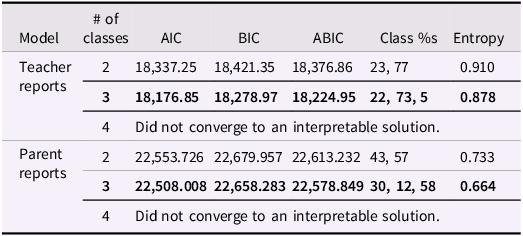
Note. All models allowed only latent means of intercepts and slopes to be class-specific, with variances and covariances being class-invariant. Additional models allowing variances and covariances to be class-specific did not converge to interpretable solutions so are not displayed here. Selected models are displayed in bold.
The majority of the sample (73%, n = 2,195) was best classified in a trajectory class with a mean of 0.24 (SE = 0.01, p < .001) teacher-reported lying at age 7 and a small but significant negative linear slope, M = −0.03, S.E. = 0.002, p < .001; 95% CI [−0.034, −0.026], that resulted in levels of lying near 0 by age 15. The average slope in this class was also significantly smaller in magnitude compared to the slopes in the other two classes, as evidenced by non-overlapping confidence intervals for the slope estimates. Thus, we titled this trajectory class Low Lie-telling. In other words, children in this trajectory class were perceived by teachers as lying at consistently low and slightly declining rates from ages 7 to 15 years.
In the second most prevalent class (22% of the sample, n = 669), the teacher-reported mean of lying at age 7 was 0.47 (SE = 0.028, p < .001), which was significantly higher than the intercept of the Low Lie-telling class, with a slope of 0.08 (SE = 0.004, p < .001; 95% CI [0.076, 0.084]) that resulted in an Increasing Lie-telling trajectory with model-estimated levels of lying just above “occasional” on the measurement scale by age 15.
The third trajectory class, Declining Lie-telling (5% of the sample, n = 138), showed the greatest change (i.e., largest slope) over time. Their teacher-reported mean of lying at age 7 was 1.45 (SE = 0.058, p < .001), the highest initial rate among all three classes, with a significant negative slope of −0.18 (SE = 0.007, p < .001; 95% CI [−0.193, −0.165]) which declined to a model-implied lie-telling mean of 0.02 by 15 years.
Follow-up sensitivity analyses indicated that cohort membership (1 = representative sample cohort, 0 = cohort formed from children exhibiting high disruptive behavior at age 6) significantly predicted trajectory class membership. Participants in the representative sample cohort were more likely to be in Low Lie-Telling as compared to Increasing Lie-Telling (b = .750, SE = .098, p < .001, OR = 2.12) or Declining Lie Telling (b = 0.841, SE = 0.228, p < .001, OR = 2.32). Cohort did not significantly predict the pairwise comparison between Increasing Lie-Telling and Declining Lie-Telling.
Predictors and a correlate of teacher-reported trajectory class membership
Next, we examined predictors and a correlate of probabilistic trajectory class membership using the automated 3-step procedure in Mplus (R3STEP command; Nylund et al., Reference Nylund, Asparouhov and Muthén2007). Logistic regression coefficients yielded by this analysis compare the likelihood of membership in each class, pairwise, as a function of varying levels of the predictor variables. Results are displayed in Table 3. No pairwise comparisons were significant for sex, indicating girls and boys were equally likely to be classified in all three trajectory classes.
Results of multinomial logistic regression examining predictors of latent trajectory class membership for teacher-reported lie-telling

Note. 1 = boys, 0 = girls.
*p < .05, **p < .01, ***p < .001.
Parent-reported aggression at age 6 was a significant predictor of all pairwise comparisons, indicating children with high aggression at age 6 were more likely to be classified in the Declining Lie-telling trajectory class as compared to the other two and were also more likely to be classified in the Increasing Lie-telling trajectory class as compared to the Low Lie-telling class. Odds ratios can be interpreted such that a one-unit difference in aggression scores was associated with a 9%–19% difference in the likelihood of being classified in the Declining Lie-telling or Increasing Lie-telling classes as compared to the other classes.
For impulsivity, results indicated that higher teacher-reported impulsivity at age 12 was associated with a higher likelihood of being classified in the Declining Lie-telling or Increasing Lie-telling trajectory classes, compared to the Low Lie-telling trajectory class (OR = 1.32–1.37).
Parent reports
Average trajectories
For the overall sample of parent report data, the quadratic model assuming unequal measurements between timepoints encountered convergence errors. Thus, we also examined models assuming equal measurement intervals (0, 1, 2, 3, etc.) as a more parsimonious alternative. When comparing the linear model assuming unequal measurement intervals (reflecting the true time lags between measurements) and the linear model assuming equal measurement intervals, the model assuming equal measurement intervals showed improved, excellent fit to the data (see Table 1). Further, the quadratic model assuming equal intervals successfully converged to an interpretable solution. Thus, we selected a quadratic model assuming equal intervals between measurements, which showed excellent fit to the data and significantly better fit compared to the linear model using equal intervals and the linear model reflecting unequal intervals between measurement occasions (see Supplemental Figure S3).
Heterogenous trajectory classes
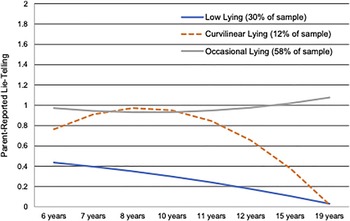
Like the results of teacher-report analyses, growth mixture analyses supported the 3-class model for parent-report data (see Table 2). Models with more classes and class-specific parameters were all non-interpretable due to local maxima and non-positive definite covariance matrices. Figure 2 shows model-implied trajectories for the selected 3-class parent-reported lying trajectories model.
Model-implied trajectories of parent reports of lying from the 3-class GMM solution. Note. Model-implied trajectories of lying using parent reports from the 3-class GMM solution. Parent reports ranged across ages 6–19 years. Parents reported at each time point how often the child told lies on a 3-point Likert-type scale with 0 = does not apply, 1 = occasional, and 2 = frequent.
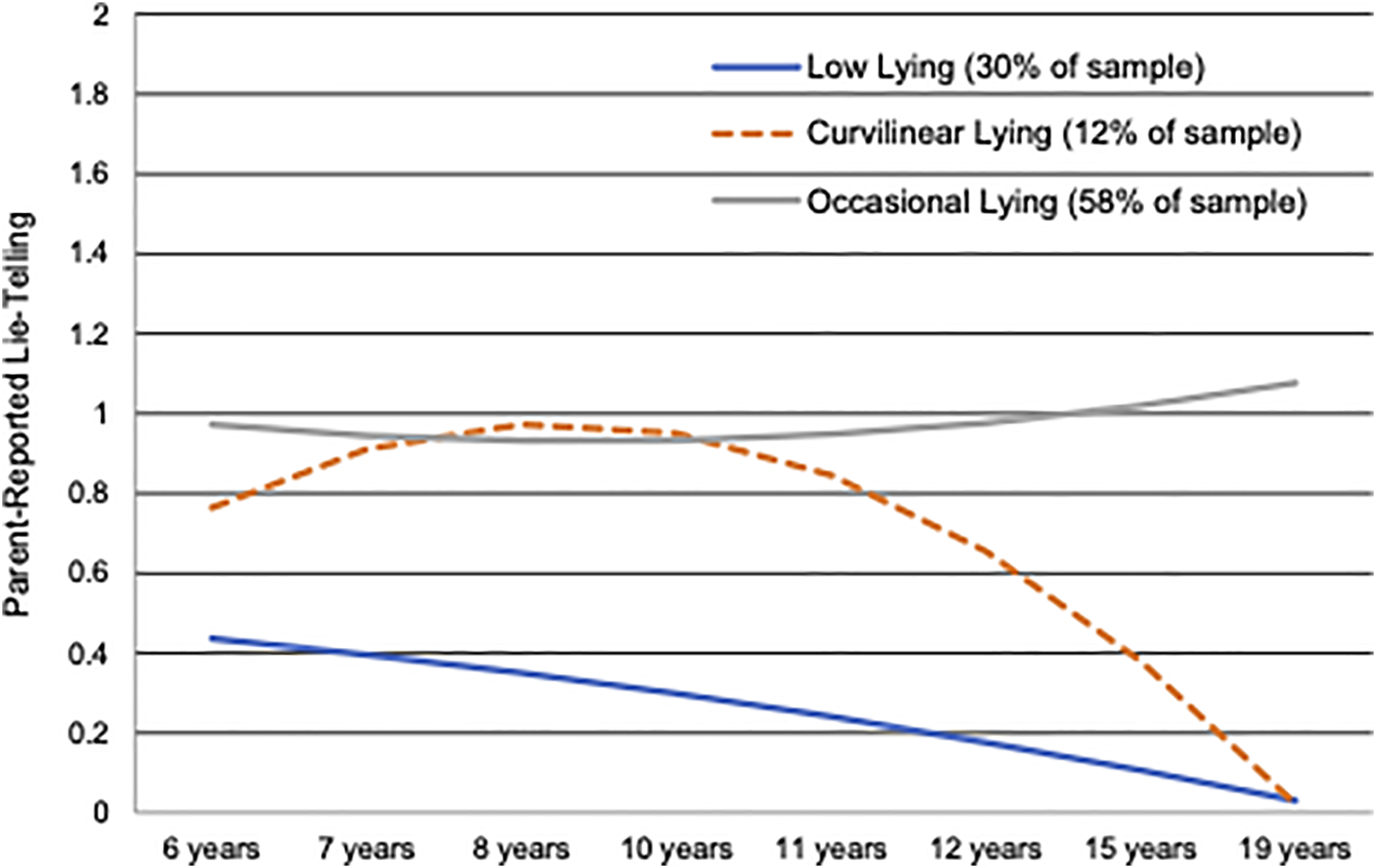
The largest trajectory class, containing 58% of the sample (n = 1,746), was characterized by occasional mean levels of parent-reported lying at age 6, M = 0.97, S.E. = 0.013, p < .001, with a small negative linear slope and a small positive quadratic slope. The resulting model-implied trajectory showed a very small decrease in lying, followed by a slight increasing pattern that continued until age 19 but overall remained near 1 (Figure 2). Thus, we refer to it as the Occasional Lying trajectory class.
The second largest class (30% of the sample, n = 899), Low Lying, contained children whose parents reported relatively low levels of lying at age 6 (M = 0.44, S.E. = 0.044, p < .001), with small and negative linear and quadratic slopes that resulted in lying overall declining to near 0 by age 19.
Lastly, the Curvilinear Lying trajectory class (12% of the sample, n = 369) displayed moderate levels of parent-reported lying at age 6 (M = 0.77, S.E. = 0.043, p < .001), initial increases in lying, followed by a rather sharp decline leading to levels of lying near 0 at age 19.
Follow-up sensitivity analyses again indicated that cohort membership (1 = representative sample cohort, 0 = cohort of children exhibiting high disruptive behavior at age 6) was significantly associated with trajectory class membership. Participants in the representative sample cohort were more likely to be in Low Lying (b = 0.801, SE = 0.121, p < .001, OR = 2.23) or Curvilinear Lying (b = 0.557, SE = 0.186, p = .003, OR = 1.75) compared to the Occasional Lying class. However, the pairwise comparison of probabilistic membership in class Low Lying versus Curvilinear Lying was not significant for cohort.
Predictors of parent-reported trajectory class membership
Logistic regression results of the automated 3-step analysis examining correlates of parent-reported lying trajectory class membership are displayed in Table 4. Boys were significantly more likely than girls to be classified in the Occasional Lying trajectory class or the Low Lying class as compared to the Curvilinear Lying class (OR = 1.66–1.88). Aggression was positively associated with membership in the Occasional Lying trajectory class as compared to the Low Lying class (OR = 1.33); aggression also negatively predicted membership in the Low Lying as compared to the Curvilinear Lying trajectory class (OR = 0.76). In other words, children with higher aggression at 6 years of age were least likely to be in the Low Lying trajectory class as compared to other trajectory classes. Impulsivity at age 12 was positively associated with membership in the Occasional Lying trajectory class as compared to the Low Lying and Curvilinear Lying classes (OR = 1.14–1.23).
Results of multinomial logistic regression examining predictors of latent trajectory class membership for parent-reported lying

Note. 1 = boys, 0 = girls.
*p < .05, **p < .01, ***p < .001.
Long-term outcomes associated with latent trajectory class memberships
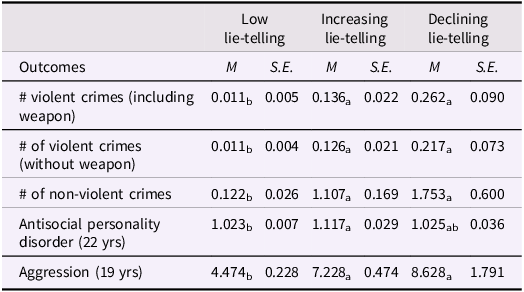
Teacher and parent lie-telling trajectories were next examined for their associations with age 19 aggression, adult criminal records, and psychopathology. For teacher ratings (see Table 5), cases best classified in the Low Lie-telling group had significantly fewer violent and non-violent crimes on their records and significantly lower levels of aggression at 19 years of age compared to the other two groups, which did not differ significantly on those outcomes. However, the Increasing Lie-telling group met significantly more criteria for antisocial personality disorder (APD) than did those in the Low Lie-telling group, with neither group differing significantly from those in the Declining Lie-telling group.
Results of analyses examining outcomes associated with latent trajectory class membership for teacher-reported lie-telling
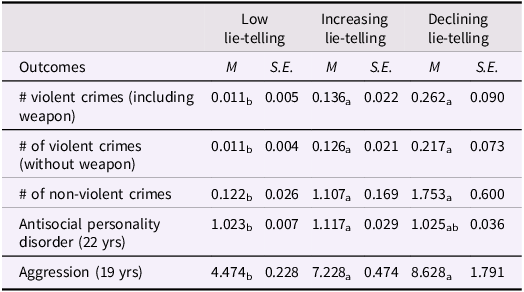
Note. Non-common subscripts in a given row indicate significantly different means across trajectory class groups (e.g., the mean of violent crimes for the Increasing Lie-telling profile is significantly higher than the means of violent crimes for the other two profiles).
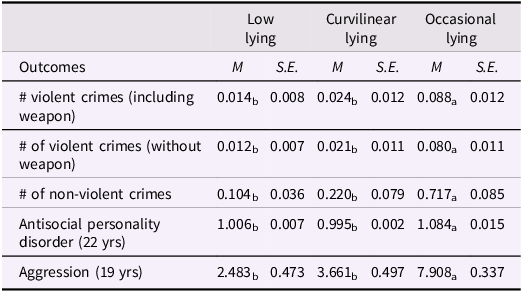
For parents’ reports of lying (see Table 6), children best classified in the Occasional Lying group were significantly higher on all crimes and APD criteria than both the Low Lying and the Curvilinear Lying groups, which did not differ. At age 19, participants best classified in the Occasional Lying trajectory class showed the highest mean levels of aggression compared to the other two groups, which did not significantly differ.
Results of analyses examining outcomes associated with latent trajectory class membership for parent-reported lying
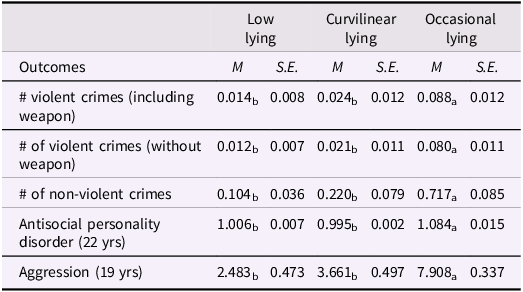
Note. Non-common subscripts in a given row indicate significantly different means across trajectory class groups.
Discussion
Lying may be associated with problem behaviors in childhood and is often perceived as a negative behavior in adulthood (e.g., Curtis & Hart, Reference Curtis and Hart2020; Stouthamer-Loeber, Reference Stouthamer-Loeber1986). Most research on children’s lying has focused on its development in relation to their social cognition. Researchers have posited that beyond early childhood, different patterns of early lying may be associated with differential developmental outcomes (e.g., Crossman & Talwar, Reference Crossman and Talwar2021; Gervais et al., Reference Gervais, Tremblay, Desmarais-Gervais and Vitaro2000; Lavoie et al., Reference Lavoie, Leduc, Arruda, Crossman and Talwar2017; Talwar & Crossman, Reference Talwar and Crossman2022). However, there has been limited investigation into developmental trajectories of lying through childhood and adolescence to examine outcomes of lying in early adulthood (e.g., Carl & Bussey, Reference Carl and Bussey2022; Dykstra et al., Reference Dykstra, Turchio, Willoughby and Evans2023; Talwar et al., Reference Talwar, Lavoie and Crossman2019). Understanding how and when typical patterns of lie-telling emerge; what factors shape these trajectories; and their long-term outcomes is crucial for identifying developmental critical points for interventions. The current study begins to fill this gap by examining teacher and parent reports of lying behavior from ages 6 to 19 years of age using growth mixture modeling to identify subgroups showing distinct trajectories of reported lying and the relations of these trajectory group memberships to important theorized outcomes in early adulthood.
Overall, in this sample, trends were detected among both teacher and parental reports. Specifically, the findings of the current study found support for our first hypothesis, detecting divergent lie-telling trajectories from childhood through adolescence and early adulthood. While some children showed increasing lie-telling as they became older, some subsequently showed a decrease. Others showed decreasing lie-telling and some showed stable but moderately high rates of lie-telling. Notably, the most common trajectories were of stability and of declining reports of lie-telling over time.
However, there were some differences in the patterns that emerged from teacher and parent reports. While for both, most youth showed stable or gradually declining trajectories of lying, parents reported higher levels of lying compared to teachers. This aligns with other research showing differences between parent and teacher reports (Gervais et al., Reference Gervais, Tremblay, Desmarais-Gervais and Vitaro2000; Stouthamer-Loeber, Reference Stouthamer-Loeber1986) and likely reflects differences in context and opportunity. Parents may detect lies more often due to spending more time with their children, being more familiar with their behavior, or having different thresholds for detecting problem behaviors (e.g., Gagnon et al., Reference Gagnon, Vitaro and Tremblay1992; Rescorla et al., Reference Rescorla, Bochicchio, Achenbach, Ivanova, Almqvist, Begovac and Verhulst2014). Additionally, as youth seek more independence, they may lie more to their parents to assert autonomy (e.g., Jensen et al., Reference Jensen, Arnett, Feldman and Cauffman2004). In contrast, teachers observe children within structured, rule-based environments that may afford different opportunities for observing deception, with the modest correlations between informants reflecting contextual variability across home and school settings. These distinct informant patterns also underscore the value of a multi-informant approach in which distinct perspectives provide complementary and ecologically valid insights into children’s observed dishonesty (Dirks et al., Reference Dirks, De Los Reyes, Briggs-Gowan, Cella and Wakschlag2012). Divergent perceptions across contexts may themselves offer important clues to situational or relational factors influencing dishonesty over time. Nevertheless, there was some convergence between parent and teacher reports as well, consistent with research showing modest agreement on ratings of youth’s problem behaviors (e.g., De Los Reyes & Kazdin, Reference De Los Reyes and Kazdin2005; Rescorla et al., Reference Rescorla, Bochicchio, Achenbach, Ivanova, Almqvist, Begovac and Verhulst2014). For both groups, reports were also consistent with previous cross-sectional studies suggesting that most people lie occasionally, but not at high rates (e.g., Debey et al., Reference Debey, Schryver, Logan, Suchotzki and Verschuere2015; Dykstra et al., Reference Dykstra, Willoughby and Evans2023; Levine et al., Reference Levine, Serota, Carey and Messer2013; Serota et al., Reference Serota, Levine and Boster2010). In the teacher reports, the largest group (73% of youth) were in the Low Lie-telling group while, in the parent reports, this pattern (i.e., Low Lying) was the second largest group (30%). The largest group for parents (Occasional Lying: 58%) showed modest, stable rates of lying that remained around the level of “occasional,” similar to Lavoie et al. (Reference Lavoie, Leduc, Arruda, Crossman and Talwar2017). Both teacher and parent reports revealed a dominant pattern of low-frequency lie-telling that tended to remain stable or decrease with age. This is consistent with adolescent self-reports (Dykstra et al., Reference Dykstra, Willoughby and Evans2023). Overall, across parent and teacher reports, the findings suggest a relatively “normative” pattern of low, stable lying as the most common trajectory where most people lie, but not at high rates (Debey et al., Reference Debey, Schryver, Logan, Suchotzki and Verschuere2015; Serota et al., Reference Serota, Levine and Boster2010).
In contrast, we did not find strong support for our second hypothesis which suggested, based on cross-sectional findings, that dishonesty would peak in adolescence and decline into early adulthood (e.g., Debey et al., Reference Debey, Schryver, Logan, Suchotzki and Verschuere2015; Levine et al., Reference Levine, Serota, Carey and Messer2013). Only 12% of parent reports followed this pattern (Curvilinear Lying group). But this peak in lying occurred around ages 8–10 years, before adolescence, consistent with reported peaks in impulsivity and lie-telling in late childhood (Dykstra et al., Reference Dykstra, Turchio, Willoughby and Evans2023). Instead, most children had stable or decreasing reports of observed lying with age. Adolescents may self-report telling more lies than parents detect, as Dykstra et al. (Reference Dykstra, Willoughby and Evans2020) found parents of children ages 8-14 unaware of many of their children’s lies. This “Nelsonian blindness” may serve to protect parent-child relationships (Talwar et al., Reference Talwar, Renaud and Conway2015). However, the absence of a clear adolescent peak here may partly reflect methodological differences: prior studies relied on self-reported lying frequency or experimentally measured lie frequency (Debey et al., Reference Debey, Schryver, Logan, Suchotzki and Verschuere2015; Dykstra et al., Reference Dykstra, Willoughby and Evans2020; Levine et al., Reference Levine, Serota, Carey and Messer2013), whereas the present observer-based approach captures socially visible deception. This design, while conservative, offers a unique strength by highlighting patterns of dishonesty that are detectable and consequential within real-world social relationships.
We also hypothesized that a small proportion of children would show persistent, higher levels of dishonesty into early adulthood. The findings provided some evidence for this pattern. In the teacher reports, 22% of youth (Increasing Lie-telling group) showed a trajectory of increasing lie-telling into adolescence. For parents, in contrast, a smaller group of children (Curvilinear Lying: 12%) showed increasing lying until middle childhood (8–10 years) and a decline thereafter. The largest group (Occasional Lying: 58%) showed stable moderate lie-telling which consistently remained in the occasional range. Overall, then, our results suggest early, frequent lying in parent and teacher reports is not necessarily an indicator of later frequent lying reports, and not all youthful lying is predictive of later problematic lying, at least not as assessed and observed by parents and teachers in this study. However, for some children (22% in teacher reports), lying may increase and potentially become maladaptive with age.
Although not predicted, gender differences emerged in parent-reported trajectory membership. Boys were more likely to be in the “extreme” groups (i.e., Occasional Lying or Low Lying trajectory) than in the Curvilinear Lying class. This suggests two distinct patterns for boys: higher likelihood of maintaining occasional moderate-high levels of lying (or of detected lies), consistent with prior findings that males lie more frequently than females (e.g., Capraro, Reference Capraro2018; Elaad & Gonen-Gal, Reference Elaad and Gonen-Gal2022; Gervais et al., Reference Gervais, Tremblay, Desmarais-Gervais and Vitaro2000), and a greater tendency to show low and decreasing lie-telling over time. These differences may reflect actual gender-based behavioral patterns, or observer bias, particularly as they appeared only in parent reports. Given that evidence for gender differences in lying is often small and variable (Kennedy & Kray, Reference Kennedy and Kray2022), further research is needed to clarify underlying mechanisms, including whether such differences relate to broader externalizing tendencies, such as aggression or conduct-related behaviors that are more prevalent among males, as well as potential perceptual biases in parental reporting.
Our third and fourth hypotheses explored whether maladaptive outcomes were associated with different lying trajectories. We found support for our third hypothesis, that children with higher levels of externalizing problems are more likely to have a trajectory characterized by higher rates of dishonesty. Specifically, more aggression at age 6 was associated with trajectories showing more reported dishonesty in adolescence, consistent with Gervais et al. (Reference Gervais, Tremblay, Desmarais-Gervais and Vitaro2000) who found that children with higher rates of lying at a young age were reported by their teachers to be more disruptive. In contrast, children in consistently low lie-telling groups showed lower aggression at age 6. Overall, then, lower levels of aggression at a young age were associated with less observed lying, consistent with previous work (Gervais et al., Reference Gervais, Tremblay, Desmarais-Gervais and Vitaro2000; Mugno et al., Reference Mugno, Malloy, Waschbusch, Pelham and Talwar2019; Ostrov et al., Reference Ostrov, Ries, Stauffacher, Godleski and Mullins2008). However, it should be noted that there may be some individuals who engage in frequent lying without displaying externalizing behaviors. Recent work suggests pathological liars lie excessively without aggressive tendencies (Curtis & Hart, Reference Curtis and Hart2022).
Additionally, teacher-reported impulsivity predicted children’s trajectories of dishonesty. Children in the Low Lie-telling group had lower ratings of impulsivity than the other two groups. Similarly, in the parent reports, children classified in the Occasional Lying group were more impulsive than the other two groups. These results are consistent with Dykstra et al. (Reference Dykstra, Turchio, Willoughby and Evans2023) who found that adolescents’ self-reported impulsivity was associated with more frequent lie-telling over one year. Recent research also suggests that frequent adult liars (i.e., pathological liars) have increased impulsivity (Curtis et al., Reference Curtis, Hart and Talwar2025). Together, these findings support the role of impulsivity in lie-telling, potentially reflecting more impetuous use of lying as a short-term expedient to achieve self-interests and goals.
Our fourth hypothesis was that trajectories of higher rates of lying would be associated with antisocial personality disorder and criminal records in adulthood. Teacher reports showed those in the Low Lie-telling group had lower crime rates compared to others who were higher in dishonesty. Similarly, parent reports showed those in the Occasional Lying trajectory had more crimes than the other two groups, who had lower or declining dishonesty through adolescence. In general, however, no groups showed high rates of criminal activity. Nevertheless, a fairly consistent overall pattern emerged, where low or declining rates of dishonesty were associated with fewer crimes, and higher stable rates of dishonesty were associated with comparatively higher rates of criminal activity in adolescence and young adulthood. This is consistent with research suggesting that lie-telling may be associated with later delinquency and criminal activity (e.g., Satterfield & Schell, Reference Satterfield and Schell1997; Spidel et al., Reference Spidel, Hervé, Greaves and Yuille2011). For some youth, lying may develop as a strategy to overtly and aggressively achieve self-interests, which may be associated with significant problem behaviors later (e.g., Stouthamer-Loeber, Reference Stouthamer-Loeber1986; Zanette et al., Reference Zanette, Walsh, Augimeri and Lee2020).
Further evidence that, for some, lying is associated with antisocial behavior was the finding that lie-telling trajectories with higher dishonesty were associated with higher means of APD symptoms. The Increasing Lie-telling group was highest on APD in teacher reports, while the Occasional Lying group was highest on APD symptoms in parent reports. This stands to reason as the diagnosis of APD includes several possible diagnostic criteria including deception, aggression, and criminal acts in identifying APD (Salekin et al., Reference Salekin, Kubak, Lee, Harrison and Clark2008). Notably, those with lower lie-telling were lower on aggression, antisocial personality symptoms, and crimes. This suggests that less frequent liars are also less likely to have negative, maladaptive outcomes in adulthood.
It is important to recognize, however, that lying can serve different functions and is not always indicative of pathology or maladaptive behavior. While some individuals lie frequently as a result of underlying traits such as aggression or impulsivity, others may engage in lying as a primary behavior – either pathological, occurring without clear external incentives (Curtis & Hart, Reference Curtis and Hart2022), or instrumental and socially reinforced, as seen in occupational or political contexts where deception may be rewarded and even expected (Babiak et al., Reference Babiak, Hare and McLaren2007). For instance, pathological liars engage in excessive lying without clear external incentives or aggression (e.g., Curtis & Hart, Reference Curtis and Hart2022; Curtis et al., Reference Curtis, Hart and Talwar2025), while prolific or instrumental liars may use deception strategically in socially reinforced contexts (Babiak et al., Reference Babiak, Hare and McLaren2007). Although our historical dataset predates this research and cannot isolate these subgroups, recognizing these profiles broadens interpretation of the observed trajectories and underscores the diversity of pathways to persistent dishonesty. Future longitudinal studies should examine whether such profiles emerge as developmentally distinct from antisocial or impulsive pathways. Distinguishing between these forms of frequent lying will be an important direction for future research to clarify which trajectories reflect maladaptive, neutral, or even adaptive outcomes.
Overall, the current findings provide significant evidence to support previous hypotheses and theoretical assertions about different profiles of lying behavior (e.g., Crossman & Talwar, Reference Crossman and Talwar2021; Curtis & Hart, Reference Curtis and Hart2020; Dykstra et al., Reference Dykstra, Willoughby and Evans2023; Lavoie et al., Reference Lavoie, Leduc, Arruda, Crossman and Talwar2017; Serota & Levine, Reference Serota and Levine2015; Talwar & Crossman, Reference Talwar, Crossman and Benson2011; Reference Talwar and Crossman2022). It provides the first long-term evidence of the development of teacher- and parent-reported lying from the early school years through early adulthood. For many, lying was occasional, normative, and not associated with other problem behaviors, while for a small percentage of individuals, lying was part of a broader pattern of problem behaviors. These findings have important clinical and forensic implications, highlighting the need for more research to understand the profiles of frequent liars and predictors and outcomes of such behavior. Interventions targeting maladaptive lying trajectories may benefit from cognitive-behavioral or other behavioral approaches that focus on improving impulse control, social reasoning, and emotion regulation to promote more adaptive interpersonal functioning (Curtis & Hart, Reference Curtis and Hart2022). Our study provides some of the first evidence of such factors to inform clinical and forensic interventions.
Limitations and conclusions
The current study makes several important contributions to the literature, yet there are limitations that should be noted. Although a key strength is the inclusion of multi-informant data from parents and teachers (Dirks et al., Reference Dirks, De Los Reyes, Briggs-Gowan, Cella and Wakschlag2012), the measure of lying was relatively blunt, relying on a restricted three-point scale that does not capture the complexity of this multifaceted behavior. While the categorical nature of the measure reflects broad frequency ranges, it is less sensitive to nuanced changes over time and may not fully represent differences in lie type and motivation (Serota et al., Reference Serota, Levine and Boster2010, Reference Serota, Levine and Docan-Morgan2022; Zanette et al., Reference Zanette, Walsh, Augimeri and Lee2020). For instance, a shift from “does not apply” to “occasional” may reflect a minimal behavioral change or differences in detection sensitivity.
A further limitation concerns measurement precision. Lie-telling was assessed using a categorical parent and teacher rating (0 = does not apply, 1 = occasional, 2 = frequent), which captures broad frequency ranges rather than exact counts. As such, small changes in trajectories should be interpreted cautiously, as a shift between categories may reflect subtle behavioral or perceptual differences rather than meaningful changes in lying frequency. Moreover, a response of “does not apply” may not necessarily indicate that a child never lies, but rather that lying was not detected or salient to the informant. Future research would benefit from continuous or type-specific measures of lying (Serota et al., Reference Serota, Levine and Boster2010, Serota et al., Reference Serota, Levine and Docan-Morgan2022) to allow for more nuanced modeling of developmental change.
The current study also does not tell us about age differences in the types of lies youth tell or to whom they lie. Future research should examine different motivations for lying to gather a more detailed understanding of varied developmental trajectories of lying and is objectives across contexts.
While including both parent and teacher reports offers insights into children’s lying across multiple contexts, these measures capture only detected lies rather than total frequency of lie-telling. Prior research has shown that adults – including parents and teachers – are often inaccurate at detecting children’s lies (Evans et al., Reference Evans, Bender and Lee2016; Gongola et al., Reference Gongola, Scurich and Quas2017; Talwar et al., Reference Talwar, Renaud and Conway2015) and that parent reports can diverge from adolescents’ self-reports (Dykstra et al., Reference Dykstra, Willoughby and Evans2020). Therefore, our trajectories represent socially visible dishonesty – they are not exhaustive indicators of all deception. Although this represents a limitation, it also means that our trajectories reflect dishonest behavior in forms that others notice and respond to and that carry meaningful social and developmental consequences. Children’s self-reports could complement these data by revealing additional lies not detected by adults. However, reports of lying frequency do not provide direct evidence of lie-telling abilities or associated cognitive, affective, and physiological characteristics of children’s lying (Talwar & Crossman, Reference Talwar, Crossman and Benson2011). Though difficult to do for feasibility and ethical concerns, longitudinal experimental research that measures cognitive, affective, and physiological characteristics over multiple years would provide a more comprehensive picture of developmental trajectories of lying.
Still, parent and teacher reports offer valuable and ecologically valid insights into observable, socially consequential patterns of dishonesty. These informants capture instances of detected lying which are socially significant in terms of interpersonal relationships in different contexts (Levine, Reference Levine2022). Moreover, our findings suggest that persistent, observable lying may signal other difficulties, such as impulsivity, externalizing behaviors, and long-term adjustment difficulties (Dishion & Patterson, Reference Dishion, Patterson, Cicchetti and Cohen2006; Lavoie et al., Reference Lavoie, Leduc, Arruda, Crossman and Talwar2017; Talwar & Lavoie, Reference Talwar and Lavoie2022). Although parents may not detect every lie their child tells (Dykstra et al., Reference Dykstra, Willoughby and Evans2020), behavior that is frequent or problematic enough to be noticed by multiple informants in different contexts (e.g., parents and teachers) may signal more significant developmental concerns (Gervais et al., Reference Gervais, Tremblay, Desmarais-Gervais and Vitaro2000; Mugno et al., Reference Mugno, Malloy, Waschbusch, Pelham and Talwar2019). Thus, even when informant reports are limited to observable behaviors, they still provide meaningful data relevant to children’s social–cognitive development and behavioral adjustment. Additionally, including reports from multiple informants enhances the reliability of assessments and reduces the bias inherent in any single source (De Los Reyes & Kazdin, Reference De Los Reyes and Kazdin2005). As such, while future work would benefit from incorporating direct, experimental assessments of lie-telling ability, parent and teacher reports remain important tools for identifying behavioral patterns with real-world significance across developmental stages.
There are also limitations in the inferences that can be drawn based upon the current sample. The sample contained two cohorts, with the second having higher disruptive behavior scores at age 6. Cohort analyses revealed that children from the representative cohort were more likely to be in the low lie-telling classes, suggesting that the oversampling of children with disruptive behavior in the second cohort may have improved our ability to observe associations between such behavior and lie-telling, though it might not have impacted rates of other predictors (e.g., impulsivity). Second, while crime data was included, not all participants had psychiatric assessments, potentially missing individuals with antisocial personality symptoms. Thus, as is the case with longitudinal samples, there may be some bias due to attrition.
Although the current study describes different lie-telling trajectories from childhood to early adulthood, it does not allow for causal interpretations of the associations with later adjustment. No prior research has documented long-term developmental trajectories of lying; hence, this study provides tantalizing first evidence of the potential profiles of behavior that may develop over the lifespan. However, the study did not account for other variables such as SES, other externalizing problems, or internalizing problems, which limits its conclusions.
Notwithstanding the limitations discussed above, the current study provides new evidence to improve understanding of transactional influences and predictors of dishonesty over the lifespan (Talwar & Crossman, Reference Talwar and Crossman2022). A key strength of the current study is its examination of developmental trajectories over a broader age range than had hitherto been examined. Findings suggest that profiles of increasing or consistent dishonesty are associated with maladaptive outcomes, including higher rates of impulsivity and aggression and greater likelihood of antisocial personality disorder and violent crimes in early adulthood. Conversely, consistently lower rates of lying were related to fewer negative outcomes and lower levels of externalizing behaviors. Future studies should investigate potential outcomes later into adulthood to fully understand how lying as an interpersonal strategy develops and changes over the entire life span.
This research provides some of the first long-term longitudinal evidence of different trajectories of dishonesty and their associations with later negative outcomes. Future studies should also examine the development of dishonesty from childhood through later adulthood. This study serves as a first step in understanding developmental trajectories of dishonesty and their impact on adaptive functioning later in life and underscores the need for more exploration of the processes shaping honesty and dishonesty over the lifespan. This will inform interventions to address maladaptive trajectories of lying in support of individuals’ adaptive functioning.
Supplementary material
The supplementary material for this article can be found at https://doi.org/10.1017/S0954579426101515.
Data availability statement
ToP standards not followed. Due to ethical and legal restrictions associated with the QLSCD, unrestricted public access to the data, materials, and analytic code is not permitted. These restrictions stem from the longitudinal nature of the dataset, the sensitive developmental, familial, and health information collected, and the fact that original participant consent did not authorize public data sharing. Researchers may request access by submitting a data-use proposal via the GRIP research group website: https://grip-info.ca/.
Acknowledgments
We are grateful to the children and parents of the Québec Longitudinal Study of Child Development (QLSCD)and the participating teachers and schools for their long-term involvement and contributions to this project.
Funding statement
The QLSCD was supported by funding from the Ministère dela Santée des Services Sociaux (Québec Government Ministry of Health and Social Services), Ministère de l’Éducation et de l’Enseignement Supérieur (Ministry of Education and Higher Learning), the Lucie and André Chagnon Foundation, the Institut de Recherche Robert-Sauvé en Santé et en sécurité du Travail (Robert-Sauvé Research Institute of Health and Security at Work), the Research Centre of the Sainte-Justine University Hospital, the Ministère du Travail, de l’Emploi et de la Solidarité Sociale (Ministry of Work, Employment, and Social Security), and the Institut de la Statistique du Québec (Québec Institute of Statistics).
Competing interests
The author(s) declare none.
Pre-registration
Not preregistered. This study involved secondary analysis of an existing longitudinal dataset (QLSCD), for which preregistration was not part of the original project design and was not feasible at the time these analyses were conceived.




 Open access

