





Introduction
The adversities that accompany socioeconomic disadvantage can hinder parents’ efforts to support the learning and development of their young children (Doan & Evans, Reference Doan and Evans2020). Limited access to high-quality early childhood education (ECE) and a lack of home learning resources contribute to socioeconomic disparities in child school readiness which are evident at kindergarten entry (Duncan et al., Reference Duncan, Magnuson, Votruba-Drzal, Bornstein, Leventhal and Lerner2015). Publicly funded Head Start and PreK programs are helpful but insufficient alone to reduce existing socioeconomic gaps in student achievement and well-being (Reardon, Reference Reardon, Duncan and Murnane2011). Research suggests that well-developed parent engagement programs that support home learning opportunities and promote positive parenting practices during the preschool years may boost child school readiness and thereby enhance the impact of ECE participation (Bierman et al., Reference Bierman, Stormshak, Mannweiler and Hails2023; Grindal et al., Reference Grindal, Bowne, Yoshikawa, Schindler, Duncan, Magnuson and Shonkoff2016; Joos et al., Reference Joos, Magnuson, Duncan, Schindler, Yoshikawa and Ziol-Guest2020). However, existing research lacks longitudinal follow-up studies to document the sustained impact of preschool parent engagement program benefits.
The present study followed children for eight years following their participation in the Research-based, Developmentally Informed [REDI-P] intervention designed to supplement Head Start classroom programming by empowering parents to support home learning and child socio-emotional development (Bierman et al., Reference Bierman, Welsh, Heinrichs, Nix and Mathis2015). In the context of a randomized-controlled design, longitudinal assessments tracked progress as students completed Head Start, proceeded through gradeschool, and transitioned into middle school. The first study aim was to evaluate the effects of REDI-P on youths’ grade 7 academic and social-emotional adjustment. The second aim was to better understand developmental processes contributing to sustained benefits by exploring serial mediation models that linked early intervention effects to subsequent grade 7 outcomes.
Promoting support for early learning at home
Preschool programs frequently incorporate strategies aimed at strengthening school–family partnerships and increasing parent engagement (Barnett et al., Reference Barnett, Paschall, Mastergeorge, Cutshaw and Warren2020; Halgunseth, Reference Halgunseth2009). These efforts vary in terms of their goals and their intensity, ranging from “light touch” strategies designed to orient parents to school programming and invite their involvement at school (e.g., back-to-school family nights, parent volunteer opportunities) to interventions that provide parents with more extensive and systematic active learning opportunities to help them support their child’s early learning (Grindal et al., Reference Grindal, Bowne, Yoshikawa, Schindler, Duncan, Magnuson and Shonkoff2016; Joos et al., Reference Joos, Magnuson, Duncan, Schindler, Yoshikawa and Ziol-Guest2020). Empirical evidence that parent engagement programming can significantly reduce disparities in child school readiness skills comes primarily from studies evaluating extended and manualized parenting programs that focus on enhancing parents’ abilities to foster children’s cognitive, language, social-emotional, or self-regulation skills through the use of structured curricula, coaching, and guided practice provided by trained professional staff (Grindal et al., Reference Grindal, Bowne, Yoshikawa, Schindler, Duncan, Magnuson and Shonkoff2016; Joos et al., Reference Joos, Magnuson, Duncan, Schindler, Yoshikawa and Ziol-Guest2020; Prime et al., Reference Prime, Andrews, McTavish, Lach, Wildeman and Browne2021).
For example, several programs have equipped parents with home learning materials and provided guidance on their use, leading to gains in children’s social-emotional and academic readiness (Ford et al., Reference Ford, McDougall and Evans2009; Mendez, Reference Mendez2010; Noble et al., Reference Noble, Duch, Darvique, Grundleger, Rodriguez and Landers2012). Similarly, preschool parent coaching programs that promote use of sensitive and responsive play strategies, linguistically rich conversations, positive behavior management, emotion coaching, and problem-solving dialog have produced gains in child self-regulation skills and social-emotional competencies (Brotman et al., Reference Brotman, Calzada, Huang, Kingston, Dawson-McClure, Kamboukos, Rosenfelt, Schwab and Petkova2011; Landry et al., Reference Landry, Zucker, Williams, Merz, Guttentag and Taylor2017; Webster-Stratton et al., Reference Webster-Stratton, Reid and Hammond2001).
REDI-P was designed to use both parent intervention strategies (providing home learning materials and coaching parents) to enrich home learning support in alignment with the REDI programming that children were receiving in Head Start classrooms that focused on strengthening social-emotional and language-literacy school readiness. Key goals of the REDI parent intervention were: (1) to foster aligned school-home support for skill development by providing home learning books, games, and activities linked with school materials, and (2) to coach parents in child-centered interaction strategies designed to scaffold child learning and support confident, enthusiastic, self-regulated learning behaviors and social-emotional competencies. To do so, home visitors delivered activity kits containing storybooks, games, and pretend play activities designed to enrich resources for home learning and align with school activities during 10 weeks of children’s prekindergarten year. Home visitors also coached parents in the child-centered use of these materials and encouraged scaffolding strategies to nurture child engagement and self-regulated learning. An additional 6 home visits were scheduled as children prepared for and entered kindergarten to encourage positive parent involvement and home learning support as children made the transition into elementary school.
Prior studies have documented academic and social-emotional benefits evident at REDI-P post-intervention assessments in kindergarten (Bierman et al., Reference Bierman, Welsh, Heinrichs, Nix and Mathis2015) and follow-up assessments through fifth grade (Bierman et al., Reference Bierman, Heinrichs, Welsh and Nix2021). This study extended the longitudinal frame of earlier evaluations to examine REDI-P effects on adolescent adjustment after the middle school transition.
Longitudinal impact of preschool parent engagement programs
Longitudinal studies suggest that parent provision of preschool cognitive stimulation and emotional support can have long-term benefits for children, extending into adolescence (Kim et al., Reference Kim, Henry and Dearing2023; Whitaker et al., Reference Whitaker, Yoo, Vandell, Duncan and Burchinal2023). To date, randomized trials of several intensive, manualized preschool parent programs document causal evidence of the malleability of early parent support for learning and positive impact on child school adjustment through the early gradeschool years. For example, Brotman and colleagues (Reference Brotman, Dawson-McClure, Kamboukos, Huang, Calzada, Goldfeld and Petkova2016) found that children who were randomized to receive the ParentCorps program in prekindergarten showed better academic performance and mental health in second grade than children in control group classrooms. Grøver and colleagues (Reference Grøver, Gustafsson, Rydland and Snow2024) found that dual-language learners who received a coordinated home-school shared reading program in preschool had better literacy skills in third grade than children in the usual-practice control group. Similarly, prior longitudinal analyses of REDI-P revealed lasting gains through fifth grade in child reading skills, academic motivation, and learning engagement (Bierman et al., Reference Bierman, Heinrichs, Welsh and Nix2021).
An unanswered question is whether the gains in school adjustment promoted by preschool-based parent programs sustain after children make the transition into adolescence and move from the smaller gradeschool context into larger middle schools (Grindal et al., Reference Grindal, Bowne, Yoshikawa, Schindler, Duncan, Magnuson and Shonkoff2016). Early adolescence represents an important developmental watershed as students undergo the physical changes associated with puberty and, concurrently, experience dramatic shifts in school context (Donaldson et al., Reference Donaldson, Moore and Hawkins2023; Jacobson et al., Reference Jacobson, Williford and Pianta2011). Early adolescence is characterized by amplified emotionality, increased sensitivity to peer influence, and elevated levels of impulsive risk behavior (Steinberg et al., Reference Steinberg, Icenogle, Shulman, Breiner, Chein, Bacchini, Chang, Chaudhary, Giunta, Dodge, Fanti, Lansford, Malone, Oburu, Pastorelli, Skinner, Sorbring, Tapanya, Tirado and Takash2018), adding to the challenge of navigating the greater social complexity and heightened demands for academic self-sufficiency that characterize middle school (Ryan et al., Reference Ryan, Kuusinen and Bedoya-Skoog2015).
These naturally occurring discontinuities in development can shift trajectories of academic and social-emotional functioning (Donaldson et al., Reference Donaldson, Moore and Hawkins2023). The transition into middle school is accompanied by increases in rates of social anxiety, deviant peer affiliation, and associated conduct problems (Evans et al., Reference Evans, Borriello and Field2018; Rudolph et al., Reference Rudolph, Lambert, Clark and Kurlakowsky2001), along with declines in academic engagement and performance (Lee et al., Reference Lee, Griffin, Ragavan and Patel2024; Symonds & Galton, Reference Symonds and Galton2014). The primary aim of the present study was to determine whether REDI-P benefits remained evident after participants transitioned into middle school and faced these new developmental challenges.
Examining developmental processes associated with sustained early intervention effects
A secondary study aim was to explore the developmental processes that linked initial REDI-P effects with sustained adolescent benefits. Prior researchers have invoked the concept of developmental cascades to describe the indirect effects of early interventions, suggesting that boosting early childhood skills can have lasting effects on child adjustment when they enhance children’s capacities to successfully tackle subsequent developmental challenges and access more protective social and relational contexts (Hentges et al., Reference Hentges, Weaver Krug, Shaw, Wilson, Dishion and Lemery-Chalfant2020; Sandler et al., Reference Sandler, Ingram, Wolchik, Tein and Winslow2015).
Prior researchers have postulated that promoting early cognitive skills facilitates academic learning at school entry and increases access to beneficial academic tracking, facilitating a sustained advantage in areas of learning performance and school achievement (Reynolds & Ou, Reference Reynolds and Ou2011). For example, boosts to IQ in early childhood served as the primary facilitator and mediator of the Abecedarian intervention effects on academic outcomes (Campbell et al., Reference Campbell, Pungello, Miller-Johnson, Burchinal and Ramey2001). Recent developmental research shows a similar cognitive advantage for children who enter kindergarten with greater academic readiness, as they are likely to maintain that advantage as they move through elementary school and transition into middle school (Jacobson et al., Reference Jacobson, Williford and Pianta2011).
A complementary hypothesis, identified as the positive youth development model by Taylor and colleagues (Reference Taylor, Oberle, Durlak and Weissberg2017) is that the promotion of social-emotional skills improves children’s capacities to meet social and behavioral expectations and form positive relationships with teachers and peers as they enter kindergarten and proceed through gradeschool. Conceptually, their foundational social-emotional competencies and subsequent positive elementary school experiences prepare youth to cope adaptively with the social and behavioral challenges of adolescence, buffering them against the rising risk for emotional distress, deviant peer affiliation, and risky behavior. Supporting this positive developmental cascade, Rudolph and colleagues (Reference Rudolph, Lambert, Clark and Kurlakowsky2001) found that children with higher levels of gradeschool social competence were buffered against early adolescent increases in emotional distress and peer concerns.
The REDI-P intervention focused on helping parents promote their children’s emergent literacy skills and social-emotional competencies as they entered kindergarten, potentially benefitting them in later years by initiating developmental cascades reflecting the cognitive advantage and positive youth development models. REDI-P also emphasized parenting practices linked with growth in the child self-regulation skills associated with improved attention control and adaptive learning behaviors (promoting cognitive advantage at school entry) and with emotion regulation and behavioral control (promoting positive youth development). In support of this hypothesis, developmental studies have linked gradeschool levels of self-regulated learning behavior and executive function (EF) skills with more positive academic and social adjustment in middle school. Early interventions that boost self-regulation skills may thus also produce cross-domain benefits during early adolescence and contribute to adjustment in both the academic and social-emotional domains (Hentges et al., Reference Hentges, Weaver Krug, Shaw, Wilson, Dishion and Lemery-Chalfant2020; Jacobson et al., Reference Jacobson, Williford and Pianta2011).
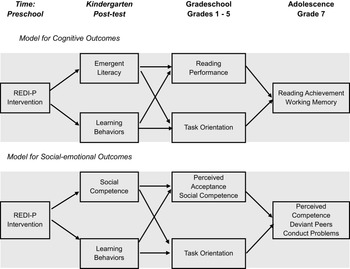
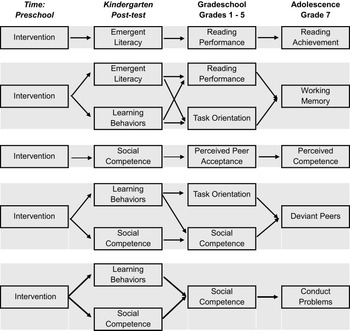
Figure 1 illustrates the longitudinal effects that were anticipated to cascade from the initial REDI-P intervention effects on: 1) child emergent literacy skills (based on the cognitive advantage model; Campbell et al., Reference Campbell, Pungello, Miller-Johnson, Burchinal and Ramey2001; Reynolds & Ou, Reference Reynolds and Ou2011), 2) child social-emotional competence (based on the positive youth development models (Rudolph et al., Reference Rudolph, Lambert, Clark and Kurlakowsky2001; Taylor et al., Reference Taylor, Oberle, Durlak and Weissberg2017), and 3) child self-regulation skills, facilitating subsequent academic performance and behavioral control (Hentges et al., Reference Hentges, Weaver Krug, Shaw, Wilson, Dishion and Lemery-Chalfant2020; Jacobson et al., Reference Jacobson, Williford and Pianta2011). To test these hypotheses, we applied a multi-phased serial mediation framework (Reynolds & Ou, Reference Reynolds and Ou2011).
Hypothesized mediation paths linking REDI-P intervention to grade 7 outcomes. Note: The cognitive advantage hypothesis posits that early intervention boosts to kindergarten literacy skills will cascade through gradeschool academic performance and task orientation to promote grade 7 reading achievement and working memory. The positive youth development model posits that early intervention gains in social-emotional competence will cascade through gradeschool social competence and perceived peer acceptance to promote grade 7 social-emotional adjustment. Developmental models of self-regulation posit cross-domain effects, with early intervention gains facilitating subsequent improvements in grade 7 cognitive and social-emotional domains.
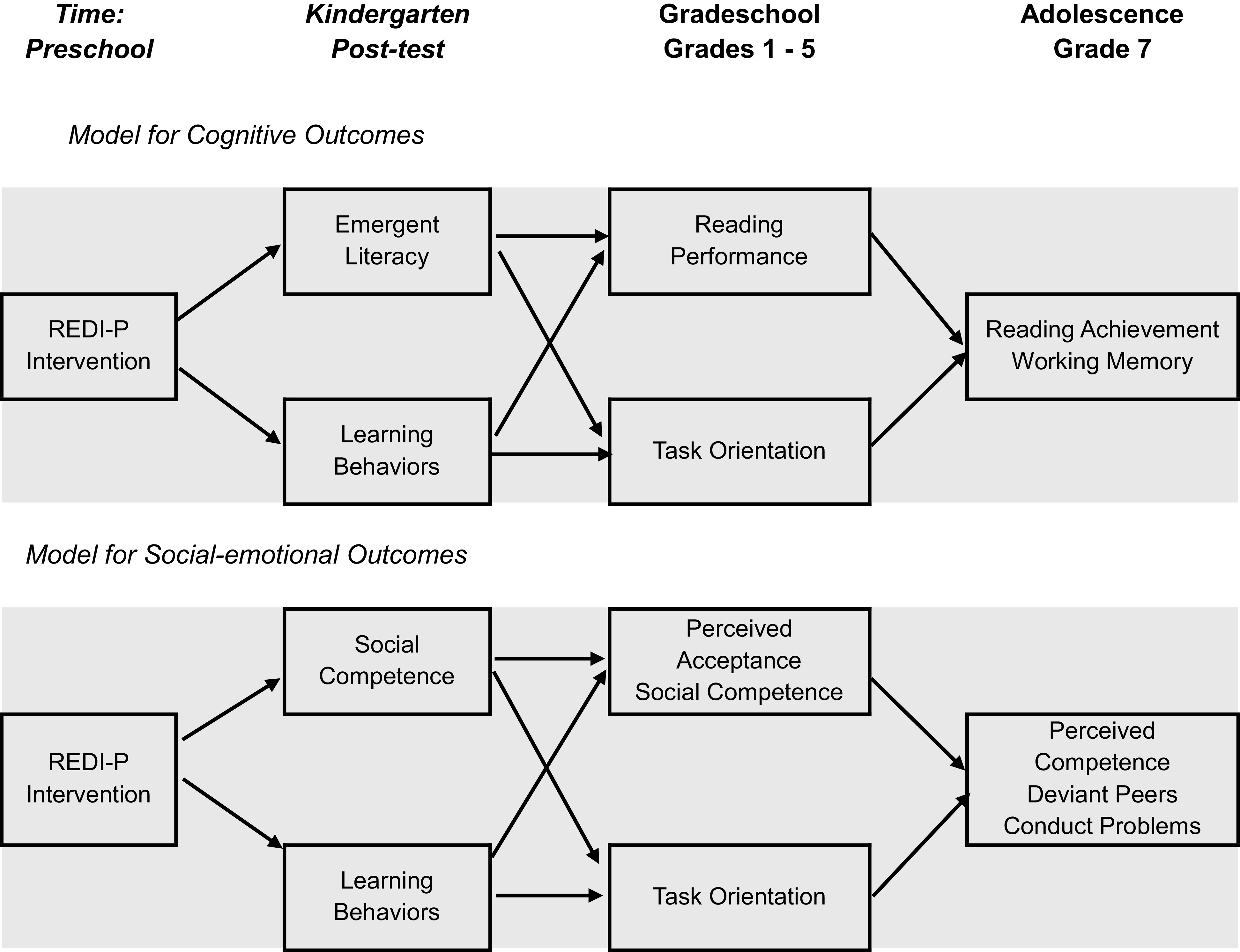
Figure 1 Long description
A diagram illustrating hypothesized mediation paths linking a preschool intervention to outcomes in grade 7, focusing on cognitive and social-emotional development. The diagram is divided into two main models: the Model for Cognitive Outcomes and the Model for Social-emotional Outcomes. The Model for Cognitive Outcomes shows the REDI-P Intervention leading to Emergent Literacy and Learning Behaviors in preschool. These, in turn, influence Reading Performance and Task Orientation in grades 1-5, which then affect Reading Achievement and Working Memory in grade 7. The Model for Social-emotional Outcomes depicts the REDI-P Intervention leading to Social Competence and Learning Behaviors in preschool. These influence Perceived Acceptance and Social Competence, as well as Task Orientation in grades 1-5, which then affect Perceived Competence, Deviant Peers, and Conduct Problems in grade 7. Arrows indicate the directional flow and relationships between these components.
The present study
The present study examined REDI-P effects on youth adjustment in grade 7, eight years after intervention, and explored mediation paths linking initial intervention gains to later grade 7 outcomes. We hypothesized that significant intervention effects would sustain in the academic domain, mediated by initial preschool intervention gains in emergent literacy skills and self-regulated learning behaviors. We further hypothesized that significant intervention effects would sustain in the social-emotional domain, mediated by initial intervention effects on social-emotional competence and self-regulated learning behaviors.
Method
Overview of procedures
In 2007 and 2008, parents of all prekindergarten-aged children attending 24 Head Start classrooms in three Pennsylvania counties using REDI-C programming were invited to participate in the REDI-P study (Bierman et al., Reference Bierman, Domitrovich, Nix, Gest, Welsh, Greenberg, Blair, Nelson and Gill2008). After completing pre-intervention assessments, families were assigned within classroom using a random numbers table to the REDI-P home visiting intervention (n = 95) or a control condition with math activities delivered via mail (n = 105). Intervention staff contacted families to initiate home visits; data collectors and teachers remained naïve concerning family assignment. Families in both conditions received REDI enrichments in their Head Start classrooms; the study thus evaluated the added benefits of the REDI-P home visiting intervention. Longitudinal assessments tracked child participants into 74 gradeschools and 67 middle schools (see participant flow diagram, Figure S1). Study procedures followed American Psychological Association ethical guidelines and had university Institutional Review Board approval. Parents provided informed consent for themselves and their children. Parents and teachers were compensated financially for their time completing assessments.
Participants
Participants included children (N = 200, 55% White, 26% Black, 19% Latino; 56% male; M age at study entry = 4.45 years) and their parents (89% mothers, 5% grandmothers, 4% fathers; 39% single; 54% unemployed; median annual income = $18,000). Parent education levels ranged from less than high school (18%) or a high school degree or equivalent (68%) to a technical certificate/2-year college degree (9%) or a 4-year college degree (7%). All parents spoke some English; 16% also spoke Spanish at home.
Intervention
The REDI-P intervention involved 16 bi-weekly 60-min home visits, with 10 delivered during the spring of the prekindergarten year (January to May) and 6 delivered as children transitioned into kindergarten (mid-August to October). Families received activity kits containing scripted interactive storybooks, guided pretend play materials, structured games (card games, board games), and conversation games to promote social-emotional learning (e.g., friendship skills, emotional understanding, self-control, and problem-solving skills) and language-literacy skill development (e.g., conversation skills, letter knowledge, letter-sound associations). Home visitors coached parents in supportive parenting practices (positive behavior management, emotion coaching, problem-solving dialog) and instructional support (asking questions, scaffolding play) and helped families individualize their use of program materials.
Intervention training and supervision was provided by the project intervention director who had extensive prior experience delivering and supervising evidence-based parenting interventions. Six home visitors were recruited from the communities served by the participating Head Start classrooms; all had an undergraduate degree in early education or human services and experience working with parents. Home visitors attended 6 days of workshop training before the intervention began and participated in weekly individual and group supervision meetings during the course of the intervention. On average, families in the intervention group completed 75% of the planned home visits (M = 12.00, SD = 5.48, range = 0 – 16). The control group (n = 105) received four activity boxes of math-focused learning activities mailed monthly to their homes.
Measures
Measures focused on the skill domains targeted by REDI-P: literacy skills, self-regulated learning behaviors, and social-emotional adjustment. Adolescent outcome measures were collected after students had transitioned into middle school and were near the end of grade 7. Longitudinal mediation models used data collected at kindergarten post-intervention assessments (adjusted for preschool pre-intervention values) and subsequent gradeschool assessments collected during follow-up waves in grades 1, 2, 3, and 5.
Grade 7 outcomes
Research assistants visited youth at their homes in the late spring of the students’ seventh grade year and administered the word recognition and reading comprehension subtests of the Kaufman Test of Educational Achievement (Kaufman & Kaufman, Reference Kaufman and Kaufman2004) to assess reading achievement. Youth were presented with a list of increasingly difficult words to read aloud to assess their ability to recognize and pronounce printed words accurately. Then youth were asked to read short passages and answer questions to assess their ability to understand and derive meaning from written text. Analyses used their grade-level equivalency scores.
Research assistants also administered the Digit Span subscale of the Wechsler Intelligence Scale for Children–Revised (Wechsler, Reference Wechsler2002) to assess youths’ short term and working memory. Youth were asked to repeat a progressive series of two to nine numbers in forward order and then a similar progressive series of numbers in backwards order. Analyses used the total number of trials in which youth repeated the number sequence accurately (forward and backward combined).
Youth provided self-ratings to assess their perceived social competence. They rated the extent to which they had positive peer relations (e.g., ease with which they made friends; feelings of social inclusion) on the Perceived Competence Scale for Children (6 items, 4-point scale, α = 0.70; Harter, Reference Harter1982).
Youth also rated their affiliation with deviant peers by rating 3 items describing their friends’ problematic behaviors (“My friends often break school rules,” “My friends have tried drinking alcohol,” “My friends sometimes break the law”) on the Self Report of Close Friends (5-point scale ranging from “strongly agree” to “strongly disagree,” α = 0.76; O’Donnell et al., Reference O’Donnell, Hawkins and Abbott1995). O’Donnell et al (Reference O’Donnell, Hawkins and Abbott1995) found that self-reports on this scale at age 12 significantly predicted subsequent adolescent involvement in antisocial behavior and substance use.
Grade 7 Language Arts teachers rated student conduct problems using three measures: 1) the Strengths and Difficulties Questionnaire conduct problems scale tapping antisocial behaviors such as fighting and stealing (5 items, 3-point scale, α = 0.76; Goodman, Reference Goodman1997), 2) the Teacher’s Observation of Child Adaptation-Revised authority acceptance scale – reverse scored, tapping temper outbursts and aggressive-disruptive behaviors such as breaking rules, being mean (TOCA-R, 7 items, 6-point scale, α = 0.90; Werthamer-Larsson et al., Reference Werthamer-Larsson, Kellam and Wheeler1991), and 3) the Children’s Social Behavior Scale—Teacher Form relational aggression scale tapping social aggression such as spreading rumors, excluding others (CSBS, 7 items, 6-point scale, α = 0.76; Crick, Reference Crick1996). Scores on each measure were standardized within the sample and the three standard scores were then averaged to represent teacher-rated conduct problems (composite α = 0.88).
Measures used in serial mediation models
Overview. Post-intervention (kindergarten) residualized gain scores (adjusted for preschool pre-intervention values) served as initial mediators of REDI-P intervention effects on subsequent outcomes and included child emergent literacy skills, learning behaviors, and social competence. Gradeschool mediators included teacher-rated reading performance and social competence, observer-rated task orientation, and self-rated perceived peer acceptance, with scores averaged over the waves of data collection during gradeschool.
Literacy skills. Post-intervention (kindergarten) measures of emergent literacy skills included four sub-tests administered by research assistants during individual sessions held at children’s schools. These included the Letter-Word Identification scale of the Woodcock-Johnson Tests of Achievement III – Revised (Woodcock et al., Reference Woodcock, McGrew and Mather2001) which assessed letter knowledge and sight word recognition (α = 0.92), the Print Awareness scale of the Test of Preschool Early Literacy (Lonigan et al., Reference Lonigan, Wagner, Torgesen and Rashotte2007) which included questions tapping print knowledge and letter identification (α = 0.90), the Letter Naming Fluency subscale of the Dynamic Indicators of Basic Early Literacy Skills (Good et al., Reference Good, Gruba, Kaminski, Thomas and Grimes2001) which tallied the number of letters identified correctly in one minute; and a Letter Sound Fluency subscale, which tallied the number of letter sounds children produced correctly in one minute. Scores on each measure were standardized and averaged (emergent literacy composite α = 0.82).
During gradeschool, teachers in grades 2, 3, and 5 rated student reading performance using the Academic Competence Evaluation Scales (DiPerna & Elliott, Reference DiPerna and Elliott1999). Teachers rated 11 items describing reading and language arts skills on a 5-point scale. Scores were totaled and standardized within grade level and averaged across grade levels (composite α = 0.88).
Self-regulated learning behaviors. Kindergarten teachers rated self-regulated learning behaviors using 5 items drawn from the School Readiness Questionnaire (can work independently, has the self-control to do well in school; Bierman et al., Reference Bierman, Domitrovich, Nix, Gest, Welsh, Greenberg, Blair, Nelson and Gill2008) and 4 items drawn from the Learning Behaviors Scale (e.g., accepts new tasks without resistance; McDermott et al., Reference McDermott, Green, Francis and Stott1999). Items were rated on a 6-point scale and totaled for analyses (α = 0.91).
During gradeschool (grades 1, 2, 3, and 5) research assistants rated student task orientation after conducting individual assessments. On the 13-item Adapted Leiter-R Assessor Report (Roid & Miller, Reference Roid and Miller1997) they rated students’ attention, impulse control, motivation, and ability to remain focused and engaged while completing assessment tasks using a 4-point scale. Ratings were totaled and standardized within the sample each year and then averaged across years (composite α = 0.70).
Social-emotional adjustment. Kindergarten teachers completed the Social Competence Scale (Conduct Problems Prevention Research Group, 1995). They rated students’ prosocial behaviors (cooperates, invites others to play) and emotion regulation (accepts things not going their way, expresses needs and feelings appropriately) using a 6-point scale (α = 0.92).
Gradeschool teachers also completed the Social Competence Scale in subsequent years and students’ scores were averaged across grades 1, 2, 3, and 5 (composite α = 0.74). In addition, children rated their perceived peer acceptance in gradeschool on 8 items tapping social inclusion (having friends, being liked; Harter, Reference Harter1982), loneliness (Asher et al., Reference Asher, Hymel and Renshaw1984), and social exclusion (being left out, isolated; Bierman & McCauley, Reference Bierman and McCauley1987). Scores were averaged across grades 2, 3, and 5 (composite α = 0.60).
Baseline covariates
Covariates included child demographics that were reported by parents at the time of study entry, including child age, gender, and race/ethnicity, and family characteristics, including single-parent status (unmarried and without live-in partner), income-to-needs, and depressive symptoms. Depressive symptoms were rated using the Center for Epidemiologic Studies Depression Scale (CES-D; Radloff, Reference Radloff1977), which was scored dichotomously for this study, indicating parents who scored above or below the clinical risk cutoff score. Covariates also included measures of child cognitive skills derived from assessments conducted by trained research assistants prior to the start of intervention. These included the Expressive One Word Picture Vocabulary Test (Brownell, Reference Brownell2000), the Block Design subtest from the Wechsler Preschool and Primary Scale of Intelligence - III (Wechsler, Reference Wechsler2002), and several EF tasks, including Backward Word Span (Davis & Pratt, Reference Davis and Pratt1996), Peg Tapping (Diamond & Taylor, Reference Diamond and Taylor1996), Dimensional Change Card Sort (Frye et al., Reference Frye, Zelazo and Palfail995), Walk-a-Line Slowly (Kochanska et al., Reference Kochanska, Murray, Jacques, Koenig and Vandegeest1996), and the Adapted Leiter-R Assessor Report (Roid & Miller, Reference Roid and Miller1997). Descriptive information about covariates is provided in supplementary Tables S1 and S2.
Missing data
Grade 7 outcome data was available for 167 participants (84% of the original sample) with equivalent retention rates for intervention and control groups. Tests comparing baseline measures of study variables revealed comparability of intervention and control groups at initial pre-intervention assessments (see Table S1). Subsequent analyses revealed no significant differences for participants with and without grade 7 data. To account for missing data, GLM analyses of grade 7 outcomes used multiple imputation (40 data sets, PROC MI, SAS 9.4) and mediation models used Full Information Maximum Likelihood (FIML) procedures (Mplus 8.4).
Plan for analyses
Preliminary analyses described the data. GLM models then evaluated intervention effects on grade 7 outcomes. Covariates included child demographics (age, gender, race/ethnicity), study design features (cohort, Head Start site), family characteristics (single parent, family income to needs, maternal depression), and child cognitive skills. Serial path models (Mplus 8.4) then explored developmental progressions linking initial REDI-P effects to later middle school outcomes. A separate model was run for each grade 7 outcome, each including multiple mediators measured in kindergarten and gradeschool. Models predicting cognitive outcomes (reading achievement and working memory) tested mediation paths through measures representing kindergarten and gradeschool literacy skills and learning behaviors that were sensitive to REDI-P effects at earlier timepoints. Models predicting social and behavioral outcomes (perceived social competence, affiliation with deviant peers, teacher-rated conduct problems) tested mediation paths through measures representing kindergarten and gradeschool social competence and learning behaviors that had been sensitive to REDI-P effects at earlier timepoints.
These analyses treat serial mediation as a system of simultaneous regression equations, estimates them jointly, and then computes indirect effects as products of the estimated path coefficients, with statistical significance of each path evaluated with 95% bootstrapped confidence intervals (Hayes, Reference Hayes2022). All measures included in the serial path models were adjusted for the set of covariates listed above representing child demographics, study design features, family characteristics, and child baseline cognitive skills. In addition, Kindergarten scores were adjusted for baseline values of emergent literacy skills and teacher-rated social competence so that they represented residualized gain scores reflecting change during the course of the intervention.
Results
Preliminary analyses
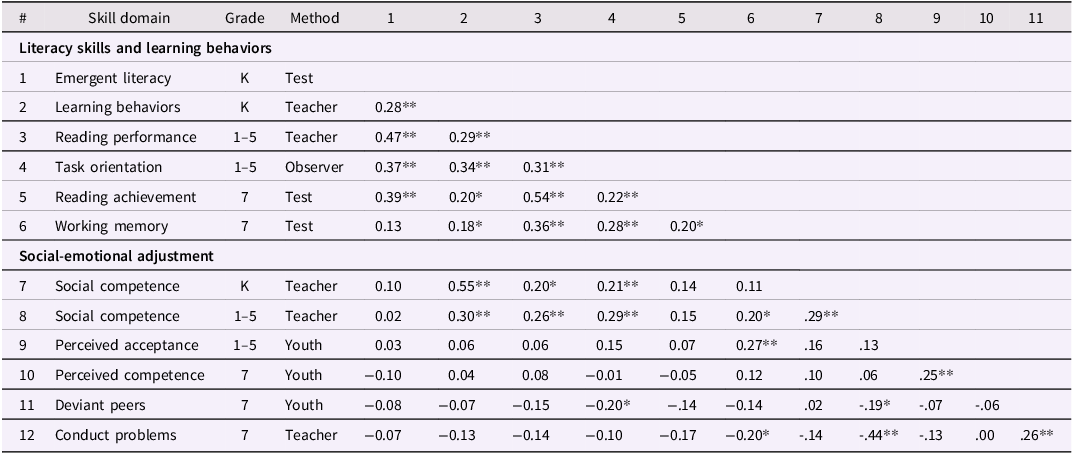
Correlations revealed significant associations within and across grade levels for literacy skills and learning behaviors (see Table 1). Significant correlations also linked kindergarten social competence with gradeschool social competence which, in turn, was linked with lower levels of grade 7 deviant peer affiliations and conduct problems. Kindergarten learning behaviors were associated with later gradeschool and grade 7 social competence, and kindergarten social competence was correlated with gradeschool reading performance and task orientation which, in turn, were prospectively correlated with grade 7 working memory.
Study variables: skill domain represented, data collection timing (Grade level), measurement method, and correlations
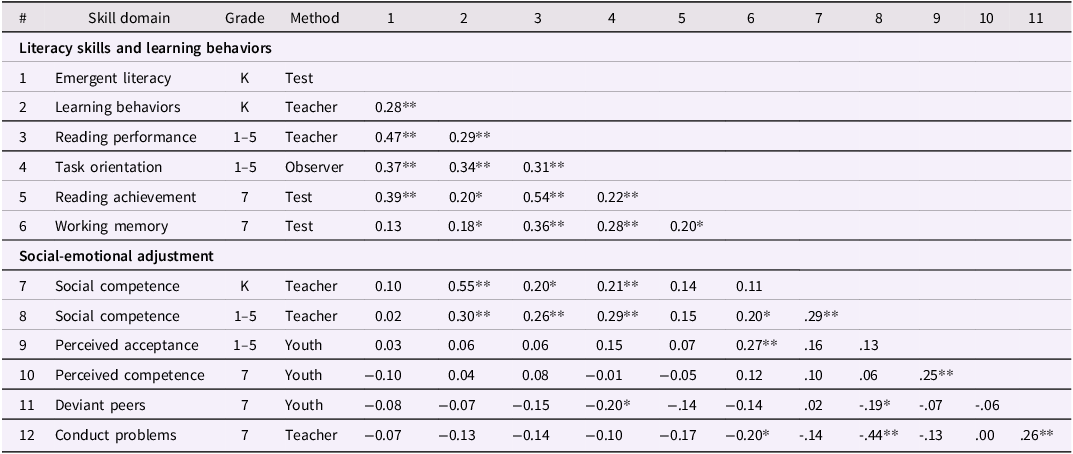
Table 1 Long description
The table presents data on correlations between different skill domains, grades, methods, and their corresponding values. It has 12 rows and 11 columns. The columns are labeled as follows: Number, Skill domain, Grade, Method, and values from 1 to 10. The rows are grouped under two main categories: Literacy skills and learning behaviors, and Social-emotional adjustment. Each row lists a specific skill domain, the grade level at which it is measured, the method of measurement, and the correlation values across different points. For example, Row 1: Emergent literacy, K, Test, and values from 1 to 10. Row 2: Learning behaviors, K, Teacher, 0.28**, and values from 2 to 10. Row 3: Reading performance, 1-5, Teacher, 0.47**, 0.29**, and values from 3 to 10. Row 4: Task orientation, 1-5, Observer, 0.37**, 0.34**, 0.31**, and values from 4 to 10. Row 5: Reading achievement, 7, Test, 0.39**, 0.20*, 0.54**, 0.22**, and values from 5 to 10. Row 6: Working memory, 7, Test, 0.13, 0.18*, 0.36**, 0.28**, 0.20*, and values from 6 to 10. Row 7: Social competence, K, Teacher, 0.10, 0.55**, 0.20*, 0.21**, 0.14, 0.11, and values from 7 to 10. Row 8: Social competence, 1-5, Teacher, 0.02, 0.30**, 0.26**, 0.29**, 0.15, 0.20*, 0.29**, and values from 8 to 10. Row 9: Perceived acceptance, 1-5, Youth, 0.03, 0.06, 0.06, 0.15, 0.07, 0.27**, 0.16, 0.13, and values from 9 to 10. Row 10: Perceived competence, 7, Youth, -0.10, 0.04, 0.08, -0.01, -0.05, 0.12, 0.10, 0.06, 0.25**. Row 11: Deviant peers, 7, Youth, -0.08, -0.07, -0.15, -0.20*, -0.14, -0.14, 0.02, -0.19*, -0.07, 0.06. Row 12: Conduct problems, 7, Teacher, -0.07, -0.13, -0.14, -0.10, -0.17, -0.20*, 0.14, -0.44**, -0.13, 0.00, 0.26**.
Note: Study participants were 200 4-year-old children from low-income families: 55% White, 26% Black, 19% Latinx; 56% male, 44% female; M age at study entry = 4.45 years and followed for 8 years. Correlations are based on scores adjusted for model covariates (child demographics, study design features, child cognitive skills, and family characteristics). Kindergarten scores are adjusted for pre-intervention scores so that they represent residualized gains during the intervention year. K = kindergarten, 1–5 = composite across grades 1, 2, 3, and 5, 7 = grade 7. Test = direct assessment, Teacher = teacher rating, Observe = observational measure, Youth = youth self-rating. *p < .05. **p < .01.
Intervention effects on grade 7 outcomes
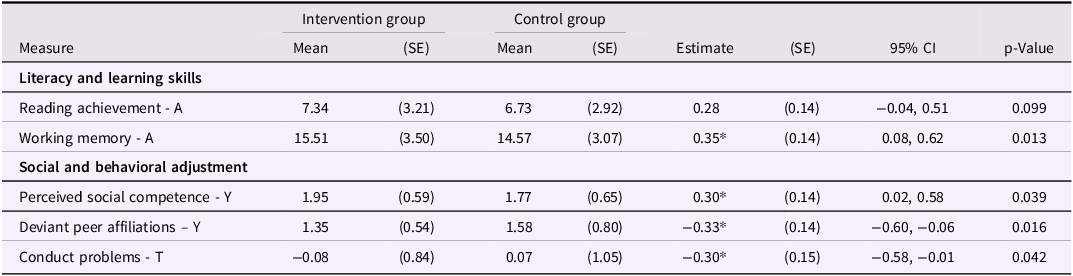
Regression models evaluated intervention effects on each grade 7 outcome. Results are shown in Table 2. Statistically significant intervention effects emerged on working memory, β = 0.35, 95% CI 0.08, 0.62, p = .013, perceived social competence, β = 0.30, 95% CI 0.02, 0.58, p = .039, deviant peer affiliations, β = −0.33, 95% CI −0.60, −0.06, p = .016, and teacher-rated conduct problems, β = −0.30, 95% CI −0.58, −0.01, p = .042. The intervention effect on grade 7 reading achievement was not statistically significant, β = 0.23, 95% CI −0.04, 0.51, p = .099.
Intervention effects on grade 7 outcomes
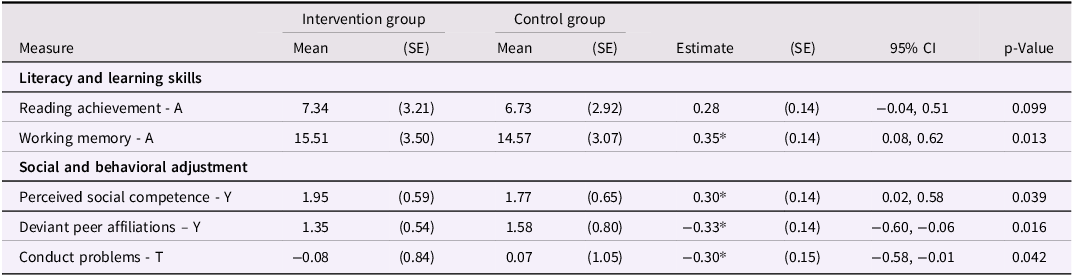
Table 2 Long description
The table presents a comparison of intervention and control groups on various measures of literacy, learning skills, and social and behavioral adjustment. It includes mean values, standard errors, estimates, confidence intervals, and p-values for each measure. The measures are divided into two categories: Literacy and learning skills, and Social and behavioral adjustment. Under Literacy and learning skills, the measures are Reading achievement - A and Working memory - A. Under Social and behavioral adjustment, the measures are Perceived social competence - Y, Deviant peer affiliations - Y, and Conduct problems - T. Each measure is listed with its corresponding mean values and standard errors for both the intervention and control groups, followed by the estimate, standard error of the estimate, 95% confidence interval, and p-value.
Note: SE = standard error. A = Assessment, T = Teacher rating, Y = Youth rating. Covariates included child demographics, study design features, child cognitive skills, and family characteristics. Means shown in the table are adjusted for covariates. Data availability included N = 163 (82%) for assessments and youth ratings and N = 139 (70%) for teacher ratings. Multiple imputation was used to estimate missing data. Analyses used standardized scores so that effects are equivalent to Cohen’s d. *p < .05.
Indirect effects on grade 7 outcomes: Serial mediation models
Next, serial mediation models explored indirect paths to illuminate how initial intervention effects evident in kindergarten and subsequent adjustment in gradeschool may have mediated the grade 7 REDI-P effects.
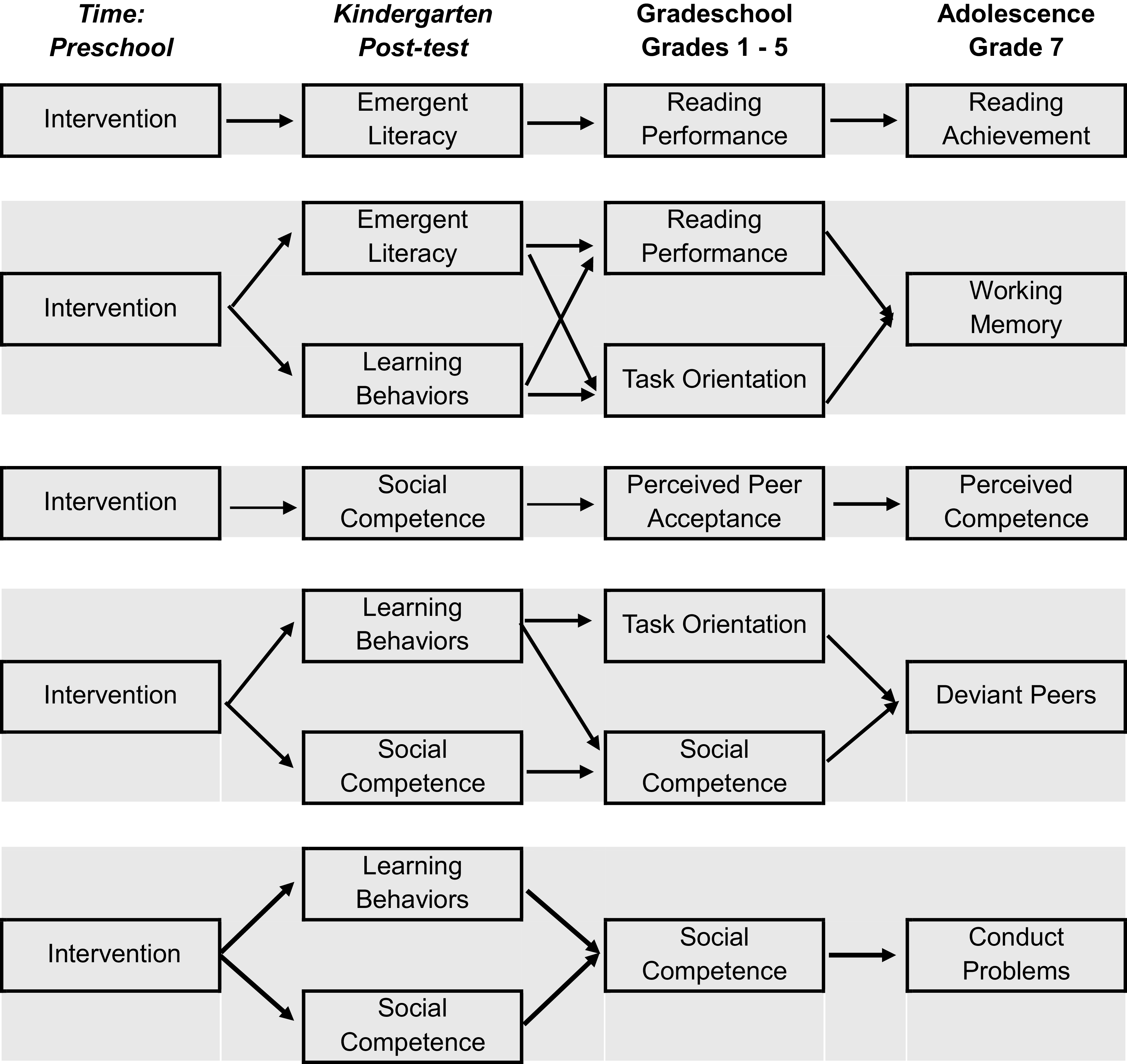
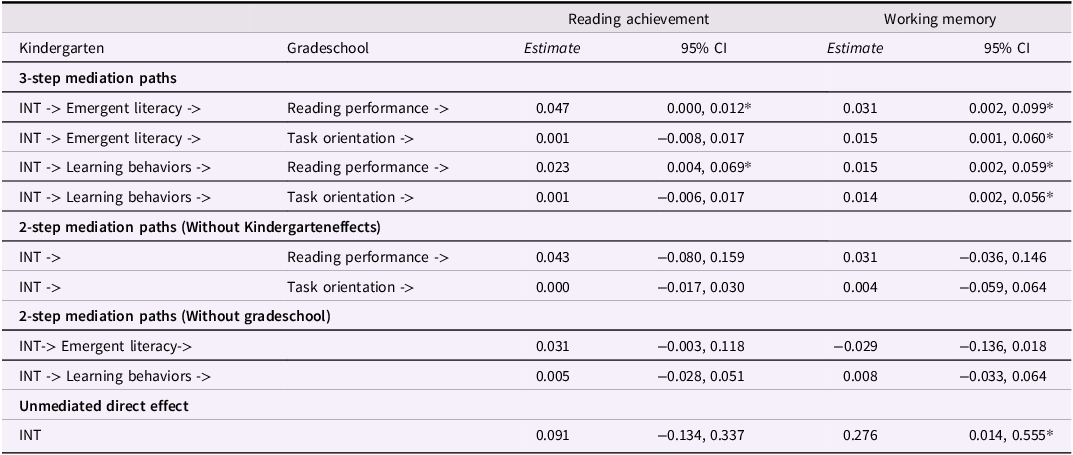
Serial models predicting grade 7 reading achievement and working memory included kindergarten and gradeschool measures of literacy skills and learning behaviors as potential mediators. One model including multiple mediators was run for each outcome. Model coefficients are listed in Table 3 and significant mediation pathways are illustrated in Figure 1. One significant indirect path to grade 7 reading achievement emerged, mediated by initial REDI-P effects on emergent literacy skills and subsequent gradeschool reading performance. Four significant indirect paths emerged for grade 7 working memory, including one parallel to reading achievement through intervention boosts to emergent literacy skills and sustained elevations in gradeschool reading performance. A second mediation path to working memory also started with intervention boosts to emergent literacy skills and then proceeded through gradeschool task orientation. Two additional mediation paths to grade 7 working memory started with intervention effects on kindergarten learning behaviors and proceeded through gradeschool reading performance and task orientation, respectively. These models fully mediated the intervention effect on grade 7 reading achievement and partially mediated the intervention effect on grade 7 working memory.
Mediation models: REDI-P effects on grade 7 reading achievement and working memory
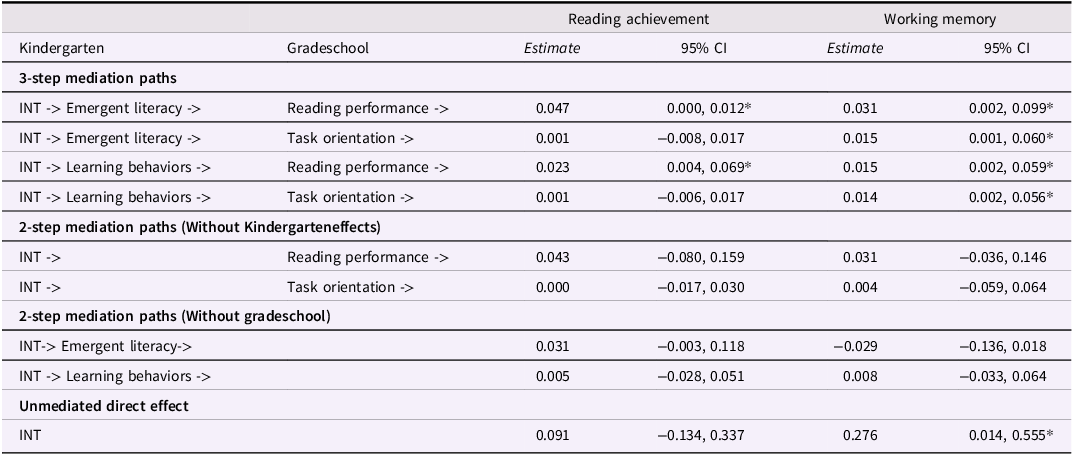
Table 3 Long description
The table presents data on the effects of intervention on reading achievement and working memory through various mediation paths. It includes estimates and 95% confidence intervals for different mediation paths involving kindergarten and gradeschool measures of literacy skills and learning behaviors. The table is divided into sections for 3-step mediation paths, 2-step mediation paths without kindergarten effects, 2-step mediation paths without gradeschool effects, and unmediated direct effects. Each row lists the path, estimate, and 95% confidence interval for reading achievement and working memory. Notable paths include significant mediation pathways for both reading achievement and working memory, with specific paths showing significant indirect effects.
Note: INT = REDI-P intervention. All variables in the model were adjusted for a set of covariates, including child demographics, study design features, child cognitive skills, and family characteristics. Kindergarten measures were also adjusted for baseline measures of emergent literacy skills, learning behaviors, and social competence, and thus represent the residualized change from preschool pre-test to kindergarten post-test. Separate models were run for reading achievement and working memory. Mplus 8.4 treats serial mediation as a system of simultaneous regression equations, estimates them jointly, and then computes indirect effects as products of the estimated path coefficients. The 95% bootstrapped confidence intervals shown in this table were used to identify indirect paths that were statistically significant. * p < .05.
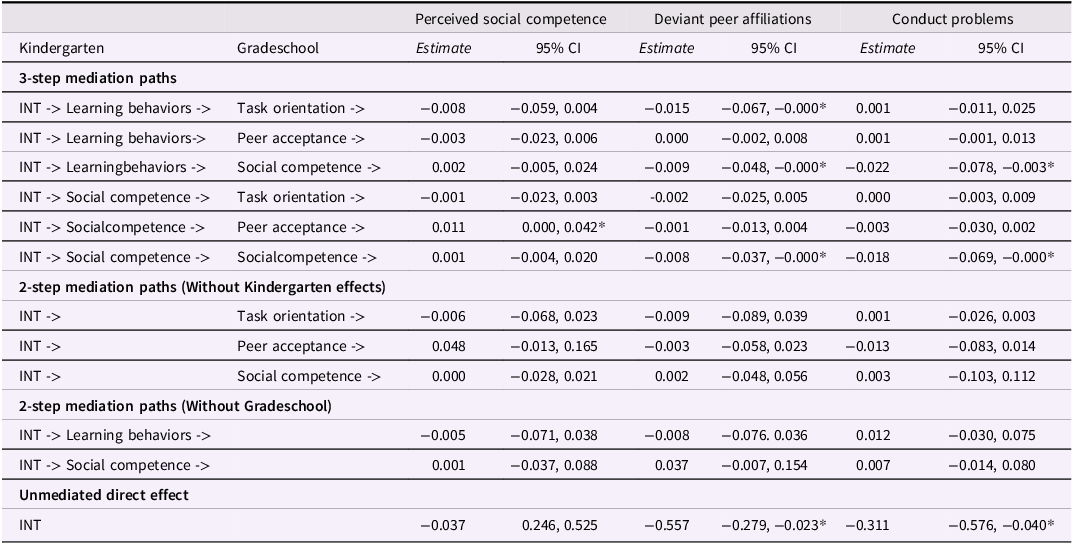
Serial mediation models predicting grade 7 social-emotional adjustment included measures of kindergarten and gradeschool social-emotional adjustment and learning behaviors. Model coefficients are listed in Table 4, and significant indirect pathways are illustrated in Figure 2. One significant indirect path emerged for grade 7 perceived social competence, mediated by REDI-P boosts to kindergarten social competence and subsequent gradeschool perceived peer acceptance. Two significant mediation paths emerged linking REDI-P intervention to grade 7 deviant peer affiliations and conduct problems via kindergarten social competence through gradeschool social competence, and via kindergarten learning behaviors through gradeschool social competence. In addition, REDI-P effects on grade 7 deviant peer affiliations were mediated by earlier effects on kindergarten learning behaviors and gradeschool task orientation. Serial path models fully mediated the intervention effect on grade 7 perceived social competence and partially mediated the intervention effects on grade 7 deviant peer affiliations and conduct problems.
Significant mediation paths linking REDI-P to grade 7 outcomes. Note: Significant paths mediating preschool intervention effects on adolescent outcomes are depicted. Kindergarten scores represent residualized change from pre- to post-intervention. Gradeschool scores were averaged across years. Measures include direct assessments (kindergarten emergent literacy, grade 7 reading achievement and working memory), observer ratings (gradeschool task orientation), teacher ratings (kindergarten social competence and learning behaviors, gradeschool social competence, grade 7 conduct problems), and self-ratings (gradeschool perceived peer acceptance, grade 7 perceived competence and deviant peer affiliations). Path coefficients are shown in Tables 3 and 4.
Mediation models: REDI-P effects on perceived competence, deviant affiliations, conduct problems
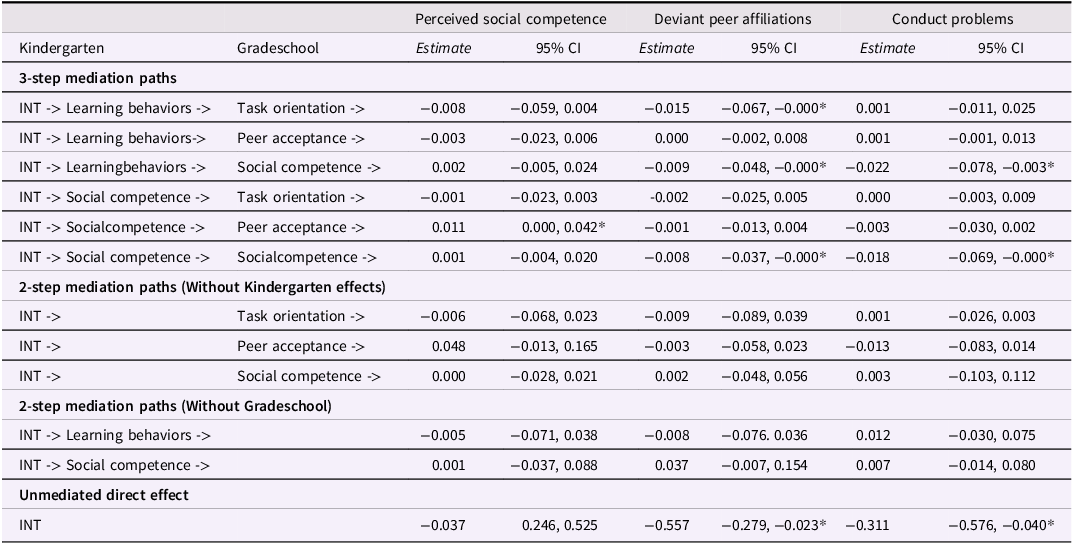
Table 4 Long description
The table presents the effects of REDI-P intervention on perceived social competence, deviant peer affiliations, and conduct problems through various mediation paths. It includes estimates and 95% confidence intervals for different mediation models. The table is organized into several sections: 3-step mediation paths, 2-step mediation paths without kindergarten effects, 2-step mediation paths without gradeschool effects, and unmediated direct effect. Each section lists the paths and their corresponding estimates and confidence intervals. For example, the 3-step mediation paths section includes paths like INT -> Learning behaviors -> Task orientation -> Perceived social competence, with an estimate of -0.008 and a 95% CI of -0.059 to 0.044. The table provides a detailed breakdown of how different factors mediate the effects of the REDI-P intervention on social-emotional adjustment outcomes.
Note: INT = REDI-P intervention. All variables in the model were adjusted for a set of covariates, including child demographics, study design features, child cognitive skills, and family characteristics. Kindergarten measures were also adjusted for baseline measures of emergent literacy skills, learning behaviors, and social competence, and thus represent the residualized change from preschool pre-test to kindergarten post-test. Separate models were run for each outcome: perceived social competence, deviant peer affiliation, and conduct problems. Mplus 8.4 treats serial mediation as a system of simultaneous regression equations, estimates them jointly, and then computes indirect effects as products of the estimated path coefficients. The 95% bootstrapped confidence intervals shown in this table were used to identify indirect paths that were statistically significant. * p < .05.
Discussion
Compared with children randomly assigned to the control group, those randomized to REDI-P showed significantly better adolescent outcomes eight years after the intervention in areas of working memory, perceived social competence, deviant peer affiliations, and conduct problems. Serial mediation models illustrated how adolescent benefits emerged via positive developmental cascades. Initial intervention gains in emergent literacy skills and self-regulated learning behaviors cascaded through gradeschool academic performance and task orientation to boost grade 7 cognitive outcomes (reading achievement and working memory). Initial intervention gains in social competence and self-regulated learning behaviors cascaded through gradeschool perceived peer acceptance, teacher-rated social competence, and self-regulated learning behaviors to boost grade 7 social-emotional outcomes (enhanced perceived social competence, and reduced affiliation with deviant peers and conduct problems).
These study findings highlight the potential long-term impact of carefully designed preschool parent interventions that promote child school readiness skills. The findings are consistent with prior research that has documented positive benefits associated with preschool parent engagement programs that increase cognitive stimulation and home learning opportunities and include intensive coaching in positive parenting strategies (Barnett et al., Reference Barnett, Paschall, Mastergeorge, Cutshaw and Warren2020; Grindal et al., Reference Grindal, Bowne, Yoshikawa, Schindler, Duncan, Magnuson and Shonkoff2016; Joos et al., Reference Joos, Magnuson, Duncan, Schindler, Yoshikawa and Ziol-Guest2020; Reynolds et al., Reference Reynolds, Lee, Eales, Varshney, Smerillo, Bierman and Sheridan2022). REDI-P included these key features by providing parents with home learning activity kits designed for easy use by caregivers with low literacy levels. These kits featured interactive stories and guided play activities designed to support collaborative parent–child interactions and conversations. Home visitors helped parents tailor their use of learning materials to align with their family goals and also provided coaching in strategies to support child social-emotional learning, language development, and emergent literacy skills. In addition, REDI-P was aligned with the REDI classroom programming that was being used in Head Start classrooms, thereby promoting coordinated home-school learning opportunities.
The grade 7 outcome measures were standardized for the analyses so that the reported estimates of significant intervention effects were equivalent to Cohen’s d, ranging from d = 0.30 to d = 0.35 and representing a difference of about a third of a standard deviation separating the intervention group from the control group. Effects in this range are generally considered to be clinically and educationally significant (Kraft, Reference Kraft2020). This size of effect is especially notable because outcomes were measured 8 years after the intervention, were drawn from multiple sources, and reflected broad domains of functioning that were not directly targeted by the intervention (Kraft, Reference Kraft2020). They compare favorably to the average post-intervention effect size that Grindal et al. (Reference Grindal, Bowne, Yoshikawa, Schindler, Duncan, Magnuson and Shonkoff2016) found for preschool parent education programs delivered via intensive home visiting (d = 0.30 at post-intervention assessments), and to those found by Brotman et al. (Reference Brotman, Dawson-McClure, Kamboukos, Huang, Calzada, Goldfeld and Petkova2016) in their 3 year follow-up of the ParentCorps RCT (d = 0.21 to d = 0.44). It is also noteworthy that, in the current study, children were randomized within classroom, so children in the control group were exposed to the same Head Start classroom-based REDI components as those in the intervention group, making the effects in this paper specific to the added parent enrichment program.
The serial mediation analyses highlight the value of targeting multiple school readiness skills, increasing child emergent literacy, self-regulated learning behaviors, and social-emotional competence at school entry, as boosts in these skill domains mediated the sustained intervention impact on adolescent outcomes. The serial mediation models run in this study were inherently exploratory, as participants were not randomly assigned to mediators, and measures were selected based on their sensitivity to intervention effects at earlier time points (kindergarten, gradeschool) rather than on an apriori basis. They provide information that is complementary to the confirmatory tests of intervention outcomes, because they offer insights that can generate and refine theoretical understanding of how early interventions like this one work developmentally.
The serial mediation models documented within-domain sustained effects evident for REDI-P related gains in early academic and social-emotional school readiness and also illuminated the cross-domain developmental benefits of early intervention-related gains in children’s self-regulation skills. Initial effects on self-regulated learning behaviors emerged as a mediator of positive adolescent outcomes in both cognitive and social-emotional domains, boosting grade 7 working memory and reducing risky behaviors (deviant peer affiliations and conduct problems). Prior developmental research has identified sensitive-responsive parent–child interactions and early cognitive stimulation as foundations for EF development and behavioral self-regulation (Merza et al., Reference Merza, Landry, Montroy and Williams2017). The current findings are consistent with longitudinal studies that have linked self-regulated learning behaviors in gradeschool with subsequent middle school adjustment across academic and social domains (Jacobson et al., Reference Jacobson, Williford and Pianta2011), and also with the intervention effects of the Family Check-up delivered in early childhood which boosted child inhibitory control which, in turn, mediated subsequent enhanced adolescent functioning on both academic and social-emotional measures (Hentges et al., Reference Hentges, Weaver Krug, Shaw, Wilson, Dishion and Lemery-Chalfant2020). These findings suggest that the socioeconomic disparities in EF and self-regulation that are associated with family socioeconomic status may be mitigated, at least in part, by helping parents increase the quality of the early home cognitive stimulation and child-centered interactions they provide during the preschool years, thereby reducing child risk for future academic difficulties and risky behaviors.
Strengths and limitations
Study strengths included the prospective longitudinal design and use of a randomized-controlled trial that allowed for unbiased estimates of sustained intervention impacts. In addition, measures utilized multiple methods (direct assessments, self-reports, teacher ratings) providing broad coverage of the targeted mediators and outcomes.
One study limitation was that the sample, drawn from three Pennsylvania counties, may not be representative of Head Start programs or parent–child populations in other geographic regions, potentially reducing the generalizability of the findings. While diverse, the sample lacked sufficient representation of racial/ethnic subgroups to determine how cultural factors may have influenced the intervention’s effects. Furthermore, the low-income status of participating families leaves unanswered questions about the intervention’s impact on children and families from different socioeconomic backgrounds.
The mediation models studied here focused on child functioning at the end of intervention and during the subsequent gradeschool years as the mechanism promoting sustained intervention effects. This focus was based on cascade models posited by prior investigators in which the skills gained during ECE interventions increase children’s future success in navigating subsequent developmental challenges and accessing more protective socialization contexts (Sandler et al., Reference Sandler, Ingram, Wolchik, Tein and Winslow2015). It is also possible that REDI-P had lasting effects on parent attitudes or practices that contributed in unmeasured ways to the observed adolescent outcomes (Hentges et al., Reference Hentges, Weaver Krug, Shaw, Wilson, Dishion and Lemery-Chalfant2020; Reynolds et al., Reference Reynolds, Lee, Eales, Varshney, Smerillo, Bierman and Sheridan2022).
Implications
This study builds on earlier REDI-P research extending evidence of positive impact after youth transitioned into middle school. The findings suggest that publicly funded preschool programs designed to address socioeconomic disparities in school readiness could increase positive impact by investing in parent engagement programs that strengthen home learning support and positive parenting practices.
Prior analyses placed the cost per student of REDI-P home visiting in the $2,880–$2,660 range ($4,043–$4,380 based on 2025 dollars; Jones et al., Reference Jones, Bierman, Crowley, Welsh and Gest2019). Additional follow-up research is needed to determine whether the intervention will represent a positive return on investment, but this seems likely given the predictive associations between adolescent educational and psychosocial adjustment and subsequent adult employment and mental health outcomes (Tayfur et al., Reference Tayfur, Prior, Roy, Fitzpatrick and Forsyth2021). The REDI-P effects documented in this study fall well above the threshold of ECE cost-effectiveness suggested by Knight and colleagues (Reference Knight, Landry, Zucker, Merz, Guttentag and Taylor2019) – gains of 0.025 standard deviations for $1,000 investment per student. The REDI-P effects also align well with the longitudinal effects documented for ParentCorps, which were linked with positive longer-term economic benefits based on a Markov simulation (Hajizadeh et al., Reference Hajizadeh, Stevens, Applegate, Huang, Kamboukos, Braithwaite and Brotman2017). These findings and other work highlighting the long-term value of effective early investment suggest that the public investment in Head Start could be effectively leveraged to substantially increase program impact by the wider adoption and dissemination of well-developed parent engagement programs that have proven effective in promoting child school readiness.
Conclusions
The findings show that empowering parents of preschoolers with scaffolded home learning materials and coaching in supportive interaction strategies has sustained benefits for their children in adolescence extending across academic and social-emotional domains. The multiple mediation pathways highlight the value of targeting both cognitive and social-emotional school readiness, creating enhanced skills at school entry that initiate positive developmental cascades and promote resilience at the early adolescent transition into middle school.
Supplementary material
The supplementary material for this article can be found at https://doi.org/10.1017/S0954579426101497.
Acknowledgements
We are indebted to all of the project intervention and research personnel. We greatly appreciate the collaboration provided by our partners: the parents, students, teachers, and program personnel of the Head Start programs of Huntingdon, Blair, and York counties in Pennsylvania and of the school districts that participated in the follow-up study.
Funding statement
This project was supported by the National Institute of Child Health and Human Development Grant HD046064.
Competing interests
The authors declare no competing interests.
Data availability statement
Data are available upon request.
Pre-registration
Apriori registration of trial follow-up data collection and analyses, Registry of Efficacy and Effectiveness Studies #16840.2v1.pdf
Link: https://sreereg.icpsr.umich.edu/sreereg/subEntry/21385/pdf


 Open access

