




Introduction
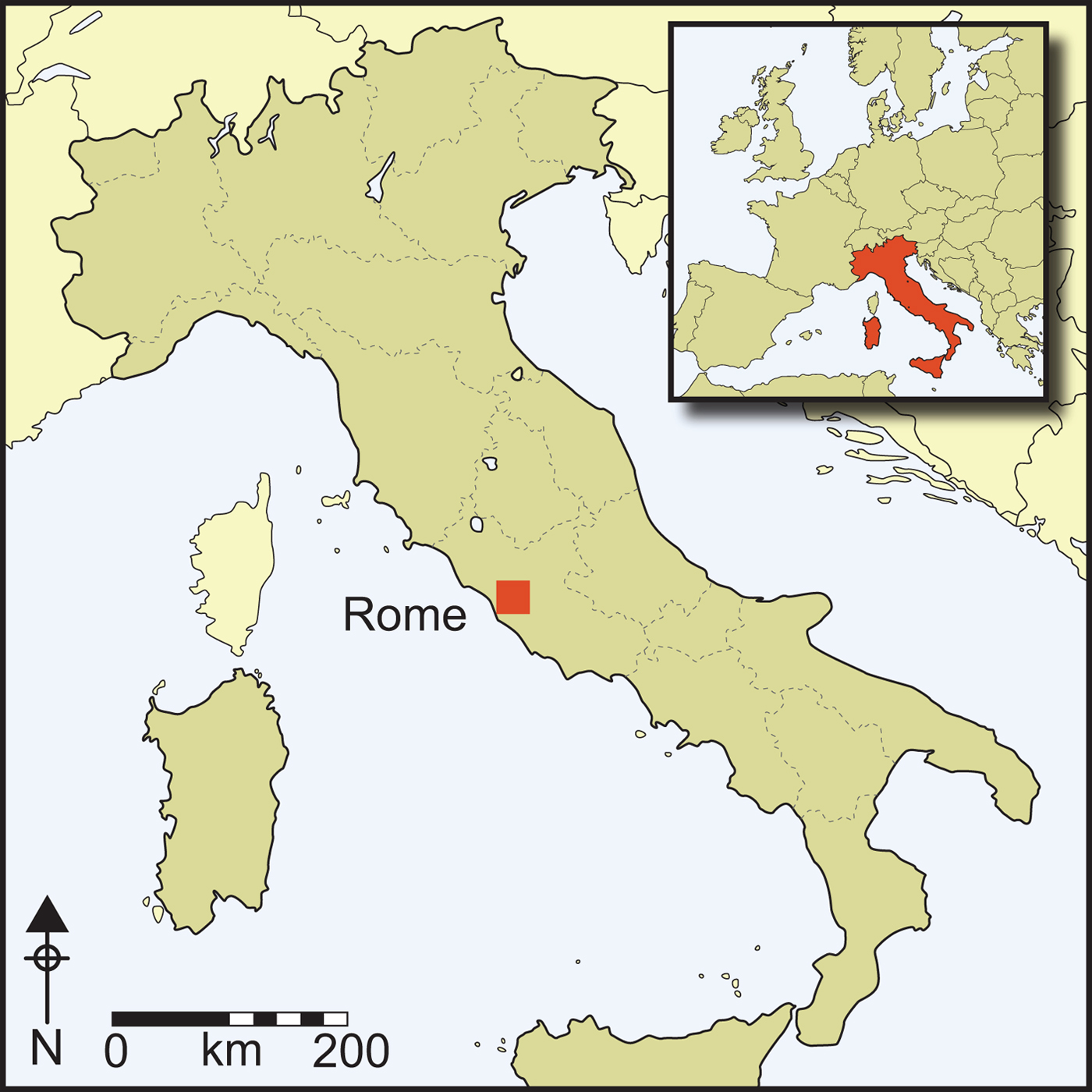
Portus, the maritime port of Imperial Rome, was established near the mouth of the River Tiber under Claudius (after AD 42), and was substantially enlarged under Trajan c. AD 112–117 (Keay et al. Reference Keay, Millett, Paroli and Strutt2005: 11–14, 298–309). For over 400 years, the port funnelled imports from across the Mediterranean to Rome, acting as a hub for the export of products from the Tiber valley, and for their redistribution around the Mediterranean. The physical extent of the port and its commercial activity during the periods of Ostrogothic and Byzantine control, however, is less well understood (Keay et al. Reference Keay, Millett, Paroli and Strutt2005: 13, 291–95).
Since 2007, the ‘Portus Project’ (www.portusproject.org) has been analysing the site in its broader economic and social contexts. The excavated evidence has transformed our understanding of the nature and development of two key port buildings, and the site's broader commercial connections with the nearby river port of Ostia, as well as Rome and other Mediterranean communities through the second to sixth centuries AD (Keay Reference Keay and Keay2012). To assess the diet and geographic origins of the port's inhabitants, this article presents the first results of research on human and animal bone and on plant remains, including stable isotope analyses.
Archaeological context
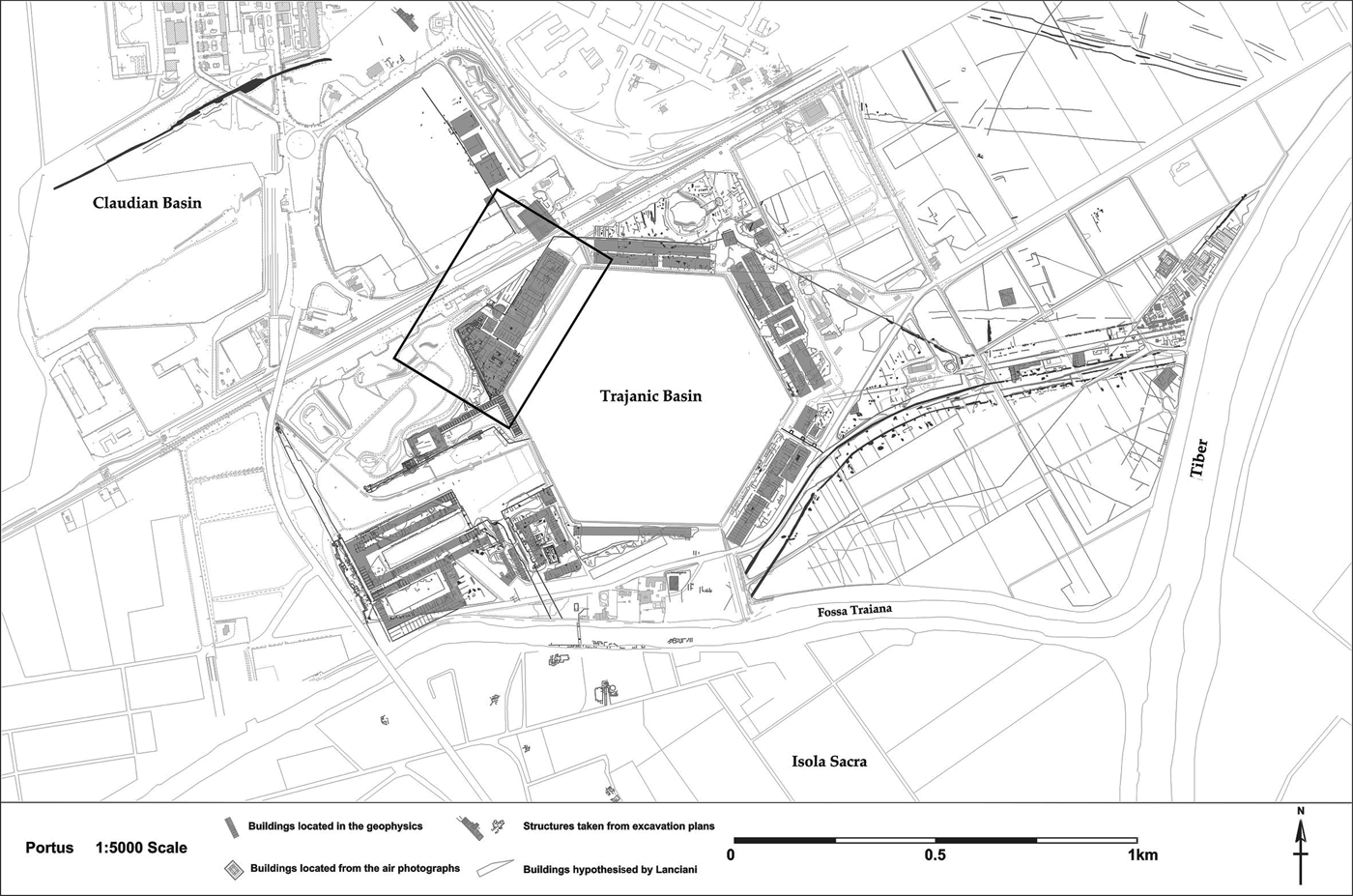
Excavation work at the heart of the port site has focused on structures known as the Palazzo Imperiale and Building 5 (Figure 1). Initially constructed c. AD 115–120, the former was an imperial villa with residential and administrative functions, and the latter probably served as a monumental (in terms of size and architecture) shelter for ships. Both underwent six periods of use through to the mid sixth century AD. The specific character and taphonomy of the studied contexts means that the sample sizes recovered vary greatly by period. Most of the plant and animal remains derive from rubbish dumps, with earlier periods underrepresented in terms of the volumes of excavated contexts (Figure 2).
Map showing the topography of Portus. The area of the 2007–2012 excavations is defined by the box (after Keay et al. Reference Keay, Millett, Paroli and Strutt2005: pull-out 1).
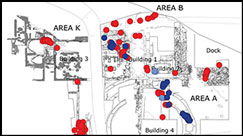
Multi-period plan of the 2007–2012 excavations, showing the spatial and chronological distribution of the contexts from which the environmental material discussed in this article was derived (figure credit: Portus Project).

Biological evidence
Plant and animal remains provide direct evidence for food, traded goods, building materials, fuels and the local environment. Imported staples and exotic goods were perhaps consumed alongside local products. The small quantities of exotics provide clear biogeographical evidence for maritime trade—notably early third-century AD charred black pepper seeds imported via Egypt from India (van der Veen & Morales Reference van der Veen and Morales2015), late fifth-century containers made of African ostrich eggshell, as well as two bear metapodials (cf. Ursus arctos) and a probable dorsal thoracic rib from a Nile crocodile (cf. Crocodylus niloticus). Both crocodiles and bears were probably used in the spectacles held at Rome, the former imported live from Egypt (MacKinnon Reference MacKinnon2006), and the latter either from Europe or possibly a now extinct subspecies from the Atlas Mountains of North Africa (Hamdine et al. Reference Hamdine, Michaux and Thévenot1998). Such exotics could only have formed minor dietary components—consumed infrequently, if at all—and therefore would have contributed little to the isotopic signatures of the site's inhabitants. Thus, the focus of this article is the principal dietary staples, represented by charred cereal grains and faunal remains, the latter predominantly domestic ungulate bones.
Distribution of samples
A sampling strategy was designed to obtain representation of all phases, excavation areas and feature types (Figure 2 & Table S1 in the online supplementary material (OSM)). The resultant assemblages, however, are somewhat limited (see the OSM). As the excavations examined the administrative and commercial areas of the site, rather than the households situated elsewhere (Keay et al. Reference Keay, Millett, Paroli and Strutt2005: 311–12; Keay Reference Keay and Keay2012: 46), the food-refuse assemblages recovered are assumed to derive primarily from the daily lives of the port workers.
Charred plant remains
The 789 macrofossils represent 25 charred plant types. Twenty of these are of food plants, with cooking or meal refuse the most probable sources (Figure 3; for binomial nomenclature, see Table S1). Cereal grain is ubiquitous and occasionally abundant, while pulses are very infrequent. This difference is perhaps explained by variable food-processing and -preparation techniques, with boiling and stewing less likely to preserve the durable, distinctive seeds than baking and associated exposure to fire (Boardman & Jones Reference Boardman and Jones1990; van der Veen Reference van der Veen2007).
Plant and animal assemblages at Portus: a) charred macrofossils of probable consumed plants by period; b) NISP of probable consumed animals by period.
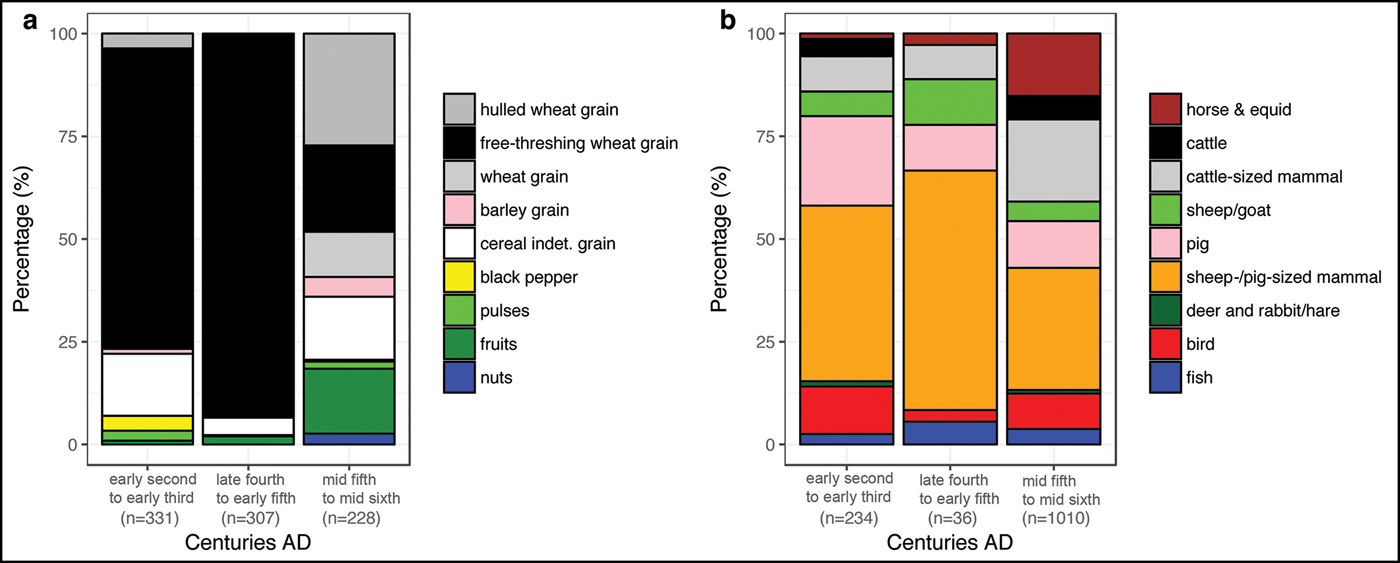
The grain is primarily from free-threshing wheats, with examples comparable to both bread wheat (183 grains) and macaroni wheat (191 grains). Hulled wheats—still cultivated today on a small scale across the Mediterranean (Nesbitt & Samuel Reference Nesbitt, Samuel, Padulosi, Hammer and Heller1996; Peña-Chocarro & Zapata Peña Reference Peña-Chocarro, Peña and Jaradat1998)—are represented by einkorn (10 grains) and emmer (31 grains). A complete absence of cereal chaff means that the identifications are cautious because of the limited morphological distinctiveness of different types of wheat grain—many grains are identified only to wheat groups, rather than species (Jones Reference Jones1998). Barley (16 grains) is less frequent, with both hulled and naked forms occasionally identifiable. The absence of chaff and the rarity of arable weed seeds further emphasises that consumption at the port was completely separate from agricultural production and primary crop-processing activities. When examined by period, the free-threshing wheats are predominant during the second to early fifth centuries AD, whereas hulled wheats predominate in dump deposits from the mid fifth century onwards (Figure 3). This temporal shift may relate to the character of associated activities, shifts in maritime trade networks, or to consumer preferences. Roman texts, for example, indicate that emmer wheat was a staple that played a central role in rituals and festivals (Papa Reference Papa, Padulosi, Hammer and Heller1996: 156). As the mid fifth- and sixth-century contexts at Portus include numerous inhumations, the presence of a more diverse range of food plants may suggest changes in the use of foods for votive, funerary—or at least quotidian—practices, as well as wider shifts in the trans-Mediterranean grain trade (Margaritis Reference Margaritis, Touchais, Laffineur, Rougemont, Procopieu and Andreou2014).
There are no clear temporal trends for the few identifiable lentil, pea and broad bean macrofossils. The mid fifth- to mid sixth-century charred seed assemblage includes multiple examples of grape, fig, blackberry, elderberry and olive, in addition to occasional pulses (Table S1), suggesting the representation of different activities in the macrofossil record in comparison with earlier periods. Such activities may include fruit drying, cooking, votive offerings linked to funerary rites, or the discard of meal refuse into fires; oil-rich olive stones are also a known fuel source (Margaritis & Jones Reference Margaritis and Jones2008). Meal refuse appears to be the most plausible explanation, however, as different fruits co-occur in several contexts, alongside occasional nutshell fragments of stone pine, oak acorn, walnut and terebinth.
Animal bones
The animal bone assemblage comprises 2570 identified bone specimens (NISP), with probable consumed taxa accounting for 234 specimens in the early second to early third centuries AD, 36 in the late fourth to the beginning of the fifth centuries AD, and 1010 in the mid fifth to the mid sixth centuries AD (Figure 3; for binomial nomenclature, see Table S2). Within each period, over half of the large mammal specimens are identified as ‘cattle-/horse-sized’ and ‘sheep-/pig-sized’; the low NISP and poor bone preservation make it impossible to infer diachronic shifts in the proportion of species. At least 33 animal taxa are present, but most bones are of sheep/goat, pig, cattle and horse/equid; these elements probably represent refuse discarded at, or near, places of work rather than domestic assemblages. While the precise activities that generated this small assemblage are uncertain, the bones are probably representative of the animals consumed more widely at the port site. Other animal species also probably consumed are fallow deer, rabbit/hare, domestic/greylag goose and domestic fowl. Some of the fallow deer and rabbit/hare bones display traces of butchery, although such marks are generally rare in the assemblage, due to bone surface erosion linked to the chemically harsh, sandy burial environment. The rarely recovered fish bones include both freshwater and marine types, such as of the carp family, sardine/sardinella, seabream and eel.
Although this animal bone assemblage from Portus is relatively small, with high levels of fragmentation and surface erosion (Table S5 & Figure S1), it is nevertheless important, as it is the first ever from the port site to be analysed and published.
Isotopic analysis
Carbon and nitrogen stable isotopic analysis allows the characterisation of isotopic food webs, with sampling limited to those entities preserved following cultural and natural taphonomy. It also offers the potential for distinguishing imported plants and animals from the same species produced locally. Such a differentiation is crucial, given the role of Portus in pan-Mediterranean commerce and the long-distance trade in cereals reported by the classical sources (Foxhall & Forbes Reference Foxhall and Forbes1982; Erdkamp Reference Erdkamp2005).
Isotopic analyses of the human remains can elucidate the habitual diet of individuals living and working at Portus, and indicate where individuals may, or may not, have been raised. Comparison of isotopic data within burial groups and across time can reveal the degree of homogeneity within a community in relation to diet and geographic origins, as well as diachronic shifts in population structure and food habits.
Plant samples
A total of 91 charred plant macrofossils were selected for analysis, based on grain abundance and context type. Eighty-eight grains are identified as wheat; the others are barley, a large legume and unidentified cereal fragments. Of the wheat samples, 85 are securely identified by morphological criteria as free-threshing, and three as hulled wheat. Each grain was analysed individually, rather than in groups (single-entity analyses) (Kanstrup et al. Reference Kanstrup, Thomsen, Mikkelsen and Christensen2012). As each grain is small, we have valid δ13C results for all 91 samples, but not necessarily valid δ15N results, due to the low nitrogen content of the samples. Table S4a contains all the isotopic results for the plant samples, with details of the archaeological context and species identification.
The overall carbon isotopic variability in wheat is 4.2‰, with a range of –24.7 to –20.4‰. While this range is similar to values observed in other Mediterranean archaeological samples, it is larger than expected for crops grown in a single year or at an individual site (Wallace et al. Reference Wallace, Jones, Charles, Fraser, Halstead, Heaton and Bogaard2013). This is consistent with the role of Portus in the Mediterranean cereal trade. The carbon isotopic values of the free-threshing wheat show an interesting temporal pattern (Figure 4a). While the overall range changes little, the 60 samples from the early second to early third centuries have significantly lower δ13C than the 21 from the late fourth to early fifth centuries; the few samples from the mid fifth to mid sixth centuries have intermediate values (Figure 4a; for statistical tests, see the OSM).
Isotopic values of (a) free-threshing wheat and (b–c) animals by period (for full information, see Tables S4a & S7).
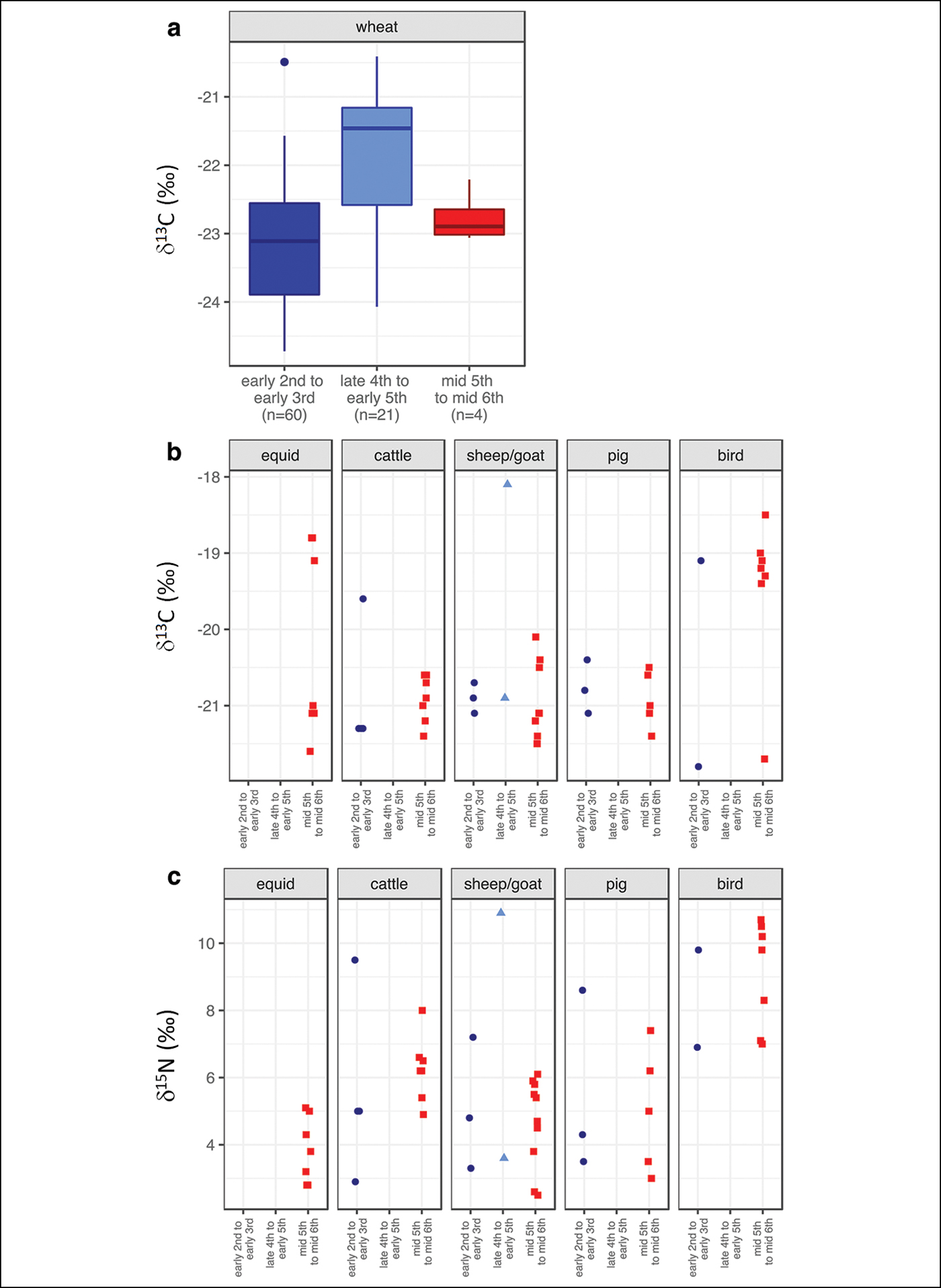
The diachronic change in the δ13C values of free-threshing wheat indicates a shift in wheat-growing conditions (Flohr et al. Reference Flohr, Müldner and Jenkins2011; Wallace et al. Reference Wallace, Jones, Charles, Fraser, Halstead, Heaton and Bogaard2013), which could relate to changes in origin, management, irrigation patterns or climate in the region of cultivation. If observed within a single population, a δ13C increase of the magnitude seen between the early third and late fourth centuries would indicate greater plant stress (such as reduced water availability: Wallace et al. Reference Wallace, Jones, Charles, Fraser, Halstead, Heaton and Bogaard2013). What is more probable in the case of Portus, however, is a change in grain-supply region. There is some evidence for wetter conditions in the Eastern Mediterranean during the fourth and fifth centuries (McCormick et al. Reference McCormick, Büntgen, Cane, Cook, Harper, Huybers, Litt, Manning, Mayewski, More, Nicolussi and Tegel2012: 188–97). The lack of evidence, however, from key grain-supply areas in the more western parts of North Africa, along with broader methodological and evidential issues (Manning Reference Manning and Harris2013), suggests caution in this interpretation.
Animal samples
A total of 57 animal bone samples were analysed, representing a range of species (Tables S5 & S7). Twelve are from the early second and early third centuries, and the remaining 45 from the late fourth/early fifth to sixth centuries, limiting our ability to assess diachronic change. As the low NISP and poor preservation limit the representativeness of our sample, statistical comparisons are unlikely to be valid, but a graphical comparison of the isotopic data from four species present in the early and late samples (birds, cattle, sheep/goat and pigs) shows no clear shift in either carbon or nitrogen isotopic values (Figure 4). The following discussion of the animal isotopic data therefore combines samples from all periods.
The animal carbon and nitrogen isotopic values (Figure 5; Tables S7 & S10) are consistent with contemporaneous samples from across Europe and similar to other Roman sites in the region (e.g. Prowse et al. Reference Prowse, Schwarcz, Saunders, Macchiarelli and Bondioli2004; Craig et al. Reference Craig, Biazzo, O'Connell, Garnsey, Martinez-Labarga, Lelli, Salvadei, Tartaglia, Nava, Reno, Fiammenghi, Rickards and Bondioli2009). Herbivore carbon isotopic values (–22.3 to –18.8‰) reflect a diet predominantly based on C3 vegetation, with no notable indication of millet or other C4 plant consumption. The domesticated herbivores have a greater nitrogen isotopic range than expected for animals sourced from any individual herd or flock—a probable scenario for livestock traded into Portus. Pigs have similar carbon and nitrogen isotopic values to other herbivores, in both absolute and relative terms, indicating that they were not fed an omnivorous diet, as often the case with pigs raised on household waste (Hamilton et al. Reference Hamilton, Hedges and Robinson2009). The birds, both wild and domestic, have higher nitrogen isotopic values than the other animals (a mean of 8.9‰), but similar δ13C values to those found elsewhere (Müldner & Richards Reference Müldner and Richards2005, Reference Müldner and Richards2007; Hakenbeck et al. Reference Hakenbeck, Mcmanus, Geisler, Grupe and O'Connell2010).
Comparing carbon and nitrogen isotopic values of animals analysed from Portus and Velia to the analysed humans from Isola Sacra, Tenuta del Duca and Building 5 (Velia data taken from Craig et al. Reference Craig, Biazzo, O'Connell, Garnsey, Martinez-Labarga, Lelli, Salvadei, Tartaglia, Nava, Reno, Fiammenghi, Rickards and Bondioli2009).
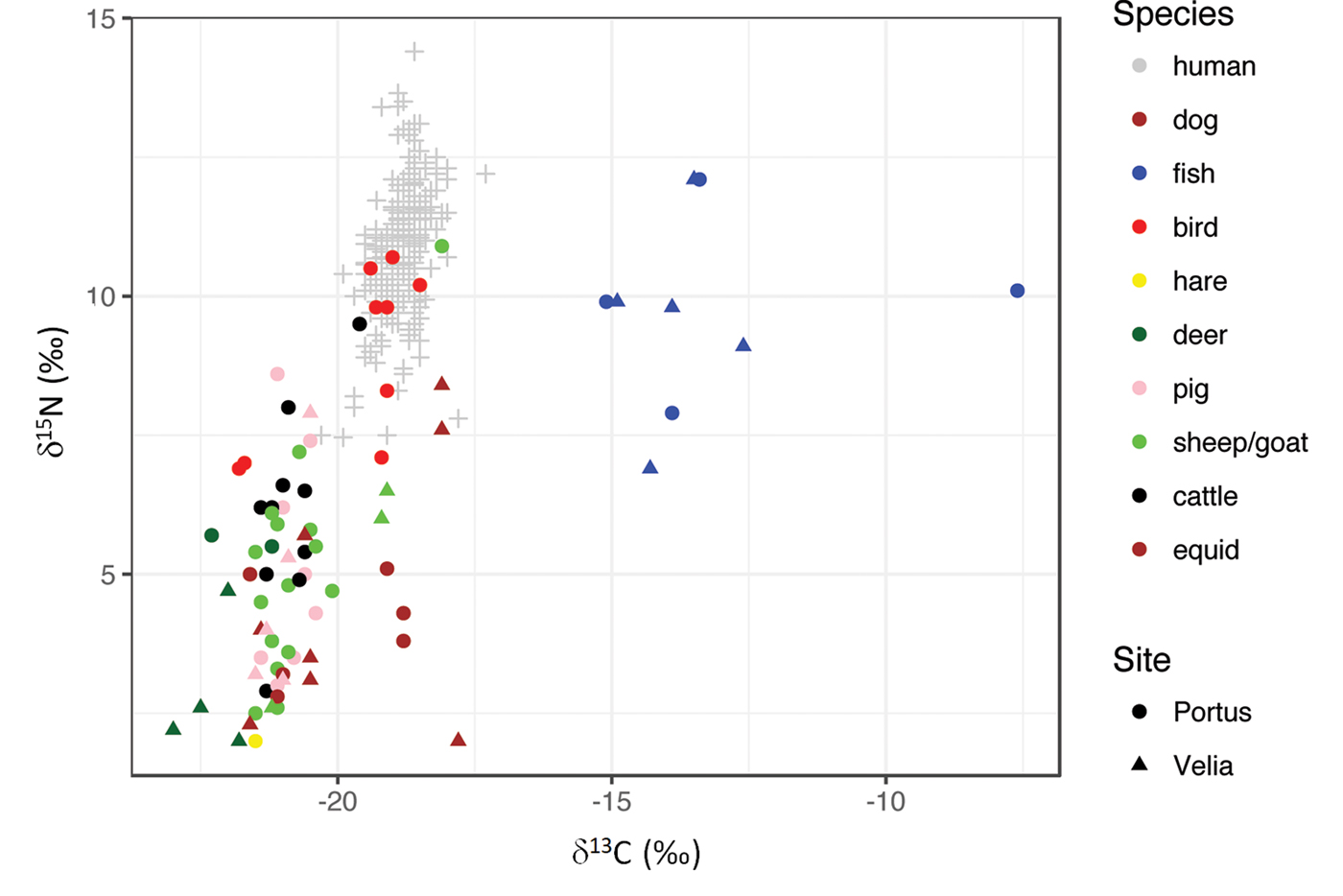
Despite the extensive flotation sieving undertaken—with heavy residues collected over 1mm mesh—very few fish remains were recovered, of which a limited number had sufficient bone mass for collagen extraction and analysis. Four samples were successfully analysed (one seabream and three unidentified to species). The carbon and nitrogen isotopic values are varied but consistent with Mediterranean fish (Blasi et al. Reference Blasi, Tomassini, Gelippi, Careddu, Insacco and Polunin2018), as well as archaeological fish samples from Velia (n = 5: Craig et al. Reference Craig, Biazzo, O'Connell, Garnsey, Martinez-Labarga, Lelli, Salvadei, Tartaglia, Nava, Reno, Fiammenghi, Rickards and Bondioli2009), and garum from Africa, Sardinia and Italy (Prowse et al. Reference Prowse, Schwarcz, Saunders, Macchiarelli and Bondioli2004).
Human skeletons
Human skeletal samples were taken from the mid fifth- and early sixth-century burials from Building 5, and from the late second-/early third- and the late fourth-/early fifth-century burials from Tenuta del Duca, a site approximately 1km to the north-east of the Palazzo Imperiale (Pantano Reference Pantano and Parolin.d.). Bone collagen from 28 individuals from Buildings 5 and 32 from Tenuta del Duca, plus 22 tooth enamel samples from Building 5 individuals, were successfully analysed.
Tables S8–9 provide the isotopic results of all samples, along with relevant details of archaeological context, osteological information, sex determinations and the bone elements sampled. These data were compared to previously published results from the adjacent Isola Sacra cemetery, dating to the first to third centuries AD (Prowse et al. Reference Prowse, Schwarcz, Garnsey, Knyf, Macchiarelli and Bondioli2007; Crowe et al. Reference Crowe, Sperduti, O'Connell, Craig, Kirsanow, Germoni, Macchiarelli, Garnsey and Bondioli2010).
Diet at Portus
Humans from the three sites—Building 5, Tenuta del Duca and Isola Sacra—have carbon isotopic values ranging from –20.3 to –17.3‰, and nitrogen isotopic values between 7.5 and 13.7‰. We have not attempted any modelling of human dietary isotopic composition, due to the paucity of data for some potential food sources (e.g. fish), and due to the absence of data for others (e.g. plant nitrogen isotopic data). Instead, we can use our animal and plant isotopic data to assess the food web, and to constrain potential interpretations of the human diet.
Overall, the isotopic data indicate that people ate predominantly terrestrial animals and C3 plants, with some input from marine foods, although with variable consumption patterns across all individuals. There is little evidence of marine fish intake for most individuals, due to the small offset between terrestrial animal and human carbon isotopic values (Bocherens & Drucker Reference Bocherens and Drucker2003). The humans have nitrogen isotopic values that are close to or above the upper end of the typical human-animal range for terrestrial consumers (approximately 13‰: Bocherens & Drucker Reference Bocherens and Drucker2003; Hedges & Reynard Reference Hedges and Reynard2007). This suggests some input of food sources with higher nitrogen isotopic values, potentially including birds—both domestic and wild—and freshwater fish.
Variation with time and place
The isotopic data show substantial variability within the samples from each site, and some patterning between the three. As isotopic values are influenced by multiple factors, they are difficult to interpret definitively, but they can indicate dietary trends between the three groups.
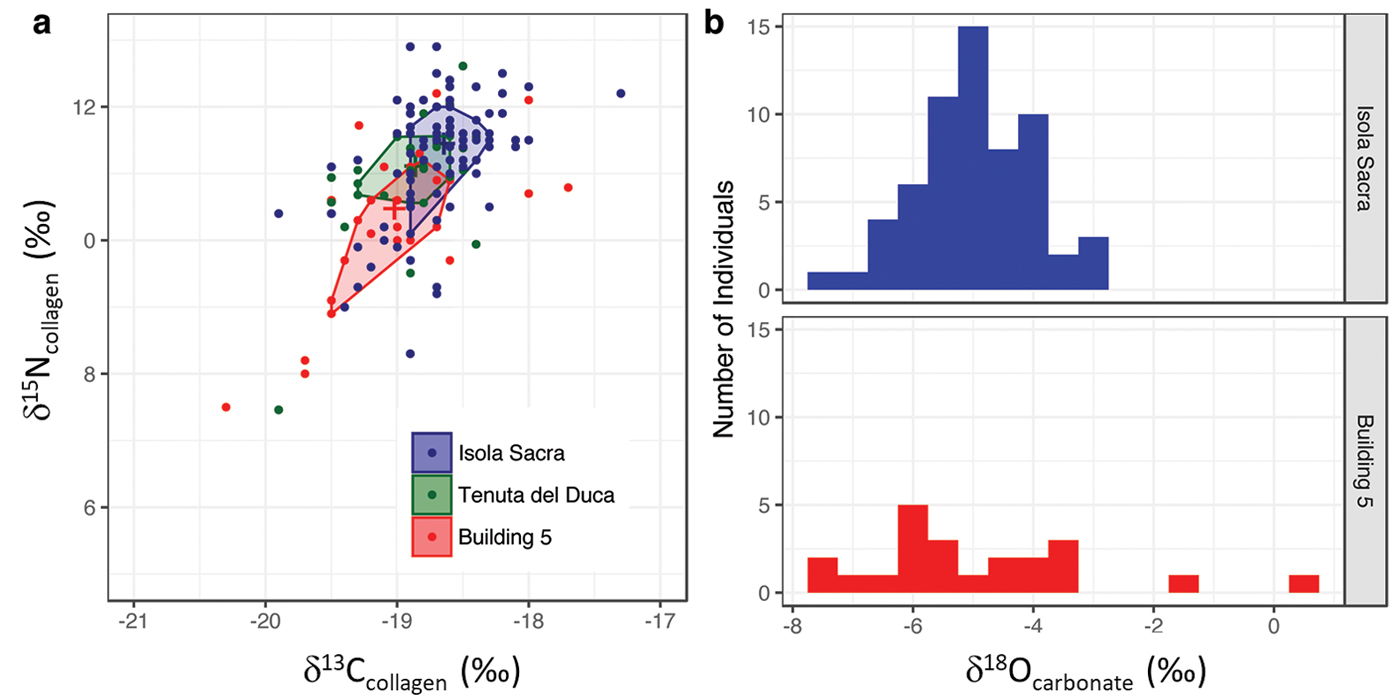
The archaeological, osteological and demographic data show that Isola Sacra was a cemetery for relatively affluent residents from Portus and Ostia (Baldassarre Reference Baldassarre1978; Helttula Reference Helttula1995). In comparison, the individuals from the Tenuta del Duca and Building 5 burials are predominantly male, in early to middle age, who undertook arduous physical labour—probably as port workers. The osteological data from the Tenuta del Duca and Building 5 individuals show similarities with those individuals excavated at cemeteries closer to Rome, including Castel Malnome and Casal Bertone, where most of the skeletons are males who exhibit signs of physical stress associated with heavy manual activity (Musco et al. Reference Musco, Catalano, Caspio, Pantano and Killgrove2008; Catalano et al. Reference Catalano, Benassi, Caldarini, Cianfriglia, Mosticone, Nava, Pantano and Porreca2010). Isotopically, we see a different patterning in the three groups. There is little difference between the isotopic composition of the diets of those buried at Tenuta del Duca and Isola Sacra, and a significant difference in nitrogen isotopic values between the two earlier groups and Building 5—a mean difference of more than 1‰ (Figure 6; Table S11; for statistical tests, see the OSM). This indicates that the diet of the Building 5 individuals was isotopically different to that of people from Isola Sacra and Tenuta Del Duca—an intriguing finding, given the demographic similarity of Tenuta del Duca and Building 5 individuals. This could result either from eating a different diet (that differs isotopically), or from the consumption of the same foods but with different isotopic values. The lack of any obvious isotopic shift in the animals over time (Figure 4) suggests a change in the human, rather than animal diet. In the absence of valid comparative plant nitrogen isotopic data, we cannot draw firm conclusions. A dietary shift to a greater reliance on plant protein—including more legumes—and a reduced intake of animal protein (either marine or terrestrial), however, is a likely explanation for the observed diachronic isotopic change. It is notable that this correlates with a shift in wheat types at Portus, as evinced by the increased prevalence of hulled wheats.
Isotopic values of humans from the three sites: a) scatter plots of bone collagen carbon and nitrogen isotopic values of humans from Isola Sacra, Tenuta del Duca and Building 5, with the coloured polygons representing the ‘bag’ that encloses 50% of the points around the depth median, marked with a cross; b) histograms of human tooth enamel carbonate oxygen isotopic values of individuals from the two cemeteries of Isola Sacra and Building 5 (for full information, see Tables S8–9).
Human origins and mobility
The oxygen isotopic values of the tooth enamel from the individuals buried at Building 5 and Isola Sacra are very similar, suggesting that they could have originated from the same geographic region (Figure 6b & Table S1). It is therefore unlikely that the carbon and nitrogen isotopic difference between those buried at Building 5 and the earlier groups is the result of long-term movement or migration; what we are observing is not the residual dietary signature of immigrants coming to work in the docks. There are, however, two individuals from Building 5 whose δ18O values are notably higher than the rest—at –1.5‰ and +0.7‰. These individuals (PTXI4425 and PTXI4054) were analysed in duplicate, with close agreement between the measurements. Their absolute values, and difference from the rest of the group, suggest that they were not raised locally; they probably moved from a warmer environment to Portus after childhood (Evans et al. Reference Evans, Chenery and Montgomery2012). One of these two, PTXI4054, a 40–50-year-old male, is the only individual from period 6B, dating to sometime after AD 530. This is notable considering the downturn in commercial activity at the port after the mid fifth century and the probable fall in the number of foreign traders present at the site.
Ceramic analysis
Transport amphorae provide additional evidence for the range and volume of imports to Portus. The origins and content of most amphorae types have been established over the last 40 years through kiln excavation, analyses of organic residues and typological comparisons. Our excavations have yielded approximately 52 000 ceramic fragments, of which just under half are from amphorae (Keay et al. Reference Keay, Cascino, Felici, Zampini, Cirelli, Diosono and Patterson2015). As with the environmental evidence, early to mid second-century material is scarce. The early third-century assemblage is much larger, while that of the mid fifth century is even greater. These variations in quantity are explained by taphonomy, rather than the result of changing volumes of imports as the later deposits derive from large dumps and the earlier material comes from thin occupation levels. The early third-century material is represented almost exclusively by amphorae for olive oil imported from Tripolitania (modern Libya). The period 6A material represents foodstuffs in circulation prior to the mid fifth-century contraction in commercial activity. These include a mixture of olive oil, fish sauce and wine, primarily from what is now Tunisia and western Libya (57%), with quantities of local Italian wine (16%) and imports from the Eastern Mediterranean (approximately 14%) far lower than documented at neighbouring Ostia and Rome. Imports are far rarer in sixth-century contexts at Portus.
Conclusions
The results of our analysis of the Portus material are best considered in terms of two consecutive time horizons. Between the earlier second and mid fifth centuries (periods 2–5), the human evidence from Tenuta del Duca indicates a local population involved in heavy manual labour—perhaps the saccarri (porters) attested on inscriptions from both Portus and Ostia (Martelli Reference Martelli2013). We suggest that in the early third century, these workers were predominately consuming free-threshing wheat and olive oil imported from North Africa, along with a broad range of common food plants and animals. Although their dietary profile might be expected to differ from that of the higher-status individuals buried at the Isola Sacra cemetery to the immediate south of Portus, there is little isotopic evidence for such dietary differences (Figure 6a). Towards the end of this time horizon, there was a change in the origin of imported free-threshing wheat, probably reflecting a shift away from North African imports.
Between the mid fifth and early part of the sixth centuries—as represented by the Building 5 burials (period 6)—the population displays a similar demographic profile to that of the earlier Tenuta del Duca group. The dead were largely males who had been involved in heavy physical labour—a profile paralleled by cemeteries closer to Rome (Caldarini et al. Reference Caldarini, Zavaroni and Benassi2015). While most were probably of local origin, two were non-local and could have been overseas traders—even though port activity had contracted sharply by this time. In terms of diet, there was a shift away from animal to plant protein, while marine intake was low. Three significant diachronic changes in foodstuffs can be discerned. By the mid fifth century, imports were dominated by olive oil, fish sauce and wine from North Africa, with smaller amounts of wine from the Eastern Mediterranean; subsequently, these disappeared. Second, there is equivocal evidence for a change in the origin of imported free-threshing wheat. Finally, hulled wheat became more abundant and ubiquitous than the free-threshing varieties for reasons that are not yet clear. Otherwise, a broad range of common food plants and some exotica were present.
The evidence presented here provides a unique glimpse into the lives of the people who lived and died at Portus, and of the goods consumed immediately prior to the commercial downturn that followed the Vandal sack of Rome in AD 455 and during the Gothic Wars (536–552). Our data suggest that the former event probably marks a significant rupture in long-standing commercial connections between Rome and North Africa; subsequently, Rome was increasingly supplied with food from sources closer to home, such as the Italian peninsula. This is symptomatic of the contraction of the city of Rome's political influence in the post-Roman Mediterranean.
This research project is rare in that it integrates a broad range of evidence to examine the lives of people at a major site across time. Furthermore, the examination of the evidence from the port of Imperial Rome has provided new insights into the lives of those at the centre of one of the world's largest early empires. We have documented a major shift in the commercial relationship between Rome and the Mediterranean, in the period of flux between the dissolution of the Western Empire in AD 476 and the establishment of Byzantine control in the mid sixth century.
Supplementary material
To view supplementary material for this article, please visit https://doi.org/10.15184/aqy.2019.64
Acknowledgements
The ‘Portus Project’, directed by Simon Keay, is a collaborative project between the University of Southampton, the British School at Rome, the Parco Archeologico di Ostia Antica and the University of Cambridge. The work presented here was funded by the Arts and Humanities Research Council (grants AH/1004483/1 and AH/E509517/1). The authors would like to thank Fabrizio Felici (Parsifal Cooperativa di Archeologia, Roma) for access to material from the site of Tenuta del Duca, and for the associated unpublished site report. We are grateful to James Rolfe (Godwin Laboratory, Department of Earth Sciences, University of Cambridge), and Catherine Kneale and Louise Butterworth (McDonald Institute for Archaeological Research, University of Cambridge) for their help with isotopic analyses; and to Maryanne Tafuri for assistance with sample collection. We are also grateful to Martin Jones (Department of Archaeology, University of Cambridge) for his advice and support.


 Open access

