


1. The problem
In Old French (OF), several factors determine whether a noun occurs with a determiner or as a bare noun, i.e., without a determiner; we call this “determiner drop” (D-drop).Footnote 1 The factors that condition D-drop include predicativity, grammatical function, semantic class, definiteness, number, and gender (Foulet 1928/Reference Foulet1974; Moignet Reference Moignet1976; Carlier and Goyens Reference Carlier and Goyens1998; Buridant Reference Buridant2000; Boucher Reference Boucher, Batllori, Hernanz, Picallo and Roca2005; Carlier Reference Carlier2007, Reference Carlier and Arteaga2013; Stark Reference Stark, Stark, Leiss and Abraham2007, Reference Stark, Müller and Kinge2008; Mathieu Reference Mathieu, Ghomeshi, Paul and Wiltschko2009; Dufresne et al. Reference Dufresne, Tremblay and Déchaineto appear), and they condition D-drop as listed in (1).
(1)
a. for predicativity, n predicates favour D-drop
b. for word order, post-verbal position favours D-drop
c. for grammatical function, object position favours D-drop
d. for semantic class, non-count (abstract and mass) n favours D-drop
e. for definiteness, indefinite contexts favour D-drop
f. for number, plural favours D-drop
g. for gender, feminine favours D-drop with count n (herein).
Our contribution is twofold. First, in light of theories of nominal syntax, we develop an analysis of the mechanisms that govern the above factors. Second, we use quantitative variationist methods to measure the relative weight of these factors and assess the predictions of our analysis.
We show that OF has indefinite, definite and expletive D-paradigms, with number and gender distributed differently in each paradigm. Corpus data from two Anglo-Norman texts — Le voyage de saint Brendan (B) and Lais de Marie de France (MdF) – indicates that, over a 60-year span, there are three changes in paradigm structure and D-inventory. First, there is a change in the expletive D-paradigm: while B uses l-based D for DDEF (with n CT) and DEXPL (with n NON-CT), MdF has a decline of overt DEXPL, which correlates with an increase of D-drop with n NON-CT.M. Second, with n CT, there is a change in the indefinite D-paradigm (Dufresne et al. Reference Dufresne, Tremblay and Déchaineto appear): while B lacks an overt DINDF.PL, MdF has one in the form of des, first attested with n CT.M. Third, with n CT, there is a change in how gender conditions D-drop, with n CT.F favouring D-drop in B, but not in MdF. The first two changes are predicted by the nano-syntactic analysis, but the third is not. More broadly, our quantitative study provides a more nuanced picture of the factors that govern the distribution of D in OF: relative to conditioning D-drop, definiteness, grammatical function, and number are loci of stability, gender is a locus of change, and word order does not play a significant role.
1.1 The context of this study: two Anglo-Norman texts
We examine D-drop in two Anglo-Norman texts. The first is Le voyage de saint Brendan, written by a male (the monk Benedeit) in the first quarter of the 12th century (c. 1106–1121), with a count of 10,829 words (Short and Merrilees Reference Benedeit, Short and Merrilees2006). The second is L ais de Marie de France, written by a female in the third quarter of the 12th century (c. 1154–1189), with a count of 33,031 words (Rychner Reference de France and Rychner1983, Harf-Lancner Reference de France and Harf-Lancner1990). These texts are large enough to allow quantitative analysis, and both are in verse, ensuring homogeneity in form and style. Their creation is separated by about 60 years, allowing us to detect changes that might be underway. Taking a generation to be a 30-year span (Tagliamonte Reference Tagliamonte2012), and recognizing that generational spans may have been shorter in the Middle Ages, this means that the 60-year span between the texts represents at least two generations.
1.2 Empirical problem: D-drop in Old French
We adopt the hypothesis that nominal arguments are DPs (Longobardi Reference Longobardi1994, Reference Longobardi, Baltin and Collins2001, Reference Longobardi, Müller and Klinge2008), and that their surface form may vary according to whether D is overt or covert (DØ). The problem that we consider is that OF DP can appear with D or DØ; the latter corresponds to D-drop, that is, a determiner with no phonological content. One factor that conditions OF D-drop is the contrast between count (section 1.2.1) and non-count DPs (section 1.2.2).
1.2.1 D-drop with count DPs
OF count DPs contrast definiteness and number, with D attested in four contexts: definite singular (2), definite plural (3), indefinite singular (4), and indefinite plural (5). In the pairs of examples in (2)–(5), (a) has overt D, while (b) has covert DØ, that is to say, D-drop.
(2)
a. E puis chantent la cumplie / Od mult grant psalmodie.
and then sing.3pl def.f compline / with very great psalmody
‘Then, on a very solemn psalmody, they sing the Compline.’ [B v.387–388]
b. Granz curs unt fait li pelerin, / Mais uncore ne sevent fin.
great courses have made def.sbj pilgrims / but yet not know end
‘The pilgrims have travelled a great distance, but they don't yet see [the] end.’
[B v.1097–1098]
(3)
a. Les plaies sunt mult parfundes, / Dun senglantes sunt les undes.
def.pl wounds are very deep / from.where bloody are def.pl waves
‘The wounds are very deep, and the waves are bloodied.’ [B v.943–944]
b. Undes de mer e ferent fort, / Pur quei n’ ad fin la süe mort.
waves of sea him hit strong / for what not have end def.f his death
‘[The] waves whip him and make him suffer a death without end.’ [B v.1226-1227]
(4)
a. – Un anel d’ or li porterez
– indf.sg ring of gold to.him will.bring
‘– You(pl) will bring to him a ring of gold’ [MdF Eliduc v.379]
b. Esturbeiluns plus tost ne vait / Quant sus en l'air li venz le trait
whirlwind more rapidly neg go / when up in d.air def.sbj wind it raised
‘[A] whirlwind raised by the wind does not fly more rapidly’ [B v.1149–1150]
(5)
a. Puis que des lais ai comencié, / Ja n'iert pur mun travail laissié;
because c indf.pl lais have started / 1sg neg.have for my work leave
‘Because I started to write some lais / nothing will make me give it up;’
[MdF Yonec v.1–2]
b. Tute fu blanche cele beste / perches de cerf out en la teste
all was white this beast / antlers of deer had in def.f head
‘The beast was all white / and had [some] deer antlers on its head’
[MdF Guigemar v.91–92]
Regarding (5), as noted in Dufresne et al. (Reference Dufresne, Tremblay and Déchaineto appear), MdF has a DINDF.PL (des) that B lacks, and it is first attested with n CT.M; we return to this in sections 2 and 5.2.1.
1.2.2 D-drop with non-count nouns
D-drop is also attested with n NON-CT, which includes abstract (6) and mass (7) nouns. The (a) examples contain a DP with overt D; the (b) examples contain a DP with D-drop.
(6)
a. Mes si vus plest que jeo vus die / La verité vus cunterai
but if 2pl please that 1sg 2pl tell / d.f truth 2pl 1sg.will.tell
‘If it interests you, I will tell you my adventure’ (lit.‘tell the truth’)
[MdF Guigemar v.312–13]
b. Entre eus meinent joie mut grant.
between 3pl maintain joy much great
‘They are happy to finally be together.’ (lit.‘maintain much joy’)
[MdF Chievrefueil v.94]
(7)
a. E par sun dun unt le cunrei.
and by his donation 3pl.have d.m provision
‘He had furnished them with provisions.’ (lit. ‘have the provision’) [B v.582]
b. Mais Deus ne volt que plus de fors Venist cunreid pur sul mun cors.
but God not want that more of.the outside came provision for only my body
‘But God did not want to bring from outside provisions destined only to feed me.’
[B v.1583-4]
1.3 The theoretical problem: the nominal spine
We are interested in the contrast in OF between [D n] versus [DØ n], with the latter corresponding to D-drop. To assess the theoretical significance of D-drop, we turn to current analyses of nominal phrases, which treat them as a series of functional heads associated with n. There is a consensus (Giusti Reference Giusti, Haider, Olsen and Vikner1995, Wiltschko Reference Wiltschko2014) that n combines with Gender, Num, D and K, as in (8). Accordingly, the contrast between [D n] and [DØ n] is a contrast between an n-spine with functional categories that have phonological content (8a), or lack phonological content (8b). In the following discussion, we contrast D/DØ, with the understanding that D is a cover term for [K-D-Num-Gender], and DØ qua D-drop is a cover term for [KØ-DØ-NumØ-GenderØ]. We present a morphological and syntactic analysis of OF φ-features as they pertain to D-drop (sections 2 and 3), and a quantitative analysis of D-drop in B and MdF (section 4), and then assess whether our analysis derives the quantitative results (section 5). We close with a discussion of how D-drop compares to pro-drop (section 6).
(8)
a. [K [D [Num [Gender [n ] ] ] ] ]
b. [KØ [DØ [NumØ [GenderØ [n ] ] ] ] ]
2. Morphological analysis
The morphological analysis is developed in two steps: we first look at n- and D-paradigms (section 2.1) and then show how Agree adjudicates the realization of φ-features on D and n (section 2.2).
2.1 OF n- and D-paradigms
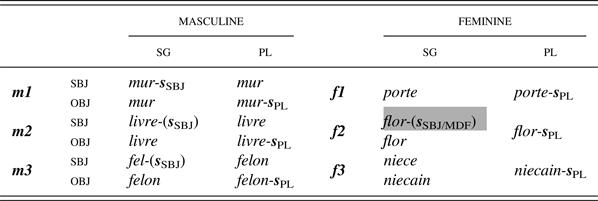
It is pertinent to examine OF n- and D-paradigms, as the φ-features that define them (case, definiteness, number, gender) also condition D-drop. Table 1 illustrates OF n-paradigms qua declension classes. In B and MdF, the masculine noun (n M) inflects for case (-sSBJ) or number (-sPL). As for the feminine noun (n F), it inflects only for number (-sPL) in B, but in MdF the second declension (f2) can also inflect for case (-sSBJ); this corresponds to the grey cell in Table 1.Footnote 2, Footnote 3
Old French n-paradigm (/mdf = form found only in MdF)
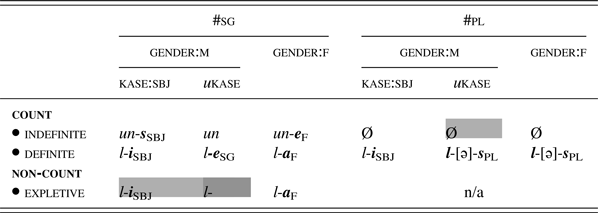
The D-paradigms of B and MdF are shown in Tables 2 and 3 respectively, with grey cells corresponding to loci of differentiation. Note that inherent gender on n conditions contextual inflectional gender on D.
Brendan D-paradigm
Lais de Marie de France D-paradigm
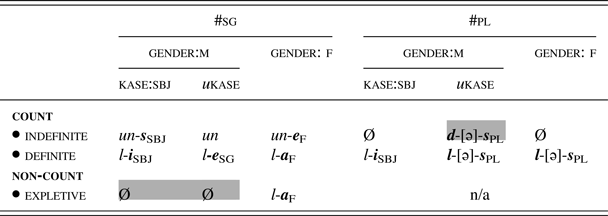
In count contexts, MdF has a DINDF.PL (des) that B lacks (Dufresne et al. Reference Dufresne, Tremblay and Déchaineto appear). In non-count contexts, we propose that there is a difference in inventory, with MdF lacking the masculine expletive D (l-) attested in B. This difference is subtle, as the OF D-base l- has a double life. First, as a semantically expletive D (Lekakou and Szendrői Reference Lekakou and Szendrői2012), l- spells out D with no contribution of definiteness, has a phonologically conditioned schwa [ǝ], subject case -i or feminine gender -a, and selects n NON-CT. Second, as DDEF, l- is accompanied by a morphologically conditioned vowel (-e SG, -i SBJ, -aF) and selects n CT. While B deploys definite and expletive le and li, MdF has only definite le and li. Note that the schwa that occurs with l-D.DEF can be analyzed as masculine gender (l-e M) or singular number (l-e SG). It marks m in Modern French (MF), but sg in OF. Motivation for analyzing OF le as l-e SG comes from comparing it with case-marked DDEF (l-i SBJ), which is number-neutral and occurs with n SG (9a) or n PL (9b). Notably, in (9b), uninflected mur ‘wall’ is construed as plural. This indicates that uninflected n is number-neutral: -s PL inflection on n forces a plural construal, but the absence of -sPL does not force a singular construal. The contrast in (9) illustrates blocking (Embick and Marantz Reference Embick and Marantz2008): in subject position -s SBJ blocks -s PL (9a), so the only way to express plurality is with uninflected n (9b).
(9)
a. l-i mur-s b. l-i mur
d.def-sbj wall-sbj d.def-sbj wall
‘the wall’ ‘the walls’
Consider DDEF.SG le, which can co-occur with case-inflected n in subject position, (10a). In the corpus data, le is used in lieu of li only with singular n CT.Footnote 4 Combining le with uninflected n yields a singular construal (10b); this differs from number-neutral li (9b), where the same combination yields a plural construal. The contrast between (9b) and (10b) confirms that le contributes singular number in (10b). With definite non-subject DPs, a plural construal is possible only if n inflects for -s PL (10c), in which case D (les) agrees in number with n. The obligatoriness of number agreement in (10c) supports the claim that the absence of -s PL on n in (9b) results from blocking.
(10)
a. l-e mur-s b. l-e mur c. l[ǝ]-s mur-s
d.def-sg wall-sbj d.def-sg wall d.def-pl wall-pl
‘the wall’ ‘the wall’ ‘the walls’
As for feminine forms with the l- D-base, in B and MdF -a codes feminine with DEXPL (l-a F) and DDEF (l DEF-a F). In our analysis, OF definite le is DDEF.SG (rather than DDEF.M); la is DDEF.F.
2.2 Agree and the realization of φ-features on D and n
We now turn to the question of how OF φ-features (case, definiteness, number, gender) are realized when D and n combine. As OF D-paradigms have three D-bases (indefinite, definite, expletive) it follows that φ-feature realization reflects this split. Specifically, morphological exponence realizes the Agree relation between n and D, that is, the span of functional categories that includes K, D, Num, and Gen. This means that the n-spine involves four Agree relations: Agree <K,n>, Agree <D,n>, Agree <Num,n>, and Agree <Gen,n >. We show how they manifest with DINDF, DDEF, and DEXPL.
Table 4 illustrates how agree plays out with DINDF un-. The first row shows case agreement, with -s SBJ on D and n. The second row shows indefiniteness agreement, realized as a selectional sortal relation where un INDF- selects n CT. The third row shows number agreement: because the cardinality of un is |1|, this is construed as a collective number (cf. (14) below). The fourth row shows gender agreement with n F and n M. The shaded second row is the least marked context, with only indefiniteness in play; note that [un n CT.M] in the last row is indistinguishable from this unmarked form.
Agree relations with indefinite D-base un–
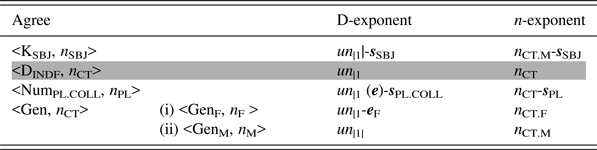
Table 5 shows how Agree is resolved with DDEF l-. The first row shows case agreement, realized as agreement between subject inflection on DDEF (-i SBJ) and n CT.M (-s SBJ). The second row shows definiteness agreement: l DEF selects n CT. The third row shows number agreement: l DEF-e SG agrees with unmarked (sg) n CT; l DEF[ǝ]-s PL agrees with plural-marked n CT-s PL. The fourth row shows gender agreement: l DEF-aF agrees with n CT.F. The shaded second row is the least marked context, with only definiteness in play.
Agree relations with definite D-base l–
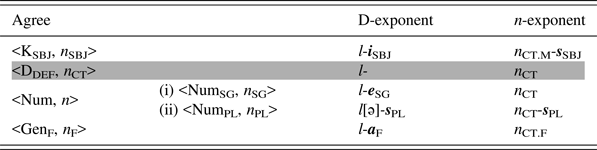
The resolution of Agree with DEXPL is shown in Table 6. The first row shows case agreement. The second row shows sortal agreement, with DEXPL selecting n NON-CT. As number is undefined for n NON-CT, as indicated in the third row, DEXPL does not participate in number agreement. The last row shows gender agreement: l-a FEM agrees with n CT.F. Tables 4–6 show how Agree in the n-spine is resolved; within the minimalist framework that we adopt, Agree arises in specific syntactic environments (Rezac Reference Rezac2011), which we now introduce.
Agree relations with expletive D-base l–

3. Syntactic analysis
We discuss nano-syntactic DP typology in section 3.1, introduce OF DP nano-syntax in section 3.2, and lay out the predictions of our analysis in section 3.3.
3.1 Nano-syntax of DP
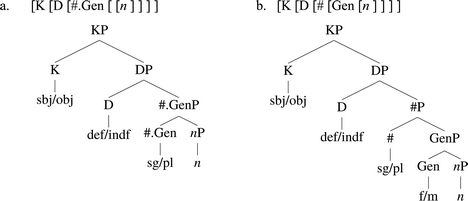
The φ-features that create paradigmatic contrasts in OF (case, definiteness, number, gender) correspond to distinct syntactic functional heads. Relevant is the fact that, cross-linguistically, DP syntax varies in how Num and Gen are realized. Gen, which introduces noun classification (Corbett Reference Corbett1991), is typically associated with the lower part of the n-spine (Ferrari Reference Ferrari2005, Lowenstamm Reference Lowenstamm, Hartmann, Hegedüs and van Riemsdijk2007). In some languages Gen and Num are realized on the same head, as in Bantu (Déchaine et al. Reference Déchaine, Girard, Mudzingwa, Wiltschko, Paciaroni, Thornton and Loporcaro2014); see (11a). But in languages such as Spanish (Picallo Reference Picallo2008), Gen and Num are distinct heads (Ritter Reference Ritter and Rothstein1991, Reference Ritter1993; Bernstein Reference Bernstein1993); see (11b).
(11)

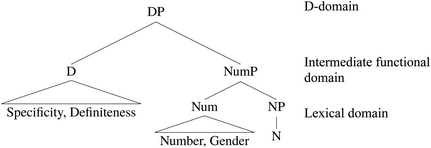
In Modern French (MF), Num and Gen are realized on the same head, as in (12), adapted from Granfeldt (Reference Granfeldt2004). D is the locus of specificity and definiteness; Num, an intermediate functional head, is the locus of number and gender; N (=n) is the lexical head. To situate MF relative to OF, consider the MF D-paradigm in Table 7, which shows that first, MF D does not inflect for case; second, MF DINDF.PL des and DDEF.PL les are gender-neutral; third, l-based D inflects for gender, contrasting l-e M with l-a F; and fourth, with n CT, Num and Gen compete. With this background, we now show that OF has both a Bantu-type and a Spanish-type DP.
(12) mf n-spine (adapted from Granfeldt Reference Granfeldt2004: 4, (5))
Modern French D-paradigm

3.2 Nano-syntax of Old French DP
Here we show that DP nano-syntax differs according to whether D combines with n CT or n NON-CT.
3.2.1 Count DP
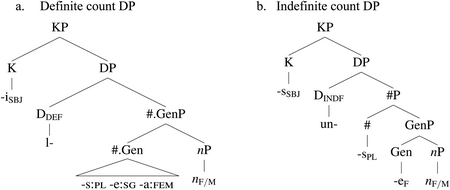
Count Ds show a definiteness split: l- spells out DDEF; un- spells out DINDF. In addition, Num and Gen are conditioned by definiteness. In the definite series, Num/Gen are substitutive, (13a); this derives plural l-[ǝ]-s PL, singular l-e SG, and feminine l-a F. In the indefinite series, Num and Gen are additive (13b); this derives two pl.coll Ds: masculine un-s PL and feminine un-e F-s PL. The latter confirms that, in the indefinite series, Num and Gen are distinct heads: (14a) is the pl.coll of n M degrez ‘steps’; (14b) is the pl.coll of n F eles ‘wings’.Footnote 5
(13)
(14)
a. un-s degre-z b. un-e-s ele-s
d.ind-coll step-pl ind-f-coll wing-pl
‘staircase’; lit ‘collection of steps’ ‘pair of wings’; lit. ‘collection of wings’
3.2.2 Non-count DP
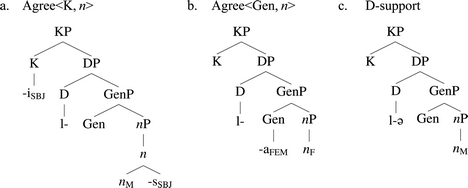
Non-count nouns do not participate in number contrasts; the absence of number on n NON-CT indicates that DPNON-CT lacks Num as a functional head, as in (15). The D-base for non-count DPs (l-) is the pure expression of D, and it inflects for case (l D-i SBJ) (15a) or gender (l D-a F), (15b). In the absence of case and gender, l D- is supported by a phonologically conditioned schwa (l D-[ǝ]).Footnote 6
(15) Non-count DP
3.3 Predicting the distribution of D-drop
The DP structures we propose for OF are summarized in (16). Our analysis makes the following claims. First, overt K forces D-to-K movement, which strands Gen and Num. This accounts for why K on D is in complementary distribution with Num and Gen. Second, overt D shows a sortal partition between n CT and n NON-CT, and with n CT, a definiteness partition that contrasts DINDF un with DDEF l. l- is also the base for DEXPL (lD-) which occurs with n NON-CT. Third, Num and Gen pattern differently in each D-series: (i) with DINDF, Num and Gen co-occur; (ii) with DDEF, Num and Gen compete; (iii) with DEXPL, only Gen is expressed. Fourth, n has inherent gender inflection, as well as contextual case (-s SBJ) and number (-s PL) inflection: n CT inflects for case (-s SBJ) or number (-s PL), but n NON-CT inflects only for case (-s SBJ).
(16)
a. [K -s SBJ [D.IND un- [# -s COLL [GEN -e F [n F/M-s SBJ/PL ]]]]] count: indf
b. [K -i SBJ [D.DEF l- [#.GEN {-s PL, -e SG, -a F} [n F/M-s SBJ/PL ]]]] count: def
c. [K -i SBJ [D l- [GEN -a F [n F/M-s SBJ ]]]] non-count
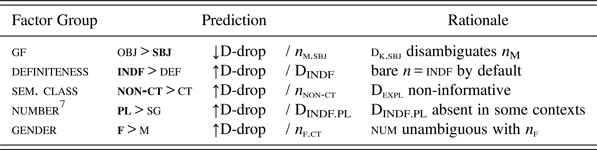
In addition to accounting for how φ-features map onto the n-spine, our analysis predicts that Num and Gen are a likely locus of variation and change in OF. While DPNON-CT lacks Num, DPCT expresses Num as a distinct syntactic head (indefinite DP) or as a feature that competes with Gen (definite DP). The factors identified in previous studies are factor groups in our variationist analysis, and we expect that the factor groups that condition D-drop (gf, semantic class, definiteness, number, gender) will show similarities and differences across the two texts. Specifically, we expect D-drop to pattern in the same way in both texts for the factor groups gf, definiteness, and semantic class. This is because, as shown in Table 8, these factor groups reflect the activity of invariant syntactic and semantic features: case inflection on D (first row), D-paradigms with a definiteness split (second row), a count/non-count contrast (third row), the absence of overt d.indf.pl in some contexts (fourth row), and unambiguous -s PL marking on n CT.F (fifth row). This leads to the following predictions. Relative to gf, with n CT.M, D-drop will be inhibited in sbj position because DSBJ disambiguates n M-s SBJ from n M-s PL. Relative to definiteness, D-drop will be favoured with DINDF as bare n is indefinite by default (Leonetti Reference Leonetti, Hualde, Olarrea and O'Rourke2012). Relative to semantic class, D-drop will be favoured with n NON-CT as DEXPL adds no information. Relative to number, D-drop will be favoured by DINDF.PL, as there are contexts where DØ is the only possibility. Finally, relative to gender, given the unambiguous number-marking with n CT.F, D-drop will be favoured in that context.
Predicted impact of factor groups that condition D-drop
(↑ = favoured; ↓ = inhibited; / = in the context of)
Since the syntax of Num and Gen varies, we expect them to be loci of variation. Our formal analysis predicts the changes in Table 9. Relative to number, in MdF, D-drop will be inhibited with indefinite plurals because of the introduction of the indefinite plural D des, initially attested with n M. Relative to gender, the change will present itself differently with n CT and n NON-CT. With n NON.CT, in MdF, D-drop will be favoured with n NON.CT.M because the decline of expletive D l D-[ǝ] and l D-i SBJ in MdF means n NON.CT.M occurs more often with DØ. In MdF, D-drop will be inhibited with n CT.M because of the introduction of DINDF.PL des with n M. To assess these predictions, we turn to our quantitative analysis of D-drop in B and MdF.
Predicted impact of factor groups contributing to change in D-drop:
(↑ = increase from B to MdF; ↓ = decrease from B to MdF; / = in the context of)

4. Quantitative analysis
We introduce the corpus in section 4.1, the variable rule program and coding procedure in section 4.2, and then present our findings in section 4.3.
4.1 Corpus analysis
Our data is drawn from the Voies du français corpus (Martineau et al. Reference Martineau, Dufresne, Dupuis, Hirschbühler, Kroch and Morin2005–2010, Martineau et al. Reference Martineau, Diaconescu and Hirschbühler2007, Martineau Reference Martineau2008), and syntactically parsed with Corpus Search (Randall et al. Reference Randall, Taylor and Kroch2009). Based on descriptions of OF Ds, as well as descriptions and analyses of Romance bare nouns (Longobardi Reference Longobardi1994, Dobrovie-Sorin and Laca Reference Dobrovie-Sorin, Laca, Godard and Abeillé2003, Dobrovie-Sorin et al. Reference Dobrovie-Sorin, Bleam, Espinal, Vogeleer and Tasmowski2006, Dufresne et al. Reference Dufresne, Tremblay and Déchaineto appear), we circumscribe the variable occurrence of D-drop as follows: (i) all n are coded for the predicate/argument contrast, word order (preverbal, interverbal, postverbal), and gender (masculine, feminine); (ii) argument n is further coded for gf (subject/object) and semantic class (count/abstract/mass); (ii) argument n CT is further coded for definiteness (definite/indefinite) and number (singular/plural).Footnote 8
4.2 Variationist analysis
Using the variable rule program GoldVarb Lion (Rand and Sankoff Reference Rand and Sankoff1990, Sankoff et al. Reference Sankoff, Tagliamonte and Smith2005) – which performs a stepwise logistic regression on multiple categorical predictors (factor groups) – we conducted a variationist quantitative analysis (Labov Reference Labov1963, Reference Labov1969, Reference Labov1972) of B and MdF with the goal of measuring the relative weight of linguistic factors. We applied a GoldVarb analysis on each text, which allows us to measure the significance (at the .05 level), size, and direction of changes in the factors (Poplack and Tagliamonte Reference Poplack and Tagliamonte2001). To measure the effect size, the program assigns factor weights (probabilities) to each factor in a group: factor weights higher than .5 or lower than .5 on a 0–1 scale indicate that the application value is favoured or disfavoured, respectively. The effect size is measured by the range, which is the difference between the highest and lowest factor weight within a given factor group. The order of factor groups mirrors the order of factor strength as assessed by range, and indicates the direction of the effect: factor groups with higher ranges are stronger constraints.
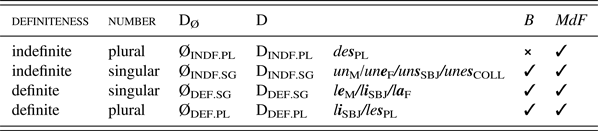
definiteness and number identify four variants of DØ, with each one having an overt counterpart, as in Table 10. For DINDF, there is one exponent of DINDF.PL (des, attested only in MdF), four exponents of DINDF.SG (un, une, uns, unes), three exponents of DDEF.SG (le, la, li), and two exponents of DDEF.PL (les, li). For DDEF, note that: (i) subject li is number-neutral and can introduce plural or singular n; (ii) following descriptive tradition we code le as masculine, as it always accompanies n M. However, le can be analysed as DDEF.M, DDEF.SG, or DEXPL (see section 2).
Old French variants of D and DØ
4.3 Results of quantitative analysis
We look at D-drop in three contexts: argument n, argument n NON-CT, and argument n CT. For each context, we consider three things: first, whether text conditions D-drop; second, which linguistic factor groups condition D-drop; and third, if relevant, the significance in changes in the proportion of D-drop.
4.3.1 Distribution of D-drop with argument n
Table 11 shows that with argument n, B mildly favours D-drop (.626), MdF mildly inhibits it (.453), and there is a highly significant decrease (p < .001) in D-drop from B (33.3%) to MdF (19.8%). This raises the question of whether D-drop decrease is uniform across all contexts.
Contribution of text to probability of D-drop with argument n

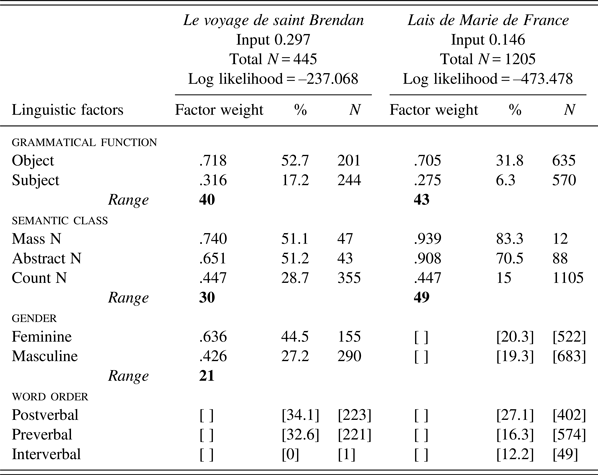
To identify where and how D-drop decreases, we ran a multivariate analysis on each text, and compared the results. This allowed us to establish the relative weight of linguistic factors within a text. In addition, juxtaposition of these results allowed us to compare the patterning of D-drop across the two texts. Similarity in the patterning of variability – similarity in significance, range and ranking – indicate the underlying grammars are similar. Conversely, dissimilarities in significance, range and ranking indicate that the underlying grammars are different. Table 12 shows that, with argument n, gf is a highly ranked and stable constraint, with a range of 40 in B, and 43 in MdF. For semantic class, which is significant in both B Footnote 9 and MdF, there is an increase in range (30 in B; 49 in MdF). Although there is an overall decrease of D-drop in almost all contexts (subject and object, feminine and masculine, postverbal and preverbal), there is an increase of D-drop with mass n (B: 51.1% to MdF: 83.3%) and abstract n (B: 51.2% to MdF: 70.5%). Thus, n NON-CT favours D-drop in both texts, but even more so in MdF. The larger value in the range for semantic class in MdF indicates that, between B and MdF, though there is an overall decrease of D-drop with argument n, there is an increase of D-drop with n NON-CT. Also, with argument n, gender is a significant factor group in B (range of 21), with n F mildly favouring D-drop (.636) and n M mildly inhibiting it (.426). However, gender is not a significant factor group in MdF.
Factors contributing to probability of D-drop with argument n
(Factor groups not selected as significant are in square brackets.)
4.3.2 Distribution of D-drop with non-count argument n
Table 13 shows that with n NON-CT, MdF mildly favours D-drop (.605), B strongly inhibits it (.384), and there is a significant increase in D-drop from B (51.1%) to MdF (72.0%).
Contribution of text to probability of D-drop with non-count n

Table 14 shows that, with n NON-CT, gf continues to be a significant and stable factor group conditioning D-drop, with a range of 33 in B, and 30 in MdF. In addition, gender emerges as a significant factor group in MdF, with masculine favouring D-drop with n NON-CT. Finally, with n NON-CT, neither semantic class (mass versus abstract n) nor word order emerge as significant factor groups. Table 14 also shows that the increase of D-drop with n NON-CT (abstract and mass) is attributable only to n M, which shows an increase from 45.2% (B) to 82.1% (MdF), which is highly significant (p = .000237). This contrasts with feminine n NON-CT which shows a stable rate of D-drop, 64.3% in B and 65.6% in MdF. We conclude that, with n NON-CT, the overall increase in D-drop between B and MdF is attributable to n M.
Factors contributing to probability of D-drop with non-count n
(Factor groups not selected as significant in square brackets.)

4.3.3 Distribution of D-drop with count argument n
Table 15 shows that text is a significant factor group in conditioning D-drop with n CT: B favours D-drop (factor weight of .651), and MdF inhibits D-drop (factor weight of .450). There is a significant decrease in D-drop from B (28.7%) to MdF (15%).
Contribution of text to probability of D-drop with count n
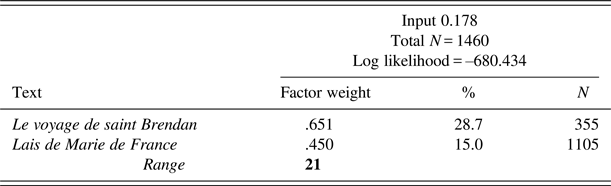
Table 16 shows that for n CT, the significant and stable factor groups are definiteness, number, and gf. Their range remains the same. Their ranking also remains the same across the two texts: namely definiteness > number > gf. gender emerges as an unstable factor group, significant only in B, with feminine favouring D-drop. This indicates that, with n CT, gender is a locus of change.
Factors contributing to probability of D-drop with count n
(Factor groups not selected as significant in square brackets.)
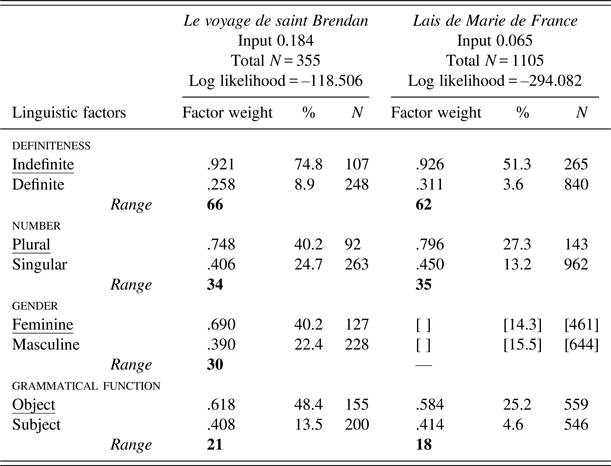
In addition to identifying which factor groups are stable for D-drop with n CT, Table 16 also shows that the decrease of D-drop is systematic, since in all contexts there is a decrease in the proportion of D-drop with n CT.
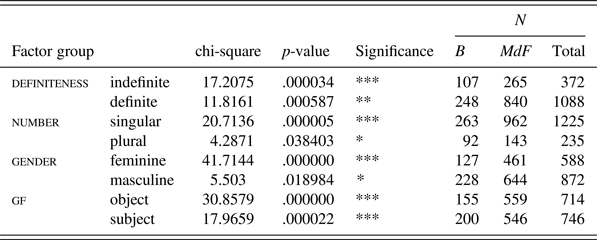
Two questions remain. For n CT, is the decrease of D-drop from B to MdF significant for all factor groups and for each factor within a factor group? For a given factor group, do the factors participate equally in the change? To answer these questions, we used a chi-square test to compare the significance of decrease in D-drop between B and MdF for each factor of the factor groups that emerged as significant in the GoldVarb analysis, namely definiteness, number, gf and gender.
Table 17 confirms that the decrease of D-drop from B to MdF is significant for all factor groups and for each factor within a factor group. It also indicates that within a factor group, not all factors participate equally in the change. For number, there is a sharp difference between pl and sg n CT (pl is more stable). For gender there is a sharp difference between n F and n M (n M is more stable). However, these differences are not equally robust. The difference between n CT.SG and n CT.PL is attributable to sample size: 1225 n CT.SG versus 235 n CT.PL. The difference between n F and n M is a more solid finding, as the sample size is comparable (588 n F, 872 n M) and the highly significant factor contains fewer tokens (588 n F) than the significant factor (872 n M). We conclude that, with n CT, the decrease in D-drop between B and MdF is mainly attributable to n F.
chi-square test of D-drop decrease with count n
(*** = highly significant (p < 0.001); ** = very significant (p < 0.01); * = significant (p < 0.05))
4.4 Summary of quantitative analysis
The GoldVarb analysis, enriched by the results of the chi-square test with n CT, yields a snapshot of progress in change. First, while there is an overall decrease in D-drop with n CT, there is an increase of D-drop with n NON-CT. Second, some factor groups are stable (gf, definiteness, number), others unstable (semantic class and gender), and others (word order) are not significant in conditioning D-drop. That word order emerges as not significant converges with Mathieu (Reference Mathieu, Ghomeshi, Paul and Wiltschko2009). In addition, the quantitative results identify gender as a locus of change: D-drop increases with n NON-CT.M, while it decreases with n CT.F.
5. Tracking the trajectory of φ-features
We revisit the trajectory of OF φ-features relative to the loci of stability (section 5.1) and change (section 5.2), and assess, in section 5.3, to what extent our morpho-syntactic analysis captures them.
5.1 Loci of stability
In assessing loci of stability, it is instructive to consider whether the formal and quantitative analyses diverge or converge. The formal analysis identifies number as a locus of change, but quantitative results indicate that it is stable. For this reason, we defer discussion of number to section 5.2, and focus here on definiteness and gf, which are identified as loci of stability by both formal and quantitative analyses.
5.1.1 definiteness
definiteness is the highest ranked factor group overall, with a range of 66 in B and 62 in MdF (see Table 16). In both texts indefinite contexts strongly favour D-drop (factor weights above .9), while definite contexts strongly inhibit it (factor weights below .35). The strength of definiteness as a factor group can be understood in two ways. First, on formal grounds D is the primary functional head of the n-spine and is the locus of the definiteness contrast (Déchaine and Tremblay Reference Déchaine, Tremblay, Galeano, Görgülü and Presnyakova2012). Accordingly, the robustness of definiteness as a factor group might reflect its UG status, and so should emerge as a highly ranked factor group in all languages. Alternatively, given that OF D-paradigms, and perforce DPs, have a definiteness partition, it could be that the high ranking of definiteness is a language-specific property. If so, we would expect definiteness to emerge as a highly ranked factor group only in languages with a morphological definiteness contrast. Finally, the fact that definiteness remains a stable factor despite the overall decrease of D-drop between B and MdF indicates that it is not a trigger of change; this is consistent with it being a stable UG-property.
5.1.2 gf
In B and MdF, gf is a significant and stable factor group – object position favours D-drop and subject position inhibits it – for all argument n, whether they are n NON-CT (B: 33, MdF: 30) or n CT (B: 21, MdF: 18). The stability of gf reflects the fact that gf tracks the function of a nominal and so involves DP-external syntax. In OF, the morphological correlate of gf is case inflection. Consider the trees in (17), which show how case-marked (in)definite DPs are resolved with overt D. An arrow indicates movement; circled nodes participate in Agree. Case inflection (-i SBJ or -s SBJ) triggers D-to-K movement, deriving DDEF l-i SBJ and DINDF un-s SBJ; Agree <K, n> derives case-inflection (-s SBJ) on n M. Now consider what happens if D-drop applies, shown in (18). When functional categories lack phonological content, -s inflection on n is ambiguous: it can be -s PL or -s SBJ. Subject DPs are under pressure to retain overt D to disambiguate inflectional -s. Subject case inflection is present in B and MdF, and as predicted by our syntactic analysis, quantitative results indicate that subject position inhibits D-drop. In our account, the subject/object asymmetry observed in OF is not because object position favours D-drop, as proposed by Longobardi (Reference Longobardi1994) for Italian.
(17)
(18)
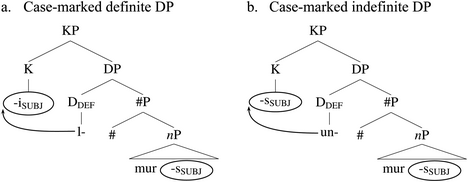
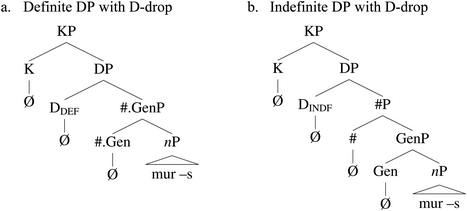
On a more speculative note, we draw attention to gf as a DP-external factor group. All the other linguistic factor groups that are significant – definiteness, number, and gender – are DP-internal. In particular, the [D-Num-Gen] cluster forms a morpho-syntactic span (Williams Reference Williams2003), as confirmed by the fact that OF case-inflection on D is in complementary distribution with Num and Gen. Our syntactic analysis models this structurally: case-inflection is resolved as D-to-K movement, and this movement strands Num and Gen, bleeding movement of Num and Gen to D. In the definite series, this blocks *l-a F-i SBJ, *l-e SG-i SBJ, and *l-[ǝ]s PL-i SBJ. In the indefinite series, this blocks *un-e F-s SBJ, *un-s PL-s SBJ, and *un-e F-s PL-s SBJ. These blocking effects follow if DP-external syntax (qua case-inflection as D-to-K movement) is distinct from DP-internal syntax (qua number and gender inflection as Num/Gen movement to D). These competition effects converge with claims in the theoretical literature that DP is a phase for movement (Adger Reference Adger2007).
5.2 gender as a locus of change
The quantitative analysis detects two loci of change: masculine gender (with n NON-CT) and feminine gender (with n CT). We argue in section 5.2.1 that masculine gender as a locus of change reflects the decline of DEXPL.M in MdF with n NON-CT. As for the disappearance of gender as a conditioning factor with n CT, at present this remains mysterious, but in section 5.2.2 we speculate on possible causes. In addition, though it does not emerge as significant in the quantitative analysis, there is a qualitative change in the D-inventory via the introduction of the (masculine) indefinite plural D des in MdF, discussed in section 5.3.
5.2.1 Non-count nouns
From B to MdF, there is an increase of D-drop with n NON-CT. In B, n NON-CT combines with DEXPL that inflects for case (l-i SUBJ), gender (l-a F), or is the pure expression of D (l-[ǝ]). In MdF, the decline of [l-[ǝ] + n NON-CT] and [l-i SUBJ + n NON-CT] is attributable to the (gradual) disappearance of expletive l- with n NON-CT.M. Though MdF retains l D.DEF-e SG and l D.DEF-i SBJ with n CT, l D.DEF cannot combine with n NON-CT, as this would be a sortal mismatch. (In our analysis, combining DDEF with n NON-CT violates Agree<D, n>.) In sum, the decline of DEXPL in MdF is mirrored by an increase of D-drop with n NON-CT.M. The independence of expletive l D-a F and l-[ǝ] is consistent with our analysis, which treats -a as the D-exponent of Agree<GenF,n F>. With DEXPL there is no counterpart *Agree<GenM,n M>, so we correctly predict no parallelism between l D-a F (which does participate in gender agreement) and l D-[ǝ] (which does not participate in gender agreement).
Our morpho-syntactic analysis of DEXPL contrasts with that of Simonenko & Carlier (Reference Simonenko and Carlier2016), who develop a semantic treatment that treats all exponents of l- as semantically weak Ds. Moreover, they assume that n NON-CT does not occur with D in OF; for the two OF texts that we study, though D-drop is more frequent with n NON-CT, it is not obligatory. Although we believe that the weak D analysis is correct for MF, the gender contrast found with n NON-CT does not support a weak D analysis for OF. Rather, in B and MdF, DEXPL and DDEF are distinct D-paradigms, as confirmed by the distributional differences that we have documented.
5.2.2 Count nouns
With n CT there is a decrease of D-drop from B to MdF, and gender is a significant factor group conditioning D-drop with n CT in B, with n CT.F favouring D-drop. This gender effect with n CT disappears in MdF. This change is not predicted by our analysis, and though we have no clear understanding of what drives it, we offer some speculative comments.
The increase in the use of overt D is accompanied by the disappearance of gender as a conditioning factor in MdF. This is puzzling, as the unambiguous number-marking of OF n CT.F favours D-drop. One can understand this as follows: if inherent gender inflection on n is no longer a conditioning factor, then we expect all n CT (n F and n M) to pattern together; this is what happens in MdF. The unsolved question is what drives this change. There are three possible sources: the syntax of n, the syntax of D, or both acting in concert. First, if a change in the declension system neutralizes the f/m contrast, then gender would not be criterial for D-drop with n CT. However, there is no detectible change in the declension classes at this stage. Second, it could be that D drives the change: recall that DINDF and DDEF differ in how they spell out Num and Gen, with DINDF having distinct Num and Gen heads, but DDEF a collapsed Num/Gen head. If, in MdF, DINDF collapses Num/Gen, this would lead to the neutralization of gender with n CT. Third, it could be that the combined effect of [D n CT.M] acts as a pull chain on [D n CT.F]. In all three scenarios, the change would take place at the same rate in all contexts, reflecting the same underlying change, namely a move away from D-drop.
5.3 Assessing the predictions
Consistent with the formal analysis, the quantitative results confirm that subject position inhibits D-drop, indefinite contexts favour D-drop, n NON-CT favours D-drop, and plural favours D-drop. As for gender, with respect to n CT, B behaves as expected, with n CT.F favouring D-drop. The unexpected twist is that MdF does not pattern in this way, showing no gender effect with n CT. Finally, we expect that the introduction of the overt DINDF.PL des in MdF would inhibit D-drop with plural n CT. At this stage of the grammar, the qualitative change in the D-inventory is not detected in the quantitative analysis. This is likely because there are so few tokens of des in MdF. The remaining prediction – increase in D-drop with n CT.M because of the introduction of DINDEF.PL des with nM – is likewise undetected by the quantitative analysis, again likely because of sample size.
6. Conclusion
In the spirit of Cornips (Reference Cornips, Adli, García and Kaufmann2015), our aim has been to show that combining formal and quantitative tools allows a more precise modeling of language change. Variationist analysis provides insight into the structure of different grammars, by measuring the significance of various factors, as well as their ordering and relative strength. Relative to the two texts investigated here – which have the status of two grammars in variationist modelling – our study uncovers three novel findings, listed in (19).
(19)
a. With n NON-CT, quantitative analysis confirms a contrast between definite l D.DEF versus expletive l D, as manifested by an increase in D-drop with n NON-CT.M in MdF. This increase in D-drop is attributable to the decline of masculine DEXPL in MdF.
b. With n CT, quantitative analysis indicates that gender is a significant factor group in B, with n F favouring D-drop. This trend is reversed in MdF, where gender is not a significant factor group. Moreover, across the two texts, with n CT, there is an overall decrease of D-drop, a decrease that is more significant with n CT.F than count n CT.M.
c. In addition to paradigmatic changes, there is a change in D-inventory, with the presence of DINDF.PL (des) in MdF in the third quarter of the 12th century indicating that it is attested at an earlier date than advanced in previous studies, which locate the 13th century as the time when des is introduced (Buridant Reference Buridant2000, Carlier Reference Carlier and Arteaga2013).
In closing, we highlight one of the research perspectives that a detailed investigation of D-drop opens up. One question that immediately presents itself is how OF D-drop compares with D-drop in other languages, and in particular with the diachrony of D-drop in Romance. A possible next step would be to determine if the factors identified in the present study interact in a similar fashion in other Romance languages (Stark Reference Stark, Stark, Leiss and Abraham2007, Reference Stark, Müller and Kinge2008). In this regard, it is relevant that ever since Postal (Reference Postal, Reibel and Schane1969), it is widely recognized that determiners and pronouns belong to the same category (Longobardi Reference Longobardi1994, Reference Longobardi, Baltin and Collins2001; Déchaine and Wiltschko Reference Déchaine and Wiltschko2002; Kiparsky Reference Kiparsky and Good2008). If so, we might expect that loss of D-drop in OF to follow a parallel trajectory to that of pro-drop, and to exhibit a constant rate effect (Kroch Reference Kroch1989). A confound is that OF pro-drop does not behave as predicted by Rizzi's (Reference Rizzi1982) parametric analysis, according to which a referential subject pronoun is possible only if accented. Rizzi's analysis further links the accentuation of overt pronouns to the absence of overt expletive pronouns, since the latter are never accented. However, OF has both overt subject pronouns and overt expletive pronouns; moreover, when subject pronouns are expressed, they do not necessarily have an emphatic interpretation. The existence of unaccented pronouns together with the variable occurrence of subject pro-drop in OF has led some linguists to consider OF as a ‘semi pro-drop’ language (Holmberg Reference Holmberg, Biberauer, Holmberg, Roberts and Sheehan2009). This is especially relevant in light of the fact that the present study shows that variable D-drop in OF is sensitive to the contrast between referential (i.e., definite and indefinite) and expletive D. This raises the question of whether variable pro-drop in OF is sensitive to the contrast between referential and expletive pronouns. We anticipate that future research will shed light on this.



